My Son-in-Law Sent Me to the Kids’ Table While Collecting $84,000 for His Food Truck—Then I Walked Into Church With One Piece of Paper
Complete story · 10 chapters · about 54 minutes · ending included
Chapter 1 · Chapter 2 · Chapter 3 · Chapter 4 · Chapter 5 · Chapter 6 · Chapter 7 · Chapter 8 · Chapter 9 · Chapter 10
Chapter 1: The Folding Table by the Door
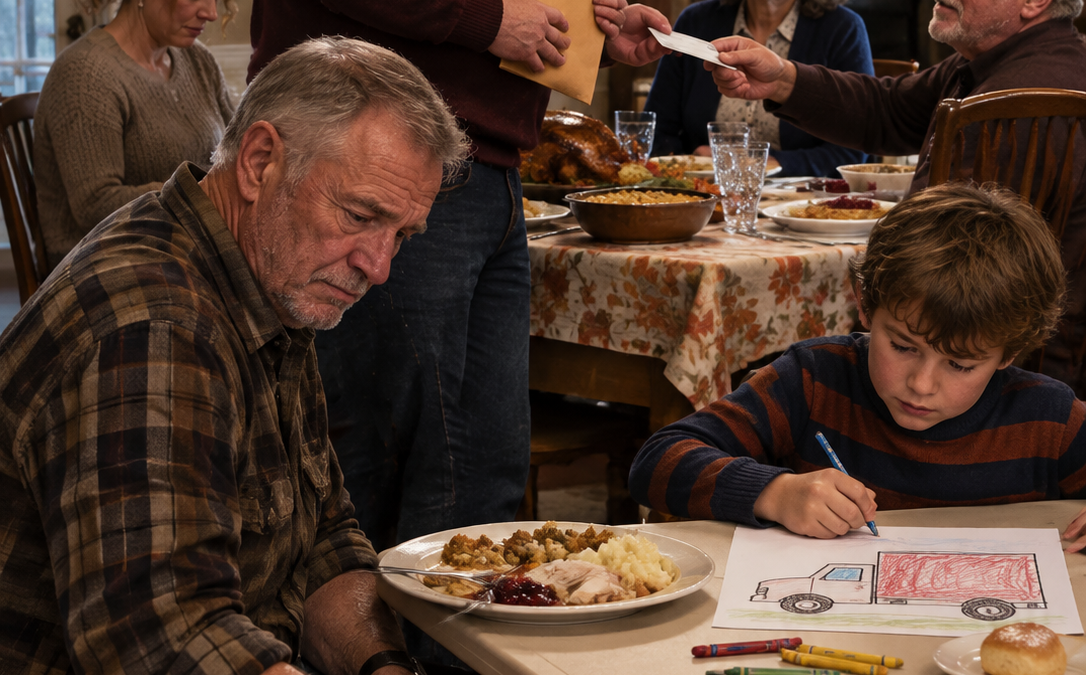
At 3:40 p.m. on Thanksgiving, Matt Hartwig lifted my dinner plate off the big table and carried it to a folding table beside my eight-year-old grandson.
“Kids’ table, Pop. Adults are talking money.”
Then he looked toward the others and laughed.
“You paint bumpers, Pop. Nobody asks the help about money.”
I pulled out the metal chair.
My knees hit the underside before I could get comfortable.
“Pass the rolls, Will.”
Will reached for the basket. Beth kept her eyes on her plate.
I was sixty-six years old. I’d spent most of my working life painting cars, standing on concrete floors, and fixing things other people had damaged. I knew when a surface looked better than the structure underneath it.
That afternoon, Matt’s family dinner had a good surface.
The rented house was warm, the turkey was carved, and six households had gathered around the dining table. There were serving dishes between the guests and a bottle of cider near the center.
My daughter, Beth, had cooked some of the food. She’d been laid off from her kitchen job and was running the truck with Matt.
I had come expecting to hear more about Matt’s food-truck business.
For weeks, he’d been talking about expansion. More customers, longer routes, better equipment. He’d mentioned a second truck more than once.
I figured that was what the gathering was about.
Matt had a way of making an announcement sound like a celebration before anyone knew what they were celebrating.
He was thirty-nine, an RV salesman, and an usher at our church. He laughed loudly, slapped shoulders, and called me Pop even when he was asking for something.
That afternoon, he was wearing a clean blue shirt with the sleeves rolled to his elbows.
He had already placed a bank envelope beside his chair.
I watched him return to the big table after moving my plate.
Nobody asked why I had been moved.
Beth was thirty-seven. She was my only daughter, and I knew the small movements she made when she wanted a difficult conversation to end.
She picked at a loose thread on her napkin.
I waited for her to look up.
She didn’t.
Will pushed the rolls toward me.
“Grandpa, do you want the end one?”
“That’s the good one.”
He smiled and took another.
At the big table, Matt stood and picked up the bank envelope.
“All right, everybody. Before we eat dessert, I want to get this part handled.”
The conversations stopped.
Matt began walking around the table.
The first household handed him a check.
He placed it inside the envelope without unfolding it.
The next household did the same.
I watched the checks disappear one after another.
Six households had agreed to invest in Matt’s company. I knew there had been conversations about it, though I hadn’t paid much attention to the details.
I thought they were helping him buy another vehicle.
Matt had talked about needing more capacity. The existing truck couldn’t handle every event and route he wanted.
That made sense to me.
I’d seen what a busy food truck could earn on a good weekend.
Matt stopped beside one of the guests and thanked him.
Then he moved to the next.
The checks were all payable to the company, Lake Street Smoke.
Don Hartwig was last.
Don was sixty-eight, Matt’s uncle, and a retired machinist. He had spent decades working with his hands. He was a loud man who liked to back his family, especially when somebody else questioned them.
He reached into his shirt pocket and pulled out his checkbook.
“Here you go,” Don said.
Matt accepted the check and slid it into the envelope.
“Appreciate it, Uncle Don.”
Don nodded.
Matt returned to the center of the room and held up the envelope.
“That’s eighty-four thousand dollars. Eighty-four thousand. We’re finally ready to move this company forward.”
A few people clapped.
Matt waited for the noise to settle.
Then he said, “That truck is paid off and owned by the company.”
I looked toward the kitchen window.
The cherry-red step van was parked outside.
I’d seen it enough times to recognize the slight difference in the rear panel where a repair had been made.
I assumed Matt meant the company had finished paying for its existing vehicle and could now purchase another one.
It sounded like good news for Beth.
She’d lost her cooking job, and the truck had become her main source of work.
I wanted the business to succeed.
I had never expected Beth to spend her life worrying about whether the next paycheck would cover the bills.
Matt tucked the envelope under his arm.
“We’ll make the formal announcement next Sunday,” he said. “Founders’ Sunday. Everybody will see what we’ve built.”
Don raised his glass.
“To Lake Street Smoke.”
The others joined him.
I lifted my water glass at the folding table.
Will was still drawing.
He had colored the body of a truck red and given it four black wheels. There was a little square window near the front and a tall exhaust pipe behind the cab.
Picking up where the Facebook post left off
“That’s a nice one,” I said.
“It’s supposed to be our truck.”
He turned the page toward me.
“See? I made the door big so people can get their food.”
I smiled.
Then I turned the paper over.
The other side wasn’t blank.
It was a page from Matt’s investment packet. There were printed lines, a few paragraphs, and a sentence near the middle that stopped my hand.
Truck: owned outright by the company.
I held the page by its corners.
The words were plain enough.
I looked toward the big table.
Matt was talking to Don. The bank envelope sat beside his elbow.
I looked back at the drawing.
Will had colored the truck carefully, keeping the red inside the outline except around one wheel.
“Grandpa?”
“Yeah?”
“Do you like it?”
“Sure do.”
I folded the paper once and slipped it into my shirt pocket.
Will returned to his crayons.
I didn’t ask him where he’d found the page. I didn’t want to make the boy feel he’d done something wrong.
The dinner continued.
People talked about the business, the holidays, and the coming Sunday gathering.
Matt mentioned the new account and said everything would be ready by Monday.
I listened without joining in.
The folding table wobbled whenever somebody leaned against it. I put one hand on the edge to steady it while Will ate.
Beth got up once to bring more potatoes from the kitchen.
She passed behind my chair.
“Everything okay, Dad?” she asked quietly.
“Fine.”
She nodded and kept walking.
I wanted to ask what she’d been told about the truck.
Instead, I finished my meal.
When people started clearing plates, I carried mine to the kitchen and thanked Beth for dinner.
Matt was already outside.
I found him beside the cherry-red step van, looking at his phone.
The afternoon air had turned cold. A few cars were parked along the driveway, and the light was beginning to fade.
I stopped beside the truck.
“Matt.”
He looked up.
“What’s up, Pop?”
I took the folded page from my pocket.
I didn’t hand it to him.
I held it between two fingers.
“Whose truck is that?”
Matt glanced at the page, then at the vehicle.
For a second, he said nothing.
Then his familiar smile came back.
“That’s the company truck.”
“Your packet says it’s owned outright by the company.”
“Right.”
I looked at the red door.
I’d spent hours working on that paint. I knew where the color changed slightly near the lower panel, where I’d had to make another pass to get it even.
I knew the vehicle.
I knew what it had cost to get it on the road.
“I’m asking whose truck it is.”
Matt slipped his phone into his pocket.
“Pop, we’ve already talked about this.”
“We haven’t.”
He gave a short laugh.
“You’re signing it over at Founders’ Sunday, Pop, in front of everybody.”
I looked at him.
“Signing what?”
“The transfer. We’ll have the paperwork ready.”
He said it as if I had forgotten an appointment.
I glanced toward the house.
Through the window, I could see people gathering dishes. Beth was standing near the kitchen counter.
Matt followed my eyes.
“It’s a big day for us,” he said. “People have put real money into this. They need to see we’re serious.”
I looked down at the folded page.
The six households had handed over their checks believing the company owned the truck.
Matt had announced the ownership in front of them.
And now he was telling me there would be a transfer ceremony the following Sunday.
I hadn’t agreed to one.
I hadn’t promised him anything.
Yet he spoke as if the signature were already settled.
“Why Sunday?” I asked.
“Because that’s Founders’ Sunday. Forty people are coming. We’ll show them the truck, make the announcement, and get everything signed.”
“Forty?”
“That’s right.”
He sounded pleased.
I put the paper back into my pocket.
I thought about the six checks inside that bank envelope. Eighty-four thousand dollars was a lot of money for six households to put into a business.
Some of those people had worked years to save what they were investing.
Don was one of them.
I knew Don trusted Matt. I also knew Don didn’t have money sitting around without a purpose.
Matt had given everyone a reason to believe the investment was safe.
He had also given them a date.
I couldn’t understand why he was so certain I’d cooperate.
I hadn’t agreed to sell the truck.
I hadn’t agreed to transfer it.
And I hadn’t told him he could call it company property.
Matt walked around the front of the van and stopped beside the hood.
He placed his palm against the red paint.
“Pop, listen.”
I looked at him.
“Beth’s whole life rides on this. Don’t make her choose.”
He patted the hood.
I stayed beside the truck, my hand resting against the folded page in my pocket.
Through the window, Beth was still inside.
Chapter 2: The Letter in the Toolbox
Friday morning, I unlocked the toolbox drawer at the collision shop.
I hadn’t opened it the day before. The page from Will’s drawing was still folded in my shirt pocket when I came home, and I’d spent most of the night thinking about what Matt had said.
Now I wanted to see exactly what I had.
The original Wisconsin title lay beneath an old shop rag. My name was printed on the owner line.
The assignment section was blank.
I lifted the title carefully and set it on the workbench.
Underneath it was the loan letter dated May 12, 2023.
Three signatures were at the bottom.
Mine.
Matt’s.
Beth’s.
I sat on the stool beside the toolbox and read the letter.
It documented what I’d agreed to from the beginning. I was lending the truck so Beth could have a way to earn a living. The truck remained my property. Matt could use it for the business, but the title would not change without my signature.
I had kept that letter because I knew how quickly family arrangements could become misunderstandings.
I hadn’t expected anyone to pretend the arrangement had never existed.
The truck had cost me $41,000.
I’d bought it at an auction after losing my previous job. The collision shop had cut back, and I was one of the men who didn’t make the next schedule.
I was sixty-three then, with a retirement account I’d spent years building.
I could have left the money alone and looked for another job.
Instead, I saw the step van at auction and thought about what Beth needed.
She’d been struggling to find steady work. Matt was talking about a food business, and Beth knew how to cook for a crowd.
I took $41,000 from my 401(k), bought the van, and spent my own time getting it ready.
I painted it cherry red.
We called it Lake Street Smoke.
Matt had wanted the title in his name.
That was where I drew the line.
He had a $23,000 judgment from a failed car lot, and I wasn’t willing to put a vehicle I’d bought with my retirement money under his name.
I explained that the truck would stay mine while Beth worked.
The loan letter put it in writing.
All three of us signed.
At the time, nobody argued.
I slid the letter into a clear sleeve and placed it beside the title.
Matt’s packet said the company owned the truck outright.
My original title said otherwise.
I locked the drawer.
Later that morning, I went to find Beth at the truck.
She was near the serving window, checking something inside. The red paint looked bright in the daylight, and the name on the side was still clean.
“Beth.”
She turned.
“Hi, Dad.”
I held the folded loan letter in my hand.
“Did Matt tell you the truck belongs to the company?”
Her eyes moved toward the paper.
“He said you agreed.”
“I didn’t.”
She wiped her hands on a towel.
“Please, Dad, not on his big day.”
I stepped closer.
“Look at this.”
I unfolded the letter and held it where she could see the date and signatures.
Beth glanced at the top.
Then she looked toward the serving window.
“It’s from two years ago,” she said.
“It’s from the day we agreed I’d lend the truck.”
“Matt said you were okay with transferring it.”
“I never agreed.”
Her mouth tightened.
She didn’t look at the letter again.
“Dad, everybody has already put money into this.”
“I know.”
“They’re counting on him.”
“They’re counting on what he told them.”
She folded the towel and set it on the counter.
I waited for her to say something about the signatures.
She didn’t.
“Please don’t ruin Sunday,” she said.
I put the letter away.
“I didn’t arrange any of this, Beth.”
She turned back toward the truck.
I stood there another few seconds, hoping she’d ask to see the title.
She didn’t.
I left without making her choose between us.
At the shop, I returned to my work.
There were two vehicles waiting for paint preparation, and I had a list of repairs to finish before the weekend.
I was sanding a replacement bumper when I heard the front door open.
Matt walked in.
Two coworkers were working in the next bay. One was cleaning a spray gun, and the other was checking a panel under the shop lights.
Matt didn’t ask whether I was busy.
“Pop. Got a minute?”
I set the sanding block down.
“What do you need?”
He glanced toward the other men.
Then he smiled.
“I just want to make sure we’re all on the same page about Sunday.”
“We aren’t.”
His smile faded a little.
“Come on. Don’t start this again.”
I wiped the dust from my hands.
“I never agreed.”
Matt looked past me at the two coworkers.
Then he gave a short laugh.
“You paint bumpers, Pop. Nobody asks the help about money.”
Neither coworker said anything.
One of them stopped cleaning the spray gun.
I looked at Matt.
“You have my title?”
“We’ll have the transfer paperwork Sunday.”
“That’s not what I asked.”
He stepped closer to the workbench.
“Everybody knows what we’re doing. Six families have put money into this. You can’t change things now because you’re having second thoughts.”
“I haven’t changed anything.”
“You’re making Beth’s life harder.”
I kept my hands on the workbench.
“Don’t put this on her.”
Matt shook his head as though I were being unreasonable.
“She’s the one who has to live with this.”
He glanced at the men in the next bay again.
I could tell he wanted them to hear enough to understand that I was the problem.
“Pop, I thought you’d be happy for us.”
“I am happy when Beth has work.”
“Then sign the paperwork.”
“No.”
His expression changed.
It wasn’t a big change. The smile simply disappeared, and his jaw tightened.
“You’re going to embarrass the whole family.”
“I bought that truck.”
“And we’re making something out of it.”
“I lent it to you.”
He looked toward the other bay.
“See? This is what I’m talking about.”
I picked up the sanding block.
The conversation was over as far as I was concerned.
Matt stood there another moment, then turned toward the door.
“Sunday, Pop. Don’t forget.”
The door closed behind him.
My coworker resumed cleaning the spray gun.
The other man went back to his panel.
Neither asked what had happened.
I understood why. It was family business, and nobody wanted to be pulled into it.
But Matt had chosen to come into my workplace and make me look like an old employee who didn’t understand money.
I went back to sanding.
For the next hour, I concentrated on the bumper.
The surface needed to be smooth before primer. If I rushed it, the flaws would show under the paint.
My phone rang just after noon.
Don Hartwig’s name appeared on the screen.
I answered.
“Hey, Don.”
He didn’t bother with a greeting.
“John, what’s going on?”
“About what?”
“Matt’s truck.”
I leaned against the workbench.
“What about it?”
Don’s voice was louder than usual.
“He says you’re going to cause trouble Sunday. Says you’ve been talking about pulling out of the deal.”
I looked at the locked toolbox drawer.
I could see the edge of the clear sleeve in my mind.
“I haven’t pulled out of anything.”
Don paused.
Then he said something that made me straighten.
“Matt told us you’d pull this.”
Chapter 3: The Uncle Who Wouldn’t Look
On Saturday morning, I drove to Don Hartwig’s house with a photograph of my truck title on my phone.
I figured one look at the owner line would settle things.
Don had known me for years. He knew I’d bought the step van, painted it, and let Beth use it to earn a living.
I thought he’d understand once he saw my name.
He opened the door wearing a gray sweatshirt and waved me inside.
“What is it, John?”
“I want to show you something.”
He led me to the kitchen.
I unlocked my phone and brought up the picture of the Wisconsin title. The owner line was clear enough to read. My name appeared there, and the assignment section was still blank.
Don adjusted his glasses.
“That’s the title?”
“Original’s in my toolbox.”
He looked at the screen for a few seconds.
“Matt said you sold it to him.”
“I never sold it.”
Don handed my phone back.
“He said, ‘I paid Pop forty-one thousand for that truck last year.’”
I rested my phone beside his coffee cup.
“Did you see him pay me?”
Don’s face tightened.
“Why would he say it if it wasn’t true?”
“Because he wants everybody to believe the company owns it.”
Don pushed his chair away from the table.
“You know what this is doing to Beth?”
“I’ve been thinking about Beth since the day I bought the truck.”
“Then stop embarrassing her.”
I looked at him.
Don had worked most of his life as a machinist. He knew what it meant to spend years earning something and then watch somebody else claim it.
I thought that might help him understand.
Instead, he picked up his coffee.
“Six families have put money into this. You want them all to think Matt’s a liar?”
“I want them to see the title.”
“He says you got paid.”
“He’s wrong.”
Don shook his head.
“John, you’re going to make a mess of this.”
I took my phone from the table.
“I came here because I thought you’d want to know.”
“I know what Matt told me.”
That was enough.
I thanked him for the coffee, although I hadn’t drunk any, and walked out.
The forty-one thousand dollars stayed on my mind all the way home.
It wasn’t a small amount to me.
I’d taken it from my retirement account because Beth needed work and I thought the truck could give her a future.
I hadn’t expected to make money from it.
I hadn’t asked for a share of the business.
I wanted my daughter to have a dependable way to earn a living.
Now Don believed I’d been paid for something I’d never sold.
At home, I set my phone beside the kitchen counter and searched through my old messages with Matt.
I started with the conversations from the year before.
There were messages about the truck’s maintenance, fuel, and schedules. Some were ordinary arrangements about where Beth would park it after a weekend event.
Then I found one dated September 9, 2025.
Matt had written:
Can we keep borrowing your truck one more season?
I sat down.
I knew the message was genuine because I remembered answering it.
At the time, I hadn’t thought much about the wording. Matt had asked to continue using the truck, and I had agreed.
But he had now told six households that he’d paid me forty-one thousand dollars for it.
He had told Don I was trying to pull out of a completed deal.
His own message called it borrowing.
I saved the message and checked the date.
September 9, 2025.
I wanted a printed copy.
The library was open that afternoon, so I drove over with my phone.
I asked the woman at the computer desk if I could print a message from my phone.
She showed me how to send it to the library printer.
I checked the page before paying.
Matt’s name was at the top. The date was visible. The sentence was exactly as he’d written it.
I folded the printed page and put it inside my coat.
It wasn’t much paper.
But it was something Matt had written himself.
From the library, I drove to the Kenosha police station.
I hadn’t planned to go there when I left home.
I had reached the point where I needed someone outside the family to tell me whether there was anything I could do.
The officer who spoke with me listened while I explained the truck, the title, the loan arrangement, and the checks.
I showed him the photograph of the title.
Then I showed him the loan letter.
Finally, I placed Matt’s printed message on the counter.
The officer looked at the date.
“September ninth?”
“Yes.”
“And he says he’s borrowing the truck?”
“That’s what he wrote.”
The officer examined the title photograph again.
“Has anybody transferred money to you?”
“No.”
“Has the company deposited the checks?”
“Not that I know of.”
He leaned back.
“Has anybody lost money yet?”
I thought about the six households.
“They’ve handed him checks.”
“But the money hasn’t moved?”
“No.”
He returned the papers.
“Without a deposit or an actual loss, this looks like a civil matter right now.”
I looked down at the printed text.
“So he can tell people he owns my truck?”
“I’m not saying that. I’m telling you what we can act on today.”
“What happens if he deposits the checks?”
“If money moves and you believe there was a false representation, come back. Bring everything you’ve got.”
I gathered the pages.
The officer wasn’t rude.
He hadn’t laughed at me or told me I was imagining things.
He simply didn’t have anything he could do with the situation as it stood.
I thanked him and walked outside.
The parking lot was filling with afternoon traffic.
I sat in my truck and placed the printed message on the passenger seat.
Don hadn’t believed the title.
The officer couldn’t act on the checks.
Matt had already spoken to the family, and I hadn’t even spoken to the people who had written them.
I had a title, a signed loan letter, and a message from Matt asking to borrow what he now claimed to own.
But who would read what an old man brought in?
After returning home, I went straight to the shelf beside my kitchen table and pulled down the church directory.
Harbor Lutheran printed a new one each year, with members’ names, addresses, and occupations.
I turned to the professional listings.
There was one attorney listed.
Sharon Figueroa.
I knew Sharon from church. She was sixty-three and had a habit of reading things carefully before giving an opinion.
I had seen her at Sunday services, but we’d never discussed anything like this.
I found her phone number.
For a while, I left the directory open and stood beside the table.
Calling an attorney meant admitting this wasn’t going to be settled with one conversation between family members.
It meant bringing the documents out of my toolbox and letting somebody examine what I’d signed.
I thought about Beth standing beside the truck, refusing to look at the letter.
I thought about Don telling me to stop embarrassing her.
Then I looked at Matt’s September message.
He had asked to keep borrowing my truck.
That was his own wording.
I picked up the phone and called Sharon’s office.
A receptionist answered.
“Sharon Figueroa’s office.”
“My name is John Kozlowski. I’m a member at Harbor Lutheran. I need to speak with her about a vehicle title and an investment agreement.”
“Is this urgent?”
“There’s a meeting coming up. I need to see her before then.”
She asked me to hold.
A few minutes later, she returned.
“Ms. Figueroa can see you Monday morning, December first, at nine.”
“I’ll be there.”
I wrote the appointment on the church directory beside Sharon’s number.
Then I put the title photograph, the printed message, and the loan letter together in a folder.
Monday was two days away.
For the first time since Thanksgiving dinner, I had somewhere to take the papers besides another family member.
Chapter 4: The Lawyer Who Read Page Four
Sharon Figueroa had my papers spread across her desk before I finished explaining what happened at Thanksgiving.
It was Monday, December 1, and I had arrived at her office at nine with the original loan letter, the title photograph, Matt’s printed message, and the page from Will’s drawing.
Sharon was sixty-three, a member of Harbor Lutheran, and an attorney who didn’t seem interested in rushing anyone.
She read the loan letter first.
Then she examined the title photograph and Matt’s September message.
Finally, she opened a folder beside her desk.
“Matt sent me something that belongs in this conversation.”
She removed a thick packet held together with a paper clip.
“This came in the mail from Matt. He invited me to invest in Lake Street Smoke.”
She laid her packet beside Will’s crayon drawing.
I recognized the formatting immediately.
It was the same investment packet I’d seen at Thanksgiving.
Sharon turned to page four.
“John, have you read this page?”
“I saw the line about the truck.”
“That’s not the only problem.”
She adjusted her glasses and began reading aloud.
“The investors have no membership interest in the company. Matt Hartwig is the sole member. His salary is ninety-six thousand dollars, payable first.”
I looked at her.
“Ninety-six thousand?”
“That’s what his own packet says.”
She placed one finger beneath the paragraph.
“Your six households aren’t buying ownership. They’re providing money to a company in which Matt alone holds membership.”
I looked down at the page from Will’s drawing.
At Thanksgiving, Matt had stood in front of those families and announced that eighty-four thousand dollars would move the business forward.
He’d made it sound as though everyone was becoming a partner.
Sharon turned another page in her copy.
“Here’s the email he sent with the packet.”
She showed me the printed message.
The sentence was short.
“Everyone in this room owns a piece of this company.”
I looked from the email to page four.
“He told them that?”
“He sent it to me too.”
“But page four says something else.”
“Exactly.”
Sharon sat back.
“Matt’s written documents contradict his sales pitch.”
I rubbed my hands together.
“What can I do?”
“First, understand what you still control.”
She pulled my Wisconsin title photograph closer.
“Your name is on the title. The assignment is blank. Wisconsin doesn’t transfer ownership just because someone announces a sale or puts a vehicle on a company balance sheet. The owner must sign the assignment.”
“So the truck is still mine?”
“Based on what you’ve shown me, the title hasn’t been transferred.”
She picked up the loan letter.
“And this is useful. Three signatures, including Matt’s. It establishes that the arrangement was a loan.”
I nodded.
“What about the checks?”
“They’re payable to the LLC, correct?”
“Yes.”
“And the account?”
“Matt says it opens December fifteenth.”
Sharon checked her notes.
“Then the checks haven’t cleared, and the company cannot deposit them before that account is available.”
She explained that each person who had written a check could contact their bank and request a stop payment.
Nobody needed to wait for Matt to agree.
“But I can’t do that for them,” I said.
“No. Each check writer has to make that decision.”
She tapped the investment packet.
“I can also send information to the state securities division. When someone raises money by offering investments, the way those investments are represented matters.”
“Will they stop him?”
“Not by next Sunday.”
She spoke plainly.
“An investigation can take weeks. I can submit the documents and make the report, but that won’t get those six people their checks back before the meeting.”
I looked at the calendar on her desk.
Founders’ Sunday was December 14.
“What do you recommend?”
“One room.”
I waited.
“Don’t send separate explanations to six households. Don’t let Matt answer each person privately before they’ve seen the same documents. Bring the check writers together. Bring the original title, the loan letter, his text, and page four.”
“You want everybody there?”
“I want everybody who wrote a check to have the same information at the same time.”
She gathered the papers into a neat stack.
“Matt has been controlling what people hear. You need to put his own documents in front of them.”
I looked at the crayon drawing.
Will had colored the truck red.
The drawing was still attached to the page that had started all this.
Sharon noticed me looking at it.
“Your grandson found this?”
“He was drawing at dinner. The packet page was on the other side.”
She examined the sentence.
“Truck: owned outright by the company.”
Then she returned it to me.
“Keep the original.”
I put the papers into my folder.
Before I left, Sharon made a copy of everything.
She told me she would prepare the information for the securities division and help me organize the documents for the meeting.
I thanked her.
“John,” she said, “one more thing.”
I stopped at the door.
“Don’t sign anything Matt brings you.”
“I won’t.”
“And don’t give him the original title.”
I put the folder under my arm.
“I understand.”
For the next few days, I tried to keep my attention on work.
The shop was busy enough to give me something to do, and I had no reason to spend every hour thinking about Matt.
Still, Saturday was coming.
Will was supposed to visit the shop that morning.
He liked sitting in the back room with crayons while I worked. Sometimes he drew trucks on scrap paper, and sometimes he asked me to explain what a paint sprayer did.
I had saved a clean piece of cardboard for him.
Saturday morning, he didn’t come.
My phone rang shortly after nine.
It was Matt.
“Pop, we’re not bringing Will over today.”
I stood beside the workbench.
“Why not?”
“Things are complicated right now.”
“Will didn’t do anything.”
“It’s between you and me.”
I looked at the cardboard I’d set aside.
“Then leave him out of it.”
Matt ended the call.
A few minutes later, a text arrived.
Sign Sunday or Will stops coming to your shop.
I sat down on the stool.
I was angry, but the first thing I felt was disappointment.
Will had nothing to do with the truck, the checks, or the investment packet.
He was eight years old.
He’d drawn a red truck because he wanted to show his grandfather something he’d made.
Now Matt was using the boy’s visits as a condition for my signature.
I didn’t answer the text.
I walked into the paint booth and shut the door.
The booth was quiet except for the ventilation system.
I took Will’s drawing from my folder and held it by the edges.
The red crayon had worn thin near the front wheel. The little exhaust pipe leaned slightly to one side.
I sat on the low stool where I usually checked paint samples.
I thought about the money I’d taken from my retirement account.
I thought about Beth standing beside the truck, unable to look at the loan letter.
And I thought about page four.
If Beth had read that page, she would know the company wasn’t giving her a share.
Matt was the sole member.
His ninety-six-thousand-dollar salary came first.
Her work, her hours, and her future were not protected by the promises he’d made to the six households.
Did Beth know what page four did to her?
I couldn’t answer that.
I wanted to call her, but Sharon had advised me to keep the documents together until everyone could see them.
I didn’t want Matt getting another chance to explain away the words.
My phone buzzed again.
A new message from Matt appeared.
It contained a picture of the head table at Harbor Lutheran.
I enlarged the image.
A transfer form lay flat on the table, with a pen placed across the top.
The pen was positioned neatly beside the signature line.
Matt had already chosen where he expected me to sit.
And he had prepared the place where he expected me to sign.
Chapter 5: The Page Through the Window
I waited until Friday to take the page to Beth.
I knew where the truck would be parked around lunchtime. Matt had a regular schedule for the business, and Beth usually handled the serving window while he took care of deliveries and other arrangements.
I drove over just before noon.
The cherry-red step van was parked near the curb. A few customers were waiting, and Beth was working behind the counter.
I got in line.
When my turn came, she looked up and smiled politely.
“What can I get you, Dad?”
“Lunch. Whatever you’ve got ready.”
She told me the price and started preparing the order.
I stood beside the window and watched her work. She moved quickly, filling containers and checking the orders against the names on the tickets.
She looked tired.
I wondered how many hours she’d worked that week and whether Matt had told her anything about the money coming from the six households.
She still believed she was building the company with him. I hadn’t shown her page four or explained what it meant.
I had shown her the loan letter, but that was different.
She had refused to look at it.
This time, I wanted her to see something Matt had written himself.
When Beth handed me the food, I took out my wallet.
I placed the cash on the counter with page four folded underneath it.
She reached for the money.
Then she noticed the printed words.
Her eyes moved down the page.
I watched her stop at the paragraph.
The investors had no membership interest.
Matt Hartwig was the sole member.
His salary was ninety-six thousand dollars, payable first.
Beth’s hands stopped moving.
For several seconds, she didn’t say anything.
“Where did you get this?” she asked.
“It’s from Matt’s packet.”
She looked at the page again.
“Dad.”
“Read the whole thing.”
She glanced toward the customers waiting behind me.
I didn’t raise my voice.
“That’s what the six families were given.”
Beth picked up the cash and counted my change.
She placed it in my hand without looking at me.
Then she pulled the serving window shut.
I stood outside with my lunch and watched her disappear from view.
I hadn’t expected her to thank me.
I hadn’t expected her to agree with me immediately.
But I had hoped she’d ask one question about the paragraph that made Matt the only owner.
She didn’t.
I carried my lunch to the truck and sat inside.
The food was still warm, but I didn’t feel much like eating.
I had spent years trying to make sure Beth had a dependable place in the world. Now I had shown her a document that suggested the business she worked for might not give her what she thought it would.
I couldn’t make her accept it.
I could only put the page in front of her.
My phone rang while I was driving back to the shop.
The caller ID showed Matt’s name. I picked up.
“Pop, I hear you’ve been stopping by the truck.”
“I bought lunch.”
“Don’t play games with me.”
I kept my eyes on the road.
“What do you want, Matt?”
He paused.
“Founders’ Sunday is almost here. I want you looking presentable.”
I said nothing.
“Wear a clean shirt.”
“I’ll be there.”
He seemed satisfied.
“Good. We’ll see you Sunday.”
The call ended.
I parked at the shop and sat for a moment before getting out.
Matt knew I’d shown Beth the page.
He knew she had read it.
He still sounded confident that Sunday would go according to his plan.
That afternoon, I called Sharon.
I told her what had happened at the truck window.
“She read page four?” Sharon asked.
“Yes.”
“Did she say anything?”
“Not much. She gave me my change and closed the window.”
Sharon was quiet for a moment.
“John, you need to understand what could happen Sunday.”
“I do.”
“I don’t think you do.”
Her voice remained calm.
“If Beth backs Matt in that room, you’re going to be an old man standing against his own child in front of forty people.”
I rubbed the side of my face.
“She knows what I did for her.”
“Knowing what you did and choosing to stand with you are two different things.”
I didn’t answer.
Sharon continued.
“And Will is caught between the adults. If this turns into a family fight, he’s the one who may pay for it.”
I looked toward the paint booth.
The cardboard I’d saved for Will was still in the back room.
“I don’t want him involved.”
“Neither do I. But Matt has already made him part of the argument.”
I knew she was right.
Sharon reminded me to bring the original title, not just the photograph.
She also told me to keep the loan letter and the printed September message together.
“Don’t argue about what Matt meant,” she said. “Show people what he signed and what he wrote.”
“I’ll do that.”
“Then let the documents speak.”
I thanked her and hung up.
The next day, I worked until late afternoon.
I checked the folder several times to make sure nothing was missing.
The title was still in my toolbox drawer.
The assignment remained blank.
The loan letter carried all three signatures.
The September message was printed and dated.
And page four was there, with Matt’s sole membership spelled out in his own packet.
Saturday evening, I was at home ironing my shirt when my phone buzzed.
It was Beth.
The message contained only three words.
Don’t come.
I stood beside the ironing board.
I waited for another message.
Nothing followed.
I wanted to call her and ask what Matt had told her.
I wanted to remind her that I had bought the truck with my retirement money so she could work.
I wanted to ask whether she’d understood what page four meant.
Instead, I put the phone down.
The shirt was almost finished.
I moved the iron carefully across the collar, then the sleeves.
I hadn’t worn it to Thanksgiving. I had worn an ordinary work shirt that afternoon, and Matt had moved my plate to the folding table without hesitation.
Sunday would be different.
Forty people were expected at Harbor Lutheran.
Matt had arranged the room, prepared the transfer form, and chosen the table where I was supposed to sign.
I took the original Wisconsin title from the toolbox drawer and checked the assignment line once more.
Still blank.
I slid it into a protective sleeve and placed it inside my coat.
The loan letter and printed message went into the folder.
I put the folder beside the front door.
I didn’t know whether Beth would stand beside Matt or whether she’d be willing to hear me.
I didn’t know whether Don would even look at the documents.
And I couldn’t know what Will had been told about why I wasn’t coming to the shop anymore.
At 1:55 p.m. on Sunday, December 14, I reached Harbor Lutheran Church.
I parked, took my coat from the passenger seat, and checked that the title was still inside.
Then I walked through the church doors.
Inside, I could hear people talking in the hall.
The folding chairs had been arranged, and the gathering was already underway.
I stepped across the entrance and walked toward the room Matt had prepared.
Chapter 6: The Pen on the Head Table
Forty people were inside Harbor Lutheran when I entered the hall.
The cherry-red truck was already displayed on a large screen at the front of the room. The photograph showed the serving window, the company name, and the bright paint I’d put on the van myself.
People were standing in small groups, talking and looking toward the screen.
I recognized several of the six households that had written checks. Don was near the front, talking with another man. Sharon stood along the side wall with a folder tucked under her arm.
I didn’t see Beth.
Matt spotted me before I reached the head table.
“There he is. Pop!”
He came over with a broad smile and put a hand against my shoulder.
“Glad you made it.”
I nodded.
He looked at my coat, then toward the front of the room.
“Come on. I’ll get you settled.”
He led me past the main tables toward a children’s craft area along the side.
There were crayons, colored paper, and a few unfinished drawings spread across a small folding table.
Matt pointed at a chair.
“You know where you sit, Pop.”
I looked at the little table.
It reminded me of Thanksgiving dinner at his rented house.
The same kind of folding legs. The same low surface. The same arrangement that left my knees with nowhere comfortable to go.
I pulled out the chair.
Matt gave my shoulder another pat.
“Enjoy yourself. We’ll get started in a minute.”
Then he returned to the front.
I sat down.
From that chair, I could see the screen and most of the room. I could also see the head table, where a transfer form and a pen had been placed in front of an empty chair.
Sharon caught my eye from across the room.
She gave one small nod.
I rested my hands on my knees.
Matt stepped up to the front and took the microphone.
“Thank you all for coming. I know everybody has busy schedules, especially this time of year.”
People turned toward him.
He smiled and pointed at the screen.
“What you’re looking at is the beginning of something we’ve worked hard to build. Lake Street Smoke started with a simple idea. Good food, hard work, and a chance to build something that belongs to the family.”
He paused for the applause.
I looked at the photograph of the truck.
It had taken my retirement money to buy it.
I had spent hours preparing the body, sanding it, and laying down the cherry-red paint. I’d been proud of how it turned out.
Matt continued.
“We’ve got six households who believed in us. People who were willing to put their money behind a business they believe can grow.”
Don nodded along.
Matt thanked the investors and talked about expansion.
He mentioned new opportunities, more events, and the company’s plans for the coming year.
He didn’t mention that the checks were still undeposited.
He didn’t mention the loan letter.
And he didn’t mention who owned the vehicle on the screen.
Instead, he talked about how everyone had helped bring the company to this point.
I listened without interrupting.
When he finished, he looked toward my chair.
“Now, there’s one more person we need up here.”
He smiled.
“My father-in-law, John.”
A few people turned toward me.
Matt extended his hand.
“Pop, come on up.”
The applause started before I stood.
I pushed my chair back and walked toward the head table.
Matt met me halfway.
“See? Everybody’s happy you’re here.”
I didn’t answer.
The transfer form lay on the table.
The pen was placed across the signature line.
Matt pulled out the chair beside it.
“We’ve got everything ready,” he said quietly.
I looked at the form.
Then I looked at the pen.
I left it where it was.
Instead, I opened my coat and removed the protective sleeve containing the original Wisconsin title.
I placed the title flat on the head table.
The room became quieter.
Matt looked down.
“What are you doing?”
I turned the title so the people standing nearby could see it.
“My name is on the owner line.”
I pointed to the printed words.
“John Kozlowski. That’s the owner.”
Someone near the front leaned forward.
I kept my finger beside the assignment section.
“And this part is blank. I haven’t signed the truck over to anybody.”
Matt shifted his weight.
“Pop, we don’t need to do this right now.”
I looked at the people in the room.
“You’ve all been told the company owns this truck. I’m showing you the original title.”
I tapped the owner line once.
“My name is still there.”
The room stayed quiet.
Matt reached toward the paper, but I put my hand beside it.
He stopped.
Sharon stepped away from the wall and approached the head table.
She carried her folder.
“John, may I?”
I moved aside.
She took out the May 12, 2023 loan letter and placed it next to the title.
“This document is dated May twelfth, 2023,” she said.
She turned it toward the room.
“It records the agreement under which John lent the vehicle for use in the business.”
She read the relevant section aloud.
“The truck remains the property of John Kozlowski. No transfer of ownership occurs without his signed assignment.”
I watched Matt’s face.
Sharon pointed to the signatures at the bottom.
“Here is John’s signature.”
She moved her finger.
“Here is Beth’s.”
Then she indicated the third signature.
“And here is Matt Hartwig’s.”
A man near the front leaned closer.
Don had stopped talking.
Matt reached for the letter.
“That’s an old document.”
Sharon kept her hand on it.
Matt looked around the room.
“That letter’s two years old. We settled up in cash.”
I felt my stomach tighten.
He said it confidently.
As though a cash payment had taken place and everyone should accept that as the explanation.
I looked at the title again.
The owner line was clear.
The assignment was empty.
But I understood what Matt was doing.
He was saying the paper no longer mattered because he’d supposedly paid me afterward.
I had not received forty-one thousand dollars from him.
I had not received any payment for the truck.
I wanted to say that immediately, but I stopped myself.
The people in the room needed more than another argument between two family members.
They needed something Matt couldn’t dismiss as my memory against his.
Sharon looked at me.
I could tell she was waiting to see what I would produce next.
Matt turned toward the crowd.
“Pop and I have had our disagreements. That’s family. But we settled this a long time ago.”
I kept my hands on the edge of the table.
I had the title.
I had the signed loan letter.
And I had the message Matt had sent on September 9, 2025.
But the question in front of forty people was no longer whether my name appeared on the title.
It was whether Matt had paid me in cash.
Matt stepped away from the head table and faced the room.
“Show me where it says I didn’t pay him.”
Chapter 7: The Six Checks in the Envelope
Matt’s question hung between the head table and the people standing around it.
“Show me where it says I didn’t pay him.”
I reached into my folder.
I took out the printed message and laid it beside the loan letter.
“This is dated September 9, 2025.”
Matt looked down.
I turned the page toward the room.
“Here’s what you wrote to me.”
I read the sentence aloud.
“Can we keep borrowing your truck one more season?”
A few people looked at Matt.
He shook his head.
“Borrowing’s just how we talk, Pop. Ask Beth.”
I didn’t answer.
Near the coffee urn, Beth was standing with her hands clasped in front of her.
She had been there the whole time.
Matt turned toward her.
“Beth, tell them. You know how we talked about the truck.”
She looked at the loan letter on the table.
Then she stepped away from the urn.
“I signed that letter. It’s Dad’s truck. I don’t own a share either.”
Nobody spoke.
Matt stared at her.
“Beth.”
She didn’t look away.
I knew what it meant for her to say those words in front of forty people.
She was standing against her husband in the church where he served as an usher. She was contradicting the man she shared a home and a life with.
Whatever happened after Sunday, she would have to live with the consequences.
Will would have to live with them too.
Beth remained beside the coffee urn.
Matt scanned the faces around him, waiting for someone to challenge what she’d said.
Don stepped forward.
“Let me see that page four.”
I picked up Will’s drawing and separated it from the printed packet page.
Don took the page.
He adjusted his glasses and read the first paragraph.
Then he moved his finger down the sheet.
“The investors have no membership interest in the company.”
He paused.
“Matt Hartwig is the sole member.”
A man near the back leaned toward his wife.
Don continued.
“His salary is ninety-six thousand dollars, payable first.”
Don lowered the page.
He walked toward Matt, holding it in one hand.
Then he extended his other hand.
“I want my check back.”
Matt stared at him.
“Uncle Don, you know that’s not what this means.”
Don kept his hand out.
“You told me I was buying into the company.”
“Everyone in this room owns a piece of this company.”
Matt raised his voice.
Nobody sat.
The six households were standing or facing the head table now.
Don held his hand out another inch.
“Then why does your own page say I’m not a member?”
Matt looked at the room.
He had no answer ready.
Sharon stepped beside the head table and opened her folder.
“The checks have not been deposited,” she said. “Each person who wrote one can take it back today.”
Matt looked at her.
“That’s not how this works.”
“The money hasn’t moved. The checks are still in your possession.”
She glanced at the bank envelope.
“Please return them.”
Matt stood motionless for a few seconds.
Then he reached beneath the head table and pulled out the envelope.
He opened the flap.
The checks were inside.
I watched him remove the first one.
Sharon read the name.
The person who had written it stepped forward.
Matt handed it over.
There was no handshake.
The next name came.
Another check changed hands.
Then another.
Matt kept looking toward the room as if someone might tell him to stop.
Nobody did.
Sharon read each name from her list.
Matt returned the checks one at a time.
The envelope grew thinner.
One household took its check and folded it into a wallet.
Another person checked the amount before putting it away.
Don remained near the head table until Sharon read his name.
Matt held out Don’s check.
Don took it without saying thank you.
By the time the last check was returned, the envelope was empty.
Eighty-four thousand dollars had gone back to the six households.
Matt placed the empty envelope on the table.
Sharon took a separate document from her folder.
“This is the notice ending the loan arrangement,” she said.
She handed it to Matt.
“It confirms that John is withdrawing permission for the company to use his vehicle. The title remains with him, and the assignment is unsigned.”
Matt looked at the letter but didn’t take the time to read it.
“You can’t just do this.”
Sharon’s voice stayed even.
“The owner can end a loan arrangement.”
I looked at the title.
My name was still printed on the owner line.
The transfer form Matt had prepared was untouched.
Beth stepped toward him.
“Give me the keys.”
Matt turned.
“What?”
“The truck keys.”
He looked down at the key ring hanging from his belt.
For a moment, I thought he might refuse.
Then Beth reached forward and removed the truck keys.
She placed them beside the original title.
The small metal ring struck the table.
I looked at my daughter.
She didn’t smile.
She didn’t look relieved.
She simply stood beside the table, with her husband on one side and the returned checks on the other.
Matt had lost the money from the six households.
He had lost the claim to the truck.
And Beth had made her choice in front of everyone.
I wondered what would be left of Matt when the room emptied.
He looked toward the screen, where the photograph of the cherry-red truck was still displayed.
Then he looked at the microphone.
I could see him deciding whether to speak again.
He stepped toward the head table and reached for it.
I was still standing beside the title.
“Adults are talking money, Matt. Go sit down.”
Chapter 8: The Appointment Nobody Kept
On Monday, December 15, the credit union appointment came and went.
Matt had planned to open the company account that morning. The six checks were supposed to provide the money he needed to get Lake Street Smoke moving forward.
But the checks were back with their owners.
I knew because Sharon had confirmed that every one had been returned after Sunday’s meeting.
At the shop, I kept working.
I had a vehicle waiting for primer and another one that needed a final coat. I tried to give the work my attention.
My phone rang shortly after the appointment time.
Matt.
I watched the screen light up beside my coffee.
It stopped.
A few minutes later, he called again.
I let it ring.
Then came a text.
We need to talk. You can’t leave things like this.
I turned the phone facedown.
I wasn’t interested in another conversation about what he thought I owed him.
He had been given the title information, the loan letter, and his own message asking to borrow the truck.
He had watched six checks leave his hands.
There wasn’t anything left for me to explain.
Around lunchtime, Don came to the shop.
He stood near the office door until I noticed him.
“Got a minute, John?”
I put down the sanding block.
“Sure.”
He walked over to the workbench.
For once, Don wasn’t talking loudly. His shoulders seemed lower than usual, and he kept his hands in his jacket pockets.
“I didn’t want you learning this from somebody else,” he said.
“What is it?”
“I reported Matt.”
I looked at him.
“To the police?”
“To the Kenosha police. And I sent the investment information to the state securities division.”
He paused.
“I gave them the packet, the email, and what happened Sunday.”
I leaned against the workbench.
“You didn’t have to do that.”
“Yes, I did.”
Don looked down at the concrete floor.
“I gave him fourteen thousand dollars. I believed I was buying into a company. He told me I was going to own a piece of it.”
He shook his head.
“I should have read the page before I wrote that check.”
I didn’t tell him he should have.
He already knew.
“Matt’s your nephew,” I said.
“I know who he is.”
Don finally looked at me.
“That’s what made it harder.”
He reached out his hand.
I took it.
His grip was firm, but he held on a little longer than usual.
“I should have listened when you showed me the title,” he said.
I nodded.
Don released my hand.
“I don’t know what they’ll do with the report. But I wasn’t going to pretend I hadn’t seen what happened.”
“Thank you, Don.”
He gave a short nod and headed for the door.
I watched him leave.
Don had spent years backing Matt because he believed family deserved loyalty.
Now he’d put his own nephew’s business pitch in front of the authorities.
I knew that hadn’t been easy.
Later that afternoon, Sharon called.
She told me the church board had met and decided Matt would no longer serve as an usher.
“They’ve taken the position away,” she said.
I stood beside the paint booth.
“Did they give a reason?”
“They discussed what happened Sunday and the concerns raised about the investment packet. They don’t want him representing the church in that role.”
I rubbed a spot of dried paint from my thumb.
“Is he still attending?”
“That’s a separate matter, John.”
I understood.
The board had taken away his position, not his membership.
Sharon also told me that the six households were no longer responding to Matt’s attempts to contact them.
He had tried reaching people individually.
Some had already made their decisions.
Others simply weren’t willing to discuss another investment.
The money was back in their hands, and they wanted no more involvement.
“Has anyone asked you to do anything else?” I said.
“No. I’ve kept the documents together in case someone needs them.”
I thanked her.
After the call, I sat at my workbench and looked at the folder.
The title was still there.
The assignment was still blank.
I had imagined that once the checks were returned, the trouble would settle down.
But Matt still had a home, a wife, and a little boy who loved spending Saturdays at my shop.
Losing the business money and the usher position didn’t tell me what would happen to those relationships.
I hadn’t heard from Beth since she sent the message telling me not to come to Founders’ Sunday.
I wanted to call her.
I also knew that if she was still living with Matt, another call from me might make things harder for her.
So I waited.
Matt called twice more that week.
I didn’t answer either time.
His messages changed from demands to requests.
The first asked me to call him.
The second said we needed to work things out as a family.
I put the phone away.
I wasn’t trying to punish him.
I simply wasn’t willing to have another conversation where he expected me to pretend the documents said something different from what they said.
The days passed.
I went to work, came home, and checked the phone less often.
On Saturday morning, I still found myself looking toward the back room when I opened the shop.
Will usually came in with his backpack and a drawing.
I’d saved some clean cardboard for him, but the little space where he liked to sit remained empty.
I wondered whether he’d been told I didn’t want him there.
That thought bothered me more than Matt’s calls.
By the following week, the shop had returned to its usual routine.
The compressor started each morning. The spray booth needed cleaning. Customers came to pick up vehicles and ask when their repairs would be finished.
I kept my head down and worked.
I still didn’t know where Beth stood.
She had read page four.
She had heard the truth about the truck in front of forty people.
She had also stood against Matt when he tried to make her confirm his story.
But that didn’t tell me what she intended to do next.
I wondered whether she and Will could stay in the house.
I wondered whether Matt was still telling her that everything would be fine if she just waited.
I didn’t know whether she had somewhere else to go.
On Friday evening, I finished the last job and began shutting down the shop.
I cleaned the workbench, put away the tools, and checked the office before turning off the lights.
The front door was locked.
I was pulling on my coat when I heard a knock against the glass.
I turned.
Beth was standing outside.
Will was beside her.
There were two duffel bags on the sidewalk near their feet.
I unlocked the door.
“Beth?”
She looked tired.
Will held one of the bag handles.
“Hi, Grandpa,” he said quietly.
I stepped back to let them inside.
Beth lifted the second bag.
“Dad, can we stay here tonight?”
Chapter 9: The Paper With Her Name
Beth and Will stayed at my house that night.
The two duffel bags sat beside the kitchen wall while Will ate a sandwich at the table. Beth hadn’t taken off her coat.
I put a glass of milk in front of Will and found a blanket for the couch.
After he went to bed, Beth and I sat at the kitchen table.
She kept both hands around a cup of coffee.
“Dad, there’s something I should have told you.”
I waited.
“For months, Matt kept telling me to get you to sign the truck over.”
I looked at her.
“He’d say it was just paperwork. He’d tell me the company couldn’t grow unless everything was in its name.”
She looked down at the table.
“Every time I asked why, he’d say, ‘Just sign it.’ He said it over and over.”
“How long?”
“Months.”
I let her continue.
“He said you’d promised. He said you were making things difficult because you didn’t trust him. Sometimes he’d tell me to call you while he was standing right there.”
I thought about the day at the truck window.
The way she’d refused to look at the loan letter.
The way she’d closed the serving window after reading page four.
“Did you believe him?”
“I wanted to.”
She rubbed her forehead.
“I kept thinking we were building something together. I didn’t want to believe he’d made promises to those families that weren’t true.”
“Beth, you signed the original letter. You knew the truck was mine.”
“I know.”
Her voice was quiet.
“I should have stood up sooner.”
I looked toward the living room.
Will was asleep on the couch, with one arm outside the blanket.
I turned back to my daughter.
“Have you eaten?”
She looked surprised.
“What?”
“Have you eaten anything today?”
She shook her head.
I got up and made her a plate.
There were leftovers in the refrigerator, and I heated them while she sat at the table.
She ate slowly.
I didn’t ask her to explain everything that had happened at home. She had already told me enough to understand why she’d brought two bags to my shop.
The following Monday, I called Sharon.
I told her Beth was staying with me and wanted to discuss the truck.
“Is she asking you to transfer ownership?” Sharon asked.
“No. She needs to work. I want to lend it to her again.”
“Under what arrangement?”
“Her name only.”
Sharon understood.
She asked us to come to her office with the original title and the previous loan documents.
When we arrived, she read the old agreement and the notice ending Matt’s permission to use the truck.
Then she started preparing a new loan letter.
“This one will name Beth as the borrower,” she explained. “Matt won’t be a party to it.”
Beth sat beside me.
Sharon read the terms aloud, including the part stating that the truck remained my property.
Beth looked at me.
“Are you sure, Dad?”
I looked at my daughter.
“I know what I’m agreeing to.”
I had already taken the risk once.
I knew the truck could be damaged, the business could struggle, and the arrangement might not work.
But Beth had never been the one who claimed to own something she hadn’t bought.
I signed the new letter.
Beth signed beneath my name.
There were no other signatures.
Sharon made copies for each of us.
On the drive back, Beth held her copy in her lap.
“Thank you,” she said.
I nodded.
“You have to make it work for yourself this time.”
“I will.”
January came.
Beth filed for divorce.
She didn’t make a big announcement about it. She simply told me one evening that she’d gone ahead with the paperwork.
I didn’t ask what Matt had said when he found out.
She had enough to handle without reporting every conversation between them.
Will began coming to the shop again.
At first, he was quiet.
He brought his crayons and sat in the back room while I worked.
One Saturday, he drew a truck with a big red door.
“That’s Mom’s truck,” he said.
“Looks familiar.”
“I’m making the window bigger.”
I smiled.
“Good idea.”
He colored while I finished sanding a panel.
Beth worked toward getting the food truck running again.
The new loan agreement gave her permission to use it without Matt making decisions about the arrangement.
She handled the work herself.
By March, the truck was open again.
Beth had customers, orders, and a regular schedule.
The first time I saw the serving window open with her working behind it, I stayed in the parking area for a few minutes.
She was taking an order when she noticed me.
“Dad!”
I walked over.
“How’s business?”
“Busy enough.”
She smiled.
I looked at the truck.
The cherry-red paint still held up well. The name on the side was a little faded, but the body was in good shape.
Beth had found her way back to work.
I was proud of her.
A few weeks later, Matt called me at the shop.
I was sanding a panel when the phone started vibrating on the workbench.
I wiped my hands and answered.
“John.”
It was Matt.
“Pop, I need to ask you something.”
“What?”
“Could the truck help pay my lawyer?”
I looked at the panel in front of me.
“No.”
He paused.
“Come on. It’s not like I’m asking you to give me the truck.”
“You don’t own it.”
“I know that. But Beth is using it. There’s money coming in.”
“That’s between Beth and me.”
“You could help me out just this once.”
“No.”
He went quiet.
Then he said something about how difficult things had become.
I didn’t argue with him.
I ended the call and put the phone on the workbench.
I picked up the sanding block and returned to the panel.
The surface still needed work.
I had no reason to leave it unfinished.
By early April, Beth had settled into her own apartment.
She and Will had found a place where they could make their own arrangements.
The truck was operating, and she was handling the business herself.
The divorce was still moving through its process.
Matt had his own problems to deal with.
I didn’t hear from him again about using the truck to pay his lawyer.
The title remained in my toolbox.
My name was still on the owner line.
The assignment was still blank.
Beth knew that.
She hadn’t asked me to change it, and I hadn’t offered.
On Sunday, April 5, 2026, Beth invited me to Easter dinner at her apartment.
When I arrived, Will was helping her carry dishes from the kitchen.
The table was set, with plates arranged around it and serving bowls waiting near the center.
Beth was straightening a chair when she noticed me.
“Dad, you’re here.”
I hung my coat near the door.
Will came over and gave me a quick hug.
“Grandpa, I saved something for you.”
“What is it?”
“You’ll see.”
Beth finished setting the table.
She looked at the chairs, then turned toward me.
“Where would you like to sit, Dad?”
Chapter 10: The Boy Who Saved Grandpa a Seat
I looked at the chair at the head of the big table, then at Will.
Beth had set my place there.
“Give me a minute,” I said.
Will was dragging the folding table out from the side of the room. One leg caught against the carpet, and he stopped to pull it free.
He pushed the table toward the dining area and straightened it with both hands.
A chair stood beside it.
“Grandpa, I made room for you.”
I looked at the little table.
It was the same kind of folding table Matt had sent me to at Thanksgiving.
Back then, he’d lifted my dinner plate from the big table and carried it beside Will because the adults were talking money.
My knees had hit the underside.
I’d kept eating because I didn’t want to turn dinner into a fight in front of the family.
Now Will had brought the table out himself.
He wasn’t trying to send me away.
He was saving me a place.
I glanced at Beth.
She looked toward Will, then back at me.
She didn’t tell him to put the table away.
Before picking up my plate, I walked to the door and took the protective title sleeve and pen from the coat I’d hung there. I carried them back and placed them at the far end of the folding table.
Then I picked up my plate and carried it across the room.
The metal chair scraped the floor as I pulled it out.
I sat down.
My knees hit the underside.
Will grinned.
“Do you have enough room?”
“Plenty.”
He reached for the rolls and passed me the basket.
I took one and put it on my plate.
The folding table wobbled when Will leaned against it. I steadied the edge with one hand.
I remembered the eighty-four thousand dollars in checks Matt had collected while I sat at a children’s table.
I remembered the transfer form and the pen waiting at the head table.
I remembered walking past that pen.
The original title had stayed in my coat because I hadn’t been willing to sign it over to Matt.
Now I had brought it to Easter dinner for a different reason.
Don was near the doorway.
He came over after I sat down.
“John, I owe you an apology.”
I looked up.
“I should have believed you when you showed me that title. I took Matt’s word over yours, and I was wrong.”
He held out his hand.
“I’m sorry.”
I shook it.
“Thank you, Don.”
He nodded and moved toward the big table.
I didn’t ask him to explain himself further.
Will reached into his pile of crayons and placed a red one beside my hand.
“Here, Grandpa.”
“What am I supposed to do with this?”
He pulled out a drawing.
It showed a red truck with four wheels and a big door. The window was larger than the one on the truck itself.
“That’s Mom’s truck,” he said.
“Looks familiar.”
“I made the door big so people can see where to get their food.”
I smiled.
“That’s a good idea.”
Beth was bringing potatoes from the kitchen.
She set the serving bowl on the big table before returning for another dish.
I watched her move around the kitchen.
She had worked hard to get the truck running again.
She had filed for divorce in January, found her own apartment, and reopened the business in March under the loan agreement with me.
She was handling the work herself.
There had been no more arguments about who owned the truck.
Matt had asked whether it could help pay his lawyer.
I’d told him no.
Beth hadn’t asked me to give her the vehicle.
She hadn’t demanded the title or tried to change the arrangement.
The original Wisconsin title was still in my toolbox until that morning.
I’d taken it out before leaving home and placed it in a protective sleeve.
The sleeve and pen were now at the far end of the folding table.
I took it out.
Will noticed the paper.
“What’s that?”
“The truck title.”
He leaned closer.
I removed the original Wisconsin title from its sleeve and laid it beside my plate.
My name was still printed on the owner line.
The assignment was blank.
Nobody had signed it for me.
Nobody could make that decision in my place.
I picked up the pen from beside the sleeve.
I looked at the title.
The truck had given me a way to help my daughter when she needed it.
Now she had rebuilt the business herself.
She didn’t need Matt’s promises or his permission to work.
She needed something she could call her own.
I filled in Beth Hartwig’s name in the buyer section.
Then I signed the assignment as the owner.
My hand paused briefly after the last letter.
Forty-one thousand dollars had come out of my retirement account to buy that truck.
I knew what I was giving away.
I wasn’t keeping a share of the business.
I wasn’t asking Beth to repay me.
I was giving her the vehicle outright.
I checked that the signature was clear.
Then I put down the pen.
“Will, would you take this to your mom?”
He picked up the title carefully with both hands.
“Don’t bend it,” I said.
“I won’t.”
He carried it across the room.
“Mom, Grandpa has something for you.”
Beth turned from the kitchen counter.
She accepted the paper and looked at the owner section.
Then she read the assignment.
Her eyes stopped at her name.
She looked toward me.
“Dad?”
I picked up the red crayon.
“It’s yours now.”
Beth held the title against the counter.
She didn’t say anything.
She walked a few steps farther into the kitchen and stood there, looking down at the paper.
I could see her reading the signature.
The truck was no longer something she had to borrow from me.
It was hers.
I didn’t call her back or ask what she thought.
She needed a minute with the paper.
Will returned to the folding table and put his drawing between us.
“Can we color now?”
“Sure.”
I turned the drawing toward myself.
The truck’s door was still white.
I took the red crayon and began filling it in.
Will worked on the wheels with a black crayon.
He was careful around the edges, but the color crossed the outline near the bottom.
He stopped and looked at his work.
“I went outside the lines.”
I looked at the wheel.
“You did.”
He waited for me to say something else.
I didn’t.
I kept coloring the truck’s door.
THE END