My Stepdaughter Sold My Late Husband’s $4,800 Piano While I Was in the Hospital—Then My Granddaughter Lifted the Lid at Her Christmas Concert
Complete story · 10 chapters · about 50 minutes · ending included
Chapter 1 · Chapter 2 · Chapter 3 · Chapter 4 · Chapter 5 · Chapter 6 · Chapter 7 · Chapter 8 · Chapter 9 · Chapter 10
Chapter 1: The Four Dents in the Carpet
At 2 p.m. on Thursday, November 27, I asked my stepdaughter, “Nina, where is my piano?”
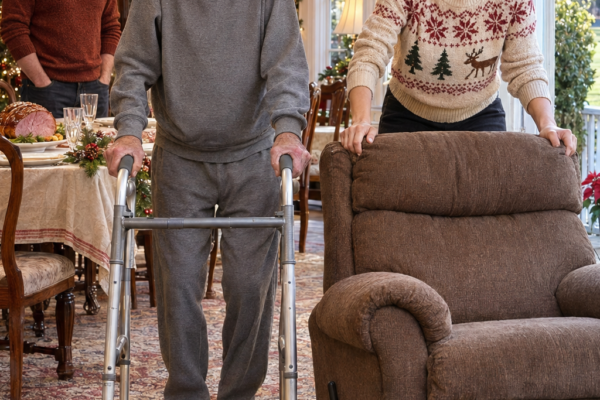
She answered, “Sold. Old women don’t need furniture,” while I gripped my walker beside the four dents in my living-room carpet.
“To whom?” I asked.
Nina kept carving the turkey.
“A man from Minnesota paid cash. He’s long gone.”
I had been home one day after surgery and weeks in the rehab wing.
My broken hip still hurt when I put too much weight on it.
The walker made every trip across the room a careful business.
I had expected to find my upright piano in its usual place when I came home Wednesday.
Instead, a children’s table stood over the four square dents where the piano’s feet had been.
There were thirty relatives in my house for Thanksgiving.
Nina was hosting, which meant she had arranged the food, chosen the seats, and decided where everyone should stand.
I had not objected.
I was grateful to be home, and I did not have the strength to manage a holiday gathering.
But I had not agreed to lose my piano.
I was sixty-eight, a retired music teacher, and I still taught six private students.
The upright had been part of my living room for eleven years.
I knew its low notes and where the bench belonged without looking.
Now the children’s table stood where the piano belonged.
Paper plates and a bowl of rolls covered its top.
The four dents were visible at the corners if you looked closely.
Nina did not look at me.
She moved a slice of turkey onto a platter and kept working.
Her voice had the bright, patient edge she used when she wanted others to think she was explaining something simple to a difficult person.
A few relatives glanced toward us, then returned to their plates.
Nobody asked why a piano had been removed from my house while I was in the hospital.
Kirk sat near the end of the dining table.
Nina’s husband had his eyes lowered to his plate.
He moved a piece of potato with his fork and said nothing.
I waited a moment.
I wanted him to look up.
He did not.
Nina picked up her glass.
“At least something good came out of all this work,” she said.
“The PTA piano fund is finished. Three thousand nine hundred dollars.”
“We finally got it done.”
A few relatives raised their glasses with hers.
Nina smiled at their congratulations.
She was PTA president, and she had a way of drawing attention back to herself.
Then she mentioned the dining set she had bought in October.
“Six thousand two hundred dollars,” she said, as if the price were a detail worth admiring.
“It was time we had something decent.”
She spoke about the dining set while my own piano was gone.
The room let her.
I wanted to ask why she had not called me before selling the piano.
I could have told the relatives that I had never given her permission.
Instead, I put both hands back on the walker grips.
I had asked her directly, in my own living room, in front of thirty people.
I would not turn my pain into a performance for Nina.
Ella stood near the doorway between the living room and dining room.
She was twelve, quiet in a way that made people forget she was paying attention.
She was looking down at the carpet, not at the turkey or the relatives.
I followed her gaze.
The children’s table covered part of the empty space, but the four dents were still visible.
Ella knew those marks.
She had sat beside me at the piano many times, waiting for her turn at the keys.
After Vern had penciled his line inside the lid, only Ella and I had lifted it.
She knew where to look, and she had never treated that little message as something ordinary.
Ella kept staring at the dents.
The meal went on around me.
Someone asked for gravy.
A child dropped a fork.
Nina moved between the kitchen and dining room, checking platters and reminding people where to put their cups.
She had taken charge of the day so completely that it seemed easier for everyone to follow her than to ask what had happened to my piano.
I stayed near the living-room doorway until I could make my way back to my chair.
My hip throbbed, and my hands had begun to ache from gripping the walker.
I wanted to go upstairs and lie down.
Picking up where the Facebook post left off
I also wanted to know whether Nina had sold the piano to a real person.
The man from Minnesota might have been real.
He might even have paid cash.
But Nina had given me no name, no address, and no way to find him.
When the relatives began leaving, they thanked Nina for dinner.
A few told me it was good to see me home.
One cousin squeezed my shoulder and said I should take it easy.
I nodded.
I did not ask anyone to stay and help me question Nina.
Kirk carried dishes to the kitchen.
He passed me once in the hall.
His eyes met mine for less than a second, then he looked away and continued walking.
Nina was putting leftovers into containers.
“You should rest,” she said.
“The doctor said you need to be careful.”
“I know what the doctor said.”
“I’m only trying to help.”
I held the walker steady.
“You could have asked me.”
She pressed a lid onto a plastic container.
“It was already handled.”
“That isn’t the same thing.”
Nina finally looked at me.
“You were in the hospital, Marilyn.”
“I was recovering.”
“You couldn’t use the piano.”
“That didn’t make it yours.”
She turned back to the counter.
I could hear relatives talking in the next room.
I did not raise my voice.
I had asked once in front of everyone, and her answer had been clear.
She believed the piano was gone, the money was hers to explain, and the matter was finished.
I made my way to my bedroom before my hip began to shake.
The walker caught against the edge of the rug.
I stopped, adjusted my footing, and continued.
I had spent years teaching children to slow down when a passage became difficult.
That afternoon, I had to follow my own advice.
I would not risk another fall trying to force my way through the house.
By the time the last relative left, the light outside had begun to fade.
Nina and Kirk were still in the kitchen.
I heard the front door close, followed by the low sound of their voices.
I did not go back to ask what they were saying.
There was one thing I could do without either of them.
I could look for my paperwork.
Vern had bought the piano for me on Friday, May 9, 2014.
He had chosen the upright because it fit the living room and suited the students I taught.
He knew I wanted an instrument that could stay in our home.
I remembered him checking the finish and asking the seller to handle the corners carefully.
The piano had arrived with an invoice.
I had kept that paper in the cedar chest.
Vern died in February 2023, and his estate closed that October.
Afterward, I had sorted the papers and left the important ones where I could find them.
The cedar chest was at the foot of my bed.
I lowered myself carefully and moved the lid open.
My hip protested when I leaned forward.
I rested one hand against the mattress and took my time.
There were old family papers inside, along with the envelope where I kept the piano records.
I moved the top documents aside.
My fingers found the invoice beneath them.
The paper had softened at the folds, but it was still legible.
I brought it closer to the bedside lamp.
The amount was printed near the top.
Four thousand eight hundred dollars.
Below it was the serial number.
418207.
Then I found the line that mattered most.
“Sold to: Marilyn Bishop.”
Chapter 2: The Woman Who Called It Dad’s
On Friday morning, November 28, I brought the invoice to the kitchen table.
I had proof of what I bought, but no piano and no name for the man Nina said had paid cash.
I carried the paper into the kitchen, where Nina was putting away the Thanksgiving dishes.
“It says the piano was sold to me,” I said.
Nina glanced at the invoice.
“It was Dad’s piano, and Dad’s things come to me.”
“Your father bought it for me.”
“He paid for it.”
“That isn’t the same as owning it.”
She shut a cupboard.
“You were in the hospital. It needed to go.”
I kept the invoice in my hand.
I did not want to argue about what the paper said while Nina was already deciding what counted.
A few minutes later, my phone lit up with a message from the family group text.
Nina had written, “Marilyn told me to sell it.”
I stood at the counter, looking at the sentence.
She had taken what she told me in private and given the family a different version.
I could have answered immediately.
I could have typed that I had never given her permission, that I had been in surgery and rehabilitation, and that I had come home to four empty dents in my carpet.
Instead, I put the phone down and folded the invoice along its old crease.
Years of teaching had trained me to pay attention to the words actually printed on a page.
Nina’s message did not change the words printed on mine.
I called the police department.
The officer who answered listened while I explained that my upright piano had been removed from my house while I was hospitalized.
I gave him the amount on the invoice and the serial number: 418207.
He asked whether I knew who had taken it.
“My stepdaughter arranged the movers,” I said.
“She says she sold it to a man from Minnesota.”
“Do you have his name?”
“No.”
“An address? A receipt from the buyer?”
“No. I have my original invoice.”
He took the report and wrote down the serial number.
His voice stayed professional, but he explained that without a buyer’s name, it looked like a civil matter.
“I understand,” I said.
He told me to keep the invoice and any other paperwork connected to the piano.
If I learned who bought it, I could contact the department again.
When the call ended, I sat with the phone in my lap.
I had expected the serial number to open a door.
Instead, it gave the officer a number to put in a report, while the piano remained somewhere I could not reach.
I called the neighbor who lived across the street.
She had seen a truck outside my house while I was away.
“It was just a plain rental truck,” she told me.
“I didn’t see a company name or anything that would tell me who it belonged to.”
“Did you see who loaded the piano?”
“I saw people moving things. I couldn’t tell you who they were.”
I thanked her and ended the call.
A plain rental truck.
No name. No buyer.
Nina had made sure the one detail I needed was the one she had not given me.
The next problem was my students.
I had six private students, and the lessons brought in $150 a week.
I had kept teaching because I enjoyed it, but the money mattered too.
There was no piano in my living room.
I could not ask children to come sit at an empty space and pretend we were having a lesson.
I called the families one by one and explained that I had to cancel until I had an instrument to teach on.
I kept my voice steady through each call.
The parents were kind, which made it harder.
They had arranged their children’s weeks around those lessons, and I had no date to offer them for a return.
After the last call, I crossed the living room with my walker and stopped beside the four dents.
The children’s table still covered part of the space where the piano had stood.
I looked at the empty area above the carpet.
I could picture the upright there, its music rack open and the bench pulled out for a student.
My hands remembered the keys.
My ears remembered the sound that used to fill the house.
The loss was not only the money.
Teaching had given shape to my weeks since I retired.
Now six appointments had disappeared from my calendar, and I had no instrument with which to bring them back.
Nina came into the living room while I was standing beside the table.
“Ella won’t be coming for lessons anymore,” she said.
I looked at her.
“Did Ella ask you to cancel?”
“She’s my daughter.”
“She likes playing.”
“She has other things to do.”
Nina said it as if that settled the matter.
She did not ask whether I wanted to keep teaching Ella, and she did not offer to let Ella decide.
I did not argue with her in front of the child.
Ella was not there, and I would not make her carry a fight between us.
I had taught Ella at the piano.
She knew the keys, the sound, and the little penciled line Vern had left inside the lid.
Nina could cancel the lessons, but she could not make Ella forget what that piano meant to her.
I went back to my bedroom and put the invoice in the cedar chest.
I did not want it left on the kitchen counter where someone could move it or spill something on it.
For the rest of the afternoon, I tried to keep my mind on ordinary things.
I ate a little lunch and rested my hip.
The house was quieter than it had been the day before, but I could not settle.
The family group text remained on my phone.
Nina’s message was still there, making her version look like the only version anyone had been given.
I considered answering.
I could send a photograph of the invoice and let the words speak for themselves.
But the invoice showed who bought the piano.
It did not tell me where Nina had taken it or who had paid her.
I needed the buyer’s name.
Without it, I had nowhere to start.
How far did Nina mean to go?
By late afternoon, she came into the living room carrying a senior-apartment brochure.
She placed it on the table beside my chair.
I looked at the photograph on the cover, then at her.
“One room. No piano. I already called them.”
She left the brochure there.
Chapter 3: The Paper Nina Forgot She Signed
By Monday, December 1, I had an invoice with my name on it, a police report, and no idea where my piano had gone.
Nina still claimed her father had owned it.
The senior-apartment brochure remained on the table in my bedroom. I had moved it there because I did not want to look at it every time I crossed the living room.
I needed someone who understood paperwork better than I did.
I called Andrea Dietz.
Andrea had been one of my piano students when she was nine. She used to sit on the bench with her shoulders held stiff, concentrating so hard on the keys that she barely noticed when I turned the pages.
She was forty-four now and an attorney.
When I explained what Nina had done, Andrea did not interrupt.
She asked me to find the invoice and the papers from Vern’s estate.
“I’ll come Monday,” she said. “Don’t throw anything away.”
That morning, Andrea arrived carrying a thick file.
She set it on my dining table and helped move the children’s table aside so we could spread out the documents.
I lowered myself into a chair.
My hip still hurt, but I could sit long enough to work through the papers.
Andrea opened the file.
“This is Vern’s estate settlement,” she said.
The estate had closed in October 2023. I remembered signing the papers, meeting with the people handling the estate, and trying to get through the arrangements without making mistakes.
At the time, I had not expected the piano to become an argument.
Andrea turned several pages before stopping at a section marked for family property.
She placed one sheet in front of me.
The words were printed clearly.
“Upright piano, serial 418207, property of Marilyn Bishop.”
I put my finger beneath my name.
“That’s mine.”
“Yes,” Andrea said. “It is.”
She checked the page and turned to the signature section.
Nina’s name appeared near the bottom.
Her signature was dated 2023.
I looked at Andrea.
“Why did Nina sign this?”
Andrea pulled another page from the file.
“Because she asked for the piano during the estate settlement.”
I remembered Nina bringing up Vern’s belongings after he died.
She had wanted the upright, and the people handling the estate had shown her the original invoice.
The invoice had my name on it.
Nina had seen it.
She had signed the settlement afterward, agreeing that the piano belonged to me.
Andrea placed the settlement beside the invoice I had found in the cedar chest.
The two documents carried the same serial number.
418207.
I ran my finger over the number on the invoice, then over the number in the settlement.
There was no confusion about which instrument the papers described.
“Nina knew,” I said.
Andrea nodded.
“She knew what she was signing.”
I thought about Thanksgiving.
I thought about Nina standing over the turkey and telling thirty relatives that a man from Minnesota had paid cash.
Then I thought about her saying her father’s things came to her.
She had signed a document saying the opposite.
Andrea gathered the two papers and arranged them neatly.
“This proves it’s yours. It doesn’t prove where it is.”
I looked toward the living room.
The children’s table was still standing over the four dents.
“I need to find it.”
“Then we start with the people who handle pianos.”
Andrea explained that the serial number could help dealers check their records and current inventory.
It would not give us a buyer’s address by itself, but it was something concrete to ask about.
I took out my telephone.
I decided to make the calls myself.
The first dealer asked me to repeat the number.
I gave it slowly, one digit at a time.
The person on the other end checked the available stock and told me the piano was not listed there.
I thanked him and hung up.
The second dealer checked as well.
Nothing.
The third asked whether I knew the manufacturer and approximate age.
I gave the information I had.
He checked his floor inventory and said he could not find it.
By then, my hand was beginning to ache from holding the telephone.
Andrea offered to finish the calls, but I wanted to make the last one myself.
I dialed the fourth dealer.
The business was Kolb Piano Service.
A clerk answered.
I explained that I was looking for an upright piano and gave him serial number 418207.
There was a short pause while he checked.
Then he said, “Not on our floor, ma’am.”
I thanked him.
The call ended without another lead.
Four calls.
Four places where my piano was not sitting in the available inventory.
I put the telephone down.
Andrea watched me gather the papers.
“Did any of them recognize the number?”
“No.”
“Then we need to ask Nina directly for the information she has refused to give you.”
I looked at the settlement again.
“She’ll say the same thing about Minnesota.”
“She might.”
“She’ll say the man paid cash and disappeared.”
“Then we’ll ask her to put his name in writing.”
Andrea took out her legal pad.
She asked me to explain exactly what Nina had told me.
I repeated the words from Thanksgiving.
A man from Minnesota had paid cash.
He was long gone.
I also told Andrea about Nina’s family group text claiming I had authorized the sale.
Andrea wrote down the details without interrupting.
She did not suggest that I send an angry reply or confront Nina in front of the family.
Instead, she explained that a written request would establish what information I had asked for and what Nina chose to provide.
“Keep this simple,” she said. “We don’t need a long argument. We need the buyer’s name.”
I looked at the invoice and the settlement.
Both carried the same serial number.
Both identified me as the owner.
Yet my piano was still missing, and the only person who knew where it had gone refused to give me a name.
“Will she answer?” I asked.
Andrea closed the file.
“That will be her decision.”
I thought about the way Nina had spoken to me in the kitchen.
She had sounded certain that nobody would challenge her.
Perhaps she believed I was too old, too tired, or too dependent on her to do anything.
I was not interested in proving how much trouble I could make.
I wanted my piano back.
Andrea drafted a letter at my dining table.
She included the date, the description of the upright, and serial number 418207.
She referred to the 2023 family settlement Nina had signed, confirming that the instrument belonged to me.
The letter did not accuse Nina of anything beyond what the documents showed.
It asked for one thing.
The name of the buyer.
Andrea explained that she would send it formally so there would be a record of the request.
I looked at the finished page.
Until then, Nina had controlled the story by giving everyone a different version.
Now she would have to answer a question on paper, with an attorney’s name at the top.
I nodded.
“Send it.”
Andrea placed the letter in her folder.
I returned the invoice to its envelope and put the settlement papers back inside Vern’s estate file.
The piano was still gone.
The four dents were still in my carpet.
But Nina could no longer claim she had never seen the paperwork proving whose piano it was.
Andrea took the letter from her folder, slid it into an envelope, and sealed the flap.
Then she wrote Nina Voss’s name across the front.
Chapter 4: The Man Who Fixed the Ramp
By Thursday, December 4, Andrea had sent Nina the letter asking for the buyer’s name.
I still had no piano, and there was no way to bring my six students back into the living room for lessons.
I had begun to move the music books from the shelf beside the empty space. Leaving them there made the room look as if I expected the upright to return any minute.
Andrea called that afternoon.
“Nina answered,” she said. “She emailed me.”
I asked her to read it.
Andrea paused, then said, “Minnesota. Cash. No paperwork. Stop harassing my family.”
“That is all?”
“That is all.”
Nina had not given us a name, an address, or anything that could help locate the piano.
She had answered a formal request with the same story she had told me at Thanksgiving, adding an accusation against the person who had asked.
“Do you want me to respond?” Andrea asked.
“Not yet.”
I was tired of sending questions to a woman who treated every question as an attack.
I wanted something more useful than another exchange of letters.
Later that afternoon, my doctor’s office called.
The receptionist asked whether I had a few minutes to speak.
Her voice was careful, the way people sound when they have news they are not sure how to deliver.
“We wanted you to know that Nina Voss has contacted the office,” she said.
“She’s been asking about your memory and whether you’ve had any concerns.”
I pulled out a chair and rested my hand against the table.
“What did she ask?”
“She wanted to know whether you had been evaluated for memory problems.”
“We can’t discuss your medical information with her, of course. The doctor asked us to let you know she’d called.”
I thanked her.
After I hung up, I kept the phone in my hand.
My hip was healing.
I was still using the walker, and I needed help with the porch steps.
That did not mean I had forgotten where I lived, what I owned, or what Nina had done.
I looked at the invoice in the cedar chest.
My name was printed on it.
The serial number was the same one in the settlement Nina had signed.
There was nothing confused about those papers.
On Sunday, December 7, Kirk came to fix the porch ramp.
He brought his tools and got to work without much conversation.
The ramp had become harder for me to use since I came home, and I was grateful he had offered to make the boards steadier.
I stayed inside until he called to say he needed me to check the angle.
I stepped onto the porch with my walker and stood beside the railing while he tightened a screw.
When he finished, he wiped his hands on a rag and looked toward the driveway.
Then he took out his phone.
He did not say anything.
He held the screen where I could see it.
The message was dated Thursday, November 6.
Movers Friday. Don’t tell Marilyn until it’s gone.
It was from Nina.
I looked at the date first, then at the words.
The message had been sent the day before the piano was taken.
Kirk kept holding the phone between us.
His thumb rested near the bottom of the screen.
“You had this then?” I asked.
He nodded.
I looked at him.
“You knew they were coming.”
He lowered his eyes.
I did not reach for the phone.
I did not ask him to hand it over or forward the message.
It was his phone, and he had already done something he was afraid to do by showing me.
“Why are you showing me now?” I asked.
He rubbed the edge of the rag between his fingers.
“Because you should know.”
The words were quiet.
He looked toward the house before he spoke again.
He told me that the $1,600 Nina had received for the piano had gone onto their store card on November 8.
It was a payment against the dining set she had bought the month before.
I thought of her raising a glass on Thanksgiving and naming the price as if it were a family achievement.
“Did you see the payment?” I asked.
He nodded and opened another screen.
The transaction showed the date and amount.
November 8. $1,600.
I did not need him to explain what it meant.
The money from my piano had gone toward Nina’s furniture.
“Can you send me the message?” I asked.
Kirk’s fingers tightened around the phone.
He shook his head.
“Please, Kirk. Andrea could use it.”
He looked at me, and I saw how frightened he was of what would happen after he went home.
“She’s my wife. I can’t.”
I let the request go.
I did not take his phone or ask him to choose between us.
He had shown me something that could help, but he was not willing to put it in my hands.
He slipped the phone into his pocket and picked up his tools.
I thanked him for fixing the ramp.
He nodded and carried his things toward his truck.
I stood on the porch until he drove away.
The ramp felt steadier beneath my walker, but the message stayed with me.
Nina had arranged the sale before I came home.
She had told Kirk not to tell me.
The payment had gone toward the dining set, and he had kept quiet while she told the family I had agreed.
The proof existed on his phone.
I could not use it.
I was still standing by the railing when Nina came onto the porch.
She had been inside.
I had not heard her come to the door.
“Did Kirk show you something?” she asked.
I kept one hand on the walker.
“He fixed the ramp.”
Nina looked toward the driveway, then back at me.
“I asked your doctor for a memory screening,” she said.
“Then we’ll talk about who signs your papers.”
She left the porch door open behind her.
Chapter 5: The Ledger at Kolb Piano Service
On Tuesday, December 9, my phone received a message from Ella.
It was a photograph.
Her message said, “Grandma, look what they got for the school.”
I opened the picture and enlarged it.
An upright piano stood in what looked like the school’s music room.
The finish, the shape of the cabinet, and the small mark near the lower keys were familiar.
Then I saw the low C.
Ella had chipped that key when she was four.
She had been reaching across the keyboard during one of her first lessons when her little hand slipped against the edge.
I remembered the afternoon because she had looked so worried about the mark.
I had told her we could still make music with it.
Now that same chipped key appeared in her photograph.
Ella had also photographed the serial number.
418207.
My fingers tightened around the phone.
The next photograph showed the inside of the lid.
There, in Vern’s handwriting, was the pencil line I had described to her so many times.
“For Marilyn, who taught me the one song I can play.”
Below it was Vern’s name.
I sat quietly with the phone in my lap.
The final picture showed a shop sticker attached to the piano.
Kolb Piano Service.
I knew the name.
It was the fourth dealer I had called on Monday, the one whose clerk had told me the piano was not on their floor.
I called Andrea.
She answered quickly.
“Did something happen?”
“Ella found my piano.”
I heard her stop moving.
“Where?”
“At her school. She sent photographs.”
I explained about the chipped key, the serial number, and Vern’s writing.
Then I read the shop sticker aloud.
“Kolb Piano Service,” Andrea repeated.
“That’s the place I called.”
“Then we’ll go there tomorrow.”
I looked at the photograph again.
My piano had been delivered to the school on Monday, December 8.
The children had already started using it.
I had spent weeks looking for a man from Minnesota.
My own granddaughter had found the instrument by recognizing a mark on a key.
On Wednesday, December 10, Andrea drove me to Kolb Piano Service.
I brought the original invoice from the cedar chest and a copy of Vern’s estate settlement.
My walker went into the back seat.
The trip was uncomfortable, but I did not ask Andrea to turn around.
I wanted to know how my piano had reached the school.
Duane Kolb was sixty-one.
He owned the shop and kept a ledger on his desk.
When Andrea introduced us, he spoke slowly and asked me to sit.
“I understand there’s a question about an upright we handled last month,” he said.
“Yes,” I answered. “It’s my piano.”
He looked at the invoice.
Then he opened his ledger and turned to a page marked November 7.
I watched his finger move down the entries.
The seller’s name was Nina Voss.
The amount was $1,600.
Beside it was a description of the instrument and the serial number.
418207.
Duane turned the page slightly so Andrea could see the attached seller’s form.
Nina had signed it.
Under the ownership declaration, she had identified herself as the sole owner.
The form also contained her promise to repay the shop for any loss if someone else proved they owned the piano.
I looked at her signature.
It was the same name I had seen on the 2023 family settlement.
Andrea leaned closer to the page.
“You took her word that she owned it?”
Duane nodded.
“She said she was the owner and had the right to sell.”
He explained that Nina had received the shop’s payment by check.
He had accepted the piano into his inventory and later sold it.
He turned to another entry.
On November 21, a music teacher had purchased the upright for $3,900 using the school’s PTA piano fund.
The piano had been delivered to the school on December 8.
“I dealt only with the music teacher,” Duane said.
He did not know Nina personally beyond the transaction.
He had not spoken with the school about where the money originally came from.
I placed my invoice beside his ledger.
The two documents showed the same serial number.
Mine showed that Vern had bought the piano for me in 2014.
His showed that Nina had sold it to him eleven years later.
Duane studied the papers.
Then he looked at me.
“She couldn’t sell it, so neither could I. I owe the school. She owes me.”
I rested my hand on the invoice.
“Can you get it back?”
“I can make the school whole. The teacher bought it in good faith, and the children are using it.”
He explained that he would refund the school the $3,900 purchase price.
He would then seek repayment from Nina under the promise she had signed.
The piano would come back to me.
I looked at the ledger again.
Nina had not simply sold something she believed belonged to her.
She had signed her name beneath a statement claiming she was the sole owner.
She had accepted $1,600 for my instrument.
And now that money had gone toward the dining set sitting in her house.
Andrea asked Duane whether the school principal knew about the ownership problem.
“Not yet,” he said.
He wanted to speak with the principal and settle the school’s payment immediately after the Christmas concert.
The concert was scheduled for Thursday, December 18.
Sixty children were expected to perform.
I looked at the photographs Ella had sent.
The piano was already part of their preparations.
“If you take it back before the concert,” I said, “those children lose their instrument.”
Duane nodded.
“And if we wait?”
I thought of Nina.
She was PTA president.
The school had bought the piano with PTA money, and she might recognize it before December 18.
She might see the chipped key.
She might lift the lid.
She might recognize Vern’s handwriting.
If she learned that the piano was at the school, she could try to interfere before Duane spoke to the principal.
I had spent weeks listening to her say the buyer was gone.
Now I knew exactly where the piano was.
I took out my phone and called the officer who had handled my original report.
I gave him Duane’s name, the shop’s name, and the details of the November 7 transaction.
I explained that the piano had been sold to the school and delivered on December 8.
He added the information to the report and asked me whether I wanted the piano removed immediately.
I looked at Andrea.
She waited for my answer.
“Not before the concert,” I said.
The officer explained that waiting could complicate matters if the piano were moved again.
I understood.
But pulling it out of the school now would leave sixty children without the instrument they had been practicing on.
I told him I wanted the information recorded and would cooperate with the next steps.
Then I ended the call.
Duane closed his ledger.
“I’ll speak with the principal after the concert,” he said.
Andrea put the invoice and settlement papers back into my folder.
On the drive home, I watched the winter fields pass outside the window.
My piano was eight days away from being heard in front of three hundred parents.
Nina would be there.
She was the PTA president who had celebrated the $3,900 piano fund at my Thanksgiving table.
She might be sitting in the front row when Ella played.
I could not tell Ella everything over the phone.
She was twelve, and I did not want her caught between her mother and me.
When I got home, I called her.
“Grandma?” she answered.
“Did you get my pictures?” she asked.
“I did, sweetheart.”
“It’s really your piano, isn’t it?”
I looked toward the empty space in my living room.
“Yes. It is.”
There was a pause.
“Are you coming to the concert?”
“I’ll be there.”
“I have my solo.”
“I know.”
I held the phone closer.
“Play your solo. Leave the lid alone. This is mine to fix.”
Chapter 6: The Girl Who Lifted the Lid
By Thursday, December 18, Duane had agreed to wait until after the last carol before settling with the principal.
The arrangement was supposed to stay private until then.
Nina knew nothing about the ledger, the invoice, or the promise she had signed at Kolb Piano Service.
I carried my original invoice in my purse.
Andrea had offered to come with me, but I wanted to sit with the other families and watch Ella play.
The Harding Middle School auditorium was already filling when I arrived.
Three hundred parents had come to hear the children perform.
I found a seat where I could see the stage without having to squeeze past too many knees with my walker.
Nina sat in the front row.
She noticed me as soon as I came through the aisle.
Her smile faltered, then returned as she turned toward the stage.
I kept my purse on my lap and sat down.
The upright stood behind the choir, its front hidden by a length of Christmas garland.
I could see the top and the edge of the lid.
Even from my seat, I knew the shape of the cabinet.
It was the piano I had played for eleven years.
I had imagined seeing it again many times, but not like this.
It belonged in my living room, not beneath school decorations while strangers waited for a concert to begin.
The children took their places.
Ella stood near the piano, holding her music.
She looked toward the audience and found me.
I gave her a small nod.
She returned it, then faced the choir director.
When the opening notes of “O Holy Night” began, I rested my hands on my purse.
Ella played her solo carefully.
Her shoulders stayed level, and her fingers moved across the keys with the concentration I remembered from our lessons.
The chipped low C was beneath her hand.
I could not hear the small difference it made from where I sat.
I could see her fingers reach for it.
For a few minutes, I was only a grandmother watching her granddaughter perform.
I did not think about Nina’s signature or the shop ledger.
I listened to Ella finish the passage she had practiced.
The last note settled, and the auditorium applauded.
Ella stepped back with the other children.
Nina rose from the front row and walked to the floor microphone.
She had a program in one hand and the practiced smile she used at PTA meetings.
“I want to thank everyone who contributed to the parents’ fund,” she said.
“Sixty kids finally have a real piano.”
The applause grew.
Nina waited for it to finish, smiling toward the families.
Then she returned to her seat in the front row.
I watched her sit.
Ella was still onstage.
The other children began shifting into place for the next carol.
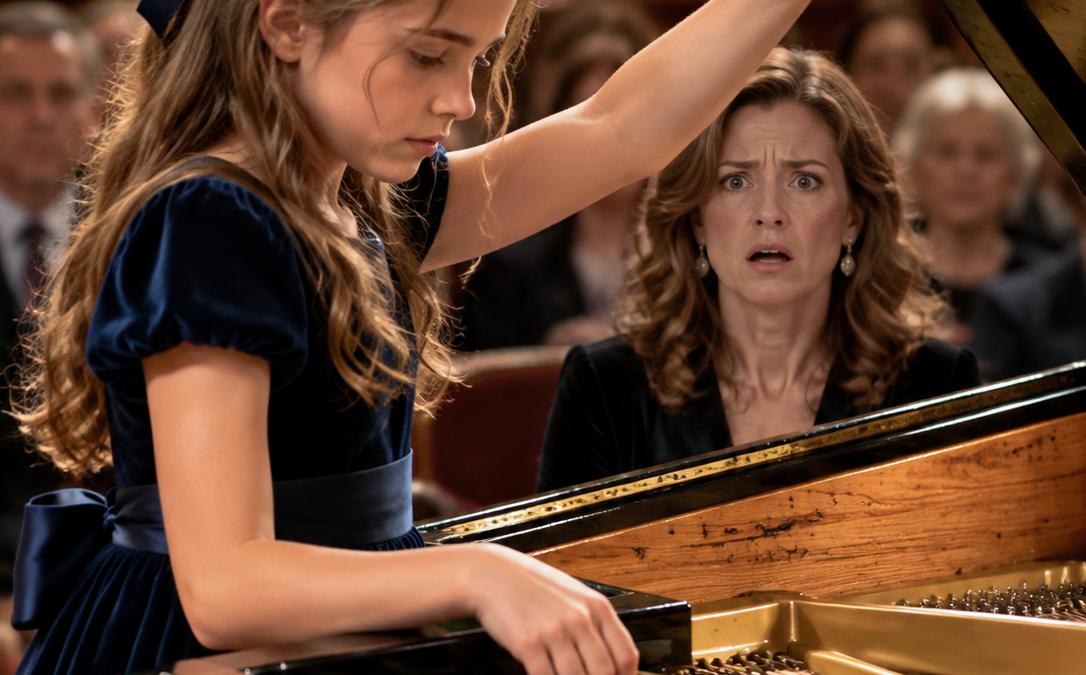
Then Ella stepped forward.
Nobody had told her to.
She walked to the piano and put one hand on the lid.
My fingers tightened around the edge of my purse.
I had told her to leave the lid alone.
I had asked her to play her solo and let me handle the rest.
But Ella lifted the lid.
The movement exposed the inside of the piano to the auditorium.
She looked down at the pencil writing.
Then she turned toward the choir microphone.
Her voice carried through the speakers.
“For Marilyn, who taught me the one song I can play.”
She paused.
“Vern.”
A few people shifted in their seats.
Ella leaned closer to the microphone and read the serial number beneath the inscription.
“Four one eight two zero seven.”
The sound system carried each digit clearly.
I looked toward the front row.
Nina had stopped moving.
Her hands were closed around the program in her lap.
She stared at the open lid.
I pushed myself up from my seat.
My hip hurt, but I kept one hand on the chair until I was standing.
Then I took the invoice from my purse.
I held it up where the stage lights could reach the printed number.
The paper trembled slightly in my hand.
“This is the invoice,” I said.
My voice was not as loud as Ella’s had been, but the auditorium had quieted.
“It has the same serial number. The piano was sold to me.”
Nina turned in her seat.
“Nobody can prove that’s the same piano.”
Her voice carried farther than she seemed to expect.
I looked at the open lid, then at the invoice in my hand.
The number was there.
The words were there.
Vern’s handwriting was above them.
But Nina had denied it in front of three hundred parents.
I was standing in the aisle with my hip aching and my purse hanging from one arm.
I had the paper that named me as the buyer.
Ella had read the inscription aloud.
Still, Nina had found one sentence to put between the room and the truth.
Who in that auditorium could prove it?
A movement came from the wings beside the stage.
Duane Kolb stepped into view.
He carried his ledger under one arm.
He walked toward the light, stopped beside the piano, and looked directly at Nina.
“I can.”
Chapter 7: The Signature in the Ledger
Duane Kolb stood beside the piano with his ledger under one arm.
Nina remained in the front row, looking from him to the invoice in my raised hand.
Duane opened the ledger.
“I bought this upright on November 7,” he said. “The seller was Nina Voss.”
He turned the book toward the audience.
“The seller’s form identifies her as the sole owner.”
A few parents leaned forward.
Duane read the entry again, slowly enough for the people near the back to hear.
“Nina Voss. Sole owner. Payment: sixteen hundred dollars.”
Nina stood.
“That doesn’t prove anything.”
Andrea Dietz rose from her seat near the aisle.
She carried the estate papers in a folder.
Andrea opened the folder and took out a printed copy of Nina’s December 4 email.
“On December 4, Nina responded to a formal request for the buyer’s name.”
Andrea read the message aloud.
“‘Minnesota. Cash. No paperwork. Stop harassing my family.’”
Several parents turned toward Nina.
Andrea placed the email back in her folder and removed another document.
“This is the 2023 family settlement.”
She read the relevant entry.
“Upright piano, serial 418207, property of Marilyn Bishop.”
Then she showed the signature at the bottom.
“Nina signed this settlement after being shown Marilyn’s original invoice.”
Nina shook her head.
“You’re making this sound like something it isn’t.”
Andrea held the page where the audience could see it.
“Your signature is here, Nina.”
Nina looked toward me.
“She’s confused. She told me to sell it and forgot.”
I stayed standing.
My invoice was still in my hand.
“I never told you to sell it,” I said.
Nina turned toward the audience.
“She was in the hospital. She wasn’t herself.”
My hip hurt from standing, but I kept my feet planted.
Andrea did not argue about my health.
She simply placed the invoice beside the settlement.
The serial numbers matched.
Duane closed his ledger halfway.
Then another chair moved in the front row.
Kirk stood beside Nina.
She turned toward him, surprised.
He took his phone from his pocket.
I recognized it.
It was the same phone he had shown me on the porch on December 7.
The message was still there.
Kirk looked at the screen.
“November 6,” he said.
He read Nina’s message aloud.
“Movers Friday. Don’t tell Marilyn until it’s gone.”
Nina’s face changed.
“Kirk, sit down.”
He did not.
He looked toward the audience, then at Ella.
Ella stood near the piano, watching him.
Kirk swallowed.
“I read that and passed the potatoes. Ella’s braver than I am.”
He looked down at his phone again.
“The $1,600 went on our dining set.”
Nobody spoke.
Kirk had spent Thanksgiving sitting at the table while Nina told everyone a man from Minnesota had bought my piano.
He had known the movers were coming.
He had known Nina planned to keep the sale from me.
And now, in front of three hundred parents, he had finally said what he knew.
Nina reached toward his arm.
“Kirk, please.”
He stepped away from her.
I did not know what would happen between them after that evening.
I only knew he had stopped protecting her story.
Duane opened his ledger again.
“I sold this piano to the school on November 21,” he said. “The music teacher paid thirty-nine hundred dollars through the PTA piano fund.”
The principal, who had been standing near the stage, stepped forward.
Duane took a check from the folder tucked inside his ledger.
He walked over and handed it to her.
“This is the full refund. Three thousand nine hundred dollars.”
The principal accepted the check.
She looked at the amount, then at the piano.
Duane turned toward Nina.
“Under the form you signed, you agreed to repay me if someone else proved ownership. The school is getting its money back from me. The bill comes to you.”
Nina stared at him.
“You can’t put that on me.”
Duane kept his voice even.
“Your signature is on the agreement.”
He showed her the page.
The principal stepped toward the floor microphone.
She took it from its stand and faced the audience.
“I want everyone to understand that the school will not lose its piano fund money,” she said.
“The refund has been provided, and the ownership matter will be handled between the people involved.”
She paused and looked toward Ella.
“The children will finish their concert tonight.”
The applause that followed was scattered at first.
Then more parents joined in.
Nina picked up her coat.
She did not look at the principal or Duane.
She walked toward the side aisle, passing row after row of parents.
Three hundred people had come to hear their children sing.
Now they watched Nina leave.
When she reached my row, she slowed.
For a second, I thought she might speak.
I looked at her.
“It was never furniture, Nina. And it was never yours.”
She kept walking.
The auditorium doors closed behind her.
Kirk remained near the front row.
He looked toward the stage, where Ella was waiting for the final carol.
I wanted to see the piano come home.
I wanted to hear it in my living room again, with the bench in its proper place and the four dents covered by its feet.
Duane had the check ready.
The principal had accepted it.
There was nothing more to settle before the concert ended.
But I could have asked them to move the piano immediately.
Instead, I looked at the children standing in their places.
They had practiced for weeks.
They had come to sing for their parents, grandparents, and teachers.
Ella had already played her solo.
I did not want her evening to end with movers carrying away the instrument she had just played.
I lowered myself carefully into my seat.
My hip complained as I settled back.
Andrea sat beside me.
“Are you all right?” she asked.
I placed the invoice in my purse.
“Yes.”
She glanced toward the piano.
I nodded toward the stage.
“Let them finish. Then it comes home.”
Ella looked toward the audience.
When she found me, she smiled and placed her hands over the keys.
The choir director raised her arms.
The last carol began.
Ella played her part, and the children joined their voices around her.
I sat beneath the auditorium lights and listened until the final note ended.
Chapter 8: The Table That Seated Twelve
On Friday, December 19, Duane’s crew brought my piano home.
I watched from the living room as two men guided the upright through the front door.
They moved carefully, checking the corners and the floor before setting it down.
I stood beside my walker and pointed toward the four dents.
“That’s where it belongs.”
One of the men nodded.
They lowered the piano and adjusted its casters until each one settled into the old marks.
The children’s table was gone.
The carpet still showed the places where the piano had stood for eleven years.
When the men finished, I walked around the instrument with my hand resting on the walker.
The finish looked familiar, and the chipped place near the lower keys was exactly where I remembered it.
I touched the side of the cabinet.
For weeks, I had pictured this moment.
I had expected to feel triumphant when the piano came back.
Instead, I was thinking about the children who had played it at Harding Middle School and the parents who had paid into the fund believing they were buying an instrument the school could keep.
Duane had refunded their $3,900.
He had also made it clear that Nina owed him the money.
I thanked his men and watched them carry their equipment outside.
Then I pulled the bench back into its proper position.
I did not play.
I wanted the house to settle around the piano again before I touched the keys.
On Monday, December 22, Andrea called with news from the PTA board.
“They accepted Nina’s resignation,” she said.
I was sitting beside the piano, sorting through the music Ella would need for her lessons.
“Did she resign herself?”
“She submitted it. The board accepted it.”
I set a music book on the bench.
Nina had been PTA president when she announced the finished piano fund at Thanksgiving.
She had stood in my living room and toasted the $3,900 achievement while my own instrument was missing.
Now she no longer held that position.
Andrea also told me that Duane had sent Nina a formal demand.
The letter required her to repay $3,900 by Friday, January 2, 2026.
It quoted the promise Nina had signed on November 7.
If someone else proved ownership, she had agreed to repay the shop for the loss.
I asked Andrea whether Nina had responded.
“Not to me,” she said.
I thanked her and returned to the music books.
The piano was home, but the matter was not finished.
Duane had paid the school back.
His money had not come from Nina.
That bill was waiting for her.
The following Saturday, December 27, I drove over to pick up Ella for her first lesson back.
My walker was in the car, and I had brought her music books.
I was looking forward to having her beside me at the piano again.
When I pulled into Nina’s driveway, two men were carrying the dining table toward a stranger’s trailer.
I recognized the table immediately.
It was the one Nina had bragged about on Thanksgiving.
The $6,200 dining set.
The same purchase that had received the $1,600 payment from my piano sale.
One man held the end of the table while the other guided it around the driveway.
They were careful not to scrape the legs against the trailer.
Nina stood near the front door with her arms folded.
Her expression was different from the bright smile she wore at PTA meetings.
She watched the men work, then noticed me beside my car.
“Happy?” she asked.
I looked at the table.
I remembered her raising her glass at Thanksgiving and announcing what it had cost.
I remembered Kirk showing me the payment on his phone.
I remembered the message about the movers coming Friday, with instructions not to tell me until the piano was gone.
The men lifted the table higher and moved it toward the trailer.
Nina waited for me to answer.
I could have told her that she had brought this on herself.
I could have reminded her that she had chosen to sell my piano while I was recovering from surgery.
But I had not come to her house to discuss the furniture.
I had come for Ella.
The front door opened, and my granddaughter appeared with her music bag.
She looked toward the men, then at me.
I kept my voice gentle.
“Ella, get your music.”
She went back inside to collect the books she had left near the door.
Nina watched her disappear.
Neither of us said anything else.
The men continued loading the table.
I opened the passenger door for Ella and moved my walker aside so she could climb in.
She settled her music bag on her lap.
“Are we going to Grandma’s now?” she asked.
“Yes.”
“Can we play the song?”
“We can.”
She smiled and fastened her seat belt.
I started the car.
I did not look back at the trailer.
When we reached my house, Ella carried her books inside while I followed with my walker.
She went straight to the piano.
Her fingers rested on the edge of the keys.
“It’s really back,” she said.
“Yes, sweetheart.”
I helped her arrange the music on the stand.
We began with the piece she had been practicing before the sale.
She made a mistake in the second line and stopped.
I showed her where her left hand needed to go.
She tried again.
The low C sounded with its familiar little flaw.
Ella smiled when she heard it.
I smiled too.
After the lesson, I put her music books back into her bag.
She had only just started getting comfortable at the piano again when my telephone rang.
The number belonged to the officer who had taken my original report.
I answered.
“Mrs. Bishop, I wanted to update you on the piano investigation.”
I moved the phone closer to my ear.
He told me Nina was scheduled to give a statement in January.
After that, the file would be forwarded to the state’s attorney.
“Even if she pays Mr. Kolb?” I asked.
“Yes, ma’am. Repayment to the shop is a separate matter. The report still goes forward.”
I looked at the piano.
Nina had sold the dining set.
She had lost her PTA position.
Duane was waiting for his money.
But the police investigation was not going away.
I thanked the officer and ended the call.
Ella was putting her music into her bag near the doorway.
“Grandma, can I come again next Tuesday?”
I looked at the calendar.
“Yes. Tuesday.”
She picked up her coat.
I walked her to the door, then returned to the piano.
The invoice was still in the cedar chest.
The four casters were back in their old dents.
And January was only a few days away.
Chapter 9: The Locksmith on Tuesday
On Friday, January 2, Duane Kolb sent me a copy of the receipt.
I was sitting beside the piano when the envelope arrived.
Inside was a short statement showing that the $3,900 had been paid in full.
Nina had paid him.
I placed the receipt beside the original invoice in my cedar chest.
The two papers represented very different transactions.
One showed what Vern had paid to put the piano in my home.
The other showed what Nina had been forced to repay after selling something that never belonged to her.
I closed the chest and returned to the living room.
The piano stood in its proper place, with its casters settled into the four dents.
I had started teaching again.
My six students were returning to their regular appointments, and Ella had her Tuesday lesson.
The house was beginning to sound like itself.
But Nina’s threat about my memory had not disappeared.
I had made an appointment for the screening after the doctor’s office told me she had been asking questions.
The appointment took place before the end of December.
The doctor asked me questions about dates, familiar places, and ordinary things I did every day.
I followed the instructions and completed the exercises.
When the results came, the doctor told me I had passed.
I asked for a copy.
I wanted the record for myself, not because I needed to show Nina anything.
Still, I put the paper with the other documents in my cedar chest.
She had suggested that I could not manage my own affairs.
Now I had an independent assessment saying otherwise.
That afternoon, my phone began buzzing with messages from the family group text.
Vern’s sister had written.
She had followed everything that happened at Thanksgiving, including the argument about the piano and the statements made at the Christmas concert.
Her message was brief.
“Thanksgiving stays at Marilyn’s from now on. Nina doesn’t carve.”
A few relatives responded with agreement.
One said she would bring dessert.
Another offered to help with the cooking.
Nobody asked Nina to host.
I read the messages without replying.
For years, Thanksgiving had been held at my house.
Vern had enjoyed having his family gathered around the dining table, and I had continued the tradition after he died.
Nina had taken over hosting while I was recovering.
She had treated that temporary arrangement as if it gave her authority over the house.
Now Vern’s sister had made the family’s decision clear.
The gathering would remain at my home.
Nina would not be in charge of the carving.
I put the phone beside the piano.
A little later, Nina called.
I considered letting it ring.
Then I answered.
“Hello.”
“Did you see what she wrote in the group?”
“Yes.”
“You have to remind them we’re relatives. They can’t keep treating this like some crime.”
I looked at the piano bench.
“What do you mean?”
“You know what I mean, Marilyn. This has gone too far. The police, the school, the whole family talking about it.”
She sounded tired and angry.
I waited.
“You could tell them it was a misunderstanding. It doesn’t need to follow me around forever.”
I rested my hand on the arm of the chair.
“It was family. That’s what I told them.”
She did not answer immediately.
Then she said, “You know how people are. They’ll never let this go.”
I thought about the Thanksgiving table.
I remembered standing beside my walker while she told thirty relatives that old women did not need furniture.
I remembered the senior-apartment brochure.
I remembered her words on the porch about who would sign my papers.
“You told them what happened,” I said.
“I was trying to handle things.”
“You handled my piano.”
She made a small sound of frustration.
“I’m not going to keep arguing with you.”
“Neither am I.”
I ended the call.
I did not send another message to the family group.
I had no intention of changing what I had already told them.
The police file remained open.
Nina had repaid Duane, but the officer had explained that the payment did not end the investigation.
Her January statement was still ahead.
I could not decide what the state’s attorney would do with the information.
That was no longer something I could control.
What I could decide was who had access to my house.
Until then, Nina still had an emergency key.
I had given it to her years earlier because she was family and because I trusted her.
She had used that access to arrange for movers to take my piano while I was hospitalized.
I did not want to wonder whether she might use it again.
Kirk had begun driving Ella to my house on Tuesdays.
He brought her for lessons and waited until she finished.
At first, he said very little.
He usually stayed near the front door, checking his phone while Ella practiced.
I did not ask him what was happening between him and Nina.
That was their marriage.
My concern was that Ella could continue playing without being caught between the adults.
One Tuesday, after her lesson, Ella came into the kitchen carrying her music bag.
“Grandma, Dad said he’ll bring me next week, too.”
“That will be fine.”
She smiled and went outside.
Kirk waited beside the car until she was safely inside.
I watched them leave.
Then I called a locksmith.
He came the following afternoon.
I showed him the front door, the back door, and the side entrance.
I asked him to change every lock.
He checked each one and gave me an estimate before beginning.
I stayed in the living room while he worked.
I could hear the tools turning and the old hardware being removed.
When he finished, he tested each door and handed me the new keys.
I put one in my purse and another in the small drawer beside the telephone.
The remaining key stayed in my hand.
The following Tuesday, Kirk brought Ella for her lesson.
He waited while she put her music on the piano.
Before she began, I stepped toward him.
“I had the locks changed.”
He looked at me, then nodded.
“I understand.”
“I don’t want Nina using the old key.”
“I understand that, too.”
I held out the new key.
“This one is for Ella. You can use it when you bring her for lessons.”
Kirk looked down at my hand.
Then he accepted it.
“I’ll make sure she has it when she needs it.”
I closed my fingers around his hand for a moment.
He put the key in his pocket.
Ella called from the piano.
“Grandma, are we starting?”
I turned toward her.
“Yes, sweetheart.”
Kirk stepped back toward the doorway.
I pulled out the bench for Ella and opened her music book.
The new key was no longer in my hand.
It was with the person who would bring my granddaughter back to the piano.
Chapter 10: The One Song He Could Play
On Saturday, March 14, 2026, I crossed my living room without a walker.
My hip had healed enough that I no longer needed it. I could walk from the kitchen to the piano without stopping to catch my balance.
All six of my private students had returned.
Their lesson times were written on the calendar beside the telephone, just as they had been before my hospitalization.
The piano stood in its usual place.
Its four casters rested in the old dents in the carpet.
I had stopped noticing the marks most days. They were no longer empty spaces where something belonged. They were covered by the piano again.
That morning, Vern’s sister came to visit with a casserole.
She carried it through the front door and set it on the kitchen counter.
“How are you getting along?” she asked.
“Quite well.”
She looked toward the living room.
“I still can’t believe what happened with that piano.”
I put two plates on the counter.
“Neither can I.”
She had been at Thanksgiving and had heard Nina’s remark about old women not needing furniture.
She had also been at the Christmas concert.
She knew about the ledger, the signed form, and the $3,900 Duane had received from Nina.
“Has the lawyer contacted you?” she asked.
I knew which lawyer she meant.
There had been no new word from the police since Nina gave her statement in January.
The file had gone to the state’s attorney.
I did not know what decision would come from that office.
“I haven’t heard anything new,” I said.
Vern’s sister took a dish towel from the counter and helped me put the casserole away.
Then she looked at me.
“You know, some people might have let the whole thing go. Just to keep peace in the family.”
I closed the refrigerator.
“I wanted my piano back.”
“I know.”
“I didn’t ask for anything that wasn’t mine.”
She nodded.
I rested one hand on the counter.
“At sixty-eight, wanting your own things kept isn’t greed.”
She did not argue.
We ate lunch together, and afterward she helped me clear the dishes.
Before leaving, she stopped beside the piano and looked at the cabinet.
“Vern would have liked seeing it back here.”
“I think so.”
She touched the edge of the music rack.
“He loved hearing you play.”
I smiled.
“He usually asked for the same song.”
“Heart and Soul?”
“Every time.”
She laughed and picked up her coat.
After she left, I returned to the living room.
An envelope was waiting on the small table beside my chair.
It had arrived earlier that week.
The letter inside was from Nina’s lawyer.
I had opened it the previous evening and left it where I could find it.
The lawyer asked me to tell the state’s attorney that I did not want charges pursued against Nina.
The letter referred to the family relationship and the harm the situation had caused.
It also mentioned that Nina had already repaid Duane.
I understood what the lawyer wanted.
If I agreed to speak on Nina’s behalf, perhaps she hoped the matter would end more easily.
I folded the letter and placed it inside the cedar chest with the other papers.
I did not write back.
I did not call the lawyer.
I did not send a message to Nina.
The $3,900 had been repaid, and my piano was home.
That did not change what Nina had done while I was in the hospital.
I closed the cedar chest and walked back to the piano.
The afternoon sunlight reached the top of the cabinet.
I paused beside the piano, then raised its lid.
Vern’s pencil writing was still there.
“For Marilyn, who taught me the one song I can play.”
I traced the words with one finger.
He had written them years ago, when the piano was new to our house.
I remembered him sitting beside me, trying to follow the melody with his left hand.
He had never been a confident pianist.
He could manage one song, and he liked playing it with me.
When he died in February 2023, I had kept the piano exactly where he left it.
Then Nina had sold it while I was hospitalized for my broken hip.
She had said a man from Minnesota paid cash.
She had told our relatives I gave her permission.
She had even suggested that I no longer had the memory to manage my own papers.
But the piano had come home.
The invoice was still in my cedar chest, and the original serial number remained beneath Vern’s handwriting.
I heard Ella come through the front door.
“Grandma?”
“I’m in here.”
She entered the living room carrying her music bag.
At twelve, she had grown more confident at the piano. Her fingers were stronger, and she no longer watched my hands every time I demonstrated a passage.
She set her bag beside the bench.
“What are you doing?”
I pointed inside the open lid.
“Come look.”
Ella moved closer.
She leaned over the writing and read Vern’s words.
Her expression softened.
“He wrote that for you.”
“Yes.”
I reached into the little drawer beside the piano and took out a pencil.
Then I handed it to her.
“Would you like to add something?”
Ella looked at me.
“Here?”
“Under his line.”
She studied the space beneath Vern’s handwriting.
Then she carefully wrote her name.
Ella Voss.
She lifted the pencil and checked the letters.
“Is that all right?”
I nodded.
“It’s just right.”
She put the pencil on the piano and looked at the two lines.
Vern’s words had been there since 2014.
Ella’s name was new.
I lowered the lid gently.
She took her music from the bag and placed it on the rack.
“What are we playing today?” she asked.
I sat beside her on the bench.
“Something your grandfather liked.”
Ella smiled.
“Heart and Soul?”
“That’s the one.”
She moved to the lower part of the keyboard.
I took the upper part.
Vern had always played the low notes, though he never played them particularly well.
Ella knew this.
She deliberately stumbled through the opening, putting one note a little too early and another too late.
I looked at her.
She gave me a mischievous smile.
“I’m playing Grandpa’s part.”
“I noticed.”
I began the higher melody.
Ella continued with the low notes, making them uneven on purpose.
I followed her rhythm rather than correcting her.
We played the song the way Vern used to play it, with the same imperfect timing and the same familiar tune.
The music filled the living room.
The piano stayed in its four old dents.
THE END