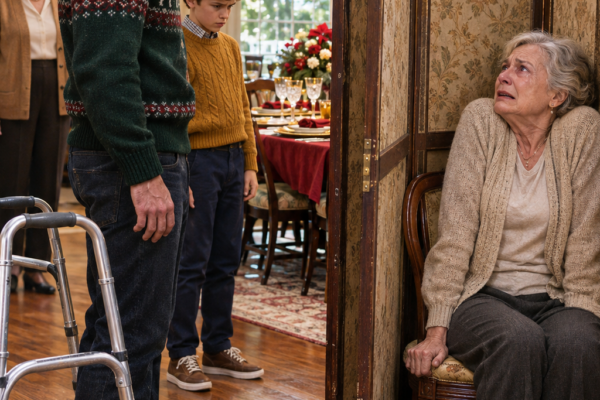
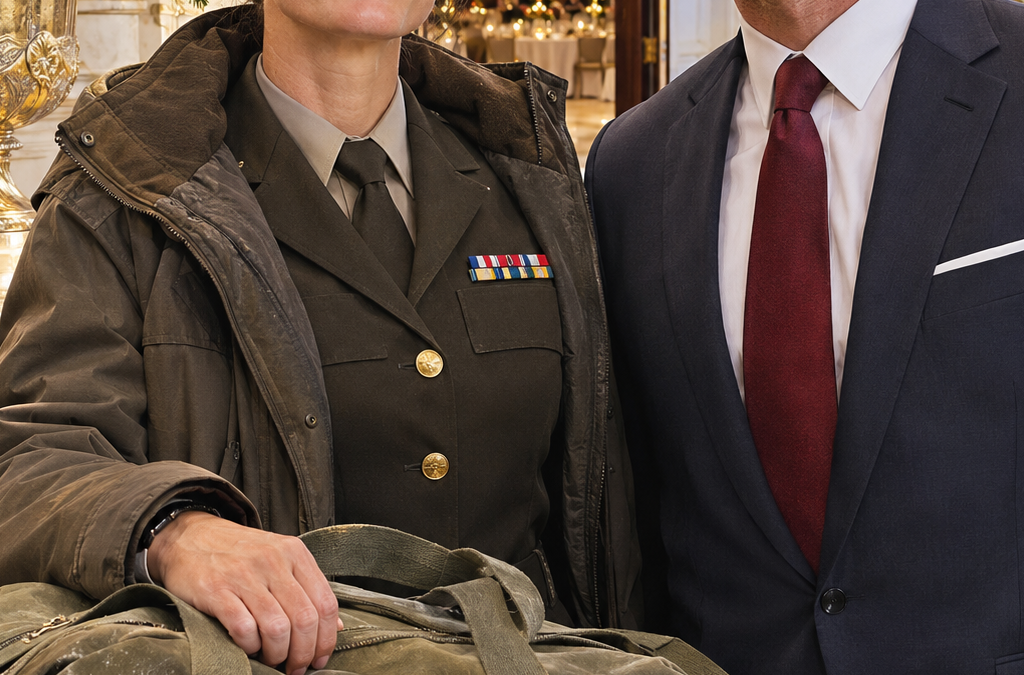
My stepfather shoved my Army duffel beneath the shoe-polishing stand at our Christmas gala in the hotel I owned and said, “Make yourself useful for once.”
Chapter 1 of 7
Richard Mercer pointed at the brush, ignoring the road salt streaking my bag.
“I came for dinner. Are you really letting him do this?”
My mother, Linda, looked toward the ballroom instead of answering. Something bright hung from her wrist beside her watch.
“You can greet people after the work is done,” Richard said.
His sister Susan stood near the reception desk, watching Linda’s wrist before looking toward the staircase.
“Please don’t embarrass us in front of everyone,” Linda said.
That hurt more than the order.
Bellweather House’s foyer smelled of pine and warm bread. Beyond Richard, sixty places waited beneath the ballroom chandeliers, each set with a folded white napkin and a little menu I hadn’t had time to read.
My coat was still buttoned, and nobody had offered to take it.
I was Claire Bennett, thirty-seven, an active-duty Army major in logistics, home on approved leave.
Bellweather House was my own mansion, converted into a hotel.
The house stood in Hendersonville, North Carolina, and I’d owned it for seven years.
Richard’s favorite coconut cake waited on the dessert table. He always requested a thin slice, then complained about whoever cut it.
Linda’s requested chair sat beside the fireplace. In the private dining room, I’d allowed family photographs among the hotel’s framed mountain views.
I had hired Richard to host family events because he knew the relatives and wanted paid work. He hadn’t acquired a piece of the place.
But I’d let him speak as though he had.
Now Linda edged closer to him, her sleeve slipping back as she reached for his arm.
My mother wore a bright brass key on her wrist.
I retrieved my duffel and turned my worn brass room key in my palm.
That key had opened the owner’s upstairs sitting room when I bought the house, back when the windows stuck and the faded curtains barely reached the floor.
I had made helping so automatic that they stopped asking.
Richard glanced at my bag, annoyed that it was no longer where he’d put it. He said the staff had enough to do without looking after me.
Then he reached through the ballroom doorway and lifted my place card from the nearest table.
“You can help through dinner. We’ll use your seat.”
Linda watched him carry the card back. “Just do what he asks tonight, Claire.”
My face burned.
Susan could hear every word, and neither of them lowered their voices. The brush still lay where Richard had pointed, its wooden handle shiny from years of use.
“You’re giving my seat away so I can serve?”
“Yes. You don’t need a place while you’re working.”
He held the card against his jacket, covering my name with his thumb.
“Get BEHIND THE STAND!”
“Keep the brush.”
I stepped around him with my bag. The ballroom doors remained open behind us, and Linda watched me cross the foyer as though I were the one who owed everyone an apology.
She called my name, but I kept walking.
Beside the reception desk, I called Natalie Brooks, the hotel’s general manager and event director.
“Claire, good. Linda’s asking when those permanent family rooms become available.”
“What permanent rooms?”
Natalie paused, then said she was coming to the foyer.
I stayed beside the desk with my coat on while Richard held my place card against his leg.
Susan moved away from the staircase, watching Linda now instead of me.
Then Natalie came through the ballroom with Daniel Ortiz. He was the gala’s guest speaker, booked in advance, wearing a civilian suit.
His program folder was tucked beneath one arm.
“Major Bennett. Natalie said you’d arrived.”
Richard stepped between us. “She’s supposed to be helping with the guests.”
“Claire is the person Daniel was scheduled to meet,” Natalie said.
Daniel stopped beside me rather than passing by.
Richard lowered the place card against his leg.
Linda stopped smiling as Natalie turned toward her.
Susan came closer to the reception desk.
Natalie waited until Richard looked directly at her.
“Richard, why is Linda asking about lifetime rooms?”
Linda answered before he could.
“He said we wouldn’t have to keep booking.” She lifted her wrist. “Our rooms would always be here for the holidays.”
Richard gave an impatient laugh. He told Natalie these were family arrangements, nothing she needed to interrupt dinner over.
But Natalie didn’t move toward the ballroom.
I looked at Linda’s key again. It was bright and decorative, with no wear along the edges. It didn’t resemble the keys Natalie issued to overnight guests.
My coat suddenly felt too warm.
Linda said Richard had offered the same arrangement to several relatives. They would have somewhere to gather every Christmas without going through the hotel each time.
“He explained it all,” she added.
Susan looked down at her phone.
Until then, she’d seemed embarrassed for Richard, watching us as though one quieter sentence might get dinner started again.
Now her attention stayed on the screen.
Richard noticed.
“Put that away. We’re not doing this out here.”
Susan didn’t answer him.
She opened something and studied it for another moment.
Linda leaned closer, trying to see the screen.
Richard stepped toward them, still holding my place card.
Susan moved the phone away from him.
Then she held it where I could read.
Susan turned her phone toward me: six families had paid him.
The list showed names, amounts, and Richard as the recipient. Susan’s own payment appeared among the others. It wasn’t a hotel receipt.
I read the names again. These were people who’d sent birthday cards and brought covered dishes when Linda was sick. They’d believed they were buying something real.
Nobody had asked me.
“I haven’t agreed to any of this,” I said. “I’m not confirming a purchase tonight.”
Susan’s mouth pulled tight. She kept the phone facing me, as if I might find a different meaning by looking longer.
Natalie said dinner and the booked rooms would continue as planned. She would keep the evening running while we sorted out what Richard had promised.
Then she told Susan she could go in and eat whenever she was ready. Susan stayed where she was.
“We have people waiting for dinner,” Richard said. “Claire can stop making this awkward.”
I was humiliated, standing there with my luggage while he blamed me for the delay. A few minutes earlier, he’d wanted me serving those same people without a seat.
Now he wanted my agreement.
Linda started to say that everyone had trusted him.
“Linda, stop talking. You’ve explained enough already.”
She closed her mouth.
Through the doorway, the tables looked exactly as they had when I arrived. Water glasses caught the chandelier light. Richard’s cake waited beneath its glass dome.
My chair still stood where I’d expected to sit.
I wanted to take off my coat and eat dinner. That small, ordinary wish was getting harder to hold on to.
Natalie asked whether the money had come to Richard personally.
He said they didn’t need to discuss money in the foyer. Susan kept her phone out.
Linda looked from its screen to my bag, then finally at me.
“He already spent our thirty-six thousand dollars.”
Chapter 2 of 7
“I paid the overdue suppliers at Mercer Event Services,” Richard said. “Those payments kept Jason’s operation running. You’d rather we let it fold?”
He looked at me as though I’d received the money.
Jason came from the ballroom before I could answer. My stepbrother wore a company jacket over his dress shirt, the collar folded underneath on one side. He stopped beside Richard.
“They were advances on future family celebrations,” Jason said. “Dad wasn’t taking donations.”
Nobody had said donations. I watched Richard shift closer to his son, making space for him in the circle he’d tried to push me out of. That hurt, even after all these years.
Natalie asked Jason whether any payments had gone through the hotel. He said Richard had handled them. Richard told him there was no need to explain every little thing.
The smell of dinner reached us from the ballroom. Daniel excused himself to check his place in the program, leaving Natalie with us at the reception desk.
“You were twelve when I took you in,” Richard said. “We didn’t ask what we’d get back.”
Linda looked down. I remembered arriving at their house with school clothes in grocery bags, trying to make myself easy to keep. Twenty-five years later, he still knew where to press.
“Mine went first. I checked with the others before tonight.”
“My mother married you. I didn’t take out a loan.”
He dismissed that with a laugh. He said I’d always had a way of making generosity sound ugly. Jason stared past me toward the dining room, apparently embarrassed by how long this was taking.
Susan moved to the reception’s edge, where we weren’t blocking the doorway. I followed her, and she showed me her payment confirmation again. Richard’s name appeared beneath the amount.
“Six payments of $6,000,” Susan said. “Mine went first. I checked with the others before tonight.”
She named the relatives on her list, then explained that they’d compared amounts while arranging their travel. Each had paid the same price. None had received a receipt from Bellweather House.
Her thumb hovered near the conversation beneath the payment screen, but she didn’t open it. She looked toward Richard instead. I was disappointed; she still wanted him to supply an explanation she could live with.
He told her he would go through everything after dinner. Susan said she’d rather stay, though she lowered the phone against her side.
“I’m not approving some permanent arrangement nobody can explain,” I said.
Natalie nodded, but she didn’t turn that into an order to Richard. She asked us to stay clear of the desk so arriving guests could reach it. Even now, she had a hotel to run.
“Richard has a signed twelve-month hosting appointment,” she said. “It gives him limited authority to arrange family events. It also lets me end the appointment for cause.”
She kept her voice low enough that we had to listen. “I need to establish what he sold and compare it with what he was allowed to do. We can’t simply pretend the agreement doesn’t exist.”
I wanted a quick answer. Hearing that there wasn’t one made me tired enough to notice the weight of my coat.
Richard seized on the word agreement. He told Linda that Natalie understood he’d been hired to bring the family together. Natalie answered that she hadn’t approved his sales.
The house had never been an effortless gift I could keep giving away. Over years of Army work, I’d saved the $128,000 down payment toward the $640,000 purchase. Borrowing covered the rest.
Afterward, hotel revenue had carried the loan payments and operations. I remembered the first winter’s heating bill and eating scrambled eggs for dinner while deciding which repairs could wait. I’d been proud of making it work.
Jason said the suppliers had needed paying before they would take another order. Richard cut him off, but the explanation was already there. Their business had needed money, and they’d collected it by promising access to my home.
“Tell them they’re welcome, and we can sort out details,” Richard said. “That’s all anyone needs from you tonight.”
He made it sound small. A welcome, a few comforting words, dinner served before the food cooled. But Susan was watching me as if my answer might protect what she’d paid.
Linda moved beside Richard again. He told her the family finally had somewhere dependable for Christmas, somewhere nobody had to beg for an invitation. If I started putting conditions on everything, he said, people would stop coming.
“I won’t promise something I haven’t agreed to,” I said.
Linda’s face pinched. She asked whether I understood how disappointing that sounded. I did, and I hated that disappointing her still made me want to soften my answer.
Natalie said the current gala and booked overnight stays were continuing. Richard ignored her. He asked Jason to show me how much planning had already gone into the holidays.
Jason pulled a folded sheet from his jacket. Across the top, he’d typed a heading for future Christmas stays, followed by household names and room assignments. He laid it on the reception counter between us.
There were practical notes about arrivals and breakfast, all written with the confidence of settled plans. Then his finger found the line beside his own name.
Jason’s roster named my private upstairs sitting room as his family’s permanent Christmas suite.
Chapter 3 of 7
“That’s my sitting room, Jason. My books are up there. My clothes.”
His finger lifted from the roster. He looked toward Richard, then back at me, as though I’d mentioned a problem with the room’s heating.
“Dad said you wouldn’t need it much. With you away.”
Nobody had asked where I would go when I came home. The shelf beside the window held paperbacks I’d kept since college. My winter coat hung in the closet upstairs.
Those things apparently counted as space waiting to be cleared.
Richard told Jason to fold the sheet. He didn’t apologize or suggest changing the assignment. Instead, he asked Natalie whether we could finish this after everyone had eaten.
“I’m not lending you money to cover money I never received,” I said.
Richard’s expression changed. Until then, he’d treated my refusal as an irritating delay. Now he looked at me as though I’d threatened him.
He said refunds would drain Mercer Event Services. Suppliers wouldn’t keep extending credit, and Jason couldn’t run an operation with nothing coming in.
“You want him out of a job over some rooms?”
Jason stood beside him, still holding the roster. He didn’t say he could find other work or that the sitting room could come off his list.
I hated being made responsible for what happened next. Richard had already spent the money, yet somehow I was supposed to be the person taking it away.
Natalie stepped closer before he could start again.
“Serious sales outside your agreed scope can end the appointment,” she said. “I haven’t made that decision. We still need to establish what you promised.”
Richard said she was making ordinary family planning sound sinister. Natalie didn’t argue. She asked him to leave the reception counter clear and reminded us that dinner was ready.
I finally took off my coat. Natalie offered to have my bag brought upstairs, and I accepted. It was the first ordinary kindness I’d accepted since arriving.
Richard headed into the ballroom with Linda close behind. Jason stopped near the doorway and began typing on his phone.
By the time I reached my table, several guests were looking down at theirs.
“Check what he’s sent,” Susan said quietly.
She held her screen low between us. Jason had posted in the family group, the same one Linda used for birthday reminders and travel plans.
Claire won’t honor the holiday arrangements. Dad’s trying to save everyone’s Christmas plans. Please give him a chance to explain.
My name looked ugly there, attached to a decision I hadn’t made.
Across the table, relatives who’d welcomed me at other dinners bent toward one another. A chair scraped away from mine so its occupant could join the next conversation.
Nobody asked me what had happened.
My place card had reappeared beside a plate of chicken and green beans. The chair on my other side stayed empty, though someone’s folded program lay beside its water glass.
I sat down because standing there felt worse.
“Are you getting much of a break?”
Daniel had paused beside the empty chair. He asked if anyone was using it, then sat when I shook my head.
He talked about leave as though we were having a normal dinner. I told him I hoped to sleep late once or twice. He said he always planned ambitious things for time off and mostly ended up buying groceries.
It was such an unremarkable conversation that I almost cried.
For fifteen years, Army work had given me problems I could name and tasks I could finish. At this table, I couldn’t even explain why my own chair felt borrowed.
“Did you think you were buying ordinary reservations?”
Daniel asked whether I’d driven in. I said yes, and we talked briefly about the mountain roads.
Then he excused himself to check the program with Natalie. He didn’t ask what I wanted done about Richard. I was grateful he hadn’t made me explain.
Susan remained across from me, barely touching her dinner. Her phone rested beside her plate, turned facedown now.
“Did you think you were buying ordinary reservations?”
She looked toward Linda before answering. That small hesitation hurt. Susan had shown me the payments, but she still seemed to want permission to question her brother.
“He used different words,” she said. “It sounded like we wouldn’t have to—”
Richard approached before she finished. Susan lowered her eyes to her plate, and I knew she wasn’t going to continue with him standing there.
He asked whether we were enjoying dinner. Neither of us answered.
“Your mother’s upset. Go talk to her.”
Linda sat two tables away, watching us. I could have crossed the ballroom in seconds. Instead, I asked Richard why she couldn’t come talk to me.
He said I knew how hard this was for her.
I looked at Susan, hoping she might finish her sentence anyway. She reached for her water instead.
Richard returned to Linda and spoke close to her ear. She glanced toward me, then down at the table. He took out his phone.
I waited for my mother to stand. Even an awkward wave would have helped.
My phone lit beside my plate. Susan’s lit too.
Linda watched Richard type and said nothing.
His new message appeared beneath Jason’s.
“Linda owns half. Claire can’t decide this alone.”
Chapter 4 of 7
Natalie came back to our table with her phone in her hand. She’d seen the message too.
“Linda, do you own any part of Bellweather House or the company that runs it?”
My mother looked up from her plate. Richard started explaining that family ownership wasn’t always as simple as names on paper.
Natalie waited for Linda.
“No. I never bought any of it.”
Richard turned toward her. She kept looking at Natalie, though her face had reddened.
“Let me answer, Richard. She asked me.”
It was the first time that evening my mother had stopped him from speaking for her. I wanted that to comfort me. Mostly, I felt sick about how easily she could have said it earlier.
Natalie asked us to step just outside the ballroom. Susan came with us, and Jason followed Richard. Through the open doors, we could still see our tables.
“I checked the records in our management file,” Natalie said. “The recorded deed names Claire alone as the building’s owner; the operating agreement and membership ledger confirm she alone owns the operating company and appointed me to manage it.”
She didn’t bring out a stack of papers. She’d checked what she needed, and now she was telling us.
Richard looked at me rather than Natalie.
“All of it? The business too?”
“Yes,” I said.
He glanced at Linda, waiting for something she didn’t give him. For years, he’d treated my work as the contribution of an absent daughter. Now he was finally looking at the person whose permission he needed.
Jason asked whether Linda had put money into the purchase later. She said she hadn’t. Richard told him to leave it.
I hated that we needed this conversation at all. My name had been enough when a repair bill arrived. Tonight, having guests and money at stake had made it debatable.
“You hired me to make family arrangements,” Richard said. “That wasn’t something I made up.”
Natalie agreed that he had been hired. She didn’t offer him anything beyond that.
Richard straightened his jacket and started again, more carefully. He said family gatherings weren’t single occasions. People needed to plan, especially around Christmas, and he’d understood my hospitality to include recurring holidays.
That was a better argument than pretending Linda owned half. He knew it too. His voice steadied as he talked about travel, room assignments, and keeping everyone together.
“I approved family events,” I said. “I never approved permanent rights to the house or its rooms.”
Susan looked toward the ballroom. At her table, two relatives were watching us through the doorway.
Richard said he couldn’t ask people to organize their lives around an invitation that might disappear. Natalie answered that future events still needed hotel approval. He heard her, but his attention stayed on me.
Linda asked if we could have a minute alone. Richard hesitated before stepping toward Jason, close enough to watch us.
“It made him feel successful. Like we finally had something to show people.”
“He knew you bought it,” she said quietly. “I didn’t tell him you hadn’t.”
“But you let him say it was yours.”
She looked past me toward the ballroom. On the mantel, Natalie had arranged greenery around the old clock. Linda had helped choose that greenery during a visit I’d encouraged.
“He liked saying ‘ours,’” she said. “It made him feel successful. Like we finally had something to show people.”
There it was, smaller and uglier than the version I’d carried for years. I’d wanted her to be proud of what I’d built. She had let him wear it instead.
It hurt enough that I had to wait before answering.
“You could have been proud of me without giving him the house.”
Her eyes filled. She said she was proud, then asked me to understand how hard things had been for him.
I knew about hard things. I also knew she was asking me to make this one easier for him again.
“I’m not protecting his feelings by giving up my home.”
Linda rubbed at a spot on her sleeve. She didn’t apologize, but she didn’t ask again.
Natalie returned before Richard could rejoin us. The scheduled host welcome was at 8:30 p.m., in the ballroom. Richard would give it from the lectern after dinner.
She asked us to remain there for the program. Daniel’s remarks would follow Richard’s welcome; Susan and the other purchasing relatives were already seated, and Jason stayed beside his father.
I asked Natalie quietly whether she needed me to do anything. She said she would handle the hosting decision under the agreement she administered. I told her I wanted her to enforce it.
Saying that frightened me more than I’d expected. Richard had spent years making every limit sound like an insult.
We went back inside. Linda returned to her chair, while Susan sat across from mine. Daniel was reviewing his program near the lectern.
My dinner had gone cold. I ate one green bean anyway, mostly because I didn’t know what else to do. Linda always called them squeaky beans when a restaurant undercooked them. These squeaked.
For a moment, I almost looked over to share the joke.
Richard stopped beside my chair before I could sit. He bent close enough that Susan couldn’t hear without leaning forward.
“You can still settle this when I welcome everyone,” he said.
I looked at the relatives waiting for the program. He followed my gaze, then lowered his voice further.
“Back my arrangements publicly, Claire, or I’ll tell them you’ve canceled all their future Christmases.”
Chapter 5 of 7
“I won’t stand up and tell them you had my permission.”
Richard stayed beside my chair. Across the table, Susan had stopped pretending she couldn’t hear.
“You’re making this bigger than it is,” he said. “I collected deposits. Hosts do that.”
A few minutes earlier, he’d threatened to blame me for canceling Christmas. Now he sounded almost bored, as though we were disagreeing over a menu.
I sat down. He remained standing until Jason came over, then moved toward the lectern with his son.
Around us, guests were finishing dinner. Someone at Linda’s table wanted coffee. I wanted the evening to end, but Richard was preparing to give everyone a reason to blame me.
“They weren’t reservations,” Susan said quietly. “That isn’t what I paid for.”
She watched her brother as she spoke. He was studying the program with Jason, pointing to something near the top.
I asked what she’d thought she was buying.
“Permanence. Somewhere we wouldn’t have to ask about every year.”
Her voice sounded embarrassed. She’d paid her brother because she trusted him, and now he was telling her she’d bought something else.
“Do you still have the whole conversation?”
Susan said she did. She didn’t reach for her phone, and I didn’t ask again yet.
Natalie paused beside us and told me she had Richard’s signed appointment available. Then she answered a question about coffee service and checked that Daniel had what he needed. Nothing stopped running because my family had made a mess.
“You know what happens to Jason if the company goes under.”
Richard returned while Susan was still looking at me.
“Sue, don’t get dragged into this. We’ll work it out.”
Susan asked whether he meant the money or the rooms. He leaned closer, lowering his voice.
“You know what happens to Jason if the company goes under.”
I heard him anyway. So did Susan.
He’d put the same responsibility on her that he’d tried to put on me. Her nephew’s job, her brother’s pride, the business that had already swallowed her money.
It hurt to watch her hesitate. I knew how much effort it took to disappoint him.
Susan told Richard she needed an answer. He said the welcome would clear things up, then went back to Jason.
At the next table, Linda rose and approached Natalie. The bright purchased key was still looped around her wrist.
“Where would I find my holiday booking?” she asked. “For next Christmas. Would it be under my name?”
Natalie said she would check the hotel’s bookings. Linda waited beside my table instead of returning to Richard.
She looked tired. I’d wanted her beside me all evening, but now that she was close, I couldn’t think of anything to say.
Natalie returned after a brief visit to the reception desk. There was no future holiday booking under Linda’s name corresponding to what Richard had sold her.
“But your room tonight is booked,” Natalie said. “That hasn’t changed. You can stay exactly as planned.”
Linda nodded, then asked whether the key Richard had given her was needed tonight. Natalie said reception would provide her room key.
My mother looked toward Richard. For once, she didn’t go to him for a different answer.
Daniel stopped by on his way to the lectern. He asked Natalie whether his remarks should still follow the welcome.
“Yes. We’re keeping the program in order.”
He told me he’d been booked a week earlier for a short tribute to the people doing the work behind family businesses.
“Just me speaking,” he said. “Civilian hat tonight, despite the haircut.”
Normally, I would have laughed. I managed a small smile, and he didn’t try to improve it.
He said he’d keep his remarks brief and moved on. He had a place in the evening that didn’t depend on rescuing me. I was grateful for that.
Richard reached the lectern and called Jason over again. They spoke with their backs partly turned.
The people settling into their chairs knew Richard. They’d hired him for anniversaries, helped him carry tables, praised him for remembering everyone’s names. Several had paid him for the promise we were now supposed to call a deposit.
“I should have asked you first,” Susan said.
I told her yes. Saying it plainly made me sad, but I wasn’t going to comfort her by pretending she hadn’t needed my permission.
Linda sat at the end of our table. She still held the purchased key, keeping it close against her wrist.
Natalie stood near the wall where she could see the tables and the lectern. I knew she could interrupt him. Part of me wanted to leave the whole ugly thing to her.
But Richard was about to tell my family what I had supposedly agreed to. I wanted them to hear my answer from me.
Richard tested the microphone with a greeting. Conversations faded as guests turned toward him.
He thanked everyone for coming. Then he talked about family needing dependable places to gather.
Susan watched without moving. Linda’s eyes stayed on the lectern.
I stood beside my chair.
Richard saw me and hurried past his next sentence. He said there’d been confusion about arrangements he’d made as the family-event host.
“These were refundable hotel deposits for family Christmas bookings.”
Susan rose across from me.
“Then explain why you refused my cancellation.”
Chapter 6 of 7
“Before you accept that explanation, Susan, will you show us what he sold?”
Susan looked at me across the table. Richard remained at the lectern, one hand covering the bottom of his program.
“They were refundable deposits. I’ve just explained that.”
He sounded impatient rather than worried. Susan had spent her life letting her brother finish, and he apparently expected her to sit down.
I stayed standing. My knees felt weak beneath the tablecloth, but I wanted her answer.
“A reservation you can cancel isn’t permanent access to somebody’s home,” I said. “Please open the conversation, Susan. The whole thing.”
She found it without searching through other screens. She’d known where it was all evening.
Richard came away from the microphone. He said Susan had misunderstood how hosts talked about repeat business. Permanent meant dependable, he explained, a family tradition. Actual visits would still go through the staff.
That explanation might have worked before dinner. Several relatives nodded, waiting for Susan to agree.
I felt sick watching him nearly make it ordinary again. He’d assigned my room to Jason, and now he was describing customer service.
Natalie moved close enough to read Susan’s screen. She didn’t take the phone.
“Could Susan give it back and get her money back?”
Richard said they would have worked something out. Susan shook her head, watching the screen instead of him.
She explained that she’d asked to cancel after realizing her household couldn’t use the rooms every Christmas. She had asked for her payment back.
Then she read his answer.
“This buys permanent holiday stays, not a hotel reservation. The key stays yours even if the event team changes.”
Richard’s eyes dropped to the phone. He started to speak, but Susan continued reading her request, then his refusal beneath it.
She showed Natalie the messages above and below, followed by the payment confirmation we’d already seen. The exchange was between her and Richard. She said that plainly, without apologizing for showing it.
For once, he couldn’t tell me I’d made too much of his words. There they were, words he’d chosen when he wanted her money.
“That wasn’t hotel business,” Susan said. “You told me it would still belong to us if someone else ran the events.”
Richard called it a misunderstanding again, but his voice had risen. He said she knew he wouldn’t cheat his own sister.
Susan stayed on her feet. Two purchasing relatives came closer to see the phone, and she let them read.
Natalie checked the appointment on her own screen. She had explained its limits before; now she named the part Richard had crossed.
“Your agreement prohibits promising residential or permanent access to the property. Selling that access is grounds for termination.”
He said he’d had family approval. Then he looked directly at my mother.
Linda sat with the purchased key against her wrist. I hated that I still had to wait for her answer.
“Linda approved the arrangement,” Richard said. “Tell them what we discussed.”
My mother rose slowly. She walked to the lectern, close enough that he shifted aside to let her stand with him.
She didn’t stay there.
“I bought a key. I never owned this house.”
“I am terminating your $19,600 hosting contract for selling rights this hotel never authorized.”
Linda placed it before him and crossed to the empty chair beside mine. I couldn’t look at her yet. I was relieved, and still terribly hurt.
Richard sat in the chair behind the lectern. For a moment, he seemed to be waiting for someone to correct her.
Natalie faced him, with Susan and the other purchasers still standing nearby.
“I am terminating your $19,600 hosting contract for selling rights this hotel never authorized.”
He stared at her.
She said the four future installments of $4,900 would not be paid. None had yet been earned. The permanent packages would not become hotel bookings, but tonight’s gala and legitimate overnight stays would continue.
Richard stood so abruptly that his chair struck the wall.
“Jason, tell her how we planned the bookings.”
Jason came forward, holding the folded roster. Natalie asked him to identify one hotel-approved reservation supporting what they’d sold. He named no booking. He said his father had handled that part.
I watched Richard turn toward his son and get nothing useful back. It hurt to remember how quickly they’d agreed that I should surrender my room.
Daniel brought over the program folder Richard had pushed aside.
“Major Bennett. I believe this was yours.”
I thanked him. He returned to his place without offering Richard an opinion.
Richard came around the lectern toward me. He said we needed privacy. A short-term loan would settle the purchasers, he said, and spare my mother further embarrassment.
“You don’t get to sell my place in this family,” I said. “And I’m not lending you the money.”
He looked toward Linda. She remained beside me, leaving her purchased key where she’d put it.
I took my worn brass key from my pocket and held it in my own hand. Linda glanced at it, then at me. She didn’t ask for it.
Susan came around to my side of the table. Coffee service resumed behind her; a guest asked for cream, and another moved a chair out of the aisle.
The ordinary sounds helped. I could remain here without taking care of Richard.
Susan asked the other purchasers to join her at the next table. On the back of an unused program, she wrote their request for repayment. They read it together, adding their names while Richard watched.
He called her over before she finished. She told him to wait.
Then Susan handed Richard the six purchasers’ written demand for return of the full $36,000.
Chapter 7 of 7
Richard didn’t hand Susan a check. The money had gone to suppliers, and he disputed how soon he could return it. The purchasers dealt with him directly; their demand didn’t produce instant cash or an arrest.
He called me twice the following week. On the second call, he suggested refinancing Bellweather House.
“You’d get it back. We just need some room.”
“I’m not borrowing against my house for you.”
Then he asked whether I would guarantee a loan. I refused that too. He said I was making repayment harder, and I let the call end without offering another solution.
It hurt afterward. Even knowing what he’d done, I disliked hearing him sound cornered.
Susan kept the purchasers together. They compared what Richard offered and refused to let six separate conversations become six different promises.
“I’m not asking you to collect it,” she told me. “I just wanted you to know we’re handling it.”
I hadn’t realized how badly I needed to hear that.
On January 11, 2027, Richard and all six purchasers signed a voluntary repayment agreement. He agreed to twelve monthly payments of $3,000. Nobody had ordered it from a courtroom; they’d negotiated terms he accepted.
I wasn’t a signer, a lender, or his backup plan.
The first payment cleared several days later. Susan sent a short message confirming that the purchasers had received their shares through the arrangement they’d agreed on.
I read it during a lunch break and went back to work. For once, a family money problem had reached my phone without becoming mine to solve.
The next family luncheon at Bellweather House took place while I was back on duty. Natalie hired another host and sent me the ordinary event report afterward.
Richard had attended as a guest. At reception, he’d asked for two more seats.
“You’ll need to ask the host,” Natalie had told him.
He’d answered that he was the host. She reminded him that his appointment had ended, then directed him to his assigned table.
The new host wore the event badge. Richard received no payment and couldn’t add guests or change the room assignments. Lunch went ahead without him running it.
Reading that made me sad in a way I hadn’t expected. I’d wanted him to do that job well. I’d wanted hiring him to be a kindness we could both live with.
Natalie’s next message concerned a leaking faucet. I was almost glad to answer it.
Over the following months, Susan stopped copying me into repayment discussions. She sent confirmations when payments cleared, nothing more. Richard stopped asking me for money after I gave him the same answer each time.
Jason continued working at Mercer Event Services. Our contact became brief and polite. He never again referred to my sitting room as his suite.
Linda called less often at first. Some conversations stayed with groceries and weather because neither of us knew how to reach anything else.
“I should have said something before Natalie asked me,” she said one evening.
“Yes,” I told her.
There was a long pause. I resisted filling it for her.
She didn’t explain Richard’s pride or Jason’s worries that time. She said she knew, then asked whether I had eaten dinner.
It was a small conversation, but it didn’t leave me exhausted.
Five months after the gala, I returned on another approved leave. The trees around Bellweather House had filled in, hiding most of the road from the upstairs windows.
Five repayments had cleared. The purchasers were still owed money, and Susan made no prediction about the remaining installments. She was keeping the agreement and checking the payments.
I was relieved they had received something real. I still didn’t trust Richard enough to assume the rest would arrive.
“Could I come see you while you’re home?” Linda asked. “Just me.”
I offered Saturday afternoon, after lunch and before dinner. She repeated the arrangement back without asking to stay overnight.
That mattered more than an apology delivered in front of everyone would have.
She arrived alone with a small grocery bag. Inside were strawberries and the boxed shortbread she bought because, she always claimed, homemade cookies required too many things to wash.
I laughed before I remembered to be careful.
“You joined in, Mom. You told me to do what he asked.”
We sat in the private dining room while the hotel carried on around us. Linda asked about my drive and my work. She didn’t ask Natalie for anything.
“I helped him by keeping quiet,” she said.
I looked at her across the table. She seemed ready for me to answer, which was different from being ready to defend herself.
“You joined in, Mom. You told me to do what he asked.”
“I know. I wanted dinner to happen without a scene.”
I told her dinner had already become a scene for me. I’d been standing beside my luggage while she worried about everyone else noticing.
She cried a little. I didn’t rush to tell her it was all right, because it wasn’t. Sitting through that without comforting her was difficult, and necessary.
“I’m glad you came,” I said eventually. “I’m still hurt.”
Linda nodded. She didn’t ask for Richard’s job back or suggest that he should come next time. We talked until the worst of the awkwardness passed.
Before dinner, I wanted an hour upstairs with a book. I told her we could have tea in my sitting room first, then I would walk her out.
“That sounds nice,” she said.
At the stairs, she asked whether I still kept the chair by the window. I did. There was room beside it for a guest, though I hadn’t decided whether to move the little table.
I pictured us there for half an hour, sharing the strawberries. Then she would go home, and I would have the rest of the afternoon.
I felt peaceful making such a small plan. My mother could visit without my giving her more than I wanted to give.
Upstairs, she waited beside me while I found the key. My books and clothes were behind that door, exactly where I had left them.
Being family did not make my home theirs to give away.
I turned the brass key and opened my own door.