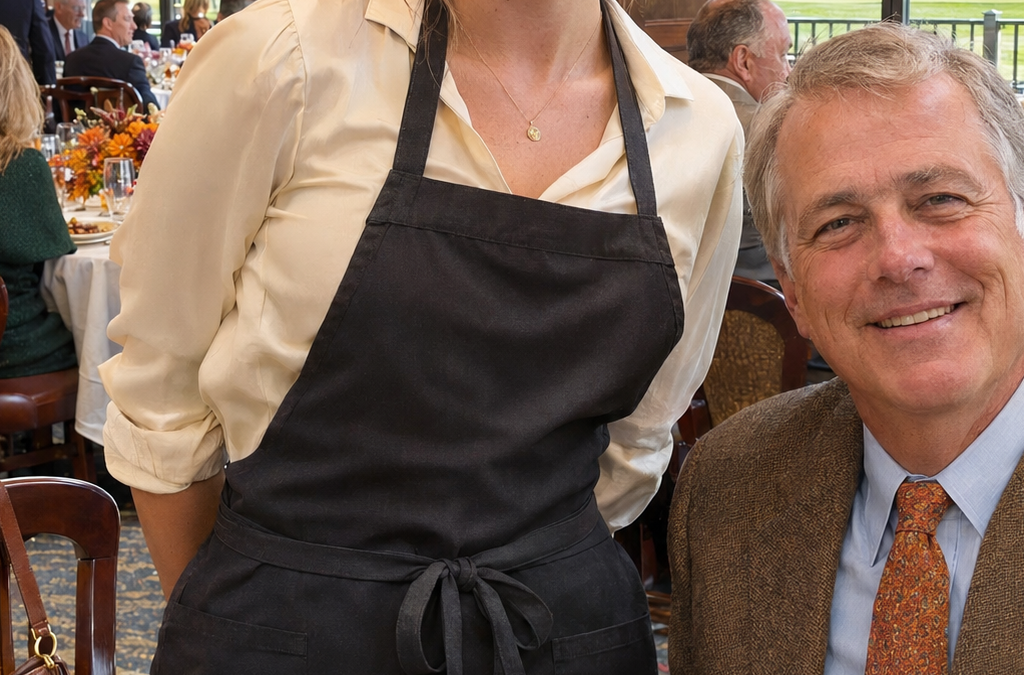
My stepmother tied a busboy apron around me at our country-club Thanksgiving and said, “Earn your dinner for once.”
Chapter 1 of 7
My father extended his dirty dinner plate toward me. Beyond it, a slice of pecan pie waited beside my untouched place setting.
“Dad, are you really handing me that? Why am I serving instead of eating?”
Robert looked toward Diane instead of answering.
Beside the family table, my brother, Adam, smiled. “Stop making dinner difficult. We’re all trying to enjoy ourselves.”
Diane pulled the knot snug against my back. Her clipboard lay beside Carol Price, who was looking between a list of names and her phone.
“Your father’s finished. Take his plate first.”
My face burned.
There were empty chairs at our table, including the one with my purse hanging from its back, where I’d expected to sit beside my father.
Nobody had mistaken me for an employee, which would have been easier to bear.
At twenty-nine, I was still waiting for permission to sit down.
My name was Erin Lane. I owned the parent company that owned this entire club.
Briar Glen was a modest nine-hole club in Greensboro, North Carolina. The sale had closed three weeks earlier, with my introduction scheduled for after the holiday. Staff knew a private company had bought it.
But my family hadn’t asked.
Diane still used the restaurant booking system I’d repaired for her. Its green boxes showed available tables instead of the frozen screen she used to smack.
Robert’s favorite rolls sat in the basket I’d brought from home, wrapped in a dish towel because he hated when the bottoms went soft.
I had kept paying and helping because being left out frightened me.
Then Carol leaned closer to Diane’s clipboard.
“Diane, were the four places I paid for supposed to include wine?”
Diane’s head turned sharply toward Carol’s still-lit phone.
Four names appeared together near the bottom of the list, bracketed in Diane’s handwriting. I knew Carol from family gatherings, but not the people beside her.
For a moment, I assumed she meant some other dinner.
Diane didn’t answer her.
Instead, she carried my clean plate and silverware to the service counter. The pie stayed behind, beyond Robert’s outstretched plate.
“Start with this table, then collect everyone else’s.”
Adam glanced toward the counter. “Just help her out and quit arguing.”
The dining room smelled of gravy and coffee, and ordinary dinner sounds continued while my place disappeared.
Then Diane pointed toward the kitchen. “You can eat AFTERWARD!”
My throat hurt, and nobody at our table looked surprised.
“You invited me here to work without pay?”
“Yes, Erin. That’s what helping your family means.”
“Then I’m not doing it.”
The knot came loose.
I held the apron against my leg, remembering other dinners when Diane sent me back for serving dishes while everyone else started dessert at the family table.
I’d washed pans in this building before, while Diane said I was quicker than Adam.
It had sounded like praise once.
But Robert still hadn’t answered my first question, his fork resting in a smear of sweet potatoes.
I stepped away from his plate.
My phone held Diane’s messages assigning setup and cleanup. They had arrived between pictures of table arrangements, as if my agreement were already settled.
In the hallway, I called Paul Bennett, the club’s board chair.
He answered with my name, and I told him where I was.
“Diane charged this to her free staff celebration,” he said. “The whole dinner. She named you as her helper.”
I hadn’t known that.
I’d assumed we were sharing the cost, as we usually did when Diane chose somewhere nicer than my father wanted.
Paul asked me to stay.
A little later, he arrived while I stood beside my empty chair.
Diane welcomed him with a sudden change of voice.
Then she glanced at what I was holding.
“This is a family dinner, Paul.”
Paul looked at my missing place setting.
“Erin is part of ownership, Diane.”
Adam stopped smiling beside my father’s chair.
Paul said I would sit as a guest.
Robert’s plate stayed suspended between us.
Diane reached toward me as Paul stepped closer.
Diane’s hand stopped on my shoulder. “Part of ownership how, Paul?”
Her fingers pressed through my blouse while she waited for an answer.
Paul said the staff introduction would happen after the holiday. Tonight, there was no reason for an invited guest to clear tables.
Diane leaned close enough that only I could hear.
“A little software-investment stake doesn’t make you my boss.”
I didn’t explain.
She knew I’d sold my interest in the software business. During those six years, she had rarely asked about my work unless something at the club stopped working.
And now she had found an explanation she liked.
Paul remained beside my chair while Diane brought my place setting back. She did it without looking at me.
Robert finally put his plate down.
That small sound hurt more than I expected. He could have done it at any point.
Carol approached from the end of the table, holding her phone low.
“I have the message she left, if that helps.”
Above Diane’s saved voice-message entry, the screen showed Tuesday.
I didn’t play it.
Diane saw the screen before Paul did. Her mouth opened, then closed without a word.
Carol began explaining that she’d paid for four places. Diane interrupted, saying Carol was confused about these gatherings.
But Paul asked Carol to finish.
Her thumb hovered over the saved message.
Diane moved closer to the phone.
Carol pulled it back against her sweater.
Paul turned before Diane could interrupt again.
Diane’s fingers curled against the clipboard’s edge.
Paul looked at Carol. “You paid Diane for a family-only dinner?”
Carol said yes.
Diane gave a short laugh that didn’t sound like her usual laugh. Several faces turned toward us.
“Carol, don’t start this nonsense in front of everybody.”
I sat down.
The apron stayed folded across my lap. Robert’s plate remained exactly where he had put it, and I left it there.
Paul took the empty chair beside mine. He told Diane they could straighten out the details without disrupting everybody’s meal.
She wanted me standing again. Her eyes kept moving from my chair to the service counter.
“Erin knows how much work I put into these things.”
“I’m not arguing about your work,” I said. “I’m eating dinner.”
My food had gone cold, though the rolls were still soft inside. For a few bites, I concentrated on those.
Adam asked if we really needed to do this here. Paul said he hadn’t asked anyone to make a speech.
That helped.
Conversations resumed around us, unevenly at first. I was embarrassed by how badly I wanted those ordinary voices back.
Then Diane turned her attention to Carol.
“You should’ve come to me privately. You know better than this.”
Carol’s face reddened. She started to apologize, then stopped with her mouth still open.
I recognized that look. Diane had made the question itself feel rude.
“She asked whether wine was included,” I said. “That’s all she did.”
Diane stared at me.
Robert pushed the basket of rolls closer, but said nothing. I didn’t thank him for it.
Carol stayed near my chair. She explained that she hadn’t meant to embarrass anybody. She’d simply wanted to know what came with the places she bought.
Paul asked her to keep what she had on her phone. He didn’t ask her to play anything.
Still, Diane insisted this was a family celebration, arranged by her. Carol had misunderstood.
“I didn’t arrange any of this,” I said.
Carol looked down at her phone. Her expression changed as she opened another message.
She turned the screen toward me. “Then why does my invitation say you’re hosting?”
Chapter 2 of 7
“Thanksgiving dinner, hosted by Diane Mercer, with Erin Lane as your family hostess.”
That was what Carol’s invitation said. My name appeared beneath a photograph of the dining room, as though I’d welcomed everyone myself.
I read it twice. Diane hadn’t named me as an owner. She’d used me as the familiar daughter who would make the arrangement seem safe.
“You’ve helped her before,” Carol said. “I figured you knew about it.”
“I didn’t see this until now.”
Carol looked embarrassed, and that hurt. She’d asked an ordinary question about something she’d bought. Now she was apologizing to me.
She let me keep a copy of the invitation. By the time I left, Diane had stopped looking in my direction.
The next morning, Paul met me in the event hall. The tables were bare, with chairs grouped along the walls. Paid staff were finishing the cleanup Diane had assigned to me.
One cart held serving dishes I recognized. Seeing them without a family argument around them made the work look ordinary. It was work someone had been scheduled and paid to do.
“The allowance is $6,000 a year,” Paul said. “It isn’t cash she can take home. She asks to use it for an approved gathering.”
He walked with me past the service counter. Diane’s request had described a private, noncommercial celebration. The board had approved $5,280 for the dinner on Wednesday.
I looked across the empty hall. Last night, there had been enough conversation to hide almost anything.
“Forty-eight people attended,” he said. “Thirty-two relatives, sixteen other guests. None of those sixteen were listed as customers.”
Carol’s party was among the personal guests. So were the others who had bought places, though Paul was still checking each account.
I wanted the numbers to settle everything. They didn’t. Dinner had been cooked, served, and eaten. Nobody could put it back.
“Does Carol’s payment prove what she paid for?” I asked.
“Her receipt proves she sent Diane money. We still need to establish what it bought.”
That distinction frustrated me, though I understood it. Being humiliated didn’t make every suspicion a fact.
Paul stopped near the doors to the terrace. Beyond the glass, the pool was covered and leaves had gathered against the fence.
“The board has authority over senior staff, including Diane,” he said. “You’re the owner, but personnel decisions belong to us.”
He would hear Diane’s explanation. He wouldn’t treat my complaint as an instruction simply because the company belonged to me.
“I want you to check what happened,” I said. “Including what she told everyone I’d agreed to.”
My phone still held the messages about arriving early, moving tables, and staying afterward. There was no question in any of them. I sent Paul the conversation, including my replies, so he could see all of it.
“Eight years here, and now I have to explain Thanksgiving.”
He read enough to understand, then said he would review the rest.
It was embarrassing to watch someone outside my family read instructions I’d barely questioned. I had even answered one with a thumbs-up because I’d been in the grocery store.
Diane arrived before we finished walking through the hall. Robert and Adam came with her. I hadn’t known they were coming.
“She’s punishing me for expecting ordinary family help,” Diane told them, looking past me toward Paul. “Eight years here, and now I have to explain Thanksgiving.”
Robert’s work jacket was zipped crookedly over his shirt. He looked tired. Usually, that would have been enough to make me soften whatever I’d come to say.
Adam asked why this couldn’t wait until everyone calmed down. Paul told him the questions concerned the event, not anyone’s mood.
Diane turned to me.
“You don’t get to make your father choose.”
“Attending dinner didn’t mean I agreed to work.”
My voice sounded steadier than I felt. Robert studied the empty tables instead of answering either of us.
Paul asked Diane to speak with him privately. I left them there, with Adam already leaning toward her.
At home, I ate leftover stuffing straight from a baking dish. Our family always made it too peppery, then blamed whoever had bought the pepper. Usually, that joke made me laugh.
That afternoon, Adam posted in the family group.
“Diane gave that club eight years. You owe her an apology over one holiday argument.”
More messages followed. Nobody asked what Carol’s invitation said. Nobody asked why I’d been named as a helper without being asked.
I started explaining the software company again. Six years of work, actual customers, a sale I hadn’t stumbled into. Halfway through, I deleted it.
They weren’t asking about my career. I was trying to make them respect it so they would listen.
Adam suggested I arrange dinner somewhere else, my treat, and let everybody start over. I’d done that after earlier arguments. By dessert, the person who hurt me usually seemed forgiven.
“I’m not paying for another reconciliation dinner,” I wrote. “Paul is checking the facts.”
Then I put the phone on the kitchen counter. Leaving the conversation unanswered felt rude, even after everything. I hated how much practice it took to stop explaining myself.
Robert’s message arrived separately. For a second, seeing his name made me hopeful.
He wrote that Diane had been crying. He wanted me to withdraw my questions and tell Paul it was a family misunderstanding.
I read the last line standing beside the cold stuffing.
“If you keep this up, don’t come home for Christmas.”
Chapter 3 of 7
“I won’t withdraw a factual question to keep an invitation,” I wrote to my father.
That was all. I booked no dinner to smooth things over. I sent no money and left his next message unopened until morning.
By then, Adam had canceled our usual drive to look at Christmas lights. We’d done it since he first got his license, arguing over which neighborhood tried too hard.
“Probably better if you make your own plans this year,” he wrote.
I sat on the edge of my bed longer than I meant to. It hurt more than the Christmas threat. Adam had found a small thing that belonged to us and put it on Diane’s side.
Our tradition included gas-station hot chocolate that tasted mostly like its paper cup. He always claimed the largest size was better value, then left half of it in my cup holder.
There would be no cup to throw away this year.
By Saturday afternoon, Diane had moved beyond the family group. Paul called and asked me to meet him at the club’s loading entrance.
“Two existing event clients have delayed their confirmations,” he said when I arrived. “Both mentioned uncertainty about the transition.”
Behind him, the delivery doors stood open. Empty racks waited inside, and a cart of clean glassware blocked part of the passage.
He’d chosen this entrance because the dining room was being set for another event. The club kept working while my family fought over what had happened there.
“Did they say what made them uncertain?” I asked.
Diane had contacted them after learning Paul was checking her event request. She’d also called suppliers, describing herself as the experienced person keeping things steady while a new investor learned the business.
Her tone had been pleasant, Paul said. She’d offered to remain their point of contact.
That part was ordinary enough for an events director. Telling them the new investor might not understand existing arrangements was different.
“She’s making herself the reassurance,” I said.
Paul nodded. One client wanted confirmation that the club would honor its plans. Another wanted to wait before committing to final numbers. Neither had canceled.
Still, food orders and staffing depended on those answers. Delays created work for people who had nothing to do with Thanksgiving.
I was angry, but I was frightened too. I’d understood that owning a business meant carrying risk. Hearing that risk described beside a loading dock felt different from reading about it before closing.
“I put $2.8 million into this,” I told him. “I have $300,000 of the sale money left outside it.”
Paul didn’t offer the reassurance I wanted. He said we needed to keep customers informed without dragging them into a family dispute.
I’d spent six years building software for businesses like this one. I knew how quickly uncertainty spread when nobody answered an ordinary question.
“This isn’t a toy to me,” I said. “And I can’t just fire everyone who embarrasses me.”
“No,” Paul said. “You need a business that works when you’re upset.”
He would handle the customer calls. I would let him do that instead of making promises just to stop feeling afraid.
Diane came through the inside doorway before we finished. She wore her club name badge and looked at me as if I’d wandered into a staff area looking for attention.
“These people book because they know me.”
“You don’t know what it takes to keep these people happy.”
She said it to me, though her eyes briefly checked Paul’s face. She wanted him to confirm it.
Paul said nobody had disputed her relationships with customers. He needed her to stop suggesting that their events were in danger.
“I’m protecting the bookings, Paul. They’re asking me questions.”
Then she turned back to me. “You don’t know what it takes to keep these people happy.”
I knew some of it. I also knew she could do parts of her job well. That had made Thanksgiving harder to explain, even to myself.
“You can know customers without listing them as relatives,” I said.
Diane’s expression hardened. She told me those people had attended gatherings with our family before. She knew who liked which table, who needed extra notice, who would come back.
The details were real. They just didn’t answer the question.
“I arranged that evening,” she said. “I knew how to make it work.”
“You arranged work for me without asking.”
Her mouth tightened. “You’ve never needed a special invitation to help before.”
I felt ashamed of how true that sounded. For years, I’d made agreement unnecessary by arriving early and staying late.
Paul ended the exchange. He asked Diane to bring customer concerns directly to him. She agreed sweetly, then walked past me without another word.
I went home without calling Adam.
Carol called while I was putting groceries away. She was sitting in her car outside a grocery store, away from anyone who might interrupt.
“Diane’s been in touch,” she said. “About the money.”
The freezer door was still open. I shut it and listened.
Diane had offered to return her $600. Carol hadn’t accepted, and she hadn’t deleted anything from her phone.
“Keep the original,” I said. “Whether you speak to Paul is your choice.”
I told her she didn’t have to persuade anybody for me. She could describe what she remembered, or take time before deciding whether she wanted to be involved.
Carol said she’d thought getting her money back should have been simple. Now she was afraid Diane would blame her for whatever happened next.
I understood that fear. It made me want to tell her everything would be fine, but I couldn’t promise that.
“Was she offering a refund, or asking for something?” I asked.
“She said the six hundred comes back only after I erase the message.”
Chapter 4 of 7
“I kept it,” Carol said. “I told her I wouldn’t delete anything for a refund.”
She sounded tired rather than relieved. I thanked her for telling me and passed her words to Paul without adding what I thought they proved.
By Monday, he had arranged a discussion at the club. Diane would be there. Nina Brooks, the finance director on the parent company’s board, would join us.
I arrived with a headache from reading family messages I’d promised myself I would ignore.
Nina met me inside the dining room. She was forty-eight, with reading glasses she wore throughout our conversation. Paul had opened the acquisition file at the end of a table.
They weren’t asking me to prove I deserved to be there. Still, sitting across from that file made me nervous.
“The signed operating agreement and membership ledger match the closed acquisition file,” Nina said. “You’re the sole admitted member.”
Paul confirmed that meant I owned one hundred percent of the parent company. He, Nina, and Mark Ellis were its three directors, responsible for management and employment decisions.
Those records established who owned and managed the company. They said nothing about whether Diane had done anything wrong.
Diane arrived before Nina finished closing the file.
“I have an event estimate waiting,” she said. “Can we make this quick?”
She sat opposite me, still wearing her club badge. For eight years, this building had been somewhere she knew people and I carried things.
Paul asked her to stay for the discussion.
Diane looked at the file, then at me. “How much did you buy, anyway?”
“The whole parent company,” I said.
She waited, apparently expecting another part of the answer.
“Erin is its only owner,” Paul said. “There isn’t another investor behind her.”
For several seconds, Diane watched him instead of me. Then she pulled her chair closer to the table.
“You sold a computer program. This place cost four million.”
“The purchase price was $4.4 million,” I said. “And I built scheduling software over six years.”
It hurt that she still described my work as something small and lucky. I could picture her frozen booking screen, back when she called me twice in one dinner service.
Diane asked whether my father knew I’d spent everything. He hadn’t asked, but I didn’t say that.
“My net proceeds were $3.1 million,” I said. “After the sale costs and taxes.”
“That doesn’t buy this club.”
“I contributed $2.8 million. The seller financed the remaining $1.6 million.”
Nina confirmed that the company owed that balance. Diane had stopped looking hurried. Her event estimate could apparently wait now.
“So you control all of this,” she said. “And you let me stand there while Paul talked about ownership.”
“My introduction was scheduled for after the holiday.”
“An owner having a family grudge shouldn’t put an established employee under suspicion.”
“You could have told your own family.”
I wanted to ask when she had last let me finish talking about work. Instead, I stayed with what we had come to discuss.
Diane turned toward Paul.
“An owner having a family grudge shouldn’t put an established employee under suspicion.”
Paul said the review concerned her event arrangements. She would have a chance to explain them.
“I helped raise you,” Diane told me. “Your father and I made room for you.”
She had married him when I was fourteen. Even now, hearing my childhood described as an accommodation made me feel ashamed of needing anything.
“I’m not discussing whether I was grateful enough,” I said. “Why was Carol’s party listed as complimentary family guests?”
Diane answered without looking away.
“It was voluntary help with decorations. People offered.”
That was possible. Diane often added flowers and table coverings beyond what the club ordinarily supplied. I remembered the Thanksgiving centerpieces, full enough that we’d had to lean around them.
Nina asked whether the payments covered those extras.
“Yes. People wanted a nice evening. Carol knows that.”
Nina said she still needed to match the approved request with the final guest list and expense entry. Company-paid hospitality and money paid personally to Diane needed to be accounted for separately.
Diane complained that we were turning favors into accusations.
“Nobody’s reached a conclusion,” Paul said. “Mark will join the review. We need your explanation alongside the records.”
I was frustrated by how reasonable Diane’s answer sounded. Part of me wanted someone to say they believed me before we left that table.
But Nina asked about expenses, not loyalties. I trusted that more, even while it disappointed me.
Through the windows, leaves moved across the covered pool. On a side table stood the club’s permanent bowl of restaurant mints. Diane always called them dinner insurance when the kitchen ran late.
I had laughed at that before. Remembering it made me sad.
Paul described the next meeting. Diane could give her account, and the factual correction would happen in front of the people affected.
“Thursday at six, here in the club dining room,” he said.
All three directors would attend, along with Diane, me, Robert, Adam, and Carol. Other affected customers could come if they wished.
Diane asked whether relatives were allowed. Paul said people who had received the conflicting accounts could hear them addressed.
She left before I did.
At home, I opened a forwarded message from Adam. He’d added nothing above it. Diane had designed another invitation using the same dining-room photograph Carol had shown me.
I hadn’t agreed to an announcement. Neither had Paul.
Beneath the photograph, Diane called Thursday “the club’s public clearing of my name.”
Chapter 5 of 7
“The board promised a hearing and a factual correction,” Paul said. “We did not promise to clear her name.”
He called Wednesday morning after reading the invitation Adam had forwarded. He had already told Diane that affected guests could attend the factual portion. Her announcement wouldn’t decide what happened afterward.
I asked whether he wanted me to answer the family messages.
“No. I’ve corrected the invitation with Diane. That’s mine to handle.”
It was a relief to leave one conversation unanswered. My phone had become a place where everyone could reach me without having to listen.
That afternoon, I met Carol in the club lobby. She had come to speak with Nina and looked uncomfortable standing beneath the framed golf photographs.
“I want you to have it,” she said. “The message. And you can play it tomorrow.”
We sat on the bench near the dining-room doors. Carol opened the original voicemail and used her phone’s share option to send me an exact copy. We checked that the transfer had finished without playing it.
Her phone stayed with her. Nothing had been erased or changed.
“Are you sure about letting people hear it?” I asked.
Carol said she was tired of being told she didn’t understand what she had bought.
I understood, but I hated that she now needed to explain herself publicly. She’d paid for a holiday dinner, not an argument with my family.
Nina joined us while Carol was checking her receipt. She compared the transfer amount with the payment confirmation Carol had authorized her to check.
“It’s the same six hundred,” Nina said. “Thank you. I’ve also checked the final attendance against the expense entry.”
Forty-eight diners had attended. Sixteen were the privately recruited guests, including Carol’s party. Nina had matched those names to Diane’s final list, where they appeared as complimentary personal guests.
Carol asked whether everyone would get their money back tomorrow.
“That hasn’t been arranged,” Nina said. “I won’t promise something we haven’t resolved.”
I appreciated the answer, though Carol looked disappointed. Being careful was much harder to sit beside than being reassuring.
Adam arrived while we were still in the lobby. He carried a statement with twelve signatures from the family.
He had written that I’d always helped Diane at gatherings and was now using Thanksgiving to retaliate against her. Seeing familiar names beneath that sentence hurt. They had signed a version of my life in which I had never been allowed to change my mind.
“These people know us,” Adam told Paul.
Paul accepted the petition without arguing about the names. He asked which signers had witnessed Carol’s purchase.
Adam said that wasn’t what the statement was about.
“Then I’ll read it for what it says,” Paul replied. “They support Diane. It doesn’t tell us what Carol paid for.”
Adam looked toward me, waiting for help with an argument he’d brought against me.
“The ones about not paying for another dinner. And what you said to Dad.”
I stayed beside Carol.
A little later, he caught me near the coat closet. Our father always insisted on hanging his jacket there, even when we were only stopping in. Adam used to claim Robert thought someone inspected it.
Neither of us made the joke.
“I sent Diane your messages,” he said. “The ones about not paying for another dinner. And what you said to Dad.”
He had forwarded them because he thought she should understand how upset I was. He thought that might prevent another family fight.
“You could have asked me first.”
“You weren’t answering anybody.”
“That didn’t make you my spokesman.”
He looked embarrassed, but I was too hurt to make that easier for him. I had written those messages to people I still hoped would hear me.
“Don’t speak for me again,” I said.
Adam nodded. He didn’t offer to withdraw the petition. When we went back, he left it at the end of the table Diane usually chose instead of carrying it around.
Diane arrived with relatives who had signed it. Robert followed her into the lobby.
She greeted Paul pleasantly and said several longtime customers wanted to attend tomorrow. People who supported the club deserved to hear why an established employee was being questioned.
Paul said they could hear the factual discussion. He didn’t agree with the rest.
Diane came over while Carol and I were seated.
“Sit down and stop making your father suffer.”
I was already sitting. For a moment, even Diane seemed to notice how little her order had to do with what I was doing.
Robert stood behind her, looking worn out. I wanted him to ask how I was. He asked whether we could all stop this before tomorrow instead.
I stayed beside Carol.
The following evening, relatives gathered at one side of the dining room. Affected customers took places farther down. I chose the chair beside Carol again, away from the people waiting for my apology.
Mark Ellis joined Paul and Nina. He introduced himself briefly, then listened while Paul explained how the discussion would proceed.
“Diane will give her account and answer questions,” Paul said. “Then the three of us will deliberate privately.”
Diane said she wanted everyone to hear her. She had asked them to come, and she wasn’t going to let questions follow her around the club.
I was scared of the conversation ahead. My phone lay within reach, with Carol’s copy saved on it.
Paul gave Diane the floor.
She stood beside the relatives who had signed Adam’s statement. Then she pointed at Carol.
“Tell them you never bought a ticket.”
Chapter 6 of 7
Before the whole family, Carol answered Diane without getting out of her chair.
“I bought four places. You told me what they cost.”
Diane looked toward the relatives, not Carol. She said the board had approved Thanksgiving. Carol had volunteered money for decorations, and now I was using my ownership to punish her after years of freeloading.
“I’ve carried these dinners for years,” she said. “Erin finally helps once, and this is what happens.”
My face grew hot. Even with everything checked, I wanted to explain every dish I’d washed.
Instead, I set the folded apron beside my place. Robert watched it come out of my bag. He still hadn’t looked directly at me.
“These were the same guests,” I said. “You asked the club to pay for them as complimentary guests. You offered Carol those places for money.”
Paul waited while Diane leaned toward him. She said putting everyone on one list had saved confusion. Carol had misunderstood the request for help with extras.
“The contributions came after approval, Paul. You know what these evenings cost.”
She reminded him that she had handled events for eight years. An inexperienced owner’s resentment shouldn’t undo that. A few relatives nodded, and I felt lonely sitting within reach of my father.
“May I play the copy Carol authorized?” I asked.
Paul agreed. Carol nodded beside me, her own phone resting in front of her. I opened the file she had sent.
Diane’s recorded voice sounded cheerful, almost hurried.
“Carol, I can offer you four places for six hundred dollars. That’s one hundred fifty per person, dinner and wine included. Send the payment directly to me, and I’ll put your four names down.”
The sales voicemail ended. Nobody needed me to explain what dinner and wine meant.
“That’s Diane,” Carol said. “She left it on my phone. I paid the six hundred she asked for. That’s the payment on my receipt.”
“That’s the timestamp on Carol’s original. I saw it beside the table that night.”
Nina confirmed the amount matched what she had checked. Diane began talking about flowers, then stopped when Carol shook her head.
I remembered Carol’s small question about wine at Thanksgiving. She had been right to ask it. It hurt that we had made her defend it this far.
Paul asked whether the offer came before or after Diane’s request for approval.
“Tuesday,” I said. “That’s the timestamp on Carol’s original. I saw it beside the table that night.”
Nina checked the record in front of her. Diane’s final complimentary guest list had been submitted Wednesday, the following day. Carol’s party was already on it.
I looked at Diane. She had sold those places before describing them to the club as free.
“You sold those places before asking us to treat them as free,” Paul said.
Diane rose so abruptly her chair struck the table behind her. She had been standing earlier; somewhere during the message, she had sat without my noticing.
“Robert, tell them Erin agreed to all this.”
My father looked down at the apron. His hand moved toward the table, then stopped. I wondered whether he was remembering how long he’d held that plate toward me.
“I handed her my dirty plate and called her a freeloader. That was false.”
He described lowering it only after Paul intervened. He said I had come expecting dinner, and he had watched Diane take my place setting away.
My eyes stung. I was glad he’d said it, and angry that somebody else had needed to arrive before he could see it.
Adam turned the petition facedown.
“I never heard Erin agree,” he said. “I figured she would because she always did.”
Paul referred briefly to Diane’s messages. They assigned tasks; they didn’t show an agreement to host or serve. I had answered some, but that didn’t make the invitation Carol received mine.
Robert moved his chair beside me. I let it remain there without reaching for him.
The directors left together to deliberate privately. During the wait, I noticed the dining room’s crooked golf print, the one Adam and I used to blame on errant indoor practice swings. Neither of us looked inclined to joke.
When Paul, Nina, and Mark returned, Mark confirmed that all three had voted for the decision.
“We are terminating your $67,500 job as events director, effective immediately,” Paul said.
Diane reached across the table toward Adam’s petition. He didn’t pass it to her. She called his name, but he stayed seated with his hands below the table.
Then she looked at me.
“Fix this, Erin. Tell them you’re withdrawing it.”
I was frightened by how familiar the order sounded. For years, that tone had meant I was about to apologize, offer money, or stay until every pan was clean.
Carol said her account hadn’t changed. Diane stared at her, waiting, but Carol remained beside me.
Paul told Diane that all future event decisions would go through him until the club assigned responsibility elsewhere. She was no longer authorized to confirm bookings or arrange employee-hosted events. Nina would contact her about the practical details.
Robert stayed in his chair. Diane told him they were leaving; he said he would speak with her outside.
“I won’t pay for a place in this family,” I said.
My voice shook on the last word. I didn’t try again.
Robert asked whether we could talk privately before I went home. I told him not tonight. His apology mattered, but I couldn’t turn straight from hearing it to making him feel forgiven.
I gathered my things and walked toward the doors. Carol caught up before I left the dining room. She had brought copies from the other customers who had authorized her to share them.
Carol placed the remaining customer receipts beside her own: sixteen paid places, $2,400 in all.
Chapter 7 of 7
Losing her job hadn’t returned anyone’s money. Three weeks after the vote, Diane signed a written settlement and completed the payments: $2,400 back to the customers and $1,760 to the club for their share of the dinner.
Nina checked the confirmations. Carol confirmed that her six hundred had arrived without any demand that she erase the message.
“The money’s back,” Carol told me. “I’m glad that part’s over.”
So was I. It didn’t give her Thanksgiving back, but she no longer had to ask Diane for something she was owed.
The agreement wasn’t a criminal judgment. It settled the repayments, and Diane paid them. I didn’t need to turn it into anything larger.
Her dismissal stayed in place. She could no longer confirm bookings or request employee-hosted celebrations. Customers who had always called her now had to deal with the club.
“Please ask Paul about that,” Robert told her during one call I overheard. “Erin isn’t the booking desk.”
He sounded uncomfortable. I was relieved he said it anyway.
For Diane, losing the job meant losing a place where people sought her out. She had known their preferences, remembered their celebrations, and expected to be needed again. That loss was real, even though she had caused it.
I felt sad about it sometimes. Feeling sad didn’t make me restore her access.
By March 4, more than three months had passed since the vote. Briar Glen still had uneven stretches of fairway and a pool cover that collected leaves.
The two customers who had delayed their confirmations eventually went ahead. Other bookings required ordinary work: estimates, menu changes, questions answered before they became complaints. Paul handled the management work while I learned what needed my attention as owner.
“We need an answer on the software renewal,” he told me one afternoon. “The dining-room curtains can wait.”
I laughed because I had spent too long thinking about the curtains. They were easier than staffing costs.
Some weeks were encouraging. Others made me worry about every dollar I’d invested. The club remained a business, with bills and people depending on it, rather than a place where I could finally make my family appreciate me.
Adam and I had started talking again, carefully.
“Would a call be okay this weekend?” he texted.
When I said Sunday would work, he waited until Sunday. It was such a small courtesy that I felt embarrassed by how much it mattered.
He told me he no longer forwarded my messages. Once, when Diane wanted him to ask me something, he told her he wasn’t carrying it.
“I should’ve done that before,” he said. “I know.”
We met for coffee twice. He talked about houses that wouldn’t sell and buyers who wanted every room painted gray. I talked about work without proving how much I knew.
I missed the easy version of us. But I didn’t give him private details I wasn’t ready to have repeated, and he stopped asking me to explain Diane to him.
Robert’s correction came in the family group, where his accusation had spread.
“Erin wasn’t freeloading. She came as an invited guest. I treated her badly, and I was wrong to threaten Christmas.”
There was more, but that was the part I kept rereading. He didn’t call it a misunderstanding or say everyone had been upset.
He also stopped suggesting dinners I could buy to bring everyone together. For a while, I waited for the request after every pleasant conversation.
It never came.
“Could I come over sometime?” he asked eventually. “Just me. If you’d rather not, say so.”
I agreed to a short dinner at my house. I told him Diane wasn’t invited. There would be no requests for money or club favors, and I wasn’t going to declare everything resolved.
He said he understood. I wasn’t sure he did, but he didn’t argue.
That evening, I made baked chicken, carrots, and the rice he used to cook when I was little. His version always stuck to the bottom. Mine did too.
The apron lay folded on the kitchen counter. I’d brought it home from the meeting in my bag, washed it, and never decided where it belonged.
Seeing it while I cooked hurt less than I expected. I left it folded.
“Where should I sit?” Robert asked from the dining-room doorway.
I pointed to the chair across from mine. He waited until I sat before reaching for the food.
For the first few minutes, we talked about the chicken. Then he said the rice tasted familiar, and I told him that wasn’t necessarily praise.
He laughed. I did too, though it made me unexpectedly sad.
“I used to scrape the bottom into your bowl,” he said. “You said you liked the crunchy bits.”
“I did.”
We ate for a while without talking. I hadn’t remembered that small kindness in years. I could remember it now without using it to excuse Thanksgiving.
“I don’t want another meeting where I have to explain why I deserve dinner.”
Robert asked whether work was going well. I gave him an ordinary answer about bookings and a software renewal. He listened without telling me Diane would have known what to do.
“I’m sorry I made you keep proving things,” he said.
My fork stopped halfway to my mouth. I was glad he hadn’t asked whether I forgave him.
“I don’t want another meeting where I have to explain why I deserve dinner.”
He nodded. “Okay.”
Afterward, he asked if I wanted help clearing. I said we could leave the plates until later. Nothing terrible happened when we did.
There was pecan pie in the kitchen, still warm. I’d bought it that afternoon because I wanted some, not because anyone had requested it.
Robert stayed seated while I went to get dessert. From the kitchen, I could see him looking around my dining room, waiting to be served in a home where I had chosen to invite him.
I was still hurt. I was also hungry, and for once I didn’t feel guilty about attending to that first.
Being family never entitled anyone to my obedience.
The apron stayed folded while I took the first slice.







