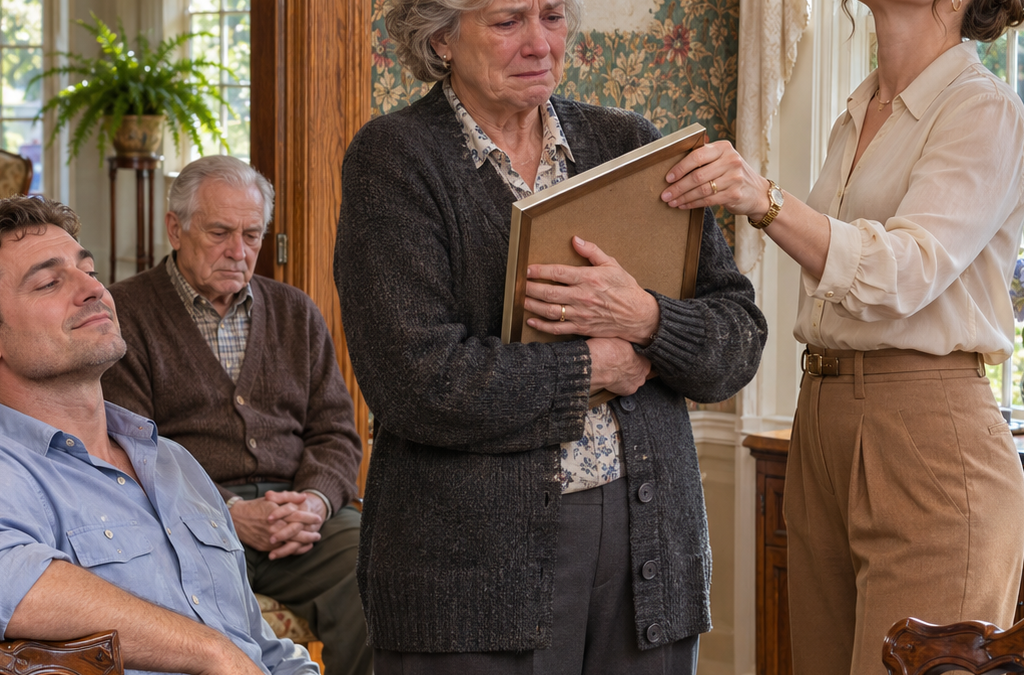
My stepson’s wife took my wedding photo off the wall at the meeting to sell my house, three weeks after the funeral: “This is the only thing you take.”
Chapter 1 of 4
My stepdaughter, Amy Mercer, stayed seated beside her brother, Brian, while his wife, Lauren, pushed the frame against my dark cardigan.
“Why are you taking down our wedding picture?” I asked.
“Brian needs the walls cleared before anybody comes through,” Lauren said.
My husband’s older brother, Frank Mercer, sat beside the dining-room doorway, his knees nearly touching the chair where my husband used to leave his sweater after supper.
“Frank, are you going to let them do this?”
At seventy-two, Frank still looked enough like his brother to make looking at him hurt. He folded his hands and studied them instead.
Beside Amy’s plate, her phone briefly showed a nineteen-second voice-message bar. Then she turned it facedown beside an unfamiliar realtor’s folder.
My name is Ellen Reed. I’m sixty-one, a recently retired hospital nurse in Dayton, Ohio.
I bought my own house in my name alone and made every mortgage payment from my nursing paycheck over twenty years.
Brian and Amy had never asked about that. Their father handled his money, and I handled mine. They assumed the rest.
For years, I carried Brian’s favorite chicken casserole to his house in an old insulated bag, usually after working a shift that left my feet too sore for shoes.
Amy once brought me a jacket before a library job interview. Its sleeve had split. I patched it while she practiced answering questions across my kitchen table.
I kept smoothing things over until they mistook silence for permission.
Brian opened the folder without looking at me.
The realtor’s folder already had a buyer’s check clipped inside.
It was an old folder, softened at the corners, but the check looked new. Under it lay a receipt with Brian’s name and a blank signature line.
“You’ll be gone before the first,” Brian said. “We’ve waited long enough.”
Lauren pointed toward the hallway. “You can stay with somebody from your hospital.”
And there it was, twenty-two years reduced to finding somebody with a spare bed.
I held the frame against my cardigan because nobody had offered me a place to put it, and Brian kept looking past me toward the rooms down the hallway.
He told Lauren to get the picture out of the way. She glanced toward the driveway instead of taking it.
“PUT IT IN THE CAR!”
His shout made Frank lift his head. Amy stared at her plate.
“Are you telling me I must leave my own home?”
“Yes, and I need you to stop delaying.”
The words hurt worse with Frank listening. He had eaten at this table for years.
“All right,” I said.
Brian pulled the receipt closer and told Lauren he needed everything settled before he signed. He spoke as though my standing there was holding up an ordinary errand.
I stepped into the adjoining doorway but kept the table in sight.
Brian had already invited David Ellis, the bank officer handling my husband’s trust. When I called, David answered from my front door.
He told me Brian had accepted $25,000 from a man expecting the house to be empty.
I asked him to confirm that Brian had taken money for my house. He did.
I let David in without telling him anything more.
Lauren straightened when she saw him behind me. Frank moved his knees out of our way.
David went straight to the picture in my hands and steadied it between us.
“We’re waiting for you to release Dad’s money,” Brian said.
David lifted the frame toward its empty nail, and I looked from him to Brian.
“He left an envelope for the day someone asked her to leave.”
Brian’s pen stopped moving above the receipt.
Lauren turned toward Brian, her smile gone. Neither of them spoke.
He took the photo from my hands and hung it back on its nail.
David held Paul’s head chair until I sat. My legs shook beneath the table.
“Brian, you took money after promising a stranger I’d be gone.”
His chair scraped backward. He looked at Amy, waiting for her to answer me.
“Ellen never agreed to sell,” David said.
Brian said they would work it out as a family. Nobody had said I wouldn’t have a place.
He still hadn’t denied taking the money.
The check clipped inside the folder was marked void.
Brian explained that the man had sent it first. At Brian’s request, he’d then paid electronically.
“So that check isn’t even good,” Lauren said.
“The money was paid,” David told her.
The worn folder, he explained, came from an earlier inquiry about the house’s value. It proved no listing.
Brian slid his forearm over the receipt.
I had thought he meant to sell after forcing me out. He had already promised I would leave.
David took a sealed envelope from his case. Paul Mercer’s name was written across it.
“Paul wanted Ellen’s remaining years protected,” he said.
Brian turned toward Frank, but Frank’s eyes stayed on David.
I waited for Frank to look at me. He didn’t.
David laid the envelope beside his case.
Lauren leaned closer, her chair bumping Brian’s.
“There’s a second page,” he said, “naming what each of you forfeits.”
Brian leaned forward. “Dad wouldn’t take anything away from his own kids.”
David said we would receive the complete terms, not selected sentences. This wasn’t a required will reading, and nobody had to remain for a ceremony.
But Brian stayed planted beside his chair.
“Dad bought this place,” he said. “She paid bills. That doesn’t make the whole house hers.”
For years, I had let remarks like that pass. Paul had sometimes corrected them halfway, saying I worked hard too, without telling them whose money paid for the roof over us.
I had been angry with him for that. Now I missed him and was angry again.
“Your father didn’t buy this house,” I said.
Brian laughed once, without amusement. “You’re mixing things up. You’ve had a rough few weeks.”
“No. You never asked, and I never told you.”
There was more I could have said about double shifts and lunches eaten standing up. I didn’t offer my work history for him to grade.
Amy’s phone lit beside her plate. Lauren looked at it, and Amy pressed the screen dark.
That small movement bothered me more than Brian’s folder. Amy had come over before this gathering. She had sat in my kitchen and let me believe she was checking on me.
David left copies of what he had brought and said the full trust papers would follow promptly. No money was released that afternoon.
Brian wanted him to stay and settle it. David told him there was more to review, then left without making the announcement Brian wanted.
Lauren gathered her coat. Frank remained near the doorway, looking older than when he arrived.
I was still in Paul’s chair when Amy finally looked at me. Her face had gone red, and she kept her phone beneath her palm.
“I told them you’d asked me to find you a room.”
Chapter 2 of 4
“I told Frank you wanted residential care,” Amy said. “A room where somebody could keep an eye on you.”
She sat across from me the next afternoon, at the same dining table. Brian and Lauren had come back with her. Frank sat nearest the doorway again.
“I never asked you for that.”
“I know. Brian said you’d only make it harder if everybody asked her. Asked you, I mean.”
She looked at him as though he might correct her. He didn’t.
I felt humiliated. They had discussed where to put me while I was still learning to sleep alone.
Amy admitted she had played Brian’s voice message for me before yesterday’s gathering. I remembered hearing his voice in my kitchen. I had been too stunned to hold on to his exact words.
“You let me think you came because you missed your father.”
She said she did miss him. I believed that, which made the rest harder.
Brian leaned forward over the table. There was a pale mark near his elbow from the year he had helped Paul carve pumpkins indoors. I had scrubbed that spot until the finish faded.
“I owe seventy-four thousand on the business,” he said. “My house is behind that loan. This isn’t some little problem.”
He admitted using the buyer’s $25,000 to bring the debt down. It left $49,000, and he said the lender wasn’t going to wait because his father had died.
Lauren had known about both the debt and the advance.
“We have a household to keep going,” she said. “You don’t have dependent children. You could manage someplace smaller.”
“Your loan wasn’t my promise.”
Brian stared at me as though I had refused to drive him to work. I was furious, but I kept my voice low.
He said losing his own home would be worse than my moving. He had tools, work commitments, a business people depended on. Apparently, I had rooms somebody else could use.
David had sent a brief message that morning: the county record confirmed that I alone owned the house. I told them that and said I had my own copy at home.
Brian looked toward Lauren, then back at me.
“So Dad never had any of it?”
“The house was mine before we married.”
He stopped arguing that it belonged to his father. Instead, he said Paul would have wanted me to help his son voluntarily.
That word made me tired. Yesterday, he had given me a deadline.
For twenty years, I had paid for this place from my nursing wages. Now Brian wanted those years treated as money I wasn’t using.
“You knew I said no to that care-home idea,” I told Amy.
She nodded. Brian had called my refusal confusion, and she had let him. She had repeated it to relatives who called after the funeral.
That hurt more than I could explain without crying. She worked with older people at the library every day. She knew grief didn’t make someone incapable.
“You made being alone sound like being helpless.”
Frank said he had believed Amy. He thought the arrangements were something I wanted but couldn’t bring myself to discuss.
He sounded ashamed. I wasn’t ready to make him feel better.
“Tell them you misunderstood what I asked,” Brian told his sister.
Amy moved her chair beside mine.
“I knew what you asked, and I helped.”
She didn’t reach for me or ask whether we were all right. I was grateful for that much.
“You won’t invite buyers or anybody else into my home.”
Lauren asked whether she had deleted Brian’s message. Amy said, “No,” and told us she had kept the original conversation.
Brian told her she was making this worse. Amy stayed beside me.
I could hear the refrigerator running in the kitchen. Paul used to claim it got louder whenever company overstayed. For a moment, I wanted to hear him complain about it again.
“Neither of you will arrange another meeting here,” I told Brian and Lauren. “You won’t invite buyers or anybody else into my home.”
Brian said he would tell David that Lauren had merely lost her temper. She looked at him, but he was already standing.
They left together. Frank remained by the doorway, and Amy stayed in her new chair. I didn’t offer either of them coffee.
Then my phone sounded with the bank’s confirmation. I read it aloud: Thursday, at the bank’s trust office, with David, Brian, me, Amy, Frank, and the purchaser, Kevin Price.
There was a sentence attached from Kevin.
“I’m bringing the receipt Brian signed, not another check.”
Chapter 3 of 4
Across the bank table, Kevin laid down the receipt Brian had signed.
He had hired Brian for eight years at his auto-repair shop. He had believed the story about a family-owned house.
“The advance was refundable,” Kevin said. “I still needed the title checked and Ellen’s signature. But you promised me an empty house.”
Brian sat beside Lauren. Amy sat beside me, with Frank beyond her.
David called this a voluntary meeting about administering Paul’s trust, not a will reading. I set our wedding photograph in front of me. I wanted Paul’s face there while his son explained himself.
“I know the house is hers,” Brian said. “And I took the advance. But I never personally demanded she leave. Lauren got angry. That wasn’t my instruction.”
Lauren looked at him. He kept his eyes on David.
He said a possible sale wasn’t an eviction. Nothing had sold, and I was still home. I felt sick hearing him use my staying as proof he had treated me well.
“You can’t take Dad’s money over a discussion,” he said. “We needed help. We were asking her to consider something.”
Kevin showed David the messages promising an empty house by the first. Brian said that still depended on my agreement. Kevin answered that Brian hadn’t mentioned any difficulty getting it.
I remembered coming home after double shifts, too tired to climb upstairs immediately. Brian had visited on those evenings. He had seen my work shoes beside the couch.
“Did you tell Ellen she had to leave, or only ask what she wanted?” David asked.
Brian said he had asked Amy to talk to me.
I told David that Brian’s message had reached me before Lauren took down the picture. Amy had played it in my kitchen. Lauren’s outburst hadn’t started this.
“Amy must have put it badly,” Brian said. “Being worried about debt doesn’t mean I forced anybody. Nobody made Ellen pack.”
Amy placed her phone beside me. She said she had played his original message, without changing a word. Then she opened their conversation to the nineteen-second recording.
I pressed play.
“Play this for Ellen. Ellen, you must be out before the first. Lauren will tell you what you can take. I’ve spent the advance.”
His recorded voice sounded ordinary. That hurt. He had given away my rooms as casually as asking someone to move a truck.
Brian reached toward the phone, then pulled his hand back when Amy said, “I kept it.”
She identified his number and the original conversation. With her permission, David preserved a copy.
Susan Grant, the bank’s attorney, had reviewed the signed trust terms; the condition was already there, not added afterward by the envelope.
David read the short condition: each child’s share depended on neither personally demanding, nor knowingly arranging a demand, that I leave my own home for that child’s financial benefit.
Then he read Paul’s explanation: “Ellen should not have to give up her home to provide money for my children.”
I was angry with Paul again, even then. He could have said more while he was alive. Hearing those words now still mattered.
“That was an instruction to leave, delivered to Ellen, for your financial benefit,” David told Brian. “The bank is withholding your $180,000 share.”
Brian stared at him.
“That’s what you signed. I didn’t pay to get between you and your family.”
David said the bank was recording that Brian’s conditional interest had ended under the trust’s terms. Brian could ask a court to review that decision. The money would remain in a separate reserve pending administration and any review, not go to Amy or me.
Brian pushed his chair back hard enough to startle me. He asked Amy to come outside with him. She said she was staying where she was.
Lauren began gathering Brian’s papers. When she reached for the receipt, Kevin kept his own original.
“I need my twenty-five thousand back,” Kevin said. “That’s what you signed. I didn’t pay to get between you and your family.”
David told him repayment was a separate matter between him and Brian. The bank wasn’t ordering it or paying it.
Frank had barely spoken. Now he looked straight at his nephew.
“She worked nights while your father saved. I should have said it then.”
I felt grateful, and still hurt that it had taken this. Frank knew how often I had worked weekends while everyone else gathered for dinner.
Brian turned to me. He said I knew what this would do to his business, to Lauren, to their house. He wanted me to say something to David.
“My home is not the payment for your mistakes.”
I told him any unfinished business concerning my property or the advance needed to come in writing. I wouldn’t sit through another family meeting about what I owed him.
Amy stayed beside me as I picked up the photograph. She didn’t ask me to forgive her. I was relieved.
Outside the meeting room, Kevin handed Brian a separate written demand for $25,000, with fourteen days to respond.
Chapter 4 of 4
Brian hired a lawyer and signed a repayment settlement within Kevin’s fourteen-day response period. They agreed on a refund; no judge ordered it, and there was no criminal case.
Kevin didn’t get my house. I didn’t pay him back for money I had never received.
“I’m not asking you to cover it,” Kevin told me. “I wanted you to know we’ve settled how he’ll repay me.”
I was relieved, though I still disliked seeing his name on my phone. He had done nothing wrong. His call still reminded me that strangers had discussed when my home would be empty.
By May 19, Brian had returned all $25,000. He sold his boat for $18,000 and supplied the remaining $7,000 from his savings.
Kevin confirmed the full refund. No trust money had paid it. Brian’s remaining business debt was still his to handle.
“He wanted to keep the boat,” Amy told me, then stopped herself. “Sorry. You don’t need to hear what he wanted.”
She was learning. I had spent years listening to what Brian needed, usually before anyone asked how I was.
Several months after the bank meeting, Brian’s lawyer confirmed in writing that he would not ask a court to review the decision. The bank’s determination remained unchallenged.
His former share stayed in the separate reserve. It wasn’t mine or Amy’s, and Brian never regained access to it.
I put the notice away. I felt relieved again, then cried because there was nobody across the hall to tell.
“I called everyone I told about the care home,” Amy said during one of our phone calls. “I said you never asked for it. I told them I knew that.”
She named the relatives. A few called me afterward, awkward and apologetic. She hadn’t softened it into a misunderstanding.
I appreciated that. I still sometimes heard her saying she knew, and had helped.
“Please don’t ask them to call me,” I said. “You can correct what you told them without giving me another job.”
She said she understood. After that, she asked before passing along my number or inviting anyone into a conversation about me.
Her visits became less frequent, but easier. She waited for invitations. She stopped bringing reports about Brian, and I stopped wondering what each visit was supposed to persuade me to do.
“I knew better than to sit there. You asked me, Ellen. I heard you.”
“I miss seeing you more,” she admitted once. “But I know I don’t get to decide how often anymore.”
I missed her too. That didn’t mean I trusted her the way I once had.
Frank apologized without asking me to explain my hurt.
“I let Brian talk for everybody,” he said. “I knew better than to sit there. You asked me, Ellen. I heard you.”
That was the part I had needed him to acknowledge. I thanked him, and he didn’t try to turn my thanks into forgiveness.
Six months after that first gathering, I invited them both to supper.
At the grocery store, I bought salmon, green beans, and a small loaf of bread. I passed the ingredients for Brian’s favorite casserole without stopping.
While choosing potatoes, I remembered the hospital locker-room bench. During the mortgage years, I had sat there before a second shift, pressing a warm washcloth against my swollen feet.
Sometimes I had needed several minutes before I could put my shoes back on. Then I had gone upstairs and worked.
I felt proud of that woman, and sad that I had so often spoken of her work as merely helping out.
“Do you want me to bring anything?” Amy asked when I called to confirm supper. “I can pick something up after the library closes.”
“Just yourself. Frank’s coming too. And I’m not making enough for extra people.”
She said that sounded good. Neither of us pretended I meant only the food.
Brian and Lauren weren’t invited. I had kept my written-contact boundary, and there was no unfinished business requiring another meeting in my dining room.
When Amy and Frank arrived, supper was almost ready. Frank said the salmon smelled good before admitting he generally cooked his until it resembled driveway gravel.
I laughed. It surprised me how little effort that took.
“Can I sit here?” Amy asked, beside the place I had chosen for myself. “Or would you rather I moved down?”
“There’s fine. Pass me the bread, would you?”
She passed it without hovering. Frank began telling us about a neighbor who kept putting outgoing mail in the wrong box.
I could enjoy their company and still remember what they had done. That evening, neither of them asked me to forget.
Family did not give anyone permission to spend my peace.
Before we ate, I returned the same photograph to its nail above my place.
I took my seat beneath our wedding photo.







