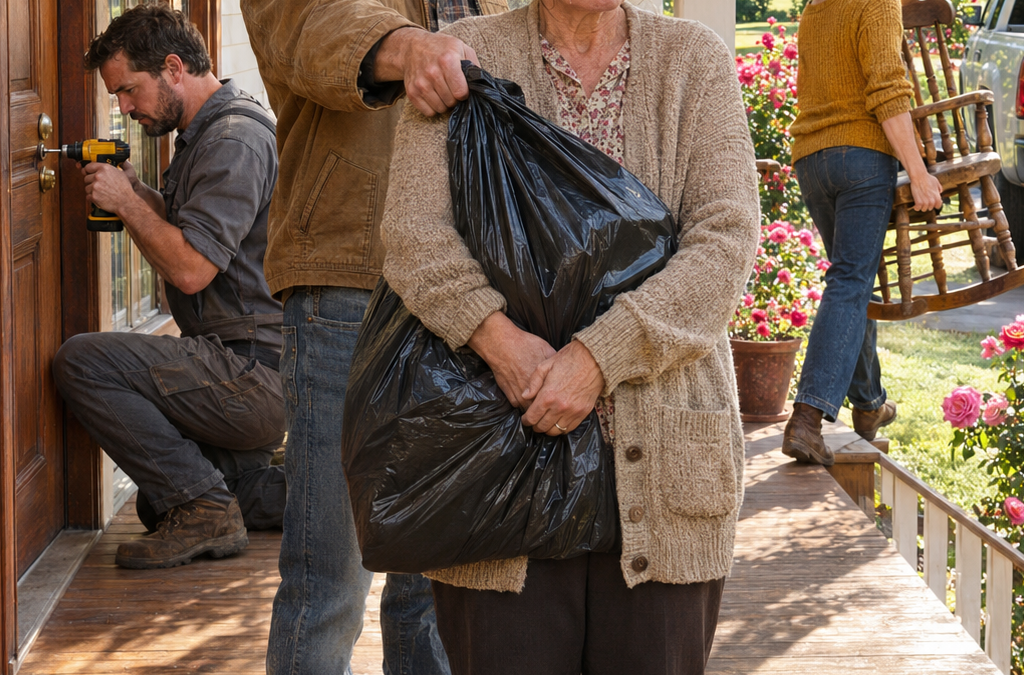
The morning after the will was read, my late husband’s nephew handed me one trash bag on the porch: “Nine years of free rent. Fill it and go.”
Chapter 1 of 7
Eric Dawson pushed the bag against my cardigan until I caught it.
“Are you really making me pack in this?”
He pointed toward the driveway instead of answering, while the locksmith he’d hired, Tom Ellis, knelt beside the front door with his drill braced against the lock.
My niece by marriage, Brenda Price, was lifting my mother-in-law’s rocking chair toward Eric’s pickup.
“Are you going to let him do this?”
Brenda looked away. “You knew you couldn’t stay here forever.”
Beside the garden stood an unfamiliar man Eric introduced as his prospective buyer, Scott Harris. Scott had a measuring wheel.
Nobody had mentioned selling.
My name is Laura Bennett. I’m fifty-six, and I live in Fort Worth, Texas. I’d spent nine years caring for my mother-in-law after my husband died.
The only thing she had left for me was her dented lunch box.
Her lawyer, Martin Cole, had promised to bring it that morning. That was all I knew about it, except that she’d forbidden anyone to open it after reclaiming it for her keepsakes.
For years, I’d cut her breakfast peaches into soft little wedges and moved her chair across the porch as the shade shifted, keeping a spare cardigan beside her.
My cafeteria hours had shrunk around her needs. Eric still called me lucky.
Yesterday, Brenda had read a circulated copy of the hospital will aloud. It wasn’t a ceremony anyone required. We’d gathered, she’d read, and Eric had started discussing my departure.
I kept smoothing things over until silence looked like agreement.
Then I looked past Brenda toward the garden.
A stranger was rolling a measuring wheel across her rose bed.
Scott eased it between the bushes as though he’d been invited to do that. The wheel caught a branch, dragging it toward the lawn.
Brenda paused halfway down the steps with the chair.
“Please don’t make this harder for everyone.”
Those words hurt more than Eric’s insults. She’d eaten Sunday dinner at our table for years.
Eric told Tom to keep working. Then he moved across the doorway, blocking the narrow space between the locksmith and the jamb.
From where I stood, I could see my slippers beneath the hall bench and the kitchen doorway beyond him, but I couldn’t reach either without pushing past his shoulder.
He called those nine years free lodging again. Apparently the night laundry, the bathroom trips, and the mornings before work hadn’t counted.
“GET YOUR THINGS OUT TODAY!”
Tom stopped looking at the lock.
“You’re changing the lock before I can pack?”
Eric said yes. He wanted the house empty, and he wasn’t letting me drag it out.
“I heard you.”
I stepped to the far end of the same porch. The bag hung empty beside my knee.
Being useful hadn’t made me safe.
But my phone was in my cardigan pocket. Martin’s number was still near the top of my recent calls, from his promise about the box.
“Martin, can you come now? Eric’s changing the lock.”
Martin was already on his way. His voice sharpened as he told me Eric had promised Scott the house and was trying to sell it.
Scott lifted his measuring wheel over a branch. I looked from him to Eric, still blocking my doorway.
When Martin arrived, I saw the dent beside the tin box’s handle before I saw his face.
“She isn’t entitled to stay here, Martin,” Eric said as Martin climbed the steps.
Martin reached for the drill’s switch, and Tom yielded. The motor stopped under Martin’s finger.
“Leave the lock. What’s in this box was recorded at the county in June.”
Then Martin told Eric that my mother-in-law had entrusted the box to me, not him.
Martin reached for the rocking chair. Brenda loosened her grip, watching him instead of me.
Scott stopped his wheel beside the porch steps.
Eric’s face lost its color; his mouth opened, but he said nothing.
He set her rocking chair back by the door and sat me in it.
Martin settled the cold tin box in my lap. I lifted its ordinary clasp.
My name was written on the folded letter at the top.
I opened it and read the first sentence aloud, facing Eric.
“You are my daughter, whether anybody else says it or not.”
Eric’s lips pressed together. His eyes stayed on the box.
“She arranged for Laura to have this house when she died,” Martin said.
Eric caught the empty trash bag where I’d dropped it.
“A letter doesn’t change the will. Brenda read it yesterday.”
I looked down at the handwriting I’d known from grocery lists.
“I’m going to finish reading,” I said.
I went back to that first sentence. This time, my eyes blurred.
She used to pack this box for our lunches on the porch.
Half a sandwich, two crackers, and she’d call it a picnic.
The refrigerator was only six feet away. I could almost hear her insisting.
Then I read why she’d kept her arrangements private: Eric pressed her whenever he needed money, and she hadn’t wanted another argument.
I lifted the letter by its bottom edge.
Eric reached abruptly across my lap, and Martin blocked his hand without grabbing him.
Eric jerked back. Red spread across his face.
Under the letter was a county receipt, stamped in June two years ago.
It was a narrow printed slip, folded across the middle. I could make out the county name and the mark showing it had been accepted.
“Does this mean the house is mine?”
“It tells us a filing was accepted,” Martin said. “I need the recorded document. This receipt isn’t enough by itself.”
He copied its details while Eric watched from the doorway. Martin didn’t tell Tom to finish a new lock or order Eric off the property. He told everyone to leave the door alone.
Tom packed his drill. He said he wouldn’t continue while the right to change the lock was disputed.
I found three folded papers beneath the receipt. Each carried Eric’s signature.
They were loan notes: eighteen thousand, twenty-four thousand, and twenty thousand dollars. Together, they totaled sixty-two thousand dollars.
“Those are between me and Grandma,” Eric said.
Martin asked me to leave them together. He would check the originals and what had been repaid before saying more.
I felt ashamed of how quickly I’d wanted to apologize for finding them.
My mother-in-law, Ruth Mercer, had known I’d do that. Her letter told me to read all the way through before deciding that somebody else needed her gift more.
She hadn’t written that she owed me wages. She’d written about being family.
Ruth remembered carrying my husband David’s repaired toy trucks home in that same box. Later, she wrote, I’d carried her small lunches out to the porch in it.
She’d wanted me to have a home, not another person to ask permission.
David had been forty-eight when he died. Moving in with his mother hadn’t brought him back, but we’d learned how to miss him together.
That was the life Eric had called free rent.
Brenda stayed beside the steps. She looked at the letter, then at the chair she’d nearly loaded into the pickup, but she didn’t offer an apology.
Scott came up from the garden without his measuring wheel.
“Eric, you already have my $10,000 deposit.”
Eric faced him. “You’re not getting it back.”
Chapter 2 of 7
“Eric said you wanted somewhere smaller,” Scott told me. “He said you’d approved the sale. You’d be glad somebody else had to keep up the garden.”
I looked past him at the roses. I had pruned them myself before Ruth went into the hospital.
Eric was halfway to his pickup. I called after him.
“You told him I agreed?”
He kept walking. Brenda followed him down the steps, looking at neither of us.
Martin had stepped away to work. He was checking the recorded filing and preserving the original papers.
Scott remained beside the porch railing. He produced a folded receipt bearing Eric’s signature and held it where I could read it.
The money had gone to Eric personally. There was no mention of me receiving any of it.
I felt humiliated. A stranger had been told what I wanted before anyone bothered to ask me.
“He was decent about you when we talked,” Scott said. “Said you’d done enough around here. I thought you were getting money from the sale. Enough for an apartment, maybe.”
That sounded almost kind. Eric had apparently saved that version of his voice for someone with a checkbook.
I told Scott I hadn’t looked for an apartment. I hadn’t agreed to sell anything.
His phone rang. Eric’s name appeared, and Scott let it stop.
“What did he tell you about the nine years?” I asked. “Exactly. I’d rather hear it now.”
Scott looked toward the pickup before answering. Eric was inside it, though he hadn’t started the engine.
“He said his grandmother supported you after your husband died. Gave you a place, paid the bills. He made it sound like you helped out some, but mostly she looked after you.”
I thought of the school cafeteria supervisor who had rearranged my shifts whenever Ruth couldn’t be left alone. I had thanked her so often it embarrassed us both.
Ruth had paid the household bills. I had never pretended otherwise. But living there hadn’t meant spending nine years with my feet up.
Scott’s phone rang again. He ignored that call too.
I was angry now, enough that I stopped worrying whether my face looked unpleasant. Eric had made my work disappear, then offered my home to somebody else.
Scott said Eric had approached him because he bought houses without needing to sell one first. He ran a landscaping business and wanted somewhere with room for his equipment.
That explained the measuring wheel. It didn’t excuse rolling it through Ruth’s roses.
“He told me he needed $48,000,” Scott said. “He was behind on his own house. Said he had thirty days to catch up, and this sale would take care of it.”
The phone rang a third time. Scott watched it until it stopped.
I knew what being afraid for your home felt like. I was sitting outside mine, unsure whether I would be allowed through the door.
For a moment, I could picture Eric awake beside his wife, trying to find money. Then I remembered him blocking my doorway.
Scott said Eric believed Ruth would have wanted him to protect his wife’s home. He had also said a blood grandson shouldn’t lose out to someone who married into the family.
“He used those words?” I asked.
Scott nodded. His phone rang for the fourth time while he was still looking at me.
Ruth and I used to disagree about mashed potatoes. She wanted them beaten smooth; I liked a few lumps. She called mine “potatoes that hadn’t finished getting ready.”
We’d had that argument every Thanksgiving. I wondered whether Eric remembered a single meal he hadn’t simply arrived to eat.
The fifth call came before Scott could put his phone away. He looked tired of it.
“I never agreed to leave, Eric. You need to tell him that.”
On the sixth, he answered and turned on the speaker.
“Stop telling my buyer your side of this,” Eric said.
I could see him through the pickup’s windshield. He was watching the porch.
“I never agreed to leave, Eric. You need to tell him that.”
“Scott, listen. I’m sorry you got dragged into this. We can still get you in right away. Let me straighten things out.”
His voice had softened for Scott. Hearing the change hurt almost as much as the words.
Scott said he wasn’t going inside and wasn’t paying anything more. Eric started explaining that families got emotional after a death.
“This isn’t what you described,” Scott said. “You told me she was ready to move. She’s telling me she never agreed. I need you to deal with that, not talk around it.”
Eric blamed me for making trouble after everything Ruth had done for me. Then he ended the call.
I was tired, but I hadn’t endorsed his story. For once, he would have to tell it without my polite silence underneath it.
Scott said the agreement required Eric to return the deposit if he couldn’t deliver the house. He repeated that he had paid Eric, not Ruth or her estate.
I told him I couldn’t promise what Eric would do. He said he understood.
Scott headed down the steps without measuring anything else. At the bottom, he stopped beside a broken rose branch.
There was more, he said. Eric had warned him I might claim that caring for Ruth entitled me to the house.
I asked what caring for her had to do with a sale I hadn’t approved.
Scott looked back toward me.
“He said you stopped visiting her.”
Chapter 3 of 7
“I came back with the coffee. They wouldn’t let me in.”
Scott looked toward the pickup. Eric was already getting out, his phone in his hand. Scott said he needed to get back to work, then left us there.
Brenda waited near the steps while Eric came toward me.
“The family already knows you chose to leave,” he said. “All twelve of us are on that thread. You could’ve answered.”
My phone had been in my pocket through everything that morning. I hadn’t looked at the family group since Brenda read the will.
There had always been somebody posting a casserole picture or asking who had the folding chairs. I’d thought I belonged there.
I opened the thread. Above the morning’s messages, Eric had written that I’d decided not to return to the hospital. Brenda had replied that Ruth needed rest.
I felt sick reading her name beneath his. She had known how badly I wanted to get back into that room.
“You sent me for coffee, Eric. You asked for the big one because you said you’d been awake all night.”
He stopped below the porch, close enough that Brenda had to move aside. He said getting coffee hadn’t prevented me from calling later.
I had called. I’d left messages, asked whether Ruth was sleeping, asked when I could come. Some had gone unanswered. Others brought the same reply: they would let me know.
“Don’t dress this up like you stayed.”
Brenda looked down at the bottom step. Eric told her that blood relatives had to think about the family’s future, even when things were painful.
He said I had walked away when Ruth was dying. Now, according to him, I wanted to walk back in and claim what belonged to everyone else.
I was furious, but my voice came out thin. I hated that he could make me sound unsure about something I had lived through.
“Brenda, you saw me leave for coffee. Did carrying my handbag out mean I was abandoning her? Is that what you thought?”
She said she had seen me leave with it over my shoulder. She remembered my coat, too. She didn’t say anything about my return.
I had taken the bag because my wallet was inside. Ruth had spent years warning me never to leave a purse unattended, even in church.
She once made me take it along to check a pie in our own oven. I’d laughed then. Remembering it on that porch nearly undid me.
Brenda opened her mouth, but Eric spoke first.
“She wanted quiet. You keep leaving that part out.”
He climbed the steps and held his phone near his face. I could see the family group open on the screen.
“Laura’s trying to take the house now. She refused to visit Grandma, and now there’s some letter she thinks changes everything. I’m handling it, but you need to know.”
He sent the recording before I could answer.
I watched it appear on my own phone. People who had eaten at Ruth’s table would hear his voice before they heard mine.
It hurt that I couldn’t name one person who would automatically question him. I’d mistaken years of birthday messages for something sturdier.
“Correct that, Eric. Send another one while I’m standing here. Tell them I came back and was turned away.”
He said we could discuss it later, after I stopped upsetting Brenda. She hadn’t said she was upset. She was staring at his phone.
I told him I wasn’t asking for a private conversation. He had accused me in front of twelve people. He could correct it in front of them.
My thumb hovered over the place where I could record my own answer. I was afraid they would hear an angry woman arguing over a house instead of somebody begging to be believed.
“The staff told me visits were limited. They said the family requested it. I stood there holding two coffees until one started leaking through the carrier.”
Eric said Ruth had asked for peace. He spoke as though I hadn’t known she got tired, as though I’d never helped her settle after a hard night.
That stopped me longer than I wanted. I hadn’t been inside the room. He had.
If Ruth had asked for quiet, I would have given it to her. I needed to know why quiet had meant keeping me out for the rest of her life.
“You didn’t hear her ask for that,” I said.
He told me I couldn’t bear the idea that she had made a choice without me. Then he brought up the hospital will. Her final wishes mattered more than an old letter, he said.
I wanted to defend every day I’d spent with her. Instead, I asked him again to correct the message.
“Come on, Brenda. We don’t need to stand here for this.”
He refused.
Brenda started toward the driveway, then stopped beside the open doorway. My coat was still folded on the hall bench.
I had left it there after coming home from the hospital, thinking I would need it again soon. One sleeve hung over the edge, untouched.
“Come on, Brenda. We don’t need to stand here for this.”
She didn’t follow him. For the first time that morning, she looked straight at me.
Eric waited, called her name again, then went down the steps alone. His pickup door slammed.
Brenda stayed beside my coat. I waited for her to tell me again that I couldn’t stay forever.
“He told me to say you wanted the break.”
Chapter 4 of 7
“I told Grandma you needed a break,” Brenda said. “That you’d gone home and didn’t want to come back yet.”
She was still beside my coat. I wanted her away from it, though she hadn’t touched it.
“You told Ruth that? While I was calling you?”
Brenda nodded. She said Eric had told her the visits were too much for Ruth. He’d said Ruth agreed, that she wanted fewer people coming through.
I waited for Brenda to tell me she had checked with her grandmother. Instead, she looked toward the driveway.
“She asked why you didn’t love her anymore.”
I sat on the hall bench because my knees wouldn’t hold me. My coat slipped against my hip.
That hurt more than anything Eric had said on the porch. Ruth had died thinking I’d stopped loving her, and Brenda had let me keep calling.
“What did you say when she asked you that?”
Brenda said she’d told Ruth I was tired. Nine years was a long time, she’d said. Everybody needed rest.
She had made my absence sound reasonable to a woman who couldn’t get out of bed and come find me.
“Start with the coffee,” I said. “I need you to tell me what happened after I left.”
“Eric asked you to get it. Then he went out and talked to someone about limiting visitors. When he came back, he told Grandma you’d gone home. I thought he meant just for the afternoon.”
She stopped there. I waited.
“I didn’t ask them to keep you out,” she added.
I knew what she wanted that distinction to do. It didn’t help me.
Brenda had reassured relatives who asked where I was. She’d told them we were taking turns, that I needed time away. Nobody had needed to call me themselves after that.
I felt betrayed in a way I hadn’t on the porch. There, at least, I’d been able to answer.
Ruth used to ask whether I’d eaten before she answered any question. Even when I brought her supper, she wanted an account of mine.
Once, I’d admitted to eating shredded cheese straight from the bag. She’d called that “standing-up nonsense” and made me sit with her.
I couldn’t bear imagining her asking for me and getting Brenda’s explanation instead.
“Who else heard her asking?”
“Amy Collins. The nurse. She heard Grandma ask when you were coming. She saw Eric talking to the staff, too. I don’t know everything she heard.”
Amy had cared for Ruth at home independently before joining the hospital’s care-coordination team. She wasn’t someone I’d hired to take my side.
Brenda said Amy had asked about me more than once. Eric had answered as though he were keeping everyone informed.
I remembered how grateful I’d been when he first offered to stay at the hospital. I’d thought I could go home for clean clothes without worrying.
Martin called while Brenda was still in the hallway.
With proper estate permission, he had obtained hospital confirmation that visits were restricted and Eric was the requesting contact; it couldn’t tell us every word spoken beside Ruth’s bed.
He had also obtained a certified recorded copy, with his signing records, confirming Ruth’s sole ownership, valid signing and recording in June two years earlier, and her designation of me.
I repeated the house news after we hung up. Brenda stared past me into the kitchen.
“So she really did it,” she said. “It wasn’t just something she wrote down because she was upset.”
I was relieved, but I couldn’t stay with that feeling. Ruth had made a place for me, then spent her last days wondering where I’d gone.
Brenda’s phone rang. She let it stop.
She asked whether I wanted her to leave. I said I wanted her to stop deciding what would be easier for me.
The phone rang again before she could answer. This time she picked up and put it on speaker.
“The house passed to Laura when Grandma died.”
“She depended on Laura for everything. You think that happened by itself?”
Eric didn’t answer immediately. I could hear his truck running.
Brenda told him Martin had the recorded copy. He asked whether it named me, and she said yes.
I watched her face as he took that in. Then his voice rose.
“She depended on Laura for everything. You think that happened by itself?”
He wasn’t arguing about whether Ruth had signed anymore. He was telling Brenda what my nine years had really meant.
I felt angry enough to stand.
“I’m here, Eric. Say it to me.”
“Then agree to sell it to keep this family together.”
He said Ruth would never have wanted this mess. He had a buyer ready, and I was making everyone suffer over a house I hadn’t paid for.
I told him I wasn’t agreeing to a sale. Brenda started to speak, and he ordered her to explain it to me.
“No,” she said. “I’m not carrying another message for you.”
Martin had offered a meeting at his office at 4 p.m. Brenda agreed to come with me; Eric and Scott would be there too.
After the call, she lingered by the door. I didn’t thank her for saying no to him. I wasn’t ready.
“There’s something else I told him,” she said.
She’d mentioned that Amy once accompanied Ruth to Martin’s office. Amy had seen me bring Ruth there.
Brenda said she hadn’t thought Eric would use that against me. I was tired of hearing what she hadn’t thought.
Her phone sounded again. She turned the screen so I could read his new message.
“Amy will confirm Laura was telling Grandma what to do.”
Chapter 5 of 7
“I told Amy I was concerned about an elderly patient,” Eric said. “She understood why I called.”
He hadn’t told her about the locksmith or Scott’s money. When I asked, he said neither had anything to do with what she’d witnessed.
We were at Martin’s office, across town from my house. Brenda had taken the chair beside Eric. Scott sat near the door, still in his work clothes, and Martin sat across from us.
“Amy saw you bring Grandma here,” Eric said. “She heard you tell her to explain what she wanted. Don’t act like nobody remembers.”
I remembered the visit. I also remembered needing to leave for my cafeteria shift. Eric hadn’t been there, but he spoke as though he’d watched us arrive.
I felt accused before I’d even settled into my chair.
Martin laid the certified recorded deed beside the hospital will.
“The house passed to Laura separately from this will. If you challenge that transfer, a court will have to decide.”
Eric barely looked at the two papers. He watched Scott instead.
“Grandma chose her blood family at the end,” he said. “That’s what she signed in the hospital. I didn’t make that up.”
Nobody had said he had. That was what made listening to him so exhausting. He kept answering accusations nobody had made while leaving his own conduct untouched.
The will was real. So were the mornings Ruth had asked me to help her sit up, and the evenings she couldn’t get comfortable.
Eric was turning those years into a reason she couldn’t choose me.
“She depended on you for everything,” he told me. “Food, rides, getting to the bathroom. You knew what that gave you.”
I was ashamed for a moment, though I hadn’t done what he meant. I could hear how ugly ordinary care sounded when he described it that way.
Ruth used to insist her toast needed scraping, even when it wasn’t burned. She liked the rough surface afterward because it held more butter.
I’d stood at her sink scraping perfectly good toast. Apparently that had been leverage, too.
“If I controlled her so much, why was I outside her hospital room? Why couldn’t I get back in?”
Eric said the restriction protected her from more pressure. He made it sound like a precaution everyone should have understood.
Brenda shifted beside him. Until then, she’d been watching Martin.
“You told Grandma Laura wouldn’t come.”
Eric turned toward her. “We already talked about this. You’re mixing up different conversations.”
She said she wasn’t. Her voice was low enough that I had to lean toward her.
He told her she was upset and ought to let him finish. She stood, crossed behind Scott, and took the empty chair beside me.
I felt relieved, then angry that relief came so easily. Changing chairs didn’t undo what she’d told Ruth.
Brenda said there was more she would answer when she was asked. She didn’t try to tell the whole story there, and I didn’t help her soften it.
Scott leaned forward.
“What about my money, Eric? You took it before you could give me a house. I want it back.”
Eric’s tone changed. He reminded Scott that he’d believed the house would be his. He had counted on the hospital will, and the sale would have gone ahead if this hadn’t happened.
“This” seemed to mean me sitting there.
“You signed for it yourself,” Scott said. “Your name. Not your grandmother’s, not anybody handling her money. I paid you because you said you could sell.”
Eric said he had acted honestly. He couldn’t release the money while ownership was being disputed.
Scott asked whether the money was still available. Eric told him that wasn’t the point.
I was frightened by how quickly I wanted to offer something. A delay, a compromise, some smaller hurt everyone could live with. I had spent years making uncomfortable moments easier for this family.
My home wasn’t mine to bargain away for their comfort. Ruth had wanted me to live there.
“We’re not deciding this here. Nobody has to agree to anything today.”
Scott looked toward me once. I told him I hadn’t received his money, and I wasn’t agreeing to a sale.
He nodded without asking again.
Martin stopped Eric when he began another explanation of what Ruth would have wanted.
“We’re not deciding this here. Nobody has to agree to anything today.”
Eric sat back. He had come expecting Martin to persuade me, or perhaps expecting me to fold once everybody heard his version.
I was tired enough that I understood why he’d counted on it.
Later, a neutral administrator took charge of Ruth’s estate, and Scott’s related claim was brought before the same court as Eric’s challenge. Everyone received notice, and the papers and witness materials were shared before the hearing.
But that afternoon, Eric still thought Amy would settle the argument for him.
He waited until Scott had stood to leave before turning back to me. Brenda remained in the chair beside mine.
I remembered bringing Ruth through that office doorway. She had been annoyed because I’d asked twice whether she needed the restroom before I went to work.
Then I’d said, “Tell Martin what you want.”
It had seemed an ordinary thing to say to a woman who knew her own mind. Hearing Eric describe it made me furious.
He hadn’t asked what Ruth wanted. He wanted me to know someone could put me in that doorway, speaking those words.
“She heard you tell Grandma what to say.”
Chapter 6 of 7
“Tell them again,” I said.
“Laura coached Grandma before the appointment. Amy saw her bring Grandma in and tell her what to say.”
Eric faced Judge Janet Reed as he repeated it. Our related claims were properly before her in Tarrant County, and Brenda and Scott sat where Eric could see them.
He conceded that the house papers had been recorded. His argument was about a woman who depended on me for meals, rides, and help getting dressed.
I felt humiliated hearing those needs listed again. Ruth had hated needing help with buttons. Now even that was being used against us.
Amy waited to answer questions. Eric had been so certain she would help him.
“But Amy stayed after I left for work,” I said. “She heard what happened when I wasn’t there.”
I brought forward the lunch box with Ruth’s letter and the original notes inside. These were the same papers everyone had already received, not another discovery.
With permission to ask, I turned toward Amy.
“What did Ruth want kept secret from me?”
Amy described Ruth asking her to stay. Ruth had known where she was and why she’d come. She had asked questions about keeping her house while she lived there.
Then Amy gave us the words Eric hadn’t heard.
“Don’t tell Laura. She’ll argue that Eric needs it.”
I looked down at the box. Even planning a gift for me, Ruth had expected me to hand it back.
It hurt because she had been right. I’d spent years calling that keeping the peace.
Amy didn’t try to explain our whole family. She said she couldn’t know every conversation in our kitchen. She had heard those words herself, after I left.
Eric leaned forward.
“Did she ever worry about being alone? Because Laura could leave. Grandma knew that.”
Amy acknowledged that Ruth disliked being alone. That didn’t change what she had said at the appointment.
Judge Reed asked whether I had remained for Ruth’s instructions.
“No,” Amy said. “Laura went to work. Ruth asked me to stay.”
“Eric told me that. I repeated it to relatives, too.”
Martin’s existing records matched that separate conversation. There had been time for Ruth to speak without me answering, prompting, or even listening.
I felt relief, but it came with grief. She had protected this choice without letting me help her.
When Brenda answered questions, Eric watched her instead of the judge.
“I told Grandma Laura wanted a break,” she said. “Eric told me that. I repeated it to relatives, too.”
Eric asked whether she had thought rest would help Ruth. Brenda said yes, then kept going.
“Grandma asked for Laura. She asked why Laura didn’t love her anymore. I knew Laura was calling, and I still let her believe that.”
The hospital record supported how the restriction had been requested. Amy also remembered Ruth asking when I would come.
Eric said asking for someone didn’t mean a patient could manage a visit. He denied intending to make Ruth feel abandoned.
Brenda didn’t argue about his intentions. She said she had told Ruth I wouldn’t come, and it wasn’t true.
I was angry that Ruth had needed an explanation at all. She should have been complaining to me about hospital oatmeal.
At home, she’d insisted oatmeal needed salt before anything sweet. She could detect an unsalted batch before the bowl reached her.
Judge Reed considered the evidence before speaking.
“The challenge fails. Ruth made this choice privately, and the recorded transfer passes the house to Laura. The later will did not undo it.”
For a moment, I couldn’t look at anybody. My house was no longer waiting for Eric’s permission.
Then I asked that Ruth’s instructions about the loans be honored too. The signed notes were already before the judge, with the history showing they remained unpaid.
Judge Reed gave the money ruling.
“Eric owes $62,000. His $20,000 legacy is credited against that debt, leaving $42,000 payable to the estate. Scott’s separate $10,000 must be returned. Deliver the cashier’s check you brought.”
Eric had brought it on his counsel’s advice, in case a settlement became necessary. Now he lost control of $10,000 in front of the people he had tried to persuade.
After we were dismissed, he stood and reached toward Brenda.
“Explain this to her. We can still fix this.”
Brenda moved beside me.
“I’m not repeating the lie again, Eric.”
She sounded tired, not brave. I trusted that more than a speech.
Scott took the check Eric handed him and read it before putting it away. Eric offered his hand, saying he hoped Scott understood how things had gotten confused.
Scott didn’t shake it.
He said he understood that he had his money back. Then he left, without promising friendship or asking me for anything.
I was relieved I hadn’t offered to rescue either man. That old urge had finally passed without my acting on it.
Eric turned to me once Scott was gone. He lowered his voice, though Brenda could still hear.
“We need to make the rest a family matter.”
He meant the money owed to Ruth’s estate. He wanted another conversation where I would worry about his house more than my own.
I told him I wasn’t making a private agreement.
He started explaining what losing his home would do to his wife. I felt sorry for her. I still didn’t offer him mine.
“You don’t get a key to my life.”
I left with the box. Brenda walked beside me but didn’t ask to come home.
At my front door, I stood for a moment before going inside. Nobody blocked the doorway.
In the kitchen, the household contact list still showed who could collect a spare key if I needed help. Eric’s name had stayed there because I hadn’t wanted another argument.
I crossed Eric’s name off the spare-key list.
Chapter 7 of 7
Eric received no key, no cash inheritance, and no private forgiveness of what he owed. When he called, I let it ring.
I sent one answer in writing: anything about the debt belonged with the estate’s neutral representative. I didn’t explain it differently the next time he asked.
“I’m not asking you to pay it,” he wrote. “Just tell them you don’t want this dragging on. They’ll listen to you.”
I didn’t answer that one. I wanted it finished, but I wasn’t offering my home as the price.
Scott confirmed that his refund had cleared. He thanked me for telling him the truth, though I hadn’t known much when he first stood in my garden.
The broken rose branch never recovered. I cut it back, and new growth came farther down the stem.
I was still sad some mornings before I remembered why. Then I’d hear a delivery truck and think Ruth would want to know what had arrived.
The house records were completed in my name. Ruth’s hospital will was handled for what remained in her estate; I hadn’t needed to tear up everything she signed there.
Her other choices could stand beside the one she’d made for me.
Brenda corrected the family group herself. She named what she had told Ruth and admitted I had been trying to return. I didn’t write her correction.
“I said you wanted a break. That was false,” she wrote. “Laura came back and was refused entry. Please stop saying she abandoned Grandma. I helped spread that, and I was wrong.”
Some relatives apologized. Others sent hearts beneath Brenda’s message and never contacted me. I stopped trying to decide what each response meant.
It hurt to learn how little asking anyone had done. Still, I no longer checked the thread before getting out of bed.
On October 15, the representative told me Eric had paid the remaining $42,000 from the voluntary sale of his own home. Nobody had seized it at the courthouse door.
He had sold it months later, after the rescue he’d planned around Ruth’s house failed. I felt sorry for his wife without offering to carry his debt.
There was $24,000 in estate cash after expenses. Added to the collected $42,000, that gave Brenda her $66,000 remainder.
She asked whether accepting it would offend me. I told her it was Ruth’s money to leave, not mine to withhold.
“The money isn’t what you need to apologize for,” I said. “You don’t have to give it away to make me believe you. But don’t confuse keeping it with being forgiven.”
She asked to visit after that. I said Sunday afternoon would work, and she arrived without anyone else.
Brenda sat across from me in the kitchen. I hadn’t offered her the old freedom to walk in and put the kettle on.
“I told Ruth you chose not to come,” she said. “She asked me about you, and I repeated it. I knew you were calling. I should have told her that.”
I let her finish. She didn’t blame Eric again or say she’d only been trying to help.
“I can’t fix what she believed,” Brenda said. “I wish I could tell you she understood before she died. I don’t know that. I’m sorry I did that to both of you.”
I cried then, which annoyed me. I’d wanted to get through one visit without feeling as though I’d just come home from the hospital.
Brenda stayed in her chair. She didn’t reach across the table or ask me whether we were all right.
“You can visit when I invite you,” I told her. “Please call first. Eric isn’t welcome here, and I don’t want you bringing him along because he says he’s ready to talk.”
She agreed. We had coffee, and after a while she left. It was a visit I could manage, not the return of everything we’d had.
By December, nearly ten months had passed since the porch. The estate was substantially finished, and weeks went by without anyone asking me about it.
I had picked up a few more cafeteria shifts. I liked having somewhere to go and people who expected me, without needing me through the night.
The house was paid for. I went to work because the schedule suited me, and because I liked feeding people who could carry their own trays.
One evening, I moved a small table into the space Eric had wanted kept open for a walkway. It fit beneath the kitchen window, with room for one chair.
I was pleased with it. I ate there while the dishwasher ran, without moving a plate aside for somebody’s pills or listening for Ruth to call.
“You’d better not be watching me use the good dishes,”
That quiet still hurt sometimes. Other evenings, I was glad of it.
Our kitchen drawer still held enough rubber bands to supply a newspaper route. Ruth had saved every one that came around the mail.
I used two to hold a bag of frozen peas shut. She would have considered that a respectable start.
“You’d better not be watching me use the good dishes,” I said aloud.
Then I ate the last bite from a plate I’d once saved for company.
After supper, I packed lunch for my next shift. The tin lunch box was clean and dry, its dent unchanged.
I made the sandwich I wanted: turkey, sharp cheddar, and mustard all the way to the corners. Beside it went a small covered portion of sliced peaches.
For once, I hadn’t chosen the softest pieces for somebody else. I stood in my kitchen eating one straight from the bowl.
I missed Ruth. I wished she could have sat at my little table and complained that I’d cut the sandwich crooked.
But I had work in the morning, clean dishes, and food ready to take. I didn’t need anyone’s permission to stay.
Being family never gave anyone the right to make me homeless.
I closed the lunch box and left it beside my keys.







