The PTA President Handed My 8-Year-Old a Mop in Front of 200 Parents—Then the Lunch Lady Took the Microphone
Complete story · 7 chapters · about 32 minutes · ending included
Chapter 1 · Chapter 2 · Chapter 3 · Chapter 4 · Chapter 5 · Chapter 6 · Chapter 7
Chapter 1: The Mop in the School Gym
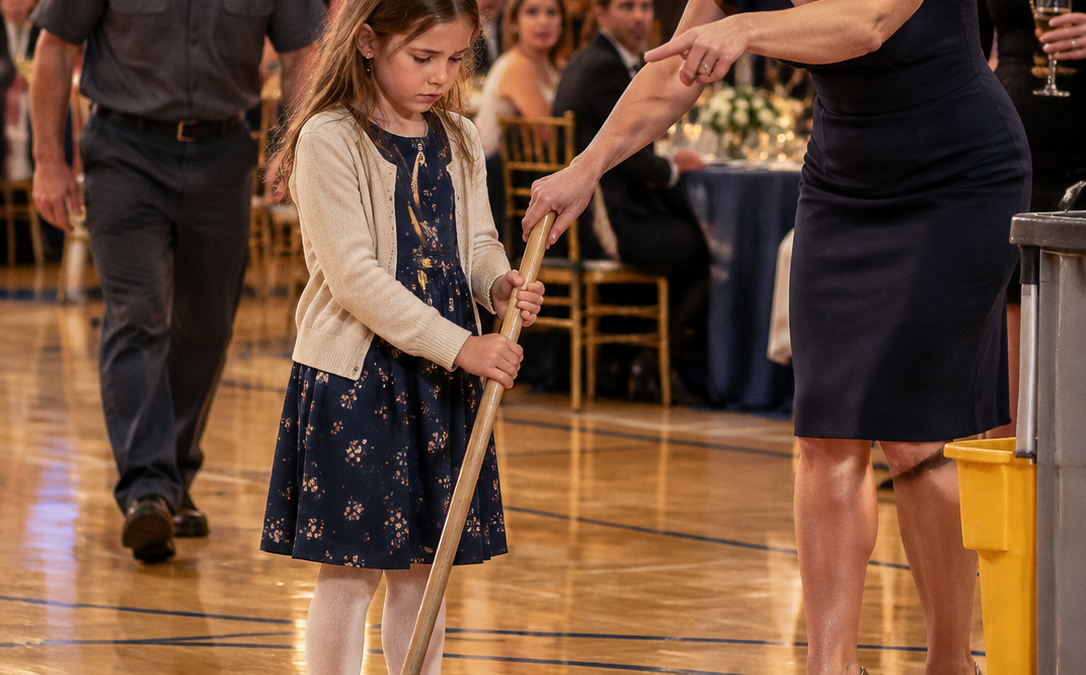
At 6:40 p.m., a guest’s punch hit the gym floor, and Kendra Aldridge smiled as she pulled the mop off my cart and held it out to my eight-year-old daughter. “Janitors’ kids clean up.”
Two hundred parents were gathered around the silent auction tables, the stage, and the rows of chairs set aside for the live bidding at eight.
The cup had spilled near the stage end, where my cart stood against the wall.
I’d left Maddie beside it while I collected empty cups at the far end of the gym.
Kendra pointed at the spill, then at Maddie.
A few people laughed.
Shannon Dale laughed too.
Kendra added, “Your girl should learn early. People like you mop so people like me don’t.”
Maddie looked at the mop handle.
For a second, she didn’t move.
Then she stepped forward and took it from Kendra.
She held the mop with both hands.
The head dragged across the floor, leaving a damp line through the punch.
Her face had gone pink, and her eyes stayed on the mess.
I crossed the whole gym, past the silent bids and the parents holding paper cups.
The gym seemed longer than it had when I wheeled my cart in that afternoon.
“I’ve got it, sweetheart.”
I took the handle from Maddie.
She let go at once, then folded her hands in front of her.
I moved the mop head over the spill, working from the outside in so I wouldn’t spread it farther.
Kendra was still smiling.
“Yes, ma’am,” I said.
It was all I gave her.
I didn’t ask why she’d taken the mop from my cart.
I didn’t tell her Maddie was eight, or that my daughter had spent the evening trying to stay out of the way while I finished my work.
I didn’t look toward the parents who had laughed.
I kept mopping.
My name is Jeff Dunning.
I was forty-four years old, and I had worked as a custodian at Cedar Ridge Elementary long enough to know the difference between a mess that needed cleaning and a mess that could get a person in trouble.
The auction was a school fundraiser, but it was also a PTA event.
Kendra was the PTA president.
She knew how to make a room look toward her.
She could put a bright smile on her face, lift a microphone, and make a sentence sound like a joke even when it wasn’t.
Picking up where the Facebook post left off
Shannon Dale, the PTA treasurer, stood near the front table with a clipboard.
She and Kendra were friends.
Shannon had laughed with the others, then looked down at her papers when I took the mop.
I finished the floor and returned the mop to my cart.
Maddie stood beside me, her hands tucked under her elbows.
I wanted to tell her she had done nothing wrong.
I wanted to say it loudly enough for the people who had laughed to hear.
Instead, I checked the floor for sticky spots and wiped the last red streak with a clean cloth.
That was the job.
Clean what was in front of me.
Leave the rest alone.
A parent stepped around the damp patch and thanked me without looking up.
I nodded.
Maddie stayed close to the cart, quiet now.
The gym carried on around us.
Parents compared bid numbers.
Someone tested the microphone.
At the stage, a volunteer moved a stack of auction folders into a neat pile.
At 6:52, Kendra climbed onto the low stage and took the microphone.
The room settled as people turned toward her.
She waited until the conversations thinned, then smiled over the crowd.
“This PTA cleared every lunch debt in this building.”
The applause came quickly.
People clapped from the tables and the rows of chairs.
A few parents called out approval.
Kendra lowered the microphone just enough to let the sound carry, then lifted it again.
The sentence was printed in the program beside the auction schedule.
I had seen the booklet on the registration table when I came in.
The claim sat beneath a heading about the PTA’s work for students and families.
It looked official in black ink, with the PTA name at the top.
I glanced at it now, lying open beside a stack of bid sheets.
I knew what I had put in my shirt pocket.
The envelope was marked 226.
Inside it was forty dollars, folded once, the same amount I had set aside on paydays over eleven years.
It was for Verna Kirby, the cafeteria manager, and her ledger.
She kept the records in the cafeteria office, and she never let me see a name beside a payment.
I had started in the spring of 2015.
On payday, I set aside forty dollars before I spent anything on myself.
I brought it to Verna in a plain envelope.
She wrote down the amount and gave me no details.
There had been years when the school meals were free, from 2020 through 2022.
I didn’t bring envelopes then.
When the regular payments began again, I returned to the same amount.
Tonight’s envelope was number 226.
Two hundred twenty-six envelopes at forty dollars each came to $9,040.
I had never asked whose account the money helped.
Verna had told me she couldn’t discuss accounts, and I had accepted that.
I knew the money went toward children’s lunch balances.
I didn’t need a child’s name to know that a balance could make a kid dread walking into the cafeteria.
I had never known one name.
The applause for Kendra’s announcement faded into talk about the next auction item.
She stayed on the stage, thanking the volunteers and reminding everyone that live bidding would begin at eight.
She had the microphone.
The program backed her up.
The parents had heard a claim they wanted to believe.
I stood beside my cart with Maddie at my elbow and the envelope against my chest.
If the PTA had cleared every lunch debt in the building, what had I been paying for?
I could have taken the envelope back to my truck.
I could have waited until another day to give it to Verna.
But it was payday, and I had brought it for her ledger.
Eleven years of keeping that small promise had taught me not to turn around just because a room had become uncomfortable.
Across the gym, Verna was serving food from the cafeteria table.
She had been working the auction since before I arrived, moving trays and keeping the line going.
Her serving spoon was in her hand.
She had a program open beside the pans.
Verna read the printed sentence.
Then she set down her serving spoon.
Across the gym, she looked straight at me.
Chapter 2: The Woman Who Never Asked
Verna was still looking at me when I pushed my cart toward the kitchen.
The envelope marked 226 pressed against my shirt, and Maddie walked beside me.
At 6:55, I found Kendra in the hallway outside the gym.
She had left the microphone on the stage, but she still had the program in one hand.
I could have kept walking.
Instead, I stopped a few feet away.
“She’s eight. Next time hand it to me.”
Kendra’s smile stayed in place.
“My family has never asked this school for a dime. Your girl should learn early. People like you mop so people like me don’t.”
She said it quietly enough that the parents inside wouldn’t hear every word.
I heard every one.
Maddie stood behind my cart, looking at the floor.
I wanted to tell Kendra what it had cost my daughter to take that handle.
I wanted to ask what kind of person made a child feel responsible for a stranger’s spill.
But my badge was clipped to my shirt, and Kendra knew exactly where I worked.
I had a mortgage, groceries, and a daughter who depended on my paycheck.
So I moved my cart out of her way.
Kendra turned toward the office corridor.
Principal Mitchell Cobb was near the double doors, speaking with one of the auction volunteers.
Kendra went straight to him.
“There’s a problem with one of the custodians’ children,” she said. “A child was loose at a ticketed event. She was handling equipment.”
I stopped beside the wall.
Maddie had not been running around.
She had been standing where I told her to stand.
Cobb looked from Kendra to me.
His expression was careful, the way it usually was when two adults wanted him to take a side.
“Jeff, Monday, 7:30, my office.”
“Yes, sir.”
Kendra tucked the program under her arm.
She didn’t look at Maddie again.
I pushed the cart toward the kitchen, with Maddie close beside me.
She didn’t ask whether we were in trouble.
That worried me more than if she had.
The kitchen was quieter than the gym, though volunteers were still moving trays and stacking serving pans.
Verna stood at the steel counter with her ledger open.
She had taken off her serving apron and folded it over the back of a chair.
When I came in, she glanced at the envelope in my shirt pocket.
“Payday?” she asked.
I nodded and pulled it out.
I had marked the envelope with the number 226.
I placed it beside her ledger.
Verna opened the envelope, counted the bills, and entered the amount in her book.
Her pen moved without hurry.
“That’s $9,040. I can’t discuss accounts.”
“I know.”
She closed the ledger halfway and kept one hand on the cover.
I had heard the sentence every time I brought her money.
It had never bothered me before.
That night, with Kendra’s announcement still carrying through the gym doors, it sounded different.
Maddie stood near the kitchen doorway.
Verna noticed her watching and gave her a small nod.
“You’re all right, honey.”
Maddie nodded back.
She didn’t come closer.
I wanted to take her home, but my shift wasn’t finished, and the auction was still going.
I told her she could sit in the staff room until I was done.
She went without arguing.
A moment later, Shannon Dale came through the kitchen door.
She held her phone in one hand and a thin folder against her chest.
Her eyes moved from Verna’s ledger to the envelope on the counter.
“Can I ask something?” she said.
Verna’s hand stayed on the ledger.
“I can’t discuss accounts.”
“I’m not asking about a child.”
Shannon sounded uneasy.
She set the folder down but didn’t open it.
“I’m asking about the PTA report. I checked the books before tonight. There aren’t any lunch payments in them.”
I looked at her.
“None?”
“None from the PTA. Not one.”
The gym applause had faded, but I could still hear the auctioneer testing his microphone.
Shannon unlocked her phone.
“Kendra sent me this on Monday, April 20. She told me what to put in the program.”
She looked at the screen, then read the message aloud.
“Print it: This PTA cleared every lunch debt. Who’s going to check, the lunch lady?”
The words sounded worse in the kitchen than they had from the stage.
I looked at the envelope beside Verna’s ledger.
“She sent you that?”
Shannon nodded.
“I thought the committee had the numbers. I asked where the payments were recorded, and she said the program wording was already approved.”
“Did you see any payments?”
“No. That’s why I checked.”
Shannon rubbed the edge of her phone with her thumb.
She was Kendra’s friend.
I could see that she wanted the answer to be something ordinary, something she could fix by correcting a line in a report.
Verna closed the ledger.
“Shannon, I can’t tell you whose account received help.”
“I know.”
“And I won’t name a child.”
“I know that too.”
Shannon looked at me.
I had no answer to give her.
I knew what I had paid. I knew the number on the envelope. I knew Verna had kept her promise not to tell me names.
I didn’t know whether the PTA had paid another way.
I didn’t know why Kendra had made that claim in front of two hundred parents.
And I didn’t know whose lunch balance had been covered by my envelopes.
Shannon picked up the folder again.
“The program says every debt. My books say no payments. I need to find out where that number came from.”
She looked toward the kitchen door, where the gym and the PTA table were still in view.
Then she turned back to the steel counter.
“The books say zero. So who paid?”
Her eyes settled on the envelope marked 226.
Chapter 3: The Page Behind the Family Assistance Tab
Shannon knew the program was false, but she still didn’t know who had paid.
I stood beside Verna’s ledger, with the envelope marked 226 on the counter.
For eleven years, I had given her forty dollars every payday.
I had never known a name.
Shannon picked up her folder and turned toward the kitchen door.
“The treasurer’s binder is still at the PTA table. I need to check something.”
Verna didn’t move.
Shannon looked at me. “I’ll be right back.”
She crossed the hallway toward the gym.
I could hear volunteers calling out bid numbers and parents moving toward the stage.
The live auction was scheduled for eight.
Verna picked up her serving spoon and wiped its handle with a towel.
“She shouldn’t have printed that,” she said.
“Did you know she was going to?”
Verna shook her head.
“I saw the program tonight. That’s all.”
I wanted to ask what she knew about the money.
But eleven years had taught me that Verna didn’t answer questions about accounts.
She had never given me a child’s name.
I had never asked for one.
Shannon returned carrying a thick binder with a plastic cover.
She set it on the steel counter and opened it near the middle.
“I’ve had this since I took over as treasurer last July,” she said. “I’ve checked the deposits, checks, and monthly statements. I never opened this tab.”
A yellow divider read FAMILY ASSISTANCE.
Shannon pulled the first sheet forward.
It was a March statement, with columns for the PTA’s programs and expenses.
Near the bottom was a line labeled lunch relief.
The amount beside it was zero.
Kendra Aldridge had initialed the statement.
Shannon touched the initials with one finger.
“Lunch relief: $0.”
Nobody spoke.
She turned the page.
Behind the statement was a request printed on PTA letterhead.
The handwriting in the signature box was Kendra’s.
Shannon leaned closer and read the request aloud.
“My son’s lunch charges, $612 over three school years. Please clear what remains.”
I looked at the paper.
Then I looked at the signature.
Kendra Aldridge.
The woman who had handed my daughter a mop.
The woman who had stood in front of two hundred parents and announced that the PTA had cleared every lunch debt.
The request was dated Monday, April 7, 2025.
Shannon turned another page.
It was a withdrawal, also signed by Kendra.
“Paid in full by a staff donor. No PTA funds used. Keep this out of the minutes.”
A receipt from Verna was stapled to the withdrawal.
It showed the balance paid in full.
I recognized Verna’s handwriting at the bottom.
The three payments were listed separately: $188, $204, and $220.
Together, they came to $612.
Shannon sat back slightly.
“Which staff donor?”
Verna kept her eyes on the receipt.
“I can’t discuss any account. That’s federal.”
“But the PTA didn’t pay it.”
“I didn’t say who paid it.”
Shannon looked at the withdrawal again.
“The request was hers. The withdrawal was hers. And she knew a staff member paid.”
Verna folded the towel and placed it beside the ledger.
“I’ve told you what I can tell you.”
Shannon looked down at the receipt.
Then she lifted the page from the binder and handed it to me.
I took it by the edges.
My thumb rested near Kendra’s signature.
In the spring of 2015, when I first started bringing Verna money, she had told me I was her only donor.
She hadn’t told me whose account needed help.
She hadn’t told me how much the balance was.
She had only told me that the money would go where it was needed.
I had kept my promise for eleven years.
Now I knew.
The money I had set aside from my paychecks had cleared the lunch debt of Kendra Aldridge’s son.
I looked at the receipt again.
There was no child’s name.
There was no reason to ask for one.
I put the paper down carefully.
“Did that boy eat?”
Verna looked at me.
“Every child in this building ate.”
I nodded.
That was the only question I had wanted answered.
Shannon still looked troubled.
“Jeff, she told everyone the PTA did it.”
I didn’t answer.
“She put it in the program,” Shannon continued. “She sent me the exact wording. I checked the books, and there’s nothing there.”
I looked at the March statement.
Lunch relief: $0.
Then I looked at the withdrawal.
No PTA funds used.
Kendra had signed both papers.
The first one asked the PTA to clear her son’s debt.
The second one acknowledged that someone outside the PTA had paid it.
And tonight, she had stood before two hundred parents and taken credit for the work.
I thought about Maddie in the gym.
She had held that mop because an adult had handed it to her.
She had listened while people laughed.
She had watched me take it away without making a scene.
Now I had another problem waiting in the custodian’s closet.
I found Maddie sitting on the small bench beside the supply shelves.
Her feet didn’t quite reach the floor.
She was looking at the toes of her shoes.
I leaned against the doorframe.
“You doing okay?”
She nodded, but didn’t look up.
I sat beside her.
After a few seconds, she asked, “Did I do the floor wrong?”
My stomach tightened.
“No, sweetheart.”
“But the mop made that red line.”
“Because the punch was sticky. You didn’t do anything wrong.”
She rubbed one shoe against the other.
I wanted to tell her what Kendra had signed.
I wanted to explain that the woman who had embarrassed her had received help from someone who never asked for recognition.
But that wasn’t Maddie’s burden.
She was eight.
She needed to know her father wasn’t ashamed of her.
I put my hand on her shoulder.
“You didn’t do anything wrong.”
She nodded again.
When I returned to the kitchen, Shannon had closed the binder.
She was standing beside the counter with the withdrawal page in front of her.
Verna was checking the time.
The live auction was getting closer.
I looked at the paper and thought about what would happen if the room learned who had paid.
My name would be spoken.
People might look at me differently.
Kendra might complain again.
Monday morning, I still had to sit in Principal Cobb’s office at 7:30.
I had spent eleven years keeping my name out of the story.
I could keep doing that.
Nobody had forced me to speak.
Verna picked up the receipt and placed it back with the withdrawal.
“She’s calling me up at eight to thank her. It’s your money.”
I looked at her.
Shannon stood quietly beside the binder.
I thought about the $9,040, the envelope in my pocket, and Maddie’s hands wrapped around that mop handle.
Then I made my choice.
“Say the number. Say it was me. Leave that boy out of it.”
Chapter 4: The Script She Handed the Lunch Lady
Verna waited until Shannon had closed the binder before she spoke.
“Before anybody says anything at eight, we need rules.”
I stood beside the steel counter.
Maddie was still in the custodian’s closet, and my Monday meeting with Principal Cobb sat in the back of my mind.
Verna looked at Shannon first.
“That paper belongs to the PTA. I don’t touch it. Jeff doesn’t touch it. Only the treasurer can handle it.”
Shannon glanced at the binder.
“That’s me.”
“Then it’s your decision what happens to it,” Verna said. “But I won’t say a child’s name. I won’t hint at a classroom or a family. Totals only.”
She put the serving spoon down.
“I’m four weeks from retirement. One child’s name gets out, the district comes for me before I get to leave this job.”
I knew what she meant.
Verna had spent years keeping the cafeteria running without making a child feel poor in front of classmates.
She wasn’t going to trade that trust for an evening in a gym.
“Say the number,” I told her. “Say it was me. Leave that boy out of it.”
“I heard you,” she said. “But you need to understand what you’re asking.”
I did.
If my name came out, Kendra could turn Monday’s complaint into something bigger.
Cobb had already called me into his office.
I had a job to protect, and Maddie had to return to the same school.
People would know her father had paid a child’s lunch debt.
Some might call her the charity janitor’s kid.
Children could make a label last longer than an adult meant it to.
I looked toward the closet door.
“She shouldn’t have been handed that mop.”
“No,” Verna said. “She shouldn’t.”
Shannon kept one hand on the binder.
“I need to be clear. Kendra’s my friend. I won’t promise you what I’ll do with this.”
Verna nodded.
“That’s fair.”
Shannon seemed surprised that Verna didn’t push her.
“I’ll check the papers,” Shannon said. “I won’t tell you tonight that I’m reading them.”
“That’s your call,” Verna answered.
The three of us stood around the counter, with the envelope and the binder between us.
In the gym, a volunteer announced another silent-auction closing time.
The sound system gave a short pop.
I had expected a decision to feel larger.
Instead, it felt like standing in a kitchen waiting for somebody else to pick up a phone.
Maddie came out of the closet carrying her little sweater.
“Can I stay here?” she asked.
“Stay where you can see me,” I said.
She moved to the doorway and sat on a low chair.
Verna tied her apron again and went back toward the serving table.
She had barely reached the door when Kendra came in.
She carried a sheet of paper, folded once, and wore the same bright expression she’d used onstage.
“Verna, I have something for you.”
Verna stopped.
Kendra handed her the paper.
“It’s a thank-you. I typed it up so you wouldn’t have to think about what to say. You never talk, Verna. Just read it.”
Verna accepted the page without answering.
Kendra smiled as if she’d done her a favor.
“Eight o’clock. I’ll bring you up after the next item.”
Then she left the kitchen.
Verna unfolded the page enough to see the first lines.
Her mouth tightened, but she didn’t read it aloud.
She folded it along the crease and tucked it into the front of her apron.
Shannon watched her.
“Are you going to read that?”
“I’m going to decide what I say when I’m standing there.”
Verna went back to the serving table.
Shannon picked up the binder and carried it toward the PTA table.
I watched her go through the kitchen door, then looked at the clock.
7:42.
I had less than twenty minutes before Kendra expected Verna onstage.
I found Maddie beside the closet and brought her back to the gym.
The mop was still on my cart, its damp head resting in the bucket.
I had rinsed it, but I hadn’t put it away.
Maddie looked at it as we passed.
I didn’t ask what she was thinking.
Near the PTA table, Shannon stood with the binder open.
Kendra approached her from the side and leaned close enough that their conversation stayed between them.
I couldn’t hear the first words.
Then Kendra’s voice sharpened.
“Sign tonight’s report as printed, or I’ll have a new treasurer by Monday.”
Shannon’s shoulders stiffened.
She didn’t answer right away.
Kendra tapped the report with one finger.
“You know what the committee approved. Don’t make this difficult.”
Shannon looked down at the page, then closed the binder.
Kendra held her gaze for another second before turning toward the stage.
I stayed where I was.
Shannon had not promised to help us.
She hadn’t promised to protect Kendra either.
Now the choice had a price attached to it, and Kendra had named the deadline.
At 7:58, parents began moving toward the stage for the live auction.
I took Maddie’s hand and walked with her to the back of the gym.
The mop stayed beside my cart.
Kendra stepped up to the microphone at eight.
She thanked the volunteers, introduced the next part of the program, and looked toward the cafeteria table.
Then she held out the microphone.
“Verna, tell them what this PTA did.”
I stood at the back with Maddie and the mop.
Chapter 5: The Lunch Lady Who Finally Talked
Kendra was smiling when Verna stepped toward the stage.
She still had the microphone in one hand and the printed program in the other.
I stood at the back of the gym with Maddie beside me.
The mop rested against my cart.
Verna climbed the two steps and stopped beside Kendra.
Kendra held out the microphone.
“Here you go,” she said. “Just tell them what we’ve accomplished.”
Verna accepted it.
The folded thank-you note remained tucked inside her apron.
She didn’t take it out.
Kendra glanced toward the audience, smiling as parents settled into their seats for the live auction.
Verna waited until the conversations quieted.
“One employee. $40 a paycheck. 226 envelopes, eleven years. $9,040. I will not name one child, tonight or ever.”
The gym grew quieter.
Verna turned slightly and pointed toward the back.
“That man with the mop said I could tell you.”
Heads turned in my direction.
I felt Maddie’s fingers tighten around mine.
Kendra stepped closer to Verna.
“The committee wrote that program. I never saw it.”
Her voice carried through the microphone.
She smiled again, but her eyes had moved toward Shannon’s table.
Shannon stood beside the treasurer’s binder.
She had not opened it yet.
Kendra continued thanking the volunteers, but Verna didn’t return the microphone.
Instead, Verna looked toward Shannon.
Shannon unlocked her phone.
“Kendra sent me a text on Monday, April 20,” she said. “She gave me the exact wording for the program.”
Kendra’s smile disappeared.
Shannon read the message aloud.
“Print it: This PTA cleared every lunch debt.
“Who’s going to check, the lunch lady?”
A few parents looked toward the printed programs in their hands.
Someone near the first row lowered a bid sheet.
Kendra reached for the microphone, but Verna kept it.
The cafeteria manager faced the audience.
“Has any officer of this PTA ever signed a paper asking to clear a child’s lunch debt? I won’t say. I’d just like to hear it.”
She stopped speaking.
Nobody answered.
Kendra took the microphone from her.
“Never. Not me, not my family. Read whatever you’ve got.”
Her voice was louder now.
She looked directly at Shannon.
“Go ahead.”
Shannon didn’t move immediately.
For a second, I thought she might close the binder and walk away.
Kendra had been her friend.
She had threatened to replace Shannon by Monday if she didn’t sign the report as printed.
Now two hundred parents were watching.
Shannon placed her phone on the table.
Then she picked up the binder.
She walked toward the stage.
The sound of her shoes against the gym floor seemed unusually clear.
Kendra stood with the microphone lowered.
“What are you doing?” she asked.
Shannon didn’t answer.
She opened the binder and removed the page we had examined in the kitchen.
Her thumb covered one line.
She held the paper where the audience could see the PTA letterhead.
“Filed with this PTA last spring. $612, three school years. Signed, Kendra Aldridge.”
Kendra stared at the page.
“That’s forged. I have never seen that paper.”
Shannon didn’t lower it.
She reached into the binder and took out another document.
It was tonight’s caterer check.
She held it beside the signed withdrawal.
“Here’s tonight’s caterer check,” Shannon said. “Look at the signature.”
The two signatures matched.
I could see Kendra’s name from the back of the gym.
So could the people standing near the stage.
Kendra moved toward Shannon.
“Put those away.”
Shannon held the papers steady.
Kendra looked toward the audience.
“That’s my son’s private school record. You can’t read that!”
Her voice came through the microphone.
The room heard every word.
A parent near the front turned toward another parent.
Someone behind the auction tables stopped writing.
Shannon looked at Kendra.
“It’s not a school record. You filed it with us. I never said whose son.”
Kendra opened her mouth, then closed it.
Shannon kept her thumb over the same line.
The page remained in the PTA binder.
The request had been signed on April 7, 2025.
The withdrawal had been signed on May 12.
The March statement carried Kendra’s initials beside the zero-dollar lunch relief total.
There was no school record on that stage.
There was a private association’s paperwork, signed by its own president.
And Kendra had just told two hundred parents exactly why she wanted it hidden.
Verna stood beside Shannon.
She didn’t take the microphone back or add another accusation.
She had given the room a total.
She had kept her promise about the children.
I looked down at Maddie.
Her face was turned toward the stage.
She was no longer looking at the floor.
I had spent eleven years making those payments without expecting anyone to know.
Now my name had been connected to the money in front of the entire school.
There would be questions.
There would be people who wanted to thank me and others who wanted to know why I hadn’t said anything sooner.
Kendra still had her title.
She still had her place on the PTA board.
The papers had exposed what she signed, but they hadn’t removed her from the office.
The PTA had rules for that.
I didn’t know yet what those rules would mean for her.
I only knew that two hundred parents had heard her deny something her own signature proved.
Shannon closed the binder.
Kendra stood near the microphone, looking from the papers to the audience.
Then parents began turning toward the back of the gym.
I felt Maddie’s small hand inside mine.
The mop was still beside my cart.
I’d mopped with it, rinsed it, and set it back leaning against my cart.
I looked at Kendra across the long gym floor.
I didn’t need the microphone.
“You were right, ma’am. Janitors clean up.”
Chapter 6: The Lanyard on the Library Table
On Monday, April 27, 2026, I sat across from Principal Cobb at 7:30 in the morning.
The folder on his desk had my name written across the tab.
He opened it, checked the notes inside, and closed it again.
“There’s no write-up, Jeff.”
I kept my hands on my knees.
“Your daughter was with you at a ticketed event. She wasn’t running loose, and she wasn’t operating equipment without permission. The complaint doesn’t support disciplinary action.”
“Thank you, sir.”
Cobb nodded, but he didn’t look pleased about any of it.
“Kendra has also filed a privacy complaint with the district.”
I looked at him.
“About the papers Shannon read?”
“About the information disclosed at the auction. The district reviewed what was said and what was shown.”
He explained that no child had been named. Verna had given a total, and Shannon had read a record filed with the PTA, not a school record.
“The binder belongs to the association,” he said. “It isn’t a district file. The complaint was denied.”
I sat quietly for a moment.
The district had not needed to know whose account had been paid. The parents hadn’t needed that name either.
Cobb slid my folder to the side of his desk.
“You’re clear to return to your regular duties.”
“Yes, sir.”
I left his office and went back to work.
The auction was over, but the matter wasn’t.
A notice had gone out on Saturday, April 25, for a special board meeting on Thursday, April 30. A majority of the board had called it. The unit’s standing rules required five days’ notice.
The meeting would be held in the school library.
By Thursday evening, the chairs were arranged in two rows facing the long library table.
All twelve board members were present, including Principal Cobb.
Kendra sat with the other officers.
She wore her PTA lanyard and kept a folder in front of her.
Shannon sat opposite her with the treasurer’s binder.
I took a chair near the back wall. I wasn’t a board member, and I had no reason to be at the table.
Verna sat beside me.
She had a few weeks left before retirement. Her hands rested together in her lap, and she watched the board without speaking.
The vice president opened the special meeting and explained that a majority of the board had requested it.
Then Shannon stood.
She read the removal provision from the unit’s bylaws. Removing an officer required a vote of two-thirds of the entire board, not simply two-thirds of those who chose to vote.
There were twelve seats.
Eight votes were required.
Shannon opened the binder to the March statement.
“Before the board considers the removal motion, I want the financial record entered into the meeting minutes.”
She read the line aloud.
“Lunch relief: $0.”
Kendra shifted in her chair.
Shannon explained that the statement had been initialed by Kendra and that the Family Assistance papers had been filed with the PTA.
She did not read the child’s line.
She did not give a classroom, a grade, or a name.
The withdrawal stated that no PTA funds had been used.
Kendra spoke before Shannon had finished.
“The program was a committee matter. I have already explained that.”
The vice president asked her to wait until the motion was presented.
The motion was read.
The vote was taken.
Nine board members voted to remove Kendra.
Two voted against it.
Principal Cobb abstained.
Nine was more than the eight required.
The vice president announced that the motion had passed.
Kendra looked around the table as if she expected someone to change the count.
Nobody did.
She reached up, unclipped her PTA lanyard, and laid it on the table beside her keys.
The room stayed quiet while she pushed both items away from her.
Her title was gone.
The foundation had been considering her for a seat, but after the board action, it dropped her name.
The vice president posted an election notice for the vacant office.
Shannon stayed behind and reconciled the checkbook and supporting records.
The $14,300 raised at the auction’s paddle raise went to the district’s meal-donation account.
Verna watched Shannon close the binder.
Then Verna took out her own ledger.
She turned to the last page and ran one finger down the entries.
The final envelope was number 226.
She closed the ledger.
I knew what that meant. There would be no envelope 227.
In the parking lot, I was helping Maddie into her coat when Kendra approached.
She had no lanyard now.
She stopped a few feet away and looked at me.
“Did you know it was my son?”
“Not until that night. He ate. That’s all I wanted to know.”
Kendra looked down at the pavement.
For a moment, I thought she might say something else.
Instead, she handed me a folded note.
It asked me to say something kind to the parents about the PTA and the work Kendra had done.
I opened the note beside my truck.
There wasn’t much room at the bottom, but there was enough.
I took a pen from the console and wrote two words.
“No, ma’am.”
I folded the note and handed it back.
Kendra accepted it without looking at me.
Maddie waited by the passenger door.
On the drive home, she was quiet. I didn’t ask her to explain what she remembered from the gym.
I wondered what had stayed with her: the laughter, the mop in her hands, or the way I had crossed the floor to take it back.
At home, she followed me into the garage while I put away my work things.
“Can you show me how to wring out the mop?” she asked.
I looked at her.
“You want to learn that?”
She nodded.
I brought the mop over and showed her where to place her hands. I explained how to hold the handle steady and turn the wringer without splashing water onto her shoes.
She tried it once, then looked at me for help.
I stood beside her and guided her hands through the motion.
“Slowly,” I said. “Let the handle do the work.”
She tried again.
This time the water ran into the bucket, and the mop head came out damp instead of dripping.
Maddie looked up at me.
“Like that?”
“Exactly like that.”
I kept one hand on the handle while she practiced once more.
Chapter 7: The Girl Who Picked Up the Mop
By the second week of school, the lunch relief line no longer showed zero.
Thursday, August 20, 2026, was busy at Cedar Ridge Elementary. The cafeteria was full of children carrying trays, looking for seats, and calling to friends across the tables.
I was working near the serving area, checking the floor and emptying the trash cans between lunch periods.
My cart stood against the wall.
The mop was clean and ready, with the handle resting against the bucket.
Maddie was eight no longer. She was in fourth grade now, and she had started the school year with a new backpack and a stack of books she insisted on carrying herself.
She still came by the cafeteria when my schedule allowed it.
She didn’t have to stay with me while I worked, but she liked knowing where I was.
Verna was there too.
She had retired in May, but she volunteered at the register during the second week of school. She wore a simple cardigan over her blouse and kept her reading glasses on a cord around her neck.
The register was familiar to her.
She knew which buttons to press, how to clear a mistake, and how to keep the line moving when several children arrived together.
A little before noon, the new PTA president came into the cafeteria carrying a folder.
She walked over to Verna’s register and waited until the line thinned.
“I brought the first statement,” she said.
Verna accepted the papers.
The new president opened the folder to a page showing the district’s meal-donation account.
There was a line for lunch relief.
This time, it showed actual money.
The statement included deposits and payments. The funds had been reconciled, and the district’s account showed the money being used for its intended purpose.
There were no children’s names.
Verna studied the page, then nodded.
“That’s how it ought to look.”
The new president gave her a small smile.
“We want to keep it that way.”
Verna placed the statement in the folder and set it beneath the register.
She didn’t make an announcement.
She didn’t call anyone over to look.
She turned back to the next child in line.
A little later, I saw him.
Kendra’s son was coming through the cafeteria line with his tray.
His hair and eyes reminded me of Kendra’s, though I still didn’t know his name.
I had never said that boy’s name to anyone.
He carried his tray with both hands, waiting his turn like the other children.
He wasn’t standing apart from anyone.
Nobody announced his arrival.
Nobody stopped the line.
He collected his food and walked toward an open seat.
He sat down and began eating.
I went back to checking the floor near the serving counter.
There was no reason for me to watch him.
He was a child having lunch at school.
That was what I had wanted when I started bringing Verna those envelopes.
The cafeteria grew louder as more students came through.
Someone dropped a fork.
A chair scraped against the floor.
Verna helped a younger student with a tray that was too full, then returned to the register.
Maddie was sitting at one of the nearby tables.
She had finished eating and was talking to another fourth grader.
I noticed her glance toward me when I moved the cart away from the wall.
She knew I was working.
She also knew where the mop was.
For months, I had wondered what she remembered about the auction.
I hadn’t asked her to describe it.
I didn’t want her to feel that she owed me an answer.
I remembered her standing in the gym with both hands around that handle.
I remembered the laughter.
I remembered how she had watched me take the mop from her.
After the board meeting, I had shown her how to wring it out because she asked.
She had practiced in the garage until she could get the water into the bucket without splashing her shoes.
I had thought that might be the end of it.
Then, near the middle of the lunch period, a milk carton burst on the floor.
It landed beside a table, and milk spread across the tiles.
Several children lifted their feet.
One called for a napkin.
I started toward the cart.
Before I could reach it, Maddie stood up.
She walked over, pulled the mop off my cart, and carried it toward the spill.
I stopped.
The mop handle was nearly as tall as she was.
She held it firmly, with one hand near the top and the other lower down.
She looked at the milk on the floor, then checked the direction of the nearby tables.
She wasn’t waiting for someone to tell her what to do.
I stepped closer.
“You don’t have to do that,” I said.
“I know,” she said.
She didn’t sound upset.
She didn’t sound as if she were trying to prove anything.
She simply knew.
I stood beside the cart and watched her lower the mop head into the milk.
She worked from the edges toward the center, the way I had shown her.
A few children moved their trays out of her path.
Nobody laughed.
Nobody pointed at her clothes or asked what her father did.
One student picked up the empty carton and carried it to the trash.
Maddie finished the first pass and brought the mop back to the bucket.
She fitted the handle into the wringer.
I had shown her where to put her hands, how to keep the handle steady, and how to turn it without splashing water.
She remembered.
She pressed down, turned the handle, and watched the milk run into the bucket.
Then she lifted the mop and checked the floor.
A small patch remained near the table leg.
She moved toward it and worked the mop over the tiles.
At the register, Verna rang up the next child.
The new president’s folder was still beneath the counter, with the first statement inside.
The lunch relief line had real money beside it.
The children kept eating.
Maddie finished the last patch and dipped the mop into the bucket once more.
She wrung it out the way I had taught her.
Then she lifted the handle and worked toward the cafeteria door, taking the mop with her.
I stayed beside my cart.
Verna rang up the next child.
I let Maddie finish.
THE END







