Two days after discharge, my wife toured my house with her boyfriend and ordered me into a $900 basement; she didn’t know what I had kept.
Chapter 1 of 7
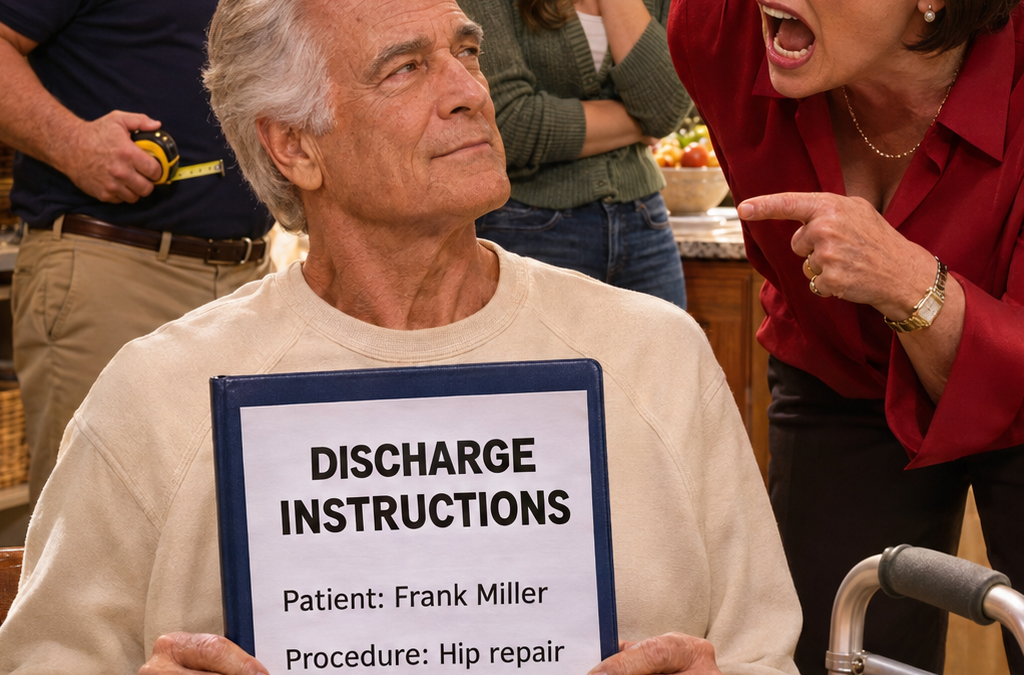
At 10:30 that Wednesday morning, Karen brought Scott through my kitchen. Leah moved my walker against the refrigerator so they could pass.
Karen showed me a rental listing on her phone.
“Recovery doesn’t require three bedrooms, but our future does.”
I was sitting beside the breakfast table, wearing sweatpants over the dressing on my hip.
“Put that back,” I told Leah.
She looked at the walker, then at her mother.
“He needs room to get through,” Karen said.
“So do I.”
Leah brought it within reach. Her phone lit up, and she checked it without looking at me.
Scott stayed near the doorway, studying the wall beside my pantry.
“Does that open into anything?”
“It’s a wall,” I said.
“I meant behind it. Wiring, plumbing.”
Karen answered before I could. “There’s an outlet down there. You’d have room.”
I had bought and paid off this Sacramento, California, house before we married. Karen had moved out in August, but now she was explaining my outlets to another man.
“What room?” I asked.
“For a desk,” Scott said. “Mine’s wider than it looks.”
“Frank, we’re looking at possibilities,” Karen said. “Nobody’s moving furniture today.”
“You brought him to measure.”
“He came to drive me.”
Scott had already pulled a tape measure from his jacket.
Karen enlarged the rental picture. A narrow window showed a strip of somebody’s driveway.
“It’s furnished. You wouldn’t have to pack much.”
“Where’s the bathroom?”
“Inside.”
“On the same floor?”
“I believe so. I saved the listing. We can ask.”
She sounded like she was arranging a weekend motel.
“I need a ride to appointments,” I said. “And somebody to carry a plate.”
“That’s what I’m trying to organize.”
“By moving me out?”
“By getting you somewhere manageable.”
The kitchen still smelled faintly of the toast I’d burned. I had eaten the unburned middle because carrying another plate had seemed like more trouble than breakfast deserved.
Karen noticed the crusts.
“See? You’re already struggling.”
“With toast.”
“With being here alone.”
Scott stretched his tape along the pantry wall. The metal clicked against the baseboard.
“Sixty inches would work,” he said.
“That’s where my grocery bags go.”
“We can find another spot,” Karen told him.
I waited for her to hear herself. She kept looking at the wall.
“You said you’d help until I could get around.”
“And I have. I brought you home Monday.”
“Today’s Wednesday.”
“I work, Frank. If you want me driving back and forth, you’ll need to cover the gas.”
My fingers went to the wallet in my sweatpants pocket. I got it halfway out before pushing it back down.
“I haven’t agreed to go anywhere.”
Karen’s voice softened.
“We put $6,000 into the cottage option. We can’t just waste that.”
“Then why are you measuring here?”
“Because we need somewhere workable while we get everything settled.”
Scott retracted his tape.
“Karen said the house was part of the arrangement.”
“The house is my separate property.”
“There are things to work through,” she said quickly. “He doesn’t need the whole history.”
Leah leaned against the counter. She had been sixteen when I married her mother. Now she watched the floor while Scott discussed my home.
“Leah?”
“What?”
“Did you come to help me pack?”
“Mom said you wanted us over.”
“I wanted groceries.”
“There are groceries in the car,” Karen said. “Nobody forgot your groceries.”
My blue binder sat beside the fruit bowl.
The yellow survey pencil on my pad was worn nearly to its old rubber grip. Below it, I had written milk, eggs, and the appointment I couldn’t drive myself to.
“Needing help wasn’t permission to replace me.”
Leah looked down at her phone again.
Karen glanced toward my bedroom.
“That bed is too low anyway. Getting up must hurt.”
“It does.”
“Then let us make this easier.”
“My bathroom is right there. My bedroom is right there.”
“And you still need supervision.”
“Read what they gave me.”
The discharge sheet lay beneath my grocery list. Karen had heard the nurse explain it Monday, but she had been checking the parking meter on her phone.
Scott started toward the hallway.
“Hold on,” I said. “Before anybody looks at another room.”
Karen bent over the discharge sheet and stopped.
Karen read the line above the therapist’s initials twice. “Why didn’t the hospital tell me that?”
“They did. You were standing beside me.”
The instructions prohibited unassisted stair use until reassessment. The basement listing she had shown me required thirteen stairs to reach the living space.
“You counted?” she asked.
“They’re in the picture.”
“There could be another entrance.”
“Does the listing say there is?”
“We’d check before you went.”
Scott came back into the kitchen.
“Stairs aren’t going to work right now,” he said.
Karen kept her eyes on the page.
“It was an option. I’m allowed to look at options.”
I hadn’t needed the binder to answer her about stairs. Inside it, though, I had kept my original grant deed, the mortgage payoff record, and our signed property settlement.
The packet concerned my separate property. I had retained my complete original after we each signed with our own advice in August.
There were contractor receipts, appliance warranties, and a last household-schedule sheet. Karen had asked back then to leave the cabinet balance on its usual Friday payment.
Now she was offering my kitchen wall to Scott.
“Please don’t make this into something it isn’t,” she said.
“What is it?”
“A recovery arrangement.”
“You haven’t asked what I want.”
“I can see you can’t manage everything.”
“That wasn’t my question.”
Leah’s phone made a small sound. Mine buzzed against the tabletop a moment later.
A bank message filled my screen.
Scott was saying something about getting the seller to wait when Karen caught sight of the header.
Karen stopped him. “They sent that to you?”
The email came from Riverbend Bank. It asked about my ownership of the house and my intended participation in a secured-loan application.
“What application?” I asked.
Karen’s mouth stayed open for a second.
“It’s preliminary.”
“What application?”
“For the cottage. We discussed using the house.”
“You and I didn’t.”
“Scott and I discussed it. I meant.”
Scott looked at her.
“He knew about the financing, didn’t he?”
“He knew we were making plans.”
I read the first paragraph again. My address was there, under the property proposed as security.
“How much?”
Karen glanced at Leah.
“How much, Karen?”
“A hundred eighty-five thousand. That’s what’s needed to complete the purchase.”
“Against this house?”
“It wouldn’t change where you are today.”
“You just showed me where you wanted me to be today.”
“The basement was temporary.”
Scott spoke carefully. “We were told there was enough interest in the house to support the request.”
“Told by whom?”
Karen answered him instead.
“There’s been money put into this home. That has to be accounted for.”
I kept reading. The email asked for a response, not a payment. Nothing on the screen said the bank had approved anything.
Karen leaned closer.
“We can go through it together. There may only be a few things they need you to sign.”
“I’m not signing anything at this kitchen table.”
“Nobody’s asking you to do it without reading.”
“I’m telling you now.”
Leah finally looked up.
“Mom, he just got home.”
“I know when he got home.”
“Then let him eat his breakfast.”
The toast crusts were still on my plate.
I opened the email’s final attachment. Nobody had asked me to participate.
The form listed “Frank Miller — proposed nonborrowing owner.”
Chapter 2 of 7
At 9:10 Thursday morning, I called the number beneath the bank email.
A woman on Denise Grant’s staff found the application while I waited.
“Who gave you my phone number?” I asked.
“Karen Wells supplied your contact information.”
“And this proposed nonborrowing owner business?”
“That’s a request for your participation. It isn’t authorization.”
“I haven’t given any.”
“We have none from you. There’s no approved loan, no funding, and no lien from this application. We’re still reviewing title.”
My coffee had cooled beside the phone.
“Then record that I haven’t agreed.”
“I can do that. Ms. Grant may contact you about the ownership information.”
Afterward, Karen called before I could finish breakfast.
“Leah’s coming with lunch,” she said.
“Did she tell you that?”
“I asked her. You two need to talk without yesterday hanging over everything.”
“About what?”
“She’s worried about having any family left after this.”
“She told you that?”
“Frank, she shouldn’t have to choose. If we can get settled, everybody can stop fighting.”
“Everybody?”
“Scott and I need a place to land. You could help make that happen.”
“I wasn’t your financing plan.”
“I’m asking you to think beyond being angry with me.”
“I have a lawyer’s call.”
“You’ve already called somebody?”
“Yes.”
She paused.
“All right. Just hear Leah out.”
I had retained Maya Collins for the divorce, before the fall. Until that morning, our conversations had concerned paperwork I could leave until after supper.
On video, she appeared against a plain office wall.
“Can you see the dates?” I asked.
“Yes. Purchase, June 16, 2003. Mortgage paid off September 10, 2010.”
“We married in 2012.”
“I have that.”
I had sent secure copies from my blue binder. The originals stayed beside my chair.
“And the settlement?”
“I received it. Signed documents need a complete review. I’m not giving you an answer from a quick look.”
“Can the bank settle this?”
“The bank decides whether to lend. It doesn’t decide your divorce.”
“Can I tell Karen she can’t come here?”
“You can say no to visits. Don’t change locks or throw out belongings without talking to me.”
“I wasn’t going to throw anything out.”
“Good. And this won’t make the divorce immediate.”
I looked past the screen at the hallway. Her old raincoat still hung there.
“What do I do today?”
“Don’t sign the owner-consent form. Send me anything else they send you.”
Leah arrived at noon with tomato soup and two grilled cheese sandwiches. Since high school, she had insisted on cutting hers into strips for dipping.
Mine was cut the same way.
“Still doing that?” I asked.
“Less embarrassing than drinking soup from the bowl.”
“You did that once.”
“It was a very good bowl.”
For a minute, she was just eating lunch in the kitchen.
Then she said, “Could you help this one time?”
I left my sandwich on the plate.
“Your mother asked you to say that.”
“She asked me to talk to you.”
“Those aren’t quite the same.”
“I don’t want holidays where everybody has separate instructions.”
“Neither do I.”
“Then maybe there’s a way you could—”
“I needed you yesterday.”
“I was here.”
“You moved my walker.”
“I brought it back.”
“Yes. After I asked.”
She looked toward the refrigerator.
“I didn’t know what to say.”
“You could’ve said the stairs were unsafe. You didn’t need to pick a side.”
“I didn’t know about the instructions.”
“You saw me trying to stand.”
Her soup went untouched.
“Mom said you’d agreed to look.”
“Did I sound like I’d agreed?”
“No.”
I let her answer stay there.
“The bank sent a consent form,” I said. “I’m declining it.”
“Does that mean you’re done with us?”
“With you? Leah, you can come have lunch. You don’t have to bring a request.”
She stayed until I finished eating. We didn’t discuss the loan again.
Karen sent the option agreement that afternoon, followed by a call.
“I want you to see why the timing matters,” she said.
The document was easier to read on my laptop.
“The price is $191,000?”
“Yes. The six thousand we paid counts toward it.”
“If you buy.”
“Yes, Frank. If we buy.”
“And you need the rest committed by October 16 at 5:00 p.m.”
“We have to send notice and proof the financing is committed. We don’t get the cottage that day. Completion is November 20.”
“Can the seller wait?”
“We can ask. We can’t make them. There’s no financing contingency or extension we can take ourselves.”
“You paid before you asked me.”
“We expected the house situation to be workable.”
“I’m not signing.”
“I heard you. I’m still entitled to have what I put into that house considered.”
After the call, I used the walker to reach the front window. Outside, a delivery truck blocked my driveway, then moved on. Nobody needed permission from me for anything else that afternoon.
Near dinner, Denise Grant emailed. The preliminary title inquiry identified me alone as the recorded owner. Karen had submitted a written response, claiming an unresolved interest from improvements and requesting that the file remain open while she supplied records.
I read the last line with my dinner still warming in the microwave.
“Applicant claims $28,000 in improvements.”
Chapter 3 of 7
At 8:20 Friday morning, Scott forwarded the kitchen invoice and a payment confirmation.
The invoice totaled $28,000. The confirmation showed the final $4,800 leaving our former joint household account on August 21.
His message began, “Frank, please look at the dates before dismissing this.”
I called him.
“What am I supposed to be dismissing?”
“The work you both paid for. Karen says you’re treating everything as finished when you signed.”
“I haven’t discussed the agreement with you.”
“Money went into the house afterward. The bank ought to see that.”
“You sent it to them?”
“Yes. Same documents I sent you.”
Behind him, somebody asked about a delivery. He said he needed a minute.
“We’re not asking them to ignore your paperwork,” he continued. “But yours isn’t the only paperwork.”
“The invoice doesn’t have your name on it.”
“I’m on the loan application. This affects me too.”
He had that much right. Karen had brought him into it, and he had paid for part of their plan.
“I’ll send it to my lawyer,” I said.
“Fine. That’s probably best.”
Karen called before I finished forwarding the attachments.
“Scott said you spoke.”
“He sent me the kitchen bill.”
“I know. I gave it to him.”
“Were you still coming before lunch?”
“That’s why I’m calling, honey. I can’t keep managing two households.”
“I asked about lunch.”
“And the rides, and the meals. I need to be clear about all of it.”
My physical therapy appointment was on the calendar beside the refrigerator. Under it, I had written her name.
“You said you could drive.”
“When I thought we were working toward an arrangement.”
“I needed a ride, not permission.”
“Please don’t put it that way. I have work. Scott has work. We’re trying to get settled, and everything keeps getting harder.”
“So you’re not coming.”
“I can’t promise practical help while you’re refusing every practical solution.”
“I can pay for gas.”
The offer came out before I could stop it.
“It’s more than gas, Frank.”
I looked at her name on the calendar.
“All right.”
“You could ask Leah.”
“I’ll arrange something.”
After the call, I tried to get lunch myself. There was leftover chicken in the refrigerator and a clean plate on the counter.
The chicken reached the plate. The plate never reached the table.
I needed both hands on the walker. Trying with one left me leaning toward the repaired hip, waiting for a pain I already knew.
Karen’s number was still at the top of my recent calls.
I could ask her to come just for an hour. Leave the house talk alone. Pay for her time, even.
The refrigerator motor clicked off. I stayed there until it started again.
Then I ate standing at the counter.
Our kitchen scissors were shaped like a rooster. Karen had bought them years ago, and I’d complained they belonged in a gift shop. That afternoon, I used them to cut chicken into pieces small enough to eat with a fork.
I booked grocery delivery from the kitchen chair. The first available window was later than I wanted, and the order needed substitutions.
Then I called a ride service and explained the walker.
“Can the driver help you from the door?” the dispatcher asked.
“That’s what I need. I can’t hurry.”
“We’ll allow extra time.”
“And the ride home?”
“We can schedule both.”
I gave her the appointment information. When she read the charge, I almost said I would call back.
Instead, I confirmed it.
The family chat started while I was waiting for the grocery confirmation. It was the little thread we’d used for holiday meals and birthday reminders.
Karen wrote, “I helped Frank home from the hospital and have tried to arrange a manageable transition. He’s now rejected what we discussed. I can’t continue doing everything while being shut out of decisions. Please be patient with us.”
Leah answered, “Okay, Mom. Thanks for letting us know.”
No question. No mention of the walker or the basement.
My reply took longer than hers.
“My discharge instructions prohibit unassisted stairs. The rental has thirteen stairs. I did not agree to move, and I will not pledge my home for the cottage loan.”
I sent it once.
Karen’s typing dots appeared, disappeared, then returned. I closed the thread before another message arrived.
Maya called after receiving Scott’s attachments.
“Are you able to bring your complete packet Monday?”
“With a ride, yes.”
“Bring the whole thing.”
“Should I send you what Karen wrote to the family?”
“Does it contain a new financial demand?”
“No. It makes me sound like I changed my mind.”
“Keep it. Don’t spend the afternoon arguing through screenshots.”
“Leah thanked her.”
Maya waited.
“She was here,” I said. “She saw it.”
“I’m sorry, Frank.”
That was all she said about Leah. It was enough to let me stop talking.
Late that afternoon, Denise Grant emailed that the invoice and payment record had been added to the bank file. They did not establish ownership. The application remained under review; the bank was not deciding Karen’s marital claim.
I read that twice, then forwarded it to Maya.
A second email arrived from Karen’s lawyer. This one was addressed to Maya, with me copied.
It demanded $28,000 for the kitchen improvements.
The attached payment confirmation carried the same August 21 date Scott had sent that morning—one week after we signed.
The demand highlighted “payment after execution.”
I had until noon Monday to respond.
Chapter 4 of 7
At ten Monday morning, Maya said she would answer the demand, not concede a debt.
“We’ll answer with the executed packet,” she said. “Their noon deadline doesn’t make the money theirs.”
The driver had helped me from the car to her Sacramento office. By the time I reached the chair, my right leg needed the rest.
My blue binder lay open on Maya’s desk.
“You kept everything together,” she said.
“Field habit. A loose page in a truck could cost you another day’s work.”
She examined the originals while I watched traffic through her window.
“Once spent half a morning looking for a boundary note,” I said. “Found it under my lunch.”
“Did you change your system?”
“Stopped wrapping sandwiches in survey paper.”
She looked up long enough to give me a small grin.
Then she returned to the packet. I let her read. Outside, a delivery driver argued with a parking meter that wouldn’t accept his card.
“On what you’ve shown me, this independently advised settlement is enforceable,” she said. “We answer Karen’s claim with its complete terms.”
“Does that finish it?”
“It gives us our answer. It doesn’t make her stop asking.”
I had paid her for advice. Still, I’d wanted her to say I could go home and never hear about the kitchen again.
“What are you sending today?”
“The principal settlement pages, with our response. Her lawyer needs to stop treating this as an undocumented promise.”
“And the bank?”
“I’ll send copies where you authorize them. They still make their own lending decision.”
She asked whether I wanted her to handle direct calls from Karen.
“About the money, yes.”
“Then let those come here.”
The ride home cost more because the driver had waited. I paid it without calling Karen.
By early afternoon, Maya confirmed that Karen’s counsel had received the principal pages. My lunch was a turkey sandwich in a paper sleeve, delivered with groceries. I ate it in the kitchen chair, where I could stay put.
Karen called before I finished.
“My lawyer sent me what Maya provided.”
“All right.”
“I’m not disputing that you bought the house before we married.”
I said nothing at all.
“Or that I signed the agreement,” she continued. “I know what my signature looks like, Frank.”
“Then talk to Maya.”
“I will. But the later payment still needs explaining.”
“To whom?”
“The bank, for one. That money left after we signed. My lawyer says there’s a question about whether it falls outside what we allocated.”
She sounded prepared. No raised voice, no claim that the deed had changed.
“I’m not sorting that out over lunch,” I said.
“I’m asking for a meeting. Everyone hearing the same explanation, instead of things passing through three people.”
“Everyone?”
“You, me, Scott. The bank. I’d like Leah there.”
“What for?”
“She was there when we signed. And she’s tired of getting pieces of this.”
“She gets pieces because you send them.”
“Frank, she offered to take you to Maya. She’s already involved.”
The sandwich rested against my untouched apple.
“How did you know that?”
“Leah told me you had an appointment. That’s hardly private financial information.”
“She offered me a ride.”
“And you booked somebody instead. I know.”
I ended the call without answering that.
Later, an email from Denise Grant arrived with a proposed appointment. Karen had requested a joint discussion, and Denise listed the people she expected: Karen, Scott, Leah, and me, with Denise conducting the review.
I forwarded it to Maya.
“Do I need to go?”
“You don’t have to,” she said when she called. “If you want the bank to hear from you directly, you can.”
“Karen wants Leah there.”
“That’s your choice to accept or question.”
The meeting was set for Riverbend Bank’s Sacramento branch conference room.
“Friday, October 16, at four,” I said.
“Yes.”
“I’ll go. They can discuss what I supplied about ownership. That’s all.”
“Put that in your reply.”
I did. I authorized discussion of my ownership material, not a loan or a transfer.
Then I called Leah.
“Did you tell your mother about Maya?”
“Just that you had an appointment.”
“You offered to drive me.”
“I wanted to help.”
“Were you going to tell her what happened afterward?”
“No. I don’t know. She asked whether you were getting advice.”
“And you answered.”
“You are getting advice.”
“That isn’t the part I’m asking about.”
She went quiet. I could hear a television somewhere behind her.
“I didn’t send her anything,” she said.
“You told her where I was going.”
“I thought if she knew you had somebody, she’d stop calling you.”
“She called.”
“I’m sorry.”
I looked at the apple beside my lunch. It still had its grocery sticker.
“Don’t report on me.”
“Okay.”
“You can visit. You can call and tell me about your day. You don’t have to carry things back and forth.”
“I wasn’t trying to spy.”
“I didn’t say you were.”
“Can I still come over?”
“Call first. I may have an appointment.”
“Okay,” she said again, quieter.
At 6:12 p.m., her name appeared on my phone.
This time, she had forwarded her mother’s message.
“Please come Friday. You saw what we signed.”
Chapter 5 of 7
At eleven Thursday morning, Leah called and asked whether I could talk.
“I drove her there in August,” she said. “To sign. I waited while she went through the household schedules.”
“Did somebody rush her?”
“No. She had time. She’d already talked to her lawyer.”
“Did she have the whole packet?”
“Yes.”
I could hear her car’s turn signal clicking.
“Have you told her you forwarded that message?”
“No. I haven’t told her.”
The clicking stopped.
“She wants me there tomorrow because I was there then,” Leah said. “She keeps saying I can explain.”
“Explain what?”
“I don’t know what she expects me to say anymore.”
My breakfast bowl was still beside me. One cornflake had dried against the rim.
“Say what you saw.”
“She’s my mother.”
“I know who she is.”
“And you’re—” She stopped. “I can’t give an answer that makes both of you happy.”
“I’m not asking for one.”
“Then don’t ask me to come because of everything you did for me.”
“I wouldn’t.”
“You might. People do.”
I let that sit between us. I had been keeping an ugly little tally myself.
“Come if you’ll speak accurately,” I said. “You don’t owe me a better version.”
“I can do that.”
After we hung up, I looked at the bowl again. Leah used to leave one spoonful of cereal, insisting it was mostly dust. I’d eaten it for her often enough.
Karen called before lunch.
“I’d like an answer today,” she said. “Before we all go into the bank.”
“You have one.”
“You’ve rejected signing as things stand. I’m asking whether you’ll consider something different.”
“What different?”
“An agreed move. Somewhere suitable, without stairs. We could take a proposal in tomorrow instead of sitting there disagreeing.”
“And Scott moves here?”
“That would be part of what we worked out. I’m not asking you to settle every detail on the phone.”
“You’re asking me to leave first.”
“I’m asking you to agree to a plan. If appearances are bothering you, I’ll tell the family it was your choice.”
I looked toward the hallway. My bedroom door stood open, with the walker’s wide track clear through to the bathroom.
“It wouldn’t be my choice.”
“We could make it comfortable, Frank.”
“I’m comfortable knowing where the bathroom is.”
“You still need help.”
“Yes. I do.”
She waited, as though admitting that had brought us somewhere.
“I’ll arrange the help,” I said. “It doesn’t buy you the house.”
“That’s a harsh way to describe what I’m offering.”
“I’m staying here.”
“Then tomorrow we’ll have to deal with what remains unresolved.”
That afternoon, we joined a conference call with Denise Grant. Karen had asked Leah to join, too. Scott sounded as though he was in his car.
“I’ve supplied my agreement scan,” Karen said. “And the payment record. I want those considered together.”
“They’re in the file,” Denise said.
“I accept that the agreement allocates the house to Frank. My concern is money that went into it afterward.”
Scott came in before she finished.
“The payment cleared after they signed. We didn’t invent that date.”
“Nobody has said you did,” Denise answered.
Karen continued, calmer than Scott.
“I’m asking whether the later payment leaves something to resolve. That’s why I don’t think the principal agreement alone answers everything.”
I said nothing at all.
“Frank?” Scott asked. “You’re there?”
“I’m here.”
Denise spoke before he could ask anything else.
“Tomorrow is a decision meeting, not a closing. No one will receive money at that appointment.”
“We understand,” Karen said.
“And a disputed improvement claim doesn’t establish title. I need the supporting records, not just everyone’s account of them.”
“What should we bring?” I asked.
“Original supporting documents, if available. Your appointment is four o’clock at our Sacramento branch.”
“Leah can speak to the signing,” Karen said. “She drove me.”
“I can say what I saw,” Leah answered.
Karen paused briefly.
“Good. That’s all anyone’s asking.”
After the call, Maya confirmed she would be available by phone Friday.
“Should I call you from the room?” I asked.
“If you need advice. I won’t be there.”
“I’d rather you were.”
“I know. Bring your complete binder. Don’t agree to something because the appointment feels uncomfortable.”
I booked the ride, including the trip home. This time, I didn’t check Karen’s work schedule first.
Friday afternoon, the driver let me take my time getting out at Riverbend Bank. My binder traveled in a tote against my leg. The walker caught briefly on the edge of the entrance mat, and I stopped instead of trying to drag it through.
Inside, someone directed me toward the conference room.
Karen was already there with Scott and Leah. Scott wore a work shirt with the store logo beneath his jacket. Karen had a document envelope tucked under her arm.
“You made it,” she said.
“The driver was early.”
“We could have picked you up.”
“I arranged it.”
Leah stood near a wall display of mortgage brochures. She gave me a small wave but stayed where she was.
Karen glanced at her.
“I told Denise you’d explain how we reviewed things. And what still hadn’t been finished.”
“Mom, I heard you.”
“We just need to be clear.”
Scott checked the conference room door. Through its narrow window, Denise was speaking to someone on the phone.
My own phone vibrated at 3:58 p.m.
Leah was close enough to speak, but her message appeared on my screen.
“I told her you didn’t have the originals.”
Chapter 6 of 7
“This is a collateral review,” Denise said as we entered at four.
Leah stayed close enough that only I could hear her.
“I thought your binder held copies. I told Mom that. I didn’t ask you.”
“Today you correct the facts in the room,” I said. “Not privately afterward.”
She nodded, then sat beside Karen.
Denise took the chair beneath the clock. My walker fit beside mine without blocking anyone.
Karen waited until we were settled.
“I accept the house allocation,” she said. “But the kitchen payment happened afterward. If that expense wasn’t covered, there’s still a claim to resolve. A final denial before that’s answered seems premature.”
Scott leaned forward.
“We supplied the payment record. That money actually went out.”
“Yes,” Denise said. “I have it.”
“The principal pages don’t address that part,” Karen continued. “I’m asking for time to establish what the later payment changes.”
Denise looked toward me.
“Do you have anything beyond the copies supplied?”
“I have the signed attachment.”
I opened my binder to the last household-schedule sheet.
“Karen, would you read the kitchen entry?”
“I can see it.”
“Out loud, please.”
“Frank, she can read it herself.”
Denise waited. Above us, the ventilation grille rattled.
Karen read, “‘Kitchen work under existing contract, total twenty-eight thousand dollars, including final installment of forty-eight hundred dollars scheduled for August twenty-first.’”
“And the next line,” I said.
She paused.
“‘Included in the improvement claims released under the agreement, regardless of disbursement date.’”
Scott looked from her to the page.
“Then what does sending the payment record do?”
“I understood this as an accounting schedule,” Karen said. “It listed household expenses. I didn’t understand it to release money that hadn’t gone out yet.”
She addressed Denise.
“I’m not denying my initials. I’m explaining what I understood.”
“Does the principal release expressly include this schedule?” Denise asked.
“Yes,” I said. “In the release paragraph.”
I laid my original beside the bank’s incomplete scan and pointed with my yellow survey pencil. The tip stayed above the paper.
Denise read the paragraph.
“Karen, is this the complete packet you reviewed?”
“It appears to be. I had advice about the agreement. That doesn’t mean I understood every expense this way.”
Leah spoke from beside her.
“You asked about that balance.”
Karen turned toward her.
“I asked when it would come out.”
“Yes. You wanted it left for Friday.”
“That’s what I just said.”
“You had the whole packet, Mom. You’d talked to your lawyer. You went through those sheets, and you initialed that page.”
“I haven’t said otherwise.”
“No. But I told you Frank didn’t have originals. I was wrong.”
Karen watched her daughter for several seconds.
Leah stood and came around the table. She sat beside me, leaving her old chair angled toward her mother.
Denise examined the page sequence and signatures against the principal agreement. Then she checked the deed and payoff record against the title materials.
Scott’s phone lit up twice. He ignored it.
At 4:26, Denise asked permission to copy the attachment. I gave it.
While she was out, Karen looked at Leah.
“You could have told me you’d changed your mind.”
“About what?”
“About helping us explain.”
“I did explain.”
Scott interrupted.
“Can we wait for the answer?”
The bank had supplied a bowl of peppermint candies. Karen used to keep those in the car, then blame the wrappers on me. Nobody touched these.
Denise returned with the copies. She checked her screen for several more minutes before speaking.
“The payment date doesn’t leave this item outside the supplied release. The attachment expressly covers it.”
“My lawyer may disagree about its effect,” Karen said.
“You can pursue that with counsel. I’m deciding this application. Neither borrower has demonstrated ownership of the proposed collateral, and Frank hasn’t authorized its use.”
“Could it stay pending while counsel sorts that out?”
“The complete attachment answers the outstanding question in our review. The later payment doesn’t support the unresolved interest you proposed.”
Denise checked the clock. It was 4:42.
She signed the notice and turned it toward us.
“$185,000 loan denied.”
Scott sat back. Karen kept looking at the notice.
“Pending would give us time,” she said. “We’re not asking you to fund today.”
“We will not issue the financing commitment your option requires on this record.”
“What if we bring you an agreed arrangement with Frank?”
“That would require his voluntary participation and a new review.”
Karen looked at me.
“My recovery wasn’t an agreement to leave,” I said. “I won’t sign a replacement consent form.”
Scott spoke before she answered.
“What can we actually fund, Karen? Without this house.”
“I need to talk to my lawyer.”
“That doesn’t give us the balance.”
“I know that, Scott.”
Karen gathered her papers carefully into her envelope. Leah stayed beside me.
Denise returned my originals and gave Karen and Scott their notices. My ride wasn’t due yet. Scott was waiting for the seller’s answer to an extension request.
Karen called her lawyer and reached voicemail. She left only her name and a request to call back.
At five, Scott checked the seller’s portal.
“It says expired,” he said. “Without exercise.”
Karen asked him to read it again.
“That’s what it says. They didn’t extend it.”
“And the six thousand?”
“No refund.”
She leaned toward his screen. Neither of them asked Denise another question.
Leah walked beside my walker through the lobby. We left without offering another way to pay for the cottage.
Outside, at 5:05, my ride hadn’t arrived.
“Could I come tomorrow?” Leah asked. “Saturday. Bring lunch, maybe. Without talking about Mom.”
“Yes. Call first. No messages or papers carried between us.”
“Just lunch?”
“Just lunch.”
Chapter 7 of 7
Leah arrived Saturday, October 17, with lunch in a paper bag. Her phone stayed inside her purse.
“I got chicken salad,” she said. “Unless you’re tired of chicken.”
“I’m tired of reaching for things I can see.”
“Where do you want this?”
“Table. Pull up a chair.”
She sat across from me instead of hovering near the counter.
“What would actually help today?”
“A grocery run.”
“Okay. What else?”
“Let’s start with groceries.”
She waited while I found my list. There were no questions about the bank, no messages from her mother tucked into the conversation.
“Any brand?”
“On the oatmeal, yes. Everything else, use your judgment.”
“That sounds dangerous.”
“You’re thirty. I’m willing to risk the bananas.”
She bought too many, but they were good ones.
When she returned, she asked where things belonged. She left the things I used most where I could reach them. Before leaving, she checked whether I wanted another visit.
“Call Thursday,” I said. “We’ll figure it out.”
That evening, I ate the rest of lunch from the same chair. The groceries were put away, and nobody had asked me to sign anything.
On Monday, October 26, my physical therapist cleared me for supervised stair practice.
“Supervised,” she repeated.
“I heard that part.”
“I’m saying it twice because you look pleased with yourself.”
She stayed beside me at the practice steps. I managed a few, slowly, with the rail. Coming down required more concentration than going up.
Afterward, I sat until the ache settled. I still needed rides. I still planned trips across the house so I wouldn’t have to make them twice.
But these steps were part of getting stronger. I could stop, rest, and try again. They weren’t the entrance to a place somebody else had picked for me.
At home, my bedroom remained downstairs, a short walk from the bathroom.
I kept it that way.
Friday, November 6, Maya called after the lawyers exchanged the signed stipulation.
“Karen has withdrawn the twenty-eight-thousand-dollar improvement demand,” she said. “She’s also agreed to reimburse eighteen hundred toward your legal costs.”
“All of them?”
“No. The agreed amount is $1,800.”
“Is that because of what the bank decided?”
“It’s negotiated between you two. The bank didn’t order a penalty.”
“All right. I wanted that straight.”
“There’s no new house transfer. The divorce is still pending.”
I looked around my kitchen while she explained when payment was due. The window over the sink needed washing. A cabinet hinge had started squeaking again.
After we hung up, I called about having the window cleaned. I left the hinge alone. It could wait until bending down was less of a production.
Karen called that afternoon.
“I signed so we could stop spending money on this,” she said.
“I received it.”
“I still think the kitchen was handled unfairly.”
“We’ve agreed what happens now.”
“I know, Frank.”
For a while, neither of us said anything.
Then she asked whether Leah was coming Sunday.
“You’ll need to ask Leah about her plans.”
“I was only asking.”
“I know.”
We ended the call there.
On Friday, November 20, the reimbursement cleared into my account. I filed the confirmation with Maya’s correspondence.
Karen emailed later that day about the remaining property paperwork. She suggested that dealing directly might save us both money.
I replied that property communications needed to go through counsel. Maya could send me anything requiring my answer.
Then I went back to choosing a delivery window for groceries.
There was no check from me for the cottage option. No offer to help Scott find another way to buy it. Their application had produced no loan, and neither of them had any right to move into my house.
The money I paid out went toward my recovery and my bills. Some weeks, that was more than I liked. I checked the charges, asked questions, and paid them without calling Karen to see what an arrangement might cost.
Leah kept calling before she visited.
Once, I said I was tired. She said, “Next week, then,” and came the next week.
Another time, she started to tell me something her mother had said, then stopped.
“Work was ridiculous today,” she said instead.
She told me about a patient who had tried to answer questions with dental equipment in his mouth. I’d done that myself. I didn’t mention it.
By Saturday, December 12, I could stand comfortably long enough to make breakfast. I still sat for jobs that didn’t require standing. The walker stayed within reach when I needed it.
Leah came by invitation that morning.
She smelled the onions from the doorway.
“You’re cooking?”
“Potatoes and eggs.”
“I thought you hated onions at breakfast.”
“Your mother hated onions at breakfast.”
“Oh.”
“There’s coffee.”
I made the potatoes the way I liked them, browned at the edges. I didn’t make a second pan or pick out the onions. Leah ate what I served and asked whether there was hot sauce.
We talked about her Friday at the dental office. Somebody had brought a bakery box for the staff and left it in the break room empty.
“Who does that?” she asked.
“Someone who doesn’t want to wash a plate.”
“That’s your theory?”
“I’m retired. I have time for theories.”
She laughed with her mouth full, then covered it with her napkin.
After breakfast, she asked whether I needed anything from the store.
“I’m going tomorrow,” I said. “With a ride.”
“You want company?”
“Not this time. I want to choose my own apples.”
“Mine were fine.”
“They were enormous. One lasted through two lunches.”
“That’s value.”
There were dishes to do, but no hurry. Sun reached the table through the clean kitchen window.
Beside the grocery list, I wrote down my plans: breakfast, a ride to the store, soup for supper. I added apples, specifying the smaller ones.
I set my yellow pencil beside tomorrow’s grocery list.







