While I was hospitalized, my son claimed my $420,000 home for his housewarming; he didn’t know what I had kept.
Chapter 1 of 7
“Grandpa, where will your bed go when this is the wine room?”
Emily’s video call had arrived at 4:30 p.m., Monday, October 12. Behind her, my closet stood open.
Mark came into view. “Dad needs supervised living, not three bedrooms.”
Dana stood beside him, holding my old brass spare key. She said nothing.
I had taken one precaution before the hospital, but I hadn’t tested it.
“Emily, honey, let me talk to Grandpa,” Mark said.
“Is he getting a different bed?”
“We’re working that out.”
She gave him the phone. The picture bounced past my dresser, then steadied on his face.
“What’s happening to my bedroom?” I asked.
“We’re making better use of the space. Nothing’s being torn out.”
Behind him, folded cartons leaned against my wallpaper.
“For Saturday?”
“The housewarming. I thought we’d mentioned it.”
“You mentioned having people over.”
“Yes. To help everyone get comfortable with the change.”
The hospital had printed the admission page he’d sent. It lay across my blanket, beside a pen and the reading glasses I needed for small print.
My fingers reached for the pen before I finished reading.
Mark saw that movement. His voice warmed.
“It’s mostly contact information, Dad. They need it to hold your place.”
I set the pen down. My delivery notebook and a slim envelope lay beside the water pitcher.
“What place?”
“The care residence. We talked about this.”
“You talked. I was coughing.”
“You couldn’t get your socks on this morning.”
“I couldn’t yesterday, either. That doesn’t give you my house.”
Dana’s mouth moved, but she didn’t speak. Mark shifted until I could no longer see her.
“Let’s keep this practical.”
Practical had usually been my department. I’d paid the shortfall, signed the form, driven across town with whatever somebody forgot.
I had made myself useful until useful became available.
“Being your father didn’t make my home yours.”
He looked away from the screen.
“Emily needs a room where she can do homework. You know what the condo’s like.”
“She has a room.”
“Her desk is beside the kitchen. You’ve got two rooms nobody uses.”
“I use one for sewing repairs and storing things.”
“You don’t sew.”
“My wife did. Her machine’s still there.”
He paused at that. Then he lowered his voice.
“I’m not asking you to throw her things away.”
From somewhere behind him, Emily asked whether she could have the little lamp. The one beside my bed.
“Leave the lamp where it is,” I said.
Mark glanced over his shoulder. “We’ll talk later, honey.”
There was a rustle, then Dana appeared farther back, near the hallway.
“Would you get Dad some clothes?” he asked her. “Enough for a week. The comfortable pants.”
“Bring them here,” I said.
“That’s where she’s bringing them.”
“You said a week. For where?”
“The residence will want things ready.”
I could hear my oxygen tubing brush the pillow. I’d been able to walk to the bathroom that afternoon, but afterward I’d needed to sit awhile.
Mark watched me catch my breath.
“This is what worries me.”
“I need help getting well.”
“And meals. Laundry. Somebody around if you fall.”
“Yes. Help.”
“You’d pay for that either way. Your savings and retirement cover a good place. We’ve checked.”
“You checked without me.”
“We didn’t want you handling all this from a hospital bed.”
I looked at the blank line marked for the resident’s signature.
“I’m not signing up to live there permanently.”
“You could at least let them assess—”
“An assessment isn’t what this page says.”
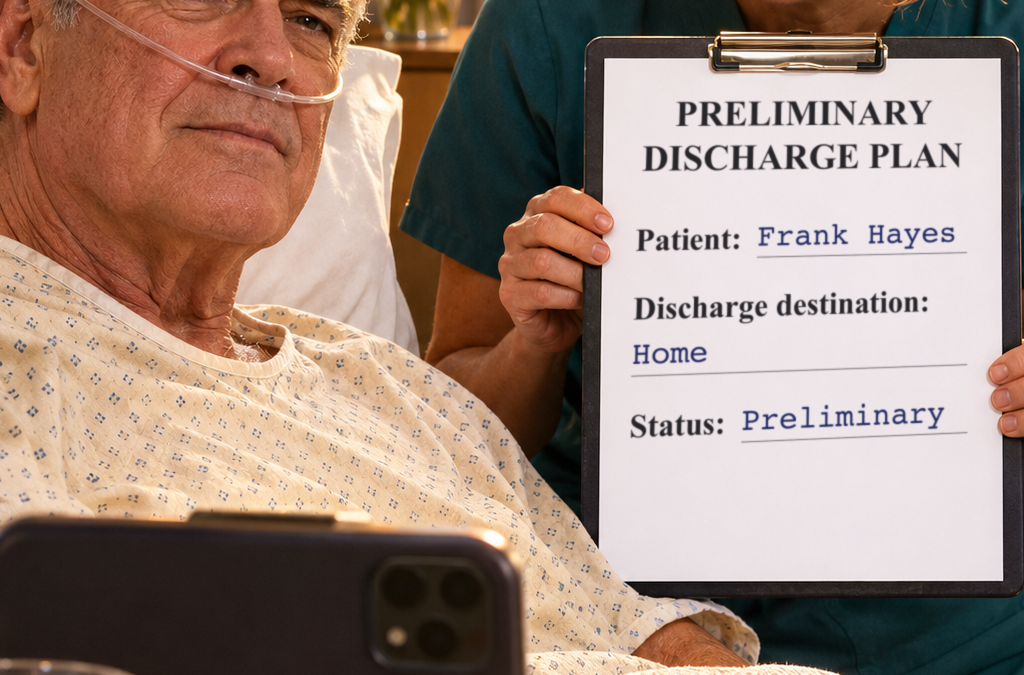
The nurse came in while he was still talking. She stopped beside my bed with the discharge-planning sheet we’d discussed earlier.
“Bad time?” she asked.
“My son’s on the phone.”
“Oh. This is the preliminary plan. You wanted a copy.”
“Can you show him?”
She turned the sheet toward the camera. I saw its gray cardboard backing, and Mark saw the printed side.
His face stayed pleasant for another second. He leaned closer, reading.
Mark’s smile began to fade as he read the nurse’s page.
“Who told the hospital you were going home?”
“I did.”
The page named my own home as my intended discharge destination. It wasn’t a discharge order; we still had to work out what help I needed.
“Dad, you can’t just put that down and make it safe.”
“I told her where I want to go. We’re working on the safe part.”
The nurse nodded. “We’ll keep discussing what he can manage.”
“Does anyone know he lives alone?”
“Yes,” she said.
She left my copy on the bed and stepped out. Mark waited until she was gone.
“You’re making this harder.”
I was seventy-one, in a Dayton, Ohio, hospital with pneumonia. I was tired enough to want him to take over the conversation.
Instead, I looked at the slim envelope. It held my signed written revocation, completed before I’d been admitted. I had withdrawn his authority, though I hadn’t told him about the envelope beside me.
“Tell Dana to leave my closet alone,” I said.
“She’s trying to help.”
“Then she can bring what I ask for. The gray sweatpants. Two shirts.”
“Your slippers?”
“Yes.”
“See? We can do this without arguing.”
He sounded relieved, as if we’d settled more than which pants I wanted.
Dana came back into view.
“Gray ones with the drawstring?” she asked.
“Yes. Top drawer.”
“And the shirts with buttons?”
“The loose ones.”
She nodded. Mark’s phone gave a muffled chime. He looked down, then read the message again.
“Hang on,” he said.
He looked from the message to my face.
Mark began leaning toward the camera, his message still open.
“Why is the title officer asking for your number?”
“What title officer?”
“Susan Miller. She wants direct contact with you about the proposed gift deed.”
“Give her my number.”
“She’s got the paperwork. I don’t know why she needs—”
“Give it to her.”
He stared at me a moment.
“Same cell number?”
“The one you’re calling.”
“Dad.”
“And my email. You have that, too.”
I said both aloud anyway. He repeated the email address, missing a letter, and I corrected him. Dana remained behind him with the clothes against her chest.
“What company?” I asked.
“Miami Valley Title Services.”
I opened my notebook on the blanket. Most pages looked like the records I’d kept at the school warehouse: dates, names, a few words saying what had arrived.
A replacement furnace filter. A returned library book. A package left with a neighbor.
The October 5 line read, “R. Scott / personal / 10:14.”
Tucked farther back was Mark’s earlier mail instruction: Rachel could accept his personal certified mail at the branch. I passed it and found a blank space for the company’s name.
“You’ve still got plenty of savings,” Mark said. “You’ll have proper care. This isn’t leaving you stranded.”
“Then why are you moving into my house?”
“We sell the condo. That clears the balloon loan.”
“How much?”
“You know this. Ninety-six thousand. Due in November.”
“I know when it’s due.”
“We’re trying to get ahead of it. Keep the family stable.”
Dana lowered her eyes. I wanted her to say anything, even that she’d found the shirts.
Instead, Mark asked whether I’d eaten. The covered hospital tray was still on the cart. Every supper came with carrots cut into identical little coins, and I’d begun taking that personally.
“I’ll eat,” I said.
“Good. Rest tonight. We’ll sort out the rest.”
At 5:20, the call ended. His text arrived before the screen dimmed.
“The deed was signed Friday. You don’t need to sign anything.”
Chapter 2 of 7
At 10:00 Tuesday morning, my sock was still hooked around my toes. Bending farther made me cough, and the discharge assessment hadn’t even started.
Paul Turner called while I was sitting there with one bare heel.
“There is a deed, Frank. The title company is holding it. It hasn’t been released or recorded.”
“So he really signed it.”
“Yes. Your January power of attorney gave express permission to give this particular house to Mark, and it was durable.”
I looked at the sock. It had a hole starting where my big toe belonged.
“I thought he’d ask me first.”
Paul waited.
“I signed it because he said it would save trouble. I figured permission and taking whatever he wanted were different things.”
“Do you have the revocation with you?”
“Yes.”
“Keep the original. We’ll get Susan a scan.”
A clinician came to the doorway. I asked Paul to call back later.
She glanced at my foot. “Want some help with that?”
“I’d rather you hadn’t caught me.”
“We usually catch people doing something.”
She helped without making a lesson of it. That was almost worse.
Mark called before we could start. I told her I’d keep it short.
“Dad, we talked as a family,” he said. “We’re worried you’re treating this as a disagreement about rooms.”
“Who’s we?”
“Dana and me. Emily’s here, too.”
In the background, Emily asked whether I was coming home Friday.
“We’re working on that, honey,” I said.
Mark came back quickly. “She needs some certainty. We all do.”
“Then tell her I’m getting better.”
“That doesn’t cover who does the work when you get home. Dana has a job. She can’t become your unpaid nurse.”
“I didn’t ask her to.”
“You’ll need somebody.”
“For bathing at first. Dressing. Some meals. I’m asking about temporary help.”
“And at night?”
“I’m asking about that, too.”
He let out a breath near the receiver.
“The move gives Emily a stable place to grow up. You’d have people available around the clock. There’s a reason we came up with this.”
“The woman helping plan my discharge is standing here. I need to talk to her.”
“Just hear Emily out. She wanted to tell you—”
“No. Please don’t make her carry this.”
For a moment, I heard only television noise behind him.
“All right,” he said. “We’ll talk when you’re less tired.”
Afterward, the clinician asked me to stand and walk with her. By the return trip, the hospital hallway seemed longer than it had from bed.
“What do I actually need at home?” I asked.
“Right now? Help with bathing and dressing. Meals within reach. Clear walking paths. We need to see more improvement before Friday.”
“But living there. Is that possible?”
“With a workable plan, it can be.”
Dana arrived in time to hear that answer. She stayed near the doorway, her work badge still clipped to her shirt.
“Does he need to go somewhere permanently?” she asked.
“That isn’t what I’m recommending from this assessment.”
Dana looked at me, then back at her.
“Mark said there’d already been a decision.”
“We’re still planning with Frank.”
I asked for service prices myself. I wanted the numbers before anybody told me what I couldn’t afford.
Later, the discharge planner brought a written option: thirty-two dollars an hour, three three-hour visits weekly, for six weeks. Two hundred eighty-eight dollars a week.
“Can we start there and review it?” I asked.
“That’s the idea. You may need less as you recover.”
Dana’s voice was quieter now. “I can bring groceries. I can’t do every morning.”
“I know. I’m not booking you.”
She gave a small, tired laugh. “Good. I’m terrible before coffee.”
At home, I kept instant coffee for her, though she always claimed it tasted like burnt toast water. I almost asked whether Mark had packed that away, too.
Instead, I asked the planner to include meal delivery options.
Paul sent me the old power of attorney and the proposed deed to review. Mark’s name appeared where I had never expected to see it.
My own signature on the January paper was worse.
With help getting a clear scan, I sent Paul the signed revocation and my available delivery information. He forwarded those to Susan while I kept the original envelope beside me.
Susan called that afternoon.
“I have what your attorney sent,” she said. “We have to review the authority issue before we complete anything.”
“Does that stop it today?”
“Nothing is being completed while we review it.”
“Will you call me directly?”
“Yes.”
Paul also arranged a brief call with Rachel. I knew her voice from the branch.
“Mark authorized you to take his personal certified mail there?” he asked.
“Yes. That’s been the arrangement.”
“Is there a delivery receipt?”
“Yes. We retain those.”
“Thank you. That’s all for now.”
After she disconnected, I asked Paul whether that settled anything.
“Accepting an envelope and personally knowing what’s in it are different questions.”
He didn’t add anything. Neither did I.
By supper, I had walked twice more and eaten most of a piece of chicken. I was tired enough that the television’s weather forecast seemed unnecessarily complicated.
At 6:12 p.m., Dana forwarded a screenshot from the family group. She hadn’t added an explanation.
Above the message was Mark’s name: “Dad failed his memory check. Please let us handle the arrangements.”
Chapter 3 of 7
“What memory check did I fail?” I asked my doctor Wednesday morning.
“You were confused when you first came in,” she said. “You were very ill with pneumonia. That’s different from failing a formal memory assessment. I don’t see one in your chart.”
“Am I confused now?”
“You’ve been following our discussions and explaining your choices. You still tire easily.”
Dana stood near the window in her work clothes. She had come before her first appointment.
“My son told the family I couldn’t make decisions.”
“I can discuss your condition with you. I can’t settle a family dispute.”
“I’m not asking you to. I want to know what help I need.”
We went over bathing, dressing, meals, and the walking I still needed to practice. Dana listened without checking her phone.
“He couldn’t get his socks on yesterday,” she said.
“He needs help dressing. That alone doesn’t make him unable to choose where he lives.”
“Could I have that written down?” I asked. “Just what I need at home.”
“We can provide a short discharge-needs summary.”
“That’s enough. Nobody needs my whole chart.”
After the doctor left, Dana looked at the family messages. Several relatives had answered Mark with hearts and offers to pray. One had written that she trusted him to do what was best.
“I thought they’d call me,” I said.
“They think you need rest.”
“I could rest after a phone call.”
Dana typed a reply, then read it aloud.
“That isn’t what his doctor said.”
She sent it to the group.
I watched the doorway. I had wanted somebody to correct him. Now I wanted her to get through the morning without paying for it.
“You’ll be late,” I said.
“I’ve got a few minutes.”
Mark called her almost immediately. She looked at me before answering.
“Can we talk together?” I asked.
She put him on speaker.
“Dad, nobody’s trying to upset you,” he said. “People saw how sick you were.”
“Then tell them I’m improving.”
“I’m glad you are. But we shouldn’t ask relatives to promise help they can’t safely give.”
“I asked for an accurate message.”
“Dana’s message makes it sound like I invented the concern.”
“She repeated what she heard.”
Dana spoke before he could answer. “I was standing here, Mark.”
“I’m not disputing that. I’m saying there’s more to going home than answering questions in bed.”
He sounded like he did at the branch, explaining why a customer’s request required another appointment.
“I’m arranging help,” I said.
“Then the people arranging it should handle the discharge. I can’t be your ride Friday.”
“You said you would.”
“I know. But driving you there makes me part of a plan I’m not comfortable with.”
Dana looked toward the hall.
“We’ll talk tonight,” she said.
After the call, she said she needed to leave soon. I asked whether she could walk with me first.
The corridor smelled of toast and floor cleaner. Someone had taped a paper pumpkin to the nurses’ station. Its left eye had peeled loose.
I made it past two doorways before slowing.
“Do you need to sit?” Dana asked.
“In a minute.”
She stayed beside me. I could hear her shoes squeak whenever I stopped.
For years, I’d answered awkward requests with my wallet. Gas money, a grocery envelope, a check nobody had to call a loan. I nearly offered to cover her missed work.
“Could you drive me home Friday?”
“Yes.”
“I need help getting inside, too. I can’t have you drop me at the curb.”
“I wasn’t going to.”
“And if they change the time—”
“Tell me when you know. I’ll arrange it.”
I stopped at the chair by the window.
“I don’t need you to say I can do everything.”
“Good,” she said. “Because you can’t right now.”
A laugh caught in my cough. She waited until it passed.
“I can drive you,” she said. “The rest, I’m still figuring out.”
That afternoon, the discharge planner confirmed that transport needed to be settled before I could leave. I gave her Dana’s number, with Dana’s permission.
I asked for a few crackers afterward. The package said “easy open.” I needed scissors from the nurse.
Rachel called while the crumbs were still on my blanket.
“I’m returning the inquiry about your certified notice,” she said.
“Are you allowed to talk to me?”
“About the relevant records, once I have permission. We retain delivery receipts and ordinary routing materials. I’m checking what I can provide.”
“I don’t want anybody’s banking information.”
“That isn’t part of this.”
“All right. Thank you for calling.”
“I’ll let you know when I have an answer.”
I wrote her name beneath the discharge planner’s number. Then I lay back until the coughing eased.
At 4:40 p.m., Susan called.
“Mark has asked us to release the deed Friday at four.”
“This Friday?”
“Yes. My office has not approved that request. The authority review is still open.”
I looked at Friday on the home-assistance schedule beside my bed.
“Send the request to me,” I said. “And Paul.”
“I will.”
Paul answered when I called him.
“Please answer Susan directly,” I said. “Whatever she needs from us.”
“Of course.”
“He’ll say I embarrassed him. Dana already got that this morning.”
“Do you want to withdraw your concern?”
“No.”
“Then I’ll respond.”
My phone chimed before we hung up. Susan had forwarded Mark’s request for release before the announced housewarming closing.
“Please release the deed Friday at four.”
Chapter 4 of 7
“I haven’t approved Friday’s release,” Susan said. “That request does not change our review.”
It was two o’clock Thursday afternoon, October 15. The hospital television showed a woman frosting cupcakes with the sound off.
“What happens Saturday?” I asked.
“We still have October seventeenth at five, at your dining-room table. But it’s conditional. We can discuss the file. We won’t complete anything unless the authority issue is resolved.”
“Who’s coming?”
“You, Mark, Dana, and me. We’ll need the relevant records.”
“I want to be there.”
“Then we’ll plan on that.”
Afterward, I called Paul.
“Five o’clock at my table,” I told him. “Apparently I’m expected.”
“You should be included.”
“I used to sit there sorting school supply orders. Now I need an appointment.”
“Send me the copy we discussed. Keep your original.”
I had requested another copy of the revocation for him. His office already had one, but I wanted the pages in my belongings checked against his file. Being sick had made every small task take twice as long.
Mark arrived while I was waiting for a nurse to help with that.
“Better color today,” he said.
“I’ve been walking.”
“Good. That’s good.”
He carried a single page without a folder. He looked at the visitor’s chair before sitting, checking for the folded hospital blanket.
“I brought something simpler,” he said. “We’ve got too many different versions of the plan going around.”
“Whose plan?”
“It acknowledges that the move is permanent. Your things would stay available while we worked out what you wanted brought over.”
“I’m going home tomorrow.”
“That’s the current discharge destination. I know.”
“That sounded like you were correcting a mailing address.”
He looked toward the television.
“Could we turn that off?”
“The remote’s beside you.”
He switched it off. Without the cupcake woman, I could hear the cart rattling down the hall.
“This isn’t an admission form,” he said. “It just gives everyone the same understanding.”
“Does it say permanent?”
“Yes, because leaving that open makes planning impossible.”
“For whom?”
“For all of us. The residence, Dana, me. You, too.”
The corner of the page bore a small yellow flag where he wanted my signature. I could see my name above it.
“I’m not signing that.”
“Will you at least read it?”
“I read the part you need me to agree to.”
A nurse came in with the copies I had requested. She asked whether I needed anything else.
“Another blanket later, maybe.”
“Ring when you want it.”
Mark waited until she left. The signed revocation lay beside its slim envelope, with the copy intended for Paul.
He read the heading.
“You’ve sent that to the title company?”
“Yes.”
“When did that become part of this?”
“It’s in their file. Susan has it.”
His eyes stayed on the page long enough for me to hear a meal tray clatter outside.
“Dad, you can revoke it. I’m not saying you can’t.”
“Then what are you saying?”
“That doesn’t answer whether I had actual notice when I acted.”
I said nothing.
“Rachel accepts a lot of envelopes. You know how that works at the branch. Her signing doesn’t tell you what reached me.”
“She was allowed to accept your mail.”
“Yes. I never received it personally.”
He spoke evenly, without looking away.
“I signed under the authority you gave me. A document you kept with your own papers can’t turn that into me knowingly doing something wrong afterward.”
“I’m having Susan speak to me directly.”
“She already is.”
“Then that continues.”
He glanced at my delivery notebook.
“Are you giving her that?”
“She has the information I sent.”
“Could I see what you’re relying on?”
“The company can ask me for what it needs.”
The notebook stayed beside my blanket. I didn’t offer it.
Paul called before Mark answered. I put him on speaker and told him Mark was there.
“Who decides whether this goes ahead?” I asked.
“Her company holds the deed,” Paul said. “If it doesn’t meet their requirements, they won’t complete it.”
“Exactly,” Mark said. “That’s what I’m asking her to review.”
“Then let her review it,” Paul said.
Dana arrived with my discharge clothes in a grocery bag. Mark was explaining that permanent arrangements still needed practical follow-through.
“Permanent?” she asked. “He’s coming home tomorrow.”
“For now,” Mark said.
Dana looked at the acknowledgment page.
“Why didn’t you show me the temporary-care schedule?”
“I didn’t want to promise something before we knew it would be enough.”
“But there was a schedule.”
“There was an option. Those aren’t always the same.”
She didn’t answer. My gray pants hung over the bag’s edge, freshly washed.
“Those still have the drawstring?” I asked.
“Yes,” she said. “And the shirt you wanted. I couldn’t find matching socks.”
“They haven’t matched since June.”
She laughed once, then looked back at Mark.
“Are we still having people Saturday?”
“Yes. The original paperwork predates this dispute. I expect the notice question will get sorted out.”
“And if it doesn’t?”
“We don’t need to alarm everybody before Susan finishes. Emily’s been looking forward to seeing people.”
He left with the unsigned acknowledgment.
Dana stayed until I needed to rest. At the door, her phone chimed.
“The revised cleaning list,” she said. “He took your bedroom off.”
She read farther, then came back to my bed. She showed me the message he had sent the guests.
“Dad has already given us the house.”
Chapter 5 of 7
At 3:30 Saturday afternoon, Dana walked beside me up my front steps. Through the screen door, I heard people laughing in my kitchen.
“I’m going myself,” I’d told her after Friday’s discharge. “Paul can stay by the phone.”
“I’ll bring you,” she’d said. “But I’m not calling it Mark’s house.”
Now eighteen adult guests and Emily were attending the housewarming. Someone had tied balloons to the porch rail I needed to hold.
Mark met us inside.
“Dad. Good. We saved you a seat.”
A woman from his branch offered me the chair near the hall. I sat before answering anyone.
“Thank you. That one’s fine.”
Emily came over, stopping short of my knees.
“Can I hug you?”
“Carefully. I’m still a little creaky.”
She leaned against my shoulder. Her hair smelled of strawberry shampoo.
“Are you staying for cake?”
“I hope there’s cake.”
“Dad said we’re doing a toast first.”
Mark stood behind her, smiling toward the guests.
“We’ve got everything timed around the appointment.”
On my kitchen counter sat a bowl of pretzels with a serving spoon. Nobody in this house had ever used a spoon for pretzels. My wife would have asked whether they were expecting the health department.
“Could I have some water?” I asked.
Dana went to get it. Mark bent closer.
“I’ve got colleagues here. Family drove over. Let’s let the professionals finish before we start explaining different possibilities.”
“What have you told them?”
“That the paperwork is being handled.”
“And the toast?”
“We’re celebrating getting everyone settled.”
Emily remained beside my chair. I didn’t ask him anything else with her there.
“Would you go outside with your mom awhile, honey?”
“Are you tired already?”
“A little.”
Mark lowered his voice. “She doesn’t need another change to worry about.”
“Then let her have some air. Dana can bring her back when we’re ready.”
Dana returned with the water.
“We’ll look at the mums,” she told Emily. “The purple ones survived me forgetting them.”
“They look dead underneath.”
“That’s where I don’t look.”
They went out through the kitchen. Mark watched them leave.
“I paid two hundred twenty-five dollars for the mobile appointment,” he said. “Susan’s coming here so you don’t have to go anywhere.”
“I’ll be here.”
“That’s all I’m asking.”
A guest approached with congratulations. I let Mark answer those.
After resting, I walked down the hall. My bedroom door was open.
The bed was still there. So were the curtains and the lamp Emily had wanted. No shelves had been built, no bottles installed.
My shirts were stacked inside two open cartons on the floor.
A pair of trousers hung over one side, belt still threaded through the loops. I’d worn those to my last retirement luncheon.
Dana found me in the doorway when she came back inside.
“Do you want to lie down?”
“Where would those have gone?”
“She’s just sorting,” Mark said behind us. “Nothing’s being thrown away.”
Dana lifted the clothes from the cartons and put them back on the bed.
“I’ll deal with these later,” she said.
“We need somewhere to put the boxes.”
“They can stay empty.”
He looked toward the living room, where somebody called his name.
“All right. For now.”
Dana waited until he left.
“Emily’s on the porch. She can stay there while we talk.”
“She doesn’t need to hear it.”
“I know.”
I rested on the bed awhile. From the kitchen came the scrape of my cake server against a plate. Somebody asked where Mark wanted the leftover food.
Susan arrived before five with a work bag and a closed file. Mark greeted her near the dining room.
“Everything you requested is ready.”
“No approval yet.”
“Of course. I meant the materials.”
She greeted me, then asked where I wanted to sit. My usual chair faced the window. I told her I wanted that one.
Mark asked whether she needed the deed out.
“It stays in my folder while we review authority.”
“Fine. I think the statement should clear up my position.”
She gave him the requested page. He read it standing beside the table.
“I’m not disputing that Dad revoked the power of attorney,” he said. “He’s entitled to do that. The question is what I knew when I signed.”
Susan waited.
“Before October ninth, I had no actual notice of the revocation. That’s what this says?”
“That is the statement you’re being asked to make.”
“And it doesn’t suggest I’m claiming authority now.”
“No.”
“Good. Because I’m not.”
He signed it. The scratching carried farther than his voice had.
My delivery notebook was on the table, within reach of my chair. It stayed closed.
“Is Rachel coming?” Susan asked.
“She said she would,” I answered.
Mark looked toward the front window.
“She’s my administrative assistant. I don’t want her put in the middle of a family disagreement.”
“I requested the relevant records,” Susan said. “That’s why she’s expected.”
“I appreciate keeping it limited.”
“It will be.”
Paul had told me he would answer his phone. I hadn’t called him. Across the doorway, guests were gathering coats without quite leaving.
At 4:58, I settled into my chair. Dana sat beside me, and Mark took the place opposite us.
My phone lit up with Rachel’s name.
I read her message, then typed back: “Can you still bring the materials you have permission to provide?”
Above my question, her message remained on the screen.
“Mark has asked me to leave the original at the branch.”
Chapter 6 of 7
“Before you sign,” I said, as the dining-room clock reached five.
Susan looked up from her file. Footsteps stopped at the screen door.
Rachel came in carrying a document sleeve.
“I have permission to provide the relevant notice records,” she said. “That includes the originals.”
Mark stood to make room.
“I only asked that we keep workplace records at work.”
“I checked what I could bring.”
Susan indicated the empty chair. Two of Mark’s colleagues remained near the living-room doorway. A relative stood behind them with her coat over one arm.
“Let’s finish the authority review,” Susan said.
Mark waited until Rachel sat.
“Dad’s wishes now aren’t in question. But I executed the deed before I personally received notice. Rachel accepts mail for me. Her signature doesn’t establish what I knew.”
Susan turned to me.
“Do you have anything beyond delivery to his workplace?”
My notebook lay closed beside Rachel’s sleeve. For a moment, I could hear the refrigerator running in the kitchen.
Rachel opened the sleeve toward me. The delivery receipt was on top, with routing pages behind it. I read far enough to see Mark’s reply, then took the receipt and placed it beside my notebook.
“Why did you answer her message before you opened the transfer?”
Mark looked at Rachel.
“I’d need to see which message you mean.”
I read from the records.
“Rachel signed October fifth at ten fourteen. You answered her at eleven nineteen that morning. You opened the transfer October sixth, at two thirty-one. You signed the deed October ninth.”
“An acknowledgment can mean an envelope was received,” he said. “It doesn’t necessarily mean I read its contents.”
Susan nodded once.
“What identifies the contents?”
Rachel brought the routing printout into view.
“The subject is ‘Frank Hayes—signed POA revocation.’ I sent it October fifth at eleven oh five. The cover and revocation were scanned and attached.”
She looked at Susan rather than Mark.
“His reply was, ‘Keep it with my personal documents.’ This is the notice I routed. It wasn’t customer mail.”
Mark’s colleague moved away from the doorway, then stopped beside the sofa.
“I receive a lot of documents,” Mark said.
Susan asked, “Is that your reply?”
“Yes.”
“Do you dispute the date?”
“No. But Dad had been resisting help for weeks. I believed we’d work through it.”
“I wasn’t in the hospital yet,” I said.
“I know that. I mean afterward. Once you were better, once you saw what we were arranging.”
“The house?” I asked.
“The whole plan. Care, the condo, Emily having space. I expected you’d accept it when the immediate crisis passed.”
Susan looked at the printout again.
“That reply acknowledges the revocation before you acted. Expecting him to change his mind is not restored authority.”
Mark started to speak. She waited, but he didn’t finish.
She closed the file.
“I will not close the $420,000 acquisition. This deed will not be released or submitted for recording by our company.”
“And insurance?” Mark asked.
“No title-insurance approval for this proposed acquisition.”
He stood and reached toward the folder.
“I need my paperwork.”
Susan kept it on her side.
“The escrowed deed stays with us.”
Dana rose from the chair she had moved to beside Mark while Rachel read. She crossed behind Susan and came to me.
The old brass key pressed into my palm.
“I heard him say no. I should have said so.”
She sat beside me. Her chair leg caught the rug, and she had to shift her weight before it settled.
Mark watched her.
“Can we talk in the kitchen?”
“After Frank’s settled.”
“This is between us.”
“I know. He still needs supper.”
I had eaten half a sandwich earlier. The other half was in my refrigerator, wrapped in wax paper because I disliked buying plastic bags for one sandwich.
“I can wait,” I said.
Dana shook her head. “You’ve waited enough for supper.”
Mark looked at me.
“If you’d simply said what you needed—”
“I did.”
“I mean before all this.”
My breathing had grown shallow from sitting upright. I wanted the conversation finished without having to prove I could outlast him.
“You can visit when invited. You cannot speak for me.”
He looked toward Susan.
“Could he give fresh consent? Separate from the old power of attorney?”
“If he chose to.”
“I’m not signing anything,” I said.
From the kitchen came the clink of glasses being gathered. Someone asked about the toast. Mark’s relative answered quietly that they should get going.
One of his colleagues said goodbye to me without offering congratulations.
“Please bring Emily in,” I told Dana. “But no more arguing when she gets here.”
“I’ll get her.”
Mark stayed standing while the guests left. Nobody asked where to put the housewarming gifts. A bottle in a silver bag remained beside the fruit bowl.
Susan took a small printer from her work bag. The page emerged slowly while Mark watched the hallway.
“This is the collection instruction,” she said. “Any proposed replacement deed documents from our file are available only as withdrawn materials. They aren’t approved for use.”
“I’d rather have this ended in writing,” he said.
“You can discuss terms with Paul.”
“Will you send him what happened?”
“With Frank’s permission.”
“Yes,” I said.
Mark took out his phone. Mine chimed shortly afterward; he had copied me on his message to Paul.
“Send me the withdrawal terms Monday.”
Chapter 7 of 7
Monday, October 19, Paul sent the withdrawal terms before I finished breakfast. Mark would withdraw the transfer, surrender his copies and deed materials, and stop relying on the old authority. Reimbursement was still being negotiated.
Paul recorded the revocation in Montgomery County that day. He also delivered copies to my financial institutions and requested acknowledgments.
The first acknowledgment arrived Tuesday. The others followed.
“Do I need a new deed?” I asked him.
“No. You’re still the sole owner.”
“So the one in my file stays.”
“Yes.”
I left it there, between the property-tax statements and the receipt for my last roof repair.
On Friday, October 23, Paul called after lunch.
“Mark signed.”
“All of it?”
“The withdrawal and nonreliance agreement. His retained power-of-attorney copies and proposed deed materials have been surrendered.”
“And your bill?”
“He agreed to reimburse twenty-one hundred dollars. I’ll send the invoice November twentieth.”
The agreement came from negotiation between us, with Paul handling the terms. Susan hadn’t ordered Mark to pay or kept authority over our family.
I read my copy twice. There was no line giving Mark a new job managing anything.
Later, Susan sent confirmation that her file was closed without completion. I filed that too.
Rachel received a short thank-you from me.
She answered, “You’re welcome, Mr. Hayes.”
I didn’t ask her what work had been like afterward.
The first week home, getting clean took more planning than anything else. A shower used up the energy I’d expected to spend making lunch.
My helper asked what I wanted done first.
“The bathroom.”
“All right. Then breakfast?”
“I’ve eaten. Could you change the sheets?”
“That’s your call.”
I stood in the hallway while she worked. I disliked needing someone else to strip my bed, especially when I could remember hauling whole pallets of school supplies.
“Want me to do the laundry too?” she asked.
“The sheets, yes. Leave the shirts. I can do those tomorrow.”
She left the shirts.
The schedule ran for six weeks: three visits a week, three hours each, at two hundred eighty-eight dollars weekly. Some mornings I needed almost every minute. Later, I could shower before she arrived and ask for help with groceries instead.
We reviewed the list each week. She never treated last Monday’s needs as instructions for the rest of my life.
By the end, I was changing the bed myself, though I rested between wrestling the corners of the fitted sheet.
Dana called about Emily rather than announcing when they would come.
“Would Saturday after lunch work?”
“Not this Saturday. I’ve got shopping coming, and I’ll be worn out.”
“Sunday?”
“Two o’clock. An hour would be good.”
“Just an hour?”
“To start.”
“Okay. I’ll tell her.”
She didn’t make me apologize for the shorter visit.
Once, Dana mentioned that she and Mark were talking through things at home. She sounded tired.
“Do you need me to do anything?” I asked.
“No. I just might be slow answering.”
“That’s fine.”
I nearly offered money. Instead, I told her Sunday could wait if she needed it to.
She brought Emily.
In November, Mark emailed asking whether he could resume managing my household paperwork.
“I can keep the bills organized without making decisions,” he wrote. “There’s no reason for you to do everything yourself.”
I read it after breakfast. He had remembered which part of asking usually worked on me.
For years, I’d hated being a bother more than I’d hated doing without. Now I had paid help when I needed it, and a stack of bills I could finish over two mornings.
“I’m handling the paperwork,” I answered. “If I need help, I’ll arrange it. You and Dana can visit when we agree on a time. No documents to review.”
His reply came that evening.
“Understood. I’d like us to get back to normal.”
I answered the part I could answer.
“Ask about a visit when you’re ready.”
I didn’t send another message explaining what normal would have to look like.
On November 20, Paul sent the agreed $2,100 invoice and payment instructions. I received a copy, not a promise that payment had already arrived.
Mark’s ninety-six-thousand-dollar balloon loan reached its original due date on November 30. I knew the date without checking.
I didn’t call to offer a bridge loan. I didn’t move money from savings.
What happened with his obligation stayed his business.
On Friday, December 4, the reimbursement cleared into my account. Paul confirmed receipt and sent the final statement.
The original three-hundred-fifty-dollar revocation bill remained separate. I’d paid that myself.
I went grocery shopping that afternoon. At the store, I bought a small roast without calculating whether Mark and Dana might need the money for something else.
By December, the cartons had gone from my bedroom. My shirts were back where I could find them. The sewing machine stayed in the spare room, beneath its cover.
On Saturday, December 19, at two o’clock, Emily arrived with Dana.
She had grown into her winter coat since I’d last seen it. Or perhaps I’d forgotten how long her arms were getting.
“Can we do something?” she asked.
“Certainly. Something sitting down.”
“Cards?”
“After I rest a little.”
She followed me to the bedroom doorway but stopped there.
“Can I sit beside you while you rest?”
“It’s still my bedroom, honey. You’re welcome in it.”
“Will talking keep you awake?”
“Depends what you’re talking about.”
“School?”
“That might do it.”
She grinned and chose a paperback from the shelf. It was a book about dogs, with a cracked spine and a grocery receipt marking somebody’s abandoned place.
Dana stayed in the kitchen. I heard water running, then nothing but Emily turning pages.
After a while, she read me a sentence she thought was funny. I missed half of it.
“Again,” I said.
She read it slower.
We never got to cards.
When they left, I walked them to Dana’s car. Emily reminded me where she’d left the book.
“Beside the lamp.”
“I’ll leave it there.”
I waited until her seat belt clicked, then crossed the porch.
I turned the old brass key and went inside.







