“Nine nights you got lost at home, Augie,” my daughter-in-law said at our class ceremony—Then the college dean stepped forward, and a judge ordered her to pay my $4,800 lawyer fees.
Complete story · 9 parts · about 34 minutes · ending included
Part 1 · Part 2 · Part 3 · Part 4 · Part 5 · Part 6 · Part 7 · Part 8 · Part 9
Part 1 of 9
Shaylee was taping a box shut over my wife’s sewing basket when I came through my own front door with the groceries.
It was 8:40 on Saturday, October 24, 2026, and I had left it locked.
I stopped with a paper bag against each hip.
Shaylee, my son Bodie’s wife, stood in the middle of my living room with her purse on her shoulder and three cardboard boxes at her feet. DONATE was written across all three in black Sharpie.
The third was still open.
Theresa’s sewing basket sat inside beside the recipe tin.
Theresa had died last year.
I was fifty-nine, a widower, and this paid-off house on Lamarque Street was mine, but Shaylee had rearranged it like she was straightening a display at her own clothing shop, Shay & Co.
My recliner had been shoved into a corner.
By the window, Theresa’s sewing machine was still on the table.
Shaylee pulled off a strip of tape.
The spare key dangled from her finger on its small brass fleur-de-lis key ring.
I looked at it.
Theresa had given that key to Bodie in 2024 for emergencies.
Shaylee smiled as if I had caught her wiping dust off a shelf.
“I’m just helping. You left the coffee pot on again.”
I set a grocery bag down against the wall.
“Let it cool first.”
Her smile stayed put.
“You don’t know what day it is half the time, Augie. Somebody has to.”
She said it lightly, almost kindly.
That made me look at the room instead of her.
Folded dish towels and Theresa’s sewing scraps showed from another box. A lamp shade, couch pillows, and her wicker tray filled the rest.
Everything in sight was usable.
Shaylee pressed the tape flat with the side of her hand.
“These are things you don’t use.”
“I use my recliner.”
“It’s still here.”
“In the corner.”
“You have more walking room.”
I picked up the bag again.
The spare key swung from her hand.
“How’d you get in?”
“You weren’t answering.”
“I was buying groceries.”
“I know. I saw the truck gone.”
I waited.
Shaylee opened her purse and slipped the key inside.
“Bodie worries when you’re by yourself.”
“Bodie can call.”
“He does.”
“So can you.”
Her mouth tightened, then eased.
“I came to help, Augie.”
I bent and pulled the tape loose from the third.
Shaylee put her palm on the flap.
“Those can go.”
“No.”
“They’ve been sitting there.”
“They can keep sitting.”
She lifted her hand.
I carried both grocery bags to the kitchen.
The answering machine sat on the counter next to the fridge, its light off. It was Theresa’s old one, and her voice was still on the greeting.
I set the bags beside it, put the boudin away to stay cold, placed the coffee nearby, and left the rest on the counter.
Behind me, tape ripped again.
I went back before Shaylee could seal anything else.
She had moved my recliner to clear a path for the boxes to the door.
I took it by both arms.
The fabric still held the shallow dent where my elbow rested. Theresa used to tell me I wore the upholstery uneven.
“Leave it.”
“It looks crowded.”
“It fit before.”
I dragged it back to its spot.
The feet caught on the rug, then settled. I lined the front edge with the rug seam.
Shaylee watched from the middle of the room.
“You could trip over that.”
“I haven’t.”
She picked at a loose adhesive edge with her thumbnail.
Through the window, my truck sat in the driveway.
The navy blue sign-in binder was on the passenger seat, metal dust caught in its spine. The master sheet lay beneath the scuffed, cloudy plastic sleeve on the front.
I turned back.
Shaylee had her purse open.
“You’re still taking Remy Monday?” she asked.
“Yes.”
“At 3:15?”
“Like every Monday since I closed the shop.”
She nodded.
“He likes it over here.”
“He likes the garage.”
“He likes watching you.”
I picked up Theresa’s basket and set it beside the sewing machine.
Shaylee looked at it, then at me.
“You shouldn’t have to keep up with all this by yourself.”
“I can keep up.”
“I’m trying to make things easier for him.”
She used the words “for him” about Bodie, about Remy, about me, usually while moving something that belonged to somebody else.
I folded the flaps down without sealing them.
Shaylee glanced toward the kitchen.
“At least let me take the boxes.”
“No.”
“You’ll change your mind.”
“I’ll know where they are.”
Her thumb rubbed over the purse strap. Her eyes moved across the living room, slow and careful.
I stayed by the window and waited.
Shaylee checked inside her purse, lifted it higher on her shoulder, and turned to leave.
The folder slid out.
It landed face up between us.
The cover was blue, with black print across it.
Comparative Market Analysis — 1412 Lamarque Street.
I looked at Shaylee.
She bent quickly, pushed the folder back inside, and gave me the same small smile.
“Coupons.”
She left.
I waited until the latch clicked.
Then I opened the third DONATE box, took out the recipe tin, carried it to the truck, and set it on the seat under the sign-in binder.
Part 2 of 9
“Mom says you get mixed up, Paw-Paw,” Remy said, and passed me the rice.
My grandson was eight. He could ask a hard question with the same face he used to ask for gravy.
It was Sunday, October 25, 2026, at 6:00 PM. I was at the head of Bodie and Shaylee’s dining table, with Shaylee on my right and my son on my left. Remy was beside me, one sneaker moving under his chair.
Shaylee laughed like Remy had said something cute.
“I text Bodie every night he’s offshore so he never has to worry.”
Bodie stopped eating.
Remy watched his mother, then me.
I spooned rice onto my plate.
Bodie said, “Shay says you were fine with her boxing up Mom’s things.”
Shaylee smoothed her napkin across her lap.
“I don’t want a thing of his. I’m doing this for him.”
Her voice stayed easy.
She leaned over and straightened Remy’s place setting, then returned her hand to her own. Everything she did looked ordinary enough at a family dinner.
I chewed, swallowed, and reached for my water.
Bodie’s eyes dropped to his plate.
His next hitch started Wednesday, November 4, he said. Fourteen days, like always.
Shaylee watched Bodie over her glass while he rubbed his thumb along the side of his fork.
“Dad doesn’t pick up a lot of nights I call from the rig.”
“Missed it.”
That was all I gave him.
Shaylee looked at her husband and said nothing.
Remy’s fork scraped faintly against the dish as he pushed a grain of rice around his plate.
Bodie cleared his throat and asked Remy about school.
Remy answered with his mouth half full. Shaylee told him to finish chewing.
Nobody said another word about it.
The meal kept moving around me in small sounds: silverware, a glass touching wood, Remy’s chair shifting when he reached for more rice.
I finished dinner, carried my plate toward the kitchen, and left it by the sink.
On my way out, I passed the key hooks by the back door.
The hook where the spare key used to hang was empty.
I put on my cap and went home.
Monday morning, October 26, I called Bodie at 7:00 AM.
“Give me back the spare key.”
A short pause came over the line.
“Let her keep it, Dad. It keeps the peace.”
I looked toward my front door.
“All right.”
After we hung up, I drove to the hardware store on Pinhook Road and bought a new deadbolt for $36.
Back home, I laid the box on the kitchen table.
The picture on the front showed the lock, the strike plate, and the screws lined up neat. Clean parts. Straight edges.
I fetched a screwdriver from the garage and placed it beside the box.
The cardboard had a perforated tab under my thumb. One pull would open it.
My hand stayed there.
Monday afternoon meant Remy.
At 3:15 PM, Remy would come out of school looking for my truck. At 5:15 PM, I’d drive him back to Bodie’s.
I slid the screwdriver away.
I left the new deadbolt unopened where I had laid it.
That night, I came home at 9:45 PM.
The house was dark until I switched on the kitchen light.
The box was where I had left it.
I moved it toward the far end of the table and pulled out a chair.
I had carried the recipe tin in from the truck on Saturday.
Its lid gave a small metal scrape when I opened it.
Theresa kept the cards packed tight, some with flour caught in the corners, others softened at the edges from years of handling. The top card bowed where a thumb had bent it long ago.
Theresa’s letters, birthday cards, and grocery lists were lowercase cursive.
Recipe cards were different.
I thumbed through them until one stopped under my finger.
PECAN PRALINES — DON’T STIR.
Her block capitals filled the top of the card.
I held it by one corner.
She used to correct me if I reached for a spoon too soon.
“Leave it alone,” Theresa would say.
I put the card back in the recipe tin and closed the lid.
The top of the fridge was clear.
I lifted the recipe tin up there and pushed it back from the edge.
The boxed deadbolt remained on the table when I turned off the light.
A week went by.
Nothing on that table moved.
On Monday, November 2, I picked Remy up at 3:15 PM like always.
He talked most of the ride, telling me about school while his backpack rested against his shoes.
At my house, he headed for the garage.
Remy knew where the dark glass belonged and where to keep himself while he watched the bright flare. I never had to tell him twice.
I kept an eye on the clock.
At 5:15 PM, I brought him home.
Remy climbed out before I had both hands off the steering wheel and hurried toward the front porch.
Shaylee was already there.
Her arms were crossed.
Remy went past his mother and into the house.
I closed the truck door and walked up the path.
Shaylee’s face was calm.
“Bodie leaves Wednesday. You’ll need somebody to sign for you soon, Augie. Better family than a stranger.”
Part 3 of 9
The deputy asked me to say my full name before he’d hand me the envelope.
It was Thursday, November 5, 2026, at 4:15 PM. A Lafayette Parish sheriff’s deputy stood on my front step while I stayed in the doorway, my hands still gray with grinding dust from the garage.
“August Baptiste.”
He checked the paper in his hand, then gave me the envelope.
“You’ve been served, Mr. Baptiste.”
I took it by one clean corner.
The deputy stepped off the porch. I watched him go only long enough to make sure he was finished with me, then closed the door.
The envelope was so thick it bent instead of folding.
I carried it to the kitchen and opened it over the counter.
Across the top of the first page were the words 15th Judicial District Court, Lafayette Parish.
Below that came the heading.
“Petition for Interdiction.”
The petitioner was Shaylee Baptiste.
The defendant was August Baptiste.
My thumb left a gray print near my own name.
I wiped my hand on a shop rag and kept reading.
Farther down, Shaylee asked the court to name her as my curator, “out of love for Defendant and for his son.”
I didn’t need a lawyer to tell me what that meant. She wanted a judge to say I couldn’t run my own life and put her in charge of it.
I laid the pages flat.
A courthouse stamp darkened the lower margin, and the toner still had that dry copier smell.
The corners kept lifting.
That evening, I called Russell Landry.
Russell was sixty, a lawyer in Lafayette, and an old customer. Back when my shop was open, I’d welded the trailer for his boat.
He answered with a short, “Landry.”
“It’s Augie Baptiste.”
“What’s wrong?”
“I got served.”
His voice changed.
“What kind of papers?”
“Interdiction.”
A pause came over the line.
“Who filed?”
“Shay.”
“Bring me everything. Ten tomorrow.”
“All right.”
I hung up and went back to the counter.
Before bed, I made myself go to page two.
One sentence stopped me in the middle of a paragraph.
“Defendant can no longer safely live alone.”
I pressed my palm flat beside the words until the paper quit sliding.
The wall calendar by the fridge was the one Theresa kept; nobody had written on it since June of last year, and I’d never started one of my own.
I left the petition where it was.
Friday morning, November 6, I carried the papers into Russell’s office at 10:00 AM.
His wooden desk had a worn patch along the front edge. A stack of files took one corner, and his reading glasses waited near the middle.
Russell pointed to the chair across from him.
I took it.
Russell put on the glasses and pulled the petition between us.
He read page one slowly.
Then the second.
He kept going without speaking.
I watched the lenses move down the print.
“All right,” he said.
His finger rested beside the heading.
“This is an interdiction case. The court can appoint a doctor to examine you, and it usually does.”
I nodded.
Russell continued.
“Your daughter-in-law has the burden. She has to prove what she’s claiming by clear and convincing evidence.”
“Meaning?”
“More than saying it.”
He flipped ahead.
“You get to put on your own proof.”
The words came out the way Russell talked about steel when I repaired his trailer. No extra shine on them.
He read farther.
I kept my hands on my knees so I wouldn’t leave gray marks on his desk. Grinding dust had stayed in the creases around my nails even after I scrubbed them Thursday.
Russell stopped at the signature page.
He tapped the bottom with one finger.
“She verified it. That’s her oath, not a rumor.”
Shaylee’s signature ran beneath the verification.
The loops were wider than the rest of the writing.
I knew that hand from birthday cards, school forms Remy brought over, and notes left on my counter.
Russell moved his finger away.
He read on, flat.
“Petitioner has visited Defendant forty-one times since August.”
I raised my eyes.
“Forty-one?”
“That’s what she swore.”
Russell leaned back in his chair and turned the page.
He read the top line aloud: “Petitioner has found Defendant at home, confused, on the evenings listed in Exhibit A.”
His pencil rolled against the desk blotter. He stopped it with the side of his hand.
“Where were you those nights?”
“I’d have to look.”
Russell held my eyes for a second.
“Bring me where you were, every one, by Tuesday.”
I rubbed the side of my thumbnail with my forefinger.
“All of them?”
“Every one.”
He went back through the pages.
I watched his thumb separate one sheet from another.
Near the back, his thumb found a page headed by two words.
Exhibit A.
The clock on his wall said 10:38. Russell read the page aloud:
“On the following nine evenings, at approximately 8:30 p.m., Petitioner found Defendant at his home, confused and unable to state the day: 8/24, 9/9, 9/14, 9/16, 9/21, 10/7, 10/12, 10/14, 10/19.”
Part 4 of 9
Remy won’t be coming Mondays until the doctor says you’re safe. That was the whole text.
Saturday, November 7, at 9:00 AM, I stood in my kitchen with the phone in one hand.
No hello.
No Bodie.
Just Shaylee deciding Monday for me.
Theresa’s wall calendar was still on its hook beside the fridge, still turned to 2025.
I pulled it down.
August.
Every square was empty.
September was the same.
So was October.
I knew it was the wrong year. I checked anyway, wanting to see something in Theresa’s handwriting.
There was nothing.
The old calendar couldn’t help me.
I closed it and put it back on the hook.
All I could picture was Remy coming out of school at 3:15, backpack bouncing against his shoulders, already watching for my truck.
Monday morning brought something else.
At 11:00 AM on November 9, a letter from the 15th Judicial District Court came to the house.
The order named Dr. Tamara Guidry to examine me.
I had to cooperate.
Trial was set for Tuesday, December 29.
I read the order at the counter, flattened the fold with my palm, then taped it to the fridge door.
The recipe tin sat right above it.
Russell called.
“The doctor is court-appointed,” he said. “Answer what she asks.”
“I will.”
“If you get flustered in front of her, it’s your word against a sworn list.”
“I heard you.”
“Good.”
Russell hung up.
My phone buzzed before I could put it down.
Bodie had texted from the rig.
“Just do the doctor thing, Dad. Shay’s only scared.”
I typed a reply.
Let it cool first.
My thumb hovered over Send.
I deleted the words instead.
The phone went face down on the counter.
At 3:15 PM, I was in the garage.
Remy’s small welding glasses hung from their hook.
His little stool was empty.
I lowered myself onto my shop chair and stayed there awhile, with my hands resting on my knees.
Nothing needed fixing.
I picked up the phone again.
Marcia Thibodeaux was the dean of workforce programs at Coulee Ridge Community College. Her number was already in my contacts.
I meant to tell her I was done teaching.
Keep it simple.
My thumb hit Call, and I hung up before the first ring.
I drove to Coulee Ridge.
At 5:45 PM, the shop room was filling with the usual metal clatter.
Twenty-two students took their places at the welding booths.
Keisha Arceneaux, twenty-nine and a single mom, was at the front bench with a pen clipped to her collar, a habit from her nursing-aide shifts.
I went to the instructor’s table.
The sign-in sheet was waiting.
I wrote my time on the instructor line, signed my name, and sent the binder down the front bench the way I did every night.
A few students were still pulling on gloves when I faced the room.
“If I’m not here next week, Ms. Thibodeaux will find you somebody.”
Keisha’s head came up.
“Find us somebody for what, Mr. B?”
“To teach.”
A booth door clanged shut farther back.
Keisha studied me for a second.
“You quitting?”
“I didn’t say that.”
“You just told us somebody else might be here.”
“Start your setup.”
That got her moving.
The room settled into work.
Metal knocked against metal. A hood came down. A student tightened a clamp.
I walked the first row, checking how pieces had been fitted before anybody struck an arc.
Measure first.
Cut after.
Keisha came back up from the front bench carrying the sign-in binder.
It was the navy blue three-ring binder I kept with me, metal dust worked into its spine. The scuffed, cloudy plastic sleeve on the front cover held the master sheet.
“Mr. B.”
She placed the sign-in binder on my table.
“Everybody’s in.”
I opened it.
The sign-in sheets were filed by night.
Each one had my line up top, twenty-two student lines, and the Guest line at the bottom.
The dates Russell had read aloud were still in my ears. I worked backward through October until I found one.
MON 10/12.
I drew it free.
At the top, the photocopied block capitals were smudged and thick.
SIGN IN EVERY NIGHT. NO NAME, NO HOURS.
My thumb rested under the line.
Something about the printing felt familiar.
I couldn’t place it.
I let that go and dropped my eyes to the instructor line.
5:47 PM – 9:36 PM.
My signature was beside it.
Below mine were twenty-two signatures.
I held the sheet flat with my palm, the same pressure I used before a tack weld.
October 12.
One of the dates in Exhibit A.
Keisha hadn’t gone back to her booth.
She saw the sheet under my hand.
“You haven’t missed one night, Mr. B. Twenty-two of us signed under you, every single time.”
Part 5 of 9
Russell laid the nine sign-in sheets beside her list like he was matching a pair of boots.
Tuesday, November 10, at 8:30 AM, my lawyer spread Exhibit A and my photocopies across his desk; one date that didn’t match would let Shaylee’s list stand.
He took them one by one.
“August twenty-fourth.”
He found the matching sign-in sheet and checked my instructor entry.
“September ninth.”
Another match.
My jaw stayed tight while he checked. One miss would break the pattern.
September 14. September 16. September 21.
October 7. October 12. October 14. October 19.
Each date had a sheet from a Monday or Wednesday night. The class ran from 6:00 to 9:30 PM, and each record carried my time, my signature, and student names underneath.
All nine.
Russell didn’t smile.
He squared the edges with his palm and went back over the dates. His pencil touched Exhibit A, crossed to the photocopy, then returned to the list.
“These help,” he said. “But the court will want certified copies straight from the college. Your copies came from you.”
“All right.”
He lifted Exhibit A.
“If Shaylee hears about this class before the hearing, she’ll amend her petition and swear to different nights. Not a word to family.”
“I won’t tell them.”
Russell lowered the paper.
“That’s the right answer.”
The rows of dates stayed between us.
“After this term I’m done at the college anyway.”
I said it mostly to the desk.
Marcia had called me in July, back when the house got too quiet after supper.
Russell gathered the photocopies.
“Talk to the dean. Keep it narrow.”
Thursday, November 12, I carried the sign-in binder into Marcia Thibodeaux’s office at Coulee Ridge.
Marcia Thibodeaux, dean of workforce programs, drew the sign-in binder toward her and studied the nine dates I’d marked.
Cars moved beyond the window over the parking lot.
“The college can certify copies,” she said. “But these sheets carry student names. I want consent forms signed before I release them.”
“Fine.”
Marcia penciled a mark beside each date.
“I read every class’s attendance out loud at the ceremony — sessions held, sessions attended. Always have.”
“Names?”
“Class numbers only.”
The ceremony was Thursday, December 17.
Marcia didn’t ask why a court needed the records. She told me whose signatures it took, what the college could certify, and nothing more.
Friday, November 13, I met Dr. Tamara Guidry at her office.
She was the court-appointed examiner.
Dr. Guidry asked what day it was. “Friday, November thirteenth,” I said.
When she asked how I spent my evenings, I told her I taught a night welding class.
Her pen moved over the paper.
“I’d like to see you in your own setting,” she said. “Does your class have a certificate ceremony?”
“December 17.”
She wrote that down too and went on to her next question.
Monday, November 16, the consent forms rode to class on the seat of my truck.
Before anybody struck an arc, I said it once.
“I need your signatures on a form so the college can copy some sign-in sheets for a court matter.”
Keisha Arceneaux raised her eyes from the front bench.
“Your court matter, Mr. B?”
“Yes.”
That was all I gave her.
Keisha took the stack and went booth to booth. Students read before signing. A few asked where their names went; I told them the college was making copies for court.
By Wednesday, November 18, the papers had worked their way back through the room.
At the end of the night, Keisha laid all the consent forms on the instructor’s table.
“Everybody signed.”
I counted them.
Twenty-two.
Next week was Thanksgiving. There would be no class Wednesday, November 25.
The college certified the copies, and Russell kept them in his office cabinet for the December 29 hearing.
Thursday, November 19, at 2:30 PM, I came into my kitchen and saw the red light blinking on the answering machine.
Theresa’s old machine was on the counter beside the house landline.
I pressed the button.
A woman’s voice filled the kitchen.
“Shaylee, it’s Monique Broussard. This is the house number you put on the listing sheet. Photographer’s booked for January eighth at your father-in-law’s place on Lamarque, ten days after your court date. I’m working off the two-fourteen number we talked about. Bring the spare key.”
The answering machine clicked.
I stayed by the counter.
I pressed the button again and held my phone beside the speaker while it recorded.
The same voice came back in pieces I needed: “January eighth.” “Ten days after your court date.” “Bring the spare key.”
When the recording ended, I opened the little tape compartment.
The tape fit in my palm.
I carried it to the kitchen drawer. Theresa had always left a blank tape there.
The recorded one went into the drawer.
I slid the blank tape into the answering machine and shut the compartment.
By about 2:35 PM, the red light was dark.
The blue folder from that Saturday in October came back to me, “Comparative Market Analysis — 1412 Lamarque Street,” along with Shaylee at Sunday supper: “I don’t want a thing of his.”
I closed the drawer.
“Two hundred fourteen thousand. For my house.”
Part 6 of 9
On Thanksgiving I made one tray of Theresa’s pralines and didn’t stir, and nobody called to say come over.
Bodie had called that Tuesday to say Shaylee wanted me to stay home “until the doctor says.” He sounded sorry and left it there.
At noon, the kitchen smelled like sugar and butter.
Theresa’s card stood against the recipe tin.
PECAN PRALINES — DON’T STIR.
I had followed it exactly.
The pralines cooled in uneven brown circles on the tray.
I ate two at the kitchen table and wrapped the rest.
There was nobody across from me to tell me I’d made them too big.
The class ran on through the final exam Wednesday, December 16.
Shaylee never called or texted.
After the final exam I left the sign-in binder in the tray outside Marcia’s office, the way every instructor did at the end of a term.
Tuesday, Russell had said I could tell Bodie about the ceremony: the hearing was two weeks away, Dr. Guidry’s report was nearly due, and Shaylee had no time left to change the petition.
At 10:00 that Wednesday night, I called Bodie.
He’d gotten back from the rig that morning.
Bodie answered tired.
“Everything okay, Dad?”
“The court’s doctor will be at my class’s ceremony. Thursday, six-thirty.”
On his end, a TV went quiet.
“That college thing you’ve been doing in the daytime?”
“Thursday. Six-thirty.”
“All right.”
I let him keep what he’d assumed.
“Shay’s been under a lot, Dad.”
I said nothing.
“Her shop borrowed thirty-one thousand. She’s trying to keep everything together.”
The number made me straighten in my chair.
Bodie kept going.
“I’ll tell her tonight.”
“Fine.”
At 10:30 PM, my phone lit up with a text from Shaylee.
We’ll be there. Somebody has to.
Thursday, December 17, at 6:30 PM, about 120 people filled the auditorium at Coulee Ridge Community College.
A stage faced the rows of folding seats.
Marcia stood behind the podium in her reading glasses, the microphone angled down to her.
The sign-in binder lay at her right hand.
The instructors’ row ran along the left side of the stage. I had the outside seat, close enough to step clear without making anybody move.
Down front, the first two rows belonged to students from the four classes.
My twenty-two welding students wore short-sleeved blue shirts. Keisha Arceneaux was at the head of row one.
Some of them had family leaning forward behind them, phones ready.
Dr. Tamara Guidry had the aisle seat in row three, a notebook on her knee.
Row five held Bodie and Remy near the aisle.
The chair beside them was empty.
Remy found me onstage and gave me a small wave.
I lifted two fingers from the arm of my chair.
Marcia welcomed the room.
Electrical went first: she read the class name, then its instructor, then the totals the way she always did.
“Thirty sessions held. Four hundred twelve attended.”
The class rose.
Applause filled the room and faded.
HVAC came next.
Again, Marcia read the numbers without student names.
Another class got to its feet.
More applause.
The auditorium doors opened while those students were sitting back down.
Shaylee came in late.
From my chair at the edge of the stage, I saw her stop at the top of the aisle with a few stapled pages in one hand.
Her eyes went to row five first.
Then to the stage.
She saw me in the instructors’ row.
Her hand tightened on the pages.
Two rows past Bodie, Dr. Guidry sat with the notebook still closed.
Shaylee saw her too.
Russell had told me the doctor interviewed Shaylee on December 3.
Marcia lowered the program for the space between classes.
The room settled to chair creaks and a cough somewhere behind row five.
Shaylee didn’t go to the empty seat beside Bodie.
Small hard heel sounds carried down the aisle.
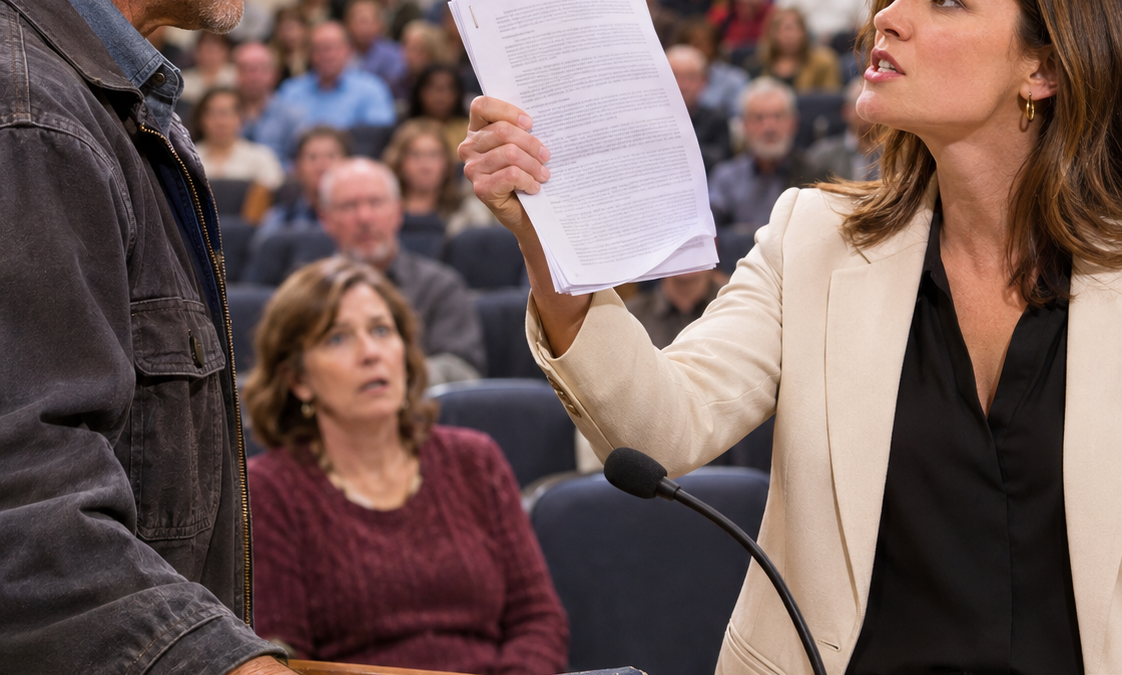
By the time she reached row three, nearby faces were following her. I recognized the layout from Russell’s desk: Exhibit A.
Shaylee bent over Dr. Guidry’s armrest.
The shake in her voice was pitched to sound worried, and to carry.
“Doctor, I’m only here for him. He doesn’t know what day it is half the time. Somebody has to. October twelfth I found him in his bathrobe in the garage at eight-thirty.”
The hall was quiet enough that I heard every word from the stage.
So did the rows around her.
Heads moved toward Shaylee.
Remy tugged Bodie’s sleeve.
Bodie stayed in his seat and said nothing.
Dr. Guidry didn’t write.
She raised her eyes toward the stage.
Marcia glanced down at the microphone.
The sign-in binder was inches from her hand.
She picked up the next line exactly where the program had left it.
“Evening Welding One. Instructor, August Baptiste.”
I rose from the outside seat.
The stage floor gave one hollow sound under my shoe.
I walked to the side of the podium.
Marcia’s eyes came to me.
I laid my hand on the sign-in binder in front of her.
“Read them October twelfth, Marcia. Please.”
Part 7 of 9
Marcia drew the binder under the microphone and opened it the way she reads a roll call.
I took my hand off the cover.
“Let it cool first,” I said under my breath.
The microphone was close enough to catch me if I leaned in. I did.
“My daughter-in-law told me, ‘You don’t know what day it is half the time, Augie. Somebody has to.'”
From the aisle, Shaylee watched me without moving from Dr. Guidry’s row, the stapled Exhibit A in her hand.
Marcia let the binder fall open at the front cover first.
The master sheet showed in the scuffed, cloudy sleeve inside the front cover, face up under the stage lights.
SIGN IN EVERY NIGHT. NO NAME, NO HOURS.
The thick black letters were plain enough for me to see from the side of the podium.
Nobody said a word about the printing.
Then she turned to the October tab and found the sign-in sheet.
“Monday, October twelfth. Instructor in, five forty-seven p.m. Out, nine thirty-six. Twenty-two student signatures.”
At the head of row one, Keisha pushed up from her chair.
“He taught us vertical-up that night.”
Twenty-one more blue shirts came up around her across the first two rows. Some chairs bumped the floor behind their legs, then went still.
They stood shoulder to shoulder, the way they’d lined up at the booths every night.
In the aisle by row three, Shaylee’s pages trembled once at the bottom corner.
“Anybody can sign a sheet of paper. Somebody could’ve signed him in.”
Marcia brought her mouth closer to the microphone.
“Each student signs beside their own name. All twenty-two signed consent forms so the college could certify copies of these nine sheets for the court.”
She didn’t wait for Shaylee to answer.
She went to the first date on the list Russell had given her.
“Monday, August twenty-fourth. Instructor in, five forty-two p.m. Out, nine thirty-four. Twenty-two.”
A chair creaked somewhere behind row five.
“Wednesday, September ninth. Instructor in, five fifty-one p.m. Out, nine thirty-nine. Twenty-two.”
The hall lost another layer of noise.
“Monday, September fourteenth. Instructor in, five forty-six p.m. Out, nine thirty-three. Twenty-two.”
Shaylee pressed Exhibit A flat against her side.
“Wednesday, September sixteenth. Instructor in, five forty-nine p.m. Out, nine forty-one. Twenty-two.”
Keisha didn’t sit.
Neither did any blue shirt behind her.
“Monday, September twenty-first. Instructor in, five forty-three p.m. Out, nine thirty-five. Twenty-two.”
From the stage, I could see Bodie’s face in row five.
His phone was already in his hand.
“Wednesday, October seventh. Instructor in, five fifty-two p.m. Out, nine thirty-seven. Twenty-two.”
In row three, Dr. Guidry had her notebook open now.
Her pen moved.
“Wednesday, October fourteenth. Instructor in, five forty-five p.m. Out, nine forty. Twenty-two.”
The microphone carried every number clean to the back wall.
“Monday, October nineteenth. Instructor in, five fifty p.m. Out, nine thirty-two. Twenty-two.”
Marcia let the last line sit by itself.
Nobody clapped.
The students were still standing, and the audience behind them had gone quiet enough that I heard somebody lower a program into their lap.
Paper dragged against paper in Shaylee’s hand.
“I must have mixed up the dates,” Shaylee said. “I was worried sick — I wrote them down from memory.”
A chair scraped in row five.
Bodie rose.
Remy didn’t get up. One small hand hooked around the back of his chair.
Bodie held his phone at chest height.
“Every one of those nights, I was offshore, Shay. You picked them.”
Shaylee looked back up the aisle at him.
Bodie scrolled.
His thumb moved once, then again.
“Dad’s not picking up again,” he read.
He moved farther down the screen.
“Same thing here.”
Another swipe.
“Those are the nights I told you he didn’t answer.”
The stapled Exhibit A shifted higher against Shaylee’s ribs.
Bodie kept reading his phone.
“Remy was at your mother’s that night, like every Monday I’m out.”
Remy glanced up at his father.
Bodie found the message he wanted.
His voice was quieter than Marcia’s had been, but the microphone wasn’t needed anymore.
“October twelfth, eight thirty-seven p.m. ‘Girls night at Darla’s. Your dad’s FINE. Stop calling him.'”
The capital word came out hard without Bodie making it louder.
A man in row four drew his knees in, away from the aisle. From where I stood, I could see Dr. Guidry’s pen continue across the notebook.
Shaylee’s grip bent one corner of Exhibit A.
“I don’t want a thing of his. I’m doing this for him.”
I took out my phone, held it near the microphone and pressed play.
Monique Broussard’s recorded voice came through thin and sharp.
“Photographer’s booked for January eighth at your father-in-law’s place on Lamarque.”
The sound carried farther than that little speaker had any business carrying.
“Ten days after your court date.”
Shaylee did not leave the aisle.
“Two-fourteen.”
Bodie lowered his phone a few inches.
“Bring the spare key.”
The recording ended with the small dead click I remembered from my kitchen.
Dr. Guidry kept writing in her notebook and did not look up.
I put my phone back in my pocket.
My students were still standing.
Exhibit A hung from Shaylee’s hand, one corner bent.
I looked at her.
“I knew what day it was. Twenty-two people signed it.”
Part 8 of 9
Dr. Guidry’s report was four pages, and the word ‘confused’ was not on any of them.
Monday, December 21, at 2:00 PM, the report lay open on Russell Landry’s desk. He read with his glasses low on his nose while I sat across from him.
“No cognitive impairment,” he said.
His pencil moved down the paragraph.
“Teaches a night welding class, per certified college attendance records. Observed speaking in front of approximately one hundred twenty people.”
The paper made a dry sound when he shifted it.
Russell tapped the date at the top. The report had gone to the court and both lawyers that morning, eight days before the hearing.
“Then why are we still going?”
“Because Shaylee won’t withdraw the petition.”
He leaned back.
“Her lawyer told her to drop it after the ceremony. He says her answer was, ‘Doctors can be fooled by a show.'”
Russell closed the report and rested one palm on it.
“And I filed for your lawyer fees. The judge still has to rule on the petition itself.”
I nodded once.
A minute later he lifted his palm and pushed the stapled pages across the desk to me. Dr. Guidry’s name was at the bottom of the last page, above the date. The words were plain. Nothing on those four pages said I needed somebody running my life.
Tuesday, December 29, at 9:00 AM, I sat at the right table in a courtroom of the 15th Judicial District Court in Lafayette.
Russell was beside me.
Across the aisle, Shaylee sat with her lawyer at the left table. She wore the same careful face she used at Sunday dinner.
Bodie was in the gallery behind us.
The judge read through the certified copies of the nine sign-in sheets Russell handed up. The consent forms went with them, all twenty-two.
Russell had clipped Exhibit A to his copy of the petition. Nine claimed evenings at about 8:30. Nine college records showing me there from before 6:00 until after 9:30.
Nobody made a speech.
The judge compared the dates to Exhibit A, then read part of Dr. Guidry’s report.
When she finished, she folded her hands over the papers.
“The petition is denied on the merits.”
Shaylee’s shoulders pulled back against her chair.
The judge faced her directly.
“A verified petition is sworn testimony, Mrs. Baptiste. Nine dates, nine sign-in sheets.”
Shaylee did not answer.
“You will not be appointed curator.”
Her mouth pressed into a thin line.
The judge moved to Russell’s request for fees.
“I am ordering Mrs. Baptiste to pay four thousand eight hundred dollars of Mr. Baptiste’s attorney’s fees, plus court costs.”
One spot of color rose high on Shaylee’s left cheek.
Under the table, Russell’s shoe nudged mine once.
The judge signed the order, and nobody at either table spoke.
Outside the courtroom, Russell squared his own copies of the sign-in sheets and the consent forms and slid them into his file.
I asked him about the money.
“She signed that list under oath,” he said. “In Louisiana, the judge can make the person who files a petition like that pay your lawyer.”
He tucked the file under his arm.
“Judge did.”
At 10:05 AM, we came out onto the courthouse steps.
Shaylee was a few feet ahead of us.
Bodie caught up to her.
“Shay.”
She stopped.
He held out his hand.
For a second, neither of them moved.
Then Bodie reached for her key ring.
The small brass fleur-de-lis caught the morning light.
He worked the spare key free, fleur-de-lis and all, and crossed back to me.
“This was Mom’s.”
Bodie put it in my hand.
“And Remy’s with you Mondays while I’m out.”
The brass was warm from his palm.
Shaylee walked straight to her car without saying a word.
Bodie watched until she opened the driver’s door. He did not follow her.
At 4:20 PM, I was home in my kitchen when I saw the red light blinking on the answering machine.
I pressed the button.
Monique Broussard’s voice came through the speaker.
“Shaylee, I’m canceling the January eighth photo shoot on Lamarque. The owner’s attorney called me. Don’t bring the key.”
The red light went dark after I erased the message.
At 6:30 PM, somebody knocked at the kitchen door.
Marcia Thibodeaux stood on the back step with an envelope tucked under one arm.
“You got a minute?”
I opened the door wider.
She came no farther than the threshold and pulled three things from the envelope.
The first was a spring-term instructor list.
My eyes found the welding line before I meant them to.
The second was the master sheet.
It was no longer inside the scuffed, cloudy sleeve from the front of the sign-in binder. Marcia had slid it out after I turned the binder in following the final exam.
The block capitals faced me.
SIGN IN EVERY NIGHT. NO NAME, NO HOURS.
I took the paper by the bottom edge.
The third thing was smaller.
A note folded in quarters.
Marcia unfolded it and handed it over.
The writing was in block capitals.
MARCIA — HE’LL NEED SOMEWHERE TO BE AT NIGHT. ASK HIM BEFORE HE CAN SAY NO. DON’T TELL HIM I ASKED. — T.
The note lay open across my palms.
Marcia glanced toward the spring-term list.
“You haven’t given me a spring answer yet. I need your name by the fourth. She wrote your sign-in sheet too, Augie. April, the year she passed.”
Part 9 of 9
I took the recipe tin down off the refrigerator and laid her praline card next to Marcia’s note.
It was about 7:00 Tuesday evening.
The kitchen had gone quiet after Marcia left.
PECAN PRALINES — DON’T STIR.
Theresa’s block capitals leaned a little to the right. The N had one long slanted middle stroke that dropped lower than the two uprights.
I pulled the master sheet closer.
SIGN IN EVERY NIGHT. NO NAME, NO HOURS.
Same N.
Same long middle slash.
On the note, MARCIA had the same square M Theresa used on recipe cards. NIGHT carried that slanted N again.
I ran the edge of the praline card even with the master sheet.
April 2025.
That was when Theresa had written the master sheet, while she was sick, and asked Marcia not to tell me.
The spring-term instructor list was still where Marcia had left it.
I took a pen from the counter.
My name went on the welding line.
August Baptiste.
The ink dried while I put Theresa’s card back in the recipe tin and folded the note along its old creases.
The deadbolt was still in its box.
It had been around since October, moved from one end of the kitchen table to the other whenever I needed room.
I opened the cardboard.
The lock, strike plate, screws, and keys came out in separate pieces.
Metal I understood.
I took the old hardware off the door, measured the opening, and fitted the deadbolt into place. The screws bit straight.
By the time I finished, the bolt slid clean into the strike plate without rubbing.
Two new keys came with it.
One went on my own ring.
For the second, I opened the drawer and took out the brass fleur-de-lis ring Bodie had returned to me that morning.
Theresa’s old key came off.
The new one went on.
At about 8:30 PM, I drove to Bodie’s house.
The porch light was on.
Bodie came outside alone before I had to knock twice. He was leaving for the rig the next morning, December 30, and a duffel bag was visible through the doorway behind him.
I held the ring out to him.
He studied the new key.
“Changed it?”
“Yes.”
Bodie closed his fingers around the ring.
I said, “Yours. Not the house’s.”
He nodded once.
“Got it.”
That was all either of us needed.
Monday, January 11, came cold enough that Remy wore his jacket zipped to his chin when school let out at 3:15 PM.
He spotted my truck and broke into a quick walk.
“Paw-Paw.”
His backpack thumped against the seat after he climbed in.
“You got me Monday again?”
“I got you Monday.”
He grinned toward the windshield.
At the house, we had time before we needed to leave.
Remy went into the garage and found his little stool where it had always been. His small welding glasses still hung on their hook.
He put them on and pushed them up his nose with one finger.
“Still fit.”
“Barely.”
At 5:45 PM, we were in the welding shop at Coulee Ridge for the first night of spring term.
New students moved toward the booths with gloves tucked under their arms.
The instructor’s desk was at the front.
A guest chair waited to the right of it.
Remy climbed into that chair wearing his welding glasses.
“They know I’m supposed to be here?”
“They will.”
The new sign-in sheet was clipped on the desk.
I wrote 5:45 PM on the instructor line and signed August Baptiste beside it.
The top carried the same instruction as before.
SIGN IN EVERY NIGHT. NO NAME, NO HOURS.
I left the pen beside the sheet.
At the shop door, Keisha Arceneaux jingled her car keys once.
She was the spring teaching assistant now.
“Ready when he is, Mr. B. I’ll drive Remy home.”
“Give us a minute.”
Remy lowered the welding glasses and studied the sheet.
“Can I sign?”
“Guest line.”
He slid out of the chair.
The student lines filled most of the page. The Guest line waited at the bottom.
Remy picked up the pen and squared his grip the way they taught him at school.
His tongue touched the corner of his mouth.
Slowly, he made the first letter.
R.
Then E.
He glanced up at me.
I pointed back to the line.
“Finish the job.”
Remy bent over the paper again.
M.
Y.
He pressed down hard on every stroke.
He capped the pen and tipped his face up, waiting.
I thought of Theresa’s praline card on my kitchen table.
The note folded in quarters.
Her capitals at the top of every sheet I had signed in this shop.
Then I looked at my grandson’s name.
He printed REMY on the guest line in big square capitals, the same ones his grandmother put at the top of the page.
THE END
More stories
My Brother-in-Law Told an Estate Manager I Was Entering Memory Care and Advertised One October 31 Sale, but My Refusal Left Every Shopper Standing Outside My DoorMy Daughter’s Groom Held Up a Bent Metal Pipe, Mocked My Knees, and Said He’d Own My Shop—Then the Eleven Electricians Who Owned It Told Him at the Wedding He Had No Management JobMy Fiancé Promised to File a Police Report After My Husband’s Guitar Vanished, but Never Gave Me a Number—Until His Own Paperwork Exposed Him at a Public Performance.My Husband Gave His Ex-Wife One of My Mother’s Three Rings and Humiliated Me Before 48 Guests—Until His Own Sister Ordered Her to Return It and Leave My House.My Ex-Husband Took Over My House With 2 Bowling Friends and Mocked My Librarian Job—Then the Door Log Helped Get Him Removed in Front of His GuestsMy Daughter’s Groom Planned to Sell 6 Acres of My Farm for $420,000—Until His Own Microphone Exposed Him Before 160 Wedding Guests, and My Daughter Refused to Marry Him








