My sister seated a notary across from my 79-year-old dad’s empty chair on the dinner train, expecting his signature—Then he walked in as conductor and she almost forgot to hand over her ticket.
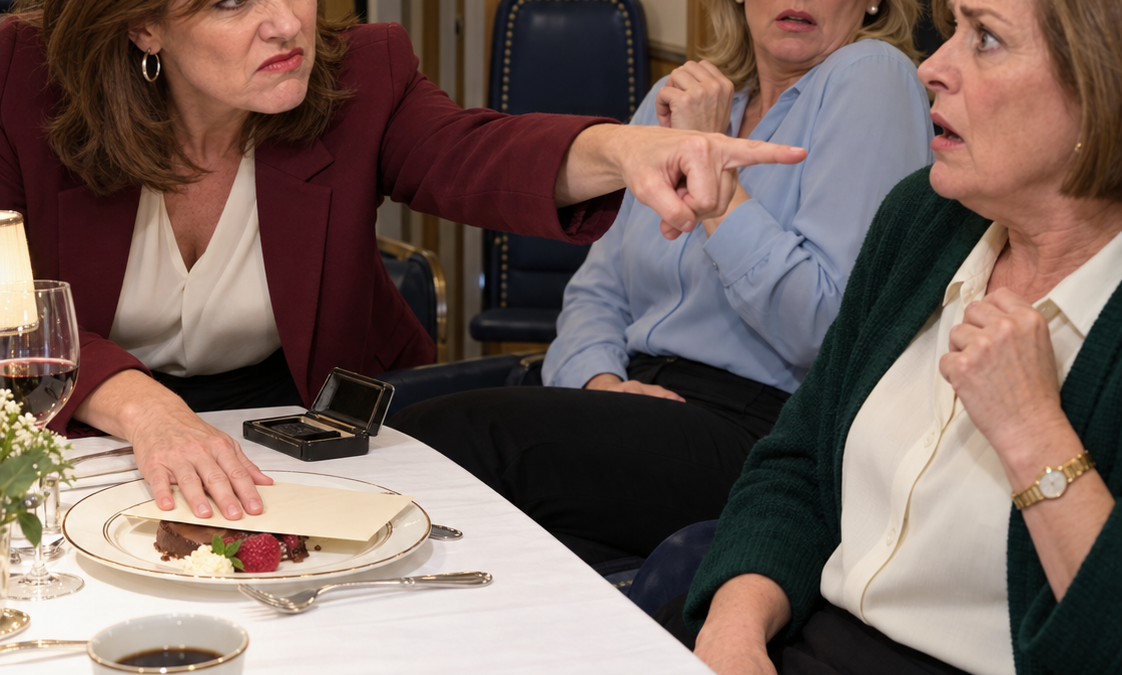
Complete story · 9 parts · about 35 minutes · ending included
Part 1 · Part 2 · Part 3 · Part 4 · Part 5 · Part 6 · Part 7 · Part 8 · Part 9
Part 1 of 9
My sister took the wallet out of our father’s hands in front of the pie ladies and said, “Dad, let me. You’ll be here all day.”
He had been counting bills for a pumpkin pie. When Shelly pulled the wallet free, the old card slipped out and skated across the folding table.
It landed face down beside a plate of cookies. On the back, a red line read “EXPIRES 12/10/2025”.
Shelly glanced at the red print.
“Even your senior card’s expiring, Dad,” she said.
The woman behind the cash box stopped making change.
I was Kathleen Halvorsen, fifty-five, and had taught high school chemistry in Rochester, Minnesota, for twenty-nine years. Our father, Vernon, was seventy-nine, retired after thirty-eight years as a freight railroad conductor. Shelly, my younger sister, was forty-eight.
It was 10:30 a.m. on Saturday, November 8, 2025, at the fall bake sale in our Lutheran church fellowship hall. Three folding tables formed a U, with women from the altar guild taking payments along one side. About twenty people stood or sat with coffee.
Dad stood at the pumpkin pie table. I was on his left, holding my grandson Toby’s hand. Shelly occupied his right shoulder as though she’d been assigned to guard it.
She put the wallet on the table and turned toward the room before Dad reached for the old card.
Toby, eight, was at eye level with the old card when Dad picked it up. Its front faced him for an instant. His eyebrows rose.
From my side, I couldn’t see a thing.
Dad tucked the old card into his wallet and closed it without a word.
“Now, Dad,” Shelly said, raising her voice, “you know you don’t need to fuss with cash when I’m here.”
“I can buy a pie,” he said.
“Of course you can, honey. Nobody said you couldn’t.”
She spoke the way someone might soothe a child while taking away his scissors.
Dad set his bills beside the box. The woman running it gave him his change, careful not to meet Shelly’s eyes.
“You’re not a railroad man anymore, Dad. You’re a man who forgets where he parked.”
At the farmers market in September, Dad had once forgotten where he’d left the truck.
She’d turned a parking spot into a diagnosis.
“What’s the sample size?” I asked.
Shelly looked from me to Dad. “Dr. Sobczak says it’s progressive. It’s handled.”
“Did Dad ask you to handle it?”
“Kathy,” Dad said quietly.
He only used that name when he wanted me to hear him instead of the noise around us.
I stopped.
Near the wall, Dad’s younger sister Lorraine sat in a plastic chair, her coat folded over her lap. She had heard. Her fingers worried the sleeve.
“He’s doing fine,” I said to Shelly.
“That’s what everyone says until something happens.”
“What happened today?”
She pressed her lips together.
“He’s not on trial, Kathleen. I’m helping him.”
“Then give him his pie.”
Shelly picked up the pie and offered it to Dad.
He took it without thanking her.
Toby loosened his grip on my hand and tugged Dad’s fingers instead.
“Grandpa, is that a real one?”
Dad’s face changed. Just around the eyes.
He winked. “My club card.”
“Can I see it again?”
“Another time, partner.”
I looked at my father. His thumb pressed against the foil rim. I said nothing.
I was keeping a secret for Dad. He had asked me to, and that was enough.
Shelly raised her phone so the church ladies could see it.
“Now here’s something you’ll all like,” she announced.
A pie lady lifted her head. Lorraine settled her coat on her knees.
“Dad loves trains,” Shelly told the room. “So I booked fifteen seats on the dinner train for their Thanksgiving run. Saturday, November twenty-second. All of us together.”
“Fifteen?” Lorraine asked from her chair.
“The whole family. Car 2. Meals included.”
Toby tipped his chin up at Shelly. “Do we get to ride the whole time?”
“Long enough to eat, sweetie.”
“Will there be a conductor?” he asked.
Shelly smiled at her screen.
“Listen to the confirmation email,” she said. “Your conductor will punch each guest’s souvenir ticket at dessert.” She grinned. “Isn’t that cute?”
Toby glanced at his grandfather.
Dad studied the floor beside his shoes. He shifted the foil pan from one hand to the other.
“That sounds nice, honey,” Lorraine said. “Whatever you think.”
I stepped around Dad to see the reservation on Shelly’s phone. She leaned close enough that her sleeve touched mine.
“He said no to me twice at his kitchen table. With all fourteen of us there, he won’t.”
“The power of attorney,” she added. “It’s only paperwork.”
“You bought a dinner to change his answer?”
“Don’t make it ugly. I want the family together.”
“Then leave the signing out of it.”
She drew back with the same smile she had worn for the pie ladies.
“Everybody’s coming, Dad. You’ll ride with us, right?”
He looked toward her.
“I’ll meet you there. I’ve got something at the center till five.”
Shelly’s jaw stiffened, and she swallowed before answering.
“Fine. We’ll make sure you find us.”
At the far end of the hall, my cousin Jolene, Lorraine’s daughter, stood beside the coffee table with a paper cup in her hand. She had been watching us over the rim of her cup.
Shelly faced Jolene and cupped a hand around her mouth.
“Jolene! You’re still a notary at the bank, right? Bring your stamp on the twenty-second.”
Part 2 of 9
At 8:40 that night my phone lit up with a photo of a letter that said my father was losing his mind.
It lay beside a stack of chemistry quizzes on my kitchen table. I’d been marking a student’s answer about measurement error when Shelly’s message appeared in the Halvorsen Family group chat.
“It’s time. We do the POA at dessert, all together, so Dad sees we agree. Kirk’s handling the tax side.”
Kirk was Shelly’s husband. He ran a small financial advisory firm in Rochester, and he had a smooth way of speaking that made a request sound like a favor.
Lorraine, Dad’s younger sister, answered before I could set down my red pen.
“Poor Vernon. Whatever you think, honey.”
Four other relatives put hearts on Shelly’s message.
Thirteen people belonged to the group chat. Dad wasn’t among them. Neither was Toby, who had asked Dad that morning about a card whose front none of the other relatives had seen.
I moved the quizzes aside and enlarged the photo.
The letter was printed on Zumbro Valley Family Clinic letterhead and signed by Dr. Alan Sobczak.
“I examined Mr. Vernon Halvorsen in my office on Saturday, October 4, 2025, at 10:00 a.m.”
Farther down, Dr. Sobczak had written “progressive cognitive decline I have observed over the past year.”
My pen hovered over the date.
In chemistry, a student who claimed a result had to show how it was obtained. You couldn’t write “over the past year” where the observations belonged and expect full credit.
I didn’t know what was wrong with the letter. I knew I wanted to see the work behind it.
My reply was short: “Has Dad seen this?”
Shelly replied, “He’s embarrassed. Please don’t make him more embarrassed.”
I deleted the question I’d started to write next.
Dad had given me a reason to keep certain things off that screen.
In December 2022, nine months after Mom died, he’d laid the old card face up on his kitchen table.
The front said “CONDUCTOR”.
“Back on the railroad?” I’d asked.
“Volunteer. Dinner train.”
He sat opposite me with his hands around a mug. He’d retired from freight work in 2011, but his shoulders had straightened when he spoke about the Saturday runs.
“Your mother told me something before she died,” he said. “Keep your Saturdays.”
After Mom was gone, Dad had spent too many weekends with the television on and nothing in his hands.
“You want me to tell Shelly?” I asked.
“No. She calls them ‘your toy trains.’ Wanted me to sell the collection. Let her think I’m at the senior center.”
“All right.”
He’d slid the old card back into his wallet, and I had kept my word.
Now I opened his private text from November 1.
“Nov: 1st and 29th.”
Those were his scheduled evening runs. November 22 wasn’t one of them.
I set the phone facedown near my grading. The red pen had leaked a dot onto an answer I’d already marked correct. I slid a clean quiz over the one beneath it and went back to work.
On Sunday at 2:00 p.m., I drove Dad to the depot.
The office was small enough that I could stand in the doorway and see the wooden desk, the open binder and the coat hanging behind it. Dad had come to turn in his October volunteer hours.
Ingrid Dahl, the trainmaster, looked up when we entered. She had the manner of somebody who would stop a train before letting a number go unchecked.
“October hours,” Dad said.
“I’ve got them.” She turned a page in the binder.
“Didn’t want to leave you short.”
“It’s on the sheet.”
Her finger moved down the crew sheet as she checked his entries. Dad waited at the desk without offering to help.
I stepped in behind Dad’s shoulder and spotted a familiar date near the top of the October page. The line was written in my father’s square hand:
“V. Halvorsen — Conductor — on duty 9:15 a.m. — off duty 3:05 p.m.”
October 4.
The clinic photo put him in a doctor’s office at 10:00 a.m. that day.
I stepped back to the doorframe and kept quiet.
“Everything there?” Dad asked.
Ingrid nodded. “Hours are good.”
He thanked her, and we walked out to my car.
In the depot parking lot, I brought up Shelly’s photo and handed Dad my phone.
“See what day that letter picked?”
He held it away from his face to read. His eyes traveled down the screen, then returned to the date.
He passed it back.
“Don’t tell your sister. Let it ride.”
“Dad, you were working.”
“I know where I was.”
He fastened his seat belt. When I didn’t start the car, he glanced toward the windshield.
“Thirteen people saw that picture, Dad,” I said.
“Thirteen people can wait,” he said.
Dad looked at his hands.
“Drive, Kathy.”
At 7:30 that evening, I’d just parked in front of my house when Shelly called.
“Did you see what I sent?” she asked.
“Yes.”
“Good. So you’ll help me keep him comfortable at the dinner?”
“Has Dad asked for help with his money?”
“You’re making this harder than it needs to be. The doctor put it in writing.”
“A judge would want more than one letter.”
“Then don’t make me find out.”
I kept the engine off and watched a porch light glow against my front steps.
“That’s a threat, Shelly.”
“It’s an option. I’m trying to spare him.”
“What happens when he says no?”
“If you fight me on this, Kirk says we file for guardianship in December, and then nobody gets to be nice about it.”
Part 3 of 9
Shelly didn’t take the pie plate from me; she pointed down the hall and said, “Kitchen. I’m on with Kirk.”
It was 4:15 on Monday afternoon, November 10. I’d come to her house on the south side of Rochester to return it after she’d left it at the bake sale.
The hallway stretched away from the front door. Framed family photographs lined one wall, their glass catching the light from the room ahead. I followed her past pictures of our mother, Phyllis, and our children at ages they had long since outgrown.
Kirk’s voice came through the phone on the counter.
“Let’s keep this simple,” he said.
Shelly leaned over it. “She’ll come around. Tell Alan thanks again.”
I paused at the doorway.
“Alan who?”
My sister turned. She glanced at the screen as if she’d forgotten who else could hear.
“Dr. Sobczak. Alan’s doing us a favor. Dad’s regular doctor would take months.”
I set the pie plate on the counter, well clear of the phone.
“What kind of favor?”
“Kathleen, you saw the letter.”
“I saw a photograph of it. Where did Dr. Sobczak examine Dad?”
“Zumbro Valley. Does it matter?”
“I could call the clinic,” I said. “They wouldn’t tell me a thing, and they shouldn’t.”
Kirk cleared his throat through the speaker.
“Maybe we should finish this later,” he said.
“No need,” Shelly answered. “Kathleen’s family.”
“Dad is family too,” I said. “Has he even met this doctor?”
She reached toward her phone but didn’t touch it.
“He’s been struggling. You’ve seen it.”
“I’ve seen you tell people he’s struggling.”
“He misplaced his truck at the farmers market.”
“He found it.”
“After looking for it.”
“That was one afternoon.”
“And that makes it all right?”
I folded my arms and stood still while Shelly watched the phone.
“Look,” Kirk said, “we all want what’s best for Vernon.”
“Then he should be part of this conversation.”
A soft click came from the counter. Shelly had ended the call.
“You don’t need to embarrass Kirk,” she said.
“I asked about a doctor.”
“You ask questions like you’re grading everyone.”
“Someone ought to check the answers.”
Shelly pulled a cup from the cupboard and poured coffee. She placed it in front of me without asking whether I wanted any.
“Kirk’s set it up so the bills just get paid. Taxes, the house, all of it.”
“Dad pays his own bills.”
“For now.”
She said it like his independence had a due date.
I left the cup untouched.
“Have you asked him which bills he wants help with?”
“He won’t talk about it.”
“Maybe he doesn’t want your help.”
“Or maybe he’s too proud to admit he needs it. You know how he is.”
I did. Dad kept his paid bills in date order in a desk drawer, with each receipt clipped to its matching envelope. There was a difference between being particular and being unable to manage a household.
“He said no to the power of attorney,” I said.
Shelly gave a small shrug. “People change their minds when they understand what’s at stake.”
“Then speak to him privately.”
“I’ve tried that. He hears everything as criticism.”
“He heard you at the bake sale. So did everybody else.”
She took the cup I’d refused and carried it to the sink. Coffee ran down the drain.
“I have a husband and kids and work,” she said. “I can’t spend every afternoon having the same argument.”
“Neither can Dad.”
Shelly stood with one hand on the faucet. For a moment I could hear only the refrigerator humming.
“The dinner train is supposed to be a nice evening,” she said. “Please don’t ruin it.”
“I’m not the one asking him to sign something over dessert.”
She looked past me toward the hallway.
“You can go if you’re going to be like this.”
I picked up my purse. The pie plate remained where I’d set it.
On my way out, I stopped beside a photograph I hadn’t noticed coming in. Kirk stood next to another man, both gripping a golf trophy shaped like a silver ball on a crooked tee. Kirk’s collar was bent under at one side. The other man held the base with both hands.
A brass plate beneath the frame carried tiny engraved lettering. From where I stood, I could make out only “Alan” near the end. The overhead light reflected off the rest.
I angled my phone until the glare shifted off the brass plate, then took the photograph.
“What are you doing?” Shelly called from the other end of the hall.
“Looking at your pictures.”
“Close the door behind you.”
At 9:10 that night, I sat at my own kitchen table with the phone in my hand. I texted Aunt Lorraine.
“Who’s Dad’s doctor these days?”
Her answer came back without a question.
“Vernon sees Dr. Raman. I drive him every March.”
Lorraine hadn’t mentioned Dr. Sobczak. Yet his signature was on the letter Shelly had sent the family.
I opened the hallway photograph and enlarged the inscription until the words were clear.
“Member-Guest Champions 2024 — Kirk Sorum & Dr. Alan Sobczak.”
Part 4 of 9
Shelly set the power of attorney beside Dad’s coffee cup before Aunt Lorraine had even cut the ham.
It was 12:30 on Tuesday, November 11, Veterans Day. I’d taken a personal day from school to be with my father at Lorraine’s dining room table.
Dad sat at the head, his Army veteran cap on an empty chair; I sat to his left, Shelly to his right, and her husband Kirk beside her. At the far end sat Dad’s younger sister Lorraine, with her son Marty, Marty’s wife Peggy, and her daughter Jolene, a bank teller and notary, along the other side.
Dad had driven himself in the truck, the 2004 Silverado Mom had bought him. When he arrived, he’d hung his keys beside the coats at the back door. A little locomotive-head fob dangled from the ring.
Shelly opened the power of attorney and smoothed it flat.
“I’m showing everyone now so nobody’s surprised on the twenty-second.”
“We’re here for Veterans Day,” Lorraine said. She stood with the carving knife over the ham.
“And we’re grateful for Dad’s service,” Shelly answered. “That’s why I want this settled.”
Dad pushed his coffee cup away from the power of attorney. He didn’t touch it.
“Just look at it, honey,” Shelly said.
“I’ve looked.”
“Kirk can explain anything you don’t understand.”
Kirk squared his napkin. “Dad, we’re trying to help.”
“Then I have a simple question,” I said. “Which day did Dr. Sobczak see Dad?”
Shelly’s eyes narrowed. “October fourth. It’s in the letter.”
“Who took him?”
“He’s perfectly capable of going to an appointment.”
“That’s what I’ve been saying.”
Lorraine set her knife down against the serving platter.
“Vernon doesn’t see a Dr. Sobczak. I drive him to Dr. Raman every March.”
Shelly turned to her. “Aunt Lorraine, please.”
“That’s his doctor, honey. I’ve sat in that waiting room with him.”
“Dr. Sobczak signed the letter,” I said. “Who can confirm Dad was in his office?”
Jolene lowered her eyes to her plate. Her fork rested on a potato she hadn’t eaten.
Marty looked at Shelly, then leaned toward Peggy. “Kirk’s had our money ten years,” he muttered.
I heard it. So did Kirk.
Shelly’s face went red, right up to her ears.
“Alan’s a specialist friend,” Kirk said. “Let’s keep this simple.”
“Specialist in what?” I asked.
“We don’t need to turn lunch into an interrogation.”
“Then stop putting forms beside Dad’s food.”
Dad sat with his hands in his lap. He glanced toward the empty chair but left his cap where it was.
Shelly folded the power of attorney shut.
“Fine. We’ll discuss it on the train.”
“Will Dad get to say no there too?” I asked.
“Kathleen,” Shelly said, “people are trying to eat.”
Lorraine picked up the knife again. The blade caught the crust of the ham, and a slice fell sideways onto the platter.
Dad waited for the food to reach him.
When lunch ended, Marty helped Peggy into her coat. Jolene gathered her purse, avoiding my eyes. Dad stood near the back door while I went for mine.
His key ring was still on the hook, truck key and spare house key together. Shelly reached past his shoulder and lifted it off.
“Dad, honey, until the paperwork’s done, you’re not driving.”
She slipped the keys into her coat pocket. The little fob caught briefly against a button.
Dad held out his hand.
“Those are mine.”
“I know. I’m keeping them safe.”
“Give them back,” I said.
“I’m not doing this in front of everybody.”
Kirk appeared beside her. “I’ll bring the truck over to your garage this afternoon, Vernon.”
Dad looked at the hook, now bare.
The truck was Mom’s gift and Dad’s only way to the depot. Shelly had no right to keep its keys.
“I’ll drive him,” I said.
Dad lowered his hand. He took the Army veteran cap from the chair, settled it on his head, and followed me outside.
I drove him home. He watched the road through the passenger window, his fingers resting against his knees.
By evening, we were in his kitchen. He had taken the old card from his wallet and was turning it around on the tabletop, back side up.
“Maybe I am the man who forgets where he parked,” he said quietly.
I pulled out the chair opposite him but couldn’t sit.
He slid the old card back into his wallet, then went into the back room. The door stood half shut while he made a short call. I could hear his voice, but none of the words.
My phone buzzed.
Lindsay, my daughter, had texted: “Mom, maybe just let Aunt Shelly handle it. Grandpa did lose the truck at the farmers market.”
I typed “OK”.
The letters sat in the reply field while my fingertip hovered over Send.
I deleted them.
At 8:15, the phone rang. Ingrid Dahl, the trainmaster, was calling.
“Your dad asked to go early. Recert is tomorrow, eight a.m., eyes and ears. Written test Thursday. He was going to drive himself. Can you drive him?”
Part 5 of 9
“If he fails either one, his card dies December tenth,” Ingrid said at the clinic door, “and that letter is the only thing anybody hears.”
At 7:50 Wednesday morning, November 12, the trainmaster stood outside the railroad medical examiner’s door with Dad’s file under her arm.
I’d taken my second personal day from school to bring him. Shelly still had the keys to his truck.
“I can hear you,” Dad told Ingrid.
“Good. Now let the doctor check.”
“She’s more worried than I am,” he said.
Ingrid didn’t smile. “I need the examiner’s signature.”
Dad went inside while I took a chair in the waiting room. I’d brought chemistry quizzes and read the same answer four times. One student had written that an experiment was reliable because the results looked right.
When the door opened, Dad came out holding the examiner’s report, signed by the doctor.
“Vision passed,” he said. “Hearing passed.”
He showed me both entries. I checked the doctor’s signature beneath them, keeping the page flat.
“Good,” I said.
“That all you have for me, Kathy?”
“Would you prefer a speech?”
“No, ma’am.”
Dad handed the report to Ingrid. She slipped it into his file.
“Thursday’s the written test,” she told him.
“I’ll be there.”
At noon Thursday, Deanna Dvorak sat across from me in the teachers’ lounge. She taught biology down the hall and was one of Kirk’s clients.
“Can I ask you something about your brother-in-law?” she said.
“Depends what it is.”
“His office has been holding up my withdrawal.”
“How much?”
“Forty thousand dollars. They keep saying paperwork.”
I put down my sandwich.
“Six weeks for my own money,” Deanna said.
“Did they give you a reason?”
“Every time I call, it’s something different. Somebody has to review it. Somebody’s waiting for a form.”
“Have you asked Kirk himself?”
“They won’t put me through to him.” She folded the wrapper around her lunch. “I thought maybe you’d heard something.”
“I don’t work there.”
“You’re right. I shouldn’t have put you on the spot.”
“Keep your messages,” I said.
She nodded, but she didn’t open her lunch again.
After school Thursday, I drove Dad to the depot for his four o’clock written test. Ingrid had cleared her wooden desk so Dad could sit there and complete the exam. I left them in the office and waited on the platform.
The wind worked through the gap at my collar. I watched the office door until I caught myself doing it and faced the tracks.
At 4:40, the door swung open and Dad stepped onto the platform.
“Well?” I asked.
“Ninety-six percent,” Dad said.
Ingrid followed him with the certificate. Her signature was on it, and the effective date was November 13.
“That’s current as of today,” she told him. “Keep it with you.”
Dad examined it briefly before slipping it into his wallet.
“Which questions did you miss?” I asked.
“Missed a few.”
“Not many.”
“Enough to know what to study.”
He walked toward my car, parked beside the platform. Instead of getting in, he took out the old card and laid it flat on the roof.
He drew a folded sticky note from behind the bills in his wallet and opened it. With a pencil, he copied one line onto the back of the old card.
I stood three steps away. I couldn’t read the writing, and Dad didn’t offer to show me.
He put the pencil away, carried the sticky note to the platform trash can, and dropped it in. Then he reopened his wallet and tucked the old card behind the certificate.
“You ready?” I asked.
“Let’s go home.”
On Saturday, November 15, Shelly asked me over to her kitchen at two to “go over the plan.” A folder lay on the island with DAD — SIGN written across the front.
She stood there and watched me take off my coat.
“You’re the only one he listens to,” she said. “Sit with him and this is over in five minutes.”
“He listens when you talk to him instead of about him.”
“Don’t start.”
“Has he agreed to any of it?”
“He’ll understand once everybody explains it together.”
“Everybody except Dad?”
Shelly straightened the folder, aligning its edge with the island.
“We’re trying to keep him in his house, Kathleen.”
“He lives there now.”
Her phone rang. Kirk’s name showed on the screen.
“I need to take this,” she said, stepping out onto the back porch.
The folder remained in front of me.
I opened it.
The power of attorney lay on top. A yellow sticky tab marked the section headed “IMPORTANT NOTICE TO PRINCIPAL.” Shelly had written “initial here” on the tab.
I read the notice. It said Dad himself had to read it, understand what he was authorizing, and initial it. Those were his decisions, not the family’s.
“You can’t be too far gone to manage money and still sign this,” I said under my breath.
The porch door opened.
My hand was still on the edge of the first page. I flipped quickly to the page clipped behind it.
It was the transfer form, already prepared to move Dad’s IRA into an account managed by Sorum Wealth Partners.
Two fields had been typed in:
“Advisor: Kirk Sorum. Authorized by: Shelly Sorum, attorney-in-fact.”
Part 6 of 9
I closed the folder a second before Shelly stepped in from the porch and said, “So. Are you sitting next to Dad or not?”
Her phone was still in her hand. Kirk’s name had disappeared from the screen.
“No. I’ll sit at the facing table with Toby.”
“You’re the one he’ll listen to.”
“He heard you at lunch.”
“And he refused to discuss anything.” Shelly moved the folder away from me. “I paid for a family evening, Kathleen. Don’t turn it into another argument.”
“You invited me to go over the plan.”
“Which is exactly what we’re doing.”
She pressed the folder shut, although I’d already closed it. I could see the yellow tab sticking out along the edge.
“Dad decides whether he signs,” I said.
“He will, once he understands.”
I left without taking a photograph or anything from her kitchen. In my car, I sat with both hands on the steering wheel before turning the key.
At seven that evening, I told Dad what I’d found. He sat at his kitchen table while I stood near the counter.
“Deanna Dvorak teaches biology at my school,” I said. “She’s a client of Kirk’s. His office has held up her forty-thousand-dollar withdrawal for six weeks.”
“Her money?”
“That’s what she said.”
Dad pulled out the chair opposite him. I sat.
“There’s more. Shelly has a transfer form clipped behind the power of attorney. It moves your whole IRA to Kirk’s firm, with Shelly listed as the person authorizing it.”
“Did she show you?”
“No. She stepped out to take Kirk’s call.”
“Hmm.”
“You didn’t ask for that account move.”
“No.”
He placed his phone between us and called Ingrid. The trainmaster answered on speakerphone.
“Kathleen’s here,” he told her. “Bring the October fourth sheet.”
“He’s working the twenty-second,” Ingrid said. “Car 2 at dessert is his. I’ll bring the sheet.”
I remembered Dad’s November text: “Nov: 1st and 29th.”
“That isn’t one of your scheduled Saturdays.”
“It is now,” Dad said, rubbing his jaw with one knuckle.
Dad watched me, his face quiet.
“What are you planning to do?” I asked him.
“Let it ride. Wear something nice.” Dad turned his coffee mug by the handle. “You call a lawyer?”
“No. Nothing’s signed. There’s nothing to stop yet. But if Shelly reads that letter to a car full of strangers before you walk in, that’s all they’ll remember,” I told Dad.
He straightened the phone until it was square with the table’s edge.
“I heard you, Kathy.”
Wednesday, November 19, after classes, I was alone in my chemistry classroom when the group chat began lighting up.
Shelly had posted a seating chart for Car 2 with a message beneath it: “Dad at the head of Car 2, Jolene across from him with her stamp, dessert = signing.”
Kirk added a thumbs-up.
I put down my pen and checked the seating chart again. Her own seat was next to Dad’s, just as she’d stood next to him at the bake sale.
Later another message arrived from her: “He’s getting a ride from the center. Fine.”
Then a private text came in.
“Don’t make a scene. Bring Toby. Dad behaves for Toby.”
I locked my phone. Toby was eight. He wanted to see a train, not watch adults decide whether his great-grandfather deserved his own money.
At 5:30 Saturday evening, November 22, the depot platform was already dark beneath its yellow lights. A server checked tickets at the door of Car 2 as our relatives filed aboard.
Dad wasn’t among us. Ingrid had picked him up at the senior center at 3:30 and texted me at 3:31: “Got him. He rides in Car 1.” I kept that to myself.
Fourteen family seats were arranged in the front half of Car 2 at three tables for four and one for two. The fifteenth chair, with a “Dad” place card, stood at the head of the aisle near the first table, its back to the connecting door. About forty other passengers filled the rear half.
Shelly sat beside the empty chair, with Jolene across from it. Jolene’s black plastic stamp case rested on her table. My daughter Lindsay, Toby, and I sat at the table opposite Dad’s place. Lorraine sat next to her son Marty.
At 5:52, Shelly held up a text from Dad and read it aloud.
“I’m on the train. See you at dessert.”
She glanced toward the empty place.
“He says he’s on the train somewhere. He’s lost again.”
A few relatives laughed politely. I looked at Toby, who was studying the window.
The train pulled out at six. The white tablecloths shifted as the car took the first curve, and Toby put both hands beside his plate to steady it.
Around 6:30, the servers brought turkey, wild rice stuffing, and cranberry sauce. Jolene moved the stamp case closer to her plate. She had barely spoken, and when Shelly leaned over to ask her something, Jolene nodded without looking up.
At 6:58, Shelly tapped her glass and stood. Her voice reached past the family tables. Passengers in the back half turned to listen.
“My sister thinks Dad should keep driving until he hurts somebody. Kathleen’s done nothing but fill his head.”
She’d kept his keys and made me the danger.
Shelly drew the letter from her purse.
“I’m going to read what his doctor says, so we all understand why we’re here.”
She set the folder labeled “DAD — SIGN” in front of Jolene. My cousin opened the lid of her stamp case.
I pushed back my chair and stood.
“Before you read it, Shelly, Dad should hear it.”
Part 7 of 9
“Tickets, please,” my father said, and the whole front half of Car 2 turned around.
The connecting door to Car 1 had swung open behind the empty chair marked “Dad.” Vernon Halvorsen stepped through in a dark blue conductor’s uniform and cap, the punch in his right hand.
Ingrid followed carrying a thin binder, with the crew sheet visible inside a clear plastic sleeve.
Shelly remained standing, the letter pressed to her chest. Across from her, Jolene sat with the stamp case open beside the folder marked “DAD — SIGN.”
Dad went straight to Toby.
“Ticket, young man.”
Toby held his out with both hands. Dad fitted a corner between the jaws of the punch and squeezed. A little piece of cardstock fell onto the white tablecloth.
“Grandpa, is that a real one?”
“It’s a real one.”
Toby studied the hole as though it might tell him where the train was going.
Dad moved down the aisle. He punched Lindsay’s souvenir ticket, then Lorraine’s, then Marty’s. Lindsay looked over at me, but I kept my attention on my father. Lorraine pinched hers by its edges. Marty watched Dad’s hands.
A passenger in the rear half stopped with her fork halfway to her mouth.
When he reached Shelly, she almost forgot to hand hers over.
He punched it and returned it.
“Dad. What are you wearing?”
“You brought fourteen people to watch me sign. They can watch me read.”
Shelly glanced at the other diners. Her mouth opened, then shut.
She laid the letter on the table. Dad took the certificate from his wallet and set it alongside.
“Effective November thirteenth. Eyes, ears, rules. Ninety-six percent.”
“That’s a railroad certificate,” Kirk said. “It doesn’t settle everything.”
“No,” Dad answered. “But it settles whether I can do my job.”
“There’s something else everyone should hear,” I said.
I stepped to Shelly’s table and picked up the letter.
Then I read the line aloud, word for word.
“I examined Mr. Vernon Halvorsen in my office on Saturday, October 4, 2025, at 10:00 a.m.”
Ingrid removed the crew sheet in its clear sleeve and held it where the family could see Dad’s entry.
“On duty nine-fifteen. Off at three-oh-five. Conductor, Harvest Run. It’s on the sheet.”
Marty leaned forward. “That’s the same morning.”
“Same morning,” Ingrid replied.
Shelly reached for the letter.
“Alan must have put the wrong date. He’s a busy man.”
“One wrong date?” I asked. “He says he observed Dad over the past year. Kirk’s golf photo with Alan is in your hallway.”
Lorraine stood slowly, bracing a hand on her chair.
“I never once drove him to this man. I take Vernon to Dr. Raman every March.”
Shelly stared at her aunt. “You’re confusing everybody.”
“No, honey,” Lorraine said. “I know which doctor I take my brother to.”
From the back half of Car 2 came the sound of a spoon touching a cup.
I faced Jolene.
“Would you turn to the page clipped behind the power of attorney?”
Jolene looked toward Shelly, then opened the folder. The transfer form was still in the same place I’d seen it in Shelly’s kitchen.
“Read the typed fields,” I said.
Jolene put a finger under the print.
“Advisor: Kirk Sorum. Authorized by: Shelly Sorum, attorney-in-fact.”
Peggy’s hand stopped halfway to her glass. Marty glanced at Kirk.
For a few seconds, all I heard was the wheels beneath us.
Kirk reached across to close the folder. Jolene kept her palm flat on it. He withdrew his hand and sat back, staring at the tablecloth.
“Kirk only filled that in just in case,” Shelly said. “We were protecting you, Dad!”
“You could have asked me,” Dad said.
“I did. You wouldn’t listen.”
“I answered.”
He held out his hand to Jolene. She detached the transfer form and passed him the power of attorney.
Dad found the notice, the section Shelly had marked for his initials.
He read its heading aloud.
“IMPORTANT NOTICE TO PRINCIPAL.”
He continued through the entire paragraph beneath it, his voice steady and unbroken.
Then he looked at Shelly.
“Your form says I have to read this and understand it. I just did.”
Shelly gripped the back of the empty chair. Her knuckles showed against the wood.
Dad continued, with the same level voice he’d used to collect tickets.
“You told the pie ladies, ‘You’re not a railroad man anymore, Dad. You’re a man who forgets where he parked.’ I’ve brought this train back to that depot twice a month for three years.”
Shelly’s hand fell away from the chair.
She’d taken his keys. She hadn’t taken his work.
Dad took the unsigned power of attorney and tore it in half. He laid the pieces on the table beside the certificate.
Lorraine stepped over to her daughter’s table and rested her hand on the stamp case.
“Put your stamp away, Jolene.”
Jolene closed the lid.
Dad turned toward Kirk, who was still clutching his unpunched souvenir ticket.
He took it, made the final punch, and handed it back.
“Tickets, please. This train doesn’t carry passengers who lie.”
Part 8 of 9
In the depot parking lot Dad held out his hand, palm up, and didn’t say a word until Shelly put the keys in it.
At 9:10 Saturday night, the pole lights shone on his conductor’s cap. Shelly stood beside her car, searching her coat pocket while Kirk waited near the driver’s door.
She produced the key ring, truck key and spare house key together. The little locomotive fob swung against Dad’s fingers.
“There’s no need to be difficult,” she said.
Dad closed his hand. “Good night.”
Shelly watched him slip the keys into his pocket.
“I had it handled, Dad.”
Dad walked past her and headed toward my car.
Kirk said nothing.
Dad got into my passenger seat. I waited for the exit to clear, then drove him home.
During my free period Monday morning, my phone rang as I was setting quizzes on the desks.
“Called Dr. Raman’s office,” Dad said. “You’re my emergency contact now. Took Shelly off.”
“And the IRA?”
“Spoke to the company that holds it. Put you down as my trusted contact person instead of her.”
“Did they give you trouble?”
“No. Garage code’s new. I’ll text it.”
After we hung up, I looked at the phone beside my lesson plan. Shelly hadn’t been needed for either call.
At lunch, a photo from Dad arrived: a certified mail receipt.
His message said he’d driven the truck to the post office himself and mailed a complaint to the Minnesota Board of Medical Practice. He’d included copies of the letter, the certificate, and the crew sheet Ingrid had provided.
I enlarged the receipt to read the mailing destination.
In the teachers’ lounge, Deanna Dvorak was peeling an orange when I sat opposite her.
“I saw something at my sister’s,” I said. “A transfer form to move Dad’s IRA into Kirk’s firm. Shelly was listed as the person authorized to sign for him.”
Deanna set the orange on her napkin.
“Did he sign?”
“No.”
She didn’t touch it again. I didn’t ask how things stood with her account.
“Thanks for telling me,” she said.
That evening, Aunt Lorraine wrote in the Halvorsen Family group chat: “Christmas is at my house this year.”
A minute later, the screen showed that Shelly had left the group.
I set my phone beside the sink and finished washing my cup.
On Tuesday, Deanna found me at the copy machine before lunch.
“I signed to move the whole account,” she said. “The new firm sent the transfer request this morning. He held my forty thousand for two months. He can’t hold this.”
“How much are you moving?”
“Two hundred twelve thousand dollars. All of it.”
I folded my lunch bag closed.
During the day, my phone brought more messages. Peggy, Marty’s wife, said she and Marty had arranged to move three hundred five thousand dollars. Renae, my cousin Randy’s wife, wrote that they had signed for one hundred eighty thousand.
Between classes, I wrote the three figures on a sticky note and added them twice. Both times I got the same total.
Six hundred ninety-seven thousand dollars in accounts were on their way out of Kirk’s firm.
Then my niece Morgan, Shelly and Kirk’s daughter, sent a private text.
“Dad says the office might close by spring.”
I sent Morgan a heart and tucked the phone into my desk drawer. Morgan had not done any of this.
At seven Tuesday evening, Dad set his wallet on the kitchen table and opened it. He wanted help clearing out the old receipts and things he’d been carrying for years.
I slid a faded pharmacy receipt toward the discard pile. When I lifted the certificate, the old card underneath showed a faint pencil line on its back.
“What did you write on that outside the depot?” I asked. “The day of your exam.”
Dad put a finger over the writing.
“Dr. Raman’s office called me November third,” he said. “Somebody asked for my medical records. Signed ‘Shelly Sorum, caregiver.’ They didn’t send them.”
“Did you tell Shelly?” I asked.
“No,” Dad said.
He shifted the wallet closer to his coffee mug.
“That afternoon I called Ingrid about my November dates. She read me the reservation list. ‘Sorum, party of 15, Car 2, Nov. 22.'”
“You knew all that time?”
Dad nodded.
“Why take the exams early? The old card still had weeks left.”
“Shelly called herself my caregiver. I wanted proof I could still do my job.”
My chair scraped the floor when I moved it closer.
“I knew nineteen days before that train left the depot, Kathy. Five days before your sister told the family. I wanted her to try it once, in front of everybody, so she’d never try it again in my kitchen.”
I looked at the card beneath his finger. He slid it out of the wallet and set it in my palm, pencil side up.
“Nov. 3 — asked Ingrid for the 22nd. Car 2.”
The twenty-second had never been one of his Saturdays.
“You kept my Saturdays three years without asking me twice. You keep this.”
Part 9 of 9
Morgan was on my porch at two o’clock on Thanksgiving with her grandmother’s pumpkin pie and her little brother.
She carried the pie against her coat, with a folded hot pad tucked beneath the pan. Brody stood behind her, studying the welcome mat.
They had driven themselves.
“Mom doesn’t know we’re here,” Morgan said. “Grandma’s recipe. I wanted Grandpa to have it.”
“Come in,” I said.
Brody wiped his shoes carefully. Morgan stopped just inside, as though she needed permission to go farther.
Dad was at the head of my dining table, which I’d pulled out to its full length. Lorraine sat near him, with Lindsay and Toby along the other side. Toby jumped down when he saw his cousins.
“You brought pie?”
Morgan showed him the browned crust.
“Grandma used to pinch the edge like that,” Dad said.
“I tried,” Morgan answered. “Mine doesn’t look quite right.”
“Looks good to me.”
He took it from her and carried it into the kitchen. By the time Morgan had taken off her coat, Dad was back, asking Brody to help him move a chair closer.
Brody pulled the chair out and sat. He kept his hands in his lap until Lorraine offered him the potatoes.
“Pass these along, honey,” she said.
He did, and Toby asked for another spoonful. Brody served him without being asked again.
We ate with the good tablecloth spread over the extra leaves. Lindsay kept reaching for the gravy before somebody else could pass it. Dad reminded Toby to leave room for dessert, and Toby looked toward the counter.
Nobody at the table asked where Shelly was.
When the dishes had been cleared, Dad brought the pie back and took the knife. He cut the first slice, eased it onto a plate, and put it in front of Morgan.
“You made it,” he said. “You get first choice.”
Morgan looked down at the filling. She pressed her lips together, picked up her fork, and took a bite.
“Needs more cinnamon,” she said.
Dad cut a slice for himself and tasted it.
“Your grandma said that about hers, too.”
Lorraine reached for her napkin and dabbed the corner of her eye. Brody leaned over to ask Morgan for a piece with more crust.
Afterward, Lindsay and I washed dishes while Dad dried them with Mom’s dish towel. I’d taken it home after the funeral. One corner was worn thin and never quite folded straight.
Lindsay lowered a plate into the water.
“You could’ve told her in her kitchen, Mom.”
I ran the sponge around the rim of a glass. Dad took the clean plate from Lindsay and drew the towel over it.
“She’d have tried again in mine.”
Lindsay glanced at him. Dad put the dry plate away and waited for the next.
That was all he said.
When we returned to the dining room, Toby was showing Brody how a piece of crust could stand upright on a fork. Morgan laughed and caught the crumbs in her palm.
Dad stood at the head of the table until everybody looked up.
“Your mother told me, ‘Keep your Saturdays.’ I’m keeping them.”
He was looking at me, but Morgan stopped smiling long enough to listen.
Then Dad turned toward Toby.
“Want to be junior conductor on Saturday’s run?”
Toby set down his fork.
“Is that a real one?”
“It’s a real one.”
Lindsay gave me a look over Toby’s head. Toby slid off his seat and went to stand at Dad’s elbow.
On Saturday, November 29, we reached the depot platform at 5:30 for the Holiday Lights run. Toby wore a small conductor’s cap that sat just above his ears. He kept checking the brim in the reflection of Car 2’s window.
Ingrid stood at the car door with the crew sheet open in its binder.
“Name for the guest line?” she asked.
“Toby Lund,” he said, standing straighter.
She wrote his name and showed him where it appeared.
Dad stood alongside her in his uniform. His wallet made a square in the front of his jacket. The old card was in my coat pocket. My fingers found its stiff edge whenever I reached inside.
Lindsay and I took seats in Car 2. Toby stayed with Dad near the aisle. The punch was in Dad’s right hand until he settled it into Toby’s, then covered the boy’s hand with his own.
“Corner goes here,” Dad said.
Toby fitted a passenger’s souvenir ticket between the jaws. Together they squeezed, and a neat hole appeared.
The passenger smiled. “Thank you, conductor.”
Toby glanced up at Dad.
“Next one,” Dad said.
They moved from seat to seat. Toby grew more careful with each corner. When a ticket bent, Dad steadied it before the punch closed. At our table, Toby did Lindsay’s souvenir ticket and then mine, and she lifted hers toward the window.
I kept one hand inside my pocket.
Near the end of Car 2, Dad reached into his coat and took out his own souvenir ticket. He pressed it against his chest while Toby finished the aisle.
After Toby visited every passenger, Dad bent a little so the boy could reach.
Toby punched Dad’s ticket last, and Dad tucked it behind the certificate in his wallet.
THE END
More stories
My husband spent $3,250 of our money on a ring for his coworker, then called me his ex-wife at dinner—Until proof he never expected hit the table and she reported him to HR.“Nine nights you got lost at home, Augie,” my daughter-in-law said at our class ceremony—Then the college dean stepped forward, and a judge ordered her to pay my $4,800 lawyer fees.My fiancé shamed me for working nights before 80 hockey parents while my son sat beside me—then the rink owner arrived, and his perfect speech began unraveling.My brother’s wife carried Mom’s clothes from her bedroom 14 days before Dad’s knee surgery—Until Dad’s case manager stepped in, and the room she called hers stopped being hers.








