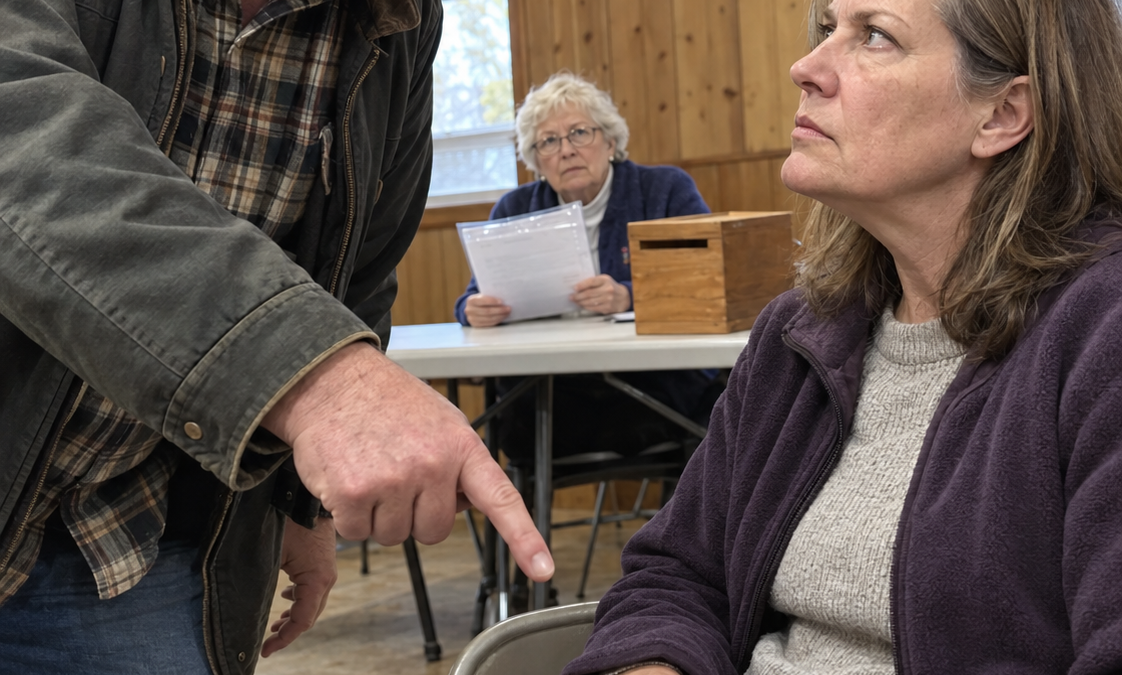
My brother pointed at me and claimed half the cabin I built on my $24,600 lot, hoping to silence my vote—Then someone he trusted stood up, and the sale failed.
Complete story · 9 parts · about 35 minutes · ending included
Part 1 · Part 2 · Part 3 · Part 4 · Part 5 · Part 6 · Part 7 · Part 8 · Part 9
Part 1 of 9
Kenny set his phone face-up beside Dad’s birthday cake and said, “October tenth, I’m voting for half your cabin, Holly.”
My younger brother said it like he’d brought good news instead of picking a fight at our father’s birthday dinner.
Dad turned seventy-eight that Saturday, September 19. It was about 6:30 in his kitchen in Duluth’s Lakeside neighborhood. He sat at the round table, back to the window. I was on his left, Kenny across from me, his wife Krista beside him, and their son Logan at the far end.
The store-bought cake still had its unlit candles. Nobody had reached for a match.
“Birchline Timber wants the road,” Kenny said. “Good money for the association. They’re one vote short, bud. We can fix that.”
“Who’s we?” I asked.
He turned his phone slightly, as though its dark screen might explain.
“Half the cabin is mine. Mom’s money paid for that lot. Everybody knows it.”
Krista smoothed the napkin across her lap. She worked as a hospital cashier and counted other people’s payments all day. She didn’t look up from her plate.
“I bought Lot 14 at the county auction in 2012,” I said. “With my own money.”
Kenny leaned back, smiling as if we’d reached his favorite part.
“You’ve always been good at buying what other people lost.”
Kenny’s chance at ownership was long gone. Now he wanted a share of what I’d built.
“I didn’t buy it from you.”
“Nobody said you did, sis.”
“You said half belongs to you.”
“I’m saying family money went into it. That’s different.”
Dad nudged the paper napkin beside his plate until its corners lined up. He’d spent thirty-four years on the Duluth ore docks, and he could make a man stop talking simply by looking at him. Tonight he studied the frosting.
At my clinic in Duluth, I talked nervous patients through cleanings without letting my own hands hurry. I rested my palms on my knees.
One tooth at a time.
“Dad,” I said, “did you and Mom ever put money into the cabin?”
His index finger touched the tabletop.
Tap.
He didn’t answer.
“Dad?” Kenny said. “You know I’m right.”
Dad watched the untouched candles.
I could hear the refrigerator motor behind us.
Logan moved his glass away from his elbow. My nephew was thirteen, old enough to see the grown-ups taking sides but still hoping the argument would be over before dessert.
“Aunt Holly? Can I still bring the blue rod up to the dock on Saturdays?”
“Sure,” I said. “You can fish with me.”
“Even if Dad’s coming?”
“Of course.”
His shoulders settled. I’d given him the blue rod because he’d been careful with mine, always wiping the handle before he put it away. He talked about the lake as though the fish belonged to him personally.
Kenny laughed.
“Look at you, bud. Worried your aunt’s going to lock us out? Nobody’s taking your fishing away.”
Logan stared at the rim of his glass.
The laugh took me back to 2012. Kenny had told me old Nyquist’s estate let the taxes go on Lot 14 and he’d lost his down payment. Before the auction, he’d said, “Go ahead and bid. Better you than strangers.”
I’d taken him at his word.
“I’ve never kept Logan off the dock,” I said.
“I know. Don’t make this personal.”
“You brought it up at Dad’s birthday.”
“Because everybody’s here. Saves a trip.”
Krista set her fork down. “Can we eat first?”
“We’re just talking,” Kenny said pleasantly. “It’s a family matter.”
Dad pushed back from the table just as the doorbell rang.
“Pizza’s here,” he said.
“I’ll get it,” I offered.
“My house,” Dad said. “I’ll pay.”
He rose carefully. Kenny took the opportunity to shift the cake away from his phone, leaving a smear of frosting on the tablecloth.
“It’s a good offer, Holly,” he said, quieter now. “Birchline handles the road. Nobody has to keep paying those road dues.”
“Is that what you want?”
“Don’t you?”
“I want to vote my own lot.”
“Everybody gets a say.”
I had never challenged Kenny’s right to speak. He was good at turning a plain answer into an accusation.
I got up to take the pizza from Dad. At the open door, he held the box against his chest while he counted cash for the delivery driver. The old brown leather wallet lay open in his hand.
Behind the bills was a yellow paper folded in four, inside a thin plastic sleeve open at one end. Its creases were worn white. A round blue stamp marked one corner, and the edge of a white lined card stuck out of the open end.
Dad caught me looking.
He pushed the card deeper with his thumb and snapped the wallet shut.
“Thanks,” he told the driver.
I took the pizza from him. Its warmth seeped through the cardboard into my wrists. Dad slipped the wallet out of sight and returned to his chair, but he didn’t reach for a slice.
Kenny had picked up his phone again.
“Look, Holly. Let the association decide. Mom’s money ought to count for something.”
Dad stood and pressed a flat hand over the wallet in his back left pocket.
He walked out to the porch without a word, leaving the birthday candles unlit.
Part 2 of 9
Kenny’s email reached all thirty lots before I’d finished my coffee: “Half of Lot 14 is mine. My mother paid for it.”
It was Sunday morning, September 20. I stood in my Duluth kitchen with my phone beside a cooling mug. Kenny’s old address was still on the association’s email list from when he’d held Lot 14.
Dad’s cake hadn’t even been cut when Kenny started on the cabin. Now he’d taken the argument to everyone at Kettle Pine Lake.
My phone lit up with texts from three neighbors.
“Is this true?”
“Does Kenny own part of your place?”
“Are you and Kenny fighting over the cabin?”
I sent each of them the same sentence: “The state deed has been in my name since 2013.”
Those neighbors had seen me working on the cabin, hauling lumber and replacing boards until my hands were too sore to hold a fork. Now a message from my brother had them asking whether it belonged to me.
I rinsed my cup and didn’t answer Kenny’s email.
On Tuesday, the meeting notice arrived in the mail. It was postmarked Monday, September 21. The annual meeting was Saturday, October 10, at 10:00 AM in the town hall.
I laid the pages on my kitchen counter.
Birchline Timber offered $180,000 for the road. The money would go into the association’s reserve fund, which paid for work like repairs to the shared dock. Birchline would maintain and plow the road, every lot would keep its right of way, and the yearly road fee would end.
The offer made sense to people tired of paying for gravel and snow removal.
But the road was also how we reached our places. The thought of log trucks using it made my shoulders tighten.
A printed ballot for Lot 14 was tucked inside the envelope. I set it aside without signing.
At the bottom of the last page, in smaller type, was Article IV, Section 3.
“Each lot has one vote. If a lot has more than one owner of record, its ballot counts only when signed by every owner of record. A lot whose ballot does not count is not counted as voting. A ballot whose ownership is disputed in writing before the vote may be held by the chair until the members present see proof of record ownership.”
I went through the paragraph again, following the words with my finger.
Disputed was an ugly word.
At work, I could show a nervous patient exactly what was written in a chart. Kenny wasn’t going to be reassured by reading anything I put in front of him.
I folded the pages back into the envelope. The papers proving the cabin was mine were somewhere safe.
On Saturday, September 26, I drove up to Lot 14. It was about 11:00 AM. The birches along the shore had turned yellow, and the air off Kettle Pine Lake smelled of wet leaves.
From the porch steps, I looked at the railing I’d fitted myself during the rebuild. The meeting notice lay on the porch table, where I’d dropped it with my keys.
I opened its drawer and worked past pencil stubs, spare screws, and folded instructions until I found my old copy of the state deed.
The name on the page was Holly Szydlo, and the recorded date was January 15, 2013.
I sat on the top step and held it against my knee. The creases had worn the paper thin, but nothing important had faded.
The receipt from the county auction wasn’t there.
I searched the drawer again, then the papers I’d brought from Duluth. Back in 2012, I’d handed it to someone for safekeeping. Who that was, I couldn’t remember.
Gravel popped beneath tires.
Kenny’s truck rolled to a stop on the road at the turn into Lot 14. A white pickup marked Birchline Timber parked behind him.
Neither man had called to ask whether he could come. They’d stopped at my turn as though the property were already open for their business.
Kenny climbed out grinning.
“Hey, sis. Nice day for a drive.”
Neil Rydberg, Birchline Timber’s land buyer, stepped out of the pickup with a clipboard.
“Ms. Szydlo,” Neil said. “The road is 1.8 miles. We’re walking the route ahead of the association vote.”
“You’re standing at my driveway,” I said.
Neil lifted a bundle of stakes tied with orange flagging tape from the pickup. He drove them into the ground along the edge of the road in front of Lot 14.
“What are those for?”
“To mark the haul line,” he said. “Planning only. We aren’t hauling anything today.”
I came down the steps with the state deed in my hand.
“That is my land.”
Kenny put his hands on his hips.
“Not for long, bud.”
My fingers tightened on the copy until the corner bent.
“Don’t put markers on my property,” I said.
Neil paused with a stake in his hand. “We can verify the boundary before any work begins.”
“Please do. Until then, keep them off my side of the road.”
Kenny’s smile narrowed. “Everybody knows Mom put money into this place. You can’t make a family claim disappear by waving paper.”
Waving paper. The only paper with a name on it was mine.
“This is a recorded deed.”
“We’ll see whose signature matters.”
Neil looked toward his pickup. Kenny didn’t. My brother walked to the end of the driveway, tapped one of the stakes, and faced me.
“October tenth, my vote counts, or I file in court and you can explain it to a judge.”
Part 3 of 9
Logan cast past the weed line and said, “Dad says when the road sells, we get to keep the truck.”
The blue rod bent in his hands, then straightened as the line landed on the lake. My nephew watched the ripples as if he’d said nothing unusual.
It was Saturday, October 3, at 9:00 AM, on the dock below the cabin on Lot 14. The birches across Kettle Pine Lake had turned yellow, with red leaves caught along the waterline. Most of the boats were gone.
I sat in a folding chair with the bait box at my feet. Logan, thirteen, had claimed his usual place on the wooden edge, his sneakers well clear of the water.
“Your dad said that?” I asked.
“Yeah. He said the credit cards are maxed.”
He reeled slowly.
“And if he can’t make the truck payments, they’re going to take it back. But he says it’ll be okay when the road sells.”
Kenny was out hauling a load. Krista, his wife and Logan’s mother, had dropped him off at 8:30 and driven home. She’d barely looked at me through the open car window.
“Has he been talking about the cabin?” I asked.
“Some.”
Logan moved the tip of the blue rod away from the weeds.
“Are you going to sell half the cabin to Dad? Because then I could still come up.”
I opened the bait box and pushed a loose hook back into its slot. Logan’s fingers were reddened by the cold, but he kept them wrapped firmly around the cork handle.
“I’m not selling it,” I said. “You can fish with me today. If anything changes, I’ll tell you myself.”
He nodded without looking back.
“Okay.”
I wanted to tell him he’d always be welcome. But whether Logan came up on Saturdays was Kenny’s call, not mine.
“Need bait?” I asked.
“Not yet. I think something’s following it.”
He brought the line in carefully and cast again. A leaf caught on the hook. He lifted it off with the concentration I’d seen him give a fish he meant to release.
Around 10:30, footsteps sounded on the path from the cabin.
Judy Lindgren, the association’s secretary, had retired after thirty-one years as a title examiner in Duluth. She carried the member list in a plastic sleeve, held flat to her coat.
“Morning, Holly,” she said. “I thought I’d find you here.”
“You could’ve called.”
“I wanted you to see the list.”
She glanced at Logan.
“Fishing any good?”
“Mostly leaves,” he said.
“Those don’t need cleaning.”
Logan grinned and moved a few steps along the dock, giving us room without being asked.
Judy slid the pages out and held them open on her palm.
“Fifteen lots favor the sale,” she said. “Fourteen oppose it, not counting Lot 14.”
“And I’m against it.”
“Your no vote makes a tie. The sale fails.”
Kenny had called the association one vote short at Dad’s birthday dinner. I’d thought he was talking about ordinary persuasion.
“What if he says he’s an owner?” I asked.
“If Kenny is treated as a co-owner, your ballot needs his signature to count. Unsigned, it’s thrown out. Fifteen to fourteen, and the sale passes.”
The lake slapped against the posts beneath us.
He could take my vote without taking my cabin.
“Does an email make him a co-owner?”
“No.”
“Then what does?”
“A member is the owner of record in the County Recorder’s books.”
Her finger traced down the page and stopped beside Lot 14.
“Holly Szydlo,” she said. “Only name on Lot 14.”
“I’ve got the state deed. It’s an old copy.”
“Bring it. That’s enough.”
“What if Kenny takes me to court?”
“You don’t need a lawyer unless he actually files.”
I watched Logan test the fishing line’s tension with his thumb. He had caught no fish, but hadn’t complained once.
“Kenny told the whole table, ‘Mom’s money paid for that lot. Everybody knows it.'”
Judy looked at me over her glasses.
“Men who say ‘everybody knows’ usually think somebody will back them up.”
I pictured Dad leaving his birthday cake untouched and walking out to the porch.
“Why is Kenny so sure?” I asked.
“You’ll have to ask him. I check titles, not minds.”
She slipped the member list back into its sleeve.
“What if he objects before the vote?”
“Bring your papers to the town hall. We’ll deal with what’s in the record.”
I ran my thumb along the bait box latch. Kenny hadn’t changed the name on the state deed, but he was making me defend it in front of our neighbors.
Judy tucked the list under her arm.
“See you October tenth.”
“Thanks for coming down.”
She climbed toward the cabin. Logan waited until her footsteps faded, then came back and sat beside my chair, the blue rod across his knees.
“Did she come about Dad?” he asked.
“About the meeting.”
“Oh.”
He laid the rod on the boards and pulled his phone from his pocket. His expression brightened.
“Look. Dad’s new job.”
On the screen was a photo of a paper taped to the fridge at his house.
I leaned closer.
The printed lines read:
“Birchline Timber — Hauling Agreement — $5,000 signing bonus — effective upon closing of the Kettle Pine Road purchase.”
Below them was another line: “3-year hauling contract.”
At the bottom, beneath the word “Signature,” was my brother’s handwriting.
Kenneth L. Szydlo.
Part 4 of 9
Kenny slapped his hand on the folding table and told Judy to write his name next to Lot 14.
It was Tuesday, October 6, at the town hall, and the board was reviewing the member list. I’d been in the visitor’s chair since 7:00 PM. Kenny walked in at 7:20, still in his hauling jacket.
Dennis Pietila, the association’s president, sat behind the table with Judy Lindgren and three other board members. Dennis had been a schoolteacher before he retired. He liked procedure, and he liked reading the bylaws out loud.
Judy didn’t pick up her pen.
She opened the member list to Lot 14 and said, “Owner of record. Bring a recorded deed, Kenny.”
“Come on, Judy. You know the family.”
“I’ll read the rule,” Dennis said.
He lifted the meeting notice.
“If a lot has more than one owner of record, its ballot counts only when signed by every owner of record.”
“Exactly,” Kenny said. “So put me on there.”
“That sentence says owner of record,” Dennis replied.
“Mom helped pay for the place. Ask anybody.”
“Have you brought a deed?” Dennis asked.
Kenny looked from Dennis to Judy, then toward me.
“You just going to sit there, Holly?”
I flattened the corner of my old copy of the state deed against my knee. I hadn’t come to argue with him.
One of the other board members gave a short laugh. It wasn’t loud, but Kenny heard it.
His neck reddened above his collar.
“Fine. Hide behind your paperwork, bud.”
Kenny kicked an empty chair. Its metal legs scraped across the floor, and he walked out with all five board members and me watching.
Dennis straightened the meeting notice.
“Back to the list,” he said.
My hands stayed folded over the copy. No one asked me to speak.
On Wednesday morning, October 7, I opened the front door of my house in Duluth before leaving for the dental office.
A black trash bag sat on the porch.
The plastic was knotted. The tip of the blue rod stuck out past the knot, and when I loosened it, I found the handle tucked against Logan’s life jacket.
Dark marks still showed in the cork where his fingers had gripped it. I’d watched him hold that rod on the dock while he told me about Kenny’s truck.
My phone vibrated.
Kenny’s text said, “He won’t be coming up anymore. Thank Judy.”
Logan’s Saturdays on the dock.
I looked down the street. It was empty. On the dock, I’d told Logan, “If anything changes, I’ll tell you myself.” Kenny had told him first.
I lifted the bag carefully so the rod wouldn’t catch against the porch railing. Inside, I took out the blue rod and stood it upright in the hall closet, away from the coats. I laid the life jacket beneath it.
Before leaving, I checked that the closet door would close without bending the tip.
After my shift, I drove to Dad’s house in the Lakeside neighborhood.
He was at the round kitchen table, in the same chair he’d sat in on his birthday, his back to the window. The shelf above the stove still held the recipe tin Mom had used for her cards.
“Dad, what does Kenny mean by ‘Mom’s money’?”
He kept his gaze on the table. I waited while his finger rested beside the place where his plate usually went.
“You heard what he told everybody,” I said. “He’s saying he owns part of the cabin.”
Dad touched his back left pocket, where he kept the wallet.
“Let him have his vote, Holly. Don’t make me choose.”
I gripped the counter edge.
Dad wasn’t asking Kenny to stop. He was asking me to step aside.
“That vote belongs to Lot 14,” I said. “My name is on the state deed.”
He said nothing.
“Can I look in your fireproof box? I can’t find the receipt from the auction.”
Dad nodded toward the place where he kept it.
I opened the box on the table. There were his house papers, his pension letters, and Mom’s death certificate. I lifted each document, checked underneath it, and returned everything in the same order.
No receipt.
At the meeting, I’d have nothing but an old photocopy.
“Did Mom ever keep anything for me?” I asked.
Dad looked at his hands but didn’t answer.
“I’ll make you some soup,” I said.
His eyes stayed lowered. At least he didn’t tell me to go home.
I took the recipe tin down. Mom had kept her index cards upright, and sometimes, at the back, the papers she wouldn’t trust to a drawer. I ran my thumb along their worn edges, looking for the soup she’d made for Dad.
There was the card labeled “Lake Trout Chowder.”
Behind it, folded to fit the tin, was the receipt.
I opened the paper on the counter. The printed lines read:
ST. LOUIS COUNTY
Tax-Forfeited Land Sale
Lot 14
Purchaser: Holly Szydlo
$24,600, cashier’s check
In the top corner, Mom had written in ballpoint:
“Holly’s. Her own money.”
Part 5 of 9
Judy put her reading glasses on at the Recorder’s counter and said, “Certified copy. Not the copy you’ve been keeping.”
On the drive to the St. Louis County building in Duluth, she’d made me hold up my old copy of the state deed so she could see it.
“His email counts as a written dispute. If all you bring is that old photocopy and he says it isn’t real, Dennis can hold your ballot. Then it passes fifteen to fourteen.”
On Saturday she’d told me that copy was enough. That was before Kenny slapped the table at Tuesday’s meeting and asked her to write his name next to Lot 14.
It was Thursday, October 8, about 9:00 AM. I’d taken the day off from the dental office because the county offices were open on weekdays, when I normally worked.
My folder held the copy from the porch drawer and the receipt I’d found in Mom’s recipe tin, her handwriting still in the corner: “Holly’s. Her own money.”
Judy had glanced at it in the car.
“Good to have,” she’d said. “But the Recorder’s books establish ownership. That’s where we’re starting.”
Now, on the first floor, the Recorder’s clerk reached for the paper I’d brought.
“For the state deed?” the clerk asked.
“Yes,” I said.
“Lot 14,” Judy added. “Holly Szydlo.”
The clerk looked up the recording, then read my name back to me. “That’s me,” I said, and she turned to the printer.
Judy stood beside me with her purse strap looped over her wrist. She hadn’t brought a stack of forms. She’d spent thirty-one years examining titles in Duluth, and she seemed content to let the county’s own record do the talking.
“What happens if Kenny brings something?” I asked.
“What kind of something?”
“He keeps saying Mom paid.”
“Those are words. You have a recorded deed.”
“He’s told every lot he owns part of it.”
“I saw the email.”
I tucked the folder flat under my arm so its corners stopped catching on my coat. I could scrape paint off the cabin’s railing, replace a board, even mend a crooked step. None of that would fix what my brother had told our neighbors.
The printer started.
The Recorder’s clerk checked the pages and handed me the certified copy of the state deed. January 15, 2013, stood on the recording line. The paper was still warm, and I felt the raised county seal beneath my thumb.
“Does that show I’m the only owner?” I asked.
“It shows what’s recorded,” the clerk said.
“And that’s what the association uses,” Judy replied.
I slipped the new copy into the folder without folding it. The receipt went behind it, Mom’s ballpoint words facing inward.
“Now we need the parcel history,” Judy said.
“Why?”
“So nobody can say the county made a mistake.”
I’d expected to go home with proof that Lot 14 was mine. Judy wanted the years before me too.
“What do I ask for?”
“The tax history. We’ll go to the Auditor’s counter.”
The Auditor’s office was down the hall. Judy gave the clerk the lot information while I held the folder ready, in case she asked to see the state deed.
“Can you print the parcel history for Lot 14?” Judy asked.
“How far back?”
“Before the state deed. We need the earlier years.”
The Auditor’s clerk shook her head at the request.
“Those years before 2013 aren’t on the county website,” she said. “I’ll have to print them from the old records.”
“Can we get them today?” I asked.
“Yes. About an hour’s wait.”
Judy nodded as though she’d expected exactly that.
We sat on a bench in the hallway, my folder on my lap.
At the town hall, Kenny could walk into a room, say “everybody knows,” and have half of them nodding before he took off his jacket. I usually stood by the coffee until someone asked me a question.
“Do you think Dennis will accept these?” I asked, touching the edge of my folder.
“He’ll look at what the county recorded.”
“What if Kenny talks over me?”
“Let him finish. Then put the folder on the head table.”
“Can I ask you something?” I said.
“Go ahead.”
“Kenny was buying it from old Nyquist on payments. He said the Nyquist estate let the taxes go and he lost his down payment.”
Judy adjusted her glasses.
“That’s a contract for deed. Who pays the taxes under one?”
“I don’t know.”
“Usually the buyer. Whatever the contract says.”
The vending machine coffee was hot enough that I held the cup by its rim. Judy clicked her pen closed and tucked it into her purse. We waited.
The Auditor’s clerk called us back to the counter. She stayed standing, a printed parcel history in her hand.
“Lot 14?” she asked.
“Yes,” I said.
The clerk looked down at the paper, found the older entries, and read aloud.
“Taxpayer of record, 2005 through forfeiture in 2011: Kenneth L. Szydlo. Taxes unpaid 2007 through 2010.”
Part 6 of 9
Kenny’s email came Friday at nine that night: “See everyone Saturday. Bring a pen. Road money’s coming.”
I was in my Duluth kitchen with the folder open on the table. The certified copy of the state deed lay on top of the receipt and the parcel history. I made sure none of the pages had folded corners.
Kenny had told the entire lake that half the cabin belonged to him. Now he sounded like a man inviting neighbors to a picnic.
I called Dad at his house in Lakeside.
“I’m bringing my papers tomorrow,” I said. “The county records, too.”
“I’ll be there.”
The call ended before I could say anything else.
I placed the phone beside the folder. He hadn’t said whose side he’d sit on.
By Saturday morning, October 10, the town hall smelled of coffee and donuts. There were about forty people, owners from the thirty lots and their families, moving folding chairs and taking off jackets.
Kenny stood at the door beside two boxes of donuts, shaking hands with every family that came in.
“No more road dues, folks,” he said.
He held one out to me.
“Morning, sis. Want one?”
“No, thanks.”
“Plenty for everybody, bud.”
He grinned past my shoulder at another arrival. The same hand he’d slapped on the folding table at the board review was now passing out glazed rings on paper napkins.
At the front of the room stood the head table. Dennis sat in the middle with the bylaws in front of him. Judy was checking names against the member list at the sign-in table.
Neil Rydberg, the man from Birchline Timber, occupied the last chair of the front row, on the left. His papers were arranged in a neat pile on his knees.
Kenny took the center of the second row. Krista sat beside him, straightening the cuff of her sweater. She glanced toward the entrance while he waved to people across the room.
I chose the fourth row, right of the center aisle, and put the folder on my lap. Dad came in and settled beside me on the aisle side. The wallet was in his left back pocket. He didn’t look toward Kenny.
“Morning, Dad,” I said.
He nodded.
At 9:50, I went back to the sign-in table. The printed ballot had come with the meeting notice, and I’d carried it inside the folder.
Judy glanced at the blank signature line.
“Lot 14?”
“Mine.”
I signed Holly Szydlo and dropped the ballot into the ballot box. Judy marked the member list and moved the box away from the edge of the table.
“Your papers?” she asked quietly.
“All here.”
“Good.”
When I returned to my seat, Dad had his hands on his knees. Beyond him, Kenny was talking to a neighbor with his palms spread wide, as though he’d arranged everything himself.
At 9:58, Judy carried the ballot box up to the head table. She took her seat on Dennis’s right, with the member list and the box in front of her. The lid remained closed.
At 10:00, Dennis called the annual meeting to order. Judy read the lot numbers from the list while he checked his notes.
Dennis picked up a typed sheet and read aloud.
“The motion is to sell the road to Birchline Timber for $180,000, paid into the association’s reserve fund. Birchline maintains and plows the road. Every lot keeps access, and the annual road fee ends.”
He set the paper down.
“Discussion?”
A neighbor near the back asked about the log trucks. Another wanted to know who would fix ruts after heavy hauling.
Neil stood beside his front-row chair.
“Birchline would maintain the full 1.8 miles,” he said. “Access for all thirty lots stays in place.”
Dennis thanked him. More hands went up. I pressed my palms flat on the folder and felt the embossed county seal through the cover.
Kenny raised his hand when Dennis asked whether anyone had further business before the ballots were counted.
“I need to speak,” Kenny said. “I’ve got a claim on Lot 14.”
Dennis adjusted the papers in front of him.
“You’re not listed as a member, Kenny.”
“That’s what I’m trying to fix.”
“Have you brought a recorded deed?”
Kenny got to his feet, empty-handed.
“No. But my sister’s ballot is part of this. You’ve got to hear me.”
Dennis looked at Judy. She kept her pen above the member list without making a mark.
“This concerns a member’s ballot,” Dennis said. “Go ahead.”
Kenny moved into the aisle.
“Half of Lot 14 is mine. The bank took my lot in ’11 and my sister swooped in.”
Someone shifted a chair behind me. The bank. When I bid on Lot 14, Kenny had blamed the Nyquist estate. My hand stayed over the folder.
“I object to the Lot 14 ballot under Article IV, Section 3,” Kenny said.
His voice carried easily without a microphone.
“My mother’s money paid for that cabin. I’m not getting a dime out of this road. I’m doing it for her memory.”
Krista’s hand stopped on her sweater cuff.
Kenny turned around and pointed straight at me.
“My sister cleans teeth for a living and bought a dead deal for pennies. Tell them, Dad. You know where Mom’s money went.”
Chairs creaked as people turned toward the fourth row. Someone set a paper cup down too hard, and coffee slopped over the rim.
Dad stayed seated. His mouth was closed, his hands resting on his knees.
I’d paid $24,600 for Lot 14 and bought every board for the cabin afterward. Pennies. I said nothing.
I stood, carried the folder up the center aisle, and set it on the head table in front of Judy.
Part 7 of 9
Judy opened my folder and read the first line out loud: “State deed, recorded January fifteenth, 2013. Grantee: Holly Szydlo.”
Judy held the certified copy flat beneath her hand. I stood beside the head table at the front of the center aisle. The ballot box sat near Judy’s elbow, still closed.
Dennis was seated in the middle. He leaned toward the raised county seal without touching the page.
“Recorded to Holly alone?” Dennis asked.
“That’s what the county says,” Judy replied.
Kenny remained in the aisle beside the second row, his hand resting on the back of his empty chair. Krista sat next to it with her purse in her lap. Around the town hall, people watched Kenny, waiting for him to interrupt.
“That’s a deed,” Kenny said. “It doesn’t tell you where the money came from.”
Judy took the receipt from my folder.
“St. Louis County, Tax-Forfeited Land Sale, Lot 14, Purchaser: Holly Szydlo, $24,600, cashier’s check.”
She placed the receipt beside the state deed where Dennis could see both.
Kenny gave a little shrug.
“Mom’s money, my money. It all went into that lake one way or another.”
“Did you bring anything from the county?” Dennis asked him.
“Everybody here knows us, Dennis.”
“That’s not what I asked.”
In the corner of the receipt was Mom’s handwriting: “Holly’s. Her own money.” I kept my eyes on it while Dennis waited for an answer. Kenny looked past him toward the front row.
I drew the parcel history from the folder and handed it to Judy.
She found the entry and read into the room.
“Taxpayer of record, 2005 through forfeiture in 2011: Kenneth L. Szydlo.”
The papers barely moved in her hands. I turned toward Kenny.
“In 2012 you told me, ‘Go ahead and bid. Better you than strangers.'”
His mouth opened, but I finished.
“‘You’ve always been good at buying what other people lost.’ You lost it, Kenny. I bought it.”
My voice stayed level. I could feel the nail of my thumb digging into my palm.
Kenny looked toward Dad’s seat in the fourth row, on the aisle.
“Tell them, Dad. You know where Mom’s money went.”
Dad stood in the aisle beside his chair. He didn’t come forward. His hand went to his back left pocket, where he’d always kept the wallet.
He drew out the wallet and opened it. A yellow paper, folded in four inside a thin plastic sleeve, came out between his fingers. A white lined card showed at the sleeve’s open end.
“I do know, son. That’s the problem. You told us you paid the county. I called them that October.”
Nobody moved. Dad kept his gaze on Kenny.
“I should have said this fifteen years ago.”
He removed the yellow paper from its sleeve and unfolded it.
“Notice of Expiration of Redemption. Kenneth L. Szydlo. Sixty days after this notice is served.”
His voice was quiet enough that someone near the back leaned forward.
“They handed it to you July fifteenth, 2011. Two days later you laid it on our kitchen table and asked your mother and me for the money.”
Kenny’s fingers came off the chair.
“That doesn’t prove what Mom paid.”
Dad slid the white card free and opened it along the crease.
“I owe Mom and Dad $8,000 for the county taxes on the lake lot. Kenny.”
The card’s edges had gone soft. Dad held it by the corners.
“Your mother’s money went to you. Not to the county.”
Eight thousand dollars. And for three weeks Kenny had told the whole lake that Mom’s money was in my cabin.
Krista turned toward her husband.
“You told me the bank took it.”
Kenny glanced at her, then faced Dennis again.
“That was a loan between me and Dad. It’s got nothing to do with her cabin.”
His chair beside Krista stayed empty. She didn’t reach for his arm.
I faced Dennis.
“Ask Mr. Rydberg about a signed hauling agreement. Five-thousand-dollar signing bonus, effective when the road closes.”
Neil sat in the last chair of the front row, on the left. He had listened with his notebook open on his knee.
Dennis looked down at the papers in front of him.
“Mr. Rydberg, does any member’s family stand to gain personally from this sale?”
Neil glanced at Kenny.
“Birchline has a hauling contract with Kenny Szydlo. There’s a $5,000 signing bonus, effective only if the road is sold.”
Kenny rubbed his jaw.
“You make it sound like I’m stealing something. I’m going to haul logs.”
Not a dime, he’d told the room. For her memory.
Neil said nothing more. Dennis picked up the meeting notice.
“Each lot has one vote,” Dennis read. “If a lot has more than one owner of record, its ballot counts only when signed by every owner of record.”
He looked at Judy, then at Kenny.
“The County Recorder lists Holly Szydlo as owner of record for Lot 14. Kenny has produced no recorded deed. Her ballot is valid.”
Judy nodded once.
Dennis opened the ballot box. Judy checked the signed ballots against the member list and counted aloud. When they reached Lot 14, Dennis took its ballot from the box and held it before Judy.
“Holly Szydlo,” she said. “Against.”
She checked her tally.
“Fifteen in favor. Fifteen against.”
“No majority,” Dennis announced. “The motion to sell the road does not pass.”
A few people clapped. Neil closed his notebook. Dad stood where he had been all along. He tucked the card back into the sleeve.
Dad folded the notice and looked at Kenny. “The bank didn’t take your lot, Kenny. The county did.”
Part 8 of 9
Judy called me on my lunch break Monday and read Neil Rydberg’s letter into the phone like it was the minutes.
I was sitting in the dental clinic with my lunch unopened. Judy didn’t bother with hello.
“Birchline Timber withdraws its offer to purchase the road,” she read. “In light of a disclosed conflict.”
“Those are his words?”
“Exactly. Neil Rydberg signed it. For a man who talks in numbers, he kept this one short.”
“What about the offer to maintain the road?”
“Gone with the purchase. The association keeps the road.”
I pulled a napkin across my lap. On Saturday, Kenny had told the whole town hall I’d bought a dead deal for pennies. Now the sale he wanted was gone, and my name was still on Lot 14.
“Has Kenny heard?” I asked.
“Neil’s letter says Birchline sent him one too. His hauling agreement is canceled.”
I stopped smoothing the napkin.
“And the stakes?”
“Pulled. Orange flagging tape and all. Nothing left by your driveway.”
She told me Neil had sent the withdrawal by email. It was Indigenous Peoples’ Day, and the post office was closed. Judy had printed the message for the association’s records.
“Are you going to send it to everyone?”
“It belongs in the minutes. I’ll put it there.”
“Thank you, Judy.”
“Don’t thank me for reading a letter.”
After the call, I peeled the lid off my lunch without spilling anything. I had appointments to get back to, and patients who wanted to know whether the scraping would hurt. I could answer that question without thinking about Kenny.
On Wednesday, October 14, at 6:00 PM, I stood beside Dad’s refrigerator in his Lakeside kitchen. Dad sat in his usual chair at the round table. Kenny was across from him, staring at a handwritten repayment paper Dad had just placed between them.
“What’s this supposed to be?” Kenny asked.
“What you owe us.”
“You got your big moment at the town hall. Isn’t that enough?”
Dad tapped a finger beside the paper.
“Sign it, or I tell Logan myself what that card says.”
Kenny lifted his chin.
“You didn’t have to do it in front of the whole lake, Dad.”
“You did it in front of the whole lake first.”
I watched the refrigerator door. Mom used to lean against it while deciding whether Dad needed more soup. Kenny never looked toward me.
“You kept that card all this time?” he asked.
“Yes.”
“And now I’m supposed to find eight thousand dollars? You know what my truck payments look like.”
Dad pushed a pen toward him.
“I’m not taking you to court over a card. I’m asking you to sign your name again.”
The paper stayed between them while Kenny rolled the pen under his palm. Behind me, the motor kicked on. Dad waited without offering another reason.
At last Kenny bent over the table and signed. He pressed hard enough to leave a mark beneath the page.
“I’ll sell my fishing boat,” he said. “That’ll pay it.”
Dad drew the repayment paper back and laid it beside his place. He didn’t tell Kenny the debt was forgiven. There was no cake on the table this time, no reason to pretend we’d gathered for a celebration.
Kenny rose and pulled on his jacket. He zipped it with his eyes on the door.
“Happy now, bud?”
I moved aside to let him reach the door. He went out, and I closed it behind him.
On Thursday, October 15, a text came from Krista, Kenny’s wife.
“It’s been fifteen years of the bank, Holly. Now I find out it wasn’t the bank. I’m taking Logan to my sister’s in Cloquet for a while.”
I sat with the phone in my hand. Krista had married Kenny in June 2010. She’d believed the bank story all that time, the same way I’d believed the Nyquist estate had cost him his down payment.
I typed a short answer: “I hope you and Logan are okay.”
Judy had already told me what they were calling him at the grocery store near the lake: “the IOU guy.” I didn’t ask who started it. I wanted no part in giving him a new nickname.
That evening, I drove to Dad’s house in Lakeside. He sat in the porch swing. I sat on the steps, close enough to hear him without making him raise his voice. He took the wallet from his back left pocket.
Dad removed the notice, its yellow folds still protected by the thin plastic sleeve. The blue county stamp showed through the front. He held it a while before passing it down to me.
“Your mother wrote on the back. I was supposed to do this a long time ago.”
I slid the notice out of its sleeve and opened the folds. Dad kept one hand on the swing’s chain.
I turned it over. Mom’s ballpoint ran across the back, the same hand as the receipt and the recipe cards she’d kept above the stove:
“Lee — Kenny kept the $8,000. Holly paid for that lot with her own check. If he ever claims her place, read this out loud. — Shirl, 10/21/12.”
Part 9 of 9
I called Krista on Saturday and asked if Logan could help me pull the dock before the lake froze.
In my Duluth kitchen, I could hear Krista breathing on the other end. She and Logan were still staying with her sister in Cloquet.
“He’s been asking every day.”
“About the cabin?”
“About you. And whether you kept his fishing gear.”
“I kept it.”
Krista was quiet again. I rested my elbow on the counter and left her room to decide.
“It’s cold up there,” she said.
“I’ll bring his life jacket. We’ll have waders.”
“Are you going to make him talk about his dad?”
“No. I need help with the dock.”
“All right. I’ll drive him up.”
“I’ll have Logan home by 3:00.”
“Thank you, Holly.”
She sounded tired. I didn’t ask her to explain anything more.
The next Saturday, October 24, the birches above Kettle Pine Lake were almost bare. Yellow leaves floated over the water, catching against the posts below the cabin on Lot 14.
At 9:00 AM, Dad was settled in a folding chair on the shore, a dock line looped through his hands. He had brought a coat with pockets deep enough to hide his fingers from the wind. I had already set the tools on the grass.
Krista brought Logan down the path. My nephew looked at my face before coming close, as if checking whether he was allowed.
“Morning, Aunt Holly.”
“Morning. I’ve got something for you.”
I lifted the blue rod from beside Dad’s chair, where I’d leaned it after the drive up from Duluth. It had stood in my hall closet since Kenny left it on my porch in a black trash bag, with Logan’s life jacket stuffed around the handle.
Logan took it carefully.
“I thought Dad threw it away.”
“He left it at my house.”
The boy ran his thumb over the cork handle. He turned the rod in his hands and wiped a spot near the reel with his sleeve, the way he always did after fishing.
“Still okay?”
“Looks fine to me.”
“Can I use it when we finish?”
“Once everything’s put away.”
I handed him his life jacket. He fastened it over his coat, and Krista checked the straps without a word. She touched his shoulder before walking back up the path.
Dad nodded toward the shallows.
“Ready?”
Logan put the blue rod well clear of our work. He stepped into his waders, and I followed in mine. Cold water pressed against the rubber as we approached the first section.
Dad kept the line taut from his chair while I worked the first pin loose. Logan steadied the wood with both hands.
“Move your foot back,” I said. “There’s a gap under that board.”
“Got it.”
We eased the section toward shore. It bumped the stones, and Logan gripped his end more tightly.
“Lift with your legs, bud,” Dad said.
That was Kenny’s word. From Dad, it came with a firm pull on the line to help Logan.
We carried the section onto the grass and laid it where the shore rose above the water. Logan took the weight without complaining. He watched my hands whenever a pin stuck, waiting for me to show him how.
“Should I pull harder?”
“Try lifting this end first.”
“Like that?”
“Exactly.”
We repeated the job along the remaining sections. Dad fed us slack, then tightened his hold when the wood started to turn. Logan and I carried each piece up the shore, leaving the posts exposed to the cold air.
My gloves became damp inside. Logan’s cheeks were pink, and he kept making small circles with his shoulders between lifts.
“You warm enough?” I asked.
“Yeah. My fingers are just stiff.”
“Tell me when you need a break.”
“I will.”
The last section caught against a post. Logan tugged and stopped when I raised my hand.
“One tooth at a time.”
He grinned at the familiar words.
I knocked the pin free, shifted my end away from the post, and asked him to lift. Dad drew the line slowly as the wood came clear. We got it onto the bank without scraping the corner.
Only the swim ladder was left, roped to the last post. Dad kept a second line on it from his chair while we checked that nothing else was in the water.
I reached into my coat pocket and handed Logan a key to the cabin, attached to a red fishing bobber.
“For Saturdays. Ask your mom first.”
He turned the bobber over in his palm.
“Mine?”
“Yours.”
“Even when I’m not helping?”
“Even then.”
He clipped the key ring to the zipper pull of his life jacket and gave it a cautious tug.
The guest book was waiting on the porch table. I went up to the cabin and opened it to the front page. Dad stood from his folding chair and came to watch, with Logan beside him.
I slid the notice out of its plastic sleeve, opened the folds, and laid it against the page. With Mom’s handwriting facing up, I taped it carefully in place. Dad bent over the page and nodded.
I closed the book and left it on the table. We went back down the slope. Dad lowered himself into his chair and took up the ladder’s line, and I untied the knot from the last post.
Dad held the last line steady while Logan carried the ladder up the hill, his new key bouncing on his zipper.
THE END
More stories
“She can’t get out of bed most days.” My husband said that while reaching for $18,400—Then I walked up in navy scrubs, and his boss turned the giant check toward me.My daughter-in-law accepted $3,000 to demolish my late husband’s kitchen, then ordered me to sign at her launch—But the proof I carried stopped her deal, and I ended her lease.My husband spent $3,250 of our money on a ring for his coworker, then called me his ex-wife at dinner—Until proof he never expected hit the table and she reported him to HR.“Nine nights you got lost at home, Augie,” my daughter-in-law said at our class ceremony—Then the college dean stepped forward, and a judge ordered her to pay my $4,800 lawyer fees.My fiancé shamed me for working nights before 80 hockey parents while my son sat beside me—then the rink owner arrived, and his perfect speech began unraveling.My brother’s wife carried Mom’s clothes from her bedroom 14 days before Dad’s knee surgery—Until Dad’s case manager stepped in, and the room she called hers stopped being hers.








