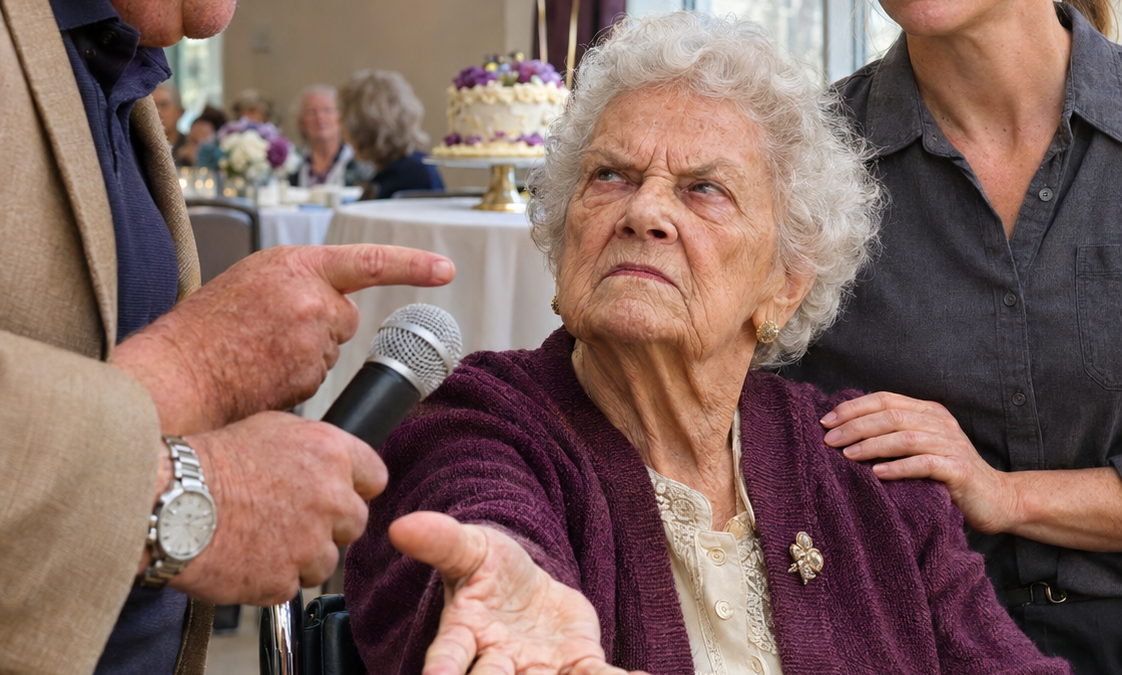
My father accused me of stealing $9,000 at Grandma’s 90th birthday while holding the microphone—then Grandma raised her hand, and even he had to listen to her.
Complete story · 9 parts · about 35 minutes · ending included
Part 1 · Part 2 · Part 3 · Part 4 · Part 5 · Part 6 · Part 7 · Part 8 · Part 9
Part 1 of 9
My father unfolded the guest list for Grandma’s ninetieth, found my name with his finger, and drew a line through it while I watched.
It was 5:35 on Thursday, October 1, in room 112 at Kittering Care Center. Grandma’s bed stood beside the window. His pen left a groove in the paper.
My aunt Debra held a measuring tape against the wall while I steadied the other end. She’d brought her quilt bag to see where the birthday quilt would hang. Jordan had stepped into the hall to answer his phone.
Grandma was getting her hair done at Kittering’s salon. She’d be back a little before six.
“Randy,” Debra said, letting the tape hang loose, “that list is for her birthday.”
“I know what it’s for.”
He kept his finger on the black mark.
“You stole from a ninety-year-old woman, Erin. The only thing this family owes you is the door.”
Debra looked down at the canvas bag. She took the tape from my hand and said nothing.
My work shirt was damp beneath the arms. I’d come straight from wiring an electrical panel, with grit still in the seams of my boots. I set my hands flat against my thighs so my father wouldn’t see my fingers move.
He’d chosen Grandma’s room to throw me out of her birthday.
“Kill the breaker first.”
That was all I said.
Randy turned the patient smile he used on customers on me.
“Let’s not make a scene, pal. You’re not on the list.”
He bent the paper along its crease and put it inside his jacket.
Debra rolled up the tape. One end caught in the zipper of her bag. I watched her work it free rather than look at me.
From the hallway, Jordan said, “Dad? You still need to close the shop.”
“At six,” Randy called back. “I’m coming.”
Randy looked around the room, past Grandma’s slippers by the bed and the cardigan draped over her chair. He didn’t ask when she would be back.
My brother appeared in the doorway, phone in his hand. He glanced from my face to Dad’s jacket pocket.
“Everything set?” he asked.
“Everything’s set,” Randy said.
Jordan shrugged toward me. “Dad’s got it.”
At 5:50, all three left. Debra carried the quilt bag close to her hip. Jordan held the door while Randy walked out ahead of them. None of them said goodbye.
I stayed where I was until their shoes stopped sounding against the hall floor.
The October activity calendar hung beside the dresser, held by a pushpin. Grandma had circled the dates for her favorite programs in pencil, but the square for October 1 was empty.
She pinned old months behind the current sheet. She liked to check when the staff changed the schedule.
I lifted the lower corners. On the first of September, a little E sat inside a pencil circle. The same mark appeared on August, then July. I checked the sheets behind those. Each first carried its own small, careful E.
I put the stack back the way she’d left it.
Beneath the bed, the shoebox showed between the legs of the frame. Grandma had written “every piece of mail since 1962” across the lid in her narrow, upright handwriting.
I didn’t touch it.
I’d arrived at the front desk at 5:12 that evening. The 2026 visitor sign-in binder lay open on the counter beside a bell and a plastic pumpkin. I wrote “E. Solberg” on the next blank line.
The receptionist smiled when she looked at the page.
“First of the month. Like clockwork.”
“Even got here before supper,” I said.
“Your grandma’s still under the dryer,” she told me.
I’d waited in the lobby chairs with my work jacket across my lap, picking dust from the cuff.
At 5:30, Randy came through the entrance with Debra and Jordan. He walked straight past the counter without signing the binder.
Debra stopped beside my chair.
“Erin, could you hold the end of the tape for me? I need the wall measured for the quilt.”
“Sure,” I’d said.
I followed her to room 112. Randy went in ahead of us, as if he’d been expecting the room to be empty.
At 5:55, an aide brought Grandma back from the salon in her wheelchair. Her silver hair was curled neatly away from her forehead, and she had a fresh tissue tucked into her sleeve.
“Sparky,” she said. “You’re still dressed for work.”
“I didn’t stop home.”
“Well, you’ve seen my hair. Was it worth the trouble?”
I smoothed a curl above her ear where it had sprung loose.
“Looks good.”
“They used too much spray.” She held my wrist until I stopped fussing with it. “Did you eat?”
“After I finish here.”
“That wasn’t my question.”
I pulled her cardigan from the chair and settled it around her shoulders. She watched me button it, then caught my sleeve.
“Something happened?”
“Debra came to measure for your quilt.”
“She’ll make it too big,” Grandma said. “She always does.”
The aide returned at 6:05 to see if she wanted help getting out of her wheelchair. Grandma glanced at the activity calendar on the wall.
“Bring me a pencil, please.”
The aide took one from the dresser. Grandma leaned forward, wrote a small E in the blank October 1 square, and circled it.
“What’s that for?” I asked.
“My bingo.”
Part 2 of 9
“Erin is not invited,” Dad’s message to the Solberg Family group said at noon on Friday. “She knows why.”
At 12:10, I sat in the cab of my company work truck at a job site, with my lunch unopened on the passenger seat.
Above his message was the invitation to Grandma’s ninetieth. He had posted it in the Solberg Family group with the cheerful certainty of a man arranging a church supper.
Nobody had questioned the sentence about me.
I pressed my palm against the steering wheel until its ridges left marks. Then I put the phone down.
I popped the glove compartment and slid the envelope out from under my work gloves. The paper inside had softened along the edges from being handled.
Kittering’s receipts were stacked beneath a copy of the notice. The original had been mailed in November 2023, when Grandma’s account at Kittering fell behind. It gave her thirty days before discharge if the overdue bill wasn’t settled.
The long-term-care insurance covered most of Kittering’s bill. The rest was Grandma’s, $1,150 a month.
Since December 2023, I’d paid that portion myself on the first of every month, after work. I left my check in the business office mail slot because it closed before my shift ended. Later the receipts arrived by mail, and I slipped them into this envelope.
I had asked Kittering not to tell Grandma.
I unfolded the notice and smoothed it against my knee. The crease across its middle had worn white.
That November, Kittering’s business office had called me as the second billing contact. I’d paid what was overdue, and the notice was withdrawn.
Dad told me Grandma’s pension deposit had gotten held up at the credit union. His boat shop was slow; he said he was tapped out. I’d seen how little business came through his doors, so I believed him.
I returned the papers to their place, shut the compartment, and picked up my phone.
I searched our private messages for Kittering. The old text was still there, dated November 20, 2023.
“Kittering called you? Handle it. You’re the one with the union paycheck.”
I’d answered, “She’s your mother.”
Nothing came back that night.
Two days later, just before Thanksgiving, he’d written, “Don’t come Thursday. You know what you did.”
I’d thought he meant the argument over Kittering. I’d pointed out his failure to handle his mother’s bill, and he’d decided I was disrespectful.
Then yesterday, in Grandma’s room, he’d called me a thief. He still hadn’t said what he thought I’d taken.
“The credit union won’t even tell me her balance,” I said to the empty cab.
Without authority on her account, I couldn’t check Dad’s story. Grandma never opened her bank mail; she left that to him.
She’d spent years making sure I had clean clothes and something hot to eat when my mother worked late. Now she was approaching ninety, and I couldn’t bring myself to tell her that her son had let her Kittering bill go unpaid.
I slid my lunch toward me, but the bread had gone damp inside its wrapping. I left it there and went back to work.
On Monday, October 5, at 7:40 p.m., I was standing in my kitchen when Dad called.
“You saw the group message?” he asked.
“Yes.”
“Good. I don’t want any misunderstanding at the party.”
“Did you ask Grandma?”
“Mom doesn’t need this confusion.”
“What confusion?”
“You know exactly what I mean, Erin.”
I leaned against the counter, keeping the phone away from my ear whenever his voice rose.
“You crossed me off her birthday list,” I said.
“It’s a family event. I organized it.”
“It’s her birthday.”
“I have Mom’s power of attorney. I decide who gets near her money and her party.”
He said it slowly, with the same voice he used when he showed a customer where to sign a sales agreement.
“Then decide who pays Kittering on the first.”
There was a scrape on his end, as though he’d shifted the phone against his collar.
“Don’t start making accusations, pal.”
“I asked you to decide.”
“I won’t be threatened in my own family.”
He hung up.
I waited until the screen went dark. Then I found Kittering’s front desk number.
A receptionist answered.
“This is Erin Solberg. I’m calling about my grandma Shirley Solberg’s birthday party.”
“Of course. What did you need?”
“Can you tell me when it starts?”
“Two p.m. on Saturday, October 17.”
“And where?”
“The main dining room.”
“Is it invitation only?”
“No, it’s open to all of A wing. Residents, families, staff. We’re expecting about eighty people.”
“So the room is open even if somebody’s name isn’t on a family list?”
“I can tell you what the event is, Ms. Solberg. Your family handles its own invitations.”
“That’s what I needed. Thank you.”
I set the phone on the counter beside my work keys. I had the date and the room. Dad had the list.
At 9:10 p.m., I was on my living-room couch when the screen lit up with another message from him.
“Show up on the 17th and I tell all eighty people what you took. With the number.”
Part 3 of 9
“Your father asked us to put you on a no-visit list,” said Monique Ferraro, Kittering’s director, while I had a fistful of fourteen-gauge wire in the dark.
It was Wednesday, October 7, at 4:40 p.m. I was pulling cable through studs in the basement of a new house in Sartell. The temporary light was upstairs, and my phone was pinned between my shoulder and ear.
“Did he put that in writing?” I asked.
“He spoke to our front desk. I am calling because this concerns your visits, Ms. Solberg.”
I set the coil against my boot.
“Can he do that?”
“The resident decides who may visit. A financial power of attorney doesn’t give Mr. Solberg authority to ban someone from Kittering.”
“Did you talk to Grandma?”
“I went to her room and asked her myself. Mrs. Solberg said no. She said it twice.”
The wire slipped through my fingers and knocked against a stud.
“Is she all right?”
“She is. I wanted you to hear the answer directly from me.”
“Thank you, Ms. Ferraro.”
“You’re welcome, Ms. Solberg.”
I ended the call and slid the phone into my work pocket. There was enough cable left to finish the run. I fed it through the next opening, keeping the jacket clear of the rough wood.
At 7:30 that evening, Aunt Debra stood at the bottom of my front steps with the quilt bag in both hands.
I stayed in the doorway. My work boots were off, but I still had a faint pencil mark across my thumb from measuring at the job site.
“Can I come up?” she asked.
“You can.”
She climbed onto the porch and stopped short of the threshold.
“I won’t stay long.”
“You want some coffee?”
“No, thank you.” She looked over my shoulder toward the kitchen. “I need to show you something.”
She opened the quilt bag. A piece of the quilt lay inside, its squares joined in neat rows. There were scraps of flowered cotton, a block with careful embroidery, and the uneven stitches of somebody who didn’t sew often.
“One square from each grandchild,” she said. “That’s how I planned it.”
“I remember.”
She smoothed the top layer with the flat of her hand, then reached down beneath it. She drew out the square I’d sewn in August.
A little light bulb sat in the middle, stitched with dark thread and pale yellow fabric. I’d made the curves twice before I was satisfied they looked like glass instead of a pear.
Debra had told me to leave room around the edge for her seam. I’d sat at my kitchen table in August, trying to get the yellow cloth to lie flat while my work shirt dried over a chair. The stitches were crooked on the back. I’d sent it anyway, knowing Grandma would turn it over and look.
It was still separate. No seam had been sewn around its edges.
“Your father doesn’t want your square on Mom’s quilt.”
Debra held it by opposite corners so the bulb wouldn’t crease.
“Did he say why, Aunt Debra?”
“I’m not taking sides.”
“You’re standing on my porch with it.”
“I know.” Her fingers tightened at the corners. “I told him I’d bring it back. You ought to keep something you made.”
I reached out. She released the fabric only when she was sure I had it.
“Grandma asked about the quilt when I saw her last,” I said.
“She knows I’m working on it.”
“She’ll look for everybody’s piece.”
Debra looked at the stitching in my hands.
“She likes looking at seams,” she said. “I was going to hang it where she can see it from her bed.”
“Is that still the plan?”
“Yes. Unless the staff wants it somewhere else.”
I ran my thumb over a knot on the back of the light bulb. The thread had held. It hadn’t come loose on its trip back across town.
“Did you tell Grandma you were returning mine?”
“No.”
“Are you going to?”
“I haven’t figured out what to say.”
I pressed the square flat between my palms. When I opened my hands, a crease remained along the yellow edge.
The envelope of Kittering receipts was on the table just inside the doorway. I’d brought it in from my work truck after Dad’s Monday message.
“Excuse me,” I said.
I stepped into the house, lifted the envelope, and tucked the square behind the papers. Its corner stuck out. I eased it down until the flap closed.
Debra waited outside. When I came back, she had drawn the quilt bag shut over Grandma’s quilt.
“Erin,” she said, “I don’t like how things are between you and your dad.”
“Neither do I.”
“He gets worked up when he thinks somebody’s questioning him.”
“I asked about Grandma’s birthday.”
She looked down at the steps.
“I wish you’d talk to him.”
“He has my number.”
“He told me you’d been difficult.”
I watched her rub the bag’s handle between her fingers.
“Did you ask me?”
Debra opened her mouth, then shut it. She turned and started down the steps.
I waited until she reached the bottom.
“Aunt Debra.”
She stopped on the bottom step and looked up.
“What does he say I took?”
“Nine thousand dollars, Erin. Out of Mom’s account the month you helped move her room. Randy showed me the line on his phone.”
Part 4 of 9
Dad’s post in the family group had twenty-three comments before I’d made coffee, and my cousin Leah had unfriended me.
At 7:30 Saturday morning, October 10, my phone lay beside the empty mug on my kitchen table.
Dad had put a photograph of the party table setup in the Solberg Family Facebook group. The chairs were straight, the tablecloths smooth. Underneath, he’d written, “Some of you know why one name isn’t on the list.”
I opened the comments. A few relatives had asked the same question.
“What did she take?”
One person had answered with a prayer for Grandma. Another just wished Grandma a happy ninetieth.
I tapped Leah’s profile. We were no longer Facebook friends.
My thumb hovered over the reply field. Then I turned the phone face down and made my coffee.
On Sunday, October 11, at 3:00 p.m., I sat in my truck parked outside my house, with my laptop balanced on my knees.
An email from Kittering’s activities coordinator asked whether I had any photographs to add to the birthday slideshow. Attached was a preview of the one Dad had submitted.
I opened it.
Grandma and Grandpa squinted into the sun in an old family picture. There was Dad behind the counter at his boat shop with Jordan grinning at his elbow, and Grandma alone at a table with a birthday cake.
I advanced through the pictures. The black paper corners from Grandma’s album showed at the edges of every scan. The pages went by faster under my finger.
None of them showed me.
Dad had left out every photograph that included his daughter.
I looked for the State Fair photo. It had been in Grandma’s album for years: the three of us at the Minnesota State Fair in 2012, Grandma in the middle, my mother Lynn on one side, me on the other. Mom had one arm around Grandma’s shoulders and her other hand caught my sleeve because I was stepping out of the frame.
Mom died in 2019.
Every picture in the preview had come off those same album pages. I didn’t have another copy. I moved the cursor back through the preview, looking for her hand on my sleeve.
It wasn’t there.
I lowered the lid before the screen went dark. The edge of the laptop pressed against my knees.
I stayed in the parked truck until I could carry it inside without dropping it. I called no one.
On Monday, October 12, at 6:00 p.m., Grandma was sitting in the armchair by the window of room 112 at Kittering. Her cane leaned against the windowsill. She had a cardigan across her lap and was worrying a loose thread at its cuff.
“Evening, Sparky.”
“Evening. Want me to fix that?”
She held out the cuff. I knotted the thread and tucked the end inside.
“Has Debra said when the quilt goes up?” Grandma asked.
“Before the party, she said.”
“Good. I hope she remembered where the window starts. I don’t want it hanging half behind the curtains.”
“I’ll remind her.”
Grandma glanced at the calendar on the wall. The small circled E remained in the October 1 square. I was visiting on a Monday, nowhere near the first of the month, and her pencil had made no mark for today.
“Your dad came that Friday,” she said.
“October ninth?”
“Yes. While you were working.”
I sat on the edge of the chair across from her.
“What did he want?”
“He wanted the shoebox.”
I looked beneath her bed. The space where the box usually showed was empty.
“Did he take it?”
“Look farther. I pushed it back.”
I bent down. The shoebox was deep under the bed, almost against the wall. Its handwritten label was barely visible.
“He said he’d take it home ‘to sort Mom’s mail,’” Grandma said. “Like I hadn’t been sorting my own things long enough.”
“What did you tell him?”
“I told him he could leave it where it was.”
“Did he?”
“He wasn’t pleased.”
Grandma pulled the cardigan back onto her knees and pressed the cuff flat.
“It’s my mail.”
I could have told her what Dad had written in the family group. I could have told her that I wasn’t in the photographs he’d sent for the party, or what he’d accused me of taking. Her hands were still smoothing the same bit of fabric.
“Would you like the window open?” I asked instead.
“A crack. It’s warm in here.”
I raised the sash two inches. Grandma watched me, then pointed to her cane.
“Bring that closer. When they hang the quilt, I’m getting up to look at every seam.”
“You will.”
“Debra’s good with a needle. She does get carried away with borders.”
I sat beside her and listened while she complained about the dining room’s overcooked vegetables. When she asked whether I’d been working in Sartell, I said yes. She wanted to know if I’d been eating lunch or just drinking coffee.
At 6:40, I stood and reached for my jacket.
“Before you go,” Grandma said.
She lifted a piece of cardboard from beneath her cardigan and pressed it into my hand. It was the place card, cut to stand on a table, with her shaky but clear handwriting across the front:
“ERIN — Table 1.”
I ran my finger along the edge, careful not to rub the writing. Then I slipped the card into the inside pocket of my jacket and zipped it shut.
“Grandma, did you make this?”
“Of course I did. Your father shouldn’t have to do everything.”
She studied my work boots, still dusty around the soles.
“Wear the good boots.”
Part 5 of 9
I laid thirty-five Kittering receipts across my kitchen table in rows, like a breaker panel, and put the odd one from November at the end.
It was Tuesday, October 13, at 8:00 p.m. My work shirt was hanging over the back of a chair. I’d carried the envelope in from the table by my front door and slid the papers out beside my phone.
Each monthly receipt showed eleven-fifty, paid on the first. December 2023 sat at the beginning. October 2026 finished the last row.
The separate receipt was from November 2023, when Kittering called to say Grandma was behind. I’d paid the three months she owed before the thirty-day notice could take effect.
I set the notice beside it. Kittering had withdrawn it, but I’d kept the copy. Its edge was worn from being handled over the years.
These papers could show what I’d paid. They couldn’t show who had taken anything from Grandma’s account in August 2023.
Dad had told Debra I’d taken nine thousand dollars. All he’d needed to do was show her a line on his phone. She’d believed him without asking me.
I straightened a crooked receipt with my fingernail.
At the far end of the table lay the place card Grandma had given me on Monday. ERIN — Table 1. Her hand had shaken on the E, but she had pressed hard enough to leave a mark in the cardboard.
Dad could cross my name off his list. Grandma had made another.
I opened my messages and scrolled back to Dad’s old text from November 20, 2023, the one I knew by heart.
I left the thread open and set the phone face up beside the receipts.
The party was Saturday. I would go to Kittering, find Table 1, and sit down where Grandma expected me. I’d bring the receipts and the notice, but I wasn’t going to spread them beside her cake.
If Dad kept his mouth shut about the accusation, so would I.
If he said “stole” in front of Grandma, I’d stand.
I studied the notice, imagining her hearing the words thirty-day discharge while the birthday guests looked on. The insurance covered most of her care. Dad had let the rest go unpaid. As far as I knew, she still thought Dad took care of her money.
Grandma would be ninety on Saturday, and her heart was weak. I knew what a crowded room and a bad surprise could do to her.
“If Grandma ends up in an ambulance on her birthday, the whole family will say I did it, and they’ll be right.”
I said it aloud in the empty kitchen.
Even with all those pages, I had nothing proving I hadn’t taken the nine thousand. The credit union wouldn’t release her records to me. A stack of proof that I’d helped her wasn’t proof I hadn’t hurt her.
I reached for the place card. There was a faint pencil smudge under the word Table, just where Grandma’s hand must have rested.
“She wrote my name. I’m not making her sit next to an empty chair.”
I put the receipts back in order. The notice went behind them. The little light-bulb square Debra had given back was still inside the envelope, tucked against the back.
I added the place card, keeping its edges flat, and returned the envelope to the table by my front door. My phone stayed on the kitchen table with Dad’s words still on it.
On Wednesday, October 14, at 8:30 p.m., I was in the laundry room pulling work clothes from the dryer when my brother called.
“Hey, Erin. You busy?”
“Folding shirts.”
“Okay. Listen, can you spot me two thousand?”
I stopped with a sleeve halfway turned right-side out.
“For what?”
“My truck loan. I’m behind again. I can pay you back.”
“Have you asked Dad?”
“Yeah. He’s out.”
“Out of what?”
“Money, I guess. Shop hasn’t been great.”
I folded the shirt along its seams and put it on top of the dryer.
“Since when is Dad out of money for you?”
“Dad co-signed the thing, but he says he’s out. I figured I’d ask you before I got another lecture.”
“What lecture?”
“About keeping up with payments. Like I don’t know that.”
“Did Dad send you to me?”
“Didn’t exactly. I asked if he could help, and he said your sister’s covering Kittering. Figured you must be doing all right.”
I turned the dryer dial to off, though the load was already finished.
“He told you that?”
“Yeah. You know Dad. He’d rather talk about who’s paying what than say no straight.”
“Did you ask him what he meant?”
“Not really. Grandma’s bill, I guess. Hey, I’m not asking for a gift.”
“I know.”
The warm clothes cooled in the basket. I sat on the laundry room floor with my back against the machine.
“You said the loan was behind again.”
“It is.”
“Was Dad helping you before?”
Jordan gave a little laugh, like I’d asked whether the truck still ran.
“He covered me once — wrote me nine grand off Grandma’s account back in ’23. Now he says you’re the one with the money.”
Part 6 of 9
“I need your mail, Grandma,” I said, and she hooked the shoebox out from under the bed with her cane before I could kneel.
It was Thursday, October 15, at 5:30 p.m. in room 112 at Kittering. Grandma sat in her wheelchair with her cardigan buttoned, watching me kneel and lift the lid.
“What are you looking for, Sparky?”
“A statement from August 2023. The month we moved you downstairs.”
“Randy usually handles those.”
“I know.”
She pointed her cane at the envelopes. “Then you’d better look carefully.”
Most were still sealed. I found one from Riverbend Prairie Credit Union beneath a stack of old mail. August 2023 was printed above the address.
“Can I open it?”
Grandma nodded.
I slipped my finger under the flap and drew out the statement. Below the account entries was a small picture of a check. I held the paper closer to the window.
Check #1147. $9,000.
Pay to Jordan Solberg.
The memo read, “Jordan – truck.”
At the bottom was the signature: “Randall Solberg, POA.”
I sat back on my heels. Jordan’s voice from Wednesday night came back to me, easy and untroubled. Dad had covered him once, he’d said. Nine thousand dollars, and my brother’s name in Dad’s handwriting.
“Grandma, look.”
I placed the statement across her lap. She bent her head over the check and stayed there, her fingers holding the page steady.
Under the other envelopes was her copy of the power of attorney. I opened it beside her chair. Her initials marked each section. The box allowing gifts was blank.
“Did you leave this box empty?” I asked.
Grandma looked from my finger to the page.
“Yes.”
I didn’t offer her a conclusion. I could see Dad’s signature on the check, and I knew the man he’d paid. That was enough to make my palms damp.
“Can I photograph these?”
“Go ahead.”
I spread the statement and the POA on her bed and took clear pictures of both with my phone. Then I handed them back.
Grandma folded the papers, tucked them into her cardigan pocket, and pressed her palm over the bulge.
“Leave it with me, Sparky.”
“We could drive to the credit union first thing tomorrow.”
“Saturday is my birthday. I’ll pick the day.”
“Dad will want the microphone on Saturday.”
“Then let him have it.”
She reached for her cane. My eyes moved toward the calendar on the wall. Grandma turned her wheelchair until its back blocked the October 17 square.
“Help me get this wheel straight,” she said.
I adjusted the chair. She didn’t move it back.
On Saturday, October 17, at 9:00 a.m., a message from Dad lit my kitchen table.
“Last chance. Stay home and nobody hears the number.”
I put the phone down beside my keys. Grandma had asked for the good boots, so I’d wiped them down the night before. I pulled them on, tied the laces, and collected the envelope from the table by my front door.
Inside were the receipts, the notice, the place card, and the little square Debra had returned. I kept the photographs on my phone. Grandma had the original papers.
At 1:45 p.m., I signed the binder at Kittering’s front desk. Dad came through the lobby behind me and walked past without signing.
The main dining room was already loud with voices and the squeak of walkers. Ten round tables took up the floor. About eighty people had come: residents from A wing, their families, and staff.
The cake table stood by the window. A slideshow screen hung behind the microphone stand at the front. Monique Ferraro waited beside it, watching the room.
Table 1 stood closest to the front. Grandma was already there in her cardigan, Debra on her left. I took the chair on her right and set her handwritten place card in front of me. Jordan sat at the far end. Dad’s chair was empty.
Debra noticed the cardboard and pulled her hands into her lap.
Dad came over before I’d taken off my jacket.
“Erin. I told you not to come.”
“Grandma invited me.”
“Let’s not make a scene, pal. Walk out before people notice.”
Monique stepped away from the microphone.
“Mrs. Solberg made the seating chart,” she said.
Dad stared at her. “I’m organizing this party.”
“And Mrs. Solberg chose where her guests sit.”
His face reddened. He sat in the empty chair and tugged at his collar.
At 2:10, Dad took the microphone. The room quieted, though a spoon still tapped against a cup near the window.
“Since 2023 I’ve covered every one of Mom’s bills, every month, myself. I’m here every week — while some people helped themselves.”
A few heads turned toward me. Debra studied her hands. Jordan stopped shifting in his seat.
My fingers stayed against the envelope on my lap.
Dad hadn’t said the word that would make me stand. Beside me, Grandma kept one palm flat over her cardigan pocket.
Monique approached the microphone as Dad lowered it.
“May I have that before the cake, Mr. Solberg?”
He gave it to her, still looking toward our table.
“Before Kittering thanks anyone else today, we want to thank the person who has come to our business office on the first of every month, for almost three years, and dropped off Shirley’s share herself.”
She looked straight at Table 1.
“Erin Solberg.”
I stood up at Table 1.
Part 7 of 9
Dad grabbed the microphone back from Monique before I’d finished standing, and he was already laughing into it.
It was 2:15 on Saturday, October 17. I stood on Grandma’s right at Table 1, my phone in my hand. The envelope from my lap was pinned under my arm. Behind Dad, the birthday slideshow had stopped on a photograph that didn’t include me.
I had barely pushed my chair back. Debra sat on Grandma’s left, with her hands wrapped around a napkin, and Jordan watched from the far end of the table.
“Hold on, folks,” Dad said. His laugh came out thin. “Mom gets confused about money. Erin’s paying because she owes it. She took nine thousand from her.”
Someone at the next table set down a fork. Nobody reached for the cake by the window.
Grandma raised her hand from the arm of her wheelchair.
“Randy. Give me that.”
“Mom, we’re celebrating your birthday.”
“I know what day it is. Give it here.”
Dad looked at Monique. She didn’t move from her place near the microphone stand. He lowered the microphone into Grandma’s outstretched hand.
With her other hand, Grandma drew the statement from her cardigan pocket. The folds had softened since Thursday. She held it out to Debra on her left, then gave her the microphone.
“Read the check, Debra. Out loud.”
A chair scraped behind me. Debra opened the statement across her knees, brought the microphone to her mouth, and stared at the image.
“Pay to Jordan Solberg. Nine thousand. Memo — Jordan, truck. Randall Solberg, POA.”
She stopped. Her thumb pressed the paper so hard that it bent at the corner.
“Randy, that’s your handwriting. I’ve read it my whole life.”
My brother had gone pale. He caught the table edge with both hands.
“Dad, you co-signed my truck loan. You said Grandma wouldn’t mind.”
Dad’s head swung toward my brother.
“Jordan, this is not the place.”
“You told me it was taken care of.”
“And it was.” Dad faced Grandma. “It was a gift to my son. I’m her power of attorney. I’m allowed.”
Grandma reached into the same pocket and took out her copy of the POA. She unfolded it on her lap, found the page, and placed one finger on an empty box.
“I read every word in 2022. I never checked the gift box. And that loan had your name on it, Randy.”
He reached for the paperwork. Grandma pulled it back against her cardigan.
“Let me explain, Mom.”
“You’ve had the microphone.”
Debra still held the microphone. She started to hold it out to Dad, but Grandma shook her head once, and Debra drew it back.
I opened the old text on my phone. My thumb found November 20, 2023, and I turned the screen toward Debra without releasing it.
“Would you read this, too?” I asked.
She leaned across Grandma’s chair and read into the microphone.
“Kittering called you? Handle it. You’re the one with the union paycheck.”
Dad’s mouth opened. Debra went on looking at the phone, as if waiting for another line to appear.
Monique stepped closer to the table.
“We mailed you a thirty-day notice in November 2023, Mr. Solberg.”
“That’s private business,” Dad said.
“You raised the payments in front of the room,” Monique answered.
I slipped my phone into my pocket and set the envelope on the table directly in front of me. The receipts and the notice were inside. I left the flap closed.
Grandma was watching Dad, her finger still on the blank box. I kept my palm on the envelope. Thirty-five firsts of the month, and he’d called it helping myself.
Debra placed the statement beside Grandma’s plate. Then she looked at me.
“Give me your square, Erin. This goes back on Mom’s quilt tonight.”
I opened the envelope, slid out the little light-bulb square, and handed it across Grandma’s wheelchair. Debra held it against her palm, smoothing the edge I’d left for her seam.
“I never should have handed this back,” she said.
I didn’t answer. She put it carefully into the quilt bag beside her chair, then gave the microphone back to Monique.
At 2:35, Monique turned to the front-desk receptionist near the entrance.
“Would you bring the 2026 visitor sign-in binder, please?”
The receptionist returned with the binder in both arms, already turning back to the first of the month. Monique directed her to Table 1, where she placed it between my envelope and Dad’s chair.
October 1 was at the top of the page. I could see my entry clearly: “E. Solberg 5:12 p.m.”
Monique turned back to September 1, then August 1, then July 1. Same name, same handwriting. Dad’s was on none of them.
“It’s a visitor book,” Dad said. “What is that supposed to prove?”
Monique walked back to the stand and secured the microphone. Two tables over, a woman set her phone face down on the tablecloth.
“Let’s not make a scene, pal,” Dad said to me, quietly enough that only our table could hear.
I looked at the man who had drawn a line through my name sixteen days ago. I spoke loud enough for Table 1.
“You stole from a ninety-year-old woman, Erin. The only thing this family owes you is the door.”
I kept my eyes on him. “You said that in Grandma’s room.”
Dad opened his hands, but no answer came. I laid my palm flat on the open binder.
“Every first of the month, Dad. I signed in. You didn’t.”
Part 8 of 9
Grandma signed the revocation at nine-thirty Monday morning, and she made the notary wait while she went down every line with her finger.
The meeting room at Kittering had a round table and a box of tissues. Grandma sat in her wheelchair, her glasses low on her nose. The notary had placed the revocation in front of her, but Grandma wouldn’t take the pen until she’d finished reading.
Monique Ferraro had stopped in before the signing.
“Mrs. Solberg, Kittering reported what came out at Saturday’s party to the Minnesota Adult Abuse Reporting Center that evening. Our staff are required to report suspected abuse.”
Grandma looked at her.
“Does Randy know?”
“I can’t speak for Mr. Solberg.”
“Then I’ll tell him myself.”
Monique left us with the notary. Grandma reached the last line, signed, then drew the new power of attorney toward her. My name was on it. She inspected the section about gifts and left the box empty again.
“Not that one,” she said, tapping the blank square.
“Are you sure you want me?” I asked.
“Would you rather I chose your father again?”
I held the page steady while she signed. She kept her copy in her lap.
At 10:30, we were at the Division Street branch of Riverbend Prairie Credit Union. Grandma sat at the counter in her wheelchair. I stood behind her, near enough to hear but not speaking for her.
She handed the revocation to the clerk.
“We’ve accepted this,” the clerk said. “Mr. Solberg can’t access the account through the old power of attorney now.”
“Good,” Grandma said. “I’d like every transaction since 2023.”
The clerk brought back a printout. Grandma put on her glasses and slid it toward me.
“Read what it says in this column.”
The same description ran down the pages: “Mom care.” Each entry was eleven-fifty. Each transfer went to Dad’s account.
I followed them with my finger and counted thirty-eight.
The first three matched the months Kittering had called me about in November 2023. The other thirty-five fell on the first of each month, from December 2023 through October 2026.
Thirty-eight months. I’d paid Kittering for every one of them, while Grandma’s money went somewhere else.
“Randy didn’t miss a month,” Grandma said.
“No.”
“Neither did you.”
Grandma took a prepared letter from her bag. It demanded that Dad give her a full account of what he’d spent. She signed it at the counter, asked the clerk to mail it to Dad, and tucked her copy beside the printout.
On Wednesday, Debra texted that Jordan had sold his pickup back to the dealership. I stood by the dryer with the message open, on the same spot of floor where I’d taken his call asking for a loan.
By Friday, October 23, the party decorations had come down. On my way to Kittering, I passed Dad’s boat shop. A For Sale sign stood on the boat parked out front.
At 4:00 p.m., Dad stood beside the door of room 112. Debra was by the dresser, and Grandma sat near the window with the printout and her copy of the letter on her lap. The calendar hung above her shoulder.
Dad held out a cashier’s check for nine thousand dollars.
Grandma took it and examined the amount and his name.
“Where did you get it?”
“It’s out of my IRA.”
She put the check with her papers. Dad laid a repayment agreement on the dresser. He’d agreed to return the “Mom care” money a little at a time, and Grandma watched him sign it.
“Leave that here,” she said.
He gave it to her. She set it beneath the printout.
Dad turned toward Debra. His eyes stayed on the floor.
“I took it. Not Erin.”
Debra’s hand went to the strap of her quilt bag. My light-bulb square had been on Grandma’s quilt since Saturday night.
Grandma held out her hand.
“Phone, Randy.”
“Mom, I just told you.”
“Now tell the family.”
Dad pulled his phone from his jacket.
“Open the Solberg Family group,” she said. “Type exactly what you said.”
He started with his thumbs, then stopped.
“Those words,” Grandma said.
I watched the screen from beside her chair as Dad entered the message: “I took it. Not Erin.”
He pressed send. Grandma didn’t look away until the message appeared in the group.
Dad put his phone away and left without looking at me. His shoes sounded down the hallway, then faded.
Debra sat on the edge of Grandma’s bed.
“Why didn’t you just tell us, Erin?” she asked.
“Who would you have believed in 2023?” I said.
She opened her mouth but didn’t answer. Her fingers worked at the zipper of the quilt bag.
Grandma beckoned me toward the calendar.
“Come here, Sparky.”
She lifted October and flipped the pinned pages backward until she reached December 2023. Every first of the month had a pencil-circled E.
“Thirty-five little E’s,” she said, turning the pages forward, touching each mark. “Did you think I couldn’t count? I saw your name on Kittering’s statement in August. I asked Monique to say it first.”
“You knew?”
Grandma looked up over her glasses.
“Look at the rest.”
She brought October to the front and pointed to Saturday the seventeenth, the square her wheelchair had hidden from me the Thursday before the party.
Written there in Grandma’s pencil were the words:
“E first.”
Part 9 of 9
For the first time in three years, Aunt Debra had set a chair for me at her dining table, and she’d put it beside Grandma.
At 5:00 p.m. on Sunday, October 25, I stood in Debra’s dining room with my jacket still on. For three years, family dinners had happened without anyone telling me what time to come. Now Debra had called and asked me herself.
“Sit down, Erin,” she said. “Everything’s on the table.”
Grandma was at the head of the table in her wheelchair. Debra had picked her up from Kittering, and her good cardigan was buttoned crookedly at the collar. The quilt hung over the back of her chair, where she could reach it.
“Come here, Sparky,” Grandma said. “Your aunt’s done the stitching.”
I stepped beside her. My little light-bulb square sat among the others, sewn into the quilt with a straight seam. Nobody looking at the rows would have guessed it was ever left out.
Grandma rubbed her thumb across the yellow cloth.
“There’s my Sparky.”
“Looks like you inspected it already,” I said.
“I inspected the back, too. Debra’s work passes.”
“Glad to hear it, Mom,” Debra said from the kitchen doorway.
She pulled out the chair on Grandma’s right. I took off my jacket and sat at a table I’d eaten Sunday dinners at since I was little.
Jordan was at the far end, turning his fork over beside his plate. There was no place set for Dad.
“Is Dad coming?” he asked Debra.
“Not tonight. Mom and I talked about it.”
Jordan put the fork down. Nobody moved to fetch another plate.
Debra passed me a bowl of potatoes, then reached for her phone on the sideboard.
“I want to show you something before we eat,” she said.
The Solberg Family group was open on her screen. Dad’s post about the missing name was gone.
“I deleted his post,” Debra said. “And I put this one up.”
She turned the phone toward me. Grandma stood in the middle of the State Fair photo, my mother Lynn beside her, and me leaning out of the frame. Mom’s hand caught my sleeve. Her face had the look she got when the camera took too long.
“You had a copy?” I asked.
“An old print of my own. I kept it.”
I’d searched for that picture in Dad’s slideshow and come up empty. I reached to enlarge it, then stopped with my fingertip just above Mom’s face.
“Can you send it to me?”
“I already did. Check when you get home.”
My phone was in my jacket pocket. I’d seen a message from Leah before dinner, too: “I was wrong to believe him. I’m sorry, Erin.” I hadn’t answered yet.
Debra put her phone away.
“Three years, and I never once called to ask your side,” she told me.
“You could have.”
“I know.”
I spooned potatoes onto Grandma’s plate and moved the bowl along. Grandma asked for the butter. Jordan passed it without looking up.
After we’d eaten for a while, my brother cleared his throat.
“Erin?”
I looked down the table at him.
“I knew it was Grandma’s money. I should’ve asked her myself.”
“Yeah. You should’ve.”
He nodded at his plate. He didn’t get up, and neither did I.
Debra reached across to straighten Grandma’s napkin, but Grandma waved her away.
“I’m still capable of wiping my chin,” she said.
“I know, Mom.”
“You keep saying that.”
A corner of the quilt had slipped down. I caught it before it touched the floor and settled it back against Grandma’s chair. The square lay right under her shoulder.
Debra watched my hands.
“I still don’t understand how you went so long without telling any of us you were paying.”
Grandma answered before I could.
“She didn’t tell because she knew who’d get hurt. That’s not hiding.”
The potatoes had cooled on my plate. I set my fork across the rim.
“Somebody has to keep the lights on,” I said.
Grandma nudged the butter toward me with the back of her spoon.
“Then eat while they’re on, Sparky.”
I took another bite. Debra brought the serving bowl around again without asking whether I wanted more. I held out my plate.
On Sunday, November 1, I drove to Kittering at 10:00 a.m.
The share now came from Grandma’s own account, under the new power of attorney. Kittering had confirmed the transfer on Friday. There was no check for me to leave at the business office.
At the front desk, the binder lay open beside the bell. I picked up the pen, and the receptionist smiled before I’d written a letter.
“First of the month,” she said.
“Still is.”
I went to room 112. Grandma was sitting near the window with a pencil already in her hand. The calendar had November on top, the old pages pinned behind it. The quilt was where she could see it, the little bulb showing along the edge.
“You’ve got your pencil ready,” I said.
“Course I have. Come look.”
I moved close enough to see the blank square at the start of the month. She steadied the calendar with her free hand.
Grandma wrote a small E on the first of November and circled it herself. Out at the front desk, the binder already had my whole name in it.
THE END
More stories
My husband spent $3,250 of our money on a ring for his coworker, then called me his ex-wife at dinner—Until proof he never expected hit the table and she reported him to HR.My Brother-in-Law Told an Estate Manager I Was Entering Memory Care and Advertised One October 31 Sale, but My Refusal Left Every Shopper Standing Outside My DoorMy Daughter’s Groom Held Up a Bent Metal Pipe, Mocked My Knees, and Said He’d Own My Shop—Then the Eleven Electricians Who Owned It Told Him at the Wedding He Had No Management JobMy Fiancé Promised to File a Police Report After My Husband’s Guitar Vanished, but Never Gave Me a Number—Until His Own Paperwork Exposed Him at a Public Performance.My Ex-Husband Took Over My House With 2 Bowling Friends and Mocked My Librarian Job—Then the Door Log Helped Get Him Removed in Front of His GuestsMy Daughter Told Me to Say I Was Visiting My Sister and Leave a Camera Running, Then Four Days Later It Showed My Husband Putting My Mother’s Rings on His Ex-Wife.








