“You Drive a Bus, Ma. You Don’t Get to Keep My Daughter,” My Son Told Me at 55—Then a Court-Appointed Woman Entered the Fight He Thought Was Simple
Complete story · 9 parts · about 34 minutes · ending included
Part 1 · Part 2 · Part 3 · Part 4 · Part 5 · Part 6 · Part 7 · Part 8 · Part 9
Part 1 of 9
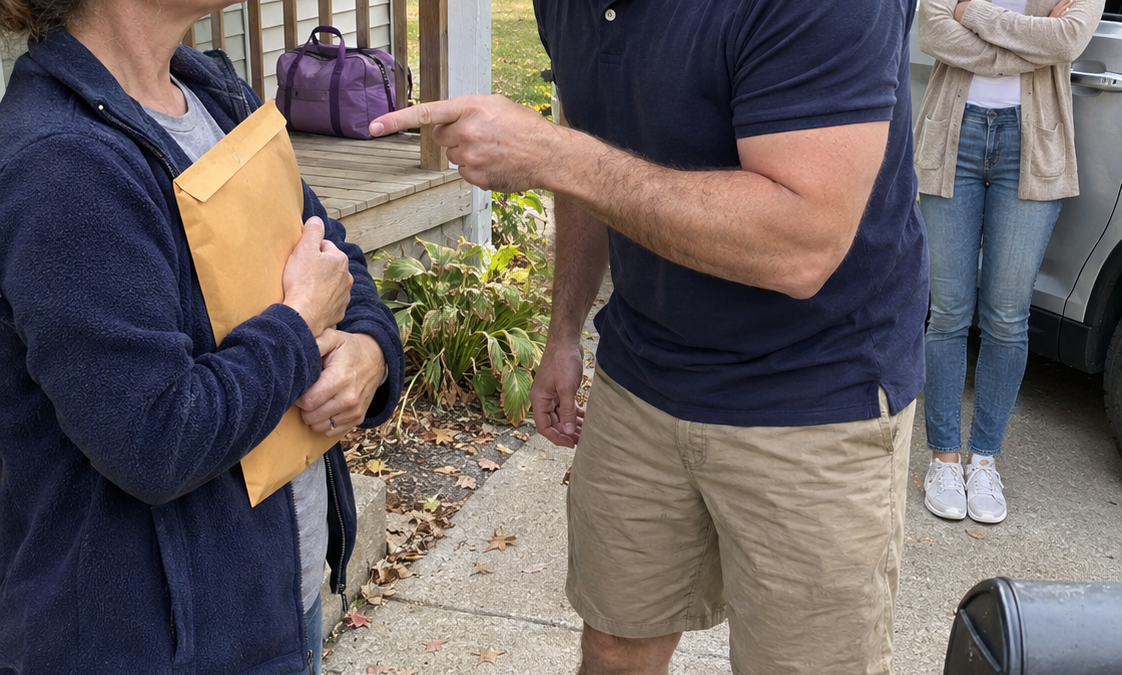
My son stepped out of a silver SUV I had never seen and said, “You drive a bus, Ma. You don’t get to keep my daughter.”
I still had the lawyer’s envelope in my right hand.
At 10:20 that Saturday morning, I had just spun the brass lock on the mailbox to 0-8-1-2. The third dial caught under my thumb, same as it had since a Sunday morning in March. A bright scratch sat beside the shackle. I stood there at the edge of the grass.
Then the SUV rolled into the middle of my driveway.
Wesley looked broader through the shoulders than I remembered. His hair was clipped close now, and dark stubble ran along his jaw.
He stopped two steps from me.
My fingers tightened around the thick paper in my right hand. He looked straight at me as if we had spoken yesterday.
Lauren stood beside the driver’s door. She had one hand resting near the handle and said nothing.
I looked at Wesley, then at the thick envelope. Brad Sowers was printed in the return corner.
I tucked it under my left arm.
“Over, under, over.”
Wesley’s mouth tightened.
“Rubes is coming to Florida. Big house. Lauren’s got a pool. Let’s keep this simple.”
A lawn mower droned somewhere down our Fort Wayne block. The maple leaves along the curb had only started turning at the edges.
I left “simple” sitting there.
The envelope stayed sealed.
Wesley glanced toward my porch as though he expected me to hurry inside and pack something.
I kept both hands empty at my sides.
The kitchen drawer was behind that front door. The Letters were in it, where I had left them.
That was enough for me to stand still.
“She’s next door baking. Do you want to see her?”
That was the only question I asked him.
His eyes moved toward Tracy’s house on the left. Ruby was in her kitchen with the window shut, working on cookies and hearing none of this.
Wesley stared at that house for a moment.
“In court.”
He turned and walked back to the SUV.
Lauren opened her door, then looked at me.
One second.
Her face did not change. She got in and pulled the door shut.
Wesley climbed into the other side.
The vehicle backed toward the street. I watched his profile through the glass until the silver shape cleared the end of the drive.
By 10:35, the block looked ordinary again.
Only after they turned away did I move.
The envelope was still tucked beneath my arm.
Inside, I set it down without breaking the seal.
Then I opened the hall closet.
The purple duffel sat in the corner where it had stayed.
On August 12, 2023, Ruby had carried that purple bag into the bus depot herself, little sneakers scuffing the floor. Wesley stood behind her. “Two weeks, Ma. Just till I get set up in Tampa.”
Then Wesley had driven off, and Ruby had stayed with me.
I shut the closet.
The kitchen was quiet enough for the refrigerator motor to sound loud. On school mornings, Ruby sat at this table at 5:40 while I braided her hair with the purple ties.
I opened the drawer.
The Letters lay flat inside.
I touched the top page with one finger, then closed it again.
A few minutes later, my back door opened.
Picking up where the Facebook post left off
Ruby came in with flour streaked on one sleeve and a folded dish towel tucked against her stomach.
“Grandma?”
“I’m here.”
She stepped into the kitchen and looked at the table.
“What’s that?”
Her eyes had landed on the envelope.
“Grown-up mail.”
She nodded as if that settled it.
“Miss Tracy let me shape the last cookies.”
“How’d they turn out?”
“One looked like Indiana.”
“That sounds edible.”
Ruby grinned and held out her sleeve for inspection.
I brushed one white streak with my fingertips.
“Vanilla?”
“Cookie dough.”
“Good. That washes.”
She put the dish towel on the counter and dusted the rest from her cuff over the sink. Then she told me Tracy was saving some for later and that one had spread until it looked more like a mitten.
I listened.
I did not tell her who had been standing outside.
Wesley had chosen court.
I turned back to the sink and let Ruby keep talking.
I left the envelope where I’d set it for lunch, the afternoon, and supper.
I washed dishes.
Ruby read at the table, turning pages with the careful fingertips she used when she did not want to bend a corner.
Outside, the September light thinned over the porch. A neighbor dragged an empty trash bin up from the curb, its wheels bumping over a seam in the sidewalk.
The locked mailbox stood at the end of the driveway.
Nothing needed answering in front of her.
At bedtime, Ruby called good night from the hall.
“Night, Grandma.”
“Good night, honey.”
Her door clicked softly.
I waited until the house settled.
At 9:30 p.m., I went back to the kitchen table.
Every night, weekends included, I laid out what morning would need.
The comb went first.
Then three purple ties.
Then the allergy pen pouch.
Tomorrow was not a workday, but the routine stayed put.
I straightened the place mat with both hands.
The envelope still lay unopened beside the napkin holder.
I slid it underneath. Wesley had said court, and Brad Sowers’s name was already in my kitchen.
Not tonight.
Part 2 of 9
I tore the envelope open with a butter knife and read my son’s lawyer telling a judge that I leave a nine-year-old alone in the dark.
Sunday night, 8:00 p.m., Ruby was asleep down the hall.
The packet held the petition and a notice of the first court date. Nothing else. No photographs.
Wesley wanted the guardianship ended.
Brad Sowers had written that I worked split shifts, left Ruby alone on the porch before sunrise, and that “Petitioner has remained in contact with the child.”
My thumb pressed into the edge of the paper until the nail went white.
I laid the pages flat.
The porch line was wrong.
Not one school morning in three years had Ruby been alone.
I opened the kitchen drawer and took out the Letters, then the blue ledger underneath them.
Since December 2023, when Social Security chose me as Ruby’s payee, I had written down her eleven hundred dollars every month.
A folded scrap of paper was tucked between two pages.
“813 — Ruby says wrong number?”
I remembered writing that in February after an unknown number called one Sunday evening while I was outside shoveling.
Ruby had answered.
She told me it was a wrong number.
I had dialed it back once, and the line would not take calls.
The line about Wesley staying in contact made me reach for my cell phone.
I scrolled through the call log until I found that Sunday evening.
One call.
Three minutes.
I stared at the 813 area code, then at my note.
Wrong number, I still thought.
I took a screenshot and set the phone near the blue ledger.
The butter knife went into the sink.
I refolded the note and tucked it back where I had kept it, then put the ledger under the Letters. Then I squared the court pages against the Letters and slid both back into their usual place.
The house stayed quiet.
From my chair, I could see the dark window over the sink and the edge of the fridge with the allergy plan taped to it. I left the phone faceup on the table and turned off the kitchen light.
At 5:40 Monday morning, Ruby sat in her usual chair while I stood behind her with the purple ties already looped around my wrist.
Her hair was damp from the comb.
“Hold still.”
“I am holding still.”
“You are reading the refrigerator.”
“That’s still.”
I separated the strands and started the braid.
Ruby tipped her chin toward the sheet on the fridge and read it aloud in the solemn voice she used for poems.
“Cashews. Pen in the front pocket.”
“Correct.”
She reached toward her backpack with one hand.
“Don’t.”
“I’m only reaching.”
“Your shoulder moves the braid.”
Ruby put her hand back in her lap.
At 5:45, Tracy came through the back door and hung her jacket over the chair.
“Morning, kiddo.”
Ruby smiled.
I finished the braid, worked the ties from my wrist into place, and checked her backpack.
The allergy pen pouch was there.
Tracy pulled out the chair near Ruby and sat down.
I put the comb away, zipped my jacket, and looked once at the backpack by her feet.
“See you after school,” I said.
“Okay, Grandma.”
I left for work.
At 10:15, I was in the depot break room with a paper cup of coffee cooling near my elbow when my phone rang.
Erik sat at the next table with the shift board in front of him.
The school office got straight to it.
A man had called saying he was Ruby’s father.
He wanted to know which teacher she had.
The office had refused to tell him.
Then he asked to pick Ruby up Friday.
The school had the Letters on file, so the answer was no.
I put my coffee down.
“No. Nobody but me or Tracy.”
Erik looked over.
The woman on the phone repeated the pickup restriction back to me and said the office would keep it that way.
“Thank you.”
I ended the call.
Erik tapped one finger on the shift board.
“Friday, you’re off at 4:35. Nobody pulls her before that but you. That’s the schedule.”
He went back to the board.
I called Andrea Vega’s office before I touched the coffee again.
The receptionist asked what I needed.
“My son filed to end my guardianship. He called Ruby’s school this morning.”
A pause.
“Can you come tomorrow?”
“Yes.”
“Nine a.m. is the earliest.”
“I’ll take it.”
She told me to bring everything I had saved. I wrote the appointment on the back of an old depot notice and folded it into my pocket.
I texted Tracy: Nobody but you or me picks Ruby up Friday.
Routes got discussed. Chairs scraped. The vending machine hummed against the wall.
I kept my phone faceup.
At home that evening, Ruby finished reading on the living room floor while I sat on the sofa.
She carried her book down the hall when bedtime came.
“Night, Grandma.”
“Good night.”
I heard her door close.
At 8:15 p.m., my phone lit on the cushion next to me. Wesley’s work number. The same number he always used when he texted.
I opened the message.
“Lauren’s dad has pictures, Ma. Six a.m. Your porch. A judge is going to love them.”
Part 3 of 9
“What’s on paper?” the lawyer asked, and I slid three years of my life across her desk.
Andrea Vega pushed her reading glasses up and read my first page without a word.
I had brought the petition, the Letters, and my phone.
“Your son signed the guardianship?”
“Yes.”
“And the school has the Letters?”
“Yes.”
“Who handles mornings?”
“Tracy comes at 5:45. She walks Ruby to before-care at 6:10 and signs her in at 6:12.”
Andrea wrote that down.
“Afternoons?”
“I sign Ruby out at 4:50 after my route.”
“Every school day?”
“Monday through Friday.”
She looked up.
“Good. Facts first.”
She took the case before I left her office.
I paid her twenty-five hundred dollars from my own savings, the kind that didn’t have Ruby’s name on it.
Andrea turned toward the monitor.
“Send me the screenshot.”
I did.
She opened the court file on her computer and frowned.
“Your copy was incomplete.”
“What does that mean?”
“The attachments were filed separately. That’s why they weren’t in the envelope Brad Sowers sent you.”
Her printer started behind her.
Andrea gathered the fresh sheets and put two in front of me.
One was an affidavit.
The other was a picture.
Ruby stood alone on my front porch at 6:05 a.m. with her backpack on.
My fingers flattened against my knees.
Her face was turned slightly toward the street. Her hair looked loose at one side, as if a braid had started to come apart.
At the far edge of the image, the next-door porch steps showed a blue cooler. A screen door stood open behind it.
I saw Ruby.
Only Ruby.
Andrea tapped the affidavit.
“Who is Bruce Mahler?”
“I don’t know.”
“He’s the witness.” Andrea read aloud: “The minor is left alone on the porch in the dark every morning.”
My thumb pressed into my palm.
She turned the sheet toward herself and read a few lines without speaking.
Then she looked at me.
“With a birth father, the law starts on his side. You have to prove, clearly and convincingly, that Ruby is better off with you.”
“What do you need?”
“Records. Routines. People who can say what actually happens.”
“I have those.”
“Then keep them.”
Andrea sent the picture file to my phone. The screen lit in my right hand, and Ruby’s face appeared there again.
I locked the phone and returned it to my purse.
Andrea looked back at the petition.
“Does any money come with Ruby?”
“Her mother’s Social Security. He’s never asked about it once.”
“Then open every envelope the day it comes.”
I looked at her.
She put the court papers into a neat stack and slid them back toward me.
I carried them out with both hands.
The next day, Wednesday, I took my cell phone into a quiet corner of the depot break room at 10:30 and called Social Security.
I asked whether anyone had changed anything about Ruby’s benefit.
Two hours later, after hold music and recorded messages, the call dropped.
I tried the number again.
The earliest appointment at the Fort Wayne office was Wednesday, October 14.
I wrote the date down and put the phone away.
A route clipboard hung crooked on a nail. I folded my scrap of notes and slipped it into my pocket.
I went back to work.
What Andrea read from the affidavit had been sitting in my chest since Tuesday.
On Tuesday, near the end of the appointment, Andrea had turned to the last page of Bruce Mahler’s affidavit.
“There’s one more thing.”
She pointed to the witness information.
The record identified him as Bruce Mahler, of Fort Wayne.
Then Andrea read the relationship he had written himself.
“Father-in-law of Petitioner since March 21, 2026.”
My hand closed on the chair arm.
“Father-in-law?”
“That’s what he wrote.”
I stared at the date.
March 21, 2026.
Lauren was from Fort Wayne.
Her father lived here.
Andrea waited.
“Nine miles.”
“What?”
“Nine miles from my house.”
She said nothing.
My son had married a woman whose father lived nine miles away back in March.
From March 21 until last Saturday, Wesley had not once come to my door to see Ruby.
Andrea turned the affidavit back toward herself.
I took my phone from my purse, looked at the picture she had sent me, then put the screen facedown on my knee.
Six months, not one visit. Then how did he know when I leave my porch?
Part 4 of 9
“When did you last see your daughter, Mr. Fenton?” the judge asked, and my son looked at his lawyer instead of at him.
Eight quiet days had passed since my call to Social Security; I worked my routes and waited.
Judge Keith Lindgren sat above us in the first-floor courtroom.
Wesley and Brad Sowers were at the left table. Andrea and I sat on the right.
Behind them, Lauren sat between Bruce and Diane Mahler.
Sowers stood.
“We’re asking that Ruby stay with her father at the Mahler home every weekend starting now.”
Judge Lindgren looked at Wesley.
“Mr. Fenton?”
Wesley shifted in his chair.
“It’s been a while.”
Andrea did not raise her voice.
“August twelfth, 2023.”
Lauren turned toward her husband.
Bruce folded his arms.
Judge Lindgren glanced down at the papers in front of him.
“I’m denying the temporary request.”
Wesley leaned closer to Sowers.
“I came all this way for this? Let’s keep this simple, Brad. She’s my kid.”
The judge kept going.
“I’m appointing Beth Odom as guardian ad litem. She will speak with Ruby, file a report, and testify at trial.”
He looked from one side to the other.
“Trial is Thursday, October 29 at 9:00 a.m.”
Andrea wrote the date on her legal pad.
I wrote it on the back of my court notice.
October 29.
On Saturday, somebody knocked at my front door.
Diane Mahler stood on the porch holding a cardboard box.
“This is for Ruby.”
She handed it to me and left before I answered.
Inside was the tablet.
Ruby was at the kitchen counter with a glass of milk when I turned it on.
Wesley’s face filled the screen.
“Big house, your own room, a pool. Grandma’s tired, Rubes.”
Ruby watched without moving.
My thumb dug into the edge of the counter.
I pressed the button, carried the tablet across to the refrigerator, and put it on top.
Then I closed my mouth and washed the glass in the sink.
Monday morning at 5:40, Ruby sat in her chair.
I had the comb in my right hand.
The ties waited on the table.
I drew the comb through one section of her hair.
Ruby pushed my hand away.
“Daddy says braids are for babies. He said it on the tablet.”
The comb stopped in my fingers.
“Okay.”
I set it down.
The ties stayed where they were.
Ruby smoothed her hair with both hands and stood.
At 5:45, Tracy came in.
Ruby put on her backpack.
At the back door, she stopped with one hand on the strap.
“Is it my fault you have to get up so early?”
I looked at her.
“No, honey.”
She waited.
“My work starts early. That’s mine.”
Ruby nodded once.
Ruby went back to the table, Tracy poured her a bowl of cereal, and I took my keys off the hook and went to work.
Tuesday, I signed Ruby out at 4:50 and drove home.
At 5:15, Beth Odom arrived carrying a folder and her notebook.
She spoke slowly and wrote by hand.
First she looked at Ruby’s room.
Then the allergy plan on the refrigerator.
Then the ledger.
Beth turned one page, then another, and stopped at the column of numbers, $1,100 in, every dime written out beside it.
“Both sides need to send me proof of address and proof of income within three days of their own interview.”
“All right.”
She made a note.
“After every private talk with a child, I file a one-page appendix with the court listing the questions I asked. The answers stay off that page, and both lawyers get a copy.”
“Both lawyers,” I said. “Good.”
Beth closed her notebook.
“I’d like fifteen minutes alone with Ruby.”
Ruby looked at me.
“On the porch?”
“If you want.”
Ruby nodded.
I stayed inside.
Through the front window, I could see them sitting apart.
Beth held her notebook on one knee.
Ruby sat with both feet on the porch boards.
Beth asked a short question.
Ruby looked toward the yard before answering.
I could not hear a word.
Beth wrote.
Then she asked another.
Ruby rubbed one thumb across the edge of her sleeve.
Beth waited.
There was no pointing, no leaning close, no smile that tried to pull something out of her.
Just a question, then space.
Fifteen minutes later, Beth came inside.
“Thank you, Ruby.”
Ruby gave a small nod.
Beth looked at me.
“I may speak with her alone another time before court.”
“Fine.”
She tucked her notebook under her arm and left.
At 8:30 that night, Ruby sat across from me in the kitchen with her hair still loose.
The comb and the ties were not where I usually left them.
“Grandma?”
“Mm-hm?”
“Ms. Odom says I can talk to her by myself again before court. Can I?”
“Yes.”
Ruby looked down at her hands.
“Even if you’re not there?”
“Yes.”
She rubbed one fingertip along the edge of the table.
Then she spoke so softly I had to stop moving to hear her.
“Grandma, if I tell Ms. Odom something Daddy said not to tell, will you be mad?”
I kept both hands flat in my lap.
“Never.”
Ruby watched my face.
I did not ask another question.
She pushed her chair back and stood.
Then she crossed to the counter, took the comb in one hand and the three ties in the other, and carried them back.
Ruby set them on the kitchen table in the exact spot where I laid them out every night.
Then she went to bed.
Part 5 of 9
Tracy dropped three school years of sign-in sheets on my kitchen table and set her blue lunch cooler right next to them.
Erik sat at the head with a pen in his hand and a blank sheet in front of him.
Ruby was in her room with the door ajar, so I put Andrea on speakerphone and kept my voice low.
Tracy spread the pages into neat piles.
“Same thing every morning,” she said.
I looked at the entries.
“6:12 T. Rinker for R. Fenton.”
Again.
And again.
Every school day.
Tracy tapped one line.
“I get here at 5:45. You leave for the 5:55 shift. I walk her over at 6:10.”
“And you sign her in at 6:12,” Andrea said through the phone.
“Yes.”
Erik kept writing.
Erik was a mechanic at the depot, and he wrote the way he fixed things, short and plain: Rhonda Fenton’s morning route begins at 5:55. Her afternoon route begins at 2:10.
He put the pen down.
“That’s the schedule.”
Beside the school records sat a fresh copy of the allergy plan the nurse had reprinted.
Cashews.
The pen in Ruby’s backpack.
A cashew warning and an allergy-pen note sat on my table between the sign-in sheets and a lawyer’s phone, and none of it belonged there.
I reached for my phone.
My eyes stopped on Tracy’s blue cooler.
I had seen that color somewhere else.
I opened the picture Andrea had sent me.
Ruby stood on my porch at 6:05 a.m., backpack on her shoulder.
I enlarged the right edge.
A blue cooler sat on the next-door porch steps.
Behind it, Tracy’s screen door stood open.
I turned my phone so she could see.
Tracy stared at the picture.
Her hand settled on top of the real cooler.
“I went back for my keys. Forty seconds.”
“What morning?” Andrea asked.
Tracy did not look away from the image.
“Tuesday, September 8.”
My fingers closed around the edge of the phone until the case pressed into my palm.
Andrea’s voice came through the speaker.
“That matters. It shows Tracy was there.”
I set the device down.
“So what happens if the evidence isn’t enough?”
Andrea answered without softening it.
“If the judge isn’t sure, the law sends her to Florida. And if Ruby says she wants the pool, that counts too.”
Nobody spoke for a moment.
Erik looked down at his statement.
Tracy pulled her hand away from the cooler.
I reached for the ledger.
The blue cover had softened at the corners from three years of use. I opened to the latest entries and ran my finger down the amounts I had recorded.
Andrea waited.
“Ruby’s savings have reached $8,750.”
“Any of that spent on you?”
“No.”
“Any household bills?”
“No.”
“Anything that wasn’t hers?”
“Not a cent.”
Tracy’s eyes moved from me to the open book.
Erik folded his statement once.
Andrea said, “Good. Bring the ledger when I ask for it.”
I closed the cover.
Tracy looked at her cooler, and Andrea hung up.
Tracy gathered the papers together and slid them toward me.
Erik put his signed statement on top.
I laid the reprinted allergy plan with the rest.
The cooler stayed by Tracy’s elbow.
The enlarged picture remained open on my phone, with that blue rectangle sitting at the edge where I had failed to see it before.
Thursday afternoon, I signed Ruby out at 4:50.
At 4:55, we reached the end of my driveway.
Ruby had her backpack over one shoulder.
I stopped at the mailbox and turned the lock.
The third dial stuck under my thumb again, the way it had every day since March.
I worked it loose.
Ruby leaned closer.
“Let me.”
The shackle had already popped open.
“Got it.”
I pulled out the stack inside and closed the box.
“Here.”
Ruby held out both hands.
I gave her the mail, and she hugged it against her sweatshirt.
There were grocery flyers mixed with white envelopes and one folded piece that had caught at the corner.
My jacket pocket started ringing.
Ruby looked at me.
“Your phone.”
“I hear it.”
I took the phone out with my right hand.
The number was local.
“Hello?”
A woman said my name.
“This is the Social Security office in Fort Wayne.”
I looked at Ruby.
She shifted the stack higher against her chest so none of it slipped.
The caller continued.
“I’m glad I caught you before I leave.”
My left hand stayed on the open mailbox door.
“Yes?”
“We’ve received a request to change who receives Ruby’s benefits. I need to verify where she lives.”
The woman paused.
“Is Ruby living with you, or with her father?”
Ruby stood beside me with her backpack on one shoulder and the afternoon mail pressed to her chest.
I looked straight at her.
“She’s standing next to me.”
Part 6 of 9
The morning after Social Security called, Andrea mailed them a copy of the court’s letters and a page in my own words.
I sat in my car at the depot parking lot at 8:50, my morning run done, with Andrea on the phone. My thermos was in the cup holder, my route sheet folded beside my knee, and my left hand rested on the steering wheel.
“Ruby has lived with me since 2023,” I said.
“That’s in there.”
I looked through the windshield at the rows of parked buses.
“And I object to changing the payee.”
“I put that in plain language too.”
I rubbed my thumb along the stitched edge of the wheel. “Good.”
Later, Beth Odom filed her report. Where her recommendation should have been, one line appeared: “Reserved until after my second interview with the child.”
I stared at those words until my phone buzzed.
Wesley had texted. “Looks like Ms. Odom isn’t buying your story, Ma.”
I put the phone facedown on the passenger seat.
For eighteen days, I worked both routes, checked Ruby out at 4:50, packed papers into her backpack, laid out the comb and ties each night, watched October leaves collect along the curb, and crossed off each square on the calendar as the trial date came closer.
Tuesday night at 9:00, another message came from Wesley.
“Pack her purple bag, Ma. Same one.”
I sat on the living room sofa and looked across the hall at the closed closet door. The duffel was inside.
I set my phone on the cushion and left his message unanswered.
Wednesday afternoon, I sat on a hallway bench outside Beth’s office while Ruby met with her alone. The door stayed shut.
For thirty-five minutes, I heard no voices or chair legs through the wood, so I kept both hands folded over my purse strap, loosened them when my fingers went stiff, then lined my thumbs along the seam and started over. A copier clicked somewhere down the hall. Shoes passed on the tile and faded toward the elevators.
At 4:35, the handle turned.
Beth came out first with her notebook tucked against her side. Ruby followed, walked straight to me, and took my hand.
“I told her the secret one too.”
My fingers closed around hers. “Okay.”
I did not ask what she meant.
That evening Andrea told me Beth had filed the one-page appendix listing the questions she asked Ruby, without the answers, and both lawyers had received copies.
Thursday morning, the courtroom was full before Judge Lindgren took up our case. Chairs scraped, the court reporter adjusted paper at her station, and the bailiff spoke quietly near the rail while a clerk moved files from one end of the room to the other. Four people waiting for the next case sat along the back row, shifting coats and knees whenever someone passed.
I counted eighteen people in that room.
Brad Sowers had the photo enlarged on an easel beside the stand. Ruby’s face was big enough to see from anywhere.
Wesley sat under oath and pointed toward the picture. “She works split shifts, Your Honor. She leaves a nine-year-old on a porch in the dark. I’ve stayed in Ruby’s life. I call her.”
My thumbnail pressed once against the edge of the papers in my lap.
Brad turned toward the judge. “A fifty-five-year-old woman driving a bus at dawn is not a plan for a child.”
Andrea did not look at me. She wrote one line on her legal pad, capped her pen, and set it beside the folder in front of her.
At 10:00, she called Tracy Rinker.
Tracy sat down, raised her hand, and answered plainly. “I come to Rhonda’s house at 5:45 every school morning. I walk Ruby to before-care at 6:10 and sign her in at 6:12.”
Andrea asked the clerk to mark one page from my stack of sign-in sheets, then held it up. “What happened Tuesday, September 8, 2026?”
“I forgot my keys. I went back inside for them.”
“How long?”
“Forty seconds.”
Sowers asked, “So Ruby was alone?”
“She was on Rhonda’s porch while I went through my own screen door for my keys.”
Andrea called Erik next.
He gave my morning and afternoon shift times in one sentence. Then Andrea asked about August 12, 2023.
Erik looked at Wesley before answering. “Route-bidding day at the depot. I saw Wesley bring six-year-old Ruby and her purple duffel in to Rhonda, then drive away.”
“Did you see him come back?”
“No.”
“That’s all.”
Erik left the chair and took his place in the row near Tracy.
The enlarged picture remained beside the empty seat. Judge Lindgren looked down at his notes while Brad whispered something to Wesley. Lauren sat very still in the row behind him, and Bruce kept both arms folded across his chest.
Andrea gathered her papers and squared the corners against the tabletop.
Then the judge raised his eyes.
“Mrs. Fenton.”
I stood.
The sign-in sheets were in my right hand. I tucked them under my left arm and walked toward the witness stand.
I passed the easel with my granddaughter’s picture on it.
Then I took the stand, and the microphone was already warm.
Part 7 of 9
“You drive a bus, Ma. You don’t get to keep my daughter,” I said into the microphone, because those were the first words he’d said to my face in three years.
I held the sign-in sheets against my lap.
“I do drive a bus. Look at the right edge of that picture.”
I pointed toward the enlarged photo.
A blue cooler sat on Tracy’s porch steps. Her screen door stood open behind it.
“Tuesday, September 8. She wasn’t alone on that porch. Tracy was next door with her door open.”
I lifted the first sheet.
“6:12, T. Rinker.”
Then the next.
“Same entry every school day.”
Tracy had already told the judge about going back for her keys. Forty seconds.
At Wesley’s table, Brad Sowers stopped writing.
My son looked at the easel, then down at his hands.
Andrea handed a copy of the sheets to the clerk and asked me two more questions about the morning routine. I answered both and stepped down.
Back at the right-hand table, I placed the sign-in sheets under my folder and sat beside her.
Andrea rose.
“Mr. Fenton, back on the stand, please.”
Wesley returned to the chair and faced her.
Andrea did not hurry.
“What is the name of Ruby’s teacher?”
His eyes shifted toward Brad.
“Mrs.… I’d have to check.”
Andrea waited, then asked the next one.
“What is Ruby allergic to?”
Wesley rubbed his thumb along the edge of the witness rail.
“Strawberries?”
A pen stopped scratching somewhere behind me.
Andrea’s voice stayed level.
“Who braids her hair every morning?”
Wesley looked toward the ceiling for a second.
“She does her own, I’d guess.” Over, under, over. My fingers worked the beat against my knee before I could stop them.
Andrea sat down.
Beth Odom was called next.
She carried her notebook to the stand and took the oath. The photo stayed on the easel several feet away, Ruby’s face turned toward the street.
Beth opened to a marked page.
Brad stood.
“Objection, Your Honor. This is a surprise.”
Judge Lindgren looked at him.
“The appendix listing these questions was filed and served on both lawyers last night. Mr. Sowers may review Ms. Odom’s notebook after she testifies. Overruled.”
Brad lowered himself into his chair.
Beth read slowly.
“I asked Ruby the name of her teacher.”
She looked at the writing in front of her.
“Ms. Adebayo.”
Beth moved to the next entry.
“I asked what she is allergic to.”
Her finger followed the line.
“Cashews. The pen is in the front pocket of my backpack.”
The room stayed still.
Beth continued.
“I asked who braids her hair every morning.”
She read Ruby’s answer exactly.
“Grandma. Five-forty. Purple ties.”
Behind Wesley, Lauren lowered her eyes.
Bruce shifted at the far end of the row and uncrossed one ankle from the other.
Beth turned a page in her notebook.
“During the second interview, Ruby also told me her father called her exactly once.”
Andrea stood.
“When?”
“In February.”
“What did Ruby say the call was about?”
Beth checked her notes.
“She said her daddy asked for the code to Grandma’s mailbox and told her not to tell Grandma.”
My hand stopped beside my folder.
Andrea did not ask whether Ruby had given him the code.
Instead, she opened the folder in front of her and removed the printed call log.
“Sunday, February 15, 2026. 7:40 p.m. Three minutes.”
She handed it toward the clerk.
“Your Honor, I’d ask that this be marked as Respondent’s Exhibit 3.”
Judge Lindgren allowed it.
Andrea looked across the aisle.
“Mr. Fenton, I’ll ask you to come up once more.”
Wesley took the chair again.
She waited until he was settled.
“Did you make that call?”
“Yes.”
“Why did you ask Ruby for the mailbox code?”
Wesley answered quickly.
“I wanted to mail her a surprise. That’s all the call was.”
Judge Lindgren leaned slightly forward.
“Did you mail anything?”
Wesley’s right hand rested on the rail.
His index finger bent once against the wood.
He did not answer.
Andrea gave the silence room.
Then she asked, “This custody case has nothing to do with Ruby’s money?”
Wesley looked straight at her.
“This was never about money. I don’t want one dime of hers.”
Andrea said, “Nothing further for now,” and Wesley walked back to the table beside Brad. Then she turned toward Beth.
“Ms. Odom, you remain under oath?”
“Yes.”
Judge Lindgren allowed Beth to answer from the chair beside the clerk’s desk.
Beth held her notebook in one hand and lifted the form copy with the other.
“On October thirteenth you told me you hadn’t applied for anything. Two days later you sent me this as proof of your Florida address.”
She looked at Wesley.
“Brandon office, September seventeenth. Request to be Selected as Payee. Your name, your Brandon address, your signature.”
Brad’s hand moved toward his client, then stopped short of touching him.
Beth kept the form raised.
“His lease and the utility bills in Brandon are in his wife’s name, so this was the only page he gave me with his own name on that address.”
Lauren stared at the back of Wesley’s head.
She stayed that way for a long moment.
Then she spoke from directly behind him.
“You told me that appointment was for her school records.”
Wesley turned halfway around.
Lauren was already standing.
She stepped past the empty chair beside her and moved down the row. Diane shifted over. Lauren sat between her mother and Bruce.
No one stopped her.
Judge Lindgren looked at Wesley.
His voice was quiet.
“Ruby answered all three questions, Mr. Fenton. You answered none.”
Part 8 of 9
The judge didn’t take a recess; he denied the petition while my son was still holding the edge of the table.
Judge Lindgren looked once at the papers in front of him.
“The petition is denied. Mrs. Fenton remains Ruby’s guardian. Any time Mr. Fenton sees Ruby will begin with supervised visits ordered by this court, with Ms. Odom reporting back. Ms. Vega may send the court’s order to Social Security.”
Wesley’s fingers slipped from the tabletop and settled in his lap. Brad Sowers closed his folder.
I put both hands around the strap of my purse to keep them still. My shoulders came down an inch, then another.
The court reporter stopped typing. The bailiff opened the rail, and chairs moved behind us as the four people waiting for the next case began gathering their things. The clerk handed Andrea the signed order. She checked the first page and slipped it into her folder.
I stood when she did.
At 11:50, we stepped into the first-floor hallway. The courthouse had emptied enough that shoes carried against the tile. The four waiting outside stood along the wall now, their papers held against coats and shirtfronts.
Lauren and Diane were near the exit doors.
Wesley sat alone on a wooden bench with his elbows on his knees. Bruce stood directly in front of him.
“That five thousand I gave Sowers? You’ll pay it back. Every cent. You told me she was alone on that porch.”
Wesley looked up.
“Let’s keep this simple.”
Bruce gave one short shake of his head.
“No.”
He turned away.
Andrea walked beside me with her folder under one arm.
“I’ll get a copy to the Social Security office this afternoon.”
“All right.”
Lauren bent, picked up her purse, and slipped the strap over her shoulder. Diane moved toward the exit with her, and Bruce joined them before they reached the doors.
Lauren did not look back.
Wesley stayed where he was, his hands hanging between his knees. Andrea and I passed him without slowing.
I kept walking.
At 4:55, I was back at the end of my driveway.
I had taken the whole day off for the trial, so Tracy had picked Ruby up after school. Ruby came across from next door with her backpack over one shoulder while Tracy sat on her own porch steps.
A few dry leaves had gathered where the driveway met the grass.
Ruby bent to retie a sneaker a few steps back. Tracy lowered her voice. “Are you going to tell her about the money?”
“Not today.”
She looked toward the street and gave a small laugh, almost to herself.
“Forty seconds. I went back for forty seconds.”
I turned to the mailbox and rested my left hand against the metal door.
The brass four-dial lock was cool against my right palm. I began turning the numbers.
The third dial caught.
I worked it with my thumb. Same little hitch it had given me every day since March.
Ruby stopped beside me.
“Daddy asked me the code.”
Beth had read that much aloud from her notebook that morning. I had not heard it in Ruby’s own voice.
She shifted the backpack strap higher on her shoulder and watched the brass piece in my hand.
“I told him Mommy’s birthday. Oh-three-one-four. That’s not it.”
The driveway disappeared for a second behind another Sunday morning.
March 22, 2026.
Seven in the morning.
The morning after a wedding I would not learn about until I read Bruce Mahler’s affidavit. His daughter had married my son nine miles from my house.
That Sunday, I had walked down in my robe to get Saturday’s mail.
The numbers were twisted away from where I had left them. I tried the combination.
The third dial stuck under my thumb.
A bright scratch marked the brass beside the shackle.
I remember bending close enough to see the mark while cold air slipped through the front of my robe. The box had stayed shut.
Saturday’s mail was still inside, untouched. Among it was an envelope from Social Security addressed to me as Ruby’s payee.
I had carried everything inside and blamed kids.
Now, standing in the same place, I looked at the scrape again.
It could only have been him.
Ruby shifted her weight from one sneaker to the other.
“Ours is the day I came. Eight-twelve. That one’s just ours.”
I looked at her. She was watching my hand, waiting.
Across the grass, Tracy stayed seated on her steps. A car passed at the end of the block and the sound faded toward the next corner.
I put my thumb back against the brass.
Ruby reached over.
“Let me.”
She moved my hand away gently, and I let my arm fall to my side.
Ruby turned the first dial.
Zero.
Her fingertip moved to the next.
Eight.
Then one.
Then two.
0-8-1-2.
The shackle released with a small click.
Ruby lifted the lock free and held it in one hand while I opened the mailbox with my left.
The day’s mail sat inside.
She handed me the brass piece first. I closed my right hand around it, and Ruby reached in with both of hers.
She gathered the envelopes and flyers, straightened their edges against her sweatshirt, and passed the stack to me.
Then she looked up.
“I didn’t tell. I kept it ours.”
Part 9 of 9
At five-forty the next morning, Ruby was already at the kitchen table with three purple ties lined up in front of her plate.
She slid them toward me.
“Braids. Tight ones.”
I stood behind her chair with the comb in my right hand.
“Changed your mind?”
“Maybe.”
I worked the first section smooth and divided it with my fingers.
Ruby watched my hands in the dark window over the sink.
“Over,” she said.
I crossed one strand.
“Under.”
Another.
“Over.”
By the time Tracy came through the back door at 5:45, both braids were tight and even.
“Morning, kiddo.”
Ruby touched one and grinned.
I set the comb by the sink and checked her backpack before I put on my jacket.
She was ready before I was.
Two weeks later, on Friday, November 13, the light was already going gray when Ruby and I came in at ten past five.
Ruby had opened the lock at the mailbox that afternoon, the same job she had claimed every day since October 29. She carried the mail inside and placed it near my elbow before hanging her backpack on its hook.
One white envelope was from Social Security.
I opened it at my usual place while Ruby peeled an orange across from me.
The letter was routine.
I remained Ruby’s representative payee.
Nothing changed.
The letter never mentioned Wesley. It didn’t have to.
I folded the paper once and put it with the rest of her records.
Then I brought out the ledger.
Ruby wiped her fingers on a napkin and leaned closer.
I opened to the newest line.
“$9,000,” she read.
“That’s your savings.”
She looked at me.
“All of it?”
“Every dollar in here is yours. I just write it down.”
Ruby traced the number with one fingertip without touching the ink.
“So I have to learn to do that too?”
“Someday.”
“Your writing or the money?”
“The money. Save yourself from my handwriting.”
She smiled and went back to her orange.
I closed the ledger and returned it to its place.
By mid-November, Wesley had not asked Ms. Odom for a single visit.
On Thanksgiving at 1:00, Tracy sat at one side of my dining table and Erik sat across from her, with turkey, mashed potatoes, green bean casserole, and rolls between us.
Ruby was in the hallway packing the duffel for a sleepover at Tracy’s the next night.
She had pulled the purple bag from the closet herself.
“Grandma, where’s a marker?”
“Kitchen drawer.”
Tracy pointed with her fork.
“Look at that. Three years you’ve been babysitting Wesley’s girl, and now she packs her own suitcase.”
I set the serving spoon back in the potatoes.
“Raising your grandbaby isn’t babysitting that ran long. It’s the whole job.”
Tracy’s fork stopped halfway to her plate.
“Well.”
From the hallway came the squeak of the zipper.
Erik reached for a roll, broke it in half, and said nothing.
That was Erik.
Ruby came back carrying a marker in one hand and the name tag in the other.
She went back to the hall table.
RUBY.
Big block letters.
She capped the marker and held the tag up.
“Now Tracy can’t steal it.”
Tracy pressed a hand to her chest.
“I’ve been exposed.”
“You have your own bags.”
“Not purple ones.”
Ruby carried the tag back to the hallway and fastened it to the duffel.
I could see the bag from my chair.
The same one she had brought into the depot when she was six.
Now she was packing it because she wanted to spend one night next door.
When she returned, Erik slid the basket of rolls toward her without a word.
Ruby took one.
“Thanks.”
He gave her a small salute with his fork.
Tracy asked whether she had packed pajamas.
“Yes.”
“Toothbrush?”
“Side pocket.”
“Book?”
Ruby stopped chewing.
Then she got up and went back to the hall.
Tracy laughed into her napkin.
I cut another piece of turkey.
Outside, dry leaves moved along the curb in the November wind. The mailbox stood at the end of the driveway, brass lock closed against the cold.
After we ate, Ruby carried plates to the kitchen two at a time.
Tracy dried while I washed.
Erik took the empty serving bowls to the counter and lined them up without being asked.
The duffel remained in the hallway with RUBY printed on the tag.
That Thanksgiving morning, ahead of the turkey and the packed bag and the dishes, Ruby had been awake at 5:40 again.
I sat with my coffee while she stood behind my chair.
The three ties circled her wrist.
She drew the comb carefully through the back of my hair.
“Too hard?”
“No.”
She separated three sections with both hands.
I stayed still.
“Over,” she whispered.
Her fingers crossed the strands.
“Under.”
She worked slowly, stopping once to smooth a piece near my ear.
“Over.”
The kitchen was quiet except for the refrigerator motor and the faint scrape of the comb when she set it down.
These days, some mornings, she braids mine.
THE END
More stories
My brother pointed at me and claimed half the cabin I built on my $24,600 lot, hoping to silence my vote—Then someone he trusted stood up, and the sale failed.My daughter-in-law moved my bed into the sewing room, earned $2,317.40, and mocked my night shifts at her shower—Until a suitcase-carrying woman rang the bell and her guests fell silent.My sister seated a notary across from my 79-year-old dad’s empty chair on the dinner train, expecting his signature—Then he walked in as conductor and she almost forgot to hand over her ticket.My Sister-in-Law Gave Me the Room Next to the Dryers at a Reunion on My Credit Card, Then Accused Me of Running Up the Spa Bill While I Was Out on the Lake.A toddler could sew better than that, my daughter-in-law mocked my quilt, then paid $1,630 to replace me—until a fire captain lifted its crooked corner, silencing her while the money stayed lost.Go on home, my dad said at our store’s 50th anniversary while handing my sister the keys—But someone they had overlooked stood between her and $185,000 in spa funding.








