At Thanksgiving, My Son Told 27 Relatives His Wife Stole My House Key—Then He Asked Me to Support a Story I Knew Was False
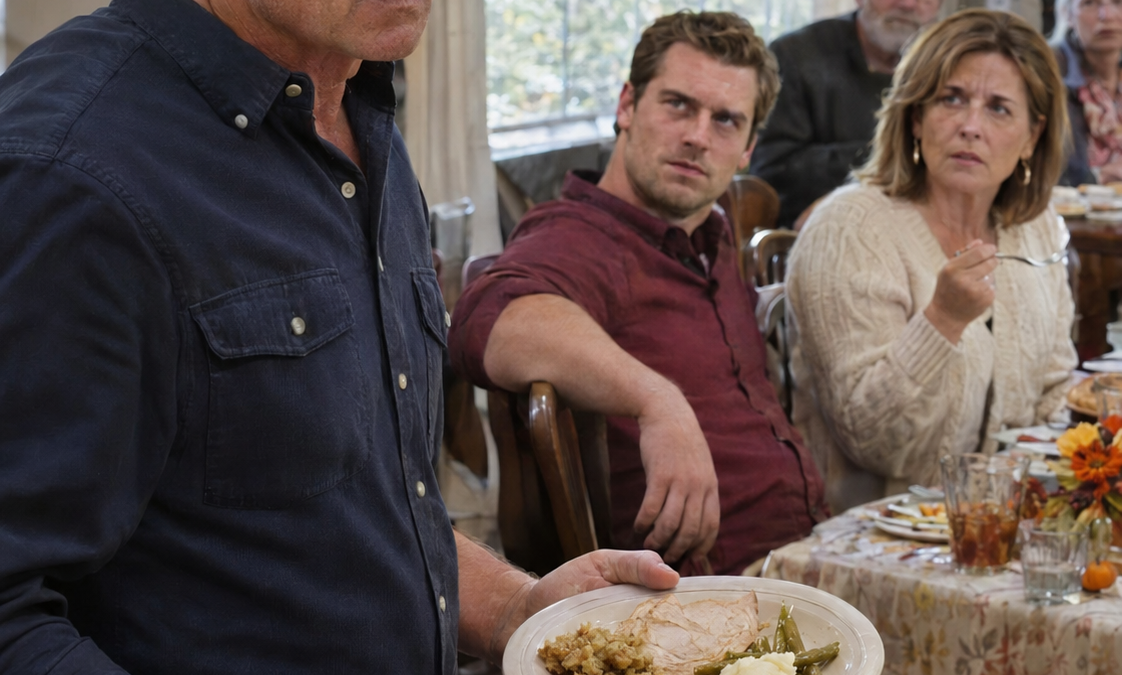
Complete story · 8 parts · about 39 minutes · ending included
Part 1 · Part 2 · Part 3 · Part 4 · Part 5 · Part 6 · Part 7 · Part 8
Part 1 of 8
“She stole Dad’s spare key.”
My son said it loud enough to stop three conversations at once.
I was standing at the end of the Thanksgiving buffet with a serving spoon in my hand and gravy cooling on my plate. Wes sat halfway down the joined tables, one arm hooked over the back of his chair. His face had that controlled, reasonable look he wore when he wanted everyone else to believe he was the calmest person in the room.
Across from him, Deena stopped cutting her turkey.
“What do you mean, stole it?” my sister asked.
Wes looked at me before he answered.
That was the part I remembered most clearly from last Thanksgiving.
Not his words.
The look.
He was giving me a chance to agree.
“She has a key to his house,” Wes said. “Dad didn’t give it to her.”
My fingers tightened around the spoon.
I knew exactly which key he meant.
Brass. Slightly worn around the teeth. A small red plastic tag through the ring.
I had put that tag on it myself because I kept several spare keys in the maintenance drawer at home, and after thirty years of opening storage rooms, utility closets, kitchens, and meeting rooms at the community hall, I had learned that unlabeled keys eventually became useless little mysteries.
Four days before Thanksgiving, I had taken that brass key from my own hand and placed it in Mara’s.
I could still see the red tag against her palm.
I could still hear myself telling her, “This opens the side door. Lock it behind you.”
So when Wes said she had stolen it, I did not wonder whether he was mistaken.
I knew he was wrong.
The room did not explode. Families rarely work that neatly.
My brother-in-law kept passing rolls. Somebody at the far table asked for sweet tea. One of my cousins leaned toward another and whispered something I couldn’t hear.
But the air around Wes changed.
People started listening.
Deena looked at me.
“Gordon?”
I set the serving spoon down.
Wes spoke before I could.
“She isn’t even here to explain herself.”
That made several heads turn toward the empty place where Mara might ordinarily have sat.
She had not come to lunch.
I knew why she had chosen not to.
I also knew more than I had permission to tell.
That was the trap.
I could correct one lie with five words.
I gave her the key.
But I was afraid that once I opened my mouth, Wes would start asking why.
Why had Mara needed access to my house?
Why had she come by without him?
Why had she wanted something kept where he could not reach it?
Those answers did not belong to me.
For years, I had mistaken knowing when to stay out of my son’s marriage for being a good father.
That Thanksgiving, I was beginning to understand there was a difference between respecting privacy and helping a lie stand up.
Wes pushed his chair back an inch.
“Dad, tell them.”
Picking up where the Facebook post left off
He did not say what he wanted me to tell them.
He didn’t have to.
I looked down at the gravy spreading into my dressing.
Then I looked at the empty chair.
Four days earlier, Mara had stood in my kitchen holding a sealed grocery bag against her coat and asked me a question that had made me uncomfortable before I even understood why.
“Can I leave this here for a few days?”
That was how it had started.
Not with a stolen key.
Not with some dramatic midnight arrival.
Just Mara at my back door on a Sunday afternoon, her hair pulled back, a sealed bag in one hand, and a tiredness in her face I had trained myself not to examine too closely.
At the Thanksgiving table, Wes was still waiting.
So was Deena.
I opened my mouth.
And for the first time in years, I realized that whatever I said next could cost me something with my son.
Four days earlier, I had not understood that yet.
I had only opened the door.
Mara had stood on the step and glanced once toward the driveway before coming inside.
“You expecting Wes?” I asked.
“No.”
She answered too quickly, then softened it.
“No. He’s busy.”
I moved aside.
The bag she carried was one of those thick reusable grocery bags with the top folded over and taped shut. Nothing showed through it.
I did not ask what was inside until she set it carefully beside the kitchen chair.
“You moving out?”
Her eyes lifted to mine.
“No.”
That answer came firmly.
“I’m not asking to live here either.”
“I didn’t say you were.”
“You were about to.”
She was right.
I was.
Mara had always been able to hear the rest of a sentence before I decided whether to say it.
I pulled out a chair.
She stayed standing.
“I need somewhere to keep a few clothes and some personal papers,” she said. “Just temporarily. Somewhere locked.”
That last word bothered me.
“Locked from what?”
She looked toward the hallway.
“From Wes.”
The refrigerator hummed behind us.
Outside, a pickup went past on the road.
I remember those ordinary sounds because for a few seconds I concentrated on them instead of answering her.
Wes was my son.
Mara was his wife.
And I had spent years finding harmless explanations for things that did not always feel harmless.
“He likes to know where things are,” I said.
Mara gave a small nod.
“Yes.”
There was no agreement in it.
Only recognition.
I rubbed my thumb along the edge of the table.
“Is this something I need to talk to him about?”
“No.”
Her answer was immediate.
Then she added, “Please don’t.”
That should have told me how serious the request felt to her.
Instead, I stood there searching for a version of the situation that would require less from me.
I had gotten very good at that.
Part 2 of 8
I had a locked cupboard in the small room off my garage.
It was nothing special. Metal doors, two shelves, a stiff latch I kept oiled because the building where I worked had taught me what happened when people ignored hinges until they failed.
I stored old tax folders there, the deed to my house, spare checks, and a few things I did not want drifting into ordinary drawers.
When I told Mara she could use part of the bottom shelf, her shoulders dropped slightly.
Not relief exactly.
More like she had stopped bracing for an argument.
“I don’t need much room,” she said.
“You already said that.”
“I know.”
She looked down at the sealed bag.
“I just want to be clear.”
That phrase stayed with me.
Mara had become very careful about being clear.
I noticed it then because of how often Wes complained that she was vague.
He said she forgot what they had agreed to.
She said she had not agreed to things he claimed she had.
I had treated those disagreements as marriage noise.
Every couple had their habits, I told myself.
Every couple had ways of irritating each other.
That was the shelf where I put anything I did not want to inspect.
I carried the bag to the garage room. Mara followed me but did not ask me to open it.
I didn’t.
She had said clothes and personal papers. That was enough.
I placed it on the bottom shelf.
“Anything in there I need to worry about?”
“No.”
“Nothing perishable?”
That made her smile for the first time.
“No sandwiches, Gordon.”
“Good. I run a respectable cupboard.”
The smile disappeared almost as quickly as it came.
I closed the metal doors and turned the key.
Mara watched my hand.
Then she said, “Could I get to it if you’re at work?”
I looked at her.
My workdays started early when the hall had events. Thanksgiving week was busy with floor setups, kitchen inspections, folding chairs, clogged sinks, and people discovering at the last minute that they needed extension cords they had not requested.
“I can leave it somewhere for you.”
She hesitated.
“What?”
“Nothing.”
“Mara.”
She rubbed the side of her thumb with one finger.
“If you leave a key outside, Wes may find it.”
There it was again.
Not anger.
Not accusation.
A practical sentence, delivered like she was discussing rain.
I leaned against the workbench.
“Does he go through your things?”
She took a moment.
“Sometimes.”
“For what?”
“Receipts. Mail. My bag.”
I waited.
She added, “He says married people shouldn’t need privacy.”
I had heard Wes say something close to that before.
Months earlier, at a Sunday supper, Mara had been looking for her phone. Wes pulled it from his pocket and handed it over.
“You left it on the counter,” he had said.
Mara stared at him.
“I left it in my purse.”
Wes laughed.
“Same difference.”
I had laughed too.
Not because it was funny.
Because laughing had ended the moment.
Standing beside that cupboard, I remembered it.
I remembered other things.
Wes asking why Mara needed her own checking account when they were married.
Wes answering questions directed at her.
Wes calling twice during one of her visits to Deena’s house and making a joke the second time about “checking whether she’d defected.”
Each example had been small enough to excuse by itself.
I had done exactly that.
“He worries,” I said now.
Mara’s face changed.
Not dramatically.
That almost made it worse.
She just looked tired.
“I know you love him.”
I straightened.
“That isn’t what I said.”
“No. But it’s usually what people mean when they explain him to me.”
I had no answer for that.
She did not ask me to take sides.
She did not tell me Wes was dangerous.
She did not hand me a list of charges against my son.
She just stood beside a sealed bag she wanted behind a lock he did not control.
That was enough information for the decision in front of me.
I went back into the house and opened the drawer where I kept spare keys.
There were three on rings.
I picked up the brass one with the red plastic tag.
“This opens the side door,” I told her.
She stared at it.
“You sure?”
“Yes.”
“I’ll give it back.”
“I assumed you would.”
“I mean as soon as I don’t need it.”
“Mara.”
She looked up.
“You asked permission. I’m giving permission.”
I held out my hand.
She took the key.
The brass disappeared into her palm, but the red tag stuck out between her fingers.
That was the image that came back to me at Thanksgiving when Wes said she had stolen it.
Not evidence in some grand sense.
Just memory.
My own hand.
Her hand.
A simple agreement.
Before she left that Sunday, I asked where she was going.
She paused with her fingers on the door handle.
“I’m not staying here.”
“I know.”
“And I’d rather you not ask where I’m staying right now.”
That landed harder than I expected.
“You think I’d tell Wes?”
She turned around.
“I think he’d ask you.”
I felt defensive immediately.
“I can tell my son no.”
Mara did not argue.
She just said, “Okay.”
That quiet answer bothered me all evening.
Because I could hear what she had not said.
Then prove it.
The next morning, I went to work before sunrise and spent an hour resetting tables somebody had left crooked after a weekend rental.
I measured the aisles twice.
Straightened chair legs.
Checked door latches.
Replaced a burned-out bulb above the side entrance.
At work, a boundary was simple.
This room stayed locked.
That exit stayed clear.
This key belonged to that door.
At home, I had spent years pretending boundaries became rude when they involved family.
Tuesday evening, Wes called.
He did not ask how I was.
He did not mention Thanksgiving.
His first question was, “Has Mara been over there?”
I looked toward the garage door.
“Yes.”
Silence.
Then, “Why?”
“You’ll have to ask her.”
Another silence.
This one colder.
“You’re my father.”
“I know who I am.”
“Then don’t play games with me.”
I gripped the phone tighter.
“I’m not playing anything.”
He breathed out through his nose.
“Did she take your spare key?”
I should have corrected him right then.
The answer was ready.
No. She didn’t take it. I gave it to her.
Instead I asked, “Why are you asking?”
Wes gave a short laugh.
And in that small delay, I handed him room to build a story.
Part 3 of 8
By Wednesday, Wes had turned my hesitation into something useful to him.
He came to my house after work without calling first.
I was in the garage wiping dust from a folding hand truck I sometimes used when I brought supplies home from the hall. The overhead door was open halfway, letting in cold gray light.
Wes ducked under it.
“You got a minute?”
“You’re already here.”
He ignored that.
He looked toward the door leading into the house, then toward the small locked room.
I noticed the glance.
That bothered me more than I wanted to admit.
“Where’s Mara?” he asked.
“I don’t know.”
That was true.
I knew she was not staying with me.
I knew she had arranged somewhere else to sleep.
I did not know where, because she had asked me not to ask.
Wes folded his arms.
“She took off.”
“She left your house.”
“That’s what I said.”
“No. It isn’t.”
His jaw tightened.
There had been a time when correcting Wes over one word would have seemed petty to me.
That week, words were becoming the whole problem.
Took off.
Stole.
Crazy.
Secretive.
Unstable.
Each one pushed the story a little farther in the direction he wanted it to go.
“She’s got your key,” he said.
“Yes.”
His eyes sharpened.
“So you know.”
“I know she has it.”
“She went through your stuff?”
“No.”
“How do you know?”
“Because I do.”
Wes stepped closer.
“Dad, she took a key from you.”
“No.”
That was my first clear correction.
He blinked.
“No?”
“I gave her the key.”
The garage went quiet.
A few leaves scraped across the driveway outside.
Wes stared at me as if I had switched languages.
“You gave it to her.”
“Yes.”
“Why?”
I had known that question would come.
“She asked for access to my house.”
“That’s not an answer.”
“It’s the answer you’re getting.”
His face flushed.
“What is she doing here?”
“She isn’t living here.”
“You just said she needs access.”
“I did.”
“For what?”
“That’s between Mara and me.”
He laughed once, without humor.
“Unbelievable.”
I set the rag down.
“What’s unbelievable?”
“My own father helping my wife sneak around behind my back.”
“That isn’t what I said.”
“It’s what you’re doing.”
There was the old invitation.
The one I had accepted for years.
Calm him down.
Explain him to himself.
Find the softer version.
Tell him I understood why he was upset.
I almost did it again.
Instead I said, “You need to stop telling people she stole that key.”
Wes stared at me.
“I haven’t told anybody.”
“Good. Then there’s nothing to stop.”
He looked away.
That should have warned me.
“Thanksgiving’s tomorrow,” he said.
“I’m aware.”
“People are going to ask why she isn’t there.”
“Tell them she couldn’t come.”
“That makes me look like an idiot.”
I felt something sink in my chest.
Not because I suddenly understood Wes.
Because I understood how much of my own behavior had been built around preventing exactly that feeling in him.
Embarrassment.
For years I had treated his embarrassment like an emergency.
If he snapped at Mara in front of me, I changed the subject.
If he criticized what she wore, I told myself couples teased.
If she went quiet after he corrected her, I found a reason to carry plates into the kitchen.
I had called it staying out of their marriage.
Sometimes it had been cowardice with good manners.
“She doesn’t have to come to Thanksgiving to protect how you look,” I said.
His eyes came back to mine.
“You’ve talked to her.”
“Yes.”
“What did she tell you?”
“That’s private.”
“I’m your son.”
“And she’s the person who told me something in confidence.”
His mouth hardened.
“So you’re choosing her.”
“No.”
“That’s exactly what you’re doing.”
I felt the familiar pull to reassure him.
I could almost hear myself saying, Of course not. You’re my boy.
He was thirty-six.
I was fifty-eight.
The sentence would still have worked on both of us.
I didn’t say it.
Instead, I pointed toward the driveway.
“Go home, Wes.”
For a second I thought he might keep arguing.
Then he nodded slowly.
“Fine.”
He ducked under the garage door.
At the edge of the driveway, he turned.
“If this comes up tomorrow, don’t make it worse.”
“What does that mean?”
“You know what it means.”
“No. Say it.”
He looked straight at me.
“You don’t need to tell everybody you gave her that key.”
There it was.
Not confusion.
Not a misunderstanding we could clear up privately.
He knew the truth.
He wanted my silence anyway.
I stepped toward him.
“I just told you to stop saying she stole it.”
“And I heard you.”
“Then we’re done.”
Wes walked to his truck.
I watched him leave with the uncomfortable feeling that we were not done at all.
That evening, I called Mara.
She answered after several rings.
“Everything okay?”
“I talked to Wes.”
She went quiet.
“He came by.”
“Did you tell him anything?”
“I told him you didn’t steal my key.”
Her breath left slowly.
“Okay.”
“I told him I gave it to you. Nothing else.”
“Thank you.”
The words were soft enough to make me ashamed that I had expected gratitude for telling the truth.
“He may bring it up tomorrow,” I said.
“I figured he might.”
“You don’t have to come.”
“I’m not coming.”
There was no hesitation.
I sat at my kitchen table.
The empty chair across from me looked strangely accusing.
“Mara, I’m sorry.”
“For what?”
I had not planned past those words.
For laughing when Wes took your phone?
For pretending his questions were concern?
For making you carry the burden of deciding when his behavior had become serious enough for me to notice?
I settled on the smallest true piece.
“For making excuses for him.”
Mara did not rush to make me feel better.
“I need some space from all of this,” she said.
“I understand.”
“I don’t think you do yet.”
That stung.
Mostly because she was right.
After we hung up, Deena called to ask whether I needed her to bring an extra pie plate.
Her voice was ordinary.
I nearly kept everything ordinary too.
Then she said, “Wes called earlier.”
My hand tightened around the receiver.
“What did he want?”
“He said Mara took your spare house key and disappeared.”
I closed my eyes.
The private correction had failed before Thanksgiving even started.
Wes had known the accusation was false when he passed it along.
And now my silence was no longer keeping a family matter contained.
It was helping my son spread it.
Part 4 of 8
I called Mara back ten minutes after I hung up with Deena.
This time she answered on the second ring.
“I need to ask you something specific,” I said.
“Okay.”
“Wes told Deena you stole my spare key.”
There was a pause.
Not surprise.
That told me enough.
“He told her that?”
“Yes.”
“What did she say?”
“She asked me if it was true.”
“And?”
“I told her no.”
Mara was quiet again.
I sat at the kitchen table with one hand flat against the wood.
“I told her I gave you the key,” I said. “I didn’t tell her why.”
“Okay.”
“I need to know what you’re comfortable with tomorrow.”
That took longer.
I could hear a faint sound in the background, maybe a television in another room, maybe water running somewhere. I did not ask where she was.
Finally she said, “If he says I stole the key, you can correct that.”
“Just that?”
“Yes.”
“What if he asks why I gave it to you?”
“Please don’t tell them.”
“I won’t.”
“And don’t tell anyone where I am.”
“I don’t know where you are.”
“I know.”
Her voice softened.
“I want to keep it that way for now.”
That sentence settled something in me.
Not because I liked it.
Because it gave me a clear line.
I could tell the truth about my own action.
I could say I gave her the key.
I could say she had permission to use it.
I could refuse everything beyond that.
The cupboard was mine.
The key was mine.
The decision to hand it over was mine.
Her reasons were hers.
It should have been simple.
Family had a way of making simple things feel disloyal.
“What if Wes says I’m hiding something?” I asked.
“You are.”
That caught me off guard.
Then she added, “You’re keeping something private because I asked you to.”
I leaned back.
“That isn’t the same thing.”
“No.”
Another pause.
“But he’ll say it is.”
I knew he would.
Mara did too.
“I don’t want you fighting with him for me,” she said.
“I’m not looking for a fight.”
“I mean it, Gordon.”
“I know.”
“You don’t have to explain my marriage to anybody. You don’t have to defend every decision I make. If he says I stole the key, correct that. Please don’t turn the rest of my life into Thanksgiving conversation.”
“I won’t.”
“Thank you.”
There it was again.
That gratitude for something that should have required no courage at all.
After we hung up, I stood in the kitchen for a long time.
Then I did something I should have done years earlier.
I decided exactly what I would say before Wes could decide it for me.
If he accused Mara of stealing the key, I would say, I gave her the key.
If he asked why, I would say, That is private.
If he asked where she was, I would say, I’m not telling you.
If relatives pushed, I would tell them the same thing once.
Then I would stop.
That was my boundary.
Not a speech.
Not a public trial of my son.
Not a rescue.
Just the truth that belonged to me and silence around everything that did not.
I slept badly anyway.
Thanksgiving morning began before daylight.
I had volunteered to open the community hall kitchen for a small church group the day before, so my body woke at its usual work hour even though I did not have to go in.
I made coffee.
Checked the turkey.
Set serving spoons beside the dishes.
Then I stood at the counter staring at my phone.
Wes had not called.
That almost made it worse.
By eight, Deena arrived carrying two casserole dishes wrapped in towels.
She set them down and looked at me.
“You look terrible.”
“Good morning to you too.”
“I’m serious.”
“I didn’t sleep much.”
“Because of Wes?”
I picked up one of the towels and folded it.
Deena waited.
She had always been better at that than I was.
Finally I said, “I’m not discussing Mara’s private business today.”
“I didn’t ask you to.”
“I know.”
“But you’re telling me anyway.”
“Yes.”
She nodded.
“And the key?”
“I gave it to her.”
“I know that now.”
“If Wes says she stole it, I’m correcting him.”
Deena leaned against the counter.
“Good.”
I looked at her.
“You say that like it’s easy.”
“No.”
She took off her coat.
“I say it like it’s overdue.”
That landed hard.
I started rearranging spoons that did not need rearranging.
Deena did not let me hide in that.
“You’ve spent years trying to keep him from getting angry with you.”
“He’s my son.”
“I’m your sister. I know.”
“He can be difficult.”
“That’s one way to put it.”
I gave her a look.
She raised both hands.
“I’m not asking you to turn Thanksgiving into a courtroom. I’m saying if you know something is false, don’t sit there while he uses your silence to make it sound true.”
“I already decided that.”
“Then why do you look like somebody’s coming to fire you?”
Because I knew the cost.
Wes had gone weeks without speaking to me before over smaller things.
Once, when I refused to lend him a tool after he returned another one damaged, he did not answer my calls for twelve days.
Another time I disagreed with him in front of Mara about a repair at their house. He left before dessert and did not visit for nearly a month.
I had learned to smooth things over partly because I loved him.
Partly because I hated the empty space when he withdrew.
That was harder to admit.
“I don’t want to lose my son,” I said.
Deena’s face softened.
“Then don’t.”
“That isn’t entirely up to me.”
“No.”
She stepped closer.
“But whether you lie for him is.”
At eleven, cars began filling the drive and lining the road.
Aunts, cousins, in-laws, people carrying foil-covered dishes and store-bought pies.
Twenty-seven relatives once everyone arrived.
I counted because I was used to counting chairs.
Wes came just before noon.
Alone.
He walked into the kitchen while I was carving turkey.
He did not offer to help.
Instead he stood beside the refrigerator and said quietly, “We need to get on the same page.”
I kept slicing.
“We already talked.”
“Not really.”
“Yes, Wes. Really.”
His voice dropped.
“If people ask about Mara, don’t start telling them things you don’t understand.”
I put down the knife.
“I understand who gave her my key.”
His eyes hardened.
“I’m trying to keep this from becoming ugly.”
“So am I.”
“Then stay out of it.”
I wiped my hands on a towel.
“If you say she stole my key, I will correct you.”
He stared at me.
“Even in front of everybody?”
“Yes.”
Something closed in his face.
Not rage.
Worse, in a way.
Distance.
“Fine,” he said.
Then he walked out of the kitchen.
I stood there with the towel in my hand and knew the cost had already started.
Part 5 of 8
By the time Wes made the accusation at lunch, everyone had settled into the kind of loose arrangement large families always make.
Nobody sat according to a plan.
People squeezed chairs into gaps.
Serving bowls traveled in the wrong direction.
Someone had forgotten a spoon for the cranberry sauce, so Deena used the one from the green beans and wiped it clean with a napkin.
The room had been noisy enough that I almost believed Wes might leave the subject alone.
Then he said Mara stole my key.
And the noise changed.
Not vanished.
Changed.
The conversations closest to him stopped first.
Then the pause widened.
A fork tapped a plate.
Someone near the end of the table asked, “What key?”
Wes turned slightly.
“Dad’s house key.”
A cousin across from him frowned.
“Why would she want Gordon’s house key?”
“That’s what I’d like to know.”
I was still standing near the buffet.
Deena looked at me.
She already knew the truth.
That mattered.
Not because I needed backup.
Because I could see, in her face, the question she had asked me that morning without saying it now.
Are you going to do what you said?
Wes continued before I moved.
“She’s been acting strange for days.”
I set my plate down on an empty corner of the buffet table.
“That isn’t what we’re talking about.”
Several people looked toward me.
Wes did too.
He gave a small, tired shrug.
“Dad, I’m trying not to drag everybody into this.”
Deena let out a short breath.
Nobody laughed.
I walked back toward my chair.
“Then don’t.”
Wes leaned forward.
“Don’t what?”
“Don’t turn it into something it isn’t.”
The relative beside him shifted in his chair.
Someone at the far end resumed passing potatoes, quieter now.
That was how our family handled discomfort.
Half of us watched.
The other half tried to continue eating loudly enough to create an exit.
Wes looked around the table.
“I’m not the one who made it something.”
I sat down.
“No?”
“Mara left. She took things. She’s got Dad’s key. She won’t tell me where she is.”
He put the pieces together carefully.
I could hear what he wanted people to conclude without him having to say all of it.
A woman near Deena asked, “Have you talked to her?”
“Yes.”
“And?”
“She doesn’t want to explain herself.”
I knew that was not the same as what Mara had told me.
But that was not mine to correct.
I kept my hands flat beside my plate.
Another relative said, “Maybe give her some time.”
Wes turned toward him.
“She’s my wife.”
Nobody answered that.
He looked back at me.
“Dad knows she has the key.”
There it was.
Not yet the theft accusation repeated.
A step toward making me confirm the shape of his story.
“I know she has it,” I said.
His expression shifted, just slightly.
He thought he had me.
“Thank you.”
“That isn’t the same thing as what you said.”
Deena stopped eating.
Wes’s mouth tightened.
“I said she took it.”
“No.”
A few people glanced between us.
He lifted one hand.
“Fine. She has a key you didn’t know she had until all this started.”
That was new.
He was changing the claim.
Trying to make the false part smaller.
I could have corrected him then.
I almost did.
But a relative beside me asked, “Gordon, is that true?”
Twenty-six other people were not staring.
Some were.
Some looked down.
One person buttered a roll with enormous concentration.
That helped me.
This was not a mob.
It was family.
Uncomfortable, curious, imperfect people who had been handed a story at lunch and were trying to figure out whether it was true.
I looked at Wes.
“I knew she had the key.”
He leaned back.
“When did you know?”
I did not answer.
“That’s what I mean,” he said to the table. “Nobody wants to say anything straight.”
Deena put down her fork.
“Wes.”
He turned.
“What?”
“You’re the one making the accusation.”
“I’m saying what happened.”
“No,” I said.
He looked at me again.
I could feel my heartbeat in my neck.
Not because I had forgotten the sentence.
Because I knew exactly what came after it.
The silence.
The look.
The possibility that Wes would leave.
The possibility that he would not call me for Christmas.
The possibility that I would spend the next weeks wondering whether telling the truth had been worth the damage.
That old fear was still there.
But now another fear sat beside it.
The fear of becoming the kind of father who knew his son was lying about a woman and stayed quiet because honesty might make dinner unpleasant.
Wes pushed his plate away.
“Dad, if you know something, say it.”
I thought of Mara’s voice.
Correct that fact.
Nothing else.
I thought of the red plastic tag against her palm.
I thought of myself laughing when Wes took her phone from her purse.
I thought of every time I had called control concern because it was easier.
“Do not bring her private business into this,” I said.
His chair scraped lightly against the floor.
“Then tell them where she is.”
“No.”
That answer came easier.
Not because it mattered less.
Because I had already decided it was not his information to demand from me.
Wes stared.
“You know where my wife is and you won’t tell me?”
“I didn’t say I know.”
He blinked.
That mattered.
I saw him realize he had assumed something I had never told him.
“So you don’t know?”
“I’m not discussing where Mara is.”
A man near the middle of the table said quietly, “Maybe that’s between them.”
Wes looked toward him, then back at me.
“What did she tell you?”
“Private things stay private.”
His face reddened.
“You’re protecting her.”
“I am respecting what she asked me not to share.”
“Same thing.”
“No.”
The room had gone still again.
This time nobody tried to cover it with serving dishes.
Wes leaned toward me.
“Then at least tell them she took the key.”
That was the moment.
Not because he raised his voice.
Because he finally asked me directly to repeat something I knew was false.
I looked down the table.
Twenty-seven relatives.
People I had spent birthdays and funerals and Christmas mornings with.
People who would remember whatever I said next.
Then I looked at my son.
He knew the truth.
He had known it before he walked into the room.
And he was still asking me to help him replace it.
I pushed my chair back and stood.
Part 6 of 8
“I gave her the key.”
Nobody moved for a second.
Wes looked at me as though the sentence had struck him physically.
I did not raise my voice.
I did not need to.
“I took the brass spare with the red tag out of my drawer,” I said. “I handed it to Mara myself.”
Deena’s eyes dropped briefly to her plate.
Not in surprise.
In relief, I think.
Across the table, somebody set down a glass.
Wes stared at me.
“You’re saying you gave her access to your house.”
“Yes.”
“Without telling me.”
“Yes.”
His voice rose.
“She’s my wife.”
“And it’s my house.”
That stopped him for half a beat.
Then he pointed toward the empty chair beside him.
“So what? She comes to you behind my back, gets a key, disappears, and I’m supposed to act like that’s normal?”
“I didn’t say anything about normal.”
“You just took her side in front of everybody.”
“No.”
I stayed standing because sitting felt impossible now.
“I corrected something false.”
His jaw moved.
He looked around the table as if searching for support.
Nobody jumped in.
That was not the same as everyone agreeing with me.
Some people looked uncomfortable.
One aunt stared at her folded napkin.
A cousin rubbed his forehead.
Someone near the far end quietly asked another person to pass the dressing.
The family had not transformed into a jury.
They were just stuck at Thanksgiving with a truth nobody could politely set beside the sweet potatoes.
Wes looked back at me.
“You made me sound like a liar.”
I felt that sentence land.
The old reflex rose immediately.
Soften it.
Give him something.
Say misunderstanding.
Say confusion.
Save his pride.
I did not.
“You said she stole the key.”
“She took it.”
“I gave it to her.”
“You know what I mean.”
“No, Wes. I know what those words mean.”
His face darkened.
“This is ridiculous.”
I kept my voice level.
“You need to correct it.”
He stared at me.
“What?”
“You told people Mara stole my key.”
“So?”
“So she didn’t.”
He laughed in disbelief.
“You want me to make some announcement now?”
“You already made one.”
Deena looked at him.
“Gordon’s right about that.”
Wes swung toward her.
“Stay out of it.”
Deena sat back.
“Fine.”
Then she picked up her fork.
That small movement did more than an argument would have.
She was not going to fight him.
Neither was I.
But neither of us was going to help him erase what had happened.
Wes turned back to me.
“You seriously expect me to apologize for trying to figure out what my wife is doing?”
“I expect you to withdraw the theft accusation.”
“That’s not the same thing.”
“I know.”
He opened his mouth.
Closed it.
The room stayed quiet.
I hated every second of it.
I hated standing there with relatives watching my son.
I hated that his face looked hurt beneath the anger.
I hated knowing I had helped teach him that family love meant other people would absorb discomfort so he would not have to.
But I did not sit down.
Finally Wes looked toward Deena.
Then toward the people nearest him.
“She didn’t steal the key.”
The words came flat.
He turned to me.
“Happy?”
“No.”
That answer surprised both of us.
I continued before he could speak.
“This isn’t about making me happy.”
He leaned back hard in his chair.
“Then what else do you want?”
“Nothing.”
It was true.
I did not demand an apology to Mara.
I did not demand he explain himself.
I did not try to use the room to force a confession about anything else.
The false accusation was withdrawn.
That was the boundary.
Wes looked at the empty chair again.
“Where is she?”
There it was.
The next door he wanted opened.
“I’m not telling you.”
A murmur moved somewhere farther down the table.
Wes’s eyes narrowed.
“So you do know.”
“I didn’t say that.”
“Then why won’t you answer?”
“Because where Mara is staying is not information I’m giving you.”
“You know something.”
“Yes.”
“What?”
“Something private.”
His hands flattened against the table.
“What did she leave at your house?”
My stomach tightened.
He knew enough to guess there was more.
Maybe from something Mara had said.
Maybe because he had noticed something missing.
I did not know.
And I did not need to know.
“That is not yours to ask me about here.”
His eyes sharpened.
“So she did leave something.”
I recognized the trap because I had spent my whole working life around people trying locked doors after being told they were locked.
Sometimes the right answer was not a better explanation.
It was simply no more access.
“I’m not discussing her belongings.”
“What belongings?”
I picked up my napkin and folded it once.
“Stop.”
Wes stared at me.
I had rarely said that word to him without softening it afterward.
This time I left it alone.
He looked around the table again.
“You all hear this, right? He’s hiding things from me.”
One relative shrugged.
“I hear him saying it’s private.”
Another person looked uncomfortable and said, “Maybe lunch isn’t the place.”
Wes gave a sharp laugh.
“That’s convenient.”
Deena reached for the bowl of green beans.
“Anybody want these before they’re cold?”
For a second, nobody moved.
Then someone held out a plate.
The room began breathing again.
Not normally.
But enough.
Wes sat there with his arms crossed.
I sat down too.
My turkey had gone cold.
I took one bite anyway.
Wes did not speak to me for the rest of the meal.
He answered other people.
He helped carry two empty dishes into the kitchen.
He put on his coat before dessert.
At the front door, I followed him into the hallway.
Not to stop him.
Just because I could not let him leave without acknowledging what had changed.
He pulled the door open.
“You embarrassed me.”
“I know.”
“In front of everybody.”
“I know.”
He waited for the apology.
I had given him one at that point in a hundred earlier arguments.
I was sorry you felt embarrassed.
I was sorry it got awkward.
I was sorry I said it that way.
Any sentence that moved the weight from his actions onto my tone.
I did not give him one now.
“You asked me to back a story that wasn’t true,” I said.
His expression went cold.
“You picked her.”
“No.”
I looked at him.
“I picked what was true about my own key.”
For a moment, he looked younger than thirty-six.
Not softer.
Just wounded.
Then it was gone.
“Don’t call me,” he said.
He stepped outside and shut the door behind him.
I stood in the hallway listening to his truck start.
That was the cost I had been afraid of.
Not imagined.
Not dramatic.
Real.
My son left angry.
And for the first time, I did not chase him into the driveway to make the truth easier for him to live with.
Part 7 of 8
Wes kept his word about not calling me.
For eleven days.
I knew the number because the first few mornings I checked my phone before I got out of bed.
Then I got embarrassed with myself and stopped counting.
Mostly.
Thanksgiving leftovers disappeared from my refrigerator. The folding tables went back to Deena’s garage. At work, I replaced two cracked outlet covers, adjusted a door closer that kept slamming, and spent most of a Tuesday moving stacks of chairs because somebody had put them in front of a fire exit.
Ordinary things kept needing attention.
That helped.
What did not help was the empty space where Wes usually appeared.
He had a habit of calling me from hardware-store parking lots with questions he could have answered himself. Which drill bit. Which washer. Whether I had a ladder long enough.
Those calls irritated me when they came.
When they stopped, I missed them.
Deena noticed.
She came by one evening with a plastic container she wanted back from Thanksgiving and found me standing in the garage pretending to reorganize screws.
“You talked to him?” she asked.
“No.”
“You going to?”
“He told me not to call.”
“You’ve never been famous for following instructions.”
I slid a box onto the shelf.
“This time I am.”
Deena studied me.
“That because you think he needs space or because you’re afraid he’ll hang up?”
“Both.”
She nodded.
Fair enough.
Then she looked toward the small locked room.
“Mara been by?”
“No.”
I had heard from her twice.
Both times she called me.
Both times she told me she was safe.
That was the word she used.
Safe.
She did not tell me where she was staying.
I did not ask.
She told me she was talking to someone professionally and figuring out what she wanted to do next.
She did not ask me to make arrangements for her.
She did not ask me to speak to Wes.
She did not ask me to solve anything.
I was beginning to understand that support sometimes looked like being available without grabbing the steering wheel.
“Does Wes know you’ve talked to her?” Deena asked.
“I don’t know.”
“Would you tell him if he asked?”
“No.”
She picked up the empty container.
“Then I guess you know what you’re doing.”
“I wouldn’t go that far.”
She smiled.
A few days later, Wes came to the community hall.
I was on a ladder changing a ceiling tile near the kitchen entrance when I heard the side door open.
I looked down.
He stood just inside, hands in his coat pockets.
For one second, relief hit me so hard I nearly smiled.
Then I saw his face.
He had not come to make peace.
“You busy?” he asked.
“I’m working.”
“I can see that.”
I climbed down.
He waited until my feet hit the floor.
“Have you talked to Mara?”
“Yes.”
His jaw tightened.
“Where is she?”
“I’m not telling you.”
The answer came without the fear it had carried at Thanksgiving.
That did not mean it was easy.
Wes looked toward the empty kitchen, then back at me.
“I’m not asking you to pick sides.”
“You are asking me for information I told her I wouldn’t give.”
“She’s my wife.”
“I know.”
“She won’t answer half my calls.”
“That’s between you and her.”
His face changed.
“You’ve got to be kidding me.”
“No.”
He stepped closer.
“She’s making me look like some kind of monster, and you’re helping.”
I felt the old urge to correct the word.
Monster.
Too big.
Too dramatic.
I could have told him nobody had called him that.
I could have reassured him.
Instead I said, “I’m not discussing what she’s told me.”
“So she has told you things.”
I picked up the replacement ceiling tile.
“You need to leave me out of trying to get information from her.”
Wes stared at me.
“You’re my father.”
“Yes.”
“Does that mean anything to you?”
That one hurt.
He knew it would.
I set the tile back down because my hands had started to shake.
“It means a lot.”
“Then act like it.”
I looked at him.
“I am.”
He laughed once.
“No. You’re acting like her father.”
“I’m acting like a man who gave his word.”
For a moment neither of us said anything.
A cart rattled somewhere down the hallway.
Wes glanced toward the sound.
Then he lowered his voice.
“You could at least tell me if she’s coming home.”
“I don’t know.”
“You expect me to believe that?”
“Yes.”
His mouth tightened.
“She tells you everything except that?”
“She doesn’t tell me everything.”
That was as much as I gave him.
He looked tired now.
Not defeated.
Not changed.
Just tired.
“I need to know what’s happening to my marriage.”
“That answer has to come from Mara.”
He turned toward the door.
I almost stopped him.
Almost said his name the way I used to when he was a teenager walking away angry.
I almost offered coffee.
Almost tried to smooth the edge.
Instead I let him reach the door.
He opened it, then looked back.
“You keep choosing this, Dad.”
I understood what he meant.
Every refusal felt like a choice against him.
Maybe for a while, that was how he needed to see it.
“I’m not giving you her location,” I said.
He left.
The door shut.
I stood there with a ceiling tile in my hands and knew I had paid again for the same boundary.
Not with applause.
With distance.
That night, Wes removed me from the small family message thread we had used for holiday plans and Sunday meals.
I noticed because Deena sent me a screenshot asking whether I had left it.
I hadn’t.
For ten minutes, I sat at my kitchen table staring at the blank space where the thread used to be.
Then I put the phone facedown.
The next morning, I went to work.
At lunch, Mara called.
“I wanted you to know I’m okay,” she said.
“I’m glad.”
“I’ve made some decisions.”
I waited.
She continued in her own time.
“I’m not going back right now.”
“Okay.”
“I’m getting help figuring out the separation.”
I closed my eyes briefly.
Not because I was surprised.
Because the word made everything more real.
“What do you need from me?”
“Nothing today.”
That answer mattered.
So I did not invent a job for myself.
I just said, “All right.”
Before we hung up, she added, “Thank you for not telling him where I am.”
I looked across the hall at the exit door I had cleared that morning.
“You asked me not to.”
“Yes.”
This time, I heard what was different.
I had finally shown her that my answer could stay no.
Part 8 of 8
Mara did not come for the bag until early spring.
By then the sealed grocery bag had spent months on the bottom shelf of my locked cupboard.
I never opened it.
I moved it once, when a pipe inspection required access to the wall behind the cabinet. I lifted it with both hands, set it on my workbench, and put it back when the inspection was done.
That was all.
The rest belonged to her.
During those months, she made her own decisions.
She told me later that she had found a place of her own.
She did not give me the address.
I did not ask.
She told me she had continued getting professional help and had chosen to remain separated from Wes.
There was no grand announcement.
No sudden transformation.
Just one decision followed by another until her life no longer seemed arranged around anticipating what he would demand next.
Wes and I were not repaired either.
We spoke sometimes.
At first, only when something practical forced it.
He called once about a tool he had borrowed months earlier.
Another time he asked whether I still had an old extension ladder.
The conversations were short.
Careful.
He did not apologize for Thanksgiving.
I did not ask him to.
He also stopped accusing Mara of stealing from me.
That mattered, even if everything else remained unfinished.
One Saturday morning, Mara called.
“I’m ready to pick up my things.”
“All right.”
“Would this afternoon work?”
“Yes.”
She arrived a little after lunch.
Alone.
She looked different, though not in any dramatic way.
Her hair was shorter.
She wore jeans, a plain sweater, and the same tired expression had been replaced by something quieter.
Not happiness exactly.
Room.
That was the word that came to me.
She looked like there was room around her now.
I opened the garage.
“You want coffee?”
“No, thanks.”
“Water?”
“I’m okay.”
She smiled slightly.
“You always need to offer something.”
“Occupational defect.”
I unlocked the small room.
The metal cupboard looked exactly as it had the day she first came.
I turned the key and opened the door.
Her bag sat on the bottom shelf.
Still sealed.
Mara stared at it for a moment.
Then she let out a breath.
“You really didn’t open it.”
“No.”
“I know you said you wouldn’t.”
“I also said I ran a respectable cupboard.”
That made her laugh.
A real laugh this time.
She bent and lifted the bag.
It seemed lighter than I remembered.
Or maybe she was carrying it differently.
She set it on the workbench and rested one hand on top.
“There are clothes in here I probably don’t even want anymore.”
“That happens.”
“And paperwork I already replaced.”
“You can throw it out.”
“I might.”
She looked at the bag.
“I think I just needed to know it stayed mine.”
I nodded.
That was not something I needed to answer.
After a moment, she reached into her purse.
When her hand came out, the brass key lay in her palm.
The little red plastic tag was still attached.
For a second, the sight of it took me straight back to Thanksgiving.
Wes accusing her.
The table going quiet.
My own fear of saying six simple words.
Then the memory shifted.
I saw the first Sunday instead.
Mara standing in my kitchen asking permission.
My hand placing the key in hers.
Trust going one direction.
Now she held it out.
“I don’t need this anymore.”
I took it.
The brass was warm from her hand.
“You sure?”
“Yes.”
She looked toward the bag.
“I have my own door now.”
I felt something catch in my throat.
I did not ask where that door was.
I did not ask whether Wes knew.
I did not ask whether she had changed the locks or what kind of neighborhood it was or whether someone else had helped her move.
Those questions belonged to the version of me who thought caring gave me the right to know everything.
So I closed my fingers around the key.
“I’m glad.”
She nodded.
That was enough.
We carried the bag out together.
I did not carry it for her.
She took one handle.
I took the other because the bottom sagged slightly, and we moved it to her car without ceremony.
At the trunk, she took the full weight herself.
“Got it?”
“Got it.”
I stepped back.
She closed the trunk.
Before she left, she stood beside the driver’s door.
“How are things with Wes?”
It was the first time she had asked in months.
“Complicated.”
She gave me a sympathetic look.
“I’m sorry.”
“Don’t be.”
I thought about saying more.
About telling her I missed him.
That I hated the careful conversations.
That some Sundays I still reached for my phone and stopped myself.
But those feelings were mine to carry.
“We talk,” I said.
“That’s something.”
“It is.”
Wes and I had reached a strange middle ground.
He would call.
I would answer.
Sometimes we talked about work.
Sometimes about weather.
Once he came by and helped me move a heavy cabinet in the garage.
We worked side by side for nearly an hour without mentioning Mara.
When he left, he said, “See you later, Dad.”
Not warmth.
Not forgiveness.
But not nothing.
I had learned to stop demanding that a relationship become whole before I allowed it to exist.
Mara opened her car door.
“Thank you, Gordon.”
“You already thanked me.”
“I know.”
She smiled.
“I’m doing it again.”
“Then you’re welcome.”
She drove away.
I stood in the driveway until her car disappeared around the bend.
Then I went back into the garage.
The red-tagged key was still in my hand.
For years, I had thought of spare keys as access.
A way in.
Something useful because it opened a door.
I carried this one to the drawer where I kept the others.
Then I stopped.
Instead of dropping it back among the loose rings, I removed the little red tag.
The brass key went into the drawer.
The tag stayed in my palm.
I turned it over once, then set it on the shelf beside my work gloves.
A few weeks later, Wes came by on a Saturday morning.
He brought back the extension ladder.
We carried it into the garage together.
He noticed the empty bottom shelf when I opened the cupboard to put away a folder.
He did not ask.
I did not explain.
When we finished, he stood at the garage door with one hand on the frame.
“I’ll call you next week,” he said.
“Okay.”
He left.
I shut the cupboard.
Then I picked up my work gloves.
The little red tag shifted beneath them, bright against the worn wood.
I left it there.
THE END
More stories
My Office Manager Called My House a Thanksgiving Venue for 34 Coworkers While I Cared for My Husband, until Her Own Records Forced a Public Correction.
My Fiancé Promised to File a Police Report After My Husband's Guitar Vanished, but Never Gave Me a Number—Until His Own Paperwork Exposed Him at a Public Performance.
My Boss's Daughter Fired Me by Text After 26 Years and Changed the Locks—Then 10 Tax Envelopes Proved I Owned Part of the Diner She Tried to Sell
My Daughter Told Me to Say I Was Visiting My Sister and Leave a Camera Running, Then Four Days Later It Showed My Husband Putting My Mother's Rings on His Ex-Wife.
My Ex-Husband Took Over My House With 2 Bowling Friends and Mocked My Librarian Job—Then the Door Log Helped Get Him Removed in Front of His Guests
My Daughter-in-Law Accused Me of Stealing Her Father's Gold Watch After Nearly 4 Years of Free Childcare—Then a Sealed Envelope Exposed Her Lie in Front of Everyone.








