I sat in my apron while my daughter-in-law promised my upstairs to her parents for $2,500—until her father came to my table and my son returned their money.
Complete story · 9 parts · about 35 minutes · ending included
Part 1 · Part 2 · Part 3 · Part 4 · Part 5 · Part 6 · Part 7 · Part 8 · Part 9
Part 1 of 9
My daughter-in-law texted me from one floor below: FYI my mom and dad move in Saturday the 28th.
My phone buzzed against the floury kitchen table while I was cutting strips of test pie dough for the dinner on the 21st. The screen lit up beside Hadley’s coloring page.
Another message followed.
“They’re taking the upstairs, your room and the sewing room, so start clearing out.”
I set down the knife and wiped my finger against my apron. Then I typed what needed saying.
“No. We need to talk.”
Three seconds later, the answer appeared.
“It’s already decided.”
Beside me, Hadley pressed an orange crayon hard enough to bend the paper. She was coloring a pumpkin, though she’d given it purple leaves.
“Does this look right, Grandma?”
“Looks like yours.”
“Pumpkins don’t have purple leaves.”
“Nobody told the crayon.”
She smiled and went back to work. I turned my phone facedown, away from the dough. A clean rectangle showed where the phone had been.
At the elementary school cafeteria, I kept a list on a clipboard: what needed thawing, what could wait, what had to be served hot. My kitchen at 1418 9th Street North usually worked the same way.
Tonight I had pie crust to test. The dough had rested, but it still pulled at the edges when I lifted a strip. I pressed it back flat with the side of my hand.
Hadley leaned across the table.
“Why are you making it before Thanksgiving?”
“The dinner’s earlier.”
“Are you bringing pies?”
“If I can get this crust right.”
“That one’s crooked.”
“I noticed.”
“Can people eat it like that?”
“They have before.”
She nodded, satisfied, and reached for another color.
Behind my chair, a white letter-size envelope from Sandvik Law Office, Fargo, hung on the refrigerator beneath my late husband Garth’s rooster magnet. The envelope’s lower edge had started to curl. The chipped red comb pointed toward the ceiling.
A footstep sounded on the basement stairs.
Raelynn came into the kitchen carrying a laundry basket against her hip. She wore her salon clothes and had her hair pulled tight off her face. She stopped at the laundry room door beside the stairway.
“You just live upstairs, Paulette. This house is Gage’s too.”
She said it while studying the towels in her basket, as though I were a chair she had to get around.
Hadley looked up from her coloring page.
I had become a guest at my own table.
I picked up the knife and made another cut.
“Gravy doesn’t hurry.”
Raelynn turned her head then.
“What does that even mean?”
I lifted the narrow strip onto the board, careful not to stretch it. Raelynn shifted her weight.
“I have to get their rooms ready,” she said. “There’s a lot to move, and I need you to make some progress this week.”
I matched the end of the dough to the edge of the pan. Hadley looked from her mother to me.
“Mom, Grandma’s making pie.”
“I can see that, Hadley.”
“For the dinner.”
“That’s nice.”
Raelynn opened the laundry room door with her elbow. She stood there a moment, waiting for me to say something else. When I didn’t, she carried the load inside.
The machine lid clattered. She came back out with the empty basket.
“I’ll be downstairs,” she said.
She went down without waiting for an answer.
I watched the stairway after her. Gage, Raelynn and Hadley had moved into the walk-out basement in August of last year, to save for a house of their own. They had paid no rent. The electric bill still came to me.
I could still picture Gage carrying their boxes past that doorway, Hadley following with her stuffed toys.
“Grandma?”
I looked back.
“Is Mom mad at your pie?”
“No, honey.”
“Then why did she use that voice?”
I scraped the dough from the blade before answering.
“Your mom has a lot on her mind.”
“She uses that voice when I leave my boots by the door.”
“Then put your boots away when you go downstairs.”
Hadley pressed her lips together, then bent over the pumpkin again.
I fitted the last strip, pinched a loose corner, and covered the pan. There was nothing else to learn from working it while it was warm. I stood, gathered the scraps, brushed the flour into a small pile and carried the knife to the sink.
At the faucet, I washed my hands with warm water and rubbed around my fingernails until the sticky bits came free. The washer hummed from the room beside the stairs. Upstairs, my bedroom and sewing room were exactly where they’d been that morning. I hadn’t carried so much as a spool of thread out of either.
Hadley held up her pumpkin picture.
“Can I put this on the fridge?”
“Leave it on the table for now. I’ll find it a spot.”
She laid it carefully beside the rolling pin, keeping the colored side away from the flour.
I dried my hands and stepped toward the refrigerator. The envelope was still tucked beneath the rooster. Kent Sandvik, our family lawyer, had sent a paper I needed to turn in to the insurance company by Monday, November 30. I’d kept it in plain sight so the deadline wouldn’t get buried under dinner preparations.
I reached up, slid the white envelope free and took my purse from the chair. I would keep it with me from now on.
As I turned it over to put it away, I saw that a torn edge of the flap had been mended with a strip of clear tape I had never put there.
Picking up where the Facebook post left off
Part 2 of 9
“Rae says you said yes,” my son told the tire he was checking.
It was Monday evening. Gage crouched beside his car in the garage, pressing a gauge to the valve. I stood near the workbench Garth had built, where a shallow groove ran across the wood from years of cutting trim.
“I said no. In writing.”
Gage kept his eyes on the wheel.
“Rae told me you two had worked it out.”
“Did she show you my reply?”
“No. She said you talked.”
“I texted her, ‘No. We need to talk.’ She answered, ‘It’s already decided.'”
He rocked back on his heels. His work pants were dusty at the knees, and he looked as if he wanted to finish with the car more than with me.
“Mom, Rae’s trying to help her parents.”
“I heard what she wants. I haven’t agreed to it.”
He put away the gauge and picked up a flashlight from the shelf. Without asking to see the texts, he went through the kitchen and down to the basement.
I had set the house up with Kent the year after Garth died, but I wanted Kent’s word on paper first; until then, it was my word against Raelynn’s.
I ran a finger along the worn edge of Garth’s workbench. My husband had built it to fit that wall. A pencil mark still crossed the back plank.
On Tuesday afternoon, I came home from the school cafeteria with my work shoes pinching my feet. Someone was walking overhead.
I went upstairs.
Raelynn stood in my sewing room, pulling a tape measure from one wall toward the window. The space where my sewing machine belonged was empty.
“Where is it?”
“Downstairs,” she said. “It was in the way.”
“You moved it while I was at work?”
“We needed to measure. There’s no sense doing this twice.”
I looked at the bare patch of floor. I’d sat at that machine to mend Gage’s work shirts and shorten Hadley’s school clothes. The cord had always reached the same outlet.
“I didn’t give you permission to move it.”
“You’re acting like I got rid of it. You can sew in the basement.”
“Put it back.”
Raelynn drew the metal strip tighter, glanced at the window, then let it retract with a snap.
“Please don’t make every little thing difficult, Paulette.”
Hadley sat on the stairs outside the room, her tablet held upright in both hands. She pointed it toward the doorway and took a picture. “For the family album,” she told me. “Grandpa Russ’s bed goes by the window.”
I looked at her instead of her mother.
“Who told you that, sweetheart?”
“Mom. She said that’s where he can see outside.”
Raelynn stepped into the hall.
“Hadley, take your tablet downstairs. Grandma and I are talking.”
“Did I do something wrong?”
“No,” I said. “You haven’t.”
She lowered the screen against her chest. She waited until Raelynn moved aside before going down.
I faced the empty space again.
“Downstairs where?”
“I left it in the family room. It’s fine.”
“I’ll decide where it belongs.”
Raelynn slipped the tape measure into her pocket and walked past me.
In the kitchen, her bag sat on the counter beside a yellow carbon receipt pad. The top sheet had been torn off. I saw the ragged edge as I set my lunch bag on a chair, then turned toward the sink.
Tuesday evening, Gage was standing in the kitchen taking off his work jacket.
“Give me Russ and Cindy’s phone number,” I said.
He rubbed the back of his neck.
“Rae handles her folks.”
“They’re planning to come into my house. I ought to speak to them myself.”
“Ask her for it.”
“I asked you.”
He folded his jacket over his arm, but made no move to get his phone.
Raelynn came up soon after. I repeated the request.
“Why would you need that?” she asked.
“To tell your parents I’m not giving up my rooms.”
“They don’t need to hear your side. There isn’t one.”
My own house, and my voice didn’t count.
Gage looked at the floor. Raelynn went to the cupboard for a glass. I took the dish towel off the oven handle and wiped the counter.
Wednesday morning, on a break, I called Sandvik Law Office from the little room off the serving line. My purse hung from the back of my chair, the white envelope still inside where I’d put it Sunday night.
“I need an appointment with Kent,” I told the receptionist.
“He’s in Bismarck for a two-week trial,” she said. “He’s booked through Thursday the 12th.”
“Is there anything earlier?”
“Next Wednesday is Veterans Day, so the office is closed. The first opening is Friday, November 13, at 10:00.”
“I’ll take it.”
“Do you want me to say why you’re coming?”
“I’ll explain when I see him.”
When I got home Wednesday afternoon, I wrote “Kent — Fri 10:00” on a sticky note and pressed it onto the refrigerator next to the rooster magnet.
By Wednesday evening, the small square was gone from the fridge.
I went downstairs to see whether my machine was all right. Raelynn stood at the foot of the stairs, holding the note between her fingers.
“You made an appointment,” she said.
“Yes.”
“To complain about me?”
“To ask about my house.”
“I thought we settled this.”
“You announced something. I said no.”
She held the paper out, but when I reached for it, she drew her hand back.
“Think carefully about what you’re doing, Paulette.”
Raelynn crumpled the note in her fist.
“Fight this, and Hadley spends Christmas with my parents. Not with you.”
Part 3 of 9
Janine set down the ladle and said, “Show me the text.”
At 6:30 a.m. Thursday, November 5, I held out my phone in the school cafeteria kitchen. Janine Reiten took it, leaving the thick oatmeal simmering beside her. The clock ticked above the steam table. Trays still waited on the cart before the children arrived.
She read the thread without speaking, her thumb stopping once on my answer.
“She’s downstairs when she sends these?”
“At home, right below me.”
“And she wants you out of your bedroom?”
“Into the family room down there. Her parents get the upstairs.”
Janine handed the phone back.
“Has Gage heard you say no?”
“I told him Monday. He said Raelynn told him I’d agreed.”
“Did he ask you himself before all this?”
“No.”
She picked up the ladle, checked the thickness of the oatmeal, and added water from a pitcher. I shifted the empty serving trays into place. We had children coming through soon, and nobody cared about our troubles when breakfast was late.
“Paper beats talk. What paper do you have?” Janine asked.
“The house paper. I’ll see Kent Friday next.”
“Then keep that appointment.”
“I will.”
“Can she get to your things?”
“She already moved my sewing machine downstairs. I found her measuring the room.”
Janine set the pitcher aside.
“You told her to put it back?”
“Yes.”
“And?”
“It’s still down there.”
She looked at me over the rim of her glasses, then reached for a clean spoon to taste the oatmeal.
“Well, that tells you how much she’s listening.”
The clock advanced. I checked the temperature, lined up bowls and pulled the next cart close enough to reach. I’d run this cafeteria for nineteen years. I spotted dried oatmeal on a tray rim and traded it for a clean one.
Janine moved the ladle through the pot.
“That volunteer meeting’s Tuesday,” she said. “I’ll go with you.”
“You don’t have to change your plans.”
“I’m going anyway. We can walk in together.”
I took my place at the service window. The first children would be hungry, and the oatmeal wasn’t going to serve itself.
On Friday, I folded Hadley’s clean clothes into a laundry basket. Her socks had turned inside out in the dryer. I fixed them while standing at the top of the basement stairs.
Since August of last year, I’d carried Hadley’s laundry down while they saved for a place of their own. Hadley still liked finding the warm towels folded on her bed. I hadn’t stopped doing that because her mother had moved my machine.
I carried the load down.
At the bottom, the door was shut. I reached for the knob and found it locked.
A sheet of paper had been taped at eye level. Raelynn’s handwriting slanted across it in dark strokes.
“Knock first. This is OUR floor.”
The dryer had left a faint warmth in the shirts against my forearm. I could hear a pipe ticking inside the wall, but nobody moving on the other side.
Fifteen months of laundry, carried down these stairs.
Now I needed permission to finish.
I set the basket on the bottom step, handles facing outward so Hadley could reach them. Then I went back up without knocking.
Saturday brought cold air through the front door when I went out to the mailbox. A card waited among the usual envelopes, addressed to me in careful, round handwriting.
The return address was a street in Valley City I didn’t recognize.
I took the mail inside, laid everything on the kitchen table and opened Cindy’s card. The front had a simple fall design. Her message covered nearly all the available space.
She thanked me “for opening your home.”
I held it nearer the window to read the next line.
“We closed on the trailer on the thirtieth.”
I looked at the line again. That day had already passed. Gage hadn’t mentioned any of this when I asked for a way to reach his in-laws.
Below that Cindy had written, “We’re staying at my sister’s in Valley City till the 28th.”
That explained the address, but it left me staring at the kitchen chair opposite mine. Raelynn had told me it was decided. Cindy had already sold the roof over her head.
Her phone number was written under her name. Gage and Raelynn had refused to share it; Cindy had sent it herself.
I pressed the card flat, smoothing the fold with my thumb. I had never asked Cindy to leave her home. Whatever she believed I’d offered, she’d taken it seriously enough to write and thank me.
Before tucking the card into my apron pocket, I read the last line below her number:
“Raelynn told us Gage owns half the house now through the family trust, and that you’re glad for the company.”
Part 4 of 9
Cindy picked up on the second ring and said, “Raelynn said you’d call.”
I pressed the receiver closer to my ear. I hadn’t even given my name.
It was Sunday, November 8. I’d taken Cindy’s card from my apron pocket to call the number she’d written beneath her signature.
“Cindy, I wanted to talk about the upstairs.”
“Oh, Paulette. Raelynn thought you might have questions.”
“I haven’t offered those rooms. I need you and Russ to know that before you come.”
There was a pause, then a small scrape, as if she’d moved her chair.
“She said since Garth passed, you get mixed up about paperwork.”
I set the card face down on the table.
“That’s not true. I know what’s mine to decide.”
“Raelynn said she and Gage have it taken care of. I don’t want us starting out with an argument.”
“So I’m calling. You shouldn’t have to guess what I’ve agreed to.”
“Well, we’ll speak another time, dear.”
The line went dead.
I dialed again. A recorded voice said the call could not be completed.
She’d been warned about me.
I put the card away. Then I took my pie pan from the drying rack and checked the rim for a stubborn bit of dough. I set the pie pan on the counter and started another crust for the dinner.
On Tuesday, November 10, at 6:00 p.m., nine of us sat around a long table at Hawthorne Park Community Center: Janine, me, and seven others. Doreen Fiskum, the director, sat at the head with the program list in her hands.
“Grace first?” Doreen asked.
“Then we serve,” I said. “Pie after the plates are cleared.”
Janine drew a pencil line beside the kitchen assignments. We were making sure the Thanksgiving dinner would run without people standing around waiting for a job.
The meeting-room door opened.
Raelynn stood in the doorway, still wearing her coat. She smiled at Doreen as though she’d been invited.
“I only need five minutes.”
“At the meeting?” Doreen asked.
“On the twenty-first. With the microphone.” Raelynn stepped closer to the table. “I want to welcome my parents — they’re moving into our house.”
Doreen lowered her list and turned to me.
“Paulette, are you changing anything?”
“The program’s set. Grace, serving, pie.”
“I just told you why,” Raelynn said. “It’s a family occasion.”
“It’s my house,” I said. “I haven’t asked anybody to make an announcement about it.”
Doreen placed her pencil beside the list.
“Paulette’s house, hon. Then that’s it.”
The other seven volunteers looked down at their lists. Janine kept her eyes on Raelynn.
“Fine,” my daughter-in-law said. “I was offering to say something nice.”
She went to the head of the table, where the Christmas sign-up sheet lay at Doreen’s elbow. Without asking, she bent over it and wrote her name on the serving line for Saturday, December 19.
“I’ll be family here by then.”
She shut the door hard enough to make the paper at my elbow flutter.
Doreen squared her pages.
“Where were we?”
“Pie,” Janine said.
I picked up my pencil and wrote my name beside the gravy.
Thursday, November 12, I pulled in from work at 3:30 p.m. just as a pickup truck eased away from my curb with Garth’s workbench in its bed.
I knew it by the shallow groove across the top. The mark showed clearly over the tailgate before the truck turned out of sight.
A sheet of paper lay near the gutter. Someone had printed FREE on it in marker.
Garth had built that bench himself in 1989, fitting it against the back wall so his tools had a home of their own. I stood beside my parked car and watched the empty street.
Raelynn waited at the end of the driveway.
“Dad’s recliner needs the garage.”
“You gave away Garth’s workbench?”
“It was taking up the space we need. Nobody uses it.”
“I do.”
“Well, you haven’t lately.”
I picked up the sheet from the curb. Its corner was damp from the pavement. I folded it and went inside. I did not go after the truck.
That evening Gage stood at the kitchen counter, turning his car keys in his hand. He kept his face lowered when I asked about his father’s bench.
“Rae said it was just sitting there.”
“You knew she was giving it away?”
“I didn’t think you’d mind.”
“It was his.”
He stared at the keys.
“Just give them the upstairs, Mom. It’s easier.”
“Easier for who?”
He didn’t answer. He walked back down to his family.
Hadley usually came up for a bedtime story. I had her book ready, but Raelynn called from below that she was staying down there tonight.
Then I heard Hadley crying behind the basement door.
I waited at the top of the stairs, the book closed against my chest. No little feet came climbing up.
Back in the kitchen I took the white envelope from my purse. Under the light above the sink, the strip of clear tape lay flat across the flap. I touched its edge and slid it back into my purse.
At 7:50 p.m., the kitchen phone rang. Doreen was on the line.
“Your daughter-in-law’s folks just signed up. Two seats, the twenty-first.”
Part 5 of 9
Kent slid the county copy across his desk and tapped one line: Trustee.
It was Friday, November 13, at 10:00 a.m., in Kent Sandvik’s Fargo office, and his pen had not moved.
“That’s my name beside it,” I said.
“Yes. The deed recorded with the county in 2022 put your house into the Paulette J. Kvale Revocable Trust. You’re the sole trustee.”
“And Gage?”
“He receives the house after you’re gone. That doesn’t make him an owner today.”
I thought about my son standing beside his car, never even asking to see the texts.
“Can he give away the upstairs?”
“Only the trustee can rent out a house held in the trust.”
“Then what happens if somebody takes his word for it?”
“Anyone tricked into signing a lease can cancel it and get their money back.”
I sat with that while Kent straightened the papers on his desk. He hadn’t rushed me in 2022, when Garth’s absence still seemed to occupy every room.
“Raelynn told her parents, Russ and Cindy, that Gage owns half,” I said. “Cindy wrote it in a card. They sold their trailer, and they’re planning to move in on November 28.”
“Have you seen anything they’ve signed?”
“No. Gage thinks I agreed. I didn’t.”
I unlocked my phone and showed Kent the text thread. He read it without changing expression.
“Cindy told me something else,” I said. “She said, ‘Since Garth passed, you get mixed up about paperwork.'”
“She got that from her daughter?”
“Yes. When I called back, I got a recording. I couldn’t reach her again.”
Kent handed my phone back.
“If they signed anything with Gage or paid him a dime, they can walk away whole. Gage can’t promise what he doesn’t control.”
“That’s what I need her parents to understand.”
“And if it comes to that, you give notice in writing, a full calendar month at least.”
He took a fresh three-page Certification of Trust from the printer and turned it toward me. I signed where he pointed: Paulette J. Kvale. He wrote his office number on the back of the last page.
“Keep this with the county copy,” he said. “Russ can call me himself if he wants to check.”
I studied the pages laid in front of me. I pictured the groove on Garth’s workbench, the one I’d watched leave in a pickup. My bedroom had become “the upstairs.”
“I can write to Russ for you,” Kent said.
“No.”
“You’re sure?”
“She’s told them I’m confused. A lawyer’s letter from me looks like a bully. And if I drive to Cindy’s sister’s door, I’m the confused woman Rae told them about. He has to read it in his own hands.”
“Where can you reach him?”
“They’re signed up for the dinner on the twenty-first. He’ll be there with Cindy.”
Kent held my gaze.
“Then bring the papers. Don’t argue about what anybody remembers. Show him what’s written.”
I gathered the new pages, checking that his number was on the back.
If Russ believed Raelynn instead, she could keep Hadley from me at Christmas. She’d already said she would.
On Saturday, November 14, I took Cindy’s card from my apron pocket and drove to the post office. I copied the Valley City return address from it and wrote a short note in my own handwriting.
“I’ll be at the stove on the 21st. Bring every paper Raelynn gave you.”
I mailed it to her sister’s house. Cindy had said that was where she and Russ were staying.
At the counter I took the new certification and the county copy from my purse. I slipped both into the old white envelope from Sandvik Law Office, then added the card. The strip of clear tape was still on its flap. I returned it to my purse before leaving.
Sunday evening, November 15, I sat in the living room, sorting the clean towels I’d brought in from the dryer. At 7:45 p.m., the printer in the kitchen corner made a rough grinding noise.
Then it stopped.
Through the doorway I saw Raelynn going down the basement stairs, her phone lit in her hand. She didn’t look back.
I finished stacking the towels. The machine was quiet, though its small light remained on. I let her go.
At 8:00 p.m., I walked into the kitchen and crouched beside the printer. A page was jammed deep inside, past the rollers. I opened the access panel and caught a corner of the paper between my fingers.
It resisted. I eased it sideways, then pulled slowly until the sheet came free without tearing.
I stood at the counter and smoothed it with my palm.
It was the signature page of a Residential Lease Agreement.
The owner line read, “Owner/Landlord: Gage Kvale.” My son had signed there.
Under “Tenant,” I saw Russ Tollefson’s signature and Cindy Tollefson’s beside it.
At the bottom, someone had written in ballpoint:
“Rec’d $2,500 — R.K.”
Part 6 of 9
“She went over my head,” Doreen said on Monday. “The board president gave her five minutes.”
I shifted the receiver to my other ear, keeping my finger on Saturday’s grocery list.
“After you told her no?”
“She showed him a page of a lease. Said her family deserved a proper welcome.”
“Did he ask you first?”
“No. He told me to put her on the program. I told him whose dinner this was, but he outranks me.”
“You don’t need to fight him for me,” I said.
“I don’t like being made a fool of, Paulette.”
“Neither do I.”
I drew a check beside the turkey. The potatoes still needed counting.
By Wednesday, November 18, a moving-truck reservation for the morning of Saturday, November 28, was hanging on my refrigerator beneath Garth’s rooster magnet, exactly where my white envelope had been.
A banner lay loosely rolled on the kitchen table, its outer edge showing “Welcome Home, Mom & Dad.”
I shifted the roll so I could set down my work bag. No one had cleared a place for the pie pans.
They’d booked a truck before I’d packed a sock.
I took my apron from its hook and checked the pocket. On Saturday, I’d carry the envelope there and cook as I always did. People would eat on time.
At 9:00 a.m. Saturday, November 21, I carried a turkey pan across the community center kitchen while Janine cleared space on a rolling cart.
“That one’s ready,” she said.
“Set it beside the other pans. We’ll need the oven room.”
Nine of us worked behind the serving counter. Janine and the other seven volunteers knew their assignments. The turkey needed cutting, the potatoes were ready for mashing, and the gravy had to stay hot without thickening into paste.
Janine lifted a lid, scraped the bottom with a long spoon and glanced at the envelope’s corner above my apron pocket.
Out in the gym, twelve long tables stretched across the floor. Folding chairs clattered as people set them straight. Coffee urns sat at the end of the service area, where guests could find them without coming through our kitchen door.
Doreen came past carrying her program folder. The Christmas sign-up sheet was clipped inside, its corner showing when she opened it.
“I put the welcome after dinner,” she said.
“Good. Nobody should eat cold potatoes.”
“Are you all right with her speaking?”
“Gravy doesn’t hurry.”
Doreen watched while I nudged a pan back onto the burner.
“She’s not changing your assignments,” she said.
“Then we’re fine.”
In the front pocket of my apron, the old white envelope rested against my hip. I had moved it from my purse before starting work. It stayed there when I lifted pans, checked the serving spoons and sent the last trays out.
At 5:00 p.m., the doors opened. Neighbors came in with coats over their arms, looking for seats and calling to friends they recognized. The room grew loud enough that Janine had to point instead of shout when a coffee urn needed refilling.
We fed 120 people. I watched for anyone coming back for seconds before the line had cleared. Janine handled the next pan while I made sure the potatoes reached the far end of the counter.
Raelynn had driven her parents from Valley City. I saw them enter together. Cindy carried a pan of bars, balanced carefully in both hands. Russ, a retired farm-equipment mechanic, held a document folder under his arm.
They joined Raelynn, Gage and Hadley at table 6, in the middle of the gym.
When Russ came through the food line, he stopped opposite me. His eyes met mine over the steam table. He nodded once, then moved along without a word.
Cindy followed with her plate. I kept the ladle moving and didn’t ask her about my note.
Hadley waved from her chair. I raised my free hand, and she smiled before turning back to Gage.
At 6:05 p.m., after the serving line had emptied and the cleanup was under control, the volunteers sat at the back table near the kitchen door. Janine put a plate in front of me.
“Eat while it’s hot,” she said.
“You too.”
Doreen stood by the low stage near our end of the gym, where a mic stand waited. She glanced at her folder, then called Raelynn forward.
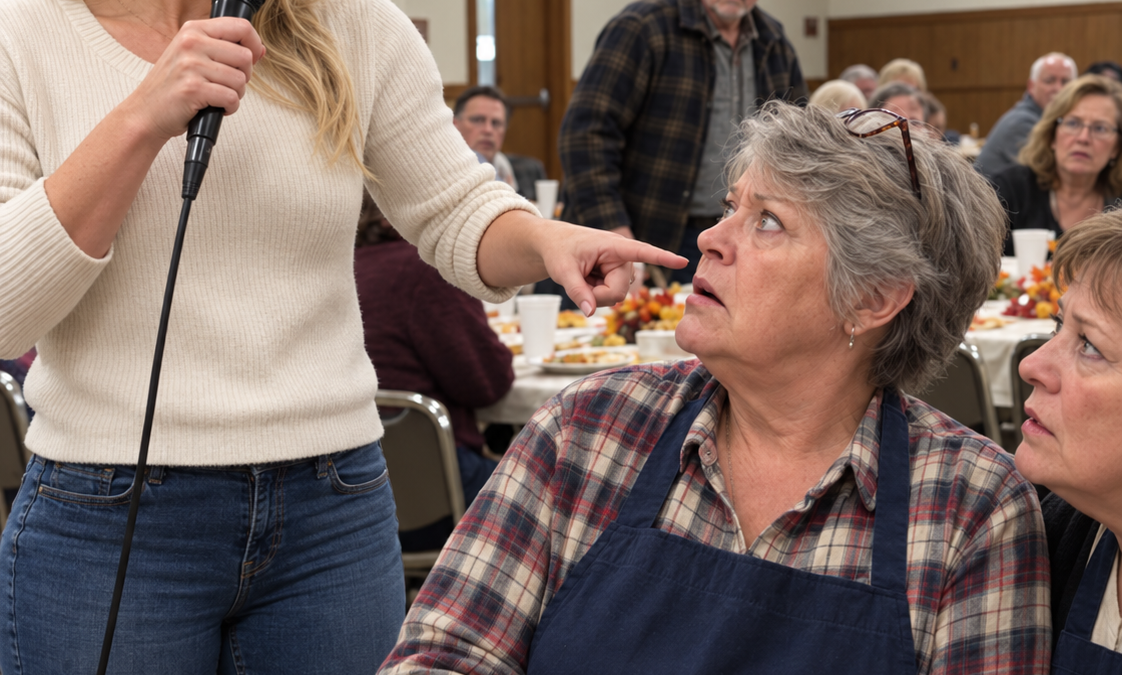
At 6:10 p.m., my daughter-in-law took the microphone and faced the long tables.
“My mom and dad sold everything to be near family. Next Saturday they move into our house on Ninth Street. Paulette’s coming down to the basement with us, and she’s glad to — she always says she just lives upstairs.”
A few people clapped. Janine put her hand on my wrist. At table 6, Hadley turned to look at me.
I caught the loose end of my apron string between my fingers and tucked it away.
Russ rose, taking his document folder with him, and walked past table after table to the volunteers’ table at the back. He opened the folder, took out the lease and laid it in front of me.
“Thank you for renting to us, ma’am. We’re paid up.”
I set down my fork and stood up.
Part 7 of 9
I took the certification and the county copy out of the envelope in my apron and put them in Russ’s free hand.
He still held his document folder in his left hand. Cindy had followed him from table 6 and stood behind his shoulder, her fingers hooked together.
“Read it, please,” I said.
Russ set his folder down and laid both papers next to the lease he’d brought over. He bent over them and followed the print with his forefinger.
“Sole trustee: Paulette J. Kvale.”
He stopped. A coffee cup rattled somewhere near the middle of the gym. The people nearest our table were watching.
“That’s you?”
“Yes.”
He found the owner line on the agreement and read it just as carefully.
“Owner/Landlord: Gage Kvale.”
Russ looked from the county copy to the lease and back. Then he turned the last sheet of the certification over. Kent’s office number was written on the back.
“I’ll call him Monday.”
Janine stayed in her chair at my elbow.
“Paper beats talk,” she said quietly.
A chair scraped against the floor.
Raelynn came off the low stage with the microphone still in her hand. The cord trailed behind her, and when she spoke, her words came through the speakers above the long tables.
“It’s a family trust. Gage is in it. That’s the same as owning it.”
I kept my hands against the table’s edge.
“Gage inherits after I’m gone. I’m standing right here.”
Cindy looked at her daughter, then at the certification.
“Raelynn, you told us he owned half already.”
“Mom, it’s the same family. This doesn’t need to be a public argument.”
I reached into the old envelope and took out Cindy’s card. Her round, careful letters filled the inside. I laid it with the other pages.
“These were your words in your mother’s handwriting,” I said to Raelynn.
Cindy bent forward and took her card off the table. She held it against her sweater without speaking.
Raelynn shifted the microphone to her other hand.
“She said yes on the phone. She forgets things since Garth — ask her what day it is.”
I didn’t forget things. I kept them. Nobody left a seat. From table 6, Hadley watched us; Gage stayed beside her, his shoulders angled toward the aisle.
My phone lay by my plate. I opened the text thread and handed the phone to Russ.
“Here is what I said.”
He read from the screen loud enough for the next tables to hear.
“No. We need to talk.”
He moved his finger and continued.
“It’s already decided.”
Russ lifted his eyes from the phone.
“That was the answer to no?”
“Yes.”
“Glad for the company,” Cindy said. “That’s what you told us, Raelynn.”
Her daughter glanced at the open screen instead of answering.
Russ gave me my phone. From his wallet he drew a folded yellow receipt. He unfolded it on the table and read the handwritten line.
“R. Kvale for G. Kvale, Owner.”
He looked at Raelynn.
“Your writing?”
Her eyes stayed on the receipt, not on him.
“Dad, Gage knew we were doing this.”
“That wasn’t what I asked.”
Gage had risen from table 6. He crossed the gym while Russ held the receipt above the agreement. His work jacket was still on, and he stopped at Raelynn’s side without touching her.
I removed the printer page from the envelope and set it in front of my son. His signature showed plainly on the owner line.
“Which line did you sign, son?”
He looked at the sheet. Then I held out my phone, the thread with Raelynn still open. Gage read the two texts before he spoke.
“Mom told me no on the second. I let Rae say it didn’t count. It counts.”
Raelynn opened her mouth, then looked down at the microphone in her hand.
Gage reached into his jacket pocket for the checkbook he kept there to buy parts. His pen left a small dent in the page beneath as he wrote a check for $2,500 payable to Russ. He tore it free and put it directly on the lease.
Russ examined the amount.
“That’s what we paid,” he said.
Gage nodded.
Russ opened the agreement to page 1. With a ballpoint pen, he wrote “Terminated — fraud — R. Tollefson 11/21/26” across it and signed his name.
Doreen walked over from the stage, program folder under her arm. She took the microphone from Raelynn’s hand without pulling or arguing. She flipped back the cover, found the Christmas sign-up sheet clipped inside and drew a line through Raelynn’s name.
Then, into the mic: “Pie’s out, folks.”
Folding chairs shifted, but the guests remained at their places. Janine moved her plate aside to make room for Russ’s papers.
I looked at Raelynn. Her eyes had gone to the envelope in my apron pocket, and they stayed there.
“‘You just live upstairs, Paulette. This house is Gage’s too.'”
She stared at me.
“I don’t just live upstairs, Raelynn. I own the stairs.”
Part 8 of 9
I slid two copies of the notice across the kitchen table, and Janine uncapped her pen to sign as witness.
Gage reached for the nearer sheet. Raelynn left the other where it was.
It was Sunday, November 22, at 2:00 p.m. Janine sat beside me; my son and his wife faced us across the worn wood.
Gage read the heading.
“You want us out?”
“The notice says you and Raelynn need to move out of the basement by Thursday, December 31.”
“That’s New Year’s Eve,” he said.
“Kent says a month in writing. I’m giving you more than that.”
Raelynn picked up the other sheet.
“Where are we supposed to go?”
“Wherever your name is on the lease.”
She glanced at Gage before laying it down.
“That isn’t funny, Paulette.”
“I wasn’t joking.”
Janine drew both pages toward herself and signed. Across the table, my son watched her pen move.
Gage shifted in his chair.
“Mom, we were saving for our own place.”
“I know why I let you move in.”
“We haven’t found anything yet.”
“You’ve got time to look.”
Raelynn pushed her chair away from the table, then stayed seated.
“And Hadley? FYI, she’ll remember who packed up her room.”
“Hadley goes where her parents take her. I’m talking to you about the basement.”
Janine slid the pages back across the table. I held out a pen.
“Sign to show you received it. That’s all.”
He wrote his name on both copies. Janine checked each one and handed him his. I kept mine.
“You’re going to change the locks?” Raelynn asked.
“No.”
“Or put our things outside while we’re at work?”
“I won’t touch your belongings.”
Gage folded his notice and stood. Raelynn followed without looking at the page she had put down.
When they went below, Janine capped her pen.
“Did you mean the date?”
“Every word.”
She watched me put my copy with the other house papers and set aside the certification Kent had mailed in October, the one the insurance office wanted by the thirtieth. Then she collected her coat.
“Hadley’s going to need you steady.”
“She’ll have me when she comes upstairs.”
On Monday, Cindy called.
I answered from the kitchen, with my school lunch bag still on the chair. Her voice sounded thin through the receiver.
“Paulette, I owe you an apology.”
I held the phone away from the running faucet and turned off the water.
“My sister drove in from Valley City yesterday and picked Russ and me up at the motel where we spent Saturday night,” she said. “We didn’t ride back with Raelynn. She’s called, but we haven’t answered.”
“Are you both all right?”
“We are. Russ has his check. He’s keeping the papers.”
I pulled out a chair but didn’t sit.
“I keep thinking about that card I sent you.”
“What about it?”
“Raelynn told us Gage owns half the house now through the family trust, and that you’re glad for the company.”
I remembered those words in Cindy’s round handwriting.
“I wrote what she told me.”
The sink dripped into the empty basin. I took a dish towel from the handle and hung it where it belonged.
Cindy spoke again, more softly.
“Would you have let us come, if she’d asked you straight?”
I looked at the basement door with the receiver at my ear. Cindy waited, and I let her.
She said goodbye before I found an answer, and I set the handset in its cradle and kept my hand on it.
Saturday, November 28, was the morning the moving truck was supposed to arrive. At 10:00 a.m., the curb out front was empty. The reservation had been canceled.
Gage came into the living room wearing his work jacket.
“Rae paid the cancellation fee,” he said. “We’re going to look at an apartment. Can Hadley stay with you?”
“Of course.”
He looked toward the stairs, where Raelynn was calling his name.
“We’ll be back for her.”
Hadley appeared carrying her tablet. She went to the window to watch her parents leave, then climbed onto the sofa beside me.
“Can I show you my pictures?”
“Go ahead.”
She brought up a photograph of a crooked pumpkin from her coloring page.
“That was at your table.”
“I remember the purple leaves.”
“Pumpkins can have purple leaves if you make them up.”
“I’d say so.”
She swiped to another picture, then another. A view of my sewing room appeared, with the window and Raelynn’s tape measure visible. It was the photograph she’d taken on November 3.
“I took that when Mom was measuring,” she said.
Her finger moved again before I could ask anything.
“Mom’s pictures show up on here, too. Her phone puts them in the family album.”
“Even when you didn’t take them?”
“Uh-huh.”
She swiped past a photograph of my kitchen counter with papers spread on it. I knew my own counter. When I put a finger on the screen to bring it back, she let me take the tablet, and I tilted it away from the window glare.
Above the picture, the album showed who had added it and when: “Raelynn · Oct 9, 9:14 PM.”
I spread two fingers on the glass until the heading on the paper filled the screen: Certification of Trust.
Beside it lay the white Sandvik Law Office envelope, its flap open.
Hadley leaned against my shoulder for a while, then went to find her crayons. I kept the picture on the screen and the tablet on my knee.
At 12:30 p.m., the front door opened. Gage stepped inside to pick up his daughter.
I turned the tablet toward him.
Part 9 of 9
Gage looked at the date on the photo for a long time, and then he asked me for the envelope.
I set the tablet on the hall table and opened my purse. Hadley was in the living room looking for crayons. I gave him the white envelope from Sandvik Law Office.
He turned it over. A strip of clear tape lay across the flap.
“She knew. She knew before she ever handed me the pen.”
His voice was low enough that Hadley couldn’t hear.
“That picture was taken in my kitchen,” I said.
“I can see.”
“She told you I’d agreed.”
“I believed her.”
He ran his eyes over the date on the screen again.
“Why didn’t you tell me what the papers said?” he asked.
“I wanted Kent’s word on paper first. And I told you no in the garage.”
Gage looked down at the tape.
“You’re right.”
He photographed the tablet’s screen with his phone, then handed me the envelope.
Hadley came into the hall carrying her crayons.
“Are we going now, Dad?”
“Yes, honey. Get your coat.”
I slid the tablet back into her hands. Gage waited beside the door while she gathered her things.
On Sunday, November 29, Gage drove to Valley City. That night he called me.
“I showed Russ and Cindy the picture,” he said. “I told them I was sorry. For signing and for letting them think you had agreed.”
“Did they listen?”
“Russ studied it without a word. Then he said, ‘You got lied to same as us, son.'”
I sat at the kitchen table. The canceled truck reservation still hung on the refrigerator door.
“How’s Cindy?”
“She talked to me. Russ did too. They’re going to make their own plans.”
“What about yours?”
“I’m looking. A place Hadley can have a room.”
“Then look for one you can manage.”
“I will, Mom.”
When he hung up, I took the moving reservation off the refrigerator. The rooster magnet stayed where it was.
On Saturday, December 5, I met Gage at a two-bedroom apartment on 12th Avenue. The rooms were small, and the kitchen had just enough counter for a cutting board beside the sink.
Gage stood by the sink with a pen and the apartment lease in front of him.
“I’m signing as the tenant,” he said.
“That’s what it says.”
“In my own name.”
I watched him sign. He’d always kept his eyes on his boots at hard moments, but he looked at me this time.
“Hadley can keep her things here. I checked the bedrooms.”
“She’ll want to see them.”
“She will.”
That night Gage called to say Raelynn had gone to stay with a friend in West Fargo. He didn’t say more, and I didn’t ask. Her yellow receipt pad was on my kitchen counter where she’d left it. I put it in a grocery sack by the basement door, for whenever she came for her things.
On Saturdays, Gage brought Hadley to see me. She still came through my front door with her coloring supplies, asking whether I had any pie dough left to roll.
Doreen called on Saturday, December 12, about the opening at the senior apartments.
“They’ve got a place for Russ and Cindy,” she said. “Their keys are ready today.”
“Does Cindy know?”
“She does. I thought you’d want to come.”
Gage helped carry their furniture in. Russ directed him through the doorway with the same plain instructions Garth used to give when a board wouldn’t fit.
“Lift your end. Now turn.”
“Got it,” Gage said.
Cindy was unwrapping dishes on the kitchen counter when I came in.
“Paulette, there’s something I asked you on the phone.”
“I remember.”
“Would you have let us come, if she’d asked you straight?”
“I’d have heard you out, Cindy. I can’t promise I’d have said yes.”
She nodded and returned to the dishes. I took the packing paper from her hands and carried it to the trash.
Later that day, Gage brought my sewing machine up from the basement. He set it in the sewing room, close enough to the outlet for its cord to reach.
“Here?” he asked.
“Right where it was.”
He moved it into place and stood looking at the floor.
“I should’ve carried it back sooner.”
“You’re here now.”
I sat down to check the pedal. The motor ran smoothly when I touched it with my foot.
On Saturday, December 19, the community center kitchen was crowded with volunteers again. Russ stood beside me peeling potatoes into a bowl. Gage carried trays to the serving line.
Hadley stood on a chair, stirring the gravy pot while I held it steady.
“Keep the spoon moving,” I told her.
“I’m doing it.”
“I see you are.”
At the serving counter, someone else took the place where Raelynn had signed up. Janine slid the next tray down the line, and nobody asked where Raelynn was.
That evening, I had leftover gravy warming on my stove when Gage asked me to come into the garage.
He had built a new workbench from Garth’s old drawings. The legs were square, the top fitted to the wall, and there was room for the tools I’d kept.
Near the front edge, he’d carved:
“G.K. 1989 / G.K. 2026”
I laid my hand on the wood. Gage watched without speaking, and Hadley ran her finger along the letters.
“Both of them have the same initials,” she said.
“They do,” I told her.
Hadley asked when the gravy would be ready, and I told her the truth: gravy doesn’t hurry, and neither do we.
THE END
More stories
At 58, I was the “grease monkey” my daughter’s fiancé mocked at his company picnic — Until his boss approached me beside coach 14 and his grin disappeared.My Son Photographed the Rent on My Tax Return and Demanded My Duplex, Until the Head of School Read One Name at My Granddaughter’s Fall Gala.My father accused me of stealing $9,000 at Grandma’s 90th birthday while holding the microphone—then Grandma raised her hand, and even he had to listen to her.My Son Told Me to Change the Locks Because His Wife Kept Coming In While I Was Out, but What She Hid in My Late Wife’s Cedar Chest Put Him Before a Judge.My daughter-in-law moved my bed into the sewing room, earned $2,317.40, and mocked my night shifts at her shower—Until a suitcase-carrying woman rang the bell and her guests fell silent.My brother pointed at me and claimed half the cabin I built on my $24,600 lot, hoping to silence my vote—Then someone he trusted stood up, and the sale failed.








