At Lunch, My Daughter’s Future Mother-in-Law Demanded Her New Address—So I Had to Choose Between a Wedding We’d Already Paid For and the Promise I’d Made My Daughter
Complete story · 8 parts · about 41 minutes · ending included
Part 1 · Part 2 · Part 3 · Part 4 · Part 5 · Part 6 · Part 7 · Part 8
Part 1 of 8
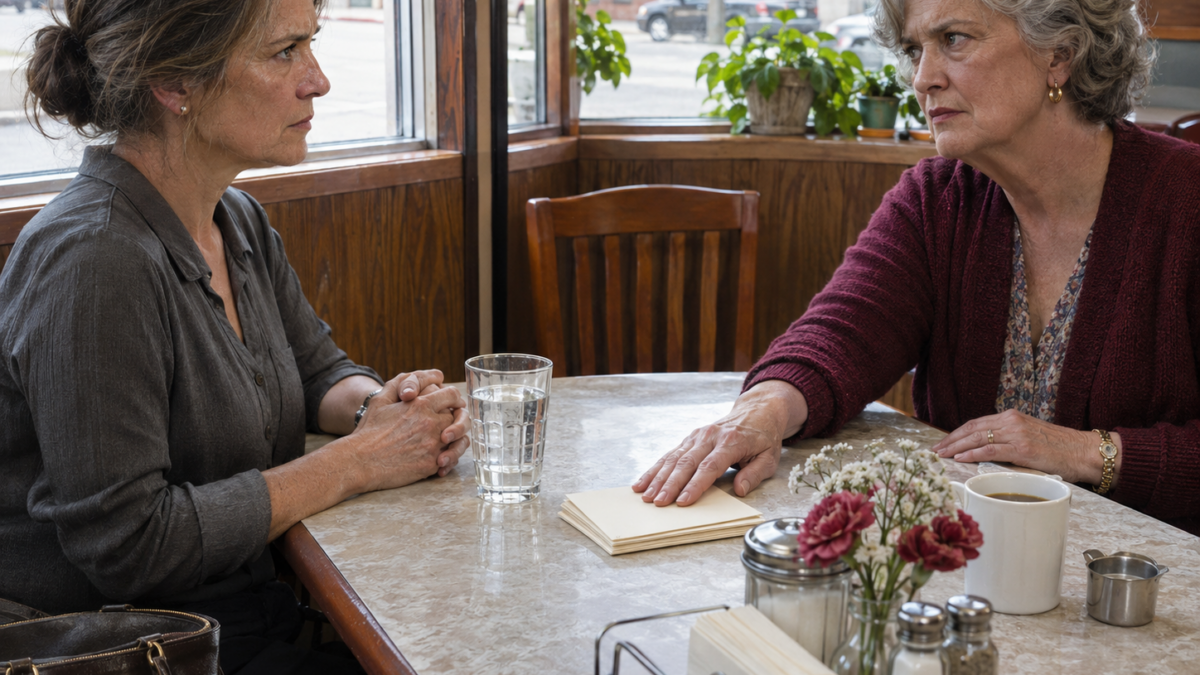
Garnet Vale pushed a stack of unused wedding invitations across the lunch table until the ivory envelopes bumped my water glass.
“Give me the address, Hester.”
At sixty-three, Garnet had the smooth, controlled voice of somebody who believed being calm made her reasonable. I was fifty-eight, a bookkeeper who had spent thirty years making columns agree whether people did or not. Across from us, Blythe’s empty chair seemed to take up more room than either of us.
“My daughter is thirty-six,” I said. “She asked me not to give it out.”
“And my son is thirty-nine and supposed to marry her in six weeks.”
Trenton Vale was Garnet’s only son. Blythe was my only daughter. Three months earlier, I had been comparing centerpiece prices with this woman. Now she wanted the address of the furnished rental where Blythe had gone after leaving the apartment she shared with Trenton.
“His aunts can go with me,” Garnet said. “We’ll bring her back for a talk.”
“No.”
Garnet’s fingers stopped on the invitations.
I had expected my voice to shake. It didn’t.
The diner was half full, the lunch crowd thinning. A waitress carried two bowls of soup past us. Somewhere behind the counter, silverware dropped into a plastic tub.
Garnet leaned back. She wore a burgundy cardigan buttoned all the way up, though the room was warm. I had come straight from work in my plain gray blouse.
“You’re really going to do this.”
“I already did.”
I opened my purse and took out the folded note Blythe had handed me three nights earlier. I didn’t pass it across the table. Garnet didn’t need to read it.
I had read it enough.
Mom, please don’t tell Trenton or his family where I’m staying. Don’t arrange a surprise conversation. If I decide I want to talk to them, I’ll tell you myself.
Underneath, in my handwriting, I had written: I won’t.
It wasn’t a sworn statement. It didn’t prove every argument Blythe and Trenton had ever had. It didn’t tell me whether every accusation each family member was already making was fair.
It told me what my adult daughter wanted me to do with information she had trusted me to keep.
Garnet tapped one envelope with a polished fingernail.
“You haven’t even heard Trenton’s side.”
“I’ve heard some of it.”
“Some.”
“Yes.”
“And that’s enough to hide her?”
“I’m not hiding her.”
“What would you call it?”
“Keeping my promise.”
Her mouth tightened.
The worst part was that six months earlier, I might have sounded like Garnet.
When Blythe first complained that Trenton showed up at her office too often, I told her he was excited about the wedding. When she said he kept pressing her to answer messages during meetings, I asked whether she could send him one quick response so he wouldn’t worry.
One evening, she came to my kitchen furious because he had changed a dinner reservation after she told him she needed the night alone.
I had said, “Marriage means adjusting.”
Blythe had stared at me as if I had shut a door in her face.
I remembered that stare better than I remembered what we ate.
“I made mistakes,” I told Garnet. “I kept asking Blythe to smooth things over because the wedding was getting close. I’m not doing that with her address.”
Picking up where the Facebook post left off
Garnet’s eyes sharpened at the word mistakes.
“So now my son is the villain.”
“I didn’t say that.”
“You didn’t have to.”
“I can believe Blythe needs distance without deciding every fact about Trenton.”
Garnet shoved the invitations another inch toward me.
“Then help fix it.”
“No.”
“They need to sit down.”
“If Blythe wants that, she can say so.”
“And if she doesn’t?”
“Then she doesn’t.”
Garnet stared at me for several seconds.
Finally she said, “The next installment for Ashwell Hall is twenty-four hundred dollars.”
I knew.
The reception room had seemed sensible in August. Small enough for ninety guests, close enough that my older relatives wouldn’t need a hotel. I had already paid twelve hundred dollars toward the initial hall deposit and six hundred forty to the florist. Both payments were nonrefundable under the agreements I had signed.
Garnet had agreed to cover the next twenty-four-hundred-dollar hall installment.
She folded her hands.
“If I’m being treated like some dangerous outsider, I’m not paying it.”
There it was.
Not a threat to hurt me. Not a crime. A choice she was entitled to make with her money, aimed directly at the weakest place in mine.
I had four thousand eight hundred dollars in emergency savings and a car that had begun making a noise on cold mornings.
“If you don’t want to pay it, don’t,” I said.
“You’ll let Blythe lose all this money because she won’t have one conversation?”
“It’s not my money to trade for her address.”
“Some of it certainly is.”
“Yes.”
“And you’ll lose it.”
“Yes.”
Garnet gave a short laugh with no humor in it.
“I used to think you were the practical one.”
“So did Blythe.”
That landed.
Garnet looked away first.
I gathered the invitations and pushed them back toward her side. “Keep those. Nobody needs to decide today whether they’re used.”
“She’s embarrassing Trenton.”
“She hasn’t posted anything. She hasn’t called relatives.”
“She disappeared from her own wedding.”
“She took a rental.”
“Same thing to people watching.”
I thought of how many decisions I had made because people were watching.
Blythe wearing a bridesmaid dress she hated at her cousin’s wedding because I said photographs lasted forever. Blythe attending Christmas dinner with a fever because her grandmother had already set the table. Blythe smiling beside Trenton at their engagement party after they had argued in the parking lot, because I had whispered, “Not tonight.”
I had mistaken keeping an event smooth for keeping a relationship healthy.
“I’m done making her perform calm so the rest of us can stay comfortable,” I said.
Garnet stood.
She gathered the invitations into her tote, but one envelope slid onto the table. She snatched it up.
“Trenton is supposed to answer questions from people every day.”
“That sounds unpleasant.”
“He loves her.”
“I’m not deciding that for him either.”
She put on her coat.
“At least tell me she’s safe.”
“She told me she’s where she chose to be.”
“That isn’t an answer.”
“It’s the one I’m giving.”
Garnet left without saying goodbye.
I stayed long enough to pay for two lunches because Garnet had walked past the check. Forty-three dollars and eighty cents went onto my debit card, which felt almost funny compared with what had just happened.
At home that evening, I changed into slippers and opened the blue wedding binder on my kitchen table.
The hall agreement was in the front pocket.
Behind it were florist receipts, the menu estimate, and a handwritten page where Blythe and I had once listed ways to keep the wedding under twelve thousand dollars.
A new sheet had been slipped into the binder.
I knew it had not been there the night before.
Trenton still had a key to my house from when he watered my plants during a summer trip. I had forgotten about it.
On the sheet, in his blocky handwriting, were three words and a time.
Blythe’s office. Tomorrow. Noon.
I sat down slowly.
He didn’t have her rental address.
But he knew exactly where she worked.
Part 2 of 8
I called Blythe that night, but not to tell her what she should do.
“I need to ask you something,” I said. “Trenton left a note here saying he plans to go to your office tomorrow at noon. What help do you want from me, if any?”
For a moment I heard only the hum of her end of the line.
Then she said, “He came into your house?”
“He still had the plant-watering key. I forgot.”
“So did I.”
“I’m sorry.”
“Mom.”
“I know. One thing at a time.”
She breathed out.
Blythe worked in purchasing for a regional medical-supply warehouse on the edge of town. She had been there eleven years, long enough that half the office knew me from holiday lunches.
“Don’t go there and confront him,” she said.
“I won’t.”
“And don’t call Garnet.”
“All right.”
“I want to tell my supervisor myself.”
“Okay.”
“I may work from home tomorrow. I can do that if she approves it.”
“That sounds like something you can ask.”
Another pause.
“You’re being very careful.”
“I’m trying to stop being helpful in the wrong direction.”
That earned me the faintest laugh.
I sat at my kitchen table with a pencil in my hand but no paper under it.
“What else?”
“I want my key back from Trenton eventually. Not tonight. And I need to think about the apartment.”
The lease on the apartment was in both their names. Blythe had not asked me to solve that, and I had no intention of pretending I could.
“What about the wedding?”
“Not tonight, Mom.”
“Then not tonight.”
I could almost feel her shoulders lower.
Before we hung up, she said, “I want you to understand why I left.”
“You don’t have to prove it to me to keep your address private.”
“I know. But I want you to understand some of it.”
“That’s different.”
“I’ll send you a few messages. The ones I choose.”
“All right.”
My phone account had once included Blythe’s line, but she had moved it into her own name years ago when she started paying all her own bills. I didn’t have access to her messages, location, passwords, or backups.
What arrived twenty minutes later came because she sent it.
Six screenshots.
Nothing dramatic enough for television. Nothing that depended on one terrible sentence.
That was what bothered me.
The first exchange was from two months earlier.
Blythe: I cannot have personal visits at work unless we plan them. Please stop dropping in.
Trenton: I was bringing coffee.
Blythe: I know. Please stop coming without asking.
Three days later:
Trenton: Outside.
Blythe: I’m in a vendor call. I asked you not to come here without checking first.
Trenton: Five minutes.
Blythe: No. Please go home.
Another screenshot showed twelve messages sent during a two-hour training session after she had written that she would have her phone silenced until four.
Are you still in training?
Can you answer yes or no?
Blythe?
I need to know dinner.
Hello?
The messages continued.
There were no threats. No confession of some hidden crime. Just a person repeatedly treating an answer as temporary until he got a different one.
I thought about all the times I had told Blythe, “He just likes certainty.”
Certainty for whom?
The final screenshot was from the week she left.
Blythe: Do not come by my office today. I need space and I will contact you when I’m ready.
Trenton: We’re getting married. You can’t put me on appointment.
Blythe: I’m asking clearly. Do not come to my workplace today.
At 1:17 p.m., according to the next message, he had written:
I’m in reception.
I closed my eyes.
Not because the words proved everything.
Because Blythe had told me about that day, and I had said, “Maybe he thought seeing you in person would help.”
The next morning, Blythe called at 8:12.
“My supervisor approved remote work today.”
“Good.”
“She also said I should document the visits through the company’s incident process.”
“Do you want to?”
“I think so.”
“Then do.”
“She said they don’t hand out security footage or employee records to families. She can submit dates from their visitor sign-in process and whatever notes staff already made, and the company decides what can be summarized.”
“That sounds reasonable.”
“I’m nervous.”
“I can stay on the phone while you fill it out, if you want.”
“No. I want to do that part myself.”
“All right.”
That answer still pricked at an old part of me, the part that wanted to be useful enough to be necessary.
I let it pass.
At eleven thirty, Garnet called my office.
I answered because I did payroll on Thursdays and could not spend the morning wondering whether she would call the owner instead.
“Hester, Trenton says Blythe isn’t at work.”
My stomach tightened.
“He went there?”
“He wanted to talk to his fiancée.”
“She told him not to.”
“He says she wasn’t even there.”
I looked through the glass wall of my office at my coworker sorting invoices.
“Garnet, I’m going to make one offer.”
“An address?”
“No. Logistics. If Trenton needs to send Blythe information about bills, wedding vendors, or property they both need to deal with, he can send it to me. I’ll forward it if she wants me to.”
“This is ridiculous.”
“It’s one neutral channel.”
“You’re acting like he can’t contact the woman he’s marrying.”
“I’m telling you what I’m willing to do.”
“And if he wants his things?”
“I’ll ask Blythe how she wants to handle belongings. I won’t promise for her.”
Garnet’s voice lowered.
“People are starting to ask why invitations haven’t gone out.”
“I know.”
“Trenton’s uncle already paid for his flight.”
“I’m sorry.”
“Are you? Because you sound very comfortable costing everyone money.”
That hurt because some of it was true.
People had booked rooms. Garnet had ordered a dress. I had paid deposits. Trenton had taken vacation days.
Choices had costs even when the choice was necessary.
“I’m not comfortable,” I said. “I’m just not using those costs to make Blythe meet anybody.”
Garnet hung up.
At four, Blythe came to my house.
She looked tired, not shattered. Jeans, navy sweater, hair tied back. She had stopped at the grocery store because she disliked arriving anywhere empty-handed, even now, and set a loaf of bread on my counter.
“I submitted the workplace incident request,” she said.
“How do you feel?”
“Like I submitted a form.”
“Fair.”
She sat at the table.
Then she placed her phone between us.
“There’s something else.”
I waited.
“Trenton keeps saying I never told him clearly enough.”
She unlocked the screen.
“I want you to read one conversation from September. Not all of them. Just this one.”
I leaned closer.
Before I could read, she covered the phone with her palm.
“And after you read it, I don’t want you calling him.”
“I won’t.”
“I mean it.”
“I know.”
Blythe studied my face, deciding whether the promise belonged to the mother she had now or the mother I had been six months earlier.
Then she lifted her hand.
Part 3 of 8
The September conversation began with a dinner reservation.
Trenton had booked a table at a restaurant for the same evening Blythe had planned to meet a college friend passing through town. She reminded him twice.
His answer was that he had already put down a fifty-dollar reservation fee.
Blythe wrote: I’m keeping my plan with Dana. Please don’t cancel things I’ve made because you decide yours matter more.
Trenton: It’s our engagement dinner with Mom.
Blythe: You never asked me.
Trenton: I’m asking now.
Blythe: No.
Twenty minutes later:
Trenton: Mom moved things around for us.
Blythe: I already said no.
Then:
Trenton: You’re making this embarrassing.
The next screenshot showed a photograph Blythe had taken of her own apartment door that evening.
No person. No damage.
Just a restaurant bag sitting outside.
Under it, she had written to him: Please stop coming over tonight. I asked for the evening to myself after I get home.
His reply:
I left food. I didn’t come in.
Blythe: That is still coming over after I asked you not to.
I handed the phone back.
“I told you to thank him for bringing dinner,” I said.
“Yes.”
“I remember.”
“I know.”
“You were angry with me.”
“I was.”
“You had a right to be.”
Blythe looked down.
“I don’t need you to punish yourself.”
“I’m not trying to.”
“You do that thing where you turn sorry into a project.”
I almost smiled.
“That sounds like me.”
“I need you steady, not guilty.”
There was my daughter, telling me how to help her.
“All right,” I said. “Steady.”
She nodded once.
The next pressure came through money.
Two days later, my sister called to tell me Garnet had been asking relatives whether I planned to reimburse the Vale family for canceled travel if Blythe “walked away.”
“She says they could be out thousands,” my sister said.
“They could.”
“Well, are you paying it?”
“No.”
“Why not?”
“Because I didn’t book their travel.”
“But if Blythe cancels—”
“Blythe hasn’t told me what she’s doing about the wedding.”
My sister groaned. “Hester, everybody knows.”
“Everybody guesses.”
“You’re splitting hairs.”
“I’m keeping the decision where it belongs.”
By evening, the story around town had already improved itself.
Blythe had supposedly vanished.
Then she had supposedly refused to return Trenton’s belongings.
Then I had supposedly rented her an apartment and forbidden Trenton from speaking to her.
The true version was less satisfying.
Blythe had paid for her own temporary rental.
She had not decided what to do about every shared possession.
I had forbidden nobody from speaking.
I had simply refused to hand over an address.
At work the next morning, my concentration broke three times over one payroll report. I entered the same mileage reimbursement twice and caught it before submitting.
My boss, Keenan, stood in my doorway.
“You need an hour?”
“I might.”
“Take it.”
I hated needing one.
I took it anyway.
Blythe had given me the name of Selma Rowe.
“She’s not a lawyer,” Blythe had warned. “And she’s not there to tell me whether to stay with Trenton.”
“What does she do?”
“Family support. Practical planning. My supervisor gave me her office number.”
Selma was fifty-one and worked independently from a small second-floor office above a tax preparer near the courthouse square. There was no grand title on the door, just her name and “Family Support Services” beneath it.
Blythe had already spoken with her once.
I did not call Selma until Blythe texted: Yes, you can talk to her. I told her what I’m okay with her discussing.
That sentence mattered to me.
At eleven, I sat across from Selma at a square table with nothing on it but a yellow pad and two pens.
She wore black trousers and a green sweater. Her gray-streaked hair was cut short around her face.
“Blythe said you’ve been helping with communication,” she said.
“Trying.”
“What does she want you to handle?”
“Neutral logistics. If Trenton sends something about bills or belongings, I can forward it. She doesn’t want me giving him her location or arranging a surprise meeting.”
Selma wrote two lines.
“And what does she want to handle herself?”
“The wedding decision. Her lease. Her employer. Anything she wants to say directly to Trenton.”
Selma looked up.
“That’s useful.”
I had expected reassurance. Instead she asked, “Have you found yourself tempted to take over?”
“Yes.”
“Good to know.”
I blinked.
She smiled slightly. “Knowing it makes it easier to notice.”
I told her about the apartment key, the office visits, the family calls, and the unused invitations.
I did not call Trenton dangerous.
Selma did not ask me to.
She said, “People can disagree about motives and still respect a clearly stated boundary.”
That sentence was simple enough that I wrote it on the back of an old deposit slip.
“What about her belongings?” I asked.
“What does Blythe want?”
“She wants clothes, work files, her grandmother’s dishes, and some other personal things from the apartment. She doesn’t want to walk in and argue over every lamp.”
“Then a list might help.”
“A legal inventory?”
“A practical one. Something both sides can review. Items they agree are hers can be packed. Disputed items can stay disputed for now.”
“And keys?”
“Separate issue.”
“The lease?”
“Separate issue.”
I realized how badly I wanted one clean solution that would make five messy things disappear.
Selma was not offering one.
“What if Trenton wants to talk during an exchange?”
“Blythe decides whether she wants an exchange at all, and under what arrangements. If she agrees to one, she can still leave if the agreement stops being followed.”
I nodded.
“A public place?” I asked.
“Can be useful depending on the circumstances. It isn’t magic.”
That embarrassed me because I had been about to treat it like magic.
Selma glanced at the clock.
“Blythe also authorized me to tell you she requested the employer summary.”
“She submitted the form.”
“Yes. Her employer will decide what it can provide under its policy. It may be limited.”
“That’s fine.”
“You sound relieved.”
“I am.”
“Why?”
“Because I don’t need them to prove her entire relationship to me.”
Selma set down her pen.
“No. But Blythe may want records for her own decision-making, especially if people keep telling her she remembers things incorrectly.”
That stayed with me.
When I returned to work, an email from Blythe waited in my personal inbox.
Not the employer report.
A list.
Winter coat. Two boxes of books. Blue file case. Grandmother’s dishes. Sewing machine. Framed diploma. Black work shoes. Medication from bathroom cabinet.
At the bottom she had written:
This is only a draft. Please don’t send it yet.
I printed nothing.
At five thirty, I went home and found Garnet sitting in a car across from my driveway.
She got out before I reached my porch.
“I need five minutes.”
“I’m tired, Garnet.”
“So am I.”
She held a thick envelope.
“Trenton’s father’s side is asking questions. His aunt says she won’t come to a wedding where the bride is treating him like this.”
“I can’t fix that.”
“I know.”
That answer surprised me.
Garnet held out the envelope.
“This is every wedding expense our family has paid so far.”
I did not take it.
“What do you want me to do with that?”
“Look at it.”
“Why?”
“Because if Blythe cancels, Trenton thinks the two families should sit down and divide the losses.”
“That would be a conversation for later, if it becomes necessary.”
“He says you’re already moving her possessions out.”
My hand tightened around my purse strap.
“I’m not.”
“He says she made a list.”
I looked at Garnet.
Blythe had sent that draft only to me.
And, she had told me earlier, to Selma.
“Who told him about a list?”
Garnet’s expression changed.
Not much.
Enough.
“I assumed you had one.”
“No,” I said. “You didn’t.”
For the first time since the lunch, Garnet had no answer ready.
I stepped onto my porch and unlocked the door.
Behind me, she said, “Hester.”
I turned.
She was still holding the expense envelope.
“Trenton told me Blythe’s company is making some kind of report about him.”
The door key went still in my hand.
I had not told Garnet.
I had not told Trenton.
And according to Blythe, neither had Selma.
I went inside without answering and locked the door.
For the first time, the question was no longer whether I could keep Blythe’s rental address private.
It was how information Blythe had chosen to share with only a few people was reaching Trenton before she was ready to discuss it with him.
Part 4 of 8
I called Blythe before I called anyone else.
“Garnet knows there’s some kind of workplace report,” I said. “And she knew enough about your things to mention a list. I want to find out what Trenton actually knows, but only if you want me involved.”
Blythe was quiet for a moment.
“I told him last week that I needed my personal things,” she said. “Not the list I sent you. Just that I’d need to arrange getting clothes and work stuff.”
“That could explain part of it.”
“Yes.”
“What about the employer request?”
“He knows the office told him not to come in without an appointment.”
That was new to me.
“You didn’t tell me that.”
“I know.”
There was no defensiveness in her voice.
I had to stop myself from asking why.
She was thirty-six. She was allowed to tell me some things and keep others to herself.
“What happened?”
“After the last time he came into reception, my supervisor spoke to him before he left. She told him personal visits weren’t appropriate if I had asked him not to come, and that future visits needed to be arranged through the office.”
“So when Garnet says the company is making a report—”
“He could be guessing because they already addressed his visits.”
“Do you want me to ask him?”
Blythe thought about it.
“Yes. But ask exactly what he thinks he knows. Don’t tell him anything new.”
“I can do that.”
“And I want to see whatever he sends you.”
“Of course.”
“You don’t have to forward every opinion Garnet gives you.”
I smiled despite myself.
“Thank you.”
“I’m serious.”
“So am I.”
After we hung up, I messaged Trenton.
Blythe has given me permission to ask one logistics question. Your mother said you know Blythe made a belongings list and that her employer is making a report about you. What exactly were you told, and by whom?
His reply came twelve minutes later.
Nobody told me anything private. Blythe already said she wanted her stuff. Her office told me last week I shouldn’t come by unless it was arranged. Now she won’t answer and she’s suddenly working from somewhere else. It doesn’t take a genius.
I read it twice.
Then I forwarded it to Blythe.
She called almost immediately.
“That’s it,” she said.
“You think so?”
“I think that explains what he actually knows.”
“He doesn’t know about your draft list.”
“Not from that.”
“And the report?”
“He’s inferring it.”
I sat on the edge of my bed.
I felt relief, but not the kind that made everything better. Just the relief of removing one imagined problem from a pile of real ones.
“I was starting to think somebody was feeding him information,” I said.
“I know.”
“I’m glad I asked instead of deciding.”
“So am I.”
Then she added, “He did send me something yesterday.”
“What?”
“A message saying if I was collecting things, he wanted to be present because some of the furniture was his before we moved in together.”
“Do you want me to see it?”
“Not yet.”
“All right.”
That answer came easier now.
Later that afternoon, Selma called me with Blythe’s permission.
“She asked me to help separate three things,” Selma said. “Immediate personal belongings, disputed property, and relationship communication.”
“That sounds like three jobs.”
“It is.”
“I keep wanting to solve them together.”
“Most people do. It usually makes them harder.”
Selma said Blythe was working on a short list of belongings she considered clearly personal: clothes, work materials, family dishes that had belonged to her grandmother, her diploma, medication, sewing machine, and several boxes of books she had owned before the engagement.
“Trenton doesn’t have to agree with every item just because Blythe puts it on paper,” Selma said. “And Blythe doesn’t have to discuss the whole relationship just because they need to arrange property.”
“So what happens if he disputes something?”
“It waits.”
“That simple?”
“Not emotionally. Practically, yes.”
I thought about the sewing machine. My mother had bought it for Blythe when she finished community college. I could have told myself that made the answer obvious.
But the point wasn’t for me to announce verdicts.
“Blythe wants me at the eventual exchange?” I asked.
“She hasn’t decided.”
That stung for half a second.
Then I recognized the feeling.
I wanted her to choose me because choosing me would mean I had repaired what I had broken.
That was not the same thing as asking what she needed.
“Fine,” I said.
Selma must have heard something in my voice.
“She did ask whether you could help with boxes and temporary storage.”
“I can.”
“That’s the part she wants from you right now.”
So I did that part.
I drove to a discount moving-supply store after work and bought twelve small boxes, six medium ones, packing paper, and tape. Fifty-seven dollars and fourteen cents.
I left everything stacked in my garage.
I did not take them to Blythe’s rental.
I did not ask where it was.
That night she came to my house and we sat at the kitchen table with tea.
She had her draft list in front of her.
“I want to change it,” she said.
“Okay.”
“I put the framed diploma on there because I was angry.”
“You don’t want it?”
“I do. But it can wait.”
She crossed it out.
“The books too. Most can wait. I need work clothes, winter things, medication, my blue file case, grandmother’s dishes, sewing machine, and black shoes.”
“Why the dishes now?”
She looked at me.
“I’m afraid something will get broken if this gets uglier.”
“Has Trenton threatened to break them?”
“No.”
“Then why do you think—”
She gave me a look.
I stopped.
I had almost done it again: turned her feeling into a courtroom question.
“You don’t need a threat to care about them,” I said.
“Thank you.”
She tapped the paper.
“I also want to include my small oak desk.”
“Wasn’t that in the apartment before he moved in?”
“Yes. But he uses it now.”
“So maybe it’s one he disputes.”
“Probably.”
She drew a line through it and wrote WAIT beside it.
That word looked more peaceful than I expected.
Not surrendered.
Not decided.
Just waiting.
Before she left, I said, “I owe you an apology that isn’t just about the dinner messages.”
Blythe zipped her coat.
“You’ve already apologized.”
“I know. This is different.”
She waited.
“When you said he kept showing up after you asked him not to, I kept translating that into something more comfortable for me. Excited. Worried. Eager. I made his reasons more important than your actual request.”
Blythe looked down at the list.
“I loved him,” she said. “That made me do some translating too.”
I didn’t answer.
She folded the paper in half.
“I still don’t know what I’m doing about the engagement.”
“You don’t have to tell me before you know.”
“I know.”
At the door she turned back.
“And Mom?”
“Yes?”
“Don’t become perfect all of a sudden. It’s unnerving.”
I laughed.
She did too.
It was the first time all week that either of us sounded like ourselves.
Part 5 of 8
The workplace summary arrived three days later.
Blythe received it directly from her employer.
She asked me to come over to Selma’s office to read it with her.
That was the first time I had been inside Blythe’s temporary place only in the sense that I knew it existed somewhere in town. I still did not know the street, the building, or which direction she drove when she left Selma’s office.
I was beginning to understand that not knowing could be part of helping.
Selma made coffee while Blythe opened the envelope.
The summary was only two pages.
No names of other employees beyond Blythe’s supervisor. No security footage. No customer information. No details about anybody’s medical business. Just a short record of incidents the company had documented involving Trenton’s visits and communications with reception.
Blythe read the first entry aloud.
“September eighteenth, 12:46 p.m. Visitor identified as Trenton Vale arrived without appointment asking for Blythe Cobb. Employee advised she was in a scheduled meeting and unavailable. Visitor waited approximately sixteen minutes and left after being told she would not be called out.”
She stopped.
“I remember that.”
“Was that the training day?” I asked.
“No. Vendor review.”
The second entry was from eleven days later.
Trenton had arrived at 3:09 p.m. after Blythe had told him by message not to come by that afternoon.
Reception had called Blythe’s supervisor rather than Blythe.
The summary said Trenton stated he needed “five minutes regarding wedding plans.”
At 3:18 he left.
Blythe pulled up the screenshot she had already shown me.
I’m in reception.
The time was 3:11.
Not proof of something enormous.
Just two records lining up.
The third entry was from the previous week.
Trenton arrived shortly before noon. Blythe had already arranged to work remotely that day after notifying her supervisor she did not want a personal visit.
Reception told Trenton Blythe was unavailable and that future personal visits should be arranged in advance.
He acknowledged the instruction and left.
That was all.
No secret file. No dramatic discovery.
Three visits.
Times.
What staff had said.
What Trenton had been told.
The company had added one final sentence stating that the summary was provided to Blythe under its internal employee incident-record process.
Blythe set the paper down.
“I feel ridiculous.”
“Why?”
“Because it’s so ordinary.”
Selma leaned against her desk.
“Ordinary doesn’t mean unimportant.”
Blythe rubbed her thumb over the edge of the paper.
“I kept thinking maybe I exaggerated it.”
I wanted to say, You didn’t.
Instead I asked, “Does seeing this help you decide anything?”
She considered that.
“It helps me trust my own memory.”
That was better than anything I could have said.
She put the summary back into the envelope.
“I don’t want Trenton to have a copy.”
Selma nodded.
“You don’t have to send it to him just because you received it.”
“I do want to tell him I’m arranging my personal things.”
“Then we can keep the message about that.”
Blythe opened her laptop.
For the next forty minutes, she wrote and rewrote six sentences.
Not because Selma dictated them.
Because Blythe kept deciding what she did and did not want to say.
In the final version, she told Trenton she wanted to arrange return of a limited group of personal belongings. She said she was not agreeing to discuss the relationship during the exchange. She attached the item list she had revised.
Winter coats and work clothes.
Blue file case.
Medication and personal toiletries.
Black work shoes.
Grandmother’s dish set.
Sewing machine.
Two smaller boxes of personal papers.
The oak desk was not on it.
Neither were the television, sofa, kitchen table, bed, or other shared household items.
“Send?” she asked.
Selma did not answer immediately.
“You tell me.”
Blythe read it once more.
Then she clicked.
“Sent.”
Trenton replied that evening.
He agreed the clothes, shoes, toiletries, papers, and file case were Blythe’s.
He objected to the sewing machine, saying he had paid for repairs the previous year.
Blythe frowned when she read that.
“Paying for a repair didn’t make it his.”
“Maybe not,” I said. “But you don’t have to settle it tonight.”
She looked at me with mild surprise.
“I was about to say that.”
“I’m learning.”
The dishes drew a longer response.
Trenton said he knew they had come from Blythe’s grandmother but claimed several pieces had been replaced using money from their joint household account.
Blythe stared at the screen.
“He means two bowls.”
“Then maybe the whole set waits?” I asked.
She hated that.
I could see it.
Finally she said, “No. I’ll ask whether the original pieces can be returned and the two replacement bowls can stay.”
Selma nodded. “That’s specific.”
Trenton agreed the next morning.
He did not agree about the sewing machine.
So the sewing machine waited.
The process was frustrating precisely because nobody got to wave a hand and declare every object solved.
By the end of the week, they had an agreed list of immediate items and a smaller list marked disputed.
Blythe and Trenton both acknowledged the same version by email.
Selma printed two copies.
“This is not a ruling about ownership,” she reminded us. “It’s just the list they agreed to use for this exchange.”
“I understand,” Blythe said.
The next problem was location.
Trenton proposed the apartment.
Blythe said no.
He proposed my house.
I said no before I could stop myself.
Blythe looked at me.
“Sorry,” I said. “That’s my house. I’m allowed that one.”
She smiled faintly.
“Yes, you are.”
Selma suggested a staffed community meeting room operated by a local nonprofit where she occasionally held client sessions. She called the director with Blythe present and explained only that two adults needed a daytime location for a prearranged belongings handover.
The director said they could use the rear meeting room for forty-five minutes if they followed the building’s normal visitor rules and kept the hallway clear.
No promise that nothing uncomfortable could happen.
No claim that being public made every risk disappear.
Just permission, staff on site, separate exits, and the ability for Blythe to leave if she chose.
Blythe asked questions.
Could Trenton arrive first?
Yes.
Could she wait outside until Selma confirmed he was inside the room?
Yes.
Could she leave without completing the exchange?
Yes.
Could the items be boxed before she arrived?
That would depend on Trenton.
“Then I want that in the request,” Blythe said.
She typed it herself.
I watched her build the arrangement one decision at a time.
For once, nobody was dragging her toward the next step.
Part 6 of 8
The wedding hall called me at 9:06 on a Monday morning.
The next twenty-four-hundred-dollar installment had not been paid.
Garnet had meant what she said.
The manager gave me until five that evening to either make the payment or release the date.
I sat at my desk with the contract open beside my calculator.
If I paid, I would preserve a reception that Blythe had not decided she wanted.
If I released the date, my twelve-hundred-dollar hall deposit stayed nonrefundable.
The florist’s six hundred forty was already gone unless we used the credit for some other event within a year, and I could not imagine what event I wanted badly enough to spend six hundred forty dollars decorating it.
I called Blythe.
“This is your wedding,” I said. “I’m not asking you whether to stay engaged. But the hall needs a decision today about the date. Do you want me to pay the next installment?”
“No.”
She answered so quickly I almost dropped my pen.
“Okay.”
“I’m not saying what I’m doing about Trenton yet.”
“I understand.”
“I’m saying don’t put another twenty-four hundred dollars into the hall.”
“Then I won’t.”
“You’ll lose your deposit.”
“Yes.”
“I’m sorry.”
“I knew it was nonrefundable when I paid it.”
“That was before all this.”
“That’s what deposits are for, unfortunately.”
She was silent.
“Mom, I can pay you back.”
“No.”
“That’s not fair.”
“I chose to pay it.”
“You chose because of my wedding.”
“Yes. And I’m choosing not to use that money as a rope around your ankle.”
“Please don’t make speeches.”
I laughed.
“Fine. The short version is no.”
After work I went to the hall and signed the cancellation form.
Twelve hundred dollars disappeared from my future without anything dramatic happening.
No one applauded my principles.
No one refunded me because my reasons were sympathetic.
The manager removed Blythe and Trenton’s names from a reservation calendar and asked whether I wanted the receipt emailed or printed.
“Printed.”
I don’t know why.
Maybe I needed to hold the cost.
Garnet called before I reached my car.
“I heard you released the hall.”
“I did.”
“So that’s it?”
“No.”
“What else could it mean?”
“It means Blythe told me not to spend another twenty-four hundred dollars.”
“You see? She’s already decided.”
“She told me she hasn’t.”
“Hester, you cannot possibly believe that.”
“I believe she knows what she has and hasn’t decided.”
Garnet made a sound of disgust.
“My sister already bought her dress.”
“I’m sorry.”
“My cousins booked rooms.”
“I’m sorry.”
“Stop saying that.”
“What would you rather I say?”
“I’d rather you admit you helped blow this up.”
I leaned against my car door.
There was a time when that sentence would have sent me racing backward through every choice, looking for one I could reverse so people would think well of me again.
“I helped make things worse before Blythe left,” I said. “I minimized what she was telling me. I encouraged her to smooth over problems because I wanted the wedding to stay on track.”
Garnet went quiet.
“But I’m not giving you her address,” I continued. “And I’m not paying another hall installment to prove I’m neutral.”
“You’re choosing her.”
“She’s my daughter.”
“And Trenton was going to be your family.”
“Maybe he still will be. That is not my decision.”
Garnet laughed sharply.
“You think after all this there’s some path back?”
“I don’t know.”
“That’s convenient.”
“No. It’s uncomfortable.”
She hung up.
That evening Blythe came to my house to discuss the handover.
Selma joined us by speakerphone.
Trenton had agreed to pack the approved items in plain boxes before the meeting. He would bring them in his vehicle. The nonprofit director had reserved the room for eleven in the morning later that week.
Selma would arrive first.
Blythe had chosen to attend.
I had not yet been told whether I would.
“I want Mom there,” Blythe said.
I tried not to let my relief show too much.
“But not in the room at first.”
That took it back down a notch.
“Okay.”
“I want you near the entrance with the empty boxes in case something wasn’t packed properly.”
“Okay.”
“If I ask you to come in, come in.”
“Yes.”
“If I don’t, don’t.”
“Yes.”
She gave me a suspicious look.
“What?”
“You agreed too fast.”
“You want me to argue?”
“No.”
“Then enjoy the moment.”
Selma laughed through the speaker.
Blythe had one more condition.
“If Trenton starts trying to make me decide the engagement there, I’m leaving.”
Selma said, “Then we make that part of the written arrangement beforehand.”
“What if he says he only wants five minutes?” I asked.
Blythe’s face changed.
Not fear.
Weariness.
“Five minutes is how every boundary becomes a negotiation.”
I remembered the workplace summary.
Five minutes regarding wedding plans.
“I won’t bargain for him,” I said.
She nodded.
Selma reviewed the logistics one last time. Trenton would arrive at 10:45 with the agreed boxes. Selma would check that the number of boxes and listed categories roughly matched the agreement without opening private papers. Blythe would arrive separately at eleven. She could leave at any point. I would bring the packing supplies and wait where Blythe had asked.
Nobody would bring extra relatives.
Nobody would turn it into a family meeting.
No one had to settle the disputed sewing machine, apartment lease, or shared household items that morning.
Those things could remain unresolved.
When the call ended, Blythe stood in my kitchen looking at the stack of boxes in my garage.
“I want to label them tonight.”
“Fine.”
“Nothing with my rental information.”
“Of course.”
We carried six small boxes and four medium ones into the kitchen.
Blythe wrote only categories in thick black marker.
WORK.
WINTER.
PAPERS.
KITCHEN.
PERSONAL.
She left the rest blank.
I held the tape dispenser while she folded the bottoms into shape.
At one point I reached for a box she was assembling.
“I’ve got it,” she said.
My hand stopped.
Then I set the tape beside her instead.
“Right.”
She finished the box herself.
The morning of the handover, I loaded every empty box into the back of my car, along with packing paper and tape.
Blythe did not ride with me.
That was her choice too.
At 10:31, I pulled into the nonprofit’s lot and parked near the entrance, exactly where we had agreed.
Selma was already there.
She came out carrying the printed inventory and walked to my car.
“He arrived early,” she said.
“Trenton?”
“Yes. Ten twenty-three.”
My hands tightened around the steering wheel.
“Is Blythe here?”
“Not yet.”
“Did he bring the boxes?”
Selma looked toward the building.
“Most of them.”
“Most?”
“One listed category is missing. He says he wants to discuss it with Blythe before he brings it in.”
I reached for the door handle.
Then stopped.
“What does Blythe want?”
Selma’s expression softened slightly.
“That’s exactly what we’re going to ask her.”
Across the lot, Blythe’s car turned in.
Part 7 of 8
Blythe parked three spaces away and stayed in her car.
Selma did not wave her in.
She walked across the lot instead.
I remained where Blythe had told me to stay, beside my open trunk with the empty boxes stacked behind me.
Through the windshield I could see Selma speaking to her. Blythe listened, then asked something. Selma answered. Neither of them looked toward the building until Blythe did first.
A minute later, she got out.
She wore black pants, a cream sweater, and the winter coat she had borrowed from me because hers was still on Trenton’s list.
Selma said, “He brought the clothing, papers, toiletries, file case, and the original pieces from your grandmother’s dish set. He did not bring the black work shoes.”
Blythe frowned.
“Why?”
“He says he wants to talk with you first.”
I felt anger rise so fast I nearly spoke.
Blythe looked at me before I could.
I closed my mouth.
“What do you want to do?” Selma asked.
Blythe glanced at the rear entrance to the building.
“Are the boxes already inside?”
“Yes.”
“Is he in the meeting room?”
“Yes. The director knows we’re here. Staff are working in the front office and down the hall.”
Blythe nodded slowly.
“And if I decide not to go in?”
“We leave.”
“What about the shoes?”
“They remain unresolved and can be requested again through the same channel.”
Blythe looked almost disappointed by how ordinary the answer was.
No rescue.
No dramatic authority forcing a resolution.
Just another choice.
She turned to me.
“What would you do?”
It was the question I had once wanted her to ask about everything.
Marriage. Money. Jobs. Men. Whether a disagreement was serious enough. Whether she should forgive.
Now that she asked, I understood the danger in answering too quickly.
“I think you should do what you’ll feel was your decision tomorrow,” I said. “If you want my opinion after that, I’ll give it.”
Her mouth moved slightly.
“That was annoyingly careful.”
“I’ve been practicing.”
She took one breath.
“I want the things he already agreed to return.”
Selma nodded.
“I do not want to bargain for the shoes.”
“All right.”
“And I’ll go inside long enough to tell him that myself.”
“Do you want me in the room?” Selma asked.
“Yes.”
Blythe looked at me.
“You stay by the door.”
“Inside or outside?”
“Inside the hallway. Not the room unless I ask.”
“Okay.”
We entered through the rear door together.
The nonprofit director greeted Selma and pointed us toward the meeting room. He did not ask for details. He only said, “If you need the room closed early, let me know.”
Trenton stood when Blythe entered.
For one second he looked relieved.
Then he saw Selma behind her.
Six taped boxes lined one wall.
Trenton had lost weight since I had last seen him. His shirt was wrinkled at the elbows. He looked tired and irritated and very much like a man who had spent days rehearsing a conversation he expected somebody else to attend.
“Blythe.”
She stayed near the doorway.
“Where are my shoes?”
His face changed.
“Can we talk first?”
“No.”
“Five minutes.”
“No.”
He pressed his lips together.
“I brought everything else.”
“I see that.”
“I’m asking for five minutes after almost four years together.”
Blythe’s hands stayed at her sides.
“I asked you not to come to my office without arranging it. You came anyway.”
“This is not your office.”
“I know.”
“I’m here because you agreed to meet.”
“I agreed to collect the items on the list.”
Trenton glanced at Selma.
“This is exactly what I mean. Everything has to be managed now.”
Selma did not answer for Blythe.
Neither did I.
Blythe said, “The management started because I kept saying what I needed and you kept treating it like the beginning of a negotiation.”
“I was trying to keep us from falling apart.”
“I know that’s how you saw it.”
“You act like I didn’t love you.”
“I’m not talking about whether you loved me.”
His jaw tightened.
“Then what are we talking about?”
“We’re not.”
That stopped him.
Blythe looked toward the boxes.
“I’m taking the things you already agreed were mine. The shoes can wait.”
Trenton stared at her.
“You drove here for this and you won’t even sit down?”
“No.”
“You won’t tell me where you’re living.”
“No.”
“You won’t tell my mother what’s happening.”
“I told her I needed space. She kept asking for a meeting.”
“Because everyone is trying to understand.”
“I’m not asking everyone to agree.”
His eyes flicked toward me in the hallway.
“Your mother sure picked a side.”
Blythe turned her head slightly.
“No. My mother finally stopped picking for me.”
I felt that sentence deeper than any accusation she could have made.
Trenton looked at the floor.
When he spoke again, his voice had dropped.
“I don’t know how we got here.”
Blythe’s expression softened, but she did not step closer.
“I do.”
He looked up.
She continued.
“I told you not to come to work. You came. I told you I had plans. You changed them anyway. I told you I needed nights alone, and you showed up because you decided food or five minutes or wedding plans made it different.”
“I wasn’t trying to scare you.”
“I didn’t say you were.”
“I never threatened you.”
“I didn’t say you did.”
He seemed almost frustrated that she would not accuse him of something larger.
Blythe said, “I’m telling you what happened between us.”
Trenton rubbed a hand across his face.
“So the office report convinced you.”
“No. It confirmed dates I already remembered.”
“The messages?”
“Same thing.”
He looked at her for a long moment.
Then he said, “I still think you’re making a permanent decision out of problems we could fix.”
Blythe’s face became very still.
“I haven’t made that permanent decision yet.”
That surprised him.
It surprised me too.
She stepped toward the boxes.
“But I’m not having that conversation because you held back my shoes.”
Trenton looked embarrassed then.
Not repentant.
Not transformed.
Just embarrassed.
He took a key from his pocket.
“They’re in my car.”
Blythe stopped.
“No.”
“What?”
“You can keep them there today.”
“They’re yours.”
“I know.”
“I’ll go get them.”
“No. We agreed the items would be here before I came in. They weren’t. I’m done for today.”
Trenton looked at Selma.
“She’s leaving her own stuff because I asked to talk?”
Selma answered calmly.
“She said what she wants to do.”
Blythe picked up the smallest box.
I stepped forward instinctively.
She glanced at me.
“Can you take that end?”
“Yes.”
That was the permission I had been waiting for.
We carried the boxes out in two trips.
Trenton did not follow us past the meeting-room doorway.
At my car, Blythe checked the labels against the agreed list. One box had her file case and papers. Another had clothing. The wrapped dishes were intact as far as she could tell without unpacking everything in a parking lot.
The sewing machine remained disputed.
The shoes remained at the apartment.
Nobody pretended that made the day a failure.
When the trunk was closed, Blythe said to Selma, “I want all future property messages to go through email. No calls.”
“That’s your choice,” Selma said.
“And I don’t want another in-person exchange unless I ask for one.”
“Okay.”
Blythe nodded.
Then she got into her own car and left.
I did not follow her.
Part 8 of 8
Blythe ended the engagement four days later.
She did it from my kitchen table.
Not because I suggested it.
Not because Selma told her to.
She came over after work carrying the ring in a small cloth pouch and asked if she could use my laptop because hers was still being repaired.
“Of course.”
“Stay in the room.”
I sat across from her.
“Do you want me to read what you write?”
“No.”
“Okay.”
She typed for fifteen minutes.
Deleted three paragraphs.
Typed again.
Finally she turned the laptop around.
Only then did I read it.
She wrote that she was ending the engagement. She said she would handle remaining property and lease matters separately. She asked Trenton to communicate about those subjects by email and not come to her workplace or temporary residence.
There was no speech about what kind of man he was.
No list of every wrong.
No invitation to argue.
At the bottom she had added:
I am not asking you to agree with this decision. I am telling you the decision I have made.
I looked at her.
“That sounds like you.”
“Is that good?”
“I think so.”
She took the laptop back.
“Do you think I’m making a mistake?”
There it was again.
The old doorway.
I could walk through it and make myself important.
Instead I said, “Do you want my opinion, or do you want me to sit with you while you do what you’ve already decided?”
She looked at me for a long moment.
“The second one.”
So I sat.
She sent the message.
Then she placed the ring pouch on the table.
“I want that returned with the remaining property discussion. Not tonight.”
“Okay.”
The next month was mostly paperwork and disappointment.
The hall deposit stayed gone.
So did the six hundred forty dollars I had paid the florist. The florist honored the contract exactly as written and offered the credit for another event within a year, but I had no use for it then.
Garnet canceled the vendors she had booked herself. I did not interfere with those contracts or pretend I had authority over them.
She stopped calling me.
So did Trenton.
The last message I received from Garnet was three sentences long.
I hope someday you understand what this did to our family. I won’t discuss it further. Please don’t contact me.
I respected that too.
Losing her did not feel clean.
For months we had tasted cakes together, compared chair covers, complained about parking, and laughed about how neither Blythe nor Trenton cared about napkin colors.
A relationship could be real and still end.
Blythe stayed in the temporary rental for another seven weeks while she worked out longer-term housing on her own.
I never learned its address.
Selma did.
She kept it private, exactly as Blythe had asked.
The remaining property took longer.
The black shoes came back through a later agreed pickup without another meeting.
The sewing machine stayed disputed until Blythe found the original purchase receipt in an old tax folder at my house. She chose to send a copy through email. Trenton then agreed to return it.
The shared furniture took longer than that.
The lease took advice and paperwork I was not part of.
That was healthy, even when I had to remind myself.
Blythe did not give me every message.
She did not tell me every conversation.
Sometimes she said, “I handled it.”
I learned to answer, “Okay.”
I paid for one month of a small storage unit when she asked whether I could help bridge the gap between moving out of the rental and getting keys to her next apartment.
It cost eighty-nine dollars.
She paid the next month herself.
Recovery looked less like triumph than boxes.
Boxes in my garage.
Boxes in storage.
Boxes opened slowly because some contained objects that made Blythe sit on the floor for a while before she could continue.
One evening in January, she came over to sort the grandmother’s dishes.
We unwrapped them at my kitchen table.
One saucer had a hairline crack I remembered from when my mother was alive.
Blythe turned it over in her hands.
“You used to say she’d haunt anybody who threw this away.”
“She probably would.”
Blythe smiled.
Then she set the saucer aside.
A few minutes later she reached for a serving bowl.
I reached too.
Our hands nearly touched.
I stopped.
“Want help?”
She looked at the bowl, then at the cabinet.
“Yes. Top shelf.”
I took it from her and placed it where she pointed.
“Left a little.”
I moved it.
“Too far.”
I shifted it back.
“There.”
I closed the cabinet.
Blythe picked up the next dish and handed it to me without asking.
This time, I waited until she told me where it went.
THE END
More stories
My Stepsister’s Husband Called Me “The Hired Driver” While Counting My Stepmother’s Dishes—Then 611 Pickup Signatures and His Own Texts Showed Who Had Been There
My Fiancé Told Everyone I Couldn't Keep Working—Then His Caregiver Application Asked Me to Verify That I Needed His Daily Care
My Brother Filmed Me While Admitting He Spent My Sons' $25,200 College Fund—But When Mom Saw His Own Paperwork, She Refused to Risk Her Paid-Off House
My Boyfriend Told Friends I Was Forgetting Things, but Our Landlord's Renewal Letter Said He Had Tried to Remove Me From the Lease Without My Signature.
My Sister-in-Law Put My Late Mother’s Quilt Under Her Grandmother’s Name and Took the $300 Prize, but My Stitches Helped the Guild Correct the Credit.
My Office Manager Called My House a Thanksgiving Venue for 34 Coworkers While I Cared for My Husband, until Her Own Records Forced a Public Correction.








