For 12 Years I Fixed RVs While My Husband Gave Our Son the Credit—Then One Customer Asked Me a Simple Question
Complete story · 8 parts · about 41 minutes · ending included
Part 1 · Part 2 · Part 3 · Part 4 · Part 5 · Part 6 · Part 7 · Part 8
Part 1 of 8
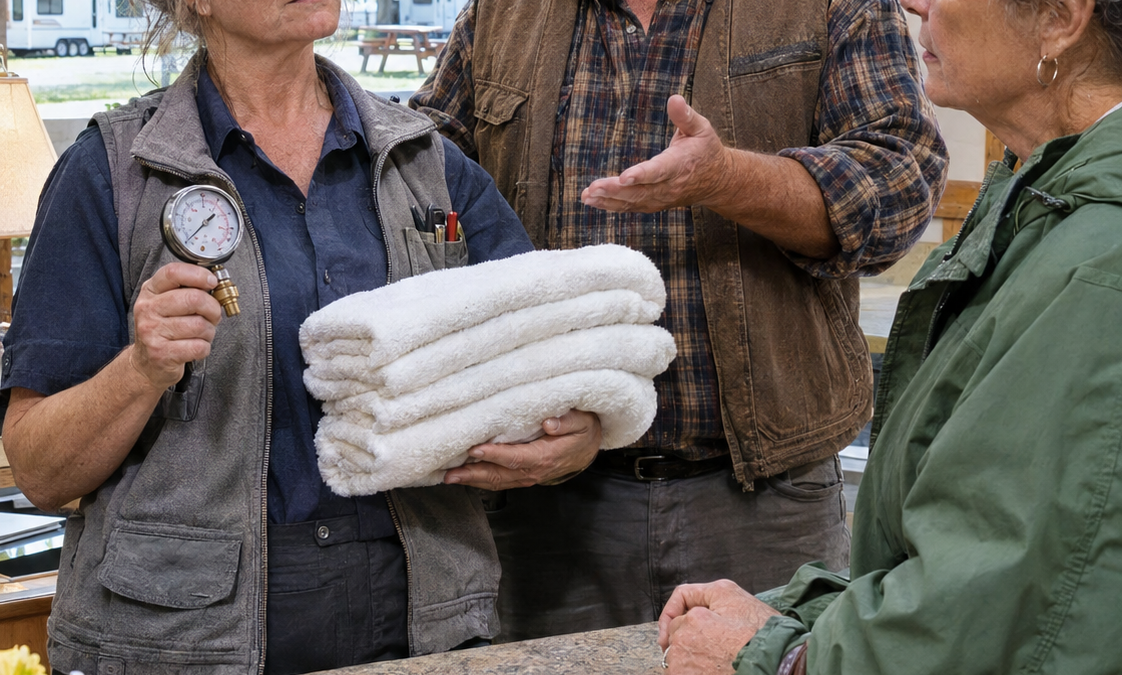
The pressure gauge was still in my right hand when Carleton dropped the towels into my left.
Not handed. Dropped.
Six white bath towels, warm from the dryer, folded into squares that blocked my view of the notebook open on the reception counter.
“Could you put those in the shower-room cabinet?” he said.
I looked at him over the stack.
Bernadine Weeks stood on the other side of the counter in a green windbreaker, her reading glasses pushed up into her gray hair. She had come into Juniper Lantern Campground ten minutes earlier because the water pressure inside her motorhome had started jumping between weak and hard enough to make the kitchen faucet spit.
I had already checked the simple things that were mine to check. Her own hose. Her filter. The pressure entering her RV. I had used my little gauge at the coach, not on any campground main, and I had come back inside to explain what I thought the next diagnostic step should be.
“It isn’t the campground supply I’m talking about,” I said, shifting the towels higher. “Bernadine’s pressure at the connection is steady. The trouble is showing up after it enters her coach.”
Carleton smiled at Bernadine as if I had interrupted him.
“My wife keeps us from running out of clean towels and coffee,” he said. “Merrill handles the service side.”
Bernadine looked at the gauge in my hand.
Then she looked at Carleton.
“Merrill wasn’t the one under my sink.”
The room went quiet enough that I could hear the little bell over the office door settle from the last guest who had gone out.
Carleton’s smile changed, not disappearing, only tightening.
“Merrill oversees it,” he said.
“I diagnosed it,” I said.
That was all.
No speech. No accusation. Just a correction.
Our son Merrill was sitting at the desk behind Carleton with the booking screen open. At thirty-three, he could talk confidently about pull-through sites, weekend minimums and which campers wanted shade. He was good at remembering names. He could calm down a man angry about a reservation mistake without making the man feel stupid.
He was not trained to diagnose Bernadine’s water system.
He turned in his chair.
“I told her it was probably the campground regulator,” he said.
I set the towels on the counter.
“No. The pressure at her connection is holding steady.”
“You checked it?”
“Yes.”
Carleton tapped one finger beside the register.
“Well, then Merrill can take it from here.”
Bernadine gave him a level look.
“With what?”
Merrill’s face reddened.
He had no tool bag. He had no pressure gauge. He had never completed the private RV service courses I had taken years ago, first through evening instruction and then through several manufacturer-neutral workshops. Those courses had not made me a licensed electrician, plumber or gas technician. I knew exactly where my limits were.
I also knew the ordinary potable-water components inside an owner’s RV well enough to tell when a problem was likely inside the coach instead of in the campground’s fixed system.
“I can finish the diagnostic work on your RV,” I told Bernadine. “If it turns out to be beyond the ordinary components I service, I’ll tell you who you need.”
Picking up where the Facebook post left off
“How much?”
That question landed harder than Carleton’s towels.
For years, too often, I had answered it badly.
“Oh, don’t worry about it.”
“Just give the office something.”
“It only took me twenty minutes.”
I had trained myself to make my own work disappear before anyone else could do it for me.
Carleton answered first.
“We take care of our guests.”
Bernadine kept looking at me.
“How much, Elva?”
I opened my mouth.
Carleton said, “Merrill will put it on the site notes.”
I placed the gauge on top of the folded towels.
“No.”
Merrill leaned back.
“No what?”
“No more putting my repair work down as a campground favor unless we decide that before I do it.”
Carleton’s eyebrows rose.
Bernadine quietly reached for her purse.
I felt heat move up my neck. This was not how I had imagined starting a serious conversation with my husband. Not with a paying guest standing three feet away and a basket of souvenir magnets beside my elbow.
But Carleton had introduced me as the towel woman while the tool I had just used was still in my hand.
I was tired of helping him tell the story wrong.
I picked up the gauge again.
“For today,” I said to Bernadine, “let me finish what I started. I should have given you a price before I touched the job. I didn’t, so I’m not going to invent one afterward. If a part needs replacing, I’ll tell you first.”
She studied me for a second.
“That sounds fair.”
Carleton said, “Elva.”
“I’m correcting my own mistake.”
He glanced toward two campers studying the trail map near the door.
“Can we not do this at the desk?”
I almost laughed.
He had done it at the desk.
But Bernadine was waiting, and her coach still had a problem.
I took my small tool case from beneath the back counter.
Carleton stepped closer.
“Merrill can go with you.”
“That’s fine.”
Merrill looked surprised.
I looked at him.
“You can watch. Don’t promise her anything until we know what we’re dealing with.”
His jaw shifted.
“I know.”
“You told her it was the campground regulator before you checked.”
Bernadine pretended to be interested in a rack of local brochures.
Merrill stood up.
“All right.”
At her motorhome, I stayed inside the work I knew. I checked the accessible fixtures and ordinary coach-side components, compared the behavior at more than one faucet and narrowed the likely fault to the RV’s own pressure-control assembly rather than anything Juniper Lantern owned.
I did not tear into something just to prove I could.
I explained the result to Bernadine and told her the component should be serviced or replaced before she kept chasing the problem with extra filters and hoses.
“You can do it?” she asked.
“Yes, on your coach. Not the campground supply. And not anything outside my training.”
Merrill stood beside me with his hands in his pockets.
Bernadine nodded.
“Then I want you to.”
When we got back to the office, Carleton had moved the towels himself.
He waited until Bernadine left.
Then he closed the reception door to the back room.
“What was that?”
I put my gauge in its case.
“Accuracy.”
“That little performance.”
“I didn’t perform.”
“You contradicted me in front of a customer.”
“You told her Merrill handled work he doesn’t know how to do.”
“He handles the service requests.”
“That isn’t the same thing.”
Carleton rubbed a hand over his mouth.
“We are running a campground, Elva. People want one answer, not a family debate every time a faucet coughs.”
“Then give them one accurate answer.”
His eyes sharpened.
“What exactly do you want?”
There it was.
Not an apology.
Not yet.
But a question.
I pulled a yellow reservation pad toward me and tore off the top sheet.
“A defined job.”
Merrill had stayed by the doorway.
Carleton looked from me to the paper.
“You have a job.”
“No. I have six jobs that become invisible whenever money comes up.”
I wrote while I spoke.
“Reception hours, if you want me here. Service hours. What kinds of RV work I’m authorized to take. What I charge. What Juniper Lantern gets if the campground books it. What I get paid.”
Carleton stared at me.
“And when somebody floods their bathroom at nine at night?”
“If it’s an immediate safety issue, we tell them what to do to make it safe and call the right person. If it’s an ordinary repair, they can schedule it.”
“So now guests get office hours?”
“Repair businesses have hours.”
“We are not a repair business.”
I looked at him.
“Then stop advertising me as free repair.”
Merrill spoke quietly.
“Dad, we kind of do.”
Carleton turned.
“Stay out of it.”
Merrill did.
That was one of his talents too.
Carleton leaned both hands on the counter.
“What are you asking to be paid?”
I had thought about that number many times and never said it aloud.
I did now.
Not a fortune. Not punishment.
A regular hourly wage for reception work, a separate defined rate for technical service, and authority to refuse work outside my competence without being treated as difficult.
Carleton listened.
Then he shook his head.
“That doesn’t work.”
“Why?”
“Because I can’t build a predictable budget around you charging technician rates every time somebody needs help.”
“Then hire someone.”
“For what? Half the time it’s ten minutes.”
“Ten minutes built on years of knowing which ten minutes matter.”
His face hardened.
“We cannot run this place like every small favor needs an invoice.”
I looked toward the open door, through which I could see Merrill answering the phone.
For twelve years, that sentence had kept me exactly where I was.
I folded the yellow sheet once.
“All right,” I said.
Carleton frowned.
“All right what?”
“If you won’t define and pay the work, I won’t keep providing it as if we did.”
He stared at me.
Outside, an RV rolled slowly past the office windows toward the west loop.
For the first time, I understood that I had not threatened him.
I had simply stopped volunteering me.
Part 2 of 8
By Saturday morning, Carleton had turned my sentence into a scheduling problem.
That was how he dealt with things that frightened him.
He made columns.
When I came downstairs at seven, he had the dining table covered with campground printouts, payroll figures and a legal pad divided into weeks.
“You said you wanted numbers,” he told me.
“I said I wanted a defined role.”
“Numbers define roles.”
I poured coffee.
We still lived in the small house at the edge of Juniper Lantern property, the one we had occupied since we took over management. The campground business itself had layers I did not pretend were simple. Some assets were business assets. Some property and household money were tied up in our marriage. Some tools had been purchased for campground use. Others were mine from before.
That complexity was one reason I had let things slide.
It was easier to say, “I’ll take care of it,” than ask which pocket the socket set belonged to.
Carleton pushed the legal pad toward me.
“If I pay what you’re asking for technical work, Merrill’s hours have to change or we raise rates.”
“Merrill’s booking job isn’t the same as mine.”
“He also handles guests.”
“So do I.”
“We all overlap.”
“That’s the problem.”
He sat back.
“What do you think happens when you stop?”
“I find out.”
He looked tired then, more than angry.
“You think I’m trying to cheat you.”
“I think you got used to cheap labor.”
“From my wife.”
“That doesn’t make it free.”
He stared at the table.
“We’ve spent years building a reputation that someone here will help.”
There was truth in that.
A camper arriving at five on Friday did not care about our internal job descriptions. Carleton had built Juniper Lantern around being dependable. He kept spare picnic-table hardware. He walked the loops after storms. He knew which families needed adjoining sites before they remembered to ask.
But dependable had slowly turned into Elva is around.
And Elva is around had turned into Elva will do it.
“We can still help people,” I said. “We just need to stop promising technical work without asking me.”
“What am I supposed to say? ‘Our service woman may or may not feel like helping’?”
“You say, ‘We don’t provide campground repair service. Here are outside options.’”
“And if it’s something you could fix in fifteen minutes?”
“Then they can hire me, if I’m available.”
He laughed once without humor.
“So you’re setting up a competing business.”
“I haven’t set up anything.”
“But that’s where this is going.”
I drank my coffee.
Maybe it was.
The thought had been sitting in my head since Bernadine asked, How much?
Not because Bernadine was rich. She was not. She had complained last spring about the cost of replacing her awning fabric and had postponed it.
But she had expected to pay for competent work.
My own family was the one acting as if payment spoiled the kindness.
At nine, Merrill came into the office carrying a service request written on a reservation slip.
“Site twenty-three says their pump keeps cycling.”
Carleton looked at me.
I looked at Merrill.
“What did you tell them?”
“That we’d send somebody.”
“Who?”
He hesitated.
“You.”
“No.”
His expression changed.
“Mom.”
“You can give them my number if they want an independent appointment after I’ve set that up. Right now, you need to tell them the campground doesn’t service private RV systems.”
Carleton stood.
“This is exactly what I mean.”
I kept my voice down.
“Is there water spraying? Electrical trouble? Anything unsafe?”
Merrill shook his head.
“They said it’s annoying at night.”
“Then it’s a maintenance problem, not an emergency.”
Merrill looked at the slip.
“So what am I supposed to do with them?”
“Tell them the truth.”
He left looking offended.
Ten minutes later he came back.
“They asked who worked on Bernadine’s.”
I felt Carleton’s attention shift toward me.
“What did you say?” I asked.
“That you did.”
“Good.”
“They want your number.”
“I don’t have a business number yet.”
Carleton closed his eyes briefly.
“Wonderful.”
I almost apologized.
The word rose automatically.
Sorry.
Sorry this is inconvenient.
Sorry I am making my labor visible.
I swallowed it.
That afternoon, Bernadine came into the office to pay for the replacement part I had installed in her coach. I had written a simple invoice for the part and nothing for labor because of the promise I had already made.
She read it.
“You left yourself off.”
“I didn’t quote you labor before I started.”
“So next time you will.”
“Yes.”
“Good.”
Carleton was filing envelopes behind me.
Bernadine put her card away.
“My sister-in-law has a trailer out by Marlow Field. She was asking who finally fixed mine.”
I looked at Carleton before I could stop myself.
Then I looked back at Bernadine.
“You can give her my name. I’m working out how I’ll take outside jobs.”
“Do you have a number?”
“Not yet.”
“Then when you do, write it down for me.”
That was all.
No miracle.
No waiting list.
One woman asking for a phone number I did not yet have.
By Sunday evening, I had made a list.
Business phone.
Liability coverage appropriate to the work I actually intended to perform.
A place to work where RV owners could legally bring their rigs.
Tools I could clearly document as mine or acquire separately.
Permission for the bay.
Rent.
A used service vehicle, if I could afford one.
And a conversation with Carleton we could not avoid.
We had that conversation Monday at the dining table.
This time I brought paper.
Not a divorce filing. Not a demand that half of everything suddenly belonged to me.
A temporary household arrangement.
I had typed it at the library because I wanted it clean and plain.
For sixty days, while we decided what happened next, I would move into a month-to-month apartment in Ashford Bend. I would continue paying an agreed portion of household obligations from my available funds. We listed which personal tools I would take and which campground tools would stay.
We listed the old compact car as mine to keep using for personal transportation.
Then came the harder part.
“I need startup money,” I said.
Carleton’s face closed.
“How much?”
I told him.
Enough for deposits, initial rent, a basic insurance payment, a used phone, registration costs and part of a cheap work vehicle if I found one.
Not enough to live on for long.
He shook his head.
“You’re asking me to fund a business that takes our customers.”
“I’m asking us to agree in writing to a limited use of money while the rest stays untouched until we sort out the broader property questions.”
“Same difference.”
“No.”
Merrill was not there. I was glad.
This was between spouses.
Carleton got up and walked to the kitchen window.
“I don’t want you moving out.”
“I don’t want to keep living like we’re fine.”
“We are fine.”
“No, Carleton. We are functional.”
He turned.
“Thirty-five years, and now you need a service van to know if you’re respected?”
“I needed you to say what my work was worth.”
“I told you the campground can’t support it.”
“And I believed you.”
That stopped him.
I meant it.
He had refused the role.
I was not going to stand there insisting Juniper Lantern become a business it could not afford to be.
But then I had to stop being its unpaid technician.
He sat again.
“What tools?”
We went line by line.
My personal hand tools and instruments stayed with me.
Campground ladders, carts, shared maintenance equipment and anything purchased specifically for fixed-site operations stayed there.
I would not use Juniper Lantern’s booking list, contact records or customer files.
If somebody wanted me, they would have to contact me directly.
When we reached the money, we argued for forty minutes.
At last, we settled on an amount lower than I had asked for.
It frightened me because I knew exactly how fast it could disappear.
Carleton signed.
I signed.
Then he said, “This doesn’t settle anything else.”
“I know.”
It settled enough for me to act.
That evening, I packed two suitcases and three tool cases.
Merrill stood in the hall watching.
“You’re really leaving.”
“For now.”
“Because Dad wouldn’t change your pay?”
“Because I asked for a defined job and he said no.”
He looked down.
“I never asked him to say I did your work.”
“No.”
“But I didn’t correct him either.”
I closed the second suitcase.
“No.”
He waited.
I did not rescue him from that silence.
Part 3 of 8
The apartment had one bedroom, a stove that clicked twice before lighting and a view of the back wall of a pharmacy.
I took it because it was month-to-month and because I could afford the deposit without eating half my startup money.
The first night, I sat on the floor with my back against the couch I had bought secondhand and listened to the refrigerator run.
At Juniper Lantern, there had always been another noise.
Golf cart.
Office door.
A guest knocking.
Carleton calling from the porch.
Merrill asking if I had seen a key.
The silence should have felt peaceful.
Instead, it felt expensive.
Tuesday morning, I started calling commercial rentals.
I did not need a showroom.
I needed a bay with enough clearance for the smaller RVs and trailers I intended to service, permission from the owner for that use, decent access, and terms I could survive if only a few people hired me.
The first place wanted a year lease.
The second would not allow vehicle service.
The third had a low door.
The fourth was six miles outside Ashford Bend in a row of older contractor bays behind a feed warehouse.
The concrete floor had stains older than Merrill.
The small office smelled like dust and cold coffee.
But the landlord allowed the type of light RV service I described, subject to proof of insurance and ordinary site rules. I walked the bay twice, measuring clearances and imagining where a workbench could go.
The rent was more than I wanted.
Everything was more than I wanted.
I asked if there was a shorter term.
Six months.
I asked if I could have three days to review the lease and confirm insurance.
He agreed.
I drove back to my apartment with the unsigned lease on the passenger seat.
On the way, my new business phone rang for the first time.
I had activated the number that morning.
“Hello, this is Elva.”
There was a pause.
“Elva Talley?”
“Yes.”
“This is the woman from site twenty-three at Juniper Lantern.”
I pulled into a parking lot before continuing the call.
“Merrill gave me your number.”
That surprised me.
“Did he?”
“He said you weren’t working through the campground anymore, but you might be taking private appointments.”
That was exactly what he should have said.
No customer list.
No stolen file.
A guest who had already asked for me, given a public professional number after I had created one.
“What are you dealing with?” I asked.
She described the pump cycling.
I asked a few general questions, enough to decide it sounded like something I could evaluate, not enough to pretend I had diagnosed it over the phone.
“I’m not taking jobs at a shop yet,” I told her. “I’m getting the business set up correctly first.”
“When?”
“I hope next week.”
The word hope came out too fast.
She said, “Could you put me down for Tuesday?”
I looked at the lease on the seat beside me.
I wanted to say yes.
A customer.
A date.
Proof that I had not made the stupidest decision of my life.
Instead I said, “I can take your contact information, but I can’t promise Tuesday until the bay and insurance are confirmed.”
There was a little silence.
“All right.”
“I can call you as soon as I know.”
“That’s fine.”
After I hung up, I wrote her first name and number in the new appointment notebook I had bought for myself.
No campground details.
No site history.
Only what she had personally given me.
Then I wrote beside it:
Do not promise before ready.
I had spent years undercharging to keep peace.
Apparently my second bad habit was overpromising to prove I was serious.
At noon, Carleton called.
“The west-loop bathhouse has a pressure problem.”
I closed my eyes.
“What kind?”
“Low flow at two sinks.”
“That’s building plumbing.”
“I know that.”
“Then you need a properly scoped contractor.”
“I’m asking if you can come look.”
“No.”
“Elva, I’m not asking you to rebuild the building.”
“And I’m not trained or authorized to work on fixed campground plumbing.”
“You’ve looked at it before.”
That was true.
Too many times I had walked into a building problem, identified something obvious and let my familiarity be mistaken for authority.
“I shouldn’t have treated that like my job before,” I said.
“So now you can’t even tell me what you see?”
“I can tell you low flow at sinks needs someone qualified for the building system.”
He let out a breath.
“This is getting ridiculous.”
“No. It’s getting clear.”
“You know what I mean.”
“I do.”
He was quiet.
Then his voice changed.
“Did Merrill give a guest your phone number?”
“Yes.”
“I told him not to advertise for you.”
“She asked for me before I had the number.”
“That isn’t the point.”
“What is?”
“The point is people staying at my campground are now calling my wife to pay for help they used to get as part of staying here.”
I leaned against the kitchen counter.
“You told me the campground wasn’t a repair business.”
“It isn’t.”
“Then there’s no repair business for me to steal.”
He hated that.
I could hear it in his silence.
But I had not said it to wound him.
It was simply the shape of the decision he had made.
“I need to go,” I said. “I’m looking at a van this afternoon.”
“A van?”
“Used.”
“With the money we agreed on.”
“Yes.”
Another silence.
“You found a shop too?”
“A possible bay.”
He sounded almost betrayed by the speed of it.
“You really planned this.”
“No. If I had planned it, I would have saved more money.”
For one second, I heard the beginning of his old laugh.
Then it disappeared.
The van was fifteen years old and white under a layer of chalky oxidation. One back door required a firm shove to close. The shelves inside were crude plywood, but solid.
I paid for an independent mechanical inspection before agreeing to buy it.
That inspection cost money I hated spending.
It also found worn tires I had not budgeted for.
I stood beside the van afterward with the seller’s number written on a scrap of paper and recalculated everything.
Bay deposit.
Insurance.
Phone.
Apartment.
Van.
Tires.
Basic supplies.
If I bought it, I would have very little cushion.
If I did not, I could keep using my car for small calls, but it would not handle the equipment and parts I needed once I started taking regular work.
I called the insurance office again before deciding.
The policy I needed for the business and the vehicle was not cheap.
Nothing about being independent came with the dramatic satisfaction people liked to imagine.
It came with deposits.
Forms.
Questions about estimated revenue when I had none.
I bought the van.
Not because it was exciting.
Because it was usable and inspected, and the price still left me enough to open the doors if nothing else went wrong.
Something else would go wrong.
I was fifty-seven. I knew that much.
Wednesday, I met Carleton at the house to collect one last box of personal tools listed in our agreement.
Merrill was in the office when I came through.
He followed me outside.
“Dad says you’re taking campground customers.”
“I’m taking people who choose to contact me.”
He looked embarrassed.
“I gave that woman your number.”
“I know.”
“She asked.”
“I know.”
“I didn’t give her anything from the system.”
“Good.”
He shoved his hands into his jacket pockets.
“I just told her your number because you said she could hire you.”
“That was fine.”
He looked relieved.
Then he said, “Somebody else asked too.”
My stomach tightened.
“Who?”
“Bernadine. She wanted cards for two people.”
“I don’t have cards yet.”
“I told her the number was public.”
“Where?”
“I put it on the little business page you made.”
I had built a plain one-page listing the night before with my name, phone number, service area and a careful description of what I did: owner-RV potable-water diagnostics and ordinary component service within my training, plus certain general RV maintenance tasks I knew I could perform safely.
Nothing about campground utilities.
Nothing about gas.
Nothing pretending I held a state trade license I did not have.
I had published it and assumed no one would see it for weeks.
Apparently Bernadine had.
“Thanks for telling me,” I said.
Merrill nodded toward my tool case.
“You know Dad thinks you’ll get tired of this.”
“I might.”
He looked startled.
I lifted the case into my car.
“That doesn’t mean I come back for free.”
Thursday morning, I returned to the contractor bays with proof of insurance.
I read the lease again.
Six months.
The number looked larger in ink than it had over the phone.
I signed anyway.
Then I paid the deposit.
By four that afternoon, the old white van was parked inside Bay Four with four new tires and almost nothing else around it.
No sign.
No waiting customers.
No polished workbench.
I had one folding table, my own tools and a metal chair the previous tenant had left behind.
I sat in that chair and opened my notebook.
The woman with the cycling pump was on the first line.
Bernadine’s name was on the second, with a note that she wanted my number for two people.
Neither was guaranteed income.
I called the first woman.
“This is Elva Talley,” I said. “I can confirm an appointment for Tuesday now, if you still want it.”
She did.
I gave her the bay address, a time and a diagnostic price.
A real price.
I nearly lowered it while I was saying it.
I did not.
She agreed.
After the call, I wrote the appointment in ink.
Tuesday, 9:00.
Paid diagnostic.
I stared at those three words longer than I should have.
Then I closed the notebook, stood up and pulled the bay door down.
The metal rattled all the way to the floor.
For six months, whether customers came or not, I owed rent on the space behind it.
Part 4 of 8
My first paid appointment arrived twenty minutes early.
I was still sweeping dust from the front edge of Bay Four when the trailer backed into the drive.
The woman from site twenty-three climbed out with her husband. I had only spoken to her by phone, and for one bad second I worried I would forget her name because I had written it in the notebook and left the notebook on my folding table.
I did not forget.
I welcomed them, confirmed the diagnostic price and asked them to describe the pump problem again in their own words.
Then I worked.
The cycling was real. So was the reason, and it was inside the trailer, within the ordinary potable-water work I had agreed to take.
The diagnosis itself was straightforward.
The trouble came after.
I found the failing component, checked availability and told them I could replace it that morning.
“How long?” the husband asked.
“About an hour.”
That was my first mistake.
The replacement fit the system, but access was worse than I expected. A previous repair had left a cramped tangle of lines and fittings in the cabinet. Nothing dangerous. Nothing dramatic.
Just slow.
One hour became two.
Then I discovered that the new part needed a small additional fitting I did not have.
“I’ll be right back,” I told them.
The nearest supplier with the correct piece was thirty minutes away.
By the time I returned, the wife was sitting on my metal chair and the husband was pacing near the bay door.
“You said an hour,” he said.
“I did.”
“We had somewhere to be.”
I looked at the clock.
He was right.
I had wanted the first job to feel smooth, so I had promised a best-case time as if it were a guarantee.
“That was my mistake,” I said. “I should have told you the repair time depended on access and parts once I opened it up.”
The wife folded her arms.
“So what now?”
“I finish it correctly. I won’t charge you for the extra time caused by my bad estimate or for the supply run.”
That cost me most of the labor I had expected to earn.
It also cost me the afternoon appointment I had tentatively hoped to take from a caller who had found my public number through Bernadine.
I finished the repair, tested the system and showed the owners that the cycling had stopped.
Then I wrote the invoice exactly as promised.
The husband read it twice.
“You really took off those hours?”
“Yes.”
“You don’t have to eat the fitting.”
“That part belongs to your repair. The extra labor was mine.”
His wife paid.
Before leaving, she said, “Next time, don’t tell people an hour.”
“I won’t.”
After they drove away, I sat in the folding chair.
My first real job had paid less than I had spent on tires the week before.
I laughed once, because the alternative was crying.
Then my phone rang.
Bernadine.
“How did your first morning go?”
“Expensively.”
She chuckled.
“I have somebody who wants you to look at a leaking city-water inlet on his travel trailer.”
“Tell him to call me directly.”
“I already did.”
That mattered.
Not because I was afraid Carleton would accuse me of stealing anyone who had ever camped at Juniper Lantern.
He probably would.
It mattered because I wanted the line clean.
People could hear about me anywhere.
They still had to choose to contact me.
That afternoon, I changed the wording on my appointment sheet.
I stopped writing fixed repair times before inspection.
I wrote estimate range.
I added a line explaining that parts availability and access could change duration.
Then I called the person I had nearly booked after lunch.
“I need to correct something before we schedule,” I said.
I explained that I was still building my parts inventory and could not promise same-day completion on every repair.
He said, “That’s fine. I just need to know before I haul over.”
That sentence taught me more than the first invoice had.
People did not need me to look effortless.
They needed me to be accurate.
Two days later, I had three completed invoices in the metal cash box I kept locked in the little office.
None were large.
One repair had required a part I ordered overnight at my cost because I had quoted too little shipping.
Another customer declined the repair after diagnosis and paid only the diagnostic fee.
That one stung less than I expected.
He had not rejected me.
He had bought information and made his own decision.
Friday afternoon, Carleton called.
“I need you at Juniper Lantern.”
I was labeling bins.
“For what?”
“Two campers are waiting.”
“What did you promise them?”
Silence.
“Carleton.”
“One has no water at the kitchen faucet. The other has a toilet that won’t fill.”
“Those are their RVs?”
“Yes.”
“Give them my public number if they want to schedule.”
“They’re leaving Sunday.”
“I’m booked today.”
“You’re six miles away.”
“I’m working.”
“This is exactly what I said would happen.”
I put down the label maker.
“What?”
“We have guests paying to stay here and the person who knows how to fix things is sitting in an empty warehouse.”
“It isn’t empty.”
“You know what I mean.”
“I do.”
His voice sharpened.
“Come over for an hour.”
“Are you hiring me?”
“For God’s sake, Elva.”
“That is a real question.”
“They’re campground guests.”
“That doesn’t make me campground staff.”
He went quiet.
Then he said, “You used to care whether people got help.”
I almost answered too quickly.
Instead I looked at the invoice on my table from that morning.
“I still care.”
“Could’ve fooled me.”
“If either situation is an immediate safety issue, tell me now.”
“No.”
“Then give them my number or another service provider’s. Don’t tell them I’m coming.”
He hung up.
Ten minutes later, my phone rang again.
A man said he was staying at Juniper Lantern and Merrill had given him my number.
“Did he tell you I would come today?” I asked.
“No. He said you were independent and probably booked.”
I smiled despite myself.
“Then Merrill told you correctly.”
The man booked Monday.
I wrote his appointment in ink.
Part 5 of 8
Carleton came to Bay Four the next Tuesday carrying a campground clipboard.
He stopped just inside the door and looked around.
I had added a used workbench and two shelves.
The van sat outside.
A trailer occupied the bay while I finished a water-inlet replacement.
Carleton watched me close the access panel.
“You have time after this?”
“For what?”
“The campground.”
I washed my hands.
“That depends on the job.”
He held out the clipboard.
“Low pressure complaints on the east loop.”
I did not take it.
“That’s fixed campground infrastructure.”
“I know what it is.”
“Then you need a qualified contractor for the campground system.”
“We already called one.”
“Good.”
“He can’t come until tomorrow.”
“Then follow whatever temporary guidance he gave you.”
Carleton’s mouth tightened.
“You could at least walk the loop with Merrill.”
“For what purpose?”
“To tell us whether it’s serious.”
“No.”
He stared at me.
“You know enough to recognize a problem.”
“I know enough to recognize that I shouldn’t pretend to be the contractor for a system I don’t service.”
He slapped the clipboard lightly against his thigh.
“We used to handle things before calling people.”
“Yes.”
“And we saved money.”
“Yes.”
There was no point pretending otherwise.
I had helped create that habit.
“I should have been firmer about the line years ago,” I said.
Carleton looked almost surprised to hear me include myself.
Then he said, “There’s more.”
Of course there was.
He opened the clipboard.
Months earlier, before I moved out, I had written a maintenance recommendation about a failing campground-side pressure-control component serving part of the east loop. I had not repaired it. I had noted the symptoms, recommended evaluation by an appropriate contractor and handed the note to Carleton.
He had initialed it.
I remembered because he had said, “After the fall rush.”
Now he pointed to the date.
“I put it off.”
I looked at him.
“How long?”
“Long enough.”
“What happened?”
“Pressure dropped yesterday. Four sites complained. We had to close two hookups until the contractor could inspect the section.”
That was not a catastrophe.
It was a business problem.
Two sites unavailable during a busy weekend meant refunds, shuffled reservations and angry guests.
Carleton looked exhausted.
“He says the control assembly needs replacement. Parts and labor are going to cost more now.”
“Did he say the delay caused that?”
“He said the wear had progressed.”
I nodded.
That was as far as I would go.
No triumphant I told you so.
No claim that one postponed recommendation explained every dollar.
“What do you need from me?”
“I need help.”
“With private RVs?”
“With everything.”
I shook my head.
“I can’t become the gap between your staffing plan and the campground.”
He pressed his lips together.
“This place worked because we all did what needed doing.”
“It worked partly because I didn’t invoice you.”
“Here we go again.”
“No. I’m not asking you to reopen the old argument.”
“Then come in tomorrow and help Merrill with the guests while the contractor works.”
“I have three appointments.”
“Move them.”
“No.”
He looked toward the trailer in my bay.
“You’d pick strangers over your own family?”
The owner was standing twenty feet away near the parking lot, talking on his phone.
I lowered my voice.
“I’m picking commitments I made after you refused to make me a paid part of Juniper Lantern.”
Carleton’s face went flat.
“So that’s it.”
“No. That’s the arrangement you chose.”
He left without another word.
The next morning, Merrill called before eight.
“Dad told me to ask if you can talk me through the east-loop problem.”
“No.”
“I figured.”
“Is the contractor there?”
“On the way.”
“Then wait for the contractor.”
He sighed.
“We have one guest yelling because his site was changed.”
“That’s a booking problem.”
“I know.”
“And you know how to do booking.”
“I know.”
There was something in his voice I had not heard before.
Not confidence.
Weight.
“Dad wants me to tell people the pressure issue is minor.”
“What did the contractor say?”
“That we should keep those two hookups out of use until he checks them.”
“Then that’s what you tell people.”
“He says it makes us look bad.”
“Merrill.”
“I know.”
He was quiet.
Then he said, “I’m keeping them closed.”
That was his difficult choice.
Not becoming a technician.
Not suddenly understanding water systems.
Just refusing to overstate what he knew.
“Good,” I said.
“I moved two reservations.”
“How angry are they?”
“One very.”
“You can handle one angry reservation.”
“Yeah.”
After the contractor evaluated the system, Carleton called me.
Not to apologize.
To tell me the section would stay partially closed until the proper repair was completed.
“That’s going to cost us the weekend,” he said.
“It’ll cost less than pretending it’s usable.”
He did not answer.
That afternoon, Bernadine arrived at my bay with a paper cup of coffee for me.
“I’m not bribing you,” she said. “I’m paying you next week.”
“For what?”
“My shower valve has started sticking.”
“Call the business number.”
She stared at me.
“I’m standing here.”
“I know. Call it anyway so I have your contact and the appointment in one place.”
She laughed.
“You got strict.”
“I got confused when I wasn’t.”
She called while standing three feet from me.
I answered.
We set her appointment for the following Thursday morning.
I wrote Bernadine Weeks, 9:00.
She looked over my shoulder.
“You doing some kind of opening?”
“Not really. Just trying to group appointments so I can stop wasting half a day moving rigs around.”
“Thursday works.”
Before she left, she said, “I told two people at Juniper Lantern you’re here.”
“Tell them to call me themselves.”
“I know the rules.”
I smiled.
“So do I now.”
Part 6 of 8
By the end of the month, Thursday had become the day I tried to group longer service appointments.
Not an opening.
Not a grand launch.
Just the first day I planned to keep Bay Four fully clear from morning through late afternoon for scheduled customer work.
Bernadine was already booked at nine.
On Monday, a second Juniper Lantern owner called.
He had heard about me from the man whose kitchen-faucet problem I had diagnosed after Merrill gave him my public number.
He wanted an inspection of an intermittent water-pump issue before a winter trip.
I asked the usual questions.
No active leak.
No electrical smell.
No flooding.
No immediate safety concern.
“Thursday at eleven-thirty?” I said.
He agreed.
I wrote him into the book.
On Tuesday afternoon, the third call came from a woman who had stayed at Juniper Lantern twice that season.
“Bernadine gave me your number,” she said.
“What can I help you with?”
Her trailer had weak flow at one fixture but normal flow elsewhere.
“I don’t diagnose over the phone,” I told her. “I can inspect the RV system and tell you whether it falls within the work I do.”
“How much?”
I gave her my diagnostic price.
“And if you fix it?”
“I quote the repair after I know what it is. I won’t promise same-day completion until I’ve seen access and parts.”
The sentence came smoothly now.
She booked Thursday at two.
Three campground owners.
Three direct calls.
Three explicit appointments.
No list.
No mass message.
No crowd appearing out of nowhere.
I drew boxes around all three names.
That same evening, Carleton called from the campground.
“We’ve got water spraying under a guest’s coach.”
I was halfway through eating soup at my apartment.
“From the RV or the site connection?”
“Can’t tell.”
“Have them shut off the water at the connection if they can do it safely and keep people away from the wet area.”
“Merrill already shut the site valve.”
“Good. If the campground fixture is damaged, call the contractor. If the leak is on the RV, the owner needs RV service.”
“Can you come?”
“Is anything still actively spraying?”
“No.”
“Any electrical equipment wet?”
“Not that Merrill can see.”
“Then if there’s any doubt, keep the area unused until the proper people check it.”
Carleton sounded angry.
“So you’re not coming.”
“If there is an immediate safety issue you need help identifying, I will help you contact the right emergency or qualified service. But I’m not taking over an unknown fixed-site repair.”
He exhaled hard.
“It’s the guest’s hose fitting, Merrill thinks.”
“Merrill should not guess if he doesn’t know.”
“I know that.”
“Then have the owner contact an RV technician.”
“You mean you.”
“If they want me and I’m available.”
“You’re available right now.”
“No. I’m off.”
The words sounded strange.
Not cruel.
Almost foreign.
Carleton was silent for several seconds.
Then he said, “You used to come.”
“Yes.”
That was all I gave him.
The next morning, Merrill called.
“It was on the RV side.”
“Did anyone get hurt?”
“No. Owner had another service company come out.”
“Good.”
“Dad was mad they charged a call-out fee.”
“I imagine he was.”
Merrill laughed once.
Then stopped.
“He wants me to start doing little things.”
“What little things?”
“Stuff you used to do.”
“Do you know how?”
“No.”
“Then don’t.”
“I told him that.”
I sat up straighter.
“How did that go?”
“He said I’ve watched you enough.”
“That isn’t training.”
“I know.”
There was a pause.
“I told him I’ll do bookings, site changes, guest communication, basic campground checks I’m actually assigned, and I’ll call qualified people for the rest.”
That was probably the most adult sentence Merrill had ever said to his father.
“What did Carleton say?”
“He said both of you have lost your minds.”
I smiled.
“That sounds like him.”
Then Merrill’s voice became serious.
“He also said he’s coming to see you Thursday.”
My smile disappeared.
“Why?”
“Said he wants to talk about a standing arrangement.”
“What kind?”
“He didn’t say.”
I looked at the appointment book.
Nine.
Eleven-thirty.
Two.
“Did you tell him I have customers?”
“Yes.”
“And?”
“He said that might be the right time.”
Of course he did.
I closed my eyes.
“Thank you for warning me.”
“He told me not to.”
That surprised me more than anything else.
“Why did you?”
Merrill was quiet for a long moment.
“Because I’m tired of being used as the reason you’re supposed to know something for free.”
I did not answer immediately.
That was not redemption.
It did not erase years of accepting credit he had not earned.
But it was a choice.
A limited one.
Maybe that was what responsibility looked like at first.
“Thursday,” I said, “you handle your job.”
“I will.”
“And don’t get in the middle.”
“I’m already in the middle.”
“You can step out of it.”
After we hung up, I went to Bay Four.
I checked the workbench, inventory and appointment notes.
I had ordered the likely parts for Bernadine but had already warned her I might still need something else after inspection.
The eleven-thirty customer had agreed to a diagnostic only.
The two o’clock owner understood that any repair beyond the initial scope could require another appointment.
Three people.
Nothing spectacular.
Enough to fill most of one day if the work ran normally.
Enough to hurt if Carleton disrupted it.
At five, I rolled the van into the bay and set three clean work-order forms on the table.
Then I added one blank estimate sheet.
Not for a customer.
For Juniper Lantern.
If Carleton wanted a standing arrangement, I would listen.
But this time, I would put a price, scope and schedule on whatever he asked for before I touched a tool.
Thursday morning was now carrying more weight than I wanted it to.
Three customers had already chosen the time.
Carleton had chosen it too.
Part 7 of 8
Bernadine arrived at eight fifty-three on Thursday with her motorhome, a paper sack and a face that told me she had brought breakfast I had not asked for.
“You’re early,” I said.
“You’re hungry.”
“I ate.”
She looked at me.
“I had coffee.”
“That’s what I thought.”
She put the sack on my folding table.
I had just finished setting out the pressure gauge I used on RV systems, along with the other tools I expected to need. Seeing it there took me back to the reception counter at Juniper Lantern, towels stacked against my chest while Carleton explained me away.
This morning there were no towels.
At nine, I started Bernadine’s appointment.
The shower valve was stiff exactly as she had described. I inspected it, found that the service was within my scope and gave her the price before I opened anything further.
She squinted at me.
“That includes your labor?”
“Yes.”
“You sure?”
“Yes.”
“Good. I don’t want another free favor.”
Neither did I.
The work went cleanly, but not instantly. I replaced the ordinary failed component, tested the water flow and cleaned up before I handed her the invoice.
Bernadine paid without ceremony.
At ten twenty-five, while I was writing the completed work in my records, Carleton’s truck pulled up outside.
He came in carrying two folded white towels.
For one strange second, I thought he was making a joke.
Then I saw the damp edge of one.
“We had a leak in the laundry room,” he said. “Merrill grabbed these before they hit the floor.”
I looked at the towels.
“Is anyone dealing with it?”
“Contractor’s coming. Merrill shut that room and put up a sign.”
Good.
Carleton set the towels on my workbench, right beside my pressure gauge.
Bernadine was still near the office door, putting away her receipt.
Carleton looked at her.
“Morning, Bernadine.”
“Carleton.”
He turned back to me.
“I need an hour.”
“I have an eleven-thirty appointment.”
“This won’t take an hour.”
“What do you need?”
He slid the towels aside and opened a small notepad.
“We’ve got three guest RV issues waiting, plus whatever comes in this weekend. I thought you could come by after your appointments, take a look, knock out the simple ones.”
There it was.
Not a standing arrangement.
Not really.
The old arrangement wearing a cleaner shirt.
Bernadine picked up her purse.
“I’ll get out of your way.”
“You don’t have to,” I said.
She looked at Carleton.
“I think I do.”
When she left, Carleton lowered his voice.
“I’m trying here.”
“So am I.”
“I’m not asking you back full-time.”
“You’re asking me to come after a full day and do unpriced work.”
“I said simple things.”
“You don’t know which ones are simple until they’re diagnosed.”
His mouth tightened.
“What would you charge?”
I pulled the blank estimate sheet toward me.
“For Juniper Lantern referrals involving privately owned RVs, I can reserve one service block a week if I have space. The owner contracts with me directly. Diagnostic fee is the same as everyone else. Repairs are quoted after inspection.”
“What about emergencies?”
“Immediate safety issues get made safe or referred immediately. Fixed campground systems go to your contractors. Gas, mains, pedestals, building wiring—none of that becomes mine because I’m nearby.”
“And if I need you to come out?”
“If it’s within my RV scope and I’m available, there’s a call-out charge.”
He stared at me.
“That’s what you’d charge your own husband?”
“That’s what the business charges Juniper Lantern.”
He looked toward the open bay.
“You know we’re still paying for that east-loop repair.”
“I know.”
“And refunds.”
“I know.”
“And now every small thing has a fee.”
I nodded.
“That’s what I helped hide before. I undercharged, called work favors and made it look cheaper than it was.”
He did not answer that.
A truck and travel trailer turned into the drive.
My eleven-thirty appointment.
Carleton looked over his shoulder.
“You’re really going to make me schedule with you.”
“Yes.”
The owner climbed out and waved.
Carleton gathered the damp towels.
For a moment, I thought he would leave angry.
Instead he said, “Send me the service terms.”
“I will.”
“And Friday afternoon?”
“I can offer three to five next week.”
He frowned.
“That’s all?”
“That’s what I have.”
He looked at the arriving customer, then at my workbench.
“All right.”
It was not agreement with my life.
It was an appointment.
I took it.
The eleven-thirty customer had an intermittent pump problem. I diagnosed an ordinary RV-side issue but did not have the exact replacement part.
“I can get it Monday,” I said. “Or I can give you the part information and you can use someone else.”
He thought about it.
“Monday’s fine.”
No applause.
No loyalty oath.
He paid the diagnostic fee because that was the work I had completed.
At two, the third owner arrived with the weak-flow complaint.
That repair turned out smaller than she feared.
I gave her the price.
She said yes.
By four fifteen, she was gone.
Three appointments.
One completed repair, one diagnosis awaiting a part, one smaller completed service.
Not a fortune.
Enough revenue to cover most of that week’s bay rent and some supplies.
At four thirty, Merrill called.
“Dad said you gave us Friday three to five.”
“Next Friday.”
“He told me to put it on the calendar.”
“Good.”
“He also told me not to promise anyone you’ll fix something.”
I smiled.
“That’s even better.”
Merrill hesitated.
“I had a guy ask if I could repair his water pump myself.”
“What did you say?”
“That I handle bookings.”
“And?”
“That if he wants technical work, I’ll give him your public number or another service company.”
“That’s the right answer.”
“I know.”
This time he sounded like he meant it.
Part 8 of 8
By December, my weeks had stopped feeling temporary even though almost everything about my life still was.
The apartment was still month-to-month.
The six-month bay lease still sat in my desk drawer with four months left.
Carleton and I had not decided what would happen to the marriage, the house or the broader property questions. Our interim arrangement stayed exactly what it had been: temporary, written and limited.
We had dinner together twice.
The first time, we argued about whether Merrill should have been correcting him years earlier.
The second time, we talked about nothing important until dessert.
Neither dinner ended with me going home with him.
Juniper Lantern did start using my Friday service block.
Not every Friday.
Some weeks there was nothing appropriate for me.
Other weeks Carleton referred one or two RV owners who chose whether to call.
The campground paid my call-out charge only when it specifically requested my presence for work within my scope. Fixed-site problems still went to contractors.
Carleton hated those invoices at first.
Then he began asking for the price before he booked me.
That was progress measured in very small units.
Merrill changed too, though not into somebody he was not.
He remained a booking manager.
He learned to say, “I don’t know.”
The first time I heard him say it to a guest in front of me, he followed it with, “I can find out who should.”
That mattered more than pretending expertise.
My own habits were slower to fix.
One Wednesday, I caught myself telling a regular customer, “I can probably squeeze that in.”
I stopped.
“No. I shouldn’t have said that. Friday is full. Monday afternoon is the first honest opening I have.”
She chose Monday.
She did not vanish.
I was learning that limits did not chase away every decent customer.
Sometimes they simply gave people information.
Money stayed tight.
The van needed a battery in January.
One week, two appointments canceled and I earned barely enough to cover rent, insurance and fuel.
I sat at my desk that Friday with the calculator in my hand and understood exactly what I had traded away.
At Juniper Lantern, there had always been another month of familiar routine waiting.
Here, nobody owed me a next job.
Still, when my phone stopped ringing at six, it stopped.
I had begun protecting Wednesday evenings and Sunday afternoons unless there was a genuine urgent situation requiring safety guidance or referral.
That was new.
One Sunday, Carleton called at five forty.
I looked at his name on the screen before answering.
“What happened?”
“Nothing.”
That surprised me.
“I was going to ask if you wanted dinner.”
I looked around my apartment.
Laundry folded on the chair.
Soup on the stove.
A library book open on the table.
“I already made something.”
“Right.”
He sounded disappointed but not offended.
Then he said, “Another time?”
“Maybe.”
A month earlier, maybe would have meant I felt guilty.
Now it meant maybe.
He accepted it.
In February, I drove to Juniper Lantern for a scheduled Friday service block.
The office looked almost unchanged.
Same counter.
Same trail maps.
Same towel cabinet behind the door.
Merrill was explaining a booking change to a couple while Carleton sorted mail.
When I stepped inside, Carleton looked up.
“You’re early.”
“Ten minutes.”
He nodded toward a woman waiting by the window.
“She called you already. Her appointment’s at three.”
Good.
Not “Elva will take care of you.”
Not “my wife can just look.”
An appointment.
I put my tool case down.
Merrill finished with the couple and came over.
“Someone left these on the counter.”
He handed me three folded white towels.
I looked at them, then at him.
“Why are you giving me towels?”
He grinned.
“Because Dad said they belong in the laundry bin and I’m going that way.”
He took them back before I could answer.
Carleton heard him and shook his head.
“Very funny.”
It was, a little.
The woman by the window had brought her own RV problem, and when three o’clock came, she paid my normal diagnostic rate.
Afterward, Carleton walked me to the van.
“We’re replacing the old laundry-room plumbing next month,” he said. “Contractor’s doing it.”
“Good.”
“I thought you’d like to know.”
“I do.”
He put his hands in his coat pockets.
Then he looked at the van.
“You still hate that thing?”
“The passenger door whistles above fifty.”
“So yes.”
“Yes.”
He smiled.
I did too.
Not because everything had been repaired.
It had not.
He lived at the campground house.
I lived above the pharmacy wall.
We still had hard decisions ahead.
But he no longer asked me to prove I loved him by disappearing into his business.
And I no longer made myself cheap to keep the room comfortable.
At six that evening, I returned to Bay Four to drop off my tools.
The pressure gauge was still in the side pocket of my case.
I took it out, wiped the face clean and set it in the top drawer where I could find it Monday.
Then I locked the drawer.
My phone rang once while I was pulling down the bay door.
A customer number.
I let it go to voicemail.
It was Friday night.
I had promised Carleton nothing.
I had promised myself dinner at home before the soup went cold.
I got into the old white van and drove there.
THE END
More stories
My Stepsister’s Husband Called Me “The Hired Driver” While Counting My Stepmother’s Dishes—Then 611 Pickup Signatures and His Own Texts Showed Who Had Been There
My Fiancé Told Everyone I Couldn't Keep Working—Then His Caregiver Application Asked Me to Verify That I Needed His Daily Care
My Brother Filmed Me While Admitting He Spent My Sons' $25,200 College Fund—But When Mom Saw His Own Paperwork, She Refused to Risk Her Paid-Off House
My Boyfriend Told Friends I Was Forgetting Things, but Our Landlord's Renewal Letter Said He Had Tried to Remove Me From the Lease Without My Signature.
My Sister-in-Law Put My Late Mother’s Quilt Under Her Grandmother’s Name and Took the $300 Prize, but My Stitches Helped the Guild Correct the Credit.
My Office Manager Called My House a Thanksgiving Venue for 34 Coworkers While I Cared for My Husband, until Her Own Records Forced a Public Correction.








