My Brother Picked Up Dad’s Sealed Ashes While I Was Away—Then at Our Family Picnic He Set an Empty Blue Tube on the Table
Complete story · 8 parts · about 37 minutes · ending included
Part 1 · Part 2 · Part 3 · Part 4 · Part 5 · Part 6 · Part 7 · Part 8
Part 1 of 8
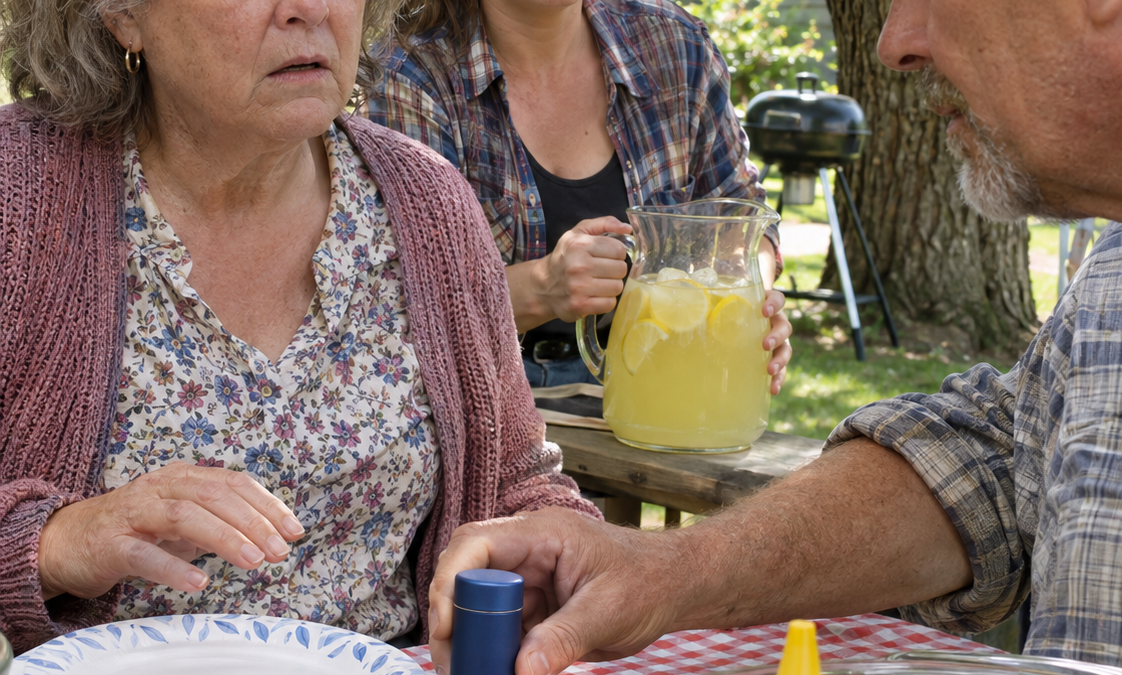
Leland set the little blue scattering tube between the mustard and the bowl of potato salad.
“I took Dad up to the cabin yesterday,” he said. “About half, anyway.”
My hand stopped over the stack of paper plates.
Coralie was three feet away, filling plastic cups with lemonade from the pitcher. She stopped too.
The picnic table sat under Leland’s maple tree, and until that second my biggest concern had been whether the deviled eggs had stayed cold enough during the drive.
“What do you mean, half?” I asked.
Leland pulled out the bench and sat down.
“I mean what I said. I scattered about half of Dad’s ashes at the cabin.”
He tapped the small tube once.
It made a hollow sound.
“Is that what’s in there?” Coralie asked.
“No. That’s empty.”
I looked at him. “Where is the rest?”
“At my house. In the original container.”
“The sealed container?”
“It isn’t sealed anymore, Thea.”
My daughter put the lemonade pitcher down carefully.
On Thursday morning, while I had been sitting in a specialist’s waiting room two counties away, Leland had picked up our father’s cremated remains from Cedar Wren Funeral Home.
I had agreed to that.
I had not agreed to this.
“You opened it,” I said.
He leaned back. “Obviously.”
“You told me you were picking it up.”
“And I did.”
“You told me you’d keep it until we all sat down.”
“We’re sitting down now.”
Coralie made a small sound through her nose.
Leland looked at her. “You got something to add?”
“No. I’m trying to figure out if you hear yourself.”
He pushed the empty tube farther onto the table.
“Dad loved that cabin.”
“He loved cinnamon toast,” I said. “That didn’t make the toaster his burial plan.”
“Thea.”
“No. Don’t ‘Thea’ me. We hadn’t decided anything.”
“You hadn’t decided anything.”
“We.”
He looked past me toward the yard where his grill smoked under the sycamore.
Dad had been gone less than two weeks.
His death had not been sudden in the dramatic sense. At eighty-six, after three hospital stays and a winter that seemed to take a piece of him every month, we had known we were getting close.
Knowing had not made Saturday afternoon feel normal.
Coralie sat beside me.
“Uncle Leland,” she said, “Grandpa told Mom to handle this.”
“He told everybody different things.”
“No,” I said. “He signed something.”
That brought his eyes back to me.
Months earlier, Dad had sat with Nolan Keene at Cedar Wren and signed a right-of-disposition declaration naming me as his representative. Nolan had already had the notarized document in Dad’s file before the cremation.
It was not hidden.
It was not something I had found after Dad died.
Leland knew it existed.
He just did not like what it said.
Picking up where the Facebook post left off
“You signed the cremation papers too,” he said. “I know.”
“As the authorizing agent.”
“And then you authorized me to pick him up.”
“To pick up the sealed container.”
He spread his hands. “Which I did.”
I got my purse from the chair behind me.
Coralie said, “Mom.”
“I’m getting the paper.”
“You brought funeral papers to a picnic?”
“I ran a school cafeteria for twenty-seven years. I bring receipts to places where people lie about who ordered extra chicken.”
Leland gave a short laugh without humor.
I found the folded copy Nolan had given me.
The pickup authorization was one page.
It named Leland as the person allowed to receive the remains from Cedar Wren on Thursday and transport and keep the sealed container until the family met.
Nothing in it appointed him to make final decisions.
Nothing said open.
Nothing said divide.
Nothing said scatter.
I put it flat beside the empty travel tube.
Leland did not touch it.
“That’s lawyer language,” he said.
“It is plain English.”
“You were out of town.”
“For a medical appointment I scheduled six weeks ago.”
“So somebody had to go.”
“No emergency existed. You offered.”
“And you said yes.”
“To transportation.”
He stared at the page.
Coralie reached across and moved the mustard so it would not drip on the paperwork.
Leland said, “Dad and I spent twenty years hunting out there.”
“I know.”
“You came twice.”
“Three times. I hated the outhouse every time.”
“He was himself there.”
That landed harder than I wanted it to.
Dad had been different at the cabin.
He and Leland could spend six hours arguing about a tree stand and come home pleased with each other. Dad taught him to clean fish there. They replaced the porch together after one spring storm. When Dad’s knees got bad, Leland built a wider step and denied doing it for him.
Those things were true.
They were not permission.
“What exactly did you do yesterday?” I asked.
Leland rubbed his thumb against the table edge.
“I took some up there. Walked behind the cabin to the ridge. Said goodbye.”
“How much?”
“I told you. About half.”
“Measured how?”
“I didn’t weigh him, Althea.”
“So ‘half’ is your estimate.”
“Yes.”
“And the rest is still in Dad’s original container at your house.”
“Yes.”
“Where?”
His face tightened. “Safe.”
“Where?”
“Bedroom closet.”
I folded my hands because otherwise I would have started gathering every object on the table just to have something to control.
“When were you planning to tell me?”
“I just did.”
“Afterward.”
“You would’ve said no beforehand.”
“That is usually why people ask before doing something irreversible.”
His mouth flattened.
Then he said, “I’m taking the rest next Friday.”
Coralie sat up.
“No,” I said.
Leland looked almost relieved to have reached the fight he had expected.
“I want him together.”
“You already made that impossible.”
“I mean together in one place.”
“You mean where you chose.”
“Where he belonged.”
I picked up the empty tube.
It was light enough that my anger made it feel cheaper than it probably was.
I set it back down.
“Do not move the remaining portion anywhere.”
“You don’t own Dad.”
“I didn’t say I did.”
“You’re acting like it.”
“I am telling you the decision was not yours to make.”
“It was my pickup.”
“That is not the same thing.”
“It was in my hands.”
Coralie said quietly, “That is definitely not the same thing.”
Leland stood.
The bench legs scraped the patio stones.
“I am not spending Dad’s memorial listening to you run it like a lunch shift.”
“Then don’t make me inventory what’s left before we’ve even picked a cemetery.”
He looked at me for several seconds.
“Friday,” he said. “I’m going back to the cabin.”
I took my phone from my purse.
“What are you doing?”
“Writing down what you just told me.”
“Oh, for God’s sake.”
“You scattered what you estimate was about half yesterday. You still have the remaining portion in the original container. You plan to scatter that Friday.”
“You need a clipboard too?”
“I have one in the car if it would improve your mood.”
Coralie lowered her head, but I saw her mouth twitch.
Leland did not.
I opened the family message thread and typed while he watched.
Please do not open, divide, transport, scatter, bury, transfer, or otherwise move Dad’s remaining cremated remains. We had not agreed on final disposition. Please keep the remaining portion secure in the original container until this is sorted out.
I turned the screen toward him.
“Accurate?”
He did not answer.
“Leland.”
“I can read.”
I sent it.
His phone buzzed in his pocket.
For the first time since he had put the blue tube on the table, he looked less certain.
Part 2 of 8
Sunday morning, I covered my dining table with paper.
Not legal strategy.
Paper.
There was a difference, although Coralie said I was making it difficult to detect.
She stood at the counter eating toast while I made three piles.
The first held Dad’s notarized right-of-disposition declaration.
The second held my copy of the Thursday pickup authorization.
The third held everything else: the funeral home invoice, the cremation authorization I had signed, two handwritten notes from Dad’s apartment, and printouts of family messages from the week before he died.
Coralie carried her plate over.
“You printed the group chat.”
“Yes.”
“You own a phone.”
“Phones lose charge.”
“Printers jam.”
“Mine fears me.”
She sat down.
I found the messages I wanted.
Four days before Dad died, Leland had written:
We should all talk after. Maybe Mom’s cemetery, maybe cabin, maybe something else.
I had answered:
No decisions until everyone can sit down.
Coralie had written:
Grandpa said he wanted people able to gather. That’s all he told me.
Leland had responded with a thumbs-up.
That was useful because it showed what Saturday’s argument had tried to erase: before he had the container in his hands, even Leland had treated the plan as unsettled.
I slid the page toward Coralie.
“This matters.”
“It does.”
She buttered the last corner of toast.
“Mom, don’t start treating every sentence anybody ever typed as Exhibit A.”
“I know.”
“You said that like somebody preparing Exhibit B.”
I ignored her.
The release receipt from Cedar Wren was missing from my folder.
I texted Nolan and got the funeral home’s automated weekend reply. I left a short message asking him to call Monday morning and requesting copies of the pickup receipt and any record showing the condition of the sealed container when released.
Then I texted Leland again.
Please confirm you received my request yesterday and will leave the remaining portion where it is until we speak with Nolan Monday.
He answered nine minutes later.
You can talk to whoever you want. Dad belongs at the cabin.
I wrote:
Will you leave the remaining portion where it is until Monday?
His reply came faster.
I’m not answering the same question twelve ways.
Coralie looked over my shoulder.
“That’s not a yes.”
“No.”
“Are you going to drive to his house?”
“No.”
She looked surprised.
“I’m angry,” I said. “I’m not stupid.”
The original container was inside Leland’s home. I had no intention of appearing on his porch demanding entry, and I was not calling law enforcement over an argument that still had a chance to be handled like adults.
I sent one final message.
I am asking you in writing not to make any further disposition before we review Dad’s declaration and the pickup authorization with Cedar Wren Monday.
Then I put the phone facedown.
Sunday stayed quiet.
Monday at 8:17, Nolan called.
“I got your message,” he said. “Are you somewhere you can talk?”
“I’m at home.”
“Good. I pulled Emmett’s file.”
His voice had the same measured quality he used when Dad died. Not soft. Just careful.
I told him what Leland had admitted at the picnic.
Nolan was silent for a moment.
“About half, according to him?”
“Yes. His estimate.”
“And he says the remainder is still in the original container?”
“Yes.”
“Do you have reason to believe he intends further scattering?”
“He said Friday.”
“All right.”
I could hear papers moving.
Nolan said, “I want to separate a few documents so we don’t talk past each other. Your father’s signed declaration names you as his representative for disposition. It was dated, notarized, and in our file before cremation.”
“Yes.”
“You were also the authorizing agent on the cremation authorization.”
“Yes.”
“The release instruction naming Leland was separate. It allowed us to release the sealed container to him as the named recipient for pickup. We did that Thursday.”
“It didn’t make him the representative.”
“No.”
“Or authorize scattering.”
“No.”
I wrote the word NO on my notepad and immediately felt foolish.
Nolan continued.
“We photographed our seal at release as part of our own documentation, and Leland signed the receipt. I can give you copies of both.”
“Was the seal photograph legally required?”
“No. It’s simply part of our records.”
“Good. I don’t want to make this sound like something it isn’t.”
“That would help everybody.”
I heard him turn another page.
“The declaration gives you authority regarding the location, manner, and conditions of disposition, subject to its terms. I’m not a court, Althea. I can’t order Leland to surrender anything, and I certainly can’t go retrieve it.”
“I understand.”
“What I can do, if he agrees, is accept the remaining portion into safeguarded custody while your family determines the final arrangements under the declaration.”
“How much?”
“No additional custody charge in these circumstances for a short period. If you later choose a new urn, cemetery placement, service, those are separate costs.”
That was the first sentence all morning that made my shoulders drop.
“Can you send the records today?”
“I can have copies ready by ten.”
“I’ll come get them.”
“Althea.”
“Yes?”
“If this becomes contested beyond voluntary return, talk to a qualified local attorney. Don’t rely on me to tell you what a judge would do.”
“I won’t.”
After we hung up, I called Leland.
He answered with, “I’m working.”
“You’re retired.”
“I’m replacing a gutter.”
“That sounds exhausting. Nolan pulled Dad’s file.”
Silence.
“He confirmed the declaration naming me was already on file before cremation,” I said. “He also confirmed your pickup paper was for receiving and holding the sealed container. Not final disposition.”
“I know what you’re going to say.”
“Then I can save minutes.”
“The cabin was Dad’s real place.”
“I know it mattered to both of you.”
“Do you?”
“Yes.”
“You hated going.”
“I can hate mosquitoes and still understand my father.”
He breathed out.
I said, “I’m picking up copies at ten. I’m sending you a written request afterward. Nolan is willing to hold what remains if you return it voluntarily.”
“So now you’re putting Dad in storage.”
“No. I’m stopping Friday from becoming another decision nobody can undo.”
He did not answer.
“Leland?”
“I said I’m working.”
He hung up.
At ten-thirty, I left Cedar Wren with a thin envelope.
The release receipt had Leland’s signature and the time he accepted the container Thursday.
The seal photograph showed the container closed at release.
The pickup instruction said exactly what my copy said.
The declaration said exactly what Leland already knew it said.
Nothing magical had appeared.
That was useful.
Part 3 of 8
I sent Leland four pages at 11:06 Monday morning.
Not twenty.
Not Dad’s entire file.
The declaration naming me.
The pickup authorization naming him as recipient.
The signed release receipt.
The funeral home’s seal photograph.
Underneath, I wrote:
I am formally asking you to return Dad’s remaining cremated remains in the original container to Cedar Wren for temporary safeguarded custody by noon Wednesday. Nolan has agreed to receive them voluntarily and document the handoff. I am not asking you to undo what happened Friday because that cannot be undone. I am asking you not to make another irreversible decision.
At 11:22 he called.
“You’re giving me a deadline now?”
“I’m giving the situation one.”
“Same difference.”
“No. You can be mad at me after Wednesday too.”
“You always did like forms.”
“I liked food-temperature logs. Forms themselves have very little charm.”
“This is exactly what I mean.”
“What?”
“You get paper in your hand and suddenly nobody else gets a father.”
I stood at my kitchen window.
Across the street, somebody’s recycling bin had tipped into the gutter.
“I am not saying the cabin meant nothing.”
“You’re saying what I did meant nothing.”
“I’m saying you chose for everybody after admitting in the family chat that no choice had been made.”
“That chat was before he died.”
“Yes.”
“People say things.”
“You did more than say something. You opened the container after agreeing to hold it.”
“I picked him up because you couldn’t.”
“I could have picked him up Friday.”
That stopped him.
I continued.
“There was no emergency Thursday. I had an appointment. You offered to help. I trusted you with transportation.”
“You trusted me until I did something you didn’t like.”
“I trusted you until you did something you didn’t have permission to do.”
His voice went flat.
“You going to sue me?”
“I would rather spend money on Dad’s memorial than a lawyer.”
“So that’s a threat.”
“No. It is the opposite of one. I am telling you what choice I want to avoid.”
I had called a local attorney after leaving Cedar Wren, just as Nolan suggested.
The consultation would cost two hundred seventy-five dollars if I needed it.
I had scheduled a phone appointment for Wednesday afternoon and could cancel by Tuesday at noon without charge.
I told Leland that.
“Of course you called a lawyer.”
“I scheduled one.”
“Same thing.”
“It costs me two hundred seventy-five dollars if this is still unresolved Wednesday.”
“Poor you.”
“That isn’t why I mentioned the price.”
“Then why?”
“Because I would prefer to spend that money on an urn Dad’s grandchildren can stand in front of instead of paying somebody to write you a longer version of what I already sent.”
He was quiet.
I said, “Bring the remaining portion to Cedar Wren. Nolan will receive it. You can watch him document the handoff. I will not be there if you don’t want me there.”
That seemed to catch him.
“You won’t?”
“No.”
“Why not?”
“Because this isn’t a hostage exchange.”
He made a sound that might have been a laugh if he had liked me better.
Then he said, “I need to think.”
“All right.”
“How long do I get?”
“Until Wednesday at noon.”
“You really can’t help yourself.”
“No.”
He hung up.
Tuesday morning passed with nothing.
At 11:43, seventeen minutes before the Tuesday noon deadline to cancel the Wednesday afternoon legal consultation without charge, Leland texted.
Tell Nolan I’ll be there Wednesday 9.
I read it twice.
Then I called the attorney’s office and canceled.
No fee.
I called Nolan next.
Wednesday morning, I stayed home.
That was harder than going.
At 9:18, Nolan called.
“Leland is here.”
I stood up from my kitchen chair.
“All right.”
“He has the original container with him. He has agreed that we may accept it into temporary safeguarded custody pending the arrangements you make under your father’s declaration.”
“Did he say anything about Friday?”
“He confirmed that before today he had opened the container and scattered a portion at his private cabin. He described it as about half. We’re recording that as his statement, not as a measured quantity.”
“Thank you.”
“He also confirmed he has not scattered any additional portion since Saturday.”
I closed my eyes for one second.
“Can I talk to him?”
There was a pause.
Then Leland came on.
“You happy?”
“No.”
That answer seemed to irritate him more than yes would have.
“Well, it’s here.”
“I heard.”
“Nolan checked it in.”
“Good.”
“He had me sign another piece of paper. Your favorite.”
“I’ll frame it over the mantel.”
“Very funny.”
Neither of us spoke.
Finally he said, “You know Dad would’ve liked that ridge.”
“I do know.”
“You keep saying that.”
“Because you keep acting like agreeing with that means I have to agree you could decide alone.”
“I was there with him more than you were.”
“Yes.”
The word came out cleanly.
That surprised him into silence.
“You were,” I said. “At the cabin, you were. You and Dad had that. I’m not taking it away.”
“Could’ve fooled me.”
“I’m also not giving you Friday.”
His breathing changed.
Not much.
Enough.
I said, “What happened there happened. I cannot fix it, and I am not going to pretend the rest of him somehow makes the first part disappear.”
“You make everything sound clinical.”
“I spent thirty years telling teenagers they could not thaw hamburger under warm water. Clinical is where I go when people frighten me.”
He did not answer.
Nolan came back on a moment later.
“Althea?”
“Yes.”
“The handoff is complete. The remaining portion is secured here.”
That changed what I could do.
Friday no longer hung over me as a second scattering date.
I could choose an urn without wondering whether there would be anything left to place in it. I could call the cemetery where Mom was buried and ask what options actually existed instead of letting fear choose the fastest one. I could tell Coralie she no longer needed to check her phone every hour in case her uncle announced another finished decision.
“Thank you,” I said.
After the call, I texted Coralie.
He returned the remaining portion. Cedar Wren has it secured.
She called immediately.
“Really?”
“Really.”
“Did you have to go there?”
“No.”
“Did he?”
“Yes.”
“And he handed it over?”
“Voluntarily.”
She exhaled so loudly I moved the phone away from my ear.
Then she said, “What now?”
I looked at the yellow pad on my table.
At the top I had written three things:
Urn.
Cemetery.
Family.
The first two looked easier.
That worried me.
“Now,” I said, “I find out what Mom’s cemetery can actually offer us.”
“And Uncle Leland?”
“I invite him into the next conversation.”
Coralie was quiet.
“You’re going to invite him?”
“Yes.”
“Even after this?”
“Yes.”
“That sounded painful.”
“It was.”
I picked up my pen.
“Do me a favor.”
“What?”
“If I start saying ‘under my authority’ more than twice in one phone call, hang up on me.”
“Twice seems generous.”
“I’m your mother.”
“That has never stopped me before.”
I wrote Leland’s name beneath Family and left a space beside it.
Then I called the cemetery office.
Part 4 of 8
The cemetery office answered on the fourth ring.
“Briar Rest Memorial Gardens.”
“My name is Althea Danner. My mother, Vera Danner, is buried there. I need to ask what options you have for my father’s cremated remains.”
The woman introduced herself as Marlene and asked for Mom’s full name.
I heard keys clicking.
“Yes, I have her record. Ground burial, section C.”
“Is there room for my father there?”
“Not in her grave.”
I appreciated the speed of that answer.
“What about beside her?”
“Let me check.”
More clicking.
“There isn’t an adjoining grave available. There are cremation niches in the columbarium across the path from section C.”
“How close?”
“About sixty yards.”
“And those are individual?”
“Yes. One person per niche unless the contract is for a companion niche. You wouldn’t be placing remains into your mother’s grave or combining anything.”
“Good.”
Marlene gave me three choices.
The least expensive was a plain interior niche at $1,125.
A glass-fronted niche was $1,780, but the cemetery required an approved decorative urn and charged another $190 for installation.
An exterior granite-fronted niche on the side facing Mom’s section was $1,460.
“That includes opening and closing?” I asked.
“Yes. It includes the niche right, placement, and standard inscription plate. The memorial service itself is separate. If you use our small chapel, that’s $325 for ninety minutes.”
“What if we gather at the niche?”
“No charge for the gathering itself if you keep it under thirty minutes and don’t require chairs or staff setup. We do need it scheduled.”
I wrote the numbers on my yellow pad.
My handwriting changed when money entered a conversation.
It got smaller.
“Can I come see the options?”
“Of course.”
I looked at the clock.
“Today?”
“I’m here until four.”
Coralie drove.
That was her first practical contribution to the process, although she called it protecting the public from my distracted driving.
At the cemetery, she brought an umbrella because the clouds looked mean, carried the folder, and took photographs of the three niche locations after Marlene said that was fine.
Not paperwork.
Locations.
That distinction mattered.
The exterior niche I liked was across a narrow paved path from Mom’s section. From it, I could see the maple tree near her grave.
Coralie stood beside me.
“This one feels right.”
“It costs three hundred thirty-five more than the interior one.”
“You can see Grandma’s section.”
“Yes.”
“You’re going to choose it.”
“I am considering it.”
“You’re doing cafeteria math with Dad.”
“I did cafeteria math with six hundred children. It kept them fed.”
She opened the umbrella.
Rain started with no warning.
Marlene led us under the columbarium overhang.
“If you want this side,” she said, “I currently have four single niches available. I can hold one for forty-eight hours without payment.”
“Which one?”
“You choose from what is available. There isn’t an automatic family claim based on your mother being buried nearby.”
“I understand.”
That sentence had become useful.
We looked at the four.
Two were high enough that I would have needed to tilt my head back.
One was low.
The fourth sat nearly at eye level.
I said, “That one.”
Coralie said, “Mom.”
“What?”
“You haven’t called Uncle Leland.”
“I’m looking.”
“You’re pointing.”
“I can point without purchasing.”
Marlene pretended to study her clipboard.
I lowered my hand.
“We’ll take the forty-eight-hour hold,” I said.
“On that niche?”
“Yes.”
She wrote it down.
Back in Coralie’s car, rain drummed on the roof.
“You promised you’d include him,” she said.
“I am going to.”
“You almost bought the niche before calling.”
“I did not.”
“You asked if they took cards.”
“That was information.”
She started the engine but did not put it in gear.
“Mom, if you decide the niche, urn, service length, music, flowers, who speaks, and what everybody eats afterward, then invite him to approve the finished list, that is not including him.”
“He lost some privileges.”
“Yes.”
Her answer came so quickly I looked at her.
She continued.
“He lost the privilege of deciding what happens to Grandpa’s remains by himself. He did not lose the ability to say Grandpa hated lilies.”
“He did hate lilies.”
“He said they smelled like a dentist office.”
“That was gardenias.”
“Fine. See? This is why other people have memories.”
I looked out at the rain.
“What exactly do you want me to do?”
“Give him actual choices that do not let him undo the safe part.”
I hated how sensible that was.
The urn was my next problem.
Cedar Wren had six in the price range I could manage without touching Dad’s estate account while everything else was still being sorted.
Nolan showed Coralie and me the catalog the following afternoon.
I had decided before we arrived that I wanted walnut.
Dad liked walnut.
Then Nolan turned the page and Coralie touched a plain dark cherry urn with a narrow brass band.
“That looks like Grandpa’s desk.”
Dad’s desk had been cherry.
Leland had refinished it with him one winter.
I stared at the picture.
“How much?”
“Four hundred eighty-five,” Nolan said.
The walnut one I had chosen in my head was $610.
I could afford either from my savings.
I disliked that the cheaper one also made more sense.
“I want to ask Leland,” I said.
Coralie looked at me.
Not triumphantly.
That helped.
I called him from Cedar Wren’s consultation room.
He answered after six rings.
“What?”
“We have two real choices I want your opinion on.”
“Is this a trap?”
“No. The remaining portion stays here until the cemetery placement. That is not being reopened.”
“Then what choices?”
“Urn and memorial details.”
Silence.
I described the cherry urn.
He said nothing for so long I thought the call had dropped.
Then he said, “Dad and I did that desk in the garage.”
“I remember.”
“He sanded through the veneer on one drawer.”
“He blamed the sander.”
“It was him.”
I looked at Coralie.
She was writing something on the back of an envelope.
I said, “Do you think the cherry urn fits him better than walnut?”
“Yes.”
That was all.
No fight.
No conditions.
Just yes.
I paid $485 from my checking account.
Nolan gave me the receipt.
The remaining portion stayed secured in Cedar Wren’s custody while the ordered urn came in.
Nothing moved that afternoon except money and one decision.
That felt like progress.
Part 5 of 8
The niche hold would expire Friday afternoon.
By noon, Leland still had not answered my message about the cemetery.
I had sent him Marlene’s photograph of the available exterior niche, the price, and one sentence:
It faces the path toward Mom’s section. I plan to contract for it today unless you see a practical problem I have missed.
Coralie was at my dining table with a legal pad of her own.
She had taken over what she called “people logistics.”
That meant phone numbers, accessibility needs, and figuring out whether Dad’s eighty-two-year-old cousin could stand outside for twenty minutes without a chair.
“He needs a chair,” she said.
“Then we need the chapel.”
“Or I bring a folding chair.”
“Marlene said no staff setup.”
“She did not outlaw my trunk.”
I looked at her.
“What?”
“You’re enjoying this.”
“I like solvable problems.”
“That is hereditary.”
At 12:38, Leland finally replied.
You already picked it.
I called him.
He rejected the call.
I called again.
He answered.
“What part of working on my mower looks like an invitation to talk?”
“The part where I cannot see you.”
“You picked the cemetery.”
“Dad wanted the family able to gather. Mom is there. The available niche is across the path. I have not signed yet.”
“You decided before you asked.”
“I found an option before I asked.”
“Same thing with you.”
I looked down at Coralie’s legal pad.
She had written:
DON’T WIN. GET ANSWER.
I turned the pad facedown.
“What would you choose?” I asked.
“The cabin.”
“That option is not available for what remains.”
“Then why ask me?”
“Because there are still choices that are.”
“Like what?”
“Whether we use the chapel or gather at the niche. Whether we play Dad’s old country records at the reception room afterward or keep it quiet. Whether you want to say something. Whether you have a photograph I don’t.”
“You’re giving me decorations.”
“No. I’m giving you parts of the goodbye that are still open.”
He was silent.
I added, “I cannot give you a veto over the niche, and I am not leaving Dad at Cedar Wren for six months while we fight. I also don’t want to build the whole service out of things only I remember.”
That cost me something to say.
I could tell because Coralie stopped writing.
Leland said, “He hated chapels.”
“Why?”
“Said they made him feel like he had to whisper.”
I almost said Dad complained about every room where someone asked him to behave.
Instead I said, “All right. Niche gathering.”
“He liked that picnic shelter by the cemetery entrance.”
“I can ask if we can reserve it afterward.”
“He used to eat lunch there when Mom was sick.”
I did not know that.
“When?”
“When I drove him to see her.”
Those months had been bad.
Mom had spent her last year in and out of care, and Dad had divided his time between her bedside and pretending he did not need help.
I had handled medication lists and insurance calls.
Leland had driven him.
We had each mistaken our own work for the whole story.
“I’ll ask,” I said.
He cleared his throat.
“There’s a picture in Dad’s hall closet. Him and Mom at Lake Erie. She’s wearing that ugly yellow visor.”
“She loved that visor.”
“She looked like road construction.”
“That photograph is forty years old.”
“About that.”
“Can you bring it?”
A pause.
“To what?”
“The memorial.”
He did not answer directly.
“I can get you the picture.”
“That wasn’t what I asked.”
“I heard you.”
After the call, I phoned Marlene.
The picnic shelter belonged to the cemetery but could be reserved for family gatherings at $85 for two hours. We could bring our own food. No alcohol. We had to remove everything afterward.
I booked it.
Then I signed the niche contract.
$1,460 from my savings.
The service would be the following Saturday morning, giving us a little more than a week to notify family and prepare.
Marlene scheduled the niche placement with cemetery staff immediately after the gathering.
The urn would be transferred from Cedar Wren to the cemetery according to their ordinary procedures before the service.
I wrote every amount down.
Urn: $485.
Niche: $1,460.
Shelter: $85.
Printed memorial cards from the local copy shop: estimated $64.
Food: I set a ceiling of $180.
Coralie looked over the list.
“You’re at $2,094 before food.”
“I can add.”
“Just checking.”
“This is from my savings. I am not assuming reimbursement.”
“I know.”
She tapped the food line.
“Let me handle this.”
“You have work.”
“I also have a grocery store.”
“I can make sandwich trays.”
“You can. You also alphabetized Dad’s cousins this morning.”
“They were out of order.”
“Mom.”
I handed her the food budget.
“One hundred eighty.”
“Good.”
“No olives.”
“Why?”
“Dad hated olives.”
“Uncle Leland loves them.”
I opened my mouth.
Coralie raised one eyebrow.
“Fine,” I said. “Olives on the side.”
She wrote it down.
That evening, I sent Leland the actual invitation.
Dad’s memorial gathering will be next Saturday at 10:00 a.m. at the exterior columbarium at Briar Rest, across the path from Mom’s section. Cemetery staff will place the urn in his separate niche afterward. We have the picnic shelter reserved from 10:45 to 12:45. You are invited to attend, speak if you want, and bring the Lake Erie photo or any other photographs you think should be displayed. Please tell me by Wednesday if you want a speaking place or need anything practical arranged.
He read it.
No answer came.
I did not send another message.
Part 6 of 8
Leland arrived at my house Tuesday evening carrying a grocery bag and Dad’s Lake Erie photograph.
He did not take off his jacket.
Coralie was already there, sitting on the floor beside three foam boards.
“What’s in the bag?” I asked.
“Pictures.”
He set it on the table.
“No ashes,” I said before I could stop myself.
His face changed.
Coralie closed her eyes.
I wished I could pull the sentence back through my teeth.
Leland said, “No, Althea. I did not smuggle Dad out of Cedar Wren in a grocery sack.”
“I know.”
“Do you?”
“Yes.”
I touched the back of a chair.
“That was unnecessary.”
He looked surprised.
I added, “What I said. Not you coming.”
Coralie opened one eye.
Leland put the photograph on the table.
Mom stood in a yellow visor beside Dad near gray water, both of them younger than I was now.
Dad had one arm around her shoulders.
He looked sunburned and irritated.
“That’s him,” I said.
“He had just paid nine dollars for parking.”
“That explains the face.”
Leland almost smiled.
Then he emptied the bag.
There were twelve photographs.
Dad holding a fish.
Dad asleep in a lawn chair.
Dad and Leland repairing the cabin porch.
Dad standing beside my cafeteria loading dock with two sheet cakes because he had decided my retirement party desserts were “too little.”
I had forgotten that one.
Coralie picked it up.
“I want this.”
“I look terrible,” I said.
“You’re not in it.”
“Exactly.”
Leland sat down.
For twenty minutes, we chose photographs.
Not evidence.
Not permissions.
Pictures.
The cabin appeared in four.
I kept all four on the board.
Leland noticed.
“You don’t have to do that.”
“Yes, I do.”
“No, you don’t.”
“I almost left them out.”
Coralie looked up.
Leland leaned back.
“Why?”
“Because I was angry.”
“You’re still angry.”
“Yes.”
That answer stayed between us.
Then he said, “I’m angry too.”
“At me?”
“At Dad. At you. At that funeral home. At myself. Pick one.”
“Nolan did what the paperwork told him to do.”
“I know.”
His voice sharpened.
“I know that now.”
Coralie stopped arranging photographs.
Leland rubbed both hands over his knees.
“When Nolan gave me the container Thursday, I thought—”
He stopped.
I waited.
He tried again.
“I thought if you trusted me to take him home, then I was being trusted with him.”
“You were.”
“That sounds like the same thing.”
“It isn’t.”
“I know.”
It was the first time he had said that to me.
Not about the cabin.
About the pickup.
He looked at the photograph of himself and Dad repairing the porch.
“I knew the family hadn’t settled it,” he said. “I knew that. I just kept telling myself Dad would have picked the cabin if somebody made him choose.”
“Maybe he would have.”
Leland looked at me.
I continued.
“But he didn’t make that instruction.”
“No.”
“And being the one who picked up the container wasn’t being asked to scatter part of it.”
His jaw worked.
“No.”
Coralie stood quietly and carried the finished photograph board to the sideboard.
No one rescued him from the sentence.
He said, “I shouldn’t have done it before we talked.”
I nodded.
That was enough.
Not forgiveness.
Not repair.
A fact finally sitting in the correct chair.
He looked at me.
“You going to put that in writing?”
“I considered it.”
Coralie said, “Mom.”
“I’m kidding.”
Leland snorted.
Then I made the mistake of opening my service folder.
“We’ll start at ten. Marlene said the cemetery staff member will meet us at the columbarium. I thought Coralie could welcome people. I’ll speak for five minutes. Cousin Vernon gets the folding chair. Then we—”
“Five minutes?” Coralie said.
“I timed it.”
“Of course you did.”
Leland said, “What happens if somebody talks six?”
“We survive.”
“Good to know.”
I ignored him.
“Afterward we walk to the shelter. Food is ready at eleven.”
Coralie reached over and closed the folder.
“Stop.”
“What?”
“You just did it again.”
“Did what?”
“You invited us into the service and then handed us our assignments.”
“I asked if you would welcome people.”
“You told me three days ago.”
“And you said yes.”
“I did. But Uncle Leland just admitted something difficult, and your response was to start reading a schedule.”
Leland stared at the table.
I said, “We need a schedule.”
“We need one. We do not need every person timed like lunch period.”
That stung because it was accurate.
I sat down.
“What do you suggest?”
Coralie opened the folder again and took out my typed page.
She crossed through “ALTHEA — 5 MINUTES.”
Then she crossed through “LELAND — OPTIONAL 3 MINUTES.”
“I did not write three.”
“You wrote ‘brief.’ Same disease.”
Leland laughed.
I let him.
Coralie said, “You open. Two minutes if you really need a number. Then anybody in the family who wants to share one short memory can. Nobody gives a sermon. Nobody gets a stopwatch.”
“What if twelve people want to speak?”
“Then Grandpa gets twelve memories.”
“The cemetery only gave us thirty minutes.”
“So Marlene ends it when we need to move.”
That was a reasonable boundary not created by me.
I disliked it less than expected.
I looked at Leland.
“Do you want to say something?”
“I don’t know.”
“That can be your answer until Saturday morning.”
He nodded.
I pulled a blank index card from the folder and wrote:
Family memories — open.
Then I placed it over the typed speaking order.
Leland watched me do it.
“There,” I said.
“Did that hurt?”
“A little.”
He picked up the Lake Erie photograph.
“I want this one beside the urn.”
“Yes.”
“And the porch picture.”
“Yes.”
“And no lilies.”
“Still no lilies.”
Coralie said, “Food update: sandwiches, fruit, cookies, coffee, water, and one small bowl of olives placed far from Grandma’s photograph.”
“Acceptable,” I said.
Leland looked at her.
“Black olives?”
“Yes.”
“Dad hated those.”
“They’re not for Dad.”
That made all three of us laugh, which felt strange enough that it ended quickly.
When Leland stood to leave, I walked him to the door.
“Are you coming Saturday?” I asked.
His hand stayed on the knob.
“I don’t know.”
“You have a place if you do.”
“I know.”
“I’m not moving the service.”
“I know that too.”
He opened the door.
Then he turned back.
“If I don’t come, use the cabin porch picture anyway.”
“I will.”
He left.
Wednesday afternoon, Cedar Wren called to say the cherry urn had arrived.
Nolan told me the remaining portion could be transferred into it according to their normal procedure, documented, and kept secured until cemetery transfer.
I approved that.
Friday, Coralie and I took the two finished photograph boards, Dad’s framed Lake Erie picture, the shelter reservation, and a box of printed memorial cards to Briar Rest.
Marlene met us at the columbarium.
She pointed to the contracted niche.
“This is the one. Staff will have it prepared Saturday morning. The urn will arrive from Cedar Wren before the gathering and remain in staff custody until placement.”
I checked the name information for the inscription plate one last time.
Correct spelling.
Correct years.
No extra phrase.
Coralie stood several feet away, holding the porch photograph.
“Mom.”
“What?”
“Come here.”
I joined her.
From that spot, with the leaves thinning, we could see Mom’s maple tree across the path.
Coralie held Dad’s photograph up at chest height, testing where it would sit on the small display stand.
“Here?”
I moved it two inches to the left.
Then I moved it back.
“Here,” I said.
She set the photograph in place.
I took Leland’s name off my speaking schedule and left the blank family-memory card where it was.
Part 7 of 8
Saturday morning was cold enough that Coralie made me put on gloves.
“You’ll lose feeling in your fingers and blame logistics,” she said.
“I would blame circulation.”
“Same personality.”
We reached Briar Rest at nine-thirty.
Marlene was already there.
So was the cherry urn.
It sat on a small covered table in front of Dad’s Lake Erie photograph, dark wood with the narrow brass band Coralie had liked.
Nolan had transferred the remaining portion into it at Cedar Wren under their normal documented procedure and delivered it into cemetery staff custody that morning.
I had received the transfer record by email before leaving home.
I did not print it.
That felt like growth.
The urn stayed closed.
Intact.
Untouched by us.
The photograph boards stood on either side.
Dad asleep in the lawn chair.
Dad carrying cakes into my cafeteria.
Dad beside Leland on the cabin porch.
Dad with Mom in her terrible yellow visor.
Coralie adjusted one board.
“Crooked?”
“A little.”
“It’s the ground.”
“It’s always the ground when you don’t want to fix something.”
She fixed it.
People began arriving.
Cousin Vernon got the folding chair.
Two of Dad’s old neighbors came together and spent five minutes arguing about whether he had ever returned a borrowed hedge trimmer.
My daughter handed out memorial cards and pointed people toward the columbarium without turning into me.
I noticed.
At nine fifty-eight, I looked toward the parking lot.
No Leland.
At ten, I looked again.
Still no Leland.
Coralie touched my elbow.
“He knows where we are.”
“I know.”
“You invited him.”
“I know.”
That did not make the empty place beside the photograph boards less obvious.
I opened the gathering.
My prepared remarks were in my coat pocket.
I left them there.
“Thank you for coming,” I said. “Dad liked people more than he admitted, and he complained about gatherings while attending every one. We’re going to keep this simple. If you have a short memory you want to share, there’s room.”
Then I stopped.
No speech about authority.
No explanation about what had happened at the cabin.
No correction of the record.
Dad was not going into that niche as evidence.
For several seconds, nobody spoke.
Then Vernon raised one hand from his chair.
“Emmett once drove forty minutes to return me six dollars.”
Someone laughed.
Vernon continued.
“He said I had overpaid him for lumber. Gas cost him more than six dollars.”
“That sounds right,” I said.
One of the neighbors told the hedge-trimmer story.
According to him, Dad had kept it nine months and returned it sharpened, painted, and with a note saying the original handle was “an insult to hands.”
Coralie told the cake story.
“I was sixteen,” she said. “Grandpa decided Mom’s retirement party didn’t have enough dessert.”
“It had plenty,” I said.
“He arrived with two sheet cakes anyway.”
“They were on sale.”
“They were not.”
People laughed again.
Then Coralie picked up the porch photograph.
She did not look at me before speaking.
“Grandpa and Uncle Leland rebuilt this porch together. Grandpa complained about every board, every screw, and the price of treated lumber. Then he sat on it every season until he couldn’t manage the drive anymore.”
I looked at the empty space where Leland could have stood.
The memory stayed.
Nobody removed it because he was absent.
Nobody turned the cabin into a forbidden word.
I said, “He loved that place.”
My voice held.
Barely.
A woman from Dad’s street remembered him clearing snow from three driveways before doing his own.
Another cousin remembered Mom making him wear a tie to church and Dad removing it in the car before reaching the first stoplight.
We used twenty-two of the thirty minutes.
No stopwatch.
At the end, Marlene stepped forward.
“We’re ready for placement whenever the family is.”
I looked at Coralie.
She nodded.
The urn remained on the table while people moved back.
Marlene and another cemetery employee handled it.
Not me.
Not Coralie.
They checked the identification against their paperwork and the contracted niche information.
Then they placed the cherry urn inside the separate niche.
Dad’s.
Not Mom’s.
Nothing combined.
Nothing pretending the part already scattered had somehow returned.
Marlene asked whether I wanted a moment before the granite front was secured.
“Yes.”
She stepped away.
I stood in front of the open niche.
Coralie stood beside me.
The urn looked smaller inside than it had on the table.
I said, “He would complain about the price.”
“He would ask if you compared three places.”
“I compared two.”
“He’d be disappointed.”
I laughed once.
Then stopped.
Across the path, the maple near Mom’s section had lost most of its leaves.
I thought of Dad eating lunch at the picnic shelter while visiting her.
Leland had known that story.
I had not.
I still did not know whether he was home, at the cabin, or driving around refusing to decide where to be.
I did not text him.
Not then.
I touched two fingers to the edge of Dad’s framed photograph instead.
“All right,” I said.
Marlene returned.
The cemetery staff secured the granite front.
Dad’s name would go on the plate when it was finished.
People walked with us toward the shelter.
Coralie carried the Lake Erie picture.
I carried nothing.
For once, that was enough.
Part 8 of 8
The shelter smelled like coffee, wet leaves, and the bowl of black olives Coralie had placed exactly where she promised.
Far from Mom’s photograph.
Leland’s chair stayed empty.
I had not assigned him one, but everybody knew which place was his because the porch picture sat near it.
No one said his name for the first ten minutes.
Then Vernon asked, “He coming?”
“No,” I said.
That ended it.
No excuse.
No invented emergency.
No version that made the family easier to look at.
He had been invited.
He had chosen not to attend.
Coralie set a sandwich on my plate.
“You haven’t eaten.”
“I had toast.”
“At seven.”
“I’m sixty-one, not seven.”
“You still need lunch.”
I ate half the sandwich.
People stayed almost the full two hours.
They told smaller stories once the formal part was over.
Dad cheating at cards by announcing everybody else’s mistakes.
Dad cutting coupons for products he never bought.
Dad insisting he could fix a toaster and then buying a new one after two hours.
The cabin came up three more times.
I did not redirect anyone.
That was harder than it should have been.
When the last relatives left, Coralie and I started cleaning.
She stacked cups.
I folded the tablecloth.
The olives had barely been touched.
“See?” I said. “Waste.”
“They cost three dollars.”
“It begins with olives.”
She rolled her eyes.
We filled two trash bags and put leftover sandwiches into containers.
The cemetery required us to leave the shelter as we found it.
Dad would have approved of that.
He would also have complained that the reservation cost eighty-five dollars when there was a perfectly good picnic table outside.
I could hear the sentence in his voice.
That did not make him feel present.
It just meant I remembered him.
There was a difference.
At home that afternoon, I spread the receipts across the dining table.
Urn, $485.
Niche, $1,460.
Shelter, $85.
Memorial cards, $61.40.
Food, $146.72.
Two thousand two hundred thirty-eight dollars and twelve cents.
From my savings.
I wrote the total once.
Then I put the receipts in an envelope.
Coralie sat across from me drinking reheated coffee.
“Are you going to ask the estate for reimbursement?”
“Not today.”
“Good.”
“I did not say never.”
“I know.”
“I want to see what expenses are appropriate before assuming anything.”
“That sounds dangerously reasonable.”
“Don’t spread it around.”
She smiled.
There was one unused memorial card on the table.
And one photograph I had not packed away.
The porch.
Dad and Leland side by side, both holding boards, both squinting into the sun as if whoever took the picture had inconvenienced them personally.
I looked at my phone.
No message from Leland.
I had sent him nothing during the service.
Nothing afterward.
Coralie noticed.
“You don’t have to tell him today.”
“He knows what time it was.”
“Yes.”
“He knows where Dad is.”
“Yes.”
The word “Dad” still covered two places now.
The cabin ridge where Leland had scattered the part he took.
The niche across from Mom’s section where the remaining portion had been placed.
There was no clean way to make that sentence prettier.
I put the phone down.
Two days later, I went back to the cemetery with Coralie.
The inscription plate was not finished yet.
We had not gone to check it.
We brought the Lake Erie photograph because I had accidentally left the display stand in Coralie’s trunk and she wanted it out.
That was her explanation.
She parked near Mom’s section.
We walked first to Dad’s niche.
The granite front was secure.
A temporary cemetery label sat where the permanent plate would go.
Nothing had changed.
That helped.
Then Coralie said, “Grandma?”
“Yes.”
We crossed the path.
Mom’s grave was under the maple, damp leaves gathered along one edge.
Coralie crouched and brushed them away with her gloved hand.
I helped.
No tools.
No ceremony.
Just leaves.
When we finished, we stood there looking across the path toward Dad’s columbarium.
“You really can see it from here,” Coralie said.
“Yes.”
She handed me the Lake Erie photograph.
Mom in the yellow visor.
Dad looking irritated about parking.
I held it at chest height and lined the picture up with the path between them.
Coralie laughed.
“What?”
“You’re doing that thing where you straighten pictures that aren’t hanging.”
“It was crooked.”
“It’s in your hands.”
“Still crooked.”
She took one side of the frame.
I kept the other.
Together we leveled it between us.
For a few seconds, neither of us let go.
THE END
More stories
My Stepsister’s Husband Called Me “The Hired Driver” While Counting My Stepmother’s Dishes—Then 611 Pickup Signatures and His Own Texts Showed Who Had Been There
My Fiancé Told Everyone I Couldn't Keep Working—Then His Caregiver Application Asked Me to Verify That I Needed His Daily Care
My Brother Filmed Me While Admitting He Spent My Sons' $25,200 College Fund—But When Mom Saw His Own Paperwork, She Refused to Risk Her Paid-Off House
My Boyfriend Told Friends I Was Forgetting Things, but Our Landlord's Renewal Letter Said He Had Tried to Remove Me From the Lease Without My Signature.
My Sister-in-Law Put My Late Mother’s Quilt Under Her Grandmother’s Name and Took the $300 Prize, but My Stitches Helped the Guild Correct the Credit.
My Office Manager Called My House a Thanksgiving Venue for 34 Coworkers While I Cared for My Husband, until Her Own Records Forced a Public Correction.








