My Son Called Me a Burden at Thanksgiving and Pushed a Power of Attorney Across the Table, but I Had Brought My Own Paperwork
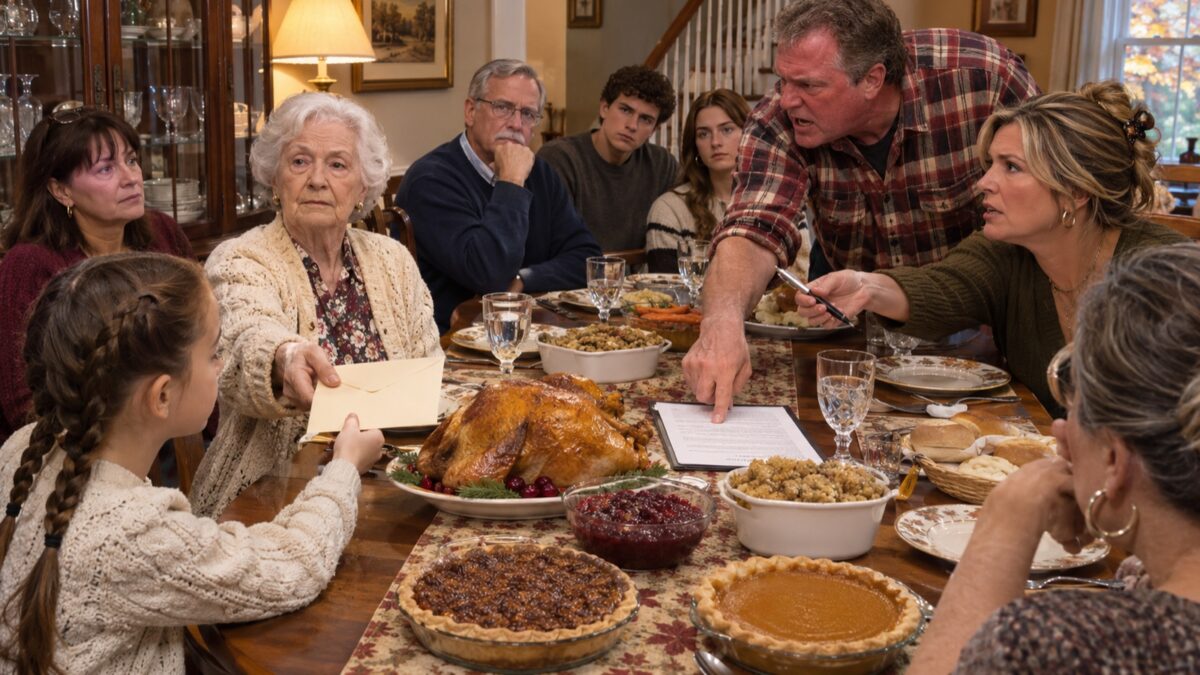
Lily held the page by its edges, keeping it clear of her plate.
“This part up here, Grandma?”
“The very top.”
Shannon reached across the table before Lily could begin.
“Let me see that first.”
Lily lifted the paper out of reach without seeming to realize she had done it.
She had spent most of third grade protecting worksheets from spilled milk.
“Her hands are clean,” I said.
“That isn’t what I meant.”
“Then she can hold it.”
Shannon’s hand stayed between us for another second.
Then she drew it back and laid it beside the bank pen.
The pen looked smaller now.
It was an ordinary thing to notice, but ordinary things helped me when people became unreasonable.
A fork.
A water glass.
A child’s crooked place card.
Things remained what they were, even when somebody across the table tried to give you a different name.
Burden.
Forgetful.
Difficult.
I was still Dorothy Harlan.
My feet still reached the floor.
And I had not signed anything.
Gary watched the envelope in my lap.
“Where did you get that?”
“From my purse.”
“I mean the paper.”
“I understood you.”
He glanced at Shannon.
For once, neither of them seemed to have the next sentence ready.
Earlier, I had asked who prepared the form with its little yellow arrows.
Shannon had called it standard.
“That wasn’t my question,” I had said.
Now those little yellow arrows pointed toward an empty signature line.
I had a sudden, practical thought.
I wanted a copy.
Not because I intended to sign it later.
Because I wanted to remember exactly what they had asked me to sign.
“Gary, would you put those pages back in their folder?”
His eyebrows lifted.
“Why?”
“I’ll take them with me.”
Shannon covered the first sheet with her palm.
“We can get you another copy.”
“This one will do.”
“It has our notes on it.”
“Then I’ll know where you wanted me to look.”
Lily lowered the page a little.
“Am I supposed to wait?”
“Just a moment, sweetheart.”
I regretted putting her in the middle.
She should have been deciding whether to have apple or pumpkin pie.
She should have been asking for whipped cream and receiving more than her mother considered sensible.
But Shannon had made the table a place for adult business.
I would not let her decide that Lily was old enough to hear her grandmother diminished but too young to read a heading.
“Is Grandma in trouble?” Lily asked.
“No,” I said.
Gary spoke at the same time.
“Nobody’s in trouble.”
Lily looked from him to the papers.
“Then why can’t she take them?”
The refrigerator motor stopped in the kitchen.
In the quiet that followed, I heard a car pass on Orchard Street, its tires making a soft hiss on the damp pavement.
Shannon picked up her napkin.
“Because Thanksgiving isn’t the time to get into all this.”
I looked at the blue folder.
She looked at it, too.
Neither of us needed to explain how it had arrived beside my plate.
Gary rubbed the side of his neck.
“Let’s put everything away and eat.”
“You may eat,” I said.
“Mom.”
“My dinner will wait.”
It had waited through worse.
When Ray worked emergency calls, I had learned to keep a plate warm without drying out the meat.
There was a trick to it.
A little broth.
A proper cover.
Not turning the oven up because you were annoyed.
I wished, briefly and foolishly, that this could be solved with broth.
Gary pushed his chair back an inch.
The leg scraped the floor.
Lily flinched.
He noticed.
That was something, at least.
He eased the chair forward again.
“Lily, hand me the page.”
She looked at me.
“You can keep holding it,” I said.
“I’m her father.”
“Yes.”
He waited for me to add something that would give him a reason to raise his voice.
I did not.
I had no wish to argue about his place in his daughter’s life.
I wanted him to remember mine.
Shannon turned toward Lily with a bright expression that did not belong at that table.
“Honey, why don’t you go pick out a movie?”
“Now?”
“We’ll have dessert in a little while.”
Lily looked down at her dinner.
She had barely touched her turkey.
“I’m not finished.”
“Take your plate into the living room.”
Food had never been permitted on Shannon’s sofa.
Lily knew that as well as I did.
She glanced toward the doorway, uncertain whether this was permission or a test.
“Let her finish here,” Gary said.
Shannon stared at him.
He kept his eyes on the table.
It was a small disagreement.
I did not mistake it for courage.
Still, Lily settled back into her chair.
I moved the gravy boat a little farther from her paper.
Earlier, without being asked, Lily had turned its handle toward my left hand, because my right wrist ached in cold weather.
My serving knife still sat beside the pies in the kitchen, waiting for a dessert nobody seemed ready to serve.
Children noticed useful things.
Which hand hurt.
Who needed the smaller measuring cup.
Whether a grown-up’s answer matched the question.
I had spent the afternoon being watched for evidence that I was failing.
Lily had simply watched me.
There was a difference.
Shannon pressed the edges of the power-of-attorney pages together.
“You’re taking this personally.”
“Yes.”
“We were trying to have a practical conversation.”
“Then give me the copy.”
Her mouth tightened.
For a moment, I thought she might tear it.
Instead, she slid the pages into the folder and pushed it across the table.
I placed it beneath my purse.
No flourish.
No announcement.
I was not going to give them a performance they could describe later as an episode.
Gary watched me do it.
“You don’t need to get a lawyer involved over a family discussion.”
I had not mentioned a lawyer.
I let him hear that sentence without helping him improve it.
His eyes moved to the page Lily held.
“Is that what this is?”
“It’s something I brought to discuss with you privately.”
“Then why give it to her?”
I looked at the pen again.
The cap had rolled against the salt shaker.
“Because private discussions seem to have become table business.”
Shannon gave a short laugh.
“Oh, Dot.”
There had been a time when that tone worked on me.
I would explain myself more gently.
Then I would apologize for explaining badly.
Eventually, everyone would be comfortable except me.
I picked up my water glass and took a drink.
The water was room temperature.
My throat needed it anyway.
Lily traced the edge of the paper with one finger.
“Grandma?”
“Yes?”
“Do I read the whole thing?”
“No, sweetheart.”
That seemed to relieve her.
She liked reading, but she disliked performing when adults were unhappy.
At her school concert the previous spring, she had searched the audience until she found me.
Then she had sung directly to my face.
I had sat very still.
I had not forgotten how that felt.
I tried to remember that now.
“You only need the name at the top,” I told her.
Gary leaned forward enough to see around the water pitcher.
The page tilted toward Lily’s chest.
He could not read it.
“Just tell us what it says, Mom.”
“She’s about to.”
“This is ridiculous.”
“Then it won’t take long.”
Shannon looked toward the kitchen.
The oven timer showed twelve minutes remaining on whatever she had put in there.
She rose halfway from her chair, then sat again.
Nobody was ready to leave the table now.
I could have taken the page back.
I could have folded it, put it away, and driven home before dark.
My little house would have been quiet.
There would have been a porch light to switch on and good shoes to take off.
But I would have carried their words inside with me.
They would have remained the last words spoken about what I could manage and who I had become.
I set my glass down.
Lily smoothed the upper corner of the page.
Her lips moved silently as she found her place.
“Go ahead, sweetheart.”
She lifted her chin.
“Harlan Family Trust…”
Gary’s fork stopped halfway to his mouth before she could read another word.
In 1984, Ray came home with rust on his cuffs and asked whether I could spare a Saturday morning.
“Depends,” I said.
“Does it involve helping somebody move a refrigerator?”
“No refrigerator.”
“A washing machine?”
“Not that I know of.”
“That sounds suspiciously qualified.”
He put a folded real estate notice beside my flour canister.
There was a small photograph of a narrow brick house.
One upstairs blind hung crooked.
The asking price was $31,500.
I studied it while he washed his hands at the kitchen sink.
“We have a house, Raymond.”
“I noticed.”
“Sometimes you act as though you haven’t.”
He dried his hands on the towel and came to stand beside me.
“This one has a bad kitchen drain and a furnace that needs somebody to stop guessing.”
“That somebody would be you?”
“Could be.”
Gary was a little boy then.
He was at the kitchen table gluing macaroni to a piece of construction paper, with more glue on his sleeve than on his project.
We didn’t discuss money over his head.
Ray waited until he had gone outside.
Then he showed me a yellow legal pad.
The figures were in his careful square handwriting.
Down payment.
Closing costs.
Insurance.
Taxes.
A reserve for repairs.
He had included a line for months when nobody paid rent.
“What’s that for?” I asked.
“So we don’t get surprised by something that happens all the time.”
I sat down.
Ray remained standing until I pointed at the other chair.
He had been working Saturdays on top of his regular plumbing jobs.
I knew that.
What I hadn’t known was how much he had put aside.
“It isn’t vacation money,” he said.
“We’ve never taken a vacation that required a suitcase bigger than a grocery bag.”
“Then we won’t miss it.”
I looked again at the photograph.
The house needed a front railing.
Somebody had patched the porch roof with something too light.
“You want to buy somebody else’s problems.”
“I understand pipes better than I understand stocks.”
That was Ray.
He trusted things he could inspect with a flashlight.
We saw the house that Saturday.
I carried a little notebook.
Ray carried a screwdriver and wore the expression other men reserved for a fine steak.
The agent talked about potential.
Ray opened the cupboard beneath the kitchen sink.
“Some of it’s dripping,” he said.
We bought it after an inspection, a lower offer, and enough signatures to make my wrist ache.
At the closing, Ray checked the spelling of both our names.
Then he checked the interest rate again.
He didn’t celebrate with a new truck.
He bought a used pipe cutter at a yard sale.
The first tenant was a woman who worked nights and had a little boy who collected smooth stones.
I sewed curtains for the kitchen window.
Ray fixed the drain properly.
When Gary asked why we weren’t buying a camper like his friend’s family, Ray answered him without looking up from his boots.
“We live small so the kids grow up hungry to work.”
Later, when Gary was asleep, I told Ray I wasn’t sure children appreciated financial philosophy.
“Neither do most adults,” he said.
Over the years, there were other Saturdays.
Other kitchens.
Other folders.
Ray bought slowly, after the numbers worked and not before.
He could walk away from a deal without spending the drive home telling himself a fairy tale.
We kept our own house.
We repaired things.
I clipped coupons because I liked paying less for soap, not because soap was beyond our reach.
Gary grew up.
He learned that his father could fix almost anything.
I wasn’t certain he ever learned how long the fixing took.
When Ray died six years before that Thanksgiving, his work boots were still by the back door.
For three days, I stepped around them.
On the fourth day, I sat on the floor and cried because I couldn’t decide where they ought to go.
Nobody had a form for that.
People brought casseroles.
Our church sent cards.
Gary came over and carried the trash out.
I was grateful.
I was also aware that grief made some people speak to me as though I had lost my husband and my understanding of electricity on the same afternoon.
“Do you know when the power bill comes?” someone asked.
I had been paying it for decades.
I simply said yes.
I learned the new shape of my days.
One cup beside the coffeepot.
One towel on the bathroom rack.
The television quiet unless I chose otherwise.
I took walks after breakfast.
I went to church.
I made pie crust in batches and froze the extra dough flat so it thawed evenly.
And I kept doing the paperwork.
On Tuesday mornings, I sat at the kitchen table with my glasses, a calculator, and a sharpened pencil.
Ray’s old folders were sturdy.
Some had his handwriting on the tabs.
I never changed those.
I did not tell my family everything in them.
Ray always said a closed drawer was nobody’s business but its owner’s.
Gary had never asked how those Tuesday mornings worked.
He did ask for money.
The first request came when Ray was still alive.
A transmission had failed.
Gary needed $2,400 to keep getting to work.
He stood in our kitchen holding an estimate from the repair shop.
“I’ll pay you back when the overtime comes through.”
Ray read the estimate.
I wrote the check.
The overtime must have taken an unusual route.
It never reached us.
The next request was $5,000.
Shannon described it as a temporary gap between expenses and a work bonus.
I remember because she said temporary three times.
I wrote that check, too.
After Ray died, Gary needed $3,200 for dental work that insurance would not cover.
He brought the treatment estimate.
Pain was pain.
I didn’t make him perform it for me.
The last request was $7,800.
By then, I asked him to sit down.
He remained near my kitchen door with his keys in his hand.
“It’s just to get current, Mom.”
“Current on what?”
“Several things.”
“Then let’s list them.”
He did not like that.
Eventually, we listed them anyway.
I asked for a repayment schedule.
He promised to work one out.
I wrote the amount in my ledger after he left.
Four entries.
Four dates.
Eighteen thousand four hundred dollars.
Nothing in the repayment column.
I didn’t call it a gift.
Neither had he.
That distinction mattered to me, though I hadn’t yet decided what to do about it.
I loved my son.
I also began letting his calls ring long enough to take a breath before answering.
Those were the things I remembered while Lily held that page at the Thanksgiving table.
The first brick house.
Ray’s legal pad.
My son’s keys turning in his fingers.
And now Gary was staring at our family name as though he had found it printed on an unfamiliar bill.
“Harlan Family Trust,” Lily read again, more quietly.
“What does trust mean, Grandma?”
“Several things, sweetheart.”
Shannon reached across the table.
“Let me see that.”
Lily looked at me before handing it over.
I held out my hand.
“Back to me, please.”
Shannon’s fingers stopped.
I put the page into its envelope.
Gary gave a laugh that came a little late.
“Oh, come on.”
I slipped the envelope into my purse.
“What?” Shannon asked him.
“Probably some old church paper.”
His voice had recovered its volume.
“Mom’s always got something from church.”
I had church bulletins in my house.
They generally advertised fellowship suppers and requests for canned peaches.
I let him keep talking.
“Dad put the name on all kinds of things,” Gary said.
“You know how he was.”
I knew very well how he was.
I stood and laid my napkin beside my plate.
Lily stood, too.
“Are you leaving?”
“Yes, honey.”
“But we haven’t had pie.”
“You can still have pie.”
Shannon looked from Gary to me.
“Dot, sit down.”
“I’m going home.”
“We haven’t settled anything.”
“That’s correct.”
Gary pushed back his chair.
“Nobody meant you had to leave.”
I took my purse from the chair.
“You told me I was a burden.”
“I was frustrated.”
“I heard you.”
He glanced at Lily.
“We shouldn’t do this in front of her.”
“No,” I said.
“We shouldn’t have.”
That stopped him for a moment.
I went to the hall closet for my coat.
Lily followed me.
She pulled one sleeve straight while I found the other.
Her little fingers worked carefully around the cuff.
“Are you mad at me?”
I turned so quickly she stepped back.
“Not for one second.”
“Because I said about the fractions?”
“You told the truth.”
She looked toward the dining room.
“I don’t like when everybody uses the nice voice.”
I crouched as far as my knees allowed.
“Neither do I.”
She hugged me around the neck.
I held her until she loosened her arms.
When I stood, Gary was in the hallway.
“Let me walk you out.”
“I can find the car.”
“Mom.”
I looked at him.
For a second, I thought he might say the one thing that would have kept me there.
Instead, he said, “You forgot your knife.”
“I’ll get it another time.”
Outside, the air smelled of wet leaves.
I sat in my Corolla until the windshield cleared.
Then I drove home.
I didn’t speed.
I stopped for milk at the little market because I needed it, and because going home without milk would not improve the day.
The clerk asked whether I’d had a nice Thanksgiving.
“Parts of it.”
She nodded as though that answer was common.
At home, I hung my coat on its hook.
I put the envelope in the drawer beside my chair.
Then I made tea.
The house was quiet, but it wasn’t empty in the way Gary seemed to imagine.
My slippers were where I had left them.
A library book waited facedown on the side table.
There was enough food in the refrigerator and enough money to pay for it.
Before bed, I wrote down the exact words I remembered from dinner.
I included Lily’s words.
Especially hers.
The next morning, I washed my teacup and checked that my front steps weren’t slick.
I had no idea what was being said over on Orchard Street.
I learned that part later.
Shannon had looked through the folder where she kept the lease and found the number for Keystone Lane Property Management.
When the office opened, she called.
“I rent the four-bedroom on Orchard Street,” she told the woman who answered.
“Could you tell me who actually owns this house?”
The woman at Keystone Lane did not give Shannon the answer she wanted.
I learned that much later.
She asked Shannon to put her question in writing.
Shannon preferred questions other people had to answer immediately.
She was less fond of leaving a record of why she had asked them.
By Monday morning, she had found a different question.
This one was for my doctor.
I was putting a second tray of oatmeal cookies into the oven when the telephone rang.
“Mrs. Harlan?”
“Yes.”
“This is Beth at Dr. Mercer’s office.”
I reached for the kitchen timer.
“Please don’t tell me I missed an appointment.”
“No, ma’am.”
There was a pause.
“Your son and daughter-in-law came in this morning.”
I set the timer down.
“Are they ill?”
“They asked to speak with Dr. Mercer about concerns regarding your memory.”
Outside my kitchen window, a squirrel was digging in the flowerpot I had filled with daffodil bulbs.
I tapped the glass.
He ignored me.
It was becoming a popular response.
“What concerns?”
“They mentioned possible dementia.”
Beth kept her voice even.
I appreciated that.
“Did you give them my medical information?”
“No.”
“Good.”
“They aren’t listed on an authorization to receive it.”
“I know.”
“Dr. Mercer asked whether you would be willing to come in.”
I looked at the cookies through the oven door.
“Yes,” I said.
“But not until these are finished.”
She found me an appointment for Wednesday.
Before we hung up, I asked her to note that I had called back willingly.
I didn’t yet know why I wanted that written down.
I only knew I did.
Gary called that evening.
“Mom, don’t get upset.”
“That depends on what follows.”
“We stopped by your doctor.”
“So I heard.”
“We’re worried.”
“What did you tell him?”
“That you’ve been acting unlike yourself.”
I sat in Ray’s chair.
It was mine now, technically.
I still called it Ray’s.
“By not signing?”
“By getting suspicious of everybody.”
“Everybody hasn’t put a power of attorney beside my turkey.”
He exhaled into the telephone.
“You keep making it sound terrible.”
“I keep describing it.”
“Shannon was trying to help.”
“Then she can stop until I ask.”
He was quiet.
I could hear a television in the background.
Finally, he said, “You’re making this harder than it needs to be.”
“For whom?”
He ended the call shortly afterward.
I wrote down the date, the time, and what he had said.
Then I put the paper in a folder.
Not the blue one Shannon had brought.
An ordinary manila folder from the box I kept beneath my desk.
Across the tab, I wrote THANKSGIVING.
By Tuesday, that seemed too small a name.
Pastor Neal called after lunch.
He asked whether he might stop by.
“Is this a pastoral visit or a reconnaissance mission?”
He sighed.
“I was hoping you wouldn’t make me say it.”
“Come at two.”
I put the good cups out.
When he arrived, he stood on the porch holding a bakery bag.
“Peace offering,” he said.
“From you or from my son?”
“From me.”
“Then come in.”
He had brought two cinnamon rolls.
I cut each in half so neither of us would have to pretend we didn’t want another piece.
We sat at the kitchen table.
“Shannon called,” he said.
“I assumed.”
“She said you might be isolating yourself.”
I looked at him across the cups.
“You’re sitting in my kitchen eating a cinnamon roll.”
“Yes.”
“Is the isolation severe?”
He smiled, but only briefly.
“She also said you were refusing help.”
“What sort?”
“She wasn’t specific.”
I opened the manila folder.
I did not show him my finances.
I showed him the notes I had made after dinner.
He read them without touching his roll.
When he finished, he pushed the page back toward me.
“I’m sorry.”
“I don’t need you taking sides.”
“I understand.”
“If you notice something concerning, tell me.”
“I will.”
“And if someone says I’m confused, ask for an example.”
He nodded.
Before he left, he asked whether I still planned to help with the church cookie trays.
“I have six dozen in the freezer.”
“All right.”
“Tell the committee I’m unreliable around the pecan ones.”
That evening, I added his visit to the folder.
On Wednesday, I took the folder to Dr. Mercer.
I also took my medication list, my hearing aids, and the glasses I actually used for reading.
I wasn’t going to lose points because vanity made the small print blurry.
He asked me why I thought I was there.
“Because my family dislikes an answer I gave them.”
He listened.
Then he examined me.
There were questions, a memory exercise, a clock to draw, and a list of words to repeat later.
He asked about sleep, meals, driving, money, and the last time I had fallen.
He reviewed my medications.
He asked whether I felt afraid at home.
“Not when I’m alone,” I said.
His pen stopped.
I explained that answer.
He didn’t laugh.
Neither did I.
When we finished, he said he had found no evidence that I lacked the ability to make my own decisions.
“Will you put that in the visit note?”
“Yes.”
“And the testing?”
“That, too.”
I asked for a copy through the patient portal.
Beth printed the instructions in large type.
That was assistance I welcomed.
On Friday morning, Shannon arrived with a woman in a camel-colored coat.
I was in my apron.
There was flour on the pocket.
The woman carried a leather portfolio and wore shoes too thin for my front walk.
“Dot,” Shannon said brightly.
“This is Marcy.”
Marcy offered her hand.
“So nice to meet you, Dorothy.”
“Mrs. Harlan will do until we know each other.”
Her hand lowered a little.
“Of course.”
“What can I do for you?”
Shannon answered.
“We thought you might like to get an idea of what the house is worth.”
I kept one hand on the door.
“Who is we?”
“Gary and I.”
“Then you should have your house valued.”
Marcy looked toward Shannon.
“I was told the family had discussed downsizing.”
“The family discussed it,” I said.
“The owner declined.”
Her expression changed.
Not dramatically.
Just enough to tell me she understood the difference.
“I’m sorry for the misunderstanding.”
Shannon stepped forward.
“Can we at least come in?”
“No.”
“You’re standing here embarrassing me.”
“I’m standing in my own doorway.”
Marcy put her business card on top of the portfolio.
“I won’t need to come inside, Mrs. Harlan.”
“Thank you.”
She turned toward the walk.
Shannon stayed.
“We canceled part of our morning for this.”
“You should have called.”
“You wouldn’t have agreed.”
“That should have saved you the trip.”
Her face tightened.
For a moment, I saw how much she disliked having to ask permission.
Then she went down the steps.
I closed the door.
I waited until their car left before I turned the lock.
My hands were shaking again.
My hands had not caught up with the rest of me.
I sat on the bottom stair until the shaking stopped.
Then I telephoned Ellen Brandt.
Her receptionist offered me the following Tuesday.
“Please tell Ellen it concerns my son trying to obtain control of my affairs.”
Ellen called back before my kettle boiled.
“Has anyone served you with court papers?”
“No.”
“Have you signed anything?”
“No.”
“Good.”
She moved an appointment.
I saw her at ten on Monday morning.
Ellen’s office had a radiator that knocked and a bowl of peppermints nobody seemed to eat.
She had handled our legal work for years.
Ray trusted her because she read every page before asking him to sign it.
I trusted her because she expected me to read them, too.
She listened without interrupting.
Then she asked me to begin again with dates.
We made a timeline.
Thanksgiving.
The doctor’s office.
The pastor.
The real estate agent.
I showed her my notes and the messages I had saved.
“Keep originals,” she said.
“Don’t write on them.”
She made copies.
She asked whether Gary had keys.
“He had an old spare.”
“Have the locks changed.”
That sentence cost me more than I expected.
She waited while I looked at the corner of her desk.
“He’s my son.”
“I know.”
I took a peppermint.
I didn’t unwrap it.
She explained that being someone’s adult child did not automatically give that person authority over medical decisions, money, or property.
She also explained what a court petition could require me to answer.
I listened carefully.
This was not a church committee disagreement.
There were ways for accusations to acquire stamps and file numbers.
Before I left, she gave me three instructions.
Save every message.
Do not meet with them alone.
Call her if anyone delivered papers.
The locksmith came Monday.
He charged $146 to rekey the front and back doors.
I wrote the check with my old house key sitting beside the checkbook.
That afternoon, Lily called.
“Did you get my picture?”
“What picture, sweetheart?”
“I put it in an envelope.”
“What did you draw?”
“You.”
“That sounds promising.”
“You had your glasses on.”
A voice spoke behind her.
She lowered hers.
“I have to go.”
The call ended.
The picture arrived two days later.
Lily had drawn me at my kitchen table with measuring cups, a book, and an enormous pair of purple glasses.
Across the top, in her careful printing, she had written:
Grandma knows everything.
I put it on the refrigerator.
Then I took a photograph for Ellen’s file.
Not because a child’s drawing proved anything.
Because I wanted a record of something kind, too.
The following morning, Ellen called while I was sorting the mail.
Her voice had lost its usual briskness.
“Dot, I’ve checked the court filing.”
I lowered the grocery circular.
“There is one?”
“Yes.”
She paused only long enough for me to hear the radiator knocking behind her.
“Shannon has filed a petition to have you declared incapacitated and a guardian appointed.”
“Tell me what happens next,” I said.
Ellen did.
She didn’t tell me not to worry.
I liked her better for that.
A petition was not a ruling.
An accusation was not a finding.
But I would have to answer, and there would be a hearing.
She would represent me.
I would be there.
So would evidence.
“Can they come today and take me somewhere?”
“Not on the strength of this filing.”
“Can they freeze my checking account?”
“Not simply because Shannon has asked for guardianship.”
I wrote both answers down.
Then I asked her to repeat the hearing date.
It was in December.
Before Christmas.
Before I had decided which tin to use for Lily’s cookies.
When the papers were served, I took them at my own front door.
The man checked my name.
I signed only to acknowledge receipt where he instructed.
Then I sat at the kitchen table and read what my daughter-in-law had said about me.
She described increasing confusion.
Poor financial judgment.
Anger when family members offered assistance.
She said I had become secretive about assets.
That last part almost made me laugh.
Almost.
She had turned my locked desk drawer into a symptom.
The petition sought a guardian of my person and estate.
Gary had signed a supporting statement.
I read his name three times.
Then I called Ellen.
“I have them.”
“Bring everything.”
“I mean the papers.”
“I know, Dot.”
At her office, we went through each allegation.
Beside “missed family arrangements,” we put the Thanksgiving text showing dinner had changed from two to three.
Beside “unable to manage household,” we put current bills, paid receipts, and service records.
Beside “refuses medical evaluation,” we put Dr. Mercer’s appointment notes.
Ellen did not let me bury her under thirty years of electric bills.
“Recent records,” she said.
“We’re establishing present ability, not applying for sainthood.”
“I wouldn’t qualify.”
“Few of my clients would.”
She asked permission to speak with Dr. Mercer.
I signed a narrow authorization covering the examination and his testimony.
I read it first.
Ellen waited.
That mattered more than she probably knew.
Gary called three days before the hearing.
I let it go to voicemail.
“Mom, this has gotten out of hand.”
I stood beside the telephone while he kept talking.
“If you’d just sit down with us, maybe we could work something out.”
He didn’t say he had asked Shannon to withdraw anything.
He didn’t say his statement was wrong.
He said he hated that lawyers were involved.
I saved the message.
Then I sent it to mine.
The night before the hearing, I pressed my navy skirt.
I laid out a white blouse and the little silver pin Ray had bought at a church bazaar.
I checked the weather.
I set two alarms.
Then I took the folder from my desk and put it by the door.
I did not sleep well.
I lay awake listening to the furnace click on and off.
Ellen met me at the Lancaster County courthouse the next morning.
I had left my pocketknife at home.
It was a small one I used to open packages, but I had read the security instructions.
I put my purse on the belt.
I walked through the detector.
I collected my things without anyone needing to supervise me.
Still, by the time we reached the courtroom, my mouth was dry.
Shannon sat beside Gary outside the doors.
She had dressed in gray.
Gary wore a tie I had given him several Christmases earlier.
He started to stand when he saw me.
“Mom.”
“Gary.”
Shannon looked at Ellen.
“We didn’t want it to come to this.”
Ellen opened the courtroom door.
“Then today will be an opportunity to explain why it did.”
Inside, everything seemed designed to make ordinary sounds travel.
A chair scraping.
A zipper closing.
Paper sliding out of a folder.
I sat where Ellen indicated.
She placed a glass of water within reach.
“Answer the question asked,” she said quietly.
“If you don’t understand it, say so.”
“I usually do.”
“I know.”
The judge explained the nature of the proceeding.
I listened to the words describing the authority someone else wanted over my life.
Where I lived.
How my bills were paid.
Who made decisions when I disagreed.
The petition had made it look like boxes on a form.
Spoken aloud, it sounded like doors closing.
Shannon testified first.
Her attorney asked about Thanksgiving.
She described our concern, our offer, our attempt to make arrangements.
She made the dinner sound like a carefully planned kindness I had overturned.
“Mrs. Harlan became agitated,” she said.
Ellen wrote something.
Gary watched his hands.
Shannon said I had produced an unexplained document and left before dessert.
She mentioned my continued driving.
My unwillingness to discuss selling my house.
My refusal to admit the real estate agent.
When Ellen stood, she carried only one page.
“Was Mrs. Harlan expecting that agent?”
“No.”
“Had she requested an appraisal?”
“No, but we were—”
“Had she agreed to sell her house?”
“No.”
“Then declining entry was consistent with her stated wishes?”
Shannon shifted.
“It was the way she did it.”
Ellen waited.
Shannon added nothing.
There were questions about the doctor visit.
About the power of attorney.
About the blank signature line and the yellow arrows.
“Did Mrs. Harlan have independent counsel present at dinner?”
“It was Thanksgiving.”
“Did you offer to let her take the document home?”
“We wanted to explain it together.”
“That wasn’t my question.”
I kept my eyes on the water glass.
I had asked those very words over a potato bowl.
They sounded different with a court reporter taking them down.
Gary testified next.
He said I was proud.
He said I had always been private.
He said I could be stubborn.
The judge looked up.
“Mr. Harlan, what decision has your mother been unable to understand?”
Gary swallowed.
“We worry she doesn’t appreciate what could happen.”
“What has happened?”
There was a long pause.
“She stopped trusting us.”
The judge waited for more.
Nothing came.
Dr. Mercer testified about his examination.
He explained what he had tested and what the results showed.
He did not call me perfect.
He mentioned arthritis, ordinary age-related changes, and the importance of continued follow-up.
Then he stated that he had found no medical basis for concluding I could not understand information or make and communicate decisions.
Shannon’s attorney asked whether a person could perform well during one appointment and still have problems at home.
“Yes,” he said.
“Which is why I considered her history, functioning, medication use, and the concerns reported to my office.”
“Were you concerned that she disagreed with her family?”
“Disagreement is not a diagnosis.”
I let out a breath through my nose.
Ellen touched the edge of my folder.
Not a warning.
Just a reminder that we were nearly there.
When it was my turn, I gave my full name.
Dorothy Harlan.
I said my age.
Seventy-eight.
I answered questions about my home, my bills, my transportation, and the people I would call if I needed help.
Ellen asked whether I understood what the power of attorney would have allowed.
I explained it in my own words.
“Why didn’t you sign?”
“Because I had not chosen those arrangements, and I wanted legal advice.”
“Do you object to receiving assistance?”
“No.”
“What assistance have you accepted recently?”
I mentioned the locksmith.
The printed medical instructions.
Ellen’s representation.
Then I mentioned Lily turning the gravy-boat handle toward my good hand.
My voice thinned on that one.
I stopped and took a drink.
The judge gave me time.
Shannon’s attorney asked whether I might be relying too heavily on a nine-year-old for emotional support.
“No,” I said.
“She’s nine.”
“But you included her drawing in material provided to your attorney?”
“Yes.”
“The one that says, ‘Grandma knows everything’?”
“Yes.”
“Do you believe that’s accurate?”
“No.”
A small sound came from the back of the room.
I waited.
“I believe she loves me,” I said.
“I don’t ask her to assess my health, pay my bills, or settle arguments with her parents.”
Ellen had not brought Lily to court.
I was grateful for that every time I looked toward the doors.
After the testimony, the judge reviewed the evidence.
I sat with both feet on the floor.
My knees ached.
The courthouse clock moved with insulting patience.
Finally, the judge said the evidence did not establish incapacity by the required clear and convincing standard.
Age alone was insufficient.
Family disagreement was insufficient.
Privacy was insufficient.
The petition was dismissed.
I heard the word.
Then I needed to hear it again inside my own head.
Dismissed.
Nobody had to authorize me to go home.
Nobody had been appointed to answer for me.
Beside me, Ellen closed her folder.
“We’re done here,” she whispered.
My hands were cold when I put on my coat.
Outside the courtroom, Shannon spoke first.
“Well, I hope you’re happy.”
Ellen turned toward her.
“Mrs. Harlan has answered enough questions for today.”
Shannon walked toward the elevators.
Gary stayed.
He looked older than he had that morning.
I didn’t take satisfaction in that.
I had wanted him to look ashamed at Thanksgiving.
I had not wanted to spend December teaching him how.
“Mom,” he said.
“Can I call you?”
“You can leave a message.”
He nodded.
Then he looked at the folder beneath my arm.
“What happens now?”
For the first time all morning, I looked directly at my son without a lawyer asking me to.
There was still something we had not discussed.
Something with a date on it.
“Your lease is up December 31st. We should talk about it.”
“You own our house?”
Gary said it too loudly for the courthouse hallway.
A woman holding a document envelope glanced over.
“We’ll discuss it at Ellen’s office,” I said.
Shannon stopped beside the elevators.
“What did she say?”
Ellen took out her appointment book.
“Tuesday at ten.”
Neither of them asked whether Tuesday was convenient.
That was new.
I went home, took off my courthouse clothes, and ate a toasted cheese sandwich over the kitchen sink.
Then I called Keystone Lane Property Management.
“No changes without written instructions from me,” I told the manager.
“And please keep the tenants’ maintenance requests separate from this family matter.”
“The Orchard Street disposal is on tomorrow’s schedule.”
“Then fix the disposal.”
I wasn’t going to become unreasonable simply because I had excellent grounds.
On Tuesday, Gary and Shannon were already in Ellen’s waiting room.
Shannon had a yellow pad.
Gary held his car keys between both hands.
Ellen led us into the conference room.
There were four chairs, a water pitcher, and no yellow arrows pointing toward anybody’s signature.
I put my purse on the floor.
Ellen placed three folders before me.
“Before we begin,” she said, “I represent Dorothy, not either of you.”
Shannon uncapped her pen.
“We understand.”
“I want to be certain.”
“We understand,” she repeated.
I opened the first folder.
The recorded deed went in the middle of the table.
Beneath it was a short certification identifying the trustee.
Gary leaned forward.
His eyes moved from the Orchard Street address to the name.
Harlan Family Trust.
Then to mine.
“You’re the trustee?”
“The sole trustee.”
“Since when?”
“Since your father died.”
Shannon reached for the deed.
Ellen slid a copy toward her.
“That one is yours.”
Gary sat back.
“Dad bought our house?”
“Your father and I bought it.”
“When?”
“Before you rented it.”
He looked at me as though the timing made it worse.
“You let us pay rent.”
“You needed a house.”
“You could have told us.”
“Yes.”
“Why didn’t you?”
I rested my hands on the table.
“Because I wanted to remain your mother without becoming the person you called whenever a faucet dripped.”
Shannon turned the page over.
“Is this the only property?”
“No.”
“How many?”
“Eleven rental houses.”
Her pen stopped.
Gary looked toward Ellen.
She didn’t rescue him from the number.
“Eleven?” he said.
“Your father bought slowly.”
“He was a plumber.”
“He was a very good plumber.”
For a while, the only sound was the heating vent.
Then Shannon asked the question I had expected.
“So you could have helped us.”
I opened the second folder.
“I did.”
The ledger lay beside the deed.
Four entries.
I had brought copies of the checks and the notes Gary had given me with his estimates.
“The transmission was twenty-four hundred,” I said.
“The temporary gap was five thousand.”
Gary shut his eyes.
“The dental work was thirty-two hundred.”
“Mom.”
“And the last check was seventy-eight hundred.”
Shannon examined the ledger.
“You kept track?”
“Yes.”
“Of money you gave your own son?”
“Money I lent him.”
“We’re family.”
“I knew that when I wrote the checks.”
Ellen placed the copies beside each entry.
The total was at the bottom.
$18,400.
The repayment column was empty.
Gary stared at it longer than he had looked at the deed.
“I intended to pay it back.”
“I know what you told me.”
Shannon tapped her pen against the table.
“Surely that amount doesn’t affect your circumstances.”
“No,” I said.
“It affected what I believed when you called me a burden.”
Gary put his keys down.
Nobody touched them.
I let the silence last.
For years, I had hurried to make uncomfortable moments easier for him.
I had fetched coffee.
Changed subjects.
Asked about work.
This time, I took a drink of water and waited.
Finally, he said, “Are you putting us out?”
“No.”
Shannon’s shoulders dropped.
“But we are going to stop pretending there are no terms.”
Ellen opened the third folder.
“The proposed renewal begins January first,” she said.
“Same monthly rent.”
Gary looked up.
“Same?”
“Same,” I said.
“Keystone Lane will continue managing the property.”
Ellen explained that rent, repairs, inspections, and notices would go through the company.
Not through Lily.
Not through Sunday dinner.
Not through a telephone call asking whether I really needed this month’s payment.
Then she set out a separate agreement.
“The loan repayment is distinct from the lease.”
I had insisted on that.
I would not make my granddaughter’s bedroom security depend on whether her father sent me a check.
The repayment plan called for two hundred dollars a month.
Ninety-two payments.
No interest.
No disappearing balance because Christmas became expensive.
“If you need a different payment date, propose one,” I said.
“If there’s a genuine emergency, tell me before the payment is missed.”
Gary ran his finger down the schedule.
“That’s more than seven years.”
“Yes.”
He looked at the four dates in my ledger again.
The oldest loan had already waited longer.
Ellen told them to take both agreements to their own lawyer.
They had until the following week to respond.
Shannon closed her pad.
“This feels punitive.”
“The rent hasn’t increased,” Ellen said.
“And repayment was promised when the loans were made.”
“I wasn’t speaking to you.”
“You’re in my office discussing my client’s legal affairs.”
Shannon looked at Gary.
He kept reading.
“There is one more document,” I said.
Ellen placed it before me, not them.
“My successor trustee designation.”
Gary’s head came up.
“You were named to take over if I couldn’t serve,” I told him.
He looked genuinely startled.
For a moment, I wished that discovery could have happened in a kinder room.
“Was?”
“I’m removing you.”
Shannon pushed her chair back.
“Oh, for heaven’s sake.”
I continued.
“Ellen has agreed to serve if someone is needed before Lily turns twenty-five.”
Gary looked down at the document.
“Lily?”
“If she’s willing and qualified then.”
“She’s nine.”
“Which is why she won’t be doing it now.”
Ellen explained the arrangement.
I remained sole trustee.
If I could no longer serve, Ellen would step in.
When Lily reached twenty-five, she could accept the responsibility under the amended terms.
There would be records.
Professional advice.
No nine-year-old collecting rent in a purple folder.
“You’re putting a child ahead of your son,” Shannon said.
“I’m choosing who may handle the paperwork.”
Gary rubbed both hands over his face.
“You don’t trust me.”
“I trusted you to read a power of attorney before asking me to sign it.”
He lowered his hands.
“I trusted you to speak accurately about me in a sworn statement.”
Shannon stood.
“We were trying to protect you.”
I looked at her.
“I paid a locksmith to protect me from my own son’s spare key.”
Her mouth opened.
Then she picked up her purse.
“Come on, Gary.”
He didn’t move.
“Gary.”
“I need the copies.”
Ellen gathered his packet.
Shannon left hard enough to make the glass in the conference-room door tremble.
Gary stayed until Ellen finished explaining the signature lines.
Before he left, he asked whether he could call me that evening.
“Not tonight,” I said.
He accepted that without an argument.
I signed the trustee amendment after he was gone.
Ellen witnessed what needed witnessing and arranged the remaining formalities.
Then she gave me the bill for defending the guardianship petition.
I paid it from my own account.
I wanted the exact cost in my records.
Not another expense that family affection was supposed to make invisible.
Their lawyer sent back two small revisions to the repayment agreement.
One changed the payment date to the fifteenth.
The other required written notice before treating a missed installment as a default.
Both were reasonable.
We signed.
Keystone Lane received the lease renewal before December 31.
Their written answer to Shannon’s ownership inquiry identified the trust and directed ownership correspondence to Ellen.
There was nothing left for anybody to discover by telephoning around me.
The first two-hundred-dollar payment arrived January fifteenth.
I entered it in the ledger.
For the first time, that column contained something besides empty paper.
Christmas had been smaller that year.
I went to church.
Pastor Neal asked whether I would help with the January supper.
He did not ask whether my son had approved.
Lily visited the Saturday afterward.
Gary brought her, along with my serving knife in a clean dish towel.
He waited on the porch until I invited him into the kitchen.
He stayed ten minutes.
That was enough.
Shannon didn’t come.
I didn’t ask Lily to explain her mother’s absence.
By February, the payments had become ordinary.
So had Gary calling first.
Sometimes I said yes to a visit.
Sometimes I had plans.
Once, my plan was to finish a library book, and I didn’t apologize for it.
In March, Gary arrived alone with the third payment.
“The automatic transfer starts next month,” he said.
“Then you won’t need to drive over with it.”
“I know.”
He sat across from me.
For a while, he watched me peel an apple.
Then he said, “I signed something saying you couldn’t manage your life because you wouldn’t let me manage it.”
I put down the knife.
He wasn’t finished.
“I heard Shannon say you were getting confused, and it was easier to agree than admit you were telling us no.”
His eyes were wet.
I left the tissue box where he could reach it.
“I called you a burden after everything you’d done for me.”
“Yes.”
“I’m sorry, Mom.”
He didn’t mention stress.
He didn’t say we had all made mistakes.
He asked whether he could send Ellen a signed correction to his statement for my records.
“You can ask her how,” I said.
He did.
I put that letter in the Thanksgiving folder.
Not on top of the other papers.
Alongside them.
In April, Lily came over to make an apple pie.
Gary dropped her off with a bag of apples and a promise to return at four.
At four, he was back.
Ray’s old toolbox sat on the counter because the drawer runner needed tightening.
I had already found the right screwdriver.
Lily rolled her dough too thin on one side.
“Can we fix it?”
“We can patch it.”
“Will anybody know?”
“Only the people eating it.”
She pressed a scrap into place with her thumb.
Then she looked at the toolbox.
“Did Grandpa make pie?”
“Only if you counted eating the broken pieces.”
She broke off a tiny edge.
“This one’s for him.”
I wondered how many more things she would ask me about him over that kitchen counter.
Beside Ray’s worn red toolbox, she left a small crescent of dough.
THE END








