The Last Label
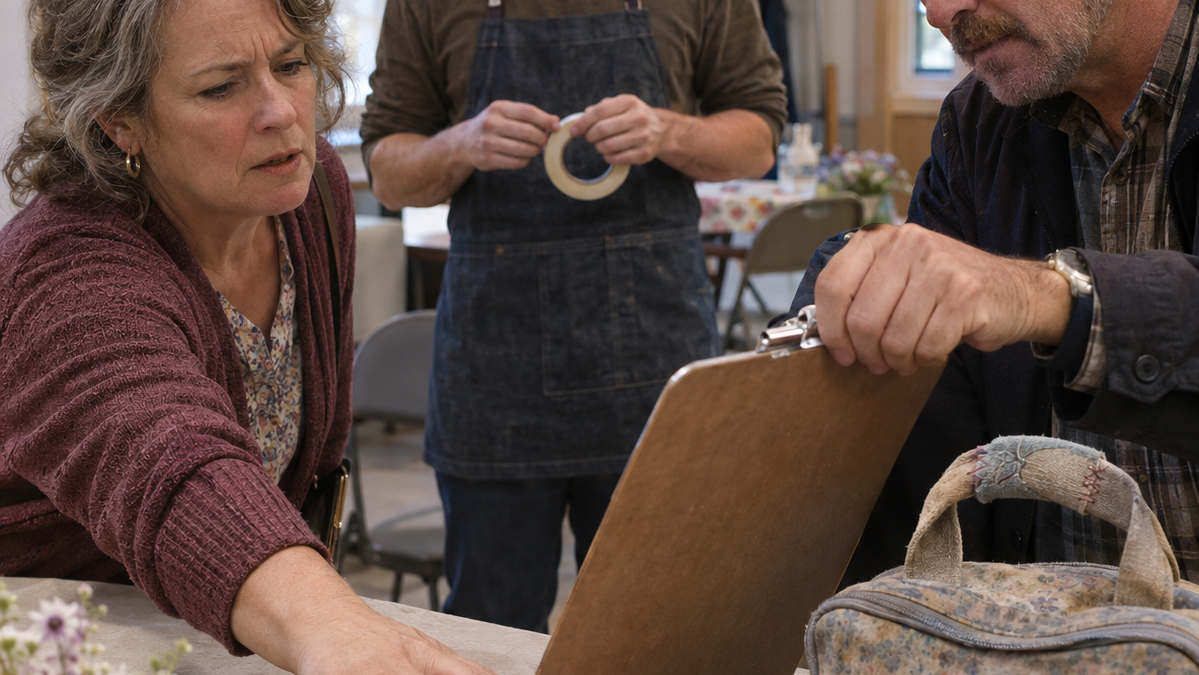
My younger brother slid my label out from beside the lunch bag while I was still straightening the bag’s handle.
“Not that one,” Martin said.
At first I thought he meant the card was crooked. Everything on the long community-room table was crooked at nine that morning: the borrowed objects, the folded tablecloth, the little sign inviting people to look but ask before touching. I had spent twenty minutes persuading one corner of the cloth to hang evenly. It kept catching on a screw.
Then Martin laid down a different label.
His was half the size of mine.
“Cloth lunch bag,” I read. “Loaned by June Palmer.”
“Cleaner,” he said. “People won’t stand here reading all morning.”
I looked at the bag. It was small enough to hold a sandwich and an apple, faded along the fold where June had closed it each day. One handle had been repaired with uneven stitches, a second line of thread following the first. June had kept it for more than sixty years. She hadn’t brought it to us because she thought our neighbors needed help identifying a bag.
Leo Brooks stopped pulling tape from the roll. The loose strip hung between his hands.
“Are we changing all of them?” he asked.
“A few,” Martin said.
“How many is a few?”
“I’m getting to it.”
My label was under Martin’s clipboard now. I could see the bottom edge, where I had put my initials in pencil after checking the date of June’s first summer job.
I reached across the table.
Martin lifted the clipboard before my fingers got there, which somehow made the whole thing worse. He gave me the card as though I had asked to see a receipt.
“You could have talked to me,” I said.
“We’re talking.”
“Before you put yours out.”
At the far end of the room, two volunteers were fitting a photograph into a standing frame. One held it while the other adjusted the back. They continued working, but neither said anything. I wished they would drop something. A harmless crash would have been welcome.
Martin tapped the new card.
“I’m trying to make this consistent.”
“For whom?”
“For the people coming at noon, Ev.”
There it was: noon. A deadline laid on the table between us, apparently heavier than anything I might say.
For years I had helped put together these small displays in Morrow Bay. Household things, mostly. A flour tin someone had taken to every apartment she ever lived in. A patched coat. An ordinary cup that had crossed three states wrapped in a dish towel. I interviewed the people lending them and tried to give each object enough words to explain why it had survived the last clearing-out.
I liked the work. I liked the second cup of coffee, when people stopped telling me what they thought ought to be remembered and began telling me what they actually remembered. I liked arriving here and finding someone had saved a chair for me.
Martin knew that. He had carried tables while I sat with people, waiting through the pauses.
“Who’s approving the new wording?” Leo asked.
He was thirty-two, nearly half my age, and had a way of asking practical questions that made the rest of us sound as though we had been arguing about the weather.
Martin looked at me.
I couldn’t tell whether Leo was objecting to the change or merely trying to learn which job came next. He folded the strip of tape back on itself so it wouldn’t stick to his fingers.
“I haven’t approved it,” I said.
“No one said—” Martin began.
“My initials are on the working list. Under labels.”
“That’s because you wrote them.”
“Then take them off anything I haven’t agreed to.”
My voice sounded sharp in the room. I wasn’t generally sharp here. I found pens, remembered whose coat was whose, made an extra copy. At fifty-eight, I had become very good at saving my sharpness for the drive home.
Martin picked up his pen, then put it down again.
“You’re really doing this now?”
I held my label against my palm to keep the paper from shaking.
“I’m not putting my name to yours.”
I hadn’t said I was leaving. I hadn’t asked anyone to stop working. Still, the space around the table seemed to widen. Martin looked toward the unfinished photograph, then at the clock above the kitchenette.
Leo tore off a fresh piece of tape.
“All right,” he said. “I’ll finish the frames until you know.”
It was such a small kindness, not making me explain myself to him too.
Martin left his replacement beside June’s bag. I kept the original.
Neither card had become any less embarrassing.
***
Martin took his clipboard to the kitchenette counter. After a moment, I followed.
“Could we not do this across the room?” he asked quietly.
“You brought it across the room.”
“I changed a label. I didn’t ring a bell.”
He rubbed the back of his neck. There was a pale rectangle on his shirt where he had peeled off a sticker. He was already wearing the shoes he called his good ones, though one lace had been knotted halfway down after breaking. At fifty-four, Martin could still look like a boy who had dressed carefully for something he was afraid might go wrong.
He turned the clipboard toward me.
The top sheet was a hand-drawn list, names down one side and arrangements beside them. Some had been crossed out and written again. Under one, he had printed, in heavy capitals, SIDE DOOR.
“Those are the people I actually spoke to,” he said. “Not everyone who saw the notice. People I called.”
“I know you’ve been calling.”
“Mrs. Vale can come only before her son picks her up. The Kellers are coming with Nora because they don’t like driving over separately. I asked two neighbors to bring people. I can’t have them make all those arrangements and find another notice on the door.”
The first opening had been postponed because we hadn’t gathered enough accounts. The second time, the room wasn’t available on the day we had chosen. Neither postponement had been Martin’s fault. He had done the unpleasant calling both times.
I ran my thumb along the edge of June’s label.
“I’m not asking you to send everybody home.”
“What are you asking me to do?”
“Ask me before replacing what I’ve written.”
“Yes, but today. What are you asking me to do today?”
Someone behind us laughed as the photograph finally stood on its own. I knew the laugh. I knew which volunteer would announce she was no good at arranging things and then move every object a quarter inch until it looked right. I loved that about this room. No one did anything quite alone, even when we complained that we were doing everything.
Once, a man who had barely spoken during his interview stayed after a display closed to tell me another story. We stood among empty chairs for forty minutes. He had died the following winter. I was glad I hadn’t looked at my watch.
Other times, I should have looked.
Last November, during my daughter’s birthday meal, Martin had called because a display case wouldn’t close properly. It wasn’t even a case, really, just a borrowed cabinet with a stubborn catch. I had said I would be twenty minutes. My daughter had been clearing plates when I left, and I’d told her to save me cake.
By the time I got back, the cake was covered and everyone but her was gone.
At the next family meal, she asked whether I wanted a piece wrapped up. She didn’t ask if I was staying for dessert.
Martin had thanked me for coming that night. He wasn’t ungrateful. Somehow that had helped me keep doing it.
Now he held the clipboard against his chest.
“They’re looking forward to this,” he said.
“So am I.”
He glanced at me, as if that hadn’t occurred to him.
“I wanted to be here when June saw it,” I said. “Not just to get it ready.”
“You will be.”
“With a card I don’t recognize?”
He exhaled through his nose.
A neighbor passed the counter carrying a stack of cups. She asked where we wanted them. Martin pointed to a shelf, thanked her, and reminded her that she could leave whenever she needed to. He remembered that she had something else planned. He was good at that, making people feel their small offering had helped.
I waited until she was gone.
“The arrangements matter,” I said. “I’m not pretending they don’t. But you can’t make the list settle everything else.”
He lowered the clipboard. For the first time that morning, he looked at the paper in my hand rather than at the clock.
***
“There’s a name on that,” Martin said.
“Yes.”
“June didn’t want it there.”
I looked down, though I knew exactly where it was.
“She told you that?”
“When she brought the bag.”
“Two weeks ago?”
He nodded.
Two weeks earlier I had been helping a friend unpack after a move. Martin had offered to receive anything people dropped off. I had left proofs on the table so participants could check them against their objects. June had been one of the last people I was waiting to hear from.
“What did she say?”
“She saw it and asked me to leave the name out.”
“Did you tell her you would tell me?”
“Yes.”
I waited.
“I should have,” he said.
The refrigerator clicked on behind us. Martin shifted aside so someone could reach the teaspoons. We both stood smiling politely until the drawer closed.
“You had two weeks,” I said.
“I know.”
“You saw me on Tuesday.”
“I know, Evelyn.”
“And Thursday. We went through the table plan.”
“I said I should have told you.”
He wasn’t denying it. That deprived me of the next angry sentence without making me feel better.
I turned the label over. On the back were my measurements for the card holder, written while I was on the phone with Leo. So many tiny preparations for something that hadn’t actually been settled.
“Did she approve your version?”
“She wanted the name out.”
“That isn’t what I asked.”
“No,” he said. “Not those exact words.”
“Any of those words?”
“I wrote it this morning.”
He looked tired now, and annoyed enough not to hide it.
“I was shortening the others. I knew this one needed changing. It seemed easier to do the whole thing at once.”
Easier than telling me he had forgotten. Easier than asking June another question. I could see how one small omission had become a neat new card.
But there had been a request. That part wasn’t something I could brush away because he had handled it badly.
I remembered June across her kitchen table, turning the bag over so I could see the repair. I had asked who had done it. She had answered. Later I had sent the draft and asked her to tell me what needed correcting. I had considered the question of permission taken care of.
“Did she say why?” I asked.
“She said she didn’t want the name printed. That was enough.”
It was. I disliked how much I disliked hearing that from him.
“Then why take out her walk to work?”
“Because I was making them shorter.”
For a moment we had nothing to say. His answer was ordinary and inadequate, and neither of us could improve it by repeating it.
Across the room, Leo held up two possible positions for a framed photograph. Martin pointed to the lower one. Even in the middle of this, he could make a decision and keep someone working.
“I need to talk to her,” I said.
“She’s coming at noon.”
“I’m not waiting until she gets here to find out what she asked us to do.”
Martin unclipped a folded sheet from the back of his list. June had written her phone number there, beneath a note saying he could call about the display. He handed it to me without argument.
I took my phone from my purse. I would call June now.
***
She answered on the fourth ring.
“I’m coming,” she said. “If this is about coming, I’m coming.”
“It’s Evelyn. Have you got a few minutes?”
“Oh. I thought you were your brother.”
“I’d hate to think we sound alike.”
“Only when one of you wants something moved.”
I sat in a folding chair near the closed storage-room door. From there I could see the end of our table, but Martin and the kitchenette were out of sight.
“It’s about your label,” I said. “Martin just told me you asked him to leave out the name of the person who repaired the handle.”
“Yes, I did.”
“He didn’t pass that on to me.”
There was a pause.
“I asked him to,” she said.
“I know that now.”
“I wondered why I hadn’t heard from you.”
I watched a corner of the paper lift in the air from the ceiling vent.
“I’m sorry. I should have called when you didn’t answer about the proof.”
“I thought I had answered. Not to you, but I thought it would get there.”
“Yes.”
I let that sit. I had called with the beginning of a defense prepared: I hadn’t known; Martin had replaced everything; my version had been based on what she told me. All true. None of it answered the person on the other end.
“The name won’t be in it,” I said. “I can promise you that.”
“Thank you.”
“Would you rather we leave the family part out altogether?”
“Yes.”
“All right.”
Then she said there was something she wanted me to understand, provided I kept it between us.
I told her I would.
She spoke for a while. I listened. What she told me was not part of the account I had collected at her kitchen table, though it belonged to the same life. Once, I started to say I was sorry, but she kept going, and I stopped.
The explanation is not mine to repeat.
When she finished, I could hear a small household sound at her end, something set down on a counter.
“I don’t want all that beside a lunch bag,” she said.
“No.”
“I’m seventy-six. I’ve had enough people explain my family to me.”
“I’m sorry, June.”
“Well. Now you know.”
“Yes.”
“And you’re not going to tell your brother.”
“No.”
There was no clever or comforting sentence available. I was relieved she didn’t seem to expect one.
After a moment, she asked, “What has he put there?”
I read Martin’s replacement.
“That makes it sound as though I found it in a cupboard and couldn’t think who else might want it.”
Despite myself, I laughed.
“I don’t think that’s what he meant.”
“I expect he meant to finish before lunch.”
I looked at the original card on my knee.
“I wanted people to understand why you kept it,” I said. “I put too much in.”
“You wrote something lovely. That doesn’t mean I wanted all of it on a table.”
That hurt in a different place from Martin’s replacement. I had been careful with her dates, careful with the spelling, careful not to make her sound grander or sadder than she had sounded in person. I had believed that care would show through.
“I thought the fuller account did the bag justice.”
“It’s a bag, Evelyn. I’m the one who has to stand beside it.”
I rubbed a pencil mark with my thumb. It smeared.
“Would you still like the walk to your first job in there?”
“Yes. I liked remembering that.”
“And the repaired handle?”
“That’s why I showed it to you.”
“We could say someone at home mended it.”
“That’s enough.”
She didn’t want the bag reduced to an object with her name attached. She wanted to share a particular morning from her own life, without finding the rest of the family arranged around it.
“I’d like to write it again,” I said. “Then read it to you before anything goes out.”
“I can look when I get there. I was going to come a little early anyway.”
“You don’t have to keep lending it if this has made you uncomfortable.”
“I know. I’d still like people to see it.”
She sounded firm, almost impatient. This wasn’t simply a favor she was doing us. She had chosen something she wanted to bring into the room.
“All right,” I said. “We’ll wait for you.”
“Don’t make it fancy this time.”
“I’ll try.”
“Try fairly hard.”
When we hung up, I stayed seated with the phone in my hand. At the table, someone had set a small wooden stool beside June’s bag. The two objects looked companionable. Their owners had never met.
***
I opened a message to Martin.
June did ask you to take out the name. She told me why.
I stopped with my thumb over the screen.
I wanted him to understand the call had mattered. More than that, I wanted him to feel the weight of what he had failed to pass on. He had made me look fussy in front of people who had watched me work for years. I could already hear the version that might circulate: Evelyn got upset over a shorter label, and then we had to stop everything.
The reason would make it harder to dismiss me that way.
I began another sentence. Then I erased it before it became anything someone else could read.
June had told me because I had asked what she wanted. She hadn’t offered evidence for my argument.
I deleted the words She told me why.
For a minute I considered writing nothing at all. That was familiar too: swallow the anger, do the repair, wait for someone to notice how decently I had behaved. It usually left me furious over some later, smaller thing.
I wrote instead:
June asked for the name to be omitted. She also wants the handle repair and her walk to her first job kept in. Neither label is ready. I’m revising mine for her to check when she comes.
I read it twice, then sent it.
My original label was bent where I had been holding it. I smoothed it against my knee. The named relative appeared in the middle, part of a passage I had worked over several times until it had a satisfying turn at the end. That was the passage people would probably have called moving.
I took a pen from my purse and crossed it out.
The ink caught on a fold. I went over it again, making the line dark enough that I wouldn’t accidentally read it aloud when June arrived. Then I crossed out the rest of the family account. What remained looked sparse and lopsided.
I had been ready to keep that card as proof of what Martin had done. Now it was a messy draft again.
My phone lit up.
Okay, Martin had written.
A moment later, another message appeared.
Are you coming back over?
I put the pen away and stood.
He was beside the table with his hand resting on the edge of the cloth. Leo had moved on to the far wall. The label Martin had made still sat beside the bag, its straight edges irritatingly clean.
“She confirmed it?” he asked.
“Yes.”
“I wasn’t making it up.”
“I didn’t say you were.”
“You looked as though—”
“I didn’t know what to think.”
He lifted his card. “So this at least doesn’t say anything she doesn’t want.”
“It doesn’t say much she does want, either.”
His mouth tightened. I heard how that sounded and tried again.
“She wants the walk to work. She wants people to notice the repair. She doesn’t want the name or the rest of the family account. I got that wrong.”
He looked at my crossed-out draft.
“She explained?”
“She told me what she wants us to use.”
“Was she upset with me?”
“She expected you to tell me.”
“I know that part.”
I could have softened it for him. I was accustomed to handing him the difficult thing wrapped in something easier to carry.
“She’s still bringing the bag into the display,” I said. “She’ll check the wording when she gets here.”
Martin glanced along the table. There were other small cards now, other short descriptions replacing the pages I recognized.
I hadn’t noticed how many.
“What about these?” I asked.
He pulled his hand off the cloth.
“I was going to show you.”
We both looked at June’s bag. Without either label beside it, the repaired handle sagged gently toward the table.
“Let’s get hers right first,” I said.
I set my draft down beside it, crossed-out lines and all.
June arrived at eleven-twenty carrying her purse and a folded shopping bag.
“For taking it home if necessary,” she said when she saw me look.
“Fair enough.”
She set both bags on a chair, then leaned over the table. Her cloth lunch bag lay between the wooden stool and an empty space where Martin had removed another card.
“You’ve got it lying on its good side.”
“I didn’t know it had one.”
“Neither did I until now.”
I pulled out the chair for her. She sat, but moved it nearer the table herself, her shoes making two brief squeaks across the floor. Martin was at the other end of the room with his phone against his ear. He lifted a hand to June. She lifted hers back.
I had made a clean draft on the back of a spare sheet. The crossed-out original was folded inside my notebook.
“May I read this?” I asked.
“That’s what I came early for.”
I read the short paragraph. It said she had carried the bag to her first summer job, that the handle had torn before she had even used it, and that someone at home had mended it. I had ended with a sentence about carrying a little piece of home into the wider world.
June looked at the bag.
“No, not that last part.”
I held my pen above the paper.
“The wider world?”
“I was walking six streets.”
I laughed, then felt myself wanting to explain that distance wasn’t quite what I meant. June reached for the handle and turned it so the stitching faced us.
“Can you say the thread didn’t match? People might not notice.”
The repair had been made with a darker thread, the stitches crowded near the edge where the cloth had begun to fray.
“Yes.”
“I liked that it was fixed. I didn’t care what it looked like. I had a lunch to put in it.”
I crossed out the last sentence. It had been a good sentence. It wasn’t going on the table.
For a while we worked with the noises of the room around us: tape peeling from a roll, Martin saying, “No, today, but could you call me back?” and Leo shifting the wooden stool a few inches so it no longer crowded the bag.
June watched me write. When I stopped, she pointed to the beginning.
“First job makes it sound like the start of a career. It was a summer job.”
“I’ve got summer here.”
“Oh. Read it again.”
This time I read more slowly.
“June Palmer carried this cloth lunch bag to her first summer job. Before her first day, someone at home mended the torn handle with thread that didn’t match. She remembers walking the six streets to work, carrying her lunch in the repaired bag.”
June put a finger on the dark stitches.
“Yes. That’s it.”
“All of it?”
“That’s what I want.”
I dated the draft in the corner and wrote that she had checked it. Then I showed her that too.
“You don’t have to sign anything,” I said. “I just want to remember which version we agreed on.”
“I can remember.”
“I’m thinking of me.”
“Oh, well. Write it down.”
I took the clean sheet to the small table where we had set up the printer. Before I typed, I looked back at her. She was turning the bag slightly, trying to find an angle that showed the handle without collapsing the rest of it.
“Like this?” she asked.
I went over and tucked a little folded tissue inside to support it. June adjusted the handle herself.
“There,” she said.
When the card came out, I brought it to her before trimming it. She read it with her glasses pushed low on her nose.
“Six streets,” she said. “I’d forgotten that until you asked me about the walk.”
“I’m glad you remembered.”
“So am I.”
That was the pleasure I had been afraid of losing: sitting beside someone while an ordinary thing became particular again. It was still there, though we had taken out my best sentence.
June handed back the sheet.
“Will the others be ready by twelve?”
Across the room, Martin lowered his phone and looked at the list beside him.
“I don’t think so,” I said.
***
There were four other replacement cards to check. One participant answered and asked Martin to put back the wording she had already seen. Another wanted to hear both versions, then chose the original with a small correction. Two calls went unanswered.
Martin left messages. He checked the time. He called one number again after finding a second contact written on the back of an envelope.
No one picked up.
I stood beside him while he compared a shortened card to the longer account underneath it. He had removed a passage that explained why the owner had kept a chipped serving plate.
“We could use the old one,” he said.
“Did she see that version?”
He looked toward my notebook.
“I sent it over, but she hadn’t got back to me.”
“So we don’t know.”
He rubbed the heel of his hand against his forehead. Outside the open door, someone was already unfolding a chair in the hallway.
“We have people coming.”
“I know.”
“Some of them have arranged their whole day around this.”
There was nothing unfair about that sentence by itself. That made it harder to hear.
June had gone to sit near the window. Leo stood with the roll of tape tucked over two fingers, waiting to find out where the remaining cards belonged.
Martin looked around the room.
“Three,” he said at last. “We can open at three. With what’s checked.”
“Not everything will be checked by then.”
“Then not everything goes out.”
He said it sharply, but he took the unconfirmed card off the table. He set it on top of the corresponding pages, away from the display.
Leo put down the tape.
“I can help until one-thirty. I still have to go after that. I can come back near closing.”
Martin nodded. “Right.”
One of the other volunteers, who had been helping since nine, came over when she heard the new time. She had somewhere to be that afternoon and couldn’t return. Martin thanked her. She looked at the part of the display she had arranged, then collected her jacket.
“I wanted to see it with people here,” she said.
“I’m sorry,” Martin told her.
She gave him a small nod and left. The empty chair where she had put her jacket remained beside the wall.
I could have stayed all afternoon. I could feel the shape of it waiting: take the list, make the calls, soothe the people at the door, discover at four that I hadn’t eaten. It was a sequence I knew well enough not to have to think through.
“I can help from twelve to one,” I said. “Moving things and setting out what’s ready.”
Martin looked up.
“One?”
“I’m having lunch with my daughter.”
“What time?”
“One-thirty. I’ll be back for three.”
He glanced at the list again.
For an instant I nearly offered to call her. My hand even moved toward my purse.
Martin said, “All right. Can you and Leo clear that end table?”
“Yes.”
“And I’ll have to leave at five-thirty this evening,” I added.
His eyes stayed on the paper a moment longer.
“I heard you.”
It wasn’t gracious, but it wasn’t an argument.
At noon I began moving the objects whose wording we couldn’t confirm. We kept each one with its papers on a separate table behind the room divider. I folded back a length of cloth on the public table, making it shorter. The arrangement looked thinner, and there was no point pretending otherwise.
Our first visitor arrived while I was carrying an empty tray.
Martin met him at the door and explained the new time. The man had a ride waiting outside and couldn’t come back.
“Another day, maybe,” he said, but he didn’t take the paper Martin offered with the later hours on it.
I set down the tray. I wanted to run after him with something—the bag, the stool, a better explanation. Instead, I watched Martin go out to speak to the driver, then return alone.
We worked until one.
When I picked up my purse, there were still loose sheets on two chairs. Martin was writing a notice for the door. Leo needed another pair of hands to move the end table.
“I can do that,” Martin told him.
I left before I could turn taking hold of one end into another hour.
***
At lunch, my daughter asked whether everything had opened on time.
“No,” I said. “Three.”
She looked at me across the table, then down at the purse I had put on the floor.
“I’m staying,” I said.
We ate. I let my phone remain inside the purse.
There wasn’t a great declaration between us. She told me about something that had happened at work, and I had to ask her to explain the beginning because I had missed part of it while thinking about the room. After that, I listened properly.
When she asked if I wanted dessert, I said yes.
***
I returned a few minutes before three. A new notice was taped below the original opening announcement. Through the doorway I could see the shortened display and a row of chairs that no longer blocked the path to it.
Martin stood in the hall with two visitors. One held the original flyer between finger and thumb.
“This says noon,” she told him.
“It did open late,” he said. “We’re opening now.”
“We came all the way over earlier.”
“I’m sorry. I should have called you when we changed it.”
“You had my number?”
“Yes.”
She waited. I stopped by the coat hooks rather than squeeze past them.
Martin took a breath.
“I changed some of the wording before I’d had the conversations I needed to have. Evelyn caught that. We had to check with the people who lent things, and we couldn’t reach everyone.”
The other visitor peered into the room.
“So there’s less?”
“Yes. Fewer things today.”
I could hear a chair scraping inside, and June’s voice telling someone that the bag was farther down the table.
The woman with the flyer noticed me.
“Was it your writing?”
“Some of it,” I said.
Martin spoke before I could find the rest of an answer.
“Evelyn did the interviews and wrote the accounts. I replaced them without asking her. She was right to stop me.”
The woman folded the flyer into a narrow strip.
“Well,” she said. “I’d rather read something the person wanted there.”
Then she went in.
It was such an ordinary response that I had nowhere to put the feeling it caused. No one applauded. She hadn’t even known there was a dispute until Martin told her. Still, I had heard him say it while I stood there, without a joke to reduce it or an explanation that made it partly my fault.
The other visitor couldn’t stay. She had come back only to see whether we were open, and now had another obligation.
“Could I bring my sister next week?” she asked.
Martin looked toward the room. People were gathering near June’s bag.
“What day works for her?” he asked.
He took out his list and wrote down a time to call. When the woman had gone, he went to the side room to check whether the community room would be available. He was still there when June began talking to the first little cluster around the table.
I went inside.
There were fewer people than we had hoped for. I recognized places where someone ought to have been standing. The man whose ride had waited at noon did not return.
But there were people reading.
One woman bent close to the wooden stool, then straightened with a smile. Two neighbors disagreed amiably about whether a similar serving dish had been green or blue. Someone asked who had made the little wooden box near the end, and its lender said, with considerable satisfaction, “I did.”
I stood beside June while a visitor read her card.
“The thread really doesn’t match,” he said.
“No,” June replied. “But it held.”
She lifted the handle a fraction, showing where the stitches passed through both layers of cloth.
“Were you nervous? Going to work?”
“Very. I thought everyone else would know what to do.”
“Did they?”
“Not as much as they let on.”
The visitor laughed. June smiled at him, and I moved back enough to let another person come closer.
Her label did not explain everything about her. It gave her an opening. She could answer a question or leave it alone.
A woman I knew from years of these gatherings came toward me with a loose card in her hand.
“Evelyn, do you know where—”
“Here,” Leo said from behind her. He had returned and was taking off his jacket. “That goes by the box. I’ll fix the tape.”
She thanked him, then stayed beside me.
“I liked the part about the first job,” she said.
“June chose what she wanted in it.”
“She was funny just now.”
“She is funny.”
We watched June explain something with both hands. For several minutes I had nothing to carry, correct, or fetch.
Martin came in late enough to miss that first part. He spoke quietly to Leo, and together they shifted two chairs away from the door where people had started to gather. Then Martin brought over a cup of water for June.
She accepted it and sent him to find a place where she could put it without spilling on the cloth.
I felt affection for him then, which was inconvenient. I was still angry. He still had the same worried crease between his eyebrows, and when someone asked about the missing objects, he looked for a moment as though he might prefer to be elsewhere.
He stayed.
***
Near five-thirty, the room had become untidy in the usual ways. A coat lay over a chair though its owner was beside the table. Someone had pushed a paper cup under the edge of a flyer. The objects remained in place; the people had begun to drift home.
June had left a little earlier. She checked that we would keep the bag supported as she had arranged it, then folded her empty shopping bag and tucked it into her purse.
“I’ll see you,” she told me.
There was no qualification in it.
I was putting on my cardigan when Martin came over.
“Have you got a minute?”
“A few.”
He turned a chair around, then didn’t sit on it.
“Thank you for calling her.”
“I needed to.”
“I should have told you what she said when she brought the bag in.”
“Yes.”
“I kept thinking I’d catch you. Then I was doing the shorter cards, and I thought that would take care of it.”
He picked at a bit of tape stuck to the chair back.
“It didn’t.”
“No.”
From behind us, Leo asked where the unused cloths belonged.
“In the cupboard by the sink,” Martin said. “Bottom shelf.”
I waited. Martin rolled the scrap of tape between his fingers.
“And I shouldn’t have pulled yours off the table like that. In front of everybody. Or when nobody was looking, either.”
That last part almost made me smile.
“I had work to fix too,” I said. “June didn’t want all I’d written.”
“That doesn’t make what I did all right.”
“No, it doesn’t.”
He let out a breath, looking down at the tape.
I had wanted that admission since nine in the morning. Now that it had come, it didn’t give me back the morning. I still remembered Leo stopping with his hand in the air. I would probably remember it the next time Martin reached across something I was working on.
“I appreciate you saying it,” I told him.
He nodded.
“I don’t want every time we do something together to turn into this,” he said.
“Then we need to talk before we decide what I’m doing.”
“I know.”
“I mean the next thing too. Not just labels. If you want me to help, ask me what I can offer before you put me down for it.”
His eyes flicked toward the room.
“All right.”
“Sometimes I’ll say no.”
“I’ve gathered that.”
There was a little of my brother in the answer, and I was glad of it. I didn’t need him to become solemn forever.
“I might say yes too,” I said.
“That would be useful.”
“Careful.”
He smiled briefly, then rubbed his face.
“Sorry. Habit.”
“I know.”
Leo carried a stack of chairs past us. The top one rattled against the others, and I reached out automatically.
He had it balanced before I touched it.
“You’re all right,” he said. “I’ve got them.”
I looked at the clock. Five-thirty.
“There are spare labels in the printer box,” I told Martin. “The checked drafts are in the folder. Mine too.”
“Okay.”
“I’m going.”
“Okay,” he said again.
At the door I looked back. Martin had taken the cloths from Leo and was trying to fit them onto the wrong shelf.
For a moment I stood with my hand on the door.
Then he bent down, found the bottom shelf himself, and I left.
***
Several weeks later, I arrived at the storytelling gathering carrying only my purse and a book I thought June might like.
The chairs were already arranged around two tables. Leo had agreed to set up that evening, and there were pencils in a mug near each end. One table was slightly crooked. It was possible to walk past it.
I put my purse beneath a chair.
Martin came out from the small kitchen with a pitcher of water.
“Did you bring the questions?”
“One sheet,” I said. “For the first fifteen minutes.”
“That’s fine.”
We had spoken on the phone beforehand. I had agreed to start the conversation, then join it. Leo was handling the room; Martin was dealing with refreshments and closing up. It had taken less time to arrange than some of our old conversations about who had let whom down.
June arrived carrying the book I had lent her the previous month.
“I haven’t finished it,” she said.
“You can keep it longer.”
“I thought I ought to show you I still had it.”
We exchanged books anyway. She settled beside me and asked what mine was about. I gave an answer that apparently ran too long, because she opened it to the first page and began reading.
More people came in. Coats accumulated. Someone moved the crooked table enough to make it worse, then moved it back. I unfolded my sheet of questions.
A cup tipped near the far end.
Water ran between two place settings and dripped over the edge. A woman lifted her papers just in time.
I had one hand on the table, ready to push myself up, when Martin turned toward me.
“Ev, could you—”
He stopped.
The water kept dripping.
“Do you want to take that,” he asked, “or stay here and get us started?”
“I’d like to stay.”
“All right.”
He went for a cloth.
June held up her book so it wouldn’t get wet, although the spill was nowhere near her.
“I’ve brought something precious,” she said.
“Apparently so.”
Across the table, the woman whose cup had tipped began apologizing. Martin came back with the cloth and a bowl.
“Only water,” he told her. “We’re not losing anything.”
He mopped while Leo shifted the dry papers. I remained in my chair. It felt conspicuous for a few seconds, though no one seemed to be watching me.
When everyone had settled, I asked whether anyone remembered a first day they had been dreading.
June shut the book.
“I could tell you about my summer job,” she said. “Not the bag this time. The work.”
“Would you like to start?”
She considered it, then shook her head.
“Let somebody else. I’m interested.”
A man across from us raised his hand halfway, embarrassed by the schoolroom gesture, and began. His first day involved a borrowed shirt and a bus he should not have taken. June leaned forward to hear him.
Martin finished drying the table and sat down in the empty chair on my other side.
“Did I miss the beginning?” he whispered.
“Some of it.”
He listened, catching up as best he could.
When my fifteen minutes were over, I folded the question sheet and slipped it beneath my book. The conversation went on without my directing it.
June nudged my elbow when someone said something funny. I turned toward her, laughing, and stayed where I was.








