My Son Demanded My $225,000 Wisconsin Cottage Before Taking Me Home From the ER, and He Had No Idea What I Had Kept.
Chapter 1 of 7
“Nobody gets discharged to a house they can’t manage.”
Eric said it over my bed, addressing the nurse instead of me. My brother, Ben, stood beside the curtain without objecting.
“I can manage my house,” I said. “I need help getting there.”
It was Thursday, September 17, around 3:50 in the afternoon. The fluids had helped. My mouth no longer felt lined with cotton, and I could follow every word they said.
My knee replacement had been Monday. That afternoon, dehydration had brought me back to the hospital.
The nurse looked at me.
“We’ll go over what you need at home before you leave.”
“He’ll tell you he’s fine,” Eric said. “Then somebody has to handle everything.”
“I didn’t say I was fine. I said I could go home.”
My walker stood within reach. My cottage had a step-free entrance, a shower seat, and clear paths through the rooms. I needed temporary help, not somebody choosing where I lived.
The nurse said she would check the discharge instructions. Eric waited until she passed through the curtain.
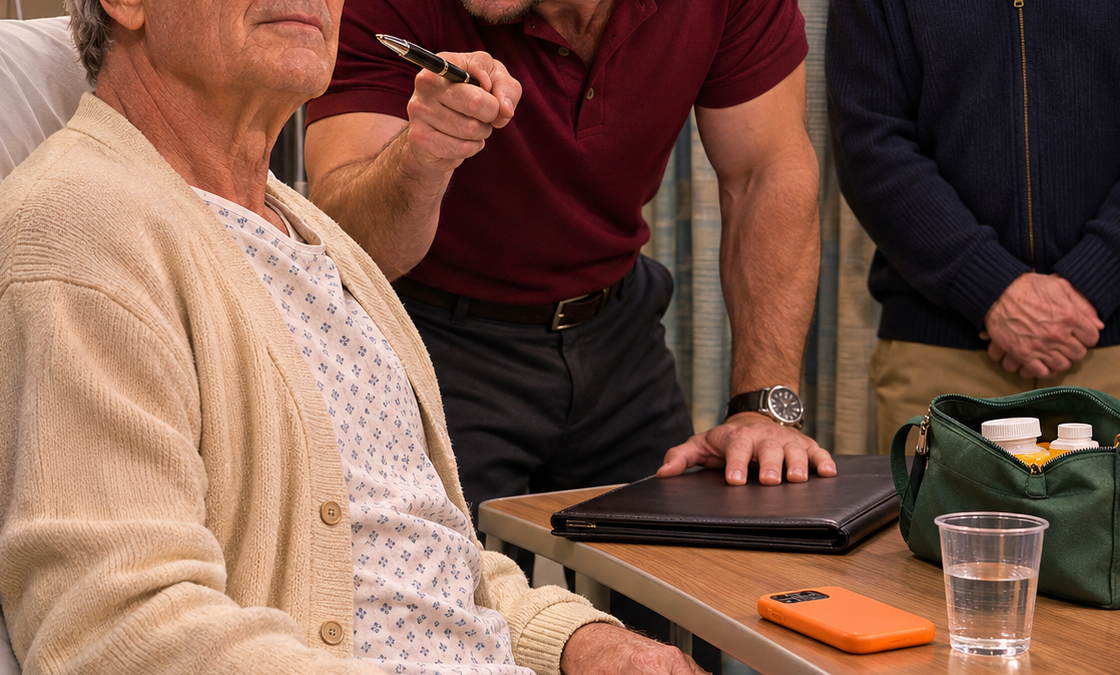
Then he brought out the pen.
“Let’s settle this while we’re all here, Dad.”
A page lay across his folder. I reached for the pen automatically, the way I had reached for school forms and repair estimates throughout his life.
Then I put it down.
“What am I signing?”
“We’ve talked about the cottage.”
“You talked. I told you no.”
Ben watched a wheel on my walker.
Eric lowered his voice.
“You want me responsible for getting you home, handling your pills, making sure you eat. I need some security too.”
“The house belongs to me.”
“I know whose name is on it.”
“I own it outright.”
“And I’m the one losing work every time something happens.”
He showed me the debt notice again. The amount was $38,400. I had seen it before surgery, when he first asked whether I could help.
Now he held it above the blanket covering my knee.
“This doesn’t wait because you’re recovering.”
“I can’t pay that.”
“I’m not asking you to write a check.”
He wanted the cottage transferred to him so he could try borrowing against it. He talked about protecting the family investment, as if my recovery were a repair job he had already underpriced.
“You’d still live there,” he said. “Nobody’s putting you out.”
“Then why do you need to own it?”
“Because promises don’t help me at the bank.”
I looked toward Ben.
He was my younger brother. He knew how many evenings I had spent fixing that cottage after work.
“Say something,” I told him.
“Maybe hear him out.”
“I have.”
Eric’s face changed then, but his voice stayed low.
“Dad, I’ve been the dependable one. You call, I come. That has to count.”
“It counts.”
“Then act like it.”
My orange-cased phone lay beside the water cup. Earlier, I had used it to keep track of instructions about the exercises and medicines. Eric glanced past it toward the curtain.
“I can’t keep doing this with nothing settled.”
“A ride home shouldn’t cost a lifetime of work.”
Ben looked up. Eric pressed his lips together.
“All right. You don’t want to sign now. Then accept the arrangements I’m making. You can’t reject every part and expect me to carry the rest.”
“What arrangements?”
“I’ll handle where you go and who keeps track of the medication.”
“I already have a ride arranged.”
“And who’s there afterward?”
“I’ll hire help.”
“With strangers.”
“With people who show up for the job.”
He closed the folder.
“I need a minute,” he said to Ben.
They stepped into the hallway together. The green medication bag went with them.
When the nurse returned, she asked whether we had worked out transportation.
“I need you to hear what he said first.”
I started the playback. My son’s voice came from beside the water cup, quiet but clear enough.
The nurse stopped. “Wait. That’s your son speaking?”
“Yes. Listen.”
My own voice sounded thin through the speaker.
“I’m not transferring my house to you, Eric.”
“Then I won’t release the organizer to you.”
On the recording, I asked what I was supposed to do about my evening medicines. Eric answered that I needed to stop making things difficult.
The nurse moved closer.
“Is that the organizer in the green bag?”
“Yes.”
“Where is it now?”
“He took it into the hall.”
By then it was nearly five. The conversation had started around 4:40, while we were waiting for the last instructions.
I called it an instruction recording. For years, repairing broadcast-radio equipment, I had recorded complicated directions rather than trust my memory over a noisy transmitter. Retirement hadn’t broken the habit.
I had left it running while Eric talked.
A cart rattled past on the playback. Ben’s low voice said, “Leave it with me, then.”
Someone outside the curtain asked whether we were finished with the wheelchair. Eric said no, then told me he had calls to make.
That was near the end of the file.
The nurse asked me to stop there.
“Did you agree to let him keep your medicines?”
“No.”
“Do you know what’s in the organizer?”
I told her what I took in the morning and evening. I explained that Eric had filled it after surgery, using the printed list.
She asked whether I had any other supply at home.
“Some. I don’t know how much he brought here.”
She went to check the discharge arrangements. I could hear voices beyond the curtain, but neither belonged to my brother.
When she came back, she checked the screen on the wall. Her eyes moved from one line to another.
“What?” I asked.
She didn’t answer immediately.
The nurse read it again. “Who canceled your six-fifteen ride?”
“Canceled?”
“It was arranged earlier. Now there’s a message saying family transportation replaced it.”
“I didn’t ask for that.”
“Did you tell your son he could cancel it?”
“No.”
The nurse was Laura Bennett. Until that moment, I had mostly thought of her as the person who checked the fluid bag and asked whether I felt dizzy.
Now she drew the curtain closed.
“Tell me what you want to happen.”
“I want to go home. My home. And I want a ride that doesn’t depend on him.”
“All right. We can look for replacement transportation.”
“Please do.”
She asked for my cottage’s location near Stoughton, Wisconsin, and checked that someone could get me through the entrance safely.
I told her about the level doorway and the walker. I could get to the bathroom and kitchen. I needed help with meals, errands, and the things I couldn’t carry yet.
“We’ll have the clinician review the plan with you,” she said.
“I’m not signing his papers.”
“You don’t need to settle family property matters to receive care here.”
“I want that written down. That I said no.”
“I’ll document what you’ve told me.”
She asked whether I could keep the recording. I told her the original was still saved, unchanged. I wasn’t deleting it.
For a moment, I hated that she had heard me asking my son for my own pills. Then she asked when my next dose was due, and there was work to do.
“Can you get the green bag?” I asked.
Laura went out to find them. I watched the curtain opening, expecting Ben’s shoes.
She returned alone.
“Ben left with your medication bag at five-oh-six.”
Chapter 2 of 7
Laura called Ben while the clinician checked what I needed that evening. She asked him to bring back the green bag and give it directly to staff.
“He says he’s coming,” she told me.
The clinician reviewed my medicine list, checked when I had last taken each dose, and gave instructions for that night. Nobody guessed from the compartments or handed me extra pills to make up for the delay.
Ben returned with the bag against his jacket.
“I thought Eric had everything worked out,” he said.
“Give it to Laura.”
He did. She checked the containers against the list before returning them to me.
Ben stayed near the curtain.
“Do you need me to—”
“The ride’s being handled.”
He nodded without looking at my bed.
At 8:10 p.m., I left in replacement transportation that cost me $48. The driver helped me through my level entrance and waited until I reached my chair.
The cottage smelled faintly of coffee grounds. I had forgotten to empty the basket before surgery.
My kitchen was twelve steps from the chair with the walker. By the eighth, my knee hurt enough that I stopped beside the refrigerator.
Getting home hadn’t made me well.
I ate toast because I could manage it. The soup in the refrigerator required carrying a bowl, and I hadn’t worked that out yet.
Before bed, I booked twelve hours with a home-assistance service. At $32 an hour, the total was $384. I asked for help with meals, laundry, groceries, and the shower routine my discharge instructions recommended.
“Do you need someone overnight?” the scheduler asked.
“No. But I need somebody who’ll come when they say.”
“We’ll send the schedule for you to approve.”
I read it twice. Then I approved it myself.
Friday morning, September 18, I woke before the alarm. My knee had stiffened overnight, and getting dressed took longer than breakfast.
The first helper arrived while I was still considering how to retrieve a dropped sock. She asked where I wanted the laundry.
That question nearly undid me.
“In the washer,” I said. “But the towels take forever. That machine’s been threatening retirement longer than I have.”
She laughed and asked about detergent.
I called Sarah Grant after breakfast. Her practice handled elder-law matters, and I told her I needed advice about my son using papers I had signed years earlier.
“Has anything happened beyond the argument?” she asked.
“He has access to my money. And he’s been asking for my house.”
“Do you have the power of attorney?”
“In the drawer with the insurance.”
“Can someone scan it for you?”
The helper asked permission before opening the drawer. Along with the 2023 document, she scanned my recorded deed and the property printout showing the cottage in my name alone.
Sarah called after reviewing them.
“This took effect when you signed it,” she said. “It gives Eric broad property powers, including gifts to himself. He still had duties to you; it wasn’t permission to use your house against your wishes.”
“I thought it was for paying bills if I couldn’t.”
“People often think that. We need to end his authority and notify anyone handling this.”
“Today.”
“Yes.”
She arranged for me to sign a written revocation and an objection to any transfer. At 10:14 a.m., she delivered both to Eric and the independent title company she had identified from his paperwork.
I watched the confirmation arrive on my computer.
“That’s done, then?” I asked when she called.
“The notice is delivered.”
“Can he still use it?”
“He can’t keep acting under it after notice. I also asked whether anything was already submitted.”
I wanted a cleaner answer. Sarah waited while I read the confirmation again.
“There was a withdrawal, too,” I said.
“How much?”
“Six hundred forty dollars.”
I sent her the bank entry and Eric’s message from the time. He had called it “reimbursement,” without asking me first.
“He bought groceries,” I said. “Picked things up. I wasn’t expecting him to work for free.”
“Did you agree to that amount?”
“No.”
“Did he give you a list?”
“No.”
The helper was folding towels at the kitchen table. I lowered my voice anyway.
“I used to cover things when he got behind. It was easier than having him upset for a month.”
I had kept paying for peace until Eric treated it as his allowance.
Sarah didn’t promise an arrest or tell me the bank would put everything back.
“Keep the message and the statement,” she said. “We’ll ask him to account for it.”
By afternoon, relatives began calling.
The first asked whether my pain medicine was making decisions difficult. Another suggested I wait until I felt more like myself before changing family arrangements.
Eric had contacted them separately. According to one caller, he was worried about my “abrupt decisions.” According to another, he had done so much and couldn’t understand my ingratitude.
I answered what I could.
“Yes, I’m taking the prescribed medicine.”
“No, nobody told me I couldn’t make decisions.”
“I have help here.”
After the third call, I let the rest go unanswered.
Ben came over later. He stopped in the doorway when he saw the helper’s schedule on the refrigerator.
“So you’ve got someone coming.”
“Twelve hours to start.”
“That adds up.”
“So does needing help.”
He sat across from me. His work jacket had a school-bus key tag attached to the zipper.
“Eric’s worried this is getting away from everybody.”
“Who’s everybody?”
“You know what I mean.”
“I don’t.”
Ben looked toward the kitchen.
“Maybe let him finish getting things settled.”
“My care is settled for this week.”
“He’s put a lot into it, Henry.”
“I’ve booked help. My medicines are here. The rides will be mine to arrange.”
“I wasn’t saying—”
“Then respect what I’ve chosen.”
He rubbed his lips together and looked at the floor.
I wanted to ask why he had walked out of the hospital carrying that bag. Instead, I asked whether he would bring the trash bin back from the road.
He did, then left without staying for coffee.
That evening, I ate a proper supper the helper had portioned into containers. She had put one on a tray I could move along the counter without carrying it.
I still needed ten minutes to get comfortable afterward. I still wished my son would call and ask how the knee felt.
Sarah’s email arrived while I was checking the next day’s schedule. The title company had acknowledged my objection, but its message referred to an earlier property package from Eric.
I called her.
“How much earlier?”
“The acknowledgment gives a receipt time.”
“Before your notice?”
“Yes. Eight-twenty-five.”
I read down to the attached message. My supper plate was still on the tray.
The title-company acknowledgment listed “Received: September 18, 8:25 a.m.”
Chapter 3 of 7
At 11:26 Saturday morning, Eric forwarded the processing receipt and copies of the package. Sarah was copied on the email.
He had signed as agent at 8:05 Friday morning. The proposed deed would put the cottage in his name.
Nothing had been recorded. The title company had placed the package on hold after receiving my objection.
I called Sarah.
“So it’s still mine.”
“Yes.”
“But he’s asking them to finish it.”
“That’s what his email says.”
I read it again while she stayed on the line.
Eric acknowledged receiving the revocation. He wasn’t pretending I hadn’t sent it. Instead, he said he had acted before it arrived, following the estate arrangements we had discussed when I signed the power of attorney.
Dad has always intended the cottage to come to me, he wrote. The submission should be processed based on the authority in effect when I signed, rather than his subsequent change of mind.
Below that, he called the transfer “part of a stable family care arrangement.”
“He means when I’m dead,” I told Sarah.
“What did you discuss?”
“That he’d probably get the house someday. I never said he could take it while I was eating breakfast in it.”
“Have you ever told him otherwise?”
“Thursday. More than once.”
“All right.”
There was no outrage in her voice. I needed that more than another person telling me how terrible it sounded.
“Does that paper let him do this?”
“It gives him an argument we have to address. It doesn’t erase what you told him.”
I had spent Friday believing the notice had stopped him. Now there was a package waiting somewhere, and my son was asking strangers to move it along.
My rehabilitation appointment was Monday morning. Eric had been going to drive.
I opened our messages and found his last ordinary one.
I’ll get you at nine. Wear the loose pants.
I had answered with a thumbs-up.
For several minutes, I stayed on that exchange instead of finding another ride.
Then I called the transportation number from my discharge papers. The first service couldn’t take me. The second could get me there but couldn’t promise the return time.
“Could somebody from your family pick you up afterward?” the scheduler asked.
“I’ll need the return ride too.”
“We may have a wait.”
“I can wait.”
She asked whether I needed help beyond the entrance. I looked down the short hallway toward my bedroom.
“Yes,” I said. “Until I’m seated, please.”
That was harder to say than the price.
Sunday was supposed to have been a family visit. Ben had suggested coming with Eric to watch the afternoon game before any of this happened.
I didn’t ask whether they were still coming.
Shortly before noon, Ben sent a message saying it might be better to give things a little time.
I had already asked the helper to move two chairs so nobody would have to squeeze past my walker. They stayed that way all afternoon.
At halftime, I turned off the television. The refrigerator made its familiar knocking sound, the one Eric used to say meant it wanted to come into the living room.
I needed someone to carry a basket of clean clothes. I needed a ride and help getting my compression stocking straight. None of that made me want my son to own the place.
Sarah called later Sunday to discuss what came next.
“The title hold buys time,” she said. “It doesn’t settle the disputed package or stop him from pressuring you again.”
“What would?”
“We can ask for an individual-at-risk order. You’d be asking the court for protection from the interference and coercion.”
“Would that decide the house?”
“No. We’d ask it to stop him advancing this transaction, not decide ownership.”
I looked toward the two chairs.
“Does somebody have to ask for me?”
“No. You can petition in your own name.”
“Then that’s what I want.”
She asked me to describe Thursday again. I gave her the words I remembered without trying to make them sound better.
When I reached the organizer, I stopped.
“Take your time,” she said.
“I don’t want to have to tell this to a roomful of people.”
“I know.”
“He’s my son.”
“Yes.”
She didn’t fill the pause after that.
On Monday, September 21, I got through rehabilitation with a driver who knew nothing about our family. He asked whether I preferred the radio on or off.
“On’s fine.”
For the length of that ride, nobody asked me to explain myself.
The hospital report had reached county Adult Protective Services that morning. Maya Brooks called while I was home between appointments.
“I’d like to arrange a visit, if you’re willing,” she said.
“Is this about whether I can stay here?”
“It’s about what happened and what support you want. We can talk through that.”
“I’ve hired help.”
“Good. We can include that.”
I told her about the twelve hours, the medicine list, and the replacement rides.
“I’ll accept help,” I said. “I don’t want accepting it to turn into somebody taking over.”
“We can meet on that basis.”
We agreed on Tuesday at ten.
By eleven Monday morning, Sarah and I were at the courthouse for my application. My knee ached from the earlier exercises. There was a chair available, and I used it.
I had expected the hardest question to be about the house.
Instead, it was my relationship to the person I was asking the court to restrain.
“My son,” I said.
I had to clear my throat before saying his name.
“Eric Cole.”
His mother and I had agreed at his birth that he would carry her surname. For forty-two years, it had never made him less mine.
Under oath, I described the demand, my refusal, and the medicines leaving the treatment area. Sarah kept her questions short. When I drifted into explaining how reliable Eric used to be, she brought me back to Thursday.
A temporary order issued on my sworn account, with a full hearing still ahead. Eric would have his chance to answer.
At 3:40 p.m., the sheriff’s service was completed.
Sarah called to tell me. I was sitting beside the empty chairs, waiting for the helper to arrive.
“Does he know he has to go through you now?” I asked.
“He’s been served. If his lawyer contacts us, I’ll handle it.”
I expected anger. What arrived instead was a lawyer’s account of a worried son, an overwhelmed father, and medicines safely entrusted to another family member.
Sarah forwarded it without commentary.
Mark Sutton’s response named “Ben Reed” as the person who could confirm unrestricted access to the medicines.
Chapter 4 of 7
I called Ben Tuesday morning.
“What did you tell Eric’s lawyer?”
“That I carried the bag.”
“He says you guaranteed I could get my medicines.”
“I didn’t use the word guaranteed.”
“Did you tell him I could have them?”
“Henry, he asked who took them out. I said I did.”
Outside my kitchen window, a squirrel was digging in the planter. I watched dirt spill over the edge while Ben breathed into the receiver.
“You could come over,” he said.
“I have somebody coming at ten.”
“I meant we could talk. Before Friday.”
“We’re talking now.”
“A hearing’s a hard thing to come back from.”
“So was Thursday.”
“I know you were upset.”
“Were you?”
He didn’t answer that.
I waited, giving him room to say more. In sixty-five years, Ben had never liked being hurried. As boys, he would take so long choosing a candy bar that I finished mine before he paid.
“Just think about whether this has to go that far,” he said.
“Tell the lawyer what happened. That’s what I’m asking.”
“I told him I carried it.”
We ended there.
At ten, Maya Brooks arrived for the visit I had agreed to. She was forty-five, with rain spots on her jacket and a county identification badge.
“Still a good time?” she asked.
“Yes. The chair by the window’s easiest.”
She asked whether I wanted anyone else present.
“No.”
My helper had left breakfast dishes drying beside the sink. The morning’s exercises were finished, though my knee still felt hot beneath my trousers.
Maya asked how the night had gone.
“Woke twice. Got to the bathroom both times.”
“Any dizziness?”
“No. Some trouble getting comfortable again.”
She asked about meals, transportation, and the medicines. I showed her the schedule on the refrigerator and the list beside it.
“The organizer’s here,” I said. “I check it against that.”
“Who helps if something doesn’t match?”
“I call the number on my discharge sheet. I don’t try to work it out myself.”
She wrote that down.
Then she asked about Eric.
“The information I’ve received describes him as concerned about you being alone after surgery.”
“He was concerned before I went in, too.”
“What did you agree he would do?”
“Rides. Pick up prescriptions. Help me keep things straight for a while.”
“And the house?”
“That wasn’t payment.”
She let me finish without offering a word for what he had done.
His account emphasized the emergency visit. Dehydration, pain medicine, nobody staying overnight. His arrangements, he said, had been intended to prevent me from going home without enough care.
“He makes it sound like I refused everything,” I said.
“Did you?”
“No. I refused the house part.”
“What help would you like now?”
I told her about the assistance I had bought. She asked whether twelve hours would be enough as recovery continued.
“I’ll add more if I need it.”
“We can help you find options.”
“I don’t want somebody moving me because I need help with my socks.”
“I’m offering choices. You can tell me no.”
I looked at the schedule again. There were blank spaces between visits. I hadn’t liked those spaces the night before.
“Maybe a backup ride number,” I said.
She gave me one and asked whether she could follow up.
“Yes.”
Before she left, she asked what worried me most.
I started to say the cottage. That would have been easier.
“I don’t know if he’ll ever come here again,” I said.
“Eric?”
“He used to come without needing anything. Sometimes.”
Maya waited.
“I keep thinking I should call and make it easier. Then I remember what I’d have to agree to.”
“What would you want to say?”
“That I’m still his father. I need help right now, but he doesn’t get to manage me.”
She didn’t promise he would hear it. She offered another visit, and I accepted a brief follow-up.
After she left, I ate the lunch my helper had prepared. The sandwich had been cut diagonally because I had mentioned it tasted better that way.
There wasn’t any reason for that at sixty-nine. I ate both halves anyway.
Sarah came that afternoon. She had an unchanged copy of the recording for us to review. The original remained saved on my device; she told me to leave it there.
“Don’t shorten it or clean up the background noise,” she said.
“I haven’t.”
We listened from the beginning, including the waiting and the interruptions. She asked me who was speaking each time a voice entered.
“That’s me.”
“And that?”
“Eric.”
I identified Ben, too, and described where we had all been standing or sitting.
“Does this fairly capture the conversation you heard?”
“Yes.”
“Any gaps you know of?”
“No. I started it for the instructions and left it running.”
Her working transcript included the cart noise and words she couldn’t make out. She asked me about those rather than guessing.
“Will they say I wasn’t allowed to record him?”
“You were part of an in-person conversation. Recording your own conversation here is lawful. Getting it admitted is a separate question.”
“What do I have to do?”
“Tell the truth about making it and recognizing the voices. I’ll address his statements and any objections. The judge decides what comes in.”
She checked the supporting records with me: the hospital notes, the bank entry, the messages, and the held property submission. The hospital had documented my treatment and discharge plan. It hadn’t been asked to decide who owned my house.
At 4:05 p.m., Sarah sent Mark the complete audio, transcript, and supporting exhibits.
“Eric gets all of it?” I asked.
“Yes. He needs to hear what we’re relying on before the hearing.”
I hadn’t expected that to bother me. For several days, those words had existed somewhere he couldn’t rearrange them. Now I pictured him listening.
Sarah called later. Mark had confirmed that he had reviewed the recording with Eric.
“What did Eric say?”
“His position is that the property discussions were voluntary estate planning. He says the medication arrangements were a separate safety measure.”
“Those are two things he said in the same conversation.”
“I know. You’ll be able to describe it.”
“Does hearing himself make any difference?”
“He’s maintaining his account.”
She confirmed Friday, September 25, at nine in the morning. Dane County Courthouse in Madison, before Judge Patricia Hayes. Eric and Mark would be there. So would Sarah and me, with Ben expected to testify.
“Plan for the ride and your knee,” she said. “We can ask for breaks.”
After supper, I checked the transportation booking again.
Then an email arrived from Ben with a proposed declaration attached. I called Sarah before opening it, but reached her voicemail.
Ben’s message read, “Eric’s lawyer wants me to sign paragraph 6. I didn’t say that.”
Chapter 5 of 7
On Thursday morning, September 24, I read paragraph 6 again before calling Ben.
It said he would have handed me the medicines whenever I requested them, without any condition about signing papers or transferring property.
“That’s what they’re asking you to swear to,” I said.
“I can read it, Henry.”
“Then have them correct it.”
“I won’t sign that paragraph.”
“Have you told the lawyer?”
“I told Eric it needed changing.”
“What did he say?”
“That nobody was trying to keep anything from you.”
I could hear a television behind him. He turned it down, but didn’t say more.
“Ben?”
“What?”
“You sent it to me because it wasn’t right.”
“I know why I sent it.”
“Will you tell them?”
“I said I won’t sign it.”
He sounded tired of me. I almost apologized for calling.
Instead, I said, “Friday’s tomorrow.”
“I know that too.”
We hung up without discussing how either of us would get there.
At two that afternoon, Sarah called about a proposal from Mark. Eric wanted a six-week cooling-off period. He would arrange transportation and assistance while I recovered. Family discussions could wait.
“What would I have to do?” I asked.
“Withdraw the injunction petition.”
“And the house?”
“The proposal doesn’t resolve the pending conveyance.”
“So he’d still be asking them to finish it.”
“He hasn’t agreed to withdraw it.”
Outside, the helper was bringing my empty trash bin up the driveway. She had found room in her schedule for another visit the following week. I had already approved it.
“What kind of assistance?” I asked.
“Rides to rehabilitation. Help with groceries and prescriptions. Scheduled check-ins.”
Those were things I needed. Hearing them offered in Eric’s name brought back the relief I’d felt when he first said he would take care of everything after surgery.
“Would he do it himself?”
“Some of it. Some would be arranged.”
“Could I choose who came?”
“We could ask.”
“And if I said no to something?”
“That’s one of the details we’d need settled.”
I watched the helper disappear around the side of the cottage.
“I don’t want another argument every time I need a ride.”
“Then we don’t agree to it as written.”
“Does turning it down sound like I don’t want him around?”
“You can want a relationship without accepting this proposal.”
“I don’t want you telling him never to come back. That’s not what I’m asking.”
“What would you like me to tell Mark?”
“That I’ll discuss help. Even help from Eric, someday. But not if I have to drop the protection first and leave him working on my house.”
“All right.”
“And he doesn’t get to decide where I go because he booked the car.”
“I’ll make that clear.”
Sarah called back later. Mark had asked whether I might reconsider if the transportation schedule were put in writing.
“What about withdrawing the property package?” I asked.
“No agreement on that.”
“Then my answer stays the same.”
“Understood.”
Afterward, I went through what I needed for morning: the original phone, the exhibits Sarah had already supplied to Mark, and my walker. Sarah would bring her own copies.
I had thought about taking photographs of the cottage before I bought it. The leaking porch roof. The kitchen with the cabinet doors missing. I left them in the album.
Nobody had asked how hard I’d worked.
An email from Sarah interrupted me. Mark had sent Eric’s proposed witness statement.
Eric described the green medication bag as proof that a reliable backup caregiver had been available. Ben had possession of the medicines, he said, and could assist while Eric handled transportation and other arrangements.
I called Sarah.
“He’s still using Ben.”
“Ben will have to answer for himself.”
“What if he doesn’t?”
“Then I’ll ask the questions. You answer yours.”
“I keep wanting to call him until he says he’ll tell it right.”
“Don’t rehearse his testimony with him, Henry.”
“I wouldn’t know what to rehearse.”
“I know. Leave it alone tonight.”
Supper was a baked potato and meatloaf from the helper’s containers. She had labeled one portion “Thursday,” though there wasn’t enough difference between that and Wednesday’s to justify separate names.
I ate at the kitchen table instead of in my chair. It took longer, but I wanted to sit somewhere that didn’t face the driveway.
At 7:12 p.m., Ben called.
“Paragraph six isn’t accurate,” he said.
“Have you told Mark?”
“I’ll tell him. I’m coming tomorrow.”
“You don’t have to come for me.”
“I know whose case it is.”
“That wasn’t what I meant.”
“I know.”
For once, neither of us tried to smooth that over.
“Are you driving yourself?” he asked.
“I booked a ride.”
“Okay.”
He stayed on the line another moment.
“Get some sleep, Henry.”
“You too.”
On Friday morning, the driver got me to the Dane County Courthouse before nine. Madison traffic had made him mutter at a delivery truck, then apologize.
“Better than listening to me complain about my knee,” I told him.
Ben was outside the entrance. He wore the jacket he used for funerals, with trousers that didn’t quite match.
“You want help?” he asked.
“With the door.”
He held it while I came through.
We stopped beyond the security area, out of the stream of people arriving. My knee needed a minute. Ben looked as though he had been there a while.
“I was afraid I’d end up doing all of it,” he said.
“All what?”
“The recovery. Driving over every day. Nights, if you couldn’t get up.”
“I didn’t ask you to do nights.”
“I know. But Eric kept saying he couldn’t keep leaving the shop. And I’ve got the dispatch shifts.”
“You could have told me you couldn’t.”
“You’d just had surgery.”
“So you let him tell me what was going to happen.”
Ben looked toward the elevators.
“I didn’t think it would get this far.”
I had no answer that would help either of us get upstairs.
Sarah met us outside the courtroom. Mark had arrived with Eric, who stood several feet away in a clean work shirt. Eric looked at my walker, then at me. He didn’t approach.
Sarah said the filed response maintained that the transfer had been voluntary, that medication access had been unconditional, and that Ben could confirm both.
Mark had his copy. Sarah had hers. Judge Hayes would have it before her.
Ben stared at the courtroom entrance.
“You don’t need to tell me what you’ll say,” I told him.
“I wasn’t going to.”
“Okay.”
Sarah went inside. Across the hall, Mark spoke quietly to Eric. My son nodded, listening closely.
Ben moved beside me as I started toward the entrance.
At the courtroom door, Ben told me, “You asked me for that bag. I need to tell her what I said.”
Chapter 6 of 7
“I’d like her to hear the whole exchange,” I told Sarah.
It was nine on Friday morning, September 25. Eric’s written account was before Judge Hayes, and she had asked what evidence we intended to present.
Sarah rose. “Mr. Reed will identify the recording, Your Honor.”
Under oath, I gave my name and age. Sixty-nine sounded older in that room than it had in my kitchen.
My orange-cased phone lay in front of me. I described starting the recording for instructions in the emergency department and leaving it running.
“Were you present throughout?” Sarah asked.
“Yes. It’s the conversation I was part of.”
“Whose voices will we hear?”
“Mine, Eric’s, and my brother Ben’s. There’s hospital noise too.”
I confirmed that the original remained on the device, unchanged. Mark had received the complete copy and transcript on Tuesday.
Judge Hayes heard the lawyers on the recording. She admitted it after addressing the foundation and Eric’s statements, allowing the others’ words for context.
Then I pressed play.
For eighteen minutes, we listened to voices from behind a hospital curtain. Nobody hurried past the waiting or the interruptions. When my refusal came through, Eric watched the judge.
“I’m not transferring my house to you, Eric.”
“Then I won’t release the organizer to you.”
I sat through my own question about the evening medicines. Hearing it there was worse than hearing it at home.
When the file ended, Sarah asked what I had agreed to.
“Help after surgery. Not giving him my house.”
“Had you previously discussed leaving him the cottage?”
“When I died. That wasn’t what he put in front of me.”
Mark questioned me about the power of attorney, the rides Eric had provided, and the medicines he had organized.
“He was helping you?”
“Yes.”
“And you needed that help?”
“Yes. I still needed help Thursday.”
Eric testified without raising his voice.
“We’d discussed the property plan before surgery. I believed I was carrying it out. Dad would continue living there.”
“And the organizer?” Mark asked.
“I shouldn’t have put it that way. He’d been dehydrated. I didn’t want an organizer handed over without somebody helping him follow the schedule.”
“You intended to deny him treatment?”
“No. Ben had the prescriptions and the organizer. He could provide anything Dad needed.”
Mark turned toward Judge Hayes.
“The wording was poor. But a postoperative patient’s medicines were with a separate family caregiver, not discarded or made unavailable.”
Judge Hayes looked at the hospital records.
“The approved discharge plan contemplated his returning home with assistance.”
“Yes,” Eric said. “That’s what I was trying to arrange.”
I leaned toward Sarah.
“Can I answer that?”
She asked permission for me to return to the point. The judge allowed it.
“I said no to the house,” I said. “The condition about my pills came right after. I wasn’t agreeing to a care plan.”
“Mr. Cole,” Judge Hayes said, “could your father obtain his medicines from your uncle without signing anything?”
“Ben was there to help him.”
“That isn’t quite my question.”
“He had another person available. I wasn’t the only person he could ask.”
The judge paused over the response naming Ben. Sarah asked to recall the relevant portion of the recording.
I replayed the closing section from the original. My refusal came first, then Eric’s answer about the organizer. A cart rattled past.
Ben’s voice followed.
“Leave it with me, then.”
When Sarah called Ben, he walked past Eric without looking at him. He took the oath and sat with his knees pressed together.
Sarah asked why he had taken the bag.
“Eric asked me to.”
“Could Henry have it whenever he asked?”
Ben looked toward me.
I spoke before Sarah’s next question.
“What were you waiting for, Ben?”
Mark began to rise. Judge Hayes stopped me gently.
“Mr. Reed, let your attorney ask.”
Sarah repeated it.
“What were you waiting for before returning the bag?”
“For Henry to sign.”
“Who told you that?”
“Eric. In the hall. He said not to bring it back until Henry signed.”
Eric leaned toward Mark. His lawyer listened, then wrote something.
“Did Henry ask you for it?” Sarah said.
“Yes. Before I left the treatment area.”
“What did you say?”
Ben swallowed.
“I told him he’d have to get it settled with Eric first.”
My knee had been aching against the chair. For several seconds, I couldn’t feel it.
“Why didn’t you tell me that before?” I asked.
Sarah glanced at me, and I stopped.
Ben answered anyway.
“Because then I’d have to say I did it.”
Mark’s questions were short.
“You returned the bag when hospital staff contacted you?”
“Yes.”
“You never intended him to miss a dose?”
“I wanted to believe Eric had it handled.”
“Your intention was to help.”
“I still told Henry no when he asked.”
Judge Hayes recalled Eric.
“Does your account of independent access remain accurate after that testimony?”
“I believed a signature would settle the entire care arrangement. Ben knew Dad couldn’t be left without help.”
“Did you tell Mr. Reed to give his brother the medicines regardless of whether he signed?”
“I expected we’d work it out before discharge.”
“Did you give that instruction?”
“No. Not in those words.”
At approximately 10:20, Judge Hayes gave her decision.
“A second custodian did not make access unconditional when he followed the same condition.”
Eric sat back.
She found grounds for protection from financial exploitation and interference, citing the demand, my refusal, the medication condition, and Ben’s testimony.
“I’m issuing a one-year injunction,” she said.
She prohibited coercive contact and interference with my medicines, care, and finances. Then she addressed the pending conveyance.
“Mr. Cole, you may take no further action to submit, record, or otherwise advance the $225,000 transfer identified in these exhibits.”
Mark looked down at his copy of the package.
“This order does not adjudicate title,” she continued. “It restrains further advancement of that transaction. There is no damages award or determination of criminal guilt here.”
She reviewed the terms with both lawyers. Eric said he understood.
When we were excused, Ben came away from the witness area. Eric stood and reached toward his sleeve.
“Ben, a minute.”
Ben kept walking until he stood beside my chair. Eric’s hand dropped.
“I’ll drive you home.”
“I booked a ride.”
“I know. If you’d rather keep it, that’s fine. But I’ll take you. And I can come Monday after dispatch. Wednesday too.”
“To do what?”
“Laundry. Supper. Whatever we agree on before I come.”
Sarah waited while I considered him. Ben had told the truth after making me ask for it under oath. I wasn’t ready to pretend that part hadn’t happened.
“Help is welcome. Control isn’t.”
“I heard you.”
“You don’t need my bank information.”
“I wasn’t asking.”
“All right. You can drive.”
Sarah helped me cancel the booked transportation before the driver left. Ben stayed beside me without taking over the conversation.
Near the doorway, Eric asked Sarah whether he could speak to me privately.
I answered him.
“Not today.”
“Dad, five minutes.”
“Anything about the property goes through Sarah.”
He looked at her, then stepped back beside Mark. Ben held the courtroom door while I brought the walker through.
In the hallway, Sarah received the title company’s message: “Send the signed order. We will close file 418 today.”
Chapter 7 of 7
On Monday, September 28, the title company confirmed that file 418 was closed. It had received the signed order and withdrawal of the held submission.
Friday’s hallway message had been a promise to close it. This was the written confirmation.
No deed had been recorded. I remained the recorded owner of my cottage, and no lender had acquired rights in it.
Sarah called after sending me the confirmation.
“Keep that with the order,” she said.
“Is there anything else waiting?”
“Not in that file.”
I read the message once more before closing it. Then I called the assistance service about the following week.
I still needed somebody to change the sheets.
The family calls thinned out. Nobody called back to ask whether the supposed confusion had cleared. A few sent messages about the weather or my knee, leaving plenty of space around anything difficult.
I answered those when I felt like it.
One afternoon, I nearly sent Eric a picture of a loose cabinet hinge. He would have known which screw hole had stripped.
His name was still near the top of my messages. I went as far as opening it.
Then I called the helper and asked whether she could bring the small toolbox from the closet. The hinge could wait until I could reach it safely.
Ben came Monday after his dispatch shift, as agreed. He brought no groceries I hadn’t requested and made no suggestions about my accounts.
He did put a fitted sheet on sideways.
“That’s never going to reach,” I said from the bedroom doorway.
“It shrank.”
“It fit Thursday.”
“Well, it’s had a hard weekend.”
We both laughed, though his ended first.
Later, while the washer ran, he sat across from me at the kitchen table.
“I need to say something about the hospital.”
“All right.”
“You asked for the bag, and I told you to settle it with Eric. I should have given it to you. Or taken it straight to the nurse.”
“Yes.”
“I was worried about getting stuck doing everything. That wasn’t your fault.”
I watched the washer through the open laundry-room door.
“I kept waiting for you to come back,” I said.
Ben nodded.
“I’m sorry I didn’t.”
I let him stay for supper. That was what I could manage that day.
For the next few weeks, we agreed on visits by telephone. Tuesday meant a rehabilitation ride. Wednesday might mean laundry and taking the bins out.
If he couldn’t come, he told me early enough to arrange somebody else.
Once, he offered to pick up a prescription.
“The pharmacy delivers,” I said. “Could you get milk instead?”
“What kind?”
“The same kind I’ve been drinking since you were born.”
“Things change.”
“Not that much.”
My medicines stayed with me. Ben received no power of attorney, account access, or custody of the organizer. He didn’t need any of those to carry milk through the door.
I learned to be specific with the paid helpers, too.
At first, I apologized before every request. Eventually, one asked whether I wanted the towels washed or just wanted to discuss being sorry about them.
After that, I wrote a short list before each visit.
On Friday, October 9, Eric’s $38,400 business obligation came due.
I knew the date without looking it up. He had shown it to me enough times.
That morning, I asked Sarah whether anything required an answer from me.
“No,” she said. “His negotiations with the creditor are his responsibility.”
I didn’t call him to ask what had happened. I didn’t offer money through somebody else.
At rehabilitation, I worked on bending my knee while watching a clock that seemed to have stopped. Coming home, I asked the driver to wait until I was inside, as I always did.
The day passed without my signature on anything.
On October 23, a deposit notification showed $640 credited to my account.
Sarah had negotiated a separate written reimbursement agreement through Mark. The payment returned the earlier withdrawal Eric had called reimbursement; it hadn’t been ordered at the injunction hearing.
I checked the amount against the agreement.
Sarah asked whether I wanted her to send an acknowledgment.
“Yes, please.”
“Anything else?”
I had several things I wanted to ask my son. Whether he was sleeping. Whether the shop was busy. Whether he ever heard himself saying those words at the hospital.
“Just confirm it arrived,” I said.
Future communication stayed with Sarah. I left the money where it was until the next ordinary bills came due.
As my knee improved, I reduced the professional assistance. First, I could make lunch without needing somebody to carry things. Later, I could manage the laundry in smaller loads.
I kept the help longer for changing the bed and cleaning the shower.
On the last scheduled visit, I thanked the helper and asked how to book again if I needed to.
“The same number,” she said.
I left it on the refrigerator.
There were still evenings when the cottage felt too quiet. Eric had been capable of filling the kitchen with complaints about a repair that should have taken twenty minutes. I missed those stories, even the ones I’d heard before.
I didn’t miss wondering what answering the telephone might cost.
By Friday, December 18, I could move around the kitchen without the walker. It stood nearby for longer days and mornings when my knee resisted getting started.
Stairs still took attention. Getting out of a low chair was an undertaking. I followed the prescribed rehabilitation exercises, including the dull ones I had hoped would be discontinued.
At 8:15 that morning, I was making eggs and toast.
The eggs were a little firmer than I liked. I had been watching the toast, which needed watching because the toaster only respected one side of the bread.
Ben knocked at the agreed time.
“Come in,” I called.
He stamped snow from his shoes on the mat.
“Roads okay?” I asked.
“Fine until your driveway.”
“You always blame the driveway.”
“It can’t defend itself.”
He stayed by the entrance.
“Still want company?”
“Yes. There’s enough for two.”
I had told him breakfast, not the whole morning. He had a dispatch shift later, and I wanted time afterward for my exercises and a shower.
He took his usual chair while I divided the eggs. I carried my plate to the table myself, slowly enough that he pretended to study the window.
“Coffee’s there,” I said. “Help yourself.”
My next rehabilitation instruction was written on the sheet beside breakfast. I wanted a spoken reminder before I put the sheet away.
I pressed record and read the instruction aloud.
I set my orange-cased phone beside my own plate.








