My son barred my daughter from his wedding and assigned us rehearsal dishes after my $9,600 deposit; he didn’t know what I had kept.
Chapter 1 of 7
Luke pulled my chair away from the family table. He said the relatives visiting from out of town needed the space, then pointed me toward the kitchen as if I would naturally follow the dishes. The clock above the community hall’s kitchen read 6:20.
“Your daughter can earn her dinner beside you.”
Emma stood next to me in the dress she’d ironed herself. My brother watched from across the table, his mouth full of somebody’s potato salad.
“Your daughter?” I said. “You mean your sister?”
“Mom. Don’t start.”
We were in Dayton, Ohio, on Thursday, October 8. The wedding was still two weeks away. This early rehearsal had started at six because it was the only evening the rented hall had available.
The food was our family potluck, separate from the wedding catering I’d paid toward. Somebody had brought baked beans in a slow cooker with one missing foot. A folded church bulletin kept it level.
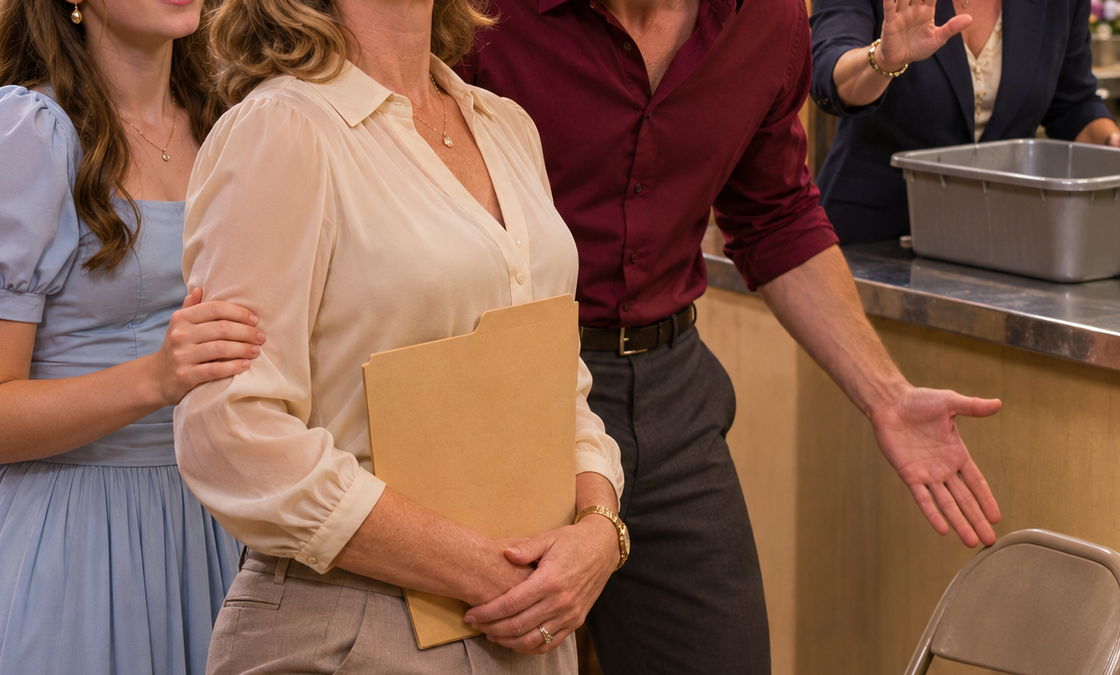
Claire held a printed cleanup list toward Emma.
“We need these tables cleared before the walkthrough finishes,” she said. “Then the serving dishes washed. The big ones can’t go in the machine.”
Emma looked at the list without taking it.
“I thought I wasn’t allowed at wedding stuff.”
“The reception is adults-only. We explained that.”
“But I can wash the dishes?”
“You’re helping tonight. That doesn’t make you a guest.”
Luke had moved my chair beside the kitchen door. There was no place setting there.
I was already holding an abandoned plate, a chicken bone sliding through orange sauce. Nobody had asked me to collect it. I’d seen an empty glass and a dirty plate, and my body had volunteered before I did.
Paying every emergency had taught my family to expect it.
“Where am I supposed to eat?” I asked.
“Afterward,” Luke said. “There’s plenty.”
“Emma hasn’t eaten.”
“Then get her something before you start.”
Claire lowered her voice, though everyone nearby could hear.
“We’ve got a lot happening, Nora. We need people who can just help.”
Emma’s cheeks had gone pink above her collar. She kept looking toward the parking lot doors.
I left the plate on the table.
“Being family did not make us free labor.”
Luke glanced toward the woman organizing cleanup, a relative of Claire’s wearing reading glasses on a cord.
“Nobody said labor. It’s dishes.”
“Then you wash them.”
“I’m the groom.”
“The wedding isn’t tonight.”
Claire’s smile stayed in place.
“We asked everyone to pitch in.”
“Who else has a chair by the kitchen?”
My brother looked down at his plate. Beside him sat an empty chair with his jacket draped over it. He didn’t offer it to Emma.
Luke nodded toward my tote.
“You brought your apron. You knew we’d need help.”
The blue apron stayed inside, folded where I’d put it that afternoon. My mother had given it to me years earlier. I’d brought it because casseroles spill, and because I still came prepared to fix things.
“I’m not wearing it tonight.”
“Fine,” Claire said. “You don’t need it. Just start with the serving pans.”
“No. Emma isn’t cleaning, either.”
Emma looked at me then.
“You can go wait in the car if you want,” I told her.
“With the keys?”
“With me. I’ll go with you.”
“Mom, honestly.” Luke stepped closer, keeping his voice low. “You’re making her feel like something happened.”
“She heard you.”
“I said she could eat.”
“After she worked.”
The cleanup organizer approached with a gray dish tub against her hip.
“Are these my kitchen helpers?”
“No,” I said.
Claire answered at the same time. “We’re sorting it out.”
The caterer was standing near the serving counter, checking the space for the wedding. She’d come for a scheduled walkthrough, not to provide tonight’s supper.
“There’s no kitchen crew here from my company,” she said.
“It’s family help,” Claire told her. “We have it covered.”
The organizer turned toward Emma.
“Come on, honey. We’ll get you started.”
“She’s staying with me.”
Luke’s face had flushed along his beard. “Can we please stop doing this in front of people?”
The plain folder lay beside my tote, clear of the spilled sauce. I told the caterer she could check whose name was on the booking. Claire began explaining before the woman had finished reading.
The caterer read the top page again and raised her hand.
“Wait. Who told you these two were staff?”
The cleanup organizer stopped in the kitchen doorway.
“Nobody said staff,” Claire answered. “We said they were helping.”
“She said no,” the caterer replied.
Her name was Karen Ellis. I’d signed the contract at her office in August. My name was listed as the client; Luke and Claire were the couple getting married.
Karen looked at me. “Do you want to discuss your booking privately?”
“I want to know what I’m still paying for.”
Inside the folder were menu notes, a signature page, and my card-payment receipt. The refundable catering deposit was $9,600, paid from my card. Our agreement allowed me to cancel by Friday at six and get that money back.
Whether anything had changed since I signed, I hadn’t checked.
Luke leaned toward us.
“She’s upset about a family disagreement. We’re not changing the wedding.”
“I’m asking her,” Karen said.
“I haven’t decided anything,” I said. “But I want you talking to me.”
Claire’s phone lit up in her hand.
“You told me to handle the food,” she said.
“I told you to choose what you wanted.”
“And I did. You can’t put me in charge, then act like I went behind your back.”
Karen’s phone sounded from her coat pocket. She glanced at the screen.
Claire said, “That’s just the event thread. I needed everyone to know we’re keeping the existing plan.”
Karen looked from the new message to Claire.
“You removed the paying client from the thread?”
Claire’s lips parted. “From the planning chat. It was getting confusing.”
Karen read the message aloud.
“‘Please don’t accept changes from Nora. Luke and I are handling decisions.’”
“I meant tonight,” Claire said. “While she’s upset.”
“Please send everything directly to me,” I told Karen. “Copies of anything about my contract. And I’d like a review of where things stand.”
“I can do that.”
Luke shook his head. “You’re embarrassing us over dishes.”
Emma spoke before I could.
“You said I wasn’t family enough to sit down.”
“I never said that.”
“You moved Mom’s chair.”
My brother finally stood. His name was David, and he was fifty, four years younger than me. Usually, when things got unpleasant, he found something that needed carrying outside.
“Maybe everybody should head home,” he said.
“Are you coming with us?” I asked Emma.
“I’m staying beside you.”
“We’re leaving in a minute.”
“Okay.”
David came around the table. “Nora, let me talk to him.”
“Talk all you want. Don’t promise anything for me.”
Luke’s eyes shifted toward him.
There was still the separate $480 I’d advanced for this rehearsal room. Luke had promised by text to reimburse me. I hadn’t mentioned it tonight, and I wasn’t going to fold it into another argument he could call confusion.
I spent my workdays doing payroll for a plumbing company. I could track other people’s money down to a missing quarter-hour. With my family, I’d let “later” become a payment date.
Karen said she would contact me directly. Claire turned away to speak to Luke, and Emma stayed close enough that our sleeves touched.
My phone buzzed before we reached the hall doors.
Luke had sent a message to the family group.
“David is handling Mom from here. He’s authorized to keep Mom out of vendor decisions.”
Chapter 2 of 7
David caught us before we reached the parking lot. By 7:20, we were in the hall’s side room, with Emma beside the coat rack.
“I told him I’d talk to you,” David said. “That’s all. I was trying to stop a scene.”
“He said you were authorized.”
“I didn’t write that.”
“Did you tell him he couldn’t?”
David looked through the doorway. “Nora, he’s worked up.”
“You can carry information. You can’t make commitments for me.”
“I wasn’t going to.”
“Then answer his message.”
His phone stayed in his shirt pocket.
“I’ll talk to him.”
“Answer where everybody can see it.”
Emma studied a poster explaining how to help someone who was choking. She’d been reading it for several minutes.
Karen appeared at the doorway with her coat over one arm.
“I can give you a few minutes,” she said.
David stepped aside but didn’t leave.
“Was I remembering the deadline right?” I asked her.
“Your original agreement gives you until Friday at six to cancel for a full refund, with no remaining balance or cancellation fee. You signed directly with us, and our records show your $9,600 card payment.”
“Food orders and event staffing don’t lock in until that deadline,” she added. “That was the flexible package you chose.”
“So that’s still available?”
“I need to check the event correspondence before I promise you that.”
Claire came in behind her.
“That’s what I’ve been trying to explain.”
Luke followed, carrying two unopened bottles of water. He offered one to Emma. She shook her head.
Karen glanced toward Claire. “I’ll need everything together, including anything sent to the event inbox.”
“I sent things where you told me to.”
“I’m not saying you didn’t.”
“I gave her permission,” I said. “For the food. I know I did.”
Claire looked at Luke as though I’d finally admitted something obvious.
I found the September email on my phone. The subject was “event contact,” all lowercase, written during my lunch break.
“‘Please work with Claire on menu, timing, and ordinary service selections,’” I read. “‘She knows what they want.’”
“That’s right,” Claire said.
“Yes. It is.”
The email was mine. I remembered eating crackers over my keyboard while I wrote it. Claire had called twice about vegetables, and I’d wanted one wedding question handled without me.
Karen said, “I’ll review that along with the rest.”
Luke leaned against the doorframe.
“She spent hours on this, Mom. You told her to handle it. Now she’s being treated like she stole something.”
“I haven’t accused her of stealing.”
“You’re pulling the money.”
“I’m asking what I agreed to.”
Claire’s voice softened.
“We picked things people would enjoy. We weren’t trying to make trouble for you.”
“Then send me what you picked.”
“You could’ve asked before tonight.”
“I’m asking now.”
From the main room came the scrape of tables being folded. Someone laughed, then called for whoever owned the green casserole dish.
Luke looked past David.
“Ruth? Could you come here a second?”
Claire’s mother appeared with her purse already over her shoulder. Ruth Sutton had been an elementary-school secretary before retiring. She spoke in the patient voice people used outside a principal’s office.
“Luke tells me there’s been a misunderstanding.”
Emma looked away from the poster.
“Would you explain the adults-only thing?” Luke asked. “Because apparently we’re the first people who ever had that rule.”
Ruth hesitated.
“It’s fairly common, Nora. Venues charge by the plate. People have to draw a line somewhere.”
“I didn’t ask them to change their guest list.”
“And helping family isn’t usually considered an insult.”
“Did Luke tell you where he put my chair?”
Ruth glanced at him.
He rubbed his forehead. “We needed the table cleared.”
“She had a place at that table?”
“There wasn’t an assigned seating chart for potato salad, Ruth.”
Emma spoke without turning around.
“I would’ve stayed home.”
Luke looked at her. “Nobody asked you to stay home tonight.”
“I mean from the wedding. If it was the same rule for everybody, fine.”
“It is the same.”
“Then why was I getting instructions for cleanup?”
“Tonight was different.”
“You wanted me at the service entrance, basically.”
“Emma,” Claire said, “there isn’t a service entrance.”
“I know that.”
Her voice cracked on “know.” She stopped talking.
I wanted Luke to hear it and go to her. He stayed against the doorframe.
Ruth said, “Perhaps the request came out badly.”
“It did,” I said. “And she’s not doing it.”
“We can add a chair,” Claire said. “If that settles this.”
“I’m not bargaining for a seat.”
“Then what do you want?”
“For her to be able to say no. For me to say it.”
David cleared his throat.
“They’re not staying to clean,” he said.
Luke stared at him. “Nobody’s holding them here.”
“Good,” David said. “Then leave that alone.”
It was late, but Emma finally looked up.
Karen checked the time.
“I need to get back to the office. Nora, I’ll send what I can tonight and review the complete file tomorrow.”
“Please keep the correspondence,” I said. “The direct emails, the event thread. Don’t replace anything with a new version.”
“We keep our records.”
“And I’m not authorizing the remaining $4,800 tonight.”
Luke pushed away from the doorway.
“It isn’t even due tonight.”
“Then there’s no reason for me to approve it tonight.”
Karen said, “I’ll note that you’re asking for review before making any further decision.”
“And I can still ask about cancellation?”
“Yes. But an accepted modification could affect that. I need to see what was submitted and what was agreed.”
Claire nodded once. Luke watched me as if I should apologize.
I said nothing at all.
David finally took out his phone. A moment later, mine buzzed.
“I can pass along messages. Nora makes her own decisions.”
It wasn’t everything I’d wanted him to say. I didn’t ask him to rewrite it.
Outside, Emma waited until we were in the car.
“Can we get something that isn’t somebody’s leftovers?”
“What sounds good?”
“Drive-through fries.”
“You haven’t had dinner.”
“Large fries.”
We got sandwiches, too. At home, she ate in her school sweatshirt, her dress hanging from the pantry door so the hem wouldn’t wrinkle.
“Are you going to have to pay anyway?” she asked.
“I don’t know yet.”
“Because of me?”
“No.”
She tore the corner off a ketchup packet.
“You didn’t sign anything. You didn’t promise anything,” I said. “This isn’t your bill.”
She nodded, but ate only half her sandwich.
Near nine, after she went upstairs, Karen’s email arrived. I read it at the kitchen table, beside the cold fries.
The last paragraph said Claire had signed a premium-service addendum on October 6.
It contained a nonrefundability provision.
Chapter 3 of 7
At 8:10 Friday morning, Karen called while my work computer was starting up.
“The proposed addition is $1,200,” she said. “Premium service. I’m gathering the complete paperwork now.”
“So they’re calling it $15,600 altogether.”
“On the proposed service sheet. I haven’t settled whether the change was authorized.”
“And you can’t promise the deposit back.”
“Not until I finish the review.”
Through the office wall, I heard a plumber asking who’d taken the last clean company shirt. Usually, that was the kind of problem my Friday started with.
Karen said, “If you’re questioning the card payment itself—”
“I’m not. I made that payment.”
“All right.”
“My card wasn’t stolen. I agreed to the original package. It’s this later change I’m asking about.”
“I have that noted.”
After we hung up, I opened the payroll file. Three employees had forgotten to enter their Thursday hours. I sent the usual reminder, without the smiley face I sometimes added.
Luke called before I finished.
“Claire said you’re talking about canceling.”
“I’m asking Karen to review everything.”
“You know what happens if we lose this service?”
“Tell me.”
“We start over. Calls, appointments, telling everybody the plan changed. We’ve already chosen this.”
“Then you need to talk about paying for it.”
He was quiet long enough that I checked whether the call had dropped.
“We’ve got $1,800,” he said.
“For what?”
“Extra money. Contingency money, whatever you want to call it.”
“The money you could use toward the food?”
“Mom, we still have other things to cover.”
“So do I.”
“You’ve already paid most of it. We’re asking you to finish what you started.”
The office printer began grinding through somebody’s parts order.
“Six thousand dollars more isn’t finishing a small favor, Luke.”
“It’s the balance with the service change.”
“I know how you got the number.”
“We can work something out afterward.”
I’d heard “afterward” when his tires went bald. When his commission check came late. When the rehearsal room needed to be booked.
“I’m not agreeing to pay it.”
“You could let us get through the wedding first.”
“No.”
His breathing sounded close to the microphone.
“Okay. Then I need you to handle Emma’s ride tomorrow.”
I sat back against my chair.
“You promised her.”
“I know. I’ve got vendor appointments now. Planning stuff. Claire can’t do all this herself.”
“She’s been counting on you.”
“And I was counting on some help, too.”
He stopped there. He didn’t need to make the comparison clearer.
“I’ll arrange it,” I said.
“I’m not doing this to her.”
“Tell her yourself.”
“I will.”
He hung up without asking how she’d been when we got home.
A few minutes later, Emma sent me a screenshot of her school theater schedule. Saturday, October 10: work session. She had circled the arrival time using her phone’s editing tool.
Under it she wrote, Luke can’t take me now.
I answered, I know. I’m finding another ride. You’re still going.
She sent back a thumbs-up. Then the little dots appeared again.
Did you ask him not to?
No.
I waited. Nothing else came.
My work phone rang. A technician wanted to know why his overtime looked short. I found the missing entry, explained it, and corrected his hours. For eight minutes, there was a problem I could actually fix.
During my morning break, I called the mother of another theater volunteer. She lived a few streets over and was already driving her daughter.
“Would Emma mind paint cans at her feet?” she asked.
“She’ll probably ask what color.”
“Good. They’re doing scenery.”
We arranged pickup at our house. I could keep my workday intact, and Emma wouldn’t lose the Saturday she’d been talking about all week.
I texted her the plan.
She called almost immediately.
“Can you talk?” I asked.
“For a minute. I’m by the lockers.”
“Your ride’s set.”
“Okay.”
A locker slammed near her phone. Someone called a name that wasn’t hers.
“Mom?”
“Yeah?”
“If you keep saying no to him, is he going to stop being my brother?”
My break-room coffee had a skin across the top. I watched it while I tried to answer without making her a promise I couldn’t keep.
“He’ll always be your brother. I can’t make him act like one.”
“So we just don’t talk now?”
“You can talk to him.”
“What if you’re mad?”
“I am mad. You don’t have to carry messages for me.”
“I wasn’t going to.”
“I know.”
She was quiet.
“You can send him something if you want,” I said. “Or leave it alone today.”
“I don’t want you writing it.”
“Then I won’t.”
Before she went back to class, she read me what she’d decided to send.
“I wasn’t asking you to pick me over your wedding. I thought you wanted to take me.”
“Does that say what you want?”
“Yeah.”
“Okay.”
She ended the call. I didn’t ask whether he answered.
By the time I returned to my desk, Claire had posted in the family group.
She started with, “We love everyone and don’t want sides.”
Then she explained that a disagreement about rehearsal seating had become a threat to the wedding meal. She said they were trying to protect eighty guests from last-minute disruption, and asked everyone to give me space rather than “adding pressure while emotions are high.”
There was no mention of the cleanup list.
An aunt responded with a praying-hands symbol. Someone else wrote, “Your day should be about you two.”
Ruth sent me a private message.
“Could you explain what happened? Claire says you may cancel their food. I don’t want to repeat anything unfair.”
She was giving me a chance. Still, I had to explain myself to a woman who’d watched my daughter stand beside a chair nobody wanted her sitting in.
I wrote back, “I’ll talk with you after work. There is more to this than seating.”
Then I answered the group.
“Neither Emma nor I agreed to be staff. I’m asking for a final meeting with Karen so we can work from accurate information about the catering. I’ll speak for myself.”
I read it once before sending. I left out the numbers, the email, and everything I wanted to say about Luke’s chair.
No one replied right away.
I closed the thread and went back to the missing time entries.
Just before ten, Karen called again.
“I need to check something directly with you,” she said.
“I’m here.”
“Has your brother been authorized to approve anything for you?”
“No.”
“I thought I should ask rather than assume.”
“What did they tell you?”
Karen paused.
“Claire has instructed me to use David’s verbal approval if you won’t respond. She says he speaks for the paying family.”
Chapter 4 of 7
At 11:30, David called me back.
“I didn’t approve any spending,” he said. “I need you to know that first.”
“What did you tell Claire?”
“That I could talk to you.”
“David.”
He let out a long breath.
“I said you usually came around once things settled down.”
Outside my office window, a company van backed toward the loading door. Its warning beep came through the glass.
“Came around to what?”
“Helping. Covering things. I wasn’t talking about a particular amount.”
“She gave Karen your name as someone who could approve things.”
“I didn’t tell her to do that.”
“You gave her a reason to think it would work.”
He didn’t answer.
I could picture him at the auto-parts counter, finding a quiet corner between customers. He hated these conversations. For years, that had been enough to get him excused.
“You need to correct it,” I said.
“I’m correcting it now.”
“With Claire. And Karen. In the same email.”
“Could you send me what Karen said?”
“No. Call her if you need to ask. I’m not writing your explanation.”
“Nora, I’m trying to help.”
“Then tell them what you told me.”
He was quiet again.
“All right. I will.”
After we hung up, I checked the family thread. Claire’s account of the disagreement was still there. Nobody had asked Emma what happened.
Karen’s email arrived a few minutes later. It contained the complete October 6 addendum and the original service schedule.
I opened them on my lunch break.
The schedule listed the meal for eighty people. The addendum proposed more table service and an additional $1,200. Claire’s name appeared where she had signed.
I hadn’t seen that page before.
At the bottom of Karen’s message, she’d written that she had retrieved the full signed original and attachments from the office file. She would review them together before giving us a final answer.
I printed the two attachments for the meeting. Beside Claire’s addendum, I laid my original signature page and marked one difference in pencil. I wrote a question for Karen in the margin; I wanted her answer before treating my reading as settled.
Beside the printer sat the office lunch jar, labeled FOR EMERGENCIES in our dispatcher’s handwriting. It held ketchup packets and one peppermint nobody wanted. I found mustard underneath and went back to my desk with my sandwich.
David’s correction came through before I finished eating.
“I told Claire I could usually persuade Nora to help. That was my assumption, not Nora’s permission. I have not approved spending or contract changes for her, and I cannot do that.”
He had copied Claire, Luke, Karen, and me.
A separate message followed.
“Is that enough?”
I answered, “Yes. Thank you.”
For once, there was nothing in it I needed to repair.
I started a new email to Karen.
I wrote that I wanted to review cancellation under my agreement before the deadline. I asked her to confirm what the proposed addendum changed, what remained unresolved, and what money would be returned if I canceled.
Then I added, “Please treat this as a request for review, not a completed cancellation. I want to give you a clear decision after we meet.”
I read that sentence twice. I wasn’t ready to send a notice I might misunderstand. I also wasn’t going to let another afternoon disappear into family calls.
Karen replied with Luke and Claire copied.
“Nora has requested a cancellation review. A full return of the deposit remains a possible outcome, pending review of the complete agreement and proposed changes. We need to address this directly today.”
Luke called less than a minute later.
“You’re asking for the money back?”
“I’m asking what happens if I cancel.”
“Claire said the deposit couldn’t come back after the upgrade.”
“That’s what she believed. Karen is checking.”
“So we’ve spent all morning trying to save this, and you might just take it back.”
“It’s my payment, Luke.”
“It’s our wedding.”
Neither of us spoke for a few seconds.
Then he said, “Claire’s here. Can we put you on speaker?”
“All right.”
Claire sounded farther from the phone.
“Nora, I need you to look at the September email again.”
“I have it.”
“You made me the designated wedding contact. I didn’t call pretending to be you. I used my own name.”
“I haven’t said otherwise.”
“Then please stop treating the things I selected as if they came from nowhere.”
“I’m not.”
“Someone has to be able to make decisions. The vendor can’t come back to you for every tray and every server.”
I watched a strip of mustard soak through my bread.
“I’m asking Karen to tell us which decisions you could make.”
“You asked me to handle service selections. This was service.”
“And the money attached to it?”
“We thought the deposit covered most of what you were giving us.”
“Did you ask me?”
Luke cut in.
“We should’ve talked about the extra amount. Fine. We can work on that.”
“The extra amount isn’t the only thing being reviewed.”
Claire’s voice stayed level.
“If we can resolve the added cost, I don’t see why the whole arrangement needs to be undone.”
I had no answer that would make her agree with me.
“We’ll talk with Karen,” I said.
After the call, Karen sent a short reply to everyone. She acknowledged Claire’s September authorization and confirmed that the menu selections were within the work Claire had been handling.
“The proposed service change and the change to cancellation terms need separate review,” she wrote. “Please don’t assume one settles the other.”
She didn’t promise me a refund. She didn’t tell Claire the money was hers to keep committed.
At 12:30, she confirmed a 5:00 p.m. meeting in the tasting room at her Dayton catering office.
The list included me, Luke, Claire, David, and Ruth. Karen’s billing manager, Michael Reed, would attend in person in case she authorized refund processing.
I called Karen.
“Do we need everybody there?”
“They’re all hearing different versions,” she said. “I’d rather answer once, with the file in front of us.”
“And Michael?”
“He handles our billing. If there’s a payment action, he can do it.”
“Okay.”
“Can you make five?”
“I can.”
My workday would be finished in time. I wouldn’t have to leave another payroll question for someone else to untangle.
Ruth sent a message saying she would attend. David did the same.
I texted Emma that there would be a meeting after work and that I’d be home later than usual.
She answered, “Do I have to go?”
“No.”
“Good. I have homework.”
I left her to it.
As I closed my email, another message arrived from Claire. She had forwarded her instruction to Karen and copied the rest of us.
“Please issue the final account in Luke Parker and Claire Sutton, replacing Nora Bennett as the named client.”
Chapter 5 of 7
At 4:30 Friday afternoon, Karen’s reply reached me while I was home changing out of my work clothes.
“The client remains Nora Bennett,” she wrote. “A transfer requires an agreement accepted by everyone involved. Changing the names on the account does not transfer the contract.”
Claire had copied six people on her request. Karen answered all six.
Emma stood outside my bedroom in socks, one heel worn thin.
“I’m still not going.”
“You don’t have to.”
“Because I don’t want everybody deciding how mean he’s allowed to be if he gets enough money.”
My blouse caught on an earring. For a second, I couldn’t get it over my head.
“Is that what you think the meeting is?”
“That’s what the messages sound like.”
She’d seen only the ones Luke sent her. Those had been enough.
“I’m going to settle what I’m responsible for,” I said. “You don’t have to come explain yourself.”
“What if they say I exaggerated?”
“I was there.”
She leaned against the doorframe.
“I want to go to the library. I can get my history thing finished.”
“All right. I’ll drop you off and come back for you afterward.”
“Even if it takes forever?”
“Even then. I’ll text if we run late.”
She went to find her shoes. I finished dressing without changing the earrings.
On the drive, she told me her history project partner had chosen a font nobody could read. They’d spent twenty minutes arguing about whether it looked old-fashioned or just blurry.
“What did you pick?” I asked.
“The boring one.”
“Good choice.”
“She said that was something a mom would say.”
“She’s right.”
Emma almost smiled.
I left her at the library entrance with her backpack. She went inside without looking back, and I drove to Karen’s office alone.
The tasting room smelled like warm bread. A display table held sample place settings, including a napkin folded into something that would never survive a family dinner at my house.
David was already sitting beside Luke.
“Hey, Nor.”
“Hi.”
He took a tasting plate from the tray near his elbow. There were two small pieces of chicken and a square of cornbread. He settled back beside my son, close enough that their jacket sleeves touched.
I chose the chair across from them.
Claire sat at the end nearest Karen’s office. She had come straight from work, judging by her dental-office badge, still clipped to her cardigan.
“Thank you for making time,” she told Karen when she entered. “We know this isn’t how you planned to spend Friday evening.”
“We needed to settle it today,” Karen said.
A man followed her into the room.
“This is Michael Reed, our billing manager.”
Michael greeted us, then sat near the small payment terminal. He had the practical expression of someone expecting numbers rather than introductions.
Ruth arrived last, slightly out of breath.
“I got caught at every light,” she said. “Have we started?”
“Not yet,” Karen answered.
Ruth sat between Claire and me. Her purse stayed on her lap.
“I’m glad we’re all here,” she said. “There’s still time to save everybody some embarrassment.”
Luke looked toward me.
“That’s what we’re hoping.”
I’d eaten half a sandwich at noon. The cornbread smelled sweet, but I didn’t want to chew while anyone was speaking.
Karen checked the clock.
“We have a few minutes before five. Michael needs to confirm the payment record. Then we’ll review the agreement.”
Luke leaned forward.
“Can I say something before we get into all that?”
Karen looked at me. I nodded.
“Mom, you don’t have to help with anything. No setup, no cleanup. We’ll handle it.”
“I already said I wasn’t doing that.”
“I know. I’m saying we heard you.”
Emma had needed to hear it. She was at the library.
“And if coming to the wedding feels uncomfortable now,” he continued, “we won’t put pressure on you.”
David stopped chewing.
Luke went on before anyone answered.
“The deposit could just stay as your wedding gift. That way you don’t have any more responsibility, and we don’t have to pull everything apart.”
“So I can stay home, and the money can come.”
“That’s not how I meant it.”
“Then tell me what I missed.”
“You said you wanted out of the work. Out of the decisions. I’m offering that.”
“You’re asking me to stop asking about my payment.”
Claire spoke gently.
“We’re trying to separate the family disagreement from the wedding arrangements.”
His face reddened, but his voice stayed low.
“You paid it for our wedding.”
“I paid under an agreement I’m here to review. I’m not turning it into a gift tonight.”
Ruth looked down at the purse on her knees.
Karen said, “We’ll go through what’s in place. Nobody needs to make a different agreement while we’re waiting.”
Claire nodded.
“I appreciate that. I do want the September authorization included.”
“It’s included,” Karen said.
“Because I didn’t just select this on my own. Nora asked me to handle service choices. Your office worked with me on that basis.”
“Yes. We have the correspondence.”
Michael looked toward me.
“I’ve confirmed the original transaction. The card account is yours alone?”
“Yes. No authorized users.”
“If Karen authorizes a refund, it goes back to the original card. We don’t send it to another person or divide it between accounts.”
“How long?” I asked.
“Business days. It won’t show as a posted credit tonight.”
Luke asked, “Can you tell us whether it’s refundable?”
“That’s Karen’s decision under the agreement,” Michael said. “I handle the payment once she authorizes it.”
The wall clock clicked toward five.
David still had his tasting plate. He hadn’t said anything since I arrived.
Ruth turned toward him.
“Did I misunderstand what you told me?”
He looked up. “About what?”
“About Nora paying.”
Luke’s eyes moved to Claire.
Ruth continued, “I thought we were here because she’d changed her mind after volunteering to cover the whole thing. The upgraded bill, too.”
“That’s what I was told,” David said.
I looked across the table at my son.
Ruth’s voice lost its careful brightness.
“Luke, you and Claire told us Nora had already offered to pay the entire upgraded bill. Have you told Karen that?”
Chapter 6 of 7
At 5:00 p.m., Karen began the final catering review. Luke answered Ruth before Karen could finish her first sentence.
“Mom offered to pay for the original event. That’s why we relied on her.”
“The upgraded bill?” Ruth asked.
“We should’ve confirmed the extra money. I’ve said that.”
“That isn’t what you told me.”
“Ruth, we weren’t trying to mislead you.”
Claire looked at Karen.
“Nora authorized me to make event decisions. Your office sent me service options, and I selected one. The form said nonrefundable. I signed it believing I had the authority she’d given me.”
Karen nodded. “I have that email here.”
“Then this wasn’t just something we hoped she’d pay,” Luke said. “We made plans based on her agreement. If she can withdraw everything because we had an argument, what was the agreement for?”
David looked toward me. Ruth did, too.
“The argument doesn’t change the paperwork,” Karen said. “We need to establish what became effective.”
“I agree,” Claire said. “And vendors need to be able to rely on an authorized contact.”
I placed my original signature page beside Claire’s addendum.
“Karen, I let Claire choose the menu and ordinary service. Does that also let her give up my cancellation rights?”
Claire started to answer.
“I’m asking about this paragraph,” I said.
Karen followed the line I indicated.
The restriction had been in the papers I brought home in August. Between payment instructions and the signatures, it required the named client and original cardholder to sign personally before surrendering the right to cancel.
I hadn’t paid much attention to it in August. At lunch that Friday, I had marked the mismatch between these pages. Now I wanted Karen’s answer to the question in my margin.
Claire leaned forward.
“I signed as her authorized representative. The September email is the authorization. It doesn’t require me to call myself Nora.”
“I’m not saying you did,” I said.
“The upgrade form says the deposit becomes nonrefundable. I read that before signing.”
Michael looked at Karen.
“Does the original agreement allow the event representative to waive that right?”
Karen read from her matching office copy.
“‘Any surrender of cancellation or refund rights requires the personal signature of the named client and original cardholder. Event-contact authorization does not satisfy this requirement.’”
Luke watched her.
“But Mom authorized service choices.”
“Yes,” Karen said. “That’s why we’re distinguishing them.”
She checked the September email against the original schedule.
“The original commitment was $14,400. Nora’s email allowed menu, timing, and ordinary service selections. It didn’t approve every later increase.”
“We can deal with the extra twelve hundred,” Luke said.
Karen continued comparing the pages.
“Nora, did you sign a separate waiver?”
“No.”
“Claire, do you have one with Nora’s signature?”
“No. I believed my signature was sufficient under her email.”
“I hear you,” Karen said. “But that authority cannot replace the personal signature this agreement specifically requires.”
Claire looked down at her addendum.
“The whole selection was offered together.”
“It was proposed together,” Karen said. “The increased price and changed cancellation terms still needed Nora’s approval. We never received it.”
For several minutes, Karen checked the attachments against the event correspondence. Michael waited while she finished. The refrigerator behind the tasting-room wall clicked on, humming beneath the scrape of traffic outside.
Karen looked at me.
“Your original cancellation terms remain available. Do you want service to proceed?”
“No. I want to cancel.”
“At that point, there’s no catering order for the wedding.”
“Yes. I’m canceling it.”
She gave me the cancellation notice. I signed beneath the order description and returned it.
Michael checked the time.
“Five seventeen.”
Karen recorded receipt at 5:17 p.m., before the six o’clock deadline.
“I accept your cancellation,” she said. “We’re withdrawing catering service. The $4,800 balance is no longer due. There’s no termination fee.”
Luke’s mouth opened, but he didn’t speak.
Karen marked the service sheet canceled and completed the written instruction authorizing the $9,600 refund.
Michael checked her authorization against the transaction record.
“Full amount, original payment method,” he said.
“Yes,” Karen answered.
He entered the merchant refund through the terminal. We waited for the processor response.
“Accepted for processing,” he said.
The printer ran. He gave me the acknowledgment and indicated the receipt reference.
“This identifies the refund submission. Keep it until the credit posts. It isn’t a posted credit yet.”
“Thank you.”
Luke stared at the canceled service sheet.
He had lost the eighty guest reception.
He rose from his chair.
“We have $1,800. Can you take that and keep the order?”
Karen looked up at him.
“Not this order. It’s canceled. Any replacement would need a new agreement and funding.”
“Could we keep the menu and do less service?”
“Not for eighty people at that amount.”
“What could you do?”
“We can discuss a smaller event separately. I can’t promise a package tonight.”
He stayed standing.
“Our hall is already paid for.”
“That booking is separate,” she said. “This doesn’t cancel your venue.”
Claire gathered her papers, keeping the addendum with the September email. She checked that she had every page before speaking.
“We’ll need to notify people.”
“There’s time,” Karen said. “Your wedding is still two weeks away.”
“That doesn’t make the calls easy.”
“No,” Karen answered. “It doesn’t.”
Ruth turned toward me. I waited for her to ask once more.
Instead, she said, “I’m not going to ask you again.”
Luke looked at her.
“I was told you’d offered,” she told me. “I should have asked you.”
David set his tasting plate down. The cornbread was still on it.
“I should’ve stopped it in the kitchen,” he said.
Luke frowned. “Uncle David—”
“I was sitting right there.”
“We weren’t forcing anybody.”
“She had to tell you no with everybody watching. Emma, too. I could’ve said something before it got that far.”
He left the chair beside Luke and came around to mine.
“And then I told Claire you’d probably come around,” he said to me. “Like I was giving her useful advice.”
“You were,” I said.
He nodded, his face red.
“I know.”
I retrieved my tote. The blue apron showed above the folder, still folded from Thursday.
Luke looked at it, then at me.
“Mom, we’re still getting married.”
“I know.”
“I don’t want this to be how things stay.”
“I don’t either. But my daughter will never work for a place in this family.”
Claire said nothing. Ruth stayed seated beside her.
David walked out with me. In the parking lot, he asked whether I wanted him to follow me home.
“I’m picking Emma up at the library.”
“I can follow you there.”
“All right.”
At 5:35 p.m., before I started the car, Emma’s text arrived.
“They asked me to come to the wedding without you. I said no.”
Chapter 7 of 7
I called Emma before leaving the caterer’s parking lot that Friday evening.
“You don’t have to go to keep anybody happy,” I said.
“I know.”
“Did Luke call you?”
“He texted. He said I was welcome if we could put yesterday behind us.”
Through her phone, I heard the library’s closing announcement.
“What did you say?”
“That I didn’t want to come if I had to pretend it was a misunderstanding.”
“Okay.”
“He said he wasn’t asking me to pretend.”
I waited.
“But he wanted me to say we were fine before I got there.”
“You don’t owe him that.”
“Are you mad he asked me without you?”
“I’m glad you told me. You can make your own choice.”
“I did.”
“I’m coming to get you.”
David followed me to the library, then drove home after Emma came outside. She waved through his windshield. He waved back, looking relieved she’d bothered.
In the car, she asked what happened with the money.
“Karen accepted the cancellation. The refund is being processed.”
“So you got it back?”
“Not yet. But it’s going back to my card.”
She nodded and started telling me about her history project. She’d finished her section. Her partner still hadn’t answered a message about the bibliography.
I let the wedding wait.
The next morning, her ride arrived with paint cans on the floor. Emma climbed in carrying an old shirt for scenery work. I watched them leave, then went inside to start laundry.
Nobody needed me to fix Saturday.
Karen emailed the cancellation receipt and refund acknowledgment. I replied in writing that I withdrew permission for any future charges to the stored card. Her office confirmed it and kept the original payment and refund records intact.
On Wednesday, October 21, the $9,600 credit posted. I checked the amount once, then removed the saved payment permission from the planning portal.
The folder went into my filing cabinet.
Luke and Claire had time to call their guests. Some relatives called me afterward. I answered the ones who wanted to talk and let the lectures go to voicemail.
Ruth sent one message.
“They’ve changed the plans. I won’t be passing along anything else about you.”
I thanked her. We left it there.
On Saturday, October 24, Luke and Claire married at three in the afternoon. Emma and I weren’t there.
That morning, she asked whether I wanted her to stay home with me.
“Do you have somewhere you’d rather be?”
“The theater kids are getting pizza after we finish.”
“Then go.”
I stayed home. At three, the dryer was thumping because I’d washed a pair of sneakers with the towels. I turned it off and sat at the kitchen table for a while.
I still wanted to see my son get married. That part hadn’t gone away.
Luke sent a photograph the following evening. Claire wore her wedding dress, and he wore the suit I’d seen hanging in his apartment.
Under it, he wrote, “We had eighteen people at the restaurant. $1,620, including tax and tip. Paid from our $1,800. Nobody owes anything for dinner.”
I looked at the photograph longer than the message.
“You both look nice,” I answered. “I’m glad the ceremony went ahead.”
He sent back, “Thanks, Mom.”
There was no request underneath it.
On Friday, November 6, Luke transferred the separate $480 rehearsal-room reimbursement. His message included a screenshot of our original agreement.
“Got paid today. This was always mine to pay back. I kept treating your help like it would be there whether I asked or not.”
I answered, “Received. Thank you for paying it.”
I didn’t add that everything was settled. He didn’t ask me to.
The following week, he requested a visit.
“Just me,” he wrote. “Sunday afternoon? Half an hour?”
I agreed to November 15.
Emma chose to go to a friend’s house. Before she left, she asked whether I planned to tell him she missed him.
“Do you want me to?”
“No.”
“Then I won’t.”
Luke arrived on time. Without Claire beside him or a phone call to finish, he looked younger than twenty-nine.
He sat on the couch where he used to leave his hockey equipment after school.
“I need to apologize about Emma.”
“You need to apologize to her.”
“I know. I wanted to tell you, too.”
“Go ahead.”
“I called her your daughter. Like she wasn’t my sister. Then I made eating sound like something she had to earn.”
The furnace started beneath us.
“And the invitation?” I asked.
“I wanted her there without having to deal with what I’d said.”
“She heard that.”
“Yeah.”
He watched the doorway for a moment, though I’d told him she wasn’t home.
“Will you tell her I said that?”
“You can write to her. She decides whether she answers.”
He nodded.
Then he asked if we could have dinner sometime.
“Maybe. But I’m not paying bills for your household, Luke. Don’t plan around me covering a shortfall.”
“I wasn’t going to ask.”
“I need it clear anyway.”
“Okay.”
He stayed twenty-eight minutes. At the door, he asked before hugging me. I let him.
Emma read his apology later that week. She didn’t answer immediately, and I didn’t ask again.
David started with a smaller invitation.
“Soup at my place Sunday,” he called to say. “I bought bread. Don’t bring anything.”
“Do you need me early?”
“No, Nor. Come when it’s time to eat.”
He’d used too much pepper. Emma drank three glasses of water, and he admitted he’d measured over the pot.
When I started toward the kitchen afterward, he said, “Leave it. I know where my sink is.”
I went back to the couch.
Claire sent one apology in December. She named the cleanup list and the attempt to keep me out of the vendor conversation.
“I was wrong to treat your payment as permission to decide everything,” she wrote.
She also corrected the family thread, saying I had never offered to cover the upgraded bill and that the cleanup demand had been wrong.
I thanked her for saying it. There were no plans for a family dinner.
By Saturday, January 9, 2027, Emma had another theater rehearsal and a request for breakfast before she left.
“Egg sandwiches,” she said. “With the edges crispy.”
The kitchen windows were cloudy from the cold. She stood at the stove in mismatched socks while I watched the bread toast.
The blue apron lay on the counter near the pantry.
“Do we need that?” I asked.
She inspected the skillet.
“I’m sixteen. I can fry an egg.”
Last winter, that would have started an argument about grease on her sweatshirt. I left it alone.
She broke one yolk and announced that sandwich was mine.
“Very generous.”
“I’m making yours easier to eat.”
She carried our plates to the table. Neither sandwich looked like the picture she’d shown me. Both smelled good.
I hung the blue apron up and sat beside her.








