Our HOA fenced my daughter out after I paid $14,000 in dues, but its richest family didn’t know what I had kept.
Chapter 1 of 7
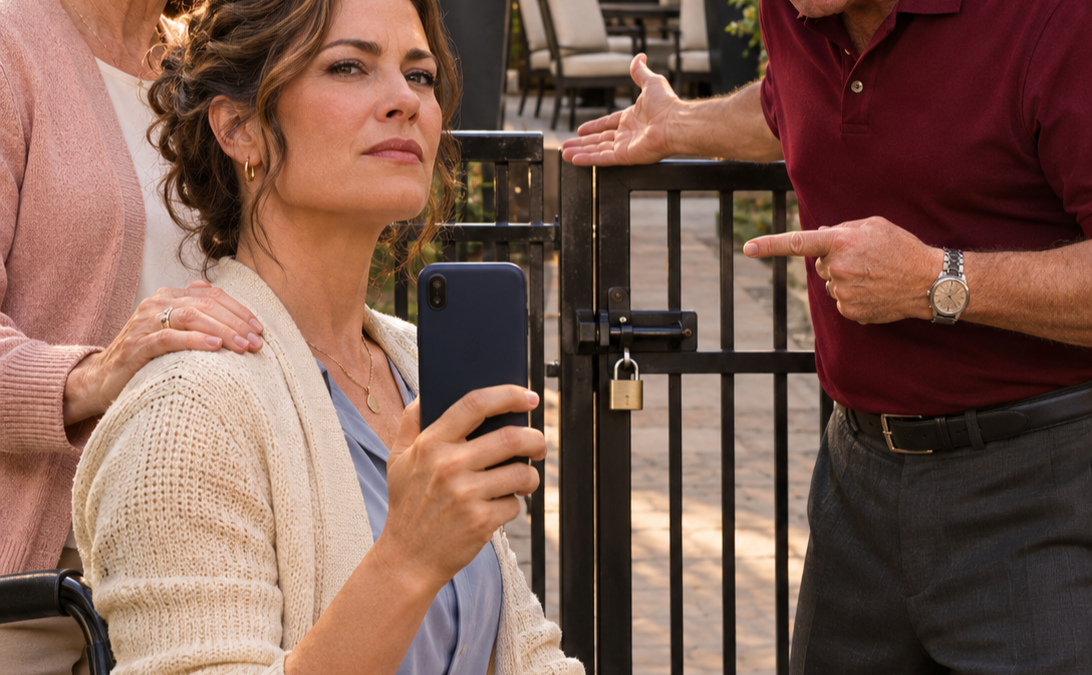
At 4:10 p.m. on Monday, April 6, Emily stopped before a locked gate. Her red canvas tote rested on her lap. Beyond the fence stood our front door.
Grant came around a tall planter.
“Your daughter’s chair isn’t everybody else’s problem.”
Paul stood beside him, close enough to hear. He looked toward our porch instead.
Emily had finished her outpatient appointment half an hour earlier. She still wore the visitor sticker she always forgot to remove.
“Open it,” she said.
Grant glanced at the latch. “This is our dining area now. The other entrance is available.”
“The other entrance has steps.”
“I know there are steps, Emily. I live here.”
The black fence crossed the paved lane beside our townhome row. Behind it were tables, heavy chairs, and planters tall enough to hide someone seated. Our short, level branch to the front door lay beyond them.
“I can cancel dinner with my sister,” I began. “We could wait while—”
“Mom. Why would you cancel dinner?”
I stopped there.
I had made keeping the peace look like agreement.
Grant looked relieved, as though my unfinished offer had settled things.
“We’ve already committed the money,” he said. “Families have been invited. We can’t keep changing arrangements after everything’s installed.”
“We live behind it,” Emily said.
“You live beside it. That’s an important difference.”
She looked down the fence toward the far end. There wasn’t another opening.
“Then clear the route. All of it.”
Grant turned toward me.
“Linda, surely we can work out something reasonable without making this unpleasant.”
He had already made it unpleasant. He just wanted me to take responsibility for that part.
“Being easy to live beside shouldn’t mean being easy to erase.”
Paul’s mouth moved, but he said nothing.
At 4:14, Emily called the management number herself.
“This is Emily Bennett. I’m outside my home, and the level entrance has been fenced off.”
Grant started to speak. She continued without raising her voice.
“No, I’m not hurt. I need the route cleared so I can get inside.”
Above our porch light, the little camera faced the lane. A spiderweb hung beneath its white casing. I had been meaning to sweep it away.
The gate was new. So were the cream-colored seat cushions and the planting screen behind Grant. Near the branch to our door, the drain cover sat inside the yellow curb’s turn, where rainwater always collected.
Emily listened to the manager.
“Yes. I can wait here safely while you get someone. But please tell them the whole route needs clearing.”
Grant stepped back, giving her room for the call.
That small courtesy made his earlier words worse.
When she hung up, he said, “There’s no reason to involve anyone beyond management. They know about the project.”
“She called management,” I said.
“I heard.”
“Then let her finish.”
He looked toward Paul. “You were at the meeting.”
Paul studied the fence.
“I was,” he said.
Grant waited for more. Nothing came.
Our townhouse in unincorporated Fairfax County, Virginia, had never seemed so far away. I could see the grocery circular wedged under our door handle.
Emily had ordered frozen waffles that morning. She had joked that being thirty-six meant buying the cereal you weren’t allowed as a child, then forgetting you owned a toaster.
Now she was calculating how long she would have to sit outside her own house.
“Do you want me to call again?” I asked.
“No. She said she’s coming.”
Grant’s phone rang. He walked a few steps away, his voice dropping into the pleasant tone he used with customers.
“Yes, we’re here. No, nobody’s been denied anything. There seems to be confusion about which entrance—”
Emily looked at me.
“Please don’t explain my chair to him.”
“I wasn’t going to.”
“You do sometimes.”
I had no good answer.
Grant ended his call and returned.
“Management approved this,” he said. “I’m not asking you to like the furniture. I’m asking for a little patience.”
A car stopped beyond the row. The manager got out, still looking at her phone.
Grant went to meet her.
“Good. You can explain what was approved.”
The manager stopped beside Grant and checked her phone again.
“You told me this entrance wasn’t in use.”
Grant glanced toward us.
“I said there were other entrances. That’s what I meant.”
“This is the level entrance,” Emily said. “I use it every day.”
The manager introduced herself as Susan Webb, then asked Emily whether she needed anything while they cleared it.
“Just access,” Emily said. “And not a gap I have to squeeze through.”
Susan called the contractor. Then she stepped aside to speak with the county office she had contacted after Emily’s call.
Grant followed her a few paces.
I stayed beside my daughter.
“The camera backup has the delivery,” I told her. “And today’s crew putting this across.”
“You kept today?”
“I protected the recording on my phone just now. The original, too.”
During my years as an infusion nurse, I had learned to keep delivery records. At home, that became saving outdoor footage when supplies arrived. An ordinary backup drive sat beside my computer.
Last Monday’s delivery was already saved. Today’s recording was still there when we returned.
“Can I share the relevant outside footage?” I asked.
“Yes,” Emily said. “The approach. Nothing from inside.”
“Of course.”
“Ask me first next time, too.”
“I will.”
A contractor’s truck pulled in. Susan met the driver before he reached the gate.
“Ben, everything across the lane needs moving. Tables, planters, all of it.”
Grant came up beside them.
“We can open the gate. That’s why we bought that kind.”
Susan shook her head.
Ben stopped with the tool case halfway out of his truck.
“The county wants the whole twenty feet clear?”
“Yes,” Susan said. “The full route. I’ve spoken with intake. They’re referring this for inspection, but we clear it now.”
Ben looked past the gate, taking in the tables.
“Then we need somewhere else to put these.”
“Along my garage,” Grant said. His voice stayed level. “I’ll show you.”
He opened the gate while Ben called his crew back. Emily remained where she was.
An open gate wouldn’t get her past the furniture.
Grant helped carry chairs away. He asked Ben to keep the cushions off the ground and thanked him when he did.
“This is temporary, Susan,” he said. “Until we’ve had a proper discussion.”
“Today, we’re getting the route clear.”
“I’m cooperating. I’d like that recorded.”
Susan didn’t answer that.
One planter took two men. Underneath it lay a pale rectangle of dry pavement. Another table came out, followed by the chairs stacked behind it.
Paul moved away from the work but stayed nearby.
I wanted to ask him what he had thought would happen. Instead, I watched Emily checking the space ahead.
“Bathroom first?” I asked.
“Obviously.”
“Tea?”
“Also obviously. But don’t make the weak kind because you’re upset.”
“I don’t make weak tea.”
“You threaten the water with a tea bag.”
I laughed once, more sharply than I intended.
By 5:05, the full lane and our level branch were clear. Ben walked its length with Susan, checking that nothing projected into it.
Emily waited until they came back.
“Are you finished moving things?”
“For now, yes,” Ben said.
“Okay.”
She rolled through at her own pace. I walked beside her without reaching for her chair.
At our door, she peeled off the visitor sticker.
“I have invoices to finish,” she said. “Please don’t invite anybody inside to discuss me.”
“I won’t.”
She entered, and I stayed on the porch with Susan. Grant stood near his relocated furniture, typing on his phone.
Susan’s phone chimed.
“He’s sent a request,” she said.
“Already?”
She read it aloud.
“Friday, April 10. Six tables back in place.”
Chapter 2 of 7
“I’m not authorizing anything to go back Friday,” Susan told me. “The county needs to review it first.”
Emily called from inside. “I’m home, Susan. I’m fine. Please keep the whole lane clear.”
“It will stay clear.”
By Tuesday morning, the tables were still beside Grant’s garage.
At 9:30, Alex Turner arrived from the Fairfax County Office of the Fire Marshal. He walked the cleared pavement before coming to our door.
Emily was already outside. She had a work call at ten and had told me twice she could speak for herself.
“Show me how you normally come home,” he asked her.
She followed the paved lane, then turned onto the level branch.
“This way. The other approach ends in steps.”
“And yesterday?”
“The fence crossed here. There were tables behind it. Opening the gate alone wouldn’t have been enough.”
He looked down the length of the pavement.
“Nothing’s been put back?”
“No.”
“Good. I’ll check the route and the county records.”
He asked about the entrance, the gate, and where the furniture had stood. He didn’t ask how she had been injured.
I had prepared answers to questions nobody needed to ask.
Susan arrived with a folder. Grant came from his garage carrying his own papers.
“I appreciate you coming out,” he told Alex. “We cleared everything as soon as management asked. There’s a difference of opinion about this particular area.”
“I’ll look at it.”
“We had board approval.”
Susan opened her folder.
“Conditional approval,” she said. “The March nineteenth minutes are here.”
All five directors had attended that meeting. Grant, Diane, Ryan, and Paul had voted yes. Carol had abstained pending county information.
I remembered leaving early to collect a prescription. I had heard “privately funded” and been grateful nobody was asking me for another check.
Susan showed Alex the minutes, then gave me the account ledger I had requested.
Five payments of $2,800. The last one had cleared January fifteenth.
“You’re current,” she said.
“I knew I was current.”
My voice came out harder than I intended.
“I paid all that, and yesterday I had to ask permission to get home.”
“You didn’t need permission to get home.”
“Could I at least demand they return my dues?”
“The ledger doesn’t give you that right, Linda. It shows your account is paid.”
The page looked smaller after that. I had wanted those five entries to carry more weight.
Grant waited until Susan finished.
“These were elected directors making a decision about common property,” he told Alex. “We relied on that decision. This wasn’t a weekend project we slipped in.”
Alex asked for a copy of his drawing.
Behind Grant, a planting screen hid most of a signpost. I moved far enough to read part of the access sign through the leaves.
“Was that always there?” I asked.
“It was farther down before the installation,” Susan said.
Grant turned.
“We believed it referred to the old layout. That’s one of the things we need clarified.”
Alex photographed its position.
The drawing Grant provided showed a neat dining rectangle. Our stretch of pavement appeared to end around it. On the ground, pavement continued beyond the paper’s edges.
I looked from one to the other, then stepped away so Alex could measure.
Emily’s phone sounded.
“Work,” she said. “I have to go in.”
Susan asked whether she could email her if anything else came up.
“Yes. But my appointments and diagnosis stay out of anything circulated.”
“Absolutely.”
Emily looked at me.
“Mom, that includes your reply if people start asking.”
“I can explain without—”
“No. You don’t need to explain why I deserve a door.”
Alex waited while she went inside.
I stayed outside with the answer I hadn’t been allowed to give.
By lunchtime, Diane had given the neighborhood one of her own.
Her message began, “Dear neighbors,” and thanked everyone for their patience. She described the dining area as a privately funded improvement intended to bring families together.
Then came my name.
“Linda has raised objections, and we respect her concerns. We hope a practical accommodation will allow everyone to enjoy the space without losing the benefit of this generous investment.”
There was a photograph of the tables from before they were moved. No fence crossed the foreground.
Underneath, someone had replied, “Such a shame after all that work.”
Another neighbor offered to bring dessert when the matter was settled.
I started a reply about Emily’s appointment. The cursor blinked after the word “medical.”
Then I deleted it.
I wrote that the level entrance had been blocked and that the county was reviewing the route. I read it to Emily before sending.
“That’s enough,” she said.
“It doesn’t sound like enough.”
“It answers what happened.”
After lunch, Paul caught me outside while I was bringing in the trash bin.
“Diane shouldn’t have made it sound like you hate having neighbors,” he said.
“Did you tell her that?”
He looked toward Grant’s house.
“They’ve committed eighteen thousand dollars, Linda.”
“For what?”
“The furniture. Planters, panels, installation. Susan has the invoice.”
“Paul, Emily was outside her own home.”
“I saw.”
“Yes. You did.”
He rubbed his lips together.
“I’m only saying why they’re worried.”
I left him beside the empty bin.
When I called Susan, she confirmed the $18,000 invoice had been shared with the directors. The furniture and planters belonged to the Mercers. They still had them.
“What did your permission actually let them do?” I asked.
“The permission was subject to county approvals and continued access. It didn’t let the board make an exception to county requirements.”
“Then why is everybody talking about generosity?”
“That’s a question for them.”
Inside, Emily had finished her invoices and was comparing seed varieties online. She kept a handwritten list beside the laptop, with “nothing that needs babying” across the top.
“Those look nice,” I said.
“They’re beans.”
“I know beans.”
“You called the last ones climbing peas.”
“They climbed.”
She turned the screen toward me, almost smiling. Then a notification appeared.
Her face changed.
“What?”
“I’ve been removed from the garden-club ride thread.”
There was a separate message from Diane.
“Just keeping transportation arrangements separate while the courtyard questions are sorted out, sweetheart. We don’t want crossed wires. You’re still very welcome at club.”
“Sweetheart,” Emily read aloud.
“I could call her.”
“Please don’t.”
“She can’t just—”
“She already did. I’ll handle my plans.”
I stood behind the empty kitchen chair. Emily returned to the seed listings, but she had lost her place.
“Do you want company?” I asked.
“For beans?”
“For sitting here.”
“Okay. But no more peas.”
That evening, Susan forwarded an update from the county’s preliminary records check. I read it beside Emily’s open seed catalog.
Susan’s email said, “The county has no approved revision matching the Mercer courtyard drawing.”
Chapter 3 of 7
On Wednesday, April 8, I emailed Alex before breakfast.
“What does it mean that there’s no approved revision?”
His answer came while Emily was working in the next room.
“The controlling plan and field measurements will determine the required access area. I’m reviewing both.”
Outside, the lane remained clear. Grant’s furniture stood beside his garage, covered against the rain forecast for that night.
I left Alex’s message open for Emily. She read it between calls.
“So he’s still checking,” she said.
“Yes.”
“Good. Let him check.”
At 6:20 that evening, Grant came to our door.
Emily had finished work. We were arguing over a baked potato that had been in the oven long enough to qualify as a tenant.
“I’ll get it,” she said.
Grant stayed on the porch.
“Emily, I need to straighten out Friday’s transportation.”
“The van?”
“Yes. With this becoming a formal dispute, we need to keep company resources separate.”
She waited.
“The van belongs to the business,” he continued. “It isn’t really mine to lend under these circumstances.”
“You offered it last month.”
“And we were glad to help. But now there are complaints involving the company’s installation work. I can’t keep treating everything as a friendly arrangement.”
I came into the hall.
“She didn’t complain about your business. She asked to get into her house.”
“Linda, I’m not here to argue. I wanted to give her notice.”
“Does the van still run?” Emily asked.
“Of course.”
“Then you’re withdrawing the offer.”
“We can’t provide it Friday.”
“All right.”
He seemed prepared for more.
“I hope you’ll still attend,” he said. “Diane would hate for this to affect the club.”
“Anything else?”
“No.”
“Good night, Grant.”
After he left, I said, “We can cancel. I’ll stay home with you.”
Emily looked at me for several seconds.
“You weren’t going.”
“I meant we could do something here.”
“I don’t want to do something here.”
“I was only—”
“Mom.”
The oven timer went off. Neither of us moved toward it.
“I’m going to the garden club,” she said. “I need a ride, not a consolation evening.”
She went back to her computer. I rescued the potato.
By the time I brought dinner over, she had found an accessible transportation provider with a Friday opening. She confirmed the pickup and return times herself.
“Eighty-six dollars round trip,” she said.
“That’s a lot because he’s angry.”
“Yes, it is.”
“I could pay—”
“I’ve paid.”
The confirmation showed $86. Her name, her card, her booking.
I sat across from her.
“You don’t have to make this easier for me,” she said.
“I’m trying to help you.”
“I know. But every time somebody does this, you offer to rearrange us.”
She stopped, watching me.
I kept my mouth closed.
“With Grant, it was always ‘Let’s not bother him.’ Or ‘Diane’s organized so much already.’ Then I had to be grateful enough that nothing got awkward.”
“I never wanted you to feel—”
“Can you let me finish?”
I nodded.
“The invitations started feeling like something I had to keep earning.”
The potato split open between us. Its middle was still hard.
Emily looked at it.
“That thing owes us rent.”
I laughed, then couldn’t quite finish.
She waited while I got us cereal instead.
Later, Diane posted another neighborhood update.
“We’re pleased that emergency access concerns have been addressed through everyone’s cooperation. The remaining discussion concerns the appearance and enjoyment of the courtyard. We hope differing preferences won’t overshadow the friendships this project was intended to support.”
I read it twice. Emily read it once.
“Preferences,” she said, and returned to her work email.
I went outside to put the failed potato in the trash.
A neighbor was walking past with her dog. She paused near our steps.
“Glad they got the access sorted out,” she said.
“It’s clear now.”
“Diane says it’s mostly about how the patio looks at this point.”
“It’s about whether they can put it back across the entrance.”
“Well, I’m sure they’ll leave you a way through.”
Her dog pulled toward the grass. She shortened the leash.
“Those screens are quite expensive, you know. I wouldn’t have chosen black myself, but sometimes you have to live with other people’s taste.”
I had spoken to this woman about storm drains, grocery deliveries, and her husband’s knee replacement. Now she was explaining tolerance to me beside my own steps.
“Emily needs to come and go without asking,” I said.
“Of course. Nobody’s saying otherwise.”
She followed the dog down the row.
Inside, Susan had emailed a request for the relevant outdoor recording and information to check the camera’s clock.
Emily came over while I selected the segment.
“That starts before we got back?” she asked.
“Yes. It includes the crew placing everything, then our arrival.”
“And ends after they clear it?”
“Yes.”
“That’s fine to send.”
I kept the originals and sent Susan the requested outdoor footage. I included the delivery timestamp and the provider’s delivery log so the camera time could be checked.
There was no reason to send anything from inside our home.
Susan acknowledged receipt. I didn’t post it beneath Diane’s message or forward it around the neighborhood.
My phone rang a little later.
Paul said, “Have you got a minute?”
Through the front window, I could see him outside the Mercers’ house.
“What is it?”
“I should have told you something yesterday.”
I waited.
“When you first asked me about the project, before they finished it, I mentioned it to Grant.”
“I asked you whether they were putting a fence across the route.”
“Yes.”
“What did you tell him?”
“That you were concerned. But I said you’d probably accept a compromise.”
Across the pavement, he turned away from our window.
“Why?”
“I thought they could work something out.”
“You told him that was what I wanted.”
“I thought I was helping it along.”
I heard voices behind him, then a door closing.
“Did you tell them tonight that you were wrong?”
“I haven’t had that conversation.”
“Then I don’t know what you want me to say.”
He said my name, but nothing followed it.
I ended the call before Emily had to hear me make him comfortable.
At nine, her phone sounded.
“Susan,” she said.
The email forwarded Grant’s proposed access arrangement for discussion. Susan hadn’t described it as approved.
Emily opened the attached draft.
The proposed rule said residents needing the courtyard crossing would “telephone ahead” for access “after 6:00 p.m.”
Below it was a drawing of our row.
An arrow pointed to Emily’s doorway, marked “Exception.”
Chapter 4 of 7
At 2:00 p.m. Thursday, April 9, Emily faced Susan on our cleared approach.
“I’m not calling anybody to come home,” she said. “Or to go out. Take my doorway off that exception list.”
Susan nodded. “The proposal can’t override required access. I’ve given it to Alex with the other materials.”
“Then please don’t ask Mom for a different version.”
“I won’t.”
I had spent breakfast considering softer wording. Emily hadn’t asked to hear any of it.
Alex stood farther down the lane with his measurements and the county’s approved plan. He had finished checking the pavement before we came outside.
Grant joined us from his garage.
“Before we get into conclusions,” he said, “Ben was working from our installation layout. Any confusion about placement shouldn’t fall entirely on him.”
Alex looked up.
“I’m addressing the condition here. I’ve finished comparing the site with the approved record.”
“Which we believe reflects an older arrangement.”
“It’s the controlling plan.”
The county record designated the lane. The outdoor recording showed who had placed things, where they had worked, and when. Neither did the other’s job.
Alex gave Susan the association’s written correction notice. Grant received the copies addressed to the responsible Mercers.
“The full access stays clear,” Alex said. “The remaining dining infrastructure comes out by April 20. The proposed use doesn’t resume.”
“This enclosure and access-control installation never received county fire-access approval,” he continued. “Its panels have been secured fully open outside the required twenty-foot lane since April 6 as temporary safe compliance, but holding it open isn’t approval to retain the assembly. The notice requires removal of that unapproved assembly by April 20, not demolition of lawful structures elsewhere.”
Grant read without speaking.
“There are fourteen days to appeal,” Alex added. “That’s in the notice.”
“April twentieth is a considerable amount of work.”
“You can coordinate removal with your contractor.”
“And in the meantime?”
“Keep the full route clear.”
Emily asked, “That includes coming through whenever I need to?”
“Yes.”
She didn’t thank Grant for leaving it open.
Susan’s email arrived while we were still outside. She had sent both sides the complete relevant footage, inspection photographs, approved plan, and notice.
Grant checked his phone.
“What recording is this?”
“Linda’s porch camera,” Susan said. “The full relevant segment, not selected stills.”
He looked at me.
“You kept the installation?”
“I kept the original. Emily agreed to sharing the outdoor portion.”
He watched several seconds on his phone. His eyes moved toward the place where the gate had stood.
“I didn’t know you had that.”
“It records deliveries,” I said.
“The timestamp was checked against the delivery information,” Susan told him.
He nodded once. He didn’t question whether the recording was genuine.
After that, he stopped talking about a contractor’s confusion.
“The issue is still what this space is,” he said. “We treated it as a separate courtyard. The lane designation predates how people use the area now.”
Alex answered, “I found no approved change.”
“I hear you. But a table that can be moved isn’t a permanent barrier. We have people available. We could establish an immediate removal procedure.”
“Send me the proposal in writing.”
“I will. We’ve already made commitments to families. There’s a reasonable version of this that doesn’t throw away the entire project.”
Susan said, “Nothing goes back while you seek that answer.”
“I’m not putting anything back today.”
He said it patiently, as though we were insisting he repeat himself.
I could see the covered furniture beside his garage. He still had every chair. What he wanted back was the place to set them.
Emily had a client call. She excused herself, and Alex asked Susan about arranging contractor access for removal.
Grant remained beside me.
“I wish we’d talked before this became so formal, Linda.”
“We were talking Monday.”
“I mean before people dug in.”
I watched Emily enter our house.
“She asked you to open the route.”
He looked down at the notice again.
“We’re going to pursue the options available to us.”
That was where we left it.
At 6:00 that evening, Susan’s meeting notice reached the directors and owners together.
The open special meeting would be Thursday, April 16, at 6:00 p.m., in the HOA clubhouse. The agenda and packet were available to owners.
All five directors were listed: Grant, Diane, Ryan, Paul, and Carol. Alex would explain compliance with the existing notice. Owners could ask questions.
Emily read it after finishing work.
“I’ll need to move a call,” she said.
“I can go for both of us.”
“Why?”
“So you don’t have to change your schedule.”
“I didn’t say I couldn’t change it.”
“I could tell them what happened.”
“You could tell them what happened to you.”
I was tired enough to hear criticism in every word.
“I was standing right there, Emily.”
“I know you were.”
“I’m not trying to take anything away from you.”
“Then stop volunteering to be both people.”
The dishwasher began its long grinding cycle. We had bought the quiet model, which had become a household joke within a week.
I waited until it stopped draining.
“I don’t want you sitting through people discussing whether you’re an inconvenience.”
“I’ve already done that part. Outside. At least this time there’ll be chairs for everybody else.”
I looked at her.
“That wasn’t funny.”
“A little.”
“A little,” I admitted.
She stayed serious after that.
“I’ll decide what I want to say. You talk about what you saw.”
“And what I heard?”
“Yes. What you heard. Just don’t explain how I felt unless you ask me.”
“All right.”
She went back to the agenda.
I had been an infusion nurse for years. I could wait beside someone through a hard hour without filling it. With my own daughter, I kept offering words she hadn’t requested.
“Do you want help writing yours?” I asked.
“No.”
“Okay.”
That answer stayed where she put it.
Friday morning, Emily confirmed her transportation pickup for the garden-club outing. Her booking was still in place.
“Do you need me outside when they arrive?” I asked.
“No, thanks.”
I had a grocery list going. I added coffee and resisted adding questions.
At 11:15, Susan forwarded another message from Grant. It had gone to Alex, with Susan copied.
He accepted that the original fixed enclosure could not return. He wanted consideration of a different arrangement in the area he continued to call the courtyard.
There would be no locked gate, he wrote. Dining pieces could be moved when access was needed. He offered to submit a removal procedure.
Emily read it beside me.
“When access was needed,” she repeated.
Her ride confirmation sounded on her phone. She checked it and left me with the email.
Grant had submitted a new request: “removable furniture only.”
Chapter 5 of 7
“The request changes nothing for now,” Susan told us Monday, April 13. “Alex will address it at the meeting. The board won’t decide what meets his notice.”
Emily had put Susan on speaker while we ate lunch.
“So nothing goes back,” Emily said.
“Correct.”
“And this other offer? The accompanied access?”
“That came from Diane. It isn’t an association requirement.”
Diane had written privately that someone from the family could accompany Emily through the dining area whenever she wished. She suggested arranging regular times so nobody would be kept waiting.
“Please tell her no,” Emily said.
“Would you like me to give a reason?”
“I want an entrance. I don’t want somebody assigned to take me through it.”
“I’ll pass that on.”
After the call, I asked whether Diane had approached her at garden club.
“She asked if the ride worked out.”
“What did you say?”
“That it worked out.”
Emily had taken her booked ride on Friday, April 10, attended the club, and paid the $86 herself. Being removed from Diane’s transportation thread hadn’t removed her from membership.
“Did you have a good time?”
“Yes. Somebody brought a tray of seedlings with no labels. We spent twenty minutes arguing about squash.”
“Was it squash?”
“We’ll find out in July.”
She returned to her sandwich. I let lunch stay lunch.
Paul came by that afternoon while Emily was working. He stopped outside our door rather than asking to come in.
“Could we finish that conversation?”
“Which part?”
“What I told Grant.”
“You told me Wednesday.”
“I know. I didn’t explain it well.”
I stepped onto the porch. The lane was empty except for a delivery truck farther down the row.
Paul watched its driver unload a box.
“When you asked about the fence, I thought a quiet word would get it handled,” he said. “Without putting you in the middle of a board argument.”
“I was already in the middle. My door was behind it.”
“I thought a neighborly fix would spare everyone embarrassment.”
“Who was embarrassed?”
He looked at me then.
“I should have asked you before I said anything.”
“You told him I’d accept a compromise.”
“I thought you would. You usually—”
He stopped.
“Yes,” I said. “I usually did.”
“I didn’t tell him to lock you out.”
“I know that, Paul.”
He seemed to have expected that answer to help him.
“I can talk to him before Thursday.”
“Don’t go back in there and explain me again.”
“I could tell him you’re not trying to ruin anything.”
“Then he’ll think I sent you.”
A truck door slammed down the row. Paul waited until the driver pulled away.
“What do you want me to do?”
“You were there when he spoke to us. You didn’t say anything.”
“I know.”
“Correct that. Where people can hear you. Don’t speak privately on my behalf.”
He glanced toward the Mercers’ garage.
I went inside before he could offer another conversation with Grant.
That evening, Emily worked on what she wanted to say at the meeting. Her first version filled half a page.
“That’s short,” I said.
“It’s getting shorter.”
“You don’t have to cut it for them.”
“I’m cutting the part where I explain that I work. They don’t get to rank my reasons for leaving.”
She read me what remained.
“I decide when I leave home. Sometimes I have somewhere to be. Sometimes I just want to go out.”
Then she stopped.
“Is that too obvious?”
“No.”
“I keep trying to make it sound more important.”
I wanted to supply the words. She waited, and I managed not to.
“Keep that part,” I said.
Across the table, I had Susan’s packet open beside an outdoor still from the recording. I checked it against Grant’s cropped diagram. Both were already in the materials everybody had received.
Emily looked over.
“Is that what you’re talking about?”
“Yes. What I saw.”
“Okay.”
She crossed out another line on her page.
By Thursday, April 16, I had slept badly enough that I put the coffee grounds in the filter basket twice.
Emily found me staring into it.
“Planning to stay awake through next week?”
“I lost count.”
“Of one?”
We left the coffee stronger than usual.
At the clubhouse that evening, Susan had copies of the distributed packet near the entrance. The meeting began at 6:00 p.m. Nineteen owners were present, including all five directors.
Carol sat at the board table with Paul, Ryan, Diane, and Grant. Alex sat at one end, his copy of the notice in front of him.
Grant was greeting people near the front row.
“We’ve saved you places,” he told a couple who had replied enthusiastically to Diane’s neighborhood post. “Hopefully we can still have everybody over once this is settled.”
Diane approached Emily.
“We left this space open for you, sweetheart. You’ll be able to see perfectly.”
“I’m sitting over there.”
Emily indicated the end of a different row.
“Oh. We thought nearer the front would be easier.”
“This is fine.”
I sat beside my daughter. Diane returned to the board table.
Paul watched us sit, then looked toward Carol. He remained in his place.
Susan opened by explaining that Alex was there to discuss the existing notice and answer questions. This wasn’t an appeal hearing, she said.
Grant thanked her.
“And thank you, Mr. Turner, for coming back out,” he said. “We recognize the concerns raised by the original installation. We’re not asking to restore a locked enclosure.”
He sounded like a man correcting an expensive misunderstanding.
“We’ve listened. The gate stays out. What we’re asking about now is ordinary dining furniture in a separate courtyard.”
A man in front nodded.
Grant continued, “Tables and chairs can be moved. We’re prepared to have someone responsible for that whenever the area is in use.”
Alex said, “The current restrictions remain in effect while we discuss your request.”
“Of course. Nothing has been put back.”
Grant looked toward us without holding the look.
“I also want to acknowledge that the experience on April sixth was upsetting. We should have communicated better.”
Emily’s page rested against her knee. She didn’t look down at it.
Grant turned on the projector. His familiar diagram appeared on the wall, its dining rectangle neatly contained within the edges of the image.
“This is the area we’re discussing,” he said. “Not the whole approach.”
Alex looked toward our row.
“Mrs. Bennett, you asked to clarify something in the packet. What would you like us to look at?”
I rose beside Emily.
Grant pointed to the projection.
“This rectangle is the courtyard. The fire route is outside it.”
Chapter 6 of 7
The courtyard argument depended on the edges of Grant’s picture.
“Susan, would you show the full outdoor still?” I asked. “The one already in the packet.”
Grant stayed beside the projection.
“That drawing was meant to simplify the discussion,” he said. “It isn’t a survey.”
“I know. But it leaves out the pavement around your tables.”
Susan brought up the image. Our porch appeared at one edge. The fence crossed the lane, with the tables and planters behind it.
I walked toward the wall.
“This drain cover is still there,” I said, tracing its outline on the projected image. “And here’s where the yellow curb turns toward our level entrance.”
Alex watched without interrupting.
I indicated the same locations on the approved plan, then on his inspection photograph.
“Here they are again. Your measurements include them?”
“Yes,” Alex said. “Those are the same fixed locations.”
I went back to the outdoor still.
“The tables start here and run all the way back here. The fence crosses between these edges. When you include the drain and the curb turn, there isn’t a separate courtyard beside the lane. Your whole dining rectangle is inside it.”
Grant’s invited guests were looking down at their packets now.
I had looked at that drain for years, usually because wet leaves clogged it. On the wall, it was small enough to cover with my thumb.
Grant waited until I returned to my place.
“I accept where the furniture stood,” he said. “I’ve never disputed the recording. But we relied on a layout that treated this as courtyard space.”
Carol leaned forward.
“Whose layout?”
“The one we submitted with the project.”
“The board drawing,” she said.
“Yes. And four elected directors approved it. We spent money based on that approval, with the understanding that access would be maintained.”
Paul kept his eyes on Grant.
Alex said, “I can see why a wide paved area might look suitable for tables.”
“Exactly,” Grant said. “And I’m not asking to put the fixed enclosure back. We bought movable pieces deliberately. The gate opened fully. We believed that gave us access in an emergency.”
Emily spoke from beside me.
“After somebody moved everything.”
Grant turned toward her.
“Which we would have done. We’re offering a procedure, with someone responsible whenever people are dining.”
“What if you’re all inside?”
“Someone would be assigned, Emily.”
Alex looked toward the board table.
“Does anyone have an approved revision changing this designation?”
Grant answered before Susan could.
“We have board authorization. We don’t have a county-approved revision.”
“All right,” Alex said. “The minutes made that permission conditional on county approvals and continued access. The board’s permission didn’t change the lane.”
Ryan shifted forward.
“But if nothing’s bolted down—”
“It still has to be moved,” Alex said. “That’s the problem.”
Grant remained standing beside the wall.
“We’re not talking about leaving it unattended for days. We could limit use to dinners. Six tables, a few hours. No locked gate.”
“The inspected lane is twenty feet wide,” Alex said. “All of that width is required. A cropped drawing doesn’t put part of it outside the lane.”
He looked toward the projected photograph.
“If a truck needs that space, it can’t wait for someone to find the responsible person and clear dinner away. The route has to be available already.”
Diane spoke for the first time.
“Could the tables stay along the edge between events?”
“Not within the required footprint.”
Grant looked at the plan again.
“So your position is that there is no version of our proposal you’ll permit there.”
Alex faced him.
“No exclusive patio use. The full 900 square feet must remain clear.”
The man Grant had seated near the front stopped nodding.
Alex continued, “The remaining gateposts, panels, and dining fixtures must be removed by April 20, as the notice requires. Your fourteen-day appeal right remains available. Tonight’s meeting doesn’t change that.”
Grant returned to his seat, then rose again. He closed the diagram folder.
“Not even six temporary tables?”
“The proposed footprint is the required lane,” Alex said. “It isn’t a dining space you can reserve.”
Grant remained on his feet a moment longer.
Diane looked toward the couple in the front row. The woman bent close to her husband.
“We’ll leave the dinner for now,” she told Diane.
“We haven’t settled on a date,” Diane said.
“Just take us off the list.”
Grant sat down. His folder stayed closed.
Emily asked Susan if she could speak.
“Please,” Susan said.
“I decide when I leave home,” Emily said. “Sometimes I have somewhere to be. Sometimes I just want to go out.”
She paused.
“I don’t want a person assigned to let me through. I don’t want to explain where I’m going. That’s what I wanted to say.”
Carol nodded.
“Thank you, Emily.”
Paul pushed back from the directors’ table. He came around the end and stood beside our row.
“Linda. Emily.” He looked at us, then toward the owners behind us. “I was there April sixth. I heard what Grant said. I stayed quiet.”
Grant watched him.
“I should have supported keeping your entrance open,” Paul continued. “Instead, I let you stand there alone.”
Emily said nothing. I left her room to answer, if she wanted.
Paul turned toward Susan.
“If there’s work I can properly help with Monday, under the contractor, I’m available.”
“Ben will direct the removal,” Susan said. “I’ll coordinate with him.”
Paul nodded and stepped aside. He didn’t ask whether we forgave him.
Grant spoke across the space between us.
“Linda, could we have a private conversation afterward? There are still neighbor issues we ought to settle without an audience.”
“We won’t ask permission to come home.”
“That isn’t what I’m suggesting.”
“Then send anything about association business through Susan. I’m not working out another arrangement tonight.”
His jaw moved before he answered.
“All right.”
Susan asked whether there were questions about complying with the notice. Carol asked about the removal schedule. Ryan said Ben had been contacted.
Behind us, someone whispered that they needed to get home to let the dog out. A phone vibrated against a chair seat. The clubhouse refrigerator clicked on, loud enough that Emily glanced toward its kitchenette.
“Still sounds like a lawn mower,” she whispered.
“It’s older than you.”
“Then it can retire too.”
I almost laughed.
When the questions ended, Emily lifted her faded red canvas tote.
“I’m ready,” she told me. “Come with me?”
“Yes.”
I didn’t ask her to wait while I checked whether Grant was upset.
We reached Susan near the clubhouse door as Ben approached from the back row. He brought her a signed work ticket.
“Monday, April 20, ten o’clock. All remaining panels and posts.”
Chapter 7 of 7
At ten on Monday, April 20, Ben’s truck stood beside the lane, leaving the full route open. Emily had already gone out for coffee.
“She said she’d be back before eleven,” I told Susan.
“You don’t have to wait out here for us.”
“I know.”
I stayed anyway.
Ben’s crew had taken the gate panels off their fittings. One lay on padded supports near the truck. The posts were next.
Paul arrived in work gloves, then stopped beside Susan.
“Where do you want me?”
“You can help Ben load that removed panel,” she said. “Hold it upright and follow his directions. Leave the posts to his crew.”
“All right.”
He didn’t look toward me for approval.
Ben took one side. Paul held the other, keeping the panel steady while they guided it onto the loading rack.
“A little toward me,” Ben said. “There. Hold that.”
The panel settled into place. Ben secured it before Paul stepped away.
I had watched Paul stand beside that fence two weeks earlier. This time, he stayed until the work was finished.
Grant came out of his garage to ask about the fittings.
“We’re keeping those,” he told Ben.
“They’re going in the box with the hardware.”
“And the panels shouldn’t rub against each other.”
“They’re padded.”
Grant checked the rack, then returned to his garage. His tables and chairs were stored inside. Nothing was being taken from him except the place he had planned to use them.
By the time Emily returned, the last post was out.
She stopped near Susan.
“Can I go through?”
“Yes,” Ben said. “We’re finished working across there.”
She continued toward our door.
“How was coffee?” I asked.
“Expensive. Good.”
“Both?”
“Usually both.”
She went inside to work. Nobody accompanied her.
Alex arrived for the follow-up after the crew had cleared away the debris. He walked the full length, checked the former post locations, and took photographs.
Susan stood with him while he recorded compliance.
“The tables, planters, posts, and dining fixtures are all out of the required footprint,” he said. “Full access is clear.”
“Will we get a copy?” I asked.
“Yes.”
He checked the short branch to our door before leaving.
That afternoon, I ate lunch while Emily worked nearby. There was drilling farther down the row, somebody else’s repair. I no longer had to look outside to find out whether it concerned our entrance.
On May 1, Susan circulated the compliance instructions.
They restated the county notice and the conditions attached to the board’s original permission. The required lane couldn’t be reserved, used for furniture storage, or made dependent on somebody’s permission.
There was no new rule for us to campaign over. No board vote waiting to reverse it.
The April 23 appeal deadline had passed without the Mercers filing one.
Emily read the email between client calls.
“Good,” she said. “I’m saving that.”
“So am I.”
Then she asked whether we had any envelopes. She needed to mail something for work.
I found three in a drawer, all with Christmas trees printed along the bottom.
“We’re very professional here,” she said.
On May 8, Susan sent the completed removal invoice with the association records. The $1,650 bill was marked paid by the Mercers.
Grant still owned his business. Diane still organized neighborhood events. Ryan still drove past on his way to work, and all three kept their board seats.
Their furnishings remained theirs. Their dining area did not.
I filed the invoice without forwarding it to anyone else.
Paul stopped me near the mailboxes later that month.
“I’m glad it’s settled,” he said.
“Yes.”
“I’m sorry I left it to you.”
I looked at the envelopes tucked under his arm.
“I heard you at the meeting.”
He nodded.
We talked briefly about a damaged mailbox hinge. Then I went home.
I didn’t invite him for coffee. He didn’t ask. When we passed each other afterward, we said hello.
On Friday, June 12, Emily told me she was leaving for another garden-club outing.
“Pickup’s at ten,” she said. “I’ll be back this afternoon.”
“Same company?”
“No. I found one with a better return window.”
I almost asked her to send me the booking. Instead, I checked the weather.
“Looks warm.”
“I have water.”
“Good.”
She waited a moment, perhaps expecting the rest.
“Have fun,” I said.
“I intend to.”
She had already been going places without me for years. Still, I had grown used to treating each trip as a set of arrangements we needed to discuss.
That morning, she told me her plans and left. I stayed home and cleaned the oven, which was considerably less pleasant than worrying.
Through the summer, Grant and I communicated about association business in writing.
When a drainage maintenance notice arrived, I replied to Susan. When Grant asked owners to report damaged landscaping, I sent a photograph through the association email.
He sometimes nodded from his driveway. I nodded back.
I didn’t resume collecting his packages when he traveled. I also didn’t tell neighbors to stop attending Diane’s gatherings.
Once, a woman asked whether I was still angry.
“We’re keeping to ourselves,” I said.
She seemed disappointed by the answer.
Inside our house, Emily’s work calls continued. Bills arrived. We argued about whether leftovers dated Sunday were still acceptable on Thursday.
The clear pavement outside became something I crossed without studying it.
At 5:30 p.m. on Friday, October 9, I heard Emily returning from the garden-club seed exchange.
I opened the front door.
She was still outside on the level approach, with seed packets in her faded red canvas tote. One corner of a paper envelope stuck up beside the handles.
“Successful?” I asked.
“Depends whether any of these grow.”
“What did you get?”
“Calendula. Some basil. A woman gave me something she called a very forgiving flower.”
“That sounds promising.”
“She couldn’t remember its name.”
Emily stopped short of the threshold to look through the packets.
“I’m going to plant these by the window,” she said. “The sunny one. If I put them upstairs, I’ll forget they exist.”
“Then you’d better use the sunny one.”
She checked a handwritten label, still outside.
I waited at the open door. There was room to pass me, and she knew it.
“Soup’s ready whenever you want it,” I said.
“Five minutes. I need to put these somewhere I won’t lose them.”
She rolled over the threshold with her things on her lap.
She brought the red tote inside.








