My daughter brought five place cards to my kitchen and said my Thanksgiving guest wasn’t family; she didn’t know what I had already told him.
Chapter 1 of 7
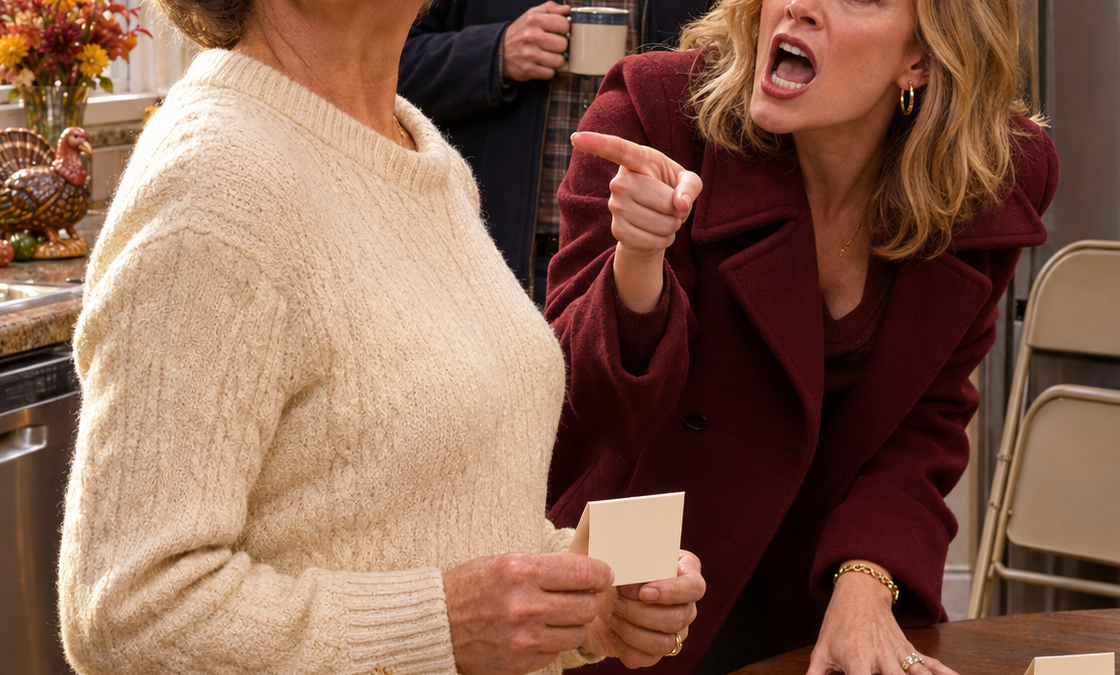
It was ten on Saturday morning, November 8. Nate stood in the doorway while Caroline laid the cards beside my Thanksgiving menu.
“Where’s Owen’s?” I asked.
“These are for family.”
“He’s coming as my guest.”
“If he sits at Thanksgiving, you’re telling us Dad was replaceable.”
The refrigerator motor cut off. From outside came the scraping of my neighbor’s rake.
“Being your mother doesn’t mean being finished with my own life.”
Caroline looked at Nate, but he stayed against the doorframe.
“I didn’t say you were finished, Mom.”
“You just said—”
“I heard what I said.”
Her coat was still on. She had come prepared to organize dinner, not stay for coffee. My menu lay underneath her handwriting, turkey and potatoes in mine, serving times in hers.
She crossed out my suggestion of peas.
“Green beans,” she said. “We always do green beans.”
“All right.”
The answer came before I considered whether I wanted them.
“And you don’t need to do rolls. I’ll pick those up.”
I almost thanked her. Then I looked at the cards again.
“You can’t just leave him off.”
“You invited him Thursday. You told me afterward.”
“I shouldn’t need permission to—”
“To have a boyfriend? No. To change Thanksgiving without even talking to us?”
I had been about to say I had done nothing wrong. The words had reached the back of my teeth.
Instead, I said, “I should have talked to you.”
“You should have told us before October, too.”
October 25. She didn’t need to supply the date. I had told both children that Saturday, after nearly six months of calling Owen my friend whenever they asked about my weekend.
“I know.”
“You keep saying that. Then you go ahead.”
Nate studied the little tear in the doorway’s weather stripping. He hadn’t taken his jacket off either.
Caroline had organized Thanksgiving since Paul died. I had welcomed the help, then let her decide things I hadn’t asked her to decide.
“I’m still making the turkey,” I said.
“Nobody said you weren’t.”
“I mean this is still dinner at my house.”
“I know where we’re eating, Mom.”
The kitchen felt too warm with three people wearing outdoor clothes. My own sweater had a dab of dried oatmeal near the cuff.
“Do you want coffee?” I asked.
Caroline looked at me as though I had offered to discuss wallpaper.
“There’s some left.”
Nate said, “Sure.”
The regular mugs were in the dishwasher. I brought the folding chair over to reach the extras above the refrigerator.
“Watch that back leg,” Caroline said. “It moved.”
I stepped down and tried it against the floor.
“The screw’s loose.”
“Then don’t stand on it.”
“I’m down.”
“I can see that.”
There it was, our old Saturday-morning irritation, tucked inside this much bigger thing. She still worried about my falling. I still hated being corrected in front of my son.
I used a mug from the draining rack instead. Nate’s coffee took the last of the pot.
“Does he even know how we do Thanksgiving?” Caroline asked.
“He knows dinner’s at three.”
“That isn’t what I meant.”
“He doesn’t need instructions for eating turkey.”
“Mom.”
I stopped. She wasn’t talking about turkey, and making her sound foolish wouldn’t undo my own part.
She had written our names in the same dark green ink: mine, hers, Nate’s, his wife’s, and my sister-in-law’s. Five living people, the gathering we had expected before I invited Owen.
“You’ve never met him,” I said.
“You didn’t give us much chance.”
“That’s fair.”
“Then why does it sound like I’m the one making trouble?”
I had no answer that wouldn’t leave something out.
Caroline began sorting the cards against the menu again. Nate finally looked directly at them.
“Are all those supposed to be for dinner seats?”
Caroline stopped sorting.
“You thought all six were for the table?”
The sixth card was Paul’s, separate from the five place cards. It belonged beside the memorial plate on the dining-room sideboard, where we had agreed to put it. He had never had an empty dining chair reserved for him.
“No,” Nate said. “I just couldn’t see.”
“Well, that one’s not a place setting.”
“I know now.”
I could see Paul’s name beneath her wrist. We had been married thirty-nine years. I didn’t need the card to remember him, but I had agreed to that small remembrance, and I still wanted it there.
“Owen isn’t taking anybody’s chair,” I said.
“I’m not counting furniture.”
“Neither am I.”
Caroline’s eyes were wet. She blinked hard, and I wished I hadn’t answered so quickly.
I could offer an honest invitation. That much was mine to give. I couldn’t make the people receiving it happy, or tell Owen he would be welcomed by people I hadn’t asked.
But that was what I had done.
“Caroline, there’s another part.”
“What part?”
I looked toward Nate. He was holding the mug without drinking.
“I didn’t just tell him the time.”
Caroline waited. I wanted to explain Thursday first: how pleased he had sounded, how easily I had let the conversation move past the question of my children.
That would only make her wait longer.
“I had already told Owen that everyone wanted him there.”
Nate set down his mug.
“You told him we’d said that?”
“I made it sound that way. Yes.”
Caroline’s mouth opened, then closed.
“So he thinks I invited him?”
“He knows I invited him.”
“That’s not what I asked.”
“He thinks you’re all happy about it.”
Nate said, “Mom, why?”
“Because I wanted him to come.”
It sounded worse without the little explanations I had been giving myself.
Caroline stared at the menu. “So now if I’m uncomfortable, I’m the awful daughter he’s heard about.”
“I haven’t called you awful.”
“You’ve made it so I have to pretend.”
“You don’t have to pretend.”
“Then you need to tell him.”
“Yes.”
I had wanted her to soften before I admitted it. Even now, some foolish part of me had expected a bargain.
Nate spoke more quietly. “Could we just do this year without him? For ease. You could see him afterward.”
“Ease for who?”
“For everybody. We only just found out.”
“I’m not settling that today.”
Caroline said, “You already settled it Thursday.”
“I invited him Thursday. I also told him something that wasn’t true. I need to fix that before anything else.”
Neither of them offered to help me say it.
Outside, the rake scraped again. I could hear leaves dragging across concrete.
Nate asked if I wanted him to make fresh coffee.
“No, thank you.”
Caroline said she needed to get going. She left the menu where it was, with green beans written over peas.
At 10:45 a.m., my phone lit up with Owen’s text.
“Would Caroline rather I brought something sweet or something savory?”
Chapter 2 of 7
I hadn’t sent Owen a choice of dishes. I had asked him to meet me instead.
At eleven on Sunday, November 9, we walked along a park path in Dayton, Ohio. He wore his brown corduroy jacket, the one with the zipper that caught halfway up.
“Caroline hasn’t welcomed the invitation,” I said. “I need to tell you that before we talk about food.”
He stopped beside a bench. “Hasn’t welcomed it how?”
“She doesn’t want you at Thanksgiving.”
“Oh.”
A runner passed us, shoes hissing over damp leaves. Owen waited until she was farther down the path.
“Yesterday you asked me to meet you. I thought somebody was sick.”
“I’m sorry. I should have said more.”
“Well. You’re saying it now.”
He sounded willing to hear me. That made the next part harder.
“She found out Thursday that I’d invited you. I didn’t talk to her first.”
“But you told me they were pleased.”
“Yes.”
“Which they?”
“The children. Everybody.”
He looked toward the empty bench but didn’t sit.
“What exactly did you tell them about me?”
“That I was seeing you. I told Caroline and Nate on October 25.”
“What did they think we’d been doing before that?”
“I’d said we were friends.”
“We were friends.”
“I left it there after it wasn’t the whole truth.”
He rubbed his lower lip against his teeth.
“And what exactly did you tell me Thursday?”
“That they’d be happy to have you.”
I had told him everyone wanted him there. Out on the path, with him waiting for the rest, I couldn’t find a gentler version that was true.
“Did anybody say that?”
“No.”
“So when I asked about bringing something, you knew she hadn’t—”
“Yes. I knew.”
A bicycle bell rang behind us. We moved aside without speaking.
“Were you going to tell me?”
“I was going to get her to agree.”
“That’s different.”
“Yes.”
“Before dinner, at least?”
“I hoped before you had to know.”
He let out a short breath through his nose.
“Well, that’s lousy, Marnie.”
“I know.”
“Don’t say that yet. Let me be annoyed a minute.”
We started walking again. I kept wanting to explain Caroline’s first remark in my kitchen. It would have made her look worse and given him somebody else to be angry with.
I left it out.
On May 17, we had eaten lunch together and finally called it a date. Owen had asked across a basket of onion rings, then admitted he’d practiced the question while driving over.
Before that, he had repaired my kitchen radio. Afterward, he’d cooked fish so long that we ate mostly rice and argued about whether ketchup could help. He said yes. I said he had already hurt the fish enough.
I liked having an ordinary evening I wanted to tell somebody about. I had taken that and started arranging what everybody was allowed to know.
“I didn’t want to lose this,” I said.
He glanced at me. “You could have told me they weren’t ready.”
“I thought you might say no.”
“I might have.”
There was nothing sharp in his voice. He was giving me the answer I’d avoided hearing.
We passed a trash can overflowing with wet leaves. Somewhere beyond the path, a dog barked and kept barking.
“I’m not showing up as a surprise,” he said.
“They know now.”
“Knowing I exist isn’t the same as expecting me at the door.”
“No.”
“And I’m not coming so everybody can spend dinner figuring out whether I measure up to your husband.”
“I wouldn’t ask that.”
“You didn’t ask me this either.”
My face grew hot despite the cold.
“You’re right.”
He walked a few steps ahead, then slowed until we were even again.
“I don’t need them to love me. They haven’t met me. But I need to know what you’re actually inviting me into.”
“I can tell you what Caroline said.”
“Do I need every word?”
“No. She’s upset I hid things. She’s upset I invited you before talking to her. And she wants Thanksgiving to stay family only.”
“Those aren’t all the same problem.”
“No, they aren’t.”
“Are you asking me to help smooth it over?”
“I was. Without telling you.”
He looked down the path for a while.
“I can be polite,” he said. “I can bring a dish. I can’t fix whatever happened before I got there.”
“I’m not asking you to.”
“You were Thursday.”
“Yes. Thursday I was.”
My phone sounded from my coat pocket. I left it there.
Owen said, “You can look. It’s all right.”
The message was in our family group, from Caroline.
“I’ve been thinking about Thanksgiving. Could the usual five of us keep our dinner the same this year? Mom and Owen could have another day together, without all this pressure. I think that would let everyone enjoy the holiday.”
I read it twice. She hadn’t insulted him. She hadn’t demanded anything outright. The suggestion now sat in front of everyone, waiting for agreement.
Nate’s idea from my kitchen had become a plan the family could endorse.
“Is that about me?” Owen asked.
“Yes.”
I told him what it said, including the part about another day.
“I do have other days,” he said. “That isn’t the trouble.”
“I know.”
“And I’m not offering to stay out of sight every time there’s a family occasion. I’m too old to start sneaking around.”
“You shouldn’t have to.”
“I also don’t want you promising them something because you think I’ll go along with it.”
I had been ready to reassure him again. My mouth was open before I stopped.
“I’ll ask you,” I said.
“That’d be better.”
I answered the group: “Please don’t speak for Owen or for me.”
I didn’t add an apology to soften it, or a dinner decision I hadn’t made. Then I sent Caroline a private message asking whether she would have breakfast with me on November 16.
Owen and I turned back toward the parking lot. We usually walked farther.
“About Thanksgiving,” I said. “I’d still like—”
“Wait until you know what you’re offering.”
“All right.”
“Then ask me again.”
“Will you think about it?”
“I will. That isn’t a yes.”
“I heard you.”
At his car, he said he needed to get groceries. I nearly asked whether he wanted company. Instead, I told him I would call, and asked if that was all right.
“Yes,” he said. “You can call.”
I sat in my own car until the windshield began to fog. His parking space was empty before I started the engine.
My phone sounded again.
Caroline replied, “Sunday at nine. Just us. I want to talk about the library errands.”
Chapter 3 of 7
“The library errands,” Caroline said. “Were those evenings with him?”
It was nine on Sunday morning, November 16. We had walked into a Dayton diner without a reservation and taken a booth near the register.
“Yes,” I said.
“When you couldn’t have supper with me because you were helping at your old branch?”
“I was with Owen.”
“And the other time? You said they needed somebody who knew the storage room.”
“That too.”
She looked out at the parking lot. A waitress brought coffee, and Caroline ordered eggs without looking at the menu. I asked for the same.
“You let me ask how it went,” she said.
“I did.”
“I told you it was nice they still needed you.”
I remembered that part. I had thanked her.
“I hid him because I wanted to avoid your reaction. Then I invited him because I wanted to control it.”
The rest crowded behind my teeth: how lonely some evenings had been, how difficult she could be when surprised. I left it there.
Caroline looked back at me.
“So you knew.”
“I knew I was lying about where I was.”
“Not just where. You were talking to me like we were close.”
“We were close.”
“While you were deciding what I could handle.”
“Yes.”
She watched the waitress refill coffee at another booth. I had worked a library desk long enough to recognize the face she wore. It was the one for a patron who kept explaining why the rules shouldn’t apply.
“I don’t know which part bothers me more,” she said. “That you did it, or that you thought I wouldn’t notice.”
“I wasn’t thinking very far ahead.”
“You managed almost six months.”
There wasn’t much I could say to that.
Our eggs arrived with toast cut diagonally. Caroline’s plate had the crisp potatoes I always forgot to request.
“When Dad died, you asked me what day to buy groceries,” she said.
“I remember.”
“You couldn’t decide whether we needed milk. You stood in front of the refrigerator crying.”
“I remember that too.”
“I’m not trying to embarrass you.”
“I know you were there.”
“I was there for all of it, Mom.”
She stopped eating before she had started.
“I called everybody about Thanksgiving. I asked Joan about the food she could manage. I checked when Nate and Elise could come. You said you couldn’t face any of it.”
“I couldn’t.”
“So I did it. And the next year, we did it together. You called me about napkins. We spent an entire afternoon on napkins.”
“We bought the first ones we saw.”
“After going to three stores.”
I laughed once. She almost did, then looked down.
That afternoon had been good. We had eaten lunch in the car because the restaurant was crowded. Caroline had gotten mustard on the napkin package and blamed the lid on the little cup.
“I liked doing those things with you,” I said.
“So did I.”
“I haven’t forgotten.”
“It feels like you have.”
The man at the next booth asked for more syrup. Caroline waited while the waitress passed us.
“I’m not saying you can’t see him,” she said. “I’m really not.”
“All right.”
“You have your evenings. Your weekends. You could go somewhere together.”
“We do.”
“Then why does he need our holidays too?”
“He doesn’t need anything from you.”
“You know what I’m asking.”
I did. I also knew how much easier the morning could become.
“We could keep some things separate,” she said. “You wouldn’t have to worry about me being uncomfortable. He wouldn’t have to sit there with people who aren’t ready.”
“Some things?”
“Thanksgiving. Christmas. Family birthdays. Things we’ve always done as a family.”
“That’s a lot.”
“It’s a few days out of a whole year.”
Put that way, it sounded small. I could call Owen and tell him we would have our own dinner. Caroline would bring the stuffing, and I could stop checking my phone with that sick, waiting feeling.
I almost said we could try it.
“Next year too?” I asked.
She frowned. “We’re talking about this year.”
“You just said Christmas and birthdays.”
“Because you asked what I meant.”
“If we’re still seeing each other next Thanksgiving, would you want him left out then?”
“I can’t tell you how I’ll feel next year.”
“But would it be your decision?”
“Why are you making it sound like that?”
“Because I need to know what I’d be agreeing to.”
She pushed her untouched potatoes toward the edge of her plate.
“I’m trying to find a way we can all have something.”
“Owen wouldn’t be at any family occasion.”
“He has his own family.”
“His daughter lives out of state. And that isn’t—Caroline, I’m talking about being able to invite him here.”
“You already did.”
“Yes. Badly. I should have told you I was seeing him. I should have talked to you before inviting him to Thanksgiving.”
“And now you want me to say it’s fine.”
“No.”
“What do you want, then?”
I looked at my breakfast. The yolk had set where I had broken it.
“I want you to come. I want him to come. I’d like you to meet without either of you having to prove anything.”
“Well, I can’t give you that.”
“You don’t have to welcome this. You do have to let me choose it.”
She sat back against the booth.
“Let you? I haven’t stopped you doing anything.”
“I know. That came out—”
“No, that’s what you said.”
“I’m not asking you to approve him. But I can’t agree you’ll always decide which parts of my life he’s allowed into.”
“And I’m supposed to trust you after the library errands.”
“No. I’ll have to stop lying.”
She looked at me for a long time.
“That doesn’t fix Thanksgiving.”
“No,” I said. “It doesn’t.”
When the check came, Caroline asked for hers separately. I didn’t argue or offer to cover it.
Outside, she said she had laundry waiting. I said I would talk to her soon. Neither of us named a day.
That afternoon, I replaced the loose screw in the folding chair. The old one wouldn’t hold in its worn hole; the replacement caught firmly. I opened the chair on the kitchen floor and tested it with my weight.
Before I could put the screwdriver away, my phone sounded.
Caroline had written to the family group.
“Nate agrees we should keep the five of us this year.”
Chapter 4 of 7
On Thursday, November 20, I called Nate instead of answering the family group.
“Did Caroline get that right?” I asked. “About you wanting the five of us?”
“Mostly.”
“Which part wasn’t right?”
“I said it would be easier without Owen. You heard me say that.”
“I did. Did you ask her to tell everybody?”
“No. We talked after your breakfast. She said you two hadn’t gotten anywhere.”
The television played somewhere behind him. Then the sound stopped.
“I wasn’t trying to put her in charge,” he said.
“But you let the message stand.”
“Yeah.”
I waited. Usually, I helped him past an uncomfortable answer.
“Mom, I just wanted to eat dinner without a fight.”
“So did I.”
“I know.”
“Did you think about what you were asking me to do?”
“Have dinner with us. See him later.”
“Keep doing that whenever somebody’s uncomfortable?”
“I wasn’t thinking past Thanksgiving.”
“That’s part of the trouble.”
He was quiet long enough that I heard his refrigerator door close.
“I guess I figured you’d be easier to ask,” he said.
“Than Caroline.”
“Yeah. That sounds pretty bad.”
“It doesn’t sound good.”
“I didn’t mean your whole life had to be separate. I wanted one easy afternoon.”
“And I’d be the one making it easy.”
“Yeah,” he said again.
I could have kept him there, agreeing with me until neither of us could stand it.
Instead, I told him dinner would be Thursday, November 27, from three until six. Owen was invited.
“I’m asking you whether you’re coming.”
“Can I think about it?”
“Yes.”
“I don’t suddenly feel comfortable with this guy.”
“You haven’t met him.”
“Exactly.”
“You don’t have to tell me you’re comfortable.”
“All right. I’ll give you my own answer.”
“And let Caroline give me hers.”
“I can do that.”
I nearly asked whether Elise felt differently. Her number was in my phone too.
When I called her, she answered with, “I’ve got about ten minutes before I have to leave.”
“I only need a few.”
“That’s what everybody says before asking about dental insurance.”
I laughed. “No teeth involved.”
“Then go ahead.”
I gave her the same invitation, including Owen’s name.
“I’m coming,” she said.
“You don’t need to check with Nate?”
“He can tell you what he’s doing.”
“I just spoke to him.”
“I figured you might.”
“I don’t want you caught between—”
“Marnie, I want dinner with you. I’m saying yes to that.”
“All right.”
“It may be awkward.”
“I expect it will.”
“I’m not very good at pretending it isn’t. Fair warning.”
“You won’t have to.”
After we hung up, I noticed I hadn’t asked her to reassure Nate. Or Caroline. There had been time, and I had let it pass.
Joan met me that afternoon for a short walk near my house. At seventy-three, she walked faster than I did until we reached a hill, then accused the city of changing the grade.
“Steeper than last month,” she said.
“We walked the other way last month.”
“That would explain it.”
The wind had left a strip of leaves along the curb. We stayed on the clear side of the sidewalk.
I told her Owen was invited. I told her Caroline might not attend, and Nate hadn’t decided.
“Do you want me to call Caroline?” she asked.
“No. Thank you.”
“Good. I wouldn’t know what to say.”
“I don’t either, half the time.”
Joan stopped at the corner to catch her breath.
“I’ll miss Paul,” she said.
“I know.”
“I’d miss him if it were just you and me eating sandwiches.”
Her brother had been gone more than three years. She still sometimes called me to ask about a story, then remembered Paul was the one who had told it.
“Does having Owen there make it harder?” I asked.
“I haven’t had dinner with him. I can’t tell you.”
“That’s fair.”
“But I’m coming.”
“You don’t have to settle anything for us.”
“I was planning to eat.”
We turned back before the next hill.
By Sunday, I had caught myself composing several versions of what I would say to Caroline. In every one, she took the news better than I expected.
At 6:15 p.m. on November 23, I called her and used none of them.
“I’ll handle the invitations this year.”
She didn’t answer right away.
“What does that leave me handling?”
“Whatever you still want to do. Nothing you don’t.”
“That’s vague, Mom.”
“I can take over every unfinished job.”
“You don’t even know what’s unfinished.”
“Then tell me.”
She gave a small, tired laugh.
“The shopping isn’t all done. There’s oven space to work out. Serving dishes. The rolls. You can’t just tell people three o’clock and have dinner appear.”
“I know there’s work.”
“I’ve been doing that work.”
“You have.”
“And now I’m supposed to bring my food and have no say?”
“You can decide whether you come. You can decide what you bring.”
“That sounds like I’m any other guest.”
I looked at the menu still attached to my refrigerator. Her green beans remained written over my peas.
“You’re my daughter. I want you here. But I’m inviting people myself.”
“Then why did we spend that Saturday planning?”
“Because I let us keep doing what we’d been doing. I should have said this then.”
She asked about the turkey, then the potatoes. I answered both without saying she needn’t worry. She knew how much I had left to do.
“If you still want to bring the dishes you chose, I’d like that,” I said. “If you don’t, tell me. I’ll make something else.”
“And Owen?”
“He’s invited.”
“Has he said yes?”
“He asked me to tell him what he’d be coming into. I’m doing that.”
“Well, don’t tell him we’re all thrilled.”
“I won’t.”
Dinner was three to six, I told her. She didn’t have to be pleased about my relationship, or act affectionate toward him.
“I’d ask you to be civil,” I said.
“I know how to behave.”
“I’m not saying you don’t.”
“I need to think.”
“All right.”
After that call, I spoke to Owen. I told him Elise and Joan had accepted, Nate was deciding, and Caroline might decline.
“What if she decides when I’m already there?” he asked.
“I don’t know what she’ll decide.”
“You’re not going to ask me to step out?”
“No.”
He was quiet.
“I’d like to come,” he said finally. “I’m still sore about how you started this.”
“I know.”
“I can be sore and eat dinner.”
I said I would like that very much.
Later that evening, Caroline called back.
“What did he say?”
“He accepted.”
“So he knows this isn’t settled?”
“He knows people are making their own decisions.”
“Mom. That makes it sound simple.”
“It isn’t.”
“Have you told him I might not come?”
Chapter 5 of 7
“Yes,” I told Caroline. “He knows you might not come.”
“And he’s all right with that?”
“He hasn’t asked me to change your mind.”
“That wasn’t what I asked.”
“I can’t tell you how he feels about every part of it. You’d have to ask him.”
“I’m asking you.”
“I told him the truth. He said he’d like to come.”
She stayed on the line a moment longer. I could hear water running at her end.
“I’ll let you know,” she said.
After we hung up, I wanted to call back and ask when. Instead, I went upstairs to check whether the spare bathroom needed a clean towel.
By Wednesday afternoon, I had cleaned things no dinner guest would see, including the shelf beneath the washing machine soap. The kitchen floor still needed sweeping.
At 4:30 p.m. on November 26, Caroline sent a message.
“Stuffing and two pies are ready. What time will your oven be free tomorrow?”
I was at the counter with a bag of apples.
“Turkey should be out by two fifteen. After that, I need it for vegetables and rolls.”
“Stuffing needs about thirty minutes covered. Can share with vegetables if you’re doing them at 350.”
“That works.”
“Don’t turn it up for the rolls until stuffing is out.”
“I remember.”
“You said that last year.”
Last year, I had browned the top before the middle was hot. We had eaten it anyway, and Caroline had complained mostly about the serving spoon, which kept sinking into the dish.
For a few minutes, we were just working out dinner. She asked which pan I was using. I asked whether her stuffing container would fit beside it.
Then she wrote, “There’s actually a way to make the whole afternoon easier.”
I watched the little dots appear, disappear, and appear again.
“We could eat at three like usual. Owen could come at six. You’d have the evening together, and nobody would have to rush.”
I left the apple bag unopened.
“He’s invited to dinner.”
“I know. I’m suggesting a different arrangement.”
“I’m not changing his invitation to afterward.”
“It isn’t excluding him from the day. I could even leave pie for you two.”
I started an answer about how generous that sounded, then erased it. She had made two pies while I was still looking at apples.
“I’d be asking him to stay away until the family part was over,” I wrote. “I’m not doing that.”
“Then why ask me about oven space?”
“Because I hope you’re coming.”
“That doesn’t feel like much of a compromise.”
It wasn’t one. I didn’t have another arrangement to offer that would give her the meal she wanted.
“I know it isn’t what you’re asking for.”
She didn’t reply.
I waited long enough for the screen to go dark, then started peeling apples.
My old apple peeler took off strips thick enough to count as wedges. Paul used to claim I served the best part to the garbage disposal. I still used it because the newer one scraped my knuckles.
The crisp went into the oven before supper. I scrubbed potatoes to bake the next day and left them ready in a bowl. With those, the turkey, vegetables, and rolls, there would be enough to eat whether Caroline came or not.
I hoped she brought her stuffing. I wanted a piece of her pie. Neither wish could be the only plan for feeding everybody.
The crisp smelled ready before its middle had softened. I gave it another ten minutes and ate cheese and crackers standing beside the refrigerator.
Caroline still hadn’t answered.
I nearly sent, “Please just tell me whether you’re coming.” Instead, I called Owen.
“Are we still on for three?” he asked.
“Yes. People will probably leave around six.”
“Should I get there early?”
“Two thirty would be fine.”
“All right. Anything I should know?”
“Caroline suggested you come after dinner. I told her no.”
He was quiet.
“Did you need to tell me that?”
“I don’t know. I didn’t want to keep something from you again.”
“You can tell me she hasn’t decided. I don’t need every conversation.”
“All right.”
“I’m not asking for a report.”
“I hear you.”
He asked about the weather. I told him it looked cold, and he said that was what his forecast said too.
Then he asked, “What happens if somebody wants to talk about Paul?”
“They can talk about him.”
“I know that. I meant—”
“I won’t ask you to hide. And I won’t make you answer questions about whether you’re anything like him.”
“I wouldn’t know how.”
“You don’t have to.”
“Okay.”
“I can’t promise it’ll be comfortable.”
“I’m bringing my own car, Marnie. If I need to leave, I can.”
“Yes.”
He had said it plainly. I let it stand.
We settled on his bringing sparkling cider, mostly because he already had some. Before we hung up, he asked whether I had eaten supper.
“Cheese and crackers.”
“That counts if you sit down.”
“I don’t think that’s the rule.”
“It’s mine.”
Afterward, I ate a pear at the table.
There was still a message to send the others. I had been putting it off without calling it that.
In earlier years, Caroline’s arrival had set the afternoon’s pace. If she called from the store, we waited. If she needed another half hour, I found crackers and told everyone dinner was nearly ready.
This time, I began typing, “We’ll see where we are when everyone gets here.”
I read it once and deleted it.
To Nate, Elise, and Joan, I sent, “The food will be ready at three. Come a little before if you’d like. We’ll probably finish up around six.”
I sent Caroline the serving time separately. No question followed it.
Elise replied that she was looking forward to turkey. Joan asked whether I needed ice. Nate said he’d received the message; he gave me nothing more to work with.
I finished sweeping the kitchen.
The apple crisp cooled on the stove, its topping darker along one edge. I covered it without taking a test spoonful. By then I had brushed my teeth, and that was usually enough to keep me out of dessert.
I checked the porch light and left it on. Then I went through the refrigerator once more, counting space for the turkey after dinner.
At 8:10 p.m., Caroline texted, “I want to speak to you before I come inside tomorrow.”
Chapter 6 of 7
“Before we sit down, I need to speak to you.”
Caroline stood outside the kitchen entrance at 2:40 p.m. on Thursday, November 27. Her coat was buttoned to her throat.
“The stuffing and pies are still in the car,” she said. “I need you to send Owen home before I bring them in.”
Through the open door behind me came the sound of Elise asking about a serving dish.
“He’s here for dinner,” I said.
“I know. That’s why I wanted to speak before we sit down.”
Cold air reached my ankles. Caroline had parked behind Nate, leaving enough room for either car to get out.
“Come inside. You don’t have to stay out here.”
“And have this conversation in front of him?”
“We could go upstairs.”
“Mom, I’m not looking for a different room.”
I stayed at the threshold.
“If I come in and eat with him, everybody gets to say we had Thanksgiving together. Like this is settled.”
“I won’t say it’s settled.”
“You don’t have to say it. I’ll be in the pictures. I’ll be passing him potatoes.”
“We don’t have to take pictures.”
“That’s not—please don’t pick at the little parts.”
“All right.”
She glanced past my shoulder, toward the kitchen.
“I’m not ready to have him in everything. You’ve had months to get used to this. I’ve had weeks. And some of those weeks you spent telling me what was already happening.”
“Yes.”
“If he goes home, we can still have dinner. Nobody has to do this today.”
Behind me, a cabinet closed. Nate appeared at the inner kitchen doorway. He stopped when he saw us.
“I’m not asking for forever,” Caroline said. “I’m asking you not to make me sit there and act like I approve.”
“You can come in without approving.”
“You say that now.”
“You don’t have to hug him. You don’t have to make a speech about being happy for us. Your place is there.”
“And when I’m quiet, everybody can worry about what’s wrong with Caroline.”
“I can’t promise nobody will notice you’re upset.”
“Exactly.”
“But sending him away isn’t the only way you can come.”
Her eyes moved to Nate.
“You think everybody else is comfortable? Maybe they’re just better at going along with you. Nobody wants to upset you.”
Nate leaned against the inner doorway, where he had stood during our first argument.
“I did suggest leaving him out,” he said.
“I know you did.”
“I thought it would be easier. But I’m staying for dinner.”
Caroline looked at him for a moment.
“You didn’t tell me that.”
“I’m telling you now.”
“So you changed your mind.”
“About coming, yeah. I’m not saying you have to.”
Elise was visible beyond him, beside the dining-room table.
Nate left the doorway and went to stand beside her. Neither of them called Caroline in.
My daughter’s nose had reddened in the cold. I wanted to tell her to unbutton her coat, to get warm, to let me feed her. For forty-two years, there had been things I could do when she stood in front of me looking miserable.
“Are you going to ask him to leave?” she said.
The kitchen clock was nearly at 2:55.
“I want you here, Caroline. I’m not asking him to leave.”
She looked past me once more. Her place card was still on the table.
“Then I’m going home.”
“I wish you’d stay.”
“I know.”
She took her keys from her coat pocket. I didn’t offer to carry in the food or ask her to leave a pie.
She walked back to her car. The stuffing and both pies went home with her.
She was leaving three hours of Thanksgiving, with her place still available. I watched her back out, then went inside.
Owen stood near the sink, well away from the doorway.
“Do you need a minute?” he asked.
“Yes.”
He went into the dining room.
I stayed by the stove until I could read the oven controls clearly. Then I checked the potatoes. They were done.
At three, I called everyone to the table.
Caroline’s setting remained through the first passing of dishes. Nobody used it. Owen sat on the folding chair at the widened end of the table, his knees a little higher than everyone else’s.
Nate looked toward the sideboard, where Paul’s card stood beside the memorial plate.
“Should we—” He stopped. “I’d like to say thanks for dinner.”
“Go ahead,” I said.
“Thanks for cooking, Mom. And thanks, everybody, for being here.”
He lifted his glass. Caroline usually said more. We drank without filling in the rest.
The green beans had gone soft while I was outside. Joan took a second helping anyway.
“You don’t have to rescue those,” I told her.
“I like them this way.”
“You like vegetables you can drink?”
“Less chewing.”
Elise laughed with a mouthful of potato and had to reach for her water. For a moment, nobody looked toward the kitchen entrance.
Owen asked Nate about his work. Nate explained a scheduling problem involving people who all wanted the same Friday off.
“You draw the short straw?” Owen asked.
“I make the straws. Apparently that’s worse.”
The conversation held for several minutes. Then it stopped, and we ate with the sound of forks against plates.
I wanted Caroline’s stuffing. The baked potato on my plate was good, and it wasn’t what I wanted.
“Pass the gravy down this end,” I said. “Don’t let it settle in.”
Joan went quiet.
“What?” I asked.
“Paul used to say that. About anything somebody kept too long.”
“The newspaper,” Nate said.
“And the good scissors,” I said. “Though he was usually the one keeping those.”
Joan nodded. After a while, she asked for the gravy.
At four, we cleared enough space for dessert. The apple crisp needed a spoon along the edges, where the topping had baked hard against the dish.
Owen tried to divide it into neat squares.
“That won’t work,” I said.
“I’m finding that out.”
“Just give everybody a pile.”
He did. Elise asked for more of the dark edge.
I checked my phone once while the coffee brewed. There was nothing from Caroline.
I left it in the kitchen.
We stayed at the table through second cups. Joan told Owen about the bus route she used to take to work. He knew the grocery store at her old stop; he had stocked shelves there years before.
They disagreed about which entrance had faced the street.
Nobody settled it.
By six, the leftovers were covered and Joan was looking for her coat. Nate asked whether I wanted the table put back to its usual size.
“Leave it for now,” I said.
Caroline’s unused plate was clean in the cupboard. Her card lay beside mine.
At 6:05 p.m., Caroline texted, “December sixth. Breakfast? Just you and me.”
Chapter 7 of 7
I accepted breakfast with Caroline. Seeing my daughter alone wasn’t the same as promising to keep Owen out of sight.
At nine on Saturday, December 6, she was already at the diner. She had taken the booth we’d used in November.
“I ordered coffee,” she said. “Not your food.”
“Thank you.”
Her coat lay beside her. Mine stayed on until the waitress came over; the window let in a draft.
We ordered, then listened to somebody at the counter trying to explain which kind of toast he wanted.
“I ate the stuffing,” Caroline said.
“On Thanksgiving?”
“Some of it. There was quite a bit for one person.”
I waited.
“I heated it up. Had a piece of each pie. That was dinner.”
“Did you make anything else?”
“No, Mom. I didn’t roast myself a turkey.”
“I wasn’t checking what you ate.”
“I know.”
She watched the waitress carry two plates past us.
“I kept thinking you’d call.”
“I wanted to.”
“But you didn’t.”
“No.”
I had looked at her number after everyone left. Then I had washed the roasting pan, twice, because the first washing hadn’t loosened the corners.
“Were you waiting for me to apologize?” she asked.
“No. I didn’t know whether a call would make things worse.”
“It might have.”
Our breakfast arrived. Caroline asked for ketchup, then left the bottle untouched.
“I was angry the whole afternoon,” she said. “Even while I was watching television. I couldn’t tell you what was on.”
“I missed you.”
“Did you?”
“Yes.”
She looked at me then.
“We ate. People talked. There were stretches when I was glad they were there. I still missed you.”
“Who said the toast?”
“Nate. Just a few words.”
“Oh.”
I didn’t tell her what he’d said.
After a while, she cut into her eggs.
“I know I can’t tell you who comes to your house.”
“All right.”
“I’m saying I know. I’m not saying it didn’t happen too fast.”
“You found out late because I kept it from you.”
“And then I was supposed to catch up.”
“Yes. I expected too much, after telling you too little.”
She ate a bite before answering.
“I don’t like finding out I’ve been talking about somebody’s evening and half of it wasn’t true.”
“I won’t give you another story about where I am.”
“You can just say you have plans.”
“I can.”
“That would have been better.”
“Yes.”
The waitress refilled our coffee. Caroline finally used the ketchup.
“What are you doing about Christmas?” she asked.
“I haven’t settled it.”
“Do you want me to organize anything?”
The question sounded practical. I had answered yes to it many times without discussing what the yes covered.
“Not automatically,” I said.
She stopped chewing.
“That sounds like I’ve been fired.”
“You haven’t. If we do something together, we need to talk about who’s doing what. I’ll ask people myself.”
“And I bring a casserole.”
“If that’s what you want to bring.”
“I did more than casseroles.”
“You did. I’m not erasing that.”
She looked toward the register.
“I don’t know what I want to do for Christmas yet.”
“Then don’t decide over eggs.”
We finished breakfast without making Christmas plans. When the waitress brought the checks, Caroline asked whether I still had the sour cream coffee cake recipe.
“The one with the cinnamon middle?” I asked.
“And the chicken casserole. Mine never comes out like yours.”
“You use the whole bag of noodles.”
“It says a bag.”
“It was a smaller bag when I wrote it.”
“That would have been useful to know.”
I laughed, and this time she did too.
I offered to make copies. We settled on a short visit Sunday, December 14, at two.
“Owen will already be there,” I said.
Her expression changed, though she didn’t look away.
“All right.”
“You can pick another time.”
“Two is fine. I can only stay a little while.”
“That’s fine too.”
That evening, I told Owen she was coming for recipes.
“Does she know I’ll be there?”
“Yes.”
“Okay.”
“I don’t know how much she’ll talk.”
“Marnie. I can manage hello.”
I left him to it.
By two on December 14, the recipe copies were ready on the dining-room table. I had left the table widened since Thanksgiving. It was useful for spreading things out, though I kept finding papers where a dinner plate ought to go.
Owen had come over for lunch. He sat on the folding chair with his mug while I compared my copies against the originals.
Caroline arrived carrying her purse and an empty envelope.
“Hi, Owen.”
“Hi, Caroline.”
“Cold out there.”
“Looks like it.”
He didn’t stand and make an occasion of it. She took off her coat and sat beside me.
“I found the casserole,” I said. “And the coffee cake. There’s a note about the noodles now.”
“Thank goodness.”
She read the first page.
“You still call this a hot oven.”
“I wrote that a long time ago.”
“How hot?”
“Three fifty.”
“That’s a regular oven, Mom.”
“Well, it’s hot when you open it.”
Owen drank his coffee. Caroline’s mouth moved at one corner, but she kept reading.
The coffee cake recipe had several additions in my handwriting. One called for walnuts; Caroline had never liked them in cake.
“You can leave those out,” I said.
“I always did.”
“I noticed.”
“You never said.”
“You ate the cake. I wasn’t going to interfere.”
She glanced at me. We let that pass without making it about anything else.
For the casserole, she wanted to know whether I cooked the noodles all the way before baking. I told her to stop while they still had some firmness.
“That isn’t on here either.”
“It is now.”
She checked the time but stayed to read the cake instructions again.
“This says two teaspoons of baking powder.”
“That’s wrong. One and a half. I changed it after it started spilling over the pan.”
“I remember cleaning that.”
“So do I.”
I made the recipe correction on the original before I could forget.
“Please save that change for my copy.”
“I’ll fix yours now.”
She waited while I worked through the remaining directions. Beside the baking time, I added a reminder to test the center.
“Do I still need the tube pan?” she asked.
“Yes. It won’t bake the same in your loaf pan.”
“I’ll have to find it.”
Owen stood to take his mug to the sink. Caroline leaned closer to see the last line.
I slid the folding chair closer and passed her the recipe.








