My daughter left me outside the hospital with two suitcases and asked for her wedding money; she had no idea what I would change before her funding meeting.
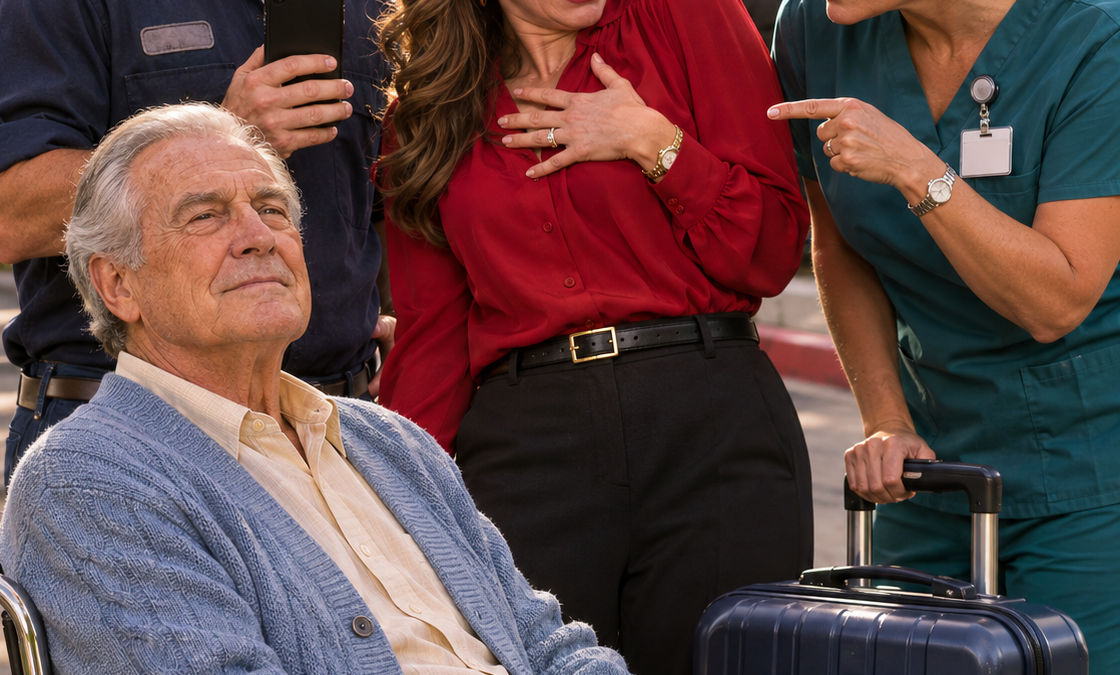
This is an original fictional story set in 2026. People, conversations, institutions, and private agreements are fictional. The illustration was generated with AI.
Chapter 1 of 7
At 1:40 p.m., Lisa stopped my wheelchair beside the pickup lane.
“Will the sixty thousand arrive before the florist’s deadline?”
“Who’s staying with me tonight?”
“Dad, hiring help is cheaper than making everyone miserable.”
It was Friday, June 5, in Sacramento, California. Heat rose through my slippers. Owen stood beside his truck, close enough to hear every word.
“You said you’d stay,” I told her.
“I know what I said. My appointment got moved. And I can’t miss another Monday at work.”
My two suitcases stood against the wheelchair. The catheter bag was discreetly secured, but I could still feel its unfamiliar presence. Nobody had promised when that temporary complication would end.
“You told the nurse you’d be there.”
“And I thought I could manage it.”
Lisa looked at Owen.
“He could get someone for the weekend. Someone who knows what they’re doing.”
Owen watched a shuttle pass behind her.
Heart surgery had left me weak enough that the entrance doors looked far away. My old blue cardigan covered my shoulders. My wife had patched one elbow with fabric that never quite matched.
Lisa had brought it to the hospital because she knew I hated being cold.
Now she checked the time.
“There’s a car service,” she said. “We can order it right here.”
“And when I get home?”
“We’ll figure that out.”
I reached toward my wallet, then stopped.
I had paid for problems until they stopped looking like problems.
The ride would become my problem. The empty house would follow. By supper, I’d be apologizing for calling someone who had already said she was busy.
“No,” I said.
Lisa’s face changed.
“No ride? Then what are you asking us to do?”
“Get me back inside.”
“Dad, they discharged you.”
“They discharged me with a plan.”
“We don’t need to make this into—”
“Being your father did not make me spare time.”
She glanced toward the entrance, where another family waited with flowers.
“I’m standing here trying to find you help.”
“I needed you to tell them before we came outside.”
“I didn’t know it would turn into this.”
Owen finally spoke.
“Maybe I could take him home and stay until dinner.”
“Can you stay overnight?” I asked.
He looked at Lisa instead of me.
There was one arrangement I had never handed over to her.
For now, though, I needed a person in hospital shoes to come through those doors.
A staff member in a burgundy polo walked past with an empty wheelchair.
“Excuse me,” I called. “My home arrangement fell through. I need help getting back inside.”
He stopped.
“Were you just discharged?”
“Yes.”
Lisa stepped closer.
“We’re arranging private help. There’s been a scheduling issue.”
“I don’t have anyone at home,” I said.
The staff member stayed beside me while he called upstairs. Lisa’s car was parked beyond Owen’s truck. She looked between them, measuring whether leaving would look different with someone watching.
“I have to let the bridal shop know,” she said.
“Then call them,” I told her.
She walked a few steps away. I could hear her apologizing into her phone, using the soft voice she used with patients at the dental office.
Owen remained by the truck.
“You knew?” I asked.
“She said she was working something out.”
“When?”
He didn’t answer.
A woman wearing a hospital badge came through the doors. Carla, the case manager, had helped arrange my discharge. She looked at the luggage first, then at me.
“What happened?”
“My daughter can’t stay after all.”
“Is there another adult at the house?”
“No.”
Lisa came back before Carla could ask anything else.
“I’m not refusing to help. I’m saying he needs somebody qualified.”
Carla looked toward Owen.
“Were you part of the pickup arrangement?”
He had his phone out now.
“I was copied on it.”
Lisa’s car door stood open. Her overnight tote was still on the passenger seat.
Owen showed Carla the screen.
Carla stopped reading Owen’s phone and turned toward Lisa.
“You confirmed this yourself?”
“Yes. The plan changed.”
Carla read aloud from Lisa’s May 29 message.
“‘I’ll collect Dad Friday, stay at his house, and supervise according to the written discharge plan. Owen, you don’t need to take time off.’”
“That was before I knew about the catheter,” Lisa said.
“You could have called us,” Carla replied.
“I thought he’d hire somebody.”
Carla moved behind my wheelchair.
“We’ll bring your father inside while we arrange an alternative.”
The staff member took my suitcases. Lisa watched us reach the doors before she spoke again.
“Call me when you know where you’re going, Dad.”
I nodded. Her car door shut while Carla wheeled me through the entrance.
Inside, the air-conditioning raised goose bumps along my wrists. Carla found a quiet assessment space and asked a nurse to stay nearby.
Owen followed with the luggage.
“Bring me the ordinary folder from the front pocket,” I told him. “Trust correspondence.”
The folder held account notices and my complete two-page family letter, its second sheet tucked behind the first.
The revocable wedding reserve was still administered by Naomi Ellis. I could change it through signed instructions. I left the papers in the folder.
“Are you calling about the wedding?” Owen asked.
“I’m finding somewhere to sleep.”
Carla returned with questions about stairs, available help, and what I could safely manage. I answered them myself.
Then she found a supervised recovery facility with a possible opening.
“Possible?” I asked.
“They’re reviewing your discharge information. We need a confirmed room, suitable transport, and the doctor’s approval.”
“Please don’t put me in a car until those people say yes.”
“I won’t.”
Owen leaned against the wall. Somewhere down the hall, a cart rattled over a floor seam.
Carla made another call. I heard her repeat that I could not go home alone.
“Have they got a bed?” I asked when she finished.
She started to answer.
Carla’s phone lit up before she could answer me.
“Supervised room confirmed. Admission at 4:30 p.m.”
She read the message twice, checking the details rather than celebrating them.
“They can take you today,” she said. “I’ll speak with Dr. Shah.”
He came to assess me and reviewed the revised arrangement with Carla. I told him plainly that nobody would be staying at my house.
He approved supervised recovery and the suitable medical transport she had arranged.
I was seventy-two. I wanted my own bathroom, my own bed, and the refrigerator that hummed too loudly. I also wanted to get there without pretending I could do more than I could.
The first three nights cost $2,100. Transport cost another $285.
I paid both from my personal checking account. The receipts went with the admission agreement, separate from the trust folder.
Owen watched the payment go through.
“I could cover the ride.”
“Keep your money.”
“Dad—”
“Next time, tell me what’s happening.”
He looked down the hall.
“I kept thinking she’d change her mind.”
The staff brought me a sandwich while we waited. It had too much mustard along one edge. At home, Lisa used to call that the exciting corner.
I ate half of it.
By 4:10 p.m., the transport team was ready. Carla had confirmed the receiving staff and made sure the instructions traveled with me. My suitcases were loaded first.
Owen came over before they took me out.
“She texted again.”
“About the room?”
“No.”
He read the message aloud.
“I told Daniel the transfer was coming Monday. Please don’t make me correct that.”
Chapter 2 of 7
On Monday, June 8, I told Owen what he should have told his sister Friday.
“The meeting is June fifteenth. That’s what we put on the calendar.”
He called while I was finishing breakfast at the recovery facility.
“She says she thought discharge moved things up.”
“I had not authorized a Monday transfer.”
“I’ll tell her.”
“Tell her exactly that.”
The toast came under a plastic cover that kept it warm and made it bend. I had slept well enough to complain about it, which felt like progress.
A staff member checked on me before my phone rang again.
Lisa appeared on the screen beside Daniel. They were at their kitchen table. He still wore his work shirt, with his name stitched above the pocket.
“Dad, how are you feeling?”
“Better this morning.”
“Good. That’s good.”
Daniel leaned closer.
“Glad they found you somewhere comfortable, Frank.”
“Me too.”
Lisa looked at him, then back at the screen.
“We wanted to talk together. Because this isn’t just about me.”
“I didn’t say it was.”
“I know you’re upset. You have every right to be upset with me.”
She paused there. I waited.
“But Daniel didn’t do anything. His family’s making plans, too. This was supposed to be something all of us shared.”
Daniel looked down at the table.
“Lisa said there was confusion about the timing,” he said.
“The funding meeting is next Monday.”
“Right. But the amount is still—”
“Nothing’s been paid.”
Lisa answered before he could.
“He knows that, Dad. We’re asking you not to punish him because you and I had a bad Friday.”
I could see a grocery list behind her, fastened to the refrigerator. Bananas, coffee, dishwasher pods. She had underlined coffee twice.
Once, she had driven across Sacramento in heavy rain because I had left my glasses at her house. She arrived soaked through one shoulder, carrying the case inside her coat.
She stayed until I found the television channel I wanted. There had been no wedding then, no money under discussion.
“I wanted to help you celebrate,” I said. “I still care about that.”
“Then please tell him that.”
“I just did.”
Daniel rubbed his forehead.
“Can I ask something without making this worse?”
“Go ahead.”
“We built an eighty-four-thousand-dollar budget. Sixty from you, twenty-four from us.”
I looked at the little speaker beside my bed. Its green light stayed steady.
“Eighty-four thousand?”
Lisa shifted away from the camera.
“That includes everything. People hear that number and think—”
“How much have you paid?”
“Twelve thousand in deposits,” Daniel said.
He said it readily, as if I had already seen the receipts.
“And the contracts?”
Lisa came back into view.
“Thirty-six thousand signed so far. That’s within the budget, Dad. It’s not another amount on top.”
I had spent years estimating printing jobs. I could still hear when a figure needed a second look.
“I haven’t seen those commitments.”
“You knew we were booking things.”
“I didn’t know how much.”
Daniel looked at her.
“I thought your confidence meant we had final approval.”
“We accepted his offer,” Lisa said. “I emailed him back in February.”
“I know you did,” I said.
“And we started booking after that. We didn’t just wake up and spend money.”
Nobody spoke for a few seconds. Somewhere outside my door, a woman asked whether lunch could come without gravy.
Daniel broke first.
“I don’t want the two of you fighting over our wedding.”
“Neither do I.”
“Then don’t make him carry this,” Lisa said.
“He’s allowed to ask me questions.”
“I’m asking you to remember we’re a family.”
“I remember.”
She waited for more. I had nothing else I could promise that morning.
After the call, I asked Naomi Ellis to speak with me privately. She called back while I was alone.
“Did you know about the contracts?” I asked.
“Not the amounts.”
“Can you do anything about them?”
“I can administer the trust under its terms and your valid instructions. I can’t cancel contracts your daughter signed.”
“She’s already spent twelve thousand.”
“That’s real money. It doesn’t give me control over her vendors.”
Naomi had been my acting trustee since 2024. She sounded the same when discussing a small invoice as a large one. That morning, I was grateful for it.
“I need to talk to Beth.”
“Yes,” she said. “Tell her what you want, Frank.”
Beth Keller arrived that afternoon after my rest. My attorney asked whether I wanted anyone else present.
“No.”
“Then we’ll start there.”
She asked about my recovery, where I expected to go next, and what help I would need at home. I answered without Owen filling a gap or Lisa correcting a date.
“Do you feel rested enough to talk money?”
“Yes.”
“What do you want the money available for?”
I looked toward the hallway. A staff member was walking slowly beside another resident.
“This. Whatever comes after this. Rides, help at home. Things I can actually count on.”
“Do you want to promise Lisa a different amount?”
“No.”
“Do you want her managing your recovery?”
“No.”
The second answer came faster.
Beth waited.
“I don’t want to buy another promise from either of my children,” I said.
“We can arrange paid support without putting them in charge.”
“I want the wedding reserve redirected. A recovery contingency, up to the same sixty thousand.”
“All of it spent?”
“No. Available if I need it. What I don’t use stays where it is.”
Beth asked me a few more questions, including what had changed since February. I told her about Friday, but also about the years before it. The bills I paid quickly. The uncomfortable conversations I never finished.
“I’ll review the trust and draft the amendment,” she said.
She made no speech about what kind of father I had been.
Before she left, she asked whether I wanted her to call Lisa.
“Not today.”
That evening, Lisa sent two attachments.
Her message said she had gotten the florist to wait. She hoped that showed she was trying to meet me halfway.
I opened the original contract first. The flowers had names I didn’t recognize. There were arrangements for the ceremony, tables, and a staircase.
The total was $6,800. A receipt showed the $1,800 deposit. The remaining balance was marked due that day.
I enlarged the signature at the bottom. Lisa Price, written with the hard downward stroke she had used since high school.
Then I opened the extension. It was short enough to read without scrolling.
The florist’s written extension said the remaining $5,000 must arrive by June 19 or Lisa must choose cancellation under her contract.
Chapter 3 of 7
Lisa was the florist’s customer. Neither Naomi nor I had signed her contract. The extension bought her eleven days from the original deadline, not a right to money from the trust.
I read it again Tuesday morning, June 9, while waiting for my rehabilitation assessment.
Owen was on the phone.
“She got them to wait,” he said. “That ought to count for something.”
“It gives her time to decide.”
“I don’t think she sees it that way.”
A therapist appeared at my open door.
“Ready, Frank?”
“I’ve got another minute here.”
“Your appointment started a minute ago.”
There was no irritation in her voice. She had other people to see.
“I have to go,” I told Owen.
“Dad, I’m only trying—”
“I know. Later.”
For the next stretch of the morning, somebody asked questions I could answer. How tired was I? Was I comfortable continuing? Did I need to stop?
Nobody asked me to make an eighty-four-thousand-dollar wedding work.
Afterward, breakfast dishes had disappeared from my room. The little cereal box remained on the tray. I had saved it because I could read the ingredients without my glasses.
Owen sent a screenshot before calling again.
Lisa’s message filled most of the screen.
“I wanted everyone to hear this from me. Dad has withdrawn his wedding support because planning the wedding kept me from being his full-time nurse. I’m grateful he’s somewhere with professional care. I can’t replace trained staff, and I hope nobody expects that of me.”
Under it, someone had replied with a heart.
I read her message twice. She hadn’t mentioned the night she had promised to stay. She hadn’t mentioned the hospital entrance.
“Who got this?” I asked when Owen called.
“The family group. The one from the holiday pictures.”
“I’m in that group.”
“She started another one.”
Outside my window, a groundskeeper fought a hose caught under a bench. He backed up, tried again, then went around the other side.
“Did you answer her?” I asked.
“Not yet.”
“Were you going to?”
“I wanted to talk to you first.”
“How did she know I was changing anything?”
He waited long enough that I checked whether the call had dropped.
“I told her you were seeing Beth.”
“Yesterday?”
“Yes.”
“Why?”
“She asked what was going on. I thought if she knew you were talking to somebody, she’d stop calling you every ten minutes.”
“She didn’t call me every ten minutes.”
“You know what I mean.”
I did. Owen had always preferred a version of trouble that could be settled with better scheduling.
“What else did you tell her?”
“That you were worried about paying for care. That Beth was coming after you rested.”
“You gave her my appointment.”
“I was trying to smooth it over.”
I watched the groundskeeper pull the hose clear.
“Don’t forward my financial messages anymore.”
“I didn’t forward anything. I told her.”
“Then don’t tell her.”
“So now I don’t get to know either?”
“You can ask how I’m doing. You can visit. Beth and Naomi will handle the money with me.”
“That sounds like I’m being shut out.”
“From that part, yes.”
He said nothing.
“You’re still my son, Owen.”
“Doesn’t feel much like it right now.”
After he hung up, my cousin called. I let it ring. She left no message.
Daniel sent a text a little later.
“I’m glad you’re getting care. I wish we’d known the support was in question before we booked. We’re trying to figure out what we can still change.”
I typed three different replies. Each one sounded like I was asking him to judge his fiancée.
Finally, I sent, “I’ll speak for myself at the meeting.”
His answer was only, “Okay.”
I had liked him from the first dinner. He had stayed afterward to help me work out why my refrigerator kept freezing lettuce. Now he was reading messages about me and deciding how much of them to believe.
Beth arrived after lunch. I was dressed and sitting by the window, rested enough to follow the pages she had brought.
“Do you want to do this today?” she asked.
“Yes.”
“Tell me what you’re asking for.”
“The wedding reserve becomes available for my recovery instead. Up to sixty thousand. We pay actual expenses. The rest stays in the trust.”
“And if Lisa’s angry?”
“She already is.”
“That wasn’t my question.”
I looked at the amendment.
“I still want it done.”
Beth reviewed it with me. I asked about the remaining facility bill and support after I went home. She answered those questions without guessing what my daughter might do next.
“The trust requires your signed writing delivered to Naomi, with her written receipt,” she said. “That’s the only amendment method it allows.”
I signed willingly. Beth stayed while Naomi came to receive the original in person.
It was 2:15 p.m.
Naomi checked the signed document and gave me a dated written receipt. My copy would stay with my records; she took the original.
“Do you need anything else from me today?” I asked.
“Not today,” she said.
Beth left shortly afterward. Nothing in the hallway looked different. The laundry cart still had one wheel that squeaked.
Owen called near supper.
“I could write something back to the group,” he said. “Explain you never asked her to be a nurse.”
“Don’t write a defense for me.”
“Then what do you want?”
“Keep the original message thread. The pickup arrangement. Don’t delete anything.”
“I wasn’t going to.”
“Good.”
“You want me to bring it?”
“When it’s needed.”
He exhaled into the phone.
“You’re putting me between you two.”
“You were there Friday.”
“I know where I was.”
“You showed Carla the message.”
“Because she asked what the plan was.”
“That’s all I’m asking you to keep.”
He was quiet for a while.
“Lisa thinks you’re making her choose between her wedding and you.”
“I asked her to tell the truth about one afternoon.”
“She’s scared, Dad.”
“I believe that.”
“She thinks Daniel’s going to—”
He stopped.
“Going to what?”
“I shouldn’t have said anything.”
We stayed on the call without finding a safer subject. Then he asked whether I wanted him to bring clean clothes the next day.
“Yes,” I said. “The gray shirts. They’re in the top drawer.”
“I know.”
“I’ll see you tomorrow.”
Lisa’s message arrived after supper.
“Daniel wants the letter. I’m bringing the copy I accepted.”
Chapter 4 of 7
On Thursday, June 11, I found the original email halfway to the courtyard.
The therapist stopped with me beside a window while I rested. I searched my sent folder on my phone. February 2, Monday. Lisa, Naomi, and Owen were all listed.
The attachment opened with both pages.
Lisa had received the complete letter. Her February 3 reply was underneath it, thanking me and accepting. Whatever else we disagreed about, nobody needed to question whether she had gotten my email.
“Good news?” the therapist asked.
“Old mail.”
“Can it wait until we get outside?”
“Yes.”
The courtyard door was closer than it had looked from my room. Still, I needed her beside me the whole way.
A tomato plant stood near the bench in a bucket. Someone had labeled it DO NOT WATER in thick black letters. The soil was soaked.
“Everybody wants to help that one,” the therapist said.
I laughed, then had to stop laughing because it hurt.
She stayed while I sat. Sun warmed my knees. It was my first supervised walk outside, and I wanted a few minutes without a screen.
I got nearly four.
Naomi called after I returned to my room.
“Lisa asked me for a status update this morning,” she said. “I told her about the recovery contingency.”
“What did you tell her?”
“That your amendment redirects the wedding reserve to your recovery expenses, up to sixty thousand. She knows now.”
I looked through the open doorway. A staff member was helping someone choose lunch.
“How did she take it?”
“She asked me to wait until you were home before acting on it.”
“Did she say why?”
“Because you’ve had major surgery. She’s concerned about how the decision was made.”
My daughter called before noon.
“Dad, please don’t hang up.”
“I answered, didn’t I?”
“I’m trying to do this properly. I called Naomi instead of bothering you.”
“She told me.”
“Then you know why I’m worried.”
“Tell me yourself.”
“You’ve been in a hospital, then another facility. People come in with papers. You’re tired. You want things handled.”
“I asked Beth to come.”
“I know you did. But couldn’t we wait until you’re home?”
I had expected her to lead with the florist. This was harder to answer without sounding as though surgery had been nothing.
“I am tired,” I said. “That doesn’t mean I didn’t ask for this.”
“I didn’t say you couldn’t make decisions.”
“You asked Naomi not to follow this one.”
“Until you’re settled. That’s different.”
She sounded like the scheduling manager who found an opening when somebody’s tooth hurt. Calm, practical, asking for a reasonable adjustment.
“Did Beth know how much you’d been through?” she asked.
“She’s been my attorney for years.”
“That doesn’t answer me.”
“She knew about the surgery.”
“And Owen wasn’t there?”
“No.”
“See, that worries me, too. Nobody from the family was there.”
“I wanted to talk without somebody answering for me.”
Lisa stopped.
“I haven’t answered for you.”
“You’re asking Naomi to wait because of how you think I felt.”
“I’m asking for time.”
I could hear traffic through her end of the call. She was probably outside the dental office, using her break.
“I’d like a direct conversation with Naomi,” I said. “You can be on it. But I speak for myself.”
“Fine. Yes. That’s what I want.”
Naomi arranged a short call that afternoon. Lisa joined from her office. I stayed in my room with the door closed.
“I’m not claiming Dad doesn’t know who he is,” Lisa began. “I’m saying this is a large change after a frightening event. Surely waiting a few days is sensible.”
“I’ve spoken with him separately,” Naomi said.
“Before or after he signed?”
“Both.”
“And Beth brought the papers?”
“At my request,” I said.
“Dad, let her answer.”
“I asked her to draft them. I asked her to bring them.”
Lisa’s microphone caught a door closing.
“Did anyone suggest using the wedding money before you did?”
“No.”
“Not even as an option?”
“Beth asked what I wanted available for care. I told her.”
Naomi spoke before Lisa could ask another question.
“Beth has confirmed that Frank gave his instructions independently. I’m not treating this call as a medical examination.”
“I wasn’t asking you to.”
“I know. I’m explaining what I checked.”
Nobody offered a doctor’s note as an answer to everything. Nobody told Lisa that concern itself made her unreasonable.
I was grateful for that, although sitting through it wore me out.
Naomi continued.
“The required amendment procedure was followed. My responsibility is to administer the reserve under those instructions.”
“What about what we already committed?” Lisa asked.
“That’s a separate question.”
“It’s the same money.”
“It’s a different question about the same money.”
Lisa’s voice thinned.
“So who listens to that part?”
“You can get independent legal advice about your commitments and any reliance claim,” Naomi said. “I don’t decide every possible claim between you and your father.”
“Then I want Daniel there Monday.”
“He’s already invited,” I said.
“I want him hearing everything.”
“So do I.”
Naomi confirmed the calendar entry.
“June 15, 10:00 a.m. The meeting time hasn’t changed.”
It had been on our calendars since May 18, before my surgery. Only the location was different.
“The facility has a private family conference room,” Naomi said. “They’ve confirmed we can use it. Frank won’t have to travel.”
“Who’s coming?” Lisa asked.
“You, Daniel, Owen, Frank, and me.”
“Not Beth?”
“She won’t be attending.”
Lisa waited a moment.
“I don’t want to walk into something where everyone’s already taken a side.”
“This is the funding meeting you were expecting,” Naomi said. “You’ll have time to explain your position.”
“And bring our records?”
“Yes.”
Afterward, I stayed on the line long enough to ask Naomi to send me the location confirmation. I wanted the same message everyone else received.
Then I lay down.
The walk had tired my legs. The call had left my jaw sore from holding it stiff.
Owen called before supper to ask whether I wanted him to bring anything Monday.
“Yourself,” I said.
“I can do that.”
“And let me finish when I’m talking.”
He didn’t make a joke of it.
“Okay.”
That evening, Daniel sent a message. He said he had finally gone through the wedding planning worksheet with Lisa. The signed contracts came to $36,000. He had heard the number on our call Monday; now he had seen the individual obligations attached to it.
He sent the spreadsheet.
I enlarged the column carrying my name. Beside $60,000, Lisa had entered “confirmed.”
Under the image, Daniel asked, “When did you confirm it?”
Chapter 5 of 7
Daniel called Friday morning, June 12, before I had finished breakfast.
“When did you confirm the sixty thousand?”
“I approved a proposal for conditional help. I didn’t approve that spreadsheet or Lisa’s vendor contracts.”
“She didn’t make up the amount.”
“No. That amount came from me.”
“Then you can see why I thought we could use it.”
“Yes.”
He waited, apparently expecting an argument.
“Frank, I’m not asking you to take my side.”
“I didn’t think you were.”
“I need to know what we can pay. Every time we talk, I come away with another thing I should have asked.”
The eggs on my tray had cooled. Someone had brought two packets of pepper and no salt. At home, I would have blamed the cook, which would have been me.
“Bring your questions Monday,” I said.
“We’ve got decisions before Monday.”
“I can’t give you the answer you want this morning.”
“I’m starting to wonder whether anybody can.”
He ended the call politely. That made it harder.
Lisa called shortly after lunch.
“I have a way to make this predictable,” she said.
“For whom?”
“For both of us. Please hear it before you say no.”
“Go ahead.”
“You sign a replacement approval by five today. Something Naomi can work from Monday. In return, I put my share of your appointments in writing.”
I looked toward the calendar on the wall. Somebody had drawn a small sun beside Friday.
“What share?”
“Later appointments. When you’re home. I can take certain mornings, and I’ll arrange coverage at work now instead of scrambling.”
“Would you do that if there weren’t wedding money?”
“That’s not fair.”
“It’s what you’re offering.”
“I’m offering to be accountable. You said you wanted something you could count on.”
“I need a care plan that works even when you’re busy.”
“So let me commit to one.”
“Without the money attached?”
She paused.
“Dad, we’re both asking for security here.”
“No. You’re asking for a payment commitment. I’m asking who will actually be there.”
“And I’m answering you.”
“For sixty thousand dollars.”
“You encouraged this wedding. You can’t act like I walked up to a stranger with an invoice.”
“I haven’t.”
“I’m trying to give us a way forward before everyone sits around that table.”
“Then tell Daniel what you know and what you assumed. Tell the family what you agreed to Friday.”
“So I have to make a public apology first?”
“I asked for the truth. I didn’t ask you to perform it.”
“I can send the appointment schedule this afternoon.”
“Don’t send it as a bargain.”
Her voice dropped.
“You used to let me fix things.”
I remembered her at sixteen, scraping burned cheese from a pan before I got home. She had left the kitchen windows open in December.
“You can call me without offering anything,” I said.
“I’m trying to keep this from getting worse.”
“I’m not signing a replacement approval.”
She stayed on the line a moment longer.
“Then we’ll talk Monday.”
Owen arrived that afternoon with the complete pickup message thread on his phone.
“I’ve kept the original,” he said. “The whole conversation.”
“Send it to Naomi, too.”
“Already did. She asked if I’d be there to answer questions.”
“Will you?”
“Yes.”
He stood near the visitor’s chair until I told him he could sit.
“Lisa called me after she talked to you,” he said.
“I expect she did.”
“She said you wouldn’t consider a compromise.”
“Did she tell you what it was?”
“Some of it.”
He looked at the unopened applesauce beside my lunch tray.
“I knew you’d find somebody,” he said.
“What?”
“Outside the hospital. When she left. I thought you’d pay for somebody, and by dinner we’d all be talking about something else.”
I watched him struggle to continue.
“That’s why I didn’t stop her.”
“You could have told Carla before I got downstairs.”
“I know.”
“You could have told me.”
“I know that, too.”
He wanted me to help him finish. I had helped both my children through enough apologies to recognize the place where I usually stepped in.
This time, I waited.
“I didn’t want her mad at me,” he said.
“She might be mad Monday.”
“Yeah.”
“Don’t promise me anything about that. Just answer what you’re asked.”
He nodded, but he didn’t look relieved.
Before he left, he asked whether I needed anything from home.
“Not today.”
“I’ll see you Monday.”
“Yes.”
Naomi called while he was still in the hallway. She was assembling the meeting packet herself and wanted to confirm everyone had the same materials.
The trust instructions, the amendment and receipt, the complete family letter, and the care messages would be included.
“Both pages of the letter?” I asked.
“Both. The original attachment.”
“Good.”
“Carla confirmed the messages match the discharge arrangement that fell through. She isn’t making any statement about the wedding.”
“I wouldn’t ask her to.”
“Neither did I.”
We were finished in less than five minutes.
At five o’clock, no replacement approval left my room. I ate supper, watched part of a baseball game, and called for help when I needed it.
Monday morning, June 15, I was dressed early for the ten o’clock meeting. My trip home later that day had its own approved arrangements. Nobody’s attendance in the conference room was part of that plan.
Naomi and Owen were already there when I arrived.
The room had six chairs and a window facing the parking lot. Naomi’s packets were at the places around the table. Mine included the same two-page letter I had kept in my folder.
Lisa and Daniel arrived just before ten.
She asked whether I was comfortable. I said I was.
Then she looked at Naomi.
“Before we start discussing changes, I need to say what we acted on.”
“You’ll have time,” Naomi said.
“I accepted your proposal in February.”
Lisa was looking at me now.
“We waited until after I accepted to book. We used our savings for deposits because we expected the help you offered.”
“I know you paid deposits,” I said.
“And signed contracts. Real ones. We can’t undo all of that because you and I had a terrible afternoon.”
Daniel remained beside her.
Lisa turned back to Naomi.
“I’m asking you to separate a family quarrel from a commitment we already relied on.”
Before Naomi answered, Daniel placed the florist contract on the table.
“Who told me he guaranteed it?”
His finger rested on the blank guarantor line as Lisa began explaining.
Chapter 6 of 7
Before anyone authorized payment, Lisa answered Daniel’s question about the blank guarantor line. It was 10:00 a.m. on Monday, June 15.
“There wasn’t a formal guarantee,” she said. “I shouldn’t have used that word.”
“Then why did you?”
“Because Dad offered to help. I accepted. He knew we were booking.”
Daniel sat beside her.
“That’s different from signing for it.”
“Yes. But it wasn’t something I invented.”
Naomi waited until Lisa looked toward her.
“Are you saying the February exchange completed the commitment?”
“Yes. That’s what I’ve been trying to explain.”
Lisa’s voice stayed even.
“We had twenty-four thousand saved. We wouldn’t have planned this wedding without his encouragement. We started signing after I accepted, not before.”
“That sequence matters,” Naomi said.
I felt the patched elbow of my old blue cardigan against the chair. Lisa had dressed carefully for this morning. Her work shoes had a scuff she had tried to cover with polish.
Naomi continued.
“If a distribution was already finalized, I’d need advice before treating it as still available to redirect.”
Lisa looked at Daniel. He kept watching Naomi.
“She accepted proposed help,” I said. “She hadn’t received the money.”
“Dad, nobody’s claiming it reached our account.”
“I’m asking whether those were the same thing in the letter.”
I placed my complete copy in front of Naomi.
“Please read the continuation, too.”
Lisa answered before Naomi began.
“The conditions were about the wedding budget. Making sure we didn’t go beyond what you offered. I didn’t think they meant you could withdraw after we booked.”
“Did you ask me that?” I said.
“I didn’t know I needed to. You sounded happy.”
“I was happy for you.”
“You asked whether we’d found a place. You asked about the food.”
“I did.”
“That encouraged us.”
Across the table, Owen studied the carpet. I had asked about the food. Lisa had told me there would be a carving station, and I had asked whether anybody still ate before the cake.
Naomi looked from Lisa to me.
“What did the letter say would make the allocation irrevocable?”
“My acceptance,” Lisa said. “That was how I understood it.”
“I’m asking what it said.”
I turned to the second page. The print was clear enough without enlarging anything.
“‘Your acceptance does not constitute final approval of a distribution. This proposal remains revocable until actual payment.’”
Lisa watched me finish.
“That’s the sentence,” I said.
Naomi checked her copy of the original sent attachment.
“It’s here. The same continuation.”
“I’m not disputing the page,” Lisa said. “I’m saying you can’t look at one sentence and ignore everything we did because of the offer.”
Naomi nodded once.
“Your reliance may deserve separate legal consideration.”
“Then shouldn’t you wait?”
It was a fair question. Even Owen looked up.
“I’m not deciding whether you have a civil claim,” Naomi said. “You can seek independent advice about that.”
“But you’re deciding whether we get paid.”
“Yes. That is my responsibility here.”
Lisa’s face had gone pale around her mouth.
“Dad knew we were spending.”
Naomi waited, then asked, “Was there any later approval from Frank that you haven’t provided?”
“No separate document. We talked.”
“Did he tell you to sign these contracts on the trust’s behalf?”
“No. I signed them myself.”
Naomi checked the account record.
“No distribution was made. The money remained in the trust when Frank’s signed amendment was delivered to me.”
“So the care facility gets sixty thousand instead?” Lisa asked.
“No. Approved recovery expenses are paid separately. Anything unused stays in the trust.”
Lisa looked at me.
“You could still change your mind.”
“I’m not changing these instructions.”
Naomi spoke before Lisa could answer.
“Acceptance did not authorize a distribution under this letter.”
She waited until Lisa faced her.
“Under Frank’s delivered amendment, I am canceling the $60,000 wedding allocation.”
Daniel’s shoe stopped moving beneath the table.
Naomi marked the wedding distribution request closed. She dated the disposition June 15, 2026, then signed it while we watched.
Lisa stared at the signed page.
“Owen. Tell her. Dad always paid when he said he would.”
He didn’t answer immediately.
“You know he did,” she said.
“He usually did.”
“Then say that.”
Owen laid the complete pickup instructions beside her letter.
“You accepted a commitment, too.”
Lisa’s eyes moved to his phone.
“That has nothing to do with whether he offered wedding help.”
“It has something to do with what you told everybody.”
“I couldn’t be his nurse.”
“He didn’t ask you to be. You agreed to stay and follow the discharge plan.”
“I know what I agreed to.”
“I watched you leave. I let him sit there because I figured he’d buy his way out of it.”
His voice caught on the last few words.
“I was passing you information about Beth instead of helping with his care.”
“Owen, I called because nobody would tell me—”
“I shouldn’t have done it.”
He moved his chair from the end of the table to the empty place beside me. I didn’t reach for him. He sat close enough that his knee bumped mine, then stayed there.
Lisa gathered her contracts into an uneven stack.
“Daniel, we need to talk about what we can cover.”
“We need the whole budget first.”
“We have a budget.”
“We have one that depends on money we aren’t getting.”
“The florist deadline is Friday.”
“I know. I’m not promising more money until we look at every bill.”
She pressed her lips together. He sounded tired, not angry enough to make this easier for her.
Naomi gave Lisa the written notice.
“This records my decision about the trust payment. It doesn’t cancel your vendor agreements or decide any separate claim you may pursue.”
Lisa read the first lines.
“Could Dad sign a replacement commitment himself?”
I answered before Naomi had to.
“I won’t.”
“Even something smaller?”
“No replacement commitment.”
She looked toward the parking lot. A delivery truck was backing into a space, taking longer than it should have.
“Then I don’t know what you want from me.”
“You can visit me without bringing an invoice.”
“I wasn’t bringing you an invoice.”
“I know you’re trying to solve this. I can’t be the payment plan.”
She said nothing.
“I’ll be home later today,” I said. “Once I’m settled, we could have a short visit. Call first. Half an hour, maybe.”
“And talk about what?”
“How your week went. Mine. We don’t have to settle everything.”
Owen shifted beside me, but didn’t offer to arrange it.
Lisa put Naomi’s notice with her contracts.
“I can’t promise when.”
“Then call when you can.”
Daniel’s phone buzzed. He opened a message from the venue offering a forty-guest reduction, conditional on Lisa’s written election by June 19.
Chapter 7 of 7
On Friday, June 19, Lisa elected the smaller venue package herself. She also canceled the florist rather than pay the outstanding balance.
She sent me the written confirmations on June 26.
“I thought you should see what we actually did,” her message said.
The florist kept $1,800. The venue-package reduction cost another $1,400 in forfeited deposits. Their revised wedding services totaled $34,000, including the deposits they had preserved.
Naomi hadn’t called a vendor or changed a contract. Lisa had written the cancellation emails, and Daniel had sat beside her while they went through the alternatives.
I called after lunch.
“That was a hard week,” I said.
“Yes.”
“Thank you for sending these.”
“I’m not asking you to cover the difference.”
“I didn’t think you were.”
She stayed quiet long enough that I could hear her car’s turn signal.
“We cut people we wanted there,” she said.
“I’m sorry.”
“I know.”
She didn’t say it warmly. She didn’t hang up, either.
By then, I had been home eleven days.
I had returned on June 15 with the approved arrangements in place. The ride was confirmed, the home-support visits were scheduled, and somebody had checked what I would need before I crossed my threshold.
My house smelled faintly of closed windows and the soap Owen had used to clean the kitchen.
He had put the dish towels in the wrong drawer. For once, I left them there.
The first evening, I ate at my own table while a paid aide stayed nearby. I wanted to tell her she could leave early. Instead, I asked whether she would mind opening a window.
The trust paid the remaining $4,900 for my supervised stay. Later invoices totaled $2,400 for approved rehabilitation transportation and home-support visits. Naomi sent records of each payment; the unused recovery reserve remained trust property.
Some days I walked farther. Other days I slept after breakfast.
At a later follow-up, the clinician removed the catheter. I called Owen afterward and told him that particular nuisance was over.
“Want me to announce it in the family group?” he asked.
“Try it and see.”
It was the first time we had laughed together without then discussing his sister.
Owen took responsibility for Tuesday appointment transportation when we agreed on it ahead of time. He put the dates in his calendar while I was still on the phone.
In July, he called about a work conflict.
“I can’t do next Tuesday. They moved the fleet inspection.”
I waited.
“I’ve arranged a substitute through the transport service you approved. Same pickup time. They’ll call you to confirm.”
“Thank you.”
“I should have told you sooner.”
“You’ve told me before Tuesday.”
He no longer sent Lisa accounts of my conversations. Once, when she asked whether I was still seeing Beth, he told her to ask me.
She did. I answered what I wanted to answer.
On July 10, Lisa and Daniel signed a $13,200 personal loan together. She told me that evening, without sending an application or asking what interest rate I could offer.
Their final outlay was $37,200: the revised services plus the lost deposits. They were using their $24,000 savings and borrowing the rest.
“Daniel wanted every invoice in one place,” she said.
“Probably helped.”
“It took us all Sunday.”
I could hear him in the background asking where the grocery receipt belonged.
“Not in the wedding folder,” she called back.
Then, to me, “He’s checking everything now.”
“Are you?”
“Yes, Dad.”
I let that answer stand.
The loan didn’t disappear after the ceremony. Neither did their jobs or their ordinary grocery bills. When Lisa mentioned the monthly payment later, she sounded annoyed by it, the way people sound about a bill they have to pay.
She never asked me to take it over.
On Saturday, August 22, my ride arrived early enough that I didn’t have to hurry.
I wore a suit that had become loose through the shoulders. Owen offered to help with my tie, then admitted he hadn’t worn one since a funeral.
“I’ll manage,” I said.
“You sure?”
“I’ve had more practice.”
The smaller wedding still had music, flowers, and more food than I could eat. The flowers were simpler than the ones in Lisa’s first photographs. I doubted anyone without those photographs would have noticed.
Daniel came over before the ceremony.
“Your driver knows when to come back?”
“Yes.”
“Good. Don’t wait around for us if you get tired.”
“I won’t.”
He looked relieved to hear it.
Lisa found me afterward, between photographs. A pin had worked loose from her hair, and she kept trying to tuck it back without a mirror.
“Thank you for coming, Dad.”
“I wanted to see you get married.”
She bent carefully to hug me.
For a moment, her cheek rested against mine. Then someone called her name from across the room.
“Go on,” I said.
“You’ll stay for cake?”
“If they cut it soon.”
She laughed and went to hurry somebody.
I gave them a card with my good wishes. There was no replacement check inside. Nobody asked me to carry anything, supervise anyone, or stay past the point when I needed rest.
When I left, Lisa waved from beside Daniel. She didn’t look toward the envelope in his hand.
By November, visits had become shorter and easier to arrange.
Lisa called before coming. If I said the afternoon didn’t work, she asked about another day. Sometimes she brought Daniel. Sometimes she came alone and told me about the dental office.
We still had difficult patches. She could become brisk when I declined something. I could hear an accusation in a question she had barely started asking.
We got better at stopping.
The wedding reserve was not restored. Naomi continued administering my recovery contingency, and Lisa and Daniel continued paying their loan.
On Saturday, November 7, Lisa called while I was getting dressed.
“Could we come by around ten?”
“I’m going out for breakfast.”
“Oh. Tomorrow, then?”
“Two o’clock would work. About an hour.”
“Okay. I’ll call if that changes.”
After we hung up, I found my old blue cardigan on the bedroom chair. The mismatched elbow patch had held through another washing.
I had chosen a diner across town, one I used to postpone because somebody might need a ride or call about a bill. They served hash browns browned all the way across, not just around the edges.
My ride was waiting outside. I checked that I had my glasses and walked to the door.
I buttoned my cardigan and went out for breakfast.