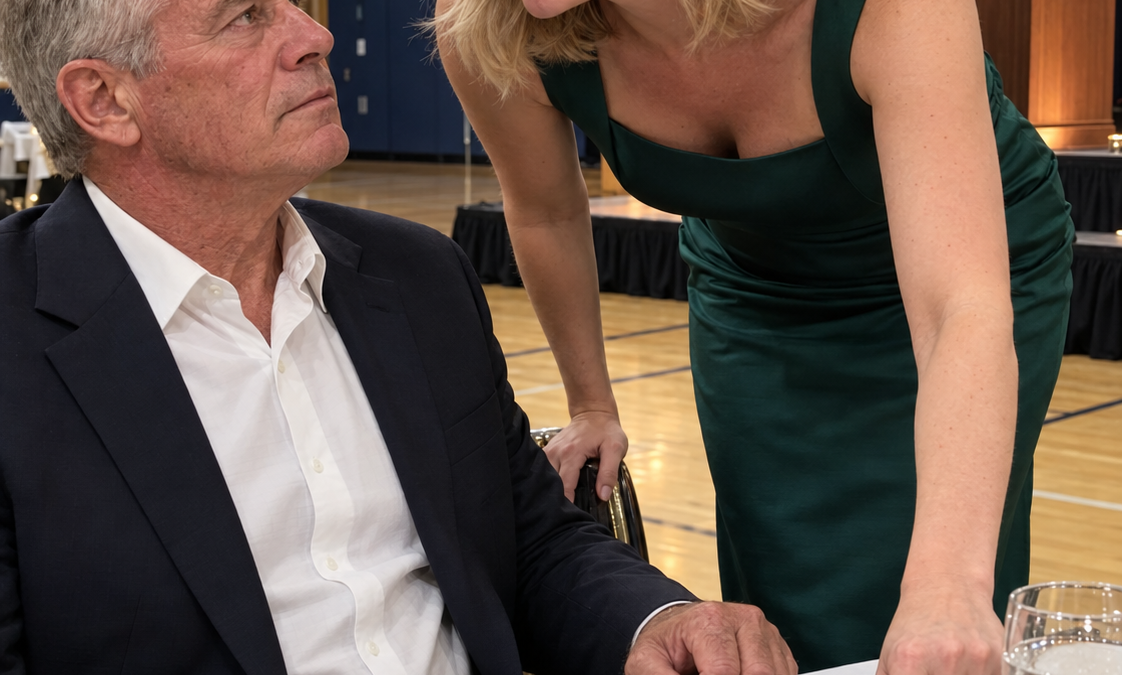
“Who let you in?” my daughter-in-law asked at the gala after my son demanded my $21,600-a-year rental property—then the head of school called me forward, and she resigned as treasurer.
Complete story · 9 parts · about 35 minutes · ending included
Part 1 · Part 2 · Part 3 · Part 4 · Part 5 · Part 6 · Part 7 · Part 8 · Part 9
Part 1 of 9
Jared held his phone over my tax return and took the picture before I could turn the page over.
The camera clicked. I had a grilled cheese sandwich lifted on my spatula, and the butter was browning around the edges.
“Did you just photograph that?” I asked.
He lowered his phone but kept his thumb on the screen.
“Dad, it’s right here.”
It was Saturday, October 3, 2026, 12:30 p.m., and my kitchen on Dunmore Road was no place for a family meeting. A frying pan sat on the stove. Piper had spread her coloring page at the end of the table. My salt shaker stood beside the return, open to Schedule E.
Jared hadn’t asked to see it. I’d left it there while making lunch.
He angled the screen toward Alyssa, who leaned against my counter.
“Twenty-one six,” he read.
He’d found the rents received at the top of the page.
He didn’t ask where it went.
I slid the sandwich onto a plate, put another in the pan, and turned down the burner.
“On a place he doesn’t even live in,” Jared told his wife.
Alyssa tilted her head toward his display.
“You told me he had that place,” she said. “You didn’t tell me it brought in that much.”
“That’s news to me,” Jared said. “He doesn’t tell us anything.”
He was thirty-three, wore his dealership shirt tucked into pressed pants, and raised his chin as if the screen had settled whatever was being argued.
“You sit on twenty-one grand a year and never helped us once. Sign the duplex over to me, Dad. Be real.”
The next sandwich hissed in the skillet.
“Ten-four,” I said.
I laid down the spatula, picked up the return, and turned it face down on the table.
Jared watched my hands.
“What’s that supposed to mean?”
“It means the sandwiches are ready.”
“Dad.”
I brought Piper her lunch. She moved her paper without lifting her eyes.
“Thank you, Grandpa,” she said softly.
“You’re welcome.”
I set the other plates where Jared and Alyssa could reach them. Neither sat.
Alyssa gave a small laugh.
“We’re going to be pretty busy at Ashcombe this month,” she said. “Piper sings with the choir at the gala on the twenty-fourth. Everybody’s making such a fuss over it.”
Piper’s crayon stopped.
“That’s good,” I said.
Alyssa examined my work shirt, the cuff I’d scrubbed before they arrived, and the dark half-moons that never quite came out from under my nails.
“You know, Rodney, there will be a lot of parents there. They pay attention to appearances.”
Jared was looking at his phone.
“Meaning what?” I asked.
Her mouth twitched.
“For Piper’s sake, wouldn’t it be kinder to skip the school events? That diesel smell does tend to follow you.”
The crayon began moving again, slowly. Piper kept her head down.
She’d said it where my granddaughter could hear.
I’d driven a tow truck for thirty-one years. The smell stayed in the seams of my jacket and around my wrists, even after a hot shower. I’d never thought of it as something a child had to be protected from.
I reached for the pan handle.
“She’s got a nice voice,” I said, nodding toward Piper.
“She does,” Alyssa said. “We’re hoping she’ll be up front.”
Jared slipped his phone into his pocket.
“Anyway, I’ll have the papers by next week.”
He said it as if we’d settled the matter over lunch.
“You won’t need to bother going anywhere,” he added. “I’ll bring them here.”
I looked past him at Piper, bent over her crayons. The bread had gone dark on one side. I shut off the burner and put the last sandwich on my plate.
“I thought we were having lunch,” I said.
“We are,” Jared replied. “I’m just trying to take a chore off your hands.”
Alyssa took a bite standing up. Jared pulled out a chair but stayed on his feet, looking at the tabletop where the page lay hidden.
Piper folded her coloring sheet away from her plate. She had used brown along the roof of a little house. Her fingers were stained green near the nails.
I washed the skillet.
After lunch, Jared checked his phone again while I cleared the plates. Alyssa brushed crumbs from the counter into her palm. Piper gathered her crayons and carried her paper carefully so it wouldn’t bend.
At 1:10 p.m., I walked them down the driveway.
My white wrecker was parked there, Kessler Towing & Recovery written across the door. The tires still carried grit from the road.
Piper went straight to the cab, as she always did. I held the door while she climbed into the driver’s seat and set her hands on the wheel.
Above her was a sealed white envelope held to the sun visor with a black binder clip. The Ashcombe Day School crest showed on the front. Across it, in Piper’s pencil capitals, were the words TO MY SCHOLARSHIP FRIEND.
I hadn’t opened it.
Piper reached up and touched the paper with one fingertip.
“What’s that?”
“Mail I’m saving.”
She left it where it was.
“Piper,” Alyssa called. “Come on.”
The little girl looked toward her mother, then down at me. I stood by the step so she had room to climb out.
Piper lowered herself to the driveway and leaned close so only I could hear.
“I like it better when your truck parks by the office.”
Then she ran after her mother.
Part 2 of 9
“We don’t need tow-truck money,” my son’s old text still said on my screen, three years later, while a stranger’s minivan steamed on the shoulder of I-75.
It was Monday, October 5, 6:40 a.m. I sat inside my wrecker with the engine idling, giving the minivan’s radiator time to cool while the hazard lights clicked in the dark. Traffic pushed past close enough to shake the mirrors.
I’d scrolled back through Jared’s messages to find it while the driver waited clear of the road.
The date above the text was Saturday, August 19, 2023.
“Don’t ever offer us money again, Dad. We don’t need tow-truck money.”
Jared had lost his job. At dinner I’d asked whether he could use some help until he found another. He’d said he had it handled, pushed back his chair, and gone home with Alyssa.
Then the message arrived.
I remembered sitting at my kitchen table with my work boots still on, trying to find a reply that wouldn’t make matters worse. In the end, I’d put the phone down.
At Sunday dinner in June 2024, he’d sounded the same way.
“If we can’t pay for it, she doesn’t go. No handouts.”
I’d looked at Piper, seated nearby where she could hear every word.
“I’m only asking whether you want to talk about it,” I’d said.
“There’s nothing to discuss, Dad.”
I hadn’t pressed him. His mother would have known what to say. Teresa could let him fuss through supper, then pass him another helping, and somehow he’d start talking like himself again.
Near the end, at the nursing home, she’d held my wrist when I stood to leave.
“Help Jared. Just don’t ever make him feel small.”
She’d died in March 2021. I’d carried those words home with the rest of her things.
I turned the phone face down on the seat and stepped out into the highway noise.
The minivan’s front tires were straight. I eased the wheel-lift under them, checked the clearance, and secured the safety chains before raising the axle. The driver watched from behind the guardrail, rubbing his hands together.
“Is it bad?” he asked.
“Can’t tell you from here. I’ll get it off the shoulder.”
He nodded and walked toward my cab. I checked the hookup again before climbing in.
It was Wednesday, October 7, at 4:30 p.m. I stood in the Kessler Towing & Recovery lot, wiping road film from my truck’s mirror. Jared pulled in driving a dealership car.
He got out carrying a sheet of paper.
“Dad, I’ve made this easy.”
He spread it flat on the wrecker’s hood and smoothed the corners with his palm.
Across the top it said QUITCLAIM DEED. Below were spaces waiting to be filled and signed.
“I’ve got a notary set up at the dealership,” he said. “Saturday, October tenth. Nine in the morning.”
“You made the appointment already?”
“I told you I’d bring the paperwork.”
“You did.”
He pointed to a blank line.
“Then we go in, sign, and it’s taken care of. You don’t have to chase anybody down.”
I set my rag beside the windshield.
“That house isn’t sitting, son. It’s working.”
“Working for who?”
I looked at the sheet without reaching for it.
A truck rolled past the chain-link fence, its loose tailgate rattling over the pavement. Jared waited until it had gone.
“Dad, be real. You pull cars off the highway all day. Are you going to keep doing that and hang on to a place you don’t need?”
“I keep the place up.”
“I know you fix things. That isn’t the point.”
“Then tell me the point.”
“The point is you could make this easier for your family.”
I watched him press the page against the paint before the breeze could lift it.
“I’m your son,” he said. “I shouldn’t have to negotiate with you.”
I folded the rag and put it in my back pocket.
“There’s a difference between asking me and scheduling my signature.”
He gave a hard little smile.
“You always make it sound like I’m trying to take something.”
Neither of us moved toward the paper.
Then Jared straightened his shirt.
“Oh, and Alyssa took you off the gala list. You can watch Piper sing on Facebook.”
I could still see Piper in my driver’s seat, both hands on the wheel.
“Does Piper know that?”
“Alyssa handles the invitations.”
“That wasn’t what I asked.”
He glanced toward the car.
“She’ll be busy with the choir. She won’t even notice.”
I kept my hands at my sides.
Jared waited another moment, then lifted the deed from the hood, folded it, and carried it back to his vehicle. He drove away with it unsigned.
I took my phone from my pocket and called my accountant.
“Where do I still need to sign on my return?”
“On the signature page at the end. We filed your extension back in April, but the deadline’s Thursday, October fifteenth.”
“I’ll take care of it.”
Then I called the front office at Ashcombe Day School.
“Could you tell me what time the fall gala starts on Saturday the twenty-fourth?”
“Seven p.m.”
“Thank you.”
The woman wished me a good afternoon. I set the phone on the dash and went back to the mirror. It had dried streaky, so I started over.
It was Friday, October 9, 9:15 p.m. I was alone in my kitchen when the phone lit up on the table. Jared’s message filled the screen.
“Sign, or I tell everyone you’re losing it.”
Part 3 of 9
Lupe Ibarra opened her screen door one inch and said, “A woman with a clipboard wanted to measure my kitchen, mijo.”
It was Monday, October 12, 5:20 p.m. I stood on the front steps of the downstairs unit on Birchall Avenue, still wearing my Kessler Towing & Recovery shirt. Lupe’s pumpkin occupied the second step, right where a visitor might trip over it.
“Did she measure anything?” I asked.
“Not unless she can do it through a locked screen.”
Lupe held the door where it was. She’d rented the downstairs since 2015 and knew which porch boards made noise in wet weather. She had never been shy about telling me when one needed attention.
“What did she want?”
“She came at ten this morning. Said the son had set up a showing.”
“Which son?”
“Yours, Rodney. Unless you have another one you haven’t introduced me to.”
I looked toward the upstairs windows. Nobody had asked my permission to bring visitors into either unit.
“What did you tell her?”
“That you owned this house, and I wasn’t letting a stranger into my kitchen on somebody else’s say-so.”
“Did she argue?”
“Politely. Those are the ones who stand on your porch longer.”
Lupe pushed the door wider. Her slippers stayed planted behind the threshold.
“Thirty years in a school office. I don’t open doors for clipboards.”
She tapped the latch once, the way she must have rapped a pen against a late slip.
“She didn’t get past you, then.”
“Not a toe. But she left this for the owner.”
Lupe passed me a business card. The front read Carmen Kreger, real estate agent. I slipped it into my shirt pocket without turning it over.
“Was she upset?” I asked.
“She looked at the house a long time before she left. As though she was trying to see through the walls.”
“You should’ve called me.”
“I knew you’d come by for the faucet. You always do what you say you’ll do.”
Her kitchen tap had been dripping again. I had a washer in my work kit and had come to replace it. First, I wanted to hear from the woman who’d left it.
At nine on Saturday, October 10, I’d stayed away from Jared’s dealership. He’d made the notary appointment without asking me, then waited there alone. Later that morning, I was looking at my phone when Jared’s message appeared.
“Your loss.”
I hadn’t replied.
At 5:40 p.m. Monday, I stood on Lupe’s porch and called the number on Carmen’s card. She answered with her name.
“This is Rodney Asplund. You came to my duplex this morning.”
“Mr. Asplund. Good to hear from you.”
“My tenant says you wanted to show her kitchen.”
“Your son Jared contacted me about selling the property. He said a showing was arranged.”
“Not with me.”
She was quiet for a moment.
“Then I owe your tenant an apology. I should have confirmed that with you.”
“Can you put my place up for sale because he asks?”
“No, sir. Without the owner’s signature, I can’t list the property.”
“Then there won’t be a listing.”
“I understand.”
I watched a dry leaf scrape along the bottom step and catch against the pumpkin.
“Did Jared tell you why he was in such a hurry?”
“He told me he’s behind on his mortgage. He wants a quick close, before his own bank does something.”
My grip tightened around the phone until the edge pressed into my palm.
Carmen waited. Somewhere inside the duplex, water ticked into a sink.
“He’s still planning to come back,” she said. “Wednesday, October fourteenth, at five-thirty. He wants me there and says he’ll bring everything needed.”
“Without my signature?”
“That’s what he requested. I’ll come with your son and the paperwork he says he’ll have. I’d rather settle this with both of you present than risk another misunderstanding.”
“I’ll be there.”
I ended the call and tapped on Lupe’s door.
She opened it with a dish towel over her shoulder.
“Did you find out who sent her?”
“Yes.”
“Your boy?”
“Yes.”
Lupe pursed her lips.
She stepped aside and let me in.
The kitchen smelled faintly of dish soap. I turned the valve under the sink, opened the tap to drain what remained, and spread a rag from my kit beneath the pipe.
Lupe watched from the doorway.
“Does Jared know you still fix my faucet yourself?”
“He doesn’t need to.”
She pulled the dish towel off her shoulder and folded it across her hands.
“You come every month, mijo. He ever ask what you do here?”
“Not lately.”
I loosened the fitting with my wrench. The old washer had flattened along its edge. I replaced it, tightened the stem, and turned the water back on. The tap ran clean. When I shut it, no drip followed.
“There,” I said. “Try it.”
Lupe tested the handle.
“Much better.”
She seemed ready to say more, then looked at the wrench still in my hand. I packed my tools, wiped the cabinet floor, and stood clear of the sink.
“Anything else giving you trouble?”
“No. Just that visitor.”
I carried my kit out past the pumpkin. Lupe followed me to the entryway. As I started down the steps, she called through the screen door.
“She said your son told her you have memory issues, mijo. And that he’ll sign for you.”
Part 4 of 9
Jared held out the power of attorney form and a pen like he was handing me a receipt.
Ten minutes earlier, at 5:20 p.m. on Wednesday, October 14, I’d been sitting in my wrecker outside the duplex on Birchall Avenue. I took Carmen Kreger’s business card from my shirt pocket and turned it over for the first time.
Her handwriting covered the back: “Owner has memory issues. Son Jared to sign under POA. Per Jared, 10/9.”
I held it toward the windshield to see the cramped writing. Then I put it back in my pocket, climbed the outside stairs with my folder, and unlocked the upstairs door.
At 5:30, Jared stood in the center of the empty living room. The upstairs unit had stood empty since September 1. Without furniture, a man’s shoes sounded louder than they should.
“Dad, this is easier,” he said, extending the form. “Just let me handle your paperwork.”
Carmen waited by the window with a clipboard. Lupe hung back at the living-room door. She’d come up because Carmen had told her about the appointment.
Jared tipped his head toward Lupe. “Didn’t know we had an audience.”
“Carmen told me you’d be here,” Lupe said before I could answer.
“I live downstairs. I wanted to see who was coming through my house.”
Jared turned back to me.
“Sign this and I can take care of everything. You won’t have to go to the dealership.”
“What’s everything?”
“The house. The calls. All the running around.”
He nudged the pen toward my hand. I left it there between us.
“Dad, I’ve got a job. I can’t keep meeting people every time something needs doing.”
“You set these meetings.”
“Because you won’t help.”
I opened my folder. Inside were the deed from June 1999 and the recorded survivorship affidavit from May 2021.
I laid them on the windowsill in front of Carmen.
We’d bought that house with three winters of night tows.
Carmen leaned over the documents. She checked the names, then the recording information. Jared looked at her instead of me.
“That’s old paperwork,” he said. “This is how we’re doing it now.”
I touched Teresa’s name on the deed.
“Her name and mine. Since 2021, just mine. My memory’s fine.”
Lupe stayed by the doorway, her arms folded.
Carmen looked from the affidavit to Jared’s hand.
“Jared, did your father agree to let you sign for him?”
“He’s standing right here.”
“That wasn’t my question.”
“He knows what we’re trying to do.”
“Mr. Asplund,” she said, turning to me, “have you signed a power of attorney?”
“No.”
“Are you planning to?”
“No.”
Jared’s neck went red above his collar.
“Dad, be real. You can’t keep digging your heels in just to prove you can.”
Carmen tore the listing sheet off her clipboard. She faced him, holding it at her side.
“I don’t list houses for people who don’t own them.”
“He’s my father,” Jared said.
“That doesn’t give you authority. This form only works if he signs it himself.”
“So you’re taking his side?”
“I’m telling you who owns the property.”
Jared folded the unsigned form around the pen.
“Fine. Keep it. Don’t ask me to clean things up when you change your mind.”
He went down the stairs without looking at Lupe. I heard his car start outside.
Carmen handed back the documents. I slipped both into my folder and closed it.
“I’m sorry I came here the other morning,” she said.
“You checked with me today.”
“I should’ve done it before.”
Lupe held the door as Carmen left. I stood at the window until the dealership car had disappeared from Birchall Avenue.
Thursday, October 15, was the deadline for my extended tax return. My accountant had filed the extension in April. I signed the page he’d marked, checked the packet, and mailed it at the post office.
That night, my phone buzzed against the kitchen counter.
“You don’t see Piper until you sign.”
I left it unanswered.
On Friday, October 16, at 3:10 p.m., I parked the wrecker in the last space at the far end of the Ashcombe Day School lot. I’d picked Piper up on Fridays since 2024. I went inside to the front office, as usual.
The receptionist checked the pickup list.
“I’m sorry, Mr. Asplund. Her parents removed your authorization.”
“Today?”
“That’s what the list says. I can’t release her to you.”
Piper stood behind the glass door that separated the office from the hallway. She put her hand flat against it.
I raised mine. The receptionist looked down at her desk.
I walked back across the parking lot and climbed into the driver’s seat.
The white envelope was still sealed beneath its black binder clip on the sun visor. I glanced at it, then left it alone.
I opened the glove box and took out the stub of the August check I’d handed to Ashcombe’s business office.
Since August 2024, every tuition payment for Piper had come out of my checkbook. That same month, Ashcombe had written Jared and Alyssa that her tuition was paid by “a private family scholarship fund whose donor wishes to remain anonymous.”
I held the stub against the steering wheel.
“Anonymous. That was the deal.”
Someone tapped on my window.
Dr. Martin Pratt, the Head of School, stood beside the wrecker. I lowered the glass.
He took his time with the words, speaking slowly and deliberately.
“The board wants to thank the Teresa Asplund Fund. I told them you’d say no.”
He passed a printed place card through the gap. I took it and tilted it toward the light to read the line across the bottom.
Ashcombe Fall Gala — October 24 — Guest of the Head of School.
Part 5 of 9
A week before the gala, I had to decide whether those checks stayed hidden. It was Saturday, October 17, and five tuition check stubs, from August 2024 through August 2026, lay across my kitchen table. Dr. Pratt’s place card sat beside them. If Dr. Pratt read the fund’s name in that gym, Jared would know exactly what I’d been doing.
I opened Jared’s threat on my phone. “Sign, or I tell everyone you’re losing it.” I printed the message and laid that page beside the stubs. The words looked worse on paper, with nothing around to soften them.
By Sunday, October 18, the five stubs, Carmen’s business card, the place card, and the printed text were in one folder.
If Jared discovered who’d been paying, he might pull Piper out of Ashcombe rather than accept what he’d called a handout. She’d lose her teachers, her friends, and the place where she’d learned to sing with the choir.
“He already took her Fridays,” I told the empty kitchen.
I closed the folder.
At 7:00 a.m. on Tuesday, October 20, I sat in the cab of my wrecker at the Kessler Towing & Recovery yard. The envelope remained sealed under its black binder clip on the driver’s sun visor. I left it alone and called Dr. Martin Pratt.
“Mr. Asplund,” he said. “Good morning.”
“I’m coming to the gala.”
“I’m glad to hear that.”
“I want you to read Teresa’s name. Not mine.”
He didn’t answer immediately. I could hear papers moving at his end.
“Are you certain, Mr. Asplund?”
“Yes.”
“Every parent in that gym knows Piper’s last name.”
“I know.”
“And her father will know whose name it is before I finish.”
“He should.”
He let the quiet sit between us before he spoke again.
“Once I read it, I can’t unread it.”
“Ten-four.”
I ended the call and watched a tow truck pull through the yard gate. Then I went to work.
At 6:00 p.m. Tuesday, I sat across from Lupe at her kitchen table in the downstairs unit on Birchall Avenue. I’d brought the folder. She’d set her dish towel over the chair back instead of putting it away.
“You didn’t come to fix anything,” she said.
“No.”
“Then tell me why you’re sitting like a man waiting for bad news.”
I opened the folder to the check stubs.
“Piper’s tuition,” I said. “I’ve paid it since August 2024. All of it.”
Lupe took her reading glasses from her cardigan pocket and studied the dates.
“The rent from this house covers part,” I said. “I make up the rest driving.”
“And her parents know?”
“They know there’s a scholarship. They don’t know it’s me.”
Lupe put a finger on the oldest stub.
“So he’s trying to sell the house that keeps his own girl in that school.”
“He told me once what he’d do. I believed him.”
“And you’re going to that gala?”
“Yes.”
“Is Jared still keeping you from her?”
“I’m still off the pickup list.”
She straightened the edges of the stubs and pushed them back across to me.
“Then wear the good jacket.”
I gathered the papers and put them away. Lupe walked me to her screen door, but she didn’t ask me to change my mind.
At 9:40 p.m. Tuesday, I sat in my armchair with my phone on the armrest. Jared’s name appeared above a message: “Stay home Saturday.”
Below it, he’d forwarded Alyssa’s draft speech, still addressed to him. He’d sent the whole thing in a hurry, without cutting off her private note, just to show me the kind of family the gym would admire and make sure I knew I wasn’t part of it.
The message began:
Jared — read this first.
I want the treasurer’s remarks to sound warm, and I want every voter in that gym to remember which family pays its own way.
When you pay full tuition, every cent, the way Jared and I do, you learn what this school is worth.
We don’t make a show of our sacrifices. We simply believe in giving our daughter the best.
Nobody at school needs to know about the scholarship. As far as Heidi knows, we pay every cent. Read before I send it to the board.
Part 6 of 9
“Notary’s at the dealership Saturday at nine,” Jared texted Wednesday. “Last chance before the gala.”
It was October 21. I stood beside my wrecker with the message open on my phone, looking at the word chance.
He’d booked the notary again, same as the last time. He hadn’t asked if I’d come. I didn’t answer.
On Saturday, October 24, at 9:00 a.m., I was in the Kessler Towing & Recovery yard, washing the truck.
Water ran black from the wheel wells. I worked a soapy rag around the door lettering, then climbed onto the step to reach the windshield. The hose had a kink near the rear tire. I straightened it with my boot and kept going.
At the dealership, Jared would have been expecting me.
I rinsed the mirrors until they showed the whole lot without streaks.
I shut off the hose, coiled it, and checked the tires. Then I went home to get dressed.
At 6:40 p.m., I sat in the wrecker outside Ashcombe Day School. I’d parked in the last space at the far end of the lot, where I normally waited for Piper on Fridays.
My suit jacket lay on the passenger seat.
It was the one I’d worn when Teresa and I married in 1991. She’d liked how it fit across my shoulders. The lining had worn thin near the inside pocket, but it was still the good jacket Lupe meant.
I reached up to the driver’s sun visor.
The white envelope was held there by its black binder clip, just as it had been since August. I eased it free. The seal hadn’t been disturbed.
I looked at Piper’s pencil capitals on the front. Then I slid the envelope into the jacket’s inside pocket without opening it.
My folder rested beside the jacket. I opened it, took out Carmen Kreger’s business card, and turned it over. Her note about Jared signing for me filled the back. I tucked it into the same pocket, behind the envelope, then took out Dr. Pratt’s printed place card.
The folder stayed in the cab. I put on the jacket, closed the truck door, and walked toward the gym.
At 7:00 p.m., the Ashcombe Fall Gala was filling the school gym with the scrape of chair legs and people talking over one another.
Fifteen round tables held ten parents each. A low stage stood at the front, with a podium and microphone. The fourth-grade choir waited on benches beside it.
Table one was closest to the stage. Heidi Holder, president of the parent association, sat there with members of the board. Alyssa had been campaigning for Heidi’s seat since August. Jared and Alyssa were at table four in the middle, where they could see the podium clearly.
I found table fifteen by the door. An extra chair had been set there for me.
I laid my place card beside my plate. It said Guest of the Head of School.
The chair faced the stage, though I had to turn slightly to see the choir benches. I’d waited for Piper from farther away than this.
At 7:10, the fourth-graders stood to sing.
Piper was near the edge of the group. She held her hands together while the teacher gave the starting cue. When the singing began, her chin rose.
Then she saw me.
Her eyes moved from my face to the wedding jacket. Her fingers lifted a little, as if she might wave. Alyssa was watching her. Piper lowered her hand and kept singing.
I stayed where I was.
After the choir finished, Alyssa followed Piper’s glance to the back of the gym. She crossed the floor with her shoulders squared and stopped beside my chair.
“Who let you in?” she asked quietly.
I pointed to the place card.
She bent enough to read it. Her smile stayed in place, but she pressed her lips together before straightening.
“That’s interesting,” she said.
I didn’t offer an explanation. She returned to the middle of the room, pausing to greet people on the way.
At 7:30, Alyssa stepped to the podium for the treasurer’s report. She wore the pleasant expression she used when she wanted a room to listen.
She thanked the families who supported Ashcombe. Then she leaned toward the microphone.
“When you pay full tuition, every cent, the way Jared and I do, you learn what this school is worth.”
Jared sat forward in his chair, his eyes on his wife.
Alyssa glanced toward the back of the gym. She gave a small laugh.
“And a warm welcome to Piper’s grandpa, who’s come straight from work at the tow yard. I’m sure everyone can forgive a little diesel.”
A few tables laughed. Heidi joined them from table one. Jared chuckled, then looked down.
I pressed a thumbnail into my jacket seam.
She’d said Grandpa loud enough for the front rows.
Piper sat on the choir bench up front. I couldn’t tell if she was looking my way.
At 7:45, Dr. Pratt took the podium. He waited until the small sounds of chairs and glasses settled.
“Tonight we thank a fund that is paying one student’s full tuition for the third year running. The Teresa Asplund Fund.”
At table four, Jared set his water glass down. Alyssa had come down from the podium but stayed by the stage steps, her fingers laced in front of her.
Dr. Pratt lifted his eyes to the last row of tables.
“Would the man behind it come up?”
I stood up at table fifteen.
Part 7 of 9
Piper hit me at the waist before I was halfway down the aisle, and she yelled “Grandpa!” loud enough for the back tables.
I caught her against my suit jacket. She buried her face near the buttons and held on while I pulled my phone from my pocket, keeping it clear of her shoulder.
“You came,” she said.
“I did.”
“Did you hear us sing?”
“Every word.”
She stayed pressed against my side. At my kitchen table, she’d have shouted that question. Tonight she said it into my jacket.
A few parents turned toward us. Someone near the aisle lowered a phone. Across the gym, heads moved from Piper to the woman standing beside the stage steps.
Now they knew which student Dr. Pratt meant.
We reached the front with her hand still on my sleeve and my phone in my other hand. I stopped below the podium.
Dr. Pratt held out a wooden plaque. Its engraving read, “The Teresa Asplund Fund — Thank You.”
I took it carefully, keeping Piper close.
“Five checks, Mr. Asplund. Paid straight to us, in person,” he said into the microphone. “Paid that way, it can only go to her schooling.”
That was all the explaining I wanted. I’d handed over those checks at a counter, without an audience. Dr. Pratt had seen me come in with grease at my cuffs and had never asked me to dress differently. He’d never once asked why.
Alyssa leaned toward the microphone before he could step away.
“I’m sorry to interrupt, Dr. Pratt, but we’ve been concerned about his memory. I’m afraid he may be confused.”
The words traveled through the speaker, clear enough to reach my empty chair by the door.
She had found a new use for my silence.
Heidi Holder rose from table one, about ten feet from the stage, and walked up to the foot of it. Her smile was gone.
I tucked the plaque beneath my left arm, reached into the inside pocket of my jacket, and withdrew Carmen Kreger’s business card. The sealed envelope stayed where it was.
I gave Heidi the card with the handwritten back facing up.
She read it without speaking, then looked at Alyssa.
“Who wrote this?”
“The realtor,” I said. “After Jared called her.”
Heidi angled the note toward the board members seated behind her. I unlocked my phone and opened Jared’s message.
“Sign, or I tell everyone you’re losing it.”
I stepped to the edge of table one and held the phone low, where Heidi and the board could read it. Nobody farther back was close enough.
Two of them bent closer, read it, and sat back without a word. A woman at the nearest table lowered her napkin to her lap.
Dr. Pratt kept his place beside the podium.
“He has handed our business office every check himself. His memory’s fine.”
Alyssa shook her head.
“You don’t see what he’s like with family.”
I didn’t answer. I scrolled down Jared’s thread to the draft he’d forwarded Tuesday night. My thumb rested below the last line as I held the screen out for Heidi to read. I kept hold of the phone.
She leaned close and read part of it half aloud.
“As far as Heidi knows, we pay every cent.”
I’d watched her laugh when Alyssa mentioned diesel. Now Heidi stood with her mouth closed, studying the words Alyssa had written for her husband.
Alyssa looked past Heidi to table four, where Jared sat holding his phone. “You sent him that?” she said under her breath. He didn’t look up.
“It’s a draft,” Alyssa told Heidi. “It wasn’t for you.”
“It has my name in it,” Heidi replied.
She took the microphone from Dr. Pratt.
“Alyssa, I’ll take the treasurer’s report from here.”
Then she returned Carmen’s card to me. I slipped it behind the envelope and lowered my arm around the plaque again.
Jared was coming up from table four, phone in hand. He stopped near the stage steps and looked at the engraving.
“That’s my mother’s name. He’s using her to make me look bad.”
I shifted the plaque so his mother’s name faced him.
Piper moved closer to my leg.
“Look at this,” I told Jared.
I opened the old message on my screen and held it toward him.
“Don’t ever offer us money again, Dad. We don’t need tow-truck money.”
He glanced at it, then at the people seated nearest us.
“You told me not to offer. So I didn’t. I paid the school.”
“Dad, that’s not what I meant.”
“Pull up your photo, son. Twenty-one six came in. Taxes, insurance and repairs took their cut. Nineteen eight went to Ashcombe, and I covered the rest.”
Jared looked down at his own phone. He found the picture he’d taken of my Schedule E on my kitchen table. His thumb stopped moving.
He said nothing.
He’d shown me that page as if every dollar coming out of the duplex belonged to him. He hadn’t asked where it went. I’d never told him.
Alyssa hadn’t moved. Her hands hung at her sides. Beyond her, the parents stayed seated. The room had gone quiet enough that I could hear someone move a chair near the door.
I looked at her.
“‘For Piper’s sake, wouldn’t it be kinder to skip the school events? That diesel smell does tend to follow you.’ You said that in my kitchen.”
Piper’s fingers curled around the hem of my jacket. I kept my voice level, just loud enough to carry to table one.
“Every semester, Alyssa, that diesel paid for her desk.”
Part 8 of 9
Dr. Pratt forwarded me Heidi’s email on Monday with one line on top: Second paragraph, Mr. Asplund.
It was October 26. I was at my kitchen table, still wearing the work shirt I’d put on before daylight. I scrolled to the part he’d marked.
Heidi had told the parents that Alyssa had stepped down as treasurer and withdrawn from the race for association president. The rest was bake-sale sign-ups and a thank-you to the chorus teacher.
I put the phone beside my cup.
Alyssa had stood at a microphone and told the room she and Jared paid every cent. Now somebody else would handle the books. I hadn’t asked Heidi to remove her. I hadn’t needed to.
The story about me losing my memory had died in that gym, in front of 150 parents. Carmen had refused to list the duplex on October 14, after seeing Teresa’s name beside mine on the 1999 papers and the recorded affidavit. Nobody who’d been in that room was going to believe Jared needed a power of attorney to speak for me.
That Monday night, another message appeared on my phone. Jared had sent it directly to me.
“Shredded the deed.”
I left the words on the display until it dimmed, then touched the glass and looked again. He’d taken the unsigned paper home from the tow yard. Now he said it was gone.
There was no appointment left for me to miss. No realtor waiting to hear that I was confused. Whatever his bank wanted, it wasn’t coming out of Birchall Avenue.
I turned the screen over and went to bed.
At 7:15 a.m. on Wednesday, October 28, I drove the wrecker past Jared and Alyssa’s house.
A For Sale sign stood on their front lawn. I saw it while slowing for the turn, its post straight in the grass. They were selling their own place to get ahead of the bank.
I didn’t pull over.
The lawn was mowed tight around the sign, the way Jared had always kept it, even in the bad years. I kept both hands on the wheel.
For a while I could still see the sign in my side mirror. Then a passing vehicle blocked it, and I watched the road ahead.
On Friday, October 30, at 4:00 p.m., I sat in the driver’s seat of my wrecker in the Kessler Towing & Recovery lot. The engine was off. My own door was shut, the window cracked.
Jared came alone.
He came around to the passenger side, opened that door, and stood with a hand on its frame. His dealership shirt was open at the collar. He looked into the cab without climbing up.
“Why didn’t you just tell me?”
“You asked me not to.”
“I asked you not to give us money. Not to lie to me.”
I glanced at the space between the seats.
“I never lied to you. I just never said who paid.”
“You let me believe it was some scholarship Piper earned.”
“The school told you the donor was anonymous.”
“And you were fine with that?”
“Yes.”
He rubbed his thumb against the rubber door seal. I knew that habit from when he was small and had something he wanted to say without knowing how to start.
“You could’ve told me afterward,” he said.
“After what?”
“After I found work again. After we got settled.”
“I didn’t know when you’d want to hear it.”
“You didn’t try.”
I looked at him. That part was true enough. I hadn’t offered again after the night his text told me not to.
“You stood there at the gala and let everybody think I couldn’t provide for my daughter.”
“I stood there after Alyssa spoke.”
“You could’ve taken me aside.”
“You could’ve asked before you photographed my return.”
He lowered his eyes to the step below him.
The open door let cold air into the cab. He’d once ridden beside me with his feet unable to reach the floor mat. Now he stood outside and wouldn’t put a foot on the step.
Neither of us said anything for a while. A truck rolled across the yard behind him, its air brakes sighing when it stopped. Jared didn’t move away from the doorway, and I didn’t invite him inside.
His gaze went up to the driver’s sun visor. I’d clipped the white envelope back there after the gala. It was still sealed, held by the black binder clip. Piper’s pencil capitals read TO MY SCHOLARSHIP FRIEND.
“What’s that?” he asked.
I reached overhead and eased the clip loose.
“Your mother’s rule. We don’t do it for the thank-yous. I told myself I’d open this one the day you came and asked me yourself.”
He watched while I slipped my finger beneath the flap and tore the edge. The paper inside was folded, with pencil marks showing through. I opened it and read the short letter. Then I reached across the seat and handed it to Jared.
“I think you are my grandpa. I saw your tow truck parked by the office on the day the money is due. I like it better there. I won’t tell Daddy. He gets sad about money.”
Part 9 of 9
Jared set a check for one hundred dollars on my kitchen table and said, “Every month. For the fund. Don’t argue.”
It was Sunday, November 1, at 5:30 p.m. I stood at the stove with a spatula in my hand. Piper sat across from her father, folding the corner of a napkin. Alyssa’s chair was empty.
“Ten-four,” I said.
Jared stared at me.
“You’re accepting it?”
“I said I was.”
“You usually make me argue before you’ll take anything.”
“Not tonight.”
I turned the chicken in the skillet and lowered the heat. Jared pushed the check toward the middle of the table, away from the edge where Piper’s elbow rested.
“Where’s Alyssa?” I asked.
“At a friend’s.”
Piper looked up, then went back to her napkin. Jared watched the stove instead of looking at me.
“The association carpool list doesn’t have her name on it anymore,” he said.
I carried the food to the table.
“Did she tell you that?”
“She showed me.”
I set his plate down and then Piper’s. Jared waited until I’d taken my seat before reaching for his fork. The check lay beside the salt shaker. It wasn’t enough to cover what I’d been paying, and nobody at that table pretended it was.
“Will she come next time?” Piper asked.
“I don’t know, honey,” Jared said.
I passed the dish to her.
“Eat while it’s warm.”
She took a bite and inspected her father’s face. Jared’s face had looked the same on Friday at the tow yard, after I handed him her letter. He hadn’t scolded her for writing it. He’d kept it in his hand a long while after he finished.
“Did you know I knew?” she asked me.
“About the truck?”
She nodded.
“No, ma’am.”
“I saw you that morning. I thought you saw me.”
“I was looking for a parking space.”
She smiled into her plate.
Jared shifted his chair. His knees almost touched the table leg, the way they had when he was young and tried to sit still through dinner.
“I still wish you’d told me,” he said.
“I heard you Friday.”
“I’m not taking that back.”
“I didn’t ask you to.”
He glanced at the check.
“I’m trying to do my part.”
“I can see that.”
A knock came from the kitchen door. Lupe stood outside holding a pan of baked macaroni between her hands. I opened the door and took it before she had to balance it any longer.
“I made too much,” she said.
“You always say that.”
“And you always eat it. Hello, Piper.”
Piper pulled out her mother’s empty chair for her. Lupe saw Jared at the table. Her eyebrows went up, but she said nothing.
Lupe put her coat over the chair back. Jared told her he’d finally learned who paid for Ashcombe, and that Piper had figured it out before he or Alyssa did. He didn’t mention what his wife had said at the gala.
Lupe listened with her hands folded.
“He should have told you in 2024.”
“Maybe. But he’d have pulled her out,” I said.
Jared looked at me.
“You don’t know that.”
“No,” I said. “I don’t.”
“You could’ve asked.”
“You’d already answered.”
Lupe reached for the serving spoon but left it resting on the pan.
“Both of you can be stubborn enough to ruin supper,” she said.
Piper pushed her plate closer.
“Can I have some of that?”
Lupe served her, and the conversation stopped while Piper blew on the hot macaroni.
After a while Jared said, “You hid it behind a scholarship.”
“The school called it that, not me,” I said. “Paying for something quietly isn’t hiding. Sometimes it’s the only way a proud kid lets you help.”
Jared picked up his fork. He didn’t agree. He also didn’t push the check back into his pocket.
On Monday, November 2, Jared and I went into Ashcombe’s front office together. He asked for the pickup form. The receptionist set it on the counter, and he wrote my name on the line for authorized pickup.
I stood beside him while he signed.
“Does this put him back on the list?” Jared asked.
“Yes,” she said. “We can release Piper to him again.”
Jared slid the completed sheet toward her. I looked at the pen mark beside his signature, then at my son.
“Your mother said help you, just never make you feel small. I got half of it right.”
He kept his eyes on the counter.
“You made your choice,” he said.
“So did you.”
He nodded once. We left through the front doors together.
On Friday, November 6, at 3:15 p.m., I parked the white wrecker beside the business office instead of in my usual space at the far end of the Ashcombe lot.
Jared had ridden over with me in the passenger seat. The plaque Dr. Pratt had handed me at the gala was screwed onto the dashboard, where it didn’t block my view of the road.
Piper came running out and climbed into the middle of the bench seat. I waited until she had her seat belt fastened.
“You parked here,” she said.
“Figured you’d like it.”
“I do.”
Jared helped her straighten the belt where it had twisted against her coat. She leaned forward to look at the wooden plaque, her lips already moving.
“The Teresa Asplund Fund.”
Her finger hovered near the letters, careful not to touch the screws. Jared looked across her at me. I checked the mirror, eased the wrecker into gear, and waited for the lane to clear.
Piper read her grandma’s name off the dash, and I pulled out slow.
THE END
More stories
“You’ll feel right at home by the laundry,” my sister-in-law said, raising my Room 108 key envelope after I prepaid $9,600 — Then a resort manager appeared, and she lost control of our reunion.My sister seated a notary across from my 79-year-old dad’s empty chair on the dinner train, expecting his signature—Then he walked in as conductor and she almost forgot to hand over her ticket.”Go on home,” my dad said at our store’s 50th anniversary while handing my sister the keys—But someone they had overlooked stood between her and $185,000 in spa funding.”A toddler could sew better than that,” my daughter-in-law mocked my quilt, then paid $1,630 to replace me—until a fire captain lifted its crooked corner, silencing her while the money stayed lost.”She can’t get out of bed most days.” My husband said that while reaching for $18,400—Then I walked up in navy scrubs, and his boss turned the giant check toward me.My daughter-in-law accepted $3,000 to demolish my late husband’s kitchen, then ordered me to sign at her launch—But the proof I carried stopped her deal, and I ended her lease.








