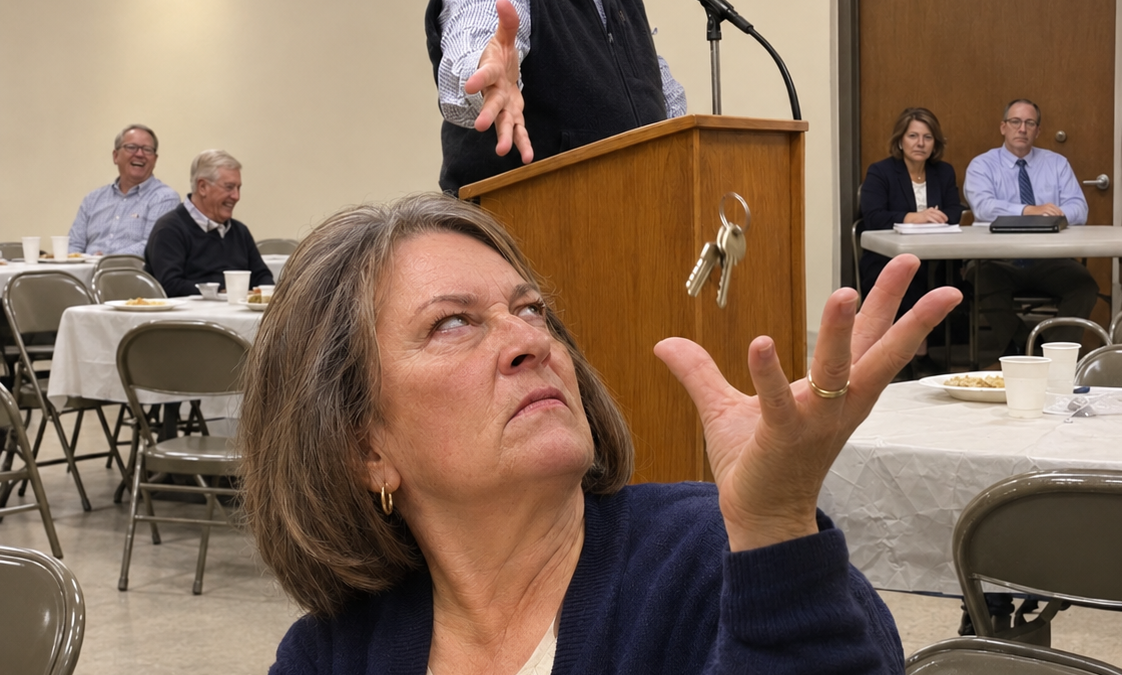
At 59, I caught the keys my husband tossed me to mock my memory—then two state auditors stood up, and his 25-year honor ended with him losing the treasurer’s office.
Complete story · 9 parts · about 35 minutes · ending included
Part 1 · Part 2 · Part 3 · Part 4 · Part 5 · Part 6 · Part 7 · Part 8 · Part 9
Part 1 of 9
At 11:20 on Wednesday, September 3, I stood in the mudroom doorway as my daughter-in-law smiled, my husband’s hand flat on her lower back.
Kaylee stood at my kitchen sink with her mouth near Vince’s ear.
She had my coffee pot in one hand and my mug in the other.
She did not jump when she saw me.
Her hand stayed steady on the pot.
She smiled.
Then she kept pouring coffee into my mug.
Vince looked over his shoulder. His hand came away from Kaylee, and he reached into the sink for a glass.
“You’re home early, Roz.”
His voice was easy.
He rinsed the glass as if I had walked in on nothing more private than dishes.
I was 59 that fall. I had spent 34 years as a dental hygienist in a small practice in Ashby Falls, Pennsylvania. I knew the face people made when they told me they flossed every night.
Vince had that face.
“I forgot my lunch,” I said.
Kaylee lifted my mug.
“Want some coffee, Mom Trask?”
“No.”
She smiled over the rim before taking a sip.
My lunch was on the kitchen counter where I had left it that morning.
I crossed the room, picked it up, and turned back.
Vince was still rinsing the same glass.
Kaylee set my mug beside the sink.
Nobody explained why she was in our kitchen on a Wednesday morning.
Nobody asked whether I wanted an explanation.
Six years earlier, Vince had started telling me we needed my Saturday pay.
“Things are tighter than they look, Roz.”
That had been his line.
So I worked Saturdays.
I had given up a trip with my sister because missing work seemed irresponsible when my husband kept saying money was tight.
Vince still took four “treasurer conferences” a year for the Ashby Falls Fire Company Relief Association.
He had been its treasurer for 25 years.
Everybody in town knew Vince.
At the propane company, he was the sales manager who remembered customers’ dogs.
At the fire hall, he was the fellow who stayed after meetings and helped stack chairs.
At home, he set his keys down whenever he wanted both hands free to make a point.
He had done it through 33 years of marriage.
I stepped back into the mudroom with my lunch in my hand.
The garage was behind me.
The kitchen was in front of me.
On the hook beside the door hung Vince’s key ring.
Picking up where the Facebook post left off
One brass key had swung outward on the ring.
A paper-and-metal tag turned slowly beneath it.
I stopped with my lunch still in my hand.
A week earlier, on Wednesday, August 27, a postcard had come to the house from the post office.
It said the box fee was past due.
It referred to Box 318.
The renter was listed as V. Trask, and the home address on the card was ours.
I had not opened anything.
There had been nothing to open.
The information was printed on the postcard, and I took a picture of it so I could ask Vince about the fee.
Vince had come in while I was holding it.
“What’s Box 318?”
He set his keys on the counter.
“Fire company stuff.”
“That comes here?”
“They needed an address.”
He took the postcard from me.
Then he picked up his keys and went on talking about something else.
At the time, I had noticed the brass key with the 318 tag because it swung against his thumb.
I had not asked another question.
Standing in the mudroom on September 3, I looked from the tag to the kitchen.
Kaylee was wiping the counter.
Vince had finished with the glass.
Neither of them looked toward me.
I put my lunch under my arm long enough to take out my phone.
I photographed the key ring where it hung.
Then I put the phone away.
“See you tonight,” Vince called.
“Yes.”
I opened the garage door and left.
Back at the dental office, the paper appointment book had a gap where my canceled patient had been.
My afternoon patient was Bernice Oakes, 77, the widow of Harold Oakes.
Harold had been with the fire company for 40 years before he died in 2021.
Bernice settled into the chair and pointed at me before I lowered it.
“You look like somebody chewed your last nerve.”
“I’m fine.”
“That means no.”
I put on my gloves.
“Open.”
Bernice opened her mouth, then shut it again.
“Harold used to hate this.”
“You told me.”
“He said you people charged him to criticize his brushing.”
“He was right about the brushing.”
That got a snort out of her.
I started the cleaning.
We talked around the instruments the way we always did.
Bernice mentioned the fire company because Harold’s old jacket was still hanging in her house.
“They were good to him,” she said when I paused. “Most of them.”
I adjusted the light.
“What do you mean?”
She waved one hand.
“Nothing worth getting worked up over now.”
I waited.
Bernice knew I would.
“When Harold died, they told me the benefit fund was short that year.”
I lowered the instrument in my hand.
“The fire company?”
“The benefit fund. Vince was so sorry about it.”
“What happened?”
“What could happen? Harold was gone.”
Bernice gave a dry little laugh.
“Your husband looked worse telling me than I did hearing it.”
I did not understand what her story had to do with my kitchen.
I did not connect it to Box 318.
Not yet.
I finished the cleaning and walked Bernice to the front desk.
On my way back, I passed the paper appointment book.
Saturday was full.
I would be there.
Vince had told me for six years that we needed the money.
I took my phone from my pocket and opened the photograph I had made in the mudroom.
The brass key filled the center of the screen.
Part 2 of 9
By Sunday, September 7, Vince was telling the family that I had started forgetting things.
He did it over dinner at my house.
My mother had left me that house, and only my name was on the deed.
Vince knew that as well as I did.
He was carving up the evening the way he carved up every room, with a warm story and a laugh that told everyone when to join in.
Colby sat across from me.
Our son was 35, a power lineman and volunteer firefighter who still looked toward Vince whenever somebody at the table needed an answer.
Kaylee sat beside him.
Their daughter, Junie, was 6 and busy arranging food on her plate into separate little territories.
Vince leaned back.
“Roz had me hunting for my keys again.”
Colby smiled at first.
“Where were they?”
“That’s the best part.”
Vince set his own keys beside his plate.
“They were where I left them.”
Kaylee laughed softly.
I looked at the ring.
The brass tag had turned under the other keys.
Vince went on.
“She moves something, then asks me where I put it.”
“I don’t move your keys,” I said.
His smile stayed easy.
“Roz, I’m teasing.”
“I know where you leave them.”
“That’s what worries me. You know better than I do.”
Colby looked from Vince to me.
Kaylee touched her napkin to the corner of her mouth.
Vince had another story ready.
Then another.
He mentioned the stove.
“Your mother scared me half to death. I came in and found the stove on.”
I put my fork down.
“I did not leave the stove on.”
Vince raised both palms.
“See? This is why I wasn’t going to bring it up.”
“You just brought it up.”
“I’m not accusing you of anything.”
His tone stayed gentle.
That made everybody else sound harsh if they answered him.
“I’m saying we all forget things.”
Kaylee smiled at me.
“Mom Trask, let me write that down for you.”
Junie looked up.
“Write what?”
“Nothing, honey,” Colby said.
His face had changed.
The smile was gone.
I looked at my son and saw something worse than suspicion.
Concern.
Vince reached for his keys, turned them once in his hand, then set them back beside his plate as he started talking about the fire company.
I listened to the scrape of Junie’s fork.
A month earlier, I might have defended myself harder.
I might have gone to the stove and checked the knobs in front of everybody.
Instead I remembered Kaylee’s smile over my mug.
I remembered the 318 tag.
Dinner moved on.
Kaylee offered to clear the plates.
“I’ve got it,” I said.
“Sit down, Mom Trask. You worked yesterday.”
“I work every Saturday.”
She gave me that helpful little smile.
“I know. Vince says you wear yourself out.”
Vince called from the table, “She likes keeping busy.”
Six years of Saturdays.
A trip with my sister I had canceled.
A husband who traveled four times a year for “treasurer conferences.”
I carried plates to the sink and did not say any of it.
After dinner, Colby helped Vince with something in the mudroom.
Kaylee packed Junie’s things.
When it was time for them to leave, Junie asked me to walk her to the car.
I took her hand.
Kaylee’s car was parked in the drive.
Junie skipped beside me while Kaylee opened the rear door.
That was when I saw the sticker on the windshield.
Dewey Beach.
I had seen beach parking stickers before.
This one should not have meant anything.
But Vince traveled four times a year.
Kaylee smiled at me over the roof of the car.
“Thanks for dinner, Mom Trask.”
“You’re welcome.”
Junie hugged my waist.
“Bye, Grandma.”
“Bye, sweetheart.”
I watched Colby buckle her in.
Then Kaylee closed the door.
Nothing happened in that driveway.
It was only a sticker, and I could not stop looking at it.
After their car pulled away, I went inside.
Vince was in the kitchen, carrying glasses toward the sink.
“That went well,” he said.
“Did it?”
He looked at me.
“Colby worries about you.”
“I noticed.”
“We all do.”
He put the glasses down.
“You’ve been working too much.”
“For six years?”
His mouth tightened, then relaxed.
“Don’t turn this into a fight, Roz.”
“I’m not fighting.”
“I’m saying maybe you should slow down a little.”
I dried my hands.
“Did I leave the stove on?”
Vince gave a tired smile.
“You really want to argue over a stove?”
“No.”
“Good.”
He walked past me.
His keys stayed on the counter.
I stood by the sink and looked at them.
Vince had spent dinner making himself the patient husband.
Kaylee had made herself the helpful daughter-in-law.
Colby had looked at me as if I might need watching.
The kitchen on Wednesday had been private.
Their story about me was not.
I understood then what the stories were doing.
If I ever said I had seen Vince’s hand on Kaylee’s lower back, I would be the woman who forgot where keys belonged.
If I mentioned Box 318, I would be the woman who left a stove on.
If I said anything strange was happening, Vince already had witnesses who had heard him worry about me.
That night, after he went to bed, I sat at the kitchen table with my phone.
I opened the photograph of the past-due postcard from August 27.
Then I opened the photograph of the brass key on the hook.
I did not call Colby.
I did not confront Kaylee.
I searched for the Auditor General’s office.
The phone number came up on the screen.
I wrote it on the back of an appointment card and put it in my purse.
Monday, I would call.
Part 3 of 9
On Monday, September 8, I spent my lunch hour in my parked car calling the state.
The appointment card with the phone number lay on the passenger seat.
My phone was in my hand.
The photographs were already saved.
One showed the past-due postcard from August 27.
The other showed Vince’s key ring hanging on the hook, the brass key and its 318 tag visible.
I had spent the morning cleaning teeth while deciding whether I was being sensible or ridiculous.
Thirty-four years in a dental chair had taught me that people could sit three feet from you and lie politely.
It had not taught me what to do when the liar slept in your house.
The woman who eventually came on the line introduced herself as Janine Dombroski.
Her voice was careful and flat.
I explained who I was.
I told her Vince had been treasurer of the Ashby Falls Fire Company Relief Association for 25 years.
I told her about the postcard.
I told her about the key.
Then I stopped.
Janine waited.
“You said you have photographs?”
“Yes.”
“Of what you personally saw?”
“Yes.”
“The postcard was addressed to your home?”
“It was sent there.”
“And you did not open mail belonging to anyone else?”
“It was a postcard. The information was printed on it.”
“Good.”
I looked through the windshield at the dental office.
“What happens if I send these?”
“Anyone can file a complaint.”
“That wasn’t exactly my question.”
“No.”
Her answer came without offense.
“We review what is provided. I cannot tell you what we find.”
“Will Vince know I called?”
“I cannot discuss what steps may be taken.”
I rubbed my thumb along the edge of the appointment card.
“There’s more.”
Janine said, “Tell me only what you know firsthand.”
So I did.
I told her I had come home on September 3.
I told her Vince had his hand flat on Kaylee’s lower back.
I told her Kaylee was secretary of the relief association.
I mentioned the Dewey Beach sticker because I had seen it on Kaylee’s windshield.
I mentioned Vince’s four yearly “treasurer conferences” because he called them that at home.
I did not guess what any of it meant.
I did not tell Janine that Vince and Kaylee were having an affair.
I had seen one moment from a doorway.
That was what I reported.
Janine asked me to send the photographs through the process she gave me.
I did.
Then she said, “Mrs. Trask, do not tell anyone you filed this.”
“Anyone?”
“Do not tell anyone. Not your son. Not your husband.”
My hand stopped on the steering wheel.
“Why?”
“Because records can disappear.”
That was all.
Four words.
Enough.
I looked at the office door.
“What if there’s nothing there?”
“Then there is nothing there.”
“What if there is?”
“We handle what we can establish.”
I thought about Colby’s face at dinner.
“He’s a volunteer firefighter.”
“Your son?”
“Yes.”
“Do not tell him.”
I closed my eyes for a moment.
“All right.”
Janine gave me nothing comforting.
I appreciated that.
She did not tell me Vince was guilty.
She did not tell me Kaylee was.
She did not tell me I was brave.
She told me what to do.
I ended the call and put the appointment card back in my purse.
Then I went inside and spent the afternoon saying, “Open a little wider.”
At home that evening, Vince behaved exactly like Vince.
He asked about dinner.
He complained mildly about work.
He set his keys on the counter while telling me about a customer who could never remember when his propane delivery was due.
I looked at the ring.
I said nothing.
That was harder than calling the state.
Silence can look like agreement when you are married.
For the next stretch of evening, mine had to.
I was cleaning the kitchen when somebody knocked.
Colby stood outside.
“Hey, Mom.”
“You could have come in.”
“I wanted to talk to you.”
He stepped inside.
Vince had gone to the fire hall for a meeting.
Colby stayed near the door.
That told me enough before he opened his mouth.
“What is it?”
He rubbed one palm over the back of his neck.
“Dad says you’ve been forgetting stuff.”
“I know what your dad says.”
“I’m not taking sides.”
“Then don’t.”
His mouth closed.
Colby looked older when he was worried.
“I saw you last night.”
“I saw you too.”
“Mom.”
I waited.
He lowered his voice.
“Would you see a doctor?”
I folded the dish towel once and laid it on the counter.
“Why?”
“Just to make sure everything’s okay.”
“Do you think I left the stove on?”
“I wasn’t here.”
“That’s not what I asked.”
He looked toward the floor.
“I think if Dad’s noticing things, and Kaylee’s noticing things, maybe it would be smart to get checked.”
I heard it in my son’s voice.
Not accusation.
Trust.
Just pointed the wrong way.
I could have told him about the kitchen.
I could have shown him the postcard.
I could have pulled up the photograph of the 318 key.
Janine’s voice came back to me.
Do not tell anyone. Not your son. Not your husband.
Records can disappear.
So I said, “All right.”
Colby looked up.
“You’ll go?”
“I’ll see a doctor.”
His shoulders loosened.
“Thank you.”
“Was this your idea?”
He hesitated.
Then he reached into his pocket.
“Kaylee already got you the referral and made the appointment.”
He held out an appointment card.
I took it.
“Already?”
“She was trying to help.”
The front of the card had the neurology appointment written on it.
Colby watched my face.
“Mom, she said she figured you might put it off if we just talked about it.”
I slipped the card into my purse beside the one with the Auditor General’s phone number.
Colby gave me a small, relieved smile.
Then he opened the door.
As he stepped out, he said, “Kaylee said you’d understand.”
Part 4 of 9
In October, Vince brought the audit notice home and laughed before he finished reading it.
He had set his keys on the kitchen counter, the way he always did when he wanted both hands for a story.
“Looks like the state remembered we exist.”
I was drying a plate.
“What do they want?”
“Same thing people always want. Paper.”
He skimmed the notice again.
“The relief association gets looked at. They read the results out at the annual meeting like any other report. Nothing dramatic.”
“Who handles it?”
“I do most of it. Kaylee keeps the secretary side straight.”
He folded the notice and tapped it against the counter.
“She’s organized. Thank God somebody in this family is.”
His smile softened the sentence before it could sound like much.
I put the plate away.
The audit notice looked routine because it was supposed to look routine.
I did not ask whether Janine Dombroski had caused it.
I did not know.
Vince picked up his keys and went to change clothes.
That same month, he came home with a different set of papers.
He laid them on the kitchen table.
“Roof.”
I looked at the first page.
The application was for a $60,000 home-equity loan.
“For the roof?” I said.
“Before it gets worse.”
“What’s wrong with it?”
Vince pulled out a chair.
“Roz, roofs don’t send invitations before they fail.”
“I’ve been up there.”
He smiled.
“You’ve been on the ladder.”
“I climbed the ladder. I looked.”
“You’re a dental hygienist.”
“Yes.”
“That doesn’t make you a roofer.”
“It also doesn’t make the shingles disappear.”
His expression stayed patient.
“You know what I mean.”
I did.
The roof was fine.
I had been the one holding the ladder when work had been done around that house.
It was my mother’s house before it was mine.
Only my name was on the deed.
Vince knew he could not borrow against it without me.
He slid the application closer.
“We’d be smart to get ahead of it.”
“I’ll read it.”
“You don’t need a week.”
“I said I’ll read it.”
His fingers rested on the table.
Then Vince gave me the same tired smile he used when I asked about something he had already decided.
“Okay, Roz.”
I took the papers and put them beside my purse.
I did not sign.
A few days later, my phone rang while I was away from the dental chair.
Janine’s name was not on the screen.
I answered anyway.
“This is Rosalind.”
“Mrs. Trask, this is Janine Dombroski.”
Her voice had not changed.
Careful.
Flat.
I stepped farther from the front desk.
“Yes.”
“I have one question.”
I waited.
“Is the second signer on the association’s accounts, Kaylee Trask, related to your husband?”
I knew the answer.
“She’s my daughter-in-law. She’s the secretary.”
Janine said nothing.
The pause was short.
It still made my hand tighten around the phone.
“So the second signer is the treasurer’s daughter-in-law,” Janine said.
Another pause.
Then Janine said, “Thank you.”
“That’s all?”
“That is all I can ask you right now.”
I stared at the wall.
“Does this have something to do with Box 318?”
“I cannot tell you what we find.”
“What about Kaylee?”
“I cannot discuss that.”
Her wording was the same as before.
I had learned to hear what she did not say.
“Do I need to do anything?”
“No. Continue as you have been.”
“Say nothing.”
“Yes.”
She ended the call.
I stood there with my phone still in my hand.
Until then, I had kept two separate problems in my head.
One belonged to my marriage.
Vince’s hand on Kaylee’s lower back.
Her mouth by his ear.
My coffee in her hand.
The other belonged to a postcard and a brass key.
Box 318.
Now Janine had asked about Kaylee as a signer.
The kitchen and the money might be the same thing.
I still had no proof of missing money.
No account figure.
No statement.
No idea what Box 318 held.
I only knew Janine had asked one question, and it had been about Kaylee.
That evening, Vince asked whether I had looked at the loan papers.
“Some.”
“And?”
“I’m reading them.”
He set his keys down.
“Roz, we’re talking about the house we live in.”
“My house.”
His eyes lifted.
“Our home.”
“The deed is in my name.”
“I know whose name is on the deed.”
He said it gently.
“We’ve been married 33 years. I didn’t think we were keeping score.”
I put the papers back together.
“I’m not signing tonight.”
He leaned against the counter.
“You’ve been different lately.”
“How?”
“Suspicious.”
I held his gaze.
“About a roof?”
“About everything.”
Then he smiled.
“Maybe that appointment will put your mind at ease.”
He picked up his keys.
The 318 tag turned against his palm before disappearing into his pocket.
I left the loan application unsigned.
Later that week, I was checking our calendar for the annual fire company dinner when I saw Vince had written in a trip.
Friday, November 21 through Sunday, November 23.
Conference.
I knew the annual meeting was Saturday, November 22.
Vince had served as treasurer for 25 years.
He was planning to miss it.
I stood with the calendar in my hand.
If the auditors came to the annual meeting, Vince would not be in the room.
Part 5 of 9
I went to see Wendell Pavlik before I said one word to Vince about the conference.
Wendell was 68, the president of the fire company and a retired plant foreman who spoke as if every sentence had to earn the trouble of leaving his mouth.
I found him at the fire hall.
Folding tables were stacked along one wall.
The room smelled faintly of coffee even when nobody was drinking any.
“I need a favor,” I said.
Wendell looked at me.
“For Vince.”
That got his attention.
“What about him?”
“He’s been treasurer of the relief association for 25 years.”
“I know.”
“I think the company should recognize that at the banquet.”
Wendell took his time.
“Recognize how?”
“A plaque.”
His eyes stayed on mine.
“Whose idea?”
“Mine.”
“You tell Vince?”
“No.”
Wendell rubbed his thumb along the edge of the table.
“He planning to be there?”
“He has a conference.”
“When?”
“Friday, November 21 through Sunday, November 23.”
Wendell’s face did not change.
“That so.”
“Yes.”
I did not ask whether he already knew.
I did not tell him why the dates bothered me.
“I want it to be a surprise.”
Wendell nodded once.
“You paying for it?”
“Yes.”
“All right.”
I ordered the plaque myself.
I paid for it myself.
The wording was simple: Vince’s name, his 25 years as treasurer, and the Ashby Falls Fire Company Relief Association.
Nothing more.
I did not put my name on it.
I did not need to.
Wendell agreed to present it during the banquet.
That was all I asked him to do.
Then I went home and waited for vanity to do what confrontation could not.
It worked before the plaque even arrived.
Wendell called Vince.
I was in the kitchen when Vince came in afterward.
His keys hit the counter.
“You knew about this?”
“About what?”
He tried to look irritated.
The corners of his mouth gave him away.
“Wendell.”
“What did Wendell say?”
“That they’re doing something for me at the banquet.”
I turned from the sink.
“Are they?”
“Roz.”
“What?”
He grinned.
“Twenty-five years.”
“That’s a long time.”
“About time somebody noticed.”
He said it with a laugh, but he stood straighter.
I dried my hands.
“What about your conference?”
“I can cancel it.”
“Can you?”
“It’s not mandatory.”
He picked up his phone.
“Would look pretty lousy if they’re honoring me and I don’t bother showing up.”
“I suppose it would.”
He made the cancellation while standing in my kitchen.
Short.
Easy.
No argument.
When he finished, he set the phone beside his keys.
“There.”
Before noon, Vince had put himself in that hall on November 22.
He had made the decision himself.
Kaylee found out at our next family meal.
Vince told Colby first.
“They’re finally putting your old man on the wall.”
Colby smiled.
“For what?”
“Service.”
“Dad.”
“What?”
“You know what I mean.”
Vince laughed.
“Twenty-five years keeping those books from turning into a shoebox.”
Kaylee’s fork stopped for a fraction of a second.
Then she smiled.
“That’s wonderful.”
Vince pointed toward me.
“Your mother arranged it.”
Kaylee looked at me.
“Mom Trask, that was sweet.”
“Wendell agreed.”
“You must be proud.”
“I thought 25 years should be recognized.”
Kaylee’s smile held.
“Absolutely.”
She looked back at Vince.
“So you’re skipping the conference?”
“Canceled it.”
“Oh.”
One small word.
Her face stayed pleasant.
Vince reached for his glass.
“No sense missing my own funeral.”
Colby laughed.
Kaylee did too.
I did not.
The plaque arrived after that.
I kept it boxed.
Vince wanted to see it.
“No,” I said.
“You paid for it with my name on it.”
“It’s a surprise.”
“You already told me about it.”
“Wendell told you.”
He chuckled.
“Same difference.”
“No.”
He gave me a look, then let it go.
He liked having something waiting for him.
By early November, the audit had stopped being a joke around the fire hall.
Vince still treated it like paperwork.
At home he complained about requests.
“They want copies of copies.”
Kaylee told him she could help organize.
“You’ve got enough at the county office,” Vince said.
“I don’t mind.”
“I know you don’t.”
I watched them from across the table.
Nobody mentioned Box 318.
Nobody mentioned the kitchen on September 3.
The $60,000 loan application remained unsigned.
Vince kept asking.
I kept reading.
One afternoon, I went back to the fire hall to make sure Wendell knew the plaque had arrived.
He was alone near the stacked tables.
“It’s here,” I said.
“Good.”
“I’ll bring it on the twenty-second.”
Wendell nodded.
Then he looked toward the door before looking back at me.
His voice dropped.
“They’ll be there.”
I did not ask who.
Janine had told me to say nothing.
Wendell had told me nothing I could use.
So I only said, “All right.”
He put both hands flat on the table.
“Sit near the door if you want.”
I left without asking what he meant.
Part 6 of 9
For eleven weeks, I ate dinner across from Vince and watched marriage reduce itself to small daily acts.
He asked whether we needed milk.
I folded towels.
He complained about work.
I packed my lunch for Saturday.
His keys landed on the counter whenever he began a story.
The brass 318 tag appeared, disappeared under the ring, then appeared again.
I never touched it.
Kaylee kept smiling.
Colby kept trusting his father.
Junie kept being six.
The strangest part was how ordinary a house could look while one person inside it had stopped believing another.
My neurology appointment came during those weeks.
Kaylee drove.
“I don’t mind,” she said when I told her I could drive myself.
“You work at the county office.”
“I can manage.”
“I know how to get there.”
She smiled.
“Mom Trask, let somebody help you.”
So I sat in the passenger seat.
The Dewey Beach sticker was still on her windshield.
Kaylee talked most of the way.
She told me Colby had been worried.
She told me Vince had been worried.
She said forgetfulness could be harmless, and getting checked would settle everybody down.
At the appointment, she tried to answer a question meant for me.
I turned my head toward her.
“I can answer.”
Kaylee smiled at the doctor.
“Sorry. Habit.”
I answered for myself after that.
I did what I was asked.
I went home.
Then I waited.
The result came later in a letter.
Normal.
I stood in the kitchen and looked at the word.
Then I folded the letter and put it into my purse.
I told no one in that family.
The letter stayed with me.
The $60,000 home-equity loan application came back to the kitchen table.
Vince had placed it beside a pen.
“We need to finish this.”
“I haven’t agreed to it.”
His eyes narrowed slightly.
“You said you’d read it.”
“I did.”
“And?”
“The roof is fine.”
“You keep saying that.”
“Because it is.”
“Roz, this isn’t only about today.”
“Then what is it about?”
He leaned back.
“Taking care of the house before we’re older and everything costs more.”
“We are older.”
That almost made him smile.
“Exactly.”
I slid the papers back toward him.
“No.”
He did not raise his voice.
Vince rarely needed to.
“You’re making this harder than it needs to be.”
“I’m not signing.”
He picked up the pen and capped it.
“All right.”
That should have ended it.
It did not.
Colby came to see me soon after.
He arrived alone.
That worried me more than if Vince had sent him openly.
“Mom, can we talk?”
“Yes.”
He sat at the kitchen table.
I stayed across from him.
He looked at the loan papers.
“Dad says you won’t sign.”
“That’s right.”
“He says the roof needs work.”
“It doesn’t.”
Colby rubbed his hands together.
“He says you already agreed and forgot.”
The words hit harder coming from my son.
I kept my face still.
“I did not agree.”
“I’m not saying you’re lying.”
“Then what are you saying?”
“I’m saying maybe you don’t remember agreeing.”
My purse hung on the chair beside me.
The normal neurology letter was inside it.
So was the old appointment card with the Auditor General’s number.
My phone held the pictures of the postcard and the 318 key.
I could have ended his doubt in less than a minute.
I could have shown him the letter.
Then the photographs.
Then told him exactly why I had called the state.
Janine’s instruction stopped me.
Do not tell anyone.
Not your son.
Not your husband.
Records can disappear.
Colby leaned forward.
“Dad’s trying to take care of the house.”
“The deed is mine.”
“I know.”
“Then he cannot borrow against it unless I sign.”
“I know that too.”
His voice tightened.
“I’m asking you to consider that maybe he remembers this conversation better than you do.”
I looked at my son.
He meant it kindly.
That made it worse.
“Did Kaylee tell you the same thing?”
He hesitated.
“She said you’ve seemed off.”
“When?”
“Mom.”
“When?”
“At dinner. Other times.”
I nodded.
He looked miserable.
“I’m not trying to gang up on you.”
“I know.”
“You’ll think about the loan?”
“I’ve thought about it.”
“Will you at least talk to Dad?”
“I talk to your father every day.”
Colby stood.
At the door, he stopped.
“I love you.”
“I love you too.”
He left without looking relieved.
I waited until his truck was gone before I opened my purse.
The neurology letter was still folded where I had put it.
I touched the edge, then closed the purse again.
Colby could know I was healthy.
He could not yet know why his father needed him to think otherwise.
Friday night, November 21, Vince laid the loan papers on the kitchen table again.
The banquet was the next day.
The plaque was already in his truck, still shut in its red case, because he had insisted on taking it to the hall himself and I had let him.
He sat down across from me.
His key ring rested beside his hand.
“Last chance before tomorrow gets busy.”
“No.”
He looked at the blank signature line.
Then Vince placed the pen neatly across the papers.
“After the banquet, then.”
Part 7 of 9
On Saturday, November 22, the Ashby Falls fire hall smelled like turkey, coffee, and wet coats.
About 130 people filled the folding tables.
Five days before Thanksgiving, the roasters along the wall were still giving off heat while volunteers carried empty pans back toward the kitchen.
Junie sat with Colby and Kaylee.
Wendell moved slowly between tables with a printed agenda in his hand.
I had one too.
Most people used theirs as place mats.
Near the bottom was one line nobody seemed interested in.
Auditor’s report.
Vince was enjoying himself.
He had spent 25 years in that room being the man who knew the numbers, knew the names, and could make a joke before anyone else noticed there was a problem.
The plaque was in his truck.
He knew it was coming.
That had not made him any less pleased.
When Wendell called him toward the front, Vince stood with his keys still in his hand.
For once he had not set them down.
He walked to the podium, thanked Wendell, then looked toward me.
“Roz.”
I looked up.
He held out his key ring.
“Run out to my truck and get the plaque. It’s the red one, honey, if you can remember.”
He tossed the keys.
I caught them against my palm.
The room laughed.
Not everybody.
Enough.
Kaylee turned toward me with a soft smile.
“I can go with you, Mom Trask.”
“No.”
“I don’t mind.”
“I know where the truck is.”
Her smile stayed in place.
“Okay. Just trying to help.”
Colby did not laugh.
He looked at his father, then at me.
I stood.
The key ring was warm from Vince’s hand.
The brass tag struck my palm as I closed my fingers around it.
I walked between the folding tables.
People moved their chairs to let me pass.
Somebody near the wall said, “Careful, Roz,” in the same playful tone Vince had used.
I kept walking.
Outside, the cold took the heat off my face.
Vince’s truck sat where he had parked it.
I unlocked it.
The plaque was on the seat in its red case.
I lifted the plaque with one hand.
The key ring stayed in the other.
For one second I stood beside the open truck and looked at the brass tag.
I had photographed it on September 3.
I had reported it on September 8.
I had watched it land on counters and tables for eleven weeks.
Now Vince had thrown it to me in front of 130 people.
I closed the truck and went back inside.
The room was louder when I entered.
Vince was still at the podium.
Wendell saw me and held out his hand for the plaque.
I gave it to him.
The keys stayed in my other hand.
Vince did not ask for them.
Wendell opened the case.
He read the wording slowly.
Vince Trask.
Twenty-five years as treasurer.
Ashby Falls Fire Company Relief Association.
Applause filled the hall.
Colby stood to clap.
Vince grinned at him.
Kaylee clapped too.
Her smile looked natural again.
Wendell handed Vince the plaque.
Vince held it against his chest.
“Well,” he said, “I guess I’m stuck another 25.”
More laughter.
Wendell’s mouth did not move.
Vince thanked the room.
He thanked Wendell.
He thanked the relief association.
He thanked me.
“Even Roz managed to keep this quiet.”
That got another laugh.
I sat down with the key ring in my lap.
The brass tag rested against my thumb.
The plaque went back into its red case beside the podium.
Then Wendell moved the meeting forward.
Minutes.
Routine business.
A few reports.
Chairs scraped.
People finished pie.
Junie leaned against Colby.
Kaylee whispered something to her, and Junie smiled.
Nothing in the room looked like a place where a family was about to break.
Then Wendell called for the treasurer’s report.
Vince stood again.
This time he carried the treasurer’s book to the podium.
He opened it.
His voice settled into the confident tone I had heard at fire company dinners for years.
He read the balances.
Two accounts.
Together, $61,300.
He explained ordinary expenses.
He answered a short question from one of the members.
No hesitation.
No concern.
I looked toward the table near the door.
Two people sat there who had not joined the applause much.
A woman and a man.
I had never seen Janine Dombroski’s face.
The woman had papers squared in front of her and had not touched her pie.
Beside her, the man kept one hand on a folder.
Neither had approached me.
Neither had looked at me long enough for Vince to notice.
Near the coat rack stood a man in a plain jacket.
I had not paid attention to him before.
Vince closed the treasurer’s book.
“That’s where we stand.”
Wendell got up.
He moved to the podium without hurrying.
Vince stepped aside.
Wendell looked down at the printed agenda.
Then he looked toward the table by the door.
“Next on the agenda.”
The woman and the man stood up.
Part 8 of 9
The woman walked to the front of the fire hall carrying papers in both hands.
The man followed with a folder.
Nobody clapped.
Vince stayed beside the podium.
He still looked comfortable.
Wendell said, “These folks are with the state Auditor General’s office. Ms. Dombroski and Mr. Yost.”
A few chairs shifted.
Janine faced the members.
“Our findings are being presented to the association at its annual meeting.”
Her voice was the same voice I had heard from my parked car.
Flat.
Polite.
She looked at Vince.
“Mr. Trask, your report identified two association accounts totaling $61,300.”
“That’s correct.”
Janine glanced down.
“We identified a third account.”
Vince’s smile thinned.
“What account?”
“An account at Laurel Ridge Bank titled Ashby Falls Firefighters Benefit Fund.”
Nobody near me moved.
Janine continued.
“Statements for that account were sent to Post Office Box 318.”
The key ring was still in my hand.
My fingers closed around it.
Vince gave a short shake of his head.
“I don’t know what you’re talking about.”
Janine did not change expression.
“Over six years, $214,000 was taken into that account.”
The room broke into low voices.
Wendell lifted one hand.
The sound dropped.
Janine kept reading.
“The account documents bear the signatures V. Trask and K. Trask.”
Kaylee stopped moving.
Colby turned toward her.
Janine looked at Vince again.
“Payments of $1,940 a month went from that account to a condominium association in Dewey Beach, Delaware.”
I looked at Kaylee.
The parking sticker.
Vince’s four yearly conferences.
I had known neither the amount nor the condominium.
My stomach tightened.
Janine turned one page.
“Mr. Trask, who holds the key to Box 318?”
Vince stared at her.
“Never heard of it.”
I stood.
Nobody told me to.
Nobody stopped me.
I walked between the folding tables with Vince’s key ring in my hand.
Colby watched me come.
Kaylee did too.
Her face had gone pale.
Vince looked at the keys.
Then at me.
I reached the podium.
I said nothing.
I placed the key ring on the wood.
The brass tag faced up.
Nobody laughed.
Janine looked at it.
Mr. Yost looked at it.
Wendell leaned closer.
Vince’s face changed.
Only for a second.
Then he straightened.
“Roz, what are you doing?”
I stepped back.
Janine turned to another paper.
“In 2021, the relief association records showed a $6,500 death benefit issued to Bernice Oakes.”
Bernice sat near the middle of the hall.
Her chin lifted.
Janine continued.
“The check was deposited into the third account.”
Bernice pushed her chair back.
“I never got a dime.”
Her voice carried farther than Janine’s.
Everyone heard it.
Vince put one hand on the podium.
“Hold on.”
Janine waited.
“This is getting presented wrong.”
Wendell said, “Then present it right.”
Vince looked around the room.
His voice became reasonable again.
The tired voice.
The patient voice.
“That account was a reserve account. We kept money separate so it was there when the company needed it.”
Janine said, “The monthly condominium payments were company needs?”
Vince glanced at the papers.
“I’d have to look at what you’re calling payments.”
Bernice stayed standing.
“What about Harold’s money?”
Vince looked toward her.
“Bernice, nobody took anything from you.”
“I never got it.”
“You were told the fund was short.”
“By you.”
His jaw tightened.
Then Vince looked toward me.
“This has gotten tangled up with a family problem.”
The room stayed still.
“My wife has been confused lately.”
Colby looked at him.
Vince kept going.
“She’s been seeing a doctor. We’ve all been trying to help her.”
That was the excuse he had been building since dinner on September 7.
I reached into my purse.
The neurology letter was where I had left it.
I unfolded it.
I walked to Wendell and handed it to him.
No speech.
Wendell read the page.
Then he looked at Vince.
“Normal.”
Vince said nothing.
Kaylee stood so quickly her chair scraped the floor.
“He told me where to sign.”
Her smile was gone.
I had never seen her without it.
Janine turned toward her.
Kaylee’s hands were empty.
“He said it was relief association paperwork.”
Colby stared at his wife.
“You signed it?”
Kaylee looked at him.
“He told me where to sign.”
“You’re the secretary.”
“I know.”
Her voice cracked.
Vince stepped away from the podium.
“Everybody needs to calm down.”
Wendell reached past him.
He took the treasurer’s book.
“No.”
One word.
Plain.
Wendell held the book against his side.
“You’re done handling this tonight.”
The man by the coat rack moved away from the wall.
Plain jacket.
State trooper.
Vince saw him.
So did everybody else.
No one had to explain why he was there.
Colby stood beside the table with one hand on the back of his chair.
He looked at Kaylee.
Then at Vince.
Then at me.
His face had emptied of everything except the question.
“Mom.”
I stopped.
“How long have you known?”
Part 9 of 9
“Eleven weeks,” I told Colby.
He stared at me.
“Eleven weeks?”
“I knew something was wrong. I did not know those numbers.”
“You let me think you were sick.”
“I was told not to tell anyone.”
“By who?”
“The state.”
His mouth tightened.
“I’m your son.”
“I know.”
“You could have told me.”
“I was told records could disappear.”
Colby looked toward Vince.
The trooper was speaking quietly to him near the coat rack.
Then Colby looked back at me.
“You watched me defend him.”
“Yes.”
His face folded in on itself for a second.
“You watched me ask you to see a doctor.”
“Yes.”
He turned away.
That did not heal that night.
It did not heal quickly afterward either.
The consequences came in separate pieces.
Vince lost the treasurer’s office in that room.
Wendell kept the treasurer’s book.
The state kept the records.
The rest took longer.
Vince eventually pleaded guilty.
He received four years.
The restitution was $214,000.
By then, I had learned what the auditors had known at the banquet. The $60,000 he kept sliding across my table was what he needed to put back before they finished counting. He would have filled that hole with my mother’s house.
The Dewey Beach payments had gone toward a condominium.
The condo was sold.
The money from it went where the court required.
Vince never became a different man in the process.
He became a man with fewer places to stand and fewer people willing to laugh at his jokes.
Kaylee lost her county job.
She took a plea and received probation.
The line she had used in the hall stayed with Colby.
He told me once that he could hear it whenever he looked at her.
“He told me where to sign.”
Colby filed for divorce.
He kept Junie.
That part mattered more to me than anything Kaylee lost.
Junie remained safe.
She still had school, her father, her routines, and the people who showed up when they said they would.
Colby’s anger at me stayed longer than I wanted.
One evening he came to my house after work.
He did not sit.
“Why didn’t you at least show me the normal letter?”
“Because then you would have asked why I had hidden it.”
“I would have.”
“And I would have had to lie or tell you.”
“You could have lied.”
“No.”
His jaw worked.
“You let Dad use me against you.”
“Yes.”
“I hate that.”
“So do I.”
He looked toward the kitchen.
“That’s not the same as fixing it.”
“No.”
He left angry.
He came back another time.
Then another.
We did not solve eleven weeks in one conversation.
He brought Junie over.
Sometimes he stayed for coffee.
Sometimes he did not.
That was as far as we got for a while.
My divorce from Vince was simpler than our marriage had become.
The house stayed mine.
My mother had left it to me.
Only my name had ever been on the deed.
The $60,000 home-equity application never got my signature.
I found it in a drawer after Vince was gone.
The pen he had set across it was gone.
The blank line remained.
I tore nothing up.
I gave the papers to my lawyer with everything else that belonged in the divorce.
The plaque came back to me too.
Wendell had taken it from the hall after the meeting.
When he handed it over, he said, “You paid for it.”
I carried it home in the red case.
For a while, it sat in the mudroom.
Then one Saturday morning, I picked up the case and set it in the back of a closet.
That was all I did with it.
I stopped working Saturdays.
The first one felt strange.
I woke early anyway.
My hands expected the old routine before my mind caught up.
For six years, Vince had said money was tight.
I had believed him enough to give up Saturdays and a trip with my sister.
That morning I called my sister and asked whether that trip was still on offer.
Then I got out of bed.
Bernice’s part came later.
The $6,500 death benefit had never reached her in 2021.
When the check finally came, she called me.
“I’m not taking this thing alone.”
“You afraid of the bank?”
“I’m afraid somebody will make me fill out a form.”
“That sounds more like you.”
She snorted.
“Pick me up.”
I did.
Bernice came out of her house carrying the $6,500 check in one hand and her purse in the other.
She got into my car and held the check against her knee.
“Harold would have had something smart to say.”
“He usually did.”
“He’d probably tell me to spend it on something foolish.”
“Will you?”
“I’m 77. I’ve earned a little foolish.”
I smiled.
We drove to the bank.
No fire hall.
No crowd.
No podium.
Just Bernice beside me and the check she should have received years earlier.
At the bank, I parked.
Bernice unfastened her seat belt.
“You coming in?”
“Yes.”
I got out, walked around the car, and opened her door.
Bernice stepped onto the pavement with the check in her hand.
I closed the door behind her.
Then I walked with her into the bank.
THE END
More stories
My daughter’s future father-in-law ordered four bottles of champagne, then sent me the $3,600 bill—But the manager walked in and contradicted him where his relatives could hear.My Son Dropped His Daughter at My Bus Depot With One Duffel Bag and Moved to Tampa, Then Sued Me for Custody Three Years Later, Until the Judge Asked Who Braids Her Hair.My Son Photographed the Rent on My Tax Return and Demanded My Duplex, Until the Head of School Read One Name at My Granddaughter’s Fall Gala.At 58, I was the “grease monkey” my daughter’s fiancé mocked at his company picnic — Until his boss approached me beside coach 14 and his grin disappeared.My Son Told Me to Change the Locks Because His Wife Kept Coming In While I Was Out, but What She Hid in My Late Wife’s Cedar Chest Put Him Before a Judge.My father accused me of stealing $9,000 at Grandma’s 90th birthday while holding the microphone—then Grandma raised her hand, and even he had to listen to her.








