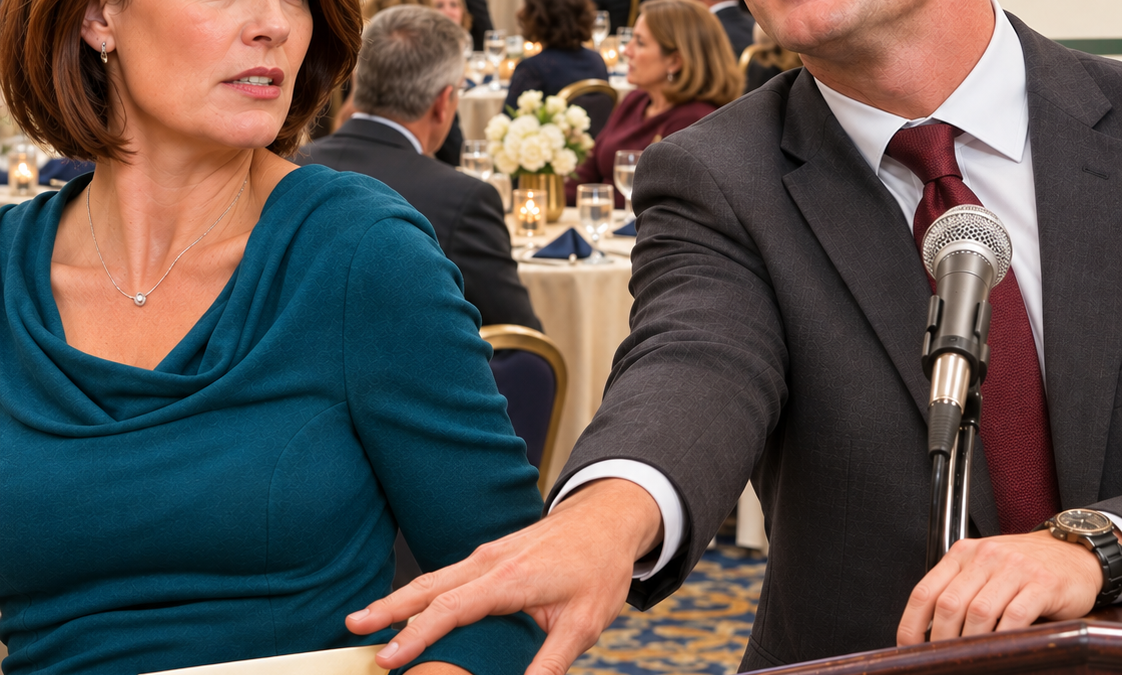
“She can’t get out of bed most days.” My husband said that while reaching for $18,400—Then I walked up in navy scrubs, and his boss turned the giant check toward me.
Complete story · 10 parts · about 38 minutes · ending included
Part 1 · Part 2 · Part 3 · Part 4 · Part 5 · Part 6 · Part 7 · Part 8 · Part 9 · Part 10
Part 1 of 10
“Isn’t Tuesday your chemo day, honey?” the woman on line two asked, while I had a beagle pinned to the table with one arm.
A moment earlier, the wall phone beside the door of Treatment room 2 had rung.
The front desk had called, “Mindy, line two — a Debbie, says she’s calling from your husband’s office.”
Chad Sundquist was my husband. I was 39, healthy, and a few hours into a regular Tuesday at Lester River Veterinary Clinic on London Road in Duluth. I’d worked there as a veterinary technician since 2012.
I tucked the receiver against my shoulder without moving my left arm. The veterinarian was clipping his nails at the stainless-steel table. The beagle’s back feet kept searching for somewhere solid to stand.
“This is Melinda,” I said.
“Oh, honey, hello. I’m Debbie Rask. My husband, Dale, is Chad’s boss at North Ridge Industrial Supply. I hope I’m not interrupting anything.”
“We’re doing a nail trim. Go ahead.”
The clippers snapped. His damp nose pressed into my sleeve.
“Chad said you used to work there. I only hoped someone could pass a message along. I didn’t think you’d pick up — isn’t Tuesday your chemo day, honey?”
I moved my forearm across his chest before he could jerk away.
“My what?”
“Your treatment, dear. I thought Tuesday was when you went in.”
The veterinarian paused with a paw cupped in her hand. She glanced at me, then waited for him to settle.
“I don’t have chemotherapy,” I said.
“Oh.” Debbie’s voice softened. “I’m sorry, honey. I must have misunderstood.”
Another extension rang in the lobby, its ordinary sound reaching me faintly through the closed door of Treatment room 2.
“Did you mean somebody else?” I asked.
“I was asking for you, Melinda Sundquist. Chad’s wife.”
“That’s me.”
For a moment I watched the veterinarian line up the next toenail in the cutter. She knew how to keep the quick clear even with an animal pulling against her grip. I shifted my palm under his breastbone, where he couldn’t twist away.
“Debbie, what did Chad say?”
“He told everyone on a Monday-morning video call in late August that you’d just been diagnosed with stage 3 cancer. That you had to stop working at the vet clinic. He said, ‘She doesn’t want calls or visitors. Texts wear her out. Send everything through me.'”
I looked toward the door. Beyond it, the lobby would be busy with dogs on short leads and carriers beside their owners’ knees.
“I’m at work. I’ve worked every Tuesday since 2012.”
Debbie went quiet long enough for that paw to be finished.
“Then I must have my days mixed up.”
“I’m here Monday through Thursday, and every other Saturday morning,” I said. “I haven’t been diagnosed with cancer.”
A faint scrape came down the line, as though Debbie had adjusted her grip.
“I didn’t mean to upset you, honey. There’s something I’d like you to know.”
“What is it?”
“The office raised money for your fight. People wanted to help. Dale wants to present it at the kickoff on Saturday, November 14, in Bloomington. We were hoping you might be there.”
He gave a short, offended whine. I eased his hindquarters back onto the steel while the veterinarian checked the nail she’d finished.
“What is that?” I asked.
“The company’s year-end kickoff party. Chad always comes. We thought it would be lovely if you could be there too. You don’t have to dress up or do anything special. Come as you are.”
Chad went to company events without me. “It’s just sales guys,” he’d say, laughing before I’d finished asking what time he’d be home. I hadn’t met anyone from his Bloomington office. He worked from our house in Lakeside when he wasn’t traveling.
“Did Chad tell you to call here?” I asked.
“No, honey. I thought I could leave an invitation with someone. I didn’t expect you to answer.”
The green lanyard shifted at my collar. I touched the badge hanging there. I’d swiped its magnetic stripe at the timeclock beside the break-room door at 6:50 AM, the same way I had on work mornings for 14 years.
With the receiver still on my shoulder, I thumbed my cell phone open to Chad’s 6:12 AM text.
Iowa till Wednesday. Love you.
He’d sent the same text every other Tuesday since September. I’d seen it while getting ready for work and hadn’t answered.
“Could you send me the details?” I said.
“Certainly, honey. I’ll send you the card the office signed, there at the clinic. Not to the house.”
“All right.”
“May I have your cell number?”
I read it out, listening while she repeated it back. She gave me hers in return. I saved the contact as “Debbie Rask.”
“Thank you for picking up, Melinda,” she said. “I hope we can meet at the kickoff.”
“I appreciate the invitation,” I said.
Across from me, the veterinarian set the clippers beside the table and reached for his other paw. He wriggled as I hung up, but my left elbow stayed snug against his ribs.
On the ledge beneath the phone lay a rabies-vaccine receipt. I wrote Debbie’s number on the back, folded it in quarters, slid it into the clear plastic sleeve behind the badge, and went back to holding the beagle.
I didn’t call Chad.
Part 2 of 10
Chad dropped his duffel at the foot of the stairs and said, “Company kickoff’s the fourteenth. Spouses aren’t invited this year.”
It was 7:00 PM on Wednesday, October 28, and dinner was already on the table when he came home from “Iowa.” He took off his coat without looking at me, then eased into the chair across from mine.
“You’d just get tired anyway,” he said.
“I’ll be at work.”
He gave his quick laugh, the one that usually arrived before an answer.
“Right. Your Saturday shift. I keep forgetting how they work you over there.”
I pressed the back of my fork into a potato until its skin split. Chad began eating while I straightened the folded napkin beside my plate.
Our wedding photograph from June 15, 2013, hung near the dining table. Below it sat a mortgage statement addressed to both of us. The wood house in Lakeside had belonged to us since 2016. When the furnace started, the vent behind Chad’s chair ticked.
Chad pushed his plate aside and checked his work calendar. As North Ridge’s only employee living in Duluth, he made the drive to Bloomington alone. He scrolled with his thumb while his supper cooled.
I carried my plate to the kitchen. His duffel stayed at the bottom of the stairs, one strap pinned beneath the weight of the bag.
On Monday, November 2, the front desk stopped me as I came out of a treatment room for lunch.
“Mindy, this came for you.”
An envelope lay in the receptionist’s hand, addressed:
Melinda Sundquist, c/o Lester River Veterinary Clinic.
There was no return address I recognized. I took it into the break room at about 12:15 PM and sat with my lunch beside my locker. The badge on its green lanyard brushed my shirt as I bent forward.
The envelope rested on my lap. I eased a finger under the flap so I wouldn’t tear the contents.
The first item slid free.
A get-well card, covered inside with signatures. I counted 31. Some people had signed in small, careful print; others had squeezed their names into spaces near the fold.
Across the top, in thick handwriting, someone had written:
“Beat this, Mel!”
Below that were the kinds of things coworkers wrote when they were trying to be useful.
“Please take good care of yourself.”
“We’re pulling for you.”
“If there’s anything we can do, say the word.”
A heart had been drawn beside the last one. I held it by its edges, careful not to smear the ink where a pen had pressed hard enough to leave a ridge.
Next came the invitation to the kickoff, printed on stiff paper. I laid it flat across my knees.
Saturday, November 14, 6:30 PM.
Ballroom of the Bridgewater Hotel, Bloomington.
Under the event details, a line read, “Spouses and partners welcome.”
I kept a fingertip on that line. Chad had told me spouses weren’t invited. The paper was clean and uncreased, with no correction written beside it.
The note was tucked beneath the invitation, a yellow sticky square with handwriting:
“Come as you are. — D.”
Its corner had folded back and snagged on the edge of the next sheet. I flattened it with my thumb.
At the bottom was a printout of the update email Chad had sent to the whole team on Monday, September 21. His name sat above the date. I stopped at a line in the body.
“Mel’s fighting. Some days I feel like I’m already a widower.”
Behind me, the refrigerator motor hummed. Through the window, Lake Superior was the color of wet pavement, and a few bare branches scraped the glass.
I brought the printout closer, holding the page by the bottom corners. The words stayed where they were.
A cabinet shut somewhere beyond the door. My lunch break wasn’t over, but I put the papers back in the order I’d found them: the card, the invitation, the note, and the update email.
The envelope fit inside my locker beneath my spare scrubs. I turned the key until the latch clicked, then tugged the handle to make sure it stayed shut.
Sitting back down, I opened the joint bank app on my phone. The balance looked normal. So did the recent transactions.
I closed the app and finished eating, though the food had gone cold.
On Tuesday, November 3, a little after seven, I left my phone on the kitchen counter and went to shower. The bathroom mirror had fogged over by the time I turned off the water.
I combed my wet hair away from my face with my fingers and stepped out into the hallway. The house was quiet except for the old furnace coming on below the stairs.
Chad stood in the kitchen doorway holding my cell phone.
He hadn’t changed out of his work clothes. His thumb rested near the bottom edge of the glass, and the light caught the lines around his eyes when he looked up.
The lock screen showed a name: Debbie Rask.
I stopped with the bathroom towel draped over my shoulder. He tilted the phone toward me, keeping his fingers wrapped around the case.
For a few seconds he watched my face. I waited with my hand still holding the towel.
Then Chad held out the phone and said, “Why is Dale’s wife calling you? Don’t call her back. Dale’s wife is a busybody — it’s office politics. If she starts talking, I lose my job — and your name’s on this mortgage too.”
Part 3 of 10
Sharon turned the card face down on her desk and said, “Then we prove where you were.”
It was 7:00 AM on Wednesday, November 4. Sharon Ostby, 61, had been the practice manager at Lester River Veterinary Clinic and my boss for 14 years. Her desk was covered in files, though she could reach the one she needed without moving the others.
I stood opposite her, still wearing the badge on its green lanyard.
She flattened the card with her palm. She’d looked at the signatures, the handwriting at the top, and the messages crammed into the folds. Her glasses rested low on her nose.
“The timeclock keeps every punch.”
She pulled a blank sheet from the stack beside her keyboard and slid it across the desk. A pen followed.
“Ask for your own records. Start where this started.”
I wrote a single line requesting my timeclock entries from September 1, then signed beneath it. My signature leaned uphill at the end where the pen had skipped.
Sharon looked at what I’d written. She didn’t offer to clean it up.
“He’s ‘in Iowa’ every other Tuesday and Wednesday. Next one’s the tenth,” I said.
Sharon kept the paper square with the edge of her blotter.
“Minnesota gives me seven working days. I’ll run it after next Tuesday and Wednesday, so his next ‘chemo’ days are on it too. You’ll have it next Thursday, the twelfth.”
“All right.”
She slipped my request into a file without covering the card.
“Who signed his paperwork? Somebody had to.”
I glanced at the card, still face down beside her hand.
“I don’t know.”
“Find out what you can,” Sharon said. “Don’t bring me guesses.”
Sharon held out her hand for the pen. Its cap had a bite mark near the clip. I gave it back and went out to start my shift.
Chad had left for an actual work trip to Iowa that morning. He wouldn’t be home until Thursday evening.
Later that Wednesday, I went into our home office. The house was quiet except for the furnace cycling beneath the floor. I switched on the desk lamp and pulled its light toward the four-drawer filing cabinet.
The bottom drawer held our tax papers. I knelt and eased it open so the hanging folders wouldn’t jump from their slots.
Behind them sat the BENEFITS folder, its label written in Chad’s block handwriting. He pressed hard when he wrote, leaving dents that showed through the paper.
I took it out and laid it beneath the lamp.
A printed HR email was on top. The line near the middle read, “approved — donated hours received: 160.”
I held the page closer to the light, keeping my thumb clear of the print, and thought of the 31 names on the card.
Beneath it was the company’s medical certification. At the top, the letterhead said “Superior Shore Cancer Specialists.”
The bottom of the page was signed “R. Nyberg, MD.”
Above it, a line stated “chemotherapy every other Tuesday beginning September 1.” The next line read, “Spouse needed the day of and the day after.” He had written himself the days off.
I sat on the floor inside the circle of lamplight, with the form across the folder on my knees. The paper looked almost translucent where the light fell. Below me, the furnace quit, leaving a faint ticking in the vent.
I used my phone to capture the HR email, moving it until the entire page fit in the frame. I photographed the form next. I checked that the lettering was readable, then placed both originals back in their previous order.
The BENEFITS folder went back into its original slot. I closed the drawer without slamming it, and turned off the lamp.
At lunch on Thursday, November 5, I searched for Superior Shore Cancer Specialists on my phone.
The clinic’s break room was empty. My meal sat beside my elbow while I tried the name with Duluth, then without it.
No Duluth clinic by that name appeared in the results.
I checked the spelling against the photograph. Superior. Shore. Cancer. Specialists. The words on the form were clear.
I searched the location printed beneath the letterhead.
The address pointed to a lot on London Road, the same road I drove to work every morning. No medical office was listed there.
I put my phone down and finished the rest of my shift. A shepherd mix needed its nails clipped. A tabby’s rabies tag waited at the front desk. I washed the stainless-steel table before I left, wiping around the legs where water had collected.
By about 6:00 PM, it was dark.
I drove down London Road and slowed near the address from the form. My headlights swept over dry grass behind a chain-link fence. Under a streetlight, I could see bare ground stretching toward the back of the empty lot.
No building stood there.
I pulled over and stayed in my car. The engine idled while the beam from the headlights shone across a patch of weeds. I took my phone from the seat and opened the photograph of the form.
The letterhead filled the display. I moved down past the printed treatment line, toward the patient information box. My thumb slipped on the glass, and I steadied the phone with my other hand.
I zoomed in until the small type came into focus.
The box marked “Patient’s date of birth” read “June 15, 1987.”
My birthday was March 9. June 15 was our wedding day.
Part 4 of 10
The woman in Chad’s HR office was polite in the way people are when they’ve already decided not to help you.
At 12:20 PM on Friday, November 6, I sat in my car in a grocery store parking lot with the engine off. It was my day off. Chad was working from home, so I’d driven somewhere I could make the call without him hearing it.
“North Ridge Industrial Supply, Human Resources. Kristin Aho speaking.”
Kristin was the HR director at my husband’s company. I watched a shopping cart roll across the pavement before I answered.
“If an employee’s wife has a concern about a leave file, how does she raise it?”
“I can’t discuss any employee’s file with you. If you have a concern, put it in writing.”
“Thank you,” I said.
“You’re welcome.”
I hung up and set the phone in the cup holder. I had photographs of the papers in the BENEFITS folder, but nothing yet from my own clinic. Sharon had my request for the timeclock records, but they weren’t ready.
I didn’t send anything. Outside, people loaded grocery bags into trunks and hurried into their cars, shoulders hunched against the wind. I waited until a cart rattled past my bumper before turning the key.
On Saturday, November 7, at 9:14 AM, my bank app buzzed on the nightstand.
The furnace fund was empty. An outgoing transfer showed $7,300.
I opened the transaction. The destination was a credit card in Chad Sundquist’s name alone. I’d never seen that card.
That money had taken three years to save.
The twenty-two-year-old furnace had started making a scraping noise when the blower ran. We’d kept adding to the savings instead of replacing it immediately, watching the balance climb through summers when the house barely needed heat. I knew how much was there because I checked every time the old unit made a new sound.
At 9:30 AM, Chad stood in our kitchen making coffee. He was filling his mug when I set my phone on the counter, the transaction open.
“Did you move this?”
He leaned closer. The coffee maker clicked behind his wrist.
“It’s on a credit card,” I said. “In your name.”
Chad gave a short laugh before answering, as if I’d asked him whether he’d remembered to buy milk.
“I’m handling it. You’ll get it back after the kickoff.”
“That was for the heat.”
“I know what it was for, Mel.”
He screwed the lid onto his travel mug and checked the transfer again. He didn’t touch my phone.
“I told Dale you’ve been confused lately — the stress. So if his wife calls, don’t embarrass yourself.”
My fingertip left a print on the glass. I wiped it off with the hem of my shirt.
Chad took his coffee into the home office. The chair rolled across the floor when he sat down. I dried the damp spot beside the sink with the dish towel and hung it back on the oven handle.
At 3:00 AM on Sunday, November 8, the blower woke me with a ragged metallic rattle. It shuddered, made a small click, and went still.
I waited under the covers for the familiar rush of warm air through the bedroom vent.
Nothing came.
At 7:00 AM, the thermostat on the living-room wall read 54°F. I pressed the temperature setting higher. The digits changed, but there was no response from below the floor.
Chad planned to spend the day bowling. He took his bag from beside the stairs while I stood at the thermostat with my clinic uniform jacket zipped over my pajamas.
“Did you hear it stop?” I asked.
He pulled on his coat.
“I heard something. I’ll look at it when I get back.”
The front door shut. His car started outside and backed down the driveway.
I brought the small electric space heater over, plugged it in, and sat on the sofa with my feet in front of the grille. My toes warmed while the rest of the room stayed cold. I leaned forward until the heat reached my knees. The zipper on my jacket scratched my chin whenever I looked down.
A strip of daylight fell across the floorboards. I watched it move past the legs of the coffee table.
The bank app still showed the transfer. The furnace fund remained empty.
I switched to the recent-calls list and stopped at the number for North Ridge HR. Their office was closed on Sunday. I locked the screen, set the phone face down on the table, and drew my sleeves over my hands.
At 4:00 PM, I went into the kitchen to find the furnace warranty. I remembered leaving it among the appliance papers in a drawer.
I moved aside folded instructions and old recipe clippings. My fingers brushed a flat, smooth edge beneath them.
The kitchen iPad.
We’d propped it on the counter for cooking until it ended up buried in that drawer. Chad had set it up years ago with the same account he used on his phone. He’d never put a passcode on it.
I pressed the button. The battery was dead.
I plugged the kitchen iPad in beside the coffee maker. The screen lit up without asking for a passcode.
Part 5 of 10
At 5:30 on Monday morning, with Chad asleep upstairs, I opened his email on a tablet we used for meatloaf recipes.
His Mail and Messages still came through on it. I sat at the kitchen table with it on my lap, my bare feet flat on the cold tile. The house was dark above the stairs.
His inbox held an August credit card statement. I angled the iPad toward the table so its light didn’t reach the staircase.
I scrolled down.
“New balance: $18,400.00”
The October statement showed a payment of exactly half that amount. The payment date sat beside it.
There were also emailed statements for a checking account in Chad’s name alone. It wasn’t part of our joint banking. A deposit had arrived from a credit union I didn’t recognize, then gone out to his credit card that same day. The heading showed his name and no one else’s.
I searched farther down the inbox. Deposit receipts from a sports betting app sat among the emails. Every receipt had a date. Many were on the Tuesdays he called “chemo” on the form and told me he was in Iowa.
I opened Messages.
A thread with Amy Moe appeared among his conversations.
On September 8, Chad had written, “Goal’s $18,400. That’s what insurance won’t touch.”
The next morning Amy had answered, “Fund’s open at my credit union. Whatever you need.”
I went back to the August statement and held my thumb beneath the same number. My knees pressed against the underside of the table while I looked at it.
In the thread, Chad’s October 9 message said, “Any chance I could get the first half now? Bills can’t wait.”
Amy answered, “Sent the first half!”
I returned to the checking-account statement. The credit union deposit was dated October 9. So was the payment to his card. I set my palm flat beside the iPad.
Using my own phone, I photographed each screen: the statements, the bank entries, the betting receipts, and the messages. I kept the dates and senders visible in every shot. When I finished, I checked the pictures on my phone rather than opening anything else on his account. Every date was readable without zooming in.
A floorboard creaked upstairs. I froze with my hand over the iPad until the house went quiet. No footsteps followed. I slid the kitchen iPad into my purse and went to get ready for work.
At the clinic printer, I made paper copies of the photos from my phone. I also printed my two photos from the BENEFITS folder, put everything in a blue folder with the form on top, and kept the folder with my things before returning to the treatment rooms.
On Thursday, November 12, at 5:40 PM, Sharon laid the punch report on her office desk.
It was on Lester River Veterinary Clinic letterhead, bore her signature, and ran from September 1 through that morning’s punch. Every Tuesday and Wednesday showed an IN punch before 7:00 AM. The rows left no gap where Chad had told his coworkers I was getting treatment. I had made those swipes myself, usually with my coat still on. Sharon slid the page closer so I could see the last line.
I stayed on my feet while she went through the rest. She had waited until this week’s “chemo” days were included, just as she’d said she would. The badge rested at the end of its green lanyard against my scrub top.
She read the copy of the form. Her pen stopped under “Spouse needed the day of and the day after.”
“Chad told Dale I’ve been confused lately. He called it stress,” I said.
Sharon put down the pen.
“I work Saturday morning,” I said. “I’ll drive straight to Bloomington afterward.”
“And when they hand over the check?”
“I’ll bring the folder up to the stage. They can see the report and what he sent them.”
Sharon kept her hand on the desk.
“If he sees you before you reach that stage, he’ll walk you out and tell them you’re confused. He’s already told his boss that.”
“I’ll wait until they’re handing it over.”
“And HR?”
“I’ll send Kristin the documents in writing Monday morning.”
“Keep the originals where they are,” she said. “Take what you can show them.”
Before I left the clinic, I called a family lawyer’s office in Duluth. The earliest appointment was Monday, November 16, at 5:45 PM, after my shift. I took it and wrote the time on the inside cover of the folder.
At 11:04 PM Thursday, Chad was upstairs. The bedroom light still showed beneath the door.
On our kitchen table, the folder lay open with the punch report on top. The kitchen iPad was face down beside it. I turned it over, opened Messages, and went to Amy’s thread. A new message from Chad sat at the bottom:
“Can Dale hand me the real check Saturday instead of mailing it? I’ll mobile-deposit it that night. The card payment’s due Monday.”
Part 6 of 10
“Get some rest this weekend,” Chad said, zipping the garment bag over his new suit.
It was six o’clock Friday evening, November 13, and he was already at our front door, smoothing the fabric with his palm. The zipper had snagged near the collar. He worked it loose without looking at me.
The night before, Thursday at 11:30 PM, I’d sat at the kitchen table with my badge in my hand. The rabies-vaccine receipt was still folded inside the clear plastic sleeve. I left it there, opened Debbie’s contact, and sent a text.
“I’ll be there Saturday. Please don’t tell Chad.”
Her answer came back: “Table 14. Come as you are.”
At 8:05 AM Friday, I’d gone to my car parked in front of our house. Chad was working inside, and it was my day off. I called the North Ridge HR number to ask where to send what I had, and got a recording.
“Our office is closed Friday for kickoff setup and will reopen Monday at eight. Voicemails and emails will be answered when we reopen Monday.”
I ended the call without leaving a voicemail.
Now, at the front door, Chad got the zipper past the snag and lifted the garment bag off the railing.
“You can have a quiet house,” he said. “Won’t that be nice?”
“I’ll be at work.”
He picked up his duffel and carried both bags to the car. I watched from the entryway until his taillights turned off our street.
Friday at 9:12 PM, I opened Messages on the kitchen iPad. Amy had answered Chad.
“Of course! Dale will hand you the real check on stage, right along with the big one.”
Beneath it, Chad had written, “Wrote a little speech. Mel would want me to take it.”
I took a picture of the screen with my own phone. The kitchen iPad went back into my purse. I put my phone beside the folder. Everything else I needed was in my locker at the clinic.
On Saturday, November 14, I swiped the badge at the timeclock at 6:50 AM. My scrub top was navy, and the green lanyard hung over the pocket. Work began as it always did: an animal shifting under my hand, the snap of nail clippers, someone calling from the front desk.
At 1:00 PM my shift ended. I took the card, the update email, and the invitation from my locker and slipped them into the folder. The note I kept in my hand. I didn’t change out of my scrubs.
Before leaving, I pressed the note to the dashboard. I drove south on I-35 with the folder on the passenger seat and the handwriting facing me.
“Come as you are.”
The drive was 155 miles.
By the time I reached Bloomington, the light was fading. I parked in the diner lot across the street from the Bridgewater Hotel, where Chad wouldn’t spot my car. Beyond the windshield, people in dress clothes crossed toward the hotel entrance.
I stayed in the driver’s seat until 6:15 PM. The engine was off, and by six I couldn’t feel my toes inside my clinic shoes. I straightened the papers, got out, and crossed the street with the folder against my side.
At 6:20 PM, the lobby was warm enough that my scrub jacket felt unnecessary. Near the ballroom entrance, a check-in table was set with a guest list. I handed over the invitation, pointing to the printed line “Spouses and partners welcome.”
The woman at the table ran a finger down the list.
“You’re here with Debbie Rask?”
“Yes.”
She marked me down as Debbie’s guest.
Debbie came toward me before I’d cleared the table. I knew her voice when she said, “Melinda, honey.” This was the first time we’d met in person. She hugged me, briefly and firmly, then touched my elbow to guide me toward the ballroom. She asked nothing.
We passed tables where suits hung over chair backs and women smoothed their dresses before sitting down. My navy scrubs made a soft brushing sound as I walked. I kept the folder tucked close.
“He won’t turn around. He never does,” Debbie said.
At table 14, beside the service door at the back, she showed me a chair. From there I could see the podium and microphone at the front. To its right stood the big check on an easel. A woman waited beside it with the envelope in her hand.
Table 1 sat directly in front of the podium. Debbie tipped her head toward the front. “Dale, Kristin from HR, and Chad. That’s Amy by the easel.” Dale and Kristin sat facing us. Chad sat with his back to the room, his head bent toward Dale as he spoke. I recognized the way he moved his shoulders when he laughed.
Debbie sat beside me. When a server moved past our chairs, she held the edge of the tablecloth so it wouldn’t catch on my folder. Her other hand rested near mine for a moment, then withdrew.
By 7:40 PM, the ballroom held 120 people. Conversations quieted as Dale went to the podium.
“With North Ridge matching every dollar you gave, we raised $18,400 for Melinda.”
He called Chad forward. Amy stood beside the easel, still holding the envelope. Chad climbed onto the stage and accepted the microphone. He smiled toward the tables.
“Mel wanted to be here so badly. She can’t get out of bed most days. She’d want me to take this for her.”
Debbie’s hand closed over my wrist, then let go.
I stood up at table 14, the badge on its green lanyard at my neck and the folder under my arm, and walked straight up the middle of the room toward the podium.
Part 7 of 10
Chad said my name like a question, and a hundred and twenty people turned around to look at a woman in navy scrubs.
I reached the front as he lowered the handheld microphone, and took the two steps up onto the stage. Chad stood a step to my left, with Dale on my right. My husband still had his speech folded in his hand.
“Mel?”
“I need the microphone,” I said.
Dale Rask looked from my work clothes to the green lanyard around my neck. His hand stopped halfway toward Chad. Beside the easel, Amy held the envelope close to her waist.
“I’m Melinda Sundquist,” I said.
Dale waited, then lifted the big check off its stand and held it out to me.
“Then this is yours, Melinda.”
Its stiff edge pressed into my forearm. Amy stepped forward and gave me the envelope. The paper inside shifted when I took it. I left the seal intact.
I leaned the big check back against the easel. At the podium, I set down the envelope and opened the folder. The podium microphone was still angled high for Dale; I bent it down toward me. A breath went through the speakers, followed by a brief squeal. Nobody spoke while I found the card.
I held it up with the signatures facing the room.
“Thirty-one of you signed this. Thank you. I mean that.”
At table 1, a man pushed his plate aside. Another person bent forward to see the handwriting. At the back, I could make out Debbie at table 14, her hands resting on the cloth.
The card went on the podium. I took out the punch report and lifted it high enough for Dale to read the clinic letterhead. He leaned toward the page without taking it.
“This is my clinic’s timeclock report, signed by my manager. It starts September first.”
I held the page steady. The rows of dates were small from that distance, but my manager’s signature filled the bottom of the page. Dale’s hand dropped to his side. Chad moved closer, so I had to shift my elbow to keep the report straight.
“Honey, you’re confused. The treatments do that. Let’s get you home.”
His voice was low, but the microphone carried it. He put his free hand out as though he meant to guide me away. I moved the paper to the other side of the podium.
“Stay there, Chad.”
From the folder I took the form. Its letterhead faced Dale before I turned it toward the tables. The paper trembled once where my thumb met the corner. I pressed it flat.
“This says my birthday is June fifteenth. That’s our wedding day. There is no Superior Shore Cancer Specialists.”
Dale turned to Chad, who started a word and didn’t finish it. He flattened his folded speech against his thigh. A chair scraped near the front, and the sound traveled all the way to the back of the ballroom.
“I was going to pay every cent back. We had bills, Mel. I did it for us.”
I put the form beside the report. Then I took out the update email. Its paper had bent slightly inside the folder; I smoothed the crease with the side of my hand. The speakers picked up the dry scrape of my hand across the wood.
I read Chad’s line into the microphone.
“‘Some days I feel like I’m already a widower.’ I’m right here, Chad.”
He looked down at the paper in his own hand. His fingers had crushed the bottom edge of it. In the first row of tables, a woman put her hand over her mouth. Dale took one step back from Chad, toward the easel.
Amy stepped away from the easel. She stopped where the microphone would pick up her voice.
“He asked me for the first half early. Nine thousand two hundred dollars. I sent it October ninth. I should have asked who his doctor was.”
Amy stayed where she was, hands at her sides. I slid the printed photo of the August statement out of the folder and laid it in front of Chad.
“His card balance in August was $18,400. That was your goal.”
Chad’s jaw tightened. He looked at Amy, then at Dale, the speech balled in his fist. He did not reach for the statement. A fork rang against a plate at the front.
I picked up the envelope, still sealed, and placed it in Amy’s hands.
“Please give it back.”
Amy closed her fingers over it. At table 1, Kristin Aho pushed back her chair. She came up beside the podium and waited until I moved away from the microphone.
“Many of you donated hours through my office, so I’ll say only this tonight: Chad, my office, Monday at eight.”
Several people at table 1 set down their glasses. Nobody clapped. Kristin stayed at the microphone while Chad looked past her at the rows of faces. Debbie hadn’t moved from the back.
I closed the folder, looked at Chad, and said, “I clocked in before seven, Chad. Every one of those Tuesdays.”
Part 8 of 10
Chad came home at eleven on Sunday, and his mother was already waiting for him in Cloquet.
I was at the kitchen table with a warm mug between my hands, and I didn’t get up. Chad stood in the doorway with his bag, still wearing the suit he’d worn at the kickoff. His collar was open, but he hadn’t taken off his coat.
I’d called his mother Saturday night after leaving the hotel. She had listened without interrupting. When I finished, she told me he could stay with her, provided he went to a Gamblers Anonymous meeting every Tuesday night.
“Your mother said you could stay,” I told him.
“I talked to her.”
“She told me about Tuesday nights.”
He shifted his grip on the bag. The handle creaked.
“I know.”
He glanced toward the stairs. The hook by the front door where he usually hung his coat was bare. I moved my mug aside.
Chad turned and left for Cloquet. I heard the latch catch behind him and watched the empty hook while my coffee cooled.
On Monday, November 16, on my lunch break, I emailed Kristin Aho copies of the punch report and the form, with my concern in writing, as she’d asked.
Kristin’s reply was two sentences: she had my documents, and Chad would not be working while the review was open.
I saved the reply with the other records and went back to the treatment rooms.
At 5:45 PM that Monday, after my shift, I sat in a family lawyer’s office in Duluth. I had the folder on my knees and the mortgage information beside it. The lawyer looked at the transfer from the furnace fund, then at my copy of the form.
“Minnesota doesn’t care whose fault it is. It does care where the furnace money went.”
The lawyer squared the pages into a stack, and I signed the divorce petition at each flag. The pen made a slight groove in the paper where I pressed too hard. I took my copy home inside the folder, with the corners lined up so they wouldn’t bend.
On Thursday, November 19, at 8:45 PM, my phone lit up while I stood at the kitchen sink.
Chad had sent a text.
“They fired me today. Hope you’re happy. Can we talk Monday?”
I set the dish towel down and typed, “I’ll be at work.”
His message stayed above my answer. I left the conversation there.
Amy called that same evening. She’d asked for my number at the hotel, when people were still making their way out of the ballroom. I stepped away from the sink before answering.
“Melinda? It’s Amy from North Ridge.”
“Hello, Amy.”
“I thought you should hear what they told everyone.”
I leaned against the counter. The dark window over the sink showed only the small light above it.
“Kristin told us: donated leave needs a doctor’s certification, and faking one gets you fired.”
“Thank you for telling me.”
“They gave every hour back to the people who signed them over,” Amy said.
Amy waited while I folded the towel over the edge of the sink.
“I’m glad they got those hours back.”
“I wanted you to know.”
“Thank you, Amy.”
When the call ended, I set the phone face down by the sink and went upstairs.
On Monday, November 23, my lawyer filed my signed petition in St. Louis County.
On Thanksgiving, Thursday, November 26, around midday, I was home while the clinic was closed. A repairman had patched the old furnace enough to keep the pipes from freezing, but the house stayed cold, and the small electric heater ran beside the sofa. I carried a cup of tea into the living room and settled with my feet near the grille.
Chad’s mother called.
“There’s a plate for you here if you want it. He’s eating at his cousin’s.”
“That’s kind of you. I’m staying home, but thank you.”
“All right, dear.”
I wished her a good Thanksgiving and ended the call. The house stayed quiet. I set the cup on the floor and turned the heater a little toward my shoes.
On Saturday, November 28, I worked the morning shift at Lester River Veterinary Clinic. The treatment rooms smelled of disinfectant, and a small stack of rabies-vaccine receipts waited by the register to be filed.
At 12:55 PM, I was wiping down the front counter when the bell on the glass door rang. I finished the section beneath my hand and looked up.
Debbie Rask came into the lobby. Without saying anything, she laid a printout of the clinic’s staff web page on the counter. The date in the corner said 9/22/26, a Tuesday, more than a month before she’d called and asked about my chemo. My name was circled in red ink: “Melinda ‘Mindy’ Sundquist, CVT.” In the margin, in the same hand as the yellow note, she had written, “Call on a Tuesday.”
Part 9 of 10
“I watched him cheer a football score on his phone the same month he told us you were in chemo,” Debbie said.
At 1:00 PM on Saturday, November 28, the last patient had gone home. We sat on the bench in the lobby, the printout resting across my knees. The phones were quiet, and the CLOSED sign faced the parking lot.
“It was the company picnic in Bloomington, back in September,” she said. “Chad kept checking scores all afternoon. He’d laugh and raise his arm when one went his way. I thought that was an odd way to act with his wife so sick.”
I ran my thumb down the margin, beside the words “Call on a Tuesday.”
“I asked him who your doctor was. He said, ‘Dr. Nyberg, at Superior Shore.'” Debbie adjusted the sleeve of her coat. “I spent thirty-four years as an oncology nurse. I’d never heard of him or that practice.”
“So you looked for me.”
“I found the staff page on your clinic’s website. Your name was right there, saying you still worked here.” She touched the red circle. “I printed it September twenty-second. Then I kept it.”
“Until October.”
“For more than a month. I kept thinking I ought to be certain.” She folded her hands together. “Then I waited for a Tuesday, one of your chemo days. I wanted to hear who answered.”
I glanced down the hall toward Treatment room 2, where I’d taken her call on the wall phone.
“And the invitation?”
“‘Come as you are’ was on purpose, honey. Wear what you wear on a Tuesday.” Debbie smiled at my scrubs. “I didn’t want you worrying about a dress.”
She straightened the curled corner of the paper where it lay across my leg.
“I put Chad’s update email in that envelope on purpose. If I’d only told you what he wrote, you could have called it gossip. I wanted you to read ‘already a widower’ in his own words.”
“Why didn’t you tell Dale?”
Debbie looked at her hands before answering.
“A hunch isn’t proof, and Dale signs his paycheck. It was your name he was using. That made it yours to decide. If you hadn’t come, I’d have been in Kristin’s office Monday with this.”
“You could have just told me.”
“I did. You picked up.”
Debbie patted the bench between us and rose. She left the printout with me. I slid it into the folder before walking her to the glass door.
On Monday, December 7, Sharon called me into her office at the clinic. A file lay open beside her keyboard, with a corner folded down.
“I’m retiring in April,” she said. “I want you to train as the next practice manager.”
I looked at her across the desk.
“You’d still do your work here,” she said. “But you’d learn mine. It isn’t glamorous.”
“Yes.”
Sharon nodded once, as if I’d confirmed an appointment.
“Good. We’ll start with the paperwork nobody else wants.”
She turned the open file toward me and tapped the first page. I took the chair opposite her.
On Friday, December 18, Chad sold his pickup and paid $9,200 back into Amy’s fund.
On Monday, December 21, Amy returned the money to all 31 coworkers in full. The same day, a new card arrived at the clinic. I opened it at the front desk with the edge of my badge resting on the counter.
Inside were 31 signatures. Across the center, someone had written, “For Melinda — who was at work.”
Some of the handwriting matched the first card, the one that began “Beat this, Mel!” I held the card out to Sharon.
She read it without adjusting her glasses.
“That’s going on the bulletin board.”
In the break room, she pinned it where everyone could see it. The paper settled against the board when she took her hand away.
“Sharon, can I leave at 3:30?”
She looked at the clock.
“Lawyer?”
“Yes.”
“Go. I’ll cover the rest.”
Sharon went back to her office. At 3:30, I swiped the badge at the timeclock and left.
At 4:00 PM, I sat at a long table in my family lawyer’s office in Duluth. Chad was at the far end, looking down at the papers in front of him. He didn’t look up when I entered.
The property settlement lay before me. The house would be mine. His credit card debt was his, and $7,300 from the furnace fund would be deducted from his share of the house.
I followed the lines with my finger. The lawyer turned the pages to the signatures. Chad signed first, then rolled the pen down the table so it stopped short of my hand.
I signed under the line that said the house in Lakeside went to me, then folded my copy into the pocket of my uniform jacket. Tomorrow was a Tuesday.
Part 10 of 10
The house was warm when I left it that morning, and the timeclock beeped at 6:50 like it always had.
I let the badge swing back against my scrub top on its green lanyard. The new furnace had gone in on Saturday, December 19. The installer had spread the cost over a year of monthly payments, and since that Saturday the heat had reached the upstairs bedrooms without the old rattle.
Through the break room doorway, I could see the new card still pinned to the bulletin board where Sharon had put it. Its corners had begun to curl outward, but the handwriting was big enough to read from there.
“For Melinda — who was at work.”
I straightened the cuff of my scrubs and went down the hall. At the front desk, the appointment sheet was waiting beneath the day’s paperwork. A familiar name appeared beside the entry for a nail trim. The request underneath it was brief: Tuesday, please.
At 10:30 AM, Debbie and Dale Rask came into Treatment room 2 with Rufus, their old Labrador. They were spending Christmas at their place near Two Harbors. Melted snow still darkened a few patches of the dog’s thick coat. Rufus walked slowly, pausing whenever the leash drew tight, but his tail tapped Dale’s trousers when he heard Debbie speak.
“He knows where the treats are,” Debbie said.
“He’s worked that out at every vet clinic,” Dale said, taking off his cap.
The veterinarian came over to the stainless-steel table. Dale helped Rufus climb up while I steadied his chest. His back legs needed a moment to find their footing. Debbie stayed near his head, stroking the fur between his ears while I gathered his foreleg into my palm.
“Easy, Rufus,” I said. “You can lean on me.”
He did. His shoulder settled under my arm, heavy and warm. A nail clicked against the steel as he adjusted his stance. The veterinarian examined the tips before bringing the clippers close.
Dale had stepped back to the door with his cap in both hands. He turned it by the brim, flattening a crease that didn’t need flattening.
“Melinda,” he said.
I looked up, keeping my left arm snug across Rufus’s chest.
“I wanted to say something to you myself.”
The veterinarian paused with the clippers. I freed my right hand, and Dale stepped closer to shake it. His palm was dry; he held on only long enough to meet my eyes.
“I signed off on that leave. I should have asked.”
“Thank you for saying that.”
He gave a small nod and went back beside the door. Debbie rubbed Rufus’s cheek with her thumb. The dog watched her closely, as though waiting for permission to leave.
“We’re nearly done,” I told him.
The clippers closed on another nail. Rufus flinched at the sound but didn’t pull free. The veterinarian waited for his foot to relax, checked the edge, and took a smaller cut. I turned the paw slightly so she could see the next tip.
“He doesn’t like anyone handling these anymore,” Debbie said. “At home he hides them under himself.”
“Most dogs have an opinion about nail trims,” I said.
Dale laughed softly. Rufus gave a long sigh through his nose and leaned harder against my hip. I shifted my feet rather than making him stand straight.
Debbie glanced at the green lanyard where it hung over my scrub top. Her mouth curved.
“Isn’t today your chemo, honey?”
“It’s Tuesday. I’m at work.”
Sharon was passing the open doorway. She stopped when she heard my answer and laughed out loud. The veterinarian smiled without letting go of Rufus’s foot.
“You picked your day well,” Sharon told Debbie.
“I thought I had,” Debbie said.
Sharon went on down the hallway, still smiling. Dale tucked his cap under his arm and stepped nearer to the table, where Rufus could see him without turning. The old Lab rested his chin against Debbie’s sleeve while the veterinarian worked on the remaining nails.
I watched the angle of each cut. When his leg stiffened, I gave him room to settle, then guided it back. Nobody hurried him. Dale held his hand near Rufus’s nose, and the dog sniffed it with great seriousness before closing his eyes again.
“He’s being good,” Debbie said.
“He is.”
While I held Rufus’s paw still for the veterinarian, I met Debbie’s eyes.
“Showing up every single day isn’t nothing. Somebody ought to notice.”
Debbie’s fingers stopped at the edge of Rufus’s ear. Dale studied the floor. Then Debbie resumed stroking the dog’s head, slow enough that he could keep his balance.
The last clipping dropped into the tray. Rufus lifted his head, looked from Debbie to me, and licked my wrist. Debbie reached over and touched the badge at my neck. Behind it, inside the clear plastic sleeve, the rabies-vaccine receipt was still folded in quarters, with her number written on the back.
It was a Tuesday, so I was at work — and this time, everybody knew it.
THE END
More stories
My Brother-in-Law Told an Estate Manager I Was Entering Memory Care and Advertised One October 31 Sale, but My Refusal Left Every Shopper Standing Outside My DoorMy Daughter’s Groom Held Up a Bent Metal Pipe, Mocked My Knees, and Said He’d Own My Shop—Then the Eleven Electricians Who Owned It Told Him at the Wedding He Had No Management JobMy Fiancé Promised to File a Police Report After My Husband’s Guitar Vanished, but Never Gave Me a Number—Until His Own Paperwork Exposed Him at a Public Performance.My Husband Gave His Ex-Wife One of My Mother’s Three Rings and Humiliated Me Before 48 Guests—Until His Own Sister Ordered Her to Return It and Leave My House.My Ex-Husband Took Over My House With 2 Bowling Friends and Mocked My Librarian Job—Then the Door Log Helped Get Him Removed in Front of His GuestsMy Daughter’s Groom Planned to Sell 6 Acres of My Farm for $420,000—Until His Own Microphone Exposed Him Before 160 Wedding Guests, and My Daughter Refused to Marry Him








