My Boss’s Daughter Fired Me by Text After 26 Years and Changed the Locks—Then 10 Tax Envelopes Proved I Owned Part of the Diner She Tried to Sell
Complete story · 9 parts · about 38 minutes · ending included
Part 1 · Part 2 · Part 3 · Part 4 · Part 5 · Part 6 · Part 7 · Part 8 · Part 9
Part 1 of 9
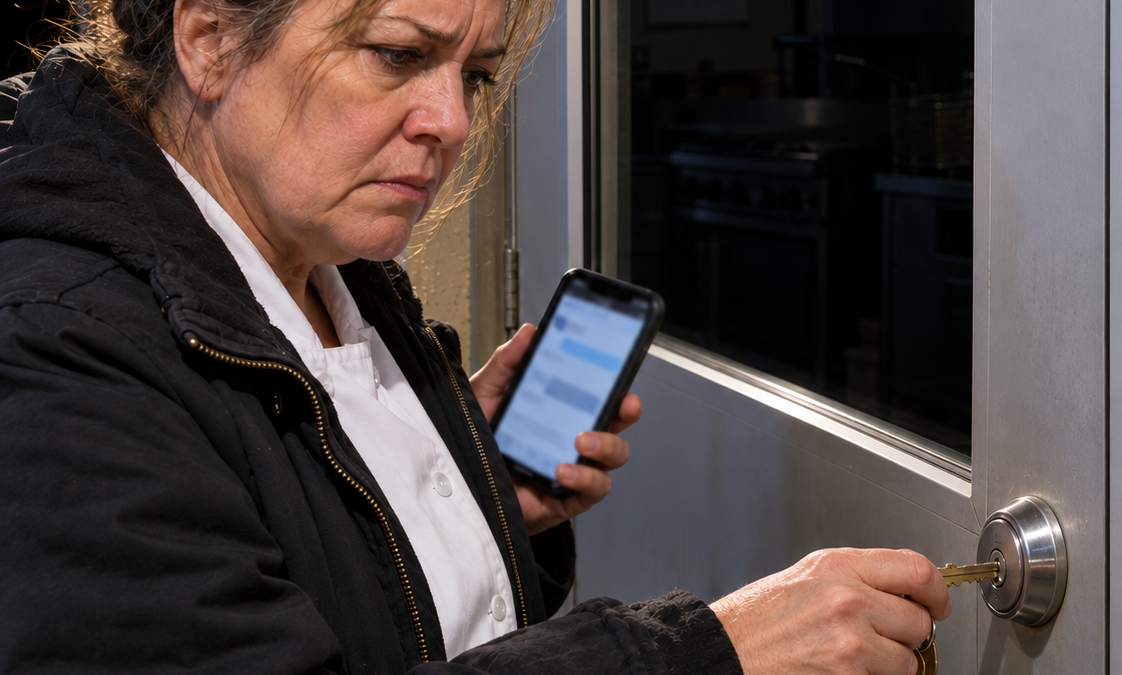
My key went into the back door of Lutz’s Grill and wouldn’t turn.
I pulled it out, wiped it against my coat, and tried again.
Nothing.
The lock was shiny silver. No scratches around the keyhole. Somebody had replaced it since I’d left work.
It was 4:55 Monday morning, September 28. The parking lot was empty, and the security light above the door made the concrete step look almost white.
I’d been opening this door since March 2000.
Twenty-six years.
I knew how far to lift the handle when the weather turned cold. I knew which hinge squeaked and where to stand when the delivery truck backed up.
This wasn’t my lock.
I took out my phone.
Courtney Lutz Wexler’s message was still there, sent Saturday, September 26, at 9:14 p.m.
“Diner’s closed. You were staff, Sheila. Staff doesn’t get a say. Don’t come in Monday.”
Herb’s only daughter had fired me with a text.
Her father had been dead less than two weeks.
Herb died of a stroke at home on September 15. He was eighty.
Courtney had come down from Chicago afterward. She was thirty-six, a commercial real estate agent, and the executor of her father’s will.
Apparently, she was handling the employees by phone.
I slipped my phone into my pocket and stepped closer to the glass.
The kitchen was dark.
The flat-top grill sat cold beneath its ventilation hood. Beside it stood the stainless-steel worktable where I’d rolled biscuit dough almost every morning.
Farther along the wall was the fryer.
Next to it hung the calendar.
September.
The bottom corner curled forward where grease and steam had worked on it. I’d marked delivery days and staff shifts there, along with the dates Herb wanted the freezer cleaned.
Tucked behind the calendar were the ten tax envelopes Marty Szabo had handed me each March.
I’d put them there myself, the one spot in that diner nobody but me ever touched. I spent more hours in that kitchen than in my own apartment.
Herb said those envelopes were mine to keep, and nobody else’s business.
They’d stayed in that kitchen while cooks came and went, while equipment broke down, while Herb grew slower walking back to his office.
Now I couldn’t reach them.
I pressed my forehead against the glass and tried to see whether anything had been disturbed.
The calendar hung exactly where I’d left it.
Whatever was behind it remained out of sight.
At 5:10, Stacy’s pickup rolled into the lot.
She parked crooked across from my car and climbed out carrying her purse and a paper cup of coffee.
“Chef?”
She stopped when she saw me outside.
“What’s wrong?”
I held up my key.
“New lock.”
Stacy came up the step and examined the silver hardware.
“Oh, hell no.”
She set her coffee on the concrete and tried her own key. It slid in, caught, and refused to turn.
Stacy pulled it free.
“That woman actually did it.”
“Looks that way.”
“She told me the diner was closed. I came anyway because I knew you’d be here.”
“She told me not to come Monday.”
Stacy turned toward me.
“You’ve worked here longer than she’s been old enough to drive.”
“And you’ve waited tables here fifteen years.”
“She couldn’t even call us?”
I showed Stacy the message.
Her lips moved as she read it.
“‘You were staff’?”
She looked up.
“What does she think we were, hired furniture?”
Across the lot, headlights swept over the front windows.
A car pulled into its usual space.
Then another.
The first regular walked to the entrance, tried the handle, and stepped back to inspect the hours posted on the glass.
By the time the third customer arrived, all three stood outside the locked front door.
One cupped his hands around his eyes and peered inside.
Stacy lifted her arm to wave them over.
“Come on,” I said.
We headed toward the front entrance.
From the front, I could see the stools lined up beneath the hanging lights. The regulars’ mugs hung on hooks behind the counter.
Each had a name written across it.
Herb started that habit years ago. If somebody came in often enough, they earned a mug and a hook.
The names faced outward, just as Stacy had left them.
One of the regulars recognized us.
“Sheila! When are you opening?”
“I don’t know yet.”
“Herb wouldn’t have done this.”
“No,” I said.
I remembered what Herb had told me in his office.
December 31, 2015.
I’d sat across from Herb at his desk while he pushed a stack of papers toward me. He showed me where to sign, waited while I finished, and collected the pages.
Picking up where the Facebook post left off
Then he leaned back in his chair.
“Nobody sells this place without your signature.”
I’d looked at him, wondering why he sounded so serious.
Stacy was still staring at the named mugs.
“What am I supposed to tell these people, Chef?”
“Tell them we’re closed.”
“For how long?”
“Ask Courtney.”
She rubbed her hands together against the morning chill.
“That isn’t going to go over well.”
“No.”
The regular nearest the entrance knocked again. Stacy went to speak with him.
I walked back toward my car.
There was nothing to cook without a key. No breakfast tickets to pull, no eggs to turn, no toast waiting at the pass.
Stacy called after me.
“Chef! You’re not quitting, are you?”
I stopped beside the driver’s door.
“Order up.”
She knew that voice. Fifteen years of hearing it over the noise of the fryer had taught her when I was finished talking.
I got into my car.
Before starting the engine, I opened Courtney’s message.
The calendar was still hanging in that kitchen.
I typed my reply and sent it.
“I’d like my personal things. Including my calendar.”
Part 2 of 9
Courtney gave me fifteen minutes, and she set a timer to prove it.
She unlocked the back door of Lutz’s Grill at 10:00 Saturday morning, October 3, and held up her phone before I stepped inside.
“Fifteen minutes. The estate’s lawyer says I have to let you in, not that I have to wait.”
She tapped the screen.
The numbers started counting down.
I carried an empty box under my arm and walked past her into the kitchen.
The fluorescent lights were on. The flat-top grill was cold, the fryer had been cleaned, and somebody had emptied the grease bucket beside the back door.
Floor cleaner had replaced the smell of bacon.
Courtney shut the door behind me.
“Your things only, Sheila.”
“That’s what I came for.”
She stood against the locked office door with her phone in her hand. Herb’s safe was inside, where he’d stored his business records for as long as I’d worked there.
Courtney didn’t offer to open it.
I set my box on the stainless-steel worktable.
My knives were still in their rack. The handles had worn smooth where my fingers rested, and the longest blade had a small nick near the heel.
I wrapped them in a clean towel and laid them flat.
Her phone rang, and she answered.
“Yes, I’m here now.”
She listened while I opened the drawer beneath my station.
“The cook’s collecting her things.”
I pulled out my aprons.
The white one had a scorch mark near the pocket. The blue one had been washed so often its ties were nearly gray.
I packed them with my knives.
Outside the kitchen window, a man in a dark jacket knelt beside the edge of the lot.
He held an orange survey stake against the pavement and struck it with a hammer.
Another stake stood farther along the curb.
I stopped folding.
The back of his jacket had a logo across the shoulders.
Corner Fuel.
Nobody drove stakes into a lot they planned to keep.
This man was working along the edge of our parking spaces.
Courtney turned slightly away from me.
“We close before Thanksgiving. My condo closes December first, so it has to. The cook’s not a problem.”
Her voice was pleasant.
The way it had been at Herb’s funeral when she’d thanked people for coming.
She listened again, then said, “I’ll handle it.”
The call ended.
Outside, the surveyor moved to another spot and swung his hammer.
Orange stakes were beginning to mark the lot where our customers had parked for years.
“What’s he doing?” I asked.
Courtney glanced toward the glass.
“Working.”
“On Herb’s lot?”
“Sheila, you have your own things to worry about.”
Her thumb moved across her phone.
I went back to the drawer.
There were spatulas I’d bought myself because the handles on Herb’s old ones kept coming loose. I gathered them and laid them with the aprons.
Courtney looked up.
“Take your calendar. Take your spatulas.”
She smiled as though she’d offered me something generous.
“Nobody’s stopping you.”
I turned toward the wall beside the fryer.
The calendar was still hanging from its nail.
September faced outward, with my pencil marks running down the squares. I’d written the delivery schedule there, along with the shifts Stacy had agreed to cover.
I lifted it carefully.
The ten envelopes slipped loose behind it.
I caught them against my chest before they reached the floor.
Her eyes stayed on the timer.
I laid the calendar on the worktable and straightened the envelopes by their dates.
Each March, Marty Szabo had handed me another one. He’d handled the diner’s accounts for twenty years, and he’d always made sure I got mine.
The oldest envelope had softened corners.
The March 2026 envelope was on top.
I opened it.
Inside were the 2025 K-1 and the certificate Herb had given me. I always kept the newest certificate with the K-1 it covered.
The certificate was dated December 31, 2024.
My name was printed beneath the name of Lutz’s Grill, Inc.
Below that were the words:
“30 of 100 shares”
Near the bottom, another line read:
“Transfer restricted — see Shareholders’ Agreement”
I touched the edge of the certificate with my thumb.
Herb had sat behind his desk when he handed it to me. Every December 31 for ten years, he’d added three shares for the coming year, taken back the older certificate, and told me to keep the new one somewhere safe.
I’d chosen the kitchen.
It seemed sensible then.
Courtney continued watching her phone.
“Your time’s running.”
I slid the certificate back into its envelope.
The March 2017 envelope felt thicker than the others.
Marty’s envelopes sometimes held extra pages I never looked at. Fine print was his job, not mine.
Behind the K-1 was the folded page, creased into quarters and covered in small print like the tax instructions he sometimes included.
Its edges had yellowed slightly.
The envelopes went into the box, beneath the calendar.
Courtney raised her phone.
“Two minutes.”
“Nearly finished.”
I checked the drawer again.
Nothing left but the utensils that belonged to the diner.
The box was heavier now. I lifted it against my hip and walked toward the back door.
Courtney stepped aside without putting her phone down.
The surveyor drove another orange stake into the lot.
His jacket shifted as he bent, showing the Corner Fuel logo again.
I watched him straighten and measure the distance to the curb.
Courtney locked the back door after us.
The click was sharp enough to hear over the hammering.
I carried the box toward my car.
Behind me, Courtney called my name.
I stopped but didn’t turn around.
“If you talk to the regulars about Dad’s business, the estate’s lawyer will send you a letter you won’t like.”
Part 3 of 9
The sign on our parking lot had a gas company’s name on it.
Between October 3 and October 16, I’d applied at four diners, heard nothing back, and kept waking at 4:30 anyway.
Friday morning, I drove past Lutz’s Grill and saw the sign standing at the corner of the lot.
White background. Red letters.
I pulled over and shut off the engine.
The front windows were dark. The regulars’ mugs still hung behind the counter, though I couldn’t make out their names from the road.
Orange survey stakes still dotted the edge of the lot, right where I’d watched them go in on October 3.
I got out and walked toward the sign.
Across the top, in letters big enough to read from a passing car, were the words:
“Request for Zoning Action”
Below that, the print got smaller.
Petitioner: Corner Fuel Co.
Proposed use: Gas station.
Property: The lot occupied by Lutz’s Grill.
The next part gave the date and place.
Plan Commission public hearing.
Thursday, November 5.
3:00 PM.
Council Chambers, Decatur Civic Center.
One line sat alone at the bottom.
“Anyone wishing to be heard may appear.”
I took out my phone and photographed the sign.
Then I took another picture, close enough to make out the small print.
A gas station.
Where Herb had served breakfast since 1979.
I looked toward the building.
I’d watched a surveyor drive orange stakes along that curb from the kitchen window while Courtney talked about closing before Thanksgiving.
Now I knew what the stakes were for.
My thumb found Marty Szabo’s number.
He’d kept the diner’s books for twenty years, and he had never once let my call go to voicemail.
The call rang.
“Szabo.”
“Marty, it’s Sheila.”
A pause.
“Hello, Sheila.”
“I’m standing outside the diner.”
“Oh.”
“There’s a zoning sign out here. Corner Fuel wants to put a gas station on the lot.”
He cleared his throat.
“Yes, well.”
“Did Courtney tell you?”
Another pause.
“Marty?”
“I’m not supposed to say. The estate is my client now.”
“I didn’t ask who your client was.”
“Sheila, please.”
“Marty, what is she doing with the lot?”
His breathing came through the phone.
Then the call ended.
I stared at the screen.
Marty had never hung up on me before. He’d once stayed on the line while I searched Herb’s office for a missing receipt, waiting patiently through every drawer.
Now he couldn’t answer a question about the building where I’d worked twenty-six years.
I put my phone away.
Across the street, a car slowed as the driver turned to read the sign.
The diner remained dark.
I got back behind the wheel and drove away.
Tuesday afternoon, October 20, my phone buzzed with a message from Ruth Ann Tobin.
Sheila, why is the diner closed? I haven’t had a decent egg since Herb died.
That sounded like Ruth Ann.
She was seventy-one, a retired real estate lawyer who’d eaten eggs over easy at my counter every Tuesday.
She always sat where she could see the flat-top grill.
If her toast came before her eggs, she’d tap the plate and say I was running a disorderly establishment.
I called her.
“Sheila Dunbar,” she answered, the way she’d call a witness. “Are you feeding people somewhere else?”
“Not yet.”
“Then who’s supposed to cook my breakfast?”
“That’s what I’d like to know.”
She asked what happened.
I told her Courtney had fired me and changed the lock.
Ruth Ann went quiet long enough for me to check whether the call had dropped.
“Can you meet me?” she asked.
“Where?”
“There’s another diner across town. Their coffee’s terrible, but they’ve got stools.”
When I arrived, Ruth Ann had already claimed the counter stool closest to the grill.
Her purse occupied the one beside her.
She lifted it when she saw me.
“Sit down, Sheila. Before somebody charges me rent for this seat.”
I sat.
A waitress brought coffee.
Ruth Ann took a sip, made a face, and pushed the cup away.
“See? Terrible.”
I showed her Courtney’s text.
Ruth Ann read it aloud. “‘Staff doesn’t get a say.'” She set the phone down as if it were sticky.
Then I opened the photograph of the sign.
Ruth Ann leaned closer.
“That’s the lot?”
“Yes.”
“Who owns the land?”
For years, I’d answered questions about Lutz’s Grill by saying Herb owned it. Nobody had ever asked me to be more exact.
I turned my cup a quarter turn on its saucer.
Ruth Ann waited.
I set my phone on the counter.
“The company does. And I own part of the company.”
Her glasses slid down her nose.
“Since when?”
“Herb arranged it years ago.”
“Does Courtney know?”
“I don’t know what Courtney knows.”
“Have you told her?”
“No.”
Ruth Ann folded her hands.
“Sheila, why didn’t you tell Courtney that when she changed the lock?”
“Herb asked me to keep it private.”
“Well, Herb isn’t here to answer questions anymore.”
I looked down at my coffee.
The calendar was at home now, along with the envelopes I’d collected from behind it. I hadn’t brought them.
Ruth Ann tapped the photograph.
“Let me find something.”
She opened the newspaper’s legal notices on her phone and scrolled while I watched.
Her finger stopped.
“Here.”
She turned the screen toward me and read aloud.
“Owner: Lutz’s Grill, Inc. — Petitioner: Corner Fuel Co.”
I looked at the words.
Ruth Ann put her phone flat between our coffee cups.
“A gas company doesn’t pay to rezone land it doesn’t have under contract. She’s already signed.”
Part 4 of 9
Forty people told Courtney they were sorry for her loss under a post that called me a quitter.
Tuesday evening, October 20, I sat in my living room with my phone and read what she’d written in the neighborhood Facebook group.
“Our cook chose to walk away after Dad passed. Please respect our family’s privacy.”
Below it were forty-one comments.
So sorry you’re going through this.
Your dad was a wonderful man.
Then one of the regulars from Lutz’s Grill had written:
Shame on her.
I recognized the name. I’d cooked that man’s breakfast so often I knew how he liked his toast without asking.
My thumb rested over the reply box.
Courtney had fired me by text, changed the lock, and given me fifteen minutes to collect my belongings.
Now she’d told the neighborhood I’d quit.
I closed the app without typing a word.
My phone rang.
Stacy.
“Chef?”
Her voice broke on the word.
“What’s happened?”
“I lost the job.”
Stacy had been offered a waitress position at a diner in the next town. She’d told me the owner was willing to give her the same hours she’d worked at Lutz’s Grill.
“He called me back,” Stacy said. “Took the offer away.”
“Why?”
“He knows Courtney. She called him.”
I sat forward.
“What did he say?”
Stacy tried to answer, but I heard her crying.
“Take your time.”
“He said your chef is making trouble for a grieving family.”
Courtney’s post was still open behind the call.
“He used those words?”
“Exactly those words. Said he couldn’t bring that kind of trouble into his business.”
Stacy sniffed.
“Chef, that job had health insurance. My son was going to be covered.”
I gripped the edge of the couch cushion until the seam pressed against my palm.
Fifteen years she’d carried plates through our dining room, taking extra shifts whenever somebody needed a day off. She’d worked sick rather than leave the counter short.
My fingers stayed buried in the cushion.
“I’m going to call him,” I said.
“No, please. He already made up his mind.”
Stacy’s breathing came unevenly through the phone.
“I just wanted to tell you before somebody says I walked away too.”
“You didn’t.”
“Neither did you.”
After we hung up, I opened the neighborhood group again.
Another sympathy comment had appeared beneath Courtney’s post.
I set my phone facedown.
Thursday, October 22, Courtney sent me an email.
The subject was A Fair Resolution.
It opened with a sentence thanking me for my years of service.
Then came the offer.
A “thank-you payment” of $20,000.
All I had to do was sign the release before Friday, October 30.
The email quoted the release:
“any claim to the diner or the company”
I stopped at the last two words.
The company.
I moved my finger under them.
The company.
Herb had spent years making sure I understood the difference between working at Lutz’s Grill and having a place in Lutz’s Grill, Inc.
Courtney hadn’t offered to pay me for my knives or the wages I’d lost.
She wanted my signature on something that went well beyond my job.
I opened the attachment.
Lutz’s Grill, Inc. appeared near the top.
The release had a space for my signature.
I left it blank.
Then I called a law office downtown.
The person who answered explained what an appointment would cost.
One hour of their time was more than I’d earned in two shifts at the diner.
They wanted money up front.
My savings were for retirement. I’d spent twenty-six years putting away what I could, and I wasn’t eager to empty that account just to get someone to listen.
I thanked the person and hung up.
The release remained open on my screen.
I sat looking at it until the room grew dark enough that I had to turn on the lamp.
Saturday, October 24, I cleared my kitchen table.
The calendar hung on a nail beside the fridge. Above it sat the cookie tin with the ten envelopes.
I pulled down the cookie tin and opened it.
The envelopes went across the table in a row.
Each March, Marty Szabo had handed me the K-1 for the year before.
I’d kept every one.
I opened the oldest envelope, dated March 2017.
Inside was the 2016 K-1.
Behind it, the folded page was stapled in place, creased into quarters. That envelope had always been thicker than the others.
Small print showed along the exposed edge.
I’d assumed it was tax instructions, the kind Marty sometimes tucked in with the forms. I left the staple alone. That morning I only needed the numbers.
On the K-1, box G showed 3%.
The 2017 form showed 6%.
The 2018 form showed 9%.
12%, 15%, 18%, 21%, 24%, 27%, each one three points higher than the last. Every April I’d carried my share of the profit from those forms onto my own return and paid the tax on it.
The newest envelope, March 2026, held the 2025 K-1.
Box G showed 30%.
I lined up the ten K-1s so the dates and percentages could be seen together.
Then I took the certificate from that same envelope.
My name was printed beneath Lutz’s Grill, Inc.
I photographed the ten K-1s, then the certificate, making sure the writing was clear.
The pictures went to Ruth Ann Tobin.
I added a message.
These are the papers Herb arranged for me. Can you look at them?
Everything went back into the envelopes, and I returned them to the cookie tin.
An hour later, someone knocked.
Ruth Ann stood at my kitchen door holding an empty file folder.
She stepped inside and placed it on the table.
“I’m retired. Retired lawyers work for eggs. Tuesday we go read what she signed.”
I reached toward the cookie tin.
Ruth Ann stopped me.
“Originals stay in the tin till we know who’s lying.”
Then she tapped the folder with one finger.
“Dates and signatures. The rest is noise.”
Part 5 of 9
The planning file was public, and it weighed less than one of my cast-iron pans.
At 10:00 a.m. on Tuesday, October 27, a clerk at the Decatur Civic Center set the planning file on the counter between Ruth Ann Tobin and me, and Courtney’s signature was somewhere inside it.
Inside were the application, a drawing of the proposed gas station, and the owner’s affidavit.
Ruth Ann opened it.
“Where’s the sale price?” I asked.
“Buyers don’t put their price in a public file.”
“And the closing date?”
“Not here either.”
She turned to the drawing.
Corner Fuel planned to put gasoline pumps where customers had parked outside Lutz’s Grill. The building I’d walked into for twenty-six years was gone from the drawing.
I put my finger where the back door should have been.
“That’s my kitchen.”
She studied the page.
“Let’s see who gave them permission.”
The owner’s affidavit was behind the drawing.
Ruth Ann adjusted her glasses and read the signature line.
Courtney Lutz Wexler.
Under her name were the words:
President of Lutz’s Grill, Inc.
Her finger moved higher.
“The Estate of Herbert Lutz holds all outstanding shares.”
I looked at the sentence.
Herb’s estate held the shares he’d kept. Mine hadn’t gone anywhere.
Ruth Ann read the line again, then checked Courtney’s signature.
“She swore to that. In a public file.”
She took out her phone and photographed the owner’s affidavit, making sure Courtney’s name and the ownership claim appeared together.
Then she photographed every remaining page.
The clerk watched without interrupting.
When Ruth Ann finished, she returned the planning file across the counter.
“Thank you,” she said.
Outside, she scrolled through the photographs on her phone.
“Next stop, the courthouse.”
At 11:00 a.m., we stood beside a public records computer at the Macon County courthouse.
Ruth Ann searched the probate file for Herb’s estate.
The screen showed when Courtney’s letters of office had been issued.
Tuesday, September 29.
“That’s when the court recognized her authority as executor,” Ruth Ann said.
I leaned closer.
“My lock was already changed by Monday, September 28.”
Ruth Ann looked at me.
“The day before the court gave her any power at all.”
“Yes.”
She wrote both dates in her file folder.
“Keep those straight, Sheila.”
“I will.”
We stepped away from the computer.
“Now tell me about this hearing,” I said.
“The Plan Commission hearing is public. Anyone can speak.”
“Even the cook?”
“Especially a cook with ownership papers.”
“When the chair calls for comments, you stand. Say your name for the record. Hand over your papers.”
“The K-1s?”
“And the certificate.”
I’d left the originals at home in the cookie tin.
Ruth Ann had photographs, but I could bring everything to the hearing.
“What if Courtney says they don’t count?”
“She might claim the K-1s were only gifts.”
I waited.
“The Plan Commission could still send the request to the City Council. If the City Council approves it and the sale goes through, you’d have to sue.”
“With what money?”
She closed the folder.
“That’s the problem.”
I thought about the law office downtown. The price of an appointment had been enough to make me hang up.
“Herb told me something,” I said.
Ruth Ann waited.
“On New Year’s Eve 2015, he had me sign papers at his desk.”
“What did he say?”
“Nobody sells this place without your signature.”
Ruth Ann held out her hand.
“Show me the certificate again.”
I brought up its photograph.
She examined the printed restriction near the bottom.
“Did Herb give you anything else to sign?”
“A stack of papers that day. I signed where he showed me, and he kept them.”
“And where are those papers?”
“I don’t have them.”
She handed back my phone.
“I’ll put the buyer’s lawyer on notice tomorrow.”
That evening, I sat at my kitchen table with Courtney’s release open on my phone.
The cookie tin was beside it.
My phone rang.
Marty Szabo.
“Sheila?”
“Hello, Marty.”
“I’m calling about Courtney.”
I sat straighter.
“Go on.”
“I read Courtney’s post. The one saying you walked away.”
“That’s what she wrote.”
“And I heard about Stacy losing her job.”
His voice caught.
“I’ve done the books for that place twenty years. Stacy never caused anybody trouble.”
“Neither did I.”
“I know.”
Marty went quiet.
“Will you come to the hearing?” I asked.
“I’m not supposed to say.”
I waited.
“But I can read you something.”
Paper moved against his telephone.
“There’s an email Courtney sent me on Monday, October 5.”
“Read it.”
He cleared his throat.
“Corner Fuel is paying $640,000 and closing November 19.”
My hand stopped beside the cookie tin.
“Before Thanksgiving. Just like she said on the phone.”
Marty continued reading.
“I signed the sole-shareholder consent Thursday. Dad owned it all.”
I looked toward the calendar hanging beside my fridge.
“She signed that?”
“That’s what her email says.”
“And you answered?”
“Yes.”
Marty took a breath.
“Sheila holds 30% and the agreement needs her written consent to sell. Read Section 4.”
“Section 4?”
“Of the shareholders’ agreement. Herb’s copy is in the safe.”
I remembered Courtney standing against the locked office door while I packed my knives.
“Can you get it?”
“I don’t have access to the safe anymore.”
“Then what did Courtney say when you told her?”
Marty shuffled the pages.
“There’s an answer. I’m looking at it.”
His voice had dropped so low I moved the phone closer.
“She’s the cook, Marty. Just send the books.”
The kitchen was quiet.
“Marty, did you send them?”
“Yes.”
“This morning I read what she swore to the city, Marty. The estate holds all outstanding shares.”
The line went quiet.
Marty swallowed hard enough for me to hear it.
“I told her about your thirty percent on October fifth, Sheila. She knew.”
Part 6 of 9
Stacy knocked on the first regular’s door before I could change my mind.
It started the night of Tuesday, October 27, when I called Ruth Ann the minute Marty hung up and read her the lines I’d copied down while he talked.
“Read Section 4.”
Then Courtney’s words: “I signed the sole-shareholder consent Thursday.”
On Wednesday, October 28, Ruth Ann sent a letter to Brent Gorski, the buyer’s lawyer. Friday, October 30, he answered by email, with the sole-shareholder consent attached.
“Our client relies on the owner’s sworn affidavit and the sole shareholder’s consent, attached. Raise it at the hearing.”
Ruth Ann read me the answer over the phone.
“I’d bet she told him those shares were a gift Dad took back.”
She called the Plan Commission secretary to put my name on the speaker list, then wrote me one page listing the papers I needed to hand over. I folded it into my coat pocket.
Stacy was already up the porch steps.
The door opened.
“Morning, Stacy. Where’s my breakfast?”
“That’s why we’re here,” she said.
I showed him the photograph of the sign on the lot.
“Thursday, November 5,” I said. “Three o’clock. Council Chambers.”
He studied the screen.
“They’re putting gasoline pumps where I park?”
“That’s what they’re asking permission to do.”
He looked from Stacy to me.
“You’re not cooking there anymore, Sheila?”
“Not since Herb’s daughter changed the locks.”
The man took another look at the photograph.
“I’ll be there.”
At the next house, a woman answered wearing an apron. She’d eaten at Lutz’s Grill every Tuesday until the doors closed.
“Sheila, honey, I thought you quit.”
“Courtney said that. I didn’t.”
The woman stepped out onto the porch.
Stacy told her about the hearing while I held up my phone.
“Can people actually stop this?” she asked.
“They can come tell the Plan Commission what they think.”
“Then I’ll come.”
Between houses, Stacy pulled her coat tighter.
“Chef, has Courtney said one word to you since she changed the locks?”
“She offered me money.”
Stacy stopped walking.
“For what?”
“To sign the release. Give up any claim to the diner or the company.”
“How much?”
“$20,000.”
Stacy stared at me.
“She gets my job offer pulled, calls you a quitter, then tries to buy your signature?”
“That’s the offer.”
“That woman wouldn’t recognize decency if somebody served it with toast.”
We went to the next door.
By Wednesday, November 4, photographs of the sign were being passed between regulars. Stacy called the ones she hadn’t reached and asked each of them to come to the hearing.
Courtney posted again in the same neighborhood Facebook group.
“Come say goodbye to the old diner — a new chapter for the corner.”
Stacy showed me the post.
“She’s inviting them to watch her tear it down.”
I checked the grocery bag on my kitchen table.
All ten envelopes were inside. The K-1s and the certificate remained where I’d put them.
Thursday, November 5, at 3:00 p.m., every chair in the Council Chambers at the Decatur Civic Center was occupied.
People stood along both walls.
In the front row, a reporter from the local paper had a notebook open on her knee.
About a hundred regulars from Lutz’s Grill had come.
I recognized faces from breakfast. Some had eaten eggs at my counter before work, brought grandchildren for pancakes, and argued over whose mug belonged on which hook.
Stacy stood near the back, waving people into the remaining spaces.
I sat in the second row, the grocery bag’s paper handles in my lap.
Ruth Ann took the chair beside me.
“Keep your papers together,” she said.
“They are.”
“And speak slowly.”
“I’ve called orders over a fryer since before you retired.”
“Good. The microphone should survive.”
Up front, the Plan Commission members sat at a U-shaped table.
A podium stood in the middle aisle. Behind the chairman’s seat hung a large screen.
On the left was the applicant’s table.
Courtney sat beside Brent Gorski, who wore a dark suit and had his papers arranged neatly.
Next to him sat the surveyor.
I recognized his Corner Fuel jacket immediately.
He’d worn it while driving orange stakes into our parking lot on October 3.
Beside their table stood an easel holding a drawing of the proposed gas station.
Nothing on it looked like a diner.
Ken Whitcomb, the Plan Commission chairman, adjusted his microphone.
“The public hearing on the Corner Fuel rezoning petition is now open.”
He looked toward Brent Gorski.
“Mr. Gorski, you may proceed.”
Brent stood, buttoned his jacket, and approached the podium.
He spoke about access to the lot and how traffic would use the corner.
Then he pointed toward the drawing.
“The owner of record supports this petition.”
I set both feet flat on the floor.
Brent returned to his seat.
Courtney rose.
She wore a black blazer and carried nothing to the microphone.
“Thank you for allowing us to present this proposal,” she said. “My father loved this community, and I appreciate the city’s consideration.”
Several people shifted in their chairs.
Courtney turned toward the rows behind me.
“Some of you have heard from our former cook. Sheila Dunbar was an employee. She had no say then, and she has no say in this sale.”
Somebody near Courtney’s chair snickered.
A few regulars looked down at their shoes.
The grocery bag crinkled beneath my hands.
I flattened its handles against my knees.
Courtney returned to her seat without looking at me.
At the back of the room, someone slipped in late.
Marty Szabo stepped inside.
He held a manila envelope to his chest and stayed by the back wall.
He didn’t look at me.
He was looking at Courtney.
Ken Whitcomb leaned toward his microphone.
“Does anyone else wish to speak on this petition?”
Ruth Ann touched my elbow.
I stood.
The grocery bag pulled against my fingers as I lifted it from my lap. I carried it down the aisle and stopped at the podium.
The microphone was already on.
“Sheila Dunbar. Twenty-six years on the grill. I’d like to be heard.”
Part 7 of 9
I read Courtney’s text into the microphone exactly the way she typed it: “Diner’s closed. You were staff, Sheila. Staff doesn’t get a say. Don’t come in Monday.”
At 3:20 p.m., the Council Chambers was full of people who’d eaten my cooking at Lutz’s Grill.
“And then she told the neighborhood I walked away.”
A woman near the back said, “Shame on her.”
Ken Whitcomb tapped his microphone.
“Please allow the speaker to continue.”
I opened the grocery bag.
My hands had started shaking. I pressed the bag against the podium until the paper stopped rattling.
The ten envelopes were inside.
I took out the oldest envelope and removed the K-1.
“Tax year 2016,” I said. “Box G. Three percent.”
I laid it flat.
The folded page remained stapled behind the 2016 K-1. I didn’t turn it over.
Another envelope. Another K-1.
“Herb gave me three percent a year. Ten years, ten forms.”
I worked along the row, laying out the K-1s in order.
A chair scraped.
Someone whispered, “She’s got proof.”
Ken Whitcomb watched from the center of the U-shaped table. The seven Plan Commission members had the planning file in front of them. None of my papers were in it.
I reached the final envelope.
“Tax year 2025. Box G. Thirty percent.”
The K-1s covered the podium.
From the March 2026 envelope, I removed the certificate.
“December 31, 2024. Thirty of a hundred shares.”
I held it where the chairman could see.
Near the bottom was a line I’d never read aloud before.
“Transfer restricted — see Shareholders’ Agreement.”
I lowered the certificate onto the K-1s.
“Herb told me, ‘Nobody sells this place without your signature.'”
The microphone picked up somebody coughing.
I turned toward Courtney. She didn’t look up.
Ruth Ann stood beside a city staff member near the big screen.
She handed over her phone.
The owner’s affidavit appeared behind Ken Whitcomb’s chair.
Courtney’s signature was visible beneath the words:
“The Estate of Herbert Lutz holds all outstanding shares.”
“That’s what Courtney swore to the city,” I said.
The next photograph showed the sole-shareholder consent.
“Nobody asked for my signature. Nobody even sent me a notice.”
Then came Ruth Ann’s letter to Brent Gorski, dated Wednesday, October 28.
“The buyer’s lawyer received that before this hearing.”
Brent sat at the applicant’s table, next to the easel with the drawing of the gas station.
Next to him, the surveyor wore the same Corner Fuel jacket I’d seen outside our kitchen window.
I looked at the jacket, then at Brent.
“I watched your man stake my parking lot.”
Courtney pushed back her chair.
“Dad gave her a few shares instead of a Christmas bonus. That doesn’t make her an owner.”
Brent turned and looked at Courtney when she said it.
Ken Whitcomb raised his hand.
“Ms. Wexler, you will have your opportunity. Please wait until you’re recognized.”
Courtney stayed standing.
“Those are tax forms, not a deed. My attorney will sort this out after the vote.”
“Please sit down,” Ken said.
Courtney sat, pulling her black blazer straight.
The reporter in the front row kept writing.
I kept two fingers on the certificate.
A movement at the back caught my attention.
Marty Szabo had left the wall.
He came down the aisle holding his manila envelope against his chest.
“Mr. Chairman?” he said.
Ken looked up.
“Please state your name for the record.”
“Marty Szabo. I’m the one who wasn’t supposed to say. I’m saying it.”
He stopped beside the podium.
“I prepared all ten K-1s for Sheila myself.”
Courtney’s chair scraped backward.
“Marty, you work for the estate.”
“I’ve been the accountant for Lutz’s Grill, Inc. since Herb hired me.”
Marty took out the printed email.
His fingers trembled so badly that the corner bent.
“This is an exchange with Courtney Lutz Wexler from Monday, October 5.”
Ken nodded for him to continue.
Marty steadied the page with both hands.
“I wrote, ‘Sheila holds 30% and the agreement needs her written consent to sell. Read Section 4.'”
Courtney reached toward Brent’s sleeve.
Marty swallowed.
“Her answer was, ‘She’s the cook, Marty. Just send the books.'”
Nobody spoke.
The regulars stopped whispering. Even the people standing along the walls were still.
I could hear Marty trying to get his breathing under control.
Brent looked from Courtney to the page in Marty’s hand.
Then he stood and stepped to the microphone.
“Let me confer with my client.”
Ken Whitcomb nodded.
Brent returned to the applicant’s table and leaned toward Courtney.
They spoke quietly.
Courtney shook her head. Brent kept talking.
She bent closer, speaking faster, but he didn’t raise his voice.
After about thirty seconds, Brent went back to the microphone.
“Corner Fuel requests to withdraw the petition.”
A murmur traveled through the Council Chambers.
Ken adjusted his glasses.
“You’re requesting withdrawal of the rezoning petition?”
“Correct.”
The chairman turned toward the Plan Commission members.
A motion was made to accept the withdrawal. The members voted.
Ken Whitcomb announced that the withdrawal was accepted and entered it into the record.
On its easel, the drawing of the gas station hadn’t moved.
At 4:05 p.m., the reporter turned to a fresh page.
Stacy stood along the wall with her hand over her mouth.
Marty lowered the printed email.
Courtney rose from her chair. Nobody in the aisle seats moved their knees to let her by.
“This isn’t over.”
I looked down at the podium.
The K-1s had slipped out of alignment while Marty spoke.
I put the certificate aside and squared the K-1s back into a stack, tapping their edges against the wood until they were even.
Then I leaned toward the microphone.
“Staff doesn’t get a say, Courtney. Owners do.”
Part 8 of 9
Corner Fuel’s letter came on a Monday, and it was addressed to Courtney, not to me.
Friday, November 13, Ruth Ann Tobin laid the copy from Brent Gorski’s office on her kitchen table before she’d even sat down.
“Monday, November 9,” she said. “Corner Fuel ended the purchase contract. The deposit went back to them. Courtney gets nothing from the sale.”
Stacy, sitting at the head of the table, set down her coffee.
“Good.”
“There’s more,” Ruth Ann said. “Under the seller’s promises in the purchase contract, Courtney owes Corner Fuel $8,400 for the survey and the legal fees.”
I wrapped my hands around my cup.
“She has to pay them?”
“That’s what their letter demands.”
Stacy leaned back.
“She was going to throw Chef out of her own diner. Now she’s paying for those orange sticks?”
“Survey stakes,” Ruth Ann said.
“I know what they’re called.”
“Then drink your coffee.”
Stacy did, though she kept muttering into the cup.
Ruth Ann moved the copy aside.
“The paper ran a story about the owner’s affidavit.”
I’d seen it.
The reporter who’d sat in the front row at the hearing had written about Courtney swearing that Herb’s estate held every share of Lutz’s Grill, Inc.
Two paragraphs down, the story named me as the owner of 30%.
“The paper called Courtney’s firm in Chicago,” Ruth Ann said. “The firm put her on leave.”
Stacy stopped drinking.
“From her real estate job?”
“Yes.”
“She told everybody Chef quit. Now she gets to explain why she’s not working.”
Ruth Ann gave Stacy a look over her glasses.
“I also sent Courtney a letter. She is not to sign anything for the company without Sheila’s signature.”
“Did she answer?” I asked.
“No.”
Ruth Ann picked up her coffee.
“She hasn’t said a word anywhere,” Stacy said. “But somebody finally took down that Facebook post.”
The neighborhood group had removed Courtney’s claim that I’d chosen to walk away.
For weeks, people had been able to read it while Lutz’s Grill sat locked.
Now the post was gone.
Stacy reached into her purse and laid a thank-you letter on the table.
“Sixty regulars signed this, Chef.”
I unfolded it.
Some signatures ran into the margins. Others were careful enough to look like checks.
I recognized the handwriting of customers who’d left me notes about their eggs.
“There’s something else,” Stacy said.
I looked up.
“Herb’s parish called. They want you to say a few words about him at their Thanksgiving dinner.”
“Me?”
“Not Courtney. You.”
I ran my thumb along the bottom of the thank-you letter.
Herb had belonged to that parish for years. When members came into Lutz’s Grill, he’d ask after their families before he asked what they wanted to eat.
Stacy pushed my cup closer.
“Speaking of Courtney, remember that release?”
“Yes.”
“Friday, October 30. That was her deadline.”
“Passed.”
Stacy watched me.
“Should you have taken her money and retired?”
I picked up the coffee pot and filled her cup.
She looked at Ruth Ann.
“See? That’s Chef. Ask her anything serious and she’ll make sure you’re fed.”
Ruth Ann set her cup down.
“Let’s look at what Sheila brought.”
The cookie tin sat beside my chair.
I’d taken it down from the top of my fridge that morning. Ruth Ann had asked me to bring the originals before she worked with the estate’s attorney.
Inside were the ten envelopes.
Until now, she’d handled only my photographs.
I put the cookie tin on the table and opened it.
Ruth Ann drew the envelopes toward her.
“These are the originals?”
“Every one.”
She checked the dates, starting with the oldest.
The March 2017 envelope held the 2016 K-1.
Ruth Ann slid out each K-1 and laid them in a row by year.
“Thirty percent by the end,” she said, running her eye along box G.
“That’s what Marty prepared.”
Her finger came back to the 2016 K-1.
A corner of the folded page showed behind it, held by a staple.
Ruth Ann tilted the K-1 toward the kitchen light.
“What’s this?”
“Tax instructions, I figured.”
“Have you read it?”
“No.”
She reached for the folded page.
“Dates and signatures. The rest is noise.”
Carefully, Ruth Ann loosened the staple and unfolded it on the table.
I leaned closer.
Across the top was the name of Lutz’s Grill, Inc.
Below it was a heading I’d only ever read at the bottom of my certificate.
Shareholders’ Agreement.
Ruth Ann straightened the creases.
“It’s page 2 of the agreement.”
All those years, I’d thought it was the ordinary tax instructions Marty included with the K-1s. That first March, the envelope had sat on Herb’s desk overnight before Marty handed it to me. Herb must have slipped the page in himself.
Ruth Ann moved her finger down to Section 6.
Her lips moved once. Then she went back to the beginning.
“Sheila, listen carefully.”
Stacy leaned forward.
“When a shareholder dies,” Ruth Ann said, “the surviving shareholder has 120 days to choose to buy the deceased shareholder’s shares.”
I looked at her.
“Buy Herb’s shares?”
“At an appraised price. And if you make that choice properly, the estate must sell.”
The room stayed quiet while Ruth Ann checked the wording again.
She stood and went to her wall calendar.
“Herb died Tuesday, September 15.”
From September, her finger moved forward through October and November, then off the last page.
“Past December,” she said, counting on her fingers.
“The deadline falls in January.”
Stacy sat up.
“Chef, did Herb know about this?”
I kept looking at the unfolded page.
He’d taken the old certificates back whenever he gave me a new one. He’d told me to keep my envelopes somewhere safe.
And he’d said nobody could sell Lutz’s Grill without my signature.
Ruth Ann returned to the table.
She held the folded page beneath the light and traced the margin with her finger.
“There’s handwriting here.”
I recognized the slant before she spoke.
Herb always made the bottom of his capital letters heavier than the tops.
Ruth Ann read aloud.
“So nobody sells it out from under you. —H.”
Part 9 of 9
The estate’s lawyer answered Ruth Ann in three days, and the answer was yes.
Monday, November 16, I sat at Ruth Ann’s kitchen table with the letter she’d drafted in front of me.
It said I was choosing to buy Herb’s shares in Lutz’s Grill, Inc. under Section 6 of the agreement.
Ruth Ann had marked where I needed to sign.
“The deadline is January 13, 2027,” she said. “We’re well ahead of it.”
I picked up the pen.
“Will Courtney have to sign?”
“The estate has to follow the agreement. That’s what Herb signed, and that’s what you signed.”
I remembered his handwriting on the folded page.
So nobody sells it out from under you.
My hand stayed steady as I signed.
Ruth Ann looked over the signature, then sent the letter to the estate’s lawyer.
“Now we find out whether they intend to honor it.”
Thursday, November 19, the answer arrived.
Ruth Ann called me.
“They’ve agreed to an independent appraiser, under Section 6.”
“Does that mean they’ll sell?”
“It means they’re following the agreement. Keep your phone close.”
I was standing at my kitchen table, looking at the cookie tin.
The envelopes were still inside.
Friday, November 20, I went to the credit union.
The branch manager had been a regular at Lutz’s Grill for 20 years. I knew how he liked his eggs and which stool he took when the counter was crowded.
He didn’t ask about Courtney.
I explained that I wanted to buy the rest of the company and needed a loan.
He listened, looked through the papers Ruth Ann had helped me prepare, and slid the application across his desk.
“Fill this out, Sheila.”
I took his pen.
When he asked about the business, I answered with the numbers I knew. When he asked about my savings, I told him what I could put toward the purchase.
He wrote it down.
Nothing was promised.
Before I left, he handed me back my papers.
“We’ll review everything.”
“Thank you.”
He nodded.
“I’d like my breakfast place back.”
Thanksgiving came on Thursday, November 26.
Herb’s parish held its dinner, and when they called my name, I stood with the page I’d written at my kitchen table.
The room smelled of turkey and coffee.
I held the page in both hands.
“Herb knew when the grill was hot enough without looking at a clock. He remembered how people liked their eggs, and he always checked the coffee before anybody asked for more. If you came into Lutz’s Grill hungry, he made sure you ate.”
I put the page down.
Courtney sat at the back of the room.
She didn’t look toward me.
When people began clearing the dinner plates, I saw her stand and leave.
Dessert hadn’t been served.
Stacy found me beside the coffee.
“Chef, you did good.”
“I said what he did.”
“You read it better than Courtney would have.”
“Have some pie, Stacy.”
She took a plate.
The appraiser needed three weeks.
Friday, December 11, Ruth Ann asked me to come by her house.
The appraiser had valued Lutz’s Grill, Inc. as a working diner under its existing zoning.
The figure was lower than Corner Fuel had offered for the property. With the gas station petition withdrawn, that proposed use wasn’t part of the appraisal.
The credit union had already approved the loan, pending the appraisal, secured by the shares and the lot themselves.
Most of my savings would cover the rest.
I sat at Ruth Ann’s kitchen table with my hands flat on either side of the papers.
Courtney arrived with the estate’s lawyer.
She wore a dark coat and carried her purse against her hip.
Ruth Ann went through the signatures and the payment arrangements.
As executor, Courtney signed the estate’s 70% of Lutz’s Grill, Inc. over to me for $392,000.
When everything was finished, Courtney put down her pen.
She looked at me.
“Dad always liked your hash browns better than my visits.”
I kept my hands on the table.
Courtney picked up her purse and left.
Ruth Ann squared the stack of pages and looked at me over her glasses.
“Well, Sheila. You own the diner.”
I reached for the papers.
“Does this mean I get the keys?”
She smiled.
“Those too.”
After months closed, the kitchen needed a month of cleaning and repairs.
Saturday, January 16, 2027, at 5:00 in the morning, I stood inside Lutz’s Grill with the new 2027 calendar in my hands.
The kitchen lights were on.
The fryer was clean, the flat-top grill was heating, and my knives were back where they belonged.
Beside the office door hung page 2 of the agreement in a frame, Herb’s handwriting still in the margin.
Stacy was behind the counter, wiping down the mugs on their hooks.
Every name still faced outward.
Outside, the regulars were lining up at the front entrance.
I walked to the front door and flipped the card in the window to “OPEN”.
The door opened, and Stacy called, “Come on in! Chef’s cooking!”
Marty took a stool at the counter.
“Eggs over easy,” he said. “And hash browns.”
Stacy wrote his order.
“You’re first, Marty. Don’t get used to it.”
He laughed and settled onto his seat.
Marty’s ticket slid across the counter.
I turned his eggs, flipped the hash browns, and set his plate at the pass.
“Order up.”
Stacy carried it away.
At 7:00, Ruth Ann came in.
She headed straight for the stool closest to the grill.
Stacy pointed at her.
“You’re early for Tuesday.”
“I’ve been waiting for decent eggs.”
“Chef’s already working.”
“Then bring me coffee.”
The counter filled. Cups rattled against saucers, and Stacy called orders toward the kitchen.
I took the new calendar back to the fryer, hung it on the old nail, and left the space behind it empty.
THE END
More stories
My Daughter’s Groom Planned to Sell 6 Acres of My Farm for $420,000—Until His Own Microphone Exposed Him Before 160 Wedding Guests, and My Daughter Refused to Marry HimMy brothers and I paid our sister Amber $1,100 each monthly for two years; she asked 40 relatives for an aide’s Christmas bonus—But Mom asked What aide? and we sued her for $79,200.My Husband Toasted Finally Our House at a Thanksgiving Table Set for 22—Then His Brother Read His Old Divorce Judgment Aloud, and I Canceled the Closing on My House.My Daughter-in-Law Gave Me 30 Days to Leave for a Camper—Then Her Own Realtor Read My Right to Stay for Life Before 30 Guests and Stopped the Sale.I Saw Wayne Use Mom’s Sunday Crosswords to Call Her “Slipping” Before 40 Guests—Until She Read a Receipt for a Second Prescription, and the Notary Refused to Notarize His 80-Acre Deed.My sister-in-law called me “hired help” over one guestbook—Then Dad learned about $11,400 in secret cottage rentals and made her cancel the next booking before fourteen women.








