My brothers and I paid our sister Amber $1,100 each monthly for two years; she asked 40 relatives for an aide’s Christmas bonus—But Mom asked “What aide?” and we sued her for $79,200.
Complete story · 13 parts · about 52 minutes · ending included
Part 1 · Part 2 · Part 3 · Part 4 · Part 5 · Part 6 · Part 7 · Part 8 · Part 9 · Part 10 · Part 11 · Part 12 · Part 13
Part 1 of 13
“Your mom smells like diesel and never shows up, sweetie. Some of us actually show up.”
Amber was talking to my son, Mason, who sat at Mom’s kitchen table with a fork in his hand and no food on it.
Amber aimed those words at Mason but kept her eyes on me in the doorway.
It was eight on Sunday, October 11th. I had come from Columbus in my own car, still wearing my Paint Creek Freight jacket. Amber had on a cream cardigan and the pearl earrings she wore to church.
She turned a bright smile on Mom.
“Morning, Mama. I was just checking whether you needed anything before service.”
“Another pair of hands to eat this cake,” Mom said.
Amber crossed the room before I could get to the coat hooks. She pressed a white envelope into my palm and closed my fingers around it.
“October’s bill,” Amber whispered close to my ear. “And I wanted to give you fair warning. Starting in December, it’ll be twelve fifty each. The agency raised the rate.”
Mom’s back was to us at the sink under the window, where running water covered Amber’s whisper.
“Keith already knows,” Amber added. “Nate will when I catch him. I thought you’d rather hear it face-to-face, Jen.”
“Log it.”
I caught myself sniffing my cuff before hanging my jacket on Dad’s brass hook beside the pantry. Mason studied his fork.
Mom’s green spiral notebook lay open on the windowsill. She had reached for it as I came in.
Under “52 degrees, fog,” she had written, “Jenny home. Mason.”
At sixteen, Mason knew when grown-ups expected him to pretend he hadn’t heard. He tucked the fork beneath his plate.
“Have you eaten?” Mom asked me.
“Coffee at the truck stop on 23.”
“That isn’t what I asked.”
She slid over a plate of cake, its cinnamon filling crooked through the middle.
My Saturday run had gotten in late, so my thirty-four-hour reset had only started that morning. While Mom fetched another mug, I added up the week’s miles without trying: 2,610. The $1,100 that left my account on the first took more than three and a half days of driving. On Tuesdays I left the Columbus yard at 4:45 a.m., headed south on US-23, and passed Blackwater Road around 6:10.
I gave the horn two blasts; Mom flipped the porch light in answer.
Portsmouth expected my load at 7:30, the company fined GPS-flagged detours, and a seventy-foot rig had nowhere to stop on Mom’s road.
Amber pulled out the chair opposite Mason but didn’t sit.
“I’ve got to get back before Wes wonders where I went,” she said. “You know how Sunday mornings are. Church, groceries, your mother’s errands. There’s always something.”
Mom put the knife down.
“I drove myself to the store Friday.”
“Well, I meant the stuff you shouldn’t have to think about.” Amber lifted a grocery circular off the counter, glanced at it, and straightened its edges. “I keep an eye on things. Somebody has to.”
“That boy could use another slice,” Amber told Mom. “His dad’s very good about feeding him during the week.”
“He can ask me if he wants one,” Mom said.
Mason kept his eyes down. A smear of cinnamon stuck to his thumb. He wiped it on his napkin, creased the paper once, and set it beside his elbow.
Amber opened the refrigerator. She found the covered roasting pan on the bottom shelf without looking.
“Is this the beef you wanted me to take?” she asked.
“It’s the roast I made yesterday.”
“That’s what I meant. I can get a couple meals out of it, and you’ll have less to worry about.” She balanced the pan on one hip. “I had to move Kaylee around this week, so my schedule’s been upside down.”
Mom had started cutting another slice of coffee cake.
The knife stopped halfway through.
Her gaze stayed on the blade. Amber was busy finding a grocery bag to carry the pan, and Mason was lining up the crumbs along the rim of his plate.
I moved the sugar bowl while Mom finished the cut.
“You’re welcome to stay and eat,” Mom told Amber.
“Oh, no. You two need your time.” Amber tucked the bag’s handles over her wrist. “It’s good Jen managed to fit you in.”
Mom put a full slice on a paper plate for Amber anyway.
“I’ll wrap it,” Amber said.
She did, using two sheets of plastic wrap, then checked her reflection in the microwave door.
Twenty minutes after I’d arrived, Amber paused at the back door with Mom’s roasting pan and the wrapped slice of cake.
“Love you, Mama. Call me if you need anything. I’m only two miles away.”
Her car backed down the gravel drive with Mom’s roast in the passenger seat.
The tires rattled over the culvert.
Mom rinsed the knife. Mason carried his plate to the sink, then stood beside the dishwasher with his hands in his pockets.
I took the invoice out of its envelope.
The paper was folded into thirds, the creases lined up neatly. I laid it beside my coffee, flattened it with two fingers, and opened the camera on my phone.
It was the same way I photographed a bill of lading before leaving a dock: all four corners visible, no shadow across the numbers.
Hickory Bend Companion Care LLC.
K. Brooks, Mon–Fri 9 a.m.–1 p.m., 86 hours × $38.
Mileage, $32. Total, $3,300.
P.O. Box 1187, Chillicothe.
I checked that the photograph was clear and put the phone facedown.
Mom dried her hands, then picked up the pen beside the open notebook. Mason came back to the table and leaned against the top rail of his chair.
My name was still there in Mom’s handwriting.
As I slipped the invoice back into its envelope, “K. Brooks” remained visible along the paper’s top edge. Mom set her pen down and asked, as lightly as she’d ask about the weather:
“Who’s Kaylee, honey?”
Part 2 of 13
“Amber’s helper. With errands.”
Mom kept her eyes on me, waiting for me to say more.
“Amber comes Sundays. Twenty minutes. Nobody else comes but you, Mason, and the frozen-food truck. Your sister says you kids chip in for the frozen meals.”
The faucet was still dripping. Mom turned it tight, then lifted her green spiral notebook to wipe the windowsill beneath it. It fell open to its first page.
I caught the start of a line in her handwriting.
“Dr. S. — write down who comes…”
Mom set the book back above the sink before I could see the rest.
“Those boxes come every other Thursday,” Mom said. “The driver leaves them on the porch. I can open my own door.”
“I know you can.”
“Then have another piece of cake.”
She reached for the knife. I moved my plate closer.
At Thanksgiving two years earlier, Amber had sat at this table and suggested we hire somebody for Mom. She’d called it a little extra help, the kind you paid for before a person needed it.
That June, Amber had been the only one to take Mom to her wrist follow-up. She came back saying, “The doctor says next time it’s the hip.” By fall, Mom’s wrist had healed, and she was driving her old sedan again.
Keith had looked at me across the Thanksgiving dishes. He worked in Columbus, too, and his days weren’t any shorter than mine. Nate was stationed in Texas. Amber lived two miles away and offered to arrange everything. Three of us would pay $1,100 apiece, and she would deal with the bills.
Later, when I asked whether Mom knew what we were spending, Amber said, “Mom’s embarrassed that you’re paying. Don’t bring it up.”
So I hadn’t.
Mom was cutting cake in front of me now, perfectly steady with the knife. She didn’t know I’d been sending money for somebody who was supposed to come five days a week.
I could have told her about the invoice. All it would prove was what Amber had charged us. Mom had already told me what she saw from her own kitchen.
“You’re making that face again,” Mom said.
“What face?”
“The one you make when the scales at the truck stop don’t agree with your paperwork.”
I took the cake. If I said more, Mom would have to carry a quarrel she hadn’t started. I needed evidence I could put beside Amber’s bill, something that didn’t depend on which daughter Mom believed.
By noon, Mason had carried the green notebook onto the porch.
“Grandma writes me in when I stay. Like a guest book.”
He settled on the step with it across his knees. A worn price sticker from the farm-supply store clung to the back cover.
“Does she write everyone down?” I asked.
“Ask her. She even writes what the weather’s doing.”
He opened to the newest page and held it flat.
Wednesday, October 7. A temperature recorded at six in the morning, then a short note about the sky. Nothing below it.
Thursday, October 8. Another six o’clock reading. No visitor listed. It wasn’t a delivery Thursday.
Friday, October 9. Temperature and weather again. The remainder of the space was empty.
Then Saturday, October 10:
“Mason. Rick dropped him off.”
I went back over the three weekday entries. Amber’s invoice said somebody was there from nine to one, Monday through Friday. Mom’s page had room for that person’s name. It had room for a minute of their time.
Mason watched me slide a finger down the blank entries.
“Grandma doesn’t leave people out,” he said.
“You sure?”
“She wrote down Dad before he’d even driven away yesterday.”
He closed the notebook carefully, keeping his thumb clear of the metal spiral.
I carried it inside and returned it to the windowsill. Mom had opened the kitchen drawer for foil to wrap the remaining cake. Behind the box was a stack of papers clipped with a wooden clothespin.
The top sheets were headed “After Visit Summary.”
Mom slid the foil free and shut the drawer.
“Take some home,” she said. “You can’t live on coffee from 23.”
“I’ve tried.”
“And how did that work?”
I held out the plate for wrapping.
After supper, I went onto the porch by myself and opened the transfer history in my bank app.
I scrolled back to December 1, when we’d started sending money. Twenty-three entries, one on the first of every month, including October.
$1,100 – Mom’s care.
Each transfer went to Amber Voss.
Not Hickory Bend Companion Care LLC. Amber’s personal name.
Keith paid $1,100 a month. Nate did, too. That made $3,300 leaving the three of us for a service Mom said she never saw.
I opened the photograph I’d taken that morning.
The invoice listed a P.O. box but no street address, phone number, or tax ID.
Every monthly bill Amber had brought me used that same eighty-six hours, even in months with holidays.
I checked the photograph again, looking for a detail I’d missed that would tell me whom to call.
There was nowhere to call.
At 8:40 p.m., a notification appeared from our family group chat. The group had nineteen adults, but not Mom, who used a landline and a flip phone. Mason and Paige weren’t members either.
Amber had posted:
“Mom’s 70th! Saturday, December 5th, 2 p.m., church hall. 40 of us. Bring $20 for Kaylee’s Christmas bonus card. Agency’s going to $1,250 in December, I’ll hand out the new invoices at the party. It’s a surprise for Mom. Don’t mention Kaylee to her, she hates anyone knowing she needs help. Jen, try to actually show up for this one.”
Keith hearted it.
Part 3 of 13
At 4:45 a.m. Tuesday, October 13, I pulled out of Paint Creek Freight’s yard on the south side of Columbus. On the phone in its mount was a photo of Amber’s invoice, billing us for a woman Mom said never came.
By 6:10, I was southbound on US-23, coming up on Blackwater Road. I sounded the air horn twice.
Mom’s porch light came on.
I caught the square of yellow above her front steps before the house slipped behind me. I kept the truck moving toward my 7:30 delivery in Portsmouth.
At the yard there, I backed against the dock and waited for the crew to unload. I took my phone off its mount.
Sunday’s invoice had an initial and a last name. K. Brooks. Amber had given Mom the first name by accident.
I remembered pictures Paige had posted from Tempe. Amber’s daughter was finishing college out in Arizona, and more than one caption had mentioned “my roommate Kaylee.” I’d scrolled past them before without much thought. This morning I found them again.
In one photograph, a young woman had an arm around Paige’s shoulders. They were smiling into the sun. Under it, Paige had written Kaylee’s name.
I searched for Kaylee Brooks with Tempe added. A nursing student’s profile came up, with the same face beside Paige in another shot.
I looked at the invoice on my phone, then back at Paige’s friend.
There were plenty of people named Brooks. There could be more than one Kaylee. But Amber had said she’d moved Kaylee’s schedule around last week. That was a specific person, supposedly driving to Mom’s house every weekday.
I opened a message to the woman in Arizona.
“Have you ever worked in Chillicothe, Ohio?”
I sent it from my own profile, under my own name. The screen showed my question, with no reply beneath it.
The dock crew finished, and I went back to work. No answer came before I left Portsmouth with the return load.
At 11:20, heading north, I passed Blackwater Road again.
From my cab, I could see down Mom’s gravel drive. Her old sedan was parked where she always kept it, facing toward the road. The space beside it was empty.
I kept my eyes on the road until the turnoff fell behind me.
The invoice said Monday through Friday, nine in the morning until one in the afternoon. It was Tuesday, and the clock on my dash read 11:20. If K. Brooks was at Mom’s house, there wasn’t another vehicle outside.
A car could have been parked somewhere I couldn’t see. Somebody could have been dropped off. I knew the difference between what I’d seen and what I could prove.
Still, my grip left damp marks on the wheel.
Even if I’d been willing to take the GPS penalty, there was no place on that road to put seventy feet of truck.
At 12:40 p.m., I dropped the freight at the Columbus yard. While I waited for the next trailer, bound for Huntington, I called Keith.
My brother repaired heating and air-conditioning systems around Columbus. He was forty-nine and liked a question he could answer with a number or a part number.
“Have you ever met the woman Amber hired?” I asked.
“What woman?”
“The one on Mom’s bills. Kaylee Brooks.”
“That’s Amber’s department.”
“I’m asking if you’ve seen her.”
He made a small sound through his nose. “Amber’s there, Jen. You’re not. Maybe the girl’s new.”
“We’ve been paying since December.”
“And Amber’s the one close enough to handle it. She’s two miles away.”
I looked out at the trailer waiting across the lot. I’d driven past Mom’s road that morning and couldn’t turn in. Keith could reach her in fifty minutes, but that was a fact neither of us usually mentioned.
“Have you got the agency’s phone number?” I asked.
“Why don’t you ask Amber?”
I said nothing more. Keith ended the call, and I went to hook up.
The afternoon run took me from Columbus to Huntington, West Virginia. By the time I parked for the night, my shoulders ached where the seat belt crossed them.
At 9:40 p.m., Amber called.
I answered from the driver’s seat. The cab was quiet except for the little fan pushing air across the dash.
“Heard you called Keith,” Amber said.
“He’s our brother.”
“And I’m the one taking care of Mom.”
I waited.
“Mom called me Sunday night asking who Kaylee is. She’s getting forgetful, Jen. Don’t go confusing her. Stay in your lane. Literally.”
Amber hung up.
I kept the phone in my palm. On Sunday, Mom had told Amber she’d driven herself to the store. She’d known which Thursdays the frozen-food truck came, and she’d written me into her notebook before I had my jacket off.
Amber had sat on that call for two days. She’d only brought it out once Keith told her I was asking.
My thumbnail pressed a white crescent into the side of the case. I put it down before I cracked the plastic.
At 10 p.m., in my cab at the Huntington yard, I opened the paper logbook I kept beside the ELD. I ruled a new column with my pen and wrote its first line.
“Tue 10/13 — 11:20 — Mom’s car only.”
Part 4 of 13
At 6:10 on Tuesday, October 20, I gave Mom two blasts of the air horn from US-23, and her porch light answered. In five hours I’d pass her driveway again, at the exact time Amber’s invoice said a caregiver was sitting with her.
At Portsmouth, I backed into the dock for my 7:30 delivery and waited for the trailer to be unloaded. The freight paperwork was squared on the passenger seat. My phone lay beside it, open to the picture of Amber’s October invoice.
I typed Hickory Bend Companion Care into the search bar.
The results offered no company website. I tried the full name with LLC attached, then added Chillicothe. There was no telephone number, no reviews, and no listing that told me where anyone worked.
I knew a business could operate without a website. Amber sold used decorations online and made plenty of sales from home. But when I needed to check whether a load broker was real, I had a phone number, a physical address, and somebody who answered for the company.
I enlarged the bottom of Amber’s bill.
P.O. Box 1187, Chillicothe.
A place to receive mail, nothing more. No door I could knock on.
I opened the shot I’d taken of the September invoice from the folder in my room and set it beside the October photograph. Amber had handed me each sheet herself, as she always did. The same type sat in the same places. The service line carried the same name, K. Brooks, and the same eighty-six hours.
I slid between the two images again. Even the mileage charge matched.
I’d never asked for anything beyond the page Amber brought. Every first of the month, I sent my share, and on my next weekend home, there was another bill to file away. I’d given my fuel receipts more attention than I’d given Mom’s house.
That thought made me lower the phone.
The crew started on my trailer. I could hear the equipment working through the wall behind my seat. As a driver, I was supposed to know what I was hauling and where it was going. When it came to those billed visits, I couldn’t name who’d shown up for even one.
I looked once more at the blank search results, then put the phone away before the dock light changed.
At 11:20, northbound with the return load, I reached the opening where Blackwater Road met US-23.
Mom’s old sedan was in the driveway.
No second car.
I’d seen exactly this seven days earlier. Tuesday fell inside the hours printed on both invoices, nine in the morning to one in the afternoon. Eighty-six hours in a month, and I was going by just after the midpoint of a four-hour shift.
Two Tuesdays. Two looks from a moving cab. Nothing parked beside Mom’s car.
I couldn’t turn in. That hadn’t changed since last week, either.
Still, I could count.
Mom’s frozen-food delivery came on alternate Thursdays, not Tuesdays. She drove herself to the store and logged everyone who crossed her doorstep. If a caregiver was being paid to keep her company, I wanted a trace of that visitor’s arrival.
A car wasn’t proof. A visitor could be inside without one. I wrote down only what I saw, because one guess was all Amber would need to throw out the rest.
I stayed on US-23.
Back at the Columbus yard, I dropped the freight and collected the trailer for Huntington. The next run had its own clock, and there was no way to make up time by arguing with a photograph.
That afternoon, while I had a break, the family group chat lit up.
Amber had posted a picture of a sample cake for Mom’s seventieth birthday. White frosting covered the top, with flowers arranged around the edge. Underneath, she’d written that it was “for the people who show up for Mom.”
My back teeth met hard enough that I heard them.
There were nineteen adults in that chat. Mom wasn’t one of them. She would see whatever cake Amber chose, but not the sentence below the picture.
Keith hearted the post.
I could have written that Mom answered my two horn blasts in the dark. Or I could have asked whether he’d ever seen Kaylee’s car, or even asked for her number. The last time I’d questioned him, Amber called before the day was over.
I locked the phone without replying.
At the Huntington yard that night, I parked and finished my paperwork. My bunk was already made, but I stayed in the driver’s seat with the overhead light on.
I pulled the paper logbook from beside the ELD, opened to the column I’d ruled the week before, and followed the straight blue line downward.
Under last Tuesday’s entry, I added a second.
“Tue 10/20 — 11:20 — Mom’s car only.”
I had two short lines in my handwriting against two invoices claiming a full month of visits.
At 9:50 p.m., the message I’d sent from the Portsmouth dock finally got a reply.
Kaylee Brooks.
The woman beside Paige in the photographs had answered a week after I’d written to her.
“Sorry, I just saw this. I’ve never been to Ohio. Two years ago, in October, Paige’s mom asked for my full name for an emergency contact form. Is something wrong?”
Part 5 of 13
On Wednesday, October 21, I sent Keith a screenshot of the message from Kaylee Brooks, the woman whose name was on every invoice we’d paid. Under it I typed one line.
“Read this before you send November.”
I knew he’d rather hear from Amber. He always had. But Keith was sending the same $1,100 I was, and Kaylee had written that she’d never been to Ohio.
Between loads at the Huntington yard, I left my phone faceup on the passenger seat. Each time somebody walked past my truck, I glanced at the screen, although a pair of work boots outside the door wasn’t going to make my brother answer.
By evening, he called.
“I talked to Amber,” Keith said.
I closed the door of my cab against the yard noise.
“Amber says it’s a different Kaylee Brooks. Mom’s Kaylee is a local girl. She asked Paige’s roommate for her name for a form for Paige once, that’s all. And Jen, you’re messaging Paige’s friends now?”
“Log it, Keith.”
He hung up.
I kept the phone at my ear a moment longer. I’d sent him a message from the woman in Paige’s photographs. Before he’d asked me a single question about it, he’d gone to Amber and come back with her explanation.
Now there were supposedly two women with the same full name. One was a nursing student in Arizona. The other worked at Mom’s house, and Keith had never even asked to meet her.
On a service call, if a customer told Keith a part had been replaced, he’d want to see the old one. But Amber lived two miles from Mom, and that was enough for him.
I put my phone away. I’d given my brother the only answer I had, and now Amber knew exactly what I was checking.
On Thursday, October 22, Amber called Rick. I didn’t know about that call until Friday morning, when a text from my ex-husband arrived while I was in the cab.
He told me Amber had said, “Jen’s spiraling.”
Rick was a welder. He didn’t care which of us was right about Mom. He cared about keeping arguments away from Mason, especially since our divorce six years ago.
The next text was about our son.
Mason wouldn’t be going down to his grandma’s on weekends anymore, Rick said, “until the drama’s over.”
I was sitting in the parked truck. I reached to set the phone on the dash, missed the flat space, and caught it against my knee. For a while I held it there with both palms.
Rick normally drove Mason down on Saturday evenings. At sixteen, a high school junior, my boy could decide which stories to tell us and which ones to keep to himself. At Mom’s table, he didn’t have to choose. She asked about his classes, I asked whether he’d eaten, and he rolled his eyes at both of us.
On the weekends I was off, that kitchen was where the three of us sat together. During the weeks I was on the road, Mason still had Grandma’s place to go. He knew her coffee cake, the chair he liked, and where she kept the extra forks.
My room near the Columbus yard wasn’t a place for Sunday dinner with my son. Mom’s was.
I’d sent a screenshot to my brother. Two days later, Mason couldn’t spend weekends with his grandmother.
I wanted to call Rick and ask what he’d been told. I already knew the words Amber had used on Keith. Anything I said now would get carried back as another example of me making trouble.
Friday afternoon, a new post appeared in the family group chat.
Keith had posted: “Amber’s handling Mom’s stuff from now on. One point of contact. Done arguing.”
Two people hearted it. One laughing reaction sat under it.
Amber’s.
Mom wasn’t in the chat to see what her oldest son had decided. Neither was Mason. I looked at those reactions until the screen went dark, then turned the phone facedown beside my paperwork.
Sunday, October 25, was my weekend off. I drove my own car down from Columbus to Mom’s white ranch on Blackwater Road, north of Chillicothe.
Mason’s chair was empty.
It was pushed in tight to the table with no plate in front of it, and I caught myself watching the back door as though Mason might still come through it.
Mom poured my coffee and asked about my drive. I told her the traffic had been fine. She didn’t mention Mason, and I couldn’t find a way to bring him up without telling her why he wasn’t there.
After church, Amber came by. She stayed twenty minutes, as usual. I was by the coffee maker when she leaned close to Mom at the kitchen window and spoke too quietly for me to hear.
Mom listened, her face turned slightly toward her younger daughter. Amber looked at me once over Mom’s shoulder. Then she took the pot roast Mom had made and carried it out to her car.
I went outside and mowed the lawn. The grass was damp in the shaded strip alongside the house, and it clumped under the mower instead of scattering. I had to stop and clear the chute before I finished.
By the time I came back in, the kitchen smelled of cut grass from my shoes. Mom was beside the windowsill with her green spiral notebook.
“Your sister says you’ve been asking about nursing homes. Have you?”
“No, Mom.”
Mom wrote something on the open page and said nothing else.
Part 6 of 13
On Sunday, November 1, I sent Amber another $1,100 from my cab at the Huntington yard while Kaylee Brooks’s message sat unanswered on my phone.
That made twenty-four payments.
I could have stopped the transfer. The bank app showed Amber Voss as the recipient, and there was still time to back out. But a missed payment would tell Amber I was digging. And Keith’s explanation stayed with me: a different Kaylee Brooks, a local girl. If that was true, I was questioning the money meant to keep Mom safe.
I pressed Send.
In the family group chat, Nate posted what he did every month.
“Paid.”
My youngest brother was an Army sergeant in Texas. His one-word answer left no question about whether he’d sent his share. I had been doing much the same thing, except I kept the invoices in a folder.
The next three Tuesdays went onto the same route sheet at Paint Creek Freight. On November 3, 10, and 17, I passed Blackwater Road at 6:10, gave two short blasts, and saw Mom answer with the porch light. Coming back north at 11:20, I could see only her old sedan in the driveway. No other car.
Each night in the Huntington yard, I opened the paper logbook beside my ELD and wrote the same words under a new date: “11:20 — Mom’s car only.”
The column I’d started in October kept getting longer. I made no claim about what was happening inside. The hours on Amber’s invoices still covered all three passes.
On Sunday, November 8, I was back at Mom’s for my weekend off. Amber arrived after church, with her good cardigan buttoned to the throat. Mom was getting a covered pan ready when my sister came over to me by the back door.
She handed me a white envelope and kept her fingers on it a second longer than she needed to.
“December’s at the party, Jen. Twelve fifty.”
Then Amber took the pot roast Mom had made, thanked her sweetly, and left before twenty minutes were up.
Inside the envelope was another Hickory Bend Companion Care LLC bill. K. Brooks. The same printed form, the same eighty-six hours. It was the twenty-fourth invoice I’d kept, even though the money for November had already gone out on the first.
Mom asked whether I wanted coffee. I said yes. She didn’t see the bill, and I put it away before she came back to the table.
That night, Mason texted.
“Dad says not Thanksgiving either. Did you do something?”
I was back in my rented room near the Columbus yard. I’d left my work boots by the door, but I still had my coat on. I sat at the edge of the bed and stared at his question.
For years, Rick had driven Mason down to Mom’s on Saturday evenings. Every other weekend I was home at that table with them; the rest, I was asleep in a cab in Huntington. Either way, my son had a chair at Grandma’s table. He knew she’d cut him the larger slice of cake while insisting she hadn’t.
Now he wouldn’t be there on Thanksgiving. I pictured Mom reaching automatically for another plate and remembering halfway across the kitchen that she didn’t need it.
I began a reply: I asked about a bill.
That sounded like a poor reason to take his weekends away. I erased it.
I typed: You didn’t do anything.
That wasn’t what he had asked. I cleared the box again. My calf tightened until I had to stretch my leg out across the floor. The cursor kept blinking below his message.
I didn’t send anything.
On Sunday, November 22, I was off again. Mom’s green spiral notebook sat on the kitchen windowsill where she always kept it. She’d written the morning temperature before I’d arrived.
“Can I borrow this?” I asked. “To check my Tuesdays against my logs.”
“What about your Tuesdays?”
“Whether I missed any.”
“You didn’t. Bring it back Saturday the fifth. Dr. Sandoval wants it at my checkup on the tenth.”
Mom picked up the notebook and ran a finger beneath the last entry, making sure the ink was dry before handing it to me. Then she took a page from a farm-supply store calendar and began writing her day on its blank back.
She propped it on the windowsill where the notebook had been.
That night in Columbus, I laid Mom’s book beside my paper logbook and began at the earliest sheets. The first pages were from June, two years earlier. When they filled, Mom had attached more inside the green cover.
Each morning had a temperature at six and a few words about the sky. On most weekdays, the space underneath stayed empty. Sunday after Sunday, there was a line about Amber.
“Amber, twenty minutes, took the roast.”
My own weekends appeared, too, beside things I’d fixed or cooked. I knew those dates from the miles I’d written down and the days I’d signed off duty.
But the Tuesdays stopped me.
At the top of each Tuesday since I’d started that route, beneath the temperature, Mom had written my name. I’d thought the horn was only a way to tell her I was nearby. I hadn’t known she counted it in that book.
I turned to Tuesday, October 13.
“6:10 — Jenny, two honks. Nobody else.”
It was the same day as the first line in my own logbook: “Tue 10/13 — 11:20 — Mom’s car only.”
Part 7 of 13
On Thanksgiving, my sister’s husband, Wes, asked whether I’d been lending Amber money behind his back.
He stopped me in Mom’s garage while I was putting away a folding chair. Amber had cooked dinner, and her voice carried from the kitchen: “Keith, take the turkey home. Jen eats out of a truck stop.” Mason was at his dad’s. Rick hadn’t budged.
“Have you lent her anything?” Wes asked. “Something she hasn’t told me about?”
Even on a holiday, his shirt was tucked in like he had a closing to run for the title company. He glanced toward the connecting door.
“The cards are at thirty-one thousand. Two of them sent letters from lawyers. We’re three months behind on the house.”
I kept one hand on the chair’s metal hinge. A sharp edge caught the pad of my finger, but I didn’t move it.
“She told me Lorraine pays the caregiver from her savings,” Wes said. “I’m asking about money you might’ve lent Amber.”
Inside, Mom was laughing at something Aunt Peggy had said. Wes waited for my answer while I eased the chair against the wall, lining its legs up with the others.
I said nothing.
On Tuesday, December 1, I came back from Portsmouth and dropped my load at Paint Creek Freight’s Columbus yard. It was just after 12:30. I went straight to Greg Pike’s office before picking up the trailer for Huntington.
“I need Saturday off,” I said. “December fifth.”
Greg looked up from his desk. He managed fleet safety and knew I’d gone two years without asking for a day off.
“Why?”
“Mom turns seventy this week. There’s a party.”
He reached for the leave form, but I set my paper logbook in front of him and pulled up my photo of October’s invoice.
“My sister says somebody comes to Mom’s every weekday,” I said. “This is what we’ve been paying for. Here’s what I’ve seen from the road.”
Greg read the eleven-twenty entries, then enlarged the image. He tapped the line where a phone number should have been, then the post office box.
“When a broker smells wrong, I look them up on the Secretary of State. Takes two minutes.”
He turned to his computer and opened Ohio Business Search. I watched him type Hickory Bend Companion Care LLC.
The state seal sat at the top of the page.
Formed: October 21, 2024.
Statutory agent: Amber L. Voss.
418 Orchard Lane.
My sister’s address. The house Wes had told me on Thanksgiving they were three months behind on.
That filing was dated before Thanksgiving two years ago, when Amber had first suggested hiring help for Mom. I touched the screen’s edge with one finger, then drew my hand back so Greg could scroll.
The listing didn’t say who owned the company. It did name Amber as the person designated to receive official papers for it. For twenty-four months, she’d handed me invoices bearing that business name.
Greg printed the result. I waited beside the printer until the sheet came out, warm along one edge.
“Show me the truck number,” he said.
He opened Paint Creek’s GPS history for my truck. My Tuesday trips filled the monitor: south to Portsmouth in the morning, north toward Columbus before lunch.
“A hundred and eight Tuesdays. Both ways.”
Greg printed those records, too. They covered far more than the recent entries in my own handwriting.
“Your ELD doesn’t lie, Jen. Neither should your family.”
He signed my leave form and handed it over.
“When this is done, bring your mom along one Tuesday. Permit’s one page.”
I folded the form in half and slid it into my logbook, between two Tuesdays.
That afternoon, heading toward Huntington, I made a plan I could carry out without warning Amber. Nate was flying into Columbus Friday night. On Sunday, December 6, I’d sit him and Keith at Mom’s kitchen table and lay out the invoices, bank transfers, business filing, and GPS printout. Monday I’d take the papers to the sheriff’s office. Only then would I tell Mom.
The last time I’d shown Keith one message, he’d taken it straight to Amber. She’d already given him an explanation by the time he called me back. Two days later, Rick stopped Mason’s weekends with Grandma.
If Amber heard first, she’d have a new story by supper, and Keith would believe her again. I kept the printout in my folder instead of sending anyone a picture.
On Thursday, December 3, I called Mom from Huntington to wish her a happy seventieth birthday.
“Seventy, and I’m still writing on the back of a calendar,” she said.
“I’ll bring your book Saturday.”
“You’d better. I need it for the doctor.”
“Did you have a good day?”
“I drove my own car, bought my own groceries, and had pie for supper.”
That made me smile against the phone. The money didn’t come up.
At seven that evening, I called the church office at Blackwater Chapel Methodist. Thursday was choir practice, so the lights there stayed on until nine. I wanted to arrive early Saturday morning and help set up tables and chairs before the two o’clock party.
Carla Yoder answered brightly, as though she already knew what I was calling about.
“Can I get into the hall early to help?” I asked.
“Oh, Amber’s got it all handled, hon. She even booked me for three-thirty to notarize your mom’s power of attorney. Financial. For the aide’s pay. She said you kids all agreed. She said your mom gets mixed up about the aide, so she wants the whole family there when she signs.”
Part 8 of 13
“I didn’t agree to anything, Carla. Nobody asked me.”
The church secretary went quiet. I could hear voices from choir practice somewhere behind her, then a door closing.
“Then I’ll be reading it very carefully.”
“Thank you, Carla.”
“Of course, hon. I’ll see you Saturday.”
We said goodbye.
I was sitting in my cab at the Huntington yard, and for several seconds I kept the phone against my ear.
Carla hadn’t promised to cancel the appointment. She hadn’t offered to call Amber, either.
That was something.
I had planned to put my evidence on Mom’s kitchen table Sunday, when Nate was home and Keith couldn’t pretend he hadn’t seen it. Now Sunday was too late.
Saturday morning, I’d drive down early, return Mom’s green notebook, and talk to her alone. She needed to hear what was happening before Amber put a pen in her hand at three-thirty.
If Mom signed and Carla stamped that financial power of attorney, Amber could walk into Ross Valley Credit Union Monday morning with notarized papers. Mom had savings there that Amber couldn’t touch now. Getting money back after that could mean a lawsuit dragging on for a year.
And Keith would still believe our sister.
I laid the phone on the passenger seat and moved everything from my folder into a brown envelope. The state printout went on top. Amber L. Voss, 418 Orchard Lane.
The proof was there. I just needed Mom in a room where Amber wasn’t doing the talking.
Friday, December 4, I picked Nate up at the Columbus airport at nine that evening.
He came through the doors carrying an Army duffel, his hair cut so close I could see the shape of his scalp. He hugged me with one arm while keeping hold of the bag.
“Everything okay with Mom?”
“Sunday. At Mom’s table. I need an hour.”
Nate looked at me over the car roof.
“That bad?”
“Bring Keith.”
He nodded.
Nate was sleeping at Keith’s house that night. Anything I said in the car might be repeated before I got to Mom. I’d already learned what happened when I handed our older brother half the story.
I drove Nate over, watched him carry his bag inside, and went back to my room near the Columbus yard.
My signed leave slip was still folded inside my logbook on the nightstand. The first day off I’d requested in two years, and I couldn’t remember the last time I’d been so unwilling to waste a minute of one.
At 7:40 Saturday morning, I picked up Mason at Rick’s.
Rick had agreed to let him come for the party because, as he’d put it, “it’s her birthday.”
Mason came out wearing a clean shirt, with his hair still damp from the shower. He climbed into my car without asking whether I’d settled things with his father.
“Grandma know I’m coming?” he asked.
“I hope she’ll be glad to see you.”
“She always is.”
I turned onto Blackwater Road, slowing for the familiar gravel entrance.
Amber’s SUV was backing out of Mom’s driveway.
Mom sat in the front passenger seat. I recognized her white sweater through the side window. Amber turned the wheel toward the opposite end of the road.
I pulled over to give them room.
Mom was looking down at something in her lap. By the time she raised her head, the SUV was already pulling away from us.
Mason twisted around in his seat.
“Was that Grandma?”
“Yes.”
“Where’s she going?”
I watched the SUV disappear beyond the bend.
“I don’t know.”
At 9:12, Amber sent me a text.
“Taking Mom for her hair and pictures. Don’t make a scene today. Mom’s heart.”
Mom had no heart trouble. Two days earlier, she’d driven her own car and eaten pie for supper. Amber had found another reason for everyone to handle her carefully.
I parked beside the house.
Inside, the kitchen table had been cleared. The windowsill where the green notebook usually sat held only the back of a farm-store calendar page, with that morning’s temperature in Mom’s hand.
Mason ran a finger along the back of his chair.
“Think they’re bringing her straight to church?”
“Maybe.”
We stayed until noon. Mom didn’t come home.
I’d meant to give her the notebook and tell her what I’d learned about the invoices. Instead, the book was still in my bag, and Mason had spent his first morning back at Grandma’s house without seeing her.
I couldn’t have that conversation over the phone. Amber was with her.
“Come on,” I told Mason. “We’ll go to the hall.”
At 1:50 p.m., we reached Blackwater Chapel Methodist.
Cars filled the parking lot. Through the hall windows, I could see relatives moving between tables, setting down gifts and straightening chairs.
I stopped just inside the entrance.
A seating chart was posted beside the door, with family names arranged by table. I found Mom’s name, then Keith’s and Nate’s.
Mine wasn’t there.
Mason leaned close enough to read over my shoulder.
“Where do we sit?”
“We’ll find somewhere.”
I chose an empty chair off to the side. Mason stayed beside me while I settled the brown envelope and Mom’s green notebook across my lap.
Inside were twenty-four invoices, my bank statements, the Ohio Secretary of State printout, Greg’s GPS records, and Kaylee Brooks’s printed message saying she’d never been to Ohio.
I checked the envelope flap. Everything was still there.
Across the room, Mom was already at her table. Amber stood beside her, greeting relatives with the same bright smile she’d worn in Mom’s kitchen on October 11.
I could see the cake.
My watch read 1:55 when the side door opened.
Carla Yoder walked in carrying a black notary stamp case, with her journal under one arm.
Amber waved from Mom’s table, a pen already in her hand.
“Carla! Right here, next to the cake.”
Part 9 of 13
At two o’clock, Amber put a pen beside Mom’s place setting. Carla Yoder’s closed stamp case was already on the table, and the papers Mom was supposed to sign were somewhere within my sister’s reach.
Forty relatives had crowded into the church hall. Pastor Mike stood near the cake while Paige, home from Arizona, carried plates toward the serving end of the room. Wes stood alone in a corner, his shoulders close to the wall. Keith, his wife Gina, and Nate occupied the table next to Mom’s. Aunt Peggy sat beside her sister, and Carla had taken a seat at the same table.
My chair sat by the coat rack.
I picked it up.
Its legs knocked against the edge of a table as I carried it across the hall. A cousin drew her feet out of my way. I placed it beside Mom and sat.
“I’m here now.”
Mom turned toward me, her freshly curled hair brushing her collar.
I lifted her green spiral notebook from my lap.
“You said bring it back Saturday.”
Mom reached for it. I settled the book across her knees, and she put her hand flat on the cover.
Mason set another chair at the corner of the table, close enough to reach Mom. He took his grandma’s hand, and Mom closed her fingers over his.
“You came,” Mom said.
Mason nodded. “Dad said I could.”
Mom held on to him.
Amber looked down at the green cover. For a moment she stopped adjusting the microphone cord. Then she gave the room her church smile.
“Everybody find a seat,” Amber said. “We’ve got something special before cake.”
She walked to the front of the room with the microphone. Mom kept the notebook on her lap.
Amber thanked “everyone who shows up,” looking from one table to the next. She listed grocery runs and doctor’s appointments as though she’d handled them all, and talked about her two years “coordinating Mom’s care.” Several relatives nodded. Most of them knew Amber as the daughter who lived nearby.
Then my sister turned until she was facing me.
“Jen smells like diesel and never shows up. But she pays, so let’s give her a hand.”
A few people laughed, then stopped when the rest of the room stayed quiet. Someone clapped twice.
Heat climbed under my shirt collar. So this was the version Amber wanted everyone to remember.
I kept my mouth closed.
Aunt Peggy didn’t laugh. She set her fork beside her plate and watched Amber without blinking.
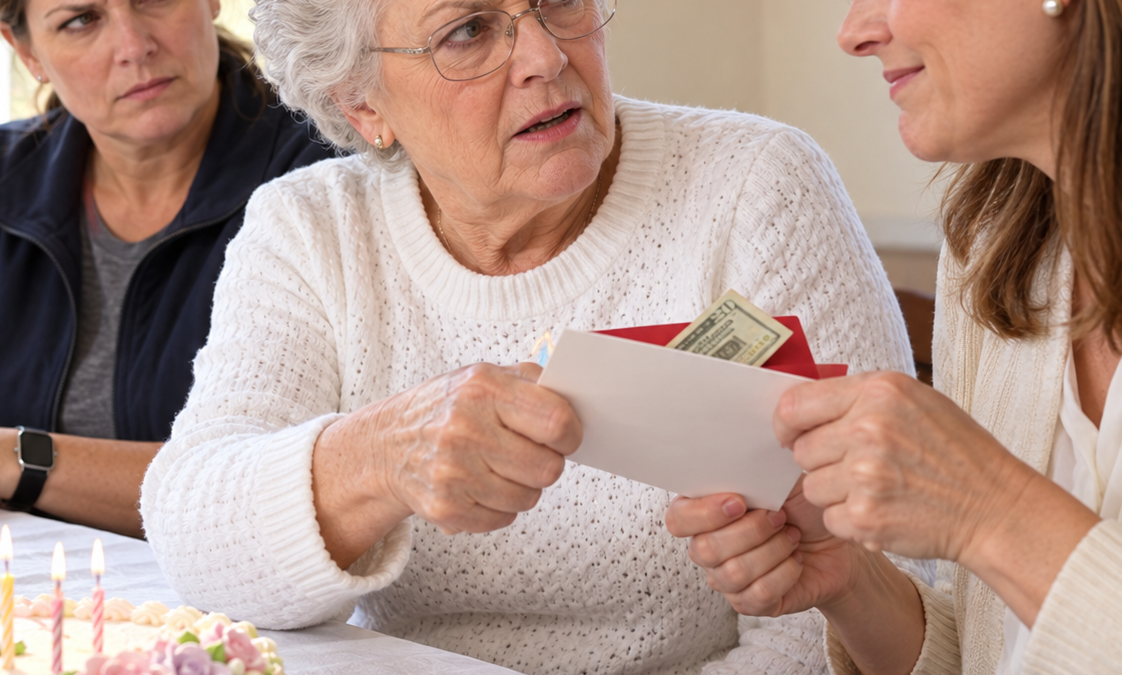
Amber lifted a large Christmas card over her head.
“We wanted to thank the woman who’s been helping Mom,” she told the room.
The front read: “Merry Christmas, Kaylee! Thank you for two years as Mom’s aide”
She opened it so the front tables could see a white envelope taped inside, marked in Amber’s handwriting: “Kaylee’s Christmas Bonus.”
Amber laid two fingers on it. “Twenty dollars a head, like I said in the group chat.”
She handed the card to a cousin at the nearest table. It went from one family member to another. People leaned over plates to sign it and folded twenty-dollar bills into the envelope. An uncle at the far end asked if Kaylee would be coming to collect it. Amber said she’d make sure it got to her.
Mom watched the card move. I couldn’t tell whether she was trying to see the writing or the faces of the people signing.
When it reached Keith’s table, he passed the pen to Gina. Nate held the card steady while she wrote. Keith added his own name, then sent it onward.
No one asked Mom to sign.
The card came back around to our table. Aunt Peggy took it from the cousin who carried it back and laid it near her own plate. The bonus envelope bulged against the tape.
Amber returned to the table with a small stack of invoices. She placed one by Keith, another in front of Nate, and a third beside my elbow. Each was for $1,250.
“One last month from you kids, then Mom’s account takes over,” she said lightly.
Keith took his bill, folded it, and slipped it into his pocket. Nate left his on the table. I didn’t touch mine.
Carla’s black case remained closed.
Amber glanced at Mom’s knees. The spiral notebook was still there.
“I think we can get the paperwork done while everybody’s together,” Amber said.
The clock above the kitchen pass-through read 2:40. Amber had booked Carla for three-thirty.
My sister picked up the Christmas card beside Aunt Peggy’s plate and opened it. From behind the bonus envelope, she drew a folded paper with a yellow “sign here” flag attached. She placed the sheet in front of Mom and Carla, smoothing it with her palm.
“Mom, this just lets me keep paying Kaylee from your account, so the kids don’t have to anymore. Carla’s here, everybody’s here. Sign it in front of all of us, so nobody can say I did anything behind anyone’s back.”
“About time,” Keith said from the next table.
Amber held the pen out to Mom.
Mom didn’t take it. She pulled the card toward her instead and read the words printed on its front, moving her gaze along the line slowly.
A fork touched a plate somewhere behind us.
“What aide?” Mom asked, loud enough for the back tables.
Nobody answered. The microphone in Amber’s hand gave a low hum.
Mom turned to look at me.
I stood up and opened the brown envelope.
Part 10 of 13
Carla drew the folded paper across the tablecloth before Amber could move the pen any closer to Mom. She held it up with the yellow flag sticking past her thumb.
“Lorraine, before I stamp anything, can you tell me what this paper does?” Carla asked.
“She says it pays an aide. I don’t have an aide,” Mom said.
Carla opened her black case but left the stamp inside. Her eyes moved from the title to the page underneath.
“Durable General Power of Attorney,” Carla read aloud.
Amber kept her smile pointed at the room.
Carla turned the page.
“Special Instructions. ‘Agent may make gifts to herself in any amount.’ Initial here.”
The flag marked a place for Mom’s signature. Beside the gift language was another empty space, smaller than the first.
“I can’t give legal advice, Lorraine, but read that line yourself before you sign anything,” Carla said.
Mom took the pen from Amber, looked at the smaller blank, and set it beside the paper.
“Then I’m not signing it.”
At the table behind Keith, somebody stopped sliding a chair across the floor. I could hear the rubber feet settle against the tile.
“Kaylee comes while you nap, Mom. You don’t always remember,” Amber said.
Mom opened the green notebook on her knees. She turned through the pages without asking anyone to help, found an entry, and held the book high enough to read.
“Wednesday, July 15th. Seventy-one degrees. Nobody.”
Mom moved back through the pages.
“Friday, January 16th. Nine degrees. Nobody.”
Then she found a Sunday.
“Sunday. Amber, twenty minutes, took the roast.”
Aunt Peggy looked across the table at Amber. The Christmas card lay open between Peggy’s plate and Mom’s, the bonus envelope still taped inside.
“I write down whoever walks through that door. I’d have written down a girl,” Mom said.
I took the first invoice from my brown envelope. Mom turned back to Wednesday and brought the open notebook against the edge of the table, keeping one hand on its cover. I laid the sheet beside the entry that said “Nobody.”
The invoice said what it had said every month: “K. Brooks, Mon–Fri 9 a.m.–1 p.m.”
I set the printed message next to it. The woman who’d sent it had said she’d never been to Ohio.
“Kaylee Brooks, Tempe,” I read.
Paige stood behind Amber’s chair with the cake plates she had been carrying. She set them down and covered her face.
“Mom, that’s my roommate,” Paige said.
From the next table, Keith leaned forward and looked at Amber.
“You said it was a different Kaylee,” Keith said.
“What other Kaylee, Mom?” Paige asked.
Amber turned toward Carla, who still held the power of attorney.
“Just stamp it, Carla,” Amber said.
Carla closed the black case.
“There’s nothing for me to stamp. She hasn’t signed it, and she’s told you she won’t. I’m writing down that I refused, and why.”
Carla kept the document pinned under one hand and opened her notary journal. Her pen moved in short, steady strokes.
“The agency handles the money. I just forward it,” Amber said.
I put the rest of the invoices on the table, twenty-four in all, with Hickory Bend Companion Care LLC printed at the top. Beside them went my bank statements, one transfer for every invoice, each to the same recipient: Amber Voss.
Last came the Ohio Secretary of State printout.
Keith pushed back from the next table and walked over. He picked up the filing, traced the statutory agent’s name, and stopped at the address.
“That’s your house, Amber,” Keith said.
The page showed Amber L. Voss, 418 Orchard Lane, where my sister lived with Wes, not the post office box printed on the bills.
From the corner, Wes spoke without moving toward his wife.
“She told me that was resale money. And that Monday’s ten o’clock at the credit union was Kaylee’s payroll,” Wes said.
Nate sat very still beside Gina. His eyes went from Wes to Amber.
“Who’s been paying?” Mom asked.
“Eleven hundred a month, Mom. Each of us. Two years,” Keith said.
Amber’s mouth worked before her voice came.
“I was going to pay it back,” Amber said.
At the far end of the hall, the uncle who had asked about Kaylee’s bonus said, “Lord,” to nobody in particular.
Mom turned another page of her notebook. She didn’t look at the bank statements. She looked at Amber, then let her finger find the lines.
“‘Smells like diesel and never shows up.’ Tuesday, March 10th. Six-ten. Jenny, two honks. Sunday, June 21st. Jenny home. Fixed the gutter. Last year, Sunday, August 17th. Jenny home. Mowed, fixed the screen door.”
It took me a second to work Greg’s GPS printout free of the envelope and lay it beside her book.
“A hundred and eight Tuesdays,” I said.
Keith left the filing on the table and moved beside me.
“Log it, Jen. Every month she took,” he said.
Aunt Peggy peeled the bonus envelope off the card, kept it under her own hand, and slid the card across the table to Amber.
“You can keep the card, honey. The money goes back,” Peggy said.
Mom closed the green notebook and looked at Amber.
“She showed up. You sent invoices.”
Part 11 of 13
Pastor Mike called me on Sunday morning, December 6. “I’ve taken Amber off the event committee,” he said. “The bulletin goes to print without her name.”
Aunt Peggy had already handled the Christmas bonus. Before anyone left the hall Saturday, she’d stood by the exit with the white envelope and returned every twenty-dollar bill to the relative who’d put it in.
She hadn’t asked Amber’s permission.
Keith, Nate, and I drove to the Ross County Sheriff’s Office on Monday morning. The deputy who took our report spread the Hickory Bend invoices across the counter while we handed over the Ohio Secretary of State printout, our bank statements, and Kaylee Brooks’s message.
Twenty-four payments from each of us. $26,400 apiece.
I watched the deputy straighten a curling corner on the company filing. Amber’s address stayed visible at the bottom.
Nobody promised us our money back. We gave the information we had and signed what we were asked to sign.
That evening, Nate flew back to Texas. He hugged me at the curb with his duffel between our feet, then carried it through the terminal doors.
The December invoices had been due that Monday. Keith didn’t pay his $1,250. Neither did Nate or I.
Midweek, Carla sent me a text.
“I called Adult Protective Services. It’s in my journal.”
A caseworker visited Mom that week. Mom told me afterward that she’d answered the questions at her kitchen table, without Amber there to explain anything for her.
“I don’t need services. I need my daughter to stop.”
Mom said she’d shown the visitor where she kept her green notebook. Then she’d put it back on the windowsill, ready for the next morning’s temperature.
On Friday, December 11, the lawyer Keith, Nate, and I hired filed a lawsuit in Ross County for the full $79,200. I kept a copy of the filing with the invoices Amber had given me.
The next day, Wes moved to his brother’s house. A For Sale sign went into the yard at 418 Orchard Lane, the same address printed on the state business record.
In the family group chat, Amber’s name disappeared from the member list. For weeks, Keith had insisted she be our one point of contact. Now his own messages had gone quiet.
Aunt Peggy drove over to Orchard Lane and left Amber’s slow cooker on the doorstep. She told me she’d washed the lid first.
Paige called from Arizona. She tried to speak, stopped, and blew her nose close to the phone.
“Kaylee won’t talk to me.”
“You didn’t do this.”
Paige’s crying came through the line again. Her mother had taken her roommate’s name for an emergency contact form and printed it on two years of invoices. I stayed with her until her breathing slowed enough to say goodbye.
I didn’t ask her to pass anything along to Kaylee.
On Tuesday, December 15, at 6:10 a.m., I came south along US-23 on my regular run for Paint Creek Freight.
Two blasts of the air horn.
Mom’s porch light came on.
My next weekend off brought me back to Blackwater Road on Sunday, December 20. When I arrived at Mom’s house, Mason was sitting at the kitchen table, picking pieces of cinnamon cake from his plate. Rick had let him come back for weekends.
Mom had already put a plate out for me.
My son pulled the chair beside him away from the table with his foot. I sat down, and Mom served another slice without asking which of us wanted it. Mason took it.
After he went to rinse his dish, Mom looked at me across the table.
“Thirty-three hundred a month. I thought it was frozen meals.”
“Amber told me you were embarrassed we paid for help,” I said.
“She told me you children chipped in for the boxes on the porch. I never heard that number until the party.”
Mom touched the green notebook beside her cup.
“At my wrist follow-up that June, Dr. Sandoval told me to keep track of visitors. How long they stayed, whether I’d fallen, everything. Bring the book to each appointment so he could see how I was managing.”
She opened to the first page. I knew the doctor’s instruction was there in her handwriting. This time Mom put her finger below it.
“If the book says I’m managing, nobody gets to tell me I need an aide.”
“Amber knew?”
“She sat right there in the exam room at that follow-up. Heard every word. I was still getting the use of my wrist back.”
Mom turned a few pages.
“I even asked Dr. Sandoval whether your horn counted. He said, ‘That counts as someone checking on you.'”
I looked toward the window. The notebook had been there every time I’d come home, open beside the sink. Mom had been keeping a record of my visits while I was keeping one of her driveway.
Mom opened the kitchen drawer and took out the stack of after-visit summaries held together with a clothespin. She set them on the table: nine sheets, one from every checkup since December 2024. The top sheet was dated Thursday, December 10.
With the clip off, she eased the pages apart. I could see the same printed line on all eight sheets underneath. On the newest one, it read:
“Support at home: Lives alone, independent. No caregiver needed. Checked on by: daughter Jennifer, weekly (Tuesdays) and every other weekend.”
Part 12 of 13
On Monday, December 21, Mom was about to sign the first power of attorney she’d ever had. Sixteen days after Amber had tried to slip one past her inside a Christmas card, Mom left the pen on the desk until she’d read this one herself.
Angela Ruiz’s office was on Second Street in Chillicothe. Carla had given Mom the attorney’s card after the birthday party. Mom had made the appointment and driven her old sedan there with her reading glasses tucked inside her purse.
Angela turned the first page toward Mom instead of toward me.
“I can only represent the person whose money it is.”
“Then you’re talking to the right one,” Mom answered.
I sat beside the window while they went through the document. Mom stopped Angela at one paragraph and read it with her finger under each line.
The new power of attorney named Nate and me as agents together. Both of us would have to sign for anything done under it. That was how Mom wanted it, even with Nate stationed in Texas.
“If one says no?” Mom asked.
“The other can’t act alone,” Angela said.
“Good. That’s what I asked for.”
When Mom reached the last page, she checked the names and went back through the signature spaces. Angela waited. Nobody touched the pen.
“I read every page.”
A notary from Angela’s office came in when Mom was ready. Mom signed, and the notary stamped it. Angela handed the finished papers to Mom, who put them in her own folder and closed the clasp.
The next day, Tuesday, December 22, while I was on my run, Mom drove to Ross Valley Credit Union and had Amber removed as the payable-on-death beneficiary on her savings. She called me that night to say she’d also handed the clerk a letter in her own handwriting: Amber had no say over any of her accounts. Her copy came back stamped received, and it went into her purse.
On Christmas Day, Friday, I heard my son laughing as soon as I stepped out of the car in Mom’s driveway on Blackwater Road. Mason opened the door before I could knock and carried the covered dish I’d brought into the kitchen.
“Grandma’s been checking the oven since breakfast,” he said.
“And your mother’s been driving since before breakfast, so neither of you touch that pan,” Mom called back.
It was our first Christmas without Amber at the table. Mom decided when the food was ready, served it herself, and told Mason to put the extra chair away. Rick had let him spend Christmas at Grandma’s as well, and he’d gone straight to the seat he’d used since he was little.
Keith arrived with food, too. He set his dish on the counter, asked what needed doing, and was told to sit down before the gravy got cold.
Later, while Mason was helping Mom with the table, Keith followed me onto the porch.
“Jen, I was wrong,” he said.
He pulled a check from his coat pocket, made out to me for $1,100. The amount I’d sent in November.
“This is yours,” Keith said, holding it out, “because you warned me and I didn’t listen.”
“You paid her that month, too.”
“I know. This one’s for you.”
The paper trembled a little between his fingers. Keith had fixed other people’s broken furnaces for years, but he looked at the check as if it were a part he couldn’t quite fit into place.
“Keep it,” I said. “Take Mom to dinner Saturday.”
“She’ll tell me she can cook.”
“She can. Ask her where she’d like to go.”
Keith put the check back in his pocket. When we went inside, he asked Mom about Saturday. She told him she’d be ready when he arrived, provided he let her choose the restaurant.
At dinner, Mason noticed the green spiral notebook on the kitchen windowsill. Mom had written his arrival in it earlier, the same way she always did when he visited.
“Did you write Aunt Amber down too?” he asked.
Mom set down the serving spoon.
“Every Sunday. Twenty minutes and a roast.”
“So the one who stayed the least said it the loudest,” Mason said.
Mom passed him the potatoes. Mason helped himself, then offered the bowl to Keith.
That evening, after we’d put the dishes away, I took a single sheet from my bag and set it beside Mom’s cup.
Greg had signed the rider permit for Paint Creek Freight. It had Mom’s name, the route from the Columbus yard to Portsmouth and back, and an expiration date.
“You can ride with me Tuesday, if you want,” I said.
Mom held the paper closer to the lamp. She followed each line, then returned to the top and went over it again, the way she used to check the name on a certified letter before she handed it over on her route.
“Tuesday. What time do I need to be up?”
“Four-fifteen.”
“I’ve been up at four-fifteen for thirty years.”
Mom opened her green notebook to the most recent Tuesday page, where she’d written “Jenny, two honks.” She signed the permit, folded it in thirds, and tucked it directly behind that page.
Part 13 of 13
At 4:45 a.m. on Tuesday, December 29, Mom climbed into a truck cab for the first time in her life. She had a thermos of coffee under one arm, her green notebook in the deep pocket of her barn coat, and no intention of letting me boost her up.
Keith had driven her up to Columbus Monday evening, and she’d slept in my rented room near the Paint Creek Freight yard. She’d laid out her clothes the night before, the same way I did for an early run.
Now she stood on the bottom step, examining the distance to the next handhold.
“That’s a tall first step,” she said.
“There’s another one above it.”
“I can see that.”
I stayed on the ground until she had both feet inside. Mom settled into the passenger seat, pulled the belt across her chest, and tugged it once to make sure it caught. The thermos went between her boots.
I walked around the front of the rig and climbed in on my side. She had already adjusted the seat so she could see past the dash.
“This is what I show up with,” I said, pointing to the ELD screen.
Mom leaned toward the display, which recorded my working hours.
“Does it tell you when you’ve been sitting too long?”
“That, too.”
“Your father could’ve used one of those.”
Mom slid the rider permit she’d signed Christmas night out of her notebook and showed it to me. She returned it to the green cover without asking me to keep it. At the gate, she held her thermos upright while the trailer crossed the uneven pavement.
By the time we reached US-23, Mom had loosened her coat and was studying the road signs through the windshield. For thirty years she’d carried rural mail along roads narrower than these, but she’d never watched this part of Ohio from so high above the pavement.
“Everything looks different up here,” she said.
“Traffic looks smaller.”
“The ditches don’t.”
The shoulder fell away sharply in places, and she picked out every culvert in the headlights before we reached it. I didn’t have to tell her why I couldn’t pull a long trailer onto Blackwater Road.
At 6:10, we came up on the turn.
Mom’s white ranch sat dark in a low fog. The porch light was off. There was nobody inside to turn it on when my truck went past.
My arm moved toward the horn cord before I thought about it.
Mom put her hand over mine.
“Don’t. I’m in here.”
I let the cord hang.
Mom watched her house from the passenger window until the trees closed in behind it. I kept the wheel straight. The usual two blasts never came, and the road went by with only the sound of our tires.
“Well,” Mom said, sitting back, “that’s one morning the neighbors can sleep.”
I laughed, and she unscrewed her thermos cap.
The load had a 7:30 delivery window in Portsmouth. I backed against the dock while Mom stayed buckled in, watching my mirrors with me. When I set the brakes, she looked out at the building and the workers getting ready to unload.
“Every Tuesday you come here?”
“Every Tuesday.”
“And then back past my place?”
“About eleven-twenty.”
Mom turned that over, the way she used to work out which houses on her mail route needed a second stop for a package. She poured me a little coffee into the thermos cup.
“Drink it while you’re parked,” she said.
While the crew unloaded, she opened her notebook across her knee. She’d missed her usual six o’clock entry, so she asked what the outside-temperature display had shown as we passed Blackwater Road. I told her, and she wrote the number, followed by “fog.”
Then she wrote one more line.
“Jenny. Didn’t honk. I was in the truck.”
I leaned close enough to read over her shoulder. The letters were the same firm ones I’d seen on the windowsill for years, except this time she was writing them with my truck idling under us.
She caught me looking.
“What?”
“Nothing. You spelled it right.”
“I should hope so.”
Her pen made a small dot at the end. Mom let the ink dry before turning back to the pages from October, when she’d recorded two honks and nobody else.
The unloading finished. I checked the paperwork, pulled away from the dock, and took the return freight north. Mom kept the book open but rested it against her coat so the pages wouldn’t slide when the rig turned.
At 11:20, we reached Blackwater Road again. Mom angled toward the window and looked down the gravel drive.
“Just my car,” she said.
I kept my eyes on US-23. I didn’t search the gravel for a second car. Instead, I glanced across at the woman I’d been looking for down that driveway for two years.
She was right there in the passenger seat, her coffee cup balanced on one knee.
“We’ll be back at the yard around twelve-thirty,” I told her. “Keith’s picking you up.”
“Good. I’ll tell him whether you drive any better than he does.”
Mom capped the thermos with its cup and turned to the new entry once more.
Then she closed the book, patted the cover, and said:
“I logged it, honey. Every Tuesday.”
THE END
More stories
My Boss Slapped a $300,000 Mortgage Note Onto My Binder During a New Hire’s Retirement Lesson—Then His Father’s Forgotten Rule Froze His Access to Our PlanMy son-in-law claimed he’d earn nothing from my $522,000 annuity before 32 retirement guests—But I revealed his $36,540 commission, and he later resigned as church treasurer.My Stepbrother Told 45 Mourners I Got Only Dad’s Rusty 1998 Pickup—But His Auction Microphone Announced My Name as the Mineral Owner and His Draft Wouldn’t Be Paid.My fiancé toasted spending my late parents’ $210,000 before 60 guests—Then I showed them the secret card he opened in my name to buy my ring and ended our engagement.My brother-in-law said our 60-year-old hardware store belonged to him at my husband’s funeral—But the papers under the register would expose him before the whole town.My HOA president sent two men with shovels into my late husband’s memorial garden and fined me $2,400—Then her own financial records cost her the presidency.








