My daughter left me at the airport after my sister’s funeral and demanded $40,000 for her kitchen; she had no idea what I had signed before my flight.
Chapter 1 of 7
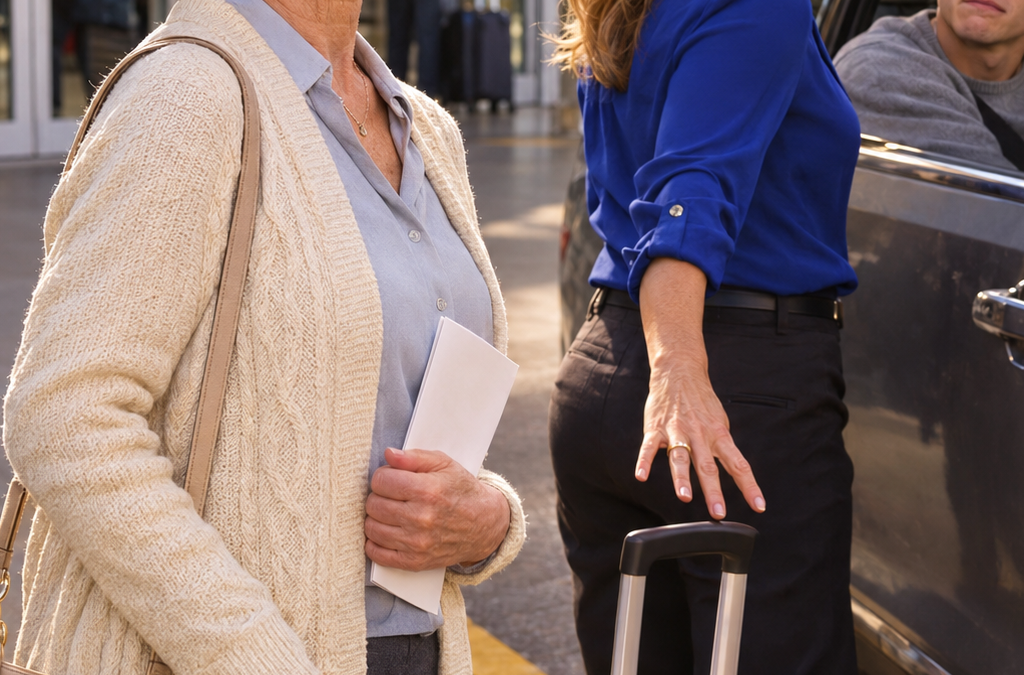
Brooke rolled my suitcase beyond Dayton airport’s automatic exit and released it beside my cane and funeral program while Noah watched from the car.
“You managed the funeral; you can manage a ride.”
The suitcase tipped against my bad knee. Behind us, the doors opened for a man carrying golf clubs.
“You said you were taking me home.”
“I said I’d pick you up. I’m here, Mom.”
“At baggage claim, you said home.”
“That was before we got held up.”
We hadn’t been held up. My flight had landed on time. It was Thursday, and the terminal clock had said 2:20 when I reached baggage claim.
“I asked for help because of my knee,” I said.
“And I got your bag.”
She glanced toward the driver’s seat. Noah sat beside it, his phone resting against his thigh.
Brooke had arrived with a printed kitchen drawing on the back seat. She had shown it to me before asking about the burial.
“Before we go anywhere,” she said, “I need that gift confirmation. The remaining kitchen installment is $40,000.”
“I’m not deciding that beside traffic.”
“It’s just a signature confirming what we discussed.”
“You showed me a picture of cabinets.”
“We talked about helping us.”
“You talked. I was packing for my sister.”
A shuttle passed close enough to lift the funeral program’s loose edge. My sister’s photograph bent beneath my thumb.
Brooke lowered her voice.
“Mom, the cabinet appointment is at four. They’ve held this time for us.”
“Then take me home first.”
“We’d have to double back. You can get a ride straight home, put your feet up.”
She said it as if she had arranged that kindness.
“Come with us, then,” she added. “We can finish everything there.”
“I’ve been traveling since this morning.”
“There are chairs.”
My knee had swollen against my pants. I could stand, but I couldn’t wrestle the suitcase across lanes while leaning on my cane.
Brooke looked at the parking ticket tucked in her phone case.
“And now I’ve paid to park for this.”
My fingers found my purse clasp before I had decided anything. Parking, lunch, a late charge—those small sums had always been mine to erase.
I reached for my wallet, then closed the purse.
Brooke noticed.
“Really? I came all the way out here.”
“Being your mother did not make my time disposable.”
She looked past me toward the terminal doors.
“I’m trying to keep today from becoming an argument.”
“Then don’t leave me here.”
“I gave you another option.”
The car’s engine was running. Through the windshield, I could see Noah looking down again.
I paid for every problem until she stopped seeing them as problems.
My phone still showed the rideshare screen I had opened inside. When I tried to request a car, it sent me back to a sign-in page. The password I remembered wasn’t accepted.
“There,” Brooke said. “Just reset it.”
“The code hasn’t come.”
“There are taxis, too.”
I could see the taxi signs. Getting there with my luggage was another matter. I needed someone to help me reach one, not point at a sign.
An airport employee in a bright vest was helping another passenger farther down the curb.
“Could you get him for me?” I asked.
Brooke glanced at her watch.
“Mom, please don’t turn this into me proving I care.”
I said nothing at all.
She opened the driver’s door.
“You have my number. Let me know when you’re home.”
I called Ellen instead. She answered with her television loud enough to hear through the phone.
“Can you come to the airport?”
“What happened?”
“Brooke has an appointment.”
“Are you inside?”
“Outside. By the passenger pickup.”
“Stay there. I’m coming.”
Brooke’s mouth pressed flat when she heard the name. Then she gave me a small, departing smile through the open car door.
A passenger door clicked behind her.
Brooke started turning back toward the curb.
Her smile disappeared. “Noah. Get back in the car.”
He had my suitcase by its handle. He moved it away from the traffic lane and set it upright beside the wall.
“Grandma couldn’t leave it there.”
“I saw it,” Brooke said. “We need to go.”
“You didn’t—”
“Noah, please.”
He looked at me.
“Go on,” I said. “Ellen’s coming.”
He returned to the passenger seat. As Brooke pulled away, he looked back through the window.
I stayed against the wall until a pickup space opened near me. By then, my leg had begun trembling from standing.
Ellen arrived with a plain folder on her passenger seat. She parked and came around without calling instructions through the window.
My neighbor of eighteen years was also my new financial agent. I had appointed her before leaving Ohio for Arizona.
“You’ve been standing this whole time?” she asked.
“Mostly.”
“All right. We’ll get you seated first.”
She didn’t ask me to explain while I balanced against the wall.
“Passenger seat far enough back?” she asked.
“Could be farther.”
“I’ll fix it.”
Ellen had spent years helping people move safely. At sixty-four, she still knew when to wait instead of grabbing an elbow.
My phone buzzed as she opened the passenger door.
Brooke’s name appeared above a new message. I read it once, then read it aloud.
Ellen stopped beside the open car door.
“Tomorrow morning? She put that in writing?”
The message said, “I’m taking my 2023 paperwork to the bank tomorrow morning. We can handle the kitchen without making you sit through another appointment.”
I read it again. Cars kept passing behind Ellen.
“Do you want to call her?” she asked.
“No.”
“Okay. Can you manage the step down?”
“If you keep the door from moving.”
She held it steady. I lowered myself onto the seat, leaving both feet outside until my knee would bend.
For a moment, neither of us talked.
The car smelled faintly of peppermint and the onion rolls Ellen bought every Thursday. A bag of them sat behind the driver’s seat.
“You bought the ones with all the loose onions again.”
“They were out of the tidy onions.”
I laughed once, and it came out rough.
“Sorry,” I said.
“For what?”
“I don’t know.”
“Then don’t bother.”
She waited while I brought my feet inside. Only then did she go back for the suitcase.
I still had the funeral program. There was a damp mark where I had held it too tightly, over the printed dates of my sister’s life.
“I could send the money,” I said when Ellen returned. “Then she’d stop calling about it.”
“Is that what you want to do?”
“No. I want to go home.”
“Home first.”
“And tomorrow I need to find out what I have to do.”
“All right.”
“I’m tired of paying because I’m tired.”
Ellen didn’t answer for me. She checked that my coat wasn’t caught in the door.
My phone rang again. Brooke.
I let it finish while Ellen walked around to the driver’s side. The dashboard clock read 3:10. We were still at the curb.
A voicemail notification appeared before Ellen had fastened her seat belt.
“You want a minute?” she asked.
“Yes.”
I pressed play.
Brooke’s voice filled the parked car.
“I called the bank. They still have my 2023 paperwork on file.”
Chapter 2 of 7
Brooke’s older authority really was still on file. Appointing Ellen hadn’t canceled it, and refusing beside traffic hadn’t ended it either.
On Friday, September 11, Amy Foster helped me sign a separate revocation before a notary at 8:30 a.m. I delivered it to Riverbend’s branch myself. An employee acknowledged my duplicate. At home, it joined my grocery receipt and Amy’s invoice in the kitchen drawer, its small “9:12” impression beside a bent staple. Years in school payroll had left me unwilling to throw receipts away.
By 4:30, I had washed the same breakfast bowl twice.
Brooke came through the kitchen doorway still wearing her dental-office badge. She usually called out before entering. This time, I heard the screen door and then her shoes.
“I got your delivery,” she said.
“I know.”
“At twelve-forty. At work.”
“I needed you to have it.”
“You could have called.”
“Would that have been enough?”
She looked at the bowl drying beside the sink.
“I’m not here to fight, Mom.”
“Then sit down.”
She sat in the chair nearest the back door. I sat across from her.
The refrigerator started its rattling hum. Brooke glanced at it.
“That thing still sounds like a lawn mower.”
“It still keeps milk cold.”
Usually she would have told me to replace it. She looked back at me instead.
“I don’t understand why you needed somebody to deliver papers. We’ve always worked things out ourselves.”
“We haven’t worked this out.”
“You didn’t give us a chance.”
“I said I wasn’t paying for the kitchen.”
“You said you weren’t deciding at the airport.”
“That wasn’t permission.”
“I know that. I’m talking about before.”
She sounded tired now, less certain which words would work.
“You knew we were planning this. I sent you pictures. You asked about the drawers.”
“I asked whether they would stick out into the doorway.”
“You were interested.”
“It’s your house. Of course I was interested.”
“You said, ‘we’ll discuss it when I’m home.’ Those were your words.”
“Yes.”
“So I thought we were discussing how to do it. The payment, I mean. Not whether you’d help at all.”
The kitchen clock clicked between us. I hadn’t changed its battery before leaving, and the second hand kept catching.
“I should have been clearer,” I said.
Brooke leaned forward.
“Thank you. That’s all I’m trying to—”
“I should have said I hadn’t agreed to anything.”
She leaned back again.
“Last year you gave us $12,000. You didn’t make me explain every little thing.”
“That was a gift I offered.”
“And I appreciated it.”
“I know.”
“I’m not pretending you’ve never done anything for us.”
“I didn’t say you were.”
“You’re making it sound like I came out of nowhere asking.”
I looked at the empty chair between us. Noah used to sit there and swing his feet against the rung.
“I’ve paid things before you finished telling me what was wrong,” I said. “Sometimes you didn’t even ask.”
“Because you wanted to.”
“Yes. I wanted everybody settled. I made it easy to expect that.”
Brooke’s eyes stayed on mine.
“Then you can see why I thought—”
“I can see how you expected help. I still didn’t approve this bill.”
Her badge had turned backward. The clip pressed against the table when she leaned forward again.
“The contract is $46,000.”
I waited.
“I already paid six thousand. From our savings. Before you left.”
“You signed it before asking me?”
“We’d been talking about it for weeks.”
“You and I hadn’t talked about that amount.”
“They had an opening. If I waited, we’d lose the installation slot.”
“Brooke.”
“I know. I know how it sounds when you say it like that.”
Her voice broke on the second “know.” She stared toward the window until it steadied.
“They’ve already done work. It isn’t just picking a color online.”
“Have you asked what happens if you stop?”
“I don’t want to stop. I want the kitchen we planned.”
There was a pale dent on her finger where a ring had been. She sometimes took it off at work.
“I put our savings into this,” she said.
I almost asked how much she had left. Instead, I waited for her to continue.
“You don’t have to make another gift today,” she said. “Just confirm the arrangement we were already working toward.”
“There wasn’t an arrangement.”
“Something dated for when we talked. Before all this paperwork. So nobody has to make this embarrassing.”
“I won’t sign that.”
“It wouldn’t change what you said.”
“It would say I agreed to something I hadn’t agreed to.”
She watched me for a long moment.
“I really did think you were helping.”
“I believe you thought that.”
“But you’re still saying no.”
“Yes.”
Brooke stood. Her chair caught on the uneven floorboard, and she left it crooked.
“I need to make some calls.”
“All right.”
At the doorway, she stopped.
“You could have told me yourself.”
“I’m telling you now.”
She left without answering.
I stayed at the table while her car backed out. The refrigerator stopped, leaving the clock’s small, uneven tick.
My phone sounded beside my elbow. A bank message said an instruction under Brooke’s older authority was being held for review.
I opened the details.
Riverbend identified Brooke’s $40,000 transfer instruction as submitted at “10:14 a.m. today.”
Chapter 3 of 7
The transfer remained on hold. Nothing had left my savings.
By Sunday, September 13, I had read that confirmation enough times. At one o’clock, I went to the Dayton ice-cream shop because Noah had asked me to come.
We had arranged the outing before my trip. That morning, he had texted, “Still coming, Grandma?”
I hadn’t wanted to make him ask twice.
Brooke was already at an outdoor table. Noah sat beside her, his hardware-store work shirt showing beneath an open sweatshirt.
“You’ve got a little time before work?” I asked.
“Don’t start until four.”
“We ordered yours,” Brooke said. “Butter pecan.”
A plastic spoon stood in the cup. She had remembered my favorite.
“Thank you.”
Noah’s chocolate ice cream had rainbow sprinkles piled along one side.
“Machine broke?” I asked.
“He still asks them to keep the sprinkles separate,” Brooke said.
“They get weird when they’re wet.”
“They’re going into ice cream, honey.”
“I know what I ordered.”
For a moment, I could have stayed there all afternoon.
Then Brooke said, “Noah’s been worried about you.”
He looked at her.
“I asked how she was.”
“Because you’re worried.”
“I can answer him,” I said.
“Of course you can, Mom. Nobody said you couldn’t.”
She had ordered a cone, but the edge was melting untouched.
“You’ve had a terrible week,” she continued. “And then you get home, and suddenly somebody’s helping you change things.”
“I asked for help.”
“That’s what worries me. You’re tired. Your sister just died.”
“I remember.”
“I didn’t mean—Mom, come on. I’m trying to talk to you.”
A little girl at the next table dropped her spoon. Her father went inside for another.
I waited until the child stopped staring at us.
Brooke lowered her voice.
“You’ve known Ellen a long time. I’m not saying she’s a stranger.”
“Eighteen years.”
“Right. As a neighbor.”
“She’s also my friend.”
“I know that. But friendship and money can get messy.”
Noah rubbed his shoe against a crack in the concrete.
“Mom said maybe you were making decisions too fast.”
“I’ve made several decisions this week,” I said. “Which one?”
He glanced at Brooke.
“I don’t know. The bank stuff.”
“You don’t have to explain it all here,” Brooke said quickly. “That’s part of what I’m saying. It should stay inside the family.”
“You brought it up here.”
“Because getting us together seemed better than another delivery.”
My ice cream had softened around the spoon. I hadn’t tasted it.
Brooke turned toward Noah.
“Maybe you can explain what I mean. You don’t want Grandma depending on somebody who isn’t family, either.”
He stared across the table at me.
“Ellen’s nice,” he said.
“I never said she wasn’t nice.”
“Then what am I supposed to explain?”
“That we’re here. That Grandma has us.”
I looked at him, not Brooke.
“You saw what happened at the airport.”
His face went red above his collar.
“Grandma—”
“I was promised a ride home. I was left there instead. Did that look like help I could count on?”
Brooke answered before he could.
“We’ve already talked about Thursday.”
“I’m asking Noah.”
“She had that cabinet appointment,” he said. “They were waiting for us.”
“Why did her appointment matter more than the ride she’d promised?”
He opened his mouth, then looked down.
I left the question there.
A truck rattled past the patio fence. Inside the shop, someone called out an order for three milkshakes.
Brooke’s cone dripped onto its paper sleeve.
“I wish I’d handled Thursday differently,” she said. “I do. But one bad afternoon doesn’t make Ellen better equipped to help you.”
“I’m not comparing you over ice cream.”
“I’m asking you to slow down.”
“And I’m not going to sit here proving I can make decisions.”
“I didn’t ask you to prove anything.”
“You asked him to persuade me.”
Noah pushed his cup away.
“Can we talk about something else?”
Brooke looked at him for a moment.
“Yes. We can.”
But she didn’t.
“I think we need a little space while this is going on. I’m not going to keep coordinating visits and pretending everything’s fine.”
Noah sat straighter.
“What visits?”
“Dinners. Stopping over. I’m always the one checking schedules.”
“My visits are my choice.”
“I didn’t say you couldn’t visit.”
“You kind of did.”
“Noah, I said I’m not arranging things.”
“I have a car. I can call Grandma.”
“I know you have a car.”
He looked at me.
“That doesn’t mean I think Mom’s wrong about everything.”
“I heard you.”
“I just don’t need somebody setting up when I see you.”
“You’ve got my number,” I said.
Brooke stood with the ruined cone.
“I’ll pay before this melts everywhere.”
She went inside. Noah waited until the door closed.
“I wasn’t trying to take sides.”
“Okay.”
“She kept asking what you said. Whether you were mad. If Ellen was over.”
“What did you tell her?”
“Stuff. I thought if she knew what was happening, she’d quit guessing.”
His eyes stayed on the tabletop.
“I wanted you guys to talk again.”
“Was there anything else?”
He nodded.
“I took a picture when I was at your house. The folder was out.”
“Ellen’s new authorization?”
“Yeah.”
“What did you send your mother?”
“I sent her the cover page.”
Chapter 4 of 7
Brooke arrived at Ellen’s porch at 5:30 on Tuesday, September 15. Noah’s photograph had shown her Ellen’s name and appointment on the cover. He hadn’t photographed my later bank acknowledgment or anything written on it.
Ellen and I were sitting beneath the porch fan. She had a bowl of cherry tomatoes between us, most split from the rain.
“Those are the ugly ones,” she’d told me. “They taste the same.”
Brooke stopped at the bottom step.
“Do you have a few minutes?”
“Yes,” I said.
She came up but stayed standing.
“Ellen, I appreciate you helping Mom while she was away.”
“I was here. Wasn’t much trouble.”
“I mean the other help, too.”
Ellen waited.
“I think we’ve reached a point where the family needs to work this out. Would you mind giving us some space?”
“Would you like me to go inside, Nora?”
“No.”
Brooke’s expression barely changed.
“I’m not asking you to leave your own porch.”
“You asked for space,” Ellen said. “I’m asking Nora what she wants.”
“I can speak for myself.”
“I know you can, Mom.”
“Then ask me.”
Brooke sat in the empty chair beside the steps. Her work badge was gone, but she still wore her dental-office cardigan.
“All right. Would you talk to me alone?”
“About my money?”
“About how we got here.”
“I’d like Ellen to stay.”
Brooke nodded once.
“Okay. Then I need to say this without it sounding personal.”
“Say it,” Ellen said.
“You’ve been good to Mom. Rides, checking the house. I’m grateful. But there are things you wouldn’t know.”
“Such as?” I asked.
“Which bills you pay automatically. Which ones you still want mailed. The insurance renewal you always put aside because you think it’s an advertisement.”
“I put it aside once.”
“And I caught it. That’s what I’m saying.”
A mower started two houses down. Brooke waited until it moved farther away.
“I can keep things organized. I know your routines.”
“You’ve helped me with bills,” I said. “I haven’t forgotten.”
“I’m not asking for credit.”
“What are you asking for?”
“To stop treating my involvement like it’s dangerous.”
Ellen said nothing. Brooke kept looking toward her anyway.
“You can know when my insurance is due,” I said. “That doesn’t let you promise my savings to someone else.”
“I didn’t think I was doing that.”
“The kitchen company expected money I hadn’t agreed to give you.”
“That’s still something we disagree about.”
“No. You disagree with my answer.”
Brooke looked toward the street. A boy on a bicycle coasted past, one pedal scraping.
“I don’t want every conversation to turn into the kitchen.”
“Then don’t use paying my insurance to explain it.”
For a while, we listened to the mower.
Brooke turned back to Ellen.
“Is the document Noah photographed actually in effect?”
“I signed it,” I said.
“I know you signed something. Has the bank accepted it?”
“They finished reviewing it before I came home.”
Brooke looked at me then, instead of Ellen.
“So this was already arranged.”
“Before my trip.”
“Why didn’t you tell me?”
“I wanted someone next door who could help while I was away.”
“I would have helped.”
“You were working. Ellen was available.”
“And now she handles everything?”
“No. I handle my money. She helps when I ask.”
Ellen’s porch fan clicked on each turn. I watched a brown leaf shift beneath Brooke’s shoe.
Brooke finally said, “All right. I’m not arguing that the new document isn’t real.”
“Good.”
“But mine was real, too.”
“I haven’t said otherwise.”
“Then the bank needs to look at what I submitted separately. Not decide everything I did was wrong because you’ve chosen somebody else now.”
“I’m willing to have them review it.”
She leaned forward.
“Without deciding the answer before we get there?”
“I’m not agreeing to a gift, Brooke.”
“I heard you.”
She stayed. We talked about whether Noah’s fall classes left him enough hours at the hardware store. Brooke knew his schedule; I knew which class he’d been worried about. Neither of us asked Ellen to leave again.
At 6:05, my phone rang. Daniel Reed from Riverbend asked whether I could discuss the review.
“Brooke and Ellen are here,” I said. “They can listen. I’d also like Noah there Friday, if he agrees.”
“That’s your choice,” Daniel said.
I put him on speaker.
“Friday at ten,” he said. “September eighteenth, at the Dayton branch. We’ll review the account access and held instruction.”
“I’ll be there,” Brooke said.
“So will I,” Ellen said.
“I’ll ask Noah myself,” I told him.
Brooke waited until the call ended.
“That’s better. Let them look at the whole thing.”
“They’re reviewing what happened,” I said. “I’m not going there to negotiate another payment.”
“I understand what you’re saying.”
She sounded careful, but she no longer looked cornered.
At the steps, she paused.
“There’s a status page I want him to see. I’ll send it.”
“All right.”
After she drove away, Ellen offered to walk home with me. Before we left, my phone lit up.
Brooke had sent a screenshot of the bank’s administrative status, captioned “processed September 14,” with a request that Daniel put it on the review agenda.
Chapter 5 of 7
Brooke was already in Riverbend’s waiting area at 9:40 on Friday morning, September 18. She had the screenshot open on her phone.
“This is what I sent Daniel,” she said. “The processing status.”
“He said he’d examine it.”
“I want it considered alongside my paperwork.”
“All right.”
Ellen sat beside me. Noah stood near the window, still wearing his jacket. He’d greeted me outside, then held the branch door for all three of us.
Brooke had saved the chair beside her for him. He stayed by the window.
The television above us showed someone making waffles without sound. Beneath it, a coffee machine offered six choices and a handwritten apology for five.
“Regular coffee’s having a big day,” Ellen said.
Noah almost laughed.
Brooke looked toward the hallway.
“Before we go in, Mom. There’s another way we could handle this.”
“What way?”
“I worked something out last night. Around seven-twenty. I wanted to sleep on it before I asked.”
She had a handwritten note with her papers. I could read the monthly amount from my chair.
“Instead of a gift,” she said, “we call it a loan. I pay you $500 a month.”
“No, Brooke.”
“You haven’t heard the rest.”
“I haven’t agreed to lend you money.”
“Eighty months. I wrote the whole thing out. We could have somebody make it official.”
Ellen watched the television. Noah turned away from the window.
“Would there be interest?” he asked.
“We could discuss that,” Brooke said.
“With what money?”
“My paycheck, Noah.”
“I know, but you said—”
“We’re not doing our household budget here.”
He looked back outside.
Brooke’s voice softened when she addressed me again.
“I’m trying to give you something you can feel comfortable with.”
“I don’t want this loan.”
“Is it the length? Because I could pay extra when I have it.”
“It’s the loan itself.”
“You wouldn’t be giving the money away. It would come back.”
“Over more than six years.”
“Yes. That’s why I put it in writing.”
“I haven’t said yes to six years, either.”
She studied my face, searching for a different objection.
“Would you at least keep the note?”
“No. You keep it.”
For several seconds, the only voice came from behind the counter. An employee was explaining a missing debit card to someone on the phone.
Brooke spoke more quietly.
“I thought this might let us leave here together.”
“We can leave the building together. I’m still not lending the money.”
“I meant without everybody feeling like this.”
“I don’t like this, either.”
“Then I don’t know what else to offer.”
“You don’t have to offer me anything.”
Her eyes moved toward Ellen.
Ellen kept watching the waffles.
“I’m asking my mother,” Brooke said.
“She answered you,” Ellen said.
“I heard her.”
After that, Brooke sat back. When she spoke again, her voice had the measured pace she used on difficult calls from the dental office.
“All right. Then we let Daniel review what’s already there.”
“Yes,” I said.
“The 2023 document is genuine. The bank has its own copy. And the status page came from them, not from me.”
“He’ll look at it.”
Noah turned toward her.
“Does that mean they’ll send it?”
“It means they need to consider when I submitted it.”
“But Grandma’s saying no now.”
“I know what she’s saying now.”
Brooke paused before continuing.
“There was paperwork in place when I sent the instruction. That’s what the review is for.”
Noah frowned.
“And that picture you showed us?”
“The bank’s record of when they processed the change.”
She looked directly at him.
“I submitted it before the file changed.”
“You’re sure?”
“Yes. I expect that to matter.”
I said nothing. Across the lobby, a man’s number was called. He rose with a plastic grocery bag full of rolled coins.
Noah came over to my chair.
“Grandma, can I ask you something?”
“Sure.”
“Is me being here going to make things worse?”
Brooke looked up, but he kept his eyes on me.
“You asked me to come,” he said. “I don’t know what I’m supposed to do.”
“You don’t have to do anything.”
“Just sit there?”
“If you want. Or you can leave.”
“Would you be upset?”
“I’ll still answer when you call.”
His face changed a little.
“I didn’t mean—”
“I know. You’re allowed to decide.”
He sat in the empty chair nearest the window.
“I’ll stay for now.”
“That’s fine.”
Brooke checked the hallway again.
I checked my small packet. My identification and the appointment information were in front, with the bank-acknowledged duplicate folded behind them. Everything was there.
At ten, Daniel opened the meeting-room door.
“Ms. Miller?”
All four of us stood.
“We’ll start with the disputed instruction,” he said. “Then we’ll address account access.”
Brooke entered beside me and put her old power of attorney and printed screenshot on the table.
Her phone sounded before anyone sat down. She read the message, then kept the phone apart from her papers.
“What is it?” Noah asked.
Brooke’s phone showed: “Final installment required by 2:00 p.m. today. Otherwise work will not proceed.”
Chapter 6 of 7
At ten, Daniel closed the meeting-room door.
“This is an authority review,” he said. “We’ll address the instruction first.”
Brooke showed him the cabinet firm’s message.
“They need the installment by two. I’m asking for a decision this morning.”
“I can’t promise payment.”
“I understand.”
She sat across from him. Noah took the chair beside her. Ellen sat on my other side.
“The document from 2023 expressly allows gifts to me,” Brooke said. “Up to fifty thousand a year. There hasn’t been one this year.”
Daniel checked his screen.
“Our stored copy has that provision.”
“And I submitted forty thousand before I received Mom’s notice. Mine arrived at twelve-forty Friday. The bank’s status says the revocation was processed Monday.”
He studied the screenshot.
“So I’m not asking you to ignore her decision,” Brooke continued. “I’m asking you to consider what was in effect when I submitted it.”
Noah looked toward Daniel. Ellen watched him, too.
Daniel opened another record.
“The older document is genuine. If we accepted an instruction while the authority remained effective, that would require a different assessment.”
“That’s what I’ve been trying to explain,” Brooke said.
I could hear someone laughing beyond the door. Here, Noah had stopped shifting in his chair.
“The screen shows processing,” I said. “It doesn’t show when you received it.”
Daniel looked at me.
“I brought my receipt.”
I removed the acknowledged duplicate and placed it directly in front of him.
Brooke leaned forward.
“Mom, signing it Friday doesn’t tell him when the bank knew. I’m not questioning that you signed it.”
“I’m showing him where they acknowledged it.”
“I hadn’t received my notice yet.”
“I know when yours arrived.”
Daniel read the bottom of the page.
“When did this branch actually receive it?”
“Friday. Nine twelve.”
“September eleventh?”
“Yes. I delivered it myself.”
He compared the acknowledgment with his screen, then opened a retained image. The page on his monitor had the same bent corner as mine.
Brooke waited.
Daniel checked another entry.
“The receiving employee’s acknowledgment matches our intake record. September eleventh, 9:12 a.m.”
“But the status page—”
“Monday was electronic processing. The bank had actual notice Friday morning.”
Brooke looked at the duplicate again.
“Before mine was submitted?”
“Your instruction was received at 10:14 a.m.”
She sat back.
“I didn’t have that page.”
“No,” Daniel said. “But the bank did.”
“I was relying on the document I had.”
“I’ve considered that. This notice specifically ended the authority in that document. The gift provision couldn’t support an instruction submitted after we received it.”
Brooke’s lips parted, then closed.
Daniel looked at me.
“Is this the decision you asked us to implement?”
“Yes.”
He faced Brooke again.
“I have two determinations. The $40,000 instruction is rejected. Your agent access is permanently removed.”
Noah stared at the monitor.
Daniel continued, “You have lost access to $228,600. That balance belongs to Ms. Miller. No funds from this instruction have left her account.”
He turned the screen enough for us to see the transaction status. It read “Rejected.”
Then he opened the access record. He checked the reviewed decision, completed the removal, and waited for the confirmation.
“The agent profile is removed,” he said. “That is complete.”
Brooke stood. The repayment note crumpled slightly in her grip.
“Noah. You understand why I thought it was available, don’t you?”
He looked at her, then at me.
“I understand what you told me.”
“The paperwork allowed it.”
“Before Grandma stopped it.”
“I didn’t know the bank had that.”
“I heard.”
Brooke stayed standing. Noah’s face had gone blotchy around his ears.
“I sent Mom the photograph,” he told Daniel. “The cover page from Grandma’s folder. Grandma didn’t give me permission.”
Daniel waited without answering.
“And I kept telling her Mom had that appointment. At the airport. Like that explained leaving her.”
Brooke’s voice thinned.
“You were there. We were late.”
“I was there,” he said. “I could’ve stayed.”
He crossed the room and sat beside me. Ellen moved her chair enough to make space.
“I’m sorry, Grandma.”
“Thank you for saying it.”
He nodded, looking down at his shoes.
Brooke still held the note.
“I was going to pay you back,” she said to me.
“I haven’t agreed to a loan.”
“I know. You’ve said that.”
“You can visit me; you cannot authorize my money.”
Her eyes stayed on mine.
“You still want me to visit?”
“Yes.”
She lowered the note against her side. I left it with her.
My cane rested beside my chair. I could see the rubber tip beneath the table, steady against the carpet.
“Daniel, future account discussions don’t include Brooke.”
“Understood.”
“If I want help from Ellen, I’ll ask her.”
“Yes.”
Ellen hadn’t spoken. She looked tired now, the way she did after driving in heavy rain.
Daniel asked whether I had any questions about my account.
“Not today.”
Brooke sat down again. For the remaining minutes, she listened while he confirmed that the rejection and access removal would be documented in writing. She didn’t interrupt or ask him to reconsider.
At 10:35 a.m., her phone sounded.
The cabinet firm’s written warning said the unpaid installment would stop Friday’s scheduled work.
Brooke turned the phone facedown.
Chapter 7 of 7
At 2:15 p.m. on September 18, the cabinet firm confirmed that work would not proceed. Brooke forwarded the message without adding anything.
I read it at my kitchen table. The $40,000 remained in my savings. There was nothing to recover.
At Brooke’s house, the kitchen stayed unfinished. Nobody arrived to tear anything out. The next stage simply didn’t happen.
I typed, “I got it,” and sent that back.
For the rest of the afternoon, I expected the phone to ring. By supper, I had carried it into three rooms with me.
It didn’t ring.
On September 25, Brooke sent the signed contract closeout. Two thousand dollars of her deposit would be refunded. The firm retained $4,000 for documented design and custom-order work already performed.
Beneath the attachment, she wrote, “This is the final amount.”
I started a reply asking whether she could manage it.
Then I deleted the question.
“Thank you for letting me know,” I wrote.
I didn’t reimburse her. She didn’t ask again.
The bank’s letter arrived on October 2. It confirmed that the disputed instruction had been rejected and Brooke’s agent profile removed. The account-access complaint was closed.
My name was still the only owner’s name on the savings account.
Ellen’s appointment hadn’t given her any of the money. It hadn’t made her a beneficiary, either. She remained next door, answering when I called and occasionally calling because her television remote had defeated her.
The bank letter said nothing about a crime. No court had heard our dispute or entered a judgment.
I filed it with the other bank papers. Then I went outside before the mail carrier reached the next block.
The air smelled of damp leaves. Across the street, someone had put pumpkins around a basketball hoop.
I had missed most of September.
Brooke came over one Sunday in October. She called first and asked whether two o’clock would work.
“Until three,” I said. “I have something to do afterward.”
She arrived at five past two with nothing for me to sign.
We sat in the living room. For several minutes, she told me about a new scheduling system at work. Patients kept receiving reminders for appointments they had already changed.
“Everybody thinks it’s my fault,” she said.
“That sounds miserable.”
“It’s mostly the phone ringing.”
I knew how to listen to that. For a little while, she was my daughter telling me about her day.
Then she looked toward the kitchen.
“I keep going over what I thought was going to happen.”
I waited.
“I was certain you’d help. Maybe not all at once, but somehow.”
“You were counting on money I hadn’t promised.”
“Yes.” She paused. “I know you’ve said that.”
“I’m not trying to start it again.”
“Neither am I.”
A car door shut outside. We both looked toward the window.
“Help always came before,” she said. “Even when you complained about the expense. By the end, you’d say we’d figure it out.”
“I did say that.”
“So when you went away, I thought we just hadn’t finished talking.”
“We hadn’t. You signed anyway.”
She nodded, but her eyes stayed on the window.
“I should have waited.”
“Yes.”
She didn’t ask me to soften it.
After a while, she said, “I miss calling you without thinking about all this.”
“I miss you, too.”
“Can we get back to that?”
“We can talk. We can have lunch.”
“But you’re keeping everything at the bank the way it is.”
“Yes.”
“All right.”
It came out flat. She didn’t have to like the answer.
Before she left, she asked about my sister’s last days. This time, she waited through the long parts. I told her about sitting beside the bed in Arizona and reading aloud when conversation became too tiring.
Brooke listened until I finished.
At three, she stood without asking what my other plans were.
Noah began arranging his own visits. Sometimes he came after class and stayed twenty minutes. Once he brought a sandwich, ate it at my table, and fell asleep in the living-room chair.
In November, he called to cancel supper.
“They asked me to cover at the store,” he said. “I said yes before I checked my calendar.”
“Thanks for telling me.”
“Could I come Tuesday?”
“Tuesday works.”
I put half the supper in the freezer. He came Tuesday.
He stopped filling pauses with news from Brooke’s house. When I asked how she was, he said she was working and getting ready for the holidays.
“You can ask her about the rest,” he said.
“I can.”
We moved on to his classes.
On Saturday, December 12, Brooke called while I was getting ready to leave.
“Are you around today?”
“After three, if you want to come over.”
“I need to run a couple errands first. I thought maybe we could—”
“I’m having lunch with Ellen and Noah.”
“Oh. What time?”
“Eleven-thirty.”
“Could you go later?”
“No, we’ve arranged it.”
She paused.
“I can come around four.”
“That’s fine. You’ll need to drive yourself.”
“I know, Mom.”
There was some irritation in it. There was also an ordinary plan for four o’clock.
At 11:30, the three of us stepped into a Dayton diner. Warm air carried the smell of coffee and onions from the grill.
A server pointed toward a booth near the register.
“Or that table by the window,” she said.
“The window, please,” I said.
Ellen had driven. Noah had met us there, his hair still damp from a shower.
“I might get breakfast,” he said.
“You’re allowed,” Ellen told him.
“I know. I’m announcing it.”
Outside, salt streaked the parked cars. Inside, a fork hit the tile, and somebody behind the counter called for more rye toast.
The server asked whether we were in a hurry.
“No,” I said.
Brooke wasn’t coming until four. There was time to eat, to hear about Noah’s week, to order another cup of coffee if I wanted one.
I let Ellen pass and chose the chair facing the window.
I hooked my cane over the empty chair.








