“Go on home,” my dad said at our store’s 50th anniversary while handing my sister the keys—But someone they had overlooked stood between her and $185,000 in spa funding.
Complete story · 9 parts · about 36 minutes · ending included
Part 1 · Part 2 · Part 3 · Part 4 · Part 5 · Part 6 · Part 7 · Part 8 · Part 9
Part 1 of 9
‘Nothing in this store has your name on it anymore,’ my sister said, and my father kept signing party invoices like she’d told him the weather.
I had just asked Sienna, “Who is lending you the money for the wellness room?”
My sister, Sienna, and I grew up around Amundsen Hardware & Appliance, which our father, Roger, opened in 1976 and our mother, Janice, helped him run. They’d adopted Sienna at nine in 1999, when I was seventeen. I’d run the service counter from 2004 to 2019, fifteen years, before leaving to build my own company, Ferncliff Heating & Cooling.
Roger didn’t look up from his wooden desk.
“I’m listening, Dad,” I said. He kept signing.
All those years. Gone with a sentence.
Twenty minutes earlier that Sunday, October 4, Roger had opened the family meeting in the back office, where the store’s first dollar hung framed behind his swivel chair. On Saturday, October 17, at the fiftieth anniversary party, he would hand Sienna the keys to Amundsen Hardware & Appliance in front of everyone who came. The building, he said, would go into her name “when the bank paperwork closes.” Janice sat on a stool beside the filing cabinet, nodding before he had finished.
Sienna stood by the window with a cream-colored folder pressed against her sweater. “The store stays the store. I’m just adding a little wellness room in back. Stan stays. Everybody stays.”
Stan Kowalczyk had run the parts counter since 1988. He wasn’t at the meeting. I looked toward the closed door and thought of him sorting furnace igniters into bins, knowing which customers needed the less expensive replacement without making them ask.
“We’ll have a celebration,” Janice said. “People will see the family is together.” Sienna smiled at her. “Exactly, Mama. That’s what matters.”
Roger slid another bill across his blotter. No one had mentioned this decision to me before I’d taken the folding chair beside his desk.
“You made your choice in 2019,” Roger said, still signing. “That’s settled.”
The pen scratched across the paper. I knew that sound. I’d spent years waiting for Dad to finish a supplier’s bill before he’d listen to anything from my end of the store.
Janice adjusted the hem of her cardigan.
“Your father just wants to enjoy the anniversary,” she said. “We should have a nice afternoon. Folks are expecting cake.”
“They’ll get cake, Mama,” Sienna said. “I’ll make sure everything looks beautiful.”
She’d worked the register since 2021, after her skin-care studio closed. She remembered customers’ grandchildren and the color of paint they’d bought last spring. People came back because she made them feel like she’d been waiting all day to see them.
That smile wasn’t on her face now.
“Nobody’s taking away what you did, Bethany,” Sienna said. “Your old regulars can still say hello when you come in.”
“They aren’t my customers anymore,” I said.
“Well, there you go.” She smoothed the folder against her ribs. “We agree.”
Beyond the office door, the store was dark for Sunday. I could picture my old counter with its scarred laminate edge, the appliance showroom across the paint aisle, and the narrow space where I’d stood taking calls while a customer waited for a part.
A furnace never cared whose daughter answered the phone. Somebody had to show up when it quit.
“Sienna knows the people here,” Roger said. “She’s here every day.”
Janice glanced at me, then at his pen.
“Beth has her own business, Roger. She’s doing well.”
“I know what she does,” Roger said.
There was no raised voice. He kept his eyes on the next invoice, checking the total against the line above it, as if adding columns would finish the meeting.
“And I’ll keep the hardware side just as it is,” Sienna said. “The folks who need a washer hose or a furnace filter will still know where to find one.”
“People have depended on this place a long time,” Janice said.
“I know, Mama. That’s why I’m doing this.”
Janice’s hands folded in her lap. When Sienna spoke softly, my mother leaned toward her, as if the conversation might stay gentle if she listened hard enough.
Roger reached for another sheet. His sleeve caught the blotter, and he straightened it with his thumb.
I lowered my eyes to the top right drawer of his desk, open an inch. Inside, under a stapler, lay a white envelope with the Harrow Creek State Bank logo and Dad’s name on the front.
I assumed it was one of the checking statements Mom opened every month and left for Dad to review.
I kept my voice level.
“Which bank, Dad?” I said.
“A credit union. It’s handled,” Sienna said before Roger could answer.
I nodded.
Roger finished the last signature, squared the pages, and put them aside.
“We’ll expect you at the party,” Janice said. She rubbed her palms together, though the room wasn’t cold. “Please don’t make it uncomfortable.”
“Bethany won’t,” Sienna said. “She has her own place now. This one is going to be mine.”
I stood, and the chair gave a small metal complaint against the floor.
Roger finally lifted his head. He looked at the chair, then at me, as though I had interrupted him by moving.
“We’re finished,” he said.
I took my key ring from my pocket. The store key was the brass back-door key I’d carried since 2004. I worked it past the tight metal loop with my thumbnail, set it on Dad’s desk beside the drawer, and walked out without saying goodbye.
The latch clicked behind me. Nobody called me back.
Part 2 of 9
My lead tech had one boot on the ladder when Sienna walked out the back door and told him to take it down.
“We switched vendors,” she said.
That was how he described it when he called me from the back lot at nine Thursday morning, October 8. The Ferncliff truck was parked behind Amundsen Hardware & Appliance, with the ladder set against the roof. Every fall, my company serviced the store’s rooftop air-conditioning unit. My crew knew the building well enough to find their way around it without asking.
“She says we’re not supposed to be here,” my tech told me.
“Did she let you finish?”
“I hadn’t started.”
“Take it down. Stay with the truck. I’ll come over.”
I drove from Ferncliff’s office on the north side of Grand Rapids and pulled into the back lot twenty minutes later. The ladder lay on the asphalt beside the truck, out of the driveway. He was waiting with his gloves in his hand.
“She said you could call her,” he told me.
“I’ll talk to her.”
“Want me to wait?”
“No. You did what you were supposed to do.”
He put his gloves in the cab. I watched him secure his equipment before I went inside.
The store smelled of cardboard, machine oil, and the coffee that always sat too long by the register. A man was comparing boxes of furnace filters near the paint aisle. The appliance showroom lights were on, but nobody stood at the service counter.
Sienna looked up from the checkout when she saw me.
“You came yourself,” she said.
“My technician was scheduled.”
“I already told him.”
“I wanted to hear it from you.”
She left the register and met me beside the service counter. Stan Kowalczyk stood behind the parts counter with a pencil in his hand. He glanced at my face, then at Sienna.
“Daddy doesn’t want your trucks in our lot before the party,” Sienna said.
“Is the roof being serviced?”
“We have someone handling that.”
“Who?”
She glanced toward Stan. “It’s taken care of, Bethany.”
I rested my hand on the edge of the service counter. The laminate had a worn patch where people set down their parts to be matched. I’d stood behind that surface for fifteen years, taking calls while the register rang and Dad checked invoices in the back office.
On the day I left in 2019, he had said, “You walk out that door, you don’t put one dollar of yours into this store. Not ever.”
Since then, outside of holidays and last Sunday’s meeting, Dad had barely said a word to me.
I lifted my hand.
“My crew comes here every fall,” I said. “If you change that, somebody needs to know what work is due.”
“Daddy knows what I’m doing.”
“Then I’ll leave it with him.”
Her mouth tightened.
“Look, I’m trying to keep things pleasant. Mama wants the anniversary to go smoothly. We don’t need Ferncliff parked outside making people ask questions.”
“About the air conditioner?”
“About you coming around every time there’s a decision.”
The man with the furnace filters brought them up front. Sienna stepped back to the register, greeted him warmly, and asked whether he’d found everything he needed. He nodded. She rang him up, thanked him, and watched until he went out.
When she came back to the service counter, her smile was gone.
“You have your own company, Bethany. You should be proud of it.”
“I am.”
“Good. Then you understand why I need room to run this one.”
I looked over her shoulder. The drawers behind Stan still had the same neat labels, and the worn mat in front of the parts counter had curled at one corner. He held his pencil still.
“Is there anything else you need to tell me?” I asked.
“Only that Saturday is Daddy’s day. Don’t turn it into a scene.”
“I came to check on my crew’s appointment.”
“And now you’ve checked.”
Sienna walked back to the front. As she turned away, Stan tapped his knuckles once on the spine of the service binder on the shelf behind the counter.
He said nothing.
I didn’t reach for it. I walked out past the appliance showroom. My tech’s truck was already gone.
I got into my truck and drove back to the office.
On Friday, October 9, at 2:15 PM, I was at my desk checking a stack of completed service tickets when my second phone rang.
It sat beside my regular phone, close enough to touch but usually quiet. Almost nobody had the number.
“Hello?”
“May I speak with the person responsible for this account?”
“Who is this?”
“This is Colleen Brower with Riverbend Community Credit Union. I’m calling about 1414 Plainfield Avenue and a pending $185,000 application. Am I speaking with the managing member? We’ll need the lienholder’s written consent.”
“Speaking. Bethany J. Amundsen. Put it in writing.”
“Should I use the mailing address we have?”
“Yes.”
“Thank you. We’ll send the request.”
The call ended. $185,000 against Dad’s building, five days after “It’s handled.”
I set the phone square with the edge of my desk.
At 8:40 PM, I was still there when my own phone lit up. The message was from Sienna.
“Stay away from the store till Saturday. Daddy says if you start anything, you’re off the guest list. Mama agrees.”
Part 3 of 9
The envelope in Box 418 had my sister’s name in the first line and my father’s building in the second.
At 10:00 AM on Tuesday, October 13, I stood at the row of P.O. boxes in the Holland post office with the envelope pinched between my fingers. I could feel the stiff edge of a folded form inside.
I carried it out to my truck before opening it.
The parking lot was damp from an earlier rain. I sat behind the wheel, laid the pages over my clipboard, and looked at the heading.
Riverbend Community Credit Union.
The consent request listed Sienna Amundsen as the applicant and the amount as $185,000. The collateral was 1414 Plainfield Avenue NE, “to be conveyed to the borrower by Roger and Janice Amundsen at closing.”
I stopped at my parents’ names.
Both of them. They were giving the building to Sienna. Dad had said as much at the family meeting, but seeing it typed beneath her name made me press the sheets flat against my knee.
The next line read, “Purpose: commercial improvements, day spa.”
Sienna had promised a little wellness room in back. I had asked who was lending her the money, and she had told me nothing in the store had my name on it anymore.
I moved down the page.
“Lienholder of record: Lakeshore Note Holdings LLC.”
Riverbend wanted a reply by Friday, October 30. The proposed closing was Tuesday, December 1. At the bottom, a signature line read, “By: ________ Bethany J. Amundsen, Managing Member.”
I turned the pages face down and opened the glove box.
Under the truck’s registration lay a plain Lakeshore business card. I held it between my thumb and forefinger. There was no Amundsen anywhere on it. The name wouldn’t tell anyone whose money was in it.
By the summer of 2020, after the spring shutdown, the store had fallen three payments behind. The bank was preparing to sell its loan to a debt collector out of Detroit.
I knew what that could mean for a hardware store that had been open since 1976. Dad could lose the building while he was still deciding which shelves to straighten for the next morning.
I formed Lakeshore Note Holdings LLC and bought the loan myself before the collector could. Lakeshore had held the loan on Dad’s building ever since. The store kept opening its doors, and I kept going to work at Ferncliff.
The bank sent Dad a letter about the sale, addressed to him at the store. I had asked that my name and personal cell number be included, so he could reach me without going through anybody else.
He never called.
I took that as his answer.
I put the card back, closed the compartment, and folded the consent request along its original creases. A postal clerk pushed a mail cart across the lot while I sat there with my hands on the wheel. I let the cart pass before starting the engine.
By 4:00 PM, I was back at my desk at Ferncliff. The day’s service tickets waited in a stack, but I dialed Stan’s number first.
Back in July 2020, Stan had been the one to call me about the sale. He was still the only one who knew.
He answered from the store with the same low voice he’d used for years when customers asked for parts he knew were no longer made.
“Stan. Has Dad ever said the word Lakeshore?”
“Not to me. Your mom writes the checks.”
“Has he asked you about it?”
“No.”
I looked at the consent request beside my keyboard. My sister’s name was at the top; mine was at the bottom.
“Sienna’s borrowing against the building,” I said. “Riverbend wants Lakeshore’s signature.”
He was quiet for a moment.
“Don’t say anything yet.”
“I won’t.”
“Thanks.”
“You take care, Beth.”
I put the receiver down. From the shop came the brief whine of a power tool, followed by the steady rattle of the ventilation fan.
At 7:00 PM, I was home in my kitchen when Mom called. I had a dish towel in my hand and a plate drying beside the sink.
“Beth, please don’t come early Saturday. Your father’s nervous.”
“I planned to arrive when the doors open.”
“Good. Your father has a lot to say, and this is Sienna’s day. Don’t make it about you, honey.”
“Is Dad all right?”
“He’s tired of discussing the arrangements. Please let him have a nice afternoon.”
“I won’t interrupt him.”
Mom was quiet long enough for me to hear something clink against her kitchen sink.
“The store’s fine, money-wise. I’ve done the books since your father’s surgery. We send Lakeshore $3,150 every month and they’ve never once charged us late.”
“That’s good of them.”
“Yes, it is. So there’s no need for anybody to worry.”
She called Lakeshore “they.” Dad must have read the bank’s letter and kept my name from Mom, too. I could picture him deciding that was easier than talking about what I’d done.
“Will you come for the cake?” Mom asked.
“I’ll be there.”
“Thank you, honey.”
After we hung up, I took the consent request outside to my truck in the driveway. Under the dome light, I spread it across the steering wheel and smoothed the bottom corner with my palm.
The last printed line read: “Lienholder consent must be received prior to closing. Without it, Riverbend cannot fund this loan.”
Below it was the blank line for my signature.
Part 4 of 9
“Her company let our rooftop unit die last winter,” Sienna told Ruth Dykstra, loud enough for the paint aisle.
“That’s why we switched.”
Ruth was holding a furnace flyer against her chest. She had taught school before retiring and had shopped at Amundsen Hardware & Appliance for forty years. She’d asked me to meet her at the service counter at eleven Wednesday morning because she wanted help choosing a new furnace.
“Bethany came to help me with this,” Ruth said, lifting the flyer.
“And I’m glad she could,” Sienna said. “I just want you to know why Daddy made a change.”
Ruth laid the flyer on the counter, and I kept my finger on the model she had circled.
“Does this one fit the space you showed me?” Ruth asked.
“It could. I’d want to measure before recommending it.”
“That’s what I thought.”
Sienna came closer, her shoes squeaking against the tile.
“The roof unit was neglected,” she said. “Customers ought to know who’s taking care of things.”
Stan stood behind the parts counter, watching her. Within his reach, on the shelf, sat the service binder, the blue three-ring book he’d tapped when Sienna sent my crew away.
He took it down, laid it flat beside Ruth’s flyer, and opened it without a word.
A maintenance ticket lay inside. Below it was another, then another, filed by date. Ferncliff’s name was printed across each page.
Ruth leaned forward.
“What’s this, Stan?”
He turned the pages so she could see.
Six years of visits to the rooftop air-conditioning unit. Every ticket was marked “No charge.” The latest, from March 2026, had a short note in the technician’s handwriting: “unit running fine.”
Ruth put her reading glasses lower on her nose.
“Honey, that’s not what this says.”
Sienna’s cheeks turned red. She reached across the counter and snapped the service binder shut, catching the edge of the flyer beneath it.
“My financing comes through tomorrow. After Saturday, that binder goes in the dumpster.”
Ruth slid her flyer free.
“Well, I wouldn’t throw away maintenance records,” she said. “They might come in handy.”
Sienna looked at me.
“Are you going to stand there and let her talk to me like that?”
“I didn’t bring the book out,” I said.
Stan lifted it from the laminate and held it against his chest.
Ruth smoothed the bent corner of her flyer.
“Could we finish looking at furnaces, Bethany?”
“Yes, ma’am.”
We stepped away from the service counter. Sienna went back toward the register without saying goodbye. Ruth compared the circled model with the measurements she’d brought. I answered what I could and told her what Ferncliff would need to check at her house.
When Ruth left, she tucked the flyer under her arm and gave Stan a small nod. He returned it. Neither of them looked toward Sienna.
At 4:30 PM, I was sitting in my truck when Dad called.
“You embarrassed your sister in front of Ruth Dykstra.”
“Ruth asked about the service tickets.”
“That’s beside the point.”
I watched a leaf scrape across the windshield and settle near the wiper.
“Saturday you come as a guest. You stand in the back. You don’t speak.”
“I’m listening.”
“I won’t have you making trouble at my anniversary.”
He hung up.
I put the phone facedown on the passenger seat. It slid toward the door when I shifted in my seat, and I caught it before it fell.
At 6:10 PM, Mom sent a photo.
“All hung for Saturday!”
The photo wall was the one beside the service counter, with “50 Years” lettered across the top. I enlarged the image on my phone. There were pictures of Dad in the early days, the familiar store entrance, and customers standing in front of the appliance showroom.
I moved my thumb toward the spot where I used to be.
That was where the 2004 picture had hung, me behind that counter the year I started running it. It was gone. A photograph of Sienna smiling at the register occupied the space.
I rubbed the edge of my phone case until my thumbnail caught.
Thursday evening, I stayed late at the Ferncliff office. Everyone else had gone home. Under my desk lamp lay the consent request from Riverbend, its signature line blank.
I hadn’t signed it. I hadn’t refused it.
The fan in the office clicked when the heat came on. I opened a message to Dad.
I typed, “Dad, can we talk before Saturday? Just you and me.”
The words sat there. He’d told me not to speak on Saturday.
The bank’s letter in 2020 had carried Dad’s name on the envelope and mine inside, with my cell number. Payments had followed. He had never called.
Mom talked about Lakeshore as “they.” Dad had kept the truth from her, too.
I held down the delete key until the message box was empty.
The consent request stayed under the lamp. I turned to a service ticket on my screen, but my eyes kept returning to the blank line.
At 9:40 PM, someone knocked at the Ferncliff office door.
Stan stood under the porch light, holding a roll of paper tucked beneath his arm. His jacket was unzipped. He didn’t come inside until I opened the door wider.
“She told me today I’m done January first. Said, ‘Daddy hands me the keys Saturday. Who are you going to tell?'”
He gripped the roll more tightly.
“I made a copy of something. I only read the first page. It says ‘Concept.'”
Part 5 of 9
Before I let Stan unroll anything, I pulled the 2020 file, because I wanted him to know exactly what I owned.
Stan sat across from me at the small meeting table in the Ferncliff office, studying the papers he’d set down without touching them. The roll lay tied shut beneath the hanging lamp. My phone rested near his elbow, its screen dark.
I opened the file cabinet and took out the folder labeled “Lakeshore 2020.”
“Is that everything?” he asked.
“Everything from the purchase.”
I placed the first page in front of him. The bank’s figures were typed neatly, but the corner had softened from being handled.
“The building loan had $362,000 left when Lakeshore bought it on August 14, 2020.”
Stan studied the date.
“Three payments behind,” he said.
“Yes. The shutdown had hurt the store. The bank wanted bad loans off its books during the pandemic.”
He looked up.
“And Detroit?”
“The debt collector had made an offer. The bank sold to me for the same price because I could close faster.”
“How’d you pay?”
“I drew down the home-equity line I’d opened on my house in 2019 and emptied my savings.”
Stan lowered his eyes to the paperwork. He knew how much time I’d spent building Ferncliff, but he’d never asked where the money came from.
“You paid cash,” he said.
“To the bank. I bought the loan, not the building.”
He nodded slowly. Through the wall came the occasional tick of the office heat settling. At the store, Dad still put his name on supplier checks and Mom kept the books. Every month, Mom still mailed a check to a box in Holland without once asking whose box it was.
I turned to the mortgage and slid it across the table.
“Read the marked paragraph.”
Stan followed the lines with his finger. The building couldn’t be transferred, and no second loan could be put on it without the lienholder’s written consent.
“That includes a transfer to Sienna?” he asked.
“It does.”
“What’s that mean now?”
“If I don’t sign, the credit union can’t lend. If Dad signs the building over anyway, I could call the whole loan, unless somebody pays me off first, and nobody in that family can.”
“So it’s on you.”
I drew the page back toward me. Dad had received the bank’s letter with my name and number six years earlier. He’d chosen never to call.
“What are you going to tell Riverbend?” Stan asked.
I took the consent request from my desk and laid it on the folder. Sienna’s name was near the top. My signature line waited at the bottom.
“I’m putting my answer in writing.”
I opened a blank document on my computer and typed a short refusal letter. It identified the property and pending application, then stated that Lakeshore would not consent.
I dated it Monday, October 19, and sent it to the printer. The tray rattled as the page came out. I signed it, checked the date, and slipped the folded page into an envelope.
Stan watched me seal the envelope.
“You’re sending that tonight?”
“Monday. It’ll ride in my truck until then.”
“Why wait?”
“Saturday is the store’s fiftieth anniversary party. He told me to stand in the back and keep quiet. That’s what I’ll do.”
Stan rested his palms on the tabletop.
“And Sunday?”
“I’ll ask Dad to talk. Just the two of us.”
“Before he hears it from anybody else. I’ll keep the plan under the register till after the party, then give it to him myself.”
“That’s the idea.”
He looked at the sealed envelope for a moment. Then he pulled his hands into his lap.
“If Sienna finds out Lakeshore is you before you talk to him, she’ll tell Roger you bought his debt to steal his store. He’ll sign that deed just to spite you.”
“Then the only thing left I could do is the one thing I’ll never do.”
I wasn’t going to be the person who shut Dad’s store.
Stan didn’t answer. I carried the refusal letter outside and left it in my truck. When I returned, he was sitting exactly where I’d left him, his eyes on the tied papers.
“Now,” I said, “show me what you brought.”
He loosened the band and spread the plan beneath the lamp. The paper fought him at the corners, so I held one edge while he flattened the other.
The cover read “Willow Stone Day Spa: Concept.”
There were sample photographs of softly lit treatment rooms and neat white towels. They reminded me of the promotional pictures from Sienna’s old skin-care studio.
“That’s all I read at the store,” Stan said.
“Turn it.”
The next page was a contractor’s drawing. I leaned closer, tracing the thick lines across the floor I’d crossed every day for fifteen years.
“Phase 1, January 4, 2027: full demolition of retail sales floor and appliance showroom.”
Stan touched the row of display rectangles on the drawing.
“All those displays?”
“Every one.”
He pulled a planning page free.
“Staffing: owner + 3 licensed estheticians. Retail staff released January 1.”
Stan flattened the page with his palm. His name wasn’t there, or anyone else’s from the store.
The store stays the store. Stan stays. Everybody stays.
She’d said it across Dad’s desk.
Stan looked at the margin. A note had been written there by hand, close to the printed demolition date. He put his finger on it.
“‘All of it goes.’ That’s her handwriting, Beth.”
Part 6 of 9
Mom met me at the door with the guest book and said, “You can sign, but sign small.”
It was two o’clock on Saturday, October 17. The doors had just opened. I hadn’t come early, as she’d asked.
Janice held the book against her forearm while I wrote Bethany Amundsen on the next available line. She glanced at the size of my signature before moving aside.
“Thank you, honey. There are refreshments toward the front.”
I was still wearing my coat. Through the doorway I could see that the sales floor had been cleared. Folding chairs filled the space where shelves of hardware usually stood, all facing a podium and microphone in front of the service counter. The photo wall was to its left. The register remained in the right corner, near the entrance.
Stan stood behind it, taking in the crowd without looking toward the stage.
I checked my phone. Sienna had posted on the store’s Facebook page late the night before: “Big announcement Saturday. The next 50 years start here!”
Hundreds of people had liked it. The comments were full of customers wishing Dad well.
An older couple stopped me in the center aisle. They’d bought appliances here for years, and both shook my hand.
“Bethany, it’s good to see you. Where’s that picture of you working the counter? We were looking at the photo wall.”
I looked toward the spot where my 2004 photograph had hung. Sienna’s smiling face occupied it now.
Before I could answer, my sister passed with the approval letter in her hand. The printout had two pages, held together at the corner.
“She’s just visiting,” Sienna told them, smiling.
Fifteen years behind that counter. Visiting.
The woman looked from Sienna to me. Her husband released my hand a little too quickly. I stepped aside so they could find their seats.
More guests arrived, bringing the scrape of shoe soles and the rattle of chair legs. Some recognized me. One woman gave my sleeve a quick squeeze; another asked if Ferncliff was keeping busy. I nodded, but didn’t go farther into the room.
At 2:20, Janice came down the aisle carrying the guest book.
“Beth, could you bring out more chairs from the back office? People are standing.”
I nodded.
I went through the door behind the service counter into the back office. Roger’s wooden desk was where it had always been, with the framed first dollar hanging over his swivel chair.
The store key still lay where I’d left it, beside the drawer, which stood open a crack. Inside, the bank envelope sat under the stapler, the Harrow Creek State Bank logo and Dad’s name visible on the front. Probably another checking statement Mom had put aside for him.
I left the desk alone, carried the extra chairs out, and opened them along the back.
Janice thanked me without meeting my eyes.
By 2:55, the last guests had found places. At the table by the door, Mom counted the guest book under her breath: 121 signatures. Mine was one of them, signed small. The other 120 were regular customers.
Ruth Dykstra sat in the second chair of the front row, her purse across her knees. Janice sat in the middle of that row. Sienna stood beside the podium, the two printed pages in her hand. Roger smoothed his tie.
I stayed against the back wall by the front door.
At three o’clock, Dad stepped to the microphone.
“Fifty years,” he said. “When we opened on Plainfield Avenue, people gave us a chance. Families from this street, from the north side of Grand Rapids, from all across Kent County. You kept coming back.”
A customer near the aisle nodded. A man two rows ahead of me said under his breath, “That’s right.”
“We’ve sold you appliances, found parts you thought nobody made anymore, and helped when things broke on a Sunday. Janice and I thank you.”
He turned to my sister.
“Now it’s time to hand it to someone who stayed.”
Roger gave Sienna the store’s key ring. She closed her fingers around it and lifted it slightly for everyone to see.
Applause ran through the chairs. Ruth brought her palms together a few times. I could hear the keys knocking against one another.
Dad waited until the clapping stopped. He looked straight toward the back wall.
“Bethany, go on home. There’s nothing for you here.”
The woman in front of me turned in her chair. Someone lowered a phone that had been held up to record. Metal legs scraped across the tile as people shifted to look.
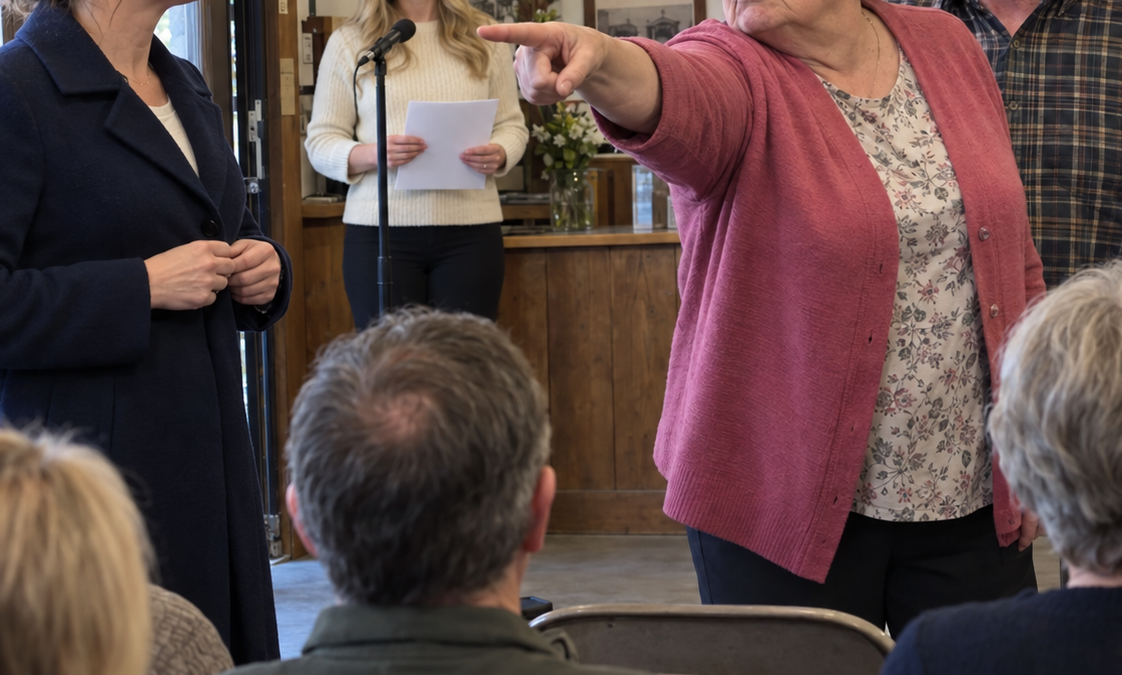
Janice rose from her chair and pointed toward the door.
“Your father’s right, Beth. Go on home.”
Mom didn’t need to point. I knew where the door was.
At the register, Stan lowered his eyes to the counter. On Thursday he’d told me he would keep the rolled plan under that counter and give it to Dad after the party. He didn’t speak.
I fastened the buttons of my coat and took the few steps to the door.
Sienna took the microphone before I reached the exit.
“One more surprise. My financing came through.”
Roger nodded. “Read it to them, honey. All of it.”
She raised the approval letter.
“Riverbend Community Credit Union is pleased to approve your application in the amount of $185,000.”
People applauded again, uncertain at first, then louder when she beamed at them.
My hand was already on the front door handle when I heard a sheet turn.
“Subject to the following conditions,” Sienna read into the microphone.
I let go of the handle, took off my coat, draped it over the back of the last chair, and walked up the center aisle.
Part 7 of 9
Sienna read the conditions the way she read the store’s specials over the intercom, fast and bright, like none of them could hurt her.
I stopped in the middle of the center aisle, about twenty feet from the podium. My coat was on the last chair. Behind me, the front door clicked as someone shifted near it.
The microphone gave a low hum. Sienna tilted the approval letter toward the overhead lights and kept going.
“Condition two,” she said, “conversion of the retail sales floor to day-spa use per the attached plan.”
Roger stood to her right, one hand resting on the podium.
“Conversion?”
Sienna didn’t look at him.
“It’s standard language, Daddy. Let me finish.”
She read on, faster than before. The paper rattled against her fingers.
“Condition six. Written consent of the current lienholder of record, Lakeshore Note Holdings LLC, in the form attached, executed by its managing member, Bethany J. Amundsen.”
The microphone carried every syllable.
Ruth Dykstra turned in the second chair of the front row. Her purse slipped against her knees. Behind her, a man leaned into the aisle to see me. Another woman twisted around, followed by the people in the row behind her.
At the front, Sienna’s photograph hung in my old spot on the photo wall, smiling at the crowd. I looked only at the podium.
Nobody applauded this time.
Sienna’s eyes stayed on the approval letter.
“That’s a typo. Lakeshore is some company in Holland.”
She raised her chin toward Roger, waiting for him to agree. He looked instead at the printed sheet in her hands.
I hadn’t moved from the aisle. I didn’t need the microphone; the room was quiet enough to hear a shoe scrape against the tile.
“It’s my company. It’s held the loan on this building since August 2020.”
Janice sat up straight, gripping the edge of her chair.
“We pay Lakeshore.”
“Every month. I never once charged you late.”
Stan shifted his weight at the register, its counter creaking under his palm. Sienna stared at me, still holding the pages in front of her chest.
“‘Nothing in this store has your name on it anymore.’ Your words, Sienna.”
This time Dad had no invoices to hide behind.
He glanced at the customers and back at me. Sienna held the approval letter a little higher, as if the print could settle what I’d said.
Her voice sharpened, though she still wore the smile she used on customers.
“She bought Daddy’s debt behind his back so she could take the store!”
Ruth straightened in her seat.
“Six years of ‘no charge’ on that roof, honey. That’s a funny way to take a store.”
A chair creaked near the back. Someone coughed, then went quiet. Janice’s mouth opened, but she said nothing.
Stan stepped away from the register. He reached beneath its counter, brought out the rolled plan, and crossed to the service counter beside the podium. Roger followed him with his eyes.
Stan spread the plan on the laminate and held its edges to stop the paper curling.
“I called her in July 2020, Roger. The bank was selling your loan to a collector out of Detroit. She put every dollar she had into this store so nobody could take it. And this is Sienna’s plan. All of it goes. Me included.”
He didn’t raise his voice. I could hear the quiet scrape of his palms against the paper.
Sienna took a step away from the podium.
“Stan, that’s a proposal. You don’t understand what you’re looking at.”
“Those are your drawings,” he said.
Roger left the podium and came to the counter. His hand landed flat beside Stan’s. I watched Dad bend over the contractor’s drawing, his lips moving over the printed heading.
Full demolition.
He stayed there long enough for Ruth to adjust her glasses and look toward the sheets. From where I stood, I could see the hard line of Roger’s jaw as he examined the outline of the store he’d built.
“What did you tell me about the hardware?” he asked Sienna.
“Daddy, we’re discussing financing. We can talk about the layout later.”
Stan didn’t let go of the edges.
Roger’s fingers stayed spread on the laminate. A man farther along Ruth’s row half rose to see, then sat again.
I took no step closer.
“I’m not calling the loan. I’m just not signing.”
Ruth turned from the counter toward me.
“Why on earth didn’t you tell them?”
“The bank told him. In 2020. My name was in that letter.”
Roger lifted his head. His face had gone gray.
“Nobody told me anything,” he said, hoarse.
A chair leg squealed in the back row. Roger was still looking at me.
I didn’t answer Dad. I’d given him my number years ago, and no call had come.
Sienna looked from Roger to the page she still held. She tried to smooth the crease with her thumb, but her fingers kept catching on the folded edge. Ruth was still turned in her chair, watching me.
Sienna lowered the microphone and looked down at the page.
“Read the last line again, Sienna. It’s my name.”
Part 8 of 9
By Sunday noon, ninety-one people had written under Sienna’s ‘next 50 years’ post, and most of them were writing to me.
I sat at my desk at Ferncliff, scrolling past comments on the store’s Facebook page.
“Thank you for keeping the doors open, Beth.”
“My family still buys everything there. Glad you stepped in.”
“Tell Stan we’re thinking of him.”
I didn’t answer.
Ruth Dykstra arrived carrying an apple pie in a dish covered with foil.
“You look like you could use a supper you don’t have to cook,” she said, putting it in my hands.
“Thank you, Ruth.”
She glanced at my phone, then left without asking what I’d do next.
That evening Mom called from home.
“Sienna didn’t come to Sunday dinner,” she said.
I could hear the kitchen faucet running.
“I set her place anyway.”
A crumb of Ruth’s pie had stuck to my sleeve. I brushed it off.
“How’s Dad?”
“Quiet.”
Monday morning, I sent Riverbend the refusal letter that had ridden in my work truck since Thursday, certified, return receipt requested. I hadn’t signed their form, and I hadn’t called the loan.
Tuesday, the “coming soon” page for Willow Stone Day Spa was gone when I looked for it.
Wednesday evening, Janice called again.
“Riverbend withdrew the approval letter,” she said. “They said condition six was never met.”
I sat at my kitchen table and listened.
“Sienna paid a $3,500 nonrefundable deposit for spa chairs and beds last Friday, October 16. She can’t get it back.”
Mom paused.
“She thought everything was approved, Beth. You could have warned her.”
“I know.”
“Your father’s hardly speaking.”
I didn’t ask if that included Sienna.
Friday, October 23, I arrived at Neil VanderMeer’s law office in downtown Grand Rapids at ten.
Neil was Mom and Dad’s lawyer. He sat at the head of a long conference table, one hand flat on the unsigned deed that would have put the building in Sienna’s name.
Roger and Janice sat together on one side. I took the chair opposite them.
Sienna’s chair sat empty beside Mom’s, pulled out a few inches, as if somebody still expected her to come in late. Nothing on the seat, no coat over the back.
“She said she wasn’t coming,” Janice told Neil.
He adjusted his glasses.
“Then we will discuss what we can with the people here.”
Roger’s jacket was buttoned, although the room was warm. He kept his palms against his knees, the way he did when he wanted a conversation finished before it started.
At the store he always had something to sign. Here the paper belonged to Neil, and Dad hadn’t put his name on it.
Neil flattened the deed, but didn’t offer it to anyone.
“The mortgage says no transfer and no second loan without the lienholder’s written consent. Sign this deed now, and Lakeshore could call the whole balance.”
“So it means we keep the building, or we lose it,” Janice said.
Roger’s jaw moved. For a moment I thought he was going to argue with the words on the table.
“Put the deed away, Neil.”
Neil slid it back into his folder.
“And Sienna?” Janice asked.
“She won’t be running the store,” Roger said.
Mom looked down at her hands and turned her wedding ring a quarter turn, then back.
Dad faced me across the long table.
“Beth, we need to talk about who runs it.”
I kept my hands in my lap. He hadn’t said my name like that in years, without ordering me somewhere.
“We can talk,” I said.
He rubbed the crease of his trousers with a thumb.
“There’s a lot to sort out,” he said.
“There is.”
He glanced toward the empty chair. I waited, but he didn’t say her name.
Mom straightened the cuff of her cardigan. Her eyes were red around the edges, though her voice stayed measured.
“You should have told us.”
“I put my name in the bank’s letter, Mom.”
“I only saw the checks going out,” she said.
She pressed her fingertips together on the tabletop. Roger’s gaze moved to the far end of the room. He didn’t say whether he remembered the notice.
Neil leaned forward.
“I want every letter from the bank since 2020. Anything addressed to either of you, whether you filed it or not.”
Janice looked at Roger.
Dad unbuttoned his jacket and reached into the inside pocket.
The white bank envelope came out between his fingers. I recognized the Harrow Creek State Bank logo and his name on the front, the same view I’d had through the drawer’s opening.
“I found it Monday, cleaning out the drawer in the back office,” Roger told Neil. “I’ve carried it four days. I wanted Bethany in the room.”
He laid the bank envelope on the table.
Neil drew back his hands. Janice bent close enough to see the address, but neither of them touched it.
Dad picked it up again and tipped the front toward me, where the stapler had covered it for six years. The postmark read August 2020.
He turned it over. The flap was still sealed.
“It came the week of my surgery. I never opened it.”
Six years I’d treated his silence as an answer.
Roger tore the edge of the bank envelope open.
Part 9 of 9
‘For all questions, please contact Bethany J. Amundsen, Managing Member,’ my father read, and then he read my cell number out loud, digit by digit, like he was dialing it.
It was still Friday, October 23, still Neil’s long table, and the bank notice rattled in Roger’s hands. The torn bank envelope lay in front of him. He finished the last digit and looked at the paper again.
“That’s the number I’ve had in my phone all along,” Janice said quietly.
Neil VanderMeer adjusted his glasses.
“I’d like a copy for the file.”
Roger nodded. Neil ran the bank notice through the copier by the door and handed it back. Dad folded it in quarters and tucked it into his shirt pocket.
“You sent it through the bank,” Dad said to me.
“I asked them to put my number in.”
He ran his thumb over the pocket seam.
“That week, everything with your name on it went in the drawer,” Mom told him. “I never checked what it was.”
Dad looked across the table at her, then back at me.
“I thought you knew,” I said.
His chair scraped as he pushed back from the table, and he held the door for Mom without a word.
Saturday, October 24, at four, I found Dad sitting on a wooden crate at the loading dock behind the store. A pallet jack stood beside the wall, its handle tipped toward the concrete. The October light was already thin, and Roger had his jacket open despite the cold.
I stayed standing near the edge of the dock.
“Six years I thought you never looked back,” he said.
“Six years I thought you read it and decided I wasn’t welcome.”
He tapped his shirt pocket, where the folded bank notice made a square beneath the cloth.
“I remember what I said when you left.”
“So do I.”
He looked down at his work shoes.
“You walk out that door, you don’t put one dollar of yours into this store.”
I didn’t answer.
“You put in a few more than one.”
A delivery truck passed on Plainfield Avenue. We listened until the engine faded. Dad slid to one end of the crate to make room, and I sat next to him. The wood was rough through my coat.
“You were starting Ferncliff,” he said. “I thought you were leaving me with the mess.”
“You still had Stan, Dad. He knew the store as well as anybody.”
“I know that now.”
His fingers worried a loose thread on the cuff of his jacket until it came free.
I pulled a splinter from the edge of the crate.
“I kept waiting for a call,” I said.
He pressed two fingers against the folded paper through his shirt.
“I’m listening,” I told him.
He shifted toward me, just enough for our sleeves to touch.
“I was wrong. That’s settled.”
We stayed on the crate until the security light over the dock buzzed on, and he stood carefully, one hand braced on his knee.
Monday, October 26, we met in the back office before the store got busy. Roger sat behind his wooden desk. Janice took the stool by the filing cabinet, and Stan remained near the door. I stood beside Dad’s desk.
“The building stays in our names,” Dad said.
Mom nodded. “We’re keeping it.”
“And Stan will manage the store.”
Stan blinked. “You sure?”
“You know what comes through that door better than I do,” Roger said.
Stan found a pen in his pocket and wrote the decision on the pad he carried for parts orders.
“I just write it down,” he said.
“Ferncliff’s technicians can work the service counter on Tuesdays and Saturdays,” I said. “We’ll keep the repair side covered.”
“Good,” Dad said.
“The service binder’s back on its shelf,” Stan added.
Janice smoothed her cardigan.
“I asked Sienna if she’d come back to the register. She wants more time.”
“Give her time,” Roger said.
“I still set a place for her every Sunday,” Mom added.
Nobody told her to stop.
Saturday, October 31, the store was handing out candy at the register around six. Neighborhood kids in costumes lined up across the sales floor while Stan dropped treats into their open bags. The aisles had their hardware shelves again. A child’s plastic mask clicked against the counter as he leaned forward.
At the photo wall, Dad moved Sienna’s register picture one space to the right and held my 2004 picture against the place where it used to hang. I helped him straighten the frame. Janice stood close enough to check whether it was level.
“Leaving the family store isn’t the same as leaving the family,” I told her.
Mom met my eyes.
“I know, Beth.”
Roger finished hanging the photo and took out the white bank envelope, torn open above the Harrow Creek State Bank logo. He’d brought the stapler from his desk, too, and set it on the counter beside the frame.
Then he opened his palm. The store key, the brass back-door key I’d laid on his desk, rested there.
“Back door sticks. You remember.”
“I remember.”
I worked the store key onto my key ring, easing the metal loop past the worn brass head with my thumbnail. Dad stayed beside me while the kids called for candy near the register.
Dad pinned the bank envelope under my picture. Opened, this time.
THE END
More stories
My brother’s wife carried Mom’s clothes from her bedroom 14 days before Dad’s knee surgery—Until Dad’s case manager stepped in, and the room she called hers stopped being hers.My fiancé shamed me for working nights before 80 hockey parents while my son sat beside me—then the rink owner arrived, and his perfect speech began unraveling.My Brother-in-Law Told an Estate Manager I Was Entering Memory Care and Advertised One October 31 Sale, but My Refusal Left Every Shopper Standing Outside My DoorMy Daughter’s Groom Held Up a Bent Metal Pipe, Mocked My Knees, and Said He’d Own My Shop—Then the Eleven Electricians Who Owned It Told Him at the Wedding He Had No Management JobMy Boss’s Daughter Fired Me by Text After 26 Years and Changed the Locks—Then 10 Tax Envelopes Proved I Owned Part of the Diner She Tried to SellMy Ex-Husband Took Over My House With 2 Bowling Friends and Mocked My Librarian Job—Then the Door Log Helped Get Him Removed in Front of His Guests








