My Fiancé Promised to File a Police Report After My Husband’s Guitar Vanished, but Never Gave Me a Number—Until His Own Paperwork Exposed Him at a Public Performance.
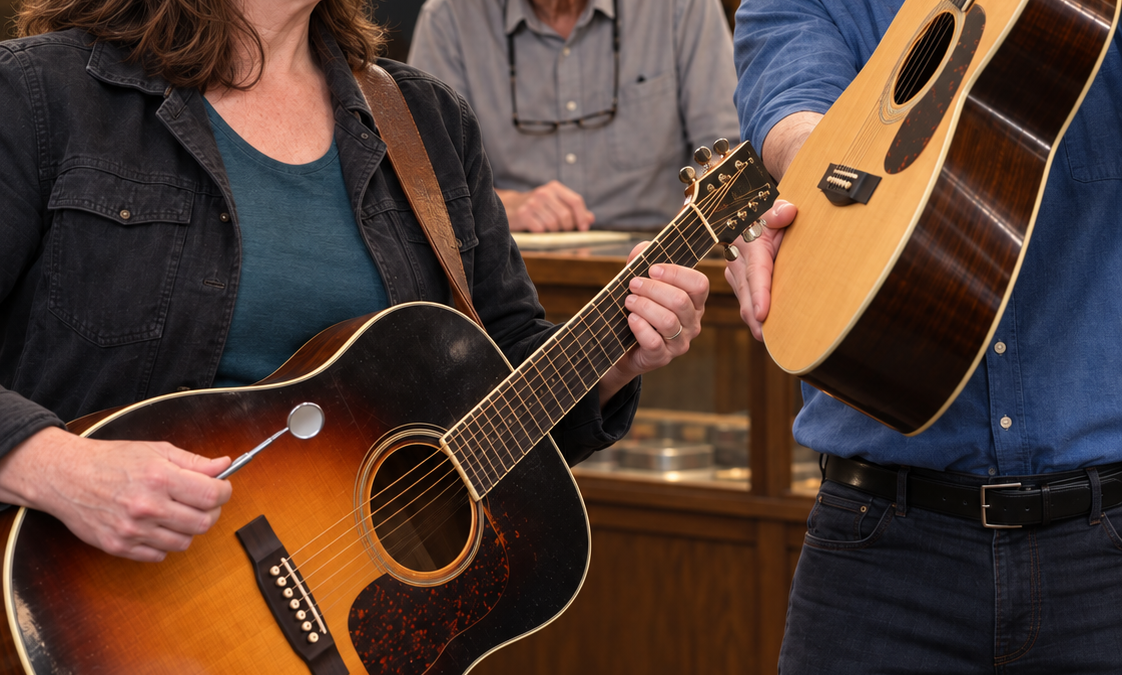
Complete story · 9 parts · about 39 minutes · ending included
Part 1 · Part 2 · Part 3 · Part 4 · Part 5 · Part 6 · Part 7 · Part 8 · Part 9
Part 1 of 9
Kurt was standing under the empty wall hanger in my garage, pointing at the side door like it had done something to him.
“Must’ve been last night, while we were asleep.”
It was 6:50 Thursday morning, October 2.
The door to the yard stood wide open. Outside, our neighbor’s sprinkler clicked across wet grass.
I looked at the bare hooks.
Roland’s guitar had hung there since September 13. Sunburst finish, brown leather strap, a scar from my 2019 repair.
Now I could see two clean marks where the brown hard case had rested against the wall below it.
“Was it open when you came out?” I asked.
“Sure was. I came to get my tape measure and saw this.”
Kurt wore his work polo and khaki pants. His coffee sat on the bench, dangerously close to a customer’s open instrument case.
I moved the cup.
“Anything else missing?”
“Looks like they knew what they wanted.”
Beside my workbench stood the rack holding three customers’ instruments.
A twelve-string needed a new nut. A student acoustic had a lifting bridge. The mandolin on the end belonged to a bluegrass picker in Soddy-Daisy who had paid more than $2,000 for it.
All three were untouched.
Even the bag of new tuners hadn’t moved.
“Did you hear anybody?” Kurt asked.
“No.”
“Neither did I. Whoever it was must’ve been quiet.”
Wednesday, I delivered a restored banjo to a collector in Nashville who wouldn’t risk shipping it.
My trip ran from 6:30 AM to 11:10 PM.
I came through the front door, went to bed, and never entered the garage.
Kurt stepped closer and rubbed my shoulder.
“I’m sorry, Gretch. I know that old thing meant something.”
I reached into the bib pocket of my overalls and pulled out the dental mirror.
Twenty years at the bench had made the motion automatic.
The steel circle caught the overhead fluorescent light.
There was nothing on that wall to inspect.
I put it away.
Roland bought the guitar at a little shop down Hixson Pike in April 1994, when he was twenty-eight, and drove it home with the seatbelt buckled across the case.
In the summer of 2019, after he fell on our porch steps and cracked its back, I glued a maple bow-tie cleat inside beneath the damage and carved “G+R 6·19” into it.
On September 13, Kurt removed the guitar and its walnut wall hanger from beside our couch, mounted both here facing my bench, and said, “You can’t marry me with a dead man hanging on the living room wall, Gretch.”
I turned the ring on my finger.
Kurt followed my eyes to the vacant hooks.
“Maybe it’s time we quit keeping everything exactly how Roland left it.”
“Somebody came into our garage.”
“I know, honey.”
“That’s different.”
Kurt studied his watch.
“I’ve got a sales meeting downtown at eight. I’ll handle the police stuff. You shouldn’t have to spend your day on this.”
I watched him pick up his coffee.
“Can you check whether any of your tools are gone?”
“I’ll take a good look when I get home.”
He kissed my forehead before walking through the kitchen.
I stayed where I was.
That latch had always required a firm pull. I tried it gently, then harder. It caught both times.
Kurt never said whether he’d found the lock turned.
I checked the threshold for damage. The screws sat flush, and the strike plate hadn’t moved.
Outside, yesterday’s leaves clung to the damp concrete.
I couldn’t make out footprints.
At 7:25, I went into the kitchen to wash the dust off my hands.
Landon’s cereal bowl waited in the sink. My ten-year-old grandson had slept over Tuesday, and Shelby picked him up at 7:15 Wednesday, while I was driving to Nashville.
His school spelling list was still held to the refrigerator by a magnet.
He’d be coming Sunday for his lesson.
He wanted to learn a whole song on Grandpa’s guitar.
I pressed the spelling list’s curling corner back under the magnet.
At 7:30, my phone buzzed.
Kurt had texted from his truck.
“So sorry babe. Thief must’ve come in through the side door. I’ll file it online from work.”
I typed, “Thank you. Please send me the report number.”
He answered with a heart.
By 6:15 that evening, I’d reset the bridge on the student acoustic and heated leftover chicken casserole for dinner.
Kurt sat at the head of my kitchen table, humming the chorus he’d been practicing for Friday karaoke.
He drummed two fingers on the table.
“Fellas at the bar keep asking when you’re coming to hear the best voice in Hixson.”
“Anybody come close?”
“Not serious competition.”
He smiled and reached for another helping.
I set the casserole dish between us.
“I want to call the police myself tomorrow. And I can ask at the pawn shops.”
Kurt’s fork stopped halfway to his mouth.
“I already filed it.”
“Did they give you a number?”
“They send that stuff electronically. I’ll find it.”
“I could still make a few calls.”
He laid his fork down carefully. “Cops won’t chase a $300 guitar, Gretch. Let it go. Fresh start.”
Three hundred dollars.
Nobody had given Kurt a price.
I figured he’d guessed what an old acoustic might bring at a pawn shop. He knew sales figures better than instruments.
“Roland played it at our wedding,” I said.
Kurt reached across the table and touched my hand.
“And I’m going to marry you in December. We’ve got a whole life ahead of us.”
The ring turned slightly beneath his thumb.
I looked at the small gap where the setting met the band.
Kurt resumed humming while I cleared his plate.
Three hundred dollars kept buzzing in my head, like a loose brace nobody can find. When a customer brings me a buzz like that, I always tell them the same thing.
Let me look inside.
After he went down the hall to bed, I went out and locked the yard door myself.
I sat at the bench, opened my repair log to the 2019 photograph of Roland’s cracked guitar back, and wrote beneath it in pencil:
“Oct 2 — gone. Customers’ guitars untouched. $300?”
Part 2 of 9
By Monday night I had called three pawn shops and read every guitar listing between Chattanooga and Knoxville.
The first man asked if I had a police report.
I told him my fiancé had filed one.
“Call back with the number,” he said. “Makes it easier to flag anything that comes in.”
On Friday, October 3, I had started with the Chattanooga listings while the glue dried on a customer’s bridge repair.
Sunburst dreadnought. Brown leather strap. Serial number ending 0417.
The second shopkeeper said he’d remember that combination.
The third asked whether I’d checked the listings around Knoxville.
By Monday, October 6, I had. Nothing matched.
I’d told Shelby that first night. We agreed to tell Landon only that “Grandpa’s guitar is away for a while,” so he wouldn’t be scared to sleep over.
On Sunday, October 5, Peggy called while I was wiping grease off the kitchen stove.
“Just checking on you, honey. Kurt said you’ve been quiet.”
Peggy was Kurt’s older sister. She worked as an elementary school secretary and had a voice that could settle an entire hallway of second graders.
I told her about Roland’s guitar.
“Oh, Gretchen. I’m sorry.”
“Thank you.”
“I know how much you loved Roland.”
I waited while she cleared her throat.
“Honey, let the dead rest.”
Peggy said it gently, the way someone might remind me to take a sweater.
“I’ve been trying to find what’s missing,” I said.
“Well, Kurt loves you. Remember that.”
She mentioned the December wedding cake before we hung up.
On Tuesday, October 7, Kurt was scrolling through his phone at the breakfast table when I asked about the police report number.
“I want to call those pawn shops back. They said it would help.”
“It’s in my work email somewhere.”
He didn’t look up.
“Could you send it to me?”
“Sure thing, Gretch. Remind me if I forget.”
He kissed my cheek on his way to the garage for his work bag.
Wednesday passed without a message.
I left it alone.
I’d already brought up the missing instrument at breakfast, dinner, and twice while he watched television. I didn’t want to become the woman who nagged a man about her dead husband’s guitar.
On Saturday, October 11, I found Kurt carrying a cardboard box out of the hall closet.
Roland’s navy band jacket lay over the contents. One brass button was missing, and a white thread marked where I’d meant to replace it.
Beneath the fabric sat a stack of sheet music, the corners soft from years of being turned on a music stand.
Kurt had written DONATE across one side in thick black marker.
“What are you doing?”
“Cleaning up a little.” He smiled. “Somebody should get use out of them.”
“That jacket was Roland’s.”
“I know. It hasn’t been worn in years.”
He carried the DONATE box through the kitchen and set it by the garage side door.
“Church thrift store takes clothes on Wednesdays. I can drop it off.”
“I haven’t decided to give those away.”
Kurt rested one hand on the DONATE box.
“Thought I was helping. We talked about making room.”
“We talked about the living room.”
He gave me a quick kiss.
“All right, Gretch. No rush.”
Later, while he picked up groceries, I sat on the garage floor and opened the DONATE box.
Roland had worn that jacket for years when he played with three men who called themselves a band, though they never earned enough to cover gas.
I checked the inside pocket. A guitar pick rested beside a matchbook from a diner long since closed.
The sheet music smelled faintly of the cedar chest where it had stayed until Kurt moved in.
Roland kept the paperwork for every instrument folded inside the first song he’d learned on it. For the sunburst, that was an old country ballad with his pencil chords in the margin. Between its pages, I found another piece of paper.
The 1994 receipt.
Handwritten across the top was Hollow Pine Music.
April 1994. One sunburst acoustic dreadnought.
At the bottom, beside the total, somebody had initialed it “H.B.”
I didn’t recognize the initials.
Roland had saved receipts for practically everything he bought. The toaster that quit in 2008 went in the kitchen drawer. Anything with strings went in with its music.
I smoothed the 1994 receipt against my knee.
The creases divided it into neat quarters.
I tucked it into my repair log at the bench and put the other pages back.
On Sunday, October 12, Landon arrived at ten with a wet maple leaf stuck to his untied shoelace and a cinnamon roll wrapped in a napkin.
I’d borrowed a customer’s guitar, with permission, for his lesson.
“Grams, can we do the song with only three chords?”
“We can try.”
“Good. Four is too many.”
He made it through the first verse before asking for the rest of his cinnamon roll.
That evening, I pulled the DONATE box away from the side door and slid it beneath the bench.
Kurt found it while looking for a screwdriver.
“Thought we settled this.”
“I said I hadn’t decided.”
He crouched beside the DONATE box and straightened a loose flap.
“Your daughter has her own house. Landon’s got plenty of memories. We don’t need to keep every scrap of Roland’s life.”
“Those are his songs.”
“They’re paper, Gretch.”
I stood beside my stool.
“He wrote notes on them.”
Kurt brushed dust from his palms.
“I’m not asking you to forget your husband. I’m asking you to give me a little room in my own home.”
“My house has room.”
His expression tightened before the smile returned.
“That’s not what I meant.”
We went into the living room together.
The wall hanger had once been mounted beside the couch. Now the paint showed a brighter patch where its walnut backing had protected it from sunlight.
Kurt pointed toward that bare space.
“See? Doesn’t the room look better?”
I looked at the pale outline.
“There’s still a mark.”
“We’ll paint it.”
“I haven’t asked you to.”
He rubbed his forehead.
“People are coming to our wedding, Gretchen. My family. Your neighbors. I’d like them to see we’re starting our life together.”
“I ordered the invitations.”
“Invitations aren’t the point.”
I returned to the bench.
Kurt stood in the garage doorway.
“The wedding’s in nine weeks, Gretch. Either the ghost moves out or I do.”
Part 3 of 9
Hal Brannock took the repaired mandolin from me like it was a baby someone had brought home from the hospital.
“Careful with the neck,” I said. “The finish is still settling.”
He adjusted his grip without arguing.
“You’re Gretchen Mabry.”
“That’s right.”
“Fellow said you could make his mandolin sound new again.”
“I told him I’d make it sound right.”
Hal smiled.
It was 11:00 Thursday morning, October 16, and I was standing inside Hollow Pine Music on Frazier Avenue in Chattanooga’s North Shore.
The glass front door had a brass bell that rang when I entered. A long wooden counter separated the customers from the repair supplies and instrument racks.
Behind it hung about twenty consignment guitars.
A small stage occupied the far corner, with two microphones and three folding chairs arranged for Thursday open-mic nights.
Hal looked about seventy-five, with white hair combed straight back and reading glasses attached to a cord around his neck.
Roland played here most Thursdays from 1994 to 2019. I seldom came because those evenings were customer drop-off hours, and I hadn’t visited since about 2015.
The mandolin was worth over $2,000, the same one left untouched when somebody took Roland’s guitar from my garage.
Its owner had purchased it here and asked me to return it after the repair.
That gave me a reason to drive down Hixson Pike.
The 1994 receipt sat folded in my overalls pocket.
I’d figured nobody stealing an instrument would be foolish enough to bring it back to the store that originally sold it.
Still, I meant to ask whether anyone had brought in a sunburst dreadnought.
Hal laid the mandolin on a padded section of the counter.
“Let’s hear what you did.”
He plucked the fourth string, listened, and worked his way across the courses.
“Intonation’s clean.”
“The bridge needed fitting. Somebody had shaved the feet unevenly.”
Hal tested a chord.
“Well, that’s a poor way to save ten minutes.”
I liked him already.
While he checked the upper frets, my eyes traveled across the display behind him.
A black twelve-string.
Two natural-finish acoustics.
A red electric with a missing knob.
Then a big sunburst dreadnought, third from the end.
I stopped moving.
The lower bout had the same amber curve where Roland’s right arm had polished the finish for nearly thirty years.
A brown leather strap hung from its shoulder.
Around its neck was a white consignment tag.
“CONSIGNMENT #C-1047 — $300”
Beneath it hung a yellow hold tag.
“HOLD — H.B.”
H.B.
Those were the initials at the bottom of the 1994 receipt.
I pressed my thumb against the folded paper inside my pocket.
Three hundred dollars.
The same amount Kurt had guessed at dinner.
I’d written it in the repair log with a question mark.
“Ma’am?”
Hal had finished checking the mandolin.
I looked up.
“That guitar.”
He followed my finger.
“Which one?”
“The sunburst. Third from the end.”
His hands went flat on the countertop.
“Yes?”
“That was my husband’s.”
Hal removed his reading glasses.
I stepped closer until I could see the narrow scratch beside the bridge.
Roland had made it changing strings at our kitchen table in 2006. He’d blamed a stubborn pin, then asked whether I could buff the mark out.
I’d told him I could.
He’d said to leave it.
“His name was Roland Mabry,” I said. “He played that corner stage for twenty-five years.”
Hal lowered his eyes toward the scratch.
“He passed in March 2022,” I added.
Hal said nothing.
“Somebody took it from my garage two weeks ago.”
“Have you reported it?”
“My fiancé filed it online.”
“Do you have the number?”
“Not with me.”
He folded his hands.
“Who brought it in?” I asked.
Hal glanced toward the glass entrance before answering.
“Consignor signed he’s the owner. His name stays with me unless the police ask. Bring me papers, and I’ll do the rest.”
“I have paperwork.”
“What kind?”
“A receipt from when my husband bought it. And his will.”
“Bring the will,” he said.
“Why?”
“Because a purchase receipt tells me who bought something. Doesn’t always tell me who owns it today.”
That was fair.
“What’s the yellow tag for?”
Hal looked toward the hold tag.
“That’s shop business.”
My eyes went back to the consignment tag.
“I suppose I could give you three hundred dollars and be done with this today.”
Hal waited.
My fingers found the 1994 receipt’s creased edge through the denim.
“I’m not paying a stranger for my own husband’s guitar.”
“It’s on hold anyway.”
The hold tag rested against the neck, its printed side facing me.
I couldn’t see its reverse.
Behind me, the front bell rang.
A woman came in carrying a child’s violin case. Hal greeted her, pointed toward a chair, and asked if she could give him a minute.
She sat near the stage.
I moved aside, conscious of blocking the display.
“I don’t want to cause trouble in your store.”
“You’re not.”
Hal held my gaze a beat longer than I expected.
Then he turned to the wall, lifted Roland’s guitar off its hook, and came around the counter.
He offered it to me before I could ask.
I supported the neck with my left hand and braced the body against my hip.
The weight was familiar.
One tuning peg had a slight bend. The third string was wound backward around its post, exactly how Roland always did it.
“Mind if I inspect the inside?”
“Go ahead.”
I drew the dental mirror from my overalls bib pocket.
Hal cleared a space on the countertop.
I laid Roland’s guitar on the padded surface, pulled out my phone, and switched on its flashlight.
The beam entered through the sound hole.
I angled the dental mirror beneath the strings, slowly turning its small steel face toward the back of the guitar.
A rib of pale wood came into view.
Then the edge of the old crack.
I tilted my wrist another quarter inch.
There, beneath the damage, was the bow-tie maple cleat I’d glued in place six years earlier.
“G+R 6·19”
Part 4 of 9
I didn’t tell Kurt about the mirror, and I didn’t sleep.
On Saturday, October 18, I opened the fireproof safe in my bedroom closet.
Kurt had left for the hardware store. His truck was already gone when I carried my coffee down the hall.
The safe sat behind my winter shoes, exactly where I’d put it after Roland died.
Inside were our marriage certificate, the deed to the house, and the will folder.
I carried it to the kitchen table.
Roland had signed his will in 2018, four years before his death. The Hamilton County Chancery Court had admitted it to probate on April 21, 2022.
I knew what it said.
I opened it anyway.
Halfway down the second page, under the section on personal property, were the words:
“my sunburst guitar and everything in my music room — to my wife, Gretchen.”
I ran my finger beneath my name.
Roland and I married in 1997. He played that instrument while I stood in my wedding dress, waiting for the minister to finish arranging everybody.
The strap had kept slipping off his shoulder.
I’d fixed it with a safety pin borrowed from my mother’s purse.
The same guitar he’d meant to teach Landon on, once the boy got big enough to hold it properly.
I closed the will folder.
The repair log was waiting at the bench. I turned to the June 15, 2019 entry, where I’d recorded the cracked back after Roland’s fall on the porch steps.
I’d taken three photographs that afternoon.
One showed the split beside the lower brace. The next caught the cleaned joint before I applied glue.
The third showed the maple cleat set across the crack, with “G+R 6·19” carved into its surface.
I photographed that page with my phone.
The pencil notes were still readable. I’d written down the adhesive, clamping time, and location of the repair.
I checked the photograph before putting my phone away.
I could make out every letter.
On Sunday, October 19, Landon sat on the stool beside the bench, trying to tune the borrowed guitar.
“Grams, this string keeps going wrong.”
“You’re turning the wrong peg.”
“I turned the one you said.”
“Try it the other direction.”
He twisted carefully.
The note climbed too high.
“Well, now it’s worse.”
“Back it off a little.”
He corrected it, then grinned when the tuner’s light turned green.
His sneakers rested on the lower rung of the stool. Shelby had packed apple slices in a plastic container, but he’d eaten only the crackers.
I reached for his music sheet.
“Ready to try the first verse?”
Landon kept one hand around the neck.
“Is Kurt’s surprise for you ready yet?”
My fingers stopped at the corner of the paper.
“What surprise, honey?”
“The one with Grandpa’s guitar.”
I set the sheet beside the tuner.
“Tell me about that.”
Landon looked toward the kitchen door.
“Am I allowed?”
“You’re talking to me.”
He rubbed the heel of his sneaker against the stool.
“That Wednesday morning, when Mom was coming to get me for school. I saw Kurt take Grandpa’s brown guitar case out to his truck.”
“Wednesday, October 1?”
“Yeah. You were gone.”
I kept my palms flat on the bench.
“Where were you standing?”
“By the kitchen window. I was watching for Mom’s car.”
“Did Kurt see you?”
Landon nodded.
“He came back inside for his keys and said, ‘It’s a surprise for Grams, don’t tell.'”
The little tuner blinked green, then went dark.
Landon studied my face.
“Was I supposed to tell you now?”
I steadied the borrowed guitar on his knee.
“You didn’t do anything wrong.”
“But I ruined it?”
“No, sweetheart.”
He picked at a loose thread on his jeans.
“Is it still a surprise?”
“I need to talk to Kurt about that.”
Landon watched me for another second.
“Can we play the song now?”
I handed him his music.
“Start with G.”
He put his fingers in place and missed the second chord completely.
“Stupid D chord.”
“Your grandfather said that plenty of times.”
Landon smiled and tried again.
On Wednesday, October 22, I called the Chattanooga police non-emergency line.
I’d written the number on a yellow note beside my work calendar.
A woman answered after the recorded menu.
“How can I help you?”
“My husband’s guitar went missing from my garage on October 2. My fiancé said he reported it online. I never got a case number.”
“Do you have the address where the incident occurred?”
I gave her my Hixson address.
She asked when I’d last seen the instrument and whether I’d noticed damage to the entrance.
I answered both questions.
Then she said, “Does anyone else in the home have a key?”
I looked at the ring on my left hand.
My thumb caught on its setting.
I ended the call.
The yellow note stayed beside the calendar, its top corner pressed down with a screwdriver.
On Saturday evening, October 25, Kurt came into the kitchen while I was sorting papers.
The will folder lay open on the table.
He stopped beside the refrigerator.
“What’s all this?”
“Some paperwork I need.”
Kurt leaned close enough to read Roland’s name.
“Still married to him on paper, huh? Put the dead man’s papers away before my sister sees them.”
I pulled the will folder shut.
“Peggy isn’t here.”
“She’s coming by tomorrow. You know how she gets.”
I knew Peggy would probably bring something she’d baked and ask whether we’d chosen the wedding flowers.
Kurt opened the refrigerator and took out a bottle of water.
“We’re getting married in seven weeks, Gretch. Could we have one weekend without Roland?”
I slid the will folder into my purse.
“Did you eat already?” he asked.
“No.”
“There’s leftover meatloaf.”
“I know.”
Kurt twisted the cap off his water and headed toward the television.
I carried my purse into the garage and sat facing the empty wall hanger.
The DONATE box was still under the bench.
I lifted it onto the bench, took out Roland’s band jacket, and hung it where his guitar used to hang, where Kurt would see it the moment he opened the kitchen door.
Part 5 of 9
Kurt never emptied his pockets. He didn’t know I did it for him.
Monday, October 27, 8:10 PM.
I stood in the laundry room beside the garage with the washer lid open and Kurt’s jackets piled on the sorting counter.
Water rushed through the shower pipes down the hall.
He’d gone in ten minutes earlier, singing the same chorus he’d practiced for Friday karaoke.
I’d gathered the jackets from the coat hooks by the kitchen door because they smelled of varnish and sawdust from the bench.
Kurt worked in sales. He didn’t get his clothes dirty for a living.
But he liked leaning against the bench while he talked about his day, and the smell followed him.
Receipts and gum wrappers from his pockets always went in the trash, and he never missed them.
I started with his gray windbreaker.
Two peppermint wrappers. A grocery receipt. Seventy-three cents in loose change.
I emptied his brown work jacket next.
A gas station napkin and a pen without a cap.
Water still drummed in the pipes.
Kurt’s jean jacket lay at the bottom of the pile.
He’d worn it Wednesday, October 1, when I left for Nashville.
Kurt had hardly worn the jacket since.
I’d seen it hanging on that same hook every day.
I picked it up by the collar.
The cuffs were stiff from old sawdust, and the left sleeve had a pale spot of dried varnish near the elbow.
I checked the outside pockets.
Empty.
The inside pocket felt thicker than it should.
I worked two fingers under the lining and found a creased edge.
A yellow sheet, folded into quarters, with a smaller slip tucked inside the fold, the way some men keep a bill wrapped around the money meant to pay it.
I unfolded the smaller one first.
It was the payment slip from the jewelry store where Kurt had bought my engagement ring.
Across the top was the store’s printed account information.
Below it, in dark type:
“FINAL INSTALLMENT $240.00 DUE 11/15”
I held the payment slip between my thumb and forefinger.
Kurt had proposed on July 4.
We’d been sitting on my back porch after supper when he brought out the little jewelry box.
He’d told me he wanted December to be the beginning of our fresh start.
I hadn’t asked what the ring cost.
When I’d noticed a payment-plan envelope in the kitchen a few weeks later, he’d said he had everything handled.
I looked down at my left hand.
The ring sat slightly crooked, as it always did when my fingers were cold.
I straightened it with my thumb.
Water continued hitting the shower floor.
I set the payment slip on the sorting counter and opened the yellow sheet.
The top line read:
“HOLLOW PINE MUSIC — CONSIGNMENT AGREEMENT #C-1047 — 10/1/2025”
I flattened the paper against the laminate.
October 1.
The Wednesday I’d driven to Nashville.
The morning Landon had watched Kurt carry the brown guitar case to his truck.
Farther down, the description read:
“acoustic guitar, sunburst, dreadnought, brown hard case, serial …0417”
I knew those last four digits.
I’d written them on repair tickets for years.
Every string change on Roland’s guitar went into my log under that number. So did the cracked back in 2019.
0417.
My fingertip rested beside the printed description.
On October 16, I’d stood at Hollow Pine Music looking at a white consignment tag around that instrument’s neck.
The number on it was C-1047.
So was the number on the consignor copy in front of me.
I lowered myself onto the laundry stool.
The shower faucet squeaked briefly as Kurt adjusted it.
I turned the yellow sheet sideways under the ceiling light.
The next section read:
“Price: $300 — Consignor receives 80%: $240”
Three hundred dollars.
Kurt had used that exact amount at our kitchen table, telling me the police wouldn’t bother looking for Roland’s guitar.
Two hundred forty dollars was eighty percent of three hundred.
And $240 was exactly the final installment on the ring.
I placed the payment slip beside the consignor copy.
The amounts matched down to the cent.
The pipes kept humming.
I could hear Kurt clearing his throat between lines of the song.
He was practicing the high notes.
My eyes returned to the agreement.
The shop’s conditions were printed in smaller type. The person consigning the instrument could withdraw it before a sale.
If Kurt knew I’d seen the consignor copy, he could drive to the shop, take the instrument away, and make it disappear a second time.
I pressed the crease flat with my thumbnail; the bottom quarter had curled back under along the old fold.
A signature on a consignment slip is your word that you own what you’re selling.
For twenty years, I’d examined repairs by following the evidence in front of me.
A crack had a beginning and an end. A loose brace left marks where it rubbed.
I could usually find the crack by running a fingernail along the grain.
The man in the shower down the hall had slept beside me since April.
He knew which coffee mug I used and how I liked my toast.
He knew I still kept Roland’s old birthday cards in my dresser.
I looked at the payment slip again.
Kurt had told me the ring was taken care of.
I gathered both papers and slipped them into my apron pocket.
Kurt’s jean jacket went into the washer with the others.
I measured detergent into the dispenser and pressed Start.
The clean jacket would go back on its hook, and Kurt would never remember what had been in its pocket.
The washer filled while the shower kept running.
I took the consignor copy out once more and opened it fully under the light.
At the bottom, beneath the line “Consignor certifies he is the sole legal owner of the item and has the right to sell it,” was Kurt Kimsey’s slanted signature.
Part 6 of 9
I laid the will folder on Hal’s counter on Tuesday morning and opened it to the page with the judge’s stamp.
It was October 28, 10:00 AM.
Hollow Pine Music smelled of fresh strings and lemon oil. Outside the glass door, somebody was unloading pumpkins from a pickup on Frazier Avenue.
Hal adjusted his reading glasses.
“Let’s see what you’ve brought.”
I pointed to Roland’s will.
He read the line aloud.
“my sunburst guitar and everything in my music room — to my wife, Gretchen.”
I showed him the certified court order from April 21, 2022.
Then I placed the consignor copy beside it.
Hal read the October 1 date, the $300 price, and Kurt Kimsey’s name.
His mouth tightened.
“Who’s he to you?”
“My fiancé.”
I opened the photograph of the 2019 repair log on my phone.
“That’s the cleat I installed after Roland cracked the back.”
Hal took Roland’s guitar down from the wall.
He brought over a small light, angled it through the sound hole, and checked the maple repair himself.
“G plus R. June nineteen.”
I nodded.
He lowered the instrument onto a padded mat.
“That guitar’s worth about nine hundred.”
“Kurt listed it for three.”
“Yes, ma’am.”
Hal removed his glasses.
“The agreement says the consignor can withdraw an item any time before it sells. That’s a problem.”
“Because Kurt could come collect it.”
“Under ordinary circumstances, yes. But you’ve shown me ownership papers, and I’m not handing it over to him.”
“Can you cancel the agreement?”
“I can.”
He rested his fingertips against the counter.
“Forty years, I’ve never voided a man’s slip behind his back. He walks in, I void it to his face, and you walk out with it.”
I glanced toward the empty stage.
“Would he have to come here himself?”
“That’s how I’d rather handle it.”
“Then let him walk in.”
Hal opened a drawer and took out one of his business cards.
“Write your number on the back.”
I did.
He put it beside the register.
“Every guitar comes home eventually.”
Before I left, Hal packed Roland’s guitar into its brown hard case, with the yellow hold tag still hanging from the neck, and carried it into the back room.
On Friday, October 31, Hal called while I was changing strings at the bench.
“Left him a voicemail,” he said. “‘Your consignment’s done. Come by Thursday night and we’ll settle up.'”
“Thank you.”
“He hasn’t called back yet.”
On Saturday, November 1, Kurt pulled Roland’s band jacket off the wall hanger in the garage and dropped it into the DONATE box.
That night he posted a public photo on social media of our bare living room wall, with the brighter patch of paint where Roland’s guitar used to hang.
“Out with the old. Six weeks till I marry the best woman in Tennessee 💍”
I saw the post while loading the dishwasher.
I turned the ring once around my finger, then closed the app.
Roland’s band jacket stayed in the DONATE box.
On Sunday, November 2, at 1:00 PM, Peggy served chicken and dumplings at her kitchen table.
She passed me the cornbread.
“How’s everything going, honey?”
“I’m still dealing with the guitar the thief took.”
Peggy lowered her eyes to her plate.
Kurt reached for the pepper.
“Speaking of music, I’m stopping by Hollow Pine on Thursday to pick up a check for some old gear.”
“Thursday?” Peggy asked.
“They have an open mic. Might sing while I’m there.”
I put down my fork.
“Will you sing for me?”
Kurt smiled.
“Since when do you like my karaoke?”
“I’d like you to sing that night, so everybody sees I’ve let go.”
He leaned back.
“About time.”
Peggy pushed her dumplings around with her spoon.
On Monday, November 3, at 9:00 AM, I called the Chattanooga police non-emergency number.
This time I answered every question.
I gave the call taker Kurt’s name, the October 1 date on the consignor copy, and the address of Hollow Pine Music.
She checked the system.
“Ma’am, there’s no theft report at your address for October.”
I wrote that down.
She took my information, gave me a case number, and explained that the file would go to the Property Crimes unit.
“A detective should call within a few business days. We’ll need a photograph and the serial number.”
“I have both.”
I copied the case number onto an index card and clipped it inside the will folder.
That night I told Shelby what I’d found, and what Kurt had agreed to sing on Thursday.
“Mom,” she said, “I’ll be there Thursday.”
On Thursday, November 6, Hollow Pine Music had about fifty folding chairs facing the corner stage.
At 8:15 PM, I sat in the front row with my purse on my lap.
Shelby stood near the glass entrance in her navy scrubs, watching the room fill.
I’d put the dental mirror in my jacket pocket on purpose.
At 8:30, Kurt walked in with Peggy, who’d driven him because his truck had been in the shop since Tuesday. Peggy took the seat behind mine, in the second row.
Kurt wore his favorite blue shirt and greeted three men near the stage as though he’d been performing there for years.
“Evening, folks.”
He borrowed a guitar from one of the regulars, adjusted the strap, and stepped toward the microphone.
“Got a special lady here tonight.”
Several people turned to look at me.
Kurt grinned.
“She’s making room for our future.”
He looked directly at my chair.
“This one’s for Gretchen. Twenty-some years of the same old song, and she finally let the new guy pick the music.”
A few people laughed.
Peggy shifted, and her chair creaked.
Kurt winked at Hal across the room.
I took the will folder out of my purse, left the purse on my chair, stood up, and walked straight toward the counter, where Hal was opening the door to the back room.
Part 7 of 9
Hal lifted the strap over my head, and the yellow tag swung against my wrist.
Roland’s guitar settled on my right hip.
It was 8:40 Thursday night, November 6.
Behind me, Kurt quit singing halfway through the first verse.
“Gretch, what is this?”
He came down from the stage, still holding the borrowed guitar by its neck.
I adjusted Roland’s brown leather strap.
“This is Roland’s guitar, Kurt.”
He gave the room a tired smile. “Every sunburst in Tennessee looks like that, Gretch. She’s been upset since the break-in, folks.”
A few heads turned toward me, polite and doubtful.
Hal had already looked inside. Kurt would only say Hal was on my side.
“Then let somebody who isn’t me or Hal look,” I said. “Does anybody here know guitars?”
The man in the front row wore a faded fishing vest with a pencil tucked behind his ear.
He raised his hand.
“I’ve done a little fret work.”
“Would you come here, please?”
He approached the counter.
I switched on my phone light, angled the beam through the sound hole, and slid the dental mirror beneath the strings.
“Look right there, toward the back.”
The man leaned closer.
I tilted the mirror until the carved letters appeared.
He squinted.
“They’re backward.”
“It’s a mirror.”
He adjusted his glasses.
“G… plus R. Six, nineteen.”
“That’s my repair. June 2019.”
I withdrew the dental mirror.
“Roland cracked the back falling on our porch steps. I installed that maple cleat myself.”
The man straightened and looked at Kurt.
“Not every sunburst has that inside it.”
“Only one.”
A chair scraped against the floor.
Kurt stood two steps from the counter, his borrowed instrument hanging from one hand.
“What’s this supposed to prove?”
I opened the will folder.
From inside, I removed the consignor copy and laid it flat.
“October first. The day before your thief.”
Kurt stared at the page.
I turned it so the front row could see the printed amount.
“Your thief walked past a two-thousand-dollar mandolin to take a three-hundred-dollar guitar.”
Somebody near the aisle set a beer bottle on the floor.
Kurt gave a small, irritated laugh.
“Come on, Gretch. You’re making this into something ugly.”
I waited.
He looked toward Peggy.
“She told me she couldn’t stand to look at it. I was doing her a favor.”
Peggy rose from the second row.
Her purse slid off her knee onto the chair.
“You told me she asked you to sell it, Kurt. You told me not to bring it up.”
“Peggy, sit down.”
“No.”
My future sister-in-law gripped the back of my empty chair.
“You said Gretchen wanted a clean start. I believed you.”
Kurt looked away.
Around us, people began turning their folding chairs toward the counter.
I brought up the October 2 message on my phone.
“This is what you sent me the morning you said somebody broke into our garage.”
I held the screen up and read it to him word for word.
“So sorry babe. Thief must’ve come in through the side door. I’ll file it online from work.”
Kurt rubbed his jaw.
“That’s what I thought happened.”
“A ten-year-old watched you carry the case to your truck at seven in the morning.”
His eyes moved toward Shelby by the glass door.
“You’re dragging Landon into this?”
“He’s ten, Kurt. He told me what he saw.”
Shelby folded her arms.
Kurt shifted the borrowed guitar to his other hand.
“Anybody could’ve signed my name on that. Hal’s got a hundred of those slips.”
Hal stood behind the register.
“I watched you sign it, son. You asked how fast I could get you cash.”
Kurt’s fingers tightened around the neck.
“That’s not how I remember it.”
I pointed to the bottom of the consignor copy.
“Here’s what you agreed to.”
I read the ownership line aloud.
“Consignor certifies he is the sole legal owner of the item and has the right to sell it.”
The printed declaration sat directly above Kurt Kimsey’s signature.
I placed the court order beside it.
“Hamilton County Chancery Court. April 21, 2022. Roland left his sunburst guitar to me.”
Hal glanced at the documents.
Kurt looked toward the entrance.
Nobody blocked it.
I unclipped the index card from inside the will folder.
“The police gave me this case number Monday.”
I read the digits.
“25-1103-1847.”
Kurt lowered his voice.
“You went to the police?”
“You never filed anything. I did.”
His mouth opened slightly.
He glanced at the floor before looking back at me.
“Couldn’t we discuss this at home?”
I kept one hand flat on Roland’s guitar.
“‘You can’t marry me with a dead man hanging on the living room wall, Gretch.’ Your words, Kurt.”
Kurt’s shoulders drew inward.
“That was weeks ago.”
“September thirteenth.”
“I was trying to make things work.”
I took the payment slip from my jacket pocket.
The store had printed the amount in bold type.
“FINAL INSTALLMENT $240.00 DUE 11/15.”
I set it beside the consignor copy.
“Your cut was two hundred forty. Same as this.”
Kurt swallowed.
“It’s my money.”
“It’s my guitar.”
He stared at the documents.
I raised my left hand.
The ring had caught on my work gloves more than once. Kurt had promised to have it resized after the wedding.
I twisted it until the band slipped over my knuckle.
“You sold Roland to finish paying for this.”
I set the ring beside the payment slip.
“We’re not getting married.”
Peggy moved her purse and sat down.
Near the entrance, Shelby lowered the phone she’d been holding.
Kurt looked at the ring, then at the fifty people facing him.
His borrowed guitar nearly touched the floor.
“Gretch, please. I’ll straighten this out.”
I closed the will folder.
“Your key goes on my bench by Saturday.”
He made a small movement toward me, then stopped.
I kept Roland’s guitar against my hip.
“Three hundred dollars, Kurt. That’s what you thought he was worth.”
Part 8 of 9
Hal pulled the white copy of number C-1047 out of his drawer and uncapped a marker.
It was just after 9:00 Thursday night, November 6.
Kurt hadn’t moved. The borrowed guitar hung against his leg like something he’d forgotten he was holding.
Hal laid the white copy beside Kurt’s yellow consignor copy.
He drew a black line through the agreement and wrote four large letters across it.
VOID.
Kurt leaned forward.
“Whoa. That’s my money you’re writing on.”
“Your consignment is canceled,” Hal said.
“Wait. You called me here to settle up.”
“Roland’s guitar isn’t for sale. There’s no two hundred forty dollars coming to you.”
Kurt pointed at the voided slip.
“You can’t change the deal after I’ve signed it.”
“True owner brought her papers.”
Hal tapped the court order.
Kurt looked from the document to the marker.
“I need that money by the fifteenth, Hal.”
Hal put the cap back on.
He opened his drawer and filed the canceled agreement.
Kurt’s eyes moved to the ring beside the payment slip.
He picked it up, turned it once between his fingers, and tucked it into his shirt pocket.
The ring was back with him.
The money wasn’t.
Peggy stood beside the second row, her purse hooked over one shoulder.
“Kurt.”
He looked toward her.
“Can we go, Peg? I’ve had about enough of this place.”
Peggy reached inside her purse and took out her own car keys.
“Call yourself a ride, Kurt.”
“Peg, seriously?”
She walked past him.
He turned to follow her, then looked down at the borrowed guitar still in his hand.
Shelby stood by the glass door, right where she’d been all night.
Kurt held out the instrument.
A man in a plain navy cap took it and carried it back to the small stage.
“Thanks,” Kurt muttered.
The man gave a short nod.
Kurt headed toward the exit.
Three regulars he’d greeted on his way in stood there putting on their coats.
He took out his phone.
From the counter, I couldn’t see what was on the screen.
Shelby could.
“That’s the wall picture,” she said, loud enough for the men beside him to hear.
Kurt glanced up.
“Mind your business, Shelby.”
“You posted it where everybody could see it.”
He angled the screen away from her.
His thumb jabbed the screen twice.
The man nearest him, one arm in his coat, glanced down at it.
“It’s gone,” he told Shelby.
One man looked away and went on buttoning his coat.
Kurt slipped his phone into his pocket.
He didn’t look at me again.
The brass bell rang when he went outside.
By Friday afternoon, a detective from the Property Crimes unit would call Kurt in for a statement; Kurt would text Peggy, Peggy would tell Shelby, and Shelby would tell me.
For now, Hal put away his marker.
I gathered the consignor copy, the payment slip, and the court order.
Shelby came to my side.
“Mom. Eat something.”
“I ate.”
“You told me on the phone you had half a sandwich at four.”
“I finished most of it.”
“Most isn’t all.”
I closed the will folder.
“We’ll stop somewhere.”
She took my purse from the front-row chair while Hal switched off the stage lights.
At 9:40 PM, the last customers had gone.
Only the three of us were inside Hollow Pine Music.
Roland’s guitar still hung from my shoulder by its brown leather strap.
The hold tag brushed my sleeve when I moved.
Hal disappeared behind the counter and returned with an old cloth-bound book.
Its corners were worn smooth.
He opened it near the beginning.
“Kept these before we had a computer. Every sale went in here.”
Across the top of the page was April 1994.
Hal pointed to one handwritten line.
“R. Mabry — sunburst dreadnought — 0417”
Beside the entry were the initials “H.B.”
I took the 1994 receipt from the will folder, where I’d moved it the night before.
April 1994.
One sunburst acoustic dreadnought.
H.B.
The date matched.
So did the handwriting.
The capital B had a peculiar open loop at the bottom, and the four leaned farther right than the other digits.
I laid the receipt beside his entry.
“You sold it to Roland.”
“Yes, ma’am.”
Hal touched the entry with his fingertip.
“He came in with his paycheck. Counted it right here.”
I looked at the date.
Roland had kept that guitar until he died, almost twenty-eight years later. He’d played it at our wedding in 1997.
“Two buyers wanted it at three hundred dollars. In five weeks, I turned them both down.”
I looked up.
“Both?”
“One came back with cash.”
“Why didn’t you call me?”
“Didn’t have your number.”
He adjusted his glasses.
“The man said you asked him to sell it. I wasn’t going to go knocking on a widow’s door to ask if that was true.”
Shelby leaned against the counter.
“You knew something wasn’t right?”
Hal rubbed the edge of the old book with his thumb.
“I knew whose guitar it had been.”
He looked at me.
“Then you walked in. A man’s signature isn’t mine to hand over on a story. I needed papers.”
I remembered him handing me Roland’s guitar on October 16 without asking what I wanted the dental mirror for.
Hal closed the book halfway.
“He played my Thursday stage for twenty-five years. I wasn’t selling his guitar to anybody but you.”
Shelby looked toward the corner.
“Dad used to tell me about playing here.”
“He’d miss a chord,” Hal said, “and stop to show everybody exactly where his fingers went wrong.”
“That sounds like him,” Shelby said.
I kept my palm on the half-closed book.
Hal untied the hold tag from the neck of Roland’s guitar, turned it over, and folded my fingers around its edges.
The back was written in the same hand as the ledger.
“Roland’s. Wait for his wife.”
Part 9 of 9
Kurt left his key on my bench on Saturday, right next to a customer’s banjo he’d never once looked at.
It was November 8, and I was labeling a twelve-string for pickup when his truck backed into the driveway.
Through the garage window, I watched him carry two suitcases from the house.
He loaded them behind the driver’s seat, then came back for a cardboard box of shoes.
His denim jacket was folded over one arm.
I’d washed it twelve days earlier.
Kurt walked through the garage without speaking. I kept writing the customer’s phone number on the repair tag.
He stopped beside the bench.
I heard a small metallic click.
When I looked up, the key lay beside the banjo’s open case.
He had already turned toward the driveway.
The truck door shut with the familiar rattle of its loose handle.
I finished writing the tag before the engine started.
By the time I taped the tag to the twelve-string’s headstock, Kurt’s truck had pulled out onto the street.
I checked the side door.
Closed.
The kitchen door was shut, too.
I picked up the key and put it in the drawer where I kept spare screws and old bridge pins.
There were two customer pickups scheduled before lunch.
I went back to work.
On Sunday, November 9, Shelby arrived at nine with Landon and a paper sack of biscuits.
“Mom. Did you eat breakfast?”
“Coffee.”
“That isn’t breakfast.”
She handed me a biscuit.
Landon was already studying the living room wall.
“Grams, that spot’s still lighter.”
“That’s where the wall hanger goes.”
“Are we putting it back?”
“Help me find the screwdriver.”
Shelby fetched the walnut wall hanger from the garage while I located the old mounting holes.
We didn’t need to measure.
Roland had installed it himself, years before Kurt moved in. The anchors were still sound, and the brighter patch of paint showed exactly where it belonged.
Shelby held it steady.
“A little left,” I said.
“Like this?”
“That’s it.”
I tightened the last screw.
Landon stood behind us, holding his biscuit with both hands.
“Is Grandpa’s guitar going there?”
“Yes.”
“Forever?”
“As long as you don’t wear out the strings.”
He grinned.
I lifted Roland’s guitar from the brown case and placed it on the wall hanger.
The sunburst finish caught the morning light from the front window.
Shelby stepped back.
“Dad always hung it crooked.”
“Your father thought the floor was crooked.”
“He said that about everything.”
We both checked the hanger.
It was level.
Roland’s guitar stayed there for approximately forty seconds.
“Grams?”
I looked at Landon.
“Can we have my lesson now?”
I took it down again.
“Get your stool.”
He hurried to the garage and pulled it beside the bench.
I sat next to him, supporting the neck while he positioned the body across his knees.
“Grandpa’s hands were bigger,” Landon said.
“Mine are smaller than his. We managed.”
He tested the strings.
The low E buzzed.
“Am I breaking it?”
“Your finger’s touching the fret wire. Move back a little.”
He adjusted his hand.
The note cleared.
“See?”
Landon smiled and tried another.
After a few minutes, I took the dental mirror from my overalls bib pocket.
“Want to see something I put inside?”
“Like a secret compartment?”
“More like a repair.”
I switched on my phone light and handed him both.
“Shine this through the sound hole. Hold the mirror underneath the strings.”
He copied the angle I showed him.
“All I see is wood.”
“Turn your wrist toward the back.”
He tried.
“There’s a little thing shaped like a butterfly.”
“That’s the cleat. I put it there when Grandpa cracked the guitar.”
Landon leaned closer.
“There’s writing!”
“Read it.”
He tilted the dental mirror until the letters came into view.
“They’re backward, Grams.”
“Take your time.”
He worked through each mark, turning his head slightly as he went.
“G. Plus R. Six. Nineteen.”
“That’s right.”
“What’s the R?”
“Roland.”
“And G is you?”
“That’s me.”
He inspected the cleat again.
“Grandpa knew you wrote that?”
“He watched me do it.”
“Did he like it?”
“He told me my letters were crooked.”
Landon smiled.
“He’s right about the six.”
I checked the carving through the mirror.
“The six could be better.”
We spent the rest of his lesson practicing three chords.
G was still giving him trouble.
On Thursday, November 13, I drove down Hixson Pike to Hollow Pine Music.
The open mic started at seven.
Shelby brought Landon after supper, and we carried the brown case inside together.
Hal was behind the counter, sorting a stack of new strings.
He looked up.
“Gretchen Mabry.”
“Evening, Hal.”
“You brought company.”
Landon introduced himself and immediately asked whether the stage had a microphone he could use.
“Depends,” Hal said. “You planning to sing?”
“No, sir. Just play.”
“Good answer.”
When Hal called my name, I carried Roland’s guitar to the small corner stage.
The hold tag was taped inside the lid of the brown case beside my stool.
Shelby sat in the front row.
Landon pulled a short chair up to my knee, close enough to see my fingers.
I started Roland’s Thursday song.
He’d played it here most weeks for twenty-five years.
I knew the changes because I’d listened to him practice them in our kitchen, usually while I was trying to make supper.
I played the opening verse alone.
Landon watched my left hand.
When the chorus came around, I lowered Roland’s guitar onto his knees and helped him position his fingers.
I kept time with a soft tap on the side of the body.
He managed the first two chords.
A man near the aisle leaned forward to hear him.
“Here comes G,” I whispered.
Landon found the G chord on his own, and somewhere inside the guitar, right above my little maple bow tie, it rang.
THE END
More stories
My Boss's Daughter Fired Me by Text After 26 Years and Changed the Locks—Then 10 Tax Envelopes Proved I Owned Part of the Diner She Tried to Sell
My Daughter Told Me to Say I Was Visiting My Sister and Leave a Camera Running, Then Four Days Later It Showed My Husband Putting My Mother's Rings on His Ex-Wife.
My Ex-Husband Took Over My House With 2 Bowling Friends and Mocked My Librarian Job—Then the Door Log Helped Get Him Removed in Front of His Guests
My Daughter-in-Law Accused Me of Stealing Her Father's Gold Watch After Nearly 4 Years of Free Childcare—Then a Sealed Envelope Exposed Her Lie in Front of Everyone.
My Husband Toasted "Finally Our House" at a Thanksgiving Table Set for 22—Then His Brother Read His Old Divorce Judgment Aloud, and I Canceled the Closing on My House.
My Daughter's Groom Planned to Sell 6 Acres of My Farm for $420,000—Until His Own Microphone Exposed Him Before 160 Wedding Guests, and My Daughter Refused to Marry Him








