My granddaughter auctioned my $12,000 necklace three weeks after my husband’s funeral; she had no idea what I had kept.
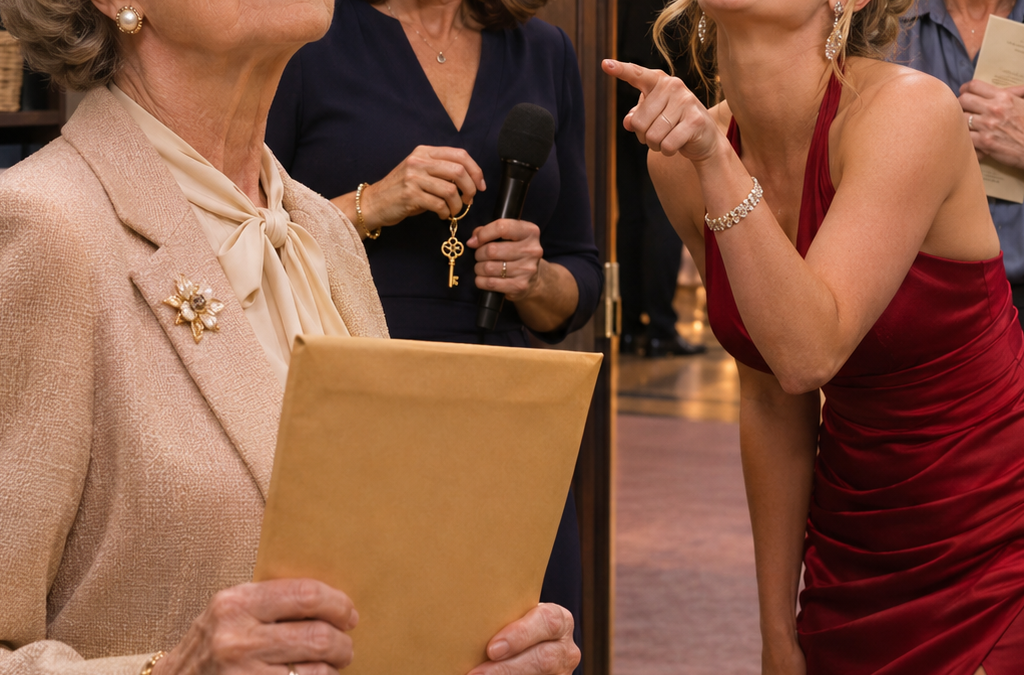
Chapter 1 of 7
“She has nowhere left to wear it.”
Madison said it beside the glass display, with Ben’s parents listening. My daughter, Linda, stood close enough to hear. She looked down at her program.
My wedding necklace lay beneath a spotlight. The sapphires looked almost black against the white satin. Beside it stood a card naming Madison as the donor.
“I have somewhere to wear it,” I said. “And you borrowed it.”
“Grandma.” She came toward me before anyone could answer. “We were just talking about how much good it could do.”
Ben’s mother looked from the necklace to me.
“You made this?” she asked.
“I worked on jewelry. This was my wedding necklace.”
“It’s a family piece,” Madison said. “That’s why I wanted it here.”
“For a display.”
“Yes, and people have responded so beautifully.”
She held out a charge slip for the extra reception tickets. My hand went toward it automatically, then stopped.
For years, I had paid whatever small amount would let a family evening continue.
“What’s that?” I asked.
“Just the guest balance. Actually, this is the one we need first.”
She turned me toward a donor acknowledgment on the table.
“They’re keeping everything together. You can put your name underneath mine.”
“I’m not donating it.”
A volunteer approached with a tray of stuffed mushrooms. Linda declined for all of us. At home, she called mushrooms little wet umbrellas, but here she watched the tray disappear as though she wished she could follow.
Madison kept her voice low.
“The charity is counting on this. So are people who put their names behind the event.”
“Then you need to tell them.”
“Ben’s parents have supported this organization for years. They’ve introduced me to everyone tonight.”
His father shifted away from the display, making room for a couple carrying bid sheets.
“Being family did not make my things available.”
Madison glanced toward the couple.
“Could we please not do this beside the bidding table?”
“You brought it to the bidding table.”
“Mom,” Linda said. “Let’s find somewhere private.”
“Will you tell her it belongs to me?”
“We can talk without an audience.”
She hadn’t answered. Ben stood beside his parents, his jacket still buttoned.
“Did you know about this?” I asked him.
He looked at the display instead of me.
“The card says it’s her donation.”
“I can see the card.”
“I only saw it when we got here.”
Madison stepped closer to him.
“I’ve already been announced as the donor, Grandma. There’s a bid on it. We can’t just pretend none of that happened.”
The bid sheet showed $8,400.
I could hear someone laughing near the refreshments. A server passed behind me with an empty coffee urn. Everyone else had come for an ordinary Saturday evening.
“Where’s my case?” I asked.
“What?”
“The blue velvet case. The hinge is worn. You had that too.”
“It’s with my things. The display people wanted their own stand.”
“I want both back.”
Madison’s face changed, but she kept her voice pleasant.
“Please let me get Karen. She can explain what’s already committed.”
“I’d like to speak to her.”
Linda leaned close.
“Your voice carries, Mom.”
“I’m speaking normally.”
“I know. I just—everyone’s looking.”
A woman with a microphone was checking names near the entrance. Madison called her over and introduced her as the charity’s executive director.
“We have a little family confusion,” Madison said. “My grandmother’s having a difficult evening.”
Karen looked at me.
“What would you like me to know?”
“That necklace was lent for photographs and a display. I didn’t offer it for auction.”
“All right. Did you sign an acknowledgment?”
“No.”
“I was just getting that sorted,” Madison said.
Karen looked at the unsigned form.
“Let’s step away from the table.”
“Can we leave it displayed?” Madison asked. “Until we’ve talked? People are still bidding.”
“Come with me first.”
There was a narrow office behind the reception desk. Linda stayed outside with Madison while Karen waved me through. I had brought a document sleeve in my handbag because Madison had stopped answering my calls that afternoon.
“Before you explain anything else,” I said, “please look at what I brought.”
Someone called through the doorway that the next announcement was ready. Karen said to wait. I opened the sleeve where she could see it.
Karen lowered the microphone and began reading the top page.
She read it twice, then took the display key off her wrist.
“Is this your original?” she asked.
“Yes.”
“Let me close this door.”
Through the remaining gap, I saw Madison approaching. Karen asked her to wait outside. The door clicked shut before Madison could see the desk.
The purchase receipt named Evelyn Brooks as the owner and recipient, with my husband listed as purchaser. Behind it was the matching appraisal and photographs, updated in September.
I had spent thirty-two years repairing other people’s jewelry. I kept my own records in sleeves, away from kitchen steam and sunlight.
Karen studied the photographs.
“You brought these because you expected a problem?”
“Because she wouldn’t answer me.”
“Did she ever ask you to donate it?”
“No.”
“Have you discussed giving it to her?”
“She was supposed to bring it home after the display.”
Karen glanced toward the door.
“I need to hear from her too.”
“I’m not asking you to skip that.”
“Good. For now, I won’t authorize any release.”
My knees ached from standing. She offered me the chair beside the desk, then sat across from me.
Outside, Madison was saying something about the announcement. Linda answered too softly for me to hear.
Karen’s phone buzzed against the desk.
“Excuse me. It’s our auction volunteer.”
She read the screen. Then she looked toward the door, where Madison’s voice had stopped.
Karen read the new message and started out of her chair.
“Who promised a nine o’clock pickup?”
The provisional bidder wanted to confirm the Sunday morning handover Madison had offered. He had arranged his morning around collecting the necklace at 9:00 a.m.
“Tomorrow?” I asked.
Karen was already opening the door.
“Madison, did you arrange an early pickup?”
“He asked when he could have it. I was trying to be helpful.”
“The auction closes Friday. We release accepted purchases afterward.”
“He understood it was the leading bid.”
“That doesn’t make it a completed purchase.”
Madison looked past her at me.
“I thought we could settle this tonight.”
Karen asked her to remain by the reception desk. Then she turned back to me.
“Do you have anything showing what you agreed to initially?”
“I have her text.”
My phone was at the bottom of my handbag. The small October 2 repair tag lay among tissues and my reading glasses. Frank always kept the full sheet in his pad; customers got the little tag.
I found the conversation under Madison’s photograph.
September 24, 6:42 p.m.
“Can I borrow your necklace for my bridal portrait tomorrow and the heritage-jewelry display at the charity preview? I’ll keep it safe.”
My reply was underneath.
“Yes, sweetheart. You can borrow it.”
Karen read the screen without taking the phone.
“Can you send me that?”
“Yes.”
For years, my contribution to Neighborhood Meals in Columbus, Ohio, had been a $300 check. I hadn’t expected to spend its reception proving I hadn’t given away my wedding necklace.
Karen called a volunteer into the office.
“Put a hold on that lot now. No release, no pickup arrangements. Tell the desk to refer every question to me.”
“Should I close the bid sheet?”
“Mark it on hold. Don’t accept anything further.”
Linda appeared behind the volunteer. Her face was blotchy above the collar of her good blouse.
“Mom, can I talk to you?”
“Did you tell her to bring it back?”
Linda looked at Karen.
Karen moved toward the doorway.
“Where is Madison?”
“I checked the display,” Linda said.
I could still see the white satin through the office window. Someone stood in front of it, blocking the necklace stand.
“Linda. Where is it?”
“Madison took the necklace out before they locked the display.”
Chapter 2 of 7
On Sunday, October 4, I reached the arts center before nine. Madison was waiting beside the reception desk with a zipped garment carrier.
“It’s in here,” she said. “I wasn’t leaving it out overnight.”
Karen stood between us, still wearing her raincoat.
“Has anyone collected it?”
“No. I told him I’d meet him here.”
Madison unzipped the carrier’s side pocket. The necklace was inside a soft cloth bag, beneath a folded sweater.
“I was protecting it for the handover,” she said.
“You could have answered that last night,” I said.
“My phone was going off constantly. I needed to get home.”
I had slept in two stretches, both short. At breakfast, I had poured orange juice into my coffee and drunk some before noticing.
“Please give it to me.”
“Can we sit down first?”
Karen opened a small meeting room off the lobby. Madison brought the carrier inside.
There were four chairs around a table. I chose the one nearest the door.
“Your mother cried after we left,” Madison said.
“Your mother can speak to me herself.”
“She’s embarrassed. She introduced me to people as a donor, and now she has to explain this.”
“I didn’t ask her to introduce you that way.”
“I know, Grandma. But she did. And the Millers heard it.”
Karen remained standing.
“Let’s stay with the necklace.”
“That’s what I’m trying to do,” Madison said. “This affects more than us. Ben’s parents brought friends. They vouched for me.”
I could see the edge of the cloth bag through the open pocket.
“I’m asking for my necklace.”
“And I’m asking you to remember what we talked about afterward.”
“After what?”
“After the pictures. After you lent it to me.”
Karen looked at her.
“You agree it began as a loan?”
“Of course. I wrote that. But she gave it to me later.”
My coat collar felt too high against my throat.
“I said you would have it one day.”
“You said it was time for me to enjoy it.”
“I said one day.”
“Grandma, we talked for a while. It wasn’t just those two words.”
Karen’s gaze moved between us.
Madison leaned forward.
“I wouldn’t have offered it otherwise. I work with events. I know what making a commitment means.”
“Then you should have asked before making one with my things.”
“I thought we’d already settled that part.”
I had expected the text to end the argument. Madison acknowledged every word of it, then walked past it.
Karen pulled out the remaining chair.
“It’s a provisional bid, and I can stop release. I can’t decide which of you owns the necklace.”
“Then it shouldn’t leave with either of us,” Madison said.
I stared at her.
“You brought it here without asking me.”
“I believe you gave it to me. I’m willing to wait while we sort that out.”
Karen asked whether we would agree to temporary custody at the charity. The necklace would be photographed, sealed, and kept in the locked office.
“I came to take it home,” I said.
“I know.”
“Will it be offered to anyone else?”
“No.”
“Or picked up?”
“No.”
Madison’s eyes went toward the lobby, where two volunteers were setting out signs.
“I don’t want people watching me carry away a donation,” she said. “Keep it here.”
Karen waited for my answer.
“All right. Here. Until this is settled.”
I wanted mine back.
Karen fetched a protective pouch and a custody form. Madison surrendered the cloth bag, and Karen photographed the necklace against a plain sheet of paper.
The form recorded the date, the necklace’s description, and the pouch seal number. It said nothing had been decided about ownership.
“Both of you will get a copy,” Karen said.
Her phone rang before she finished. She answered beside the open doorway.
“Yes, I’m sorry about the change. There won’t be a pickup this morning.”
She listened.
“No charge. The lot is suspended. We’ll contact you when we have an update.”
When she returned, Madison asked, “Was he upset?”
“He needed to know whether to drive over. Now he knows.”
Outside, Linda waited near her car. She had brought coffee in a travel mug for me, but it had leaked into the cup holder.
“I should have checked the lid,” she said.
Madison stayed inside with Karen. Linda watched the entrance before speaking again.
“What if I bought you another necklace?”
I looked at the coffee pooled around the mug.
“Another one.”
“Something you chose. We could go together.”
“And she gives this one away?”
“It would get everyone out of this.”
“Everyone?”
“Mom, please. I’m trying.”
“Why is replacing your father’s gift easier than telling Madison no?”
Linda’s mouth stayed open a moment.
“I didn’t say it was easier.”
“You offered that first.”
She looked toward the entrance again.
“I don’t have the money right now. I’d have to spread it out.”
“Keep your money, Linda.”
“I just want us to stop hurting each other.”
“Then stop asking me to pay for it.”
She offered to drive me home. I told her I had my car.
At home, the kitchen clock needed a battery. It had stopped during the night, and for several minutes I kept believing it was still ten past eleven.
My phone lit up beside my untouched toast.
In the family messages, Madison had posted a photograph of my appointment reminder. I recognized the date I had copied onto the wrong square of my calendar during the week Robert died.
More names appeared beneath it. Before I opened their replies, another notification arrived.
A new family thread appeared on my phone with the title “Grandma’s confusion.”
Chapter 3 of 7
On Monday, October 5, I read Madison’s message in “Grandma’s confusion” before breakfast.
“Grandma doesn’t remember our conversation about giving me the necklace. Please don’t argue with her. She mixed up an appointment last month, too. She’s had so much to deal with. Let’s be gentle and not upset her.”
Underneath was the appointment reminder I had copied onto the wrong day.
One relative had answered, “Of course, honey.” Another offered to bring me soup.
Nobody had asked me a question.
I typed, “I remember what I said.” Then I deleted it. I couldn’t bear waiting for someone to explain my own sentence back to me.
My Monday jewelry-mending session started at nine at the community center. I had been doing it since retirement: loose clasps, broken jump rings, earrings missing their backs. People brought things in sandwich bags.
That morning, a woman brought her mother’s charm bracelet.
“The little shoe keeps catching my sleeve,” she said.
“I can close that gap.”
Usually she sat beside me and talked while I worked. This time she stayed across the table.
“I heard you’ve had a difficult weekend.”
“Who told you?”
“Your granddaughter’s post. My sister knows someone from the charity.”
I examined the bracelet beneath the lamp. The ring holding the shoe had opened just enough to snag knit fabric.
“Nothing wrong with the charm,” I said. “Just the ring.”
“Are you sure you feel up to doing this?”
“Yes.”
“Should Linda collect you afterward?”
The pliers’ rubber grips had worn smooth where my fingers rested. I had used that pair for years.
“I drove here.”
“Oh. Well, I only meant—”
“I know.”
She watched the bracelet instead of my face.
I closed the ring and checked it against a scrap of stocking. Nothing caught. Usually I would have shown her the repair. Instead, I told her it was ready.
She inspected it before putting it on.
Two more people were waiting. I apologized and said I needed to leave early.
In the hallway, somebody had put a paper witch above the drinking fountain. Its pointed hat had sagged into the basin. Robert would have said she needed a union break.
I stood there longer than I needed to.
Madison called before I reached the parking lot.
“Grandma, can we make this easier?”
“Take down that thread.”
“I’m trying to keep people from bothering you.”
“They’re asking whether I can get myself home.”
“I didn’t tell anyone you couldn’t drive.”
“You told them I couldn’t remember.”
“That’s why I’m calling. We could fix how this sounds.”
“How what sounds?”
“If you let the charity keep the necklace, I can explain we disagreed about the dedication. You wanted Grandpa mentioned. Nobody needs to hear anything else.”
My car was parked between two vans. I could barely see its windshield.
“You’d tell them that?”
“It gives everyone a way forward. Mom wouldn’t have to keep explaining.”
“You will not make a statement for me.”
“I’m offering to clear it up.”
“Don’t put any more words in my mouth.”
She said my name, then corrected herself to Grandma.
I ended the call.
At 10:30 a.m., I was at a Columbus police station, asking to make a property complaint. I had called Linda from the parking lot. She arrived before an officer came to speak with me.
“Let me come in with you,” she said.
“I need to tell it myself.”
She stayed in the waiting area.
Officer Reed was younger than I expected. His badge said Aaron Reed. He asked me to start with how Madison had received the necklace.
I showed him the loan conversation on my phone. Then I gave him the description and explained where Karen was keeping it.
“Has your granddaughter said it was a gift?”
“She says I gave it to her after the loan.”
“And you disagree.”
“Yes.”
He wrote that down.
“We’ll need to investigate that. This report doesn’t settle ownership, and I can’t arrest her just because you’ve come in.”
“I want it recorded.”
“All right.”
He asked when I had gotten the necklace.
“My husband bought it in 1976. For our wedding.”
“Your husband’s name?”
“Robert Brooks.”
The last stranger who had needed his full name worked at the funeral home.
Officer Reed waited.
“He paid twelve hundred and fifty dollars,” I said. “He was a postal carrier. He’d saved for it.”
My voice thinned on the last word. I tried again.
“He knew I liked sapphires.”
The officer gave me time before asking his next question. Through the glass, I could see Linda sitting with her coat still on.
When I came out, she stood.
“Did you report her?”
“I reported what happened.”
“Will they go to the charity? In front of Ben’s parents?”
“I asked them to help recover my property.”
“But if they arrest her there—”
“Linda, I didn’t ask for a performance. I asked for my necklace.”
She looked toward the interview-room door.
“You could have told me before you came.”
“I called you from outside.”
“You know what I mean.”
I did. She wanted time to talk me out of it.
That evening, I heated half a can of soup. Linda texted that she had taken pictures of my papers while helping me sort them. She had sent them to Madison, she said, hoping it would help. Madison hadn’t opened the message yet.
I read that twice.
At 6:10 p.m., Linda’s message reads, “I sent her a photograph. Call me.”
Chapter 4 of 7
On Tuesday, October 6, Linda called while my oatmeal was still too hot.
“The receipt and the appraisal,” she said. “Those were the two pages I photographed.”
“You should have asked me.”
“I thought if she saw your name—”
“You should have asked.”
“I know.”
At 8:05 a.m., Madison had opened the photographs and replied. Linda read her answer to me.
“Of course Grandma has the original papers. It was hers for years. Those don’t show what happened afterward. I’d like Karen to hear both sides before she makes any decision.”
I watched a skin form over my oatmeal.
“Did you answer her?”
“I said I hoped you two could work this out.”
“Was that all?”
“Yes, Mom.”
There was nothing else for me to discover in Linda’s account. She had sent the purchase receipt and matching appraisal, the same pages Karen had seen privately at the reception. Now Madison had seen them too.
“Please don’t send anything else for me,” I said.
“I was trying to help.”
“I heard you.”
After we hung up, I ate standing beside the stove. Robert used to leave the cinnamon lid loose. I still checked it before shaking, although nobody had touched it but me.
Karen called later that morning.
“Madison has written to me,” she said. “She copied you.”
“I haven’t checked.”
“She’s asking for a meeting.”
“Has she agreed to give it back?”
“No.”
I opened the email on my phone. Madison had addressed Karen by her full name and thanked her for keeping the necklace secure.
“I have never disputed that my grandmother owned the necklace originally,” she wrote. “An older receipt is exactly what I would expect her to have. But a later gift can still be a gift. Please give me a fair chance to explain before changing the donor acknowledgment.”
“She sounds very reasonable,” I said.
“I need to hear her account.”
“You heard her call it her donation. So did Ben’s parents.”
“Yes.”
“Then I want them there when she explains it.”
Karen paused.
“Are you asking for a public announcement?”
“I’m asking not to be taken into an office while everyone else keeps believing her.”
“I won’t turn this into an open microphone.”
“I don’t want a microphone.”
Outside my kitchen window, a squirrel was digging in the planter I hadn’t watered since August.
“I want her to tell me what she says happened,” I said. “With the people who heard her take credit sitting there.”
“I can ask them to attend.”
“And my daughter.”
“Yes.”
Karen explained that the necklace could not be sold while the claim remained unresolved.
“Then cancel it,” I said.
“I can withdraw the lot. That still doesn’t get it back to you.”
“Why not?”
“Because she’s claiming it belongs to her now. Unless you reach an agreement, you may need to take that part to court.”
I had refused the form, shown my papers, and made the report. The necklace was still in Karen’s office.
“So what can you decide?”
“What the charity accepts. Who handles property for us. What we put on our donor list.”
“And she could leave the meeting still saying it’s hers.”
“Yes.”
I appreciated that answer less than I appreciated her giving it plainly.
At 3:00 p.m., Karen called again with a proposed time.
“Friday at 6:45. October ninth, in the arts center’s auction room.”
“Before the closing?”
“Yes. We’ll use the tables at the far end. The auction closes at eight, but your necklace won’t be part of that.”
She had spoken with Madison and the Millers. Ben would attend. Linda had agreed too.
“Frank Ellis can come,” Karen added. “He said you might want to call him.”
“And Officer Reed?”
“He’s agreed to attend. He can record any voluntary return under your existing complaint. He won’t be there to decide who owns it.”
“Does Madison know he’s coming?”
“Yes. Everyone will have the same information about the meeting.”
I wrote the time on my calendar, in Friday’s square.
Karen continued, “I’ll hear what each of you has to say. Then I’ll make the charity’s decisions.”
“Will you tell me beforehand if something changes?”
“I will.”
Frank answered his shop phone over the whine of a polishing motor.
“Give me a second, Evelyn.”
The noise stopped.
“Karen called,” he said. “You holding up?”
“I’m tired of telling people I am.”
“Fair enough.”
I asked him to bring his appraisal copy and his ordinary job records for the necklace.
“Sure. I’ll bring the records.”
“I don’t want to keep you from the shop.”
“I close before then.”
For a moment, neither of us spoke. I could hear his wall clock, the one that ran several minutes fast so he wouldn’t miss lunch.
“Have you been working at your bench?” he asked.
“No.”
“Leave it alone until you feel like it.”
“Everybody else wants me occupied.”
“Well, I’ve got plenty of work. I’m not assigning you any.”
I laughed once. It surprised us both.
That evening, I put Friday’s appointment beside the telephone as well as on the calendar. I wanted to stop checking it.
Linda hadn’t called again. I nearly called her, then saw Karen’s name appear on my screen.
It was a forwarded email from Madison.
“My mother heard her give it to me.”
Chapter 5 of 7
On Thursday, October 8, at 5:30 p.m., Linda stood in my kitchen with her coat still on.
“I heard you talking about the necklace,” she said. “I didn’t hear you say she could donate it.”
“Have you told Karen that?”
“Mom, giving it to her and letting her donate it aren’t exactly—”
“What did you hear me say?”
“That she’d have it one day.”
The oven clicked behind me. I had baked a potato because it needed nothing from me for an hour.
“Then why does Karen have an email saying you heard me give it to her?”
“I didn’t write that.”
“You haven’t corrected it.”
Linda looked at the empty place beside mine.
“Could we call it crossed wires? Just tomorrow. Let everybody get through it.”
“And afterward?”
“We can work out afterward.”
“You want me to say I wasn’t clear.”
“I want there to still be a wedding.”
The potato’s skin had split. Robert always ate the skin first, calling it the wrapper. I had never managed to persuade him that wasn’t funny.
“Has Ben threatened to cancel it?”
“No. But he’s asking questions.”
“Then she should answer them.”
The doorbell rang before Linda could reply.
Madison came in carrying her work bag. She had changed out of her hotel uniform, but the indentation from her name badge remained on her sweater.
“Hi, Grandma. Mom said she was coming over.”
“She’s here.”
“I can see that.”
She sounded tired rather than angry. For a moment, I wanted to ask whether she’d eaten.
Instead, I waited.
“I’ve thought of something that might work,” she said. “The donation could be dedicated to Grandpa. Properly. His name on the acknowledgment, a few words about him.”
“He didn’t donate my necklace either.”
“No, I’m saying we could honor him. And privately, you could choose a replacement. Same quality, same value.”
“Who’s buying it?”
“We’d work that out.”
Linda’s eyes dropped.
“You’ve already offered that,” I told her.
“This is different,” Madison said. “You’d have something you actually chose.”
“I chose to lend you mine.”
“I know how it started.”
“Then you know which necklace I want.”
She stopped for a moment.
“We can’t go backward, Grandma. People have heard about the contribution.”
“They can hear it was withdrawn.”
“That’s easy for you to say.”
“No. It isn’t.”
Madison looked toward Linda, who said nothing.
“I can’t replace fifty years,” I said. “And I’m not agreeing to a story that says I offered to.”
“I’m trying to give you a choice.”
“I’ve answered.”
They left together before my potato was cool enough to eat.
Ben called later, after I had washed the supper plate.
“Do you have a minute?”
“Yes.”
“Did she honestly think it was hers?”
“You need to ask Madison.”
“I have.”
“And?”
“She says yes. I’m asking whether you think she believed it.”
I could hear traffic behind him.
“I can tell you what I said. I can’t tell you what she believed.”
“Was there any chance—sorry. I don’t know how to ask this.”
“I’m not going to tell you whether to marry her, Ben.”
“I wasn’t asking that.”
“I know. But I’m not going to say something untrue so you don’t have to decide.”
He was quiet for several seconds.
“Okay,” he said. “I’ll see you tomorrow.”
On Friday, October 9, at 6:30 p.m., I arrived at the community arts center with my original receipt and appraisal in their sleeve.
Karen had arranged an ordinary folding table beside the auction display. A volunteer was testing a card reader nearby. Nothing about the space suggested that anyone’s family was about to come apart.
“You can sit wherever you like,” Karen told me.
I chose the chair facing the entrance.
Frank arrived with his service pad tucked beneath his arm.
“Parking’s worse than Christmas,” he said.
“There’s an auction.”
“Apparently everybody drove separately to it.”
He sat beside me without asking whether I needed him there.
Officer Reed came in a few minutes later, in uniform. He greeted Karen, then me.
“Still following up the complaint,” he said. “If you reach an agreement about returning it, I can document that.”
“Thank you.”
Across the room, Linda entered with Madison. They took adjoining chairs.
Ben came with his parents. His mother introduced herself as Diane Miller, though we had spoken at the reception. Thomas, his father, asked Frank whether the chair beside him was free.
At 6:45, Karen began.
“We’re here about the necklace, its return, and the charity’s involvement. Madison, you asked for a chance to explain.”
Two volunteers remained near the display. Madison glanced toward them, then spoke at her normal volume.
“I understand why Grandma wants it back now. Grandpa’s only been gone a month. Something that felt generous a few weeks ago can feel different afterward.”
Linda stared at the table.
“But it was mine before I offered it,” Madison continued. “I wouldn’t knowingly donate something I’d only borrowed.”
Diane leaned forward.
“And you’re saying the borrowing arrangement changed?”
“Yes. We had a family conversation.”
Karen waited.
“What was said?”
“That she wanted me to have it.”
“Was that about having it eventually, or having it then?”
“Then. That’s what I’m trying to explain.”
“Please give us the date.”
Madison answered without looking at me.
“She gave it to me on September 28. My mother was there.”
Chapter 6 of 7
“Before you thank her,” I said.
Karen had reached the donor acknowledgment beside her notes. It was still 6:45 p.m.
“Please hear what she says I gave her.”
Madison turned toward me.
“On September 28, you said I should have it. You told me to put it to good use.”
“What came before that?”
“We were talking about the pictures. How happy Grandpa would have been.”
Linda stared at the table.
“Keep that date, then,” I said. “While Karen hears both accounts.”
I laid my original purchase receipt and appraisal between us. The paper sleeve caught against a rough spot on the folding table.
Madison waited while Karen looked.
“I’m not questioning those,” she said. “Grandpa bought it for you. The appraisal tells us what it would cost to replace. Neither tells us whether you gave it to me afterward.”
Frank sat with his service pad across his knees.
“And the text?” Karen asked.
“Of course I borrowed it initially. I’ve never denied that.”
Diane looked at me, then back at Madison.
Karen’s voice stayed even.
“Evelyn, do you have anything beyond the original purchase and the initial loan?”
For several seconds, I heard the card reader beeping behind us. A volunteer apologized to someone whose payment hadn’t gone through.
Madison waited for my answer without interrupting.
“Were you still borrowing it when you collected it from Frank?”
“The repair was under your account,” she said. “You’d arranged it. Shops don’t change customer details every time somebody gives something away.”
“Frank, would you open the full service sheet you kept?”
He brought his pad onto the table.
Madison looked toward Linda. My daughter’s chair was close enough to hers that their coat sleeves touched.
Frank opened the pad.
“October 2,” he said. “Clasp repair. Collected at four twenty.”
He turned the original toward Karen.
“That’s Madison’s signature underneath the instruction.”
“Would you read it?” I asked.
“‘Borrowed from Evelyn Brooks. Display only. Return Saturday.’”
A volunteer beside the display stopped peeling labels from a roll.
“This is the sheet for this necklace?” Karen asked.
“Yes. Same job as Evelyn’s repair tag. I checked it against the photographs.”
“Why were you borrowing it four days after you said it was yours?”
Madison’s lips parted. She looked down at the sheet.
Karen waited before asking, “Do you dispute that signature?”
“No.”
“Or that acknowledgment, dated October 2?”
“I signed it. I was collecting the repair.”
“But you called it borrowed.”
“I expected Grandma to approve using it for the charity afterward. Once she saw what we were doing.”
Thomas leaned back. Ben stayed where he was, beside his mother.
Linda spoke so quietly that Karen asked her to repeat it.
“She said one day.”
“Mom,” Madison said.
“I heard the conversation. She said you’d have it one day.”
“You know we talked longer than that.”
“Yes. About your pictures. And your grandfather.” Linda’s voice broke on that word. “She didn’t give it to you then.”
Madison watched her.
“I told you things she’d said privately,” Linda continued. “How badly she was sleeping. That she’d mixed up the appointment. I wanted you to calm down, and then you used it.”
“I was worried about her.”
“I should have corrected you Saturday.”
Linda looked at me.
“I want you to give it back.”
She left the chair beside Madison and crossed to the empty one on my other side. Her coat brushed my knee as she sat.
“I’m asking you to return my necklace,” I said.
Karen addressed Madison.
“Your later acknowledgment says borrowed, and you have just said approval was still needed. That contradicts your account of a completed gift.”
Madison looked toward the donor placard.
“I’m withdrawing the $8,400 provisional sale,” Karen said. “I’m also removing the $12,000 donation credit and your donor attribution.”
Diane’s eyes went to the placard bearing Madison’s name. Then she turned her chair toward me. Thomas turned with her.
Karen brought the sealed pouch from beside her chair. Madison reached toward it, then stopped when Karen kept it on the table.
“Please return my mother’s necklace,” Linda said.
Madison looked at Ben.
“I thought she’d want—”
He didn’t finish it for her. His gaze stayed on the pouch.
“It was borrowed,” Madison said.
Officer Reed leaned forward.
“Are you agreeing to release it voluntarily to Evelyn?”
“Yes.”
He asked Karen to open the pouch so he could photograph the necklace. He checked its description against his existing report, then recorded Madison’s agreement.
“No one’s asking you to sign a new donation form,” he told me. “I’m documenting the recovery.”
I watched the sapphires emerge from the protective cloth. One section of chain lay folded beneath another. After thirty-two years at a repair bench, I still wanted to tell people not to pull at a tangle.
Karen eased it free without pulling.
Reed asked Madison once more whether she agreed to its return. She said yes, and he passed it directly to me.
The gold felt cool against my palm.
“Grandma, can we talk later?”
“You may ask. You may not take.”
I put the necklace into the blue velvet case. The worn hinge held when I closed it.
By the time Linda walked out with me, a volunteer had removed Madison’s placard. Ben remained beside her, but neither of them was speaking.
Outside, Linda offered to drive. I told her I could manage.
I had reached my car when my phone sounded.
Madison’s 7:15 p.m. message reads, “Tell me what I owe for the clasp.”
Chapter 7 of 7
On October 9, I answered Madison from my parked car.
“The clasp repair was $95. I’ll send you the invoice when I get home.”
Her reply arrived before I started the engine.
“Will that make things okay?”
“It will pay for the repair. It won’t erase the report or restore your access to my house and jewelry. It doesn’t buy forgiveness.”
At home, I sent the invoice already in my records. I added nothing about the wedding, her mother, or what her grandfather would have wanted.
Officer Reed followed up to confirm that the necklace had been returned intact. His record included Madison’s agreement to surrender it and my receipt of it. There had been no arrest, no judge, no order to repay me.
When a cousin called it a police victory, I corrected her.
“He documented the return. Madison agreed to give it back.”
“Oh,” she said. “Well. You know what I meant.”
I let her sit with what she had said.
On Friday, October 16, Karen emailed the charity board’s decision. Madison had been removed from the spring auction intake team. For twelve months, she could not handle donated property for Neighborhood Meals.
Karen called that afternoon.
“I wanted you to hear directly that this is final.”
“Does it affect her job?”
“Her hotel job? No. That’s nothing to do with us.”
“Good.”
Karen paused.
“I also corrected the donor record. Anyone asking about the withdrawn lot will get the same explanation.”
“That it wasn’t hers to donate.”
“That it was borrowed and returned to you.”
We finished without discussing whether Madison had suffered enough. Karen had property to protect at the next event. I had mine home.
Linda asked to visit the following Sunday.
“Not just drop in,” she said. “Would three be all right?”
“Three is fine.”
She arrived without Madison and without anything she wanted me to sign.
We sat in the kitchen. The place beside mine remained empty, although I had moved Robert’s mail basket off the table.
“I wrote something,” Linda said. “For the family thread.”
“Have you sent it?”
“No. I wanted to know if you wanted to read it first.”
“I don’t want to write your apology.”
“I know. That’s not—okay.”
She read it aloud.
“Mom did not donate her necklace or forget doing so. Madison borrowed it and has now returned it. I heard Mom say Madison could have it one day, not that she was giving it to her then.”
Linda stopped.
“Keep going,” I said.
“I should have spoken at the reception. Instead, I asked Mom to stay quiet and let people question her memory. I also shared private information I had no permission to share.”
Her eyes stayed on the phone.
“Is that accurate?” she asked.
“Yes.”
She sent it to the original thread, beneath the title Madison had chosen.
Several relatives answered that afternoon. One apologized to me directly. Another wrote that everyone had been under strain.
Linda answered that one herself.
“Mom wasn’t responsible for what I chose to do.”
I read that reply more than once.
Before she left, I told her what visiting would look like.
“Call first. Wait for an answer. And my messages stay between us.”
“Even if Madison asks?”
“Especially then.”
Linda nodded.
“She’s going to ask how you are.”
“You can say you saw me. You can’t send her photographs of my papers or tell her what I say in private.”
“I won’t.”
“I’ll need time before I trust that.”
“I know, Mom.”
She didn’t ask how much time.
On Friday, October 23, Madison’s $95 reimbursement arrived. I checked it against the invoice and answered, “Received. Thank you.”
There was no conversation attached to it.
Later that month, Ben called to ask how I was doing. He sounded careful, but he did ask me rather than Linda.
“I’m sleeping better,” I told him.
“That’s good.”
“How are you?”
“We’re talking. About everything.”
I left him room to stop there.
“I don’t expect you to sort it out for us,” he said.
“I won’t.”
“And you don’t have to explain anything to my parents.”
“Neither do you. They were there.”
He gave a short, tired laugh.
“Yes. They were.”
Their engagement remained theirs to manage. I offered no wedding money to smooth things over. I made no condition about it, either.
Madison could contact me herself. For now, any visit would need my agreement, with someone else present. She would not be alone in my home or handling my jewelry.
When Linda asked whether she should explain that gently, I said, “Explain it clearly.”
By December, Linda had kept six appointments and canceled one when she had a cold. She called that morning instead of arriving with tissues and insisting she was fine.
We talked about her work, the grocery store closing early, a neighbor’s new fence. Sometimes we spoke about Robert. Sometimes an entire visit passed without either of us trying to repair anything.
On Saturday, December 19, she called about supper.
“The restaurant has jazz tonight. Six-thirty. Would you like to go?”
“Yes.”
“Just us,” she added. “I haven’t invited Madison.”
“I’d like that.”
I chose a dark green dress that fit comfortably when I sat down. Then I changed my shoes. The first pair looked better; the second pair would get me through supper without counting the minutes.
The necklace lay in its blue velvet case on my dresser.
I wore it again that evening.
At the mirror, I fastened it myself. The repaired clasp sat comfortably at the back of my neck. I turned my head both ways to check that no chain had caught beneath it.
Linda rang the bell downstairs.
“Coming,” I called.
I found my coat and went down to meet her. We had a supper reservation, and I wanted to hear the first set.
I left the blue velvet case open.








