My Husband Called My Skilled Sewing a Hobby and Used My Panel in His Sales Demo, but the Buyer Matched the Stitching to My Entry and Awarded Me the Contract.
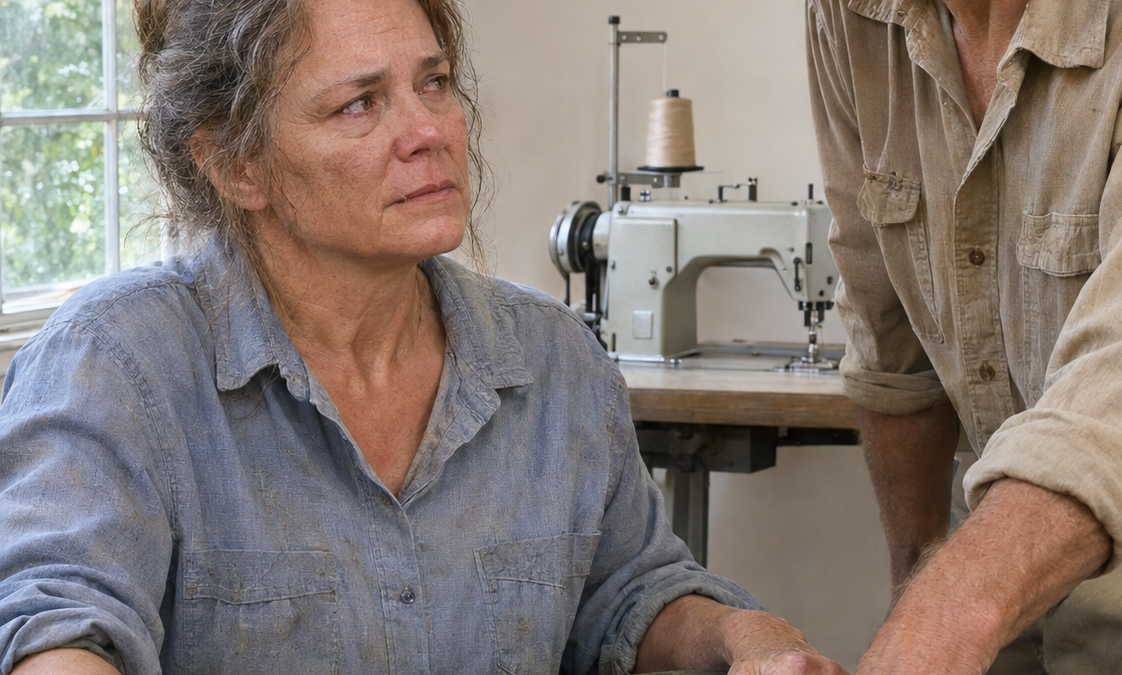
Complete story · 9 parts · about 33 minutes · ending included
Part 1 · Part 2 · Part 3 · Part 4 · Part 5 · Part 6 · Part 7 · Part 8 · Part 9
Part 1 of 9
Vaughn tapped my repair panel and said, ‘She just runs the machine.’
My husband lifted his finger before I could tell him not to touch the work.
I was fifty-six, an industrial sewer, and I had spent enough years repairing truck tarps and farm-equipment covers to know what careless pressure could do to fresh stitching.
The gray trapezoid reinforcement lay flat beneath my hand, firm and smooth under my palm. I finished the off-center box-X, clipped the thread, and pressed each corner lightly with my thumbnail to check the stitching.
Vaughn watched from the other side of the table.
“You make it sound easy,” I said.
“It is easy if you have the machine.”
“Show me what you mean.”
His eyes dropped to the seam.
Vaughn could explain equipment features to customers without reaching for a brochure. At home, he preferred broad statements when the subject was my work.
“You sit there and guide material,” he said. “That’s different from understanding the whole operation.”
I turned the piece over.
The underside was clean. No loose loops. No skipped stitches.
“Okay,” I said.
His mouth tightened.
After twenty-seven years of marriage, I knew the shape of the silence that followed. On Monday, September 14, I did what I usually did with the fabric in front of me.
I kept working.
Vaughn opened a cabinet harder than necessary. Later, at supper, he answered questions with a word or two.
I rinsed my plate without asking what was wrong.
Tuesday went much the same way.
I finished customer work, swept thread scraps from the floor, and left the panel where I had placed it. Vaughn never picked it up. He had tapped it once, and that was all.
By Wednesday morning, September 16, I recognized something before paying attention to him.
I had slept better.
My coffee was still hot when I finished checking a seam because I had not spent breakfast trying to read Vaughn’s face.
At the worktable, my hands stayed on the job.
I pulled out a fresh notebook and began keeping my work hours and costs separately, writing down thread, patch material, completed jobs, and money coming in as I worked.
The entries were plain.
So was the difference in my concentration.
When Vaughn crossed the room without speaking, I marked the next line and kept going.
Thursday, September 17, I carried the records with me when I handled an expense I had been considering for months.
The total was $4,600.
The money came from savings earned through my tarp and equipment-cover work. I spent it on a used walking-foot machine and a deposit for a small workspace.
I kept the purchase papers with the source records in my folder.
When I got home, Vaughn saw them beside the notebook.
“You bought another machine?”
“A used one.”
“For this?”
“For paid work.”
He looked toward my sewing area.
“You’re putting a lot into a side thing.”
I slid the documents into the folder.
“I know what I put into it.”
He waited.
I went back to trimming thread.
Friday, September 18, I carried the same physical panel into Prairie Span Fleet Services in Fargo.
There was only one.
It had stayed with me from my table at home to the intake counter.
The process separated identity from technical judging. The front-end staff handled my name and maker certification, while the graders would receive anonymous work without knowing who had made it.
That mattered to me.
The person handling my entry photographed the workmanship up close, pausing over the repaired section.
The lens moved over the gray reinforcement, then followed the distinctive box-X stitch pattern beside it.
I watched the images appear on the intake screen.
Those details showed what I had made. The graders would not receive my name with them.
I signed the maker certification where indicated.
The original paperwork stayed in the buyer’s file with the photographs.
So did the physical sample.
Once I released it into the buyer’s custody, I did not touch the fabric again.
The intake worker turned to the file, entered the submission, and placed the panel with the buyer’s materials.
Then the worker slid a yellow receipt toward me, and I took it in my hand.
I picked it up.
That paper showed my entry had been received. It carried no score, and nobody there told me how the anonymous grading would come out.
I folded it once.
The panel remained with the buyer, and the original intake file stayed there under its control too.
My hands felt strange without the heavy fabric in them after carrying it through the week.
I kept the paper in my hand, folded once between my fingers, and headed for the door.
Before stepping outside, I looked down once more at the paper in my hand.
The yellow receipt said ENTRY 17 beside my name.
Part 2 of 9
I cleared one shelf for paid work Vaughn still called a hobby.
On Monday, September 21, I lined up thread, patch material, and the notebook I had started the week before. The used walking-foot machine sat ready in the workspace I had paid to use.
My phone buzzed while I was checking a torn cover.
Prairie Span.
I set the fabric down and answered.
“This is Dana Kroll in purchasing,” Dana said. “Your capacity review is complete. Your machine, workspace, batch schedule, and ability to carry material and operating costs meet our requirements, and your accepted seasonal price is $32,000 gross under the invoice terms.”
I looked at the supply list beside my hand.
Dana continued. “Identity intake stays separate from blind technical grading. Under the established terms, the highest-scoring eligible entry receives the contract.”
“Understood.”
The call ended there.
I stood over the cutting table for another moment, studying the cover I already owed somebody.
The gross figure did not change the tear in front of me.
I checked how much patch material the job required, then compared the rest of my supply needs with the delivery windows I had laid out for the coming work.
If Prairie Span eventually selected my entry, the material would still have to be bought before it could be sewn. Batches would still have to leave on schedule. Invoices would still have to wait their turn.
I marked the current job for completion ahead of the next delivery window and went back to work.
The panel I had submitted remained with Prairie Span intake, along with the original maker certification and close-up photographs.
My yellow receipt stayed with me.
At the future industry showcase, forty-four fleet and farm attendees would be witnesses to the session; Prairie Span alone was buying the contract services.
That was enough business detail for one morning.
I lowered the presser foot.
The machine pulled the heavier layers evenly while I guided the damaged edge beneath the needle.
By the middle of the week, the shelf no longer looked empty.
Finished covers left the workspace. New material came in for jobs already booked. I checked each damaged section before cutting, opened weak stitching where necessary, and reinforced areas that would take the strain again.
The used machine had its own rhythm.
A slight change in sound told me when thick layers were feeding cleanly and when I needed to slow my hands.
I learned that sound faster than I had expected.
Vaughn crossed the room once while I was trimming loose thread.
He looked at the shelf.
Then at the machine.
“You’re really filling this place up.”
“I have work.”
He gave a short nod and kept walking.
I did not ask whether something in my answer had bothered him.
That evening, he talked about an equipment customer over supper, then went quiet halfway through his plate.
I finished eating.
The next day, I repaired a split seam, packed a finished job, and reviewed what material I would need next.
Vaughn’s silence stayed where it belonged.
With Vaughn.
My coffee remained hot longer.
So did my concentration.
My concentration held longer, and fewer errors crept into the work.
Near the end of the workweek, I had a cover spread across the table when Vaughn appeared in the doorway.
“What happened with that fleet thing?”
I kept one hand on the fabric.
“I submitted a sample.”
“Did they score it?”
“I haven’t received a score.”
He watched me line up the torn section.
“So you have no idea how you did.”
“No.”
That answer seemed to satisfy something in him.
He stepped farther into the room and looked around.
The shelf held thread and material for current jobs. Completed work was stacked separately for pickup or delivery. My notebook stayed open beside the cutting surface.
Vaughn glanced at the machine again.
“You think a place this size can handle fleet work?”
I smoothed the fabric flat.
“I’m handling the work I have.”
“That’s not what I asked.”
I looked up.
“What did you ask?”
His jaw shifted.
“You know what I mean. A seasonal contract isn’t the same thing as patching covers for people you already know.”
“I know.”
He waited for more.
I went back to the seam.
The needle punched through the layers in a steady line.
Vaughn stayed in the doorway.
“Who else is trying for it?”
“I don’t know.”
“How big are their shops?”
“I have no idea.”
“You don’t know much about the competition.”
“No.”
That was true too.
My own entry number was clear to me.
So was what I had submitted.
The buyer still had my sample and the original intake file.
Nothing in Vaughn’s questions required any of that.
He rubbed a thumb along the edge of the doorframe.
“You at least know what the buyer wants?”
“They’re grading the work.”
A small laugh came through his nose.
“That’s only part of a real contract.”
I lifted the foot, turned the fabric, and felt the repaired seam under my fingertips.
The seam sat flat.
Vaughn’s eyes moved back to the shelf.
Then at the machine.
Then at me.
His voice took on the smooth tone he used when he thought somebody needed professional instruction.
“That kind of contract needs a real sales operation.”
Part 3 of 9
The bonus line was sitting under the grocery list Vaughn had moved.
Friday, October 2, I had gone to the shared work area for the list and found a planning page partly uncovered beneath it. Vaughn’s name was visible near the top. So was a heading about a performance bonus.
The rest of that section disappeared under the paper above it.
Before I moved anything farther, Vaughn came through looking for the sales materials Jody was picking up.
“Those staying there?” he asked.
I glanced toward the papers.
“For now.”
He gathered what he needed from the other end of the table.
I left both papers where they were and went back to my sewing work.
The bonus page stayed where it was.
My machine was already threaded for heavy fabric. I had a damaged section opened flat in front of me, with the old stitching removed far enough to rebuild the seam cleanly.
Vaughn had been paying more attention to that kind of work lately.
Not enough to sit down and learn it.
Enough to ask questions while I worked.
“Why take all that thread out?” he asked as I lined up the layers.
“Because it failed.”
“You can’t just sew another line beside it?”
“Not if I want the repair flat.”
He watched while I positioned the edge.
“What makes it hold better?”
“The load has to spread through sound material.”
Vaughn nodded once.
Then he looked toward the sales papers again.
I lowered the foot and started sewing.
The walking mechanism fed the layers evenly while I kept the edge straight. I listened to the motor, eased my hands when the fabric thickened, and let the machine do the pulling instead of forcing it.
Vaughn stayed nearby and asked, “Would a customer even notice the difference?”
“They would if the seam opened again.”
He gave me the same look he used when he thought I had answered the wrong question.
“I mean when you’re explaining it.”
“I’m describing the repair.”
“That’s what I mean.”
I kept sewing.
Prairie Span still held my submitted panel and the original intake file. My yellow receipt remained with me. No score had come back, and Vaughn had never asked for my entry number.
Nothing about the covered record changed any of that.
By the time I finished the seam, Vaughn had moved on to arranging the materials Jody was coming to collect.
I clipped the loose thread and turned the fabric enough to inspect the repaired line.
“Clean enough?” he asked.
“It’s finished.”
“That wasn’t my question.”
I ran my fingertips over the surface.
“It lies flat. The stitching is even. That’s what I was checking.”
He leaned against the edge of the shared table.
“You always go straight into the technical part.”
“You’re the one asking about the method.”
His mouth tightened.
The door opened before he answered.
Jody Pike came in to collect Vaughn’s sales materials. She was the event and sales coordinator at his employer.
“Got everything together?” she asked.
“Most of it.”
I stayed at the sewing table.
The machine was off while I checked the seam under my fingertips, so their voices carried plainly across the room.
Jody sorted through what Vaughn had prepared.
“This goes with the showcase material?”
“Yeah.”
Paper shifted against paper.
She asked him something about the repair approach he had been discussing.
Vaughn stepped closer to the worktable.
I kept my eyes on the fabric in front of me.
Jody said, “So whose work are you showing when you explain this?”
Vaughn answered without hesitation.
“Fern did the stitching. I know how to sell the fix.”
My thumb stopped on the seam.
That was the whole reaction.
I left it there against one raised thread until my hand settled, then moved on to the next section of the repair.
Jody had heard him.
So had I.
She did not challenge the statement.
Instead, she gathered the remaining sales materials Vaughn had set out.
“Anything else?”
“That’s it.”
Jody tucked the stack against her side and headed out.
Vaughn followed her toward the door and finished the exchange there.
I stayed at my table until their voices stopped.
The machine remained off.
For a moment, the room held only the small sounds of fabric moving under my hands.
Then I stood.
The list was still where I had left it over the shared papers.
So was the page beneath it.
I returned to the table and lifted the list just enough to read the section I had only seen the heading of earlier.
The record still identified Vaughn at the top.
The printed line underneath gave the amount and the condition.
I read it once.
Then I lowered the list back over the page and left the record where Vaughn had put it.
Performance bonus: $6,000 if employer wins the fleet deal.
Part 4 of 9
Vaughn told me to keep my ‘shop stuff’ out of his showcase.
Thursday, October 8, I was at the shared table with my notebook open and fabric samples stacked beside it.
He stood on the other side, sorting his own sales papers.
I looked up.
“What counts as shop stuff?”
He pointed toward my notes.
“That. Samples. Stitching notes. All of it.”
“You’ve spent weeks asking me about repair methods.”
“That doesn’t mean I want your hobby spread through the presentation.”
Then he gave me the line he had used before.
“She just runs the machine.”
He said it almost lightly.
Like repetition had turned it into fact.
My hand went to the work file beside me.
The yellow receipt was inside.
I pulled it out and looked at my name next to ENTRY 17.
It proved I had submitted a sample.
That was all.
There was no score.
A result had not come.
Prairie Span had made no promise to choose my work.
I slid the yellow slip back into the file.
Vaughn watched me.
“What’s that?”
“My entry receipt.”
“You still don’t have a score?”
“No.”
He nodded once, satisfied with the answer.
Then he gathered his papers.
“Good. Keep the rest of this separate from my presentation material.”
I did not ask him what he meant by my work and his showcase.
I already knew how he divided those things.
A week passed in ordinary jobs.
I repaired torn covers, checked thread, moved finished work out, and kept my notes where I could reach them.
Vaughn kept talking about the October showcase as if the room belonged to him before anyone entered it.
Thursday evening, October 15, he came through the common work area while I was sorting material for the next job.
He stopped beside the table.
“The showcase needs a clean story.”
I kept folding the fabric.
“What story?”
“The repair approach.”
“Whose?”
He frowned.
“You know what I mean.”
“I’m asking.”
He tapped one of my notes with a finger.
“Our method. The company’s method. What I’ve been putting together.”
I looked at the page beneath his hand.
The handwriting was mine.
So were the notes about where reinforcement carried strain better and my observations from actual repairs.
“You mean the methods you keep asking me about.”
“I mean the repair approach I’m presenting.”
“Did you develop it?”
His expression sharpened.
“You’re doing this again.”
“Doing what?”
“Making everything about credit.”
I folded the last piece of material and set it with the rest.
“You told Jody I did the stitching.”
“And I said I know how to sell the fix.”
“That part I heard.”
He spread one hand over the table.
“This is exactly why I need one clear story. Customers don’t want a husband-and-wife argument about who touched what.”
“I’m not asking for a fight.”
“Then don’t make one.”
He pushed my notebook a few inches away from his papers.
The motion was small.
It was enough.
I picked it up.
Then I gathered the material samples that belonged with my current work.
Vaughn kept his eyes on me.
“What are you doing?”
“Moving my work.”
“You don’t have to be dramatic.”
“I’m making room for your version.”
His mouth tightened.
“That’s not what I said.”
I carried the notes and materials into my own workspace.
The walking-foot machine sat where I had left it.
The shelf held thread and current-job supplies.
I put the notebook down next to the machine and stacked the material where I could reach it without crossing back into the shared area.
Nothing about the room changed size.
It simply held my work now.
Vaughn stayed behind.
I heard papers shift on the other table.
He did not follow me.
I finished organizing the current job, checked what I needed for the next workday, and left his sales material where he had chosen to keep it.
Later that evening, I called Nina Dorsey, a family-law attorney in Fargo.
I had spoken with lawyers before for ordinary questions.
This call was different.
Nina listened while I gave her the facts without dressing them up.
Twenty-seven years of marriage.
Shared household.
My repair work.
His sales role.
No final decision about service.
When I finished, she said, “Preparation is not service, and being served is not filing or judgment. Financial disclosure and accounting come later in the process; none of those steps automatically decides who gets what.”
I looked through the open doorway toward the shared work area.
Vaughn’s papers were still on his table.
Mine were no longer mixed with them.
Nina continued, “If you want that choice available, I can prepare the documents without serving or filing them.”
The machine beside me was quiet.
My notebook lay open to the work I had already scheduled.
I ran my thumb down the edge of the page.
“What happens if I change my mind before service?”
“Then nothing moves beyond preparation.”
I looked at the material stacked near the machine.
The work did not depend on what Prairie Span eventually decided.
Neither did this call.
Nina waited.
I did not ask her whether leaving would be easy.
I did not ask what Vaughn would say.
Those were not questions she could answer for me.
The choice in front of me was smaller and more useful.
Keep the choice available.
I sat straighter in the chair.
“Prepare the papers. I will decide when to serve them.”
Part 5 of 9
The scoring closed before either of us knew whose sample had won.
On Thursday, October 22, Prairie Span finished the anonymous technical grading and sealed the result.
That was all I knew.
The panel was still with the buyer. My yellow receipt stayed with me.
Vaughn knew no more about the winner than I did.
By then, the Monday showcase could not change the points. Whatever the graders had recorded was already locked.
I went back to the work in front of me.
A torn cover needed its damaged stitching opened before I could rebuild the seam. I kept the edge flat, worked out the loose thread, and checked the sound material underneath.
The result could sit sealed.
The work on my table could not.
Friday, October 23, Prairie Span returned my physical sample.
I picked it up from the buyer knowing exactly what it was before I reached the door.
There was no entry number attached to it.
The gray trapezoid reinforcement sat where I had sewn it.
So did the off-center box-X.
I ran my thumb lightly over the stitches.
It was the same fabric, the same repair, and the same panel.
The buyer kept the original intake file, including the maker certification and close-up photographs.
I brought the sample home.
Vaughn was not there when I first set it in my workspace.
I put it where I could see the repaired section and went back to the job already waiting on the machine.
The house stayed quiet.
My phone buzzed later.
The message was from Vaughn.
Need your best panel Monday. Just for the demo.
I looked at the sample across the room.
He knew it was mine and that I had made it.
What he did not know was that it had been my submission or that Prairie Span had assigned it entry seventeen.
The text did not ask for any of that.
It asked to borrow the object.
I typed back that he could use it for the demo.
Nothing else.
I offered no explanation or argument about credit, and no invitation to treat the work as his.
When Vaughn came home, he went into my workspace only far enough to collect the panel after I had given permission.
He picked it up by the edges.
“This one?”
“Yes.”
He turned it slightly toward the light.
“The stitching shows well.”
“It should.”
His mouth moved like he had expected more.
I gave him nothing else.
He carried the sample out.
The cold silence between us did not soften because I had loaned him something.
The panel was now with Vaughn.
I still had the receipt.
Prairie Span still had the intake records.
And neither of us knew what the sealed result said.
After Vaughn left the room, I sat at my own worktable.
The notebook from the shared area was already there beside my current job.
So were the materials I had moved on October 15.
I looked at both without touching them.
The choice I had asked Nina to prepare for was still mine.
The sealed score had nothing to do with whether twenty-seven years of marriage could keep running on the same terms.
If my entry lost, the work was still mine.
If it won, our relationship did not become repaired.
I picked up my phone and called Nina Dorsey.
She answered in the same measured voice she had used the week before.
“I want you to finish the Summons and Complaint,” I said.
“I’ll complete them before the showcase,” Nina said. “You’re proceeding with the divorce, and you’ll choose when service happens.”
“Yes.”
That was enough.
I made no speech.
Nina offered no promise about what a judge would do later.
We did not discuss property as if a phone call could settle it.
I returned to the machine after we disconnected.
The job beneath the needle still needed finishing.
I aligned the layers, lowered the foot, and guided the material through.
The motor filled the room.
For once, I was not waiting to see what Vaughn thought before completing something that belonged to me.
I finished the seam and turned the cover over.
The underside lay clean.
I clipped the trailing thread and stacked the job with the rest of my work.
The next day, I checked material needs and delivery timing for the jobs already on my schedule.
Vaughn still had the panel.
The scoring remained sealed.
The legal preparation had not changed that.
By the weekend, Nina had completed the forms I had asked her to finish.
I had not served Vaughn.
Nothing had been filed.
There was no judgment.
No property had been divided.
Before Monday, I received the completed prepared copy.
I sat at my worktable with it in front of me.
I did not flip through the pages looking for reassurance.
The first page was enough to make the change visible.
My name was where it belonged.
Vaughn’s name was on the defendant line of the prepared complaint.
Part 6 of 9
Vaughn set my panel at the center of his demo like it belonged there.
Monday, October 26, the Fargo Winter Equipment Showcase was already filling when I reached the industry session.
He stood at the front arranging sales material around the borrowed sample.
The gray trapezoid reinforcement faced outward.
So did the off-center box-X.
He had positioned the stitched area where everyone could see it.
I sat in an aisle-side chair.
My yellow receipt was folded in my hand.
Across the room, Dana Kroll sat at the Prairie Span table with the buyer’s intake file. Jody Pike worked nearby.
Nobody had opened the sealed result.
I still did not know whose anonymous work had scored highest.
Vaughn did not know either.
That uncertainty had not slowed him down.
He straightened the panel once, stepped back, and checked the display from the customers’ side.
“You’re really using that one,” I said when he passed close enough to hear me.
“It photographs well.”
“It’s a demo.”
“That’s what I borrowed it for.”
He kept moving.
I did not stop him.
He had asked to borrow the sample, and I had said yes.
Permission to display it for the demo did not make the work his.
The chairs filled.
Forty-four fleet and farm customers were there for the session.
Prairie Span was still the only buyer of the seasonal service.
Vaughn took his place at the front and raised the panel.
My thumb tightened against the folded receipt.
He started with the smooth voice he used for customers.
He talked about durability, field repairs, and keeping equipment moving.
Then he held my work higher.
The reinforced section caught the overhead light.
Vaughn smiled toward the room.
“She just runs the machine.”
A few heads turned toward me.
He had used the line at home.
Hearing it in front of forty-four people changed the temperature in my face.
I kept sitting.
Vaughn rotated the panel so the stitching faced the audience.
“I made this repair panel for our bid.”
My fingers closed around the receipt.
The paper edge pressed into my palm.
He had not made it.
I had cut the reinforcement and positioned it.
The box-X was mine too.
At my table, I had turned that piece over and checked the underside with my own hands.
Jody was still at her station.
She had heard him tell her who had done the stitching on October 2.
She did not speak.
I looked toward Dana.
She remained at the Prairie Span table with the file closed in front of her.
Vaughn continued.
He pointed to the stitched area while holding the panel himself.
“This is the sample our company put through the scoring.”
That lie was different.
My stomach tightened.
I knew where the panel had gone on September 18.
I had carried it into Prairie Span myself.
The buyer had kept it through grading.
On Friday, they had returned that same panel to me.
Vaughn had borrowed it afterward.
His employer had not submitted the object he was holding.
I knew that much without knowing who had won.
The room did not.
Vaughn kept talking.
He described the repair as part of his employer’s approach and moved smoothly into sales language about fleet needs.
I heard individual words.
Most of them stopped meaning anything.
The yellow paper in my hand did not tell me I had won.
No score appeared on it, and it could not make Dana speak.
It showed only what it had always shown: I had submitted an entry.
That was enough for the choice in front of me.
Vaughn raised the panel again.
His fingers rested near the gray reinforcement.
He was using my work to support two statements I knew were false while I sat within sight of him.
My knees pressed against the chair in front of me.
For a second, I thought about staying where I was until the buyer opened whatever had been sealed.
A low score would not make the lies true.
A high one would not make them more false.
The result was not what had put my hands on that fabric.
Vaughn turned slightly to one of the customers and continued explaining the repair.
Jody glanced in my direction.
She still said nothing.
Dana remained behind the buyer table.
No one moved for me.
I unfolded the receipt once beneath the edge of my hand.
My name was there.
So was the entry number I had not yet spoken aloud in that room.
I kept the paper.
Vaughn still held the panel.
Dana still had the intake file.
The forty-four witnesses still faced the demonstration area.
I shifted forward in my chair.
The legs scraped lightly against the floor.
Vaughn’s voice continued for another sentence before his eyes found me.
My weight moved toward my feet.
The yellow paper stayed between my fingers.
I leaned into the aisle, ready to move.
Vaughn stopped speaking.
I stood up with the yellow receipt in my hand.
Part 7 of 9
I gave Dana my entry number without letting go of the receipt.
“Entry seventeen,” I said. “I submitted it.”
I moved far enough toward the demonstration area that Vaughn had to face me instead of looking past me.
He still held the panel.
His fingers tightened along the edges.
“Fern pushed that panel into my presentation. I never asked her for it.”
“My phone says otherwise.”
I kept it in my own hand.
Vaughn glanced at the screen, then back at me.
“You told this room, ‘She just runs the machine.’ I made the panel you’re holding.”
A chair creaked somewhere behind me.
The forty-four fleet and farm customers had gone quiet.
I turned slightly toward Jody.
“On October 2, I personally heard Vaughn say who did the stitching. Jody was standing there when he said it.”
Jody’s face tightened.
Vaughn looked toward her.
She did not look away.
“You told me Fern made the panel.”
Vaughn shifted the fabric against his palms.
“I meant I presented the repair, not that I stitched it.”
I let that sit.
Then I opened the one message I needed.
I did not offer Vaughn the phone.
I read the text aloud once.
“Need your best panel Monday. Just for the demo.”
His jaw flexed.
“You asked me for it,” I said.
Dana opened the intake file at the Prairie Span table.
Vaughn turned toward her.
“I borrowed it for the presentation. I didn’t know it was entry seventeen.”
Dana studied the fabric Vaughn held, then the close-up images in her file.
“The intake photographs show the reinforcement and the off-center box-X on that exact piece.”
She turned a page.
“The maker certification identifies Fern.”
Vaughn’s eyes dropped to the stitching.
Dana continued in the same even voice.
“Prairie Span received this panel from Fern, kept it through the closed grading process, and returned it afterward.”
She checked the next record.
“Your company submitted a separate official entry.”
Vaughn said nothing.
The panel stayed in his hands.
Dana compared another page against the fabric.
“This borrowed panel is not the sample your employer put through scoring.”
That left nowhere for the second claim to go.
Vaughn looked across the room instead.
I could see the sales smile trying to come back.
It did not make it all the way.
Dana turned to the identity side of the file.
“Fern also completed capacity qualification before scoring and accepted Prairie Span’s fixed seasonal price and invoice terms.”
Vaughn’s head came around fast.
He had not known that.
I did not explain it to him.
Dana kept speaking to the room.
“Those terms were established before the blind result. The highest-scoring eligible entry receives the contract.”
The unopened result still rested inside her file.
She had not opened it.
I still did not know whether entry seventeen was first, last, or somewhere between.
Neither did Vaughn.
That was the cleanest part of the moment.
I had not stood because I knew I had won.
I had stood because the work Vaughn held was mine before any result existed.
Vaughn looked down at the reinforcement.
His thumb hovered near the stitch pattern he had been showing the room.
I thought about my worktable, the pressure of the heavy fabric beneath my palms.
I remembered cutting the patch.
Then guiding those layers under the needle.
Finally, I had turned the finished piece over and checked the underside before carrying it to Prairie Span.
None of that depended on the sealed page Dana had not opened.
Jody remained at the event table.
Dana held the buyer file.
My phone stayed with me.
So did the yellow receipt.
Vaughn still had the panel.
He cleared his throat.
“You could have told me more about what you were doing.”
I looked at him.
“You knew enough to ask for my best panel.”
His mouth flattened.
I did not open the message again.
Dana stayed still.
The room held quiet with her.
I could feel the folded receipt against my palm.
That number had been assigned to my submission on September 18.
Whatever score sat behind that seal could not change who had made it, who had submitted it, or who had asked to borrow it for a demo.
Vaughn had retreated from making the repair to presenting it.
Then he had admitted borrowing the panel.
The buyer’s records had separated his employer’s scored sample from mine.
Nothing left in the room required me to guess the result.
I looked directly at him.
“Entry seventeen was mine before it was your prop.”
Vaughn’s face went still.
Dana reached for the sealed page inside her file.
She opened it.
Her eyes moved down the page once.
Then she looked up.
“Entry seventeen has the highest score, and Prairie Span awards Fern the $32,000 seasonal service contract.”
Part 8 of 9
Tuesday morning, someone other than me served Vaughn the divorce papers Nina had prepared.
I was at my worktable when Nina called. A length of heavy fabric lay across the cutting surface, with the first service batch waiting beside it.
“Service is complete,” she said. “The proof is being handled, and I’m taking care of the next step.”
“Okay.”
After we hung up, I kept my hand on the phone.
I had expected relief. Instead, I wanted to ask whether Vaughn had read the papers yet, whether he had looked angry, whether he had said anything about me.
Nina would not have been there to see those things. Neither had I.
I put the phone facedown.
For most of our marriage, I had tried to learn Vaughn’s mood before deciding how to behave. Sometimes I changed what I meant to say before he even entered the room.
That morning, I caught myself preparing an explanation for papers he had already been served.
I had spent weeks preparing those papers with Nina. I had told her to finish them before the showcase, when I still had no idea what entry seventeen would score.
I had made that decision without knowing whether Prairie Span would give me a contract.
Still, my fingers moved toward the phone again.
I wanted to tell Vaughn that the papers were not punishment for losing the bid. I wanted him to understand that I had already reached the end of what I could live with.
Then I remembered how many explanations I had offered him over the years, each one becoming another chance for him to decide whether my reasons were good enough.
I left the phone where it was.
Before cutting, I checked the material order against what remained in stock.
Prairie Span’s $32,000 seasonal contract was gross value, not money already sitting in my account. Materials would cost money. So would keeping the workspace running. The invoice terms meant I had to complete the required work before expecting payment for it.
My earlier $4,600 startup spending had already gone toward the used walking-foot machine and the workspace.
I could not afford to confuse winning a contract with having earned every dollar of it.
Vaughn’s employer had lost because its separately scored entry ranked below mine. His $6,000 bonus had depended on that employer winning. None of that had been decided by my standing up at the showcase. Dana had opened a result determined through the blind scoring process.
I knew Vaughn might see the divorce papers and the contract award as one story about what I had done to him.
I could not make him see them differently.
The week went forward. I completed the work that was ready and kept the remaining material arranged for the service schedule. Whenever my phone lay within reach, I still checked it.
By Monday, November 2, the workspace had changed. The materials were no longer arranged around a single competition entry. Finished repairs had their own area, and the schedule covered work that would have to be delivered in batches.
I gathered the documents Nina had asked me to bring.
The $4,600 startup papers were together. One recorded the used machine purchase. Another covered the workspace deposit. The records of my savings showed where the money had come from. I added the business documents accumulated since then.
Before leaving, I checked the folder again, worried about what those papers might mean once the marriage and property questions had to be addressed.
Nina looked through them without making a speech.
“These will go into the later accounting work,” she said.
I nodded, then hesitated with my hand on the folder.
I wanted her to tell me the machine would remain mine. I wanted her to say the contract could not become another argument about what Vaughn deserved. I wanted the papers to settle everything I had been afraid to ask.
But the divorce had not been resolved. Neither had the property questions.
I let Nina keep the records she needed without asking her to promise an outcome.
Back at the workspace, I opened the contract folder to put the remaining documents away.
The yellow receipt was inside.
ENTRY 17 stood beside my name, exactly as it had since September.
I remembered holding that receipt at the showcase while Vaughn displayed the panel I had made. Even after Dana announced the award, I had been afraid to loosen my fingers.
Now I laid the receipt flat and slipped it into its place.
I did not need to carry it in my hand to keep the work mine.
Near the end of the day, a message from Nina arrived with a copy attached from the case paperwork.
My first impulse was to leave it unopened until I had finished everything else.
There would always be something else.
I moved the work aside, sat down, and opened the attachment.
The first page carried the case information. When I reached the court marking, I stopped.
The stamp read, “Filed October 27, 2026, Cass County District Court.”
I touched the edge of the phone without covering the words.
The papers had been served. The filing was recorded. Nothing on that page promised how the divorce would end.
For a moment, I wanted Vaughn to know how frightened I had been while doing something I believed was necessary.
I did not send him that explanation.
I read the stamp once more and left the page open until my hand stopped shaking.
Part 9 of 9
I took the returned panel down from the sample wall.
Vaughn had brought it back after the public session without another confrontation. Since then, it had hung with the other samples while I worked around it.
I carried it to the table and spread it flat.
The gray trapezoid reinforcement still sat where I had placed it. The off-center box-X crossed the repaired section without pulling the fabric out of shape. My fingertips followed the front surface first, then I flipped the panel and studied the stitching from behind.
The thread held cleanly through the heavier fabric. I traced the outer edge of the patch, feeling for any lift where the repair met sound material. At the thicker corner, I pinched the fabric lightly and rolled it between my fingers. The seam stayed flat. Each crossing line remained firm where it entered and left the box-X.
The repair had not shifted.
Right side up again, the panel went back to the sample area. I rehung it with the working samples, in a spot where I could reach it without moving anything else. The reinforcement remained visible, and the stitched side was easy to inspect when needed.
I left it there and went back to the table.
The papers from the case were already open where I had been working through them. I read the relevant section again, then kept the page beside me while I answered. Nina was handling the case, so I wrote the response through the existing case correspondence, reviewed it once, and sent it.
After that, I opened a separate blank draft addressed to Vaughn.
My hands rested over the keys for a moment.
I typed that the showcase had not been meant to humiliate him. I added that the divorce papers had not begun because of the contract result.
The words sat on the screen long enough for me to read them through.
Then I highlighted the entire draft and erased it.
None of those lines went into the legal reply. None went to Vaughn.
I placed the phone face down near the folder.
The divorce was still unresolved, and I left it there.
Next came the delivery requirements.
The completed first batch was already stacked in order. With the schedule open beside my left hand, I matched each item to what had to be ready for the next step.
The first repair lay smooth when I opened it. I spread the edge across the table, flattened the repaired section with my palm, and followed the seam from one end to the other. The fabric stayed smooth through the reinforced area, with no stray end standing high enough to catch during packing.
I settled it back into the stack.
On another piece, a short tail stood out near the edge. I clipped it cleanly, brushed the loose end away, then smoothed the fabric once with my palm so the repaired area would lie cleanly against the next piece.
The following repair needed only a quick look at the back before I returned it to the stack.
I continued through the batch at the same pace.
The contract still meant scheduled work, materials, and completed repairs before invoices followed. I ran one finger down the delivery line and matched the finished stack to the listed sequence before moving on.
At the last item, I confirmed the repair was ready and placed it with the others.
The yellow receipt stayed filed in the work folder.
With the review finished, I pulled the packing material closer and arranged the completed pieces in the same sequence. I kept the edges flat and made sure repaired sections did not snag against one another. Both hands squared the stack before I closed it, and I smoothed the top once after the last edge settled into place.
Thread scraps had gathered beneath the table and around the machine stand.
Using the side of my hand, I swept them together, then cleared the small pile away. A few strands clung near the stand, so I bent, gathered them with my fingertips, and dropped them with the rest.
The work surface looked cleaner when I straightened.
My coffee sat near the notebook.
I lifted the cup, took a drink, and set it down again. It had cooled, but I left it that way.
For a moment, the room held only the small sounds that followed a stretch of work: paper settling, the cup touching the table, the packed stack shifting when I moved it nearer the edge.
The marriage still hurt.
I did not open another draft.
One final glance at the schedule confirmed the batch was where it needed to be in the sequence. I closed the page, slid it near the folder, and cleared enough space to lift the finished work without brushing anything else.
I slid both hands beneath the finished stack, lifted it clear of the table, and crossed the workspace.
I set the packed first batch beside the door.
THE END
More stories
My Fiancé Promised to File a Police Report After My Husband's Guitar Vanished, but Never Gave Me a Number—Until His Own Paperwork Exposed Him at a Public Performance.
My Boss's Daughter Fired Me by Text After 26 Years and Changed the Locks—Then 10 Tax Envelopes Proved I Owned Part of the Diner She Tried to Sell
My Daughter Told Me to Say I Was Visiting My Sister and Leave a Camera Running, Then Four Days Later It Showed My Husband Putting My Mother's Rings on His Ex-Wife.
My Ex-Husband Took Over My House With 2 Bowling Friends and Mocked My Librarian Job—Then the Door Log Helped Get Him Removed in Front of His Guests
My Daughter-in-Law Accused Me of Stealing Her Father's Gold Watch After Nearly 4 Years of Free Childcare—Then a Sealed Envelope Exposed Her Lie in Front of Everyone.
My Husband Toasted "Finally Our House" at a Thanksgiving Table Set for 22—Then His Brother Read His Old Divorce Judgment Aloud, and I Canceled the Closing on My House.








