My Husband Poured Out My Coffee Before Our 2 Children and Suggested I Needed Wine—But Our Son Had Activated the Camera That Would Undo His Custody Plan
Complete story · 9 parts · about 38 minutes · ending included
Part 1 · Part 2 · Part 3 · Part 4 · Part 5 · Part 6 · Part 7 · Part 8 · Part 9
Part 1 of 9
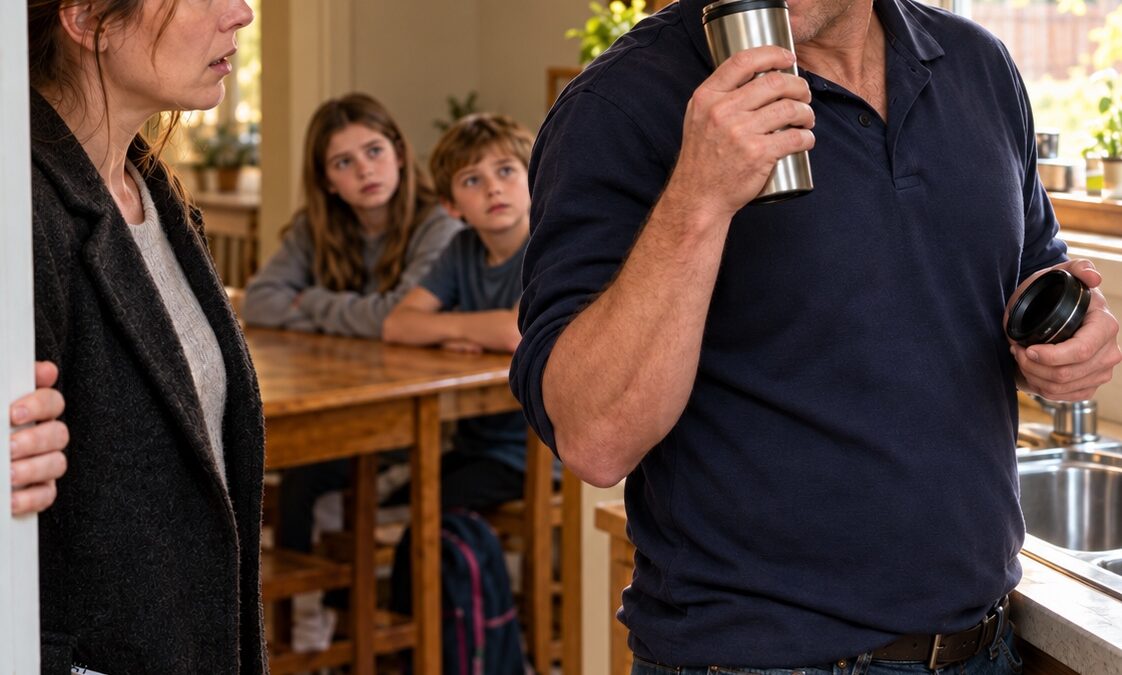
My husband poured the last of my coffee into his mother’s sink, held my empty mug under his nose, and said, “Just checking.”
It was Friday evening, October 2, and I had brought our children to Sand Springs for his weekend.
Jeremy sniffed again, louder this time.
Addison stopped pulling a folder from her backpack.
Carter looked up from the pantry doorway.
“Smells like coffee to me,” Jeremy said. “But you can never be too careful.”
Glenda stood beside the dishwasher, drying a dinner plate with a dish towel. She kept rubbing the same spot.
I stayed in the kitchen doorway.
We had been separated since July 6, the day Jeremy moved into Brittany Lusk’s apartment in Broken Arrow. She worked the parts counter at the store he managed. After fifteen years of marriage, I knew when Jeremy wanted an audience.
He still had on his work polo from East 11th Street, sleeves rolled up like he’d just come off a hard shift.
“Meredith’s been working those hospital nights,” he told his mother. “You know how it goes. Everybody needs something to help them unwind.”
“I sleep when I can,” I said.
Jeremy smiled at Addison.
“Your mom’s got a tough job, sweetheart. Nobody’s arguing that.”
Addison pushed her folder back inside her bag.
Jeremy placed my mug on the counter.
“Nobody gives two kids to a woman who needs wine to fall asleep at nine in the morning.”
Carter frowned.
“Mom drinks coffee.”
“I know, buddy.” Jeremy chuckled. “That’s what we’re checking.”
Glenda’s towel stopped moving.
Addison stared at the wood grain of her grandmother’s table.
For nineteen years, I’d worked in the emergency department at Mingo Valley Medical Center. I’d cleaned blood off strangers, called families at three in the morning, and explained monitor readings to frightened patients.
I had never needed Jeremy to explain my job to me.
“What time is it?” I asked.
Jeremy glanced at the microwave.
“Six-oh-eight. Why?”
I touched the small shift notebook in my coat pocket.
“Just checking,” I said.
Glenda set the plate in the cabinet.
“Let’s not, honey.”
Jeremy leaned against the sink.
“See, Mom? I can’t even make conversation anymore.”
I picked up my mug.
“Are the kids’ overnight bags upstairs?”
“Already put them in their rooms,” Glenda said.
“Thank you.”
Jeremy’s motion for temporary primary custody was scheduled for Monday morning at nine. He had filed it September 14, asking for the children, exclusive use of our house, and support from me.
The papers hadn’t mentioned drinking.
Jeremy knew I kept records.
He also knew how to make a quiet woman look like the problem in a room.
I didn’t give him the chance.
Addison pulled her zipper closed.
“Mom’s home tomorrow night. She said she’s finally sleeping.”
Jeremy raised his eyebrows at me.
“Well, that’s good news.”
“She slept four hours yesterday,” Addison said. “Carter kept asking her where the batteries were.”
“They were for my flashlight,” Carter said.
“Which one?” Jeremy asked.
“The one with the little red button.”
Carter pointed into the open pantry.
“That one has your name, Mom.”
Three dark glass bottles stood on the top shelf. Two had cracked purple wax; the nearest was still sealed. White strings held small paper tags around their necks.
Glenda followed his finger.
“Vernon made everybody one. Hers is the only one nobody’s opened.”
Jeremy’s father had made blackberry wine every Christmas before he died in March 2021.
I could see my name in his blue ballpoint handwriting on the nearest tag.
Jeremy laughed.
“Give her time.”
Glenda shut the pantry door.
“Beds are made upstairs.”
Carter stayed near Glenda, holding up his flashlight.
“Can I take it to bed?”
“If Grandma says it’s okay,” I told him.
“I’ll find batteries,” Glenda said.
While Carter talked to Glenda, Addison stepped close to me.
“Are you coming to my volleyball practice Tuesday?”
“I’ll be there.”
“Dad said maybe he could come too.”
“Good.”
She studied my face.
“Did you and Dad have another fight?”
I straightened the strap on her backpack.
“Your dad and I have things to work out. You don’t have to do that for us.”
She nodded without looking convinced.
The kids walked me to my car by Glenda’s flower bed. I had already shut the engine off when I parked.
Jeremy followed us out.
He pointed at the small camera mounted beside my rearview mirror and tapped its casing.
“A hundred and eighty-nine bucks to babysit a dent.”
“Someone hit my car at work,” I said.
“And you’ve been playing security guard ever since.”
“I like knowing what happened.”
Carter reached inside the car.
“Mom, phone.”
I handed it over.
He climbed into the driver’s seat and held the camera’s button until its green light blinked.
Picking up where the Facebook post left off
Then he opened the camera app on my phone and tapped the screen.
“I made it watch for robbers.”
“Thank you, Officer Carter.”
“I’m serious.”
“I know you are.”
Jeremy shook his head.
“Your mother’s got you doing surveillance now?”
Carter was busy climbing back out.
I kissed the top of his head and took my phone. The display was still lit, but I slipped it into my coat without looking.
Addison hugged me around the waist.
“Don’t forget Tuesday.”
“I won’t.”
Glenda called from the front steps. Carter ran toward her, talking about batteries.
Jeremy stayed by my car.
“Monday’s going to be interesting, Nurse.”
I opened the driver’s door.
“Nine o’clock,” I said.
He smiled.
“Bright and early.”
At 7:40 PM, I stood inside my house on Linwood Place.
I took the shift notebook from my coat and opened it beneath the overhead light.
I wrote:
Fri 10/2, 6:08 PM, Glenda’s kitchen.
Then I copied Jeremy’s sentence word for word: the two kids, the wine, nine in the morning.
Beneath nine in the morning, I drew a line.
The notebook went into my scrub top pocket for my next shift.
On Monday at nine, Jeremy would hear his own words again, with the time attached.
Part 2 of 9
“Monday the judge hears about your drinking,” my husband texted at 10:15 Saturday morning. “Mom’s seen it too.”
I sat at my kitchen table on Linwood Place, holding my phone above a bowl of cold oatmeal.
I scrolled up through our messages until I found one from July 7, the day after Jeremy moved out.
“Don’t touch the garage code. My tools are in there and half that house is mine.”
He had sent it at 8:42 that morning.
The code hadn’t changed.
Under our temporary custody order, Jeremy could collect his tools with twenty-four hours’ notice. He had never asked to come by.
I set my phone facedown.
On the refrigerator, an appointment card hung beneath a magnet.
Mon 10/5 9:00 — Judge Pettit, 6th floor.
Jeremy wanted the children and the house.
I washed my bowl and left both messages unanswered.
Saturday night, I was off work. By 10:30, I was asleep in my own bed.
My car sat unlocked, as usual, inside the closed garage.
Sunday afternoon, I put on jeans, a clean blouse, and the light coat, and moved my shift notebook from my scrubs to its pocket.
At 2:58 PM, Jeremy called.
“You leaving soon? Kids are packed.”
“Leaving now.”
“Good. Mom’s got dinner planned.”
“I’ll see you there.”
He said something about traffic on the highway. I told him I knew the route.
The call ended after forty seconds.
I collected my keys, checked that the back seats were clear, and pulled out at 3:05 PM.
The custody order said four o’clock at Glenda’s house in Sand Springs. I had never missed an exchange.
At 3:19, red and blue lights appeared in my rearview mirror on Charles Page Boulevard.
I checked my speed.
Thirty-eight in a forty.
I signaled and pulled onto the right shoulder, leaving room between my tires and the traffic lane.
The patrol car stopped behind me.
An officer approached my window.
“Afternoon, ma’am. Officer Reyes, Tulsa Police. License and insurance, please.”
I handed them over and put my hands back on the wheel at ten and two.
“Is there a problem?”
“We received a report of a possibly impaired driver matching your vehicle.”
“Impaired?”
“Caller says you were weaving. Said you were on your way to pick up your kids.”
My thumbs pressed into the leather of the steering wheel.
“Please give me the breath test now.”
He looked at me.
“Have you consumed any alcohol today?”
“No.”
“Any medication that affects your driving?”
“No.”
“All right. Step out for me, please.”
I switched off the engine and opened my door.
Reyes directed me onto the sidewalk, away from traffic.
He checked my eyes, had me walk heel to toe, and asked me to balance on one foot.
I did each test.
I didn’t sway or miss a step.
He took a portable breath tester from its case.
“Blow steadily until I tell you to stop.”
I followed his instructions.
Reyes examined the display.
“Zero-point-zero-zero.”
“What time is it?”
“Three thirty-one.”
I took the notebook from my coat.
The pen caught against the fabric lining. I freed it and wrote the time beneath Sunday’s date.
3:31 PM. PBT 0.00. Officer Reyes.
“My dashcam has the drive,” I said. “You can see how I was driving.”
Reyes returned the tester to its case.
“Point-zero-zero is all I need, ma’am.”
I knew from nineteen years in an emergency department that a roadside breath screening wasn’t the same as a laboratory blood-alcohol result.
But it was a number.
And Reyes had watched me produce it.
He walked me back toward my vehicle, my license in his hand.
“Your driving didn’t show any impairment during my observation,” he said.
“Thank you.”
My door was still open.
Reyes stopped.
“Ma’am, what’s that under your seat?”
I followed his gaze.
A dark glass bottle lay partly beneath the driver’s seat. Its neck protruded toward the pedals.
Broken purple wax clung to the top, but the cork was still in.
A loop of torn white string circled the neck.
I stared at it.
“That’s not mine. Please write that down. Don’t pour it out.”
“I’ll note it,” Reyes said. “Nothing gets poured out.”
“Do you know what it contains?”
“No.”
“Have you seen it before?”
“It’s never been in my car.”
Reyes crouched and studied it without touching it.
“Looks like wine.”
He put on gloves, removed the bottle, and placed it on my hood.
The wax had cracked along one side. There was no paper tag attached to the string.
“May I photograph it?”
“From where you’re standing. Don’t touch it.”
I took out my phone.
My hands made the first picture blurry.
I planted my elbow against my ribs and took another, showing the bottle, the broken seal, and the torn string.
The next photograph included the windshield and patrol car reflected in the glass.
Reyes sealed it in an evidence bag.
“Are you citing me?” I asked.
“No. You tested zero, and you say you didn’t know it was there.”
He checked my information once more.
Then he handed me a card with his name and the case number.
On the back, he wrote:
PBT 0.00 @ 1531 — L. Reyes
I put the card between the pages of my notebook.
“Will you tell whoever called what happened?”
“Dispatch tells the caller we made contact. That’s all he gets from us.”
“Can I get a copy of your report?”
“Use the case number on that card.”
I thanked him.
Reyes returned to his patrol car to finish his paperwork.
I stayed on the shoulder.
My notebook was open against the hood, and the pen had left a blue mark on my thumb.
I wrote down the report of weaving, the roadside tests, the photographs, and the bottle’s position beneath my seat.
Then I checked my phone.
3:48 PM.
A message from Jeremy appeared.
“Heard the cops found you. Kids stay with me tonight. Grant’s filing.”
Part 3 of 9
“I need a doctor to examine me and order a blood alcohol level,” I told the triage nurse, “and I’m paying cash.”
It was 4:30 Sunday afternoon at St. Anselm Hospital in south Tulsa.
The nurse checked my license.
“My husband reported me for drunk driving. Police tested me and let me go. My custody hearing is tomorrow.”
“We’ll get you registered.”
I signed the self-pay paperwork and paid a $312 deposit. The receipt went into my coat pocket with the notebook.
At 4:35, I sat on the edge of the bed in exam bay 3.
The doctor on duty stood in front of me with a tablet. His badge was turned backward on its clip.
“Tell me what happened.”
I gave him the timeline.
Jeremy’s call at 2:58. Departure at 3:05. Police lights at 3:19. Breath screening at 3:31.
“Result?”
“Zero-point-zero-zero.”
“And you want a laboratory test?”
“Yes. Ordered by you and run by your lab, so it goes in my chart.”
He checked my pupils and had me walk across the bay.
He returned to his tablet.
I could see the words as he entered them.
Alert, oriented, no signs of intoxication.
“That’s what I’m documenting,” he said. “The blood result will post separately.”
“Thank you.”
He studied my face.
“You’ve done this before.”
“From the other side of the bed.”
He tapped in the order.
A few minutes later, a phlebotomist rolled her stool beside the bed.
“Left arm okay?”
“That’s fine.”
She tied the tourniquet, found the vein, and slid the needle in.
At 4:41, she removed the needle and labeled the tube.
“May I check the draw time?”
She held it where I could read.
10/04, 16:41.
“Thank you.”
She bagged the sample and left.
I recorded 4:41 in my notes.
Then I pressed the gauze harder against my arm.
The cotton had developed a small red spot.
Jeremy’s message remained on my phone.
Our temporary order said Addison and Carter came home with me at four on Sunday.
He had sent his text while I was still standing beside my car.
At 5:37, the nurse returned with my discharge paperwork.
“The lab is back.”
“Could I have the result printed from the electronic chart? With the ordering doctor’s name, please.”
She checked the screen.
“Yes. Give me a minute.”
The printer behind the desk started.
She handed me a page with the hospital heading, my name, the physician’s name, and 16:41 beside the collection line.
The result was halfway down.
Ethanol, serum: none detected (<10 mg/dL).
I checked the name and date.
Then I folded the paper into my shift notebook, next to Officer Reyes’s card.
The blood draw came seventy minutes after the roadside screening.
I thanked the nurse and walked out.
At 6:20, I sat in my parked car in the hospital lot and called my lawyer, Yvonne Castillo, on her cell.
She answered on the fourth ring.
“Meredith?”
“Jeremy sent the police after me today. I was stopped on Charles Page Boulevard.”
“Are you safe?”
“Yes. No citation.”
“Tell me the times.”
I opened my notebook against the steering wheel.
Yvonne listened without interrupting as I went through the stop, the breath test, and the bottle Officer Reyes had taken from under my seat.
“Did he give you paperwork?”
“A card with the case number. He wrote the result and time on the back.”
“Keep it. Write every time down.”
“I have.”
“Did anyone photograph the bottle?”
“I did. On the hood.”
“Good. Don’t alter those pictures.”
“My dashcam has the drive. I told the officer.”
“Weaving is his word. The drive won’t beat a bottle. Get the blood number.”
“I already have it.”
A short pause followed.
“From where?”
“St. Anselm. The doctor examined me at 4:35 and ordered a serum ethanol level. Blood drawn at 4:41. None detected.”
“Do you have the printout?”
“In my hand.”
“Keep the original. I’ll need a copy.”
“Jeremy says he’s keeping the children.”
“Did he put that in writing?”
“At 3:48.”
“Save it.”
“Should I drive to Glenda’s?”
“No. Don’t fight on that porch. Pettit hears about tonight in the morning.”
“What about the children?”
“We’ll address the violation at the hearing.”
She asked me to photograph the card and the printout.
She didn’t tell me everything would be fine.
I preferred that.
At home, I laid them on the kitchen table, took the pictures, and emailed them to Yvonne.
The originals went back into my coat pocket.
At 8:02, an email from Yvonne arrived.
It was a forwarded message from Grant Ferrell, Jeremy’s lawyer.
Meredith, received these from Ferrell. Review both attachments. Bring your notebook and medical records tomorrow. Yvonne.
I opened the first document.
Jeremy’s sworn statement filled three pages.
He wrote that he had “watched Meredith’s drinking get worse since summer” and that he “had no choice but to protect my kids.”
Two sentences caught my eye as I skimmed.
“At 3:12 p.m. I called 911”
“officers found an open bottle of wine under her driver seat.”
His signature sat under a line that said he swore it was true under penalty of perjury.
I moved to the next attachment.
The filename included the word log.
The refrigerator motor hummed in the empty house.
I carried my laptop into the small home office and sent the file to the printer.
The machine fed out one sheet.
I lifted it while the page was still warm.
Across the top of the page:
Exhibit B — Father’s Log
Nine dated entries followed.
The first was marked July 10, four days after he moved out.
July 10, 11:20 PM — drove by, saw M. drinking on the couch through the front window.
Part 4 of 9
“You’re not taking them anywhere tonight,” Jeremy said through the screen door before I reached the top step.
It was 8:40 Sunday evening. Glenda’s porch light was on, and my husband stood with one hand resting against the doorframe.
“I came to say goodnight.”
“The kids are getting ready for bed.”
“I won’t keep them.”
Jeremy stayed where he was.
Moths ticked against the bulb above his head.
I stopped at the bottom step.
Behind him, Carter sat on the stairs inside Glenda’s house. His pajama pants had little footballs on them.
Tears ran down Carter’s cheeks.
“Carter?”
He wiped his nose on his sleeve.
“Dad said you got stopped.”
“I did, sweetheart. Then they let me go.”
Addison appeared in the hallway, wearing her volleyball team sweatshirt.
“Can I talk to Mom?”
He moved aside for her, then blocked the doorway again.
Addison came down one step.
“Dad says you can’t drive us anymore.”
“The police let me drive.”
“Then why did they stop you?”
“A caller reported bad driving. The police checked.”
Addison studied the railing.
“Dad said they found something.”
I kept my hands on the strap of my purse.
“The officer found a bottle in my car. It wasn’t mine.”
Behind the mesh, Jeremy folded his arms.
“She’s had a long day, Addison.”
Glenda stood in the hallway with a dish towel gathered between her hands.
I looked at her.
Glenda lowered her eyes to the towel.
Addison stepped close enough for me to kiss her hair.
Carter called from the stairs.
“Mom, are you coming tomorrow?”
“I’ll see you as soon as I can.”
Jeremy reached for the inside door.
“That’s enough for tonight, Nurse.”
I looked past his shoulder at my son.
“Goodnight, Carter. I love you.”
“Love you, Mom.”
Addison stayed on the porch until I reached the driveway.
Her hands had disappeared into the sleeves of her sweatshirt.
I kept walking.
Inside my car, I took the shift notebook from my coat.
The overhead light went out while I was finding a blank line. I opened the door a few inches to bring it back on.
8:44 PM. Glenda’s porch. Jeremy refused return. Addison said Dad told her I couldn’t drive. Carter crying.
The pen left a deep mark beneath the last word.
I drove home.
At 9:40, my phone rang on the kitchen table.
Yvonne Castillo.
“Tell me you didn’t argue on that porch.”
“I said goodnight to Addison. Carter was inside, and Glenda never said a word.”
“Did Jeremy let you take the children?”
“No.”
“Pettit sees a 911 call, a bottle, and three months of entries. Your blood is one number, drawn eighty-two minutes after the stop. Grant will say you sobered up.”
I held the phone against my ear.
“We have Reyes’s card, but no report,” Yvonne said. “Records won’t release it before nine.”
The refrigerator clicked off.
Yvonne continued.
“Be ready to lose temporary custody for a month.”
My thumb pressed into the phone case.
“A month?”
Across the kitchen, the refrigerator calendar still showed Monday’s hearing at nine. Below it, in my handwriting, Addison’s Tuesday volleyball practices ran to the end of October.
“Send me the drive tonight anyway.”
“I can download it.”
“Do it before you sleep,” Yvonne said. “Whatever we have by nine is what we have.”
I went down the hallway to the children’s rooms.
Carter’s blue pajamas lay in a heap on his bed. Addison had left her gray pair over the back of her desk chair.
I folded each pair into its own dresser drawer.
Carter’s waistband was twisted, and I straightened it before I closed his drawer.
His pickup-truck night-light was still on. I left it burning.
In the kitchen, their lunch boxes sat on the counter.
I set the two empty boxes together, then put them in the cabinet.
Carter’s still had a peeling robot sticker on the lid.
At 11:12, I went out to the garage.
My car sat beneath the overhead bulb.
I climbed into the driver’s seat without starting the engine.
I held the camera’s power button for three seconds until its Wi-Fi came on.
A green light blinked.
My phone found the camera.
The dashboard clock stayed dark, so I checked my phone and wrote 11:14 in the notebook.
I opened the app and waited for the recorded files to load.
I scrolled to the 3:05 drive and selected it for download.
The progress circle started moving.
During the transfer, I checked the settings.
One line caught my attention.
Motion detection: ON.
I hadn’t turned that setting on.
I’d set it to record only on impact.
A red badge appeared beside the event folder.
8 unviewed parking events.
I opened the event list.
The newest entries were from tonight: 11:12, when I’d walked into the garage, and 8:12, when I’d left for Glenda’s. Below them sat 5:40 in the St. Anselm lot, 3:33 on Charles Page Boulevard, when Officer Reyes had leaned in under my seat, and 3:04, when I’d climbed in to leave for Sand Springs.
I scrolled past those five.
Three entries remained, older than all of them: 2:14 AM, 2:14 AM, and 2:16 AM. The first read:
Sun 10/4 — 2:14 AM — Garage.
At 2:14 that morning, I had been asleep down the hall, and the garage door had been shut.
Part 5 of 9
I pulled the memory card out of the dashcam with tweezers from my first-aid kit, the way I’d pull glass from a cut.
It was 12:05 Monday morning.
My laptop sat on the kitchen table, plugged into the wall. I slid the card into a reader and opened the folder marked October 4.
Three files.
The first began at 2:14:09 AM.
The garage door rose, and a strip of night opened beneath it. The camera’s infrared view turned the concrete floor pale gray.
No sound. I’d disabled audio when I installed it.
The second recording started at 2:14:31.
My driver’s door opened.
The dome light came on.
A person wearing a gray hoodie leaned into the car, back toward the cabin camera. The hood covered the head completely.
A cloth bag hung from one wrist.
The person reached into the bag and pulled out a dark glass bottle, its purple wax cracked.
A broken loop of white string hung around its neck.
I moved closer to the screen.
The bottle went beneath my driver’s seat, pushed toward the pedals until only its neck remained visible.
The person withdrew, taking the empty bag.
At 2:16:02, the third clip showed the garage door closing.
I sat with my hands flat against the table.
Whoever had opened that door knew the keypad code.
I played the three recordings again.
Then once more.
Each run showed the same actions. At full speed the hood was a gray blur, and one pale flicker near the dome light came and went too fast to read.
I opened my shift notebook.
2:14:09 — garage opens.
2:14:31 — driver door opens. Purple-wax bottle placed under seat.
2:16:02 — garage closes.
The pen stopped over the second entry.
I looked at the wax on the screen for another minute before closing the video.
At 12:40, I called Yvonne Castillo.
She answered with a rough voice.
“Meredith? What happened?”
“I found somebody putting the bottle in my car.”
Yvonne was quiet for a second.
“On video?”
“Three parking recordings. Sunday morning, starting at 2:14.”
“Can you identify the person?”
“No. Gray hoodie. Face covered.”
“Does the recording show the bottle?”
“Clearly. Even the broken string.”
Paper rustled near her phone.
“I’m looking at Jeremy’s affidavit,” Yvonne said.
I waited.
“‘Under her driver seat.’ Who told him that?”
“Officer Reyes said the caller only gets a contact notification.”
“His exact words?”
I turned a page in my notebook.
“Dispatch tells the caller we made contact. That’s all he gets from us.”
“Good. Keep those words.”
Yvonne asked whether I’d changed anything on the recordings.
“No. I’m watching the files from the original card.”
“Stop using it once we have copies. We need to preserve it.”
I found two empty USB drives in my desk drawer.
“How many copies?”
“Two. One for me, one for court.”
“What about the card?”
“Put the original in an envelope. Seal it and sign across the flap.”
I wrote the instructions on a clean page.
“Should I call Officer Reyes?”
“Not tonight. I want the card in court at nine. Pettit can send it to the police afterward.”
I looked toward the garage door.
“There’s purple wax around the bottle’s neck. Jeremy’s father used to seal his blackberry wine that way.”
“Can you prove it’s Vernon’s?”
“No.”
“Then don’t guess in front of his mother.”
I put the pen down.
Yvonne turned to Jeremy’s log.
“Can you get your hospital clock records?”
“Through the employee app.”
“All nine dates?”
“Yes.”
“Check each one against his entries.”
I opened the printed exhibit.
July 10 sat at the top: “11:20 PM — drove by, saw M. drinking on the couch through the front window.” Eight more dates followed, the last in late September.
“I’ll check at six-thirty,” I said.
“Send me screenshots. I need the clock-in times visible.”
Yvonne’s voice sharpened.
“Pettit can refuse anything Grant hasn’t seen. If she does, the kids stay with Jeremy until November fifth.”
I looked at the refrigerator calendar.
Addison had volleyball practice Tuesday.
“Then Grant needs it before court.”
“I’ll email him at seven. The garage recording, the driving footage, the blood result, and your time records.”
“I’ll send everything.”
“One more thing. Get me a clear still of that person.”
“I’ll try.”
“Don’t improve the picture or change the original.”
After we hung up, I copied the three files onto my laptop.
The 3:05 drive was already on my phone from the garage download. I checked that it opened and included the trip on Charles Page Boulevard.
Then I copied the requested recordings onto both USB drives.
At 1:05 AM, I placed the original memory card inside a white envelope.
I sealed it, signed my name across the flap, and wrote 1:05 AM beneath my signature.
The envelope went into the inside pocket of my work bag.
I laid the two drives beside the laptop, each with a paper label.
The kitchen clock showed 1:18.
I went through Jeremy’s log, marking all nine dates on a separate sheet.
I already knew the hospital’s employee app locked older time punches during the nightly payroll update. The history would open after six.
At 6:30, I opened the time-clock app.
Six of Jeremy’s nine dates showed me clocked in at Mingo Valley Medical Center during the hours he’d written that he saw me drinking at home.
I took screenshots with the dates and punch times visible.
The other three dates had no matching work shift. I left those entries unmarked.
I emailed Yvonne the six screenshots and sent the video copies through a shared folder link.
At 6:45, I opened my laptop again.
She still needed a clear image.
The original card remained sealed in the white envelope.
Using the copy of the second garage recording, I advanced one frame at a time.
02:14:34.
The gray hood covered the person’s head.
02:14:35.
A hand drew the bottle out of the bag.
02:14:36.
The person began to straighten, the bottle held low.
At 02:14:37, the hood slipped backward, and the face turned into the dome light.
Brittany Lusk.
Her hand was still on the purple-wax bottle, the broken white string hanging beneath its neck.
Part 6 of 9
“Lunch is on me after,” Jeremy told his mother in the sixth-floor hallway, loud enough for the whole bench to hear.
It was 8:20 Monday morning at the Tulsa County Courthouse.
Glenda stood by the window, clutching her purse. Brittany Lusk wore a cream sweater and black pants.
Jeremy had on the blue button-down I used to iron every Sunday.
Grant Ferrell stood with them, a blue file folder tucked beneath his arm.
Across the hallway, Yvonne Castillo and I sat on a wooden bench.
My purse rested on my lap.
Before dawn I’d moved the white envelope there from my work bag, the original dashcam memory card sealed inside at 1:05.
I kept my palm flat against it.
“Mom, you want barbecue?” Jeremy asked.
Glenda shifted her weight.
“We’ll see, honey.”
“Come on. We’re celebrating a fresh start.”
Jeremy’s girlfriend moved closer and hooked her arm through Glenda’s.
“You’re going to have a nice afternoon,” Brittany said, patting the older woman’s wrist.
Glenda watched the elevators.
Grant crossed the hall.
“Got your email at seven. I’ll watch it if it matters.”
Yvonne looked up and gave him one nod.
Grant kept walking toward the restrooms.
I watched Brittany’s fingers rest on Glenda’s arm.
At 2:14 Sunday morning, her face had turned into my car’s dome light.
I lowered my eyes.
My thumb found the envelope’s corner through the lining.
Yvonne put away her phone.
“Keep your answers short.”
She glanced at Jeremy.
“Don’t watch them. Watch the judge.”
A clerk opened the courtroom a few minutes before nine.
People rose from the benches and gathered their belongings.
Jeremy went in first, holding the door for his mother.
Brittany followed close enough that her shoulder brushed Glenda’s sleeve.
At 9:10, our hearing began.
Judge Deborah Pettit sat above the courtroom, a stack of papers arranged beside her microphone.
The clerk was to her right. A court reporter sat below the bench, and a bailiff stood near the door.
Grant and Jeremy took the left table.
Yvonne and I sat at the right table. Her laptop lay open between us, and I slid the envelope from my purse to her side.
Glenda settled into the second row on the left side of the gallery. Brittany sat beside her.
About ten others waited for their cases. Counting court staff and both sides, about twenty people filled the room.
Judge Pettit checked the case number.
“We have seventy-five minutes set aside for this matter. Mr. Ferrell, proceed.”
Grant stood.
“Your Honor, we’re asking the court to modify the temporary order. My client is concerned about the children’s safety in their mother’s care.”
He opened the blue folder.
“Mr. Dobbins has submitted a sworn statement concerning an incident yesterday afternoon.”
Grant read the account of the 3:12 p.m. 911 call.
He paused after the time.
Then he read the sentence about officers finding “an open bottle of wine under her driver seat.”
A woman two rows behind Glenda stopped searching through her handbag.
Judge Pettit made a note.
Grant turned another page.
“We also submitted Exhibit B, a record my client kept over the past three months.”
He read the first entry.
“July 10, 11:20 PM. Drove by, saw M. drinking on the couch through the front window.”
Under the table, I counted them off on my knee with one finger.
The nine entries ended in September.
Each gave a date, a time, and a claim that I’d been drinking at home.
Grant read every one.
When he finished, the judge made another mark on her pad.
My husband was sworn in at the witness stand.
Grant approached the lectern.
“Mr. Dobbins, why did you begin keeping this record?”
“Because I was seeing behavior I couldn’t ignore.”
“What did you see?”
“Meredith coming home exhausted. Drinking when she should’ve been sleeping. I started writing it down.”
His voice sounded the way it did when he explained a difficult customer to his employees.
Patient. Almost amused.
“Did you confront her?” Grant asked.
“I tried. She shuts down when anybody questions her.”
He faced the gallery.
“I’ve told my mother the same thing. Meredith’s a wonderful nurse when she’s at that hospital. But there’s another side people don’t see.”
Grant waited.
Jeremy spread his hands.
“At work she’s a nurse. At home she’s a wine glass in scrubs.”
A spectator shifted on the wooden bench.
The woman with the handbag turned to watch me.
I kept my eyes on the judge.
Glenda lowered her head and studied her own hands.
Her fingers were clasped so tightly that the skin around her knuckles had gone pale.
Grant asked whether Jeremy believed the children would be safer living with him temporarily.
“Absolutely,” Jeremy said.
“And are you requesting exclusive use of the marital home?”
“So the kids can stay where they’re comfortable.”
Judge Pettit wrote something down.
Grant returned to his table.
“Your Honor, the timeline speaks for itself.”
He closed the folder.
The judge looked across the room.
“Ms. Castillo, any questions for Mr. Dobbins, or anything in response?”
Yvonne stood.
“Not for him yet, Your Honor. I sent Mr. Ferrell our exhibits at seven this morning.”
Grant rose immediately.
“Late disclosure, Your Honor.”
“His supplemental affidavit reached me at 7:55 last night, Your Honor. This answers it.”
Judge Pettit looked at Grant, then at Yvonne.
“I’ll hear it. Then I’ll decide what it’s worth.”
Jeremy stepped down from the stand and took his seat beside Grant.
Yvonne turned slightly toward me.
“My client will testify, Your Honor.”
I stood, took my shift notebook, and walked to the witness chair.
Behind me, Yvonne handed the sealed white envelope to the clerk, and Jeremy’s eyes followed it all the way to her desk.
Part 7 of 9
“Officer Reyes wrote it on the back of his card while I watched,” I said, “because I asked him to.”
It was 9:40 Monday morning, and Jeremy was still smiling beside Grant.
Yvonne held up the copy for Judge Pettit.
“PBT 0.00 @ 1531 — L. Reyes.”
The original was clipped inside my notebook.
“Three thirty-one Sunday afternoon,” I said. “He tested me beside Charles Page Boulevard.”
Yvonne placed another page on the document stand.
“St. Anselm Hospital. Blood drawn at 4:41 PM. Ethanol, serum: none detected.”
She turned the sheet.
“The doctor examined her at 4:35. His note is on the same page.”
Grant stood.
“We don’t dispute the printout, Your Honor. Eighty-two minutes. Plenty of time to sober up.”
Judge Pettit looked at me.
“Mrs. Dobbins?”
I held up my phone.
“Jeremy called me at 2:58 Sunday afternoon. Forty seconds.”
Yvonne passed the clerk a copy of the same call log.
“He talked to me fourteen minutes before he called 911. Ask him if I slurred.”
At the left table, Jeremy stopped turning his pen.
I faced Judge Pettit.
“At one drink an hour, zero at 4:41 means one drink at most at 3:19. One drink doesn’t slur anyone. And the officer’s test said zero at 3:31. A doctor examined me at 4:35 and wrote no signs of intoxication. It’s in my chart. And the drive is on the card: I never left my lane.”
Yvonne clicked the driving file on her laptop. On the screen, my car held its lane all the way to the flashing lights.
The judge watched it to the end without a word.
Jeremy leaned forward at his table.
“Then the bottle was hers. She hides them in the car.”
“Mr. Dobbins,” Judge Pettit said. “Stay quiet. Your attorney will have his turn.”
Grant put one hand against Jeremy’s sleeve.
I turned a page in my notebook.
“There’s something else in his affidavit.”
Yvonne handed me the copy.
I read one line aloud: “officers found an open bottle of wine under her driver seat.”
“Officer Reyes told me dispatch only tells the caller they made contact. His report wasn’t available to anyone this morning. So how did Jeremy know where it was?”
Jeremy looked at Grant.
“I drove past the house. I never set foot in that garage. She changed the code in July.”
“My car sat in a closed garage until 3:05, Your Honor. Nobody driving past could see under my seat, and at 3:12 he was at his mother’s with the kids.”
Grant stood again.
“Your Honor, my client should have an opportunity to answer through questioning.”
“He will,” Pettit said. “Sit down.”
Yvonne opened another exhibit.
“Nine entries in Mr. Dobbins’s log. Here are the hospital time-clock records for six of those nights.”
She placed the screenshots beside Exhibit B.
Each one showed my name, Mingo Valley Medical Center, and the minute I’d clocked in.
“Mrs. Dobbins was on duty when these six observations supposedly occurred.”
Judge Pettit compared the dates.
Her pen stopped at July 18.
“Mr. Ferrell, have you reviewed these?”
“Received them this morning, Your Honor.”
“That wasn’t my question.”
Grant glanced down at the pages.
“Yes.”
Yvonne raised a sheet with the text Jeremy sent me on July 7.
She read it aloud, every word, down to “half that house is mine.”
Under the table, Jeremy’s knee started bouncing.
Yvonne turned her laptop toward the bench.
“The original memory card is in the sealed envelope with the clerk. This is a copy of Sunday’s recording.”
The screen showed my parked car.
At 2:14 AM, the garage door rose.
A gray-hooded figure entered.
The driver’s door opened. The dome light came on.
One woman in the gallery leaned forward.
Yvonne advanced the recording frame by frame.
At 02:14:37, she stopped.
The hood had slipped back. Brittany’s face filled the frame.
Her hand held a bottle with broken purple wax. A snapped loop of white string hung around its neck.
Yvonne put my roadside photograph beside the frozen image.
The cracked seal and the torn loop matched.
Glenda raised her head and stared at the bottle on the screen.
Brittany pushed herself up from the second row. Her handbag knocked the row in front of her as she turned.
The bailiff held the door while she walked out.
Jeremy stared at the screen.
“I didn’t know anything about that. Brittany did that on her own.”
Yvonne closed the video window.
Judge Pettit turned to Grant.
“Does your client wish to explain his log?”
Grant spoke quietly to Jeremy, then faced the bench.
“Not at this time, Your Honor.”
I flipped back to Friday in my shift notebook.
“May I read one more entry?”
The judge nodded.
“‘Nobody gives two kids to a woman who needs wine to fall asleep at nine in the morning.’ Friday, six-oh-eight p.m., your mother’s kitchen.”
Glenda’s purse slid from her lap. She caught it by the strap.
The court reporter’s keys stopped.
Judge Pettit reviewed the papers in front of her.
At 10:25, she set down her pen.
“The motion for temporary primary custody is denied.”
Jeremy reached for Grant’s arm.
“The children return to their mother this afternoon,” Pettit continued. “Mrs. Dobbins retains exclusive use of the Linwood Place home.”
Yvonne wrote on her legal pad. I laid my notebook on my knee and held it there until the pages stopped trembling.
“Mr. Dobbins will surrender the garage remote and access code through counsel. His parenting time will be supervised daytime visits until further order.”
The judge checked another page.
“Ms. Lusk is not to be around the children. The sworn statement, Exhibit B, and the recording will be referred to the Tulsa County District Attorney’s office.”
Grant closed his blue folder.
“A written order will follow,” Pettit said.
Glenda stood and picked up her purse.
She walked toward the door.
“Mom?” Jeremy said.
Glenda didn’t turn around.
My husband faced me.
“Meredith—”
“I don’t drink, Jeremy. My dashcam doesn’t sleep.”
Part 8 of 9
The school secretary read the court clerk’s stamped minute order twice before she called my kids to the office.
It was 3:10 Monday afternoon.
I stood at the counter, waiting for her to hand back the order.
“You’re picking up both children today?”
“Yes, ma’am.”
She checked the judge’s initials beneath the clerk’s stamp.
“All right. Have a seat.”
I stayed standing.
A few minutes later, Carter came around the corner carrying his backpack by one strap.
“Mom!”
He ran straight into me and hugged my waist.
I put my hand on the back of his head.
“Hi, buddy.”
“Can we go home now?”
“Yes.”
Addison appeared behind him, her earbuds already in. She stopped when she saw me, then adjusted her backpack.
“Ready?” I asked.
She nodded.
In the car, Carter climbed into his booster seat behind me and buckled up. Addison took her usual place against the far window.
The stamped order went into my purse.
Carter talked all the way to Linwood Place.
He told me about a spelling test, a boy who’d dropped his lunch tray, and the fact that Grandma’s upstairs bathroom faucet made a squeaking noise.
Beside him, my daughter watched the passing houses.
Once, Carter poked his sister’s arm.
“Addison, tell Mom about volleyball.”
She didn’t answer.
“She can’t hear you,” he told me. “She’s got those things in.”
I checked the rearview mirror.
Her eyes met mine, then slid back to the glass.
That evening, I made dinner and packed their school bags for Tuesday.
Carter fell asleep with his pickup-truck night-light burning.
I was sitting on my bed when Addison appeared in the doorway.
She stood there with her sleeves pulled over her hands.
She looked at the folded blanket at the foot of my bed.
For a long moment, she didn’t move.
Then she said, “Night.”
“Goodnight, sweetheart.”
She went down the hallway.
I kept my bedroom door open.
Tuesday afternoon, October 6, Yvonne emailed the written order Judge Pettit had signed that day.
I sat at the kitchen table and read it.
The custody provisions matched what the judge had said Monday.
Jeremy’s visits were supervised and limited to daytime. Brittany was not permitted around the children.
The house remained mine to occupy while the divorce was pending.
Farther down, one line gave the amount.
Jeremy Dobbins shall pay child support of $1,140 per month beginning November 1.
I ran my finger beneath the date.
Our August order had left support open. His motion had asked the court to make me pay him.
Now his name stood on the payment line.
At six, a courier from Grant’s office dropped off the garage remote Jeremy had surrendered.
I set it on the kitchen counter, took my phone, and went into the garage.
The keypad was mounted beside the door.
He had used that code for years and kept it after moving to Brittany’s apartment in Broken Arrow.
I changed the code and tested the new one.
The door rose. I lowered it again.
The keypad stayed lit for a few seconds after my hand moved away.
I stood on the concrete until its light went dark.
After dinner, my phone rang.
The caller identified himself as a detective with the Tulsa Police Department.
“We’ve asked Ms. Lusk to come in and talk,” he told me.
“Has she agreed?”
“Nothing I can tell you about that yet.”
“All right.”
“The case is at the county district attorney’s office. I’ve also left a message for Mrs. Glenda Dobbins.”
I took my notebook from the kitchen drawer.
“What time is it?”
“Seven-twenty,” he said.
I wrote down the time and his words.
Before hanging up, I asked whether he needed anything else from me.
“Keep what you’ve got. We’ll contact you.”
Jeremy called four times that evening.
I watched his name appear, then disappear.
On the fourth call, I put the phone facedown.
A text followed.
“Mom won’t pick up. What did you tell her?”
I didn’t answer.
I hadn’t spoken to Glenda since the hearing.
Wednesday, October 7, at 7:05 PM, someone knocked on my front door.
The porch light was already on.
Glenda stood on the top step, purse hanging from her arm.
“Evening, Meredith.”
“Come in.”
She stayed where she was.
“Let me say this out here, honey.”
I held the door open.
She looked past me into the hallway for a second, then down at her shoes.
“Saturday night, at eleven-forty, I heard the pantry door.”
She hitched the strap higher on her arm.
“I called out to Jeremy. He said, ‘Looking for a flashlight, Mom.'”
I waited.
“At twelve-thirty, I heard a car start in my driveway.”
Glenda pressed her lips together.
“Sunday morning, I was emptying the kitchen trash. I found a tag in Vernon’s handwriting. I couldn’t throw it away, honey. I set it on the windowsill without thinking about it.”
She stopped and looked toward the street.
“In court, when that woman was on the screen, I saw the purple wax in her hand.”
My throat tightened.
I rested my palm against the doorframe.
“Monday afternoon, I checked the top shelf of the pantry,” Glenda said. “There was one bottle missing.”
She looked at me.
“Yours.”
Neither of us moved.
Under the bulb, gray showed along her part.
For fifteen years, I’d carried groceries into Glenda’s kitchen, washed holiday dishes beside her, and called when the children had a fever.
Now she wouldn’t step past my welcome mat.
Glenda took a long breath.
“I never saw you drink. He asked me to say I had.”
I swallowed twice.
“Did you?”
“No, honey.”
She looked down.
“But I didn’t tell him I wouldn’t.”
I couldn’t answer right away.
Glenda reached into her purse.
“I’ll tell the detective. All of it.”
Then she put something small into my hand.
The tag was creased, with a stub of white string still knotted through the torn hole.
I recognized Vernon’s blue ballpoint handwriting.
For Meredith — who’ll never drink it. Merry Christmas. V. 2019.
Part 9 of 9
Glenda set Vernon’s tag on the detective’s desk and kept two fingers on it until he wrote down the time.
It was 10:00 Friday morning at Tulsa Police Department headquarters.
I had driven her there.
She sat beside me, wearing the same brown cardigan she wore to church when the weather turned cold.
The detective uncapped a pen over a yellow legal pad.
“Tell me what you heard Saturday night, Mrs. Dobbins.”
Glenda straightened in her chair.
“At eleven-forty, I heard somebody open the pantry. I called out, and Jeremy said he was looking for a flashlight.”
“Did you see him take anything?”
“No, sir.”
“What happened next?”
“At twelve-thirty, a car started in my driveway.”
“Did you see who was driving?”
“No. I was in bed.”
The detective wrote that down.
He asked about Sunday morning, then about the hearing, then about her pantry. Glenda answered each one in the same words she had used on my porch.
“And what did your son tell you about Meredith drinking?”
Glenda adjusted her glasses.
“He asked me to say I’d seen it. I hadn’t.”
“Did you tell him that?”
“I didn’t say yes. I should’ve told him no.”
The detective finished writing.
Then he turned to me.
“This is the original tag?”
“Yes. My mother-in-law gave it to me Wednesday. May I photograph it before you put it away?”
“Go ahead.”
I held my phone flat above the tag and took a picture of the handwriting, the torn hole, and the white string.
The detective let me finish.
He slid the tag into an evidence envelope and marked it.
Glenda watched him seal the flap.
He looked at me again.
“Oklahoma gives you the right to talk to the DA before they decide, if you ask. Their victim advocate will call. They’ll want to hear what you want, with the kids in mind.”
I opened my shift notebook on my lap.
“What time is it?”
“Ten thirty-eight.”
I wrote 10:38 beneath Friday’s date.
“Do you want to talk about that now?” he asked.
“I’ll answer later.”
He nodded.
“That’s fine.”
Glenda stood slowly, holding the arm of her chair until she had her balance.
I picked up her purse and handed it to her.
On the drive back toward Sand Springs, she sat with her hands folded over it.
Traffic slowed near a construction sign.
“Vernon made that wine every Christmas,” she said.
“I remember.”
“He always said you were the only person in the family who never needed a drink. He was proud of that.”
I checked the lane ahead.
“He knew you, honey. I should have said so in that kitchen.”
My thumb moved over the stitching on the steering wheel.
Friday, at 6:30 PM, I drove back out to Sand Springs and pulled into Glenda’s driveway.
Her porch light had come on.
Glenda came down the steps to meet me, and I took the shift notebook from my coat.
I tore out a clean page.
On it, I wrote the new garage code.
“Here.”
Glenda looked at the paper.
“What’s this?”
“The code for my garage. I changed it Tuesday.”
She held the page between her fingers.
“Meredith, are you sure?”
“I’m sure. And I need to ask you something.”
“All right.”
“Could you stay with Addison and Carter on the Thursday nights I work?”
Glenda looked up.
“At your house?”
“Yes. The overnight sitter has been covering my shifts. I’d like the kids to have you there instead.”
She smoothed the torn edge flat against her palm.
“I can do that.”
She opened her wallet.
Inside the clear pocket was a photograph of Vernon wearing his old electrician’s work shirt.
Glenda folded the page and slipped it behind the picture.
I waited until she closed the wallet.
“There’s one more thing.”
We walked over to her car.
The new dashcam I’d bought for her was already mounted behind the rearview mirror.
I opened the app on my phone.
“When the engine is off, this can still watch your car.”
Glenda leaned closer.
“Even in my driveway?”
“Yes. See this?”
I pointed to the parking-mode switch.
She asked to turn it on herself. Her finger missed the control once, and I steadied the phone while she touched it again. The indicator changed.
“There,” I said.
Glenda studied the screen.
“Well. Vernon would’ve spent all afternoon playing with that.”
Then she went inside.
Sunday, October 11, at 6:52 PM, chili was simmering on the stove at Linwood Place.
Glenda stood over the pot, stirring with the wooden spoon she’d brought from Sand Springs.
“Needs another minute,” she said.
Addison was setting the table.
She carried five plates from the cabinet and placed them around the kitchen table.
Then she stopped.
Her hand rested on the fifth plate.
She picked it up, put it away, and closed the cabinet door.
Nobody said anything.
“Can you drive me to practice Tuesday?” she asked.
“I can.”
Carter sat on a stool at the counter with my phone.
He had opened the camera app.
“Mom, look.”
I went over.
He pointed at the screen.
“Did my robber button help?”
Glenda turned from the stove.
“It helped, baby.”
Carter grinned and handed my phone back.
“Can I have cheese on my chili?”
“Top shelf,” I said.
He climbed down to get it.
On the fridge door, beneath a magnet, was the printed photograph of the tag.
I glanced at it while Carter searched for the cheese.
Glenda set the pot on the table. Addison brought the spoons.
I took the notebook from the counter and sat between Addison and Carter.
Across the table, Glenda pulled out her chair.
The children started passing plates toward the pot.
I uncapped my pen.
I opened my shift notebook and wrote it down: Sunday, 6:52 p.m. Everybody home.
THE END
More stories
My Husband Toasted Finally Our House at a Thanksgiving Table Set for 22—Then His Brother Read His Old Divorce Judgment Aloud, and I Canceled the Closing on My House.My brothers and I paid our sister Amber $1,100 each monthly for two years; she asked 40 relatives for an aide’s Christmas bonus—But Mom asked What aide? and we sued her for $79,200.My Daughter-in-Law Gave Me 30 Days to Leave for a Camper—Then Her Own Realtor Read My Right to Stay for Life Before 30 Guests and Stopped the Sale.I Saw Wayne Use Mom’s Sunday Crosswords to Call Her “Slipping” Before 40 Guests—Until She Read a Receipt for a Second Prescription, and the Notary Refused to Notarize His 80-Acre Deed.My sister-in-law called me “hired help” over one guestbook—Then Dad learned about $11,400 in secret cottage rentals and made her cancel the next booking before fourteen women.My Boss Slapped a $300,000 Mortgage Note Onto My Binder During a New Hire’s Retirement Lesson—Then His Father’s Forgotten Rule Froze His Access to Our Plan








