My Husband’s Final Roll Came Back Almost Blank—Then the Lab Manager Told Me He Probably Never Took the Pictures
Complete story · 8 parts · about 39 minutes · ending included
Part 1 · Part 2 · Part 3 · Part 4 · Part 5 · Part 6 · Part 7 · Part 8
Part 1 of 8
I held the negative strip up to the bright kitchen window and turned it a few degrees.
Nothing changed.
Thirty-six frames should have made a long row of little windows, each one darkened differently by sky, trees, Hollis’s red cap, the lake, whatever he’d pointed that camera at.
Instead, the strip looked washed nearly clean.
I could make out divisions between frames. A few weak smudges. Faint factory edge markings along one side.
That was about it.
My phone sat on the table with Benton Rusk on speaker.
“I’m looking at them right now,” I said.
“And I’m looking at the order notes,” he said. “There wasn’t an equipment problem reported that day.”
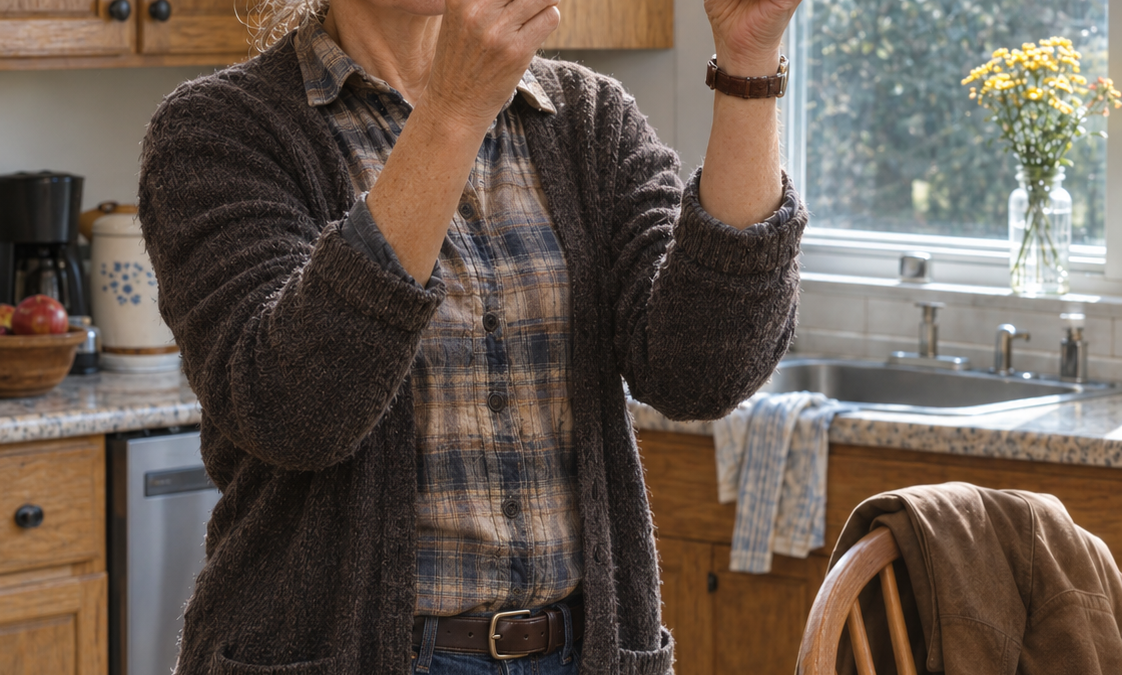
Hollis’s brown jacket was still hanging over the back of the kitchen chair beside me.
Twelve days had gone by since he died, and I had moved his shoes from the hallway because Della kept tripping over them.
The jacket was apparently where I drew the line.
“Benton, the film has almost no density.”
There was a pause.
“Mrs. Quillen, I’m trying to help you.”
“Then don’t call me Mrs. Quillen like you’re about to explain a coupon.”
Another pause.
I knew that pause. I’d spent thirty-two years in photo labs before retiring. It was the pause managers used when they were deciding whether experience counted if it belonged to somebody standing on the wrong side of the counter.
He said, “Sometimes customers think they took more pictures than they did.”
I lowered the strip.
“I loaded that camera myself.”
“I’m not saying you didn’t load it.”
“You just told me maybe my dead husband didn’t take any pictures.”
“I said it’s possible the exposures weren’t made.”
“All thirty-six?”
“It happens.”
“Not like this.”
Benton sighed softly.
That irritated me more than if he’d raised his voice.
“Marva, I understand you’ve worked in photography.”
“Photo processing.”
“Right. But without being there when he used the camera—”
“The edge markings are faint too.”
“They’re still there.”
“Yes.”
“So the film went through processing.”
“I didn’t say it didn’t.”
That stopped him for a moment.
Edge markings were useful, but they weren’t a confession. I could tell the film looked wrong. I could suspect weak development or some other processing failure. I could not hold a strip to the sun and declare which chemical had failed, much less prove who had caused it.
Benton seemed to hear only the part where I couldn’t prove it.
Picking up where the Facebook post left off
“Then we’re in the same place,” he said. “There’s no way to know whether the issue happened before the roll came to us.”
“There’s a way to look.”
“We looked.”
“At what?”
“The negatives.”
“No. At your processing records.”
His voice cooled a little.
“Our equipment is monitored.”
“Good. Preserve the records from the day my roll was processed.”
“Preserve them?”
“Yes. Control records, run information, order records. Whatever you keep for that processor and that shift.”
“That’s not something customers request.”
“I just did.”
Another manager pause.
Then he said, “I’m not going to get into internal documentation over one blank roll.”
“Almost blank.”
“Fine. Almost blank.”
I put the strip down on a clean sheet of white paper.
The envelope lay beside it. So did the receipt from November 3.
Hollis had taken the pictures October 19, on the last day trip we ever made together. He died October 24.
I had not brought the roll in immediately. For five days it sat in the small bowl by the back door with two receipts and a key Hollis claimed belonged to something important.
Nothing had happened to it.
No attic. No hot glove compartment. No damp basement box from 1987.
Just our kitchen.
Benton said, “What I can do is replace the film.”
I stared at the jacket.
“A new roll.”
“Yes. No charge.”
“For Hollis to shoot?”
He did not answer.
I let the silence sit there long enough to embarrass both of us.
Finally he said, “I meant as a goodwill gesture.”
“I know what you meant.”
“It’s what I can offer at branch level.”
“I don’t want another roll.”
“I can also refund the processing fee.”
“Not yet.”
That surprised him.
“Not yet?”
“I want the original negatives returned to me. Untouched. In the envelope they came in.”
“They’ve already been returned.”
“I mean nobody trims them again, cleans them, scans them, sleeves them differently, or throws away anything connected to that order.”
“We don’t throw customer negatives away.”
“Good.”
I picked up the receipt.
“And I’m putting my request for preservation in writing.”
His tone changed again.
“You’re making this sound much bigger than it is.”
“No. I’m making it exactly as big as one roll of thirty-six pictures.”
“Which may never have contained images.”
“Then records won’t hurt you.”
He said nothing.
That was the first useful thing Benton had done all morning.
I ended the call.
For a minute, all I heard was the refrigerator clicking and the furnace coming on.
Then the back door opened.
Della came in carrying two flat cardboard boxes and a paper bag of sandwiches.
“Mom?”
“In here.”
She stopped when she saw me at the window.
“Oh, no.”
“I got the negatives back.”
She set the boxes down.
“And?”
I didn’t answer.
Della looked at the strip on the white paper.
She had Hollis’s habit of leaning closer to bad news as if proximity might improve it.
“That’s all of them?”
“That’s the roll.”
Her mouth tightened.
The memorial was set for Saturday, November 14, at the little community room beside the township library.
Not a funeral. We had already done the funeral.
This was Della’s idea because her father had hated formal things and loved making people stand around folding tables while he told stories they had already heard.
We were putting together a small display of family photographs. Nothing elaborate. Twelve foam boards. Maybe sixty pictures.
Hollis had spent the last month of his life complaining that every photograph of him made him look “like a county employee surprised at lunch.”
The last roll was supposed to give us something newer.
Something from the day at Grand Traverse Bay when the wind had nearly taken his cap.
Della touched the edge of the envelope but not the film.
“Maybe we just use what we have.”
“We may have more than this.”
“Mom.”
“I said may.”
She pulled out a chair.
“I know you know this stuff.”
“That’s a dangerous way to begin a sentence.”
“I’m serious.”
“So am I.”
Della rubbed her forehead.
“We have nine days.”
“I know.”
“I still have to pick up the boards. Aunt Carla hasn’t sent me her pictures. Uncle Keith sent twelve pictures of his fishing boat and three of Dad.”
“That sounds like Keith.”
“I have to get the food count in next Thursday.”
“I know.”
“And I don’t want you spending nine days fighting a photo lab when we already know Dad is dead.”
I looked at her.
She closed her eyes.
“That came out wrong.”
“No, it came out tired.”
“I am tired.”
“So am I.”
She nodded once.
Neither of us apologized.
That helped.
Della opened one of the sandwiches and pushed half toward me.
“What are you going to do?”
“First, I’m going to put the negatives somewhere safe.”
“And then?”
“Write down exactly what I asked Benton for.”
“Then?”
“I don’t know yet.”
That part was true.
I had a suspicion.
I had a receipt.
I had one nearly empty strip of film that could not testify for itself.
What I needed next was somebody who had no reason to protect a branch report.
I carried the negatives to the desk in the spare bedroom.
I slid them, the envelope, and the receipt into a clean archival sleeve from an old box of supplies I still kept.
Then I sat down and wrote Benton an email.
I did not accuse him of ruining Hollis’s film.
I wrote that the negatives appeared abnormally thin, that the edge markings were faint, and that I was requesting preservation of processing records associated with order 61428 from November 3 while I sought an independent evaluation.
I read it twice.
Then I added one sentence.
Please confirm this request has been received.
I sent it before I could improve it into something less useful.
Part 2 of 8
Benton answered the next afternoon.
His email was six sentences long.
He thanked me for contacting the branch.
He repeated that no equipment issue had been documented.
He offered a replacement roll and a refund of the original processing charge.
He did not confirm that anything would be preserved.
I called.
He did not answer.
At four-thirty he called back while Della and I were standing on my dining room floor arranging photographs into piles.
“Early,” Della said.
“College.”
“Christmas.”
“Why does Dad have that mustache?”
“Temporary mental illness.”
My phone rang.
I saw the branch number.
Della saw my face.
“Please don’t start another forty-minute call.”
“I didn’t start the first one.”
“You absolutely did.”
I answered.
“Benton.”
“Marva. I saw your follow-up.”
“My original email.”
“Yes.”
“You didn’t answer my request.”
“I answered your concerns.”
“No. You answered different concerns.”
Della picked up a stack of pictures and carried them to the table.
Benton said, “As I mentioned yesterday, branch records aren’t customer documents.”
“I didn’t ask you to give them to me.”
“You asked for them.”
“I asked you to preserve them.”
His chair creaked on the other end.
“We don’t have a process where a customer directs internal retention.”
“Then forward my request to whoever does.”
“Marva, I’m trying to save you time.”
“Whose?”
He was quiet.
Then he said, “I don’t believe escalating this is going to produce the result you’re hoping for.”
“What result do you think I’m hoping for?”
“I think you’re grieving.”
There it was.
Not cruel enough to quote dramatically.
Just useful enough to him.
I looked across the room at Della. She had stopped sorting.
Benton continued, “And I don’t want you spending money or putting yourself through a lot of frustration over film that may not have usable images.”
“I appreciate your concern for my budget.”
“That’s not what I meant.”
“It sounded very economical.”
Della covered her mouth.
I wasn’t sure if she was hiding a laugh or a groan.
Benton said, “I’m saying expectations should be realistic.”
“I agree.”
That caught him off guard.
“I don’t expect thirty-six photographs to jump back onto the film because I complain loudly enough. I want to know whether there is image information left and whether your processing records show anything relevant.”
“I can’t authorize outside people to review our records.”
“I didn’t ask you to.”
“Then what are you asking right now?”
“That you forward the quality complaint.”
“It isn’t a quality complaint yet.”
“Why not?”
“Because we’ve offered a customer-service resolution.”
“A new roll.”
“And a refund.”
“My husband is dead.”
His voice dropped.
“I know.”
“No. You know the sentence. That’s different.”
Della turned away.
I softened my voice because I was not trying to punish him with Hollis.
“I am declining the replacement roll. Please document that. I am also asking where a written quality complaint goes.”
Benton gave me an email address associated with the company’s customer-quality office.
He said it quickly, like a man handing over a key he expected never to see again.
I wrote it down.
After we hung up, Della looked at me.
“So now it’s official?”
“Not yet.”
She let out a breath through her nose.
“Mom, I need you Saturday.”
“For what?”
“The display boards.”
“I said I’d help.”
“You also said you’d help yesterday, and you spent two hours going through old lab notebooks.”
“Forty minutes.”
“It was dark when you came out.”
“I was looking for Roscoe Wynn’s number.”
She frowned.
“Who’s Roscoe Wynn?”
“Independent scanner. Used to handle restoration work for photographers all over the county.”
“Used to?”
“Still does. I just haven’t talked to him in years.”
Della sat on the edge of the dining chair.
“How much?”
“I don’t know yet.”
“Mom.”
“I’ll ask.”
She looked at the photographs spread across the floor.
There was Hollis beside our first used camper.
Hollis holding baby Della with both hands and the expression of a man who had been given unstable machinery.
Hollis at fifty, wearing a birthday crown Della had bought at a party store.
We had photographs.
That was part of what made me feel foolish.
And part of what made me unwilling to let the last roll disappear without being examined.
Della picked up one from the Grand Traverse trip the year before.
“Dad took five pictures of that same lighthouse.”
“He liked repetition.”
“He called it studying the light.”
“He liked repetition with a better vocabulary.”
She smiled, but only briefly.
Then she said, “What was on this last roll?”
I had been avoiding that question because I did not know every frame.
Hollis had carried the camera most of that day.
But I knew some.
“The gull on the rail that stole half his sandwich.”
Della looked down.
“He took that?”
“Three times, I think. He kept saying the bird had no shame.”
“What else?”
“The overlook above the water. He made me stand there with my hood blowing over my face.”
“Classic.”
“He took that old blue fishing skiff pulled up by the reeds.”
“The one Dad said looked like it had retired?”
“That one.”
I paused.
“And near the end, he set the camera on the stone wall with the timer.”
Della looked at me.
“A picture of both of you?”
“He tried.”
“Did it work?”
“I don’t know.”
The timer had blinked.
Hollis had jogged back toward me.
I remembered him arriving late, one hand on my shoulder, laughing because he’d nearly slipped on wet leaves.
Whether the shutter had fired at the right moment, I couldn’t say.
Della put the photograph in her lap.
“That’s the one, isn’t it?”
“No.”
“Mom.”
“It’s all of them.”
She gave me a tired look.
“That wasn’t my question.”
I gathered the pictures marked for the second board.
“Call your caterer.”
She did not move.
Finally she said, “Please don’t miss Saturday.”
“I won’t.”
The following Wednesday morning, November 11, I called Roscoe Wynn.
He answered on the fourth ring.
“Roscoe.”
“It’s Marva Quillen.”
There was half a second of silence.
Then, “Photo-lab Marva?”
“Retired photo-lab Marva.”
“That’s the only kind we have left.”
His voice had deepened, but the dry tone was the same.
I told him what I had.
I did not tell him what conclusion I wanted.
That mattered.
He asked three questions about storage, film type, and whether the negatives had been cut.
Then he said, “Don’t clean them.”
“I haven’t.”
“Don’t run them through anything.”
“I won’t.”
“I can do a high-bit-depth diagnostic scan. Nondestructive. It may tell us whether there’s weak image information hiding in there.”
“May.”
“Yes.”
“And it won’t tell me exactly what happened in processing.”
“Not by itself.”
“Good.”
He laughed once.
“You’re checking whether I’ve become a magician.”
“I’m checking whether you’ve become expensive.”
“I’ve become both, but only one is real.”
The diagnostic would cost me two hundred forty dollars.
I wrote the number on the back of an envelope.
Hollis and I had spent more than that on a weekend we barely remembered.
It still felt like a lot of money for the possibility of learning that nearly nothing remained nearly nothing.
Roscoe said, “I can look at it Monday afternoon.”
The memorial was Saturday.
“Nothing sooner?”
“No.”
I looked at the calendar.
“Monday works.”
After we hung up, I stood in the kitchen with the envelope in my hand.
Della came in through the back door carrying foam boards.
She saw the number.
“Two hundred forty?”
“Yes.”
She set the boards down harder than necessary.
“For a scan.”
“For a diagnostic.”
“That is a scan wearing a tie.”
I almost smiled.
She didn’t.
“Mom, Saturday is in three days.”
“I know.”
“You promised you’d help tonight.”
“I will.”
“Not while emailing Benton.”
“I won’t email Benton tonight.”
She studied me.
“Or Roscoe.”
“I said I’d help.”
She nodded.
“Okay.”
That evening, I left my phone in the kitchen drawer.
Della and I worked at the dining room table until eleven.
We mounted fifty-eight photographs.
None of them came from Hollis’s last roll.
Part 3 of 8
On Monday afternoon, Roscoe put the first enlarged scan on his monitor and said, “There.”
I leaned closer.
At first I saw only dirty gray-green.
Then a shape separated from it.
A railing.
Behind it, pale water.
“That’s the overlook,” I said.
Roscoe nodded.
His workroom occupied the back half of a converted garage outside Alder Reach. Two scanners sat on one long bench. Film sleeves were stacked in labeled boxes. A small fan hummed under the table.
He had already warned me twice that weak information was not the same as recoverable photographs.
He did not warn me again.
He clicked to another frame.
A darker mass appeared.
Something narrow tilted diagonally through the murk.
“The skiff,” I said.
“You sure?”
“Blue fishing boat. Pulled up in reeds.”
“Color’s not telling us much here.”
“I know the shape.”
He clicked again.
This one looked almost empty.
Then he increased the view.
Near the left side, a small dark form sat against a lighter band.
I laughed before I meant to.
Roscoe glanced at me.
“The gull.”
“That is one rude-looking blob.”
“It was a rude bird.”
I sat back.
Three subjects.
Not pictures yet.
Not really.
But they were there.
Hollis had pressed the shutter.
That mattered more than I expected.
Roscoe moved through the remaining frames slowly.
Most gave us little or nothing recognizable.
A few held weak patches suggesting sky or shoreline.
One had what might have been a person but could just as easily have been overlapping shadows.
Near the end, Roscoe stopped.
He adjusted the scan once.
Then again.
Two upright shapes appeared near the center.
The left one was darker and taller.
The right one had a pale area where a face might have been.
I put both hands flat on my knees.
“Don’t tell me what I want to hear.”
“I wasn’t planning to.”
“Is there something there?”
“There’s image information.”
“Us?”
“Maybe.”
I stared at it.
The stone wall made a faint horizontal line near the bottom.
That was enough to make my chest tighten.
Roscoe leaned back.
“I wouldn’t print this yet.”
“Why?”
“Because I’d want to rescan the promising frames more carefully. Different settings. Maybe separate channels. See what’s actually in the dye.”
“How many promising?”
He looked at his notes.
“Four I’d spend real time on.”
I looked at him.
“Four?”
“That’s not four finished photographs.”
“I heard you.”
“The rest may stay gone.”
“I heard you.”
He nodded.
I appreciated that he stopped there.
After a minute I asked, “Can you tell whether the lab caused this?”
“No.”
“Can you tell whether the film was exposed?”
“Some frames, yes. Clearly enough to show that there were exposures.”
“All thirty-six?”
“No.”
“What can you say?”
He folded his arms.
“I can say there is residual image information in several frames, including recognizable scene structure. The negatives are unusually thin. That’s consistent with inadequate image formation somewhere in the process, but I can’t tell you the exact cause from the negatives alone.”
“Could it have been the camera?”
“I wouldn’t rule out every possible contributing problem from a scan.”
“Storage?”
“You told me how it was stored. I don’t see anything here that lets me prove storage damage, and this doesn’t look like a roll that’s been baking for twenty years. But that’s different from proving what happened at the processor.”
“Good.”
He looked amused.
“You really don’t want me to give you more than I know.”
“I spent a career cleaning up after people who did.”
He printed a one-page diagnostic note.
It described what he had observed, his scanning method, and the limitations.
No accusation.
No chemical diagnosis.
No grand language.
Just enough.
At the bottom was his invoice.
Two hundred forty dollars.
I paid it.
When I stepped outside, it had started to sleet.
My phone showed three missed calls from Della.
I called her from the car.
She answered immediately.
“Where are you?”
“Roscoe’s.”
There was silence.
Then, “Of course.”
“What happened?”
“The library moved the easel return up to four.”
I looked at the dashboard clock.
Four-twelve.
“I thought we had until five.”
“The borrowed display easels, Mom. The ones we said we’d return together.”
I closed my eyes.
I had forgotten.
Not because of grief.
Not because Della had failed to remind me.
Because I had been looking at Hollis’s film.
“I forgot.”
“Yes.”
“I’m sorry.”
“I had to leave work.”
“I said I’m sorry.”
“And two of the mounting clips were missing, so I stood there checking boxes and retracing Saturday while my supervisor called twice.”
“I can come now.”
“I already did it.”
The words were flat.
That was worse than anger.
I held the phone tighter.
“Della, Roscoe found images.”
She did not answer.
“Not all of them. Most may be gone. But he found some information. The overlook. The boat. The gull. And maybe—”
“Mom.”
I stopped.
She said, “The memorial was two days ago.”
I looked through the windshield.
Sleet ticked against the glass.
We had held it Saturday without the last roll.
Seventy-three people came.
Della had handled the food count, the display boards, the coffee, the extra chairs, the missing extension cord, and Aunt Carla crying in the parking lot.
I had been there.
I had helped.
But not enough.
And after spending the morning telling myself I would stay present, I had left early Sunday to organize my notes for Roscoe.
Della said, “You keep talking like if you solve this, Saturday changes.”
“I know it doesn’t.”
“Do you?”
“Yes.”
“Because I needed you last week.”
I looked down at Roscoe’s report on the passenger seat.
“You did.”
“And now I need you to stop making every hour about this roll.”
“I can’t stop now.”
The second the words left my mouth, I knew what they sounded like.
Della gave a small laugh with no humor in it.
“Right.”
“Della—”
“No. I have to go back to work.”
She hung up.
I sat there while the sleet thickened.
Then I picked up Roscoe’s report.
For the first time since Benton told me Hollis might never have taken the pictures, I had independent evidence that some images had existed.
Not proof of whose fault the loss was.
Not proof of a particular processing mistake.
Enough to make the next choice mine.
I opened the quality-office email address Benton had given me.
I attached a copy of the original receipt, photographs of the negative strips, my preservation request, Benton’s written response, and Roscoe’s diagnostic note.
I wrote three short paragraphs.
I stated that I was not asking the branch to guess at a cause.
I asked for formal review of the processing interval tied to my order and renewed my request that relevant quality-control and run records be preserved.
Then I added the cost of Roscoe’s diagnostic scan and explained why I had obtained it.
I did not mention Della.
I did not mention the missed board pickup.
Those belonged on my side of the ledger.
Before sending, I called her back.
She let it ring long enough that I thought she would ignore me.
Then she answered.
“What?”
“I’m submitting the complaint.”
A pause.
“Okay.”
“And tomorrow after lunch, I’ll bring the memorial things back to your house and help you put them away.”
“I can do it.”
“I know.”
Another pause.
Then she said, “One o’clock.”
“One o’clock.”
We hung up.
I looked once more at the faint shape of the two figures on Roscoe’s monitor in the photograph he’d let me take for reference.
Then I pressed send.
At 4:31, an automatic reply came back with a case number and one useful sentence:
A regional quality representative had been assigned to review the complaint.
Part 4 of 8
At twelve-fifty Tuesday, I parked in Della’s driveway with three plastic tubs, two empty foam-board cartons, and the extension cord we’d accused three different relatives of stealing.
It had been under my passenger seat.
Della opened the garage before I reached the door.
“You came.”
“I said one.”
“You’ve said things before.”
Fair.
I carried in the first tub.
The memorial leftovers had taken over half her dining room. Paper tablecloths. Framed photographs. A cardboard box full of sympathy cards. Two unopened packages of napkins because Della had planned for the population of Alder Reach.
She pointed toward the table.
“Pictures first. Food stuff goes in the basement.”
I set my phone facedown on the counter.
She noticed.
“Expecting a call?”
“Probably.”
“From the company?”
“Probably.”
She looked at the phone, then at me.
“Are you going to answer?”
“Not until we’re done with this room.”
Della studied me long enough to make sure I understood my own sentence.
Then she handed me a roll of tissue paper.
We packed Hollis away in categories.
Childhood.
Our wedding.
Della.
Trips.
Holidays.
The photographs from Saturday’s display came down from their boards one by one.
There was Hollis standing beside a snowblower with a broken handle.
Hollis at Della’s high-school graduation, looking more nervous than she did.
Hollis asleep in a lawn chair with a newspaper over his chest.
Della slid that one into a sleeve.
“I still hate that we didn’t have anything from October.”
“So do I.”
She waited.
I didn’t add anything about Roscoe.
That was harder than it sounds.
At one-forty, my phone buzzed.
I kept wrapping frames.
At one-forty-three, it buzzed again.
Della said nothing.
At two-ten, we had the dining table cleared.
She carried the last box toward the hall closet.
“You can check it.”
“Thank you.”
“That wasn’t permission. It was mercy.”
The missed call was from Leonie Voss.
Her voicemail was brief.
She identified herself as regional quality manager for Birch Lantern Imaging and gave me a direct number. She said she’d been assigned my complaint and had begun reviewing the order history.
I called her from Della’s kitchen.
Della stayed in the room.
Leonie answered, “This is Leonie.”
“Marva Quillen returning your call.”
“Thank you. Before we get into anything, I want to confirm something you asked for. The relevant branch quality and processor records are still within our normal thirty-day retention period, and I’ve placed an internal hold on the records connected to your order and that processing date.”
I looked at Della.
She raised her eyebrows.
“Thank you,” I said.
“I’m also requesting the processor control charts, control-strip results, and run log for November 3. I can access those through our internal system. You won’t need to obtain them.”
That was the first time anybody at the company had said the obvious thing without making me fight for it.
“Good.”
“I’ve reviewed the images you sent of the negatives and Mr. Wynn’s note. His findings are useful, but I want to be careful about what they establish.”
“So do I.”
“I saw that.”
Her tone was dry enough that I liked her a little.
She continued, “At this point, I can confirm your order was processed at the Alder Reach branch on November 3. I cannot yet tell you whether the processor records show a quality failure during your specific run.”
“How long?”
“I expect to have the records tomorrow.”
Della opened the refrigerator, found nothing she wanted, and closed it again.
Leonie said, “I also need to ask about the original negatives. Do you still have them?”
“Yes.”
“Keep them. Don’t send them anywhere unless we arrange it.”
“They’re not going anywhere.”
“Good.”
I almost told her that Benton had offered me a new roll.
There was no need. It was already in the complaint.
Instead I asked, “Did Benton forward my first preservation request?”
A small pause.
“I don’t see that he escalated it before your written complaint reached us.”
That landed quietly.
Not fraud.
Not conspiracy.
Just a choice.
“All right,” I said.
“I’ll speak with him as part of the review.”
After the call, Della leaned against the counter.
“So she sounds competent.”
“Annoying, isn’t it?”
“Deeply.”
I put my phone back down.
Della looked toward the stacked boxes.
“Are we done?”
“With the dining room.”
“Basement.”
“I was afraid you’d remember.”
We carried the food supplies downstairs.
At the bottom step, Della said, “Thank you for coming.”
I stopped.
She was holding a box of paper cups against her hip.
“I should have been there yesterday.”
“Yes.”
“I can’t fix that.”
“No.”
We stood there with the furnace humming beside us.
Then she said, “Put those on the second shelf.”
It was not forgiveness.
It was a shelf.
For the moment, it was enough.
Part 5 of 8
Leonie called Wednesday at 10:18 in the morning.
I was in the backyard shaking dead leaves out of a doormat.
“Do you have a few minutes?” she asked.
“Yes.”
“I have the November 3 records.”
I sat on the back step.
She did not begin with chemistry.
I appreciated that.
“The branch ran routine processor quality checks that day. One control-strip result was outside the acceptable range before your order was processed.”
I looked at the wet grass.
“How far before?”
“I’m still reconciling the timing. The control chart is timestamped, and the order log shows when your roll entered the processor, but I want the branch to confirm the sequence.”
“So there was a bad result.”
“There was an out-of-control result.”
“And somebody kept processing.”
“The records indicate customer work continued.”
I rubbed my thumb along the edge of the step.
“What kind of result?”
“Low developer activity indicators.”
That was enough.
I did not need her to perform my old job back to me.
“Was there a correction logged?”
“Not before your order.”
I stood up.
The cold had come through my jeans.
Leonie continued, “There is also an equipment-service note entered later that afternoon referring to a developer mix adjustment. I’m obtaining the original entry and speaking with the staff who were present.”
“Mix adjustment.”
“Yes.”
“Does that prove my roll was affected?”
“Not by itself.”
“Good.”
She paused.
“You keep saying that.”
“People get careless when the answer starts leaning their direction.”
“That’s true.”
I went inside.
On my kitchen table, Hollis’s negatives were in their sleeve beside Roscoe’s report.
Leonie said, “The run log matters here. Your order is listed in a group processed after the control result and before the adjustment. I want to verify whether all timestamps were entered automatically or whether any were handwritten later.”
“How many customer orders were in that interval?”
“I can’t discuss other customers’ details.”
“I didn’t ask who they were.”
“Seven orders are listed in the interval.”
That was enough to make my stomach turn.
“Have you contacted them?”
“That decision isn’t mine alone, and I’m not going to speculate before I finish the review.”
Fair again.
It was getting inconvenient how often Leonie was fair.
She asked whether Roscoe still had the diagnostic scan files.
“He does.”
“If he’s willing, I’d like a copy of the original scan data and his invoice. With your permission.”
“I already sent the invoice.”
“I have the invoice. I mean the scan files.”
“Why?”
“So our technical group can compare what remains on the film with the processor records. Not to replace his opinion.”
I looked at the clock.
Roscoe had told me he’d keep the raw diagnostic files for thirty days unless I asked for longer storage.
“That may cost more.”
“It may.”
“Are you authorizing that?”
“Not yet.”
There it was.
A complication with a price tag.
“If your specialist needs those files, why wouldn’t you cover it?”
“I have to get approval first.”
“How long?”
“Possibly two business days.”
I looked at Hollis’s negatives.
Roscoe’s thirty days were not the problem.
Time was.
The longer this stretched, the more it occupied every room I entered.
“What if I pay him now to prepare and retain the full diagnostic set?”
“Keep the receipt. I can’t promise reimbursement today.”
I hated that answer because it was the correct one.
“All right.”
After we hung up, I called Roscoe.
“How much to preserve the raw files, document the scan settings, and prepare a copy if Leonie’s technical group asks?”
“One hundred eighty.”
I closed my eyes.
“You’re getting worse.”
“Inflation.”
“You’re a menace.”
“Also true.”
I told him to do it.
Then I called Della.
Not because I needed permission.
Because I had promised myself I would stop letting every choice become something she discovered afterward.
“I’m spending another hundred eighty on the film.”
She was silent.
Then, “Why?”
I explained.
Not the chemistry.
Just the decision.
At the end she said, “Can you afford it?”
“Yes.”
“That’s not what I asked.”
“It won’t hurt the mortgage. It will annoy me.”
“Okay.”
I waited.
She said, “I don’t like it.”
“I know.”
“But I like you telling me.”
That sentence cost more than one hundred eighty dollars.
Thursday afternoon, Leonie emailed to confirm the additional scan documentation had been approved as a reasonable review expense if the technical group used it.
I read the email twice.
Then I forwarded it to Roscoe.
He sent the files directly to the secure address Leonie provided.
Nobody gave me access to the company’s internal records.
Nobody gave Roscoe access to them either.
His job was the film.
Leonie’s job was the records.
For once, people stayed in their lanes.
Friday morning, Benton called.
I let it ring.
Then I called back ten minutes later.
“Marva,” he said.
“Benton.”
“I understand regional quality is reviewing the order.”
“Yes.”
“I wanted to make sure you knew I never intended to dismiss your concerns.”
I leaned against the kitchen counter.
“You told me I might be grieving too hard to understand what I was looking at.”
“I said grief can affect expectations.”
“That’s a longer version.”
He exhaled.
“I was trying to prevent this from becoming more upsetting.”
“You were trying to keep it at branch level.”
Silence.
That was not a question.
He said, “Branch managers are expected to resolve customer issues when possible.”
“With replacement film.”
“And refunds.”
“Was the out-of-control control strip already in your records when I called?”
The silence changed.
“I can’t discuss an active internal review.”
“That’s fine.”
“Marva—”
“No. It actually is.”
I ended the call.
I did not need him to confess anything to me.
Leonie had records.
The records could speak for themselves when the right people had to answer for them.
I had my kitchen.
Part 6 of 8
By the following Tuesday, November 24, Leonie had enough to stop using the word preliminary.
She called at nine in the morning.
“I’ve completed the technical portion of the record review,” she said. “There are still management questions to address.”
I sat at the table.
Hollis’s jacket had finally moved from the chair.
Not far.
It was hanging on the coat hook by the back door.
“What did the technical review find?”
“The control chart shows developer activity outside the acceptable range before your roll was processed. The run log ties your order to the interval after that result and before the corrective mix adjustment.”
I said nothing.
Leonie continued.
“The maintenance entry records that the developer working solution had been mixed incorrectly earlier in the day. The correction restored activity afterward.”
“Was the bad control result missed?”
“It was recorded.”
“That’s not what I asked.”
“No.”
Her voice stayed even.
“The result was recorded and customer processing continued without the required branch response being documented at that time.”
I looked at the receipt dated November 3.
“So now you can say the lab caused it.”
“I can say the company records support a processing failure affecting the interval containing your roll. Combined with the condition of your negatives and the independent scan findings, we are treating your loss as resulting from that processing failure.”
The sentence was clean.
It did not bring back one frame.
I felt my eyes burn anyway.
“All right.”
“We will refund the original processing charge and the documented diagnostic expenses you’ve incurred. We’re also prepared to cover careful recovery scanning of the surviving image information.”
“How much can be recovered?”
“That still depends on the film.”
“Roscoe thinks four frames may be worth serious work.”
“I saw his note.”
“Most of it is gone.”
“Yes.”
She did not soften the word.
That helped more than sympathy would have.
I asked, “What happens with Benton?”
“There is a separate management review.”
“Separate from me?”
“Not entirely. Your complaint is part of it. But personnel decisions aren’t something I can promise or discuss in advance.”
“I don’t want him fired because I asked for it.”
“I understand.”
“I want him to answer for telling me there was nothing worth reviewing when the branch already had a failed quality check.”
Leonie was quiet for a moment.
“That is one of the questions being reviewed.”
She told me a regional operations director would be joining a formal case review on Monday, November 30.
Benton would attend.
So would the branch’s processing lead and Leonie.
She asked whether I wanted to participate for the portion concerning my complaint.
“Yes.”
“I thought you might.”
“Do I need to bring the negatives?”
“No. Bring the original receipt if you want it in front of you, but we already have the order record. Keep the film protected.”
After the call, I sat at the table until the furnace clicked on.
I had spent three weeks wanting somebody to say the roll had been mishandled.
Now somebody had.
The kitchen looked exactly the same.
At eleven, Della came by carrying two grocery bags.
She put them on the counter.
“I bought too much soup.”
“You inherited that from your father.”
“He bought too much bacon.”
“Different food group.”
She saw my face.
“What happened?”
“They admitted the processing failure.”
Della stopped unpacking.
“Actually admitted it?”
“Leonie did.”
“And the pictures?”
“Four may be recoverable. Maybe.”
She nodded slowly.
“The rest?”
“Gone.”
The word sat between us.
Della took a carton of broth from the bag and lined it up beside another one.
“So what happens now?”
“Regional review Monday.”
“Are you going?”
“Yes.”
She looked at me.
I knew what she was thinking before she said it.
“Monday is when we were going through Dad’s clothes.”
I had forgotten.
Again.
Not completely. The plan existed somewhere in my head.
It had simply been pushed behind Monday at ten, conference room, receipt, Benton.
I rubbed my forehead.
“What time did we say?”
“Morning.”
“My review is ten.”
“Of course it is.”
“Della.”
She closed the cupboard harder than necessary.
“No, go. You’ve gotten this far.”
“That’s not the point.”
“It kind of is.”
“I can come afterward.”
“We both know what happens afterward. You’ll replay every sentence Benton says until dinner.”
I started to defend myself.
Then I didn’t.
She was right.
I pulled out a chair.
“Sit down.”
“I don’t want a meeting.”
“Neither do I.”
She stayed standing.
I said, “We do Dad’s clothes Sunday afternoon.”
“I have plans Sunday.”
“Saturday.”
“I’m helping Carla.”
I looked at the calendar.
“Tuesday evening.”
Della stared at me.
Then she said, “Seven.”
“Seven.”
“And you leave your phone in the kitchen.”
“Drawer.”
“Good.”
She sat.
I poured two bowls of the soup she’d brought.
After a few minutes she said, “What do you want from Monday?”
I thought about Benton offering a new roll.
About Leonie saying the failed result had been recorded.
About the four weak shapes Roscoe could still see.
“I want the record to say what happened.”
“And after that?”
“I want to stop making you pay for the time it takes me to prove it.”
Della looked down at her soup.
“That’s harder.”
“Yes.”
She nodded.
“Seven Tuesday.”
“Seven Tuesday.”
On Monday morning, November 30, I put the original receipt in my purse.
I left Hollis’s negatives at home.
Then I drove to the regional office with no replacement roll, no speech prepared, and four possible pictures still waiting inside damaged film.
Benton was already seated when I walked into the conference room.
Part 7 of 8
Benton was already seated when I walked into the conference room.
He had a paper cup in front of him and both hands around it.
Leonie stood near the far end of the table beside a woman in a charcoal cardigan who introduced herself as Nadine Mercer, regional operations director.
The fourth person was a man named Cal Durnell, the processing lead from the Alder Reach branch.
Nobody had brought pastries.
That seemed appropriate.
Leonie pointed to a chair.
“Marva, thank you for coming.”
I sat across from Benton.
He looked at me once.
“Morning.”
“Morning.”
Nadine opened a folder.
“We’ve already completed the technical review. Today I want to address what happened at the branch after the quality-control failure and after you raised your complaint.”
She looked at Benton and Cal.
“This isn’t a hearing. But I do expect direct answers.”
Benton nodded.
Cal stared at the table.
Nadine turned to me.
“You have the option to leave after we cover the customer-impact portion.”
“I’ll stay as long as I’m allowed.”
“All right.”
Leonie laid one sheet in front of herself.
She did not hand it to me.
“Your order was logged into the Alder Reach processor at 11:42 a.m. November 3.”
She tapped the sheet.
“The processor control strip run earlier that morning showed developer activity below the acceptable range. That result was entered on the daily control chart.”
Nadine said, “Cal, what should have happened then?”
Cal shifted in his chair.
“Customer work should’ve stopped until the cause was checked and the processor brought back into control.”
“Did that happen?”
“No.”
“Why not?”
He looked toward Benton.
Then back at Nadine.
“I thought the strip might’ve been handled wrong. Benton was trying to clear the morning orders. I ran another check later.”
Nadine’s expression did not change.
“Was the first result documented as invalid?”
“No.”
“Was there a documented basis for continuing customer work?”
“No.”
Leonie said, “The later maintenance entry records a developer mix correction at 1:16 p.m. The mix ticket from that morning shows the working solution was prepared at the wrong dilution.”
I kept my hands folded in my lap.
There it was.
Not in the edge markings.
Not in my instincts.
In their records.
Leonie continued, “The processor run log places Marva’s order, along with several others, in the interval after the low-activity control result and before the corrective mix.”
Nadine turned to Cal.
“Who made the mix?”
“I did.”
“Did you know it was wrong when you made it?”
“No.”
“Did you know something was wrong when the control strip failed?”
“I knew the result was low.”
“That’s not the same answer.”
Cal’s face reddened.
“No. I didn’t know the mix was wrong then.”
Nadine nodded once.
That part mattered.
A mistake was one thing.
What happened after the warning was another.
She turned to Benton.
“When did you become aware of the failed control result?”
Benton looked at Leonie.
“That morning.”
“Before Marva’s order?”
“Yes.”
I felt something tighten behind my ribs.
Not surprise.
I had already suspected it.
Still, hearing him say it changed the temperature in the room.
Nadine asked, “Why did processing continue?”
“We were behind. Cal believed it might’ve been a bad control strip. We hadn’t had complaints yet.”
“Was that consistent with procedure?”
“No.”
“And when Marva called after receiving her negatives, did you check the November 3 control records?”
Benton did not answer immediately.
“I knew there’d been an adjustment that day.”
“Did you check the records?”
“Yes.”
“When?”
“After her first call.”
I looked at him.
Nadine said, “So when Marva asked you to preserve the processing records and requested quality review, you already knew there had been a control failure and later mix correction.”
“I knew there had been an issue that was corrected.”
“That wasn’t my question.”
Benton’s mouth tightened.
“Yes.”
The room stayed quiet.
He finally looked at me.
“I should have escalated it.”
I waited.
He continued.
“I thought the most likely outcome was an unrecoverable roll, and I thought I could resolve it at branch level with a refund and replacement film.”
“Even after I asked you not to,” I said.
“Yes.”
“And you told me maybe Hollis hadn’t taken the pictures.”
His face changed slightly at Hollis’s name.
“Yes.”
“You also told me grief might be affecting my expectations.”
“I did.”
Nadine looked at him.
“Why?”
Benton stared at the paper cup.
“Because she kept pressing.”
It was the first thing he’d said all morning that sounded completely unprepared.
I said, “That isn’t an answer.”
“No.”
He rubbed his thumb over the cup seam.
“I thought she was making a customer complaint into a technical investigation. I thought she was overreading faint negatives because she’d worked in labs years ago.”
“Retired,” I said.
He looked at me.
“Yes.”
“And?”
“And I was wrong.”
Nadine said, “About her background?”
“About dismissing it.”
That was better.
Not elegant.
Better.
Leonie spoke next.
“Marva’s observation that the negatives were abnormally thin gave her a reasonable basis to question processing. It did not establish the specific cause. The company records did that.”
I nodded.
Exactly.
Nadine turned a page.
“We’re changing the branch workflow so any out-of-control processor result automatically requires a documented hold before customer work can resume. Branch managers will no longer be able to close a quality complaint as a routine service recovery when the complaint references a processing-control failure.”
Benton’s jaw shifted.
No dramatic firing.
No security escort.
Just a rule being built around a place where judgment had failed.
Nadine continued, “Benton and Cal will both have corrective action recorded. Their responsibilities and retraining are being handled internally.”
I did not ask for more.
She looked at me.
“Regarding your costs, we are voluntarily refunding the original processing charge. We’re reimbursing the two hundred forty dollars you paid for the first diagnostic scan and the additional one hundred eighty for scan preservation and documentation. We’re also paying Roscoe Wynn directly for the recovery work on the four frames he identified as potentially viable.”
“Potentially.”
“Yes.”
“Not promising four finished pictures.”
“No.”
Good.
I opened my purse and took out the November 3 receipt.
It looked absurdly ordinary.
A little strip of paper.
Benton stared at it.
I put it on the table between us.
“This was all I had when I first called.”
He nodded.
“You also had your experience.”
“I did.”
“But it wasn’t proof.”
“No.”
He looked at me for a long moment.
“I treated your not having proof as if you had no reason to ask.”
That was the closest thing to honesty I’d heard from him.
“Yes,” I said.
Nadine closed the folder.
The customer portion was over.
When I stood, Leonie walked me to the door.
“Roscoe can begin as soon as you authorize release of the negatives to him.”
“I’ll bring them myself.”
“I thought you might.”
I put the receipt back in my purse.
It had done its job.
Part 8 of 8
Tuesday at six-fifty-two, I put my phone in my kitchen drawer.
She watched me do it.
“All the way in.”
“I know how drawers work.”
“Evidence has been mixed.”
We were at my house, not hers.
Hollis’s clothes still filled the bedroom closet.
Della had brought two empty storage totes and one paper grocery bag.
At seven exactly, she opened the closet door.
“Shirts?”
“Shirts.”
We started there.
No speech.
No ceremony.
Just hangers sliding over the metal rod.
Della kept three flannel shirts aside.
I kept Hollis’s heavy green sweater even though I had complained about it for fifteen winters because it shed fuzz onto everything.
At eight-fifteen, Della held up his red cap.
“The lake one?”
“Yes.”
She put it on the dresser instead of in either tote.
Neither of us commented.
At eight-thirty, we stopped.
One bag for donation.
One tote for Della.
One tote I wasn’t ready to decide about.
That was enough.
Three days later, I carried the negatives to Roscoe myself.
He signed for them at his workbench.
“I heard somebody else is paying me now.”
“Try not to become unbearable.”
“Too late.”
He spent the next week working only with what remained in the film.
No invented detail.
No filled faces.
No miracle sharpening.
When he called me on December 9, he said, “I have four small prints worth looking at.”
I drove over that afternoon.
He had laid them face down on a clean mat.
“Ready?”
“No.”
He turned over the first one anyway.
The gull sat on the railing with part of Hollis’s sandwich in its beak.
The image was thin and uneven.
The sky had a sick green cast near one corner.
The railing faded almost completely on the right.
But the bird was recognizable.
So was the missing triangle of sandwich.
I laughed.
“That thief.”
Roscoe smiled.
“Frame twelve.”
The second print showed the old skiff in the reeds.
The blue was barely blue.
More gray than anything.
A pale band ran across the lower third where the image had never formed properly.
Still, I could see the tilted bow.
I could hear Hollis again.
Looks retired.
Roscoe turned over the third.
The overlook.
Water behind the railing.
My coat visible at the left edge, hood blown sideways over part of my face.
I was not centered.
Hollis had apparently ignored every compositional principle I had spent thirty years pretending mattered.
“That’s me.”
“That’s what I thought.”
My face was partly lost in a weak patch.
But my hand was visible gripping the hood.
The fourth print remained face down.
I looked at Roscoe.
“Timer?”
“Timer.”
He turned it over.
For several seconds, I could not make sense of it.
Then I saw the stone wall.
Two figures.
Me on the left.
Hollis coming in from the right.
He had not made it all the way beside me before the shutter fired.
His face was soft and incomplete, one side weakened almost into the pale background.
My face was not much better.
But his left hand had reached my shoulder.
And I was turned toward him.
Not toward the camera.
Toward him.
The whole thing was slightly blurred.
No one would have chosen it for a Christmas card.
I put one finger near the edge of the print without touching the image.
“He was late.”
Roscoe nodded.
“You can see the motion.”
“He almost slipped.”
“I believe it.”
I sat down.
“That’s all?”
He did not pretend not to understand.
“That’s all I could recover to a print I’d stand behind.”
“Thirty-two?”
“Nothing I’d call a real photograph.”
I nodded.
The room blurred for a moment.
Not because I had lost everything.
Because I had not.
Four was enough to prove what had happened.
Four was not enough to make thirty-six stop being thirty-six.
Roscoe slid the prints into separate protective sleeves.
“The company covered the recovery invoice.”
“Good.”
“They also asked if you wanted larger enlargements.”
“No.”
He looked at me.
“No?”
“These are honest at this size.”
He nodded.
That evening I called Della.
“I have them.”
She was quiet.
“Four?”
“Four.”
“Can I come over?”
“Yes.”
She arrived twenty minutes later with her coat still zipped.
I had put the prints on the kitchen table.
Not in frames.
Not under glass.
Just four little photographs in sleeves.
Della sat down.
She started with the gull.
“Oh, Dad.”
Then the skiff.
Then the overlook.
When she reached the timer picture, she stopped.
Her thumb pressed against the edge of the sleeve.
“That’s his red cap.”
“Yes.”
“You can barely see his face.”
“I know.”
“But that’s him.”
“Yes.”
She stared at it.
“That would’ve been on the memorial board.”
The words landed harder than anything Benton had said.
“Yes.”
Della’s eyes filled.
She wiped them with the heel of her hand and looked irritated by the inconvenience.
“I hate that.”
“So do I.”
“We can’t redo it.”
“No.”
She looked at me.
“You missed things trying to get these.”
“Yes.”
“I’m still mad about the easels.”
“I know.”
“And the board pickup before that.”
“I know.”
“You keep saying that.”
“I don’t have a better sentence.”
That got half a laugh.
Then she looked down at the four prints again.
After a while she said, “What are we doing with them?”
I had thought about frames.
An album.
A box.
All of them felt too finished.
“Bring the memorial photo board that’s still at your house.”
“The family-trip one?”
“Yes.”
She looked at the timer print.
“You want to add them now?”
“Not to pretend they were there that day.”
“Then why?”
“Because they’re here now.”
Della considered that.
“Okay.”
Saturday morning, she brought the board over.
We did not recreate the memorial display.
We did not reprint all sixty photographs.
We put the board flat on my dining table and made room along the bottom edge.
Della measured.
I cut four small cream mats.
The recovered prints looked rough beside the older photographs.
Faded.
Uneven.
Small.
Exactly what they were.
Della mounted the gull first.
Then the skiff.
Then the overlook.
She handed me the timer photograph.
“You do this one.”
I peeled the backing from the corner tabs.
My hands were steady until I lowered the print.
Then they weren’t.
Della held the board still.
“Left a little.”
“I see it.”
“Mom.”
“I see it.”
“You don’t.”
“I do now.”
I shifted the print a quarter inch.
There.
Hollis, still late to his own photograph, reaching me after the shutter had already decided not to wait.
Della pressed the last corner down.
Neither of us said anything.
We carried the board into the living room and leaned it on the low cabinet beneath the window.
The red cap from the lake trip was already there.
Della set it beside the board.
Then she went back to the kitchen, came out with two mugs of coffee, and handed one to me.
We sat on the couch facing the four imperfect prints.
After a minute, Della said, “That gull really did get half his sandwich.”
“More than half.”
“Dad always exaggerated.”
“He did.”
We kept looking anyway.
THE END
More stories
My Stepsister’s Husband Called Me “The Hired Driver” While Counting My Stepmother’s Dishes—Then 611 Pickup Signatures and His Own Texts Showed Who Had Been There
My Fiancé Told Everyone I Couldn't Keep Working—Then His Caregiver Application Asked Me to Verify That I Needed His Daily Care
My Brother Filmed Me While Admitting He Spent My Sons' $25,200 College Fund—But When Mom Saw His Own Paperwork, She Refused to Risk Her Paid-Off House
My Boyfriend Told Friends I Was Forgetting Things, but Our Landlord's Renewal Letter Said He Had Tried to Remove Me From the Lease Without My Signature.
My Sister-in-Law Put My Late Mother’s Quilt Under Her Grandmother’s Name and Took the $300 Prize, but My Stitches Helped the Guild Correct the Credit.
My Office Manager Called My House a Thanksgiving Venue for 34 Coworkers While I Cared for My Husband, until Her Own Records Forced a Public Correction.








