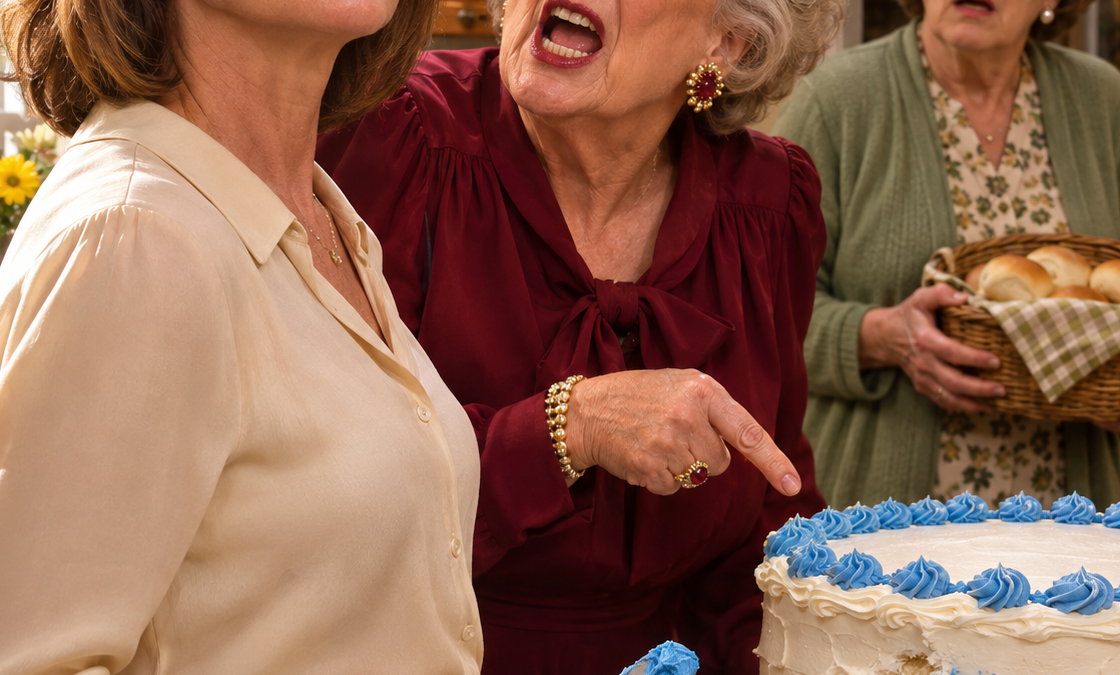
My mother made me erase “daughter” from my child’s thirty-sixth birthday cake; she didn’t know what I would finally stop protecting.
Chapter 1 of 7
“You gave her up. Don’t take her mother away now.”
Evelyn said it as June came into the kitchen carrying rolls. From the doorway, June couldn’t see the word I had piped beneath Leah’s name. She looked toward the dining room instead.
I had given birth to Leah. My mother had raised her. Leah believed we were sisters.
“Scrape it off, Ruth,” Evelyn said. “She’ll be here soon.”
My old wristwatch said 6:10 p.m. Leah was expected at 6:30. I had worn that watch since buying it with my first paycheck after moving out.
I had practiced writing the word on a saucer first.
“You heard me.”
“I heard you.”
“Then fix it before somebody gets hurt.”
June’s basket crackled against her blouse. She had caught enough to wish she hadn’t come through that door, but not enough to know why.
“Where should these go?”
“On the table, honey,” Evelyn said. “There’s butter already out.”
June went without looking at me.
I scraped the blue letters into the sink. The white frosting underneath came away, too. I covered the bare patch with a thick, crooked border.
“Now promise me we’ll keep tonight simple.”
“No.”
“Ruth.”
“I’ll eat supper. I’ll help with dishes. That’s what I can promise.”
“It’s her birthday.”
“I know whose birthday it is.”
Evelyn glanced toward the doorway. Her voice dropped.
“She has enough on her mind with Cleveland. Don’t add something she can’t do anything about.”
Being family did not make silence a kindness.
But I had made silence useful to everybody, including me.
Evelyn watched me rinse the spatula. She knew the word on that cake hadn’t been a mistake.
“Put it on the sideboard,” she said.
By the time Leah arrived, the cake said only Happy Birthday, Leah. The thick blue bottom edge looked like a repair because it was one.
“Something smells good,” she called.
“Chicken’s drying out waiting for you,” Evelyn said.
“It’s six twenty-eight, Mom.”
“Then it’s drying out ahead of schedule.”
Leah laughed and kissed her cheek. She was still wearing her work shoes, the plain black ones she bought for walking hospital corridors.
At thirty-six, she could spot a supply shortage before anyone called downstairs. At this table, she still checked her mother’s face before choosing a chair.
June passed the rolls. Leah picked out the darkest one for me.
“Your favorite. Almost burned.”
“Properly cooked,” I said.
“That’s what you always call it.”
She remembered that. She remembered little things about all of us.
Evelyn asked about work before Leah had finished her first bite.
“Did you tell them yet?”
“Not yet.”
“They need to know, sweetheart. They’ll have somebody else waiting.”
“I have until next Friday.”
June nodded. “These programs must take some arranging.”
“It’s nine months,” Leah said. “Materials management. More planning, less chasing missing boxes.”
“You’re good at the chasing,” I said.
“I’d like to be good at something that doesn’t wear through my shoes.”
Evelyn gave a small laugh, then looked at Leah.
“And I’d like to eat supper with somebody once in a while.”
Leah’s smile faded at the edges.
“I know, Mom.”
“I’m not asking you to give up work. You’ve got a good job here.”
“It would still be work.”
“In Cleveland. With all that driving.”
June said, “That’s a lot after a full day.”
Leah pulled her phone from her pocket. “I asked about that. They said they were checking something.”
“You shouldn’t have to chase them for answers,” Evelyn said. “And keeping your apartment while paying for somewhere else—well.”
“I told them that, too.”
“You’ve always been sensible. Your dad used to say it.”
Leah looked down at her plate.
Evelyn’s house in Oberlin, Ohio, was safe and entirely her own. She drove, shopped, and kept appointments without help. Still, the empty chair beside her was real.
“After everything your mother did,” June said, “it’s nice you can have this time together.”
Leah’s phone lit beside her plate.
“Wait. This is from the program.”
Evelyn rose to cut the cake before Leah finished reading. Leah stared at the screen, then began reading aloud.
Evelyn stopped cutting. “They’re giving you what?”
“A furnished studio. Nothing fancy. Arranged through work, no extra housing charge while I’m there.”
“Oh,” June said. “Well, that changes things.”
Evelyn kept the knife above the plate.
“For the whole placement?” I asked.
“That’s what it says.” Leah read it again. “I wouldn’t have to commute.”
Her face had opened before she remembered the rest of us.
“But I haven’t accepted,” she added.
Evelyn began cutting smaller slices than usual.
I could tell the whole truth. I had given birth to Leah at eighteen. Evelyn and my father had legally adopted her as an infant, through a completed court adoption. They had raised her; that was true, too.
I was fifty-four now. I had kept lying long after I no longer needed their roof.
Leah looked at the cake. “That’s a lot of blue.”
“Your sister got carried away,” Evelyn said.
I watched Leah accept the plate. She had no reason to question either word.
“The studio sounds worth looking at,” I said.
“It does,” Leah said, almost under her breath.
Evelyn sat.
“Of course it sounds nice. They want you there. But we’ve been making plans here.”
“I know.”
“I’ve started sorting the linen closet. I thought we could leave the heavy things until later.”
“Mom, you don’t need to sort everything tonight.”
“September comes fast. Have you even checked about transportation?”
Leah’s fork stopped short of the cake.
“I already booked it.” June’s smile disappeared.
“The van,” Leah said. “For September twentieth. I booked a moving van.”
Evelyn’s shoulders eased.
“Well, there we are. You should have said.”
“I was going to.”
“That’s one thing settled, then.”
“A reservation isn’t—” I began.
Leah looked at me. “It’s just a van, Ruth.”
“I know.”
I let the rest go. I had no business making her explain an ordinary reservation while I hid the reason I wanted her to reconsider.
June leaned forward.
“I can carry lamps. No furniture, though. My knees have filed a complaint.”
“You don’t have to carry anything,” Leah said.
“I’d rather carry a lamp than stand around being directed.”
That got a laugh. Evelyn’s came first.
“You can supervise me,” she told June. “Apparently I’m going to need it.”
For a few seconds, we sounded like any family sorting out a move. Leah ate cake while Evelyn described which dresser she could leave behind.
“The smaller one will fit,” Leah said.
“I’d rather bring the good one.”
“Then I’ll measure again.”
“What about your desk?” I asked.
“I can work that out.”
“You use it.”
“Ruth, I don’t need a whole room for a laptop.”
She said it patiently, as though I were worrying about the wrong thing. I was. A desk was something I could mention without losing my place at the table.
Evelyn asked whether the cake was too sweet. June said birthday cake couldn’t be too sweet. Leah ate around the blue border.
“I’m off tomorrow,” I said.
“Good. I was hoping.”
“What time?”
“Whenever you’re up. There’s more in that room than I thought.”
Evelyn said, “Don’t let her keep every old catalog.”
“They’re mine, Mom.”
“I know, honey. I’m only saying.”
Leah reached into her bag for the little tape measure she carried when she shopped for furniture. I had seen her use it in thrift stores, hopeful over tables she never bought.
She placed it beside my plate.
“Come tomorrow. I need help emptying the room.”
Chapter 2 of 7
By Saturday morning, Leah’s desk was in the hallway. I had to turn sideways to get into the room we were supposed to empty.
She had moved her own desk.
The window where it had stood faced a maple tree. A pale rectangle marked its place on the rug.
“Where will you work?” I asked.
“Kitchen table, probably.”
“You eat there.”
“I’m familiar with the concept, Ruth.”
She smiled from the floor, surrounded by books. There were grocery bags along the wall, each labeled in her square printing.
“Keep, donate, and things I’m pretending I’ll donate.”
“That last one needs a bigger bag.”
“That’s why you’re here.”
I sat beside her. The first shelf held cookbooks, hospital supply catalogs, and a book about growing vegetables in containers. Her balcony basil had produced enough leaves for one sandwich.
“Keep that,” she said. “I’m still farming.”
We worked until the lower shelves were bare. Then she found a photograph behind a stack of folders.
“Look at Dad’s glasses.”
The picture showed Evelyn holding Leah as an infant. My father stood behind them. I was beside my mother, wearing a blouse that pulled across my breasts.
During my pregnancy, we had moved from another Ohio community to Oberlin. New acquaintances heard that Evelyn had experienced a late pregnancy.
“Mom looks exhausted,” Leah said.
“She probably was.”
“You look mad.”
“I didn’t like that blouse.”
That much was true. My mother had bought it because it hung loosely.
The adoption had been completed while Leah was an infant. Evelyn and Arthur were her legal parents. At eighteen, I could not separate staying near my baby from doing what they told me.
I had remained in the house. I could hear her wake at night.
“Were you still living there?” Leah asked.
“Yes.”
“Must have been weird. Being eighteen with a baby sister.”
I read the title on the book in my lap twice.
“It was a crowded house.”
She leaned the photograph against the wall with the things she was keeping.
“Remember when I used to ask why you didn’t have kids?”
“I remember.”
“I was about sixteen. I thought everybody should get married and produce cousins for me.”
“You were very firm.”
“You said you never wanted children. Like I’d asked if you wanted termites.”
I had said that. I remembered how easily it ended the questions. Leah had gone back to her homework, and I had gone home relieved.
“I shouldn’t have answered like that.”
“Oh, I got over the cousin shortage.”
She reached for another stack of catalogs.
“Do you actually read these?” I asked.
“Some. Don’t judge me.”
“I schedule rehab appointments all week. I’m not judging anybody’s reading.”
“That’s why I wanted to show you this.”
Her laptop was on the kitchen counter. She opened the placement outline while I stood in the doorway, still holding a cookbook.
“It’s paid work,” she said. “Not classes I’d have to squeeze around my regular shifts.”
The screen listed $24.60 an hour, forty hours a week, nine months.
“Would you be doing something different every day?”
“Rotations. Inventory planning, ordering, figuring out where things get stuck.” Her voice quickened. “Yesterday a floor nearly ran out of the supplies they needed because the boxes were sitting in the wrong holding area.”
“You found them?”
“Yes, but that’s the problem. Somebody always has to go find them.”
She showed me the next section.
“I like fixing it before somebody upstairs has to call. Before a patient’s waiting and everybody’s mad.”
“You sound like you want to go.”
“I wanted to know what I’d be turning down.”
Her phone rang beside the laptop. Evelyn’s name filled the screen.
“Hi, Mom.”
I could hear my mother without trying.
“How far have you girls gotten?”
“Books, mostly.”
“I told June the room’s nearly ready.”
Leah looked toward the hallway desk.
“Well, not quite.”
“She was asking. She’s so pleased we worked this out.”
“We’re still sorting.”
“Of course, honey. Don’t wear yourselves out.”
When the call ended, Leah closed the laptop.
“She makes it sound like I’ve got fresh towels laid out.”
“You can tell her it isn’t settled.”
“She’s excited.”
“That doesn’t settle it.”
Leah’s face changed.
“I know how to tell my mother no.”
I had been putting advice where an answer belonged. I let her go back to the books.
When we finished, she asked me to lock up. She wanted to take the donation bags downstairs before she lost her nerve.
“You’ve still got my spare?”
“Yes.”
“Good. Pull the door hard. It sticks.”
The key had been on my ring since her divorce. I had used it to water plants and once to let in a repairman. That afternoon, I locked her apartment and checked the door.
Then I drove to Evelyn’s.
She was watching a cooking show with the sound low. A bowl of trimmed green beans sat beside her chair.
“How much did you get done?”
“She needs that room.”
“She offered it.”
“She needs to know before she decides.”
Evelyn looked at the television until the host finished speaking.
“About last night?”
“About Leah.”
“I knew what you meant.”
“Then don’t make me keep going around it.”
She switched off the television.
“What do you imagine happens afterward, Ruth?”
“I don’t know.”
“You tell her, and then you go home. She’s left looking at every birthday, every school picture—”
“I’d be in those pictures too.”
“Yes. You would.”
The beans smelled green and sharp. My mother had always snapped them while watching television, never needing to look down.
“She has a life,” Evelyn said. “She works. She’s been through a divorce. She finally seems settled.”
“She’s about to turn down something she wants.”
“You don’t know what she wants.”
“I heard her talking about the work.”
“And I’ve heard her talking about coming home to somebody. Both things can be true.”
I had no quick answer for that.
“You can’t give her childhood back afterward,” she said. “You can’t say, never mind, let’s have Sunday dinner.”
“I’m not asking you to tell me it’ll be fine.”
“Then what are you asking?”
“That you stop treating her decision like it’s already made.”
Evelyn looked tired. She was seventy-seven, and she missed my father. I could see his chair from where I stood.
“I want company,” she said. “Is that so terrible?”
“No.”
“Then help us. Tell June what’s left to do.”
I said no.
“I’ll help Leah with her books. I won’t tell people she’s decided.”
“You’re making an announcement out of not making one.”
“I’m telling you.”
Evelyn glanced toward the hall, where empty grocery boxes waited against the wall.
“Leah booked the van herself, Ruth. She doesn’t need you to arrange her life.”
“I know that.”
“June has volunteered to help carry boxes on September 20, and Leah has already thanked her.”
Chapter 3 of 7
On Sunday, September 6, Leah drove me to return library books. My car was parked at my apartment, but she had offered when I mentioned the errand.
“June called,” she said before we reached the corner. “She’s bringing her folding cart for the boxes.”
“So I heard.”
“She says it’ll save everybody’s backs. Now Mom wants to make lunch for the moving crew.”
“Is that what we are?”
Leah glanced at me.
“It’s getting bigger than carrying a dresser. Everybody’s offering something. Then I have to thank everybody, and it sounds like—”
“Like you’ve decided.”
“I haven’t told work no.”
A man on the car speakers was describing a freight yard. Leah turned him down as we stopped behind a delivery truck.
“Sorry. He was getting to the interesting part.”
“Which was?”
“Why they stopped using that particular yard.”
“I’m sorry I interrupted all the excitement.”
“Laugh now. There’s a whole episode about grain elevators.”
She smiled, but she didn’t turn the podcast back up.
Oberlin was quiet that morning. Someone had put a dining chair at the curb with a FREE sign taped across its back. Leah slowed enough to inspect it.
“No,” I said.
“I wasn’t stopping.”
“You were pricing upholstery in your head.”
“It had good legs.”
At the library, I dropped my books through the return slot. When I got back into the car, Leah was looking at a photograph on her phone.
“Did you take that?”
It showed a steel bridge, dark against a pale sky.
“Last month.”
“Where?”
“Up near Cleveland. I drove around on my day off.”
“I didn’t know you went.”
“I don’t send out an itinerary, Ruth.”
She said it lightly. I still felt the correction.
“Of course you don’t.”
“There’s a spot where you can see the old industrial crossings. I took about fifty pictures and kept four.”
She showed me another. Rust-colored beams filled most of the frame.
“I like that one,” I said.
“You can barely see the water.”
“I like the beams.”
She studied my face, deciding whether I was humoring her.
“I like the beams too.”
We drove back by a different street. She knew which intersections had longer lights, which pavement to avoid. She had an entire working map of places I never went.
“Mom asked if I’d bring my little table over before the twentieth,” she said. “So she can decide what fits.”
“Are you going to?”
“I told her we could measure hers.”
“That sounds reasonable.”
“Please don’t say it like I negotiated a hostage release.”
“I didn’t mean—”
“I know she’s pushing.”
I looked out at a row of clipped hedges.
“She’s excited,” Leah said. “And lonely. Both.”
“I know.”
“After Dad died, she started leaving the television on in the kitchen. Even when she was watching something in the living room.”
My father had died in November 2023. His jacket had stayed on the hook by the back door through the following summer.
“She likes hearing voices,” Leah said.
“She has June.”
“June goes home.”
I had nothing useful to say to that.
“She raised me, Ruth. I can complain about the table and still remember that.”
“I remember too.”
There had been a school meeting when Leah was struggling with math. Evelyn had exchanged a grocery shift to attend, then worked Saturday evening to make up the hours.
She had driven Leah to orthodontic appointments with a folded towel on the seat because the car upholstery split every summer. She knew which wire rubbed and which soup Leah could eat afterward.
Once, when Leah had a fever, I stayed until evening. Then I went home because I had work early.
Evelyn had spent the night beside the bed, calling the doctor when she needed to, changing the damp pillowcase.
She stayed when I went home.
Those were things my mother had done. Nothing I said could move me into her place in that bedroom.
“She’s been a good mother to you,” I said.
“Then why do you look like that every time I talk about moving her in?”
We were waiting at a light. Leah watched the crosswalk instead of me.
“Because you sounded happy talking about the placement.”
“I am happy about it. Was. I don’t know.”
“You still have time.”
“Everybody keeps telling me what I still have.”
The light changed.
“I know I have time. I know she has a house. I know she can buy her own groceries.”
“I wasn’t going to say that.”
“You were working toward it.”
She was right.
“I don’t think I’d be some prisoner,” she said. “She’d complain about my laundry. I’d complain about her news shows. We’d have dinner.”
“And your work?”
“My job here doesn’t disappear.”
“But the training—”
“I know what the training is.”
Her voice had sharpened. I had helped her sort books while withholding the one thing she couldn’t sort without me.
My phone sounded inside my purse.
“It can wait,” Leah said.
I checked because I expected it to be Evelyn. It was a group message to June and me.
Please keep Leah’s first weekend free if you can. I’d like her to have help getting her mother settled, not spend the whole time doing for everybody. Lunch here afterward, my treat.
No demand. Even lunch offered as a kindness.
“What?” Leah asked.
“Your mother’s asking us to keep your first weekend free.”
“For moving?”
“For settling her.”
Leah drove another block before answering.
“She could ask me first.”
“Yes.”
“Don’t start a fight in the group.”
“I won’t.”
I put the phone away without answering.
At my apartment, she parked but left the engine running. The freight historian returned briefly, explaining a railroad merger, before she shut off the sound.
“Do you think moving her in is a mistake?”
I nearly told her to take the opportunity while she had it. I could have talked about advancement, confidence, nine months passing quickly.
She knew all that. She had read the placement outline to me.
“There is something I need to tell you.”
“About Mom?”
“About our family. I need to tell you privately.”
“We’re private now.”
A car pulled into the space beside us. Neither of us looked toward it.
“I’d like to come over. When you aren’t about to go somewhere.”
“Is somebody sick?”
“No.”
“Then what is it?”
I had made her ask, then left her sitting with another unanswered question.
“It’s something I should have told you before now. Could I come tomorrow evening?”
“Monday?”
“Yes.”
She rubbed her lips together.
“I need to check work.”
“All right.”
“I’m not promising.”
“You don’t have to.”
I got out before I could turn the request into pressure. If she said no to Monday, that would only be no to Monday. It would not give me another year.
Upstairs, I left the television off. Near evening, my phone sounded.
A new text from Leah read, “Monday won’t work. Tuesday, seven. Just you.”
Chapter 4 of 7
On Monday morning, September 7, I answered Leah’s text.
Tuesday at seven. Just me.
She replied while I was still standing beside my kitchen counter.
Inventory tonight. Somebody has to count all the things we swear we already counted.
I didn’t ask why she couldn’t trade the assignment. Tuesday was the time she had offered.
At work, I scheduled rehabilitation appointments and called people about cancellations. A woman thanked me for finding her a morning slot. I had done something useful in less than five minutes.
I ate my sandwich in the break room with my phone beside it.
Evelyn called before I finished.
“Leah says you’re going over tomorrow.”
“Yes.”
“She called to ask whether I wanted anything from the store. She mentioned it.”
“All right.”
“What are you planning to discuss?”
A coworker came in for the coffee creamer. I waited until she left.
“What I told you we needed to discuss.”
“With her?”
“Yes, Mom. With her.”
“Come by when you get off. Please.”
Her please made it harder to refuse. It usually did.
“I can come for a little while.”
“I’ll be here.”
Her car was in the driveway when I arrived. A grocery receipt lay beside a bowl of pears. She had bought the hard green kind my father liked, though she preferred them soft.
“I drove out for those,” she said, following my glance. “The ones in town were bruised.”
There was one untouched place setting at the kitchen table. A bowl of soup sat beside it, with skin forming across the top.
“Were you waiting for me?”
“No. I got talking to June on the phone.”
“You should eat.”
“I will.”
She sat across from the empty chair. The refrigerator hummed, stopped, then started again.
“What have you told Leah?”
“That there’s something about our family she needs to hear.”
“Does she know what?”
“No.”
Evelyn looked toward the soup.
“You’ve left her worrying all day?”
“She has an inventory assignment tonight. That’s why we’re meeting tomorrow.”
“That isn’t what I asked.”
“I know.”
Outside, somebody was mowing. The sound moved past the kitchen window, then faded.
“I’m going to tell her before she decides about the placement,” I said. “Before September eleventh.”
Evelyn looked back at me.
“You’ve decided that.”
“Yes.”
“Without talking to me.”
“We’re talking now.”
“After you’ve arranged it.”
I had come to her before, frightened and halfway asking permission. She had always found another reason to wait. This time she studied my face longer.
“Then listen before you go through with it.”
“I’m listening.”
“Let her move first.”
“Mom.”
“September twentieth. That’s hardly any time.”
“She has to answer work before then.”
“Exactly. Let her make one decision without dropping this on her.”
“She’s making that decision without knowing—”
“About her whole childhood. Yes. I know what we’re discussing.”
Her voice stayed low. She had supervised grocery departments for years, settling complaints beside frozen food cases. She could sound patient while somebody else sounded unreasonable.
“Tell her after she’s settled,” she said. “When she can come home and I’m there. When you can come over, and we can answer things together.”
“She might not want us together.”
“She might not want anything at first. That’s why she shouldn’t be packing for another city at the same time.”
Evelyn’s soup remained untouched.
“You’re asking her to decide about work while she’s wondering whether anybody in her family ever told her the truth. What if she accepts just to get away from us? What if she turns it down because she can’t think?”
I could picture Leah sitting with the placement email open, unable to read it. My mother had raised a risk I hadn’t wanted to examine.
“Tomorrow won’t be a good time,” I said. “Waiting until she’s moved you in won’t make it better.”
“You don’t know that.”
“No. I don’t.”
“She offered me that room.”
“Yes.”
“I didn’t take it from her.”
“I helped her empty it.”
Evelyn looked at me then.
“So you know she’s been planning.”
“I know.”
“And now she’ll think every box was some trick.”
I had carried bags downstairs. I had measured the doorway with Leah. My part was already in that room.
“I’ll tell her what I did,” I said.
“And what will you tell her about me?”
“That you raised her.”
“Will you tell her I’m still her mother?”
“You are her mother.”
“Will you tell her she doesn’t have to change that?”
“I won’t ask her to call me anything else.”
“That’s not the same answer.”
“It’s the one I have.”
She looked older without her glasses. There was a pale dent along each side of her nose.
“I’ll be only the grandmother.”
“You raised her, Mom. You don’t get to decide what she’s allowed to know.”
“I’m asking for a few weeks.”
“You’re asking me to wait until after she’s given up the placement.”
“She hasn’t given it up yet.”
“I’m going tomorrow.”
The mower started again farther down the street. Evelyn watched the window until it passed.
“What happens to us afterward?”
“I don’t know.”
“You and me.”
“I heard you.”
“Can we at least agree we’ll help her through it? Together?”
“I cannot promise you that.”
Her face changed at the word together.
“If she wants you there and not me,” I said, “I won’t insist. If she doesn’t want either of us—”
“You’d leave her alone with this?”
“If she asks me to leave, I’ll leave.”
“And you think that’s helping.”
“I think staying after she asks me to go would be worse.”
Evelyn pushed back from the table.
“I have library books due tomorrow. I’ll take them over in the morning.”
She spoke as though we had finished discussing an appliance repair. Her library bag was ready by the back door. Her shopping was put away except for the pears.
“Your soup’s cold,” I said.
“I know how to use the microwave, Ruth.”
“I know you do.”
I left her in her kitchen.
Tuesday evening, I arrived at Leah’s apartment at 6:55 p.m. I had eaten toast before leaving home because I didn’t want to arrive expecting supper.
Her desk still narrowed the hallway. The chair was tucked beneath it, facing the wall instead of the window.
I knocked. When the door opened, I could see the shelf she had cleared near the kitchen. She had told me it would hold Evelyn’s mug and medication basket. Nothing was there yet.
Leah stood in the doorway holding her phone. On the screen was an unsent draft email declining the placement.
“Will you check this before I send it?”
Chapter 5 of 7
“Please don’t send it yet,” I said. “There’s something you need to hear first.”
Leah kept the phone.
“Is this what you wanted to talk about?”
“Yes.”
She stepped back to let me in. The apartment smelled of warmed tomato sauce. A plate sat beside the stove, with a piece of bread balanced on its edge.
“I haven’t eaten,” she said. “Can we talk while I eat?”
“If you want.”
“You’re making me nervous.”
I followed her to the kitchen. By seven, we were sitting across from each other. Her phone was beside her plate, the withdrawal email still unsent.
“I gave birth to you.”
She looked at me without moving.
“What?”
“I gave birth to you, Leah.”
“You mean—what are you saying?”
“I’m your biological mother.”
A refrigerator magnet clicked against the door as the motor started. Leah looked toward it, then back at me.
“No. Mom had me.”
“I had you. She and Dad adopted you when you were a baby.”
“Adopted.”
“Yes.”
“Me.”
“Yes.”
She looked down at her plate.
“Is this some way of saying you helped? Like you were there?”
“No. I was pregnant with you. You were born on September fourth, 1990. I was eighteen.”
She pushed her chair back enough that her knees cleared the table.
“Does she know you’re saying this?”
“Yes. She knows I came here to tell you.”
“And Dad?”
“He knew.”
“Obviously. He adopted me. You just said that.”
“Yes.”
“Was that real? The adoption?”
“It was a completed court adoption. They were your legal parents. They raised you.”
“So what are you now?”
“I’m Ruth.”
“That’s not an answer.”
“I don’t have a different name to ask you to use.”
She stared at my blouse, somewhere below my face.
“Were you ever my sister?”
“That was what we told you.”
“Always?”
“Yes.”
“Even when I was little?”
“Yes.”
She gave a short, breathless laugh.
“I used to climb into your bed.”
“I remember.”
“Don’t. Don’t do that.”
“All right.”
“You can’t say it like we’re remembering something nice together.”
I said nothing at all.
Her dinner had stopped steaming. There were red marks in the sauce where she had dragged her bread through it.
“Who else knows?”
“In our family, it was me, Mom, and Dad.”
“June?”
“No.”
“So she’s just been coming over for cake and talking about how much I look like Mom.”
“She doesn’t know.”
“But I do look like her.”
“Yes.”
“Because she’s your mother.”
“Yes.”
Leah looked toward the hallway, where her desk blocked part of the wall.
“When were you going to tell me?”
“I kept thinking I would find a time.”
“That’s not when.”
“No.”
“When you moved out?”
“I should have.”
“When I got married? When I got divorced? Was there a birthday you liked for it?”
“I didn’t choose one.”
“Why?”
“At first, I was eighteen. I was scared of losing you. I didn’t have anywhere else to go with a baby, and staying in the house—”
“What about thirty?”
I stopped.
“You weren’t eighteen when you were thirty,” she said. “You had a car. You had a job.”
“Yes.”
“What about last year?”
“I could have told you.”
“And you didn’t.”
“No.”
She waited. I had spent years using that frightened girl to answer questions about the woman I became.
“There was no plan,” I said. “I thought about telling you. Then something would happen, or nothing would happen, and I’d leave it alone.”
“Nothing would happen.”
“Yes.”
“Like a normal Tuesday.”
“Yes.”
She looked at the phone beside her plate.
“Saturday. I told you what you said when I was sixteen.”
“I remember saying it. That I never wanted children.”
“You let me laugh about it.”
“Yes.”
“Did you mean it?”
“I didn’t want you asking why I hadn’t had any. I wanted the questions to stop.”
“And did they?”
“Yes.”
She pressed her lips together.
“I liked being your sister,” I said. “You told me things. We went places. If we had a good afternoon, I could take you home afterward.”
“To her.”
“Yes. She handled school and rules and the nights you were sick. I got to be somebody you trusted without doing all of that.”
“You babysat.”
“Sometimes.”
“Did she pay you?”
“No.”
“I don’t know why I asked that.”
“You can ask.”
“I don’t need permission.”
“You’re right.”
The kitchen light made a bright patch on her untouched bread. I could hear a television through the wall, someone laughing at something neither of us could see.
“Who was he?”
“David Miller.”
She repeated the name quietly.
“He was nineteen. I knew him before we moved here. He’s the man I know as your biological father.”
“Where is he?”
“I don’t know.”
“Alive?”
“I don’t know.”
“Did he know about me?”
“I can tell you what I remember of that time. I can’t tell you what he knew afterward, or what anybody told him.”
“Did he sign something?”
“I don’t know his part in the adoption. I won’t guess.”
“So you’ve had thirty-six years, and that’s what you have.”
“Yes.”
She looked toward the window. It was still light outside.
“Why tonight?”
“Because you’re about to make a decision about work and having Mom here. I couldn’t keep letting you do that without telling you.”
“You could. You were doing it.”
“Yes.”
“You helped move the books.”
“Yes.”
“You measured the doorway.”
“I did.”
“And now I’m supposed to do what with all this?”
“I don’t know.”
“Take the placement? Keep the room? Call her?”
“I’m not going to tell you what to do.”
“You waited until I had an email ready.”
“I didn’t know you’d written it.”
“But you knew I was going to turn it down.”
“I knew you were considering it.”
She looked at me then, directly.
“Do you expect me to call you Mom?”
“No.”
“Ever?”
“No. I’m not asking you for that.”
“She’s my mother.”
“Yes.”
“I’m angry with her. I haven’t even talked to her, and I’m—” She stopped. “That doesn’t make her stop being my mother.”
“I know.”
“You don’t get her place.”
“I’m not asking for it.”
Leah sat back. Her face had gone blotchy around her mouth.
“I want you to leave.”
“All right.”
“Now. I can’t eat with you sitting there.”
I stood. My bag was still over my shoulder; I hadn’t noticed its weight until then.
At the door, I wanted to say I was sorry again. She had already heard it in other words, and none had given her back her supper.
I left without touching her.
Outside the apartment, my phone sounded. Leah’s message read, “Tomorrow, six, at her house. I want to ask Evelyn myself. Bring my key.”
Chapter 6 of 7
“Before we arrange anything,” Leah said, “I need you to answer me.”
It was six on Wednesday, September 9. I had arrived at Evelyn’s kitchen table with Leah’s spare key separated from mine.
June sat beside my mother. A moving list lay between them.
“June helped make the carrying plans,” Leah said. “I asked her to stay. She can hear this.”
Evelyn looked at me, then back at Leah.
“Did Ruth give birth to me?”
“Yes.”
“And you and Dad adopted me?”
“Yes. When you were a baby.”
“Tell me without waiting for me to ask each part.”
Evelyn’s face sagged around her mouth.
“Ruth was pregnant when we moved here. After you were born, Arthur and I adopted you. We told people you were ours. We raised you as our daughter.”
“And me?”
“We told you Ruth was your sister.”
June’s lips parted. She looked down at the moving list.
Evelyn kept her eyes on Leah.
“I’m sorry you heard it this way.”
“What way would have been better?”
“From all of us. With time to explain.”
“Was that arranged?”
“No,” Evelyn said. “It should have been.”
Leah sat back. She had come without her work bag. There was nothing beside her chair to suggest she might stay for supper.
“I’m not going to pretend we handled it well,” Evelyn said. “But I need you to consider why Ruth is telling you now.”
“Go on.”
“You offered me a place with you. Suddenly she tells you she gave birth to you. That may be true, but it doesn’t give her the years she wasn’t your parent.”
“I haven’t said it does.”
“I know, sweetheart. I’m asking you not to let her guilt decide what happens between us.”
Evelyn sounded tired, almost reasonable.
“She could tell you and still leave me to answer for everything. She’s done that before.”
I had. Leah looked at me.
“What do you expect now?”
“Nothing you haven’t offered.”
“That’s vague.”
“No new name. No right to come over. You asked for your key.”
I put it beside her.
She didn’t reach for it.
“If I stop speaking to her, are you expecting me to speak to you?”
“No.”
“Even though you told me?”
“I kept it from you too.”
“For years when you didn’t have to.”
“Yes.”
“I don’t want you coming over to check on me.”
“I won’t.”
“Or deciding I need company.”
“I won’t do that.”
Evelyn looked between us.
“You’re talking about cutting us both off?”
“I’m trying to finish a sentence,” Leah said.
“Of course. I’m sorry.”
The apology came quickly. Evelyn waited.
“I offered you that room because I love you,” Leah said. “I also thought Ruth had chosen to stay out of parenting. You let me keep thinking that.”
“Ruth did stay out of most of it,” Evelyn said. “I was there. You know I was.”
“Yes.”
“That wasn’t a story we made up.”
“No.”
“So please don’t throw away thirty-six years because of what we should have told you.”
Leah’s jaw shifted.
“Is that what changing my mind about the room would be?”
“It would feel that way. I can’t help that.”
“You can feel hurt. But you keep making the room a test.”
“I’m not testing you.”
“If I can’t reconsider without being a bad daughter, it wasn’t an offer anymore.”
June looked up then.
Evelyn spoke carefully.
“I thought we could explain after you were settled. When you weren’t trying to decide about work.”
“After I’d turned down Cleveland.”
“When you had support around you.”
“And your bed in my apartment.”
“We could still have talked.”
“But I’d already have said no to the placement.”
Evelyn looked toward the window. The kitchen screen had a small hole my father had patched with gray tape.
“I didn’t want you making a decision you couldn’t take back while you were upset.”
“I accepted today,” Leah said. “Before their Friday deadline.”
Evelyn looked back.
“The training?”
“Yes. I’m going to Cleveland.”
“You’ve already answered them.”
“Yes.”
Nobody congratulated her. I kept my mouth closed rather than make her choice sound like something she had done for me.
Leah faced Evelyn.
“I’m canceling the September move.”
My mother’s eyes dropped to the list. At the top, she had written BEDROOM in capitals.
“The van can be canceled,” Leah continued. “Your things stay here. I’m not making room for them.”
Evelyn’s mouth moved before any sound came.
“I see.”
“And I want six weeks without contact. From both of you. Count it from six this evening.”
“What does that mean?” Evelyn asked.
“No calls, visits, texts, gifts. Nothing forwarded through somebody else. Don’t ask June or anybody to check for you.”
I nodded.
“I need you to say it, Ruth.”
“I’ll leave you alone. The same as you’re asking her to.”
June got up from beside Evelyn and took the chair next to Leah.
“I offered to carry boxes. I didn’t ask if you wanted them.”
“You were helping,” Leah said.
“I should’ve asked. I’m not helping with that move now.”
Evelyn gathered the unused moving list against the table edge. Her chair scraped backward.
“So everybody’s finished with it.”
“The move, yes,” Leah said.
“And in six weeks?”
I glanced at my old wristwatch. Six o’clock had passed while we talked.
“October twenty-first, at six,” Leah said. “That’s forty-two days. It doesn’t mean call at six-oh-one. I’ll decide when I’m ready.”
“Not even to say we’re thinking of you?” Evelyn asked.
“No.”
June remained beside Leah. Outside, a neighbor’s mower sputtered and stopped.
Evelyn turned toward me.
“Explain what she means, Ruth.”
“She’s told us.”
“Does she mean we can’t know whether she got there safely?”
“She said no messages.”
“I’m asking you.”
“I will not speak for her again.”
Evelyn looked at the list in her lap. There were measurements on the back. I had helped make some of them.
Leah picked up the spare key.
“I can get my own things to Cleveland. Please don’t come on October fifth.”
“All right,” I said.
She stood. Nobody moved to follow her.
At the back door, she paused to free her jacket from a loose screw on the hook. Evelyn had asked my father to fix that hook for years. Leah worked the fabric loose herself.
Then she left without a hug or an escort.
June stayed. I went home, leaving Evelyn in her own kitchen with the boxes still empty in the hall.
On September 10, Evelyn called me.
“Ask her whether Sunday lunch counts. She always came on Sundays.”
Chapter 7 of 7
“A lunch invitation would be contact, Mom. I won’t deliver it.”
“She has to eat.”
“She can eat without coming over.”
“I could make something she likes.”
“Please don’t send food.”
Evelyn stayed on the line. I could hear her kitchen radio.
“So what am I supposed to do Sunday?”
“What you want. June might be free.”
“I don’t want June out of pity.”
“Then ask her because you like her.”
“You make everything sound easy now.”
I had made plenty of things easy for myself. This wasn’t one of them.
“I can visit Saturday afternoon,” I said. “But I won’t bring news about Leah.”
She said she needed to check her calendar. When I arrived Saturday, she had been shopping and was irritated about the price of apples. June had stayed for coffee that morning.
Her house was quiet, but she was living in it.
September 11 passed. Leah’s employer already had her answer. There was nothing for me to remind her about, no deadline I could use as an excuse to call.
On September 20, no van came.
Evelyn called after lunch.
“I keep thinking I should be doing something.”
“I’m doing laundry.”
“I meant about today.”
“I know.”
“You could come over.”
“I’m staying home today. I’ll see you Wednesday, like we planned.”
She ended the call before I did. I finished the laundry without calling back to make sure she wasn’t angry.
At work, people needed appointment changes and directions to the right entrance. I could answer those questions. At home, I read whole pages without remembering them.
Once, I wrote Leah a message.
No reply needed. I just wanted you to know—
I stopped there. I had put a request inside the first three words and pretended it wasn’t one.
I deleted it.
October 5 was a Monday. Leah began in Cleveland without either of us going along.
That evening, her ordinary social feed showed an update visible to her friends: First day done. Learned where almost nothing is.
I saw it between a coworker’s garden pictures and an advertisement. There was no photograph of her studio, no account of the drive.
I didn’t comment or ask anyone for more.
Evelyn asked once whether I had heard anything.
“We’re still leaving her alone,” I said.
“I asked about you.”
“I haven’t heard from her.”
We talked about the library’s shortened Saturday hours instead.
On October 21, I was home before six. I ate a baked potato standing at the counter because sitting down made dinner feel like an event I had failed to arrange.
Six came and went.
The refrigerator needed cleaning. I threw away a soft cucumber and wiped the drawer. My phone stayed where it was.
Leah wrote the next afternoon.
Breakfast Saturday? Cleveland. Eight ten. I have forty minutes. Just you.
She included the diner’s name and address.
I answered, Yes. I’ll be there.
I didn’t add a question about afterward.
On Saturday, October 24, I arrived at 8:10 with my coat over my arm. I had brought no flowers, food, or photographs.
Leah was in a booth near the window. She wore a gray sweatshirt I hadn’t seen before.
“Hi, Ruth.”
“Hi.”
She nodded toward the seat across from her.
The server arrived before I could ask how she was.
“Coffee?”
“Yes, please.”
“Regular?”
“Yes.”
“Good. Decaf’s still brewing.”
Leah had already ordered eggs and toast. I asked for the same.
“Hash browns?” the server asked.
“Sure.”
“You sound uncertain.”
“I haven’t had enough coffee.”
“That’s fixable.”
Leah gave a small laugh. I waited while the server filled my cup.
“How’s the work?” I asked.
“Good. A lot.”
“Different from home?”
“Some of it. There’s a woman there who labels bins so you can read them from either end of the aisle.”
“That sounds obvious when you say it.”
“Exactly. Then you go back somewhere with one little label facing the wall.”
She described learning the supply routes, which elevators carried deliveries, where orders stalled.
“I like knowing where things go,” she said. “The whole route, instead of just the part I used to handle.”
“You sound busy.”
“I am.”
The server brought breakfast and asked who had ordered the wheat toast. We both had. She checked the plates anyway.
Leah broke the corner off hers.
“I’m glad I came here.”
“I’m glad you did.”
She looked at me.
“For the work,” I added.
“I know.”
A bus stopped outside. People stepped down carrying bags and travel mugs. Leah ate while she watched them.
I ate too. The eggs were cooling, and I had no reason to leave them untouched.
“Can I ask about the hospital?” she said.
“Yes.”
“When I was born.”
“Yes.”
“Did you hold me before she did?”
I wanted the answer to be simple. I wanted to remember a nurse placing her against me and nobody else close enough to interfere.
“I held you later that day,” I said. “I remember that.”
“But before her?”
“I don’t remember the order clearly enough to tell you.”
Leah’s fork rested against her plate.
“You don’t know?”
“No. I was exhausted. I remember that more clearly than who held you first.”
She looked down at her breakfast.
“I could tell you I did,” I said. “But I don’t know.”
“Then don’t.”
“All right.”
The server came back with the coffee pot.
“Warm those up?”
Leah said yes. I said I was fine.
Neither of us spoke until she moved to the next booth.
“I’m still angry,” Leah said.
“I know.”
“I don’t want to spend breakfast explaining how angry.”
“You don’t have to.”
“And this isn’t a schedule.”
“No.”
She finished her toast. I left the last of my potatoes.
We talked about the drive into Cleveland. She knew a stretch where traffic slowed for no visible reason. I had sat in it that morning.
“It always clears just when you start thinking you’ve missed something,” she said.
“That’s exactly what I did.”
“I figured.”
When the server brought the check, Leah glanced toward the clock above the counter.
“I need to go soon, Ruth.”
“All right.”
At 8:50, I left my part of the bill beneath the edge of my plate. Leah was finishing her coffee. I put on my coat without asking when I might see her again.
“Thanks for coming,” she said.
“Thanks for breakfast.”
I checked my watch and left on time.








