My Niece Handed Me a Serving Apron After I Paid $24,000 for Her Wedding; She Didn’t Know What I Had Kept.
Chapter 1 of 7
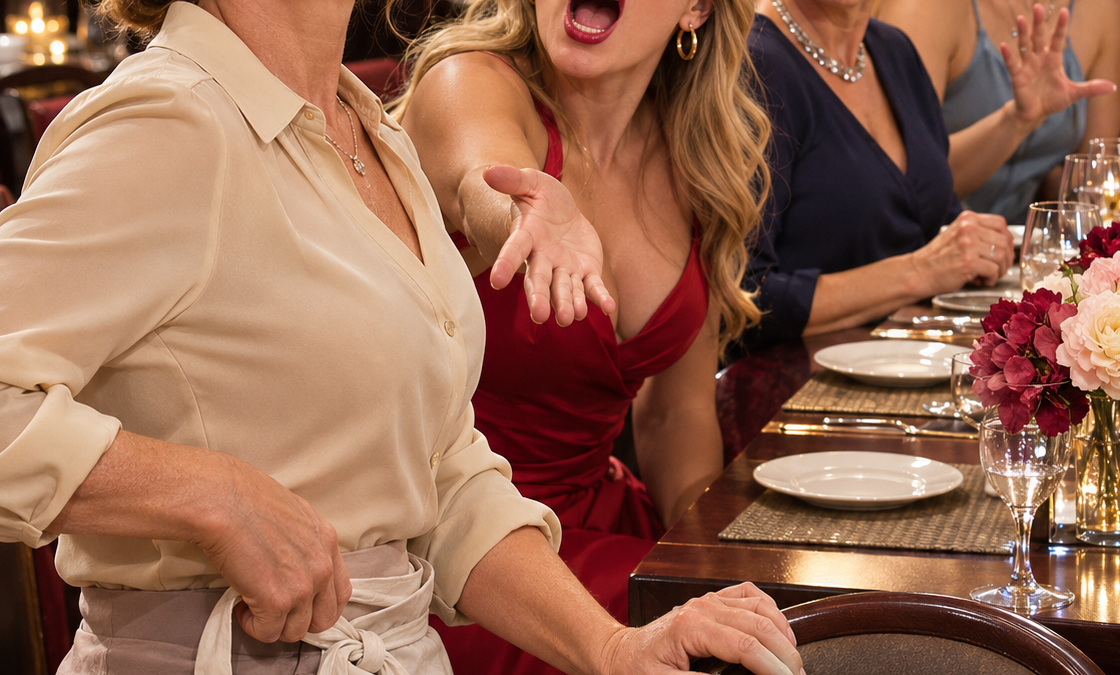
“To Mom and Dad,” Vanessa said. “For making this feel like a real family wedding.”
She finished her toast, then handed me a serving apron.
“Can you get their plates first, Aunt Pat?”
“I thought I was sitting with you.”
“They’re my parents; you’re just good at taking care of things.”
Six bridesmaids heard her. My sister heard her. Nobody told her to try again.
It was Saturday, September 5, and dinner had started at six. Forty minutes later, I was standing beside my niece with apron strings dangling against my skirt.
My fingers found the ties without instruction.
That was the part I hated afterward. Before I answered, before I even looked at my sister, I tied the apron.
Monica sat beside Russell at the long table. Vanessa had put little silk flowers beside their places. Mine had been moved while I was in the restroom.
“The girls have everything organized,” Vanessa said. “We just need somebody who knows what they’re doing.”
One bridesmaid looked toward the buffet. Another studied her bread.
I gathered two empty appetizer plates. A third came toward me from the far end.
“The staff brings dinner,” the maid of honor said quietly.
“Sure, but we can help,” Vanessa said. “We’ve got a car coming for the girls afterward. I don’t want us running late.”
By “we,” she meant me.
I had raised her from eight. I had learned which stores carried the socks whose seams she could tolerate. I still bought them when I saw a sale.
“Where am I sitting?” I asked.
“We’re sorting that out.”
“You’ve sorted out your parents.”
“They need to be near me.”
“So do I.”
Monica gave me the careful smile she used when a customer disliked a delivery date.
“Patricia, honey. Let her have tonight.”
“I paid $24,000 toward this wedding. I’m asking where my chair went.”
A bridesmaid stopped chewing.
“This dinner is ours,” the maid of honor said. “The six of us booked it and paid for it. You don’t need to do anything.”
“I know,” I said. “Thank you.”
Vanessa’s cheeks colored.
“Nobody said you had to pay for dinner. This isn’t about money.”
“Then don’t answer me about money. Where’s my chair?”
“We can move one over.”
“From where?”
She glanced toward the wall, where the restaurant had stacked two extra chairs beside a high chair.
Russell cleared his throat. “I can scoot down.”
“No, Dad, you’re fine.” Vanessa turned back to me. “Can we please eat first?”
There it was again. Everybody could eat first, if I would get on with it.
I left the plates on the nearest empty place and untied the apron.
“I raised you; I didn’t apply for a permanent shift.”
Vanessa looked toward her friends.
“Aunt Pat.”
“I’m not serving.”
“I wasn’t asking you to be a waitress.”
“You handed me an apron.”
“So you wouldn’t get sauce on your dress. You always complain about tomato stains.”
I did. I also used to send her home with spaghetti in old butter tubs. Once she had called to ask why the butter had meatballs in it.
Nobody laughed now.
“Could you at least cut the cake?” she asked.
“No.”
“It’s already here.”
“Then it’ll still be here when someone else cuts it.”
My bag stood open beneath the unused chair. A yellow studio pass stuck out beside a plain document wallet. I had paid for an introductory watercolor visit before the wedding errands swallowed another Saturday.
The maid of honor had brought October wedding reception walkthrough paperwork to the September bachelorette family dinner: napkin counts, meal preferences, a reception slip reading “P. Wells — 12.” I took a photo, as I always did with plans.
Monica leaned forward. “Vanessa’s asking for a little grace,” she said.
“She can speak for herself.”
“I’m only asking you to be a little understanding.”
“Then let her ask.”
Vanessa’s phone lit up against her plate. She read the screen with a small, impatient smile.
“Great. Now he’s doing this.”
“What?” Russell asked.
She started typing, then stopped.
Vanessa stopped smiling and leaned closer to her phone.
“Why is he asking whether you’re even a guest?”
Her fiancé had seen the wedding schedule she had sent him. His question was plain: Why was I listed under setup instead of guests?
“He’s at work,” Vanessa said. “He’s looking at it between calls.”
“Does that make the question different?” I asked.
“It makes him rushed.”
The dinner room faced a parking lot in Columbus, Ohio. Beyond the glass, somebody was trying to fit a balloon bouquet into a compact car. I watched one silver star escape and bump along the ceiling inside.
I wanted to be worried about a balloon.
My bag had tipped sideways. The document wallet showed its paper tab: client copies. Those were the vendor agreements I had signed myself.
At nineteen, Vanessa had brought me soup after an outpatient procedure. She had slept on my couch, waking whenever I got up.
That girl had been real, too.
“Ethan doesn’t need to get pulled into an argument,” Monica said.
“He’s marrying her,” I said.
Vanessa looked up sharply. “And he will. Whatever this is.”
“I didn’t say otherwise.”
“You’re acting like tonight changes everything.”
“Tonight changed whether I’m cutting the cake.”
The maid of honor, Jill, made a small sound that might have become a laugh somewhere else.
Vanessa sent another message.
“Fine,” she said. “I asked him what we could cover ourselves. Since apparently we need a backup plan.”
“I haven’t asked you for a plan tonight.”
“You mentioned what you paid in front of everybody.”
“After you couldn’t find me a chair.”
She pushed her phone toward Monica when the reply came.
Monica began reading the message again, her glass halfway up.
“He’s saying no to that money?”
Vanessa nodded. “The emergency account.”
Ethan would not use their rent money or emergency savings. Between them, they had $2,500 available.
Russell looked down at his plate.
“Good,” I said.
Vanessa stared at me. “Good?”
“They still have to live somewhere afterward.”
“We know that.”
“Then he’s right to leave it alone.”
Monica lowered her voice. “Nobody’s asking them to miss rent.”
“He just said what he’s willing to use.”
“And you’ve made him feel he needs to say it.”
Across the table, one bridesmaid began folding her napkin into smaller squares. Jill watched Vanessa, waiting for something I couldn’t name.
“I want to eat my dinner,” I said. “Sitting down.”
Russell moved over before Vanessa could answer. He pulled an extra chair to the table, and I sat beside him.
The food arrived while Vanessa was still looking at her phone. My chicken had cooled by the time I tasted it.
“Are you going to leave us hanging?” she asked.
“I’m going home after dinner.”
“That isn’t what I meant.”
“I know.”
“Just tell me we’re okay for the wedding.”
“I’m not promising anything about wedding money tonight.”
Monica’s mouth opened.
“Tonight,” I repeated. “I’m upset. I’m not making promises so everybody can enjoy dessert.”
Vanessa’s eyes filled. I knew the little crease between her eyebrows. I had checked it for fever, sunscreen, a forgotten splinter.
I stayed in my chair.
“Are you still coming?” she asked.
“To your wedding? I haven’t said I’m not.”
“Then why does this feel like—”
She didn’t finish. I didn’t finish it for her.
When the bridesmaids began checking the car’s arrival, I kissed Vanessa’s cheek. She stood stiffly, then said, “Text when you get home.”
“I will.”
I left the apron on the unused chair.
At the restaurant door, my phone chimed with an addition to our shared calendar. Vanessa had entered “Reception setup and cleanup — Patricia.”
An expanded task list was attached.
Chapter 2 of 7
At ten Sunday morning, I read Vanessa’s task list aloud in my kitchen.
“Haul table supplies. Check special meals. Stay until guests leave.”
The refrigerator hummed through the pause.
“Friday delivery and setup. Noon until finished.”
That Friday afternoon, before the Saturday wedding, I had reserved time for open studio. I had written it on my paper calendar because wedding errands kept swallowing anything stored only on my phone.
The calendar hung beside my refrigerator. October had one square marked in blue for me.
I was still looking at it when Vanessa called.
“Did you get home okay?”
“I texted you.”
“I know. I just—did you sleep?”
“Some.”
“The girls felt terrible after you left.”
“About what?”
“How dinner went. Everything.”
I waited.
“They’ve bought dresses, Aunt Pat. They’re paying for alterations. Jill’s been doing things every weekend. Everybody’s contributing.”
“I contributed.”
“I mean helping. Being there.”
“I was there last night.”
“You know what I mean.”
I knew exactly what she meant. Money had counted until she needed something else.
“I’m not doing that list,” I said.
“The boxes aren’t heavy.”
“That isn’t the problem.”
“Alicia’s taking Friday off. Tessa changed a shift. I can’t ask them to do everything.”
“You can ask me. You can’t schedule me.”
For a moment, I heard only a faucet running at her end.
“I thought you’d want to help.”
“Volunteering starts with being asked.”
“Okay. Will you help Friday?”
“No. I have plans.”
“What plans?”
“Open studio.”
“Oh.”
She said it as though I had announced an appointment to watch paint dry. That was, admittedly, part of the activity.
“I didn’t know you were serious about that,” she said.
“I paid for it.”
“You pay for lots of things.”
“Yes,” I said. “I do.”
I went down the hall to my bookkeeping desk. The document wallet was where I had left it beside my adding machine.
My clients trusted me to catch small mistakes before they became expensive ones. A doubled invoice. A missing deposit. I had checked those things for strangers while letting my own promises grow fuzzy around the edges.
“I’m looking at the wedding papers this morning,” I said.
“Why?”
“Because I need to read what I agreed to.”
I had signed both agreements at Maple Room Events on April 16. The installments were complete; the last payment had cleared in August.
I was the client. Vanessa was listed as the planning contact for menu and layout choices. She had received copies, too.
The refund schedule was attached to each agreement. I read it twice, the same way I checked a payroll total before sending it.
“Aunt Pat?”
“I’m here.”
“Are you canceling?”
“I haven’t done that.”
“But you’re looking.”
“The deadline is Wednesday. September 9 at five.”
“What deadline?”
“For written cancellation under these agreements. Before that, the venue returns $4,000. Catering returns $12,000.”
“And the rest?”
“I lose $8,000.”
“You’d throw away eight thousand dollars because of dinner?”
“I’m reading the terms, Vanessa. I’m not asking you to pay it back.”
“Then why tell me?”
“Because you asked what I’m doing.”
“You promised us a wedding.”
“I promised to pay for this reception. I didn’t promise to work through it.”
She was quiet long enough that I checked whether the call had dropped.
“Please don’t do anything today,” she said.
“I’m going to finish reading.”
“That’s not an answer.”
“It’s the answer I have.”
After we hung up, I stayed at the desk.
The retained charges were there from the beginning: $750 for completed layout and design, $1,250 for holding the venue date. Catering listed $1,500 for menu work and tastings, $1,500 for planning labor, and $3,000 for the capacity commitment.
I had agreed to them. Some work had already been done.
Still, $8,000 was a winter of answering calls after supper. It was chasing missing receipts while a client insisted he had already sent them. It was the Saturday I spent correcting a quarter’s worth of entries after somebody’s nephew “cleaned up” the books.
I could accept the loss. I couldn’t make it feel small.
At lunch, I heated half a baked potato and ate it standing up. Then I carried the plate to the table and sat down.
Jill came by a little after two for party supplies stored in my hall closet.
She had texted first. I appreciated that more than I wanted to.
“The little battery candles,” she said at the door. “And the empty favor boxes, if that’s okay.”
“They’re ready.”
“I can come back.”
“You’re here now.”
The supplies filled two grocery bags. Vanessa had brought them over because I had room, which was how most things arrived at my house.
Jill remained beside the closet.
“Last night was ugly,” she said.
“Yes.”
“I don’t think she meant it the way it sounded.”
“Which part?”
Jill looked toward the bags.
I spared her nothing, but I didn’t help her either.
“She’s been wound up about her parents,” she said finally.
“They’ve been coming around since March last year. This isn’t their first dinner.”
“I know. But now it’s the wedding. Her mom’s interested in flowers and pictures, and Vanessa keeps checking whether she’s happy.”
“She can have her mother there.”
“I know you’re not stopping that.”
“Does Vanessa?”
Jill didn’t answer.
Outside, a mower started, caught, then died. My neighbor had been having the same argument with it all summer.
“Why didn’t you say anything?” I asked.
“At dinner?”
“Yes.”
“I should have.”
“That’s different from why.”
Her face reddened.
“I thought if I pushed back, her mom might leave. Or Vanessa would think I was trying to spoil it. She finally had them both sitting there, and I—”
She stopped.
“You thought I’d manage,” I said.
Jill nodded once.
“You usually do.”
I looked at the favor boxes. I had folded every bottom while watching television. Vanessa had dropped them off flat.
“I can’t keep being the person everybody expects to manage.”
“I’m sorry.”
“I heard you tell her the dinner was paid for. That helped.”
“Not much.”
“It helped.”
Jill asked whether I wanted her to talk to Vanessa. I told her she could say what she thought, but she wasn’t to carry messages for me.
At the door, she said, “I’ll tell her you have plans Friday.”
“Tell her I said no.”
She left with both bags.
For the rest of the afternoon, I tried to finish a client’s bank reconciliation. I found a transposed number I should have caught sooner.
At 4:20, my phone announced a revised wedding-day schedule.
I opened it expecting, foolishly, that Vanessa had removed my name.
Monica was listed as “family hostess.”
I was listed as “service lead.”
Chapter 3 of 7
“Service lead” included checking meals, directing setup, and supervising cleanup after the reception.
On Monday morning, September 7, I replied to Vanessa’s revised schedule.
“I won’t manage staff or cleanup. Please remove me from these assignments.”
It was Labor Day. My clients’ offices were closed, and the street had the late-start quiet of a holiday. Across from my kitchen window, a man washed a truck that already looked clean.
Vanessa didn’t answer me privately.
At 11:15, she posted in the family message group.
“I want everyone to hear this from me before there’s confusion. Aunt Pat is feeling overwhelmed by wedding preparations and is considering withdrawing her wedding gift. We’re trying to work things out privately. I know people have arranged travel and made plans. Please give us a little patience while we figure out what’s still possible.”
I read it standing beside the washing machine.
Nothing in it sounded vicious. That made answering harder.
A cousin sent a heart. Someone asked whether the wedding date was changing. Monica wrote, “We’re doing everything we can to keep this happy for Vanessa.”
Then came a message addressed to me.
“Pat, let somebody else handle the little details. You’ve done enough.”
I wanted to ask which little detail she meant. The apron? The missing chair? Staying behind after everyone else had gone?
Instead, I wrote, “I’m not overwhelmed by planning. I’ve declined work I didn’t agree to do. Vanessa and I are discussing the reception directly.”
Three dots appeared beneath Monica’s name, then disappeared.
I put a load of towels in. I had forgotten the detergent and had to stop the machine.
Russell called before noon.
“Got a minute, Pat?”
“Yes.”
“I’m not calling to take sides.”
“All right.”
“We’ve got people coming in. Invitations have been out a while.”
“I know.”
“Some of them have hotel reservations. Time off work. You know how hard that is to get.”
“I do payroll for people who have to ask.”
“Then you see what I’m saying.”
“I see that people have plans.”
He paused.
“Vanessa’s embarrassed. She’s trying to keep from having to explain all this.”
“She explained it to the family group.”
“That was to get ahead of questions.”
“Questions nobody had asked yet.”
“Look, couldn’t you let the day happen? Then you two can sort out whatever needs sorting.”
I watched a towel turn against the washer glass.
“Does letting it happen include me working?”
“Nobody’s going to make you carry chairs.”
“Her schedule says I’m supervising cleanup.”
“Then tell her you won’t.”
“I did. Before she sent this version.”
He made a tired sound.
“Don’t embarrass her over a list, Pat.”
“Sending invitations didn’t volunteer me for a job.”
“That isn’t what I said.”
“It’s what you’re asking.”
He went quiet. I could hear a television at his end.
“I’ll talk to Monica,” he said.
“You can talk to Vanessa, too.”
After we hung up, I left the towels in the machine until they needed another rinse.
Ethan texted early that afternoon, asking whether he could come over. I told him yes.
He arrived in a clean T-shirt with his work boots still on. At twenty-nine, he looked younger when he wasn’t wearing his service uniform.
“I’m not here to talk you into anything,” he said.
“Come in.”
He stopped inside the doorway.
“I’ve heard about four versions. I’d like yours.”
We sat at the kitchen table. I offered him lunch, then remembered I hadn’t made any.
“I can do toast.”
“I ate.”
“Good. That’s the extent of the menu.”
He laughed briefly, then looked toward the wedding schedule on my counter.
“Was that there before Saturday?”
“Parts of it. Not all the jobs.”
“She told me you always handled the family stuff.”
“I have.”
“That doesn’t answer whether you wanted to.”
“No.”
He waited. He was better at that than I expected.
I told him about the apron and the chair. I repeated Vanessa’s words without softening them.
He looked down at a small burn mark on my table, left years earlier by a casserole dish.
“She told me there was an argument about her parents.”
“There was.”
“She didn’t tell me that part.”
“I’m not asking you to have the argument for me.”
“I know. I just need to know what we’re doing.”
He asked about the money next, awkwardly.
“If she gives back what’s left—”
“There isn’t anything in her account to give back.”
“I thought you’d transferred the wedding money.”
“No. The $24,000 went straight to the business.”
“All of it?”
“In installments. I paid them directly.”
He leaned back.
“Okay. I had that wrong.”
“Vanessa knew how it was paid.”
“She said it was your gift. I didn’t ask enough questions.”
Neither of us spoke for a while. Outside, the clean truck started up and drove away.
“Would a smaller celebration be less awful than this?” he asked.
“For whom?”
“All of us, maybe. I don’t want every conversation for the next month to be somebody trying to wear you down.”
“You’d be willing to change it?”
“I want to marry her. I like dinner, too, but it doesn’t have to be that dinner.”
“Have you told her?”
“She thinks changing anything now will make people ask why.”
“People already ask why.”
“Yeah.”
He looked tired then, closer to his age.
“I should’ve asked about that schedule sooner.”
“You asked Saturday.”
“After she’d sent it.”
“I’ve been on the calendar longer than you have.”
He almost smiled. I couldn’t manage one.
“I kept saying yes because I was afraid they’d stop asking me to come.”
He didn’t hurry to contradict me.
Finally he said, “I’d still want you there.”
“Thank you.”
He left without asking me for a promise. At the door, he said he would speak to Vanessa himself.
At 3:30, I emailed Vanessa and Colleen Ward at Maple Room Events.
I kept it short.
“I will not authorize someone else to take over my agreements or use my payments. I intend to cancel within the agreed deadline unless I affirmatively tell you that I have changed that instruction. Please don’t treat further planning discussions as my consent.”
I reread it before sending. There was no apology in it, which made the message look unfinished.
I sent it anyway.
The business was closed for the holiday. No reply came from Colleen, and no bank notice arrived. I folded the towels while my phone stayed beside the basket.
Later, Vanessa forwarded the participant list for Tuesday’s two o’clock walkthrough. It was the group already scheduled to review tables and service: both her parents, Ethan, Jill, the other five bridesmaids, Colleen, and me.
Beneath it, Vanessa wrote that Monica was willing to become the paying client. She wanted us to discuss it together before I made anything final.
Then another message appeared.
“Mom can take over the booking. She’ll bring her card tomorrow.”
Chapter 4 of 7
At 9:10 Tuesday morning, Colleen replied to my holiday email. Vanessa was copied.
“Mrs. Wells, I’ve noted your instruction. Vanessa, you are the planning contact, not the client. We can discuss changes with you, but we need Patricia’s authorization for any change to the client.”
Below that, she asked us to keep the afternoon appointment.
Vanessa called before I finished my coffee.
“I’ve got the papers open.”
“All right.”
“I thought planning contact meant I could handle the booking.”
“You’ve been handling the menu and tables.”
“I know what I’ve been doing, Aunt Pat.”
I waited.
“It says we can change the client if everybody agrees.”
“I read that.”
“So that’s what I’m asking. The three of us sign whatever Colleen needs. Mom takes over, you don’t have to organize anything, and we stop fighting.”
Her voice sounded different from Sunday’s. She had found a question she could reasonably ask.
“Would your mother be paying for a new reception?”
“No. Taking over this one.”
“With what money?”
“The money that’s already there. Plus hers, if we change anything.”
I looked at the April date on the agreement. Back then, Vanessa had wanted to know whether the windows faced the sunset.
“I need to talk to her,” I said.
“She’s trying to help.”
“Then she can tell me what she’s offering.”
Monica called a few minutes later.
“Before you ask, no, I don’t have twenty-four thousand dollars sitting around.”
“Vanessa said you’d bring your card.”
“I will. We can put in $3,000. That’s what Russell and I can afford.”
“Toward a new booking?”
“Patricia, please. You know that wouldn’t cover it.”
“I need us to be talking about the same thing.”
“We’d take responsibility. Be the people Colleen calls. Pay for any extras within that amount. You’ve said you don’t want to run things.”
“I said I wouldn’t work at the reception.”
“Well, then you wouldn’t.”
Her voice had the bright edge she used when she wanted a difficult conversation finished.
“The reception is paid for,” I said. “There aren’t installments left for you to take over.”
“I know that now.”
“Now?”
“I asked Vanessa last night.”
For once, neither of us filled the pause.
Then Monica said, “I want to be able to stand beside my daughter without everybody checking whether that’s all right with you.”
“I haven’t asked anybody to check.”
“You don’t have to. They look at you.”
“What do you want me to do about that?”
“Let me handle the meeting. Let me do something as her mother.”
There was enough truth in it to hurt. For years, school secretaries had called me first. So had dentists, coaches, and Vanessa herself.
“I’m not keeping you from being her mother,” I said.
“I didn’t say you were.”
“You’re asking me to leave my money there so you can take over.”
“I’m asking whether there’s a way through this that doesn’t leave her explaining everything to a hundred people.”
I said nothing at all.
“Three thousand is our limit,” she added. “We’re not holding anything back.”
“I believe you.”
She sounded surprised when she said goodbye.
I called Colleen’s office next. She answered with another phone ringing behind her.
“I haven’t authorized reassignment,” I said.
“I have that in your email.”
“I wanted to make sure talking today doesn’t change it.”
“It doesn’t.”
The original agreements required written consent from both Colleen and me before anyone could take my place as client. A different credit card, by itself, changed nothing.
“If you decide you want the substitution, tell me,” she said. “Until then, I’m dealing with you.”
“Should everyone still come this afternoon?”
“Yes. Two o’clock. We already have the time set aside.”
There was plenty on the agenda besides money. Colleen needed the table layout settled and the service roles clarified. Vanessa’s parents had questions about family photographs, and all six bridesmaids were due to review their procession positions.
Jill had collected meal changes. Tessa had asked about revised invitations if the plans changed. Nobody had been summoned just to watch us argue.
“I’ll send everyone the same papers,” I said.
“That would help.”
After the call, I tried to eat breakfast. The toaster had burned one side of my English muffin and left the other pale, its usual contribution to household compromise.
I ate the pale half.
Jill forwarded the current reception layout before eleven. Her message said, “This is the version Colleen has. Vanessa said there may be changes today.”
I opened it at my bookkeeping desk.
The guest tables had circles for chairs. Near the service entrance was a narrow rectangle marked 12, with room for trays and supplies. There was no chair.
I checked the photograph I had taken of the dinner materials. “P. Wells — 12” sat beside the napkin counts.
So that was where the number led.
I looked through the guest tables again. My name wasn’t there.
Vanessa had said they would move a chair over at dinner. Perhaps she had another change planned for the reception. I wanted to see an actual place before I accepted another promise about one.
At 11:40, I sent the complete agreements, including the refund schedules, to everyone attending the walkthrough. I attached the placement-slip photograph and Jill’s current layout.
“These are the materials I’m working from,” I wrote. “Please bring any proposed changes this afternoon.”
I didn’t circle the service rectangle. Everyone could read the same page.
Vanessa called while I was putting on shoes.
“Can Mom just handle the talking today?”
“You’ve asked me that.”
“I’m asking differently. You don’t have to give anything up right this minute.”
“What would happen to my payments?”
“They’d stay where they are. We’d keep the package. Mom would deal with the rest.”
“And I’d be where?”
“At the wedding. With us.”
“Where would I sit?”
“We’ll fix the seating.”
“Bring that change today.”
“I will. But please don’t go in ready to cancel.”
I could hear traffic behind her.
“Vanessa, I’m coming to listen.”
“Okay.”
“That isn’t permission.”
“I heard you.”
She sounded tired. I was tired enough to want her proposal to work.
A little later, Ethan texted that he and Vanessa were going through their budget together. Their $2,500 and her parents’ contribution were all they could use without touching rent or emergency savings.
He wasn’t asking me to make up the difference. He wanted everyone working from the actual amount.
Then he sent a screenshot of the budget.
“Available for a new reception: $5,500.”
Chapter 5 of 7
Ethan was asking about the bar when I arrived at Maple Room Events.
“If we cut that and did a smaller meal, could we keep what’s already booked?”
It was a few minutes before two on Tuesday. Colleen stood beside the meeting table, where the agreements and refund schedules were already laid out.
“We can discuss a smaller event,” she said. “But changing these agreements still takes Patricia’s consent.”
“I’m not trying to get around that.”
“I know. I’m making sure we’re discussing the same thing.”
Vanessa stood near the windows. She wore the pale blue blouse I had bought her for a job interview. One sleeve button had been missing then. I had replaced both so they matched.
“We’ve got $5,500 if we start over,” Ethan said. “That’s our ceiling.”
“I can price alternatives,” Colleen said. “I can’t promise this package at that price.”
“Right. Okay.”
He looked toward me.
“Hi, Pat.”
“Hello.”
Vanessa came over before either of us found anything else to say.
“I’ve taken you off the jobs.”
“All of them?”
“Yes. Friday, setup, meals, cleanup. All of it.”
“And who’s doing them?”
“The staff does their part. We’ll figure out anything else. It doesn’t have to be you.”
Colleen nodded. “My staff handles the contracted service. Personal decorations and favors need an arrangement, but we can discuss that.”
“See?” Vanessa said. “We made it bigger than it needed to be.”
I looked at her.
“The jobs,” she added. “I mean the jobs.”
Monica and Russell arrived behind me. Monica greeted Colleen, then stood beside Vanessa.
“I can be the family contact,” she said. “People can ask me where they’re supposed to go.”
“That would be fine for practical questions,” Colleen said.
Vanessa’s shoulders eased.
“You could just come,” she told me. “Get dressed, have dinner. You wouldn’t even have to come early.”
For years, “come early” had been attached to every invitation I received. Bring scissors. Bring ice. Bring the good extension cord.
I could almost picture arriving with nothing but my purse.
“Would that be what you wanted?” I asked.
“Yes, Aunt Pat. That’s what I’m saying.”
I wanted her wedding. I wanted Ethan beside her, looking pleased and a little frightened. I wanted to eat cake and complain mildly about the music on the drive home.
There was still time to say yes.
At two, Colleen called everyone toward the open reception floor.
“We’ll start with the procession space. Then tables.”
All six bridesmaids had made it. Jill stood with Tessa and Alicia near the entrance. Hannah had come straight from work, and Nicole was comparing the floor with the soles of her shoes. Leah carried the shoe box Vanessa had asked her to bring.
“Are we walking in pairs?” Tessa asked.
“For the reception entrance,” Vanessa said.
“Then I need somebody who doesn’t take enormous steps.”
“That was one time,” Alicia said.
“You left me by the kitchen at your cousin’s wedding.”
“You stopped to talk.”
“I was telling you to slow down.”
Leah tried one of the wedding shoes on the floor.
“This is the one I’m wearing,” she said. “For pictures. After that, I make no promises.”
“Bring flats,” Nicole told her.
“I’m bringing slippers with a rubber bottom.”
Vanessa laughed. It came out surprised, as though she had forgotten she could.
Colleen showed them the turn between the entrance and the first row of tables. Russell asked where the parents would wait. Monica wanted to know whether they would be called in before the wedding party.
“We can settle the order,” Colleen said. “Nobody needs to stand in the doorway.”
I stayed near the edge of the floor. Jill stood farther back than the others, still holding her bag.
The room looked different without flowers or guests. There were scuff marks near the service doors. Afternoon sunlight reached halfway across the floor.
I had chosen this place partly because Vanessa loved those windows.
“Family pictures are outside if the weather holds?” Russell asked.
“That’s the plan,” Vanessa said.
“And if it doesn’t?”
“We use this side,” Colleen answered.
Monica asked whether the family group would fit. Ethan said they could move closer together.
“Some of us have to breathe,” Russell said.
Tessa laughed, and for a minute it was an ordinary wedding appointment. People had sore feet and questions about where to stand.
Then we returned to the meeting table.
My copy of the layout was beside the agreements. The service position near the entrance was still marked 12. No revised guest seat had appeared among the papers.
Vanessa sat across from me.
“We can still make this work.”
Nobody answered immediately.
She continued, more carefully. “I don’t want you going home thinking the only choices are doing everything or taking the reception away.”
“I don’t want those choices either.”
“Then let Mom handle it. You keep your studio plans. You don’t carry anything. We have the wedding we’ve been planning.”
Monica nodded. “I’m willing.”
“I hear you,” I said.
Vanessa looked around the table before looking back at me.
“There’s a place for you.”
“Where?”
“With our family.”
“I’m asking about the reception.”
“We can fix the seating. That’s why we’re here.”
She referred to the layout everyone had received.
“This is a working plan. We’ve changed other things. Nobody’s saying that page is the way it has to stay.”
Colleen said, “Changes can be made.”
“I’m not pretending Saturday was good,” Vanessa said. “It wasn’t. But we can correct a bad dinner without losing the whole reception.”
“The dinner wasn’t part of this booking,” Jill said quietly.
“I know that.”
“I just—”
Jill stopped.
She moved her bag off the chair beside me. The chair had been empty since we came back from the floor.
Vanessa waited, then turned to me again.
“I’ve told you there won’t be jobs. Mom’s offered to take responsibility. What else do you need before we can move forward?”
I looked at the empty chair beside me.
“A little time to finish this conversation.”
Monica’s credit card was beside the proposed substitution form. She spoke to Colleen in the same courteous voice she had used on arrival.
“Could we get this part underway while they talk? I don’t want us using the whole appointment on something you can’t help with.”
Colleen looked toward me.
Monica slid the proposed substitution form toward Colleen with her card on top.
“Please put it in my name.”
Chapter 6 of 7
“Before you reassign anything,” I said, while Monica’s card still rested on the form, “I need Vanessa to answer me.”
Colleen waited.
Vanessa spoke evenly. “You promised this as a family gift. We planned around it. I’m not saying Saturday was okay, but I’ve taken you off every job.”
“I heard that.”
“And there’s a place reserved for you. We can change the name on the paperwork and still have you there. Nobody has to lose anything else.”
Monica stayed beside her. Ethan watched me from the end of the table.
I could have signed. There would have been flowers in those windows, dinner on those tables. I could have swallowed the rest and gone home afterward.
“Show me the chair at twelve.”
Colleen unfolded the layout we had all received that morning. I put my printed photograph of the placement slip beside it.
“P. Wells — 12” was clear enough to read.
“I saw where that number went this morning,” I said. “I’m asking where you’ve moved me.”
Vanessa looked at the guest tables.
“That was for when you were helping.”
“Where is the guest chair?”
“We hadn’t finished that part.”
“You said it was reserved.”
“A place, Aunt Pat. I said a place.”
Tessa looked toward Jill. Neither spoke.
Vanessa continued. “You would have eaten. There was always going to be a meal for you. It wasn’t like you’d be standing in a hallway with nothing.”
“After helping?”
“Yes, originally. Now you’re not helping, so we change it.”
Colleen looked at her own floorplan.
“Station twelve is a service position,” she said. “There isn’t a chair there.”
“I know,” Vanessa said. “That’s what I’m saying we can correct.”
Colleen turned to Jill. “Was another guest seat ever assigned to Patricia?”
Jill’s lips parted. She looked at Vanessa first.
“Jill,” Vanessa said, “we’ve changed the arrangement now.”
“Was there another seat?” Colleen asked.
“No.”
My eyes stayed on Jill.
“Was I missed?” I asked.
She shook her head.
“Vanessa asked me not to count you among the seated guests.”
Nobody spoke over her.
“She said you’d be moving around. That you’d eat when the service people ate.”
Monica looked at Vanessa. Russell’s face changed before he looked away.
“I thought she wanted to help,” Vanessa said.
Jill answered quietly. “You told me not to ask her.”
“You make that sound—”
“You said she’d want a chair if I asked.”
Vanessa stopped.
The room’s air conditioner clicked on. A loose sheet near the vent stirred against the table.
I had come ready to believe a bad arrangement could be repaired. I would have signed for that. Jill had taken that explanation away.
Vanessa looked back at me.
“I was trying to keep Mom involved without making everything complicated. I handled it badly.”
“You could have put me at a table.”
“I’m offering that now.”
Jill was still standing across from us.
“Remember when you got that fever in fourth grade?” she asked Vanessa. “Your aunt came to school in slippers. The secretary laughed because one had a pom-pom missing.”
I remembered the slippers. I had been halfway through mopping the kitchen.
“She took me home, too,” Jill said. “My mom couldn’t leave work. We watched game shows while you slept.”
Vanessa said nothing.
Jill came around the table and sat in the chair beside me.
“I should have said it Saturday,” she told me.
My hand found the yellow studio pass in my pocket. Its corner had softened from being carried around.
I let it stay there.
“I’m not signing the release,” I said.
Monica’s voice was low. “Patricia, we can put in a chair.”
“I’m canceling my agreements.”
“Please,” Vanessa said. “Can we talk alone?”
“We’ve been talking.”
“Five minutes.”
I wanted those five minutes. I wanted her to say something that would let me leave the money where it was.
Instead, I gave Colleen the dated cancellation I had brought with me. My signature was already on it.
Colleen read it, then looked up.
“Is there any signed consent from Patricia to the proposed assignment?”
“No,” Monica said. “We hoped to get that today.”
Colleen addressed her directly.
“Without Patricia’s written consent, I can’t transfer these agreements.”
Monica nodded, barely.
“I’m refusing the proposed substitution,” Colleen said.
She checked the time on her computer.
“Mrs. Wells, do you want me to accept this cancellation now?”
“Yes.”
“It’s Tuesday, September 8, at two twenty. Your notice is within the deadline.”
She signed the acceptance beneath mine.
“The venue refund is $4,000. The catering refund is $12,000, returned to your original account. The retained charges remain as agreed.”
“All right.”
“The reserved dinner for one hundred on October 24 is now canceled. I’ll email the acknowledgment this afternoon.”
Vanessa had lost the 100-guest dinner.
Monica took back her card. Vanessa stood, then sat again without speaking.
At the far end, Alicia stared at the floor. Hannah leaned closer to Nicole but said nothing. Leah still had the shoe box on her lap.
Russell turned to Ethan.
“What does that leave us to work with?”
“The same budget,” Ethan said.
“Could you move anything?”
“Not from rent. Not from the emergency account.”
“I meant wedding expenses.”
“The dress, photographer, and ceremony are separate. We need to look at dinner.”
Vanessa kept her eyes on the canceled agreements.
“I won’t pay to disappear,” I said.
She looked up then, but didn’t answer.
Jill remained beside me.
Colleen asked whether we wanted a few minutes before discussing alternatives.
“I’m not staying to redesign the reception,” I said.
Monica rubbed the spot on her wrist where her watch had slipped.
“We still have people to tell.”
“Yes.”
“You’ve always been good at handling that.”
I nearly offered to draft the message. The first sentence was already forming.
“Vanessa and Ethan need to contact their guests,” I said.
Ethan nodded. “We will.”
I stood. Jill stood with me, though I told her she could stay.
“I’ll walk out with you.”
We waited in the lobby while Colleen copied the cancellation. Through the doorway, I heard Tessa ask whether they should pause the favor assembly.
“Yes,” Ethan said. “Please pause everything we haven’t paid for.”
At 3:05, the acknowledgment reached my phone. I checked the two refund amounts and saved it.
Ethan came into the lobby with a fresh proposal Colleen had prepared.
“I asked what a new, smaller booking would cost,” he said. “New money. Nothing transferred from yours.”
“Okay.”
“She’s cut the guest count and the service. We still have to fund it ourselves.”
Vanessa stood behind him. I waited while he read the total again.
“Nine thousand six hundred. We have fifty-five hundred.”
Chapter 7 of 7
On Wednesday, September 9, Ethan told me they had declined the $9,600 proposal.
“We can’t cover it,” he said. “And I’m not using the emergency savings.”
“Have you told Colleen?”
“Yes. We’re looking at restaurants.”
I stood in my kitchen with a grocery list beside the phone. For once, I didn’t offer to make calls.
“Let me know when you’ve chosen somewhere.”
“We will.”
After we hung up, I added coffee to my list. They would find a place, or they would have cake after the ceremony. I went to the grocery store.
The following Tuesday, September 15, I checked my account before starting a client’s payroll.
The $4,000 credit was there. A separate $12,000 credit appeared beneath it.
I checked both against Colleen’s acknowledgment, though I could have recited the amounts. The whole $16,000 had arrived.
For several minutes, I stayed at my desk. My coffee cooled beside the keyboard.
The $8,000 retained by Maple Room Events was gone. I filed the final statement with the agreements, closed the folder, and started payroll.
That evening, I paid $640 for the watercolor course.
The registration form asked whether I had previous experience. I wrote, “A little,” then changed it to “Beginner.”
By Sunday, September 20, Vanessa and Ethan had reserved a private room at a restaurant in Columbus. The reception would cost $4,800 for twenty-two people.
Her parents’ contribution and the couple’s reserve covered it, with $700 left for incidental changes.
Ethan sent me the plan. He didn’t attach a request.
They contacted every original invitee themselves. Some calls were short. Others required explaining the smaller gathering without blaming the venue or promising another party they couldn’t afford.
A cousin asked whether she should cancel her hotel. Someone had already bought shoes. Tessa helped check the revised list against the original one so nobody was missed.
Vanessa sent the family group a correction.
“I described Aunt Pat as overwhelmed. That wasn’t fair. She declined work we had assigned her, and we didn’t respect that.”
I read it twice.
Then I went back to peeling a potato. I had bought one large enough for two meals and was still learning not to cook for visitors who hadn’t said they were coming.
Vanessa asked to visit on Sunday, October 4.
“Just me,” she wrote. “If that’s okay.”
She arrived without wedding boxes. We sat at my kitchen table, where she had once done spelling homework with both feet tucked under her.
“I’ve been trying to figure out how to say this.”
“You can start badly.”
She gave a small laugh.
“I handed you that apron in front of everybody. Then I acted like you were being difficult for taking it off.”
I waited.
“And I told Jill not to count you as a guest. It wasn’t something she misunderstood.”
The refrigerator motor stopped. I could hear a car passing outside.
“I thought if you were busy, Mom wouldn’t feel like everybody was comparing you,” she said. “That sounds awful.”
“It was awful.”
“I know.”
“I would have sat quietly and eaten dinner.”
Her eyes filled.
“I know that now.”
“You knew it then, Vanessa.”
She looked down.
“Yes.”
She stayed with the answer instead of arguing.
“And the message,” she said. “Making it sound like you weren’t stable enough to handle things. I wanted people to talk you out of canceling. I’m sorry for that, too.”
“Thank you for saying what happened.”
“Does that mean we’re okay?”
“It means I’m glad you came.”
She nodded, wiping her cheek with her sleeve.
“If you want me somewhere, invite me directly,” I said. “Don’t send me a schedule and assume I’m coming early.”
“Okay.”
“No jobs attached. If you need help, ask. I might say no.”
“I heard you.”
“And I’m not putting any more money into the wedding.”
“I didn’t come for money.”
“I needed to say it anyway.”
She stayed another half hour. She told me about a patient who kept calling her dental office to ask whether his appointment was still Tuesday.
“Was it?” I asked.
“Thursday. Every time.”
I laughed. She did, too.
When she left, I hugged her at the door. We didn’t make plans for the next morning.
On Saturday, October 24, I drove myself to the ceremony. Nobody had asked me to arrive early, and I resisted giving myself an errand on the way.
Vanessa’s dress and photographer were there, along with the ceremony they had kept. Ethan looked toward her before the music started and forgot to turn back.
I cried a little. I had brought tissues for myself.
At the restaurant afterward, a place card stood beside a water glass with my name on it.
Jill moved a menu off the chair.
“Saved you this one.”
“Thank you.”
I sat as a guest, not staff.
Monica and Russell were already at the table. We exchanged greetings without trying to settle nineteen years between the bread and the salad.
Ethan stopped beside my chair.
“Thanks for being here, Pat.”
“I wanted to come.”
He touched my shoulder briefly, then went to speak to the server.
The meal was good. Twenty-two people could hear one another without shouting. Vanessa came around the table and asked whether I was enjoying dinner.
“Yes,” I said. “Are you?”
“I am.”
Later, she hugged me before I left. I gave them a card with a note inside, and no check.
After the refund, I also booked a spring trip for $1,260. The confirmation stayed on my desk until I entered the dates on my calendar.
The course and trip left $14,100 of the returned money in savings. I left it there.
On Saturday, November 7, I went to watercolor class carrying a brush roll that still smelled new.
Before class, the instructor returned my yellow studio pass after checking me in. A small card marked my reserved place, just beyond the lamp.
I sat down and opened my paints.
The instructor had arranged pears beneath a lamp. Mine spread sideways across the paper, resembling a potato with ambitions.
The woman beside me leaned over.
“That one’s had a difficult week.”
I laughed hard enough to leave a green streak across its bottom.
“Now it’s sitting in grass,” I said.
I set my studio pass beside the water jar.








