My sister sold chances on my late husband’s quilt for her $3,000 honeymoon at our town exhibition; she didn’t know what I had kept.
Chapter 1 of 7
“Thirty entries,” Beth announced beside the quilt. “Every one paid. Somebody’s going home with something beautiful.”
“I’m taking it home,” I said. “It’s mine.”
She glanced toward our mother, then back at me.
“He’s gone; let those shirts help someone still living.”
Linda gave a little laugh, the kind people made when they needed something to be a joke. Our mother straightened the display behind Beth. She said nothing.
The blue work-shirt pocket sat near the quilt’s center. Daniel had carried grocery lists there, then complained when I washed them into pulp. Below it was the faded checked shirt he wore on Sundays.
Beth had hung a honeymoon drawing sign beside them.
“You sold chances on this?”
“Everybody wanted to help.”
“I asked about my quilt.”
“Yes, and I’m telling you why people bought them.” Her voice softened. “These are people we know. Nobody’s a stranger.”
It was Friday, October 16, and the invitation-only preview had barely started. The clock above the refreshment table said 6:15. Behind us, people were still comparing name tags and finding friends.
Beth had waited until she had an audience.
“Who bought them?” I asked.
“My wedding group. The sewing circle. Some of your regulars.”
Linda’s laugh had disappeared.
“I bought one,” she said. “You said your sister donated it.”
Beth looked at her. “That was the arrangement as I understood it.”
“You told me she wanted it used.”
“She does want people to see it.”
“That isn’t the same,” I said.
A corner of Beth’s tablecloth had slipped. I reached toward it automatically, then stopped before touching it. Even now, I had nearly fixed her display for her.
I had made agreement too easy for my family.
“Please don’t do this here, honey,” Beth said. “We can talk after the preview.”
“You announced it here.”
“Because everybody’s excited. They’ve been asking all week.”
“All week?”
“I sent the invitations after we settled the display.”
Linda looked toward the quilt again. She had brought pants to my shop for years, always with the hems pinned unevenly. She trusted me to fix those. Apparently, she had trusted my sister about this.
“I thought you’d decided,” she said to me.
“I hadn’t.”
Beth lowered her voice, making me the one everybody could hear.
“You know how much sewing went into this. Who else would appreciate it better than these women?”
“That doesn’t make it theirs.”
“Nobody said it did yet. There hasn’t been a drawing.”
“There won’t be.”
Our mother watched the entrance as though someone might arrive who could make this easier.
“Mom,” I said.
She looked at Beth first.
That small delay hurt worse than Linda’s laugh.
Beth moved closer. “I’m not asking you for money. I found a way people could help without anyone having to give more than they wanted.”
“With something you didn’t own.”
“With something you weren’t using.”
I could hear the refrigeration unit humming behind the refreshment counter. Someone nearby asked where the coffee cups were. Ordinary questions kept moving around us.
Being family did not make my work ownerless.
“Bring me the packing box,” I said.
Beth’s face changed, though her voice stayed careful.
“People paid because they trusted us. You can’t just walk off and leave me explaining an empty display.”
“I can explain.”
“Please think about what you’re doing.”
“I have. I want my quilt.”
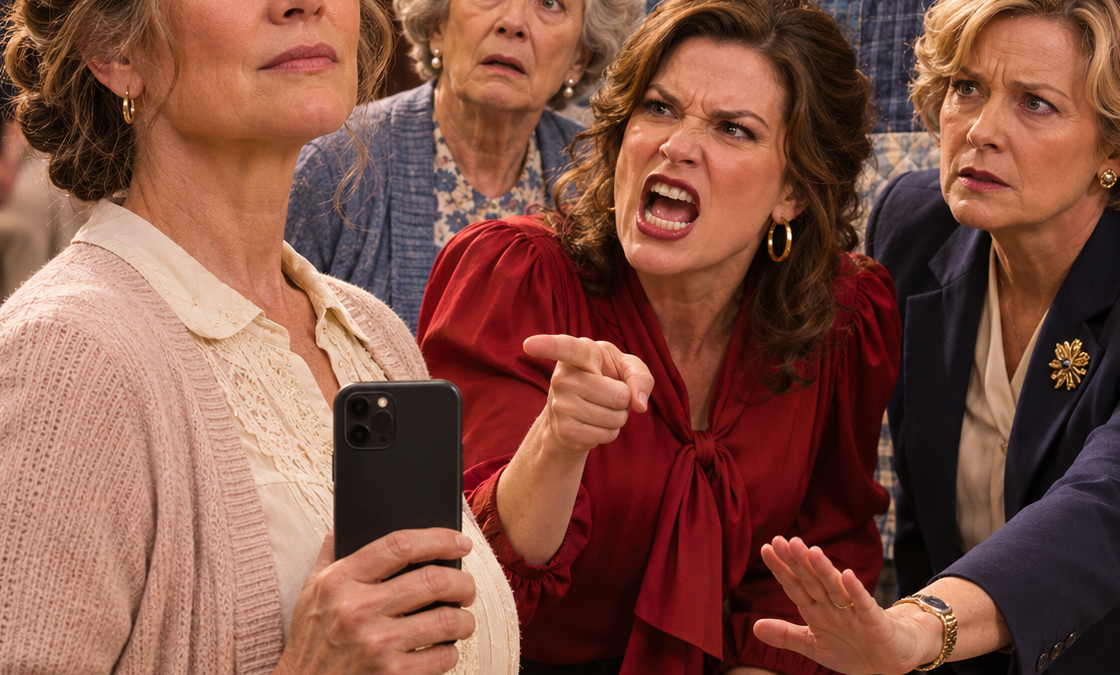
Linda held out her phone. “This is what I received.”
On its screen was Beth’s invitation, with a photograph I hadn’t known she had taken.
“Send that to me,” I said.
Beth looked toward the aisle. “Could we at least step somewhere private?”
A woman with a director’s badge had stopped beside the next display. I called her over. Beth started telling her we had a family question, but I held up Linda’s forwarded invitation.
Ruth read my phone and stopped beside the display.
“Beth, put the ticket box down.”
The invitation advertised a personal honeymoon drawing. It said my quilt had been donated, and it directed payments to Beth.
“There will be no sales and no drawing,” Ruth said. “Starting now. Was any of this submitted to us?”
“No,” Beth said. “I thought a family fundraiser—”
“It wasn’t approved. Have you taken payments?”
Beth hesitated.
While she found the transactions, I opened the security app on my phone. The camera at Bennett Alterations was openly mounted above the register. I had used it for years.
I exported Thursday’s collection segment, leaving the original on the system. The shop camera footage was silent. I saved it without playing it there.
Ruth asked Beth to send her the payment record.
“It’s all still there,” Beth said. “I haven’t spent anything.”
“How many payments?”
“I’ll show you.”
Only then did Ruth ask my name.
“Nora Bennett,” I said. “The quilt’s mine.”
Beth still used Collins from her first marriage; our mother was Carol Hayes after remarrying. I gave Ruth our relationships without trying to explain the whole family.
“This is my sister’s display place,” I said. “Not her quilt.”
“I understand that’s disputed,” Ruth said. “Right now, I’m stopping the fundraising.”
Beth’s phone chimed as she sent the screenshot. Two women near the doorway stopped talking when Ruth’s phone sounded in answer.
Beth said, “They’re all people I can contact. This doesn’t need to become something bigger.”
Ruth began reading the new message, her clipboard dropping against her skirt.
“Thirty people have already paid you?”
“Yes. A hundred each.”
“Before tonight?”
“Yes.”
Ruth looked up. “And you told them Nora donated the quilt?”
“That was my understanding by the time I sent the invitation.”
“It wasn’t mine,” I said.
I had finished the quilt Monday, eighteen months after Daniel died. On Wednesday, Beth and I had exchanged messages and signed a short form: display-only, returned to me October 24.
“We both kept copies,” I told Ruth.
“I’m not denying the form,” Beth said. “We talked afterward.”
“About collecting it.”
“About what you wanted done with it.”
I looked at our mother.
She had come with Beth to collect it Thursday at 4:20. While I found the packing material, Mom had held the display label and read it. Beth had taken the label with the quilt.
“You were there,” I said.
Mom’s lips parted. “We shouldn’t be doing this with everybody standing around.”
Ruth moved us a few feet behind the display, but people could still see us.
“Send me the form and messages,” she said. “Beth, your participation is suspended while I review this.”
“Can you give it back to me?” I asked.
“I can ask her to return it. I can’t take it from her.”
“I’m not giving anything away tonight,” Beth said. “Including my side of this.”
Ruth said the signed exhibition rules covered unauthorized fundraising, false ownership claims, and disposing of displayed work without approval. She could cancel Beth’s participation and correct the publicity. She could not settle ownership.
Beth agreed to stop. Her honeymoon sign went into the exhibition materials, and she began boxing her display.
I stayed with Ruth to forward our messages. When I turned back, Beth and the box were gone.
My phone lit with her text from outside.
“I’ve taken the quilt home. Mark and I understood it was a gift.”
Chapter 2 of 7
At ten Saturday morning, I called Beth from my shop.
“Is the quilt at your house?”
“Yes, Nora. That’s what I told you.”
“Then bring it back.”
“I’m keeping it here until we settle this. You agreed I could have it.”
“I agreed you could display it.”
“We could settle it over family dinner. Mom could come. Mark wants to talk, too.”
“I’m not coming to dinner to ask for my own quilt.”
“You wouldn’t be asking. We’d be talking.”
A customer stood outside my fitting-room curtain, wearing trousers with one finished leg. I had left the other pinned.
“I have to work,” I said.
“So do I, most days. That doesn’t mean we can’t—”
“Please bring it back.”
“Not while you’re saying the agreement never changed.”
The call ended without a time or a promise.
My customer looked down at her bare feet. “I can come back.”
“No. You’ve already parked twice for these pants.”
She gave me a small, relieved laugh. The first pair had needed different shoes. This pair apparently required a different family.
I was checking the pinned hem when Ruth called.
“Is this a bad time?”
“A fitting. Give me a second.”
My customer nodded toward the phone. “Take it. I need to check whether I can sit down.”
Ruth kept it short.
“I’ve reviewed the loan form and your messages. Beth confirmed her signature.”
“She says it became a gift afterward.”
“Yes. She told me that.”
“Did you tell her she could take it home?”
“No. I did not authorize its removal as a prize or donation.”
“She took it anyway.”
“I know. Her participation remains suspended. Nothing is being sold or drawn.”
“Can the form make her return it?”
“The form supports what you’re saying. I control participation in the exhibition, Nora. I don’t decide ownership.”
My customer sat carefully in the fitting-room chair. Nothing split. On an ordinary Saturday, that would have counted as good news.
Ruth asked me to send any further messages about the arrangement. Then she let me get back to work.
I finished both hems, charged my usual price, and apologized once for the interruption. Usually, I would have knocked something off the bill.
That morning, I needed to stop paying for everybody’s discomfort.
Beth called again before lunch.
“I spoke to Mom.”
“About returning it?”
“About how we got here. And I asked Mark to talk to you.”
“He wasn’t at the shop.”
“He knows what this wedding has been like for me.”
I waited.
“Every family thing, Nora. We have to check whether it’s too soon, whether it’ll upset you, whether we can mention Daniel.”
“You mentioned him quite freely last night.”
“I’m trying to say this badly. I know that.” Her voice stayed soft. “I want one happy thing that doesn’t turn into a discussion about what we lost.”
“Then leave my quilt out of it.”
“I thought you were letting me do that. Letting it be part of something happy.”
“Did you tell Mark I said yes?”
“I told him what happened as I remember it.”
“And you want him to call me.”
“I want somebody to help us have a private conversation. The drawing is stopped. I’m not trying to keep selling anything.”
She sounded tired rather than angry. That made it harder to hang up. I had spent years treating Beth’s tiredness as a job I needed to finish.
“I’ll talk about returning it,” I said.
“That’s not much of a conversation.”
“It’s the one I can have.”
Mom called while I ate a sandwich behind the counter. She asked whether I had eaten, then talked over my answer.
“Your sister barely slept.”
“Neither did I.”
“She’s embarrassed. People were looking at her.”
“They were looking at me, too.”
“You’re older. You’ve always been better with people.”
“I’m fifty-four, Mom. That doesn’t make this easier.”
At seventy-five, she still used the patient voice she had used in the school cafeteria. Somebody had spilled something. Somebody needed to stop crying so lunch could continue.
“Couldn’t you keep this between yourselves now?”
“Thirty people paid.”
“Yes, but you don’t need to humiliate her.”
“I lent her my work. I didn’t give her permission to sell chances on it.”
“She thought you’d want to help.”
“She could have asked me.”
Mom went quiet long enough for me to hear her television.
“I’m not calling everyone,” I said. “I’m working. Beth needs to return what she borrowed.”
“Well. Don’t say anything you can’t take back.”
Afterward, I discovered I had eaten only the sandwich crust.
Linda arrived early that afternoon with a jacket over her arm.
“This can wait,” she said.
“Does the zipper work?”
“Yes.”
“Then you’re already ahead.”
She didn’t laugh much, but she came inside.
“I need to tell you about last night. That noise I made.”
“I heard it.”
“I know you did. I didn’t know what else to do.”
The jacket needed its sleeves shortened. She had folded them inward instead of pinning them, afraid of making holes.
“Beth told me you wanted to help,” she said. “A hundred dollars was more than I usually spend on something like that.”
“You shouldn’t have had to spend it.”
“I wasn’t only buying a chance. I thought, well, Nora’s doing this for her sister.”
My name had helped sell it. Linda had trusted years of hems and repaired linings, then sent Beth money.
“I didn’t change my mind afterward,” I said.
“I believe you.”
“I need you to know that.”
“I do.”
She hesitated before asking, “Will she send the money back?”
“She hasn’t agreed to start yet.”
Linda looked at the unfinished sleeve. “I’d rather have my hundred dollars than somebody else’s quilt.”
I wrote down the alteration, nothing extra. She stayed a few minutes without asking me to make her feel better about having bought a chance.
Later, Ruth forwarded Beth’s purchaser list. Thirty entries, each marked paid. Linda’s name sat among women I knew from fittings, sewing gatherings, and wedding referrals.
Beth had also supplied a redacted account history showing the unspent balance. Ruth hadn’t obtained it herself; Beth wanted us to see it.
The money was still there.
That should have made the next step simple.
Beth’s accompanying message said she could contact everyone once we resolved the misunderstanding. Returning payments now, she wrote, would tell people she had knowingly offered something that wasn’t hers.
I replied that refunds did not need to wait for me to agree with her.
She answered, “Please let us establish what happened first.”
Ruth confirmed that the suspension remained in place.
I worked through the afternoon with my phone facedown nearby. Each time it sounded, I let the machine finish its seam before checking.
At 4:10 p.m., Mark sent me a message.
“I’m trying to follow this. Beth says she knows you signed a loan. She says you made it a gift afterward. Is there a part I’m missing?”
Before I could answer, he forwarded her account.
“She gave it to me afterward. Mom was right there.”
Chapter 3 of 7
On Sunday morning, October 18, I called Mom before answering Mark.
“Did you hear me give Beth the quilt?”
“Well, good morning to you, too.”
“Mark says you were right there.”
“I was there when she collected it.”
“That isn’t what I asked.”
“Nora, I thought you’d eventually want her to have it. You’ve always helped each other.”
“Did you hear me say she could keep it?”
She told me she hadn’t slept well. Then she asked whether I was opening the shop on a Sunday.
“No. I’m delivering some finished work.”
“Good. Get out for a bit.”
She had answered everything except my question. I stayed on the line until she said she needed to get dressed.
The signed form was on my kitchen table. Both our names were there, and the return date. Beth wasn’t disputing any of that; she was telling people something else had happened afterward.
Mom had left that part standing.
Linda forwarded Beth’s note while I was getting ready to leave. Above it, she wrote, “Thought you should see exactly what we received.”
Beth had addressed the purchasers as friends.
“Thank you for your patience while we work through a family misunderstanding. Nora’s generous offer came during an emotional week, and she has since expressed reservations about the arrangement. Out of respect for her, everything remains paused while we clarify matters with the exhibition director.”
The last paragraph assured them their payments remained untouched. She thanked them for their kindness and asked them to avoid speculation.
There was no drawing date. No request for more money. Just my supposed generosity, followed by my supposed change of mind.
I read “out of respect for her” twice.
Then I drove across Lancaster with a finished dress hanging behind my seat. The customer had asked for a Sunday delivery because she worked weekdays and couldn’t get to Bennett Alterations before closing.
Usually, she invited me inside. That day, she stood in the doorway.
“I’ve got the shoes here,” she said. “But you checked it already, didn’t you?”
“With those shoes, yes.”
“Then I’m sure it’s fine.”
Her television was on behind her. I could see an ironing board in the living room and a stack of folded towels.
She reached for the dress, then stopped.
“I got Beth’s message.”
“Did you buy a chance?”
“Yes. I thought—you know. I thought you wanted us to.”
“I lent it for display. I didn’t donate it.”
“Oh.”
“I haven’t changed my mind about a gift. There wasn’t one.”
She looked past me toward my car.
“I don’t want to get in the middle.”
“I’m not asking you to.”
“No, of course. I just like both of you.”
She paid the alteration bill in full. I thanked her and left.
At the curb, I checked the empty back seat before starting the car. For years, she had sent me pictures after wearing something I fixed. I couldn’t remember another delivery when we hadn’t talked about where she was going.
At home, I started a message to the family.
I got as far as, “Beth had no right to tell any of you—”
Then came a paragraph about all the things I had made, fixed, driven over, paid for. None of it got my quilt home. All of it could be forwarded.
I deleted it.
My message to Ruth was shorter. I attached Beth’s purchaser note and wrote that I had not donated the quilt or later agreed to give it away. I asked that any correction reach the purchasers directly, rather than leaving them with Beth’s account.
Ruth answered that afternoon.
“I’ll include this in the review. Please keep the original message.”
There was nothing in her reply about families or healing. I was grateful for that.
Mark called while I was heating leftover soup.
“I read what you sent yesterday,” he said. “About the loan staying a loan.”
“Yes.”
“Beth says there was another conversation.”
“She keeps saying that.”
“She says you’re hurt now, and that’s changed how you remember it.”
I turned off the burner. The soup had started spitting onto the stove.
“Did she tell you what she said at the preview?”
“She said she handled that badly.”
I waited for him to ask what she had said. He didn’t.
“I’m getting two different accounts,” he said.
“You are.”
“What would settle it for you?”
“My quilt comes home. The people who paid get their money back.”
“And that’s it?”
“That’s what needs doing.”
“She’s worried you want me to call off the wedding.”
“I haven’t asked you to.”
“I know. I’m asking.”
“Your wedding is yours, Mark. I’m asking for my property and their money.”
He was quiet for a few seconds.
“I can talk to her.”
“You can. I’m not giving you a speech to deliver.”
“All right.”
I ate the soup standing at the counter. It had gone lukewarm, with one patch hot enough to burn my tongue.
Mom came over near supper. She brought grocery-store rolls, although I hadn’t asked her to bring food.
“They were two packages for the price of one,” she said. “I can’t eat all those.”
“You freeze them.”
“Then they taste like the freezer.”
We had argued about her uncovered freezer bread for years. For a minute, we managed to argue about it again.
Then she asked whether Mark had called.
“Yes.”
“He’s a decent man.”
“I didn’t say otherwise.”
“Beth doesn’t want him thinking she’s dishonest.”
“Then she needs to stop saying I gave her the quilt.”
Mom sat at my kitchen table. She hadn’t taken off her coat.
“I may have encouraged her.”
“To sell chances?”
“No. To believe you’d come around.”
I sat across from her.
“What did you tell her?”
“That sometimes you need time. That if she didn’t push too hard, you might want to help.”
“She sold thirty chances, Mom.”
“I didn’t tell her to do that.”
“But you told her my answer would change.”
Mom stared at the unopened rolls.
“You’ve said no before and then done things anyway.”
There it was, ordinary as the bread between us. The dress I couldn’t fit into my schedule. The ride I couldn’t make. The bill that wasn’t mine.
“So when I say no, you tell her to wait?”
“I didn’t put it that way.”
“How did you put it?”
“I said you wouldn’t let her down.”
I pushed my chair back enough to make room for my knees. Mom watched me as though I might leave my own kitchen.
“That was unfair,” she said.
“What did you actually hear at the shop?”
“We’ve been over this.”
“No. We keep going around it.”
Her phone sounded on the table. She looked at the clock above my stove. It was 7:05.
“It’s Beth.”
“Is she bringing it back?”
Mom read for a moment.
“She wants something in writing.”
“What?”
Mom began reading aloud. “Please tell Ruth you heard her.”
“Heard me what?”
She looked at me, then read Beth’s whole sentence.
“Please tell Ruth you heard her give it to me.”
Chapter 4 of 7
“Have you answered her?” I asked.
Mom’s phone stayed lit between us.
“No.”
“Don’t sign anything that isn’t true.”
“I know better than that, Nora.”
“I need you to know it with Beth, too.”
She said she should go home. The rolls stayed on my kitchen table.
Before bed, I asked Ruth whether we could meet at my shop Monday afternoon. I wanted Beth to look at the same things we were discussing, instead of sending accounts through other people.
Mom declined when I invited her the next morning.
“I can’t sit through another argument.”
“You were there when she collected it.”
“And now you’re both mad at me.”
She wouldn’t agree to come.
At 3:30 Monday, October 19, Ruth and Beth arrived at Bennett Alterations in Lancaster. I had blocked the last fitting appointment, but the shop wasn’t finished for the day. Three coats needed linings repaired. A customer had left a note asking me to make her waistband “Thanksgiving friendly.”
Usually, I would have shown Beth that note.
She stood near the fitting-room curtain, still wearing her dental-office badge.
“I only have so much time,” she said. “I took a late lunch.”
“This shouldn’t take long,” Ruth said.
Beth looked toward the ceiling.
“Are you recording this?”
“The security camera is always on. It doesn’t record sound.”
“I know where it is.”
“I’m telling you what it does.”
We sat at the small cutting table behind the register. Beth had brought her copy of the loan form. Mine was already there, beside the messages I had printed.
Ruth read both copies.
“Are these the forms each of you signed Wednesday?”
“Yes,” I said.
“Yes,” Beth said. “I’ve never said otherwise.”
Ruth checked the messages next. Beth confirmed the ones she had sent. I confirmed mine.
“The return date was October 24,” Ruth said.
“For the loan,” Beth answered. “We agree about how it started.”
I had brought my laptop from home to show the exported recording. The original segment remained in the shop’s camera system.
“This is Thursday’s collection,” I said. “The whole relevant part. I haven’t cut anything out of it.”
Beth watched the screen.
The view showed the counter, the front door, and part of the work area. There I was, coming from the back with packing material. Mom stood near the counter holding the readable display label. Beth’s empty box rested beside her bag.
We watched the ordinary business of getting something ready to leave. Mom read the label while Beth made room in the box. I went back for more packing material. The quilt went in, the label went with it, and Beth carried the box out.
Without sound, the shop looked farther away than it was.
Ruth let the clip finish.
“Is that you collecting it?” she asked Beth.
“Yes. That’s Thursday.”
“Anything missing from the collection?”
“Not that I can see.”
Ruth looked at me. “And this is the original export?”
“Yes.”
Beth faced me across the table.
“You saved this Friday?”
“At the preview.”
“So you were already collecting evidence while I was trying to explain.”
“I was keeping what happened.”
“That shows us packing a box.”
“Yes.”
“It doesn’t tell you what we said.”
“No,” I said. “It doesn’t.”
She seemed to have expected an argument about that.
Ruth spoke before Beth could continue.
“I’m treating it as silent video. Nobody here can hear a conversation on it.”
“Then you see the problem,” Beth said. “Nora lent it on Wednesday. On Thursday, we talked. She said I could have it. I relied on that.”
“I didn’t say that.”
“You said you wanted it out in the world.”
“For people to see.”
“That wasn’t how I heard it.”
“You knew it was coming back.”
Beth looked at Ruth.
“This is what happens. We get stuck on the wording. I should have gotten the change in writing. I can admit that.”
“There wasn’t a change,” I said.
“I believed there was. That’s why I sent the invitation. I wasn’t hiding the drawing from Nora. I announced it in front of her.”
“You didn’t tell me before you took their money.”
“No. I should have talked to you again.”
Her voice was level. She had conceded the part she could afford to concede.
Ruth waited until we both stopped.
“I’m not deciding which sister owns the quilt,” she said. “You’ll have to resolve that between you. I’m deciding whether Beth can continue in this exhibition.”
Beth frowned. “Based on a family disagreement?”
“Based on private fundraising we did not approve, and an invitation naming a donor who says she never donated. Your agreement allows us to cancel participation and correct that information.”
“So what am I supposed to do?”
“You can give your account before I make the final participation decision. The purchasers also need a direct correction. They shouldn’t have to piece this together from forwarded messages.”
“I already told them everything was paused.”
“Paused isn’t corrected.”
Beth looked toward the shop window. Outside, someone was trying to parallel park in a space barely longer than the car.
“Can we do that by email?”
“We’ll send written information as well,” Ruth said. “I’m arranging a meeting in the exhibition room. Saturday, October 24, at ten.”
“Saturday at ten,” I repeated.
“Yes. I’ll invite the purchasers, both of you, Carol, and Mark.”
“My mother doesn’t want to be involved,” Beth said.
“She can decide whether to attend.”
“And Mark wasn’t even there Thursday.”
“He’s been included in the account you’ve given. He can hear the correction with everyone else.”
Beth’s badge had twisted backward against her sweater. I could see the plain plastic back instead of her name.
“Thirty people watching us fight,” she said.
“I’ll conduct the meeting,” Ruth answered. “It won’t be an open argument.”
“Will I get to speak?”
“Yes.”
Beth turned to me.
“You really want this?”
“I want the people who paid to hear what happened.”
“They’re our friends.”
“They think I offered them my quilt.”
Ruth confirmed that sales and the drawing remained stopped. Then she said she would send the meeting details that afternoon.
Beth left first. She didn’t ask about the coats or tell me which lunch she had missed.
I reopened the appointment book after Ruth went. A woman had called twice about a zipper, and I called her back. We talked for four minutes about whether the replacement had to match exactly.
It was a relief to have an answer.
At 6:40 p.m., after I closed the shop, Beth sent a message.
She said there was still a way to keep our memories and the wedding from becoming everybody else’s business. She could arrange another quilt for me, one made to my specifications, if we resolved this privately. Nobody needed to leave Saturday feeling accused.
I read it beside the coats waiting for their linings.
Her next message offered the substitute quilt if I agreed by 9:00 a.m. Tuesday.
“If we do this publicly, I’m telling them about the gift.”
Chapter 5 of 7
At 8:15 Tuesday morning, October 20, I called Beth.
“I will not trade it.”
“Nora, did you read the whole message?”
“Yes. I want the quilt I made from Daniel’s shirts. Another quilt isn’t that quilt.”
“I was trying to give us a way out.”
“I’m coming Saturday. I won’t sew something or give something up just to stop us arguing anymore.”
“So now everything you’ve done for me is a grievance?”
“I’m talking about what I’ll do next.”
She paused.
“Then I want equal time. Not five minutes after you’ve told everybody your version.”
“Ask Ruth.”
“I want Mark beside me. And I won’t sit there while people call me a thief.”
“I haven’t called you that.”
“You know what people hear.”
“They heard that I donated it.”
“I’ll send Ruth my conditions.”
At the shop, I found a customer’s husband waiting with a bag of trousers. His wife had included written instructions: “He will say all four need shortening. Only do three. The gray ones are his brother’s.”
He looked offended when I read it aloud.
“I know which pants are mine.”
“Then we’re already halfway done.”
For a few minutes, the problem in front of me had chalk marks and an answer.
Beth copied me on her email to Ruth before lunch. Ruth replied to both of us.
“You’ll have a fair opportunity to explain your account. Mark may sit with you. I won’t describe you as a thief. I can’t agree in advance to wording that leaves purchasers with inaccurate information.”
Beth answered, “I need my account heard before you decide.”
“It will be,” Ruth wrote.
The formal notice arrived that afternoon. No drawing would occur. The original thirty purchasers were invited Saturday at ten for a correction and refund arrangements. Ruth would decide Beth’s continued participation after hearing her response.
Beth’s absence, the notice said, would not prevent cancellation or a correction.
Beth replied that she would attend and bring the quilt. She added that bringing it did not mean she accepted my account.
I checked that the signed loan, original messages, and saved clip were accessible on my laptop. Then I closed it. There wasn’t another piece of preparation I could do that would make Mom answer a question.
I called her Wednesday.
“Are you coming Saturday?”
“I haven’t decided.”
“Ruth invited you.”
“I got it.”
“Then please answer her.”
“You make it sound like I’m avoiding everybody.”
I said nothing at all.
On Friday, October 23, Mom came to the shop near closing. She wore the good walking shoes she saved for places with unreliable parking.
“I could’ve called,” she said.
“You’re here now.”
She had brought her exhibition program. There were notes beside several displays, mostly names of people she knew and reminders of things she wanted to see again.
Beside Beth’s listing, she had written, “Ask Nora about return.”
I left it open on the counter.
“Why didn’t you ask me?”
“I thought I knew.”
“About the return?”
“About how this would go.”
A car passed with its radio loud enough to rattle my front window. Mom waited until it was gone.
“Beth would call me upset, and I’d call you. Then you’d be short with me, and I’d tell her you were tired.”
“I was tired.”
“I know. But I kept making excuses for both of you. So neither of you had to say anything nice.”
“What did you tell her about the quilt?”
“That you’d come round.”
“Those words?”
“Yes.”
“Did I tell you I would?”
“No.”
She looked toward the fitting room.
“I used to say that about you when you were a girl. Give her a little while. She’ll come round. Usually you did.”
“Usually you needed me to.”
Her face changed at that. She didn’t argue.
“Beth says if I go Saturday, people will think I’ve picked a daughter.”
“Did you tell her you’d support the gift story?”
“I told her I wanted this settled.”
“That’s not the same.”
“No.”
“Mom, I’m not asking you to pick me. I’m asking you to say what you know.”
“And then I go home.”
“Yes.”
“You don’t know what those calls are like.”
“I’ve been getting them, too.”
She glanced down at the program.
“I told her you wouldn’t let her down. I shouldn’t have. You hadn’t promised anything.”
“Have you told Beth that?”
“Not plainly.”
“Will you?”
“I’m trying to get there.”
I wanted to ask about Thursday again. Instead, I asked whether she had answered Ruth.
“I’ll answer tonight.”
“Does that mean you’re coming?”
“Yes, Nora. It means I’m coming.”
She left the program with me. I told her I would bring it Saturday.
That night, I almost called to make sure she hadn’t changed her mind. I got as far as finding her number.
Then I went to bed.
Saturday morning, October 24, I reached the exhibition room with my laptop and the program. Ruth had arranged chairs facing the wall where Beth’s display had stood. The honeymoon sign was among the materials set aside nearby.
Linda arrived before most of the others.
“I brought my payment confirmation,” she said.
“Ruth asked for those.”
“I know. I nearly brought the jacket, too. Habit.”
“The sleeves will be ready Monday.”
“I wasn’t asking.”
“I know.”
Other purchasers came in together, recognizing one another from sewing meetings and wedding appointments. A few greeted me warmly. Others checked the room before choosing a seat.
Mom arrived and sat near the aisle.
At a few minutes before ten, Beth came through the door carrying the packed quilt. Mark walked beside her. She kept the box with her when they sat down.
I wanted to ask her to give it to me before anything started. Ruth was counting chairs. People were still arriving. I stayed where I was.
Beth addressed the women nearest her, loudly enough for the next row to hear.
“I agreed to this because Nora’s entitled to explain how she feels. I do want everybody to hear both sides.”
One woman asked, “So it wasn’t a donation?”
“I understood it to be a gift,” Beth said. “After the original loan. That’s what we’ll be explaining.”
Mark watched Ruth cross the room.
Mom sat two chairs away from Beth. Her coat was still buttoned.
Beth turned toward her.
“Mom, you can sit closer. Mark can move over.”
Mom looked at me. I was seated on the other side of the aisle, with an empty chair beside mine.
Ruth checked the clock. She hadn’t begun.
Mom rose and moved her chair away from Beth, placing it beside the empty chair next to mine.
“I read the label.”
Chapter 6 of 7
“Before these ticket holders, I want the account made clear,” Ruth said. “Carol, what did you read?”
Mom’s coat was still buttoned. She sat with her knees together.
“Nora’s name. It said she owned the quilt. Display only, and back to her October 24. Today.”
“Yes,” Beth said. “That was the original arrangement. I’ve agreed about that from the beginning.”
“And you say it changed?” Ruth asked.
“During collection. Nora let me take it, we talked about the wedding, and I understood she was giving it to me.”
The clock above the doorway reached ten. All thirty purchasers had come. Some still wore their coats.
I opened the collection clip on my laptop, paused it, and turned the screen toward the chairs. Then I put the signed loan beside the displayed still.
“Who heard me change that?”
Beth looked at me.
“Mom was there.”
“I’m asking who heard it.”
“Nora, we were having a family conversation. Nobody was taking minutes.”
“I’m not asking for minutes.”
“I know you’ve been hurting. Maybe what felt possible Thursday felt different when you saw it hanging there.”
“We’re not deciding whether I’ve grieved long enough.”
“I didn’t say that.”
“Then leave that out. What did I say?”
Beth’s cheeks colored, but she kept her voice level.
“You said you wanted people to see it. You asked about the wedding. You said you hoped we’d have a good time.”
“I did.”
“And you let me leave with it. Mom had been telling me you wanted to help, even if it was hard for you. I took those things together.”
Ruth looked from Beth to the paused image.
“The recording has no sound,” she said. “It can’t settle what was said.”
“Exactly,” Beth answered. “I should have asked Nora to put the change in writing. But I wasn’t taking something behind her back. She helped pack it.”
A purchaser in the front row nodded slightly. Linda looked down at her lap.
Ruth turned toward Mom.
“Carol, what did you actually hear?”
“Could we play it?” Mom asked.
I let the clip run from its opening.
On the screen, Mom stood holding the label while Beth made room in the box. I went toward the back for packing material. We watched ourselves move through that ordinary Thursday without hearing a thing.
“I read all of it,” Mom said. “Not just Nora’s name.”
Beth leaned forward.
“Mom, nobody’s saying you didn’t.”
“And when Nora came back, she said, ‘Display only. Don’t lose that label.’”
My recorded self returned to the counter.
“Did you hear Nora say Beth could keep it?” Ruth asked.
“No.”
“Did you hear her offer it as a donation?”
“No.”
Beth’s gaze stayed on Mom.
“You told me she wanted me to have something for the wedding.”
“I told you she’d come round.”
“Yes.”
“That was me saying what I wanted. Nora hadn’t said it.”
“You said you knew her.”
“I thought I did. I thought if you went ahead, she’d let it stand. She’s done that before.”
Someone behind me shifted a chair.
Mom’s voice thinned.
“And Friday night, I stood there while you said those things. I could have spoken then.”
“You could have told me before I sent the invitation,” Beth said.
“Yes. I should have.”
Ruth waited.
“Carol, to be clear: you heard the restriction, but no later gift?”
“That’s right. I helped Beth expect a yes. I didn’t hear Nora give one.”
Beth sat back. The box rested against her ankles.
“I believed Mom,” she said. “I believed Nora was trying to do something kind.”
Ruth faced her.
“But an expectation wasn’t permission from Nora. And even if you believed it was a gift, did anyone here approve the honeymoon drawing?”
“No. I thought it was separate from the exhibition.”
“You advertised it using your exhibition display.”
“Yes.”
Ruth stood at the table with the cancellation in front of her.
“That fundraising was never approved. The donation you advertised wasn’t authorized by Nora. Those don’t meet the rules you accepted, so I’m canceling your participation.”
“Not just keeping it suspended?” Beth asked.
“No.”
Ruth signed and dated the cancellation while Beth watched. She gave Beth a copy.
Then Ruth addressed the purchasers.
“The donor listing will be corrected. Nora Bennett lent her quilt for display; she did not donate a drawing prize. The exhibition did not authorize this fundraiser.”
Beth had lost her exhibition place. The women she had wanted to impress watched her read the cancellation. One folded her program closed.
Beth rose and reached toward the packed quilt.
“Beth,” Mark said. “Did Nora actually say you could sell chances on it?”
She stopped.
“You heard what I understood.”
“I heard. Did she say that part?”
“No.”
He looked at the box, then at her.
“Then we need to give it back.”
Beth stayed standing.
“Mom told me—”
“I know,” he said. “I’m asking you now.”
For several seconds, she looked at me instead of him.
“It was a display-only loan,” she said. “You can take it home.”
“Are you giving it back to me?”
“Yes, Nora.”
She stepped away from the box. Ruth remained at her table.
I lifted the quilt out myself. A folded corner opened against my wrist, and Daniel’s blue pocket showed. The cotton was cool from the room. I folded it back along the same seam.
Mark offered to carry the box.
“I’ll carry it,” I said.
Mom crossed to the exhibition materials and took down the honeymoon drawing sign. She stood holding it against her coat while Linda got to her feet.
“I need to say something,” Linda said. “I bought because I was told Nora donated it. I wouldn’t have paid otherwise.”
Several women answered at once.
“So did I.”
“That’s what the invitation said.”
Beth looked toward the phones coming out of bags.
“I have everybody’s payments listed. I’ll send them back the way they came.”
She sat and opened her ledger. Mark stayed beside her, checking the names as she queued three $100 refunds on her phone.
Linda read out the last digits from her payment confirmation. Two women behind her found theirs. Nobody asked me to cover a shortage or make something else.
Beth glanced up.
“We’ll still need to talk about the wedding.”
“Not today.”
“I wasn’t asking you to do anything today.”
“You may ask me. You may not decide for me.”
She looked down at her phone again.
I held the quilt against my side and moved toward the door, without promising a fitting or a dress repair. Behind me, Beth asked Linda to check her account.
Linda’s phone displayed the first completed $100 refund. Beth’s ledger still listed twenty-nine purchasers to repay.
Chapter 7 of 7
Before I left on October 24, the next two purchasers confirmed their refunds. One showed Beth her screen. The other waited for an email, then said, “Yes. It’s back.”
Three completed refunds, $300 returned. Twenty-seven people still needed their money.
Those took the rest of the week. Beth sent payments through the same channels people had used to pay her. Each purchaser confirmed receipt. Some answered quickly; others checked their accounts after work.
I wasn’t copied on every exchange. Ruth kept the confirmations with the purchaser list and sent me the final count.
On Friday, October 30, Beth sent the last repayment confirmation herself.
“That’s everyone,” she wrote.
Ruth’s message followed later: thirty refunds, $3,000 returned.
None of that money came to me. It had belonged to the purchasers, even while Beth counted it toward a honeymoon. She didn’t ask me to replace it.
I answered her message that evening.
“Thank you for finishing the refunds.”
She replied, “I said I would.”
I left that alone.
The quilt stayed home. For the first few days, I kept it folded on the sofa, where I could see it when I came in from the shop.
Then a cold evening came, and I used it.
I spilled a little tea on one corner. I blotted it, checked the washing instructions I had written myself, and laughed once in the empty house.
Daniel would have asked whether I charged extra for cleaning my own work.
On Friday, November 6, Ruth confirmed that Beth’s canceled display had been removed from the exhibition’s vendor follow-up mailing and promotional feature.
“That completes our correction,” she wrote.
I thanked her for keeping the purchasers informed. There was nothing else I needed her to do.
Beth called that Sunday.
“Mark and I are still getting married,” she said.
“I didn’t think you weren’t.”
“Well. People have asked.”
“I haven’t.”
“No.”
For a while, I could hear water running at her end.
“We’re looking at a shorter honeymoon,” she said. “Something we can pay for. Mark wants us to write down the whole budget.”
“That sounds useful.”
“He has a spreadsheet.”
“Does it work?”
“It has colors, Nora.”
I almost laughed. She sounded enough like my sister that I nearly asked her to come over.
Instead, I asked whether she had found somewhere they both wanted to go.
“Not yet.”
We talked another few minutes. She didn’t apologize that day, and I didn’t supply one for her. When the call ended, I went back to the laundry I had left in the dryer.
On Saturday, November 14, Beth called the shop about bridal alterations.
“Twelve altogether,” she said. “Not twelve dresses. A couple are just hems.”
“Bring the garments to an appointment. I’ll need to see them before I quote.”
“I meant could you do them for us.”
“I can book paid work.”
“You always said you’d help with the wedding.”
“I can offer an appointment under the same terms as everybody else.”
“Nora.”
I waited.
“Some of these women already spent more than they planned.”
“Then they need prices before they decide.”
She exhaled into the phone.
“I wasn’t expecting to pay you.”
“I know.”
“And twelve at once wouldn’t get us some kind of—”
“I’d quote each garment. The usual deposit would hold the work.”
There was a long pause. Behind my fitting-room curtain, a customer sneezed, then apologized to nobody in particular.
Beth said, “I’ll ask another shop.”
“All right.”
“You don’t have to sound pleased.”
“I’m not pleased. I’m telling you what I can offer.”
She ended the call soon afterward. Later, she texted that she had booked elsewhere.
I didn’t ask what they charged. I didn’t clear space in case she changed her mind.
That afternoon, I went home when I had planned to. There were no garment bags from Beth waiting in my car.
Mom called the next week and asked whether she could visit.
“Just you?” I said.
“Just me.”
“No Beth arriving afterward?”
“No.”
“And I don’t want messages brought over.”
“I have something of my own to say.”
We agreed on Sunday afternoon.
She arrived with no food, which was unusual enough that I checked behind her.
“I can visit without feeding you,” she said.
“You’ve kept that quiet.”
We sat at the kitchen table. She asked about work, then stopped herself halfway through a story about a neighbor’s curtains.
“I treated what I expected from you as though you’d agreed,” she said. “When I told Beth you’d come round. I’m sorry for that.”
I watched her for a moment.
“You kept doing it after I said no.”
“Yes.”
“And you let her tell people I’d given it.”
“Yes. I was afraid of making her angry.”
“I was angry, too.”
“I know.”
She didn’t ask which daughter had called more or who had suffered longer.
“I want to see you,” I said. “But visits need to be arranged. And if Beth wants to tell me something, she can tell me.”
“I can do that.”
“If you start carrying messages, I’ll end the conversation.”
She looked down, then back at me.
“All right.”
We had coffee. She stayed an hour. When she left, neither of us tried to turn it into more than that.
On Sunday, December 13, Mom came by invitation again. She stayed through the afternoon and complained that my kitchen clock was four minutes fast.
“It gets me to work,” I told her.
“It makes your coffee late.”
She left before supper. We hadn’t discussed Beth.
At 7:30 that evening, I carried a bowl of popcorn into the living room. The house was warm except near the window. I had never persuaded Daniel that the draft came from the frame, not my imagination.
I found the movie he used to talk through. He knew when the car chase started and still warned the driver out loud. Every time.
I selected it, then stopped before it began.
I wanted the comedy I had missed at the theater.
Nobody had to approve the change. I found it, started it, and settled against the sofa cushion with my popcorn.
The quilt lay folded beside me. Along one edge, the Sunday checks had softened under my thumb. Near the center, his work-shirt pocket still had its crooked topstitching.
I missed him. I also wanted to hear the next line.
I pulled his shirts over my knees.








