My son called me “the delivery lady” at a $240,000 contract signing for the flower shop I mortgaged my house to build; he didn’t know what I’d kept.
Chapter 1 of 7
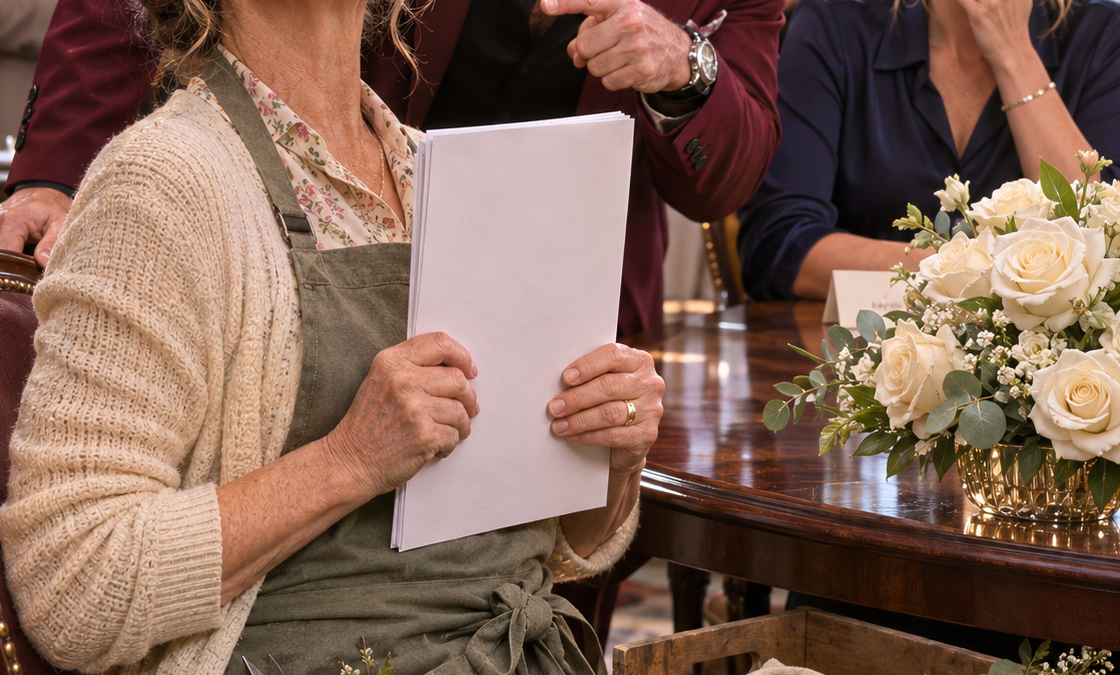
Eric blocked my chair with his knee. At two o’clock that Friday, October 2, the Fort Worth hotel’s signing table had a seat for everyone except me.
“Mom, deliveries use the back entrance—not the family table.”
Amy stayed seated. She slid my place card behind the centerpiece, where the white roses hid it.
I lowered the delivery crate to the carpet. Our old brass counter bell lay inside, tucked beside spare ribbon.
“I mortgaged my house to build this shop,” I said.
Eric glanced toward the purchasing director, who stood beside the window.
“David, this is my mother. Our delivery lady today, although she does considerably more than that.”
“I made everything on this table.”
“And they’re beautiful, Mom. Nobody’s questioning your flowers.”
His knee remained against the chair. I still wore my work apron beneath my cardigan. There was a wet patch near my waist where I’d carried the arrangement against me.
“Let me get somebody to take that crate,” David said.
“It can stay there.”
I hadn’t meant to sound sharp with him. He was the only person offering help.
Eric gave him the little laugh he used when an order arrived wrong.
“She’d rather be working than sitting through business talk. We practically have to drag her away from her buckets.”
Amy’s eyes stayed on the centerpiece. One rose leaned toward her sleeve, and she moved her elbow away.
“There’s a service entrance display still waiting,” Eric told me. “Could you see to that while we finish here? Your touch, you know.”
“After I sit down.”
“We’ve got the photographer coming through shortly.”
“I washed my hands.”
“I didn’t say—Mom, come on.”
The hotel had put out little dishes of butter shaped like flowers. Eric had already eaten his roll. At home he still called the last roll “quality control,” the same excuse he’d used at twelve.
I had saved the last roll for him for years.
My phone buzzed inside my apron.
His message read: Could you cover another short advance? Just until collections catch up. We can settle it afterward.
He stood close enough to ask me. Instead, he watched my face while David checked the place settings.
My fingers went toward the checkbook in my bag. I stopped at the zipper.
Eric’s eyes followed them.
“We can discuss that later,” he said softly.
“No.”
“The display?”
“The advance.”
Amy looked up then.
“Mom, he said later.”
“He asked now.”
David turned toward the window again, giving us privacy that the room was too small to provide. Outside, traffic moved through the afternoon sunlight.
Eric lowered his voice.
“This isn’t the place for a cash-flow conversation.”
“You sent it to me here.”
“I thought we could handle it without making everyone uncomfortable.”
I could feel the damp apron cooling against my blouse. My shoes had rubbed a raw place above one heel, and I wanted that chair badly enough to hate myself for asking.
“Being your mother did not make my work free.”
“You’re on payroll,” Eric said. “Nobody said otherwise.”
“Then introduce me as the designer. And move your knee.”
He glanced at David before stepping aside.
I sat with my bag against my ankles. Amy’s hand rested near my hidden place card, but she left it where it was.
David returned to the table.
“Shall we check the packet before anybody signs?”
“Absolutely,” Eric said. “We’re ready.”
“I’d like to see it too,” I said.
“You have your copy.”
“Here. With everyone.”
He passed me a packet. His photograph filled most of the first page; the flowers behind him were an arrangement I’d made before sunrise.
David checked the attachment list against the pages. Eric leaned toward him, explaining where the signature tabs were.
David stopped with his pen above the paper.
He turned the last page over, then back again. “Where is the approval?”
Eric glanced at Amy.
“The member authorization isn’t attached,” David continued. “Our purchasing file needs it before we execute.”
“We agreed on the scope,” Eric said.
“That’s useful. I still need the approval.”
Amy said, “I thought the final draft was what you needed.”
“The draft is fine. I can wait while you sort out the attachment.”
No one asked me whether I had approved it.
I opened my copy to the signature page. Beneath it, in my bag, was the gray envelope I’d brought from our locked bookkeeping cabinet. The original funding packet was inside.
Those were my original funding records. I had once kept books professionally, and I retained the bank’s own records.
A pink return slip sat among deposit sleeves and postage receipts. I left the envelope where it was.
“Nothing has changed in the pricing,” Eric told David. “We don’t want you worrying about an internal paperwork delay.”
“I’m not worried about pricing.”
Amy’s phone vibrated. She checked it, then said, “I’m forwarding the company background page too. That was separate.”
David’s phone sounded beside his folder.
Eric looked at the screen before David picked it up.
“That’s just the partner biography,” Eric said. “For your announcement.”
David read the new email twice.
Then he looked directly at Amy. “You approved this biography?”
“Yes. Last Friday.”
The September 25 email described Eric as the founder whose own $30,000 investment remained in the shop.
I read that line from David’s screen. It was new to me.
“Our agreement lists Linda at forty percent, Amy at thirty-five, and Eric at twenty-five,” Ruth, our company attorney, said over the conference speaker. “It requires member approval above $100,000, and more than half of all voting interests can remove the manager at a properly noticed meeting.”
Eric kept his voice even.
“Then let’s postpone. David shouldn’t have to sit through family questions to buy flowers.”
“I can hold the appointment,” David said. “I can’t sign without the attachment.”
“We appreciate that,” Eric replied. “Really. We’ll send a clean packet rather than patching things at the table.”
Amy looked at the butter dish.
“The biography can be edited,” she said.
“Who wrote that sentence?” I asked.
“I assembled it from what Eric sent.”
“Did you ask me?”
“You were doing the samples. I didn’t think—”
“No,” I said. “You didn’t ask.”
Eric pulled his chair closer to the table.
“Mom, you’ve always said you wanted me handling sales. That’s what I’ve been doing. The hotel people don’t need our whole family history.”
“I didn’t ask them to read it.”
He waited, giving me room to soften that.
I had let him tell the shop’s story too long. At openings and customer lunches, I had corrected a stem or fetched another vase while he spoke. It had seemed easier than interrupting my son in front of strangers.
David closed his folder without signing.
“We can arrange another date once your approval is ready.”
“Thank you,” I said.
Eric nodded to him.
“Of course. We want this done properly.”
Amy finally looked toward me, but only as far as my shoulder.
“Can we talk at the shop?”
“We’re here now.”
“With everybody listening?”
“You were here when he sent me to the service entrance.”
Her lips parted, then closed. Eric’s phone was below the edge of the table.
Amy’s screen lit. She laid it between us, showing his new text.
“You and I have sixty percent. We can authorize it ourselves.”
Chapter 2 of 7
“You and Eric can do it without me?”
Amy’s marketing desk faced the shop’s back wall. That Monday, October 5, she had turned her chair toward the doorway instead.
“The contract, Mom. Our voting interests together are sixty percent. That’s what his text meant.”
“I know he didn’t mean my house.”
“I’m considering voting with him.”
Behind her, the printer pulled through a sheet crookedly. Neither of us reached for it.
“So Friday was just waiting for the two of you to agree.”
“We still have to approve it properly. But you saying no doesn’t stop it.”
She had said it gently. I had to resist asking her to say it differently, as though a different tone would leave me more room.
“Have you answered him?”
“I said I wanted to talk first.”
“Good. Let’s talk.”
Eric’s office door opened across the workroom. He came over carrying the hotel proposal.
“Can I sit in?”
“It’s your proposal,” Amy said.
He took the spare chair. I stayed beside the desk.
“I should have handled Friday differently,” he said.
“Which part?”
“The seating. The introductions. We were under pressure.”
Amy watched him.
“But I need you both to separate that from the work,” he continued. “I spent months getting us into that hotel group. Calls, estimates, revisions. None of that happened by itself.”
“No one said it did,” Amy said.
“I’m asking you to remember it when you vote.”
He was speaking to her now. I could have been another cabinet against the wall.
“You know what those first years were,” he said. “I took every sales appointment we could get. Saturdays, evenings. And I had thirty thousand tied up here when we barely had regular customers.”
Amy nodded.
“I remember.”
“I need to know you’re still with me on this.”
She glanced at me before answering.
“I want the hotel business.”
“So do I,” I said.
Eric looked almost relieved.
“Then we’re closer than it felt Friday.”
“The contract and your biography are two different things.”
“The customer asked for a company story.”
“And you gave him one.”
Amy’s desk calendar lay open beneath her keyboard. She had written HOTEL in purple ink across Friday’s square. Underneath it, smaller, was Mom—flowers.
She brought up an old message on her phone.
“This is why I approved that part,” she said.
The photograph showed a check for $30,000, payable to Parker Floral LLC. Eric had sent it to her in May 2022.
“He told me he put the money back,” she said. “I’ve believed that for years.”
Eric leaned back.
“Because I showed you.”
“It’s a photograph,” I said.
“Yes,” he replied. “Of the check.”
I looked at Amy rather than arguing over what sat on her screen.
“Will you send me that?”
She hesitated.
“It’s company funding,” I said. “I’m allowed to ask.”
“I didn’t say you weren’t.”
Her phone chimed against mine when the image arrived.
Outside the workroom, someone tested the card reader twice. The second beep was followed by a customer laughing. We still had arrangements to sell while we stood back here counting what we believed about one another.
Amy’s printer made its warning noise again.
“Your paper’s crooked,” I said.
“I know.”
For years, she had printed her grocery lists on the backs of spoiled drafts. Half her refrigerator recipes had our logo underneath them.
“I can come back,” Eric said.
“Stay,” I told him. “I don’t want three versions of this conversation.”
I asked Amy to open the business banking page. I still had my own authorized access, but her monitor faced all three of us.
She moved aside so I could log in.
I found my original transfer: $120,000 from the mortgage proceeds, received by the business in March 2022. Amy read the amount without speaking.
“That’s what came from my house,” I said.
“Nobody disputes your contribution,” Eric replied.
“Then it should survive a company introduction.”
“The percentages aren’t based only on cash.”
“I know. Bank records show money moving. The signed agreement shows what each of us owns.”
I logged out. I wasn’t going to settle the rest by scrolling while my son watched the clock.
“Stop using the sole-founder biography,” I told Amy.
Her eyes went toward Eric.
“I can’t change everything this morning.”
“You can stop sending it.”
“The hotel already has it. The presentation has it. If I pull it now, they’ll ask what was wrong.”
“They already asked.”
She rubbed a worn spot on her jeans.
“I approved the presentation. My name’s on that email.”
“Yes.”
“And Eric trusted me to handle it.”
Eric spoke before she could continue.
“You did handle it. We can make adjustments without turning it into a confession.”
Amy looked miserable at that word.
“There was an earlier slide,” she told me. “It had both of you.”
“Who changed it?”
“I deleted your name.”
The cooler motor started behind us. I could hear its loose panel rattling.
“Why?”
“The slide was crowded. Eric was going to speak. I thought—”
She stopped.
“You thought I would still bring the flowers.”
“Mom.”
“Wouldn’t I?”
She didn’t answer.
Eric’s voice stayed level.
“Can we at least acknowledge the hours I’ve put in?”
“I respect your work, Eric. I won’t certify a financial claim without checking it.”
“I’m not asking you to certify anything.”
“Your company is saying it to customers. My name belongs to that company too.”
Amy studied the crooked page still caught in the printer.
“Could you two talk privately?” she asked. “Maybe over dinner?”
“I want a member meeting. All of us, with the full company records. We can ask Ruth to arrange it.”
Eric stood.
“Fine. But the suppliers won’t wait for us to finish being upset.”
He returned to his office. Amy stayed seated, her phone dark beside the keyboard.
A few minutes later, his email reached me with a supplier-deposit schedule attached. He asked for $12,000 from my personal account by noon Thursday.
Chapter 3 of 7
On Tuesday, October 6, I answered Eric’s email before turning on the workroom lights.
“I’m not lending the company $12,000 from my personal account.”
He came out of his office while I was filling buckets.
“Did you look at the supplier schedule?”
“Yes. We have credit for our ordinary orders. You’ll need staged deliveries for the hotel.”
“Which costs us flexibility.”
“Then tell them what we can manage.”
“The customer hasn’t paid a deposit because we haven’t signed.”
“I know.”
He stood beside the empty cart.
“We could get ahead of this with one transfer.”
“I’m not making it.”
A delivery driver rattled the back door. Eric waited until the driver had wheeled in the boxes.
“All right,” he said. “I’ll call the wholesaler. But we need to stop giving the hotel different versions.”
“I haven’t given them a version.”
“Friday wasn’t exactly reassuring.”
I checked the sleeves of white stock against the invoice. We had enough for the week’s orders. Nobody’s flowers were being canceled because I had kept my savings.
Eric followed me into the front workroom, where two employees were sorting enclosure cards.
“For hotel inquiries, send everything to me,” he told them. “Pricing, staffing, flowers. All of it.”
One looked toward me.
“Even design questions?”
“I’ll coordinate with Mom.”
“I can answer a design question,” I said.
“The customer needs one recognizable leader. They’re buying a service, not trying to follow a family discussion.”
He spoke pleasantly, as though we were choosing delivery routes.
“Use the biography Amy sent with the presentation,” he added. “That keeps our introductions consistent.”
Neither employee argued. One tucked the printed biography beside the order binder.
My son went back to his office. His photograph stayed at the counter.
Late that morning, a longtime customer came for her anniversary arrangement. She had bought flowers from me since our first storefront.
“Your boy’s doing so well,” she said. “I saw that hotel announcement.”
“We haven’t signed yet.”
“Oh, I’m sure you will. After what he put into this place.”
I checked the card on her arrangement.
“What did you hear?”
“That he rescued it with his savings. Starting a business is such a gamble.”
The tissue around her vase made a small crackling sound.
“I started it with a mortgage on my house.”
Her face changed.
“Well, yes. Of course you helped.”
Helped. She had watched me scrape paint off our first windows.
“I founded the shop,” I said. “Eric helped build the sales.”
“I didn’t mean to offend you.”
“You didn’t.”
She left more quietly than she had arrived.
At the counter, the biography was still beside the binder. I had stayed quiet through introductions for years. Now a customer who knew me had mistaken that quiet for agreement.
I called David from the little desk beside the cooler.
“Linda Parker,” I said when he answered. “Do you have a minute about our signing?”
“Have you got the approval?”
“Not yet. I’m requesting a member meeting. Would you hold another date while we arrange it?”
There was typing at his end.
“What date?”
“Could you reserve October 16 provisionally?”
“I can put a hold on the small signing room. I can’t keep our schedule open indefinitely.”
“I wouldn’t ask you to.”
“Will your team be ready to supply the work?”
“We’re discussing staged supplier orders. I don’t want to promise a first delivery before that’s settled.”
“Then send me a workable staffing plan with the authorization. I need to know who handles substitutions and who answers when something doesn’t arrive.”
“Fair enough.”
“And Linda? I’m not choosing between family members.”
“I’m asking you for time. That’s all.”
He confirmed the provisional date. When we hung up, I still had bouquets to finish and no promise that the hotel would wait beyond it.
Amy found me trimming greenery after lunch.
“Did you call David?”
“Yes.”
“Eric was supposed to handle him.”
“Eric hadn’t requested the meeting.”
“So now the buyer knows we’re fighting.”
“He was sitting there Friday.”
“That was awkward. This makes it official.”
I kept working. A pile of usable stems lay beside the scraps; I separated them for the smaller orders.
“Did David call Eric?” I asked.
“He asked for a staffing plan. Eric thinks you made him nervous.”
“He asked me for that too.”
Amy leaned against the doorway.
“Mom, can you see how this looks?”
I looked at her then.
“What does my mortgage look like?”
“That isn’t what I’m talking about.”
“It’s what I have to pay.”
“The business pays you.”
“And the lender bills me. I still owe about $94,750. That doesn’t go away if our company story falls apart.”
She looked down at the leaves on the floor.
“Nobody’s taking your house.”
“I didn’t say they were. I’m saying I can’t keep adding my savings whenever asking questions becomes inconvenient.”
“I wish you’d talked to us first.”
“I asked for a meeting yesterday.”
She had no answer for that. A customer came in, and she went to the front before either of us could say more.
I called Ruth during my lunch break. My sandwich was wrapped in a paper towel because I had forgotten the lid to my container.
“I want a properly noticed member meeting,” I said. “The hotel authorization needs to be on the agenda.”
“I’ll contact all three of you,” she said. “Send your request by email so I have it in writing.”
“I will.”
“I represent the company, Linda. I’ll make sure everyone gets the same notice and materials.”
“That’s what I’m asking.”
Afterward, I ate standing beside the sink. I had packed the heel of the bread again. Nobody else at home had wanted it for years, but I still chose it first.
Near closing, Amy forwarded an email without a message of her own.
Eric had attached a proposed transition chart for hotel operations. His box remained at the top. Amy’s covered marketing. Below them were purchasing, delivery, and design assignments.
My paid design role was gone.
The new chart labeled my position “volunteer founder support,” with my $42,000 salary removed.
Chapter 4 of 7
“I won’t do my job unpaid.”
Ruth was on speakerphone that Wednesday morning, October 7. Eric stood in my office doorway, listening.
“The chart is a proposal,” Ruth said. “It hasn’t changed your payroll.”
“Then put employment on the meeting agenda. Management too.”
“It’s a discussion draft,” Eric said. “Nobody asked her to start volunteering today.”
“You labeled my job volunteer founder support.”
“I was trying to give you less physical work.”
“The work’s still on your chart. Just without my pay.”
Ruth interrupted before he answered.
“I’ll list the proposed management and employment decisions separately from the contract authorization.”
“Include removing the manager and appointing a successor,” I said.
Eric looked at me.
“All right,” Ruth said. “Everyone will receive the same notice.”
After the call, he stayed in the doorway.
“You could have asked me what I intended.”
“You could have asked whether I wanted to retire.”
“I didn’t say retire.”
There was an order waiting for me in the cooler. I went to work.
By midmorning, Ruth’s written notice reached all three of us. The meeting was Friday, October 16, at nine o’clock, in the hotel’s small signing room.
Ruth would record the minutes. David was invited for the customer portion, subject to everyone’s agreement. Manager removal, successor appointment, employment consequences, and contract authorization were all on the agenda.
Eric replied that he had received it. Amy did too.
I read their replies beside an order for a funeral spray that couldn’t have lilies.
The woman ordering it had called twice. Her mother had hated lilies, she said, and everybody kept sending them.
“She liked yellow. But please don’t make it cheerful.”
I knew what she wanted. Getting there took longer.
The first yellow roses were too bright. The second bunch had bruised outer petals. I used cream stock and pale yellow roses, then took out half the greenery because it made the arrangement look crowded.
Amy passed the workroom with her phone against her ear.
“No, the October 16 appointment is provisional. We’re still planning for the work.”
She listened.
“I know you need an answer for your calendar.”
When she came back, I needed someone to stand across from the spray.
“Does that gap show from there?”
“Which gap?”
“Above the ribbon.”
She looked properly this time.
“Yes. A little.”
I fixed it while she watched.
“That’s taken you all morning?”
“Her mother only dies once.”
Amy looked toward the front.
“I didn’t mean hurry.”
“I know.”
She stayed until I had the shape right. Then the hotel called again.
Eric came in after lunch to collect a copy of the operating agreement. Ruth had sent him an electronic copy, but he wanted the signed version from our files.
It lay on my desk beside the original funding packet. I had taken the packet out to make copies for Ruth. The gray envelope and the rest of the archive were back in the locked cabinet.
He read the packet’s cover before looking at me.
“You kept the opening bank records?”
“Yes.”
“All of them?”
“I kept our business records, Eric.”
“I thought some of that went when we replaced the old computer.”
“Paper didn’t.”
He remained beside the desk.
“If Ruth wants records, I’m entitled to see what she gets.”
“Of course.”
“I don’t want us walking into a meeting with different packets.”
“Neither do I.”
He looked at the folder again, then back at me.
“Can we talk without a phone on?”
I waited.
“I’ll fix the founder description. Both of us, or you first. Whatever wording you want.”
“It should be accurate.”
“Fine. You founded it. I developed sales. Amy built the marketing. We can say all that.”
“And?”
“Leave operations with me.”
A delivery truck passed outside, making the office window buzz.
“I’m good at getting business,” he said. “You know I am.”
“Yes.”
“Then consider what you’re asking. You take my position away, you take my salary. My household runs on that money.”
“So does mine.”
“I’m not trying to leave you with nothing.”
“Your chart did.”
“It was a proposal. We can keep your position.”
He sounded tired now. For a moment, he looked like the boy who used to ask whether a bad report card could wait until after dinner.
“I’m offering to correct what upset you,” he said.
“The biography needs correcting. Who runs the company is a separate question.”
“You want me to give up everything over an introduction?”
“I’m not making a private bargain about the vote.”
He waited, but I had no gentler version to offer.
“All right,” he said. “Send the same records to everyone.”
That afternoon, Ruth called about copies issued directly by the bank.
“Authorize delivery to the company file,” she said. “I’m checking authenticity and completeness.”
“Do you need me there?”
“No. Keep your originals intact.”
She didn’t tell me how to vote. I didn’t ask.
Thursday, October 8, brought rain and a sympathy-order customer who cried because I had remembered no lilies. After she left, I found a stray piece of yellow ribbon stuck to my shoe.
Amy was at her desk eating crackers from a sleeve. She had skipped lunch to revise the hotel’s seasonal presentation.
“Eric says there may be a retention payment,” she said.
“For you?”
“I’ve done a lot of extra work.”
“You have.”
She looked surprised that I’d said it.
“I’ve been here late almost every night.”
“I know.”
“He wants me committed through the hotel rollout.”
“What would you be signing?”
“He’s sending it.”
She had a car payment due. I knew because she had mentioned it before any of this started. I also knew the crackers were lunch, not a snack.
My signature wasn’t necessary if she gave him hers. I could refuse money, refuse unpaid work, and still lose the vote.
“Read all of it,” I said.
“I do read things, Mom.”
Her phone chimed.
The proposed consent kept Eric as manager and awarded Amy a $6,000 retention bonus. Her signature field was already dated October 8.
Above it, his message read, “Please sign this evening.”
Chapter 5 of 7
“Will those records make me look bad too?”
Amy stood outside the bookkeeping office on Friday, October 9. She hadn’t taken off her jacket.
“I haven’t signed,” she added. “The bonus matters, Mom. Six thousand dollars matters.”
“Yes. It does.”
“So what am I going to hear next Friday?”
“What you approved. What you sent.”
“Are you going to tell everybody I deleted your name?”
“If it comes up, I won’t hide it.”
She looked past me toward the locked cabinet.
“I thought you wanted me on your side.”
“I will not buy your vote.”
“I didn’t ask you for money.”
“I know. But I won’t trade keeping your part quiet for your vote either.”
Her face flushed. I wanted to soften it by promising she hadn’t done much harm.
Instead, I waited.
“I’m leaving it unsigned for now,” she said. “That doesn’t mean I’ve decided anything else.”
Before lunch, Eric published the revised signing announcement. It named him founder and manager above a photograph of our hotel samples.
The employees saw it before I did. One asked whether we should order extra flowers for pictures.
“Wait until we have an approved order,” I said.
Eric came out of his office.
“We need to keep moving. Staff have schedules. The hotel has people expecting this.”
“Then why announce it before the vote?”
“Because another cancellation makes us look unreliable.”
“We haven’t canceled.”
“Good. Let’s keep it that way.”
He spoke toward the workroom as much as toward me.
“People here depend on this business. We can disagree without making them wonder whether they’ll have jobs.”
One employee lowered her eyes to the ribbon rack.
“The ordinary orders are going out,” I said. “Nobody’s been told otherwise.”
“I’d like to keep it that way too.”
He returned to his office, leaving his announcement on everybody’s phones.
I called David.
“Please keep the signing appointment,” I said. “But separate it from our member meeting.”
“That was my preference.”
“I don’t want you sitting through employment decisions.”
“I’ll wait outside for those. If all three members agree, I’ll attend the authorization and funding presentation. Otherwise, send me what I need afterward.”
“That works.”
“I need the company ready to perform, Linda. Whoever signs.”
“We’re preparing for that.”
After lunch, I opened the bookkeeping cabinet and brought out the complete bank archive. The gray envelope held the early packet; the folders behind it covered the later years.
There were statements, paid-check images, deposit sleeves, bank notices, address-change confirmations, and postage receipts. Some paper clips had rusted onto their corners.
I knew those files. I had made them while eating lunches over the adding machine.
Now I carried them to Ruth’s office as company records, not something I needed my children’s permission to keep.
Ruth compared my copies with the bank-issued records.
“I’ll make one exhibit set for each member,” she said. “Same order. Same pages.”
“Do you need anything else?”
“The capital ledger. And keep the originals together.”
She marked a short checklist.
“I’m also confirming payroll can continue under either meeting outcome.”
“Has Eric been told?”
“Yes. This isn’t a discharge today. Everyone keeps doing their jobs.”
When I returned, Amy was waiting with printouts.
“The check photograph,” she said. “And my approval email.”
“You could have forwarded them.”
“I wanted to bring them.”
Her approval sat at the top of the email chain: Looks good. Use this version.
“I told him you were checking.”
I looked up.
“Eric. After Monday. I told him you were looking at the funding records.”
“Why?”
“He asked why you wanted a meeting.”
“So you told him what I was doing.”
“I thought he could explain it before it became—”
She stopped there.
His careful questions about my folders had come after that conversation. So had the offer to correct my founder credit if I left him in charge.
“Did you send him anything else?”
“The photograph. He already had it, obviously. And I told him you wanted the biography stopped.”
“Thank you for telling me now.”
“Are you being sarcastic?”
“No.”
She stayed beside the desk.
“I didn’t delete the email.”
“I can see that.”
“I could have.”
“But you didn’t.”
She left the printouts with me. She still hadn’t promised a vote.
That afternoon, two paid employees came with me to finish the hotel’s sample installation, a display already on our schedule. I recorded their hours along with mine.
The service corridor smelled of coffee and warm dishwasher steam. One employee had brought a bag of pretzels for us. The bag split down the side, so we ate them from a clean centerpiece bowl.
“That’s the fanciest lunch I’ve had all week,” she said.
I laughed with my mouth full.
We adjusted the display for the light, checked that guests could see across it, and photographed the finished work. I sent David the care instructions and copied the shop.
Then I went home. No extra errands arrived disguised as a favor for my son.
Eric called while my supper heated.
“I can keep your salary in the plan,” he said.
“Keep it?”
“Leave it unchanged. The design position stays. You get the founder wording you want.”
“What are you asking for?”
“A statement that we agree on the company’s financial history. So we can stop alarming the buyer.”
“Send me the statement.”
“I’d rather know whether you’re open to it first.”
The microwave beeped.
“I’m open to reading it.”
“Mom. We have a good business. You’ve got records, I’ve got records. We remember some things differently.”
“Then we should look at them.”
“Before this gets in front of David.”
“I won’t sign a financial history I haven’t agreed is true.”
He was quiet for a few seconds.
“You know what another delay could cost.”
“I know we need the contract.”
“And I’m trying to get it signed.”
We ended the call without another offer.
My supper was hot around the edges and cold in the middle. While I stirred it, an email arrived from David.
He had attached a newly signed biography from Eric. The signature was dated that day.
It stated that Eric’s $30,000 remained invested in Parker Floral LLC and unreimbursed.
David’s message read, “Please address this $30,000 claim at the meeting before the hotel signs.”
Chapter 6 of 7
“Before we sign, I want to address this sentence.”
At nine o’clock on Friday, October 16, I read Eric’s signed biography aloud in the hotel’s small signing room.
“Your thirty thousand dollars remains invested in Parker Floral LLC and unreimbursed. Is that your position?”
“Yes,” Eric said. “That money and four years of sales work built our customer base. Keeping management stable protects the staff and this contract.”
All three members had agreed David could witness the funding presentation. He sat beside Ruth, away from the voting members.
The old brass delivery bell sat beside the finished flowers. A hotel employee had used it to keep our care instructions from curling.
I put the bank-issued paid-check image in front of Eric.
“Did you receive this thirty-thousand-dollar repayment on April 15, 2022?”
“Yes. That repaid the temporary bridge advance.”
“The full amount?”
“Yes, Mom. Then I put it back.”
Amy looked toward him.
“The original repayment doesn’t tell you what I contributed afterward,” he continued. “You have to look at both transactions.”
“That’s the check I showed you,” Amy told me. “The one he sent in May.”
Her printout was already in the exhibit set. It showed the replacement check, dated May 2, payable to Parker Floral LLC.
Ruth spoke.
“A later contribution that cleared would matter. Repayment of the advance alone doesn’t settle that.”
Eric nodded.
“Exactly. I’m not disputing the April check. I’m asking everyone to consider the whole history.”
He sounded reasonable. Amy leaned closer to the photograph.
I put the original pink notice beside it.
“Then we need this too.”
Amy read the top line first.
“The bank returned that check on May 4,” I said. “The check number matches your photograph. The reason is here. ‘Stopped payment.’”
Eric looked at the notice without reaching for it.
“The deposit was reversed,” I continued. “The complete company account statements and capital ledger are in your packets. There’s no replacement.”
Ruth said, “The bank-issued records match Linda’s originals.”
“Was it deposited somewhere else?” I asked Eric. “Another company account? Give us a cleared deposit we can check.”
He took a moment before answering.
“No. There isn’t another deposit.”
Amy’s chair creaked.
“You sent me that picture,” she said.
“I intended to restore the money.”
“You let me send it to people.”
“I didn’t know you were using the photograph itself.”
“You knew why I believed you.”
“I was working here every day, Amy. I wasn’t taking a vacation while everyone else carried me.”
“I didn’t ask about a vacation.”
“I’m saying the contribution wasn’t only cash.”
David stayed out of it. Ruth waited.
I could hear dishes being stacked beyond the closed door. Someone in the hallway laughed, then apologized for being loud.
“Your work earned your twenty-five percent,” I said. “You still own it. This isn’t a vote to take that away.”
“Then don’t describe me like I brought nothing.”
“I haven’t. But your work didn’t put that thirty thousand into the bank.”
Amy looked down at her approval email.
“I deleted her name,” she told David.
“Amy,” Eric said.
“I made the slide. I approved the biography. I wanted it simple, and he was the one talking.”
Her voice caught on the last word. She waited before continuing.
“Mom would still make everything. I knew she would. So I erased her to protect a story I hadn’t checked.”
“You don’t have to put it that way,” Eric said.
“That’s how I did it.”
She pushed the unsigned bonus consent toward him.
“I’m not signing this.”
“The payment was for extra work,” he said.
“I did extra work. I also did this.”
She moved her chair beside mine. Its leg caught the carpet seam, and she had to pull it again.
Ruth asked David to wait outside while we discussed employment.
After the door closed, Eric spoke to his sister.
“You know what this does to my household.”
Amy’s face reddened.
“Yes.”
“You can correct the biography without removing me.”
“I don’t trust what you sign anymore.”
He turned toward me.
“Are you going to let her make this decision while she’s upset?”
“She gets to vote,” I said.
Ruth confirmed that Eric’s employment was at will and tied to his appointment. Earned wages remained due. His ownership and right to company information would remain.
Nobody proposed severance.
We agreed David could return for the recorded decisions and contract authorization. When he came back, his unsigned folder was still where he had left it.
Ruth looked toward Eric.
“Before the vote, is there any record showing that check supplied the continuing capital claimed in your biography?”
“The members should count my years of work,” he answered. “That’s a real investment. You can’t reduce everything I’ve done to a returned check.”
Amy faced him.
“Work earned your interest. It did not make that check clear.”
Ruth read the first resolution: remove Eric as manager and discharge him effective that day; appoint me manager; preserve earned pay and all membership rights.
“Linda?”
“My forty percent votes yes.”
“Amy?”
“My thirty-five percent votes yes.”
Eric watched her.
“Eric?”
“My twenty-five percent votes no.”
Ruth recorded each answer.
“Seventy-five percent in favor. The required majority has passed the resolution. Linda is appointed manager. Eric’s manager employment ends today.”
That ended his $72,000 salary. Ruth had recorded it with the same plain voice she used for the meeting time.
Eric stood and reached for the contract folder. I kept it on my side of the table.
“I could be your mother without financing your version of me.”
His hand stopped short of the folder.
“Amy, reconsider. We can take a break.”
She stayed beside me.
“We’ve taken two weeks,” she said.
“Because Mom wanted records.”
“Because you signed something that wasn’t true.”
He looked toward David, then away.
David didn’t offer an opinion. He waited while Ruth read the second resolution, authorizing the hotel agreement and my signature as manager.
I voted yes. Amy voted yes.
Eric remained standing.
“Yes,” he said finally. “The company needs the business.”
Ruth recorded unanimous approval.
For a few seconds, nobody spoke. Amy’s sleeve touched mine. I left my arm where it was.
David turned to me.
“Linda, who handles substitutions if the approved flowers aren’t available?”
“I do. We’ll send alternatives before ordering. Amy handles the monthly marketing calendar.”
“And staffing?”
“The existing paid team covers the opening schedule. We’re budgeting an operations position, with sales work assigned separately. I’ll send you the contact list.”
“Please include an after-hours number. Not everyone’s personal numbers.”
“Agreed.”
He opened the contract to the signature page.
Eric sat down again, but farther from the table. The hotel employee had left him a coffee he hadn’t touched.
I read the signature block before signing. David signed after me. Ruth entered the authorization and execution in the minutes.
Amy asked whether the hotel needed corrected copy that morning.
“Send it through purchasing,” David said. “We’ll replace the earlier version.”
“I’ll do it today.”
She didn’t ask me to write it for her.
David gathered his copy and thanked us for the flowers. Ruth stayed to explain the bank forms and the afternoon appointment. Eric would retain account access until the bank processed the change; the vote alone hadn’t changed its system.
He listened without arguing.
When the others stepped into the hallway, he waited beside me. His voice was low enough that Amy couldn’t hear.
“Can you at least cover November’s payment?”
Chapter 7 of 7
“No, Eric. I won’t cover November’s payment.”
He looked toward the hallway.
“Even just this once?”
“Your earned final paycheck will be paid October 20. That’s company money you’re owed. I’m not adding money from my household account.”
“So who do I talk to now?”
“For company matters, use the company email.”
“I meant you.”
“You can call me. The answer about the payment won’t change.”
He left without waiting for Amy. I didn’t follow him into the parking lot.
At 2:30 that afternoon, I sat at the bank with Ruth’s certified member resolution and the new authorized-signer forms.
The banker checked the documents, processed the change, and had me confirm my access. Only then did she remove Eric’s signing authority and online access.
“Your next payroll is already scheduled,” she said.
“Please leave that in place.”
I went back to the shop with copies in a bank envelope. There were three orders waiting and water under the cooler door.
We paid Eric’s earned wages on Tuesday, October 20. I checked the payroll confirmation once, then filed it with the other payroll records.
His twenty-five percent remained his. Ruth sent all three members the same reminder about records, voting, and company communications. There was no promised buyout.
Eric requested the monthly financial statements through the company email. Amy asked whether I wanted her to answer.
“Send them,” I said. “He’s entitled to them.”
She copied me on her reply.
By Friday, November 6, we had a budget we could staff without pretending I could cover every empty position.
The operations job carried a $48,000 annual salary. We advertised, interviewed, checked references, and hired someone who had actually scheduled deliveries and managed inventory.
Sales work was divided between me and Amy, with time assigned for it. We stopped booking appointments as though making the flowers happened during invisible hours.
Amy’s salary stayed at $36,000. There was no retention bonus.
Mine became $50,400. I would lead design, train the floral staff, and have scheduled office time instead of doing bookkeeping after everyone left.
At the budget meeting, Amy studied the payroll page.
“Are we counting on the whole hotel amount?”
“We’re counting on monthly bills getting paid,” I said. “And we’re allowing for flowers, labor, delivery, waste, and ordinary expenses.”
The $240,000 contract was gross revenue spread over twelve months. It wasn’t money sitting in my checking account.
Eric attended by phone. He asked about the operations cost and the sales assignments. We answered him.
When the vote came, Amy and I approved the budget. Eric abstained.
Afterward, Amy stayed behind.
“I used to think if we got something big enough, all this would get easier.”
“Help me check the waste allowance,” I said. “We were low last winter.”
She stayed another twenty minutes.
At home, I spread my lender’s schedule beside the household bills.
The October mortgage balance had been $94,750. My regular principal-and-interest payment was $1,045.33, with taxes and insurance separate. The house still secured the loan.
I checked groceries, utilities, insurance, and the emergency cushion before adding anything extra.
On Monday, November 9, I paid an additional $400 toward principal.
The confirmation was one page. I printed it on the clean side of an old appliance manual cover.
There was still a long schedule beneath that payment. I could afford the extra amount without counting on a good December or an unplanned company distribution.
The second additional $400 cleared on Tuesday, December 1. I kept making the regular payment too.
I didn’t send either confirmation to my children.
On Friday, December 4, Amy came into the office with a printer’s receipt.
“Nine hundred,” she said. “I paid them directly. From my account.”
The $900 replaced the misleading brochures and presentation sheets she had approved.
“Has the website changed?”
“It’s live. Will you read it?”
The corrected history named me as the founder of Parker Floral LLC. It described Eric’s sales work and Amy’s marketing work without inventing invested cash.
I read it twice.
“That’s accurate,” I said.
“I should have done it before you had to ask.”
“Yes.”
She waited a moment.
“Can I still sit with you for the monthly numbers?”
“You’re a member, Amy. You get the records.”
“I mean sit here. Ask questions.”
“Put it on the calendar.”
We did. I didn’t promise her a future raise, and she didn’t ask whether paying the printer made everything all right.
Later that month, Eric asked whether the company would purchase his interest.
“Not under this budget,” I wrote. “There’s no approved buyout.”
He received the financial reports and meeting notices. He received no more salary, and I made no personal transfers to him.
We spoke briefly on Christmas. He asked how I was doing, and I told him I was making dinner.
Neither of us mentioned the shop. We didn’t settle much in that call, but we finished it without discussing money.
On Saturday, December 26, Amy arrived at my house early. We had volunteered for a short shift checking the cooler and preparing a few scheduled pickups.
She still had her coat on.
“Ready?”
“After breakfast.”
“Oh. Sure.”
In the past, I would have wrapped toast in a napkin and eaten over the steering wheel.
That morning I made scrambled eggs. Amy stayed at the kitchen table while I waited for the last wet patch to cook.
There was only one slice of bread left.
“You want it?” I asked.
“Half?”
I cut it, and she complained mildly that my half was bigger. I offered her the plate.
“No, now I’ve already committed,” she said.
We ate sitting down. My coffee stayed hot long enough to drink it.
At the shop, Amy carried in the empty holiday display boxes through the back entrance. I switched on the workroom lights and checked the cooler temperature.
The operations employee had left a clear delivery schedule for Monday. Nobody needed me to invent a plan before taking off my coat.
Amy went to check the pickup cards. I brought my coffee to the front counter, where our old brass delivery bell sat again.
We had a short list for the morning. The floor could wait until the arrangements were done, and the two of us could manage without calling anyone in.
“Want to start with the small ones?” Amy asked.
“In a minute.”
She read through the cards while I finished my coffee.
I set my coffee down and rang the brass bell.








