My son-in-law claimed he’d earn nothing from my $522,000 annuity before 32 retirement guests—But I revealed his $36,540 commission, and he later resigned as church treasurer.
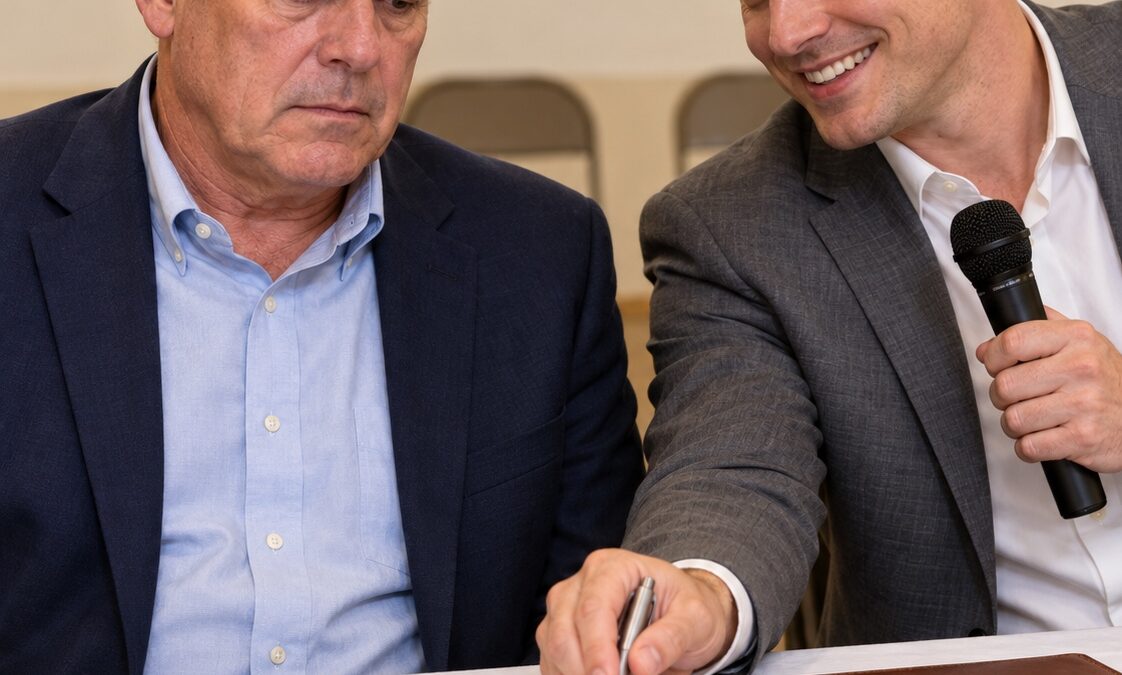
Complete story · 13 parts · about 52 minutes · ending included
Part 1 · Part 2 · Part 3 · Part 4 · Part 5 · Part 6 · Part 7 · Part 8 · Part 9 · Part 10 · Part 11 · Part 12 · Part 13
Part 1 of 13
Cody slid a folder across my dining table, nudging aside the butter dish.
Huffman Family Fund — prepared by Brandt Family Wealth.
He laid a pen on top. A yellow SIGN HERE flag stuck out beneath the closed cover, its arrow pointing toward page five.
“You wired outlets for forty years, Glenn. Let somebody who understands money handle it.”
My son-in-law grinned and laughed loud enough to make Addie look up from her macaroni. Jess lowered her eyes to her plate and pushed a green bean around with her fork.
Cody liked telling people he was “the money guy.” He had an insurance license and worked at his older brother Derek’s used-car lot. He called me Glenn, never Dad.
I was sixty, and I’d spent forty years working with wires that could kill a careless man. On Friday, I’d sold Huffman Electric, my shop on North Third Street. I wasn’t about to sign something without looking inside.
I moved the pen and opened to the first page.
Annuity Application — Cardinal Point Life.
Below were my name, Glenn R. Huffman, and an amount: $522,000.00.
“That’s the retirement part,” Cody said. “I did the hard work already.”
I took out my cell phone. Cedar Run Credit Union had texted me Friday when the sale money arrived. I pulled up the message.
Incoming wire $612,000.00 posted to savings, owner HUFFMAN GLENN R.
I looked from the screen to the smaller figure on the paper.
“Different amounts,” I said.
“Because you’ve got family to take care of.” Cody spread his hands. “I’m building you something better than a savings account.”
Jess was thirty-two, a dental hygienist who spent her days leaning over strangers’ mouths. I glanced at her plate. She’d barely touched the roast chicken I’d made.
“It’s fine, Dad,” she said.
I turned through the application. Dense boxes, tiny print, a blank for my signature. After page four was a separate Kentucky insurance disclosure. One square on the sheet had been checked.
Cody reached over and tapped it.
“That commission box is the company’s form. They make everybody check it. I waive mine for family.”
He left his finger on the sheet until I looked at him. I closed the folder.
“I’ll read it first.”
“It’s five pages of boilerplate, Glenn. Page five, that’s me. I’m just the name on it so the girls never deal with paperwork. It all goes to them anyway. First thing, we get Jess and Addie out of that rental.”
He smiled at Jess as if he’d promised her a front porch. She reached for Addie’s water glass, though it wasn’t empty.
My granddaughter was drawing a house on the back of a grocery receipt. She added two windows and a crooked chimney. Seven years old, second grade, still certain a home needed a tree beside it.
“Grandpa, am I still sleeping here Wednesday?”
“Same as every Wednesday.”
She’d stayed over in the little upstairs room since the winter after Sharon died. Her pink toothbrush lived in the cup beside mine.
“Can we do the light?”
“Let’s see what it does.”
Addie hurried to the front door. When she flipped the porch switch, the bulb outside blinked, steadied, then flickered again. It had been doing that since last fall.
“I ordered the replacement from the supply house,” I told her. “Soon as the new switch comes in, Wednesday night, I’ll show you how to change it.”
“Can I hold the screwdriver?”
“If we turn the breaker off first.”
She nodded and tried the switch once more.
At three, Cody backed his pickup away from the curb on Stephen Foster Avenue. Jess sat in the passenger seat with her hands folded over her purse. Addie pressed her palm to the rear window until they turned the corner.
My two-story wood house went quiet except for the kitchen clock. I cleared four plates and wrapped the leftover chicken.
That evening, I carried the papers to my desk.
I used to read wiring diagrams with a pencil beside me. I followed each circuit from its source and checked every connection. You don’t guess with live wire.
The application listed CP Secure 10 as the product. I drew a question mark next to it. The fine print covered withdrawals and time periods. I’d need somebody to explain what those paragraphs meant.
On page five, a name was typed in block capitals.
C. J. BRANDT.
That was Cody, like he’d said. He’d put his name there so Jess and Addie wouldn’t have to handle forms. I’d never filled out a beneficiary page myself. Sharon managed our household paperwork, and Jess handled her mother’s insurance after the funeral.
Beside Relationship, I found SIL and gave it the second mark in the margin.
Under that: Contingent: NONE.
My third question mark went next to it.
A printed Case Summary was clipped behind the fifth page. Farther down, I found Producer comp. I added my fourth question mark there. Cody had said he’d waive that part for family.
I stacked the sheets without signing.
From my desk drawer I took Sharon’s blue-covered checkbook. The first stub was still in her handwriting: Third Street Pharmacy — Oct. ’22.
Seventeen stubs after that, one a month since the spring before last, carried the same entry. Ron Brenner. $650.
I wrote on the next blank check, Ron Brenner — $650 — Oct., and signed my name.
I slid it into an envelope addressed to Ron and pressed a stamp into the upper corner.
Then I put the book back with the unsigned folder beside it, turned the drawer’s lock, and dropped the key into my shirt pocket.
Cody could wait. That yellow flag said he didn’t plan to.
Part 2 of 13
“Glenn already promised us the down payment — right, Glenn?”
Cody was pouring beer into Derek’s glass when he said it, loud enough to reach the kitchen. Foam rose to the rim.
Everybody at the table turned toward me.
“I said I’d read it.”
Cody set the bottle down and gave me the same easy grin he used when he wanted a customer to quit asking questions.
“That’s Glenn. Never rushes a decision.”
I’d driven myself to the rented duplex on North Fifth Street for Sunday supper. My truck was parked beside the curb, behind Derek’s pickup. Inside, the dining table had been pulled away from the wall so six of us could fit around it. Addie sat on a cushion to reach her plate.
At thirty-seven, Derek owned the used-car lot on US-31E where Cody worked. His wife sat beside him, cutting her meat into small pieces.
Cody slid his chair back and reached for a paper napkin.
“Let me show you something.”
He flattened it between the ketchup bottle and his plate, then borrowed Addie’s blue marker. Along the bottom he drew a row of short ticks. Above them, a curve rose slowly at first, then climbed sharply into the upper corner.
“Compound interest,” Cody said. “Your earnings start earning, too. You leave money sitting in the wrong place, you miss that climb.”
He angled the drawing toward Derek and his wife. The small labels were barely readable.
“That’s why they call me the money guy.”
Derek lifted his glass. “You’ve got an answer for everything.”
“I’m treasurer of the building fund at Grace now — Pastor Gary and I sign every check.”
Cody said that while tracing the rising line with his marker. He belonged to Grace Community Church and mentioned the treasurer job whenever anyone asked about his work.
Derek leaned back and laughed.
“So how much are you making off your father-in-law’s deal?”
For a moment Cody’s marker stopped moving. Then he laid it on the table and put a hand on Jess’s shoulder.
“I don’t make a dime off family. This is for Jess and Addie.”
Jess nodded. Her potatoes sat untouched. Cody tightened his grip briefly, then took his hand away.
Addie pushed a pea to the edge of her plate.
“Can I have my marker back?”
“Here you go, sweetheart.”
He capped it and handed it back without looking at her.
I took a bite of chicken. The crust had gone soft where the gravy touched it. Jess had cooked more than we needed, the way Sharon used to when company came over. There was plenty left.
Cody picked up the napkin and held it toward me.
“See what I’m saying, Glenn?”
“I see the curve.”
“That isn’t the same as understanding it.”
He smiled and folded his little chart in half. Derek took a sip of his drink.
“Glenn still writes paper checks,” Cody said.
Derek and Cody laughed. Addie giggled along with them. Jess managed a small smile. I set my napkin down beside my plate. Derek’s wife kept her lips pressed together. She looked across the table at me, then lowered her fork.
I’d paid suppliers by check for thirty years. If a statement didn’t match an invoice, I could lay both papers on the counter. No guessing.
“Listen to the man,” Derek said.
“I’m listening,” I told him.
Cody took the last piece of bread from the basket.
“Next time, bring your ID so we can move it by October eighteenth.”
He said it as though we had settled something.
I put down my fork.
“I’ll read what you want me to sign.”
Cody wiped his mouth with the napkin he’d drawn on, leaving a brown streak across the curve. He asked Derek whether a sedan on the lot had sold. They talked about its bad transmission.
Jess carried plates into the kitchen. I started to stand, but she shook her head and took mine, too.
At the front door, I put on my jacket. The hallway smelled of dish soap and cinnamon.
Addie came running from the living room with a sheet of paper held in both hands.
“I made this for you, Grandpa.”
It showed a house with a white porch. One window was colored pink. Across the roof she’d written 2214 BIRCHWOOD in careful block letters.
A yellow sticky note with a printed star in one corner covered part of the pink square. In Addie’s handwriting were the words MY ROOM.
“See? That’s where my bed goes.”
She tapped the drawing with one finger, keeping the note in place.
“Mom gave me a whole pad of these star notes for my birthday,” she said. “I can put them on anything.”
“That’s a useful present.”
“I’m bringing some Wednesday.”
“Your room upstairs has plenty of places for them.”
She hugged me around the waist. Behind her, Jess stood by the kitchen doorway, drying her hands on a dish towel. Cody was still talking in the dining room.
I carried the drawing outside without folding it.
In my truck, I switched on the dome light and turned the sheet over. The upper edge was ragged where it had been torn from a promotional notepad. On the back was a printed logo and a line of words:
Limestone Ridge Mortgage — Your Home Starts Here.
I turned it toward the light again. The front held an adult’s faint handwriting beneath Addie’s crayon address. She’d copied each letter and even the spaces between them.
A lender. A specific house.
They’d already picked it.
I hadn’t promised a dollar.
Part 3 of 13
At 7:00 a.m. Tuesday, September 23, I carried Cody’s folder across Stephen Foster Avenue to Donna Fultz’s driveway.
I’d been watching for her car since Sunday night, when I turned Addie’s drawing over under my dome light. My neighbor had left at five Monday morning to collect paperwork in Louisville for her sister’s surgery and hadn’t come back until after midnight.
Now her trunk was open, and she was lifting a suitcase onto the bumper.
“Got a minute?” I asked.
“For you, yes. Make it quick.”
Donna had lived across from me for twenty-five years and was Sharon’s best friend. Before she retired, she’d spent thirty years in the annuity service department of an insurance company in Louisville.
Sharon used to say, “Donna reads paper for a living.”
I handed her the packet.
“Cody wants me to sign this.”
Donna rested it against the rear fender and opened the cover. She read the heading on page one, then tapped the printed words Annuity Application.
“That’s not a fund, Glenn. That’s an annuity application. Don’t sign a thing till I’m back and read every page. Don’t call anybody about it, don’t argue with him — you’ll just warn him.”
She closed the cover without going any farther.
“My sister’s having knee surgery in Lexington. I’m driving there to look after her while she recovers. I’ll be back Saturday, October 4.”
“Then I’ll see you after that.”
“Bring the whole packet.”
She handed the papers back, then pushed her suitcase into the trunk. I stepped away while she lowered the lid, climbed behind the wheel, and backed into the street.
Through the windshield, she gave me a quick wave.
I watched her drive off, then walked home.
At my desk, I laid the application next to a stack of old electrical invoices. Forty years of wiring had taught me to read every line of a diagram before I put a hand near a live connection.
Donna had examined only the beginning. She’d told me exactly what she knew.
Nothing had my signature. The money from selling Huffman Electric still sat in my savings account at Cedar Run Credit Union, under my name alone.
October eighteenth was weeks away.
I put everything back in the drawer and locked it.
At noon Wednesday, September 24, I found a plain white envelope in my mailbox.
No return address.
The postmark read Bardstown, September 23.
Inside was a single yellow sticky note with a small printed star in one corner.
Someone had written in square block capitals, pressing hard enough to leave grooves in the paper.
DON’T SIGN ANYTHING UNTIL SOMEBODY ELSE READS EVERY PAGE. PLEASE.
I held it under the kitchen light.
There was no signature. The back was blank except for the adhesive strip.
I unlocked my desk drawer and lifted out Sharon’s checkbook. Her handwriting was still on the first stub, from the pharmacy purchase she’d made the month before she died.
The warning went inside the front cover. I closed the book and put it back.
In the kitchen, Addie’s drawing hung on the refrigerator where I’d taped it Sunday night.
The house had a white porch and a pink window. Her crayon address still ran across the roof.
A small yellow note covered part of her bedroom.
MY ROOM.
I looked at the little printed star.
The same kind.
I thought about Jess.
My daughter had always written with round letters. Even when she left notes on my counter as a teenager, her capitals had curves to them.
These were square, with sharp corners.
And on Sunday she’d nodded at everything Cody said. She’d sat beside him while he made promises with my money that I hadn’t agreed to.
I curled my fingers around the refrigerator handle.
The dollar store on Third Street sold those exact pads. They hung in strips beside the register, right where I bought my stamps.
Anybody could have one.
I remembered Derek’s wife.
At Sunday supper, she’d pressed her lips together while Cody made fun of my paper checks. She’d watched me across the table, then lowered her fork.
Right in front of her, Cody had told me to bring my ID.
If somebody at that dinner wanted to warn me without giving a name, she’d be my first guess.
Donna would have said it to my face. She’d never been one to hide behind a stamp, and she was already on the road to Lexington when the letter was mailed.
I left Addie’s picture hanging where she could see it that night.
Cody had told a whole table this was for Jess and Addie, so I took out my cell phone and dialed Ron Brenner.
“Did his full rent come this month?” I asked.
“Your check came. His thousand came. Same as always, sparky.”
I watched a car pass the front window and ended the call.
Wednesday afternoon, I heard tires on my gravel driveway.
Cody’s pickup rolled in and stopped beside my truck.
I went outside.
He stayed in the driver’s seat with the engine running. The window came down, and he held out a sheet of paper covered in names.
A handwritten guest list.
I walked over to his door.
Jess would bring Addie that evening for her regular Wednesday sleepover. The new porch-light switch still hadn’t arrived from the supply house, so I’d have to promise Addie we’d change it next Wednesday.
I wasn’t going to ask my granddaughter anything about that warning.
Cody extended the list a little farther.
I could see names in two columns, with several squeezed into the margins. Some had check marks beside them.
He tapped the steering wheel.
I looked at the sheet but left it in his fingers.
Cody grinned.
“I booked the Veterans Hall for your retirement. October eighteenth, thirty-two people. You can sign in front of everybody if you’re still ‘reading.’”
Part 4 of 13
The thick envelope caught against the lip of my mailbox when I pulled it out around noon Friday, September 26.
Limestone Ridge Mortgage was printed in the upper left corner. On the line above my street address, one word followed my name.
Glenn R. Huffman — Donor.
I stood on the front steps with the mail tucked under my arm. The sender was the same lender from the back of Addie’s drawing.
Inside, a letter signed by Kelsey Moran, loan officer, sat on top of a stack of forms. I carried everything to the kitchen and spread the sheets across the table.
The first document named the property: 2214 Birchwood Drive.
Borrowers: Cody J. Brandt and Jessica H. Brandt.
Closing date: October 31.
My daughter’s name was printed in the same type as Cody’s. There was no space marked for my approval on that page.
The next sheet was already prepared for me to sign. A gift letter.
$90,000.
Below the amount were the words no repayment expected. The form said I was giving the money toward the house. At the bottom was a blank line for the donor’s signature.
I laid my index finger along it. Cody had told a roomful of people I had promised the down payment. Now somebody I’d never met was waiting for my name in ink.
I returned to the cover sheet.
“Cody let us know you don’t use email, so I’m mailing this for your wet signature. Per Cody, you confirmed the $90,000 gift by phone on 9/10. Please sign and return the enclosed letter by 10/22.”
Below that, the lender requested a bank statement showing I had the funds. I wasn’t supplying proof for money I hadn’t agreed to give.
September 10.
I pulled out my cell phone and opened the call history, scrolling back to that Wednesday. The shop’s old number had forwarded to this phone for years. There wasn’t another line where a conversation could have gone.
Three calls from the dentist in Elizabethtown. I’d spent that entire day wiring his office. He’d needed to know when we could turn the power back on to the rooms at the rear.
One call from the electrical supply house.
Nothing from Cody.
I went through the entries from morning to evening, keeping my thumb against the edge of the screen. The list agreed with everything I remembered about that day.
Back at the table, I picked up Kelsey’s letter. The final paragraph was still unread, and my hands weren’t steady enough for it yet. I creased the page into thirds, then folded it in half and carried it to my desk.
My key opened the drawer. The checkbook lay beside the unsigned annuity application. I turned back its front cover. The warning that had arrived Wednesday rested there, its little printed star near the spine.
I slipped the mortgage correspondence in with it, leaving both pieces flat enough to find again. The blank gift form went underneath the other papers. I locked the drawer and put the key in my shirt pocket.
The property sheet still lay on the kitchen table.
I carried it to the refrigerator and held it next to Addie’s picture. Her white porch tipped sideways under a strip of tape. The company logo was the one I’d seen on the back of her artwork Sunday night, down to the lettering beneath it.
Her crayon address matched the typed line on the official document.
I thought about her showing me the pink bedroom. She’d pointed at that square as though somebody had already told her which window would be hers.
Donna’s cell number was in my contacts. I dialed it.
“Donna? It’s Glenn. Something else came in the mail.”
A speaker crackled behind her. I heard a hospital operator page a doctor, then footsteps and a door shutting.
“I’m in the hallway,” she said. “What happened?”
“More papers about Cody’s house.”
“Honey, I can’t read contracts over the phone. Pieces lie. Every page, my kitchen, when I’m back. Don’t sign, don’t call anybody, don’t argue.”
“All right.”
She had her sister to tend to. I ended the call without reading her a line.
I sat down at the table with the Birchwood page. Kelsey’s direct number was printed along its bottom edge. I touched it and started entering the digits on my phone.
Then I stopped.
Cody handled everything with the mortgage company. A question from me would reach him within the hour. He’d tell Jess and the church people I was getting confused about a promise I’d made.
My finger stayed above the last number.
If I never signed that gift form, there was no gift from me. They could print my name on as many sheets as they wanted. The money was still in my account.
I cleared the screen and set the phone facedown.
Across the kitchen, Addie’s drawing still hung on the refrigerator. I got up and smoothed the tape where it had pulled loose. There was no blaming her for wanting a room with pink curtains. Cody was the grown man who had promised her that house.
Back at my desk, the key turned again, and I took the folded letter out of the checkbook. My hands were steady now. I opened the creases and read the paragraph I’d left.
“The purchase contract was signed 9/8 and closing is 10/31, so we’re on a tight timeline.”
Cody had agreed to buy that house four days before my shop money arrived.
Part 5 of 13
Donna had told me not to argue with Cody. I was walking up his drive to do it anyway. Water sheeted off his pickup hood and ran into the gravel.
He stood beside the front tire with a garden hose in his hand. The duplex door was propped open. From inside came Addie’s voice asking Jess whether the ice cream place had rainbow sprinkles.
Jess and I had arranged this outing by phone Thursday. I’d driven over at noon with Addie’s booster seat buckled into the back of my truck.
Cody aimed the spray at the wheel well.
“She’s almost ready,” he said, and grinned at me over the hood.
I stayed near the edge of the grass. The lie about a September tenth phone call had my name in it. I wanted to give Cody one chance to own it, with no audience, before Jess or Addie got pulled in.
He shut off the nozzle. Water dripped from the chrome bumper.
“What do you make off this, Cody?” I asked, keeping my voice low.
“Not a dime. It’s family.”
He said it without looking at me. His thumb worked the brass fitting where the hose joined the nozzle, tightening something that wasn’t loose.
“Did you tell a bank I called you on September tenth?”
The twisting stopped.
Cody lifted his head. The grin was gone. He glanced at the open doorway and pitched his voice to carry inside.
“Your dad’s getting confused, Jess. He’s forgetting calls now.”
A screen door creaked against its spring. Jess appeared in the entry with one hand on the frame. She had a dish towel over her shoulder and no shoes on. The color had gone from her face.
I made no answer.
Cody dropped the nozzle onto the lawn. It rolled against the tire, and a narrow stream of runoff crossed the driveway.
“Dad?” Jess said.
I looked at her, then at the open space behind her. Somewhere inside, Addie dragged a chair across the kitchen floor.
Jess came down the front steps and walked as far as the curbside end of the path. She stopped close enough that I could hear her without her raising her voice. Cody had turned back to the pickup. Water dripping onto the gravel filled the pause.
“One more word against him and Cody takes the Charlotte job. He means it, Dad.”
Charlotte. North Carolina. A long drive from Bardstown.
I’d never heard about any job there.
Her bare toes curled against the edge of the concrete. Jess kept her eyes on the ground until I nodded once.
She went back to the entrance, held the screen open, and told Addie there would be no ice cream today. The child’s answer was too low for me to make out. Then the inner door shut.
Cody picked up his hose and went back to the wheel well, whistling, as if I’d already left.
Her booster seat rode empty all the way back to Stephen Foster Avenue.
At home, I parked in my usual spot by the side yard. On Wednesdays she’d carry her overnight things through the front door herself, her shoes knocking against the step while she told me about school.
I came in with nothing but my keys.
The kitchen was as I’d left it. Her drawing still hung on the refrigerator. I stood at the counter for a while, looking at the window she’d colored pink.
Then I set my keys beside the sink.
The afternoon sun had reached the living-room rug when Jess pulled up outside. This time she had driven her own car. Addie sat in her booster in the back, looking out past her mother’s shoulder.
I walked onto the front porch.
Jess remained in the driver’s seat and lowered her window. She asked me to get the pink sleeping bag from upstairs and Addie’s toothbrush from the cup in my bathroom.
I waited for her to say why. Her phone lay face-up in the cup holder, Cody’s name glowing at the top of the screen. She stared at the steering wheel.
“All right,” I said. Arguing at her car window would only cost her more once she got home.
The little room at the top of the stairs smelled faintly of the strawberry shampoo Addie used after her baths. Her sleeping bag was rolled at the foot of the bed. One end of the drawstring had slipped loose, so I tucked it under the strap before carrying it into the hall.
In the bathroom, our brushes stood together in the ceramic cup Sharon had kept by the basin. Addie’s was smaller, pink, with tooth marks along the handle where she’d chewed it while deciding what to tell me about her day.
Every Wednesday since my first winter alone, she’d slept under my roof. She liked a story before bed, or showing me how her teacher wrote a word on the board. I knew which stair squeaked when she crept down for water.
I lifted the smaller brush out. The bristles had dried stiff since Thursday morning.
Outside, Jess had put the car in park. I passed the rolled bedding through her open window. She settled it on the empty seat beside her, then took the toothbrush between two fingers.
“No Wednesdays for a while. Cody thinks it’s better until you’re… yourself.”
Her mouth tightened on the last word. Addie watched us from the back, her hands resting on the belt across her lap.
I stepped away so Jess could close the window.
She shifted into drive. I went back up the porch steps and gripped the railing as she pulled away. At the corner, before they turned off Stephen Foster Avenue, Addie’s hand pressed flat against the rear glass.
Inside, only my own toothbrush was left in the bathroom cup.
Part 6 of 13
The new porch-light switch came in from the supply house on Monday, and Wednesday night there was nobody to hold the screwdriver.
October 1 was the first Wednesday in nearly three years that Addie didn’t come for supper. I ate the leftover meatloaf standing at the counter and left the extra place mat folded in the cabinet.
After dark, I carried my toolbox onto the front porch and set the part beside it, still in its cardboard sleeve, directly under the fixture that kept flickering.
I opened the case, checked that the insulated driver was in its slot, and shut the lid again. I carried both things indoors, the new switch unopened, without touching the wall plate.
My cell phone showed no message.
On Saturday afternoon, October 4, I parked on North Fifth Street, on the opposite curb a little way down from the duplex.
I left the engine off. Cody’s pickup stood in the drive, which meant he’d come home early from Derek’s lot.
Addie sat at a small table by the front window, head bent over a white page. Her crayon moved in short, hard strokes.
Three yellow squares were still stuck low on the pane. From my seat, they were only patches of color. I couldn’t make out anything written on them.
A sedan passed between us. When it cleared, her hair brushed the tabletop.
Then she looked up.
I kept my hand on the wheel. For a second I thought she was looking at another car.
She sprang from her chair.
“Grandpa’s truck!”
Her shout reached me faintly through the glass. She ran deeper into the house, leaving her picture where it lay.
I sat straighter but left the door handle alone.
Addie hurried back with a fresh white sheet. She pressed it flat on the table and went at it with a crayon, her whole arm moving.
From a tape dispenser at her elbow, she tore two clear strips, tipping it sideways.
Standing on tiptoe, she fixed the paper to the pane. One piece held the top left; she smoothed the other along the right edge with her palm.
Then she stepped away.
WED?
The letters were thick as my thumb. The question mark trailed nearly to the bottom.
I lifted one hand from the steering wheel. She saw it. Her mouth opened, and she brought both palms up against the glass.
Someone came into the room behind her.
Jess stood there, arms at her sides, looking directly at my pickup. Her face held perfectly still, her eyes fixed on the spot where I sat.
I kept my arm raised. A long moment passed while the little girl turned and looked up at her mother.
Jess didn’t wave.
She took Addie by the hand, led her away from the window, and reached back for the blind. It came down in uneven little drops behind the taped sheet until the room disappeared.
Only Addie’s paper remained, white on the shut slats. The tape held.
Cody must have heard Addie’s shout from somewhere in the back. Seconds after the blind touched the sill, the front door opened.
He stepped onto the stoop with his phone in one hand. Without a glance up or down the block, Cody looked straight at my truck.
His thumb brushed the screen. He never came down the steps; he just turned and went back inside.
My cell buzzed on the passenger seat.
Cody: “Saw you parked out front. Charlotte offer’s real. Seven hours away. We’d be gone by Thanksgiving. Sign at the party and we stay.”
I held the screen where I could see all of it. On the other side of the road, the WED? sheet still hung against the closed blind.
I didn’t type a reply. I set the phone facedown, started the engine, and drove home.
That evening, at my desk, I unlocked the bottom drawer with the key from my shirt pocket.
I moved Sharon’s blue checkbook onto the desktop to reach Kelsey’s gift letter beneath Cody’s folder. I lifted the unsigned form free and laid it square in front of me. The amount was already printed. So was my name. Only the donor’s signature line remained empty.
My phone lay by the lamp. I woke the screen, and Cody’s text came up again: Sign at the party and we stay. I picked up my pen and put its tip on the thin black rule.
The book was in the way of my elbow. When I lifted it, a square of yellow paper slipped from inside the front cover and landed faceup across the lender’s form.
DON’T SIGN ANYTHING UNTIL SOMEBODY ELSE READS EVERY PAGE. PLEASE.
The small printed star sat beside the first word. I held the book above the desk while I looked at those block capitals.
The ballpoint was still resting on the blank line. I moved it over to the blotter.
I returned the unsigned gift form to its place under the folder and slipped the note back into the checkbook cover. Then I put the book away, turned the key, and tested the lock with my thumb.
Later I sat on the front porch beneath the faulty light. Its glow caught the edge of the empty chair beside mine, went dim, then brightened.
Headlights turned into Donna’s driveway across Stephen Foster Avenue. I watched her park and get out, still wearing the travel jacket she’d taken to Lexington. She noticed me before reaching her front steps.
Instead of going into her house, Donna crossed the street. She came up my walk with her car keys in her hand.
She stopped beside the spare chair.
“Tell me you didn’t sign.”
I shook my head and pointed toward the house, where the locked drawer held the papers.
“Good. Bring me every page he gave you — every one. Tomorrow after church, my kitchen.”
Part 7 of 13
Donna caught the staple with her thumbnail and worked it out of Cody’s packet without tearing the corner.
Her reading glasses sat low on her nose. She put the bent metal beside a coffee cup and laid the contents across her kitchen table, one sheet at a time. I sat opposite her as she arranged the forms in order.
Thirty years of forms like these had crossed her desk in Louisville. I had brought her every piece Cody gave me. All four of my penciled question marks were still in the margins.
It was Sunday afternoon, October 5. Through the window I could see my house across Stephen Foster Avenue.
Donna angled the first page toward the light and found the product name.
“CP Secure 10 — that’s ten years of surrender charges. Nine percent if you touch it the first year.”
I looked at $522,000 printed beneath my name. Touching my own money would cost me nine cents on the dollar. I kept my hands in my lap.
She moved the opening sheet aside, keeping it within reach, and worked down through the rest. At the bottom of page four, my son-in-law’s name was typed next to Agent, with a signature line below.
The separate Kentucky disclosure had been clipped just behind it. Donna smoothed the crease beside a checked square marked commission.
“He said he waives it for family.”
She pressed that sheet flat with her palm.
“There’s no box on this application to give it back to anybody, Glenn. The company pays the agent when you sign — that’s what this disclosure is telling you. Producer means the agent. Him.”
I’d watched Cody hold his finger on that marked square at my dining table. He’d looked straight at me while he said it.
Donna reached past the fifth page and slid out the printed Case Summary lying under it. My fourth question mark sat next to Producer comp. She drew the sheet toward herself.
“This is his case summary from the marketing company. He wasn’t supposed to leave it in. Producer comp, seven percent — thirty-six thousand, five hundred forty dollars. Target close: October eighteenth.”
I leaned closer to the date.
“That’s my party.”
The clock above the stove clicked. She turned the summary toward me.
Cody had held his handwritten guest list out of his truck window back in September. He wanted me in the Veterans Hall with people watching as I picked up his pen. Now the target date was sitting there in type.
“He told me the same thing twice,” I said. “Not a dime. It’s family.”
Donna lifted her pen and tapped the figure once.
“Paper doesn’t lie, Glenn. People fill it out.”
I kept my eyes on the comma in $36,540.00. All those years I’d checked supplier invoices against my own records. If the amounts didn’t agree, I held the check until somebody explained the difference.
I’d asked Cody what he made off this. He’d given me an answer. Now I had the company’s.
I looked at the signature line on the application again. His agent section was still empty in this copy. So was my place at the end.
“He wants me to sign at the retirement dinner,” I said.
Donna brought the cover back toward me.
“Let him put his own copy in front of you.”
I tapped one corner of the stack with my knuckle.
“With Pastor Gary and the family right there?”
She kept her hand on the folder until I looked up.
“That’s where he wants to do it, isn’t it?”
I nodded. We worked it out across her table. Whatever Cody had put his name to before the party, my line would stay blank. I was finished arguing with him in private. He could set his application down himself and let everyone see what he was asking.
Raising one finger, Donna said, “Start with page five, one line. You’ll see why.”
She moved the summary beside my elbow. I put the flat of my hand against its bottom edge.
“Then I read this amount to the room, off the paper he left in.”
She nodded and slid the cover across the wood. I pushed it back to her with empty hands.
“He gets his folder back unsigned,” I said.
Donna held the sheet steady.
“And you keep this,” she said, resting her knuckle near the commission figure.
I pictured Cody smiling at the hall while he explained my confusion to the guests. He’d already told Jess I was forgetting things.
“If he says it’s routine paperwork and I’m getting confused, Jess might believe him. He’s got that job offer in Charlotte. He could take Addie there, and I could lose her for good.”
I rubbed the seam of my trousers. Wednesday nights had been quiet since Jess took Addie’s sleeping bag home.
Shaking her head, Donna said, “Then don’t explain. Read. Let the paper talk.”
She drew page five into the middle of the table. My second and third question marks sat in its margin. The Case Summary stayed beside my arm, and the disclosure lay back with page four.
“Always find the beneficiary page first. Then ask what he gets paid.”
I leaned forward. Cody had told me his name was there to spare Jess and Addie the trouble of paperwork. He’d promised it would all go to them anyway.
Donna moved her glasses up her nose, found the beginning of the typed line, and traced it left to right.
“Primary Beneficiary: C. J. Brandt. SIL — son-in-law. One hundred percent. Contingent: none. A beneficiary doesn’t hold anything for anybody, Glenn. It’s his. All of it. And there’s no backup name — Jess and Addie aren’t on this page.”
She set her finger under the word NONE and kept it there, on the spot where Jess’s name and Addie’s name should have been.
Part 8 of 13
My cell phone buzzed against the kitchen counter while I was rinsing my coffee cup, and Cody’s name lit the screen.
It was Saturday, October 11. He had sent a guest list, a photograph, and a message. I dried my hands before opening any of them.
The names accounted for thirty-two people. Near the bottom was “Pastor Gary + 2 elders.” Then came the sheet cake, “Glenn’s Next Chapter” printed across the top.
I could already see Cody waving guests toward their seats.
His message was longer.
“Bring your ID and Kelsey’s letter. We’ll sign it all at the table, nice and easy. I’ll drive you to the credit union and the post office Monday the twentieth — she needs it by the 22nd.”
He’d arranged the party, the paperwork, and even my ride. At the hall he wanted an audience for my signature. On Monday he expected me at Cedar Run Credit Union.
I set the phone faceup beside the sink. The cake remained on the screen until it went dark.
That evening Ron Brenner called while I was wiping down the kitchen table.
“He gave me notice for the thirty-first. Says you’re buying them a house. I signed a new family for November, sparky — I had to.”
The cloth stopped in my hand. Cody had given up the roof over Jess and Addie before the new one was theirs.
“I asked him straight, Ron. He said ‘not a dime.’”
Something scraped at Ron’s end. He was quiet a moment.
“Then you gave him his chance.”
After we hung up, I left the cloth draped over the faucet and climbed the stairs. Addie’s little room faced the street. Her bed was made, though nobody had slept in it since the last Wednesday in September.
From the hall closet I took clean linens and changed the bedding. One pillowcase caught on a seam. I worked it loose and set the pillow close to the wall, where Addie liked it.
Her bedroom door stayed open when I went downstairs.
At 5:30 p.m. Tuesday, October 14, I was on my front porch when Cody’s pickup stopped at the curb. Its engine kept running. Jess got out, leaving the passenger window down.
She hurried up the path and stood below the steps. Cody sat behind the wheel, close enough to hear. Jess spoke fast, keeping her voice raised toward the cab.
“Please, Dad. Just sign at the party. If you embarrass him, I can’t keep bringing Addie around.”
Her key ring trembled. She closed her fist over the keys and glanced toward the pickup, then back at me.
My palm rested on the railing. Nothing I said would stay on this porch.
“I heard you, Jess.”
She searched my face. I kept Donna’s advice to myself. Jess pushed a loose strand of hair behind her ear and looked back at the street.
At the curb, Cody tapped the steering wheel twice. I let her go without making a promise.
She got into the passenger seat. They drove away once her door shut. I watched until the taillights disappeared.
The next envelope from Limestone Ridge Mortgage arrived in Thursday’s mail, October 16. I opened it beside the mailbox. Kelsey Moran had sent another reminder and an undated replacement gift form, its signature line blank.
Her note said:
“Cody let us know you’ll be signing this weekend. Please mail the letter back to me directly — we can only accept it from the donor.”
Kelsey needed that paper from me, not Cody. The October 22 deadline had not moved. Once again he had answered for me, just as he’d done with a September phone call I never made.
In my desk drawer, under Cody’s folder, the replacement joined the first gift form, both donor lines still blank.
On the night before the party, I unlocked the drawer and lifted out the loose pages Donna had unstapled in her kitchen.
The Case Summary lay behind the application, my penciled question mark still beside the commission line.
I folded the sheet in thirds, then in half. Sharon’s checkbook lay below the paperwork. Kelsey’s first cover letter and the unsigned yellow warning were tucked inside, the tiny printed star showing above the edge.
The summary went in beside them, and the cover still shut flat. I put the rest of the pages back with the gift forms, locked the drawer, and slipped the book into the inside pocket of my sport coat, already hanging on the closet door for tomorrow.
Outside, footsteps came up my front walk. Donna had crossed from her house and was waiting by the porch steps when I opened the door.
Overhead, the light on its old switch flickered across her sleeve. She glanced up at the fixture before turning to me.
“What happens if Cody reprints page five differently?” I asked.
Donna rested her hand on the railing.
“He won’t retype a page he thinks you can’t read. He’ll print the same pages.”
I glanced over my shoulder at the coat ready by the closet. She waited until I turned around.
“You’re really going to stand up in that hall?”
I looked across the street, where her kitchen window was lit.
“It’s my party, Donna. Somebody ought to read the fine print.”
Part 9 of 13
I turned my truck into the Nelson County Veterans Hall lot at 5:40, Sharon’s blue-covered checkbook riding in the inside pocket of my sport coat.
My cell phone sat in there with it. The unsigned gift letters stayed locked in my desk drawer at home.
Through the glass doors I saw white tablecloths and folding chairs. I parked, straightened my collar in the mirror, and went inside.
Cody met me at the door with the hall’s wireless handheld microphone. He raised an arm to guide me forward.
At the center of the head table he drew out a chair for me, then pointed to a photo board Jess had made. Across its top, in large careful letters, she’d written “40 Years of Glenn Huffman.”
One picture showed Huffman Electric on North Third Street, the sign above its door. Farther down, Sharon stood beside me in a photograph I hadn’t seen in years. Her hair blew across her cheek.
I kept my eyes on it until Cody moved on.
Directly in front of us, Pastor Gary and the two elders sat at table one. Over the microphone, Cody called them “the folks who trust me with our building fund.” At table two were Jess, Addie, Derek, and his wife. Table three held Ron, Donna, and six men who had worked for me at the shop. The other church friends and neighbors filled the hall.
Ron raised his chin when he saw me. Donna met my gaze, then folded her hands on the tablecloth. Neither spoke.
I sat before a place card bearing my name. Cody had left the photo board close enough for me to see Sharon without turning my head.
Dinner was chicken, mashed potatoes, and green beans. I ate slowly. One of the old crew caught my eye as he talked about pulling cable through a tight wall. He lifted his fork in my direction. I nodded.
A photograph hung crooked near the bottom of Jess’s display. Ordinarily she’d have come to straighten it. Tonight she stayed beside Addie.
My granddaughter kept smoothing the napkin over her knees. She hadn’t asked me a question all evening.
When the main course was finished, Cody stepped in front of the head table. He lifted the microphone, waited until the talk settled, and began a story about visiting my shop.
“I stopped by Huffman Electric once, and Glenn was putting stamps on a whole stack of supplier envelopes. Took him till closing.”
Cody turned toward Pastor Gary, pausing as though he had practiced the timing.
“Glenn’s great with a wire stripper. Numbers? Man wrote paper checks for thirty years — still would if you let him.”
Laughter rose around the room. At table three, one of my former electricians put down his fork. Addie didn’t smile. Her eyes moved from Cody to me, and the edge of her napkin slipped from her fingers.
Not one of those checks had ever bounced. He knew that.
Cody let the noise die down, then raised the microphone again.
“Glenn promised us weeks ago, so here’s the plan. From now on, I’ll be managing Glenn’s business money — and I don’t make a dime off family. First job — getting Jess and Addie into 2214 Birchwood.”
He stepped around to the empty chair beside mine, picked up a leather folder, and laid it square in front of me. Then he set a new pen on top, almost in line with my place card.
The room clapped. Derek struck his palms together above his plate. Pastor Gary joined in, looking toward me as if the arrangement had already been settled.
Cody bent until his face was near mine, turning the microphone away from us.
“You bring Kelsey’s letter?”
I looked down at the ballpoint. The envelope had come to my mailbox, addressed to the donor.
“It’s in my drawer.”
Cody kept smiling for the people beyond my shoulder. He nudged the leather cover with a finger.
“Sign these, we’ll grab it after.”
I moved the pen aside and opened the folder. The annuity application inside was freshly printed. Beginning at the front, I turned each sheet separately and kept the corners flat.
At the bottom of page four, Cody’s signature filled the Agent line. The ink was dark and firm. I continued past the separate disclosure, then flattened page five under my palm.
Nothing had changed. The typed name, the relationship, the entry at the bottom all matched the copy in my locked drawer.
At table two, Jess closed her fingers around Addie’s hand. My daughter’s grip stayed firm, and my granddaughter watched the paper.
“Sign it, Glenn!” Derek called.
Cody offered me the microphone. I didn’t reach for it.
“Forty years of shouting over generators, son. I don’t need that.”
He held it out another moment. I touched the front of my coat once, where Sharon’s checkbook rested behind the lining, then lowered my arm.
“I’ll read it first.”
I pushed my chair back with my leg and rose, the leather folder open at page five between my hands. Thirty-two faces turned up toward me.
Part 10 of 13
“I’ll start with one line.”
I held the application at chest height, flattening the curling corner with my thumb. My name was printed at the top. The space meant for my signature waited below the last box. Cody watched me instead of the words.
“Primary Beneficiary: C. J. Brandt. Relationship: S-I-L. One hundred percent.”
The hall’s ceiling fan rattled. A fork scraped against china, then stopped.
At table two, Jess let go of Addie’s hand. My granddaughter laid both palms flat on the tablecloth. Jess stared at the print as though she were trying to find room for another name.
Cody laughed into the microphone, the sound coming back from the far wall.
“That’s standard paperwork, folks. Somebody’s got to be named — I’d take care of my girls.”
He faced the church friends while he said it. At my dining table he’d told me his name was there to spare the girls the trouble. I let him finish.
My eyes moved to the next entry.
“Contingent Beneficiary: none.”
Cody’s fingers slid down the microphone handle. Nobody joined his laugh.
Pastor Gary put down his fork at table one. He rose, passed the folding chairs, and came up behind my shoulder. I held the paper steady.
He leaned in and followed the type across the page.
“S-I-L. Son-in-law, one hundred percent. Contingent, none. There’s no other name on it, Cody.”
Addie tipped her chin up to watch him speak. Jess pressed her fingertips together until they whitened.
Pastor Gary returned to his seat. Neither elder moved. Cody kept the wireless microphone close to his chin, but nothing came through the speaker.
I laid the application open on the head table and reached inside my sport coat. Sharon’s blue-covered checkbook caught against the lining before I freed it.
Under the cover were the papers I’d put away on Friday night. I held them in place with my thumb and withdrew the Case Summary, folded in thirds, then in half. The creases resisted as I spread it flat.
My penciled question mark sat beside Producer comp. The date appeared under the amount.
“Producer comp, seven percent. Thirty-six thousand, five hundred forty dollars. Target close, October eighteenth.”
A chair leg tapped against the floor. I showed the figures to the front tables. Earlier, Cody had said he didn’t make a dime off family.
He turned toward the guests, giving the microphone a firm grip.
“Glenn’s been slipping since Sharon passed — he doesn’t even know what he’s reading.”
Sharon’s name carried to the last table. Jess looked down. My wife’s photograph was taped to the display board beside me, one corner lifting.
I kept my gaze on her face while I folded the Case Summary along its creases and tucked it under the blue cover.
“Five hundred twenty-two thousand at seven percent is thirty-six thousand, five hundred forty. I figured it twice.”
Cody stared at the checkbook as though the number might change. At table two, Derek got to his feet behind his chair.
Next I drew out Kelsey Moran’s letter from September, opened its creases, and found the line meant for me as the donor.
“Per Cody, you confirmed the $90,000 gift by phone on 9/10.”
Those were his words to the lender, not mine.
I set the letter beside the application and took my cell phone from my coat. With my thumb I opened the log for September 10: three calls from my customer, one from the electrical supply house. I held the screen toward the room. None of the entries was Cody’s.
“I was in Elizabethtown wiring a dentist’s office all day. We never spoke on the phone that day. Not once.”
Jess pushed back her chair, and it squealed on the boards. She stood and reached for Addie, who slipped off her seat without taking her eyes from me.
My daughter brought her up to the empty chair on my right. Addie climbed onto it and caught a fistful of her mother’s sleeve.
Jess looked straight at Cody.
“You said it was for Addie. Addie’s not even on the page.”
Cody lowered the microphone to his hip. His mouth opened, but he said nothing. Derek sat down and looked at his plate.
A guest farther back muttered, “That was a lot, in front of everybody.”
Ron answered from table three. He hadn’t left his chair, and he didn’t raise his voice.
“He gave him every chance to stop.”
Beside him, Donna said nothing; she only moved his water glass an inch closer. I put the cover letter back inside the blue checkbook and returned it to my coat, along with my phone. Then I closed the leather folder, laid the pen against it, and slid both across the head table to Cody. I hadn’t signed a single page.
“You said, ‘You wired outlets for forty years, Glenn. Let somebody who understands money handle it.’ Forty years taught me one thing, son. Read every line.”
Part 11 of 13
Pastor Gary’s name lit my cell while Sharon’s checkbook lay open on my desk.
I answered. He called me Brother Huffman, the way he did after services, and said he wanted me to hear it from him first.
It was Monday, October 20. I could still picture him leaning over Cody’s application at the Veterans Hall.
After Sunday morning worship, Derek had admitted that Cody spent Saturday night at his house. That afternoon, the pastor and the two elders had gone there.
He said he’d talked with Cody about the building fund, whose checks the two of them had co-signed since January. Then he’d given him a choice.
“I told him, ‘Write it today, or next Sunday I explain to the whole church why we need a new signer.’”
My thumb rested on the first stub, the one in Sharon’s handwriting.
Cody had walked out to his pickup, flattened a sheet of paper on the hard cover over its bed, and written his resignation as treasurer right there. He’d handed the page over with the fund’s checkbook.
I thought of the two elders sitting motionless at the front table while Cody gripped the microphone.
“Thank you for telling me.”
After the call, I closed the book over the yellow warning, Kelsey’s cover note, and the Case Summary, and locked it back in the drawer. Both gift forms lay beneath it, unsigned.
Headlights moved up my driveway Thursday evening, October 23. I was at the front door when Jess stepped out. Addie remained in the back seat, watching me through the window.
My daughter came up the walk without her purse. She stopped under the flickering porch light and handed me her phone.
“Kelsey answered me,” Jess said. “I asked about my own loan file this morning.”
The email was from Kelsey Moran at Limestone Ridge Mortgage. Jess’s question appeared below the reply. I scrolled with one slow thumb.
Without a gift letter signed on paper and mailed directly by the donor by October 22, the lender could not count the $90,000. The deadline had been yesterday, and my signature line was still empty. Their loan could not close on October 31, so the purchase of 2214 Birchwood Drive had fallen through.
I reached the end of the message and returned the phone. Every dollar from the shop still sat in my savings account. Jess had pulled her work sweater down over her knuckles.
She thumbed past the email to the Brandt family group text.
“Derek sent this,” she said.
She read it aloud.
“On the lot every day, eight sharp. No more side ‘clients.’”
Jess let the screen go dark. Cody was hauling the rest of his things to Derek’s basement that night, she told me. Ron had a new family moving into the duplex on November 1.
In the car, Addie raised her hand against the glass. I went down a step and waved back.
Jess tucked the cell into her pocket. Her gaze moved from the back seat to my face.
“Can Addie and I come home Saturday?”
I caught the screen door before the spring pulled it shut.
“The upstairs is ready,” I said.
She laid one hand on the railing. I stepped aside so she could see the light in the hall.
I lowered the tailgate in my driveway on Saturday morning, October 25, and reached for the first carton of Jess’s and Addie’s belongings. Two men who’d worked for me at Huffman Electric came to help. They knew how to turn a load through a narrow doorway without scraping the trim.
One of them carried the small dresser upstairs while the other set Addie’s rolled bedding beside the staircase. Jess followed with folded clothes against her chest, and the men asked me where each box belonged.
When the truck bed was empty, I shook their hands on the front walk. They drove off, leaving Jess to arrange her dishes in my kitchen and Addie to explore her room.
Her drawing still hung on the refrigerator. Across the roof, 2214 BIRCHWOOD stood in blue crayon. The little yellow MY ROOM square covered part of the pink window. Jess stopped with a dish towel in her hands and smoothed the curling corner. She left the picture hanging.
Above us, the stair that always squeaked complained beneath Addie’s shoes. I knew that sound from all those Wednesdays when she used to stay over.
Jess went into my bathroom with her daughter’s toiletry bag. When I passed the doorway, the pink toothbrush was back in the ceramic cup beside mine. She had lined up their handles and stood with her palms on either side of the sink.
In Addie’s little room, the clean sheets I’d put on earlier in October still covered the bed. She climbed onto it and dumped her backpack, hunting for her crayons. Out came a spelling page, a bent eraser, and a handful of pencils. A yellow pad slipped from an open pocket and landed near me.
I picked it up. The top square had a tiny printed star in one corner. Addie freed the crayons caught in the bottom seam, then saw what I held.
“Don’t use those, Grandpa. Mommy used my star ones for your secret letter.”
I held the pad by its cardboard backing. Downstairs, the unsigned warning rested in Sharon’s checkbook, where I’d put it after the envelope with no sender arrived on September 24.
I tilted the top sheet toward the window light. The upper line had worn smooth inside her backpack. Below it, square block capitals still dented the yellow paper:
SOMEBODY ELSE READS EVERY PAGE.
Part 12 of 13
I laid the yellow warning from Sharon’s checkbook beside Addie’s pad on the little table between our chairs. Their stars matched. The pressed letters caught the afternoon light.
Jess sat across from me on the front porch that Sunday, October 26, twisting a dish towel. Addie was napping upstairs.
“That was me,” my daughter said.
I kept one finger on the unsigned square.
“Saturday, September 20, Cody left his laptop and some printouts on our kitchen table. I saw page five lying there.”
She worked the cloth between her palms.
“C. J. BRANDT — SIL — 100%. Right underneath, Contingent: NONE.”
Jess stared at the dented yellow sheet.
“Neither of us was listed. You remember what he told you at your table? ‘It all goes to them anyway.’”
I remembered his pen beside the butter dish.
“Then I saw another printout. It had $36,540 on it. I didn’t understand everything, Dad, but I understood whose name wasn’t there.”
She folded the cloth on her knee.
“He read my phone. And whenever I asked questions, he brought up Charlotte. I couldn’t send you a message he might find.”
“So you mailed one.”
“I used Addie’s pad. I made the capitals square because he knows how I write.”
Her thumb found the printed star. The warning had spent weeks inside my desk drawer. I left it beside the pad.
Jess turned toward the street.
“About what I said when I came here in the pickup…”
I waited.
“He was sitting in the truck with the window down, Dad. I had to say it loud enough.”
I remembered her clenched keys and Cody tapping the steering wheel while she begged me to sign at the party.
“I know,” I said.
“After the dinner, I sent him a text.”
Her thumb tapped the arm of her chair as she said the words.
“Don’t come home tonight.”
She glanced up at Addie’s window.
“Derek’s wife talked to me after the party. She knew Cody was lying about his ‘clients’ at the car lot. That’s why she looked at you across the supper table back in September.”
I’d suspected Derek’s wife of sending the warning. I’d been wrong.
Jess reached for the pad, then stopped short of touching the grooves.
“Why didn’t you just tell me in the kitchen?”
“Because he’d have told you I was confused, and you’d have had to pick. At the dinner, the paper picked.”
She held my eyes, then looked at the unsigned warning.
I opened the blue checkbook and laid it across her knees.
“Start here,” I said.
She counted the stubs under her breath, turning them one at a time. All eighteen carried the same entry: Ron Brenner — $650. At the last one, she ran her finger under the amount.
“Cody said he paid the rent.”
“He paid a thousand. I sent Ron the rest, every month.”
Jess put a hand against her mouth. A tear fell beside the ink. She dabbed it away with the cloth.
“We never got a late notice.”
I turned to the very first stub. The pharmacy entry was in Sharon’s handwriting. Jess touched the slant of the letters, then looked at my monthly entries.
“You still put the month up in the corner. Just like Mom did.”
She laughed through wet cheeks and dried the book’s edge.
“I have something to do Thursday,” Jess said. “I’m meeting a family lawyer.”
Her warning went back inside the blue cover, and I shut it. We carried everything in.
Friday, October 31, was supposed to have been the closing on Birchwood Drive. Instead I drove Jess to Cedar Run Credit Union in Bardstown. The blue checkbook rode in my coat pocket.
In the parking lot, my daughter kept her hand on the door handle a moment longer than she needed to. Then she climbed out, and we went inside.
At the first counter, Jess opened a savings account in her name only. She answered the clerk’s questions herself and signed where she was asked. I stood aside.
Two desks over, a woman from member services gave me a payable-on-death form for my own savings. I read the front and the back before I uncapped my pen.
Under the spaces for beneficiaries I wrote Jessica Brandt and Addison Brandt. I checked the spellings.
“Paper doesn’t lie, Donna says. People fill it out. So I’m filling it out.”
Jess stood beside me as I handed the completed form across.
Then I pulled Sharon’s checkbook from my pocket and turned to the last blank check in the book. When I finished, it read: Pay to the order of Jessica Huffman Brandt — $11,700.00.
I signed below and tore it cleanly along the perforation.
It wasn’t rent coming back around; it was a new gift from my own money, the same sum I’d quietly sent Ron.
I passed her the check. She held it by both ends and stared at the amount.
“You don’t have to do this, Dad.”
“It’s yours,” I said. “What happens to it is up to you.”
At her counter, Jess picked up a deposit slip and wrote in the spaces herself. She clipped the check to it, slid both across to the clerk for the account that held only her name, and looked back at me.
“My name only, Dad. From now on, nobody fills out my pages but me.”
Part 13 of 13
Chili spattered the stovetop just as Ron Brenner knocked at my kitchen door. I turned down the burner, wiped my hand on a dish towel, and let him in.
He’d driven over after stopping at his duplex on North Fifth Street. An envelope rode in his shirt pocket, its flap sticking out where he’d tucked it in a hurry.
“From the new family,” he said. “They asked me to give you this.”
Inside was a thank-you card with a short handwritten note about getting settled. I held it by the edges while Ron hung his coat on a chair.
“I asked whether the place suited them,” he said, “and they say the wiring’s the best they’ve had, sparky.”
“Glad somebody appreciates a decent circuit.”
He grinned and lifted the lid to look at the pot.
Donna walked over from across Stephen Foster Avenue a few minutes later, a folded Grace Community Church bulletin under her arm. The cold had pinked her cheeks. She smelled supper before she’d taken off her jacket.
“You put beans in it this time?”
“I always put beans in it,” I said, and tipped the ladle so she could see.
“You also always say I don’t notice.”
Donna took a magnet from the side of the refrigerator, flattened the folded sheet, and pinned the top edge where everybody could see it.
Building fund questions: see Pastor Gary.
“I’m keeping that up for the file,” she said.
She stepped back to make sure the paper hung straight. Then she nudged the magnet a quarter inch to the left.
Jess carried bowls from the cupboard, lifting its door to clear the old hinge. Addie followed with spoons.
“The $11,700 check cleared Wednesday, November 5,” I told Jess.
“I saw it,” she said.
She put the dishes down and smoothed the top napkin. Then Addie studied the refrigerator. Beside Donna’s notice hung the drawing of 2214 Birchwood Drive, with its white porch and pink bedroom. Its tape had yellowed at the corners.
“Mom, I brought the other one.”
Jess looked toward the hallway, where Addie’s school things rested on the bench. Addie pulled a sheet from her folder without bending it and carried it in with both hands.
It showed my wooden house on Stephen Foster Avenue. She’d made the siding in careful horizontal strokes, put a tree near the front walk, and shaded an upstairs window. Across that square, in heavy pencil capitals, she’d printed MY ROOM.
My daughter peeled the old picture free, working slowly to keep the corners from tearing. She slid it flat into a kitchen drawer. Then she found fresh tape and fixed the new house beside the church notice.
“That’s my window,” Addie said.
“I know which one,” Jess answered.
From the stove came another wet pop. I stirred the pot and called everybody to supper.
Ron ate his chili with crackers. Donna pushed the hot sauce toward him, but he shook his head. Jess cut Addie’s cornbread and passed me the butter. My granddaughter kept glancing at the toolbox on the hallway bench. The new part was still in its package.
“After we finish?” she asked.
“After the dishes.”
She carried her bowl to the sink. Ron brought the others. By the time the table was wiped, the windows showed black glass with our own reflections. Outside, that Friday evening had already turned cold.
I carried the toolbox from the bench to the porch-light switch inside the entry, then led Addie to the electrical panel. Jess, Donna, and Ron stayed at the table while my granddaughter watched me find the correct circuit.
“First thing?” I asked.
“Turn off the power.”
She kept her hands back as I shut off the breaker. Back at the entry, I removed the faceplate, loosened the mounting screws, and eased the old one out where I could reach its contacts. I tried my voltage tester on a live receptacle served by another circuit, then checked every connection in the exposed box. Nothing. At the working outlet once more, the probe lit up again.
“Now we can work,” I said.
I held the flashlight close while Addie fitted the screwdriver into a terminal screw. Her first turn slipped. She reset the tip in the slot and tried with less force.
“Press straight in. Let your wrist do the turning.”
The worn plastic had yellowed along one edge. I held it steady as she loosened the fasteners and freed the wires. Addie laid the old part in the toolbox tray. Then I showed her where the copper loops belonged on the replacement. She seated each end beneath the correct brass head and tightened it herself.
“Firm,” I told her. “You don’t need to crush anything.”
She set the screwdriver down and looked up.
Her work checked out. I folded the leads back into the box and let her screw the new one in place and put the cover on. The faceplate sat flush and level. Addie brushed a speck of dust off it with her sleeve.
Back at the panel, I turned the breaker on again. When I returned, the new toggle in the entry was still down, and through the open doorway the bulb waited dark in its glass shade.
“Everybody out on the porch,” I called toward the kitchen.
Jess stepped out first, drying her hands on her jeans. Donna came after her, and Ron propped the screen door open with his shoulder. We gathered in the November dark, with the smell of chili drifting out behind us.
In the bathroom cup, Addie’s pink toothbrush stood beside mine. Every night was a Wednesday night now.
From the doorway, my granddaughter reached inside and put her finger on the little plastic lever. I kept the flashlight pointed at the boards beneath our feet.
Addie flipped the new switch, the porch light came on steady, and for the first time in a year, nothing in my house flickered.
THE END
More stories
My brother-in-law said our 60-year-old hardware store belonged to him at my husband’s funeral—But the papers under the register would expose him before the whole town.My HOA president sent two men with shovels into my late husband’s memorial garden and fined me $2,400—Then her own financial records cost her the presidency.








