My Stepsister’s Husband Called Me “The Hired Driver” While Counting My Stepmother’s Dishes—Then 611 Pickup Signatures and His Own Texts Showed Who Had Been There
Complete story · 9 parts · about 39 minutes · ending included
Part 1 · Part 2 · Part 3 · Part 4 · Part 5 · Part 6 · Part 7 · Part 8 · Part 9
Part 1 of 9
“You were the hired driver, Merle,” Lenny said from my stepmother’s kitchen. “Drivers don’t inherit.”
It was Saturday, September 13, nine-forty in the morning.
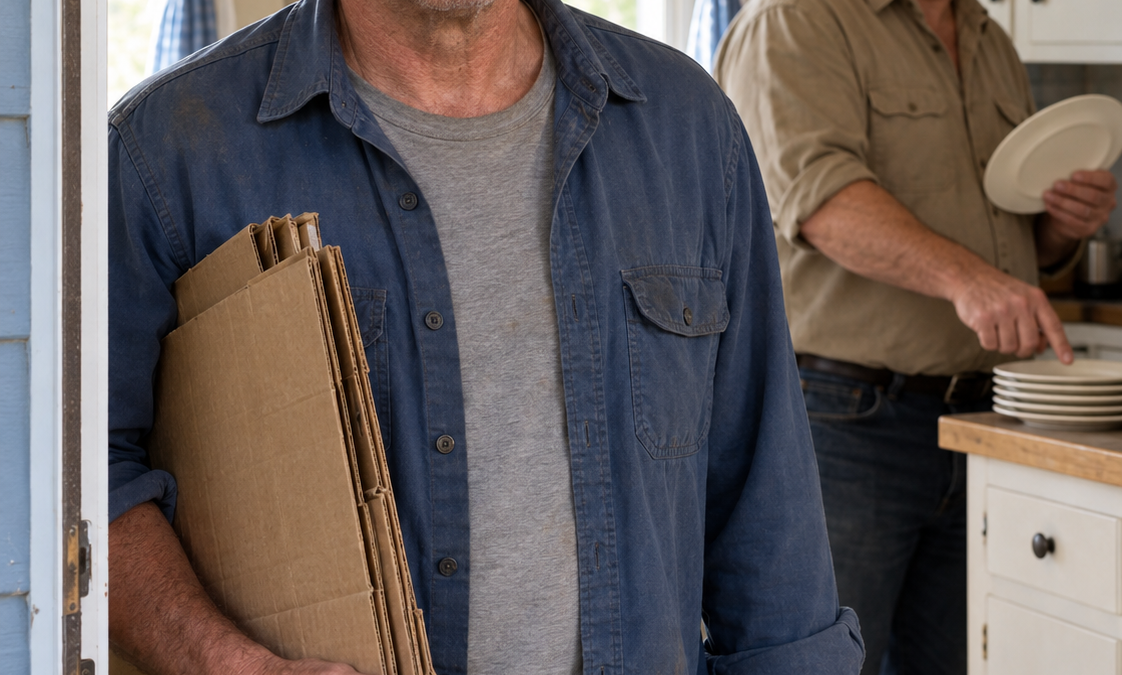
I stood halfway up the porch steps at 7 Wren Hollow Road in Joplin, Missouri, carrying a flattened cardboard box under my arm.
The door was open.
Lenny Ratliff stood beside the stove, counting Opal’s dinner plates. Three cabinet doors hung wide.
“Eight,” he said. “Thought she had twelve.”
I glanced toward the curb.
Sheree sat in the passenger seat of Lenny’s truck, her hands folded over her purse. She didn’t get out.
“Morning, Lenny.”
He pulled another plate from the cupboard.
“Morning, Merle. Thought you’d be mopping somewhere. You’ve had your hands on this place long enough.”
I’d worked at Ridgeview Elementary for twenty-four years. Stripping cafeteria floors, replacing soap dispensers, cleaning up after other people’s children.
Lenny liked reminding people of that.
“How’d you get inside?”
“With a key. How else?”
During her hospital stay in May, Opal had given Sheree the spare key so someone would water her African violets.
Lenny held up the brass key.
“Family has access, Merle.”
“So do I.”
“That’s what we’re fixing.”
A gray sedan stopped behind my car.
A young man in a navy polo approached the porch with a clipboard and a manila envelope.
“Merle Dugan?”
“Yes.”
“I’m a private process server. These are for you.”
He handed me the documents, checked a box, and returned to his car.
I put the cardboard beside Opal’s porch chair and opened the papers.
The first page had my name on it.
Probate Division.
Circuit Court of Jasper County.
Petition to Contest Will.
Sheree Ratliff was listed as the petitioner.
I read the accusation.
Undue influence.
It said I had “isolated the decedent from her only daughter.”
Filed Friday, September 12.
From the kitchen, Lenny called, “You getting educated out there?”
I folded the papers against my palm.
For four years, my mornings had started in Opal’s driveway.
Monday, Wednesday, Friday.
I’d arrived at 5:55, helped her down the front steps, and settled her into my old sedan for dialysis.
At Four States Kidney Center, I’d walked her to the desk and waited until the nurses took her back.
In June 2021, I’d switched to the 2:30-to-11:00 evening shift at Ridgeview.
I kept that schedule after Opal died.
Nobody in the family had ever asked why I’d changed shifts.
By Christmas 2021, Lenny was calling me Driver.
I went inside.
The kitchen smelled faintly of lemon dish soap. Opal’s blue curtains were tied back with white cotton strips she’d sewn herself.
Lenny had stacked her dishes across the counter.
“Those belong in the cabinets,” I said.
He inspected a small saucer.
“Sheree remembers these from when she was little. She’s entitled to her mother’s things.”
“Put it back, please.”
He set it beside the plates.
“Your problem is you think doing errands makes you somebody.”
Through the window, I could see Sheree sitting motionless in the truck.
“Ask her to come inside.”
“She doesn’t need another lecture from you.”
“I haven’t spoken to her.”
“Exactly. You kept her mother all to yourself, and now you want the house too.”
I placed the papers on the kitchen table.
Opal had died Tuesday, June 17.
She was eighty-four.
My father, Royce, had married her in 1979. After he died in 2012, she remained in the one-story house they’d shared. Her will left it to me.
I stood beside her empty chair.
The cushion still had the shallow dent where she’d sat sorting grocery coupons.
“Give me the spare key, Lenny.”
He slipped it into his pants pocket.
“Sheree’s got every right to be here.”
“She’s outside.”
“Because you’ve made her uncomfortable in her own mother’s home.”
I could have reminded him that Sheree hadn’t attended a single dialysis session.
I could have described Opal searching the clinic entrance on her birthday, hoping her daughter might surprise her.
Instead, I returned the saucer to its shelf.
Lenny watched me.
“Careful, Merle. A judge might call that tampering.”
I left the remaining dishes alone.
On the table sat Opal’s purse.
Brown vinyl, worn pale at the corners. A knot of thread marked the zipper pull so her stiff fingers could find it.
I opened it.
Her folded handkerchief lay against a packet of tissues.
Underneath was the yarn roll, yellow and small enough to fit in my palm.
At Four States Kidney Center, Opal used to point at the pickup log whenever I arrived at the front desk. Next to it sat the counter pen, a blue ballpoint with a bow made from her yellow yarn, so she could carry it to her chair without losing her grip. She’d tap the paper with one finger and grin. “You sign more than I sign checks, Merle.”
I closed the purse halfway.
Across the room, Royce’s old answering machine occupied a corner of the counter.
Its red light blinked.
The display showed 9.
Nine unheard messages.
Opal never used it. She called everyone from her cell phone, even when she was sitting three feet from the kitchen telephone.
Royce had left it there, and she’d never moved it.
I watched the number blink.
Not today.
“Your lawyer tell you that you’re being sued?” Lenny asked.
“I received the petition.”
“Good. Saves me explaining it.”
He leaned against the sink.
“Sheree just wants what’s fair.”
That was her favorite sentence.
She’d said it at the funeral home when we discussed her mother’s sewing things. She repeated it on the phone in July when the court notice about the will arrived.
Now Sheree waited in the truck while Lenny searched Opal’s cupboards.
“Sheree can call me,” I said.
“She doesn’t owe you a conversation.”
I picked up the papers.
“Neither do you.”
Lenny patted the pocket with the key in it, then walked past me.
I heard his boots cross the porch.
I reached into Opal’s purse and lifted out the yarn roll. Its loose end had caught around a tissue, so I freed it carefully.
I tucked it into my shirt pocket.
Taking a pen from the counter, I wrote 9:40 AM on the edge of the petition, with the same careful strokes I used at the clinic desk.
I stepped onto the porch, closed the door, and locked it with my own key.
At the curb, Lenny climbed into his pickup. Sheree turned toward him without looking at the house.
I sat on the top step, the petition across my knees.
I stayed until his truck was gone.
Opal’s spare key went with him.
Part 2 of 9
Aunt Dot called before church and said, “Lenny says you had her signing things.”
It was Sunday, September 14, at 8:05 in the morning.
I stood in my apartment kitchen with a bowl of cereal going soft beside the sink.
“Signing what, Aunt Dot?”
“Well, that’s what I’m trying to understand.”
Dot Lamb was Opal’s younger sister. Seventy-nine, widowed, living in Carthage. She hosted Thanksgiving every year and still set an extra place in case somebody brought a friend.
“Lenny called three cousins yesterday,” she said. “He’s telling everybody it happened when she wasn’t well.”
“What things?”
“He didn’t say.”
I put my spoon down.
“Opal went to dialysis Monday, Wednesday, and Friday. I picked her up at 5:55 on those mornings for four years, except the month my knee was in a brace and the county van took her. I took her to Four States Kidney Center, and I brought her home afterward.”
“Merle, honey.”
“June 7, 2021, was the first treatment. June 13 was the last one before she died.”
“I know you helped.”
“I drove her when she could barely get her shoes on. If Sheree wanted to visit, nobody stopped her.”
Aunt Dot made a small sound against the telephone.
“Let’s just pass the rolls on this one, honey.”
I’d heard that sentence at Dot’s house in Carthage since I was a boy.
She’d used it when cousins fought over Christmas presents, when Royce and his brother disagreed about the farm, and when Lenny criticized Opal’s cooking at Easter.
Afterward, she’d bring out another plate and ask who wanted butter.
I stopped talking.
“Are you coming for Thanksgiving?” she asked.
“I don’t know yet.”
“Well, you’re always welcome. You know that.”
“Thank you, Aunt Dot.”
She reminded me that church started at nine, then ended the call.
My cereal had soaked up all the milk.
I scraped it into the trash.
At 10:00 AM on Monday, September 15, I sat across from Ramona Kibler in her Joplin law office. I told her Sheree’s husband had entered Opal’s kitchen with the key Opal gave Sheree.
She was sixty-two, with short gray hair and reading glasses attached to a black cord.
Opal had hired her to prepare the will in 2023.
Ramona spread the petition across her desk.
“Paper first, then feelings.”
She turned to the second page.
“They’re alleging undue influence and isolation.”
“Yes, ma’am.”
“Did you tell Opal what to put in her will?”
“No.”
“Did you arrange the appointment?”
“She asked me to drive her.”
“Did you enter the conference room?”
“No.”
Ramona removed her glasses.
“Good. Because I remember that afternoon.”
She pulled a folder from the cabinet beside her chair.
“Tuesday, April 11, 2023. Opal signed right here, in my office. Two members of my staff witnessed her signature.”
She touched the date with her fingernail.
“You sat in the waiting room the entire time. You had a newspaper folded on your knee.”
“I remember.”
“You asked my receptionist where to put your coffee cup.”
I nodded.
Ramona opened another file.
“The will is straightforward. The house goes to you. Sheree receives eight thousand dollars in savings and Opal’s sewing machine.”
She placed the document flat between us.
“Your father left the house to Opal. She owned it when she made these decisions.”
“Yes.”
“I filed for your letters testamentary at the end of June. The court issued them Monday, July 7. You’re the executor.”
She tapped the petition.
“This contest doesn’t erase those facts.”
I watched her straighten the pages.
“Will they take the house?”
“They’re asking the court to set aside the will. They’ll need evidence. We’ll answer with ours.”
She closed the folder.
“I’ll represent you in the contest. We’ll meet again Monday, September 29. I want you here before your work shift.”
“I’ll be there at six.”
“We open at eight, Merle.”
“Eight, then.”
She wrote the appointment on a card and handed it across the desk.
“Bring anything relevant that you already have. Don’t argue with Leonard.”
“I haven’t.”
“Keep it that way.”
I slipped the card into my wallet.
Friday, September 19, at 11:48 PM, I sat on the edge of my bed with my phone.
I’d come home from Ridgeview Elementary, eaten a sandwich standing at the counter, and washed my work shirt.
Sheree’s July call had come from Lenny’s cell.
Her own number was buried in an old group text with Lenny.
I opened Lenny’s texts and scrolled backward.
There were messages about rides and appointments.
One dated Friday, August 19, 2022, at 6:12 AM stopped my thumb.
“Sheree can’t make Friday. That’s what the hired driver is for.”
I opened the date details.
Then I went farther back.
Wednesday, June 9, 2021.
“We know it’s Monday Wednesday Friday. We can’t.”
I returned to the August message, then scrolled back to June.
I took a screenshot of each.
Two screenshots. Two dates.
With my elbows on my knees, I stayed still until the screen went dark.
I didn’t reply to Lenny.
I didn’t call Sheree.
At 12:17 AM, I plugged the phone into its charger.
The deposition notice came Saturday morning, September 20, at 9:26, forwarded by Ramona from Sheree’s lawyer, Gordon Hanna.
I was scheduled to give sworn testimony Monday, December 15.
I saved the attachment.
Monday, September 22, at 2:30 PM, I clocked in at Ridgeview Elementary.
My evening shift ran until 11:00.
At 3:15, I was behind the school, taking flattened lunch cartons to the recycling container.
The garbage truck used the narrow service lane between the loading dock and the chain-link fence.
I heard tires crunch over loose gravel.
Lenny’s pickup turned into the lane.
He stopped sideways across the entrance, leaving no room for another vehicle to pass.
I set the cartons on the concrete.
Lenny rolled down his window.
He still wore his dealership shirt, with LEONARD stitched above the pocket.
“Afternoon, Merle. Don’t let me keep you from the trash.”
“You’re blocking the service lane.”
“Won’t take long.”
He rested his left arm on the door frame and leaned toward me.
“Deposition’s December fifteenth. Sign half over before then, or you’ll say under oath what you did to her.”
Part 3 of 9
Lenny was counting my stepmother’s cereal bowls into a notebook when I came in with the boxes.
My watch said 9:15. Saturday, September 27.
He stood at Opal’s kitchen counter, wearing his dealership shirt and reading glasses I’d never seen on him.
Every cabinet door had a strip of masking tape on it, numbered in black marker.
I’d brought three cardboard boxes from my apartment. They were flattened against my chest, with packing tape hooked over two fingers.
Lenny didn’t offer to move.
“What’s the notebook for?”
“For the case.”
He held it up.
“Property inventory. Somebody has to keep track of what you’re hauling out.”
I looked at the open cabinets.
“Nothing on this counter moves till the lawyers say,” Lenny said.
“I came for Opal’s clothes.”
“You don’t take a spoon out of here till it’s on the list.”
“I’m packing her bedroom.”
“You don’t get to say what’s whose anymore, Merle.”
He tapped the eraser twice.
He did that at Thanksgiving when lecturing relatives about financing.
“Sheree knows you’re here?” I asked.
“She knows what she needs to know.”
“All right.”
I carried the boxes down the hall.
Opal’s bedroom still smelled of the lavender powder she used after bathing.
Her slippers waited beneath the bed, toes pointing toward the bathroom. The left heel was folded inward because she’d stopped bending down to straighten it.
On the dresser sat her sewing basket.
I lifted the lid.
Inside were a tomato-shaped pincushion, two thimbles, and a measuring tape wound around a spool of blue thread.
I packed the slippers first.
From the kitchen came Lenny’s voice.
“Six dinner forks. Eight teaspoons.”
His pencil scratched across paper.
I folded Opal’s cardigans along their seams. She’d sewn little loops inside the collars so she could hang them without stretching the shoulders.
One green sweater had a missing button.
I set it with the others.
“Merle!” Lenny called.
I stopped beside the bed.
“You listening?”
“Yes.”
“I’m photographing everything before you take it. Don’t get ahead of yourself.”
I checked the carton.
“Take your pictures.”
He stayed in the kitchen.
By 10:05, I’d packed the clothing and bedding I intended to sort at my apartment.
Lenny hadn’t entered the bedroom.
I carried my things through the hallway.
He was still counting dishes.
“That all?”
“For today.”
“Good. Less to argue about.”
As I passed the doorway, I saw Opal’s spare key hanging from his belt loop on a small metal ring.
I said nothing.
Monday, September 29, at 8:00 AM, Ramona Kibler was reading at her desk when I arrived.
She pointed to the chair.
I stayed standing beside the window.
A delivery truck backed toward the pharmacy across the street.
Ramona adjusted her glasses.
“I have a letter from Gordon Hanna.”
“Sheree’s lawyer.”
“Correct. It arrived Wednesday, September 24.”
She angled the page so I could read it.
“They’re offering to settle.”
“How?”
“You sign over half of the house before Monday, December 15. In exchange, they’ll withdraw the petition.”
I kept my hands at my sides.
“That’s the day of my deposition.”
“Yes. They chose it deliberately.”
Ramona read from the letter.
“‘A man who made an old woman depend on him.'”
She lowered the paper.
“Their description of you.”
“I drove her to treatment.”
“They intend to describe those rides differently.”
She continued reading.
“‘Please direct all scheduling to our client’s husband, Leonard Ratliff, who is handling this matter for the family.'”
I watched her underline the sentence.
“There’s another part,” she said.
“‘Mrs. Ratliff signed our authorization to file on September 10.'”
Three days before the process server came to the house.
“Sheree signed that?”
“That’s what Mr. Hanna represents.”
Ramona aligned the edges of the letter.
“Their argument will be that a caregiver used an elderly woman’s trust to obtain her property.”
“I never asked Opal for the house.”
“I know what she told me. But they’re going to make your presence sound suspicious.”
She folded her hands on the letter.
“We answer with dates and names. Paper that shows who actually came.”
“I was there. Every time.”
“Then somebody wrote it down.”
She reached for her appointment calendar.
“Now. Leonard still has a key?”
“Yes.”
“You’re the executor. That makes the house your responsibility.”
“Since July 7.”
“Have the locks changed. Today.”
“He was inside Saturday.”
“All the more reason. Give the locksmith your letters testamentary if he asks. Keep the receipt.”
I picked up my jacket.
Before I reached the door, Ramona added, “I’m in court at nine. Come back at one. There’s one more page you need to see.”
At 11:20 AM, I met a locksmith at the house.
He checked my identification and the court papers, then replaced the front and back locks.
The job took thirty-eight minutes.
I paid him and received two new keys.
One went on my ring.
The other went into my shirt pocket.
The key on Lenny’s belt loop no longer opened either door.
Ramona was back from court when I walked in at 1:10 PM.
She had the September 24 letter spread across her desk.
“Sit down this time, Merle.”
I sat down.
“Leonard called my office on September 16,” she said. “He wanted to ‘talk for Sheree’ about a settlement.”
“Did you speak to him?”
“No. I wrote to Mr. Hanna asking him to clarify who his actual client was.”
She tapped the correspondence.
“Sheree is the person contesting the will. Leonard is her husband. Those are different positions.”
I waited.
“Hanna confirmed Mrs. Ratliff authorized it. Lenny emailed this photo himself, insisting he had a say.”
Ramona turned to a printout stapled behind the letter.
She flattened the sheet.
“Your stepsister isn’t paying for this. He is.”
She laid the signature page of the fee agreement directly in front of me.
Near the bottom, I recognized Lenny’s slanted handwriting.
Guarantor: Leonard Ratliff
The ink ran past the printed line.
Immediately below it was another space.
Client: Sheree Ratliff
The line was completely blank.
Part 4 of 9
The box on my doormat had Aunt Dot’s handwriting on it and Opal’s quilt inside.
I’d come up the steps at 8:17 AM that Saturday, October 4, with milk, eggs, and a loaf of wheat bread.
The box was taped shut.
My name appeared across the top in Dot’s careful block letters. No return address. She’d driven from Carthage and left it herself.
I carried it inside.
The quilt was folded into a square, with the blue side facing up.
Opal had sewn it from scraps of our old clothes. One patch came from a green work shirt I’d worn at Ridgeview Elementary. Another was cut from Royce’s Sunday trousers.
I’d given it to Aunt Dot after the funeral in June.
She’d held it against her chest and said she’d keep it on the guest bed.
Now it was back.
I unfolded one corner.
Opal’s stitches were small and even, except where her fingers had begun to stiffen. Along the binding, she’d used white thread because she’d run out of blue.
My phone rang at 8:23.
Aunt Dot.
“Morning, honey.”
“Morning.”
“Did you get my package?”
“Yes, ma’am.”
“Good. I was worried somebody might take it off your porch.”
I glanced at the cardboard.
“It’s here.”
Aunt Dot cleared her throat.
There was a television playing quietly in the background. I could hear a weather forecast and a cabinet closing.
“Merle, I need to tell you something.”
I waited.
“Don’t come for Thanksgiving this year. Lenny says it’ll upset Sheree.”
I pressed the loose binding flat with my thumb.
“All right.”
“She’s having a difficult time. He said you’d understand. He said you’re used to waiting in the car.”
“I understand.”
Dot didn’t say anything for several seconds.
Then she asked, “Did the quilt get wrinkled?”
“No, ma’am.”
“Opal worked so hard on that thing.”
“She did.”
“Well. I’ve got a pie in the oven.”
“Take care, Aunt Dot.”
“You too, honey.”
She hung up.
For forty-six years, since I was ten, I’d had a seat at Dot’s Thanksgiving table in Carthage.
This would be the first year without one.
I laid the quilt across my knees.
At Dot’s house, the dining room table had two leaves that came out of a closet every November. She always seated me near Opal. In her last few years, that meant I could cut her turkey and still get up for the heavy roasting pan.
Even after Royce died, she’d kept my place.
Now Lenny had decided I wasn’t coming.
I found the green square from my old shirt and worked a loose thread back beneath the stitching with my fingernail.
The groceries were still on the floor.
At 8:41, I put the milk in the refrigerator.
The wall clock at Four States Kidney Center read 10:00 AM when I arrived on Monday, October 6.
The waiting room smelled of disinfectant and coffee.
I’d stood in that room three mornings a week for four years.
The desk clerk looked up.
“Can I help you?”
“I need a copy of Opal Dugan’s records.”
“Are you her next of kin?”
“I’m the executor.”
“Do you have your letters testamentary?”
I reached into my jacket.
My wallet was there. So was the appointment card Ramona had given me.
The letters were in the kitchen drawer at the house.
“No.”
She turned her monitor slightly away from me.
“We need those before we can process a request. Only the executor with the court papers is authorized to receive copies.”
“I can bring them.”
“Once we have everything, it can take up to thirty days.”
“Thirty?”
“Up to thirty.”
She reached for another folder.
I didn’t move.
Next to the pickup log lay the counter pen.
The blue ballpoint still had Opal’s bow tied around it. The yarn had faded where hundreds of fingers had held the barrel.
Opal used to point at that pen and wait for me to pick it up.
I’d sign at the desk when I came back for her, then walk her out to the car.
The last time we’d come here, she’d asked whether the air conditioning was broken. I’d checked the thermostat above the hallway door.
Seventy-two degrees.
She’d kept her cardigan on anyway.
“Sir?” the clerk asked.
I put my hand against the edge of the desk.
The counter pen was six inches from my fingers.
I left it alone.
“I’ll bring the letters,” I said.
“You can drop them off any weekday.”
I nodded.
My feet stayed where they were.
A door opened down the hallway.
“Merle?”
Tasha Greer came toward me carrying a folder against her hip.
She was forty, with a badge clipped to her blouse.
She’d been Opal’s social worker.
“How are you doing?”
“Working.”
“I figured. Ridgeview still keeping you busy?”
“Yes, ma’am.”
She glanced at the clerk, then back at me.
“What do you need?”
“Sheree’s contesting Opal’s will.”
Tasha’s hand tightened around the folder.
“They say I kept Opal away from her daughter.”
“Who says?”
“Her lawyer. It’s in the petition.”
Tasha pulled a chair away from the wall.
“Come sit down, Merle.”
“I’m all right.”
“I didn’t ask if you were all right.”
I sat.
Tasha took the empty chair opposite me.
“I write everything down. That’s the job.”
She didn’t look at the clerk when she said it.
“Every fall-risk patient has a pickup log. Whoever comes to collect that person signs at the front desk.”
“I know.”
“And we keep those records for ten years. That’s our clinic policy.”
I checked my watch.
10:14.
“Can I request that?”
“With your letters testamentary, yes. It still has to go through the office.”
“What time can I bring them?”
“The front desk opens at six on Monday mornings.”
I stood.
“I’ll be there at six.”
Tasha went to the desk, collected the request form, and put it in my hand.
“Bring your letters Monday. I’ll pull the pickup logs myself. Every page has a name on it.”
Part 5 of 9
The binder was two inches thick, and Ramona counted my name in pencil marks of five.
Ten days after I’d handed Tasha Greer my letters testamentary and the request form at six on Monday, October 13, Four States Kidney Center released the binder on Thursday, October 23: four years of the pickup log in color copies.
By 10:15 AM, it lay open on Ramona Kibler’s desk.
She had a legal pad and her reading glasses halfway down her nose.
“Six hundred thirty,” she said.
“Ma’am?”
“Dialysis days. June 7, 2021, through June 13, 2025. Monday, Wednesday, Friday.”
She drew another tally.
I watched her finish the last group.
“Your name appears six hundred eleven times.”
“That’s right,” I said.
“Twelve pickups by the county van. February 5 through March 1, 2024.”
“I had knee surgery.”
“You started driving again March 4.”
“Yes.”
“Seven treatments inside the hospital.”
Ramona added the columns.
611 + 12 + 7 = 630.
She compared the total with the clinic’s summary.
“And Sheree?”
“She never came.”
“Zero.”
Ramona circled it.
Somebody was running the copier in the next room.
“Did your stepsister know the treatment schedule?”
“Yes.”
“Did anybody ever tell her she couldn’t visit?”
“No.”
She kept going.
Each page was Opal’s alone: a date, a pickup time, and the person who collected her.
My handwriting had changed over those four years.
Some mornings the letters leaned. On others, they were nearly square. After surgery, I’d rested against the desk to keep weight off my knee, and the writing came out cramped.
But the ink was blue throughout.
“All those signatures. Every one in blue ink.”
“It was always the same pen.”
“Explain.”
“The counter pen had Opal’s yellow yarn tied around it. When it ran dry, the clerk brought another blue one.”
“And the yarn?”
“Opal untied it and made a bow on the replacement.”
“Every time?”
“Yes.”
Ramona made a notation on her pad.
She flipped several pages.
“Here’s something else.”
A social worker entry was dated Wednesday, March 13, 2024.
Ramona read it aloud.
“Pt asks staff to call stepson Merle when daughter cancels.”
She held her finger under the sentence.
“Do you remember that day?”
“That was my second week back driving. My name’s on that page.”
“Did Sheree tell you she’d planned to come?”
“No. Nobody told me.”
Ramona marked the entry with a small paper tab.
I studied the date.
March 13.
I’d brought Opal home that morning. She’d asked me to stop at the grocery store for strawberry preserves and complained that the store had moved the bread again.
She hadn’t mentioned Sheree.
At 10:42, she set her pencil down.
“This is what wins these cases. Pickup records, texts, ordinary notes nobody expected anybody to read.”
She rested her palm on the binder.
“Will that stop the lawsuit?”
“It gives us evidence. Hanna gets a copy before your deposition on Monday, December 15.”
“All of it?”
“Yes. But he’ll have an answer.”
Ramona leaned back.
“He’ll say you made yourself indispensable. That Opal depended on you so completely she couldn’t make independent decisions.”
“I never asked her to.”
“That isn’t the question he’ll ask.”
She tapped the petition beside her calendar.
“He’ll ask whether she could manage without you. We need to be ready for that.”
I kept my hands folded.
Ramona studied the totals again.
“What I don’t have is why. Why does Lenny want that house so badly?”
“I don’t know.”
“Has he mentioned selling it?”
“No.”
“Has Sheree?”
“She says she wants what’s fair.”
Ramona removed her glasses.
“That tells me very little.”
The clock over her file cabinet said 11:06, and my shift at Ridgeview Elementary started at 2:30.
“I’d better get going.”
“Keep those texts from Lenny you showed me. Don’t delete anything.”
“I won’t.”
She slid the binder across to me.
“Keep it somewhere dry.”
I carried it out under my arm.
Two cardboard boxes stood beside Opal’s kitchen table when I arrived at the house around 8:00 AM on Saturday, October 25.
I’d come to pack the remaining pantry dishes.
The curtains were open. Somewhere down Wren Hollow Road, a pickup needed a new muffler.
Royce’s old answering machine sat near the wall outlet.
A red 9 glowed on its display.
Nine unheard messages.
Opal called everybody from her cell phone. She never checked the answering machine, though she’d recorded its greeting when Royce first brought it home.
I hadn’t touched the buttons since June.
Her voice was the first thing I would hear.
I put a stack of dish towels into one box.
At 8:19, I crossed the room.
I pressed GREETING.
The speaker clicked.
“You’ve reached the Dugans. Leave your number, honey, and somebody’ll get back to you.”
I listened until the recording finished.
Then I hit PLAY.
The first two messages were pharmacy reminders about prescription refills.
Another confirmed an appointment.
The answering machine announced the next date and time.
“Friday, May ninth. Eleven forty-two AM.”
It was this past May. The refill reminders before it were for the blood pressure pills I’d picked up the day she came home from the hospital.
A woman’s voice followed.
“Lenny, it’s Brandi Nolte. Your cell mailbox is full, and you said you’d be at the house all week watering. You left your copy of the market sheet on the counter by the open back door, so I slid it under this answering machine. Call me when you’re ready to list.”
Another message began playing.
I pressed STOP.
She was hospitalized May 6 through May 13.
Lenny had Sheree’s key that week.
I looked down at the machine under my hand.
Royce had set it there years ago. Opal never moved it. Nobody else had played that message.
I lifted it.
Underneath was the market sheet.
Across the top was a printed date.
May 8, 2025.
I flipped it over.
On the back, in Lenny’s slanted handwriting:
“List 12/1 — pays both cards $41,300.”
Part 6 of 9
“Dot says you can come Thursday after all,” Lenny texted. “Bring a pen.”
The message arrived Tuesday, November 4, at 7:12 AM.
Another line followed.
“You’ll want to sign before December 15th.”
I saved it with Lenny’s texts and didn’t answer.
The Monday after I’d found the market sheet, I’d given Ramona a copy. Through November, I kept working my regular 2:30-to-11:00 shift at Ridgeview Elementary.
On November 18, Aunt Dot called about Thanksgiving.
“Leonard’s planning to say a few words,” she told me.
“About what?”
“He says he’ll read the lawyer’s letter so everybody knows.”
I stood in my apartment kitchen with a dish towel in my hand.
“Everybody knows what?”
“Well, whatever needs clearing up.”
“All right, Aunt Dot.”
“He promised it wouldn’t take long.”
I hung the towel over the oven handle.
The day before Thanksgiving, I sat across from Ramona Kibler at 10:30 AM.
She had Hanna’s letter in front of her, with a yellow legal pad beside it.
“Your aunt invited you back?”
“Lenny sent the invitation.”
“Not your aunt, then.”
She uncapped her pen.
“Are you planning to attend?”
“I’m thinking about it.”
Ramona drew a line across the pad.
“You may show your family papers that are genuine and that you’re entitled to share. Don’t threaten anybody. Don’t make accusations you can’t support.”
“I understand.”
“And don’t sign anything at a dinner table.”
“I won’t.”
She rested the pen against the folder.
“Leonard isn’t your lawyer. Neither is Gordon Hanna. If someone puts an agreement in front of you, leave it unsigned.”
“Yes, ma’am.”
“I’m not telling you whether to go. That’s your decision.”
I picked up my jacket.
“See you Monday?”
“Eight o’clock, Merle.”
When I got home from my shift that night, I spread a clean bath towel across my apartment table.
The binder lay beside it.
I checked the fasteners and made sure no pages had slipped loose.
The canvas tote was an old grocery bag with reinforced handles. I lowered the binder inside, zipped the top, and set it by the door with my work shoes.
My phone went into its charger.
The market sheet stayed with my other papers until morning.
I parked across the road from Dot’s house in Carthage at 2:30 PM on Thanksgiving.
Her driveway was full. Two cars had parked on the grass beside the mailbox, and Lenny’s truck occupied the space closest to the porch.
I carried the canvas tote in my left hand.
Aunt Dot answered before I knocked.
She wore a flowered apron and had flour on one sleeve.
“Merle. You made it.”
“Yes, ma’am.”
“Come in before the heat gets out.”
The house smelled of roasted turkey and celery dressing.
From the kitchen came the sound of somebody scraping potatoes from a saucepan.
Dot took my parka. I kept on the corduroy jacket I’d worn to Opal’s funeral.
“Everybody’s nearly seated,” she said.
I followed her into the dining room.
Three tables had been pushed together into one long table. Different tablecloths covered the joins, and somebody had wedged a folded grocery advertisement beneath a short leg.
Twenty-seven places.
Twenty-four relatives, plus Lenny, Sheree, and me.
I’d counted the plates while Dot went to check the gravy.
Lenny stood at the head of the table beside the turkey.
He wore a white shirt with his collar open and a gold-colored watch that caught the overhead light when he moved.
Sheree sat on his right.
Her napkin was already folded in her lap.
Aunt Dot’s chair waited at the far end, beside a small serving cart holding extra rolls.
My place was the folding chair by the kitchen door.
It had a vinyl seat and a metal back that leaned against the wall whenever somebody carried food through.
Last year I’d sat at Opal’s left and cut her turkey small.
I sat down.
The canvas tote went beneath my chair.
My phone and the market sheet were in my jacket pocket.
Across from me, Cousin Lorna was helping her youngest granddaughter cut a biscuit. Two chairs away, an uncle asked whether the Cowboys had played yet.
Somebody passed the cranberry sauce.
At 2:42, Lenny raised his glass.
“Folks, before we eat.”
Aunt Dot paused with the gravy boat in her hands.
Lenny waited until the conversations stopped.
“I know this isn’t pleasant, but family deserves the truth.”
He removed a folded letter from his shirt pocket.
“We’ve all heard different stories about Opal’s estate. Sheree and I thought everybody ought to hear what her lawyer put in writing.”
He unfolded Hanna’s letter.
I knew those pages. Ramona had laid the same letter in front of me on September 29.
Lenny cleared his throat and began reading.
He skipped the greeting and went straight to the accusation.
“‘A man who made an old woman depend on him.'”
At the middle table, Uncle Clyde put his fork down.
Lenny continued through the paragraphs about influence and family contact.
He held the paper high enough that people at the far end could see it, though nobody could read the print from there.
“This is a legal letter, folks. These aren’t just my words.”
He folded it once.
Then he addressed the table without looking down.
“He kept Sheree away from her own mother. Sheree would have driven her any day — he never told us the schedule. And this isn’t about money. It’s about what’s fair for Sheree.”
Lorna lowered her eyes to her plate.
The granddaughter beside her kept spreading butter across a biscuit that was already covered.
Aunt Dot opened her mouth.
Her fingers tightened around the handle of the gravy boat.
She set it on the serving cart without speaking.
Lenny looked down the length of the table.
His eyes found me at the kitchen door.
“You were the hired driver, Merle. Drivers don’t inherit.”
Sheree adjusted the napkin on her knees.
She didn’t look at me.
I folded my napkin and laid it next to my plate.
Lenny put Hanna’s letter next to his glass.
He remained standing.
I pushed the folding chair back, stood, and lifted the canvas tote onto the table.
Part 7 of 9
“You said that in Opal’s kitchen too, September thirteenth, nine-forty,” I said. “You were the hired driver, Merle. Drivers don’t inherit.”
Lenny kept one hand on the back of his chair.
“What’s your point, Merle?”
I picked up the canvas tote and left the folding chair by the kitchen door.
At Sheree’s place, I pulled out the binder.
I set it in front of my stepsister.
“611 times I signed. Find your name.”
Sheree looked at the cover.
“What’s this?”
“The pickup log from Four States Kidney Center.”
I opened it to the first page.
“Whoever picked Opal up signed at the front desk. Six hundred thirty treatments. The county van signed for twelve. Seven were done in the hospital. The rest are mine.”
Sheree put her fingers on the paper.
“Where am I supposed to look?”
“Last column.”
She began turning pages.
I stepped away.
At the head of the table, Lenny adjusted his cuffs.
He watched Sheree examine the dates without speaking.
One page stuck to the next. She separated them with her thumbnail and kept going.
“There’s a lot here,” she said.
“Four years.”
She reached the final section.
Her finger stopped.
“My name isn’t here.”
“No.”
Lenny raised his voice for the relatives.
“So he drove. Nobody’s arguing he drove.”
Uncle Clyde remained seated with his fork on the tablecloth.
I took out my phone and opened Lenny’s texts.
“August nineteenth, 2022. Friday. Six-twelve in the morning.”
“‘Sheree can’t make Friday. That’s what the hired driver is for.'”
Lenny folded his arms.
I moved to the older message.
“Wednesday, June ninth, 2021.”
I turned the screen so Sheree could see it.
“‘We know it’s Monday Wednesday Friday. We can’t.'”
Sheree lifted her head.
I asked her, “Did you know he was cancelling for you?”
Her thumb rested against the edge of the binder.
“He said you didn’t want me there.”
Lenny leaned forward.
“Those texts are out of context. Sheree couldn’t get off work.”
I faced Sheree.
“Did you know Opal went Monday, Wednesday, and Friday?”
“I knew it was three days.”
“And the times?”
Sheree studied her husband.
“He told me you handled the appointments. He said Mom didn’t want visitors afterward.”
“She asked about you.”
Sheree pressed her lips together.
Lenny picked up his water glass.
“Merle, you’re twisting private family conversations.”
I kept my phone in my hand.
“Those were your words.”
“Everybody sends messages they don’t remember.”
“These have dates.”
He put the glass down without drinking.
I looked at Sheree again.
“Did you read what you signed?”
“The form from Hanna’s office?”
“Yes.”
“I never read it all. He said sign here.”
She glanced toward Lenny.
“He told me the lawyer had already gone over everything.”
“Sheree,” Lenny said, “don’t let him confuse you.”
I pointed at the front cover of the binder.
Ramona had given me a copy of the fee agreement, folded inside.
“He signed the line that says Guarantor. Your line on the fee page is blank.”
Sheree opened the copy without lifting the binder from her place.
“Leonard?”
“That’s billing paperwork,” Lenny said.
“Why isn’t my name signed?”
“Because Hanna handles that.”
“But you signed yours.”
Lenny turned the gold watch on his wrist.
“Somebody had to make sure the lawyer got paid.”
I slipped my phone back into my jacket pocket.
Twenty-four relatives had heard him read Hanna’s letter. Now they watched Sheree follow the signatures with her finger.
I took out the market sheet.
The paper had a crease across its middle from where I’d folded it after finding it under Royce’s answering machine.
“Lenny, is this your handwriting?”
He looked at it.
“What’s that supposed to be?”
I held it so he could see the back.
“‘List 12/1 — pays both cards $41,300.'”
Lenny’s jaw moved once.
I waited.
“That’s a realtor’s scratch paper. Anybody could’ve written on it.”
I walked toward the turkey and laid the market sheet next to the platter.
Lenny looked at the relatives.
“You people know me. I’ve handled financing for twenty years. I write numbers on scraps all day.”
Aunt Dot sat at the far end, her hands resting on either side of her untouched dinner plate.
“Sheree?”
My stepsister leaned over the market sheet.
“That’s his writing.”
Lenny faced her.
“Now, honey.”
“You leave your fours open at the top. Like that one.”
“Sheree, please.”
“I’ve seen you write them on our grocery lists.”
Cousin Lorna moved her granddaughter’s biscuit away from the edge of the plate. The little girl had stopped eating and was watching Lenny.
Uncle Clyde picked up his fork, then put it down again.
Nobody reached for the turkey.
Aunt Dot stood.
She came along the table slowly, passing the cranberry sauce and the bowl of sweet potatoes.
At Lenny’s place, she picked up Hanna’s letter from next to his glass.
She folded it and slipped it under the pie plate.
Lenny watched her hands.
“Dot, we’re trying to settle a legal matter.”
Aunt Dot faced him.
“Opal called me every Friday from her dialysis chair, Leonard. She said ‘Merle drove me.’ I chose not to hear it.”
Lenny pulled his chair away from the table.
“Now everybody’s taking his side?”
Sheree closed the binder.
She kept both hands on its cover.
“I want to see the rest of those papers, Leonard.”
“Those are lawyer documents.”
“My name’s on the case.”
He opened his mouth, but Sheree spoke again.
“I want to know what I signed.”
Aunt Dot remained at Lenny’s place.
Lenny looked toward Uncle Clyde, then Cousin Lorna.
Neither answered him.
I stood across the turkey platter from my stepsister’s husband.
“Drivers sign in, Lenny. You never even parked.”
Part 8 of 9
Ramona called me in the supply closet at school and said, “They filed a dismissal with prejudice.”
I had a case of paper towels balanced against my hip.
Monday, December 1. A little after 2:30 PM.
I’d just clocked in for my evening shift at Ridgeview Elementary.
“What does that mean?” I asked.
“Sheree’s lawsuit is dismissed. With prejudice means she can’t file the same will contest again. It’s finished, Merle.”
That morning at 8:00 AM, I’d sat across Ramona’s desk.
She had a phone message from Gordon Hanna’s office.
Sheree had called Hanna herself and told him to drop the case.
“Let’s see if it’s real by this afternoon,” Ramona had said.
Now I shifted the carton onto the shelf.
“And the deposition?”
“Cancelled. You won’t be giving sworn testimony on Monday, December 15.”
“Okay.”
“There’s something else. Hanna sent me a new letter.”
I held the phone against my shoulder and straightened the paper towel packages.
Ramona read one sentence.
“‘Mr. Ratliff is no longer handling this matter.'”
“That’s what it says?”
“Exactly. From now on, Hanna’s office will communicate only with Sheree.”
I pulled the remaining package into place.
“All right.”
“Merle, are you still at work?”
“Yes, ma’am.”
“Then finish your shift. I’ll send you the court filing.”
“I will.”
I hung up and pulled the closet door shut.
That evening, after my shift ended at 11:00 PM, I drove down Wren Hollow Road.
My headlights caught the porch steps Royce repaired years ago and Opal’s curtains behind the front windows.
There was no for-sale sign in the yard.
December 1 was the day Lenny had written on the market sheet.
I slowed enough to see the driveway.
Then I kept driving.
My grip loosened on the steering wheel before I reached the corner.
Wednesday, December 3, I was eating breakfast at my apartment when Aunt Dot sent a text.
It came through at 8:36 AM.
Dot rarely texted.
This message was longer than anything she’d sent me before.
“Merle honey. Sheree is staying in my spare room. She brought her clothes over. That lawyer sent Leonard the bill, $4,800, since he signed for it. He’s selling his fishing boat. No Lenny at Sunday lunch anymore. Would you bring Opal’s quilt back? Love, Aunt Dot.”
I set my coffee cup down.
The quilt was folded on the back of my living room chair.
I’d kept it there since Dot returned it in October.
My thumb stayed under the line about Sheree.
Then I typed my answer.
“I’ll bring it Sunday, Aunt Dot.”
I sent it.
There was no reply before I left for work.
Saturday, December 6, the knock came at 10:00 AM.
I was at the house, emptying Opal’s linen drawer.
The locks I’d changed in September still caught a little when I opened the front door.
Tasha Greer stood on the porch.
She wore a navy jacket and had a box in both arms.
“Morning, Merle.”
“Morning, Tasha.”
“Hope I’m not interrupting.”
“No, ma’am.”
She glanced past me into the kitchen.
“The center cleaned out the lockers this week. We put in a new front desk Monday.”
I stepped aside.
“Opal’s locker still had her own padlock on it,” Tasha said. “Nobody had the combination, so it sat until we needed the space and had it cut.”
“I didn’t know anything was left.”
“That’s why I’m here.”
She carried the box to the kitchen table and placed it in front of me.
“These belonged to her.”
I lifted the cardboard flaps.
Opal’s beige cardigan was folded at the bottom. The cuffs had gone thin where she’d pushed them above her wrists during treatment.
Her reading glasses rested inside a soft cloth case.
A little tin of peppermints had slid against the side.
I recognized the scratched lid. Opal used to offer those mints to the nurses, although she always told me they tasted like toothpaste.
On top lay the counter pen.
Blue plastic.
The yarn was still tied around it in a small yellow bow.
“That was on the old desk,” Tasha said. “I took it off before they moved the furniture.”
I picked it up.
The bow had one loop longer than the other.
Opal never managed to make them match once her fingers stiffened.
At the clinic, she’d pointed toward the pickup log whenever I came back for her.
I rolled the counter pen between my thumb and forefinger.
The plastic had a shallow dent near the clip.
Tasha remained standing across from me.
I put the tip against my palm without pressing.
“I remember that one,” I said.
“So do I.”
She looked into the box.
“Merle, there was another thing.”
I kept the counter pen in my hand.
“At the bottom of Opal’s locker, under the cardigan, I found a folded paper.”
Tasha reached into her jacket pocket.
“I read it Monday, while I was listing what was in the locker. I write everything down. That’s the job. After I saw it, I wanted to bring these things myself.”
“All right.”
Tasha handed it to me.
It had been folded in four.
The outside was worn where the creases met, and one corner had a faint blue stain.
“What is it?”
“You should read it.”
She didn’t offer anything else.
I placed the counter pen on the table.
The paper opened stiffly.
At the top was a printed heading.
My Goals
I recognized the form from the rack of handouts in the Four States Kidney Center lobby.
Patients could take one home or fill it out while waiting.
This one was dated March 13, 2024.
Below it, Opal had written two sentences in blue ink.
Her letters leaned toward the right.
I held the page closer to the kitchen window.
Goal: Keep my house for my son Merle. He never missed a day unless his knee did.
Part 9 of 9
Sheree held the goals form flat on her knee and didn’t look up for a long time.
Sunday afternoon, December 7, the furnace in the house ticked while she read.
She sat in Opal’s chair.
Her mother’s sewing machine waited on the table, with the power cord wrapped around its base.
At noon Sunday, I’d carried the quilt into Dot’s house, as I’d promised.
Over lunch, I told Sheree there was something of her mother’s she needed to read at the house. Afterward, she followed my car back to Joplin.
Now she was studying Opal’s handwriting.
Sheree moved her thumb along the bottom of the page.
“Mom wrote this?”
“Yes.”
“March thirteenth?”
“That’s the date.”
She read the last sentence again.
Her nose had turned pink. She reached into her purse for a tissue, pressed it against her mouth, and held it there.
“She called me that week,” Sheree said.
I kept my hands in my pockets.
“I remember telling her I’d call back after work.”
She folded the tissue into a square.
“I never did.”
I looked toward the table.
The machine still had a narrow strip of cotton under the presser foot. Opal had left the needle halfway down.
Sheree lowered the form.
“I’m sorry, Merle. I should’ve called her myself.”
“She would’ve answered.”
“I know.”
Sheree wiped beneath her glasses.
Then she noticed the machine.
“You haven’t packed that?”
“It’s yours.”
“Could I take it today? And Mom’s box of thread?”
“Yes.”
Sheree stood and went over to the table.
She touched the chipped corner of the wooden base.
“Mom taught me to sew on this. I used to push the pedal too hard.”
“She told me.”
“She did?”
“More than once.”
Sheree lifted the needle and slid the fabric free.
The little seam was unfinished.
“She used to make me take the stitches out when they weren’t straight.”
“She made me do that with a curtain once.”
Sheree gave a short smile.
“I remember those curtains.”
I brought her mother’s thread from the cabinet and set it next to the machine.
Sheree laid the goals form down near the lamp.
I collected it and slipped it into my shirt pocket.
Then I removed my key ring.
The locksmith had given me two keys in September. The second one hung on my ring now, next to my apartment key.
I worked it off the ring.
“Here.”
Sheree looked at the brass key in my palm.
“What’s that for?”
“The front door.”
She didn’t reach for it immediately.
“Merle, I don’t need to come over when you’re not here.”
“You can come any time.”
“Even if you’re at work?”
“Even then.”
I put the key in her hand.
Sheree closed her fingers around it.
She was fifty years old, but standing by that sewing machine, she looked like the four-year-old who’d sat at Opal’s feet sorting buttons by color.
“I’ll bring it back if you need it,” she said.
“Keep it.”
She tucked it into her purse.
I helped her carry the sewing machine to her car. Sheree carried Opal’s thread herself.
Before leaving, she paused near the porch steps.
“What are you going to do now?”
“Keep working.”
“At the school?”
“Yes. Nights, same as always.”
I rested my hand against the doorframe.
“I signed up to drive patients on Saturdays at Four States Kidney Center. People who don’t have anybody to take them.”
Sheree studied me.
“Do they let you start right away?”
“No. Background check first. Tasha says it takes about two weeks.”
“You’re doing all that after four years of taking Mom?”
“Saturday mornings are free.”
She adjusted the strap of her purse.
“Can I ride with you?”
“Anybody in the car with a patient gets checked too.”
Sheree nodded.
“Then put my name in.”
She got into her car.
I went back inside and closed the front door.
The table by Opal’s chair had a clean square in the dust where the machine had stood.
I folded the paper and put it away with her things.
Saturday, December 20, at 9:00 AM, Sheree and I walked into Four States Kidney Center.
The new front desk was pale wood, with a wider counter and space underneath for wheelchairs.
Tasha stood behind it.
“Morning, Merle. You must be Sheree.”
“She is,” I said.
Tasha set out the volunteer sign-up sheet.
“Both your background checks cleared yesterday. Merle’s on the sheet as driver. Sheree, a rider helps patients up the steps and signs right under the driver.”
The counter pen from Opal’s box had been in my shirt pocket all morning.
I set it on the clean surface and carefully untied the yarn from its barrel.
Tasha watched.
“That’s Opal’s, isn’t it?”
“Yes.”
A new blue pen sat on the counter.
I looped the old yarn around it and tied the bow the way Opal used to.
One loop came out longer.
I left it that way.
The yarn roll had ridden in my car’s glove box since the week I’d taken it from Opal’s purse. I’d brought it inside this morning.
I took it from my pocket, cut a short piece with the scissors Tasha handed me, and tied a second bow next to the old one.
Sheree leaned closer.
“She put those on the pens?”
“Every time one ran dry.”
I straightened the loose end.
“She used to say, ‘You sign more than I sign checks, Merle.'”
Sheree touched the edge of the volunteer sheet.
“That sounds like Mom.”
My name was already there.
Sheree picked up the new pen and signed directly underneath it.
Tasha asked us to stand together for a photograph for the center’s bulletin board.
Sheree stood at my side.
Tasha raised her phone.
After the picture, Sheree set the pen between our names.
“Next Saturday?” she asked.
“I’ll be there at six.”
Two names on the sheet now. Two bows on the pen.
THE END
More stories
My Fiancé Promised to File a Police Report After My Husband's Guitar Vanished, but Never Gave Me a Number—Until His Own Paperwork Exposed Him at a Public Performance.
My Boss's Daughter Fired Me by Text After 26 Years and Changed the Locks—Then 10 Tax Envelopes Proved I Owned Part of the Diner She Tried to Sell
My Daughter Told Me to Say I Was Visiting My Sister and Leave a Camera Running, Then Four Days Later It Showed My Husband Putting My Mother's Rings on His Ex-Wife.
My Ex-Husband Took Over My House With 2 Bowling Friends and Mocked My Librarian Job—Then the Door Log Helped Get Him Removed in Front of His Guests
My Daughter-in-Law Accused Me of Stealing Her Father's Gold Watch After Nearly 4 Years of Free Childcare—Then a Sealed Envelope Exposed Her Lie in Front of Everyone.
My Husband Toasted "Finally Our House" at a Thanksgiving Table Set for 22—Then His Brother Read His Old Divorce Judgment Aloud, and I Canceled the Closing on My House.








