Saturday at the Laundromat
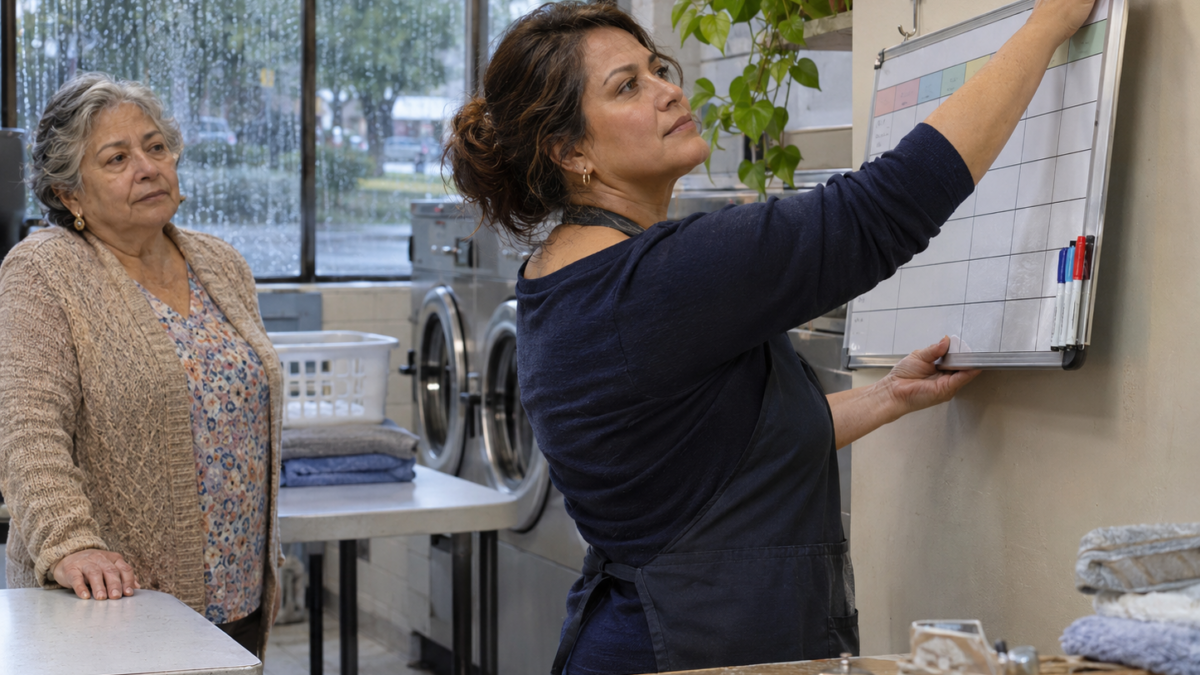
My sister-in-law Nora had one hand on the shift board when her mother said she didn’t know why anyone expected Nora to do more.
“She just sits at a machine,” Marisol said. “Daniel’s the one keeping this place going.”
Nora stopped reaching for the marker.
It was eight on Saturday morning. The laundromat had been open an hour, and rain had brought in people who usually hung their clothes outside. Nora was at the counter, helping a man work out which of his two nearly identical laundry bags had gone home with someone else. She had his phone number written on a slip of paper and a customer’s abandoned blue sock beside her elbow.
Daniel, my husband, stood at the open office door with a carton of paper towels against his hip. He looked up when his mother spoke.
He heard her. That was the part I would keep returning to.
Tessa, their cousin, was sorting the supply shelf behind me. I had come to help Daniel reconcile the week’s counter records, but I was still wearing my coat, holding two coffees in a cardboard carrier. Nora’s was the one with the milk already added. She always said she couldn’t taste a difference, and always noticed when I got it wrong.
“Mrs. Bell comes in around nine,” Nora told the man at the counter. “Those look like her bags. I’ll ask her before I call you.”
He thanked her and went back to his dryer.
Marisol was beside the folding tables, pulling a chair out of the aisle. “I’m not saying she doesn’t help. I’m saying your brother has enough on his shoulders without everyone asking him who’s coming and going.”
Nora looked at the board. Across its top, in her square handwriting, she had written the week’s dates. Beneath them were names, hours, and little notes: Tessa needs to leave by two. Lena—confirm Sunday. Call before changing.
Nora had bought that board herself after three people arrived to cover the same Sunday afternoon. She kept the markers clipped to its edge with a binder clip because the tray was broken.
She also worked two paid half-day shifts every week. That morning she had already wiped spilled detergent off a chair, helped a woman carry a wet comforter from one washer to another, and dealt with the missing bag. Her sitting down had lasted about four minutes.
And from January through June, she had sent Daniel two hundred dollars a month toward repairs.
Six payments. Twelve hundred dollars.
I knew because she and Daniel had both sent me copies for the private log I kept. Nora’s money went to his personal account; he sent the same amount on to the shop account. Marisol had given him access to that account and asked him to handle ordinary bills and vendor arrangements. Nora had no access to it.
The route had been Nora’s choice. She didn’t want her mother feeling that her daughter was rescuing her. Daniel had offered to pass the money along while they figured out what the machines needed. It was supposed to last six months, then they would talk.
We had reached the end of those six months without having the talk.
I put the coffee carrier down.
“Those questions were mine,” Nora said. “I asked Daniel whether he’d confirmed Sunday.”
“He has a lot to remember,” Marisol said.
“So do I.”
There was no sharpness in it. That made Marisol’s impatient wave look worse.
Daniel shifted the carton against his hip.
“Let’s get through the morning,” he said.
Nora watched him for a moment. Then she turned back to the counter and put the customer’s phone number beneath the register, weighted with the blue sock.
She walked to the board.
It hung on two hooks, one higher than the other. She lifted the right corner first, the way she always did when she wanted to clean behind it. This time she took it down completely.
“Nora,” Marisol said.
“I’ll finish at eleven, like the schedule says.” Nora folded the little easel legs out from the back and set the board on the floor behind the counter. “But I’m not making next week’s board.”
Tessa lowered a stack of paper towel rolls.
“We’ve already got next week in the office, don’t we?”
“Yes,” Nora said. “The copy is on the clipboard.”
“Then why take that down?” Marisol asked.
“Because it’s mine.”
A dryer stopped. In the sudden gap, I could hear rain ticking against the front windows.
Nora picked up her coffee and took a sip. I wanted her to look at me, partly because I wanted to offer something and partly because I wanted her to know I was not on the other side of the room with them.
She didn’t.
Daniel carried the carton into the office. Marisol straightened the chair she had moved, although it was already straight.
I stood beside the counter with my coat still on, angry enough to feel clumsy.
The receipts were on my phone. I could have brought them up before anyone finished another sentence. But Nora had given me those copies to keep a record, not to hold them out in front of her mother.
So I took off my coat and asked the woman waiting behind me what she needed.
***
By nine, the man with the missing bag had his clothes back. Mrs. Bell had brought them in with an apology and a container of oatmeal cookies that Nora put beneath the counter, away from the detergent.
Nothing else had been put right.
Tessa found the office schedule and brought it out on its clipboard. She had another job during the week and checked her hours against the calendar on her phone.
“This still says I’m here tomorrow morning.”
“You are,” Nora said.
“Daniel asked me yesterday about afternoon.”
“He asked me too.”
Daniel came out of the office with a pen tucked behind his ear. “I was checking options.”
“Did you change it?” Tessa asked.
“No.”
“Okay. Because I can do what’s here, but I can’t do both.”
Nora pressed her lips together and reached for the clipboard. Then she stopped and let Tessa keep it.
I had been wiping the same sticky patch off the counter. It was clean. I folded the cloth and set it beside the sink.
“Daniel.”
He looked toward me, then toward a customer coming through the door.
“Will you correct what your mother said about Nora?”
Marisol turned from the row of dryers.
“What did I say that needs correcting?”
“That she sits here while he keeps everything going.”
“I said he has a lot on his shoulders.”
“And Nora has regular shifts. She handles customers. She made that schedule.”
“You don’t have to list it,” Nora said quietly.
I looked at her. She was standing with a basket of stray socks against her waist.
“I’m not trying to—”
“I know.”
But I wasn’t sure she did.
Daniel took the pen from behind his ear and clicked it twice.
“Lena, nobody said Nora doesn’t help.”
“You let it sound that way.”
He looked at Nora, who gave him no assistance.
There had been another opening in May. Marisol had told him he was good at finding the money when something needed doing. I had been beside him in the office, adding figures on a calculator. He had said, “We’re managing.”
Afterward I told myself that naming the source would have broken our promise to Nora. I had not asked him why he couldn’t say there were other people helping, or why he couldn’t stop his mother from making him the only useful person in the room.
Now Tessa stood with the clipboard held against her chest. Marisol watched her son. Nora waited, though she had stopped looking as if she expected anything.
“I’m not asking you to discuss anything private,” I said. “I’m asking whether you’re going to correct the idea that your sister leaves all the work to you.”
Daniel glanced toward the entrance again.
I could feel the shape of the answer I wanted from him. A few ordinary words. Something he could have said while holding a carton of paper towels.
Instead he reached for the clipboard.
“We need to get Sunday covered first.”
***
At eleven, Nora wrote down the missing-bag customer’s name and the fact that he had collected his laundry. She showed Tessa where she had put the cookies, checked that her hours were entered, and lifted her board.
I offered to hold the door.
“I’ve got it,” she said.
She carried it against her side, markers still clipped to the frame. The rain had thinned to a mist. I watched her get it into the back seat of her car, then returned to the office.
Daniel was at the desk with a folder open in front of him.
“Can you give me a minute?” he asked.
“For what?”
“To finish this.”
“No.”
He looked up.
I closed the door most of the way. Through the remaining gap I could see Tessa at the counter and hear Marisol greeting a customer.
“Why wouldn’t you answer me?”
“Because that wasn’t the place.”
“It was where she said it.”
He rubbed his forehead. “I know.”
“Then what were you waiting for?”
Daniel leaned back. The office chair gave its usual complaining creak. There wasn’t room in there for both of us to sit unless I moved a box, and I didn’t want to settle in.
“I didn’t want Mom asking about the money.”
“You could have talked about Nora’s work.”
“I should have.”
“You watched her take the board down.”
“I know, Lena.”
He said my name as if I were asking him to remember something instead of explain it.
I pulled the box off the second chair and sat.
“Tell me what you thought would happen.”
He looked past me at the shelves where Marisol kept old receipt books, spare pens, and an unopened jar of instant coffee.
“She’d ask what I meant by everything Nora does. Then she’d ask what else she didn’t know.”
“And?”
“And I’d have to tell her we’re not doing as well as she thinks.”
I waited.
“The money comes in. She sees people using the machines. She sees me paying bills. As far as she’s concerned, we’re tight sometimes, but we always get through it.”
“Have you told her anything different?”
“Not all of it.”
He turned the folder toward me.
On top was the written estimate he had received Friday from Eli Warren, the technician the shop already used. Fifteen hundred dollars for work on the machine Daniel had kept out of service since earlier in the week.
Underneath was his summary of the shop’s current balance and the bills coming due.
I read it once, then again.
“If you pay all these, there isn’t enough for this.”
“No.”
“Even with Nora’s twelve hundred.”
“It’s in the balance. It isn’t another twelve hundred sitting somewhere.”
“I understand that. Does your mother?”
He shook his head.
The contribution log tracked Nora’s money toward repairs. It did not keep the rest of the shop from having rent, supplies, and other bills. I had reconciled the transfer copies each month, but I had not been looking at the whole picture with Marisol either.
Daniel pushed his glasses up and rubbed the bridge of his nose.
“Mom built this place into something that paid for our lives. I didn’t want to sit her down and tell her it barely has room to breathe.”
“So you let her think you were keeping it breathing by yourself.”
He opened his mouth, then closed it.
Finally he said, “Yes.”
The admission was quieter than his evasions had been.
“Was that what you meant to do in January?”
“No. Nora wanted it private, and it seemed simple. I could get the payments into the account. You could keep the copies. We’d get a better idea of what needed doing.”
“And in May?”
“I should have stopped Mom then.”
“Why didn’t you?”
He looked at the estimate.
“Because she was proud of me. And because I didn’t want the next conversation.”
Outside the office, someone laughed at something Tessa had said.
I had expected fear, maybe shame about the business. I had not expected him to name the part he had liked.
“Your sister got the other side of that,” I said.
“I heard her.”
“You heard her this morning. She’s been hearing nothing from you.”
He reached for his phone, then set it down without waking the screen.
“I can call her.”
“Ask if she’ll see us. Bring this.”
He glanced at the papers.
“I owe her an apology.”
“Yes. And she needs to know what you’ve been deciding without her.”
***
Nora said we could come at noon.
Her house was ten minutes from the shop, on a narrow street where everyone’s trash cans stayed visible from the sidewalk. By the time we arrived, her board was leaning against a kitchen chair. The week’s assignments still faced out.
She let us in without moving it.
“I haven’t eaten,” she said. “You can talk while I make something.”
She took three plates from a cupboard, hesitated, and put two back.
Daniel stood near the table until she told him to sit down.
He apologized before he opened the folder.
“I should have said something when Mom said that.”
“Yes,” Nora said.
“I should have said it before today.”
Her hand stopped over the bread bag.
“What does that mean?”
He told her about May. He told her that Marisol believed he had found the repair money, and that he had let the idea stand. He did not look at me while he said it.
Nora put the bread on her plate.
“How many times?”
“I don’t have a count.”
“More than once.”
“Yes.”
“Did she say I didn’t help?”
“She said she wished you understood how much there was to do.”
Nora gave a short, disbelieving breath.
“And what did you tell her?”
“That you were busy too.”
She sat down without making her sandwich.
I wanted to touch her hand, but she had drawn both hands into her lap.
Daniel laid out the estimate and the operating summary. He explained what the balance included and which bills still had to come out of it.
Nora moved the estimate closer.
“Fifteen hundred.”
“That’s Eli’s estimate.”
“When did you get it?”
“Yesterday.”
“And you didn’t bring it to Mom?”
“No.”
“Does she know you don’t have enough?”
“Not yet.”
Nora looked at him for a long time.
Then she took her phone from her pocket and opened the folder where she had saved her payment receipts. She held it herself while she checked the dates against the printed confirmations Daniel brought.
January. February. March.
By June, I could hear the refrigerator humming.
“Each one went through,” Daniel said.
“I can see that.”
“I didn’t keep any of it.”
“I didn’t say you did.”
He sat back.
She finished checking the last confirmation and put her phone facedown on the table. The private log matched the six payments and the six transfers to the shop.
The money had gone where she had agreed it should go. Somehow that made the rest harder to look at. There was no missing transfer to find, no mistake we could correct with a call.
“So the twelve hundred is accounted for,” Nora said. “But it isn’t enough to promise this repair and keep paying everything else.”
“Right.”
“And when were you going to ask me for more?”
“I wasn’t going to just assume—”
“When?”
Daniel looked down. “After we went through the estimate.”
“With Mom?”
“I hadn’t worked it out.”
Nora pushed the papers away from her plate.
“There won’t be a July payment.”
He nodded.
“I mean it, Daniel. Don’t put one in your figures.”
“I won’t.”
“We said six months, then we’d look. We didn’t say six months, then I’d keep sending it because nobody wanted to tell Mom anything.”
“I know what we said.”
“Then use that.”
Her voice had finally risen. She looked toward the window, took a breath, and brought it back down.
“I asked you not to make her feel rescued. I didn’t ask you to let her think I was useless.”
Daniel bent his head.
“I know.”
Nora got up and finished making her sandwich. She cut it across, though she had always eaten it whole at the shop.
I watched the knife go carefully through the bread.
“What happens now?” Daniel asked.
“I’m going to eat my lunch.”
“I meant—”
“I know what you meant.” She put the knife in the sink. “You can go back. I want to talk to Lena.”
For a moment he looked wounded, and I almost made it easier for him. I almost said he could stay.
Instead I moved my chair so he could get past.
At the door he asked Nora to call when she was ready.
“I’ll let you know,” she said.
She shut the door and stood with her hand on the knob until his car started.
***
When Nora came back, she took out the other two plates.
“Now I feel rude.”
“You don’t have to feed me.”
“I know. I’m hungry, and I don’t like somebody watching.”
She made me a sandwich and put mustard on it without asking. She knew how I took it. I had been married to her brother seventeen years.
We ate for a few minutes. I could see the board over her shoulder, Tessa’s name in green, mine in blue. Nora used different colors because Marisol said her glasses made the black writing run together under the counter lights.
“I thought if he told them about the money—” I began.
“That would fix it?”
“I thought it would stop her saying you don’t contribute.”
“Maybe.” Nora picked a crumb off the table. “What if I hadn’t sent any?”
“I know you work.”
“I know you know.”
I put down my sandwich.
She looked tired now that there was no one left to brace herself against.
“The board isn’t just writing names,” she said. “It looks like that because I do the rest before I write them.”
She reached for her phone, then left it where it was.
“Last Tuesday Tessa couldn’t do the last hour. I called Daniel. He was waiting for a delivery. I called Mom. She had a ride somewhere. So I stayed.”
“I didn’t know.”
“Why would you? The counter was covered. Wednesday, Mom asked me to switch next Thursday because she wants Daniel free in the morning. I called him, and he said he’d check. Yesterday she asked why I hadn’t settled it.”
The blank spot beneath Thursday’s date was still on the board.
“How often?”
“Enough that I look at my phone on my days off and hope it isn’t the shop.”
I thought of the messages I sent her. Can you check with your mom? Do you know whether Daniel found someone? Usually followed by thanks, sometimes a heart.
“I’ve asked you to do it too.”
“Yes.”
No softening. No list of my offenses either. Just room for me to hear the answer.
“I’m sorry.”
She nodded and took another bite.
“I like working there,” she said after a while. “Most days. I know the customers. I like being useful. But I finish a shift and somehow I’m still the person who has to know what happens next.”
“Did you tell Daniel that?”
“Not like this.”
She looked at the board.
“I should have. I should have asked for a time to talk instead of keeping track of every time I was annoyed.”
“You didn’t make him stay quiet this morning.”
“No. That’s his.” She pressed her thumb against the edge of her plate. “But the secret money was partly for me too.”
I waited.
“Mom gets that look when she thinks one of us is worried about her. Then she starts telling us everything she doesn’t need. I didn’t want to argue through that every month. Passing it through Daniel meant I didn’t have to.”
“It was supposed to be temporary.”
“And I should have asked what temporary meant when we got to June. I didn’t want that conversation either.”
She said it without excusing him. I could hear the difference.
The afternoon light had reached the kitchen floor. Somewhere nearby, a mower started and stopped, then started again.
“When Mom said that,” Nora said, “I thought he would say something.”
“I did too.”
“And you knew.”
I looked at her.
“You knew she thought he found the money.”
“Since May. I heard her say it once.”
Nora’s expression changed, only a little.
“I told myself I couldn’t tell her,” I said. “Because you’d asked us not to.”
“You couldn’t tell her about my money.”
“I could have asked what she meant. I could have told Daniel to stop letting it happen.”
“Yes.”
I wanted her to say she understood. She might have understood perfectly and still not have wanted to reassure me.
“I’m sorry I left you outside that conversation,” I said.
She slid her plate away.
“Don’t make it up to me by having another one without me.”
I had already been arranging words in my head for eight o’clock, when the shop would close and everyone could hear the truth. I had imagined Daniel naming the total, Marisol’s face changing, Nora finally getting what she was owed.
Nora hadn’t agreed to any of that.
“All right,” I said.
She studied me for a moment.
“I’m not saying nobody can talk about it.”
“I know. But I’ve been thinking about how to prove your mother wrong. I haven’t asked what you want.”
Nora leaned back. Beside her, the board rested against the chair, ready to be carried somewhere or left exactly where it was.
I stopped looking at it as something we needed back at the shop.
“What do you want us to understand?” I asked.
She took her time before answering, and I let her.
“I want to be able to finish work,” Nora said, “and actually be finished.”
She glanced at her phone.
“And I want Mom to know what she said wasn’t true. Not just the money part.”
“Do you want to tell her?”
“No.” Her answer came quickly. Then she rubbed her forehead. “I might say something. But I don’t want to have to argue my own case while Daniel sits there knowing.”
Outside, the mower stopped again. This time it stayed off.
“Would you like him to come back?” I asked.
She looked at the plates, the board, the papers still stacked at the far end of the table.
“Let me clear this first.”
I helped her put lunch away. She wrapped the other half of a tomato and searched through a drawer for a lid that fit its container. When I offered to wash the plates, she handed me the dishcloth. Neither of us hurried.
Afterward, she called Daniel herself.
“Come over when you can,” she said. “We need to settle what you’re going to say.”
He arrived twenty minutes later, carrying the shop keys even though he wasn’t driving the shop anywhere. They rattled when he put them on the table.
Nora sat opposite him.
“You can tell Mom I sent twelve hundred dollars for repairs. Tessa can hear it too. She was there this morning.”
Daniel nodded.
“No receipts. No phone passed around. I’m not opening my accounts for a family inspection.”
“I wasn’t going to—”
“I’m telling you before we start.”
“All right.”
“And don’t tell her what I can afford. You don’t know that.”
He looked at her then. “I know.”
“You know six payments. That’s what you know.”
He drew his keys closer to him.
Nora went on. “Tell her I work two shifts a week. Paid shifts. And that I’ve been doing the changes and replacement calls around them. I don’t want the money turning into the reason I’m allowed to be upset.”
Daniel’s eyes moved briefly toward me. I kept quiet.
“I can say that,” he said.
“Will you tell her you let her believe you found the money?”
“Yes.”
“Not that I made you keep a secret?”
He took a breath.
“I’ll tell her you asked for privacy at the beginning. If she asks. But I’ll tell her I let it turn into something else.”
Nora considered that.
“I did ask for it. I’m not asking you to lie now.”
“I know.”
“And this isn’t me saying I’m coming back with the board tomorrow.”
His hand stopped on the keys.
“What about your shifts?”
“I haven’t quit. I’m also not agreeing to anything extra.”
“Okay.”
She waited, as though expecting another question. When none came, some of the stiffness left her shoulders.
Daniel asked whether eight o’clock at the shop would work. He would ask Marisol and Tessa to stay after closing, and we would all look at next week’s schedule and the repair figures.
“I’ll come,” Nora said. “But don’t tell Mom we’re having a meeting to straighten me out.”
Daniel winced.
“I won’t.”
After he left, Nora gathered her receipts and put them in a kitchen drawer. She left the estimate on the table.
“Are you coming with me tonight?” she asked.
“If you want.”
“I don’t want you to talk for me.”
“I won’t.”
She shut the drawer.
“But come.”
***
At eight that evening, Daniel turned the sign to CLOSED while I checked that the last customer had taken the bag she’d left beneath a folding table. Marisol stood by the door until the woman’s car pulled away, then locked it.
The shop sounded different with no customers in it. A dryer was still turning with the towels we used for cleaning. Somewhere along the back wall, a pipe ticked.
Tessa had brought a sandwich wrapped in foil. She held it up.
“Is this a sandwich-length meeting or should I have brought dinner?”
“I hope sandwich,” Daniel said.
Nobody laughed much, but she sat and unwrapped it anyway.
We used the folding table nearest the office because five people couldn’t sit comfortably around the desk. Daniel laid out the estimate, a summary of the shop’s available money and upcoming bills, and the office copy of the schedule.
Nora came in without her board. Marisol noticed. Her eyes went from Nora’s empty hands to the bare hooks near the counter.
Daniel pulled out a chair for his sister. She moved another one over and sat in that instead.
He didn’t try again.
“We need to look at all of this together,” he said.
Marisol reached for the estimate first.
“Fifteen hundred?”
“That’s Eli’s estimate for this machine.”
She read down the page, then turned it over as though there might be a smaller number on the back.
“You told me the repair money was covered.”
“I told you it was covered for now. I should have shown you the figures.”
“What figures?”
He pushed the cash summary toward her.
Marisol read it with one finger beside the lines. She stopped at the bills due that week.
“This includes the money already put in?”
“Yes.”
“Then why isn’t there enough?”
“Because putting money toward repairs didn’t stop the other bills. Some weeks there was enough coming in to leave that amount alone. Some weeks there wasn’t.”
She looked toward the office.
“I gave you access so you could pay things when I wasn’t here.”
“I know.”
“That didn’t mean I didn’t want to see.”
Daniel sat down.
“I know that now.”
“No. You knew it before.”
He lowered his eyes to the paper.
“Yes.”
Tessa folded the foil beneath her sandwich. She had stopped eating.
For a few minutes Marisol asked questions: which bills were due first, what was already paid, whether the repair estimate meant Eli could come immediately. Daniel answered what he knew and put a small mark beside what he needed to confirm.
When he reached the end, Marisol sat back.
“So we need more.”
“We need a plan,” Nora said.
Her mother turned toward her.
“I didn’t ask you.”
“I know. I’m saying it now so nobody builds the plan around me finding the difference.”
Marisol’s mouth tightened. “I wasn’t doing that.”
Nora didn’t answer.
I felt the old urge to smooth it over, to say we were all tired and nobody meant anything. I flattened a curled corner of the schedule instead.
Daniel put his pen down.
“Before we decide anything else, I need to correct what happened this morning.”
Marisol looked at him, then at Nora.
“I’ve been letting you believe something that wasn’t true,” he said. “The repair contributions came from Nora. Two hundred dollars a month, January through June. Twelve hundred altogether.”
Tessa’s eyes lifted from the table.
Marisol stayed very still.
“Nora sent it to me,” Daniel continued. “I transferred the same amounts into the shop account. Lena kept the record from the copies we gave her.”
“You told me—”
“I told you the money was covered. I didn’t tell you who was covering it.”
Marisol looked at me.
I nodded once. “That’s what the shared records show.”
There were no bank receipts on the table. Nora’s drawer at home stayed closed, even here.
“Why wouldn’t you tell me?” Marisol asked her daughter.
Nora folded her hands.
“At first, I didn’t want you worrying about me helping. I thought we could get through six months and then sit down and look.”
“So this was supposed to keep me from worrying?”
“It was supposed to be temporary.”
Marisol looked back at Daniel. “And you let me thank you.”
“Yes.”
“You let me say—”
“Yes,” he said again. “I heard you give me credit. In May, and other times. I could have told you not to do that without telling you Nora’s private business. I didn’t.”
His face had gone red, all the way to his ears.
“I liked you thinking I had it handled,” he said. “I was worried about you seeing how tight things were, but that wasn’t all of it.”
No one helped him past that.
He picked up the pen, then put it down again.
“And this morning, when you said Nora just sits at a machine, I should have stopped you. She was working. She does her paid shifts. She handles customers and cleans and does the closing work when she’s scheduled for it. And she’s been making calls and sorting out changes that should not all have landed on her.”
Tessa nodded slowly.
“I call you first,” she said to Nora. “Even when it’s my shift I need changed.”
“Usually,” Nora said.
“I thought you were the schedule person.”
“I became the schedule person.”
Tessa looked down at the paper copy.
“I’m sorry.”
Daniel turned to his mother.
“She hasn’t been doing nothing. I knew that when you said it. I let it stand.”
Marisol’s hand lay flat on the estimate. Her fingers looked smaller than they had while she was pointing at the bills.
“I didn’t say nothing,” she began.
Nora’s chair moved slightly.
Marisol looked at her.
Then she stopped.
“No,” she said. “That’s what I meant.”
The last dryer went quiet. I could hear traffic beyond the glass.
Marisol turned her chair toward her daughter.
“I saw you sitting, and I said something mean. I made it sound like your work didn’t count.” She swallowed. “It counts. I know what customers can be like. I know there’s more to it than standing up.”
Nora watched her without nodding.
“And I shouldn’t have put your brother above you like that.”
Marisol looked at Daniel, but she didn’t leave the apology with him.
“I’m sorry, Nora.”
“Thank you for saying it.”
Her mother waited.
Nora rubbed a mark on the edge of the table.
“I’m still angry.”
“I can see that.”
“I don’t want us deciding tonight that because we talked, it’s all finished.”
Marisol pulled her hand off the estimate and set it in her lap.
“All right.”
It was an uncomfortable answer, and she looked uncomfortable giving it. But she didn’t ask Nora for a hug. She didn’t tell us how much worse she felt than anyone else.
Daniel looked at his sister.
“Did I get it right?”
Nora took a moment.
“Yes,” she said. “That was right.”
***
Tessa picked up her sandwich again.
“Now can we make Thursday exist?” she asked.
Nora let out a breath that almost became a laugh.
The Thursday gap was still there on the office copy. Daniel’s name appeared in the morning, with a question mark beside it. Marisol had wanted him free to handle a delivery, but nobody had confirmed a replacement.
We started there.
It took longer than writing a name. Daniel had to check the delivery message. Marisol had to decide whether she could move an errand. Tessa could take the last hour, but not the first three.
Nora sat with both hands around a paper cup of water and let them work it out.
At one point Daniel looked toward her.
She raised her eyebrows.
He turned back to the schedule.
By the time Thursday was covered, we had used the back of an old flyer for a list of rules none of us would have called rules before that morning.
A person who needed a change would call Daniel, not Nora. A shift wasn’t changed until the replacement had agreed and Daniel had confirmed it. I would update the shared paper copy during my regular bookkeeping time. If someone called me asking what Nora knew, I would direct them to the person responsible instead of forwarding the question.
“Don’t make Lena the new switchboard,” Nora said.
“Please don’t,” I said.
Marisol took a regular Saturday counter period and agreed to be the first person Daniel called for coverage on Saturdays when she wasn’t already working. He would cover until help arrived if no one could get there immediately.
“I may be in the middle of something,” she said.
“So might everybody else,” Tessa said.
Marisol gave her a look, then crossed out a time and wrote in a different one.
Tessa offered a paid backup period on the weekday afternoon she was usually available. Nora kept her two half-day shifts, including Saturday from seven to eleven.
“And when my shift ends,” she said, “I can leave.”
“Yes,” Daniel said.
“Even if the next person’s late.”
“I’ll handle it.”
She looked at him until he added, “I’ll cover the counter. I don’t mean I’ll call you to handle it.”
That time Tessa did laugh. Daniel managed a small smile.
The repair was harder.
We went through the upcoming bills again, and Daniel showed us why paying the full estimate immediately would leave too little for what was due. No rearrangement of the pages changed that.
Marisol looked toward the affected machine. Its out-of-service sign had curled outward at the bottom.
“I don’t like leaving it.”
“Neither do I,” Daniel said.
“But you’re not calling Eli tonight.”
“No. Monday.”
She tapped the estimate.
“Find out the dates. Find out when he needs the money. No promises until we know we can pay.”
“And it stays closed off,” I said.
“Yes,” she said, more sharply than she needed to. Then she rubbed her eyes. “Yes. It stays out.”
There would be fewer machines available. Customers might wait or go elsewhere. Waiting for an affordable appointment had a cost too; we could see it through the office window without anyone explaining it.
Daniel would bring Marisol a short report every month, with the bills and available cash, and the rest of us would have a chance to review the shop figures together. The first review went on the calendar before anyone could call it something we would get around to.
Nora watched him write the date.
“If we do this,” she said, “I’ll add one hundred dollars. Once.”
Daniel looked up.
“One hundred,” she repeated. “Not another two hundred a month. After the schedule is written and the review is set.”
“You don’t have to,” Marisol said.
“I know.”
Her mother seemed ready to say it again. Instead she pressed her lips together.
Nora continued. “It goes straight to the shop this time. I’ll give it to you, Mom, and we’ll write it in the family log. No passing it through Daniel.”
“All right.”
“And after that, don’t put more from me in any projection.”
Daniel drew a line through something on his scratch paper.
“What was that?” Nora asked.
“Nothing from you. I was changing the amount we’d still need.”
She held out her hand. He passed her the paper without protest.
She read it and gave it back.
We didn’t leave with the repair booked. We left with the machine staying out of service, a call assigned for Monday, and an appointment dependent on money the shop could actually spare.
The board stayed at Nora’s house.
As we walked out, Marisol reached toward her daughter’s arm, then stopped short of touching it.
“Drive carefully.”
“I will.”
Daniel and I waited until we were in our car before speaking.
“I’m sorry I left you to push me,” he said.
I put my bag on the floor.
“You left Nora waiting longer.”
“I know.”
“I need you to tell me when something is going wrong. Not after you’ve worked out how to make everybody feel better about it.”
He looked through the windshield at his mother locking the shop.
“I don’t know if I can make this business work.”
It was the first time I had heard him say that plainly.
“I don’t either,” I said.
We sat with it for a little while before he started the car.
***
On Monday, Daniel sent all of us the same message after speaking to Eli.
Eli wasn’t offering a payment arrangement. He could book the work for a date when the shop was ready to pay. He had an opening later in the month, and Daniel asked him to hold it only after Marisol had reviewed the updated figures with him.
That evening, Daniel called me from the office while Marisol was still there. They had checked the bills against the expected receipts again. With the later appointment, and without spending money they needed for the immediate expenses, Marisol was willing to approve it. Daniel confirmed the date with Eli the next morning and sent us Eli’s reply.
No one said Nora’s hundred dollars had solved it. It helped. The delay did the rest of what the money couldn’t do, and it cost the shop the use of that machine in the meantime.
On Thursday, Nora brought Marisol the single hundred-dollar contribution they had agreed on. Marisol sent me a photograph of the line they had both checked in our private family log.
Below it, she had written, No further amount promised.
I looked at those words for a long time.
***
Two Saturdays later, Nora arrived carrying the board under one arm.
I was opening the office when she came through the door. She had erased the old week at home. The corner where she usually rested her hand was still faintly green.
“Do you want help hanging it?” I asked.
“Hold that side.”
We lifted it onto the hooks together.
She had added a line beneath the schedule: CHANGES CONFIRMED BY.
“Daniel gets a place to put his initials,” she said.
“He’ll be thrilled.”
“He can get his own color.”
It wasn’t forgiveness, but it was the first joke she had offered me about the shop since that morning.
By ten-thirty, the folding tables were full. The affected machine still had its sign on it; the appointment was the following week. A customer asked Nora whether he could use it just this once, and she said no, then helped him find another machine coming free.
She didn’t apologize for the wait as though she had personally caused it.
At ten-forty, Daniel’s phone rang. Tessa’s car wouldn’t start. She wasn’t going to make her eleven o’clock shift, and she couldn’t give him a reliable arrival time.
I looked at Nora.
She was sorting the clean counter cloths into a basket. Her jacket hung on the peg beside her bag.
“Could you stay—” I began.
She stopped folding.
I caught myself, but not before she had heard it.
“Would you want the extra time?” I asked. “It’s all right if you don’t.”
“No. I have plans.”
For a second I wanted to ask what plans. Whether they could be moved. The questions were so familiar that I almost mistook them for necessary.
“All right,” I said.
She put the last cloth in the basket.
“Daniel calls his backup.”
He was already calling Marisol.
She could get there, but not until about eleven-forty. He checked the clock, looked at the box of supplies he’d planned to take to the back, and told her he would stay on the counter.
“I’ll have to put off the rest,” he said after hanging up.
“Yes,” Nora said.
He nodded, picked up the box, and slid it beneath the desk instead of leaving it in her path.
At eleven, Nora counted through the handoff with him. A customer needed help with a change problem, and Daniel went out to speak to her while Nora finished her notes.
I stood beside the board.
“What should I put?”
“Wait until he confirms it.”
When he returned, he told us Marisol had just called again. She was leaving home now.
“Me until she gets here,” he said. “Then Mom.”
Nora picked up the green marker.
She wrote the actual coverage, put Daniel’s initials on the confirmation line after he agreed, and capped the marker.
At eleven-ten, she put on her jacket.
Daniel was helping a customer at the counter. He lifted his hand when she said goodbye, but he didn’t ask where she was going or how long she would be.
“Have a good afternoon,” I said.
“You too.”
Marisol arrived with her bag sliding off one shoulder and went straight to the counter. When Daniel showed her the waiting customer’s question, she listened, set her bag down, and took over. Later she would restock the supplies she had agreed to handle. For now, Daniel could carry his box to the back.
Through the front glass, I watched Nora reach her car. She checked something in her bag, found it, and drove away.
Behind me, the board showed who was working.
This time, it wasn’t a list of people Nora still had to call.








