A Salesman Made My Daughter Put My Birthday Dress Back; He Didn’t Know I Owned the Building His Store Rented.
Chapter 1 of 7
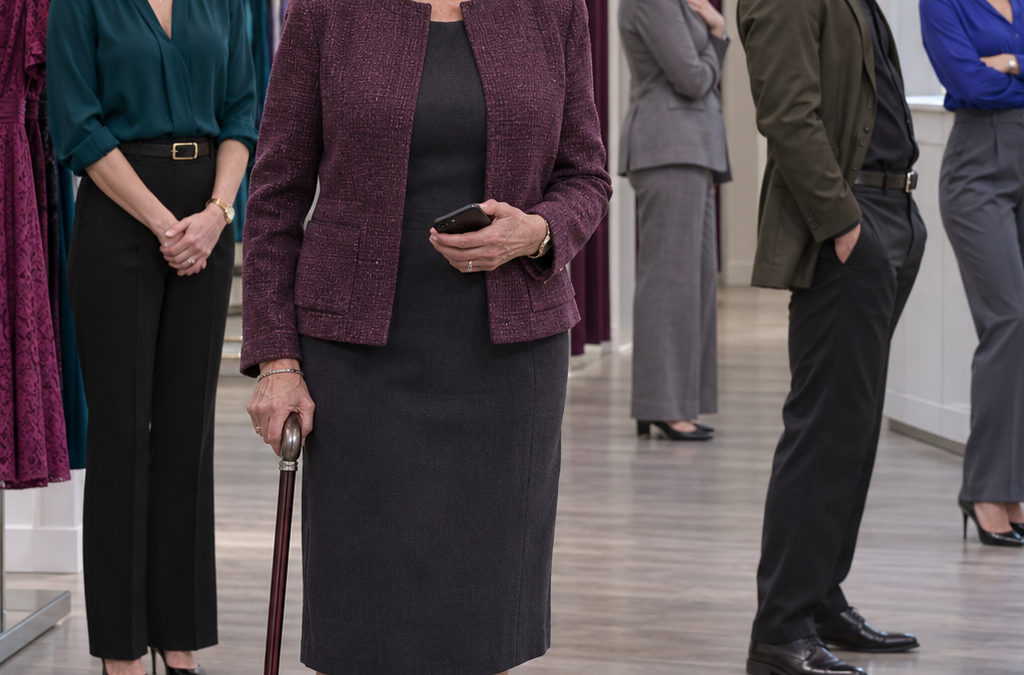
My cane was planted beside my right shoe. Claire stood beside me, holding the dress against her shoulder so I could see its shape.
“Put it back. She’ll stretch it.”
The salesman hadn’t even asked my size. His name tag said Evan.
At the register, Maya smirked.
“Just put it back.”
Four other employees stood within hearing distance. Nobody objected. One looked toward the fitting rooms, then down again.
Claire’s face changed before she lowered the dress. That hurt more than the salesman’s remark. She had brought me there for my birthday, and now she looked responsible for what he had done.
My name is Nora Bennett. I’m seventy-two.
I had been widowed for six years. Eight months before that shopping trip, I’d had hip surgery. I still needed the cane, especially when I got tired.
For thirty-one years, I ran an alterations shop. I had fitted brides, shortened school uniforms, and let out waistbands for men who blamed their dry cleaners. I knew what fabric could take. Nothing about the dress suggested it wouldn’t fit me.
I owned this building, and his employer rented it from me.
I had owned it for eighteen years. The boutique had rented the space for nine. Two winters earlier, I paid $18,400 to replace the roof. Five years before this, I paid $6,800 for the step-free entrance.
Those repairs were my responsibility. They didn’t buy me better manners than another customer deserved.
But these people worked beneath that roof and walked through that entrance. They had never asked who I was.
Claire had suggested a birthday outing instead of lunch at home. Usually, she brought a grocery-store cake and complained that I cut slices thin enough to mail.
I had wanted something different that year. I felt embarrassed by how quickly that wish had become a problem.
“Don’t block the mirrors,” Evan said.
We weren’t blocking one. We were beside the corridor, leaving room for anyone to pass. Still, I shifted closer to Claire.
Maya looked at the dress, then at me.
“She needs somewhere cheaper.”
Claire didn’t put it back immediately. She looked at me first, waiting for something I couldn’t seem to say.
I felt ashamed, though I had done nothing wrong.
“We don’t have time for this,” Evan said.
He didn’t lower his voice. The other customer could hear him. So could every employee who kept finding somewhere else to look.
“You’re holding everybody up,” Maya added.
Claire had been openly filming our birthday outing from the moment we came inside. I had agreed because she wanted a little video of me choosing something for myself.
Now she held the phone where both employees could see it.
“I’m still recording,” she said.
Evan glanced at it and turned back toward the corridor.
“The fitting rooms are all closed.”
I was angry then. He had decided I couldn’t try the dress before he’d asked a single ordinary question.
Claire handed me the phone so she could return the dress. The recording kept running. On the screen, I could see the mirror beside the corridor. A blue sleeve crossed its edge.
I watched Claire hang my birthday choice back on its rack.
I had never felt so small.
“We can go somewhere else, Mom.”
She sounded gentle. That made it worse. My daughter already knew how to help me leave without making trouble.
I almost thanked her.
I had spent years making other people’s bad behavior easier.
Then I looked at her face.
“Wait,” I said.
I knew the regional director through building-repair visits. She already had a routine visit planned for the following week. I stopped the recording and called her.
“A salesman won’t let me try a dress,” I told her. “He told my daughter I’d stretch it. We’re still here.”
She asked to speak to him. I put the call on speaker.
Evan started explaining, but she cut him off.
“Step away. Have another employee assist her.”
Evan stepped aside when his director ordered him to.
He moved only far enough to clear the corridor entrance.
“She went around me,” he said. “I’m running the floor.”
The director asked who else was present. Evan named Maya first, then indicated the four employees who had watched without speaking.
I was relieved someone had listened. I also hated needing someone else to make my words count.
Claire stayed beside me. She didn’t reach for another dress.
“Can we handle this afterward?” Evan asked.
His voice had changed. He sounded patient now, as if the director had interrupted a reasonable man doing his work.
“No,” she said. “Tell me what happened.”
He said he had offered guidance about fit. Maya looked toward him but didn’t repeat her comment about somewhere cheaper.
“He didn’t offer guidance,” I said. “He told her to put it back.”
Evan looked straight at me.
“I was speaking to my director.”
That old urge came back, the one that made me apologize for interrupting my own humiliation. Claire’s shoulder was against mine. I stayed where I was.
The director asked whether all six employees had been there when he spoke.
“Yes,” he said. “They’ll tell you.”
He sounded certain of that. The four silent employees were no longer pretending to be busy.
“Then I want each person’s account,” she said. “Separately. Don’t write one together.”
Evan opened his mouth to answer.
His director ordered separate accounts from all six employees.
“Of course,” he said. “Whatever you need.”
He nodded toward Maya, but she was looking at the floor.
The director asked another employee to help us. The woman came forward slowly, with a careful expression that made me sad all over again.
“I can find another size,” she said.
Claire answered before I could.
“That’s not what happened here.”
Her voice cracked on “happened.” I wanted to get her outside, away from all those watching faces. For once, I understood that leaving quietly wouldn’t spare her what she had already heard.
I told the employee I wasn’t buying anything.
The director asked if she could contact me directly afterward. I said yes. She told Evan she expected his account as well, and the call ended.
He looked at Claire.
“There. Someone else can help you.”
“We’re leaving,” I said.
I didn’t add an apology.
Outside, Raleigh, North Carolina, carried on around us. People were walking past Bellweather with errands of their own. I stood clear of the entrance while Claire waited beside me.
I had passed that storefront many times during the boutique’s nine years there. Until then, I had worried about leaks, heating, and whether deliveries damaged the doorway. I hadn’t wondered how customers were treated once they got inside.
The regional director was Laura Collins. I knew her as someone who answered repair questions directly and followed up when she promised to.
I hadn’t called her to make a demand about Evan’s employment. I wanted her to hear what he had said while everyone was still standing there.
Later, I learned he was chasing a $12,000 sales week. In the store, all I knew was that he had treated the time I needed as time he couldn’t afford.
Claire asked whether I wanted to try another shop.
“No. I want to go home.”
She nodded, then asked if I was all right.
“I’m hurt,” I said. “And I’m angry.”
Her face eased a little. I usually told her I was fine.
I gave her phone back. She checked that the birthday recording had saved and kept the original.
Before we left, Laura sent a message.
“Evan says you refused a safety instruction.”
Chapter 2 of 7
“He means the cane,” Claire said. “He’s going to say you blocked the corridor.”
“Maybe he thought I was in the way.”
“Mom. You were already starting to apologize. He hadn’t even said there was a hazard.”
We were still outside Bellweather. I wanted to get away from the entrance before somebody came out and found another reason we shouldn’t be there.
Laura’s next message clarified Evan’s claim. He said he had asked me to keep my cane clear of the fitting-room corridor.
“He told me not to block the mirrors,” I said.
“That isn’t the same thing.”
I knew it wasn’t. Still, I had begun searching for a mistake of mine that would explain his behavior. I was embarrassed when Claire caught me doing it.
She asked whether I wanted her to answer Laura.
“I’ll answer.”
I told Laura where my cane had been and what Evan had actually said. Then Claire drove me home. Neither of us suggested another birthday stop.
By the following morning, Laura had checked my name against the company’s current lease and property information. I supplied the signature page privately when she asked.
“That confirms you’re our landlord,” she told me. “It doesn’t tell me what happened with Evan. I need to handle that separately.”
“The building is mine. The store isn’t.”
“Right. Their employment is my responsibility.”
I wasn’t asking for his job. I wanted someone to stop treating his explanation as the sensible one simply because he worked there.
Claire sent Laura a short excerpt showing the insult and our response.
“This is a short extract, not the whole recording,” she wrote. “The continuous version is saved.”
We kept the original.
I felt relieved when Laura confirmed she had received the excerpt. Then I felt foolish for needing proof of something five other employees had heard.
Claire had asked Laura to route further messages through her while I decided what I wanted to do. Evan’s first message sounded nothing like the man at the store.
He regretted that our visit had become upsetting. He hoped we could resolve the matter privately. He said a conversation might clear things up.
Claire agreed to a call, provided I could join it.
“I’m sure your mother didn’t intend any difficulty,” he began.
“I’m here,” I said.
His pleasant voice disappeared.
“Then stop filming my staff.”
“She was filming me.”
“You kept it going. You made us look bad.”
I hadn’t posted anything. Neither had Claire. The only person outside that store who had received the excerpt was his director.
He talked over that distinction. Customers expected privacy, he said. Staff shouldn’t have to worry about appearing online while doing their jobs.
Then he offered us a way out.
“Delete it. We call it a misunderstanding.”
Claire asked what he meant by “we.”
“I’ll withdraw my complaint. You drop yours.”
I was angry at how easily he said it. His remark about my body had become a dispute between equal offenders, and the price of peace was the evidence.
“Did Laura ask you to offer that?” I asked.
“Don’t drag her into everything.”
Claire ended the conversation without agreeing.
Later, Maya sent Claire a message through the same contact thread. She said she wanted to explain the pressure Evan had been under.
His weekly sales target was $12,000. He had missed it for two weeks. As floor lead, he was trying to keep customers moving and fitting rooms available.
“He can’t spend forever on one person,” she wrote.
I read that sentence more than once.
He hadn’t spent forever on me. He hadn’t asked my size or offered another dress. Yet I could see how they had counted the minutes they expected me to need and decided against me.
“It doesn’t excuse what she said,” Claire told me.
“I know.”
Knowing didn’t keep it from hurting. I had spent thirty-one years helping people dress bodies they sometimes apologized for. I couldn’t remember once wishing a customer would disappear before I’d measured her.
I asked Claire whether shopping with me had become difficult.
She didn’t answer immediately.
“It’s been eight months,” I said. “Since the surgery. I still need you to carry things sometimes.”
“Are you asking if you embarrassed me?”
I hated that she could hear the question I hadn’t managed to ask.
“Yes.”
“The cane didn’t hurt me, Mom.”
She sounded tired now, and that frightened me more than anger would have.
“You looked at me like I should put it back before he got annoyed again. Like we’d done something.”
I remembered waiting for her to return the dress. I had wanted her to hurry.
“I thought leaving would make it easier.”
“For who?”
I couldn’t answer that neatly. It would have spared me another insult. It would also have left Claire carrying the one he had already delivered.
She said she would not delete the recording.
“I wasn’t going to ask you to.”
“You were thinking about it.”
She was right. I felt ashamed, then grateful she hadn’t let me pretend otherwise.
We had once argued about whether leftover birthday cake counted as breakfast. I missed having that sort of problem with her.
Claire asked if I wanted the excerpt posted publicly.
I said no. I wanted Laura to receive a customer complaint in writing, with my own account attached. I would put my name on it and answer questions myself.
Laura confirmed receipt before the end of the day. A second message followed, forwarding Evan’s proposed condition for letting me return.
I could shop there again only after signing an apology for “unsafe conduct.”
Chapter 3 of 7
Claire read the proposed apology aloud at her kitchen table.
“‘I apologize for moving my cane toward an employee and ignoring a warning that the fitting-room area was closed.’”
“Neither of those things happened,” I said.
There was another sentence about following staff instructions during future visits. My daughter stopped reading there.
We had planned to send Laura a short refusal, then go out for lunch. Now Claire was asking whether we needed someone to help us answer it.
I would not sign that.
I said it again so she knew I meant it.
“Tell Laura no. Those words, if you want.”
Claire’s kitchen smelled of toast. She always scraped the darkest parts over the sink and called the rest perfectly good. That morning, she had left both pieces uneaten.
I felt sick with embarrassment. I had come to her home to discuss an apology for something I hadn’t done.
Laura called after receiving our answer. Claire asked whether I wanted her to stay.
“Yes. But I’ll talk.”
Laura sounded tired, though she didn’t rush me.
“You’re not required to sign his statement,” she said.
“Then we’re finished with that?”
“With the statement. There’s still his report.”
She explained that a floor lead could report an incident and request a temporary restriction on a customer’s return. Evan had done both. He couldn’t turn his request into a permanent ban himself.
“So he gets to say I can’t come in?”
“He gets to ask. I have to review what he’s reported.”
I disliked how much room that left him. Refusing his version hadn’t removed it. It was still there, waiting for someone to decide whether I was safe to admit.
Laura said his latest account concerned protecting employees from my cane.
“He says you moved it toward him when he redirected you.”
“It stayed beside my right shoe.”
“Did you move toward him?”
“I turned when he spoke. I didn’t go after him.”
I wanted to explain how carefully I walked since surgery. I wanted to tell her I had never threatened anyone in a shop.
Instead, I repeated where the cane had been.
Laura asked Claire for her recollection separately. Then she told us to send any further corrections directly to her rather than argue with Evan.
After the call, Claire pushed her toast away.
“He knows you didn’t do that.”
“I don’t know what he thinks he saw.”
“Oh, Mom.”
“I’m not agreeing with him.”
But I heard myself offering him room again. It hurt to realize how quickly I could supply excuses for someone who had supplied none for me.
Later, Laura sent a brief update about the staff accounts. One employee had reported that Evan was warning the others about the consequences of admitting fault.
“He’s telling them the whole opening shift could face discipline,” Claire read. “That includes people who didn’t speak.”
Five people had been there besides him. Two had spoken to us; the other four had watched. Now he was making their different choices sound like one shared problem.
I remembered the employee who had come forward only after Laura ordered someone to help. I wondered what she would write if she believed the wrong answer might cost her work.
“I want to put the clip online,” Claire said.
She didn’t sound impulsive. She sounded as if she had been waiting to say it.
“People should see what he’s defending.”
“Please don’t make a fuss.”
The words came out easily. Claire leaned back, and I hated the tired look on her face.
“About what he did, or about what he’s doing now?”
I couldn’t answer immediately.
She had been standing beside me when he said I would stretch that dress. She had carried it back. Now I was asking her to make the truth small enough that nobody would be upset by it.
“Wait,” I said. “I shouldn’t have said that.”
“You don’t want it posted.”
“No. I don’t. But you’re not making a fuss by being angry.”
I was frightened of strangers discussing my body. I was frightened of comments about whether I should have been shopping there at all. I told her that instead of making her concern sound unreasonable.
She looked toward the kitchen window.
“I don’t want to spend the week watching you get blamed.”
“Neither do I.”
We agreed to leave the clip with Laura while she gathered the accounts. Claire agreed reluctantly. I didn’t ask her to pretend she felt better.
Before lunch, I asked Laura one more question.
“Could I just come back and shop?”
I wasn’t sure I wanted that dress anymore. I wanted to know whether walking through the entrance was still an ordinary choice I could make.
“Please wait until I’ve reviewed the return request,” she said. “I need individual accounts before I decide that.”
There it was. I could refuse the apology, but I couldn’t simply return and finish choosing my birthday dress.
I felt angry enough to cry. Claire stayed at the table without offering to take over.
“I won’t say I threatened him to get back inside,” I told Laura.
“I understand. I’m not asking you to.”
Afterward, Claire asked if I still wanted lunch out.
“Yes.”
“Somewhere new?”
“The place we like.”
I didn’t want Evan choosing that for us, too.
We were nearly ready to leave when Laura’s next message arrived. She was still seeking separate accounts, but Evan had supplied a name for the fitting-room closure.
Claire read his words aloud.
“Maya closed the rooms.”
Chapter 4 of 7
“Maya hasn’t told me that,” Laura said. “That’s Evan’s account of what she did.”
Claire and I were speaking with her the following morning. I had spent too much of the night wondering why Maya would claim to have closed rooms she had barely looked toward.
“I’ve asked her to answer separately,” Laura continued. “I’m not treating his answer as hers.”
“And the apology?” I asked.
“You don’t have to sign anything to come back. I’m suspending that condition while I hear from both of you and the staff.”
I was relieved, though I resented how much relief those few words gave me. Entering a dress shop shouldn’t have required days of defending myself.
Claire asked whether Evan understood that the proposed apology was no longer a condition.
“I’ve told him,” Laura said. “There’s something else you should know.”
During a routine exchange about the premises, Laura had identified me to Evan as Nora Bennett, the building’s landlord. Until then, he had known me only as the customer who called his director.
“He asked whether you owned the store,” she said. “I explained that you own the building.”
I pictured him behind the register, hearing my name again. I wished I could have enjoyed his surprise. Mostly, I worried about what he would make of it.
Laura soon forwarded his response.
“I appreciate the clarification. This places the customer’s expectations in a different context. I’m concerned that our staff are being pressured to provide preferential treatment because of the tenancy.”
Claire read it twice.
“He didn’t know who you were when he said it.”
“He knows now,” I said.
That seemed to be enough for him to rearrange the whole visit.
He called Claire later, asking to clear up the “property situation.” I was with her, and she told him I could hear.
“You should’ve said you were the landlord,” he said.
“Why?”
“So we knew what this was.”
“It was my birthday. I wanted to try a dress.”
“Then why bring the building into it?”
“I didn’t.”
He ignored that.
“Stay out of our business.”
I felt angry, and for a moment I wanted to remind him whose building held his business. The words were there, ready to make everything worse.
Instead, I asked, “Are you calling about my complaint?”
“I’m calling because staff shouldn’t have to worry about rent over a customer disagreement.”
“The rent had nothing to do with it.”
Claire began to speak, then stopped. She let me finish.
“I won’t discuss the lease with you. Send Laura anything else you want her to know.”
He ended the call without answering.
Afterward, I felt shaken by how close I had come to using the very thing he accused me of using. I wanted him to feel small for once. Admitting that to myself wasn’t pleasant.
Claire had brought lunch in a container marked SOUP, as if I might mistake it for something else. She labeled everything she left at my house, including things I could plainly see.
“You don’t label the bread,” I said.
“Give me time.”
I laughed. It surprised both of us.
We ate before answering Laura. I needed a few minutes in which I wasn’t a landlord, a complainant, or a woman someone had decided was dangerous.
Then I wrote my own response.
I wasn’t asking about rent. I didn’t want free clothing, and I wasn’t choosing a punishment for Evan. I wanted Laura to establish what had happened and decide what her employees should do about it.
“Would you read that?” I asked Claire.
She did.
“You don’t need the part explaining you’ve always paid for your clothes.”
I had included it without noticing how defensive it sounded.
I removed that sentence. It hurt that I still felt obliged to prove I was a decent customer before objecting to being mistreated.
Laura called after receiving my answer.
“I make the employment decision,” she said. “You don’t have to recommend one.”
“Good. I don’t want to.”
“I do need the original recording for the review.”
“Claire has kept it.”
This was the company reviewing its own employees, she explained, not a court hearing. She needed the recording and separate accounts, not a formal exchange of demands between us.
She would use her already scheduled visit: Monday, September 21, at 10 a.m., in Bellweather’s front salon.
Claire and I would attend with Evan, Maya, and the other four employees from that opening shift. Laura wanted the people who had been there to answer for themselves.
“Will the store be closed?” I asked.
“No. Anyone already shopping can stay. We won’t invite an audience.”
I was embarrassed at the thought of returning to those faces. I had wanted someone to believe me, but sitting in front of them while they explained themselves felt harder than writing the complaint.
Claire asked whether I wanted her to handle most of the talking.
“I want you there,” I said. “I don’t know yet how much I’ll say.”
“All right.”
She didn’t insist on a plan. I was grateful for that.
Before she went home, Claire received a private message from Maya. It wasn’t another explanation about targets or keeping customers moving.
She asked Claire not to put her name into an argument with Evan. He had circulated a draft account, and she wanted us to know one part wasn’t hers.
Claire read the last line aloud.
“He put me down as seeing a spill. I never signed that.”
Chapter 5 of 7
“Tell Laura that yourself,” Claire wrote back.
Maya’s answer came the following morning. She was afraid of losing the good shifts. Evan ran the floor often enough to make her work miserable, even when someone else made the schedule.
She hadn’t said his draft was true. She had said she was scared to contradict it.
Claire asked what I wanted to tell her.
“I can’t protect her job,” I said. “I won’t promise something I can’t do.”
“She’s asking whether you’ll tell Laura she helped.”
“Then she needs to help by telling the truth.”
I asked Claire to send one more sentence from me: please don’t make this worse by saying you saw something you didn’t.
I felt sorry for Maya. I was still angry at her. Both feelings could sit there without my finding a way to make her comfortable.
Laura requested the continuous original for the review. Claire confirmed that it ran from our arrival through the encounter, without a stop or edit, until I ended it to call her.
“I can show her where everything happens,” Claire said.
“I’ll do it.”
She looked doubtful.
“I know how to play a video.”
“That’s not what I meant.”
I knew. She was worried I would get flustered, apologize, and hand the whole thing back to her. I had given her reasons to expect that.
“I want to be the one who shows her.”
Claire told Laura I would present it. We didn’t watch it again that morning. I couldn’t bear hearing that remark over breakfast.
I had made oatmeal too thick, the way my husband used to call brick mortar. Claire ate hers without complaint until I told her there was more.
“Please don’t make me build anything with it.”
I laughed, then cried before I could stop myself. I was tired of this being in my kitchen.
By afternoon, Laura had sent the draft Evan wanted the staff to confirm. She asked us to identify anything we disputed.
His account described a temporary fitting-room closure and employees working together to direct customers away. It said I had handled my cane aggressively after being warned.
He had written “the whole shift” more than once.
The four people who hadn’t spoken were now part of his explanation. So was Maya. His draft made their silence sound like agreement.
“He’s got an answer for everything,” Claire said.
“He’s got their answers, too.”
I wrote that nobody had warned me about unsafe conduct. Nobody had explained a spill. Evan had told me not to block the mirrors, then told us the rooms were closed.
I kept my response to what I remembered. I wanted to add that I wasn’t the sort of person who threatened store employees. I left that out.
Claire asked whether I wanted her to speak first when we went back.
“No.”
“Okay. If it gets bad, we can leave.”
There it was again, offered with love. I had taught her that leaving was how we managed things.
“Do you want to go?” I asked.
“Of course I don’t.”
“Then why do you keep offering?”
She looked hurt, and I nearly withdrew the question.
“Because you always want a way out,” she said. “If I say something, you tell me it’s fine. If I don’t, I stand there watching you take it.”
I had no quick answer.
“So I find another restaurant. Another shop. Somewhere we can go before you start thanking people for letting us leave.”
It hurt because she was right. I had thought she understood my wish to avoid an ugly scene. I hadn’t asked what it cost her to keep arranging our exits.
“I thought I was sparing you,” I said.
“You weren’t.”
She didn’t soften it. I was grateful later. Just then, I wanted her to.
“Let me answer for myself.”
“I’m trying to.”
“I know. Stand beside me. Please. But if somebody asks me a question, let me get the words out.”
“Even if it takes a minute?”
“Especially then.”
When we returned for the scheduled visit, the front salon was already arranged for us. The four employees from that morning stood near Maya and Evan. A couple of regular customers waited farther back while another employee explained there would be a short delay.
I was embarrassed to be recognized. One employee looked at my cane before meeting my eyes.
Claire stayed beside me without offering to leave.
Evan greeted Laura warmly.
“Thanks for coming. I know you’ve got the other stores to think about.”
Laura asked everyone to sit or stand where they could hear. She said she wanted answers from the person she addressed, not agreement from the group.
Evan began before she asked a question.
“The whole shift understood we had a temporary closure. We were keeping the corridor clear.”
“I was beside—”
“Don’t interrupt me.”
His voice snapped toward me. Claire shifted beside me, but she didn’t speak.
Laura looked at him.
“I’ll decide who answers. Finish your explanation.”
He returned to his careful voice. The short excerpt, he said, showed an unpleasant exchange without the safety problem that explained it. He hadn’t meant to insult anyone. He had been responsible for the floor.
I felt furious hearing my birthday described as a problem he had managed.
Laura asked, “What exact action made it necessary to exclude her?”
“The cane. The way she moved it.”
“What movement?”
“I sent you an image. It shows what I was dealing with.”
He said he had taken it from the excerpt Claire supplied and cropped it to make the issue easier to see.
Laura received Evan’s cropped still, labeled “Raised cane.”
Chapter 6 of 7
“Play it uncut,” I said.
Evan looked at Laura.
“The image shows why I acted. She doesn’t have to agree with my judgment.”
Claire gave me her phone. I opened the original recording and started it before his warning about the mirrors. Laura leaned close enough to watch.
On the screen, I turned toward his voice. My cane stayed planted beside my right shoe. The moving picture showed what his crop had left out: my body turning around the cane, not the cane swinging toward him.
I felt sick seeing myself hesitate again.
Laura watched without asking me to explain it. Evan watched her instead.
“That’s not what your caption says,” she told him.
“It’s the movement I was concerned about.”
I let the recording continue. My daughter stood on the screen holding a dress I had barely been allowed to want.
“The rooms,” I said. “He said nobody could use them. I want you to see whether that was true.”
Evan shifted forward.
“A temporary closure can end. Once they moved away, we could have reopened. A reflection won’t tell you what was happening before that.”
It was an explanation someone might believe. I had spent days listening to explanations that sounded reasonable without me in them.
Laura looked at the screen.
“Keep it running, Nora.”
I did.
We heard him say the fitting rooms were all closed. Then Claire handed me the phone in the recording, and its view tilted toward the corridor mirror.
The blue sleeve crossed its edge.
Eight seconds after refusing me, Evan appeared in that reflection. He held a fitting-room door open for the other customer and ushered her inside.
Nothing had been cleaned. Nobody signaled that a hazard had been cleared. The recording hadn’t stopped between his refusal and that open door.
I felt angry watching him give her the small courtesy I had expected.
Laura waited until the customer disappeared inside.
“Was every fitting room closed?” she asked.
“At that point, we could accommodate her.”
“What changed?”
“She could enter safely. I still had a concern about Mrs. Bennett.”
He said my name carefully, as though care with my name could make up for the rest. Behind him, one of the four employees looked toward the actual corridor.
Laura asked, “What actual hazard made Nora unsafe?”
Evan started with the space available, then mentioned my turning. He no longer said the cane had been raised. I kept waiting for the spill.
Maya moved away from him.
She stopped beside me, leaving enough room for my cane. I remembered her smirk, and having her close didn’t make me feel better yet.
“There wasn’t a spill,” she said. “I didn’t close any rooms.”
Evan turned toward her.
“Maya. We talked about this.”
“You wrote it down. I didn’t say it.”
Her voice shook. She stayed beside me anyway.
I was relieved, but it hurt that the truth had required this much from everyone.
Laura asked Maya whether she had seen me threaten Evan. Maya said no. Then Laura asked the other four employees individually. None said they had seen a raised cane or a spill.
The recording was still running. Claire returned the dress. My recorded voice contained no demand about the building, no request for anything free. I heard myself almost accept leaving.
At home, Claire sometimes teased me for saying goodbye three times before ending a call. Watching that woman on the screen, I wished she had found even one more thing to say.
I stopped playback when Laura asked.
She faced Evan.
“That wasn’t a closure. You chose who could go in.”
“I was responsible for the floor.”
“And you mistreated a customer. Then you gave me an account this recording contradicts.”
He began to answer, but she continued.
“I’m ending your employment. Evan, your job ends today.”
He stared at her.
For six years, this had been his full-time job, forty hours a week. He had held the floor-lead duties and the keys. Now the five employees accustomed to his directions were watching Laura take that authority away.
I felt shaken. I had wanted his account corrected. Hearing the consequence spoken aloud was harder than imagining it.
Evan rose.
“Maya, tell her what the last two weeks have been like.”
Maya didn’t move back to him.
“I told her what happened.”
He looked toward the other employees. One met his eyes, then looked to Laura. Nobody supplied the answer he wanted.
He turned to me.
“We need to talk privately.”
“I came for a dress, not permission to belong.”
“Just five minutes.”
“No. I won’t have a private conversation with you.”
Claire stayed beside me. She didn’t explain my refusal or apologize for how it sounded. I was grateful she let it stand.
Laura told Evan she would accompany him to collect his personal belongings. He was to return both store keys and stop using the customer system.
“Maya, cover the register,” he said.
Maya looked at Laura instead.
“I’ll arrange coverage,” Laura told him. “You’re finished directing the staff.”
One employee went to assist the waiting customers after Laura asked her. Another cleared the path toward the back. They moved without looking to Evan first.
I stayed seated while he gathered himself enough to follow Laura. My hip ached. My birthday dress was still somewhere on its rack, and I didn’t want anyone bringing it out as though it could fix the morning.
Claire asked quietly whether I needed anything.
“Give me a minute.”
She waited.
When Laura returned, she turned to me.
“Would you like to choose your own dress now?”
Chapter 7 of 7
“Yes, I do want a dress,” I told Laura. “But not today. Thank you.”
Claire waited while I found the rest of what I meant.
“I don’t want this to be my birthday celebration. I’ll come back when I feel like shopping.”
Laura nodded. She didn’t ask an employee to bring anything over.
I stood with my cane and looked toward the entrance. This time, nobody had told us to go. I wasn’t leaving because I had become inconvenient.
“Ready?” I asked Claire.
“Yes.”
Outside, she asked if I wanted to go home.
“Eventually. I’d like lunch first.”
She started to suggest somewhere, then waited.
“The place with the terrible parking,” I said.
“You really know how to treat us.”
I laughed, though I still felt shaky. I had spent the morning waiting for another accusation. It took a while to stop listening for one.
At lunch, I ate more than I expected. Claire talked about a patient at the clinic who kept calling every nurse “coach.” I asked about her work instead of asking whether I had made the morning harder.
For a little while, we were just having lunch.
On October 2, Laura followed up. Evan had returned the two keys belonging to the company. His access to the customer system had ended, and he could not transfer into another position at any of its eight stores.
“That’s everything I needed to confirm,” she said.
“Thank you for letting me know.”
I didn’t ask where he would work next.
Afterward, I felt relieved, then sad about the whole waste of it. None of those days had needed to happen. I let myself feel that without calling Laura back to soften anything.
The building remained a separate part of my life. When a routine question about maintenance came up, I answered it as I always had.
A few days later, Maya asked through Laura whether I would accept an apology. I agreed to a short call.
She didn’t begin with the sales target.
“I told you to put it back,” she said. “And I said you needed somewhere cheaper.”
“Yes.”
“I was agreeing with him. I thought if I kept him happy, my day would be easier.”
I waited. She sounded young, but she was old enough to know what she had done.
“Then I let him say things that weren’t true. I knew better before that meeting.”
“That part hurt, too.”
“I’m sorry.”
“I appreciate you saying exactly what you did.”
She started to explain how difficult Evan could be, then stopped herself.
“I shouldn’t have needed you to complain.”
“No,” I said. “You shouldn’t.”
I accepted her apology. I didn’t tell her everything was fine. When the conversation ended, I was glad I hadn’t made comforting her my last task.
Over the following weeks, Claire and I caught ourselves in old habits.
At a restaurant, the hostess looked at my cane and told Claire she would put us right beside the entrance.
“So your mother won’t have far to walk.”
Claire opened her mouth. Then she looked at me.
“I’d rather sit away from the door,” I said. “It’s cold there.”
The hostess asked whether I could manage the walk.
“Yes. I’ll tell you if I need help.”
She showed us to another table. There was no argument, no complaint to bring home.
Still, I felt proud of myself. That embarrassed me a little.
Claire didn’t congratulate me. She asked whether I wanted to split the chicken, and I loved her for making room for both things.
Later, I told her how often I had mistaken being quiet for protecting her.
“I thought if I didn’t answer people, you wouldn’t have to be caught in it.”
“I was already there, Mom.”
“I know that now.”
She watched me for a moment.
“You can still want to leave sometimes.”
“I know. I just want to choose it.”
We didn’t settle every habit in one conversation. Sometimes she answered too quickly. Sometimes I said “it’s fine” when it wasn’t. We had begun noticing.
Eight weeks after the review, I asked Claire to take me shopping.
“Bellweather?” she asked.
“Yes. I still need something I haven’t already worn everywhere.”
“Do you want me to film, or would you rather have privacy?”
“Privacy while I’m choosing. Maybe a photograph afterward.”
“All right.”
She didn’t ask whether I was sure about going back.
At Bellweather, I paused inside long enough to get my bearings. Raleigh had turned chilly, and the warm store felt good after the walk from the car.
Maya greeted us. I greeted her back. Neither of us tried to turn it into another conversation about what had happened.
The dress I chose was different from the birthday one. It was a deep green, with sleeves I liked and enough movement through the skirt to sit comfortably.
An employee suggested a looser dress.
“This might be more suitable.”
“Thank you. I want to try the green one.”
She brought my size.
Claire stayed outside the fitting room until I asked her to look. I was nervous when I opened the door. Then I saw that the shoulders sat properly.
“What do you think?” she asked.
“I like it.”
“Then I do, too.”
I paid the regular price. Maya gave me the receipt and thanked me. I didn’t ask about Evan, and nobody offered news.
Near the entrance, Claire stood beside me with my purchase. I wanted a photograph before we went out into the cold.
Keeping the peace had cost my daughter too much of her mother.
“Let me take it,” I said.
Claire handed me her phone and moved close enough for our shoulders to touch. My cane stayed beside my right shoe.
“Can you get us both?” she asked.
“Yes. Come here.”
I lifted the phone and kept myself in the picture.







