A week after my husband’s funeral, his daughter folded the living-room rug around my slippers and pushed it toward the front door.
Chapter 1 of 7
“Put your shoes on. You’re leaving.” My stepdaughter, Rachel Foster, shoved the bundle across the floor.
“Can I at least have my slippers?”
She kept pushing.
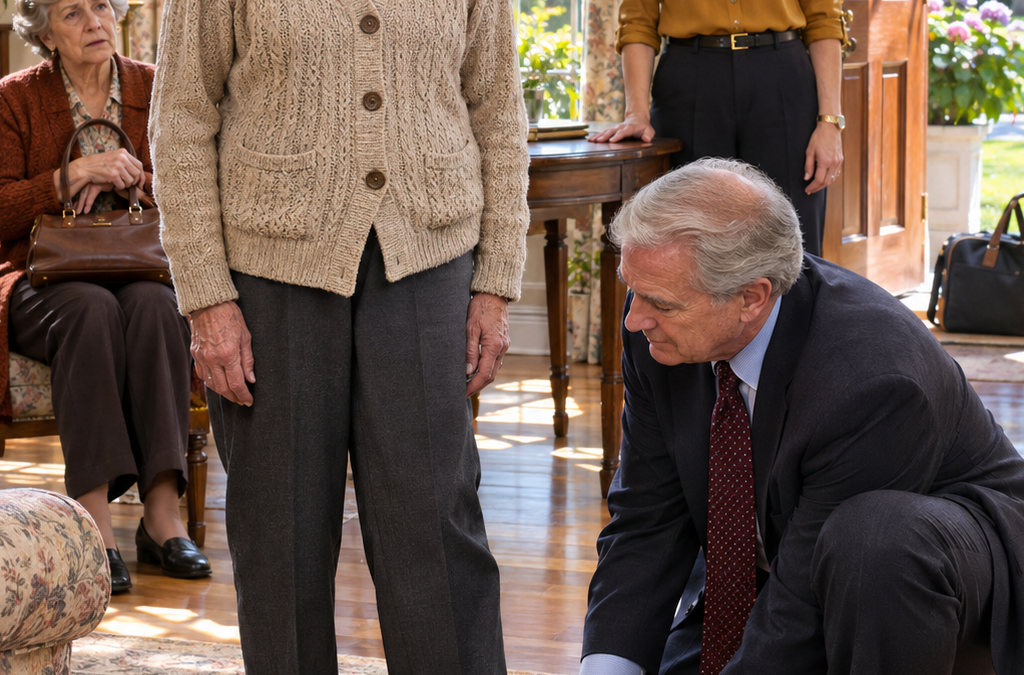
My sister-in-law, Carol Hayes, sat beside the front window, holding her handbag with both hands while I stood in socks and an old cardigan near her chair.
“Carol, are you going to let her?”
Carol looked down at her handbag.
Rachel’s husband, Eric Foster, answered instead. “Rachel already told you what needs to happen.”
Those words hurt more than Rachel’s orders. Carol had eaten supper at our table every Sunday during my husband’s last winter.
And now she wouldn’t look at me.
A windowed envelope lay beneath our family photograph, its printed red border showing. Rachel had brought it inside with her purse.
My name is Linda Bennett. I’m sixty-eight, and I live in Columbus, Ohio.
My husband left me a lifetime inheritance: our home to live in and money to support me for life. His daughter controls the payments, not my right to them.
We’d been married twenty-two years, and during his last three years I kept his care schedule on the refrigerator while learning which foods he could still swallow comfortably.
Rachel’s favorite chicken soup was cooling untouched in the kitchen. I’d made it because she usually skipped lunch before coming over.
My worn blue slippers had been beside the chair. My husband used to warm them near the heating vent before I got up.
I kept making things easier until nobody asked what it cost me.
Rachel’s lender envelope lay beneath the family photograph.
Rachel folded the rug tighter, trapping one blue heel in its fringe. Then Eric opened the front door toward a rental van parked outside.
Our expected guest, my husband’s longtime attorney, David Turner, hadn’t arrived yet. He was coming to talk through the estate with us.
Eric checked the empty walk.
“We can get this done before David starts talking.”
So that was the hurry.
Carol was seventy-three, older than either of us, and I waited for her to tell them this was enough, but she kept watching the clasp of her handbag.
Rachel pointed toward my coat on the hall hook. She’d already put an overnight bag beside the door.
It was mine. I hadn’t packed it.
“GET YOUR COAT ON!”
“You’re making me leave before we even talk?”
“Yes, and I’m done waiting for you.”
My face burned. The bag held the nightgown I’d worn when my husband died.
But I didn’t pick it up.
Rachel had left a page on the table for me to sign. She’d called it a family agreement. I’d refused before she started on the rug.
She said she couldn’t release my support until we settled things. Nothing had arrived, and groceries were coming out of my small emergency cushion.
I stepped only as far as the living-room doorway. My phone was in my cardigan pocket, still silenced from those first days after the funeral.
I called David before Rachel could reach me.
“Rachel wants you to surrender your lifetime support to pay her debt.”
I asked how much, watching Rachel beside the table.
“Eighty-six thousand dollars. I’m outside now.”
She’d called it helping the family. I stared at her lender’s envelope until David came through the open door.
Eric was bending toward the rug. David looked from my socks to my packed bag, then at Carol beside the window.
“We’re handling this as a family,” Rachel said, blocking his way to the table.
“Then stop moving Linda’s belongings.”
He knelt and unrolled the rug before placing my slippers beneath my feet. I slipped them on, and Eric sat in the nearest chair.
“Rachel asked me to send your support to her lender.”
David tapped the envelope beneath our photograph. I looked at Rachel; she kept her eyes on his hand.
Eric’s chair scraped backward.
Rachel went pale, her mouth still open without a word.
Eric reached across me, his hand stopping above Rachel’s lender envelope.
“Eric, you asked me to hide Rachel’s debt from Mark,” David said.
Eric’s hand jerked back from the envelope. Rachel turned and stared at him.
“That’s private family business. It should stay private,” Eric said, louder now.
“Not from her brother,” David said.
Hearing my stepson’s name, I looked at Rachel. She wouldn’t look back.
David’s folder lay open on the table, my husband’s handwriting visible inside.
The envelope was addressed in those familiar letters, leaning hard to the right.
My husband had told me David held a letter about my support.
For a moment, I wanted them all gone. I wanted his words alone.
But David left the letter where it was. He hadn’t taken it out to read.
Copies of the signed pages explaining my husband’s plan lay beside his folder.
Rachel looked away from those, too.
My phone still showed her unheard voicemail from a few days earlier.
I’d let condolences pile up after the funeral. I couldn’t bear answering them.
I left her message untouched. I wasn’t deleting anything she’d sent me.
“Mark knows we’re working this out,” Eric said.
“Stop talking,” Rachel told him, low and sharp.
He kept his eyes on David instead.
Eric pressed the lender envelope flat against the table.
Carol caught her breath.
“Rachel told Mark you’d already agreed to pay,” Eric said.
“I never agreed to pay Rachel’s debt.”
My voice sounded thin, but nobody could mistake what I’d said.
Rachel turned toward David with an expression I recognized from her office calls. She used it when she needed someone important to stay pleased with her.
“David, please. You’ve misunderstood what we were trying to do.”
Eric stood beside the table, the envelope still under his palm. I asked him about the van.
“I rented it because Rachel told me to. I parked it out there myself. We weren’t going to leave your things on the street.”
As if that were the part I should appreciate.
Nobody carried my bag outside. The van waited with its back doors shut.
Rachel said there were expenses we didn’t understand yet. She’d taken on the responsibility of handling her father’s estate, and everyone was making it harder.
I had heard that tone throughout his illness. A request for help became a complaint about her burden before I could finish explaining what he needed.
It hurt to remember how often I’d apologized.
“The page is still there,” Rachel told David. “We can sit down and discuss it properly. Linda doesn’t need to make this into a fight.”
“I’m not signing it.”
She looked at me then, openly angry again.
David said the court would decide any disputed rights. He wasn’t issuing a ruling in my living room, and he wasn’t going to pretend a signature settled things when I’d refused.
And my refusal hadn’t put the missing support in my bank account. I still had to buy food and keep the lights on.
David kept my husband’s original letter inside his folder without reading it aloud. Rachel watched him close it.
Carol finally looked up at me, but I couldn’t make myself offer the reassuring nod she seemed to want.
My phone lit against my cardigan. A message from Mark filled the screen.
“Did Dad really borrow the $86,000 from Rachel?”
Chapter 2 of 7
“Rachel said she borrowed it for Dad. She said you knew, and you’d agreed to pay her back.”
My stepson, Mark Bennett, sat across from me in the living room. He’d come over two days after sending his question. His coat was still on.
He looked tired, but I resented how carefully he watched me. He seemed to be waiting for me to admit something.
My late husband, Paul, had always been easy with his son. Even their disagreements usually ended with plans for lunch. I didn’t know how to begin this conversation without him.
“Did she say what the money bought?” I asked. “Because eighty-six thousand dollars is a lot of money, Mark.”
He said Rachel hadn’t broken it down. She’d called while he was away working, when getting him on the phone took planning. He remembered that part clearly.
“She said, ‘Dad would be ashamed to leave me carrying this.’ Then she said you were getting selfish about helping.”
I felt ashamed before I’d done anything wrong. That bothered me almost as much as the accusation.
I had fed these children, waited for them, remembered what they liked. Now I was explaining myself from the chair where I’d sat beside their dying father.
“What did you actually see your father borrow?”
Mark looked toward the hallway. He said he’d been gone for stretches. Plenty could have happened without his seeing it.
I agreed that plenty could have happened. I asked whether he’d seen a payment, something purchased, anything his father said he’d repay.
He couldn’t name one.
The refrigerator hummed through the kitchen doorway. On his last visit before the funeral, Mark had complained that it sounded like a tugboat. His father used to claim the noise stopped if you threatened to replace it.
Neither of us made that joke now.
Mark’s phone rang. Rachel’s name showed on the screen between us, and he turned it facedown.
“She’s been under pressure,” he said. “I’m not saying you haven’t. But she wouldn’t borrow that much for no reason.”
“I didn’t say there wasn’t a reason.”
He rubbed his face. I could see him trying to keep both versions of his sister intact.
The phone rang again before he found an answer.
I was angry with him, but I still noticed he hadn’t eaten. There was a banana turning brown in the kitchen. I nearly offered it, then realized I was trying to make him comfortable while he questioned me.
“Yes. I handled it. That didn’t mean there was money left over.”
Instead, I told him about the small shortages I’d covered.
When Rachel said she couldn’t contribute to a household errand, I paid. When something cost more than she’d expected, I found the difference. I hadn’t wanted another argument during his father’s illness.
“You always said it was handled,” Mark said.
“Yes. I handled it. That didn’t mean there was money left over.”
His phone rang a third time.
I told him my emergency cushion was $1,100. I’d stretched it through the first missing payment, but food and utilities kept coming due.
The house was familiar and full of things we’d chosen. That didn’t make staying there free.
Saying the amount out loud frightened me. I had spent years reassuring everyone that we were managing.
“I can send you something today,” he said. “Enough for groceries, whatever you need until this gets straightened out.”
“I appreciate it. But I need what your father left for my support. I can’t have that replaced by asking his children for grocery money.”
He leaned back. I worried he’d heard rejection instead of fear.
I told him I wasn’t refusing because I had plenty. I was refusing to let Rachel’s withholding become an arrangement everyone else worked around.
David had confirmed that the signed plan required my support payments. I had also retained my own lawyer, Anna Brooks.
That was all I told Mark about it. I wanted him to hear me without another person having to make me credible.
By then Rachel had called six times.
A message followed. He glanced down, then read it when I asked.
“Keep Linda out of this until we talk.”
I looked at the facedown phone. That small movement had hurt: how quickly he’d hidden her call while sitting in my home.
He said he hadn’t meant to keep anything from me. He just didn’t want another argument.
“But you came here to ask me about her money,” I said. “And she’s telling you not to talk to me. What am I supposed to do with that?”
He had no quick answer.
Outside, a car passed with its radio loud enough to hear through the windows. Mark waited until it faded.
He said Rachel believed their father had promised to look after her. As his daughter, she felt she shouldn’t have to beg everyone to recognize what she’d done.
“I’m not asking you to decide she’s a bad person,” I told him. “Just separate what she told you from what you know.”
He nodded, reluctantly. He still thought she might have misunderstood something. But he stopped calling my refusal selfish.
That mattered, though I wasn’t ready to feel grateful for it.
Rachel’s seventh call lit the screen. This time Mark left the phone where I could see it and let it ring out.
A fresh message arrived. He read it twice before looking toward the hallway.
“What?” I asked.
He swallowed. Then he read his sister’s words aloud.
“I promised Amy Linda’s bedroom. I told her she could move in this weekend.”
Chapter 3 of 7
Rachel stood in my living room beside her younger sister, my stepdaughter Amy Reed. Amy had a tape measure sticking out of her jacket pocket.
“I came to measure the bedroom,” Amy said. “Rachel said you’d decided to move. She promised me the room.”
Amy was thirty-nine, but I could still picture her visiting during our first married summer. She’d slept late and eaten frozen waffles straight from the toaster.
Now she was looking past me toward the hallway.
“I never agreed to give you my bedroom.”
Amy looked at Rachel. Her sister answered before she could ask anything.
Rachel said their father’s house ought to help his children, especially when one of them was struggling with rent. She sounded almost gentle explaining it to Amy.
Then she faced me.
“You’re one person taking up a whole family home. Move your bag so Amy can sit down.”
My purse was on the armchair. The overnight bag Rachel had packed without asking remained by the front door. I hated that it was still there, but I hadn’t been able to face unpacking it.
Amy stayed standing. I told her she was welcome to sit anywhere else.
“Stop making everyone work around your feelings,” Rachel said.
I felt humiliated. Amy had come expecting a favor already settled, and Rachel was making me seem childish for refusing it.
Amy explained that her rent had gone up again. She could manage groceries and gas, or rent and utilities, but lately something always ended up late.
“Rachel said it was settled. I gave notice because she said you wanted somewhere smaller, without all the memories.”
I could hear the worry under her irritation. This wasn’t an idle wish for a nicer room.
Amy worked on her feet at the grocery store. On visits, she usually wanted the firm kitchen chair instead of anything soft. I knew how tired she got.
I wanted her to have somewhere affordable. I also wanted to sleep in my own bed.
“Did Linda tell you that herself?” Rachel asked her. “No, because I was handling the arrangements. Nobody needed another upsetting conversation.”
Amy said she’d thought she was sparing me questions. She had even waited to call about the closet because Rachel said I needed quiet.
That hurt. While I’d been struggling to answer condolences, Rachel had used my silence to speak for me.
I told Amy I had never chosen another place. I hadn’t looked at apartments or asked anyone to pack.
Rachel gave an impatient laugh.
“You told me you didn’t know how to sleep alone. You said you couldn’t stand going into that bedroom.”
I remembered saying it. I had called her after waking and reaching across the bed.
It embarrassed me to hear those words repeated like evidence of some foolishness. I had trusted her with a lonely moment.
“Yes, I said that. I wanted your father back. I wasn’t asking you to find someone else for my room.”
Amy’s eyes dropped. Rachel said I couldn’t expect everyone to guess which things I meant.
For years, I’d explained away that tone. She was tired, worried, under pressure. Standing there, I felt angry enough to stop helping her sound better.
Amy asked where Rachel thought I was going. Rachel said we had discussed several possibilities.
We hadn’t. She had named places while I asked her to release my support.
“The van cost the estate $420,” Rachel said. “I’ve already spent money making this easy. Now Amy’s supposed to lose her place because you changed your mind?”
I hadn’t changed my mind, and the money spent trying to remove me didn’t make leaving my responsibility.
Amy stared at her sister. She asked why there had been a van if I hadn’t found anywhere to live.
Rachel said it had only been for getting things organized.
Anna had filed my challenge, and Rachel had received notice. She also confirmed there was money for my required support: the estate held $840,000 in available funds, including $52,000 set aside for its bills.
Knowing that had relieved one fear. It hadn’t bought groceries.
“You didn’t say I’d be taking her room while she was still in it.”
“I’ll tell everyone what you’re doing to Amy,” Rachel said. “They should know you’re leaving her without a place.”
She sent the message to the family chat while standing in front of me. My phone sounded from the kitchen.
I didn’t go read it. Amy was watching Rachel now, her mouth pinched with something besides worry.
“You said she wanted me here,” Amy said. “You didn’t say I’d be taking her room while she was still in it.”
Rachel told her not to let me confuse the issue. There was plenty of space, she said, if I would just cooperate.
I told Amy she deserved the truth before giving up her rental. Rachel had no right to promise my bedroom or make me leave it.
I was sorry she’d been put in this position. I wasn’t going to repair it by moving out.
Amy said nothing for a while. Then she asked Rachel to take her home.
At the door, Rachel pointed to my overnight bag and told Amy to carry it out. Amy stepped around it.
“That’s Linda’s. You can ask her yourself.”
They left together. Amy didn’t hug me, but she looked back once before Rachel opened the car.
I stayed in the hallway until they drove away. I felt worn out and sad for Amy, who still needed somewhere to live.
When my phone sounded again, I expected another accusation. Instead, it was Carol.
“I carried your husband’s letter to David. Rachel never knew.”
Chapter 4 of 7
Carol met me on the enclosed front porch, still wearing her coat.
“I carried it to David myself,” she said. “Before Paul died. A sealed envelope with David’s name on it. Paul wanted him to have it if anyone pressed you to give up your support.”
She sat at the other end of the wicker couch. Usually, she complained about that couch before settling into it. Paul had bought it secondhand, and one cushion always slid forward until your knees nearly touched your chin.
That morning, she stayed perched on the edge.
“Why didn’t you tell me when Rachel was here? You watched her pack my things.”
Carol looked toward the glass door between us and the living room. Nobody was inside to rescue her from answering.
She said she had thought David would arrive before anything actually happened.
My feet had been bare. My bag had been packed. I wondered what she counted as something happening.
I felt angry enough that I didn’t trust myself to help her along.
“Rachel asked me to tell David that Paul changed his mind about looking after Linda,” she said. “Those were her words. I wouldn’t say it.”
I waited. Carol had brought me one good thing she’d done, and I could see how badly she wanted it to cover the rest.
She said Rachel had called several times. At first, she complained about money. Later, she wanted Carol to remember conversations differently.
Carol had told her no. But she hadn’t called me.
“You could carry his letter, but you couldn’t say my name?”
Her eyes filled. She didn’t reach for me.
“No. I couldn’t. I knew what she was doing, and I sat there hoping somebody else would stop her.”
That answer hurt more than an excuse would have. I could have argued with an excuse.
Carol said she was afraid Rachel would shut her out. Birthdays, holiday meals, news about the children—Rachel organized most of it. Carol had let that become a reason to keep quiet.
I had known her for twenty-two years. I hadn’t realized how easily I could be excluded from her idea of family contact.
“I was right there,” I said. “You could have spoken to me afterward. You didn’t even have to take her call.”
Carol nodded, looking miserable. I let her be miserable.
The porch was still cold, although sunlight reached the couch. Paul used to insist it was warm enough out here whenever he wanted to escape a televised cooking competition. Carol would follow him, then come back inside complaining about her toes.
Remembering that ordinary silliness made me miss him fiercely.
Carol told me he had asked her to make the delivery because he no longer trusted himself to get out comfortably. She remembered him checking that the envelope was sealed.
“He wanted somebody outside the family holding it,” she said. “He said David would keep track. I didn’t open it, Linda. I only know what Paul told me.”
David still had the original. What I’d seen in his folder had passed through Carol’s hands while my husband was alive.
She had carried out his errand. Then, when I needed her, she had failed me.
Anna had confirmed that Paul’s signed plan required support payments during administration, a home for my lifetime, and afterward, lifetime support managed by someone independent. Rachel had received that explanation too; she now knew my home and support did not depend on her permission.
Carol’s phone sounded inside her coat. She read the screen and held it where I could see.
“Stay out of my father’s business.”
“I told her I hadn’t done much turning when she was standing over you.”
Rachel had sent it.
Carol told me she had finally said she was coming to see me. She hadn’t asked whether Rachel approved.
I was relieved to hear that, but wary. One visit didn’t undo what had happened in my living room.
“She thinks I’m turning everybody against her,” Carol said. “I told her I hadn’t done much turning when she was standing over you.”
Her phone sounded again before I answered.
The next message was longer. Rachel said bringing outsiders into this would eat up what Paul meant to leave his children. She wanted Carol to persuade me to stop before we all spent money that should stay in the family.
I felt the old pull to explain myself carefully, to make my needs sound inexpensive.
Instead, I told Carol that keeping quiet had already made this family unsafe for me. Rachel had withheld money I needed and tried to send me away. I couldn’t protect everyone from the cost of answering for that.
He had already protected my home and support, and Rachel had treated both as bargaining chips.
“I’ll come and tell them what I saw,” Carol said. “About the bag. About you asking me. I won’t say I didn’t understand.”
I told her I would accept that. I didn’t tell her everything was all right between us.
The hearing arrangements had been confirmed for Tuesday at nine at Franklin County Probate Court. Rachel and I would attend with our lawyers; David, Carol, Mark, and Amy were expected in the assigned courtroom.
Carol asked whether she should come here first so we could go together.
“Meet me there,” I said.
She looked down, then said she would. It hurt to keep that distance, but I wasn’t ready to spend the ride reassuring her.
We stayed on the porch a little longer. This time, Carol didn’t try to fill the quiet with news about Rachel.
When her phone sounded a third time, she read the message aloud.
“Bring Dad’s letter to me tonight.”
Chapter 5 of 7
Rachel came into my living room with Mark and Amy behind her. Carol had refused her demand for the letter. David still held the original, and several weeks had passed without Rachel restoring my support.
She had reduced her work hours during her father’s illness. I hadn’t known until that evening that she considered those lost hours a debt the rest of us owed.
Rachel pulled a dining chair near hers for Mark. Amy sat on the couch, still wearing her grocery store fleece.
Anna had already sent the material for tomorrow to Rachel’s lawyer. David would identify the signed provision, and I would bring my phone.
“I thought we could manage one conversation without everybody else involved,” Rachel said. “Just us. Before this gets any uglier.”
I sat in my usual chair. I was tired of being asked to prevent the ugliness after she had already done something cruel.
Mark said he had come to listen. Amy said she couldn’t stay long.
Rachel described the afternoons she had left work early. She remembered each conversation with her supervisor, each smaller paycheck.
I remembered those afternoons too. Sometimes I had waited beside Paul’s bed, afraid she would call and say she couldn’t come.
“You were his wife. I still had to stop being his daughter and become his nurse.”
She looked at Mark when she said it. I could see that she wanted him to understand something he hadn’t been home to witness.
I told her I knew she had lost work. She had come when he needed help, and some of those days had been awful.
That was true even now. I wasn’t going to make her care disappear because she had hurt me afterward.
One morning, I had fed Paul oatmeal from his enormous Ohio State mug. He could hold its handle when a bowl was too awkward. He complained that breakfast ought to come with coffee, then forgot what he’d been complaining about.
I had stood at the sink afterward and cried where he couldn’t see.
“I was there too, Rachel. I know you gave up things. But I didn’t promise you my home in return.”
She said I always made it about the house. To her, that was proof I hadn’t understood.
It hurt to hear our years of caring for him reduced to something I had received.
Rachel turned toward her brother and sister. Her voice became patient, almost cheerful.
“Tell them you’re willing to do your part.”
“There’s still a family solution. Nobody needs to lose everything. We could settle what Dad left unfinished and stop spending money fighting.”
Amy asked what she meant by everything. Rachel said she meant the damage we were doing to each other.
She talked around the money until Mark asked what I would have to give up. Then she looked straight at me.
“Tell them you’re willing to do your part.”
I said I had already told them what I was willing to do. I would speak honestly. I wouldn’t agree to something because she had brought an audience.
My face felt hot. Even after everything, refusing her in front of the others felt like misbehaving.
Rachel insisted the missing payments had protected the family while we sorted things out. She said she hadn’t held anything back for herself.
Mark leaned forward, his elbows on his knees.
“Why does the family solution only need Linda to give something up? What are you asking the rest of us to do?”
Rachel said he could have asked that while their father was alive.
He looked down. The remark landed, and she let it sit there.
I knew he regretted being away. I also knew she had chosen the one thing most likely to stop his questions.
Then Amy asked whether Eric knew what Rachel was proposing.
“Eric wants an answer. I told him the debt would be resolved from the estate. Now he keeps asking me what happened.”
For the first time that evening, Rachel sounded frightened. She said he was tired of hearing that she was handling it.
I felt sorry for her. I wished I didn’t, because she was watching for it.
I said nothing reassuring. I didn’t offer money or promise that her brother and sister would keep this private.
Rachel told Mark I had understood the arrangement before David made it into something else.
He got up, moved the chair she had placed for him, and sat beside me.
“She didn’t agree. Stop telling us she did.”
Rachel stared at him. He didn’t reach for me or make another speech. He stayed where he was.
Amy said she would work out her housing without my bedroom. She sounded weary, not pleased.
I felt relieved, though neither of them could give me back the weeks I had spent frightened in my own house.
Rachel looked toward the kitchen, where my phone was charging. She asked whether I was really bringing it tomorrow. I told her I was.
Her lawyer had already received the saved copy. She knew which message we meant.
For a moment, she seemed about to argue with me. Instead, she stood beside the chair Mark had left empty.
“It was a settlement offer.”
She waited for one of us to answer. Nobody did.
Then she faced me again.
“A settlement offer made while everyone was grieving. That’s what it was, Linda. The judge needs to hear it that way.”
Chapter 6 of 7
“It was a family settlement offer, Your Honor.”
Rachel sat facing the judge in the probate courtroom. Mark and Amy were behind me. Eric and Carol sat across the aisle, behind Rachel.
“I delayed the payments to protect the estate while we resolved its obligations,” Rachel continued. “I wasn’t refusing to support her.”
The probate judge, Helen Morris, listened without nodding. Rachel turned toward me.
“Tell them you understood we were still settling things.”
I stood when Anna indicated I could answer. My blue slippers showed beneath my pants. After the long wait, my formal shoes had become too painful to keep wearing.
I felt embarrassed by the slippers until Rachel looked at them. Then I was angry.
“If the problem was his bills, why would paying your personal debt get my support released?”
Rachel faced the judge again. She said the borrowing represented sacrifices she had made for her father. He had wanted to make her whole.
Anna asked whether I had agreed to surrender my support. I said I hadn’t.
I remembered Paul asking me once whether our potatoes tasted scorched. They had. He’d eaten them anyway, saying ketchup covered most household mistakes.
I wanted that kitchen back. Instead, I was explaining that I hadn’t agreed to pay his daughter.
David identified Paul’s original letter and the signed provision it referenced. He read the passage Anna asked him to read.
“The monthly support during administration is not payment for Linda’s cooperation, and my children’s personal debts are not conditions on it.”
Rachel watched him. Eric looked down.
David explained that the letter described what Paul had already signed. The signed provision required $3,200 monthly payments during administration; the letter hadn’t created them.
The financial records showed enough money remained after the estate’s bills were provided for. Neither missed payment had been necessary to preserve that reserve.
Hearing Paul’s words hurt. He had worried about this while I was still worrying about whether he could manage breakfast.
When Anna called me to testify, I brought my phone.
“I have the voicemail Rachel left me. May I play it?”
I explained that it had arrived a few days after the funeral, while my phone was silenced. I hadn’t played it then. The original remained on my phone, and Anna had supplied a saved copy to Rachel’s lawyer.
After a few questions, Judge Morris admitted the recording and allowed me to play it.
Rachel’s voice sounded louder than I expected.
“My eighty-six-thousand-dollar debt isn’t going away. Sign away your support to cover it. Then I’ll release what I’ve been holding.”
I looked at the judge while the message finished. I couldn’t look at the children.
Rachel’s lawyer asked her about its context. She said she had been angry and negotiating, not threatening me.
I felt humiliated again, hearing how plainly she had spoken when she thought only I would hear.
Judge Morris asked, “What estate bill would her signature have paid?”
“Our family—”
“Which bill, Ms. Foster?”
Rachel said she had lost wages caring for her father. She started explaining the hours again. The judge let her finish, then invited me to answer the question about the lender.
“The lender was Rachel’s. She wanted me to give up my support to pay it.”
Carol had already described the packed bag and the rug. Now her eyes stayed on Rachel.
Judge Morris looked directly at her.
“Even if you have a claim, you cannot use her support to collect your personal debt.”
Anna asked what I wanted the court to do.
“You are removed as executor. I’m appointing Thomas Grant as successor administrator.”
“I’m asking you to take her out of charge.”
My voice shook. I was frightened she would turn around and order me to stop.
Judge Morris addressed Rachel.
“You are removed as executor. I’m appointing Thomas Grant as successor administrator.”
The judge also made clear that Rachel’s approved $600 monthly compensation ended with her service. The $7,200 annualized amount was no longer income she could count on.
Rachel stared at her lawyer. Her control of the $1.2 million estate had ended, and she seemed to be waiting for him to correct what she’d heard.
Then she stood abruptly and reached toward my phone as I returned to my seat.
“Ms. Foster. Stop,” the judge said.
Rachel stopped.
“Mark, tell her. Tell her how often I came over. You know I was there.”
Mark stayed seated behind me. He looked miserable, and for a moment I feared he would give her what she wanted.
“You were there,” he said. “That didn’t give you permission to do this.”
I felt relieved, then sad that such a small acknowledgment meant so much.
After the judge finished, Carol got up from Rachel’s side. She carried her handbag across the aisle and took the empty chair beside me.
“I should have sat here in your house.”
I nodded. I wasn’t ready to comfort her.
Amy headed toward the door. Rachel called after her that she could explain once we were outside. Amy kept walking. Eric followed several steps behind her, without waiting for his wife.
Rachel turned to me.
“Linda, we can still work something out privately. You know what Dad wanted for all of us.”
“You don’t get to charge me for belonging.”
She looked toward Mark, but I kept speaking.
“I’m not making another private arrangement. Estate questions go to Mr. Grant now.”
I was tired. I wanted to go home without being followed by another demand.
The appointed administrator, Thomas Grant, approached with Rachel’s lawyer beside him. Rachel asked whether he needed everything immediately.
“On Friday,” Thomas told her. “Deliver the estate access materials and the house-management keys.”
Chapter 7 of 7
Three days after the hearing, Rachel delivered the estate materials and management keys to Thomas. He confirmed the handover afterward. I didn’t have to meet her at my door.
My own house key had never left me. I used it that afternoon after getting the mail, then stood inside long enough to notice I wasn’t listening for Rachel’s car.
Six days after the hearing, once Thomas finished his immediate checks, the support arrived: $6,400 overdue and the current $3,200 installment.
“Both missed payments?” Mark asked when I called him. “And this month too? You actually have it now?”
I told him I did. I had checked twice before calling.
At the grocery store, I bought fresh fish instead of putting it back. Then I cried in the car because choosing supper had felt safe.
“I’m glad you called me,” Mark said later. “You don’t have to wait until something’s wrong.”
He started asking me directly whether he could visit. Sometimes I said yes. Once, I said I wanted an afternoon alone, and he came another day.
That small change relieved me more than his offer of grocery money had. I could want company without needing rescue.
On June 16, the court required Rachel to reimburse the estate for the $420 van expense. She completed the repayment two months later.
The money went back to the estate, not to me. My restored support had come from estate funds, as it should have.
“Does that settle everything with her?” Mark asked.
“No. It settles the van.”
Rachel’s $86,000 debt remained hers; asserting that her father owed it hadn’t made it his obligation. Her care for him hadn’t been declared worthless, and removal hadn’t canceled her inheritance.
I was glad the consequences were specific. I still remembered her sitting beside his bed when I desperately needed sleep.
The estate was still being administered, and my lifetime support arrangement would be funded under Paul’s existing plan. Living in the house didn’t make the children’s eventual shares mine to give away.
Amy found another place before summer. She called to tell me herself.
“I know where it is. I just don’t want you thinking I’m measuring anything.”
“It’s smaller than the old one,” she said. “But I can afford it without working every extra shift they offer.”
She didn’t mention my bedroom. I didn’t offer it.
A few weeks later, she came over after work and stayed for supper. She asked whether she could use the bathroom, then laughed awkwardly at herself.
“I know where it is. I just don’t want you thinking I’m measuring anything.”
I laughed too, though it hurt a little. She apologized before leaving, without explaining what Rachel had told her again.
Carol took longer to come inside comfortably. On her first visit after the hearing, she stood near the chair beside the window.
“I keep seeing myself sitting there,” she said. “I knew you wanted me to help.”
I told her I remembered it too.
She didn’t ask whether we could forget it. She came when invited, left when I was tired, and stopped passing along Rachel’s complaints.
I was still angry sometimes. Carol learned to stay with me through that without making me soothe her.
Rachel wrote later asking for money. She said Eric wanted an answer, and that I now had enough to help.
“After everything I gave up for Dad, I can’t believe you’d let this keep hanging over me,” she wrote.
I felt guilty reading it. I missed being able to hear from her without wondering what she wanted.
I answered once, in writing: “I will not surrender my support or give it toward your debt. I will not discuss estate decisions privately. Those questions belong with Thomas.”
She didn’t answer that message. I saved both and went on with my afternoon.
By late fall, almost nine months had passed since the funeral. I invited Carol and Mark for a simple supper because I wanted them there.
“Would you like me to bring the food?” Carol asked.
“Bring yourselves. I’ve already decided what we’re eating.”
I made baked potatoes and scrambled eggs, the supper Paul used to request when neither of us wanted to cook. I put too much pepper in mine, just as I always had.
That evening, I wore the same worn blue slippers. The living-room rug lay where I liked it, close enough to my chair that my feet rested on it.
I had moved it twice that afternoon before deciding. Nobody needed to approve the spot.
“Potatoes and eggs,” Mark said when he came in. “Dad would’ve called this breakfast with better attendance.”
Carol laughed from the doorway. I heard myself laugh with her.
For a moment, I missed Paul so badly I couldn’t answer. Then Mark asked where I wanted him to sit, and I pointed to the kitchen table.
We ate while Carol described a casserole she’d ruined by forgetting the oven was off. Mark said he’d once done the reverse and cooked an empty pan.
Paul would have enjoyed that conversation. It hurt that he wasn’t there, but I didn’t want everyone to stop talking.
“Can I get you more?” Carol asked when she stood for another helping.
I told her I’d had enough. She accepted that and took her plate to the stove.
Afterward, Mark asked whether I wanted the table cleared. I said yes, but to leave the leftover potatoes. I had plans for them in the morning.
We went into the living room while the dishes dried. Carol chose the couch. Mark waited until I settled before taking the chair opposite me.
“Want the television on?” he asked.
“Leave it off a little while.”
He did. We talked about Amy’s new place and whether the grocery store near me had finally fixed its freezer doors.
I felt happy in an ordinary, tired way. Nobody was waiting for my signature or deciding where I ought to sleep.
Being family did not mean giving someone the right to diminish me.
When Carol and Mark were ready to leave, I told them I’d enjoyed supper. I meant it, and I would decide when to invite them again.
I tucked my slippers beneath my own chair.







