After my elderly neighbor’s funeral, her sister dumped my casserole into the sink while my ten-year-old watched.
Chapter 1 of 7
“The help doesn’t take leftovers.”
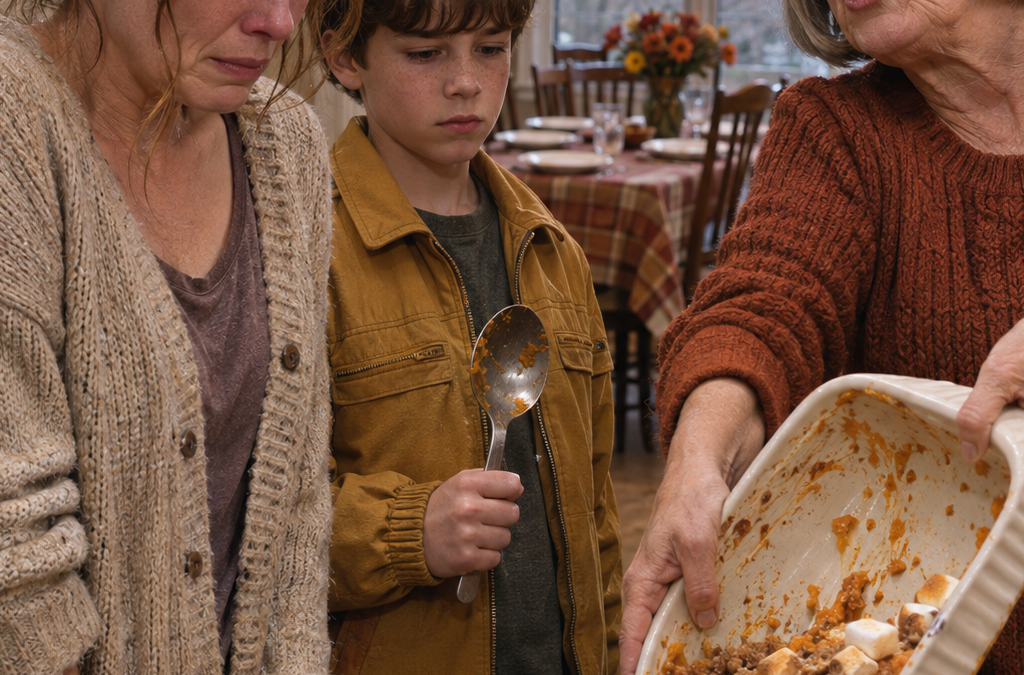
Diane Mercer said it while the sweet potatoes slid past the drain. It was Thanksgiving, the day after we’d buried her sister.
Noah stood beside the kitchen doorway holding the empty serving spoon. He watched the last of the food fall, then put the spoon beside my hand.
“I brought dinner, Diane. I didn’t ask for anything.”
“You can take your dish and leave.”
An unfamiliar envelope addressed to Lone Oak Bank lay beside her place.
“Paul, are you going to let that stand?”
Paul Bennett looked toward the dining room instead of at me.
“Diane’s had enough to manage this week.”
My face burned. Noah still had his jacket on; we hadn’t even sat down. Behind Paul, three plates waited around the table where we’d expected to remember his sister together.
At forty-two, I was Megan Brooks, the neighbor who repaired clothes in a rented duplex in Georgetown, Texas. For six years, I’d also been the person next door who came when his sister needed help.
She left me the house.
But that wasn’t what had brought us over with dinner. There had been bowls of soup cooling on her counter, and Noah’s school pants spread across her table while I fixed the hems.
Before Diane’s visits, I’d made up the guest bed with the yellow sheets. She liked those better than the blue ones.
After the funeral, Claire Foster had offered an optional appointment at her law office. The will left me nothing. Claire gave me my neighbor’s old sewing tin, which I’d carried over in my tote.
Diane’s envelope had the bank’s name where mine should have been.
She scraped the remaining food from my dish. I’d brought the sweet potatoes because my neighbor used to insist marshmallows counted as a vegetable on holidays. Noah had believed her until second grade.
“Could Noah at least sit while I get our things?”
“There isn’t a place set for either of you.”
Diane had been living there about five months. My neighbor’s chair was still at the end of the table, with its cushion tied crookedly around the back.
Paul stayed between the kitchen and dining room. He could have moved a chair over. Instead, he watched Diane rinse the dish.
“Please don’t turn dinner into another argument.”
Another argument. I’d said nothing when Diane changed the meal without asking. And I’d said nothing when she told Noah to leave his drawing in our house.
Those words hurt more than I wanted Paul to see.
“STOP MAKING THIS ABOUT YOU!”
Diane’s shout sent Noah back against the doorframe. I wanted to get him outside, but I needed her to answer.
“You’re calling me hired help in front of my son?”
“You helped her; that doesn’t make you family.”
“We’ll go.”
Being useful hadn’t made me welcome.
At the side entry, my tote leaned against the bench. I reached inside for my phone and felt the tin’s loose fabric lining catch beneath my thumbnail.
Years of fixing torn pockets had taught me to notice a lifted edge. But this one had been tucked down rather than glued.
Noah sat on the bench to fasten his shoes. The kitchen was out of sight, though we could still hear Diane talking to Paul.
Beneath the lining lay a folded page in my neighbor’s handwriting. I recognized the wide loops before I finished the first line.
She wanted Claire to deliver her household file to Lone Oak Bank. Farther down, she’d written that nobody else should answer questions meant for me.
I read that sentence twice. The page smelled faintly of the lavender soap she kept among her sewing things.
Then I called Claire.
“There’s a note under the lining,” I said. “It mentions your household file.”
“Keep it with you. Let me see it tomorrow.”
Claire gave me Elaine Turner’s number. Elaine handled the bank’s arrangements and already planned a brief visit because the siblings were together. She lived nearby; the holiday visit had been settled before dinner.
I reached her before she left home.
“Diane’s asked to continue living there,” Elaine told me. “She said you’d agreed.”
“Agreed to what?”
“We need to discuss that directly.”
My fingers went cold around the phone. From the kitchen, Diane called for Paul to bring in the bread.
Elaine Turner stepped inside. Diane reached for the envelope in her hand.
“Thank you for coming on a holiday,” Diane said. Her voice had changed. “We’ve just been trying to get everybody settled.”
But Elaine kept the envelope.
Noah had finished his shoes. I told him to stay beside me while Elaine looked from Diane to Paul, then back toward the side entry.
“Megan, I need your answer from you.”
Diane moved into the doorway.
“She doesn’t understand what we discussed.”
“I’d like her to answer.”
There was nothing loud about Elaine. She wore a coat over a plain sweater, and she hadn’t come with a crowd or made an announcement. Still, Diane stepped back.
I stayed beside the bench. It was embarrassing to be standing there with our coats while the others had dinner waiting.
Then Elaine explained that she had received a request to let Diane remain in the house for six additional years. Diane had described that arrangement as something already discussed and accepted by me.
No conversation like that had happened. We’d talked about groceries and my neighbor’s medicines. Since the funeral, we’d barely spoken except about this meal.
Diane gave a little laugh.
“We didn’t need to make a whole thing of it.”
Elaine’s envelope held a copy of the request. Diane’s name was at the bottom. Above it was a sentence saying I supported the extension.
Diane had asked for six years—and put my agreement in writing.
“I agreed to nothing,” I said.
Diane looked past Elaine at me.
“It was family planning. You weren’t supposed to complicate everything.”
Paul came closer, but he stopped short of the entry. His dinner plate was still empty behind him.
Elaine told Diane she would not count my silence as permission. She wasn’t settling who would stay in the house that afternoon. She needed to check the records and speak to each of us directly.
And for the first time since we’d arrived, I wasn’t the only person Diane had to answer.
Ruth Ellis had been seventy-nine when she died. She’d run a school cafeteria before retiring, and she could remember a child’s food allergy twenty years after forgetting the child’s last name.
She would have hated seeing Noah waiting by that bench.
I was angry now, enough that I didn’t trust myself to keep talking. Ruth’s gardener, Frank Harris, had spent years coming through that side entrance for water. I’d never once wondered whether he needed permission to stand there. Until that day, neither had I.
“Come on, Noah,” I said. “We’re going home.”
Diane started to speak, but Elaine asked her to stay. I didn’t wait to hear the question.
Outside, Noah walked close enough that his sleeve brushed mine. Our duplex was next door. We didn’t need to cross a street or get into the car, which somehow made being sent away worse.
At home, he pulled off his jacket and went to his room. So I let him have a minute. There was leftover chicken in our refrigerator, and I could make rice.
My tote was still over my shoulder when my phone lit up with Diane’s name.
“Tell the bank you agreed, or stop bringing Noah here.”
Chapter 2 of 7
Noah came back before I could answer Diane’s text.
“Are we not allowed in Ruth’s kitchen anymore?”
“I don’t know when we’ll go back,” I said. “But adults can’t trade your visits for me saying yes.”
He looked toward the window facing her house. I hated that he could see the kitchen light from ours.
“This isn’t something you have to fix.”
Then I answered Diane: “Send all requests about the house to Elaine. Don’t put Noah in the middle.”
For dinner, I made chicken and rice. Noah ate the rice first, as usual, digging a little ditch around the chicken. Ruth used to call that his road construction.
He didn’t ask about going next door again.
By morning, I had a pair of work pants waiting for a new zipper and three messages from Diane. None answered what I’d written. They were about how tired she was and how hard the funeral had been.
Claire called while Noah was still asleep.
“The will really didn’t include me?” I asked.
“It didn’t. The letter you found concerns separate arrangements held by the bank.”
“So the letter doesn’t change anything?”
“It tells me where Ruth wanted her household file delivered. It doesn’t give you the house.”
That hurt, though Claire hadn’t said it unkindly. Ruth was gone, and I was trying to understand what she’d left behind from pieces other people held.
Claire told me Elaine would need to check those arrangements directly. I hadn’t seen them. Nothing in that conversation gave me permission to walk next door and make decisions.
But it hadn’t given Diane permission to answer for me, either.
Paul came over before lunch. He stopped just inside my front door, where the rack of finished repairs stood.
“Diane’s upset about your message.”
“I’m upset about hers.”
“She didn’t mean it the way it sounded.”
He looked at the clothes instead of me. A pair of Noah’s jeans hung among the customer orders, one knee waiting for a patch.
Paul said the house was the last place he and Diane could gather. Ruth had always made room for them. Now everything seemed to be passing into strangers’ hands.
“You mean Elaine?”
“Well, the bank. People who don’t know us.”
I had known him for six years. Hearing myself left out of “us” still embarrassed me.
“She’s checking what Ruth arranged,” I said.
“Ruth wouldn’t want strangers deciding our future.”
He said it gently, as though gentleness made it a different request.
Then he suggested Noah could visit Diane. Just for a little while. She missed having someone around the kitchen, and seeing him might settle her down.
“Noah isn’t going over to make her feel better.”
“Nobody’s asking him to do anything.”
“She needs some security, Megan. You could tell Elaine you two had an understanding.”
“You just did.”
Paul frowned. Usually, that was where I would have softened things. I would have offered coffee or explained his meaning back to him more kindly.
Instead, I let him be uncomfortable.
“She needs some security, Megan. You could tell Elaine you two had an understanding.”
“I never agreed.”
“Maybe not in those exact words.”
“There weren’t other words, Paul.”
The work pants lay across my sewing table. I needed that job finished. Yet there I stood, being asked to turn a conversation that never happened into a favor.
Paul said Diane only wanted to keep the family together. Before leaving, he asked me to think about what Ruth would have wanted.
I had been thinking about little else.
Later, I went next door for my casserole dish. I’d left it on the entry bench while getting Noah out, and I wanted one thing back that didn’t require a discussion.
Frank Harris was outside near the bare flower bed.
“Afternoon, Megan. Getting cold for this.”
“Sure is.”
He had worked around Ruth’s house through the summer, too. I remembered his truck outside when Diane was settling in and Ruth had people coming about household arrangements. Back then, I’d been more concerned with whether Ruth had eaten lunch.
Frank returned to his work. I stayed on the doorstep and knocked.
Diane opened the door far enough to stand in the gap.
“I came for my dish.”
“You could have answered my messages.”
“I answered the one about Noah.”
She brought the dish from the bench. Behind her, Ruth’s kitchen looked painfully ordinary. The stove light was on. A loaf of bread sat where Ruth always kept it.
It hurt to miss a place while standing close enough to smell its coffee.
“You’re making me sound like I moved in without asking,” Diane said. “Ruth let me stay while I got settled.”
“I haven’t said you moved in without asking.”
“Then stop treating me like I’m in your way.”
“I came for the dish, Diane.”
She held it out. I took it home without crossing the threshold.
That afternoon, Elaine returned my call. I told her Diane was asking me to confirm an understanding we’d never had.
“I’ve recorded your answer,” she said.
“Can anyone tell me what happens now?”
“I need to verify the governing records before anyone promises who can stay or when. For now, don’t make arrangements on the bank’s behalf.”
There was nothing comforting about waiting. Still, she had asked for my answer and kept it as mine.
I finished the zipper before dinner. For almost an hour, nobody asked me to fix anything I couldn’t put beneath a sewing needle.
Then Diane sent a photographed list of household purchases. At the bottom, she had totaled $2,400 and labeled it my share.
“Pay your share before you ask for anything.”
Chapter 3 of 7
I forwarded Diane’s list to Elaine before answering it. In my message, I said I hadn’t ordered the purchases or authorized Diane to spend anything for me.
Diane had chosen those purchases. I hadn’t hired her.
Elaine called after the weekend, while I was matching thread to a customer’s gray trousers.
“A list isn’t proof you owe her personally,” she said. “I’ll ask for receipts and review any household expenses separately. We won’t subtract money on her say-so.”
“Do I need to answer her?”
“You’ve answered me. Keep anything else she sends.”
That helped, but I still hated seeing my name beside a debt I hadn’t made. There were groceries on that list I’d never eaten and cleaning supplies I’d never used.
I sent Diane one sentence saying Elaine had the request. She didn’t argue about the total again.
By then, she had found another way to make me pay.
Paul came over that afternoon without the bag of clothes he’d promised to bring. Before the funeral, he’d asked me to handle a batch of family alterations. I’d left space for them between my regular orders.
He stayed near the door.
“Are the clothes in your car?” I asked.
“We’re going to hold off on that.”
“All of them?”
“For now. Things are uncomfortable.”
The order wasn’t enough to change my life. It would have covered groceries and part of the electric bill. I’d turned down a rush hem because I expected his work.
I was embarrassed by how badly I wanted him to leave the clothes anyway.
“Diane thinks we need to straighten this out first,” he said.
“My work has nothing to do with her request.”
“She says you’re making it sound like nobody ever did anything for you.”
I waited. Paul looked past me at the sewing machine, as if the explanation might be sitting there.
He said Diane had been talking about the meals Ruth served us. About how often Noah and I were in her kitchen. Ruth had also sent neighbors my way when they needed trousers shortened or a zipper replaced.
“She says it wasn’t exactly unpaid,” Paul added.
“Ruth invited us to dinner.”
“I know. I’m just telling you.”
He was telling me while taking away work. That part seemed to escape him.
A half-finished sleeve lay across my lap. I had already undone the bad stitching and couldn’t remember where I’d stopped.
“Did Diane say I charged Ruth?”
“No. She said helping next door doesn’t make you family.”
There it was again, carried into my own house this time.
For a moment, I nearly apologized. I could say I’d misunderstood, that everyone was grieving, that I didn’t want trouble. Paul would relax. He might even bring the clothes back.
I had spent years making everyone comfortable enough to ignore me.
“Ruth sent me customers because I did good work,” I said.
“I didn’t say you didn’t.”
“Then don’t bring that here as something I owe back.”
He said he hadn’t come to fight. I hadn’t asked him to come at all.
After he left, I wrote another customer to say I had an opening. Then I finished the sleeve. My eyes stung, and I had to check the seam twice.
Diane came to my door before I’d put the work away.
“Paul said you got upset over some sewing.”
“An order got canceled. That costs me money.”
“You’re not the only person with bills.”
She held her phone toward me. On the screen was a rental listing, then another. Small kitchens, beige carpet, places nothing like Ruth’s house.
“Everything decent is about $2,150 a month,” she said. “I can’t keep paying that.”
She hadn’t signed a lease. She was showing me what leaving might cost.
For the first time, her fear was plain. I understood being afraid of rent. Mine came due whether customers picked up their clothes or not.
But understanding her didn’t make her account of me true.
“A sister shouldn’t end up homeless while a neighbor gets rewarded.”
“You’re living there now.”
“And you’re trying to stop me from staying.”
“I’m saying I never agreed to six years.”
“You knew I needed somewhere to go.”
I had no answer that would satisfy her except the one she wanted.
From inside, Noah called that the toaster had burned one side again. At our house, we called it the half-price setting. Usually, that made me laugh.
“I need to go back inside,” I said.
“It establishes your answer. It doesn’t remove someone who’s already living there.”
Diane left with the listings still open on her phone.
Later, I called Elaine. I told her about the lost order and Diane’s visit, though I felt foolish mentioning groceries to someone handling a house.
“If I keep saying no, does anything actually change?” I asked.
“It establishes your answer. It doesn’t remove someone who’s already living there.”
She still had to confirm the bank’s authority and the arrangement Diane was living under. I couldn’t settle that by refusing to sign something.
I was tired of being pressed for an answer that wasn’t enough to end the pressure.
That evening, Diane sent me a screenshot of a message she’d written to Paul. She wanted me to see it; she’d added, “He deserves to know.”
I expected another account of meals and favors. Instead, she’d changed what she said Ruth had promised.
The bank request had asked for six more years. Now Diane was claiming something much larger.
Her family message ended, “Ruth promised me a home for life.”
Chapter 4 of 7
Diane’s message told me what she claimed, not what Ruth had said. When Elaine called to arrange a meeting at the house, I sent her the screenshot.
She asked Diane about it with both of us at Ruth’s dining table.
“When did that conversation happen?”
“During my spring visit. Before Ruth went into rehabilitation.”
Elaine wrote that down. She didn’t agree with Diane or tell her the conversation didn’t matter.
I sat across from Diane, where I could see the kitchen doorway. Being back there hurt. I had almost stayed home and asked Elaine to call afterward, but I was tired of learning what people had said about me after they’d said it.
Diane had set out two coffee cups. Neither was in front of my chair.
Elaine had brought copies of the bank’s records. She explained that she’d checked the house records against Ruth’s existing trust, then showed us the pages together.
“Lone Oak Bank holds the house under Ruth’s living trust,” she said. “The will doesn’t control this property.”
Diane leaned forward. Until then, she’d been sitting back with her arms folded.
Elaine pointed to the part naming who would receive the house when the bank finished its work.
“She named Megan.”
For a few seconds, Diane kept looking at the page.
“The house?” she asked.
“The entire house.”
Elaine’s records listed its value at $593,000. I could read that number without understanding how it could belong in a conversation about me. At home, I’d been deciding whether a worn cutting mat could last another month.
I was grateful, and badly shaken. Ruth had made a place for us that I couldn’t thank her for.
“That doesn’t make Megan the owner today,” Elaine continued. “The bank still holds it while we finish administering the trust.”
“Well, Ruth depended on her. That can put pressure on an older person.”
Diane read the passage again. Then she turned away from me and addressed Elaine in the voice she used with people she wanted to impress.
“May I ask whether anyone looked into the influence involved?”
“What influence are you concerned about?”
“Well, Ruth depended on her. That can put pressure on an older person.”
My cheeks got hot. I’d expected anger over the house. Hearing my time with Ruth described that way made me want to leave before I said something ugly.
Diane finally looked at me.
“Don’t pretend you didn’t know what you were doing.”
“I didn’t know what these pages said.”
“But you kept coming over. You made yourself necessary.”
There were answers I could have given her. I knew exactly how many times I’d left unfinished work to go next door. Listing them now would make those visits sound like a bill.
“Please examine what Ruth actually signed,” I told Elaine.
“That’s what I’m doing.”
Diane pushed back from the table, but stayed seated. The coffee she’d poured for herself hadn’t been touched.
She said there ought to be an arrangement between us. Something that recognized family before the bank went any further. She didn’t name a share or explain what she expected me to give up.
“You could make this easier for everyone,” she said.
“I’m not agreeing to something you haven’t even described.”
“You know what I need.”
I did know. She wanted to stay, and she wanted my agreement to stop being a question anyone asked her.
Elaine said the bank was still examining the terms under which Diane occupied the house. She would hear Diane’s account, but none of us should make promises on the bank’s behalf.
Diane looked back at the page naming me.
“So this trust exists. Fine. Ruth still made me a promise.”
Elaine didn’t argue with her. She said there would be a follow-up at the house, with the relevant people and records together.
“Friday at two, here.”
She named everyone who would attend: Diane, Paul, Claire, Frank, and me, with Elaine handling the bank’s part. We would use Ruth’s dining table.
I was relieved Claire would be there. I also hated that a table where Ruth had sorted grocery coupons now needed a meeting about whether she’d meant what she’d put in writing.
As Elaine gathered her copies, Diane asked whether she could submit her own account beforehand. Elaine said yes.
Diane didn’t ask me anything else.
At home, Noah was working on a drawing of a turkey with sneakers. Thanksgiving had passed, but he said bare feet in cold weather were still a design problem.
I laughed harder than the joke deserved. He looked pleased and went back to adding laces.
For a little while, I stayed beside him. I needed to be his mother in our own kitchen, where nobody was asking me to prove why we’d been welcome somewhere else.
By evening, Paul called.
“Diane says you knew about the house and let us carry on.”
“I didn’t have the records until today.”
“She says she kept Ruth connected to the family. That you were always there, but you never encouraged—”
He stopped. I could hear him deciding whether to finish.
It hurt that Diane could turn Ruth’s choice into another thing I’d done wrong.
“I made up the bed when you visited,” I said. “You know that.”
“I know. I’m telling you what she said.”
This time, I didn’t help him soften it. He said Diane was writing down her account so everyone would understand.
After we hung up, I returned to a coat lining that needed stitching. I got through one side before my phone lit up.
Paul forwarded Diane’s declaration: “My brother will confirm what Ruth promised.”
Chapter 5 of 7
I called Paul and asked what he had personally heard Ruth promise.
“She wanted Diane comfortable,” he said. “I remember that much.”
“For how long?”
“I couldn’t give you a date. Or a number of years.”
“Did you ever hear me agree to six?”
“No. Diane wants me to put down more than—look, I said I’d write what I actually heard.”
He sounded annoyed with me for asking. I sat beside the unfinished coat lining, trying not to apologize for needing an answer.
“Then write that.”
“How would you word it?”
“I can’t do that for you, Paul.”
He stayed on the phone a few seconds longer. I could hear his television, louder than either of us. Then he said he would handle it and hung up.
I wanted his memory to settle the whole thing. Instead, I had to leave him responsible for what he chose to say.
Diane came over the afternoon before the meeting. I was putting my work away early so I could take Noah to his school’s winter art display.
She stayed on the porch with a page she’d printed.
“This would save everybody a miserable afternoon,” she said.
The page said I supported her remaining in the house for six additional years. There was a blank for my signature.
“I won’t sign that.”
“Then tomorrow you can explain why you’re forcing me out.”
“I haven’t ordered you out of anything.”
“You keep saying that while you let the bank do it.”
Through the doorway, I could see Noah searching beneath the couch for his good shoes. He had rejected his everyday sneakers because they had dried mud along both soles.
“I’m not trading an answer about the house for a dinner invitation.”
Diane lowered her voice, but her words were no kinder.
“You want family dinners? Start acting like family.”
It hurt that she still thought that offer would work. Part of me wanted the kitchen back badly enough to listen.
“I’m not trading an answer about the house for a dinner invitation.”
“You’re making a choice. Paul will see that.”
She left with the page unsigned. I waited until she reached Ruth’s porch before calling Noah to hurry.
On the walk to school, he explained that his picture would be near the library. He’d drawn our street with every roof a different color, even though most of them were brown.
“Brown was making it look like a potato farm,” he said.
At the display, he led me straight to it. Our duplex had a blue roof. Ruth’s house had a yellow one, and he’d drawn the tree between them much taller than it really was.
I loved it, and looking at those two houses made me sad.
He pointed out a bicycle he’d nearly forgotten to include. I asked about the wheels instead of asking what he remembered about next door.
That evening belonged to him. He didn’t need to tell me what he’d seen on Thanksgiving or help me decide what to say at Ruth’s table.
We stayed until he had shown me every part of his picture.
Later, Claire called to confirm she would bring Ruth’s retained household file to Elaine at the meeting.
“Do you need anything from me?” I asked.
“Only your own account. Don’t try to answer for anyone else.”
I had already begun imagining every accusation Diane might make. Claire couldn’t stop that, but she gave me one less thing to prepare.
The next morning, I saw Frank beside his truck outside Ruth’s house. I was carrying finished repairs to my car.
“Elaine says you’ll be there,” I said.
“I will. I was around during the summer arrangements. I can tell her what I know.”
“Thank you.”
He nodded toward the clothes.
“You’ve got work. I won’t keep you.”
I was grateful he didn’t ask me to explain myself on the driveway. I put the repairs in the car and went back inside.
By the time I crossed to Ruth’s house for the meeting, Noah was still at school. I would be home before he was. I had left a snack ready and cleared my sewing table, small jobs that gave the afternoon a shape beyond whatever happened next door.
Diane opened the door before I knocked.
“Paul’s already here.”
She said it as though I had arrived late to something they’d settled.
I was nervous enough that my mouth felt dry. But I went through the entry without offering to make coffee or asking whether she needed help.
Diane had taken Ruth’s usual place. Paul sat beside her, with his chair angled toward hers.
“Sit over here, Megan,” she said, pointing toward the far end.
I chose an ordinary chair along the side. There was no reason to argue about where I sat.
Claire arrived with Elaine, and Frank followed them in. Elaine greeted each of us, then took a chair where she could see everyone.
Diane waited until Claire was seated before beginning.
“I want this understood before we start,” she said. “Nobody signed away my place in my sister’s home.”
Elaine looked at her.
“We’ll hear your account.”
Diane’s voice softened when she answered Elaine.
“Thank you. I know you have a job to do.”
Then she looked at me.
“You don’t get to erase family because you stayed nearby.”
I kept my eyes on her. Paul shifted beside her but didn’t speak.
“My brother has put it in writing,” Diane said. “This isn’t just me saying what Ruth wanted.”
Diane laid Paul’s statement on the table; beneath her claim was his signature beside “witness.”
Chapter 6 of 7
In front of everyone, Paul said his signature wasn’t evidence of a housing promise.
“I wrote about Diane helping Ruth during visits. That’s what I signed.”
“Don’t start picking it apart now, Paul.”
He looked down at the page. His name was real. What Diane had put above it was more than he could support.
I kept my voice level with effort.
“Diane, tell us exactly what you’re saying Ruth promised.”
She addressed Elaine instead of me.
“A permanent home. The summer paperwork was about getting keys and settling household things. Ruth had already told me I could stay.”
Then she turned toward me.
“And you knew. You kept helping after I moved in.”
Helping Ruth had become evidence against me. I was humiliated all over again, sitting at the table where she’d once saved me the corner piece of cornbread.
“I never agreed to six years,” I said.
Paul’s chair creaked beneath him. He admitted he hadn’t heard me agree, either.
Elaine said the request in her file contained Diane’s account of my answer. It contained no answer from me.
Diane dismissed that with a glance.
“Megan didn’t object until she learned about the house.”
I remembered bringing groceries through the side door while Diane watched television. Nothing about those afternoons had felt like a negotiation.
“You said the promise came before her rehab stay. What did you accept afterward?”
Diane looked toward Claire.
I put the sewing tin on the table.
“This is the original signed agreement. I retained it with Ruth’s household records.”
“Claire, please give Elaine the household file, the way Ruth asked.”
The tin looked small there. One corner still had the worn patch where Ruth had rubbed away the painted flowers. I had carried it over because her instruction was the one thing I could bring in her own words.
Claire opened the file she’d brought.
“This is the original signed agreement. I retained it with Ruth’s household records.”
She showed Elaine the signature page, then turned it so Diane could see. The summer signing came after the spring visit Diane had described.
I read the paragraph beside Diane’s signature. It called her stay temporary. It gave the bank the right to end it with sixty days’ written notice.
Relief came with anger. Diane had signed something about her stay, then spent weeks insisting my silence should count as a different agreement.
“Ruth called that housekeeping,” Diane said. “She didn’t mean I’d be put out.”
Claire let her finish.
“It wasn’t only about keys,” she said.
“I know what I signed. I’m telling you what my sister said.”
Diane’s voice softened when she turned to Elaine. She asked the bank to respect the earlier conversation, whatever the paper said.
For a moment, I could see how easily that account might carry the afternoon. Paul was looking at her again.
Then Frank spoke.
“You asked me to witness it, Diane.”
She frowned at him.
“You were working outside. You weren’t part of our conversation.”
“I was trimming by the open doorway. You called me in.”
Frank spoke slowly, checking each part before going on. He said Diane had read the paragraph about the temporary stay before accepting the key.
His account was ordinary and specific. He remembered the work he’d stopped doing. He remembered waiting while she finished reading.
“You said you only needed somewhere until you found your own place,” he told her.
Diane stared at him.
I was grateful enough that it hurt. Frank hadn’t come to tell anyone what Ruth must have wanted. He had come to say what he’d seen.
Elaine waited, giving Diane room to answer. Diane said nothing more about the doorway or the key.
“Did the bank ever agree to replace those terms?” Elaine asked.
“I sent you the request.”
“You did. It wasn’t approved.”
Elaine explained that the request and the disputed conversation didn’t replace the signed arrangement under which the bank had allowed Diane to stay.
Diane looked toward Paul. He didn’t answer for her.
Elaine signed the notice she had brought and personally handed it to Diane.
“Your rent-free housing privilege ends in sixty days. This is written notice.”
Diane stood so abruptly her chair struck the wall.
“No. You can take this back.”
She held the notice toward Elaine, who remained seated.
“You have the full notice period,” Elaine said. “We’ll arrange the return of possession with you.”
The paper stayed in Diane’s hand. I watched her look from Elaine to Claire, searching for someone who would soften what had happened.
“Paul, tell them what family means. Don’t just sit there.”
He looked miserable. For once, I didn’t feel responsible for helping him out of it.
“I didn’t hear that promise, and I shouldn’t have backed it.”
Diane began talking over him, but he got up from beside her. He sat in the empty chair next to mine and placed the spare key by my hand.
I left it there. His change mattered, but it didn’t undo what he’d carried into my house.
“Both of you are doing this?” Diane asked me.
“You don’t get to call me help and speak for me.”
My voice shook. I wished it hadn’t, but I finished.
“Send anything else about the house to Elaine. I’m not discussing another arrangement privately.”
Diane said we could still settle things between ourselves. I gathered the tin and left without answering. Noah would be home soon, and I wanted to be there when he arrived.
Elaine caught up with me outside. She looked back toward the house.
“Diane has already said, ‘I may make you take me to court.’”
Chapter 7 of 7
Diane stayed through most of the notice period, but the threatened court fight never happened. She moved out on February 8, the fifty-ninth day.
The bank hadn’t changed the locks while she lived there. I hadn’t gone inside to make her pack.
Elaine arranged the handover and met Diane at the house. From my sewing table next door, I saw Diane come out carrying her last bag. She spoke to Elaine beside the porch, then left without looking toward our duplex.
The whole $593,000 house was back in the bank’s possession. Diane had made her own housing arrangements. She hadn’t gotten an extension from me.
Elaine called afterward.
“She’s returned possession. You don’t need to do anything today.”
“Did she leave anything I need to bring her?”
“No, Megan.”
I was embarrassed by how quickly I’d offered. Even then, I’d been ready to carry something next door.
Four days later, Paul sent his correction to Elaine and copied me. He wrote that he had never witnessed Ruth promise Diane six years in the house. He had never heard me agree to that arrangement, either.
Elaine kept it with Diane’s rejected extension request. Paul sent the same correction to Diane.
He called afterward, sounding uncertain.
“I sent it to her, too. I should have said it sooner.”
“Yes,” I said. “You should have.”
He didn’t ask me to soften that.
The bank still had work to finish. The house stayed under its care while I stayed in the duplex, paying rent and repairing clothes.
Spring came through other people’s wardrobes. I shortened graduation dresses and replaced a zipper in a windbreaker whose owner wanted it back before the rain.
I didn’t borrow against the house or buy furniture for rooms I hadn’t received. When a customer asked whether I’d be moving my business, I told her I didn’t have a moving date.
Waiting was hard. The empty house was close enough that I could see its porch every morning, but I kept sending Elaine questions instead of treating it as mine.
Noah asked once whether he should start packing his books.
“Not yet,” I said. “You’ll know when I know.”
He accepted that better than I did.
About five and a half months after Ruth died, Elaine sent confirmation that the bank had recorded the deed transferring the house to me.
I read the message standing beside my sewing machine. Then I sat down.
Until then, Ruth’s house had been something I was supposed to receive. Now the recorded owner was Megan Brooks.
It hurt that the first person I wanted to tell was Ruth.
Noah came home to find me still at the table.
“Is it ours now?”
“Yes. It’s ours.”
“Can my books go over?”
“All of them.”
He went straight to his room. A minute later, he called out to ask whether comic books counted as books.
“They counted yesterday,” I told him.
He brought those first.
I gave notice on the duplex and arranged the move around my promised work. Frank greeted us from the yard one afternoon, and I thanked him again.
“I’m sorry. I knew better than some of what I repeated.”
“I’m glad you’re here,” he said.
I had to look away for a second before answering.
Paul called to ask whether he could visit. This time, he didn’t tell me what Diane needed or begin with how difficult everything had been for her.
“I helped her make you feel like you didn’t belong,” he said. “I’m sorry. I knew better than some of what I repeated.”
I wanted that apology. Hearing it didn’t make me ready for Sunday dinners.
“You can come for a short visit,” I said. “But from now on, visits are by invitation only.”
“I understand.”
“And no spare key. You don’t make decisions about the house.”
“All right, Megan.”
I had returned his old key to Elaine after the meeting. It hadn’t been mine to hand back then, and I wasn’t offering him a replacement now.
He came while Noah was at school. We had coffee, and he asked about my work. He didn’t inspect the rooms or suggest where Ruth would have wanted things.
When I said I needed to get back to sewing, he left.
I was relieved, though I still locked the door afterward. Trust would take longer than a visit.
Diane made one more request through Elaine. She wanted me to come help organize her new kitchen because I knew how Ruth had kept things.
For a moment, I pictured the job. I knew which shelf would suit her plates. I could almost hear her telling me I’d put them too high.
“Please tell her I’m not available,” I told Elaine.
I didn’t call Diane to explain. There was no private conversation about the house and no afternoon spent making her comfortable in another kitchen.
Elaine passed along my answer. Nothing else came.
A week after the deed was recorded, Noah and I ate dinner in our new kitchen. We still had boxes along one wall, but I had cleared the table.
He carried his plate toward the doorway, paused, then came back.
“I’ll eat here,” he said.
“Good. Me too.”
He chose a chair and pulled it close. I was glad he hadn’t settled somewhere with the plate in his lap. I wanted him comfortable at this table without wondering whether someone would send him away.
Dinner was tomato soup and grilled cheese. Noah insisted on cutting his sandwich into four triangles, then complained that I had given him too many corners.
While the soup cooled, I opened Ruth’s sewing tin. A loose cuff on my own shirt had been catching on everything. For once, I was fixing something before it tore.
I made three stitches, then stopped when Noah began telling me about school. The cuff could wait until after dinner. Nobody had promised it to a customer.
I missed Ruth badly at that table. I also liked hearing Noah talk with his elbows beside his plate, taking up room.
Being family never gave anyone permission to make me smaller.
The cuff lay unfinished across my knee. Noah reached toward the bread basket, still telling his story.
I closed the sewing tin and passed Noah the bread.







