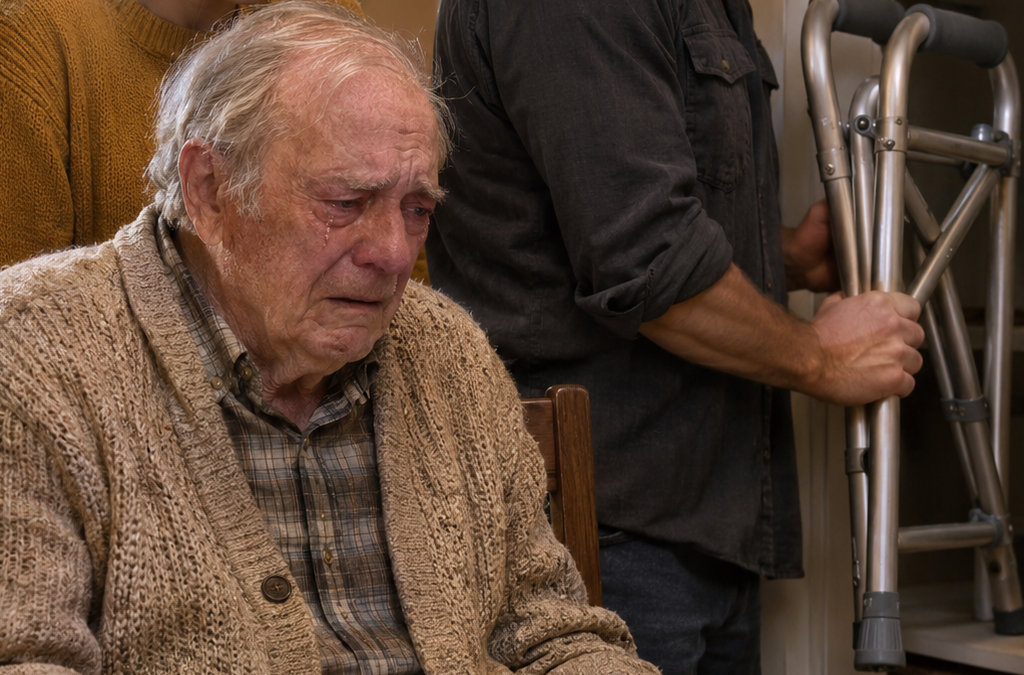
At 73, I watched my son fold my walker and lock it in the pantry during our Thanksgiving house-sale meeting.
Chapter 1 of 7
“Stop wandering. Sit and listen.”
Mark left the brass key on the sideboard. I stayed in my dining chair, both feet planted.
“I was going to the bathroom,” I said. “Will you really let him take that?”
My brother Luke smirked, then looked down at his plate. He’d come early enough to watch Mark carry the walker away.
Lisa pushed a sales brochure toward me. “Your room is already being sorted.”
A tag poked from underneath it, beside the turkey platter. Our Thanksgiving dinner hadn’t even been carved.
“Sorted by whom?” I asked.
“Let Mark explain what happens next.”
Ella stood beside my chair. Mark had moved her place setting farther down the table, but she hadn’t followed it. She was looking at the pantry door.
I was Henry Morgan, seventy-three, a retired cabinetmaker in Dayton, Ohio. Nine weeks earlier, I’d become a widower after twenty-four years with my husband.
This was my own house, and their monthly allowance came from my money.
The pie cooling on the counter was the sour-cherry kind Mark liked. I’d picked the pale cherries out because he still complained about those.
Lisa sat in a chair whose split arms I’d repaired. Behind her, the kitchen doorway held the pencil marks I’d preserved through two repaintings: Mark growing, then Ella catching up.
Ella Hayes was nineteen now. She retrieved the key from the sideboard and put it in my palm. Its shallow filed notch caught against my skin.
Mark watched her do it. Then his eyes went to the brochure, where the tag had slipped into view.
Beside the turkey platter lay a moving-company tag marked “vacant.”
For a moment, I couldn’t make the word belong to this room. My slippers were under the table. And my coat hung beside the back door.
Mark worked as a remodeling estimator. He knew how much a label could tell someone before they ever entered a house.
I reached toward the brochure. But Mark took it away before I could turn the first page.
“You don’t need to pick this apart.”
He laid it beside Lisa instead. Then he told her to explain where my dresser would fit and which things could go into storage.
They spoke across me while I sat between them. I felt humiliated, and Ella’s face told me she knew it.
“I haven’t agreed to a room,” I said.
Lisa kept her eyes on Mark. “The smaller dresser would be better anyway.”
I shifted forward to ease my stiff hip.
“YOU WILL STAY SEATED!”
Ella flinched. Luke pushed his plate back but said nothing. Mark stood close enough that I couldn’t see the pantry door behind him.
“Are you keeping my walker until I agree?”
“Until you listen to the whole plan.”
“Then explain it without my agreement.”
I settled back safely. Getting up without support would have given them another story about me, and I wasn’t going to risk a fall.
The turkey smelled of sage. Usually, Luke complained that I used enough to season a mattress. But nobody made that joke this year.
I kept the key inside my palm. It hurt to need it.
Mark started describing the convenience of one household, one grocery trip, somebody nearby at night. He hadn’t asked what help I wanted.
A week earlier, I’d agreed to discuss home help. Rachel Price, my contact at Stillwater Community Bank, had arranged a brief visit because she’d already be nearby for Thanksgiving.
So I got my phone out and called her.
“Are you still coming by?” I asked.
“I’m nearby, Henry. Has something changed?”
“There’s a moving tag on my table.”
Rachel paused. I could hear her car signal clicking.
“Mark has already reserved movers,” she said. “He also submitted a housing request.”
The tag had seemed like carelessness. Now it looked like a piece of something already underway.
“I didn’t ask for either one.”
“I’ll be there shortly.”
No office needed to open. This was the home visit we’d already arranged, though the discussion in my dining room had become something entirely different.
A little later, Ella answered the door. Mark was describing how quickly the house could be cleared when he heard Rachel’s voice in the hall.
Rachel stepped into my dining room, and Mark stopped smiling.
He recovered before she reached the table.
“Rachel, thank you for making time. We’re getting Dad comfortable with everything.”
Her coat was still buttoned. She looked at me rather than at the brochure.
“Henry, is this where you’d like to talk?”
“Yes. Right here.”
Lisa straightened in the repaired chair. Luke finally looked up. Rachel had been invited to hear about care, and all the seats seemed arranged for a sale.
I wanted to hide how they’d treated me. Admitting it to someone outside the family felt worse than I’d expected.
But the pantry was still locked.
“I authorized neither a move nor a sale,” I said.
Mark gave an impatient laugh. “We’re having the discussion now. That’s why you’re here.”
Rachel stayed beside the empty chair. “The request I received describes more than a discussion.”
Lisa interrupted. “We’ve done a lot of work already.”
Rachel waited until Lisa finished. Then she addressed me.
“Mark requested $28,600 to move you out,” Rachel said.
My hand opened on my knee.
“Please use this key to get my walker.”
Rachel accepted it without asking Mark’s permission. She opened the pantry, unfolded the walker, and brought it within reach. Then she returned the key.
Ella moved her chair beside mine. I stood with the support I normally used and sat again when my hip eased.
Mark stared at Rachel. “We have forty-eight thousand dollars in that suite. Somebody has to pay the contractor.”
Then he turned back to me.
“You’re holding our future inheritance and letting us drown.”
“I never promised to pay for it.”
Lisa looked toward Luke, waiting for help. But he studied the turkey instead. I had never seen him work so hard at avoiding me.
My husband, David Morgan, had transferred the house outright to me before he died. Separately, he’d funded a bank-managed trust with $947,000 for my benefit.
The bank handled the payments. Mark’s household had been receiving supplemental help, but that didn’t give him the right to decide where I lived.
“I had kept paying because arguing seemed harder than helping,” I said.
Rachel sat down. “No distribution is being approved today. I need to check the actual booking and what was submitted.”
Mark started explaining the suite again. This time Rachel stopped him.
“First, I need Henry’s account.”
My phone screen had dimmed. When I woke it, the saved-message list appeared, including one Mark had left recently. Ella leaned closer.
“Want the words bigger?”
“Yes, please.”
With my permission, she enlarged the text. Mark’s saved message remained there. Its harmless closing words were visible: “Call me when you’re ready to talk.”
I left it saved.
Rachel asked me to contact the moving company using the number on the tag. So I called and left my name and number, asking for the person handling the survey.
While Rachel was still at the table, my phone lit up with a return call. I missed it trying to open the screen. A new message appeared from Ben Foster at Miami Valley Moving.
Ella waited while I pressed play myself.
“Your son said you’d already moved out, Mr. Morgan.”
Chapter 2 of 7
I called Ben back with Rachel still sitting across from me.
“I’m speaking from that house,” I said. “I was still living there when you came, too.”
“Your son was the booking customer, Mr. Morgan. He let me in.”
“Which room did you measure?”
“The downstairs bedroom. I photographed it for the estimate. There were personal things in it.”
Ben sounded careful now. He explained that Mark had supplied the occupancy description. The survey recorded furniture, measurements, and what a crew would need to move.
“I can’t tell you what anybody agreed to,” he added.
That distinction mattered. He wasn’t offering to settle our family argument. He could tell me what he’d seen.
“Please send me the original photographs and booking information you’re allowed to release.”
Ben asked for my permission to email photographs of my room. I gave it, then read him my address.
Mark leaned back beside Lisa.
“Luke, help Dad accept assistance. He can’t keep putting everything on himself.”
Luke rubbed his forehead. Earlier, he’d watched my walker disappear into the pantry. Now he looked tired, as though my wanting it back had worn him out.
“You wouldn’t have to worry about the furnace,” Luke told me. “Or getting groceries when it snows.”
Those were things I needed help with sometimes. Hearing them turned into reasons to leave hurt more than I expected.
“Stop making everybody work around your moods,” Mark said.
I kept the phone against my ear.
“Ben, whose name is on the booking, and what are the access instructions?”
He checked before answering. The booking was Mark’s. Mark was listed as the contact who would arrange entry for the movers.
Ben also confirmed that Mark had paid the $2,400 deposit himself.
A paid deposit made it sound settled. I looked toward the hall, where my bedroom door stood open. Nobody had asked me what could go.
“I don’t permit packing,” I said. “Or entry for a move.”
“I’ll flag access as unconfirmed. A reservation doesn’t give us permission to enter against your wishes.”
He explained that Mark remained the customer. Changing the access note didn’t cancel Mark’s order or settle whatever charges his booking carried.
Lisa started to speak, then stopped when Rachel looked toward the phone.
I asked Ben to put my instruction in the record. He said he would. Before we ended the call, he repeated that he wasn’t deciding whether I’d consented earlier.
That was fair. I wanted him to be accurate, even where accuracy didn’t give me everything I wanted.
The email arrived before Rachel left. Small previews ran beneath Ben’s message. In one, I recognized the rail beside my bed and my worn brown slippers.
“It’s an estimate, Dad. You’re acting like somebody emptied the place.”
The bed itself nearly filled the little image. I’d built its headboard to fit between two narrow windows. The guest room couldn’t have held it that way.
My face grew hot. Someone had stood beside the bed where David and I had slept, making plans while I was at therapy.
Mark glanced at my screen.
“It’s an estimate, Dad. You’re acting like somebody emptied the place.”
I didn’t open the pictures further. Ben’s message was there, and I could read it without Mark explaining it over my shoulder.
Rachel said she would check the request and records when the bank reopened. She made no promise about the outcome.
After she left, Mark told Luke about the convenience of having everyone under one roof. I heard my name several times. He never turned to ask me anything.
By the next morning, Rachel had checked the pending request against the bank’s accepted copy of David’s trust and its payment history. She called while Ella was waiting to drive me to therapy.
“The $28,600 request is still pending,” she said. “The existing household support has continued.”
I had expected the first part. The second embarrassed me, though Rachel hadn’t said it unkindly. I’d spent so long avoiding arguments that ordinary payments had started feeling automatic.
“The bank decides its distributions,” she said. “It doesn’t decide where you live, whether you can walk, or whether you can make your own decisions.”
I asked whether she’d need anything else from me. She said she would contact me after checking what Mark had submitted.
Ella waited until I finished the call.
“Want me to carry your folder?”
“Yes. Leave the walker to me.”
She did exactly that.
At the therapy office, she walked beside me instead of pulling ahead. When I needed a rest near the entrance, she waited without announcing it to everyone.
I hated being slow. But I didn’t hate having company when the company let me set the pace.
My exercises were the familiar ones: controlled steps, a supported turn, the careful work of getting up from a chair. Ella stayed in the waiting area with a paperback from the bookstore where she worked.
Afterward, she admitted she’d read the same page three times.
“Bad book?” I asked.
“Bad waiting-room television.”
That got a laugh out of me. It surprised us both.
At checkout, I accepted the card for my next appointment. My leg ached from the work, but I’d done it.
Ella was beside me when my phone buzzed. Our family group had a new message from Lisa. Mark and Luke were included, along with Ella and me.
I stood there holding the appointment card, reading a claim they could all see. Now refusing their plan was being turned into proof I couldn’t care for myself.
“He’s stopped therapy. We can’t keep pretending he’s managing.”
Chapter 3 of 7
With Ella beside me, I sent the appointment confirmation to the same family group.
“I attended therapy today. My next appointment is booked.”
No explanation about my hip. No apology for needing help. The confirmation showed where I’d been while Lisa was telling everyone I’d stopped going.
Ella read my reply without reaching for my phone.
“That’s enough, Grandpa.”
Lisa answered before we reached the car.
“Attendance isn’t the whole problem. Can you afford to turn down our help?”
That hurt. She’d made an accusation, watched it fall apart, then stepped around it.
By Monday, Mark wanted to come over and discuss expenses. I agreed to a conversation. Ella would be there after class, and Luke said he’d stop by.
Mark arrived carrying flattened moving cartons under one arm. He walked them into the pantry before joining us.
“Those can wait here until we need them.”
“You can leave empty boxes for now,” I said. “I agreed to talk, not to packing.”
Ella stood near the dining table. She heard me clearly. Mark looked at her, then back at me.
“Nobody’s touching your precious things today.”
The contempt embarrassed me more than the boxes. I had once carried everything that boy owned in two grocery bags when he came to stay for the summer.
He sat across from me and opened with the contractor balance.
“We put $48,000 into that suite for you.”
“You and Lisa chose that work.”
“Because somebody had to think past next week.”
He described the wider doorway, the bathroom fixtures, the flooring Lisa had picked. Some of it might have helped me. That didn’t make the room mine to pay for.
“I never ordered that room,” I said. “I never promised to pay for it.”
Mark leaned forward.
“Then don’t expect me to keep driving across town.”
Ella looked up. Luke kept his eyes on Mark.
“Therapy, groceries, all of it,” Mark continued. “You want our help, help settle the bill.”
I was frightened by how quickly I started counting rides. My hip hadn’t improved just because I’d finally argued with him.
But I remembered the suite itself.
There was still a step at its entrance. Mark had called it small, as though the height changed depending on who described it.
During my brief visit, I’d asked where David’s workbench might go. Lisa said there wasn’t room for workshop furniture. She’d already assumed most of my things would go into storage.
David had used that bench to mend lamps and wrap presents. He always left tape stuck along its edge, ready for the next package.
I could have accepted a smaller room. Being expected to leave our life boxed elsewhere was harder.
“You showed me what you’d built,” I told Mark. “That wasn’t me asking you to build it.”
He gave Luke an impatient look.
Luke shifted in his chair. “Henry, you’ve got to meet them halfway.”
“What would halfway be?”
“Accepting that you can’t do everything.”
“I already accept that.”
For a while, Luke said nothing. Then his real worry came out.
“If they stop coming, it’ll all land on me. I’m sixty-nine. I can’t be here every morning.”
I hadn’t asked him to be. Still, I could hear the fear under his irritation, and I didn’t want to dismiss it.
“Will you drive me to my next therapy appointment?” I asked. “One ride. Tell me if you can’t.”
He looked relieved by the size of the question.
“I can do that one.”
“Then that’s what I’m asking.”
Mark pushed back from the table. He’d wanted Luke to explain me to myself. Instead, Luke had agreed to take me somewhere I wanted to go.
“The provisional crew slot gets assigned by five unless the customer changes the order.”
After they left, Ella stayed while I called Ben.
The cartons bothered me. Leaving them in the pantry had been my choice, but Mark had made even an empty box seem like evidence that his plan was proceeding.
Ben checked the booking while I waited.
“The provisional crew slot gets assigned by five unless the customer changes the order.”
“Does my refusal still show?”
“Yes. Access is unconfirmed. We won’t enter over your objection.”
He couldn’t cancel Mark’s order for me. Mark could keep the reservation and incur charges under it, even without permission to bring a crew inside.
So the moving date could keep appearing in Mark’s account of things. A slot existed. A deposit had been paid. None of that meant I’d agreed, but I was tired of correcting facts that sounded settled.
I thanked Ben and ended the call.
Ella had brought a bookstore sandwich, flattened beneath her textbook. She offered me half, then admitted the mustard had escaped into the bag.
We found bread that hadn’t absorbed any. For a few minutes, we ate without discussing my future.
Rachel called later. Lisa had emailed her an account of the suite visit.
“The bank has two different accounts now,” she said. “I need the details of that visit from you.”
“I won’t sign anything about moving.”
“I understand. But I also need to address what they’ve submitted for funding.”
That included their pending request and the support already being reviewed. Refusing a signature wouldn’t correct someone else’s account of what I’d supposedly said.
I hated having to defend an ordinary visit. I’d gone to look at a room my son wanted me to see.
Rachel said she’d forward Lisa’s statement so I could answer the actual claim. Her email appeared while Ella was still beside me.
“Henry chose the suite after seeing it.”
Chapter 4 of 7
“I looked at the room,” I told Rachel. “Then I left because of the entrance step. That wasn’t choosing it.”
Ella was still beside me, reading Lisa’s statement on my phone.
“She came with me,” I said. “Ask her what she heard.”
Rachel asked to speak with Ella. I put the call on speaker.
“Grandpa visited,” Ella said. “He didn’t agree to move. I can’t tell you anything beyond that.”
“Please have Lisa explain her claim with me present,” I told Rachel.
It hurt to be described as choosing something I’d struggled even to enter. My leg was stretched beneath the table, aching where the chair edge pressed it.
Rachel suggested a call with Mark and Lisa the next morning. I agreed. Ella had class, and I didn’t ask her to miss it.
Before the call, I went into the kitchen for breakfast. David and I had always argued about grapefruit. He called it punishment with juice.
There was still one in the fruit bowl. I ate toast instead, standing at the counter with my walker close.
I missed having someone there who already knew what I meant. Every conversation lately required me to start from the beginning.
Rachel called with Mark and Lisa already connected. Mark sounded as though he was in his truck.
“We’re going in circles,” he said. “Dad saw the suite. We went ahead based on that.”
“I asked about the step.”
“And I told you we could fix it.”
“That wasn’t permission to move me.”
Rachel interrupted before he answered.
“I checked the county record: Henry is the sole owner because David transferred the house to him outright. The funded trust is administered outside probate; its $947,000 was not an unclaimed inheritance for the family to divide.”
Mark’s truck noise disappeared. I guessed he’d switched off the engine.
“So where does that leave what David wanted for everybody?”
Rachel let the question sit briefly.
I had heard that word, everybody, used to include my son and exclude me. It made me feel small, sitting alone at my own table.
The house wasn’t waiting for someone to finish settling David’s affairs. Neither was the money a family account Mark could direct. Rachel had made both facts plain.
She explained that the bank’s accepted trust copy gave it discretion over Mark’s supplemental support, with my needs taking priority.
“These payments aren’t guaranteed. The bank decides whether they continue.”
Lisa spoke then.
“We’ve been budgeting around that help.”
“I understand,” Rachel said.
She didn’t apologize or promise it would stay unchanged. Mark came back before Lisa could say anything else.
“I know he owns the house. That’s not what I’m arguing.”
He hadn’t sounded as certain about that a moment earlier. Now he had found somewhere else to stand.
“He asked us to make arrangements,” Mark continued. “Then he got embarrassed when everybody started talking about it.”
“No, Mark. I agreed to discuss help.”
“You didn’t act confused when you saw the room.”
“I wasn’t confused.”
My voice came out louder than I’d intended. I hated that he could still make me sound as though I was asking his permission to remember my own life.
Lisa tried a softer voice for Rachel.
“We wouldn’t have spent all that money on a guess.”
Rachel answered without softening hers.
“I need to separate what you chose to spend from what Henry asked you to do.”
For several seconds, nobody spoke. Through my kitchen window, I could see leaves caught against the fence. The yard needed work. That was true whether or not Mark liked my answer.
“Your account, directly. And anyone you want present who heard the conversations.”
Rachel said her review team had the trust, payment history, proposed budget, and both accounts of what I’d agreed to. They needed the remaining factual questions addressed together.
She would come with the bank’s delegated authority to decide the pending relocation request and the review of existing support. There wouldn’t be another person appearing afterward to make the actual decision.
“What do you need from me?” I asked.
“Your account, directly. And anyone you want present who heard the conversations.”
Mark immediately said Luke should come. I said Ella should be included too.
We settled on my dining table, with Rachel, Mark, Lisa, Luke, Ella, and me.
“Friday at two,” Rachel said.
I wrote it on the kitchen calendar. My handwriting looked uneven, but I could read it.
After the call, I checked with Ella and Luke. Both could come. Luke asked whether this would take all afternoon.
“I don’t know,” I said.
He sighed, then said he’d be there.
I felt tired enough to leave everything alone until the meeting. Instead, I called Ben.
“Please make the original survey files available to me,” I said. “The photographs and booking record.”
He said the copies he’d sent came from his business records. He could provide the original image files as well.
“You don’t need to come to the house,” I told him.
“All right. I’ll send them directly.”
Then I sat by the window for a while. I wanted an afternoon without having to defend where I slept.
Rachel forwarded Mark’s email later. He’d added a witness to his account without asking that witness what he remembered.
“Luke heard him agree.”
Chapter 5 of 7
“Luke, what did you actually hear me agree to?”
He didn’t answer right away. Through the phone, I heard his television get quieter.
“You said you’d talk about housing. About getting some help.”
“Did you hear me agree to leave?”
“No. Not those words.” He sounded irritated with me for making him say it. “But don’t put me in the middle of this.”
Mark had already put him there. I didn’t say that. Luke knew whose email I’d read.
“Tell her the words you actually heard.”
“You make it sound easy, Henry.”
He worried that Mark would stop inviting him over. Most of his visits with Ella happened there, too, between her classes and shifts at the bookstore.
I hadn’t realized how much he depended on those invitations. It hurt that keeping them might matter more than correcting what Mark had said about me.
“I’m not asking you to argue with him.”
Luke sighed. “I’ll be there.”
On Friday, I chose the chair at the head of my dining table.
For years, I’d sat wherever serving was easiest. With David gone, I’d started eating near the kitchen end, close to the doorway. That afternoon, I wanted to see everyone without turning in my seat.
My walker fit beside me. There was enough room to stand without anyone moving.
Ella arrived first. She stopped behind the chair on my right.
“Can I move this closer?”
“Yes. Leave room for my leg.”
She checked the space before she sat. Such a small question shouldn’t have made me grateful, but it did.
The chair squeaked beneath her. It had squeaked since Mark was little, despite everything I’d tried.
“Still doing that?” she asked.
“The dates belong to the original files. Mark supplied ‘vacant’ when he booked.”
“Only when somebody sits in it.”
She laughed, and for a minute I felt like her grandfather instead of the reason everyone was coming over.
Ben called before the others arrived. His email had come through with the original image files attached.
“Those are straight from our survey records,” he said. “The dates belong to the original files. Mark supplied ‘vacant’ when he booked.”
“Thank you. That’s what I needed to know.”
I checked that the attachments had arrived without opening the full pictures. Then I left the email where I could find it.
Ella didn’t ask to see them.
While she hung her coat in the hall, I checked the sound on my phone. An old saved message played clearly enough. I stopped it, checked that Mark’s message was still in the list, and set the phone beside my place.
I disliked how nervous I was. My own son was coming to my own table, and I was worrying about whether my voice would hold.
Luke arrived next. He took a chair across from Ella, leaving the place beside me empty. He asked about my hip, then seemed relieved when I gave him a short answer.
Rachel came in with Mark and Lisa just behind her.
Lisa had dressed as though we were going somewhere afterward. She greeted Rachel warmly and barely looked at me.
“We appreciate you coming back,” she said. “We’d really like to put this misunderstanding behind us.”
Rachel sat where she could see everyone. Mark took the chair beside Lisa.
For a moment, nobody seemed willing to start. I could hear Luke breathing through his nose, the way he did when he wanted to leave but hadn’t thought of a reason.
Lisa began with the work they’d done.
She described making space, changing their household, trying to give me company. She used “we all” several times. We all wanted me comfortable. We all understood the plan.
Then she looked directly at me.
“Don’t turn this into another scene.”
I felt humiliated before I’d said a word. She’d made my objection the thing everyone needed protection from.
“Rachel, please hear each person directly,” I said. “Don’t let anyone answer for me.”
“I will,” Rachel said.
Mark leaned forward, impatient now that the pleasant opening hadn’t settled anything.
“Nobody’s saying Dad doesn’t own his house. He can do what he wants with it.”
He paused, looking at Rachel rather than me.
“But he told us to go ahead. We renovated because he agreed. We booked the move because he agreed. The application covered expenses he’d already authorized.”
Rachel asked what he’d understood me to authorize.
“The move. The room. Getting him settled with us.”
“You didn’t ask me about the movers,” I said.
“You asked us to handle things. That’s what handling things looks like.”
He sounded so certain that I could understand why Luke had stayed quiet. Arguing meant stopping him at every sentence, explaining ordinary words until everyone grew tired of hearing them.
I was tired, too. My hip ached, and I wanted this over. But I couldn’t leave his account standing just to make the afternoon easier.
Rachel asked Mark to finish. She listened without agreeing, then asked Luke what he’d heard.
Luke looked at me first. I gave him no signal.
“He said he’d discuss—”
“Come on, Luke,” Mark interrupted. “You know what we were arranging.”
Luke’s face reddened. Ella shifted beside me, but she waited.
Mark looked from his uncle to his daughter. Then he pointed to Ella.
“She heard him agree.”
Chapter 6 of 7
“Say it here,” I told Mark. “Tell Rachel what you think Ella heard.”
“I heard him agree to talk,” Ella said. “He didn’t agree to move.”
Mark barely looked at her. He kept his attention on Rachel.
“That was the first conversation. Dad told me later to go ahead, before the survey.”
My granddaughter’s face reddened. He’d called on her, then discarded her answer.
I opened Ben’s email on my phone. The original photographs filled the screen, each with its business date beneath it. I enlarged the first and placed the phone where Rachel and Mark could see.
“My bed. My rail. My slippers,” I said. “I was living there.”
Rachel studied the image. Lisa leaned forward, close enough to see the blanket folded across the foot of my bed.
The photograph showed the narrow path I’d measured myself, wide enough for my walker. Someone had stood in that path and photographed my room for removal. Seeing the whole image hurt more than the preview had.
“Ben took this during my therapy appointment,” I said. “You described it as vacant.”
“Vacant by moving day,” Mark answered. “That’s what it meant.”
“He told me you said I’d already moved out.”
“Then he misunderstood what I was telling him.”
Rachel looked at the booking record beneath the photographs. Mark waited, apparently satisfied that he’d explained the difference.
I wanted to argue about every word. Instead, I left the photograph in front of him.
“You knew I was coming home to that bed.”
“Of course you were. Nobody said the crew was coming that afternoon.”
Luke stared at my slippers on the screen. He’d bought them for me. One heel had collapsed, but they stayed on without my bending down.
Mark continued before his uncle could speak.
“Dad authorized preparations. Then he changed his mind. We’d already done the work.”
The pictures couldn’t tell everyone what we’d said to each other. Rachel hadn’t pretended they could. She asked about the refusal instead.
“Did he agree again after he told you no?”
Mark shifted toward me.
“He goes back and forth. That’s what we’ve been trying to explain.”
“He’s sitting here,” Ella said.
Rachel repeated the question. This time Mark said we’d had several conversations, as though their number answered it.
I was embarrassed by how badly I wanted him to stop. Even now, I wanted my son to say he’d pushed too hard and let us finish.
But he was waiting for Rachel to accept his account.
I opened my saved messages myself. Mark’s message still carried its original received timestamp. I showed Rachel the screen beside Ben’s survey date.
“This came the next morning.”
Then I pressed play.
“You said no again this morning. I’m keeping the movers anyway. We’ll sort it out after the holiday.”
Mark’s recorded voice sounded ordinary, almost distracted. There was no shouting to explain away. He’d left those words for me to hear.
The message finished with the closing I’d seen before.
“Call me when you’re ready to talk.”
For a few seconds, I watched my son look at my phone. I remembered listening to that message alone, wondering how many times I had to refuse.
Lisa spoke first.
“He was frustrated. We’ve all been dealing with grief. Henry hasn’t been easy to reach.”
“I never changed my answer.”
Mark started to interrupt, but Rachel spoke over him.
“That message acknowledges refusal after the survey. I cannot treat this as his agreed housing plan.”
Lisa looked at Mark. He didn’t look back.
Rachel continued in the same dry voice she’d used to ask her questions.
“I’m denying the $28,600 relocation request.”
Mark’s jaw moved before any words came out.
“The expenses are real.”
“How is the contractor supposed to get paid?”
Rachel addressed him directly.
“I’m ending your $3,925 monthly allowance.”
His chair scraped backward. He stood so abruptly that Lisa reached toward him, then stopped.
“How is the contractor supposed to get paid?”
I felt sick with relief. For nineteen months, that help had been part of their household budget. I knew this would hurt them. I also knew how much of my life they’d expected in return.
Mark turned toward Luke.
“You know what we put into that room.”
Luke looked at him, then at me. He rose without answering.
I offered him the pantry key. He crossed to my chair and accepted it, his face flushed almost to his ears.
The lock clicked in the kitchen. Luke brought out the unfilled cartons Mark had left during his visit and set them beside Mark’s coat.
My walker stood beside me, where I’d put it myself. Luke walked around it and took the empty chair on my left.
“He said no. We should have listened.”
Mark stared at the boxes.
“So you’re all just leaving us with this?”
Luke stayed beside me. Ella hadn’t moved from my right.
“You can visit me,” I said. “You cannot arrange my disappearance.”
Lisa called that unfair. I let her finish. For once, I didn’t soften what I’d said to make her stay pleasant.
“Any future money requests go to Rachel. You don’t speak for me.”
Mark asked again about the contractor. I said I wasn’t paying the bill. My voice shook, but he heard me.
I told them the meeting was finished.
Rachel remained seated while she sent the bank’s instructions. Mark stood beside his chair, unwilling to put on the coat lying next to his cartons.
A notification arrived before anyone left. Rachel showed us the confirmation on her screen.
“Recurring payment: ended.”
Chapter 7 of 7
On December 8, I received Rachel’s written confirmation: no further $3,925 transfers to Mark’s household were scheduled.
The bank wasn’t reclaiming money already paid. My ordinary support would continue under its administration, including help with my home and care. The house remained mine.
I read the letter twice at my dining table. I was relieved, but I still dreaded the phone ringing.
That week, Miami Valley Moving closed Mark’s booking. He forwarded the receipt: $1,920 returned from his $2,400 deposit, with the agreed $480 charge retained.
His message underneath was longer than the receipt.
“Could you at least cover the cancellation charge? We were trying to do something for you.”
“No. I won’t pay that charge.”
I sent the answer before I could turn it into an apology. Then I went back to the grocery list I’d been making.
Mark called later about the contractor. He and Lisa had arranged a repayment plan for the $48,000 balance. He sounded worn out, and I hated hearing it.
“We’ll be paying this for a while,” he said.
I let him speak. He described smaller payments, things they’d postpone, another conversation he’d have to have with Lisa.
“Any request for bank money goes directly to Rachel,” I said. “You can’t submit it as something I’ve asked for.”
“So that’s all you’ve got to say?”
“For today.”
Afterward, I sat longer than I needed to. I wanted to call back and ask whether he’d eaten. Instead, I finished my list. Wanting to comfort him didn’t mean I had to pay his bill.
Luke drove me to therapy the following week because I’d asked him. He arrived early and waited in the driveway until I came out.
“Want me at the door?” he called.
“Just hold it when I get there.”
He did. On the drive home, he asked whether I needed groceries.
“Milk and apples. I can go in.”
“I laughed. When he took it away. I keep thinking about that.”
“All right.”
He didn’t suggest waiting in the car. That small change eased a hurt I hadn’t known how to explain to him.
Later, he apologized for Thanksgiving. We were parked outside my house, and he kept looking through the windshield.
“I laughed. When he took it away. I keep thinking about that.”
“I remember.”
“I should’ve got up.”
“Yes.”
He nodded. I didn’t tell him it was fine. But I asked whether he’d come back for supper sometime, and he said he would.
Mark’s first visit afterward was arranged by phone. I told him I wanted a visit, without boxes, sales brochures, or questions about money.
He arrived alone and stayed less than an hour. We talked about a cabinet installation he’d estimated incorrectly. I knew the sort of corner that had caused the trouble.
“Did you measure behind the trim?”
He looked annoyed, then almost smiled.
“I did the second time.”
For a little while, we sounded familiar to each other. When he left, he asked before coming around the table to hug me.
It hurt that he had to ask. I was glad he did.
Lisa remained colder. She sent short replies when I included her in family messages. I stopped trying to warm every exchange by offering something.
There was no large reconciliation over a meal. Mark called sometimes. Sometimes I wanted to speak, and sometimes I asked him to call another day. Ella kept coming on her own, between classes and bookstore shifts.
Nobody else made my appointments or answered questions for me. When I needed help, I asked for the particular thing.
Nearly four months later, I still went to prescribed therapy. My turns were steadier, and getting out of a chair took less effort. Some mornings my hip remained stiff enough to make dressing tedious.
The walker came with me. I wasn’t interested in proving I could manage without equipment that helped me.
One afternoon, Ella found me considering the planter outside the back door. It stood high enough that I could work from a chair.
“That’s either gardening,” she said, “or you’re mad at the dirt.”
“I haven’t decided.”
We’d always grown radishes there. David disliked them but pulled them anyway, surprised each year by how quickly they’d appeared.
I wanted to plant one short row, within easy reach. Ella brought the seed packet while I checked the clear path from the door.
“Do you want me to do the digging?”
“Loosen that end. Leave this part for me.”
She followed my directions, though she watched when I lowered myself into the outdoor chair. I didn’t mind her watching. She waited for me to ask before helping.
The work tired me sooner than I wanted. My fingers were clumsy with the small seeds, and a few landed together. Ella said nothing about it.
I was happy out there. I hadn’t expected that feeling to return so plainly, with damp soil under my nails and my granddaughter talking about a difficult customer.
We went inside to wash before finishing. In the kitchen, Ella noticed the brass pantry key where Luke had returned it after the meeting.
“Want this put away?”
“Leave it for me.”
Its shallow notch was familiar against my finger. I had made it years earlier so I could tell it apart from the others without glasses.
Being family did not give anyone permission to erase me.
“Want company outside,” Ella asked, “or another cup of coffee?”
“Outside first. We still have half a row.”
She went to get her sweater. I stood with my walker and checked that the back-door path was clear. The planter could wait while I got there.
My coat hung on its kitchen hook, ready for the cool air. There was an empty hook beside it.
I hung the key beside my coat.







