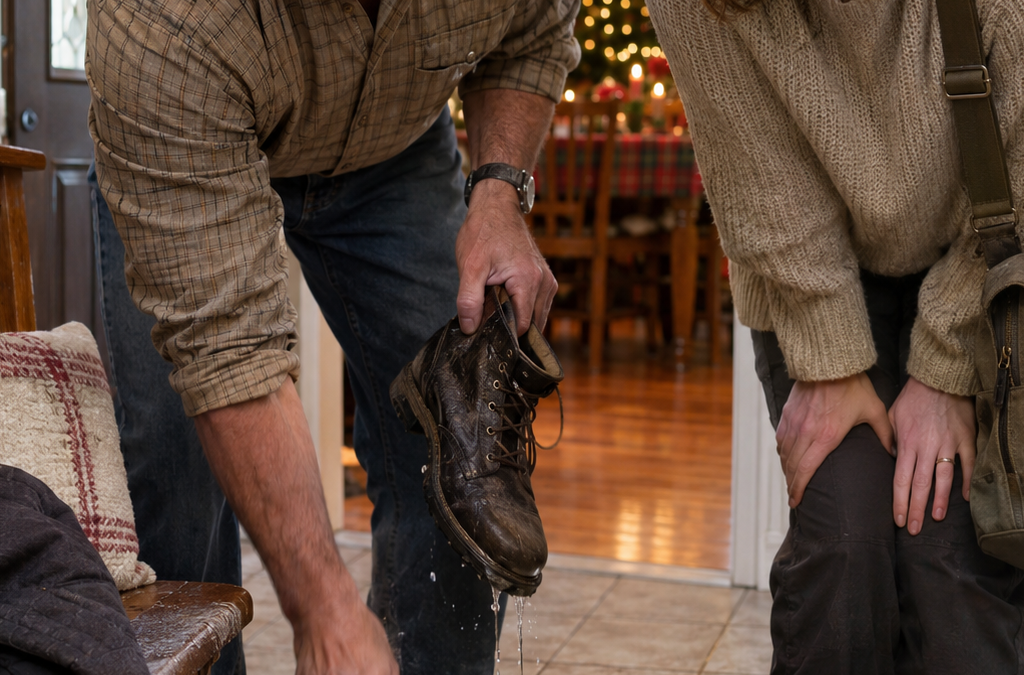
At Christmas dinner in my husband’s house, my stepfather tipped my boots into the dog’s water bowl and said, “Leave your filthy stuff outside.”
Chapter 1 of 7
“Why would you put my boots in there?”
Frank Mercer stood beside the entry bench, watching water soak into the leather. I’d just taken them off. My duty bag still hung from my shoulder.
“Are you really going to let him do that?” I asked my mother.
Linda looked toward the dining room instead of answering. Beyond her, dinner waited in Adam’s house in Cornelius, North Carolina. An unfamiliar envelope marked “Honeymoon” lay on his entry console.
“Your shoes were in the way,” Linda said.
They’d been underneath the bench. Frank had reached under it to get them.
Adam stood at the foot of the stairs. His mouth opened, then closed. That hurt more than the cold water spreading across the entry tile.
Five weeks earlier, I’d become Claire Bennett at a courthouse. At thirty, I was an Air Force major. My family knew I worked at Seymour Johnson Air Force Base, though nobody ever asked much beyond whether I still did paperwork.
Ruth Parker, my mother’s older sister, owned six lakeside cottages near Lake Norman and employed Frank to look after them. She sat beside the dining room doorway, her simple blessing folder on the chair next to her. We’d asked her to bless our marriage with the family gathered later that week.
In my travel cooler was Adam’s favorite Christmas bread, the orange kind he always toasted until the edges nearly burned. Linda’s winter coat hung over a chair; I’d brought it back with its torn lining repaired. Getting leave for this gathering had taken weeks of arranging work around other people’s schedules.
And there I stood, still wearing my road sweater, wondering where to put my feet. The envelope’s glossy picture had slid halfway out.
The photograph on my honeymoon envelope showed somebody else’s house.
“Get that bag off the bench,” Frank said.
I’d lowered it there while looking at the picture. It wasn’t touching anything meant for dinner.
“Don’t turn Christmas into another argument,” Linda said.
Another argument. As if I’d come through the door looking for one. My face burned, and I hated that Frank could see it.
“He worked all day, Claire. Just move them.”
Frank looked toward Adam, expecting agreement. He’d been married to my mother since I was fourteen, and he still spoke as though every doorway belonged to him.
“You brought work dirt into Adam’s home.”
The bench sat well away from the dining table. My ordinary travel clothes were clean. Those details seemed foolish to explain, but part of me still wanted to explain them.
“KEEP THAT BAG OUTSIDE!”
“You’re treating my things like garbage in Adam’s house?”
“Then stop leaving them where people eat.”
Adam finally spoke. “Frank, you’ve gone too far with this.”
But he stayed beside the stairs. He didn’t pick up my bag or ask Frank to leave the entryway. His objection hung there while Frank waited for me to obey.
“I heard you,” I said.
I lifted the boots by their heels and carried them into Adam’s laundry room. Water dripped down my wrists. The sink was empty, and I set them inside it, side by side.
When I returned, Adam took my duty bag upstairs. I let him go without telling him everything was fine.
The cooler stayed closed. So did the bag of wrapped gifts beneath it. Usually, this was where I started making everybody comfortable again. There would be bread to slice, presents to hand out, some harmless question about the drive.
I had mistaken keeping dinner peaceful for keeping my family safe.
Instead, I read the envelope. My name was right. The seven nights were right. The house had a broad white porch, nothing like the little lakeside cottage I’d chosen.
Emily Brooks had handled the booking. She’d worked for Ruth for nine years and knew me from family stays long before my marriage.
I called her from the entryway.
“Emily, why is this house on my envelope?”
“Claire, your stay was moved to another rental.”
“I didn’t ask anyone to move it.”
“No. Frank gave me the change.”
Her voice lost its usual cheerful hurry. I looked toward him. He was close enough to hear my side of the call, and he had stopped pretending to be interested in dinner.
“That’s your honeymoon sorted,” he said. “You can stop making trouble over it.”
Ruth stood. “Frank, you will not speak for this family.”
She hadn’t raised her voice. Frank straightened anyway, the way he did when a guest complained within Ruth’s hearing.
My aunt looked at the phone.
“Let Emily speak where we can all hear.”
“Emily, I’m putting you on speaker,” I said.
“Of course. Ruth, I have the booking open.”
Ruth stayed near her chair. Her folder remained beside it, and for the first time since I’d arrived, Frank wasn’t looking at me.
“The cottage Claire reserved was available,” Emily said. “It was available when I changed her stay, too.”
Frank gave a short laugh.
“It’s an upgrade. I found them something better.”
Linda looked at the photograph, then at Adam. He’d come back downstairs and stood beside me now, though there was still space between us.
I wanted him to say something without waiting for another person to go first. Wanting that felt almost worse than being alone.
“We chose the cottage together,” Adam said.
“It’s a bigger house,” Frank answered. “There’s nothing to complain about.”
Ruth didn’t argue about the size. She asked Emily to keep going.
Through the speaker came the faint sound of Emily’s keyboard. This was her ordinary work, the same calendar she used to answer vacation questions and arrange arrivals.
“Claire’s reservation isn’t the only thing I need to explain.”
Frank’s expression changed. He looked at Linda, but she was watching the phone.
Emily hesitated long enough that I could hear her breathing.
“Some guests were given a reason for moving,” she said. “It involved Claire.”
I hadn’t spoken to a single other guest. Frank stepped closer to the console, between Ruth and me.
Emily said, “He’s using Claire’s name to close the cottages.”
For a moment I couldn’t connect the words to anything I’d done. My entire request had been one quiet week with Adam after the blessing, in a cottage where I’d stayed growing up.
“Close them for what?” I asked.
“For your wedding,” Emily said. “That’s what guests were told.”
The house in the photograph belonged to Dana Cole, Frank’s daughter from his first marriage. She ran a separate four-bedroom vacation rental. I’d seen pictures of it before, but never expected one to arrive with my honeymoon arrangements.
“Dana has room for people,” Frank said. “Somebody has to keep them happy.”
He sounded annoyed at having to explain such an obvious favor. Linda said nothing. Her earlier certainty had gone, but she hadn’t come to stand with me either.
Emily spoke carefully. “I kept your latest voicemail, Frank. What you said didn’t match the booking entries.”
He told her she was confusing things. She didn’t answer him, and she didn’t play the message.
I looked toward the laundry room. Ruth had bought those boots when my old pair wore out during a difficult assignment. She’d asked what size, what kind, and where to order them. No lecture about whether my work deserved decent equipment.
Remembering that kindness nearly undid me. My throat hurt, and I couldn’t have thanked her aloud just then.
For years, I’d let Frank’s version of things stand because correcting him spoiled visits. Adam had seen me do it. My mother had counted on it. Now my name had traveled into conversations I’d never heard.
Ruth asked Emily whether there were other reservations she needed to know about.
Frank started to answer for her.
“Let her finish,” I said.
Emily said, “The Harris family’s $18,600 reservation was sent to Dana’s house, too.”
Chapter 2 of 7
“The Harris reservation was for fourteen nights next summer,” Emily said. “Eighteen thousand six hundred dollars for a family stay here. Frank sent them to Dana’s instead.”
The next morning, Adam and I sat in the cottage office. Through the window, Lake Norman looked gray beneath a low sky.
“Because of my wedding,” I said.
“That’s the reason I was given. I’ve asked Martin Harris to confirm what he heard.”
That amount belonged to a guest’s reservation. It wasn’t money waiting for Ruth to claim back simply because we’d discovered the change.
Emily had turned the office heater toward our chairs. She wore a fleece over her work shirt and looked tired.
“Your cottage is empty,” she said. “You can go look.”
Adam glanced at me before answering. I appreciated that small hesitation, though I hated needing it.
“Yes,” I said. “I want to see it.”
We walked down the gravel path together. The little cottage stood behind two bare maples, with its porch facing the lake. Nothing about it suggested a problem that required moving us elsewhere.
Inside, the bed was made. The heat was on low. The kitchen was clean, and the window above the sink looked out over the water.
Ruth had always called this the quiet cottage. Its kitchen clock clicked so loudly that our family considered the name false advertising.
Adam looked toward the bedroom.
“This is what we picked.”
“Yes.”
“I liked it because there wasn’t room for anybody else.”
That almost made me laugh. We’d planned seven nights without hosting, explaining, or finding an extra chair.
Instead, someone had decided even our honeymoon needed his approval. I was angry, standing in that perfectly usable room.
Adam stayed near the kitchen doorway while I looked around. He didn’t tell me Dana’s house might still be nice.
When we returned to the office, Emily had my original confirmation open. I’d paid $2,400 for seven nights in this cottage, beginning after the blessing.
Beside it, she showed us the changed reservation. The destination had become Dana’s house.
“This shows when I changed it,” Emily said. “It doesn’t show what somebody told me over the phone.”
She didn’t pretend the screen could settle every question. Her work had been pulled into a family fight, and I was embarrassed by how much we were asking of her.
“I’m sorry you’re spending your holiday on this,” I said.
“I’d rather know now than explain it to you at check-in.”
The office door opened before I could answer. Linda came in wearing the coat I’d repaired. She looked at Emily, then asked whether we could talk outside.
We stayed on the covered porch. Adam came with us.
“Frank wants to straighten this out,” Linda said.
“Then he can speak to Ruth.”
“He asked me to speak to you.”
Of course he had. My mother had carried his requests for years, usually wrapped in a warning about how badly he might react.
Linda glanced through the office window.
“He needs a short message. Just say you approved the move. We can stop this before it hurts the holiday work.”
“I didn’t approve it.”
“You have something better now. A sensible bride would help everybody get through the week.”
She wanted me to make the story true after the fact. It hurt that she could ask so easily.
“I won’t put my name on something I didn’t choose.”
Linda looked at Adam, waiting for him to soften that.
“She’s answered you,” he said.
For a moment, my mother seemed more surprised by him than by me.
“I’ll tell Frank,” she said.
She left without going back inside. I watched her cross the gravel, shoulders raised against the cold.
My refusal protected my own answer. It didn’t tell another guest where to stay, undo Emily’s work, or sort out Ruth’s business. That helplessness frustrated me.
Adam and I stayed on the porch.
“I froze yesterday,” he said.
“I noticed.”
“I’ve spent years letting family scenes burn out. If I stayed out of them, usually they stopped.”
“They stopped for you.”
“I need you to tell Frank your house isn’t his to police.”
He looked down the path toward the cottage.
“Yeah. I guess they did.”
I was still hurt, and his honesty didn’t make that disappear. But he hadn’t asked me to forgive him before I’d finished being upset.
“I need you to tell Frank your house isn’t his to police.”
“Now?”
“Now.”
Adam called him. He kept the phone off speaker, but stood beside me.
“Frank, I need to be clear about my house. You don’t make the rules for Claire there.”
A voice buzzed through the receiver. Adam waited, his jaw working.
“No. Don’t do that. She didn’t put me up to deciding how people treat my wife.”
He listened again.
“You don’t police her belongings or order her outside. If there’s a problem in my home, you come to me.”
When he ended the call, he didn’t ask whether that was good enough. I was grateful for that.
Inside, Emily’s phone sounded on her desk. She read the screen, then looked through the window at us.
We went back in.
“Martin answered,” she said.
She turned the phone so I could read his message.
“Frank told us the bride asked for every cottage to close.”
Chapter 3 of 7
The next morning, Martin Harris called while Adam and I were still at the kitchen table.
“Frank said you wanted the whole place cleared,” he told me. “Said you were particular about your wedding. He offered Dana’s house before I could ask what else was open.”
“I didn’t ask him to move you.”
“Well, that’s different from what I heard.”
Martin sounded tired rather than angry. He owned a plumbing business and had arranged fourteen summer nights around work schedules and family travel. He needed somewhere dependable to take everybody.
“I’m not asking you to cancel anything,” I said.
“Good. Because I can’t start over every time somebody has a disagreement.”
That stung, though he hadn’t meant it cruelly. To him, I was another person attached to a reservation that had become complicated.
Adam stayed across the table while I explained that Emily could help with questions about the cottages. Martin agreed to speak with her again. We ended the call without pretending his vacation was already fixed.
Then my mother forwarded Frank’s post to the family group.
She added nothing of her own. No question about whether it was true.
Frank had written that my “special wedding demands” were hurting the cottages. He said paying customers had been pushed aside and he was the only person making sure they still had somewhere to stay.
His last sentence asked everyone to remember who had kept the place running.
Underneath it, relatives had begun responding with worried questions. A few thanked him.
I felt humiliated sitting in my own kitchen. Adam could see the screen, and I hated having to explain why people who knew me would believe it.
“He got there first,” I said.
“That doesn’t make him right.”
“No. It makes me the one answering questions.”
One relative who had accepted our invitation to the blessing sent a separate message. With everything going on, they thought it best not to come. They hoped I understood.
Their name was still on the list beside the refrigerator. I’d counted their chair when we decided how to arrange the living room.
For several minutes, I wrote replies. One explained the courthouse marriage. Another explained that the cottages hadn’t needed to close. A third began with an apology, though I couldn’t have said what I was apologizing for.
“One question, if you have a minute. Who first suggested Dana’s house?”
None of them got sent.
There were too many separate conversations, each asking me to start from the beginning. Frank could make one accusation. Apparently, answering it was supposed to become my whole day.
Instead, I called Martin back.
“One question, if you have a minute. Who first suggested Dana’s house?”
“Frank did. I hadn’t heard of it.”
“Thank you. That’s what I needed to know.”
He asked whether Emily still expected to call him. I said yes. His concern was reasonable, and keeping it separate from my anger took more effort than I liked.
When Ruth arrived, I was still in the kitchen. Adam let her in, then went upstairs to give us room.
She wore the same wool coat she’d owned for years. Our family called it her visiting coat because its pockets usually contained something she’d meant to return three visits earlier.
This time, she had only come to see me.
“Your mother sent me his message,” she said.
“She sent it to me, too.”
Ruth sat across from me. She didn’t tell me everyone would come around.
“Do you still want me to conduct the blessing?”
The question hurt. Until then, I’d been worrying about who might refuse to attend. I hadn’t considered whether I wanted to stand in front of them.
“Yes,” I said. “I want us to celebrate being married. I don’t want to have to buy Frank’s approval first.”
“You don’t have to decide for everybody else.”
“I keep trying to make it easy for Mom.”
“I know.”
She said it gently, which nearly made me cry. My mother had forwarded a complaint about me before asking if I was all right. I wanted that to matter to her.
My phone rang with Frank’s name on the screen.
Ruth stayed seated while I answered.
“You need to fix what you started,” he said. “People are asking me questions now.”
“They’re asking because of what you posted.”
“Don’t get smart. Tell them I helped you.”
His voice had the same impatient edge he used when I was fourteen. For a second, I almost explained more carefully, as if better wording might change his answer.
“I’m not apologizing for a request I never made.”
He began talking over me. Ruth asked if she could speak to him, and I passed her the phone.
“Ruth,” he said, suddenly pleasant. I could hear him from across the table. “I’m glad you’re there. We need to get this settled.”
She asked why guests had been told my wedding required closures.
“I’ve given those cottages twelve years,” he said. “There ought to be some loyalty. I can’t keep customers happy while Claire makes me look dishonest.”
Ruth listened without agreeing. He kept talking about all the calls he handled and the problems nobody else wanted.
When she ended the conversation, she didn’t offer me a prediction. She asked whether I’d eaten. For once, I answered the question instead of saying I was fine.
Adam came downstairs as my phone lit again. It was Emily.
She wrote that Frank had told the cleaners there would be no turnover instructions unless I publicly retracted my complaint.
Chapter 4 of 7
Ruth called the cleaning crew from the cottage office the next morning. I waited by the open doorway, close enough to hear her side.
“Yes, the same cottages. You’re still scheduled, and you’ll be paid as usual. Call this office if you need anything.”
She ended the call. Frank sat behind the desk with his jacket still on.
“They’ll need more than a phone call,” he said.
“They’ll get what they need.”
Emily stood near her own desk. I stayed out of Ruth’s way, though I wanted Frank to see me. He’d threatened work that had nothing to do with my marriage, and I was angry enough to stop worrying about looking angry.
“You can promise whatever you want,” he said. “Somebody still has to run this place.”
Ruth took the chair opposite him. She didn’t ask me to leave.
“Then tell me what needs doing.”
That seemed to irritate him more than an argument would have. He began listing supplies, arrivals, a loose railing, a heater that needed checking. Ruth listened. Emily knew several of the details and answered when Ruth asked her a question.
Frank interrupted before she finished.
“Knowing who’s coming isn’t keeping six cottages standing.”
Emily stopped speaking. I’d heard him cut my mother off that way for years. Seeing it happen at someone’s workplace embarrassed me in a different way.
“You think this is just handing people keys,” he told Ruth. “There’s debt. Maintenance. Empty weeks. Without me keeping the money moving, those bills will swallow you.”
“The maintenance still needs doing,” Ruth said. “The loan is paid.”
He glanced at Emily, then back at Ruth.
“You mean the payments are covered.”
“No. I paid the remaining balance myself.”
Ruth showed him a page from her lender. The remaining $219,000 had been paid nine months earlier, from savings she’d accumulated herself.
“Helen Price checked the account record for me,” she said. “It’s finished.”
I hadn’t known the amount. Ruth still bought store-brand cereal and complained when a restaurant charged extra for a second biscuit. I’d mistaken those habits for a small margin of safety.
Relief came so sharply that I had to sit down. Frank couldn’t hold a missed loan payment over her.
He read the page without answering. An office drawer stood open beside his knee. He shut it, then looked at Ruth again.
“I knew payments weren’t going through here anymore,” he said. “You could’ve told me what you arranged.”
“I’m telling you now.”
“Well. Good. That gives us some breathing room.”
His voice had changed. He sat back, speaking more carefully. Until then, he’d talked as though every rent payment needed his hands on it before Ruth could stay afloat.
Ruth didn’t join him in saying “us.”
“What it doesn’t explain,” she said, “is why guests were sent elsewhere when we had room.”
“When we couldn’t fit people properly. You left those calls to me.”
Frank looked at me.
“So we’re still doing this.”
I said nothing. I wasn’t going to help him make my presence the problem.
“You told me I could use occasional overflow,” he said to Ruth. “When we couldn’t fit people properly. You left those calls to me.”
“When we couldn’t accommodate them.”
“Right. That doesn’t always mean every bed is full.”
It was the first thing he’d said that morning that made Ruth pause.
He kept going. A larger family might prefer one house. A guest might need a layout the cottages didn’t offer. Sometimes he had to recommend something before a caller went elsewhere.
I hated that part of it sounded reasonable. People did ask for things a booking calendar couldn’t explain.
“Did you approve moving our stay?” I asked Ruth.
“No.”
“I didn’t need approval for every recommendation,” Frank said. “That was the point.”
“You didn’t recommend it to me.”
“Claire, let Ruth and me handle the business.”
It hurt to be dismissed while he defended a decision made in my name. But the page on the desk couldn’t tell us what Ruth had once allowed him to do. Paying the loan hadn’t settled that argument.
Ruth asked Emily whether guests’ original requests were still available.
“Yes. Along with the changes.”
Emily glanced toward her phone, then waited. Nobody had asked her about the particular message she’d kept. She seemed ready to answer, but unwilling to push past Ruth’s questions.
“Good,” Ruth said.
Frank began explaining another referral. Ruth let him finish, then stood.
“I have what I came for.”
She left without threatening him or promising me anything. Outside, the cold made my eyes water. I was relieved about the loan and still upset about everything else.
“Was he right about the overflow?” I asked.
“I allowed referrals when we couldn’t take someone,” she said. “I’ll listen to what he says. That doesn’t mean I’ve agreed.”
At home, Adam was counting chairs in the living room. Our blessing was set for Monday, December 28, at 6 p.m., at his house in Cornelius. Ruth would conduct it, with Adam and me, Linda, Frank, Emily, and several familiar relatives gathered together.
Emily was coming at Ruth’s invitation. I was glad she’d have a place to sit instead of being treated like the office phone.
Adam looked up when I came in.
“Enough chairs,” he said. “Unless somebody brings somebody.”
“Please don’t say that like it’s an invitation.”
“I won’t.”
Linda arrived before I’d taken off my coat. She stayed near the entry, avoiding Adam’s eyes.
“Frank says he won’t attend unless you thank him publicly for saving your honeymoon.”
Chapter 5 of 7
“No,” I told Linda. “I’m not thanking him for changing something I paid for.”
Adam called Frank while my mother was still standing in the entry.
“You’re invited,” he said. “But there won’t be a tribute or an apology. We’re celebrating our marriage.”
Frank’s answer carried through the receiver, though I couldn’t make out the words.
“That’s the invitation,” Adam said. “You decide.”
Linda watched him end the call. Then she asked where I wanted the extra chairs.
It hurt that she could move straight from delivering his demand to helping us get ready. I couldn’t make that change as quickly. For a moment, I didn’t answer.
“Along the living room wall,” I said.
Adam helped her carry them in. We’d borrowed folding chairs because neither of us wanted people balancing dinner plates on their knees. Now we arranged them around the rug, leaving a clear path from the entry.
One chair had a loose vinyl cushion that sighed whenever anyone sat down. Adam tested it twice.
“That one’s mine,” he said. “If it makes noises, nobody will be surprised.”
I laughed despite myself. Then I wished it hadn’t felt like such a relief.
As the relatives arrived, I answered questions about the drive, my leave, and whether anybody should take their coats upstairs. Several people hugged me too carefully. I knew they’d read Frank’s messages.
I hated wondering which version of me they’d brought into the house.
Emily arrived with Ruth. She looked less certain at our front door than she had behind her office desk.
“Thank you for having me,” she said.
“I’m glad you came.”
She’d known our family through years of cottage stays. Still, I understood why she hesitated. There was no desk between her and Frank here, no ringing office phone to give her a reason to step away.
Ruth asked whether she’d had time to consider their conversation about work.
“Yes,” Emily said. “I have. We can talk afterward.”
“That’ll be fine.”
Emily kept her phone with her when she took a chair. Ruth sat nearby, her blessing folder across her lap. Neither of them looked toward me for a signal.
Frank came in without knocking again. Linda went to meet him, and they sat together on the sofa.
He greeted Ruth first.
“Glad we could all make this work,” he said.
Then he looked around at the relatives, making sure nobody missed how agreeable he was being. When his eyes reached me, his expression changed.
“That’s all this was. You protect a booking instead of losing it.”
“Let’s try to enjoy ourselves for once, Claire.”
I stayed beside the doorway. My face grew hot, but I wasn’t going to leave my own celebration to hide it.
Frank rested against the sofa as though he’d been waiting patiently for us to catch up.
“Ruth gave me permission to use overflow,” he said. “That’s all this was. You protect a booking instead of losing it.”
Ruth watched him. She hadn’t opened her folder.
“I could’ve made the suggestion more nicely,” he continued. “Apparently I should’ve praised Claire’s choice first. I can accept that.”
He made it sound small and embarrassing, a quarrel about whether he’d admired my taste enough. A relative nodded without looking at me.
I felt humiliated, and angry that he’d found a version people could comfortably accept.
“You didn’t offer me a choice,” I said.
“You’ve made your feelings clear. Let me finish explaining.”
His voice was flat with me. Then he turned back to Ruth.
“You know how these calls go. People want an answer. They don’t want a week of discussion.”
Linda leaned forward beside him.
“He does try to find somewhere for everyone. Ruth always—”
“Did you hear Ruth approve moving the Harris family?” I asked.
My mother stopped. Her eyes went to her sister.
“I knew there was an arrangement.”
“Did you hear her approve that stay?”
“No,” she said.
It was barely loud enough to reach the chairs by the window. But she didn’t change it when Frank looked at her.
For several seconds, nobody helped him. I could hear the furnace running beneath the floor.
I went to Adam, who stood beside the dining room entrance. I kept my voice low, though I didn’t pretend we were discussing refreshments.
“I won’t stand up for this while he tells everybody I agreed.”
“You don’t have to.”
“I mean the blessing. I want it, but not if getting through it means letting that become true.”
Adam looked at the seats we’d arranged. Then he moved his chair beside mine, leaving the place he’d saved near the sofa empty.
“This house won’t be used to pressure Claire,” he said.
He didn’t raise his voice or look to me afterward for approval. I was grateful, though gratitude wasn’t the same as forgetting Christmas.
We sat down together.
Frank looked from Adam to the relatives. He seemed to recognize that his easy compromise hadn’t settled anything. His attention shifted to Emily, sitting with her phone against her knee.
She hadn’t contradicted him yet. He seemed to take that as an opening.
“You can ask Emily,” he said. “I told her how to handle it.”
Emily looked at Ruth, then back at him. She waited.
Frank leaned forward and pointed at her.
“Try our cottages first. That’s what she was told. Dana’s place only came into it when nothing suitable remained.”
“That isn’t what Emily was told.”
Chapter 6 of 7
Before the blessing could begin, Ruth closed her folder.
Frank kept his finger pointed toward Emily.
“The Harris family needed something our cottages couldn’t provide. I sent them somewhere suitable. That’s what you let me do.”
“What came first?” Ruth asked. “Their inquiry, or checking whether we had room?”
“They called. We worked out what suited them.”
Ruth looked at me. “Claire, what doesn’t match?”
My mouth was dry. He was watching me with the impatience I remembered from childhood.
“He says the cottages couldn’t accommodate them. Emily showed me the booking history. There was no availability check before he directed her to send them elsewhere.”
“That screen isn’t every conversation I have,” Frank said.
He had an answer ready, and it wasn’t foolish. Calls could happen before anyone entered anything. I’d seen enough rushed workdays to know that.
“A phone inquiry can come first,” he continued. “Emily might enter it later. Ruth didn’t require permission for every overflow call.”
Two relatives looked toward Emily, waiting. Frank settled back against the sofa.
For a moment, I hated how easily his explanation filled the gap. I’d spent days answering things he could invent in seconds.
But I wasn’t asking the screen to prove everything.
“Emily, will you play what he actually told you?”
She looked directly at Frank.
“You left this voicemail for me. It came from your number. I recognized your voice, and I kept the original message.”
Frank’s gaze dropped to her phone.
“This isn’t the place for office messages.”
Emily started it.
His voice came through smaller than it sounded across the room, but unmistakable.
“Don’t check our dates for Harris. Send him straight to Dana. Tell him Claire needs the cottages closed for the wedding.”
The message ended. Emily didn’t play it again.
My mother stared at Frank. One relative who had nodded along with him lowered her eyes.
Hearing him give that instruction hurt more than reading what he’d posted. There had been no misunderstanding for me to untangle. He’d supplied my name himself.
Frank stood.
“I was managing a temporary family situation. You’re taking one message out of—”
“Why tell a paying guest Claire requested something you never asked her?”
He reached toward the phone. Emily stepped back, keeping it beyond his reach.
“Leave it with her,” Adam said.
Ruth waited until Frank looked at her.
“Why tell a paying guest Claire requested something you never asked her?”
“She wanted her honeymoon sorted. Everybody wanted arrangements made.”
“I reserved one cottage,” I said.
“You don’t understand how many things I handle.”
He spoke to me, but his eyes kept returning to Ruth. She hadn’t offered him another question to answer instead.
“Overflow starts when we have no room,” she said. “You told her not to check.”
Frank remained standing beside the sofa. Linda shifted away from his knee.
I was angry, but underneath it was an unfamiliar relief. This time, someone else had heard exactly what I’d heard. I didn’t have to find kinder words for it.
Ruth turned toward me.
“Major Bennett.”
Adam looked at me, then back at her. My mother’s lips parted. She’d never asked my rank.
“You’ve worked hard for that,” Ruth said. “I’m sorry we let him talk down to you here.”
I couldn’t answer without crying. She didn’t wait for me to make her feel better.
“Frank, your caretaker job ends now.”
His face changed before he spoke.
“You’re firing me in front of your family?”
“Yes. The position paid you $61,200 a year to look after my cottages. Your authority to collect rents ends with the job.”
He looked around, searching for someone willing to interrupt her.
Ruth continued. “Emily has accepted the manager position. Emily, remove his booking and payment-account access now, please.”
Emily sat down with her phone. Frank watched her, no longer pretending this was an argument about my manners.
“Linda. Get your coat. We’re leaving.”
My mother stood. I expected her to obey; even then, I expected it. That embarrassed me, though she’d given me plenty of reasons.
Instead, she went through the kitchen toward Adam’s garage.
Frank called after her. She didn’t answer.
Nobody offered to pour coffee or bring out the food. The potatoes were still in the oven, because Adam had insisted they could survive another few minutes. We’d joked earlier that potatoes handled family gatherings better than we did.
I wished I could have gone back to that small joke.
Linda returned carrying my boots. They were dry, the laces tucked inside.
“I dried them,” she said. “I kept them in the garage.”
She stopped beside me.
“I should have stopped him the first time.”
It hurt to hear the apology I’d wanted for years arrive so late. I was glad she’d said it. I wasn’t ready to tell her that fixed anything.
Frank stared at her.
“You’re making a spectacle. Put those down and come on.”
She stayed beside my chair.
Adam opened the front door. He didn’t look at me for instructions.
Frank turned toward me. “You’ve cost this family enough already.”
“You don’t get to punish me for telling the truth.”
My voice shook. The words still came out.
I told Ruth I didn’t want the blessing that evening. Then I asked Adam to take a walk with me. I wanted cold air, and no audience while I cried.
We reached the porch as Frank passed us. Behind me, Emily’s phone sounded.
“The main access is removed,” she told Ruth. “One connected payment account needs a separate removal through its provider.”
“Call the provider with me now,” Ruth said.
Chapter 7 of 7
The provider verified Ruth as the account owner and removed Frank’s access that evening. She told me when Adam and I came back from our walk. No guest payment had gone missing while we were outside.
Emily stayed to check the remaining accounts with her. Frank received his earned wages normally. Nobody changed the locks on his home or took anything that belonged to him.
I was relieved, but too tired to talk about it. Adam warmed two plates of dinner, and we ate at the kitchen counter after everyone left.
He asked whether I wanted company upstairs.
“Yes,” I said. “But I don’t want to talk anymore.”
He came with me without asking when I’d feel better.
Eight weeks after the dismissal, Helen finished reviewing the payments and negotiating with Frank. Ruth asked me to come over after the settlement was signed.
“He returned eighty-four hundred dollars,” she said.
“From how many bookings?”
“Three. Payments he received for sending them to Dana.”
Helen had matched those payments to the redirected stays. The money went back to Ruth’s business. There was no extra award for what he’d done to our family, and I hadn’t expected one.
Still, I resented how much time it took to recover money he should never have received.
Ruth understood what I meant when I said that.
“I’d rather have spent those hours doing almost anything else,” she said. “Even cleaning the refrigerator.”
Dana’s rental no longer received referrals from the cottages. Emily contacted the affected guests individually instead of sending a sweeping announcement that left them to sort it out.
Some kept their agreed stays at Dana’s house. Others changed their plans with everyone’s consent. Martin chose to return to Ruth’s property.
He called me after Emily confirmed it.
“We’ve got the cottages worked out,” he said. “My family likes having separate kitchens anyway.”
“I’m glad.”
“Emily’s been good. Calls back when she says she will.”
That ordinary compliment pleased me more than another apology would have. His vacation was his again, instead of evidence in our family argument.
Emily also corrected our honeymoon reservation. Ruth honored the seven nights I’d paid for, without another charge. Adam and I finally went.
For the first afternoon, I kept expecting somebody to call with a problem. By the second, I left my phone in the kitchen while we walked beside the lake.
It was a good week. It didn’t repair everything.
Adam and I started counseling after we returned. At first, I was embarrassed to need help so soon after getting married. I worried we’d made a mistake neither of us wanted to name.
Sometimes our conversations there were awkward and repetitive. Adam still wanted a clear point when an argument counted as finished. I still said I was fine when I meant I couldn’t face explaining myself again.
We worked on those habits without pretending Christmas had caused all of them.
“You shouldn’t have to be exhausted to have a weekend,”
At home, his changes were easier to see.
He asked before inviting people over. When I had leave, he stopped offering pieces of it to relatives before checking with me. Once, I heard him tell someone we weren’t available without adding that Claire was tired.
Later, I thanked him.
“You shouldn’t have to be exhausted to have a weekend,” he said.
“No,” I said. “I shouldn’t.”
We chose the blessing again after several weeks. Ruth came alone. There were no borrowed chairs or people waiting for me to look forgiving.
I cried anyway. Adam stayed beside me, and Ruth gave us time.
Linda moved into a small rented apartment. I heard about the narrow kitchen and the bedroom that barely fit her dresser, but I didn’t help decide what she should do about her marriage.
When she first tried to tell me something Frank wanted me to know, I stopped her.
“Mom, I’m not doing messages through you anymore.”
“He only said—”
“I don’t want it.”
She was quiet for a while.
“All right.”
I expected to have that conversation repeatedly. For several months, I didn’t have to.
That mattered more than the apologies she sometimes began and didn’t know how to finish. I remained hurt. I also began answering her calls without bracing for an assignment.
On June 28, 2027, six months after the confrontation, I drove back to Cornelius from a routine work trip.
Emily was settled into the manager position at $58,000 a year. Calls went through the cottage office, where she and the staff could handle them without finding Frank’s personal phone.
Ruth had stopped filling every conversation with business trouble. That afternoon, she was coming to lunch because we wanted her there.
Linda was invited, too. Frank wasn’t.
Adam had asked me before making either invitation. I’d said yes, then asked him to keep lunch simple.
When I came inside, he and Linda were arguing mildly over a tomato.
“You said thin slices,” my mother told him.
“I meant thinner than that.”
“You can see through these.”
Our house had a standing disagreement about sandwiches. Adam believed tomatoes belonged in a separate bowl. I considered that an unfinished sandwich.
Ruth sat at the table, already eating a slice with salt.
“I’m helping reduce the problem,” she said.
I laughed, and nobody looked relieved that I had.
At the entry, I took off my boots and set them inside the door. Then I carried my bag upstairs.
When I came down, Linda asked whether I wanted to eat right away.
“In a minute. I’m going to sit.”
“Good,” she said. “We’ve got it.”
I sat beside Ruth while Adam and my mother finished lunch. Nobody asked about Frank. Nobody needed me to arrange the plates or rescue the conversation.
My mother was still responsible for what she’d allowed. Adam still had things to learn about standing beside me. I loved them without having to call those things settled.
Ruth asked about my drive. I told her about the roadwork and the gas station coffee, and she complained about the tomatoes dripping on her shirt.
It was an ordinary lunch. I was glad I’d come home for it.
Family never required me to make room for cruelty.
My boots stood inside the door.







